







Abstract
Recently, some authors have pointed out that the subject of university–firm collaboration (UFC) in the teaching context has been neglected. To fill this gap, and considering that educational provision is co-created with various stakeholders, this study aims to provide an exploratory characterization of the current state of UFC in the teaching context and to explore UFC as a mechanism for the co-creation of value. A qualitative approach was chosen, through a case study applied to one faculty at a Portuguese university. Data were obtained through documentary analysis and interviews with people in charge of this faculty. The results suggest that collaboration activities in this domain occur, albeit not systematically or in a planned way. The involvement of the current faculty direction in stimulating this collaboration is recognized, and the leaders see this phenomenon as a mechanism for co-creating value between firms and academia. As a practical contribution, the study proposes a set of recommendations to encourage such UFC. The scientific contribution arises from the presentation of a conceptual structure which explores the UFC phenomenon in the teaching context, bringing together the perspectives of collaboration and the co-creation of educational provision, as well as presenting a number of suggestions for future research.
Universities and firms have been collaborating for centuries, transmitting knowledge and joining forces to fulfil their objectives and those of society in general (Galán-Muros and Plewa, 2016). However, in Europe research into collaboration between universities and firms (UFC) became more popular when the European Union decided to become the most competitive economy in the world (Dan, 2013) and, in defining the strategic plan for European development for Horizon 2020, recognized the importance of universities in the transfer of knowledge to society and their vital contribution to the competitiveness of the European economy (Davey et al., 2011). The prominence of knowledge, as a valuable resource, led to universities being increasingly expected to commercialize that knowledge alongside their teaching and research activities (Etzkowitz et al., 2000; Todorovic et al., 2011). In this context of the importance of commercializing the knowledge created in universities, many studies examining UFC have done so from the perspective of research and knowledge transfer, which is a restricted perspective of UFC (Galan-Muros and Davey, 2019; Wang et al., 2016). University–firm collaboration should be analysed from a broader point of view (Berbegal-Mirabent et al., 2019); that is, it should be understood as any type of collaborative, formal or informal interaction between the university and firms for mutual benefit (Davey et al., 2011).
It is important to note that co-creation cannot be inseparable from teaching, taking into consideration that the concept of teaching is ‘a bilateral teaching and learning process’ (Baranov and Slastioni, 1989: 75), which is based on the fact that ‘the fundamental line of the teaching process is the transmission and appropriation of a solid system of lasting and applicable knowledge and skills’ (Neuner et al., 1981: 254). On the other hand, the concept of co-creation refers to building bridges between all stakeholders to increase the value of something and relies on the development of a relationship based on dialogue and an interaction between all these parties (Payne et al., 2008). In other words, the combination of these definitions allows us to argue that Higher Education Institution (HEIs) constitute a propitious environment for the generation of critical added value – that is, the co-creation of value through establishing collaborative processes with the business sector. In the case of HEIs, it is assumed in this study that co-creation is a means to introduce external actors into them, as an integral part of that process. This line of thought is supported by the conclusions of Lemmens et al. (2014) in which the flow of co-creation of value involves transforming the ‘customer’ into an active partner by focusing on the end and not the means, by developing projects based on the capabilities of the organizations and by generating learning through dialogue and relationships.
In these circumstances, the theory of resources and capabilities and the theory of dominant service logic constitute the theoretical framework of this research, since the co-creation flow associated with teaching aims at an integrative process for building bridges between teachers, students and companies for the dissemination of knowledge. This co-creation process involves the resources and capabilities of all parties involved and the application of knowledge and skills for their mutual benefit as a function of attitudes, perceptions and circumstances generated by interaction and dialogue (Grönroos and Voima, 2013; Prahalad & Ramaswamy, 2000, 2004; Vargo and Lusch, 2004).
University–firm collaboration is a fundamental mechanism for fulfilling the interests of universities, firms and society (Orazbayeva et al., 2019) and can occur as part of all three university missions (Galan-Muros and Davey, 2019). It is understood that these missions encompass teaching, research and engagement with society in its economic and social dimensions (innovation and technology transfer; continuing education; social commitment, as a link between university and society, as a function of teaching, research and social engagement) (Soeiro et al., 2012). However, the most recognized form of collaboration is the transfer of knowledge through activities such as patents, licences, spin-offs and research and development (R&D) contracts, which represent economic value for academic research (Perkmann and Walsh, 2007) and are areas of particular interest to industry since they represent sources of improved competitiveness (Dan, 2013). This type of collaboration has been subject to excessive attention from researchers, overlooking the presence of other less visible forms of collaboration in terms of economic profitability but equally important in terms of their impact on the economy, such as collaboration in teaching (Galan-Muros and Davey, 2019; Kunttu, 2017).
Thus, UFC in the field of teaching has been neglected by researchers (Borah et al., 2019; Galan-Muros and Davey, 2019; Wang et al., 2016). This is surprising, given that teaching is the oldest way in which universities have contributed to economic growth (Kunttu, 2017; Orazbayeva et al., 2020). In addition, students are an important channel for the transmission of knowledge to industry (Berbegal-Mirabent et al., 2019) and one of the universityʼs main strategic functions is teaching (Matkovic et al., 2014). But despite its importance, UFC in the field of teaching remains little explored (Galán-Muros et al., 2017; Plewa et al., 2015). Collaboration in teaching can be defined here as interactions between academic institutions and non-academic organizations, involving academic teaching activities (Kunttu, 2017).
Given the importance of the topic and the fact that few studies have analysed the current state of UFC in the teaching field, this study, supported by the theories of resource and capability and service-dominant logic, aims to characterize the state of UFC in a faculty at a Portuguese university, and to explore UFC as a mechanism for co-creating value. To do so, formal and informal activities carried out in recent years are identified, together with facilitators and barriers to the process, from the perspective of administrators and course directors in the faculty, who also explain their vision of the co-creation of value. The relevance of this empirical study lies in the fact that HEIs are understood as competence centres of excellence, geared towards the dissemination of knowledge in which UFC plays a crucial role. This means that HEIs can be a conduit for supporting and stimulating the co-creation of social economic value by strengthening their connection with business and society at large. In an increasingly global society, in which the co-creation of critical value is important for the strengthening of economic and social ecosystems, this study shows how the analysed HEI has positively contributed to the economic development of its region by leveraging these partnerships as a strategy with benefits for all stakeholders.
After data collection and treatment, and comparison of the results with the existing literature, a set of recommendations is presented to improve the current state of UFC in the faculty in the field of teaching. A number of suggestions for future research may contribute to better academic knowledge about this phenomenon.
Supporting theories
As noted, to support the relevance of the UFC process in the teaching context, this study resorts to two theories: the theory of resources and capabilities and the theory of service-dominant logic.
University–firm collaboration emerges through multiple channels in parallel with a set of human, material and financial resources (Dan, 2013; Galan-Muros and Davey, 2019), triggering access to resources which universities do not possess and which, together with their own internal resources, form a source of competitive advantage. From this perspective, the resource and capability approach has been frequently adopted in research on UFC in various fields. Resource and capability theory highlights these two factors as the main ones that influence organizational growth and development (Wernerfelt, 1984) and as the source of sustainable competitive advantage if they are valuable, rare and difficult to substitute and imitate (Barney, 1991).
In the field of teaching, UFC can help universities to improve their key resources, such as curricular programmes, academic competences, laboratories, social capital and knowledge of industry, thus contributing to higher performance in the teaching process (Borah et al., 2019). When universities and firms collaborate in exchanging knowledge and resources, they are not only able to develop and strengthen their competitive advantage but also form a powerful mechanism for innovation and economic growth (Galán-Muros and Plewa, 2016). That integration of resources can also be seen in a broader approach to the ecosystem, whereby the co-creation of value occurs through collaboration (Orazbayeva et al., 2019). Therefore, the capacity to integrate the resources of the parties involved, whether tangible or intangible, supports not only resource and capability theory but also the theory of service-dominant logic.
The theory of service-dominant logic, introduced by Vargo and Lusch (2004) and subsequently developed by those authors (Vargo and Lusch, 2008), proposes that through the integration of resources in the value co-creation process, fundamental sources of competitive advantage are triggered. Co-creation can broadly be described as a process of creation in which different stakeholders, in collaboration and reciprocally, contribute to creating value (Grönroos and Voima, 2013). In this new approach to value co-creation, value emerges through integrating resources that arise not only from the supplier but also from the other parties involved in the co-creation process (Vargo and Lusch, 2008). According to this perspective, the value incorporated in educational provision is co-created essentially through a complex network of stakeholders who interact with universities (Díaz-Méndez and Gummesson, 2012), implying the need for active participation by the different stakeholders in the process of planning, configuring and delivering the educational provision (Pucciarelli and Kaplan, 2016).
From this perspective, UFC in teaching belongs to the process of value co-creation between universities and firms, and enables the alignment of educational programmes with firmsʼ needs (Plewa et al., 2015). Therefore collaboration between universities and firms should increasingly by carried out by focussing on the development of a new approach to teaching and learning, to meet studentsʼ needs, in terms of providing the necessary competences – and therefore meeting firmsʼ needs and providing solutions to their problems (Berbegal-Mirabent et al., 2019). From the viewpoint of service-dominant logic, we consider UFC in the teaching domain as necessary, for an integration of firmsʼ resources, in conceiving the product to be consumed by these firms.
Literature review
Collaborative activities in teaching
University–firm collaboration activities can be defined as collaborative interactions and collaboration efforts in the process of exchanging and transferring knowledge, technology and other property, between university academics or managers and a member of an external, private or public organization (Galan-Muros and Davey, 2019). Therefore, UFC in teaching can be developed through firmsʼ active participation in curricular development, continuous and specialized training for industry, student mobility and support in terms of material and financial resources for teaching (DʼEste and Patel, 2007; Dan, 2013; Galan-Muros and Davey, 2019).
From the point of view of value creation, it can be argued that today strong UFC in the process of curricular development has become critical in the process of matching studentsʼ competences to the world of work (Shewakena Tessema, 2017). This procedure is part of the process of value co-creation between universities and firms, and enables programmes to be aligned with the needs of firms (Plewa et al., 2015). Collaboration through curricular development includes the active participation of firms in developing courses, modules, large or small planned experiments and courses taught by firm employees in degree, masterʼs or PhD programmes (Galán-Muros and Plewa, 2016). Firmsʼ involvement in curricular development can also take place through meetings, whereby their opinions and viewpoints can be gathered on the knowledge, values and skills they expect of students (Laguador and Ramos, 2014).
Through ‘invited lecturers’, students can acquire knowledge produced inside companies, have opportunities for work placement and employment and can visualize opportunities for entrepreneurial projects (Borah et al., 2019). In practice, collaboration in the field of curricular development takes place mostly through personal relations; that is, the development occurs through informal channels rather than in an institutionalized or centralized way through university management (Galan-Muros and Davey, 2019).
Continuous training in the field of UFC is understood as regular training given by universities to employees of external organizations (Galán-Muros and Plewa, 2016). Such training is a source of income for universities, a means of transferring knowledge to firms and a response to the need for improved organizational competences in the firms involved (Galan-Muros and Davey, 2019).
Then again, studentsʼ temporary mobility from universities to companies takes place in the form of work placements – studies carried out inside firms as part of research programmes and the hiring of students through lecturers or the institution (Galan-Muros and Davey, 2019). Curricular work placements are one form of knowledge transfer, with the student placed in a company for a stipulated period, with or without salary, and simultaneously under the supervision of a university lecturer and someone in the company (Franco et al., 2019).
Benefits of UFC in teaching
Besides involving firms in the first mission of universities, UFC in teaching enables the enhancement of the studentʼs experience of teaching through contact with the real environment of companies and alignment of curricular development with firmsʼ real needs (Berbegal-Mirabent et al., 2019; Plewa et al., 2015).
University–firm collaboration in teaching generates a process of value co-creation for all parties involved – students, academics, firms and university – leading to significant benefits. For firms, the benefits can be related to discovering new talents, identifying potential collaborators, learning about new ways of thinking in the millennial generation (Berbegal-Mirabent et al., 2019), acquiring workers with practical experience requiring low-cost training (Nguyen and Nguyen, 2020), and assessment of the teaching product before a recruitment process (Rampersad, 2015). On the other hand, academics can benefit from real case studies, an opening to new teaching experiences and the alignment of curricular plans with market needs (Baaken et al., 2015). Students can benefit from the opportunity to keep in contact with industry, identifying future employers and creating entrepreneurial initiatives inspired by challenges witnessed in the firm (Dan, 2013); contact with the latest technology developed in the firm (Berbegal-Mirabent et al., 2019); the development of employable skills (Baaken et al., 2015); and forming professional contact networks (Rampersad, 2015), thereby assuring better results in terms of developing transversal competences and skills (Nguyen and Nguyen, 2020). Benefits for universities include the matching of course content to firmsʼ needs (Matkovic et al., 2014), improved quality of teaching, from the companyʼs point of view, and enhanced reputation (Nguyen and Nguyen, 2020).
Facilitators and barriers in the collaboration process
Universities should develop a set of strategic mechanisms to stimulate UFC in the various areas (Galán-Muros et al., 2017). Regarding teaching, more important than the involvement of financial resources in this collaboration is that university managers should focus on developing relations in terms of strategic management as a platform for value co-creation (Plewa et al., 2015). Managing those UFC relations is a challenge with regard to maximizing the results that can be achieved, which requires a strategic vision and understanding of how this phenomenon works (Galan-Muros and Davey, 2019). Positive relations formed on the basis of trust, shared objectives and involvement are an important facilitator of UFC (Galán-Muros and Plewa, 2016).
Plewa et al. (2015) carried out a survey of European HEIs, aiming to identify the mechanisms that facilitated the process; the results indicate that the involvement of senior managers and the alumni network and the communication of UFC are the main facilitators. These results are corroborated in a study by Galán-Muros et al. (2017) focusing on the strategic mechanisms that can strengthen UFC relations. This study concluded that, at the strategic level, the involvement of universitiesʼ top management in supporting collaboration had a direct impact on all cooperation activities, including teaching. Academics expect a set of incentives, mainly in the sphere of curricular development, and communication of this collaboration relationship in the teaching sphere is extremely important to promote greater firm involvement.
University–firm collaboration in the field of teaching can also give rise to barriers. To encourage this type of collaboration, there must be a change of organizational culture in HEIs to close the existing gap between business culture and academic culture (Galan-Muros and Davey, 2019). The differences in culture may be related to different values, norms and mental models (Muscio and Pozzali, 2013), manifested in different objectives and goals (Gillis and McNally, 2010; Van der Sijde, 2012). Regarding UFC in teaching, more specifically in the conception and implementation of curricular plans, some academics believe that firmsʼ influence in this domain can compromise critical thought and the curriculum structure, and may even cast doubt on accreditation and the coursesʼ reputation (Gillis and McNally, 2010); this perception can form a barrier to UFC in teaching. However, firmsʼ influence in the curriculum through informal activities such as workshops is seen by students as a mechanism to enhance their knowledge (Karl et al., 2018).
Bruneel, DʼEste and Salter (2010) indicate that although some areas of teaching and research are directly related to firms and bring them direct and indirect benefits, this is not the case in other areas (Bruneel, DʼEste and Salter, 2010). Plewa et al. (2015) claim that despite the controversy, firmsʼ influence on the conception of curricular programmes has been shown to have a positive impact on matching curricular plans to firmsʼ needs.
Similarly, considering the co-existence of academicsʼ multiple functions, the fact that the assessment system for academics is focussed on research may form a barrier to UFC in teaching and stimulate this type of collaboration in research (Gillis and McNally, 2010; Siegel et al., 2003). Another barrier to UFC relates to the difficulties of connectivity and awareness of the other partyʼs activities and provision, creating a cognitive distance with a strong negative impact on interactions between the parties (Muscio and Pozzali, 2013).
Proposal of a UFC framework in the field of teaching
Figure 1 reflects the perspective adopted in this study regarding the UFC phenomenon in the field of teaching, supported by resource and capability theory and service-dominant logic theory. Seen in this light, this type of co-creation of value triggers an enabling environment, with facilitators that allow the operationalization of collaborative activities at various levels which involve the sharing of knowledge, skills and experience (theory of service-dominant logic) and the integration of resources and capabilities (theory of resources and capabilities). When these constructs are supported by dialogue, transparency among all parties involved and inherent proactive interaction, a teaching environment is created for the co-creation of value, not as a service that is sold, but as an added value with a synergistic effect for students, teachers, companies and society in general. It is evident that for this whole process to take place, facilitating elements are needed and barriers must be overcome. Framework of analysis of the university–firm collaboration phenomenon in the teaching context.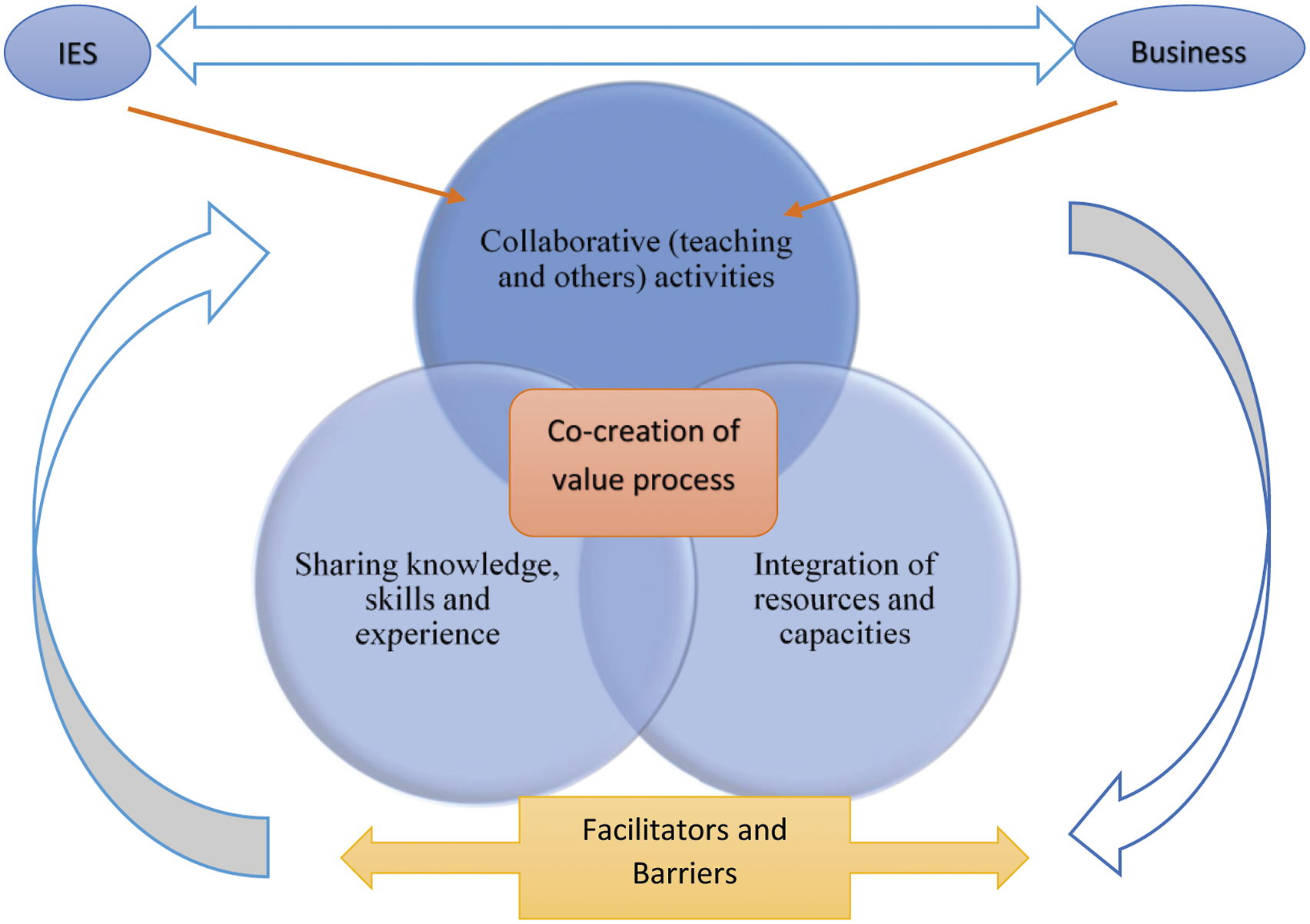
Methodology
Type of study and case selection
Considering that the main aim of this study is to understand how UFC occurs in the sphere of a specific context, without intending to generalize the results, a qualitative methodology was adopted, and the case study method in particular. The choice of this approach was because the researchers were addressing a phenomenon that is difficult to quantify and, to achieve the aim of the study, it was necessary to understand how this phenomenon occurred (Fassinger and Morrow, 2013). Considering the context and the research objectives, the recommendations of Yin (2015) were followed, using the case study method. According to Yin (2015), among the forms of qualitative research the case study is the most advisable when the aim is to understand and explore a complex phenomenon, such as the one studied here.
The case study is of a descriptive nature, since the aim is to characterize the current state of collaboration in the field of teaching between a faculty at a Portuguese university and firms, seeking to identify the activities, characterizing the mechanisms the faculty has used to stimulate this collaboration and identifying the facilitators and barriers observed in developing these cooperation activities.
The university studied here is structured in six organic units, covering five faculties and the Research Coordinating Institute (ICI). Among the faculties at the university, the faculty studied here was chosen, with a focus on one department, because UFC in the field of teaching is becoming more critical for business areas. Considering the absence of laboratories in this area, contact with the business world can serve as a kind of laboratory experiment during the period of study. University–firm collaboration may increase studentsʼ level of practice – something highly valued by firms – and consequently their suitability for firmsʼ needs, ultimately making them more employable.
Methods and instruments for data collection and analysis
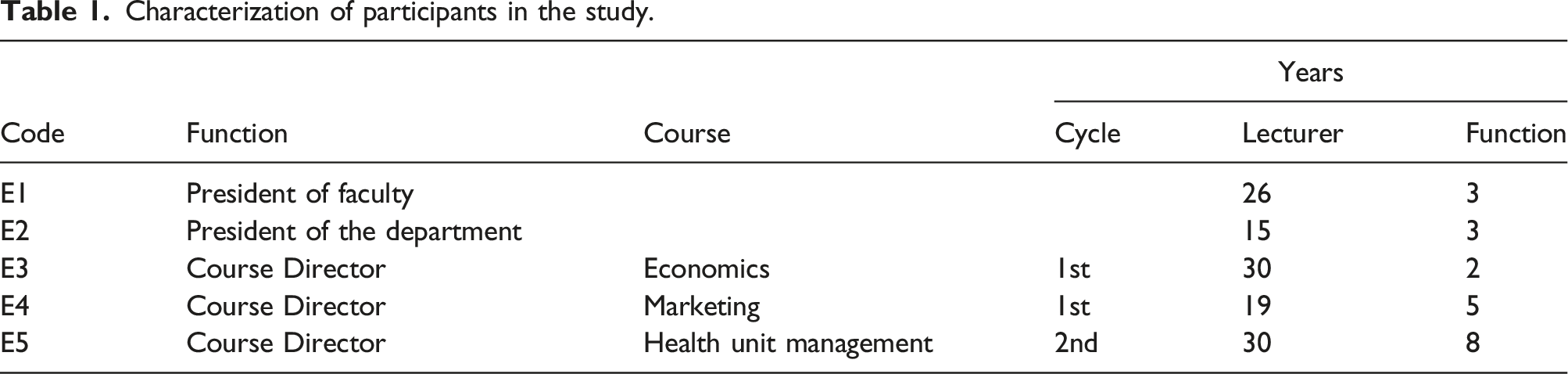
Data were collected by triangulating methods and different data sources, using the interview technique and documentary analysis in order to obtain as broad a characterization as possible. Documentary analysis was based on universityʼs accounting reports for 2016, 2017 and 2018, focusing on analysis of faculty activities. An interview was held with the President of the faculty studied in order to capture the perspective of faculty leaders in relation to this topic and, finally, interviews were held with the departmental President and the Course Directors for the first and second cycles covered by this department.
Due to COVID-19, the interviews were held via the Zoom platform, having been arranged previously through an invitation by email. They took place between 8 and 22 June 2020, lasting 45 min on average. They followed a semi-structured questionnaire, elaborated based on the literature review and on the framework of the UFC phenomenon conceived for the purpose of this study. In total, 10 people were invited to participate in the study. In the end, the response rate was 50%.
Characterization of participants in the study.
The interviews held were transcribed and were subject to content analysis. Content analysis is a research method that provides objective and systematized meanings through valid inferences of verbal, visual or written data in order to describe and quantify a given phenomenon (Downe-Wamboldt, 1992). This technique can be used in quantitative or qualitative, deductive or inductive studies (Elo and Kyngäs, 2008). In this case, content analysis fell into the category of deductive content analysis, since the structure of the analysis was operationalized from previous studies (Elo and Kyngäs, 2008). In qualitative studies, this analysis results in identifying categories and themes (Morse, 2008) through a process involving various levels of description and interpretation (Lindgren et al., 2020).
Results
This section presents the results of content analysis performed based on the interviews and activity reports of the case studied.
From the analysis of the activity and accounts reports of 2016, 2017 and 2018 it was found that the earlier ones present a functional structure focused on the activities developed in each faculty, while the report of 2018 presents a structure focussed on the strategic and operational objectives to be achieved with respect to each of the universityʼs missions (teaching and learning; research; and technology and knowledge transfer). This change in the structure adopted in the presentation of the report is relevant because it may explain in part the change in the content alluding to cooperation with companies. The report for 2018 mentions that UBIʼs vision is based on a university that ‘... creates partnerships with the other regional actors and is a space for networks between them’ (UBI, 2019: 7) and that the achievement of the objectives from 2018 to 2021, in the context of teaching and learning involves, among other things, ‘strengthening the connection with the business environment’ (UBI, 2019: 19). In the context of projects, the 2018 report states: "Throughout 2018 105 applications were submitted to the funding programmes H2020, Erasmus+, INTERREG POCTEP, INTERREG SUDOE, Fundación "La Caixa", SAICT, SAICT - PAC, IC&DT Projects in Co-promotion, Integrated Programmes of IC&DT; Vales I&DT, PDR 2020, POISE, Scientific Community Support Fund, IAPMEI, Turismo de Portugal and Private Funding, 27 of which were approved, 69 are under analysis and 9 were refused." (UBI, 2019: 45).
The report also mentions that ‘in 2018, 36 research contracts, 14 technology transfer contracts, 8 consortium and partnership contracts and 3 protocols with various institutions ’ (UBI, 2019: 53) were materialized.
Meanwhile, the creation of a UBI Executive stands out, with a direct focus on collaboration in the field of training for executives, MBA, etc., having as the target audience companies, public administration, non-profit organizations and the general public. The UBI Executive is described as “[A] School of advanced training in connection with companies, resulting from the collaboration of the University of Beira Interior with entities from various fields, such as business associations (AEBB - Associação Empresarial da Beira Baixa, NERGA - Núcleo Empresarial da Região da Guarda and ANIL) and with companies and multinationals, including the most important ones based in the region: Altran, Bial, Coficab, Fitecom, Grupo Paulo de Oliveira, Mazars, Natura IMB Hotels and PricewaterhouseCoopers (PwC).” (UBI, 2019: 61)
The report also states that ‘in 2018 the Public Relations Office intervened and provided the signing of 80 Protocols and Covenants’ (UBI, 2019: 67); of these, 18 were established with companies.
In short, the analysis of these reports shows a positive and pertinent evolution of the HEI to follow the path of value co-creation, both at the teaching level (e.g. UBI Executive), and at the level of companies and other institutions in the region where it is located.
The results of the interviews are presented according to the themes of analysis identified previously in the literature review and in the analytical model adopted in this research. These are (i) policies to promote UFC activities in teaching, (ii) activities developed, (iii) barriers to collaboration, (iv) perspective of value co-creation and (v) benefits of the UFC phenomenon. To conclude the analysis, an overview of the current state of collaboration is presented.
Policies to promote collaborative activities
Optimization of the results achievable, in the UFC context, requires a strategic vision and an understanding of how this phenomenon works (Galan-Muros and Davey, 2019). The policies and involvement of universitiesʼ top management in supporting collaboration have a direct impact on all collaborative activities, including teaching (Galán-Muros et al., 2017).
Regarding the facultyʼs policies, according to its President, an initiative was created in the faculty aiming to stimulate collaboration with companies, including in the teaching domain: “The faculty created a Consultative Council, formed of firms, organisations and civil society, to promote greater collaboration and proximity […] this Consultative Council was created this year in 2020 and two meetings have already been held. The second meeting aimed to outline a working plan and we are at that stage now” (E1).
Also, according to the President of the faculty, it participated in creating the UBI Executive at the end of December 2018: “The faculty participated in creating the University Executive. This unit aims to provide companies with specific training. In terms of courses already held, we had the preparatory course for exporting in partnership with the ICEP [Investment and Foreign Trade of Portugal]. Also in the scope of the Artisan project, training was given in the area of entrepreneurship and firm succession. We are preparing a postgraduate course for firms in the area of bio-health.” (E1)
The efforts of the new faculty leadership, in terms of policies to encourage collaboration, have been recognized by course directors, with the Director of Marketing considering the current state collaboration very good ‘because the faculty leadership has been engaged in this collaboration and the current state is very different from what existed years ago’ (E4). Similarly, the Director of the Health Unit Management Course observed that ‘there has been collaboration at the facultyʼs initiative and this has been very interesting in recent years’ (E5).
However, there are still many limitations in internal policies in relation to stimulating this UFC collaboration. The Course Director of Economics stated: “In terms of rhetoric, there is this encouragement, but much remains to be done and, internally, the university puts more pressure on being involved more in direct teaching and research projects, responding to the requirements of course assessment and accreditation.” (E3)
The Director of the Marketing course agreed, observing, ‘there is pressure regarding the different tasks academics have to perform, particularly in research’ (E4).
The faculty leadership also recognizes the importance of alumni in strengthening collaborative relations with companies, mainly in respect of teaching, and so policies have been implemented to recognize their role, particularly through ‘…compiling a database by area of alumni and creating a “hall of fame” with statements from alumni’ (E1).
Communication with firms and organizations in the region is also recognized as a critical factor in stimulating collaboration and, as a formal faculty policy, this communication ‘existed through newsletters’ (E1). However, the President of the faculty considered that ‘there could be greater company engagement in the activities developed by the university if there were better targeting of invitations to firms’ (E1).
Activities carried out
In teaching, UFC can be developed through firmsʼ active participation in curricular development, continuous and specialized training for industry, student mobility and support in terms of material and financial resources for teaching (DʼEste and Patel, 2007; Dan, 2013; Galan-Muros and Davey, 2019). From the perspective of the leaders interviewed, all those activities are observed, albeit with some differences being noted.
Regarding participation in curricular development, the practice of hiring specialists and collaborators from firms to teach is not very extensive. The Director of the Marketing course observed that, in relation to that course, ‘this practice does not exist. What exists is the practice of open classes where, in the domain of certain curricular units, a professional is invited to speak about a subject’. (E4). In other courses, although specialized lecturers are taken on, this is not very extensive. The Director of the Economics course observed: ‘Normally this collaboration takes place in the form of open classes, but there are specific curricular units, two or three, where professionals are invited to teach and the experiences have been good’. (E3)
Continuous and specialized training for companies is not carried out in the courses, but it is contemplated in the department. At present, the department collaborates in activities developed by the UBI Executive, as noted by the President of the department: “Directed training, in this case in the scope of the MBA in business, used to be organised by the department but is now the responsibility of the University Executive, and the department also collaborates.” (E2)
Student mobility is another prominent collaborative activity, in the form of curricular work placements. According to the faculty President, ‘that collaboration exists because there are courses in the faculty that are obliged to include curricular work placements’ (E1). Concerning the department, this practice is still limited to the degree in Management, but recently there have been efforts to extend it to other courses: “In restructuring courses, we have been working on curricular work placements. Regarding degree courses, in the Management course there is a strict process of work placement in Accountancy and Management, with direct involvement of the departmental presidency. In the Marketing course, a Curricular Work Placement will be implemented next year. At the Masterʼs level, with the new structure, the student can complete a dissertation, project or work placement.” (E2)
It is noted that in some courses this practice is not relevant, as revealed by the course director of the Masterʼs in Health Unit Management: “Collaboration with firms and entities in the teaching context is not the strength of this course, because the majority of students are professionally active in the areas of health or in management, and so there is no need for the study plan to consider curricular work placements or contact with institutions to place students.” (E5)
Regarding studentsʼ study visits to firms, these are very occasional and usually up to lecturers in the scope of curricular units (CUs). The President of the department explained that ‘lecturers in some CUs organise study visits, in articulation with the different course coordinators’ (E2). In addition, the Director of the Economics course said that for that course ‘this practice does not exist. The Economics course concentrates on a non-specific vision of a given firmʼs situation, but more on giving students transversal knowledge and autonomous capacity’. (E3)
With regard to attracting material and financial resources for teaching, this is not done by the department. According to its president, ‘The department has autonomy to request support from companies, but generally we end up not doing this, perhaps due to inertia or due to these initiatives traditionally being carried out by the central services of the University’. (E2). This observation is corroborated by that of the President of the faculty, who mentioned some relevant initiatives: “In this domain, we have the partnership with the Banco Santander, which attributes study grants to students and awards to the best. This partnership is at the University level, not just the faculty. We had a partnership with a company in painting the front of the faculty. We also had help in remodelling the amphitheatre. There hasnʼt been much more.” (E1)
The Universityʼs accounting and activity report also states that the ‘faculty has established continuous partnerships with various entities and firms in the region’ (UBI, 2018: 30), with no mention of the particular entities concerned or the nature of those partnerships. It is noted that the faculty held 95 events, 14 of which were considered ‘open classes’.
This analysis reveals the existence of all the activities identified in the literature, with some nuances in terms of transversality to all courses in the department, and many of these practices, except for work placements, occur rather unsystematically.
Barriers to collaboration
In the opinion of the President of faculty, the barriers to UFC exist due to all those who are mainly responsible for encouraging this collaboration: “On one hand, on the firm side, thereʼs a lack of time to get involved in specific projects in the field of teaching with the faculty; on the lecturer side, we have the very system for assessing lecturers which does not highlight that collaboration, as the assessment system gives prominence to research. And in the case of our companies, research is not what firms prioritize. The partiesʼ interests are out of step.” (E1).
In this connection, according to Galan-Muros and Davey (2019), one of the main barriers to UFC is the difference in respective cultures. This is consistent with the observation from the Director of the Economics course, who said that ‘one of the barriers is the culture in force in the two situations. In one it’s the business culture and in the other it’s the scientific culture’. (E3). This interviewee highlighted that ‘the greatest limitation or obstacle to closer collaboration with companies, in this domain, is related to the business density of the region where the university is situated’ (E3). In addition, the President of the department considered it ‘difficult to strengthen this collaboration when there are no financial resources to compensate the people involved in it’ (E2). On the other hand, the coordinator of the Marketing course thought that ‘the main barrier is business-peopleʼs vision regarding the knowledge produced in universities, although this is changing as the business community is increasingly formed of professionals trained in the universities’ (E4). This may corroborate the observation by Muscio and Pozzali (2013) that another barrier to UFC is related to difficulties in connectivity and awareness of activities and provision on both sides, which create a cognitive distance and have a strong negative impact on interactions.
The results show that although some leaders indicate barriers in all the main parties in the process, arising from availability of time, objectives, timing and cultural differences, others consider that the main barrier lies in the lack of resources or in firmsʼ perceptions of the usefulness of the knowledge produced in universities.
Collaboration from a perspective of value co-creation
Considering that firms are among the main beneficiaries of the products of universities, and can be seen as the final consumers of those products (Jones, 2010), UFC in teaching is part of the value co-creation process between universities and companies, and can align programmes with companiesʼ needs (Plewa et al., 2015). The President of the faculty agrees with this perspective but goes further, seeing the co-creation of value as something more than collaborative actions: “Collaboration just for the sake of it makes no sense, it only makes sense when there are results and benefits for the parties. And when that beneficial collaboration exists, normally this can involve co-creation. That is to say, participation to carry out joint actions. I think that co-creation is one step beyond collaboration and if there is co-creation, that collaboration becomes more fruitful. From a perspective of co-creation, this collaboration is no longer based just on responding to occasional needs, but has the aim to construct something.” (E1)
The President of the department observed: “We could have co-created courses with firms, but ended up not doing so, because universities consider themselves able to define what is needed in terms of training students and also the attempts to consult companies are often difficult to arrange because often they demonstrate they do not have the time available.” (E2)
The above statement refers to the vision of value co-creation in the educational service, restricted to configuring curricular plans, but the literature demonstrates that this co-creation can occur in other activities. Despite finding that in some courses firms do not participate in forming curricular plans, in others this practice has already occurred occasionally: “In the penultimate course restructuring, besides lecturers from the department, we invited lecturers from the Faculty of Health Sciences and also two or three people from entities linked to health unit management to obtain inputs for the process.” (E5)
Benefíts of UFC collaboration
University–firm collaboration in teaching generates a process of value co-creation for all parties involved – students, academics, firms and university – with significant benefits. However, for there to be greater involvement on all sides, leading to a more fruitful process, it is necessary to clarify the benefits for those involved (Nguyen and Nguyen, 2020). The interviewees discussed a number of benefits for the parties. In the opinion of the President of the department: “Students gain a more practical vision. The university gains in terms of prestige; lecturers can have here an excellent source of research and firms can profit from the work carried out, very often completely free of charge.” (E2)
This view is corroborated by the Director of the Marketing course who goes further, emphasizing the gains for the university: ‘[…] firms obtain professionals with better knowledge of their situation; lecturers work better with more motivated students; and universities gain in terms of the image projected, fame, attracting more students and improved classification in rankings’ (E4). In addition, the Director of the Economics course noted that ‘this can give greater value to the assets created within the university’ (E3). The President of the faculty mentioned the gains for academics: “It helps them to complement what they present in classes, it helps them to demonstrate to students that what is taught is used in practice, it helps them to identify the possibility of carrying out projects and research.” (E1)
Some of these benefits have been indicated in the literature, but it is interesting to find that the Course Directors emphasize the benefits for the faculty and the university, while the Director of the faculty emphasizes the benefits for lecturers.
Current state of this collaboration
According to the President of the faculty, ‘this collaboration exists, whether collaborating with companies or with non-profit organisations’ and it exists to a great extent because ‘there are courses in the faculty that must include curricular work placements’.
The Director of the Economics course observed that ‘politics are not absent, but it is not a priority axis, and it is a project that takes time to build’ (E3), which may explain why, despite implementing a set of policies and strategies in the last 2 years and despite the engagement of the facultyʼs top management, the President of the department commented that, regarding the department: “[This collaboration] is light years away from what would be desirable. Probably because weʼre very focused on ourselves and firms are very focused on the market. Our concern is with teaching, attracting students, and often we only remember about this partnership to collaborate when students are finishing and we need to find a work placement for them.” (E2)
We highlight an observation by the Director of the Marketing course, who considered the courseʼs collaboration with companies to be good, but said that ‘it could be better if there was more time available to devote to stimulating those practices and if firms were more willing to collaborate in this area’ (E4). The President of the faculty, indeed, considered that ‘this collaboration could be greater’ (E1). We also highlight an observation by the Director of the Economics course, who emphasized that ‘there is no systematic approach, with monitoring and permanent dialogue with companies, based on a common strategy’ (E3).
Summary of the main ideas about UFC in teaching
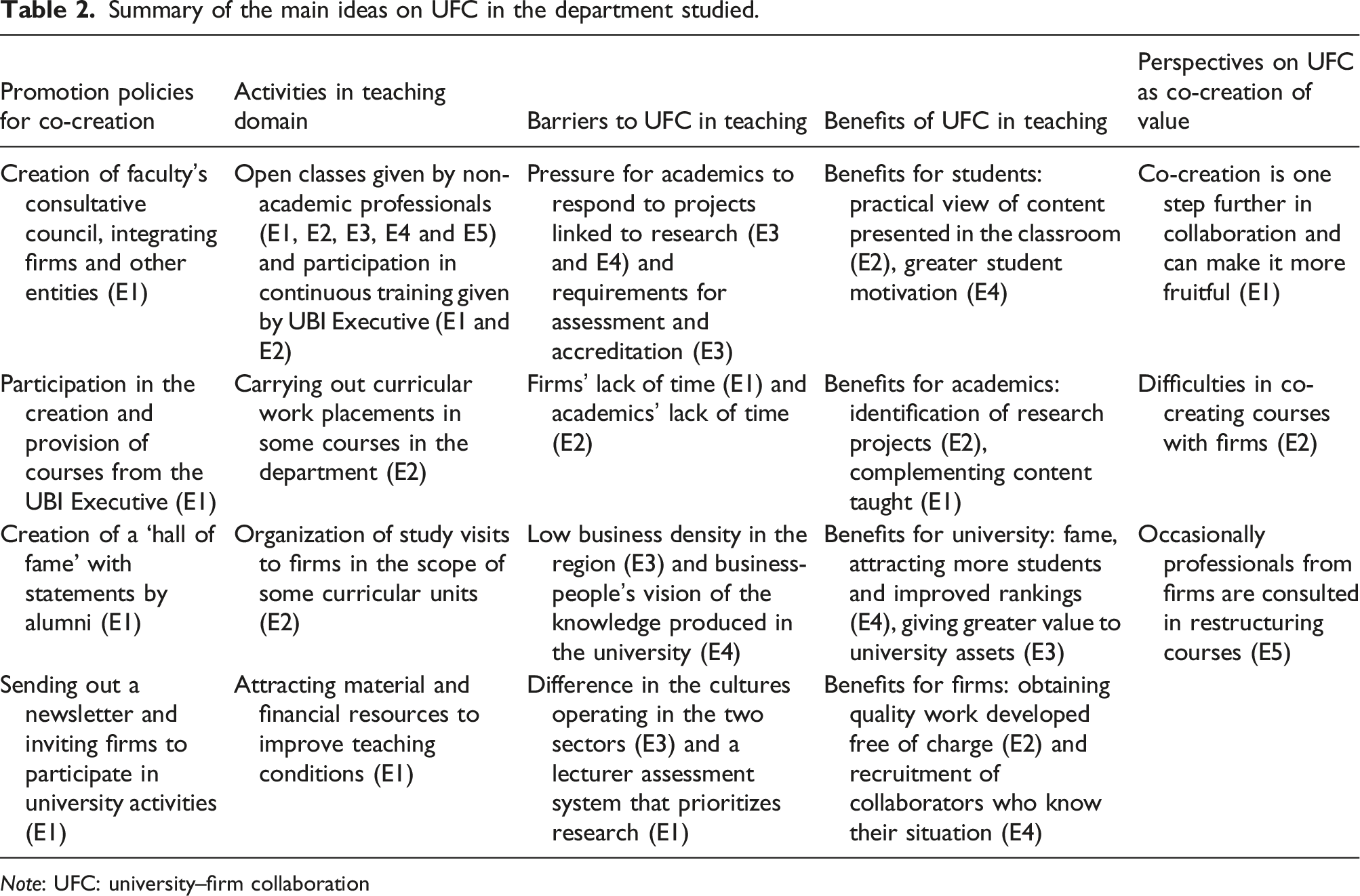
Summary of the main ideas on UFC in the department studied.
Note: UFC: university–firm collaboration
The testimonies above and the review presented in Table 2 allow us to argue that the strategy of the HEI under analysis is going in the direction of orienting practices towards the co-creation of value through a paradigmatic change – visible in the formal and informal collaborative activities organized – as a means of promoting economic and social development (e.g. Cvijić et al., 2019; Davey et al., 2011). On the other hand, collaborative activities in the teaching domain, such as offering curricular and/or professional internships in companies, are a positive and proactive way for universities and companies to co-create value for two reasons. The first lies in the fact that students have a unique opportunity to apply the knowledge obtained in real cases; the second is because this experience in a real environment provides internship coordinators with information on the suitability of curricula for companiesʼ needs. These arguments have also been reported by previous research, such as that of Plewa et al. (2015). Additionally, the realization of other activities inserted into the teaching regime, such as workshops, lectures and study trips, among others, is another way to foster the co-creation of value in the university environment, because, as Borah et al. (2019) point out, these are mostly carried out by external actors.
The creation of the UBI Executive introduced another vehicle for stimulating the engagement of the university with the business sector and an innovative way to transfer knowledge to companies and other entities; as noted by Galan-Muros and Davey (2019), this provides a means of improving the organizational skills of those involved. Finally, the current age demands that university programmes train talented human capital, which requires continuous value co-creation, as this is increasingly sought by companies (e.g. Berbegal-Mirabent et al., 2019).
Although the positive aspects have been highlighted, this does not mean that there are only facilitators in this case study; as E1, E3 and E4 argued, there are still many barriers and they are not easy to overcome (requiring time that is not available to all parties involved) and the low density of companies in the region is also a constraint. Hence, the topic of value co-creation in education is a little explored topic (Galán-Muros et al., 2017; Plewa et al., 2015), especially in HEIs based in regions with low population and business density, as in the case presented here.
The study highlights the important requirement that any process of value co-creation in the field of education should be based on the proper integration of resources and capabilities, so that the generation of value for the parties involved is beneficial and has a positive impact on their performance. Such integration can help universities towards enhanced competitive advantage and the formation of rare and inimitable intangible resources (Barney, 1991). The theory of dominant service logic applied to teaching, not as a service but as a sharing of knowledge, experiences and skills, suggests that the process of co-creation generates synergies to achieve the end intended by the stakeholders involved (e.g. Pucciarelli and Kaplan, 2016; Vargo and Lusch, 2008).
Conclusions and implications
General conclusions
This study shows that collaboration between the university (UBI) and firms in teaching, although existing, is not a consolidated practice, perhaps due to this higher education institution being a state university. The results demonstrate hat the new faculty leadership has made an effort to reinforce collaboration in the teaching context, which is recognized by the Course Directors in the department. However, some practices in place are not keeping with the literature – in terms of the weak systematization and planning of the process – and there are still many barriers to be overcome.
The study also concludes that this type of collaboration is often considered almost exclusively in the context of the need to carry out curricular work placements. Therefore, to reap the potential benefits of broader collaboration, it is recommended that actions are taken to spread awareness of all the potential activities that could be developed. It is also necessary to adopt a broader perspective, in accordance with a vision of co-creating educational service, so as to transform motivations to collaborate into something more fruitful. Greater emphasis on this aspect of collaboration is also recommended in activity reports – in the rhetoric, the clear definition of objectives and a specific agenda to be contemplated in the coming activity plans.
Contributions and directions for future research
Although this study contributes to the area of UFC and promotes awareness among the actors involved in this type of collaboration by showing its benefits from both educational and business perspectives, and by noting the barriers that continue to constrain it, like any study it has limitations. Firstly, it analyses only one department in one faculty. Secondly, lecturersʼ opinions were not studied, and only 50% of the Course Directors participated. Therefore, the following are recommended for future research: (i) extending the study to the other departments of the faculty studied here, (ii) carrying out a quantitative study, using surveys to gather the opinions of all lecturers and students regarding their perceptions of the activities performed by the faculty in the context of UFC in teaching and (iii) carrying out studies with companies to understand their degree of openness to this type of collaboration and their perceptions of the actions the faculty has, or has not, taken to encourage such collaboration. Also suggested is research extended to all faculties of the university examined here to obtain a generalized characterization of the current state of the institutionʼs collaboration with companies in the field of teaching. The fact that this study is very much focused on the teaching domain suggests the need for a future study extending into other domains relevant to the co-creation of value in universities. Also, the use of other theories for the conceptual framework might be adopted for future studies, such as network theory, absorptive capacity and institutional theory (isomorphism).
Given the importance of the subject, a quantitative study to characterize the current state of all Portuguese universitiesʼ collaboration with the business world in the teaching context would be valuable, with the aim of drawing up specific policies to strengthen relations in this area so that universities can make a greater contribution to the economy and achieve greater co-creation of the educational value of the service they provide. A final recommendation is for a future study to explore the conditions that should be created to transform UFC in the teaching context into an effective mechanism for value co-creation of the educational service between firms and universities.
Footnotes
Acknowledgements
The authors are grateful to the anonymous referees of the journal for their extremely useful suggestions to improve the quality of the paper. The authors gratefully acknowledge financial support from National Funds of the FCT – Portuguese Foundation for Science and Technology within the project UIDB/04007/2020.
Declaration of conflicting interests
The author(s) declared no potential conflicts of interest with respect to the research, authorship, and/or publication of this article.
Funding
The author(s) received no financial support for the research, authorship, and/or publication of this article.
