







Abstract
Guided by the Technology-Organization-Environment (TOE) framework, this study investigates how digital leadership, digital resource construction, employee digital literacy, and organizational culture collectively impact industry-education integration. An analysis of the survey data from 354 faculty at Chinese higher education institutions indicates that digital leadership serves as the crucial factor. It not only directly promotes industry-education integration but also indirectly facilitates it through the digital resources construction and the enhancement of employee digital literacy. Moreover, digital resources alone do not directly impact industry-education integration, their effect is fully mediated by employee digital literacy. Contrary to expectations, while both digital leadership and digital resource construction positively shaped organizational culture, the culture itself did not significantly influence industry-education integration. Collectively, these contributions constitute an integrated theoretical and practical framework that deepens academic understanding and provides actionable guidance for the promotion of industry - education integration.
Introduction
The rapid development of technology is subtly reshaping the global economic, social, and cultural landscape. Globally, governments, enterprises, universities, and even individuals are facing pressures and opportunities brought about by digital transformation (Kuo et al., 2021; Xiao et al., 2022), which represents not only an iterative upgrading of technology but also an all-encompassing change covering all levels of organizational structure, management models, and educational systems (Moghrabi et al., 2023; Čorejová and Chinoracký, 2021). Driven by both globalization and technological innovation, the education sector is experiencing a profound transformation (Henderson et al., 2017), which involves not only the transfer of knowledge and the development of skills but also the sustainable development of human societies and the enhancement of global competitiveness.
In 2020, the World Economic Forum published a groundbreaking white paper that introduced, for the first time, a global framework for Education 4.0 in response to the Fourth Industrial Revolution. The framework emphasizes the significance of technical skills, encompassing programming, digital responsibility, and technology utilization, alongside interpersonal skills such as cooperation, negotiation, leadership, and social awareness. This comprehensive framework serves as a guideline for the global reform of educational principles (Ramírez-Montoya et al., 2021). Subsequently, the European University Alliance proposed the establishment of the Education 4.0 Alliance, a multi-stakeholder coalition aimed at advancing global education reform and creating an inclusive and innovative learning environment. This initiative further underscores the international community’s commitment to educational innovation and digital transformation (Ülker, 2025). The European Commission, in January 2022, founded the Centre for Digital Education to enhance collaboration and knowledge exchange in digital education at the EU level (Hervas-Oliver et al., 2021). The plan outlines two key areas for development: first, the advancement of high-performance digital education ecosystems, and second, the augmentation of digital skills and competencies for digital transformation (Marchisio et al., 2021; Yanli and Danni, 2021).
Against the backdrop of profound changes in the global education landscape, the higher education sector faces not only the pressures and opportunities of digital transformation but also an urgent need for the integration of industry and education. Industry-education integration has emerged as a critical concern for the global higher education sector. Its essence lies in the close amalgamation of education and social development to construct a sustainable, people-centered, and resilient education system. This comprehensive integration gradually erases the divide between traditional industry and education, dismantles barriers between the educational environment and social needs, and facilitates mutual understanding and exchange of educational resources and industry needs (Gong and Wang, 2021). This alignment allows educational content to closely match actual industry needs, enabling higher education institutions not only to precisely adjust their teaching curricula and talent training programs but also to assist enterprises in efficiently selecting talent that aligns with their development needs (Yüceol, 2021). Sun et al. (2025) analyzed the impact of AI on vocational education, elucidating the necessity, significance, and challenges of integrating industry and education for educational development.
However, it is crucial to recognize that the integration of digital technology not only introduces new platforms and tools for school-enterprise cooperation but also presents the opportunity to update educational content and innovate teaching methods. This, to some extent, transforms the traditional school management style and educational model toward greater flexibility, versatility, and uncharted directions. Thus, the digital transformation of education is not merely a technological upgrade; it represents a comprehensive process of change within the education system, management model, and organizational structure (Rubashkin et al., 2024). Faced with these challenges, university administrators must urgently leverage digital reform to facilitate the implementation of the policy for integrating industry and education. Nonetheless, a gap remains in the academic community regarding how to effectively drive digital reform and attain successful policy implementation. To bridge this gap, this paper introduces the concept of “digital leadership (DL)” based on the Technology-Organization-Environment (TOE) theoretical framework proposed by Tornatzky and Fleisher in 1990. The concept of DL is thoroughly introduced and analyzed to explore its central role in implementing industry-education integration (UEI). Additionally, considering the potential mediating roles of employee digital literacy (EDL), organizational culture (OC), and digital resource construction (DRC), this study integrates these four variables into a structural equation model to comprehensively analyze how they collectively influence the implementation of the industry-education integration.
This study aims to offer a comprehensive understanding of the key elements and their interactions in digital transformation, considering digital resources, organizational management, and the integration of internal and external factors. It seeks to unveil how these elements contribute to implementing industry-education integration. Through empirical research, we anticipate providing strategic recommendations for universities to foster industry-education integration development, offering decision support for policymakers, and proposing new theoretical frameworks and research directions for academic inquiry.
Literature review
The TOE theory offers a comprehensive framework for comprehending the intricate decision-making process of organizations adopting new technologies. It emphasizes the dynamic interaction among technology, organizational structure, and the external environment (Ergado et al., 2021; Tornatzky and Fleischer, 1990). This theory plays a crucial role in guiding how to capture organizational adoption and adaptation to technology and how technological change influences policy implementation. To delve deeper into the application of the TOE theory in this paper, the literature review section will analyze key factors that may impact the integration of education and industry in terms of the three dimensions: technology, organization, and environment.
Digital leadership in technological factors
Leadership is the capacity of an individual to address problems, coordinate teams, and inspire others to attain shared objectives within an organization (Calvert, 1992). Effective leadership significantly influences team performance. Research indicates that teams led by competent leaders are more adept at motivating team members and enhancing overall team performance (Santos et al., 2015; Stewart, 2006).
In the present digital era, managers face new competency requirements, and digital competence emerges as an essential skill for them (Mihalcea, 2017). In contrast to traditional leadership, digital leadership prioritizes adaptation, understanding, acceptance, and support of the external environment (Mihalcea, 2017). Souza and Pietrafesa (2023) demonstrated that digital leadership is associated with the understanding, adoption, guidance, and promotion of new technologies and policies by organizational leadership. Hence, digital leadership is regarded as a technical proficiency that leaders should possess within organizations, playing a crucial role in both organizational management and operations.
Within the TOE theoretical framework, digital leadership, serving as a core technological factor, profoundly influences the implementation of the policy for industry-education integration. First, managers with digital leadership possess long-term strategic awareness and the ability to seize initial opportunities. This makes it easier for organizations to adopt advanced digital technologies in education and industry, providing a robust technological foundation for policy implementation (Deogaonkar, 2025). Second, digital leadership fosters the development and execution of digital strategies, enhancing the specificity and feasibility of the policy for industry-education integration. Leaders seamlessly integrate technology with organizational goals through precise digital strategies, rendering policy implementation more forward-looking and strategic (Brunner et al., 2023). Additionally, leaders’ digital literacy and collaborative capabilities facilitate enhanced collaboration between schools and enterprises during policy implementation (Yang, 2022). In conclusion, digital leadership actively and irreplaceably contributes to the policy of integrating education and industry. Hence, the following hypothesis is proposed:
Digital leadership influences the industry-education integration.
Digital resource construction in environmental factors
In the TOE model, environmental factors are defined as all external conditions that may impact an organization’s adoption of new elements. Digital resources embody the external factors organizations must consider and adjust to during the adoption of new technologies. Additionally, they encompass the physical conditions in Higher Education Institutions (HEIs) for promoting the industry-education integration policy (Bian and Wang, 2021; Feroz et al., 2021). Digital resource construction is bifurcated into two pivotal segments in this study: the introduced digital educational resources and the associated supporting hardware and software resources. Specifically, the segment related to the construction of digital educational resources encompasses not only the comprehensive transformation of resources in terms of digitization, networking, and intelligence but also addresses the construction management of associated resources and the sharing of resources between schools and enterprises (Zhang and Peng, 2022). Navaridas-Nalda et al. (2020) demonstrated that the process of constructing digital resources is inseparable from leadership management. Leadership with a digital focus in this process guides the team in constructing digital resources, actively engaging in their development and application, and establishing the requisite digital infrastructure. This foresight ensures the organization’s ability to adapt and remain competitive in the evolving external environment. Additionally, the process of resource construction demands that leaders concentrate not only on the technical aspects but also ensure the richness and utility of the content, facilitating the effective alignment of educational resources with the latest industry developments. Hence, the following hypothesis is posited:
Digital leadership influences digital resource construction. Furthermore, the establishment of digital resources offers an extensive knowledge reservoir and technical backing for the fusion of industry and education (Kong et al., 2025). Due to the advancements in information technology, numerous educational resources have undergone digitization, culminating in an extensive digital resource repository comprising e-books, online courses, teaching software, research databases, and more (Guo et al., 2019; Jongsermtrakoon and Nasongkhla, 2015). These resources not only enhance teaching and research but also serve as a conduit for industries to update knowledge and upgrade technology. Through the exploration of a knowledge-sharing model, Silvério and Franco (2025) discovered that sharing knowledge is vital for inter-organizational cooperation; it not only heightens mutual trust levels but also plays a pivotal role in fostering collaborative relationships. Drawing from this study’s findings, the development of digital resources will propel the realization of the industry-education integration policy, serving as a more profound form of collaboration between educational institutions and businesses. Furthermore, it has been demonstrated that as digital resources improve, faculty and staff involved in resource construction gain easier access to the latest industry information, technological trends, and management knowledge. This access is crucial for them to comprehend digitalization trends, acquire proficiency in necessary information technology tools, and enhance their ability to apply data analysis, among other skills (Huang et al., 2022; Ma, 2021). Therefore, the following hypotheses are formulated:
Digital resource construction influences the industry-education integration.
Digital resource construction influences employee digital literacy.
Employee digital literacy in environmental factors
Digital literacy among employees mirrors their capacity to comprehend, apply, and adapt to digital technology. Their performance directly influences the implementation and promotion of policies, whether in the context of digital transformation or the introduction of new policies. Organizations must align with the level of employee literacy. Hence, this study incorporates employee digital literacy as an environmental factor in the TOE theory. The evolution of digital technology in contemporary society has shaped a digital information realm, altering the occupational structure and the knowledge and skill framework of talents. Facilitating the digital transformation of education and augmenting the development of teachers’ digital literacy have emerged as crucial trends in the educational reform of international organizations and countries globally (Molnár et al., 2022). Pertinent studies highlight the pivotal role of digital leadership in shaping employees’ digital literacy. Through demonstration and guidance, leaders ignite staff interest and motivation to learn about digital technology. Leaders also steer staff to personalize their learning, thereby enhancing their digital literacy (Nwaham Caroline, 2023). Therefore, the following hypothesis is formulated:
Digital leadership influences employee digital literacy. Additionally, Khan and Gul (2022) assert that teachers with enhanced digital literacy can adeptly comprehend industry digitalization trends and promptly update their teaching content, ensuring that their students’ skills align with current and future industry requirements. Such sensitivity and adaptability are crucial capabilities within the education sector to respond to external environmental changes. Based on this, it can be inferred that the digital literacy of employees, particularly teachers, as core members of an organization, not only directly impacts the organization’s digital transformation process but also dictates the effectiveness of the organization’s role in the external policy environment. Enhancing the digital literacy of teachers establishes a strong foundation for the in-depth advancement of industry-education integration. This, in turn, facilitates the effective alignment of educational resources with industrial demand, promoting the concurrent progress of education and industry. Consequently, the following hypothesis is formulated:
Employee digital literacy influences the industry-education integration.
Organizational culture in organizational factors
Within the TOE theory, organizational culture significantly influences the adoption and diffusion of new technologies. According to Schein (1996), organizations fostering a culture of openness, innovation, and learning are more inclined to adopt new technologies. This cultural orientation encourages members to embrace change, engage in continuous learning, and adapt effectively to technological shifts. Conversely, an organizational culture that is outdated and conservative may exhibit resistance to new technologies, impeding their diffusion and application. Jain, A. and Jain, S. (2013) highlighted the pivotal role of organizational culture in organizational change and development. This cultural aspect significantly influences team building, change implementation, corporate goals and strategies, employee productivity, and company performance levels. Likewise, within the realm of education, the organizational culture of higher education institutions, functioning as a specific organizational group, influences the attitudes, behaviors, and the efficacy of decision implementation by its members, consequently impacting the entire institution.
George et al. (1999) emphasize that leaders’ management style significantly impacts organizational culture; leaders serve not only as culture shapers but also as culture transmitters and maintainers. Leaders can utilize digital platforms to dismantle information silos, foster interdisciplinary and cross-sectoral collaboration, diminish internal organizational barriers, and foster innovation, openness, and change in organizational culture (Navaridas-Nalda et al., 2020; Nită and Gutu, 2023). Leaders demonstrating digital leadership possess the ability to recognize and adapt to changes in the external environment. They guide the organization to be more receptive to the integration of new technologies, steering the organizational culture towards acceptance and continuous learning (Nwaham Caroline, 2023). Therefore, the following hypothesis is posited:
Digital leadership influences organizational culture. Moreover, the development of digital resources in universities influences the organizational culture of these institutions. First, abundant digital resources can mirror and strengthen the cultural values of Higher Education Institutions (Zhelev et al., 2021). For instance, digital repositories housing open-access theses and scholarly works foster a culture of academic sharing. Simultaneously, online platforms showcasing campus history, art, and student activities underscore universities’ commitment to traditional culture and innovation. Second, research on enterprise technology adoption consistently links platforms like ERP and CRM to shifts in organizational culture (Al-Bashayreh et al., 2022; AlMarri et al., 2025). By enforcing new workflows and data transparency, these systems inherently encourage a more data-driven and collaborative cultural environment by breaking down long-standing departmental barriers. Finally, the convenience and efficiency facilitated by digital resources enable certain teachers to exhibit positive attitudes towards new technologies and innovations, thereby mitigating the negative impacts arising from organizational culture. Therefore, the following hypothesis is formulated:
Digital resource construction influences organizational culture. Simultaneously, other scholars have highlighted that the organizational culture of Higher Education Institutions encompasses academic traditions, educational values, staff work attitudes, institutional culture, acceptance of change, etc. These elements directly influence the attitudes of various professions and disciplines toward the integration of industry and education, and significantly impact the depth and scope of industry-education integration (Letelier and Sandoval, 2015). For instance, the cultural environment of certain universities may emphasize the cultivation of professionals closely integrated with industries. This emphasis facilitates the seamless integration of subject specializations into industrial practices, fostering greater depth in industry-education integration. In contrast, other disciplines may adopt a more conservative approach, emphasizing theoretical research. It is evident that an organization’s alignment with the policy of industry-education integration is critical. This alignment determines whether members are inclined to actively engage in the integration of industry and education and whether they possess the capability to comprehend and cater to the actual needs of enterprises (Jin and Bojing, 2022). An organizational culture emphasizing openness, creativity, cooperation, fostering innovation, and valuing practical experience facilitates communication and interaction between educational institutions and enterprises, thereby advancing the deepening of industry-education integration (Kunnari and Ilomäki, 2016). Nonetheless, during the digital transformation of universities, negative organizational cultures play a significant role in hindering the integration of industry and education. Examples include cultural barriers like conservatism, closed-mindedness, resistance to change, and a lack of cooperation (Schein, 1996). These obstacles originate not only from managers but also from other employees within the organization. Meijer (2015) discovered that certain employees hesitate to embrace or even reject new technologies unless these technologies can convincingly demonstrate their positive value. Ashaye and Rand Irani (2019) identified that, when staff encounter technological innovations, a portion of them exhibit negative attitudes due to concerns about potential job loss resulting from changes in the new technology. Moreover, some bureaucrats go to the extent of organizing staff to instigate boycotts of new technologies as a form of resistance against organizational change and innovation (Al-Emadi and Anouze, 2018; Ashaye and Rand Irani, 2019; Meijer, 2015; Weerakkody et al., 2019). Digital transformation in universities and educational reforms are unavoidable and significant trends in the current landscape. These negative organizational cultures are bound to impact the progress of the industry-education integration policy. Therefore, the following hypothesis is posited:
Organizational culture influences the industry-education integration.
Resulting conceptual model
Guided by the TOE framework, the conceptual model in Figure 1 posits that Digital Leadership (Technological Factor) directly influences industry-teaching integration. This relationship is theorized to be mediated by Digital Resource Construction and Employee Digital Literacy (Environmental Factor), as well as Organizational Culture (Organizational Factor). This structured application of the TOE framework enables a systematic investigation of the research hypotheses. The conceptual model.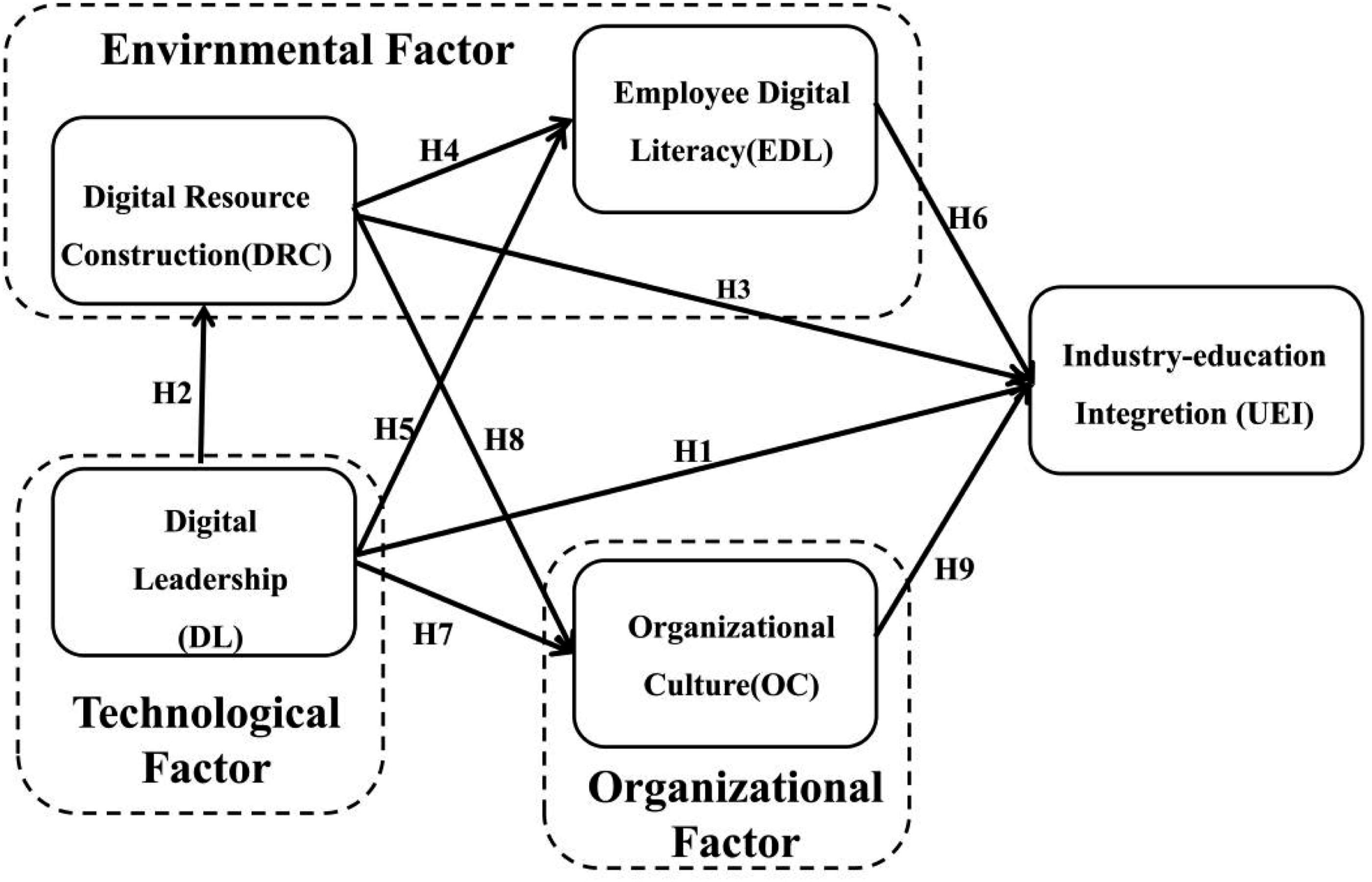
Method
Research instrument
This study employed a self-administered questionnaire grounded in the Technology-Organization-Environment (TOE) framework. To this end, the survey instrument was designed to operationalize the framework by investigating a technological factor (digital leadership), technological factors (digital resource construction, employee digital literacy), organizational factors (organizational culture), and their relationship with the environmental outcome of industry-education integration. The scales were adapted from established instruments and modified to fit the specific context of this study (Chen, 2022; Prince, 2018; Wang et al., 2021; Wen, 2022; Zhao, 2023). See Appendix 1 for details.
The instrument development followed a rigorous process: First, an initial item pool was generated based on a comprehensive literature review. Subsequently, the draft questionnaire was refined through consultations with three experts in the fields of education management and public policy to ensure content validity and contextual relevance. A pilot study was then conducted with 81 academic staff, and the reliability of the scales was assessed using Cronbach’s alpha. All constructs demonstrated good internal consistency, with values exceeding the recommended threshold of 0.7.
The questionnaire consisted of five sections: Digital Resource Construction (7 items), Employee Digital Literacy (3 items), Digital Leadership (4 items), Organizational Culture (4 items), and Industry-Education Integration Policy (4 items). All items were measured on a five-point Likert scale, from 1 (strongly disagree) to 5 (strongly agree). The original questionnaire was developed in Chinese. For reporting purposes, it was translated into English following a standard back-translation procedure to ensure conceptual equivalence.
To assess the potential for common method bias, a full collinearity test was performed (Kock, 2015). The variance inflation factor (VIF) values for all constructs were below the conservative threshold of 5, indicating that common method bias is not a critical concern in this dataset.
Population, sample and data collection
The target population comprised faculty from diverse Higher Education Institutions in China. The non-probability sampling approach focused on obtaining a heterogeneous sample to adequately test the hypothesized relationships within the TOE framework, rather than to achieve population representativeness. In alignment with the sample size guideline by Hair et al. (2010) for structural equation modeling, 500 questionnaires were distributed electronically. A rigorous data cleansing procedure was implemented, excluding responses that were incomplete, exhibited contradictory answers, showed patterns of straight-lining, or were completed in less than 2 minutes. This process yielded 354 valid questionnaires for analysis, representing an effective response rate of 70.8%.
The final sample (N = 354) reflected a diverse cross-section of the sector. In terms of institution type, 41.1% of respondents were from general undergraduate universities, and 58.9% were from higher vocational colleges. The sample consisted of 44.3% male and 55.7% female respondents. Regarding age, the largest cohort was under 29 years (64.7%), followed by 30–39 (23.5%), 40–49 (6.0%), and 50 and above (5.8%). In terms of the highest qualification, 11.2% held a bachelor’s degree, 67.3% a master’s degree, and 21.5% a doctoral degree. Their professional roles were categorized as administrative staff (31.5%), teaching faculty (42.4%), and research staff (26.1%). Finally, the data was analyzed using structural equation modeling (SEM) with the software packages AMOS 24.0 and SPSS 27.
Data analysis
Measurement model testing
The results of reliability and validity testing.
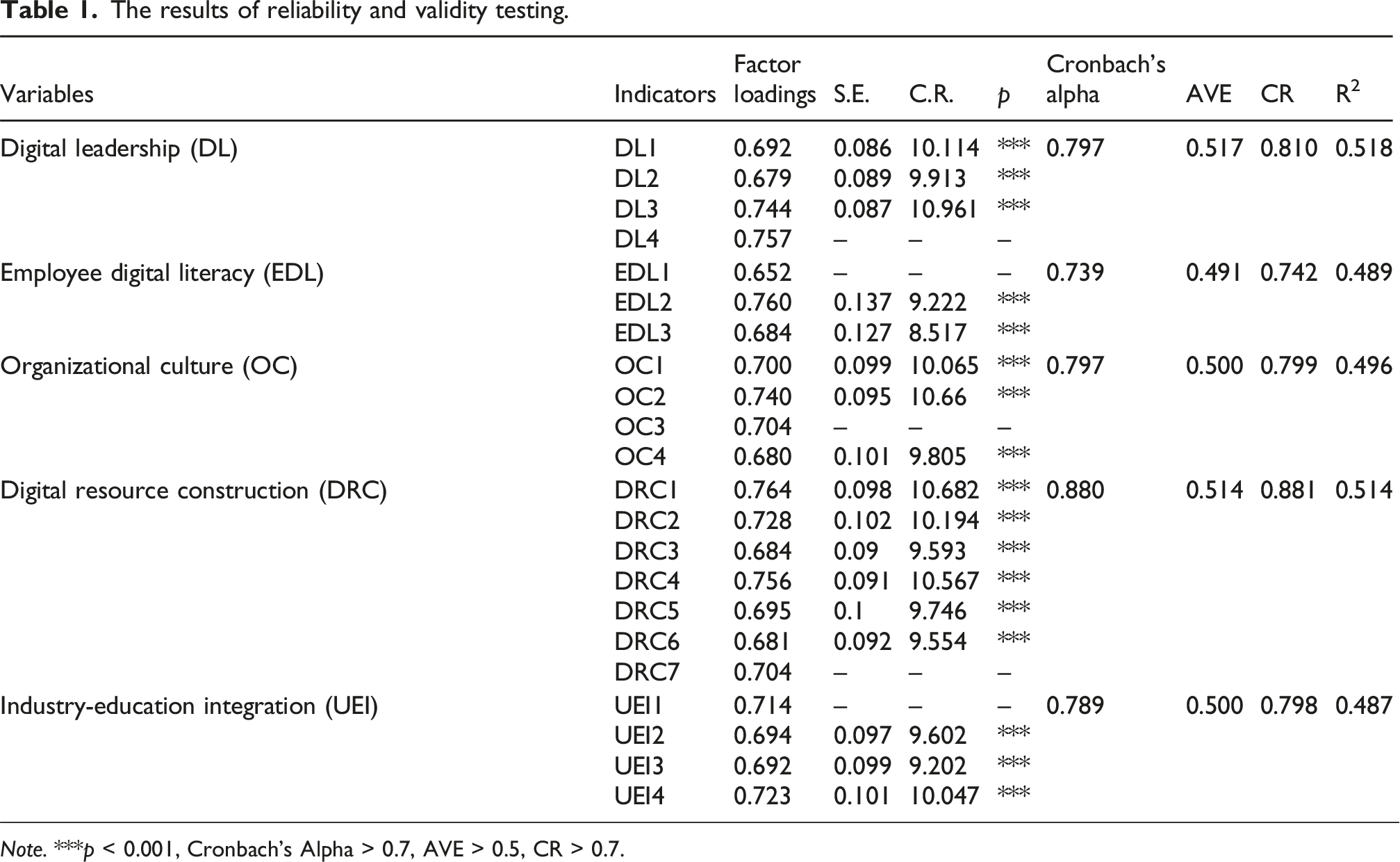
Note. ***p < 0.001, Cronbach’s Alpha > 0.7, AVE > 0.5, CR > 0.7.
Then, convergent validity was evaluated by composite reliability (CR) and average variance extracted (AVE), using the conventional thresholds of CR >0.70 and AVE >0.50 (Fornell and Larcker, 1981). The results are summarized in Table 1. The results indicate that all CR values and most AVE values meet the standard thresholds. Although the AVE for Employee Digital Literacy is 0.491, slightly below the 0.5 benchmark, it is considered acceptable as it exceeds the alternative threshold of 0.4 when accompanied by a satisfactory CR value, which is met in this case (Fornell and Larcker, 1981; Lam, 2012). Consequently, all three measurement items for this construct were retained to maintain content coverage (Tangi et al., 2021).
To further substantiate the convergent validity of the measures, the squared multiple correlations (R2) of the indicator items were examined, as shown in Table 1. The R2 values for the constructs were 0.518, 0.489, 0.496, 0.514, and 0.487. These results indicate that, on average, approximately half of the variance in the observed items is accounted for by their respective latent constructs (Wetzels et al., 2009). This provides strong evidence for the adequacy of the measurement model, as the constructs sufficiently explain their intended indicators.
Discriminant validity.
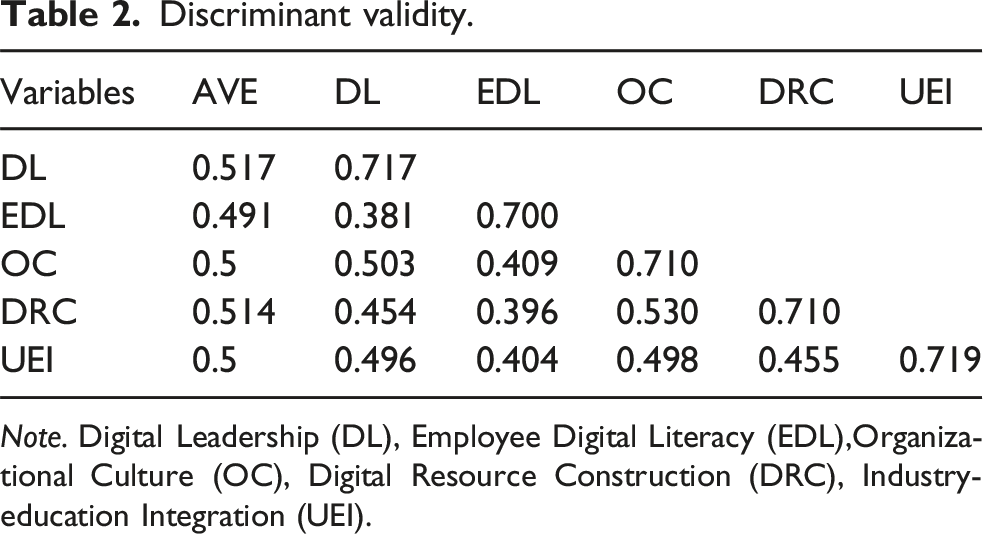
Note. Digital Leadership (DL), Employee Digital Literacy (EDL),Organizational Culture (OC), Digital Resource Construction (DRC), Industry-education Integration (UEI).
Structural model testing
This study established the structural equation model, and tested the theoretical hypotheses using AMOS 24.0, as shown in Figure 2. The result, as shown in Table 3, reveals that CMIN/DF = 1.400, within the range of 1–3; RMSEA = 0.043, within the excellent range of <0.05. Additionally, the AGFI value is 0.879, close to 0.9, indicating acceptability. GFI = 0.904, IFI = 0.968, TLI = 0.963, and CFI = 0.968, all surpassing the excellent threshold of 0.9. Therefore, the collective results of this analysis suggest that the structural equation model is well-suited for its purpose. Structural equation modelling. Model fit indices.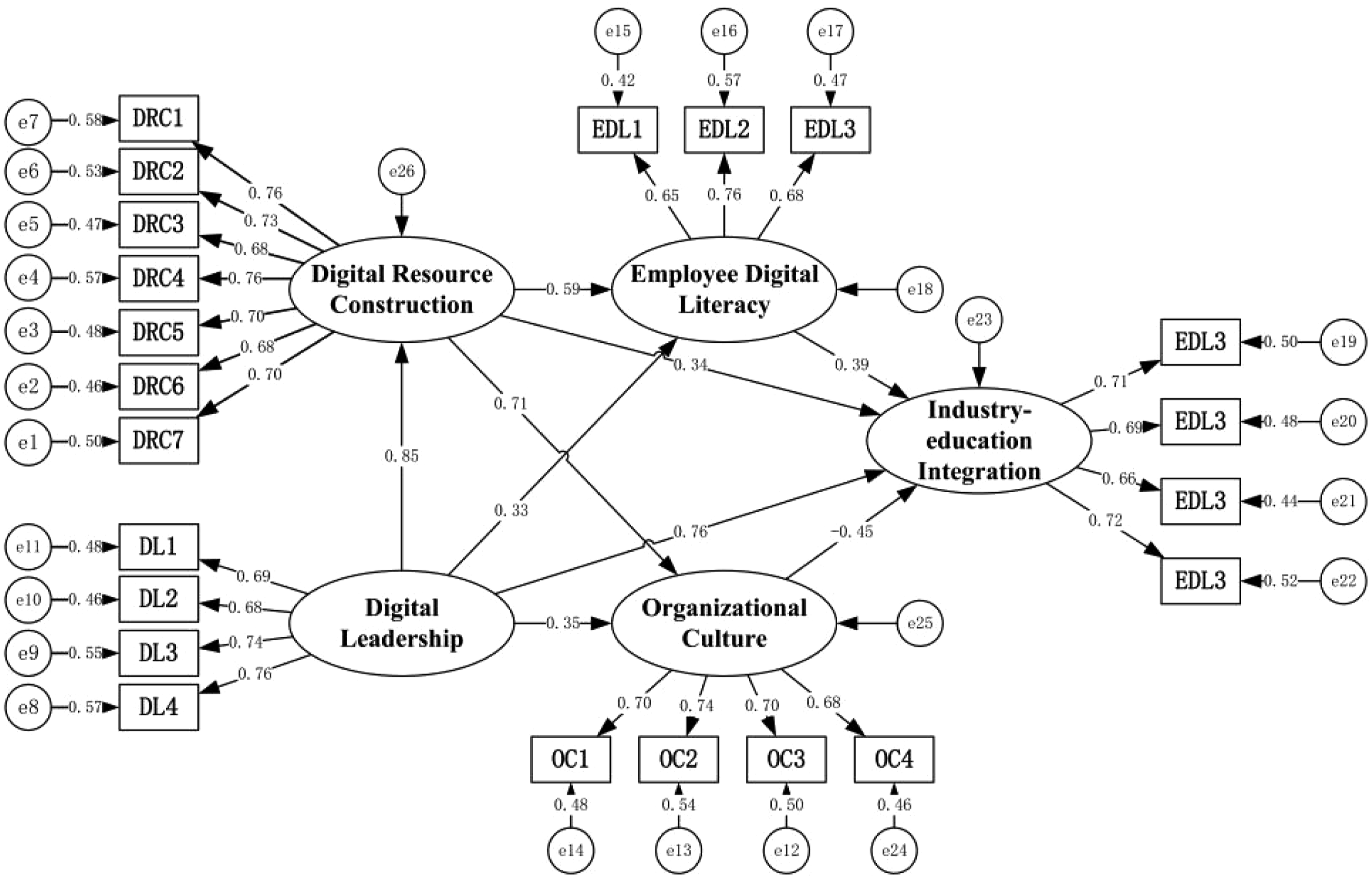

Results of testing among variables.
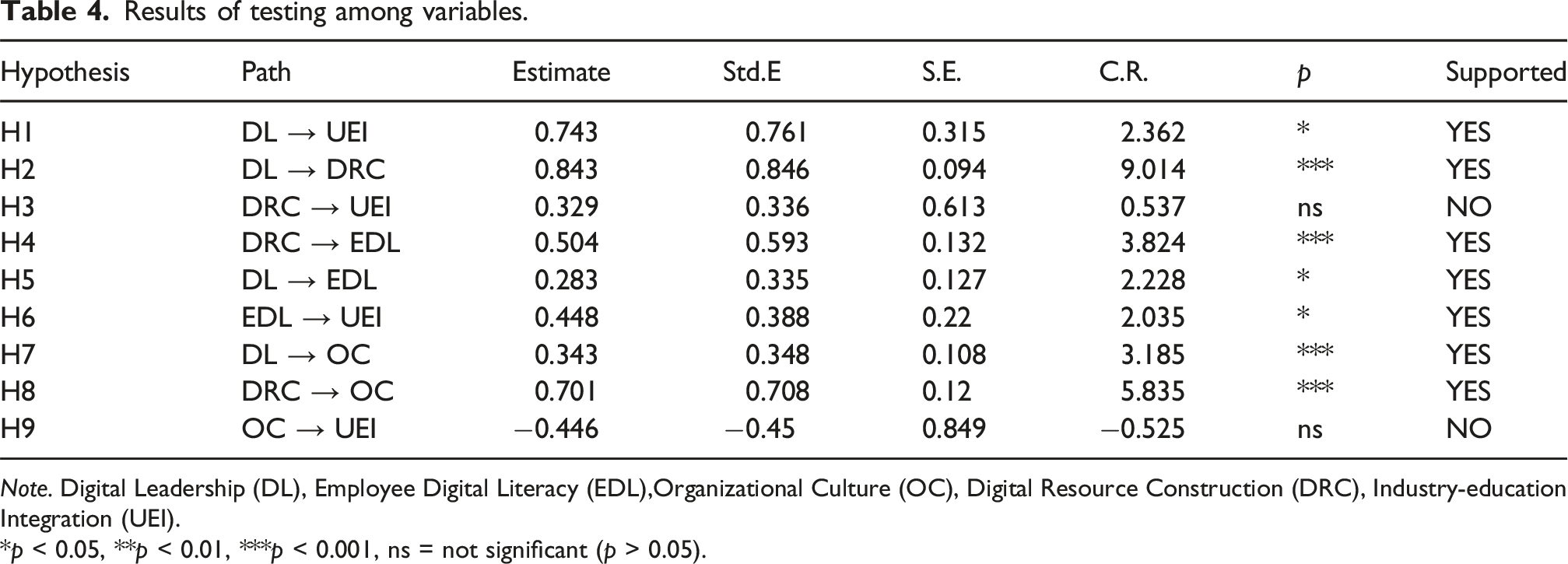
Note. Digital Leadership (DL), Employee Digital Literacy (EDL),Organizational Culture (OC), Digital Resource Construction (DRC), Industry-education Integration (UEI).
*p < 0.05, **p < 0.01, ***p < 0.001, ns = not significant (p > 0.05).
Conversely, Hypothesis 3 is not supported (p > 0.05), indicating that digital resource construction does not exert a direct effect on industry-education integration. Hypothesis 9 is also not supported (p > 0.05), suggesting that organizational culture does not significantly influence industry-education integration.
Additionally, the mediating effects were examined using a bias-corrected bootstrap procedure with 5000 resamples. The total indirect effect of digital leadership on industry-education integration was significant (95% CI [0.129, 0.241]). Then, the structural model revealed that digital leadership accounted for 53.2% of the variance in industry-education integration (R2 = 0.532), demonstrating a strong explanatory power. The effect size of this relationship was further assessed, yielding a large effect (f2 = 0.667) that substantially exceeds the common threshold for a large effect (f2 > 0.35). This confirms that digital leadership is not only a statistically significant but also a powerfully substantive predictor of industry-education integration.
Discussion
Employing the TOE theoretical framework, this study conducts a thorough analysis of the interconnections among digital leadership, digital resource construction, employee digital literacy, organizational culture, and industry-education integration. By applying structural equation modeling, the study derives the following pivotal insights, which are subsequently discussed.
First, digital leadership, as a pivotal element within the technological context, plays a crucial role and exerts a substantial positive influence on advancing industry-education integration. This finding supports the TOE theory regarding the interplay between technology, organization, and environment. It underscores the significance of technological factors in executing the industry-education integration policy in the digital era. It highlights that leaders who possess insights into emerging technologies and the capability to navigate them effectively can more successfully promote organizational change and facilitate a seamless connection between educational resources and industrial needs. Furthermore, a deeper exploration reveals that digital leadership also positively influences both digital resource construction and employee digital literacy. This aligns with the fundamental tenet of the TOE theory, emphasizing the significance of technical factors in intra-organizational change. As a torchbearer of technical factors, digital leadership orchestrates resources and drives organizational change, establishing a robust foundation for the seamless execution of industry-education integration in universities.
Second, the non-significant direct relationship between digital resource construction and industry-education integration drew our attention. Through thorough analysis, we identified that the influence of digital resource construction on the policy is mediated by its enhancing effect on employees’ digital literacy. This reinforces the significance of environmental factors in the adoption of technology, as posited by the TOE theory. The establishment of digital resources, serving as a channel for information and knowledge provision, requires employees to possess adequate digital literacy. When employees have lower levels of digital literacy, they may encounter challenges in comprehending and efficiently utilizing digital resources. Consequently, they might face difficulties in directly applying these resources to implement the industry-education integration policy (Venkatesh and Goyal, 2010).
Finally, both digital leadership and digital resource construction exhibited notably positive associations with organizational culture. This implies that positive transformations in organizational culture stem not only from internal leadership but are also positively influenced by environmental factors. This validates the relevance of the TOE theory and underscores the necessity of considering the interplay between technology, organizational structure, and the external environment in understanding the dynamics of organizational change. However, contrary to expectations, organizational culture did not exhibit a significant influence on industry-education integration. While the significance of organizational factors in TOE theory has been extensively affirmed by scholars, the reason for this non-significant finding in our study may be that the research methodology was insufficient to comprehensively capture the intricate dynamics of organizational culture’s impact on policy implementation. Simultaneously, this study of treating the organization as a whole and employing quantitative measurements may have oversimplified the complexity of culture, overlooking the variations existing across different departments, teams, and institutions.
Conclusion, implications and recommendations
Conclusion
This study, grounded in the Technology-Organization-Environment (TOE) framework, aimed to identify the key factors influencing the implementation of industry-education integration policies in the digital era. Analyzing data from 354 valid questionnaire responses using structural equation modeling yielded several key findings that directly address this objective.
This study elucidates a definitive model for achieving industry-education integration, establishing digital leadership as its central driver. The findings reveal that digital leadership not only directly promotes integration but also indirectly facilitates it by digital resources construction and enhancing employee digital literacy. A critical insight from this research is that digital resources alone are insufficient; their contribution is fully mediated by the digital literacy of the employees who use them. This delineates a clear pathway for influence: leadership enables resource development, which in turn empowers employees to effectively execute integration. It is noteworthy that while both digital leadership and resource construction positively shaped organizational culture, the culture itself did not significantly influence integration. For policymakers and university leaders, these conclusions provide an actionable framework: successful integration demands a coordinated strategy that concurrently develops digital leadership, invests in technological infrastructure, and prioritizes the cultivation of digital literacy across the faculty.
Theoretical implications
Grounded in the TOE framework, our findings advance its theoretical scope. We establish digital leadership as a critical driver for executing industry-education integration policies within Higher Education Institutions, a key addition to TOE’s focus on adoption decisions. Treating digital resources as an environmental factor, their impact via staff literacy refines understanding of this component. Crucially, organizational culture’s non-significant effect reveals limitations in traditional TOE operationalization; future research requires more nuanced methods to capture its true influence on policy implementation. This study thus extends TOE theory by highlighting leadership agency, specifying environmental mechanisms, and identifying gaps in conceptualizing culture.
Practical implications
• This study provides Higher Education Institutions with critical insights for promoting industry-education integration. The findings establish digital leadership as the central driver, directly facilitating integration while simultaneously enhancing digital resource construction and employee digital literacy. This underscores the necessity of cultivating leadership with a strong digital vision and strategic insight. • The demonstrated mediation effect of employee digital literacy indicates that digital resource investments alone are insufficient. Institutions must couple technological infrastructure with comprehensive digital skills training to ensure effective resource utilization. The evidence confirms that resources achieve impact through enhanced human capabilities rather than through direct effects. • While organizational culture’s direct influence was not established, its strong connections with leadership and resources suggest cultural development should be integrated with digital transformation initiatives. These findings offer an evidence-based framework for strategic planning that emphasizes the synergy between technological, human, and organizational factors.
Recommendations
Based on the study’s conclusions, the following actionable recommendations are proposed for university administrators and policymakers: • Institutionalize Digital Leadership Development. Schools should establish formal training programs in digital strategy and change management, and incorporate digital transformation outcomes into performance evaluations for academic leaders, recognizing that digital leadership is the primary direct driver of integration. • Implement Targeted Digital Literacy Programs. Move beyond generic IT training to deliver role-specific upskilling, such as training for engineering faculty on industry-standard simulation software. Support should be provided for staff to apply these skills in collaborative projects with industry partners. • Adopt a “Training-Coupled” Investment Strategy for Digital Resources. Ensure that any procurement of new digital platforms or tools is accompanied by the immediate development of robust training and support plans. This ensures that technological investments directly enhance staff capabilities, which is the proven pathway to impact. • Integrate Cultural Nurturing with Digital Initiatives. Leaders should proactively use digital transformation projects as platforms to model and reward collaborative and innovative behaviors. Showcasing successful, cross-departmental digital projects can help cultivate an organizational environment that supports long-term integration goals.
Supplemental Material
Supplemental material – Influences on promoting the policy of integrating education and industry in the digital era: Based on the TOE theory
Supplemental material for Influences on promoting the policy of integrating education and industry in the digital era: Based on the TOE theory by Yuqiao Shen in Industry and Higher Education
Footnotes
Author note
Shen’s research fields include educational leadership, educational policy and digital teaching material construction. He is affiliated with Urban Vocational College of Sichuan and has been a lecturer since 2018.

Consent to participate
All participants in this study were informed and agreed to publish this paper.
Funding
The author received no financial support for the research, authorship, and/or publication of this article.
Declaration of conflicting interests
The author declared no potential conflicts of interest with respect to the research, authorship, and publication of this article.
Supplemental Material
Supplemental material is available online.
References
Supplementary Material
Please find the following supplemental material available below.
For Open Access articles published under a Creative Commons License, all supplemental material carries the same license as the article it is associated with.
For non-Open Access articles published, all supplemental material carries a non-exclusive license, and permission requests for re-use of supplemental material or any part of supplemental material shall be sent directly to the copyright owner as specified in the copyright notice associated with the article.
