






Abstract
Educators are challenged to keep courses relevant amid fast-changing technology and knowledge, yet systematic approaches for continuous course updates remain underdeveloped. To address this gap, we propose the Course Development-Quality Function Deployment (CD-QFD) framework, which adapts organizational QFD principles that center on creating value for customers as a core objective. Our objective is to provide educators with a streamlined, student-centered framework that can guide the continuous alignment of courses with evolving competency requirements. Methodologically, CD-QFD integrates insights from internal and external sources to identify learner competencies and map them onto interconnected matrices that align with the QFD principles. A case study of digital literacy course development for healthcare workers illustrates the practical deployment of CD-QFD. The contribution of this work lies in offering a systematic, discipline-neutral process for curriculum development that enables educators to refine competencies into specific subject areas, topics, modules, sections, and, finally, lesson objectives.
Keywords
Introduction
The fast-paced evolution of knowledge and technology requires constant updates to course content, design, and delivery to maintain relevancy. Updating and developing courses is a complex process that demands meticulous planning, coordination, and execution. This challenge is intensified by the emergence of Education 4.0, which emphasizes innovative curriculum practices and digital literacy as core outcomes of higher education (Sharma et al., 2025). In practice, course development is often carried out through faculty- or committee-led review cycles, accreditation and program requirements, and the application of instructional design techniques (e.g., outcomes mapping and iterative redesign); however, these efforts are often unevenly applied across courses and may rely on ad hoc processes to gather and interpret stakeholder input for design decisions (Dey, 2024; Mantai and Calma, 2022). With countless proposed methodologies, identifying effective strategies for course development can be daunting. This article introduces an innovative approach that leverages Quality Function Deployment (QFD), a product quality manufacturing technique, to streamline and improve the efficiency and effectiveness of course development.
QFD has been widely recognized by industry professionals as a valuable process for integrating consumer perspectives, such as needs and desires, into solution-driven product and service features (Gonzalez et al., 2011). This approach is often referred to as listening to the voice of the customer (Abuzid, 2017). Similarly, educational institutions must adapt and transform to ensure they produce graduates who are not only attractive to employers but also proficient in the skills required for their careers (Verna, 2014). Just as businesses have achieved success through QFD by prioritizing the voice of the customer, educators can apply the same principles to design courses that prepare students to excel as business leaders and responsible members of society (Abuzid, 2017). By leveraging QFD in curriculum development and mirroring its application in creating value-driven products and services, educators can enhance students’ competitiveness and competence in the job market and their future professional roles.
Therefore, we propose a novel approach to applying the principles of QFD to the development of educational course curricula. This adaptation of the QFD model builds on its theoretical foundation, incorporating insights from prior research that highlight the synergies between corporations and higher education institutions. Specifically, the consumer-centric focus of QFD, designed to create value for stakeholders such as students and their future employers, has merit beyond the confines of industry and for-profit entities (Calma and Dickson-Deane, 2020). While many course design methods focus on alignment and iterative improvement, they lack a unified, structured way to (1) gather multi-stakeholder requirements, (2) rank those requirements, and (3) systematically turn them into traceable and trackable course design and delivery features. This is an implementation gap that QFD is designed to address.
While there is ongoing debate among academics about whether students should be viewed as traditional customers, there is consensus on the importance of focusing on the short- and long-term needs of the student as a central and guiding principle of curriculum and classroom content (Calma and Dickson-Deane, 2020; LeBlanc and Nguyen, 1999). Mani (2025) highlights the challenges of revising curricula to meet goals of competency-based education, particularly in the absence of structured guidelines and processes. Relatedly, Sultan et al. (2025) provide a comprehensive review of competency-based education initiatives for healthcare workers and emphasize the importance of co-creating curricula with stakeholders through collaborative and iterative design as a key determinant of success in translating competencies into practice. In summary, developing a structured, student-centered approach to curriculum and course design that incorporates stakeholder input and allows for continuous adaptation through competency-based mapping is necessary in the age of Education 4.0.
Developing a student-centered, competency-based approach can be supported by established course design frameworks such as backward design (Kerimoğlu and Altun, 2024; Wiggins and McTighe, 2008), constructive alignment (Biggs, 1996), ADDIE (Adeoye et al., 2024), universal design for learning (Meyer et al., 2014), and community of inquiry (Garrison, 2009). Our method strongly aligns with these well-known educational frameworks: (1) backward design, (2) constructive alignment, and (3) ADDIE. Backward design starts by defining intended learning outcomes, then planning the design and delivery accordingly. Constructive alignment ensures assessments and learning activities correspond to those outcomes. ADDIE offers a systematic and iterative process that allows for stakeholder input and ongoing improvement during course implementation. These approaches are similar to QFD in their focus on intentional design, alignment, and iterative refinement; however, they do not require the explicit “voice of the customer” to be expressed through interconnected matrices that prioritize requirements and maintain traceability from requirements to design choices. Therefore, common challenges in traditional course development, such as inconsistent stakeholder involvement, unclear prioritization among various competency demands, and weak traceability from competencies to topics, objectives, assessments, and delivery, are the kinds of issues that QFD aims to address.
The proposed Course Development-Quality Function Deployment (CD-QFD) model leverages both internal and external resources to identify curriculum and course requirements, referred to as competencies. Reflecting the core principles of classic QFD, our process applies a structured framework with interconnected matrices that inform and guide one another to establish course delivery and course management protocols that are centered around the identified competencies. These matrices enable the seamless identification and integration of new or evolving competencies, allowing for timely updates to affected course designs. While the CD-QFD process is versatile and applicable to various curriculum or course development contexts, it is specifically tailored for use in continuing education, structured training programs, or higher education contexts.
Summary of terminology used in the CD-QFD process.

The remainder of this article is structured as follows. The literature review section evaluates classic QFD and the prior usage of classic QFD in course development. The methods section explores our proposed CD-QFD process, which utilizes the product design methodology of classic QFD in a new way to improve course development. The application section presents a case study that details how we successfully used our CD-QFD process in a continuing education setting to assist in the integration of information technology into existing course development for advanced healthcare education. The article concludes with summaries and suggestions for future research.
Literature review
This work introduces the process we termed CD-QFD, expanding upon previous research on QFD and its relatively limited exploration within educational contexts. To establish a theoretical foundation, a brief overview of prior research in this area highlights the potential that classic QFD offers to educators through our proposed CD-QFD process. This model also answers the more recent call for authentic assessment as a crucial means of validating student learning in real-world contexts (Garay-Rondero et al., 2024).
QFD, originally developed in Japan over 60 years ago, is a planning process that adopts a consumer-centric approach to achieving a competitive market advantage. QFD provides a visual, systematic methodology to guide the development of products or services through matrix mappings of customer requirements to product/service characteristics to part characteristics to process design and, finally, to operations (Zare Mehrjerdi, 2010). QFD has been described as a set of planning and communication routines by which to focus and coordinate the resources of an organization to design, manufacture, and market products/services that customers will want to purchase and will continue to purchase (Cohen, 1995; Hauser and Clausing, 1988).
QFD is a four-phase process: house of quality, product/service design and deployment, process design and deployment, and operating requirements. A modified version of Russell and Taylor’s (2018) series of QFD matrices for use in manufacturing is provided in Figure 1. Series of connected QFD matrices in manufacturing.
The initial phase, referred to as the House of Quality (HOQ), identifies customer requirements, ranks the customer requirements by importance, and translates them into design characteristics. The HOQ consists of six sections: customer requirements, competitive assessment, design characteristics, relationship matrix, trade-off matrix, and target values (see Figure 2). We expand on each of these six sections below (Akao, 2024; Hauser and Clausing, 1988; Huang et al., 2022; Russell and Taylor, 2018). HOQ in a manufacturing environment.
Customer requirements (1) identify the needs, wants, requirements, or characteristics of internal and external customers. The relative importance section is a tool to rate or order the customer requirements based on importance. The competitive assessment (2) evaluates the current company against the competitors based on the customer requirements. The design characteristics (3) are the technical terms for what a product must have to achieve the customer requirements; also known as product characteristics. The relationship matrix (4) is the crucial connection between customer requirements and design characteristics. If a customer requirement is not covered in a design characteristic, the relationship matrix will detect this gap; on the other hand, if a customer requirement is covered in multiple design characteristics, the matrix will show redundancy. The trade-off matrix (5) identifies trade-offs between the design characteristics. Finally, the target values (6) add quantitative values through a technical assessment of the design characteristics.
QFD has grown in popularity with applications in various industries including construction, electronics, software development, aerospace, educational institutions, and real estate (Chan and Wu, 2002; Erdil and Arani, 2019; Mujalda and Verma, 2015). Despite the richness of the QFD process to product/service design in various industries, the applications of QFD to course development remain limited (Agrawal and Sharma, 2014; Aytac and Deniz, 2005; Rahmawan, 2023; Singh and Rawani, 2018; Yaarubi and Rajakannu, 2024).
Singh and Rawani (2018) provide a short overview that includes examples of QFD’s usage in curriculum and course redesign. Even though these examples do not exist in large quantities, QFD shows promise for various reasons. The common threads that exist in the studies that elaborate on using QFD for course design highlight how it can be used to ensure the customer’s wants and needs are at the center of the course design process. Examples have shown this at the curriculum level (e.g., Denton et al., 2005; Franceschini and Terzago, 1998) and the course level (e.g., Duffuaa et al., 2003; Gonzalez et al., 2011).
Franceschini and Terzago (1998) used QFD to describe all activities needed to develop a theoretical yet practical industrial training course. The QFD model outlined the prioritized customer requirements (student needs), the design characteristics (technical design), and the relationship between the requirements and characteristics. The authors suggested collecting customer requirements information from students and training agencies. The data was organized by grouping the information into categories based on similarity. This process was challenging due to intersecting and/or overlapping customer requirements which fell into two or more categories. Franceschini and Terzago (1998) stressed that the construction of a ‘perfect’ hierarchy is not the most important element of the process. Incorporating all information from the data collection stage was the most important element. While their study showed how QFD can be used in this manner to organize student needs for individual course development, we show how CD-QFD can also be applied to a multi-course curriculum design.
Chan et al. (2002) used QFD to assist in the identification of potential improvements to distance-learning modules. In other words, the capabilities of staff were the customer requirements and distance-learning modules were the design characteristics in the initial QFD matrix (the HOQ). While our proposed model similarly maps capabilities to design elements, we delve more deeply and comprehensively into the identification of design and content elements by incorporating all matrices in CD-QFD instead of just the initial matrix (HOQ).
Denton et al. (2005) used the HOQ to overcome resource constraints while delivering a comprehensive curriculum within a well-designed course in management information systems. They converted customer requirements into the expected abilities of the program graduates. The product in their study was the graduated student, and the customer was the future employer (Denton et al., 2005). Denton et al. (2005) used curriculum guidelines provided by a university to build the customer requirements. When presenting our research design, we suggest extending Denton, Kleist, and Surendra’s tactics by using curriculum guidelines in tandem with other sources (i.e., industry or university feedback) during the CD-QFD process.
In addition, Denton, Kleist and Surendra used the trade-off matrix, the competitive assessment section, and the target value section of the HOQ. However, in our application of CD-QFD, we remove the trade-off matrix and the competitive assessment in its entirety. We also do not incorporate the target value section until the fourth matrix. While Denton, Kleist, and Surendra used an extension of the HOQ application, which moves from the HOQ straight to the logistics of course design and delivery, we extend the detailed levels of design characteristics into five matrices. This strategy enables academia and industry to understand how each level of our taxonomy fits into the course design and delivery.
Looking at another individual course example, Duffuaa et al. (2003) customized the QFD approach to design a basic statistics course at King Fahd University of Petroleum and Minerals. The customer requirements were collected from external customers (companies) and internal customers (students and faculty). Students and companies were given a survey to identify prioritized customer requirements. The design characteristics were obtained from faculty via surveys to identify the most important elements of design and delivery of the course. Each design characteristic had subsections allowing for detailed information for the logistics of the course. For example, the design characteristic “prerequisite” included subsections “calculus” and “college algebra” (Duffuaa et al., 2003). We believe the same approach can be used to create a hierarchy in course and curriculum development through a specific taxonomy. While Duffuaa, Al-Turki, and Hawsawi concentrated on the logistics of developing a course, we propose using CD-QFD to concentrate on the course design and delivery, making the primary objective the development of course content.
In a final example, Gonzalez et al. (2011) used QFD to discuss and define a customer-based improvement strategy for curriculum design. They argued that industry employers, not students should be the voice of the customer; that is, industry employer feedback should be utilized to determine skills and expectations from graduates (Gonzalez et al., 2011). In their discussion, students who graduate from a program are viewed as the product. This viewpoint differs from previous discussions that gathered customer requirements from the students themselves (e.g., Franceschini and Terzago, 1998) but aligns with those that viewed students as the product (e.g., Denton et al., 2005). We feel that this debate is not as productive as utilizing both internal and external sources for customer requirements. Overlap should occur and the CD-QFD process can be used to identify these as well as any misalignments that exist.
A summary of literature related to the CD-QFD process development.

Specifically, CD-QFD incorporates the elements that have been proven successful through anecdotal and empirical research but offers a systematic approach to improve course development. This approach provides a process to guide curriculum updates in a manner that is methodical and ensures alignment of course development and student success objectives and measures. By implementing the CD-QFD process, educators can adapt quickly to emerging industry demands, incorporate the most relevant advancements, and meet the needs of the learners (customers). Ultimately, this process promotes a culture of lifelong learning and adaptability among educators, learners, and industry partners.
Methodology
This study adopts a design-oriented methodological approach that combines development of the CD-QFD framework with an embedded case study of its implementation. The main goal is to propose and explain a systematic process for competency-driven course development and then demonstrate its use in a real curriculum modification project.
The proposed CD-QFD process reimagines the product design methodology of classic QFD in a new way to enhance course development. This approach encompasses identifying course requirements and content structures, defining course delivery features, and managing implementation to ensure competency needs are fully addressed. Our focus is course design and delivery guided by insights from both internal and external sources to align with customer requirements. The process employs detailed design characteristics organized across five specific matrices, which are outlined below. The CD-QFD process is completed in two stages: (1) Identification of Competencies and (2) Implementation of CD-QFD.
Stage 1: Identification of Competencies
In Stage 1 of the CD-QFD process, market research is conducted to identify customer requirements, defined as the needs and wants of stakeholders. This identification can be captured through various research methods; for example, exploratory research may involve focus groups or one-on-one interviews as an initial step. Data collection can be sourced from a sample of the relevant stakeholders, both internal (within the university, e.g., students, faculty, or curriculum guidelines) and external (outside the university, e.g., employers, industry standards, or accreditation standards). A follow-up survey might offer confirmatory and quantifiable information to validate customer requirements that have been accurately identified and prioritized.
Within the CD-QFD framework, these detailed customer requirements are referred to as competencies. MacLean and Scott (2011) provide a comprehensive review of potential competencies relevant to various training and educational contexts, including generic competencies identified by the 2004 American Society for Training and Development. Once identified, the competencies are sorted and grouped based on commonality and refined to eliminate redundancies.
Stage 2: Implementation of CD-QFD
In Stage 2, the classic QFD process is adapted to further structure and organize information for efficient course content development, design, and delivery. Competencies identified in Stage 1 are translated into design characteristics, which are aligned with specific subject areas and their associated topics. Secondary design characteristics, such as subsections of each topic are also identified. These are referred to as modules and sections. Finally, sections are mapped to corresponding lesson objectives, establishing a hierarchical taxonomy for course development, as illustrated in Figure 3. Course development taxonomy hierarchy.
In practical applications, the hierarchy is far more intricate than a simple linear structure and becomes increasingly complex based on the depth and level of the content. Each subject area likely requires multiple topics, which in turn include multiple modules each with multiple sections, and sections with multiple lesson objectives. Figure 4 illustrates an example of a complex hierarchy taxonomy for course development. Example of a complex course development taxonomy hierarchy.
The CD-QFD process modifies the classic QFD methodology, shifting its focus from a manufacturing context to an educational one. Four of the six components of the classic HOQ matrix are retained: customer requirements (1), design characteristics (3), relationship matrix (4), and target values (6). The omitted components, including relative importance, competitive assessment (2), and the trade-off matrix (5), are more relevant to manufacturing and have been excluded from the proposed academic framework. Figure 5 provides a side-by-side comparison of the classic HOQ in a manufacturing context and the adapted CD-QFD HOQ. Classic HOQ versus the adapted CD-QFD HOQ.
In the CD-QFD HOQ, the terminology has been adapted to better align with educational contexts. Instead of customer requirements (1), we use competencies, as discussed in Stage 1. Similarly, design characteristics (3) are replaced with subject areas and topics, which can be identified through course syllabi, course content, and course design. The relationship matrix (4) plays a critical role in ensuring competency coverage by mapping competencies to subject areas and topics. If a competency is not covered in a subject area, the relationship matrix will detect this gap; on the other hand, if a competency is covered in multiple subject areas, the matrix will show redundancy.
Unlike classic QFD, all competencies in CD-QFD are considered to be equally important and need to be incorporated into the course; therefore, competitive assessment (2), the trade-off matrix (5), and relative importance are omitted. Because the competencies identified in Stage 1 are based on accreditation requirements and input from multiple stakeholders, they serve as threshold outcomes rather than optional features. Weighting the competencies or identifying trade-offs between them would suggest that some competencies can be sacrificed in favor of others, which conflicts with the pedagogical goal of ensuring comprehensive competency coverage. As a result, CD-QFD relies on the relationship matrix to guarantee complete and non-redundant coverage of all competencies. The target values component (6) is incorporated only in the fourth matrix which focuses on course delivery (See Figure 6). Series of connected CD-QFD matrices.
The CD-QFD process progresses through a series of interconnected matrices, organized into a four-phase process that transforms competencies into actionable course delivery and course management strategies: • Phase 1- Competencies-Subject Areas and Topics Phase (HOQ) • Phase 2- Modules and Sections Phase • Phase 3- Lesson Objectives Phase • Phase 4a- Course Delivery Phase • Phase 4b- Course Management Phase
The structured progression ensures that all competencies are effectively integrated into the course design and course delivery. Phase 1, the CD-QFD HOQ, maps competencies to subject areas and topics; Phase 2 refines these into modules and sections; Phase 3 further translates them into lesson objectives; and Phase 4 maps lesson objectives to course delivery and course management, incorporating the target values component in Phase 4a to quantify classroom time and address logistics of course delivery. A detailed series of connected CD-QFD matrices, with each phase clearly identified, is provided in Figure 6.
Application
The healthcare industry continues to grapple with the challenge of integrating health information technology (IT) systems, principles, and practices into the daily workflows of healthcare employees. According to the Office of the National Coordinator for Health Information Technology, the percentage of hospitals adopting electronic health record systems has grown from 9% in 2008 to 96% in 2021 (ONC, n.d.). This rapid adoption underscores the pressing need to ensure recent healthcare program graduates are not only proficient in using electronic health record systems but also skilled in leveraging IT to enhance their digital literacy, a priority that aligns with broader Education 4.0 trends in curriculum design (Sharma et al., 2025).
Many new and existing healthcare employees struggle with healthcare IT systems, digital communication, and basic computer skills, which hinder their ability to effectively use and troubleshoot these technologies (Sisodia and Agarwal, 2017). To address these challenges, a federal grant of $4.7 million was allocated to launch the Health Information Technology Education (HITE) initiative, a community-based job training program in western Virginia (Hall, 2010; U.S. Department of Health and Human Services, 2008). The HITE initiative concentrated on targeted training and employment services for five key healthcare roles: • Medical Records/Health Information Technicians • Medical Assistants • Pharmacy Technicians • Licensed Practical Nurses • Registered Nurses
HITE participants.
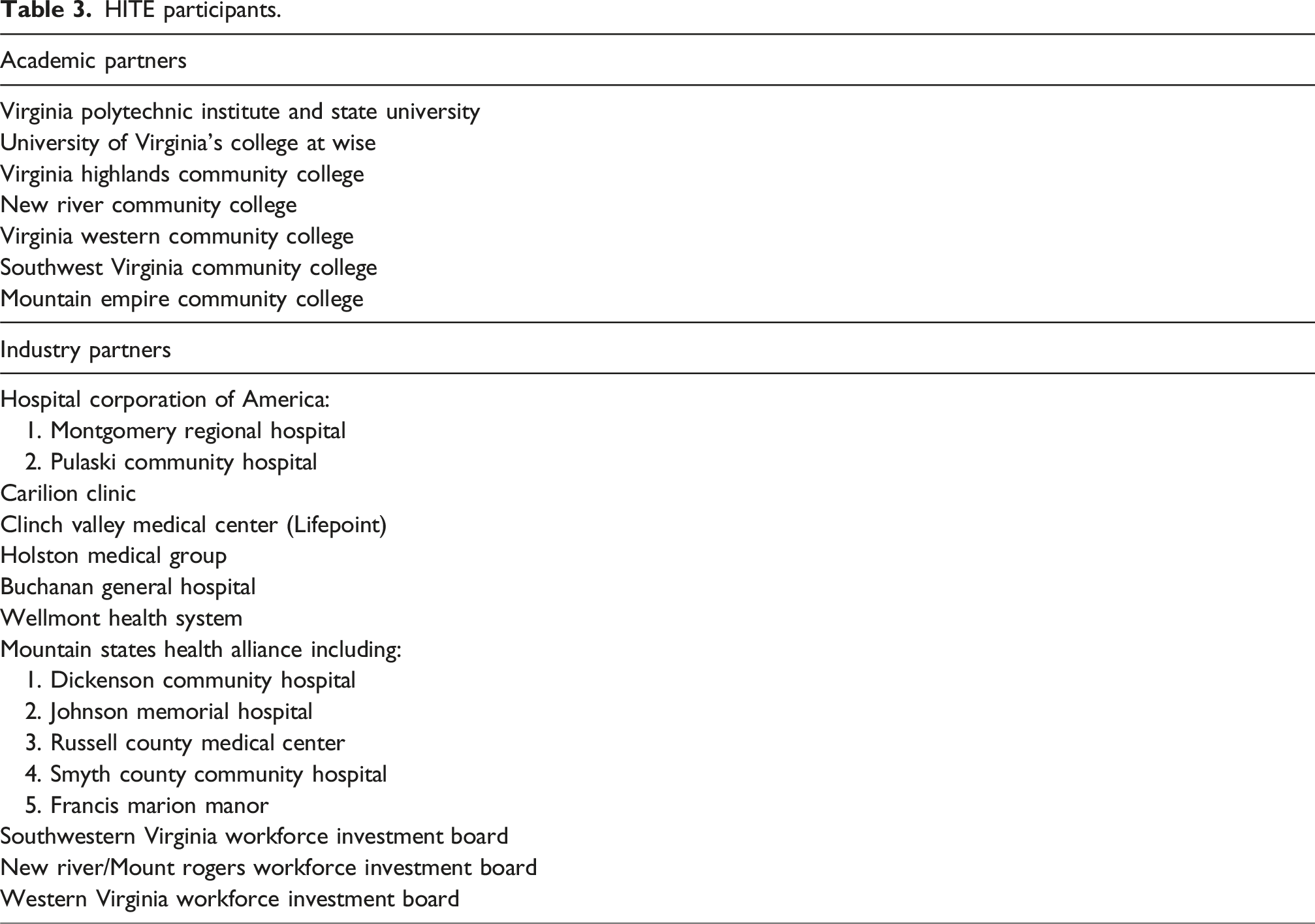
For the HITE case, data were collected from project documentation (e.g., grant materials, reports, and committee records), as well as curricular artifacts produced during the initiative (e.g., competency lists, CD-QFD matrices, and revised course materials), and discussions within the three HITE committees. Participants included faculty members from two universities and five community colleges, along with representatives from the healthcare organizations and workforce boards listed in Table 3, who collaboratively contributed to identifying competencies and reviewing the resulting CD-QFD outputs.
Stage 1: HITE Identification of competencies
The CMC began by gathering competencies through roundtable discussions with academic and industry partners, incorporating healthcare requirements and regulations. This process identified the potential needs and improvements for the academic programs related to the five targeted healthcare occupations at the five local community colleges. The identified needs, improvements, and requirements were then sorted and grouped based on commonality, with duplicate and redundant competencies removed to streamline the list.
While we cannot provide details or release all competencies from the HITE program results, examples of the identified competencies include keyboarding, emailing/attachments, search, research, navigation in Word, written/verbal communication, and troubleshooting hardware issues. The appendices that are referenced in the following discussion of Stage 2 show how these competencies were systematically mapped to associated subject areas in the HITE implementation of CD-QFD.
Stage 2: HITE implementation of CD-QFD
In Stage 2, the CD-QFD process was applied to further organize the information, ensuring that each competency was systematically mapped from subject area to topic, then to module, section, and finally to lesson objectives. This approach provided comprehensive coverage within the course delivery and course management framework. As previously noted, the hierarchy of information is significantly more intricate and involved than a simple linear structure. To illustrate this complexity, a detailed example of the HITE taxonomy is presented in Figure 7. A detailed example of the HITE taxonomy for computer skills.
In this example, the highest level of organization (the subject area) is Computer Skills. This subject area is further divided into two topic areas: (1) Security and Protection and (2) Computers and Related Devices. Focusing on the second topic area, Computers and Related Devices, it is split into two modules: (1) General Knowledge and (2) Microsoft Office Applications. Zooming in on the Microsoft Office Applications module, it is further subdivided into three sections: (1) Excel, (2) Word, and (3) PowerPoint. Within the section for Microsoft Excel, the content is organized into five lesson objectives: (1) Menu System, (2) Navigation, (3) Proofread and Edit, (4) Tables and Graphs, and (5) Formulas. This hierarchal taxonomy is emphasized in Figure 7 and highlighted with bold text.
HITE implementation of CD-QFD matrices.

The CD-QFD framework was repeatedly refined during the HITE initiative through multiple reviews of the matrices by committee members, checks for coverage and redundancy across phases, and feedback from academic and industry partners on the clarity and usefulness of the resulting course development outputs.
The HITE application highlights how the CD-QFD process supports the development and integration of healthcare IT into the curricula for five healthcare occupations. The CD-QFD process establishes a framework to summarize and map the competencies required for specific healthcare occupations to their corresponding curricula, addressing the IT needs of healthcare industry partners. This mapping enables the efficient identification and integration of new or changing competencies, ensuring they are incorporated into the affected course designs. For example, when Microsoft Excel updates its tables and graphs functionality or improves formulas that are frequently used within the healthcare IT space, the results of the HITE CD-QFD implementation (specifically, Phase 4a and Phase 4b) allow the interested parties to see that Dr Z should be notified and that modifications may be needed to HW2, the tutorial, the virtual lab, the midterm exam, and the team project. In addition, these changes apply to face-to-face instruction of module 1 at site A. It is worth noting that the successful application of the proposed framework to a complex and multifaceted industry such as healthcare demonstrates the generalizability of the method across disciplines, which scholars note as a crucial characteristic of curriculum-based research (Petitte, 2000). For example, previous literature highlights the importance of generalizable and proven curriculum frameworks, indicating that few extant studies provide curriculum development models that are both sufficiently concrete to be applicable in practice and general enough to be transferable to other disciplines (Valiente Bermejo et al., 2022).
Enhanced education is essential for driving progress and adaptation in the health informatics era, and the CD-QFD process was instrumental in supporting this transition. Howell (2012) emphasizes, “To fulfill their roles…nurses will need additional skills from technology to evidence-based research. Enhanced education will be the foundation of it all.” (p. 36). Industry partners involved in the HITE initiative responded positively to the CD-QFD process, appreciating its ability to systematically capture and organize their desired employee competencies. Additionally, the community college faculty gained a deeper understanding of the evolving healthcare industry, thanks to the clarity and structure provided by the CD-QFD model.
While the HITE implementation provided clear benefits, it also revealed some challenges important for understanding how the framework functions in practice. First, coordinating input across multiple community colleges, universities, and healthcare providers required significant effort to align different terminologies, priorities, and expectations for graduate competencies. Second, the three committees (PMC, AC, and CMC) were essential for governance but added extra layers of communication that needed careful management to keep momentum and consistency across CD-QFD phases. Third and finally, many of the participating healthcare programs already operated at full or near-full capacity, leaving limited room to incorporate newly identified digital literacy and healthcare IT competencies without displacing existing content. This raised strategic questions about whether to offer stand-alone IT courses or embed these competencies within existing offerings. In summary, these challenges highlight the need to see CD-QFD as an iterative, collaborative process requiring ongoing commitment and dialogue between industry and higher education partners.
Conclusion and future directions
Scholars acknowledge that innovative educational responses to an ever-changing industry landscape are required for schools to remain relevant and produce marketable and employable graduates (Boud and Solomon, 2007; Hurn, 2016). Previous research similarly presents initiatives to address the well-documented goal of ensuring alignment between industry and education (Dunne and Rawlins, 2000). This article presents a structured, stakeholder-driven framework, CD-QFD, that contributes to educational theory of curriculum design by formalizing the incorporation of stakeholder input and needs into development of courses that prepare students to thrive in post-graduate careers.
The current work bridges the gap between industry and academia by proposing an application of a proven industry process (QFD) adapted to higher education. We provide a novel, systematic adaptation of QFD to the education context and provide an alternative or supplement to other curriculum design approaches. CD-QFD provides course designers a way to analytically promote industry-academia alignment during curriculum development. This work thus brings to light the potential insights to be gained through the recognition of the role of industry and academic partnerships beyond classroom endeavors such as guest speakers or consulting projects. In doing so, CD-QFD offers a model that can be replicated in a way that meaningfully aligns competency identification and course components and strengthens the theoretical basis and practical execution of curriculum design.
Instead, we suggest that there is an opportunity to harness industry best practices in a curriculum development capacity that begins with the educator. The current work answers this call as well as the ongoing goal of merging industry and academia to focus on optimizing the needs of stakeholders including graduates seeking roles and the industry firms seeking to fill roles with skilled and competent graduates. Practically, the CD-QFD model provides program leaders and educators with a versatile and discipline-agnostic process that allows continual integration of competencies while preserving instructional quality.
Specifically, this article presents a method for adapting the classic QFD process from manufacturing to create a streamlined and systematic approach for enhancing course development in continuing education, structured training programs, and higher education contexts. Our model theoretically extends QFD principles from manufacturing to the pedagogy context by clarifying how to operationalize stakeholder “voices” in a practical way that does not require complete program redesign. The proposed CD-QFD process leverages insights from both internal and external sources to identify curriculum and course requirements (i.e., competencies) and employs a series of interconnected matrices to establish course delivery and course management protocols based on these competencies. The article details how the CD-QFD process can refine competencies into specific subject areas and related topics, modules and sections, and ultimately lesson objectives.
To illustrate the use of the CD-QFD process, we include a case study from the HITE initiative, which employed CD-QFD to ensure digital literacy among healthcare professionals. In considering this example, natural avenues for extending this research stream become evident. Future work should test CD-QFD beyond the healthcare setting. Industries and programs that would benefit from piloting the use of the CD-QFD model include, but are not limited to, the following: business analytics, engineering, information systems and technology, teacher education, and workforce reskilling. Meaningful contributions can be highlighted through longitudinal studies that track the impacts that incorporating this model has over time on competencies and learning outcomes as well as other factors such as graduate employability. Other interesting avenues for extending our research include conducting comparative experiments that contrast CD-QFD to traditional course design processes with respect to factors such as student performance, efficiency of instruction, and stakeholder feedback or satisfaction. For example, future studies could examine the degree to which curricula need to adapt to address the competencies identified through the CD-QFD process. While implementing the findings from the CD-QFD phases is the logical next step, this may pose challenges for certain industries and programs.
Looking back to the healthcare example, the curriculum under review was already packed with required material prior to the HITE initiative’s usage of CD-QFD. This raises critical questions: How can new subject areas and topics be integrated into an already full program? Should nursing programs add stand-alone IT courses, or should IT content be incorporated into existing courses? Addressing these questions represents two important directions for future research to advance the application and impact of the CD-QFD process.
Supplemental material
Supplemental material - Introducing CD-QFD: Using quality function deployment to improve course development
Supplemental material for Introducing CD-QFD: Using quality function deployment to improve course development by Megan Wydick Martin, Kevin D Matthews, and Lisa Monahan in Industry and Higher Education.
Footnotes

Ethical considerations
This article does not contain any studies with human or animal participants.
Funding
The authors disclosed receipt of the following financial support for the research, authorship, and/or publication of this article: This work is supported by the Department of Human and Health Services under the grant titled Exploratory and Development Grant to Improve Health Care Quality through Health Information Technology (FOA #: PA-14-001) with a portion of the funding allocated to regional implementation titled Health Information Technology Education.
Declaration of conflicting interests
The authors declared no potential conflicts of interest with respect to the research, authorship, and/or publication of this article.
Data Availability Statement
The data supporting the findings of this study are subject to restrictions and are not publicly available. However, access to certain portions of the data may be granted on a case-by-case basis.
Supplemental material
Supplemental material for this article is available online.
References
Supplementary Material
Please find the following supplemental material available below.
For Open Access articles published under a Creative Commons License, all supplemental material carries the same license as the article it is associated with.
For non-Open Access articles published, all supplemental material carries a non-exclusive license, and permission requests for re-use of supplemental material or any part of supplemental material shall be sent directly to the copyright owner as specified in the copyright notice associated with the article.
