







Abstract
The research emphasizes the role of technology scouting and innovation behaviors in the development of the startup ecosystem and in the innovative development of companies and nations. The importance of these factors in relationships between universities and industry is highlighted. The authors consider technology scouting as one of the functions of innovation intermediaries and focus on the concept of innovation intermediary. The study is based on interviews with university and industry representatives to identify barriers in the interaction between the parties (some interviews are made as references). The main barriers in the interaction with universities and industry were noted as differences in goals and key performance indicators, commercialization issues, and bureaucracy. In order to fix these barriers, both sides are supposed to communicate more and make use of high-quality third-party services. Respondents from both industry and university side described the difficulties caused by these barriers.
Keywords
Introduction
Development of the country in the modern world is directly dependent on innovation in all spheres (Carayannis and Campbell, 2006). The political, economic, social and climatic instability of the world encourages states to become independent in all areas of the economy. For this purpose, governments take actions which allow the successful development of innovations and successful commercialization to meet the needs of the national economy. The development of the start-up ecosystem is of particular importance in this context.
The startup ecosystem is a complex system that consists of a large number of actors like servicers, investors, innovators etc. Startup ecosystem is described as a network of actors in which each actor contributes to the development of the ecosystem. University and industry play an important role in the development of the startup ecosystem.
The innovative development of the state is a complex task. Successful innovative development of the state depends on the actions of each actor in the economy, including the state and public funds, universities and research centres, industry and R&D centres of industrial players, innovation intermediaries at all levels, etc. All these players form an ecosystem. The quality of the actions of these players contributes to the development of the ecosystem and characterizes the degree of ecosystem development.
Motivation to research university and industry collaborations stems from the recognition that these partnerships are instrumental in fostering innovation and driving economic development. The collaboration between universities and industries brings together academic knowledge and research capabilities with the practical experience and resources of businesses. This synergy enhances the potential for groundbreaking discoveries, technological advancements, and the successful commercialization of innovations.
A key motivation for such collaborations is the realization that universities are often hubs of cutting-edge research and intellectual capital (Nawaz and Koç, 2020). By partnering with industries, these academic institutions can transfer their research findings into practical applications, products or services that address real-world challenges. Industry, in turn, gains access to the latest advancements and a pool of talented researchers and students who can con tribute fresh perspectives to problem-solving.
Moreover, the collaborative efforts between universities and industries can lead to a more skilled and adaptable workforce. The exposure of students to real-world industry challenges through internships, collaborative projects or joint research initiatives prepares them for the demands of the modern job market. This integration of academic learning with practical experience fosters a culture of innovation and entrepreneurship among students.
Context specificity is a crucial aspect in understanding the dynamics of university and industry collaborations (Perissi et al., 2010). Each region or country has its unique economic, social, and cultural context, which influences the nature and focus of collaborative initiatives. Tailoring collaborations to the specific needs and strengths of a particular context enhances the relevance and effectiveness of these partnerships. For example, industries in a region with a strong focus on renewable energy might collaborate with local universities to develop innovative solutions in that specific domain.
Emerging markets can be an interesting framework for studying university-industry collaboration (UIC) since, at times, they possess different institutional structures, market dynamics, and degrees of technological development from developed countries. With their increasing contributions to the global economy still fairly untapped, there is a lack of proper research of the contexts and especially regarding technology transfer and startup ecosystem development. This gap paves room for the more comprehensive type of studies which can be used for the development of both theory and practice.
Previous research to a large extent has concerned with developed economies whose robust institutional frameworks provide for various institutions that are well established and which cement the clear pathways for UIC. On the other side, some emerging markets could be characterized by a situation where approaches to UIC which are widely accepted in developed countries might not be applicable or could have to be modified to fit the local environment. For example, policy frameworks, IPRs and government involvement, among many other factors, might differ across emerging markets, which in turn, can create differences in performance (Madani and Khormaei, 2013; Şendoğdu and Diken, 2013).
For instance, the researches by Hafkesbrink et al. (2010) try to make sense of the fact that the context matters when it comes to emerging economies, which might have technology scouting and open innovation processes, dissimilar to an established economy. While the rate of technological innovation and market change is the highest in emerging economies, the flexibility and speed of both universities and industries in these markets can constitute a strong side as well as a limitation to tight relationship establishment.
However, in emerging markets, the intermediaries’ role could have been more pronounced as the bridging of institutional voids and facilitating connections between educational institutions and industries (Bendis et al., 2008). The ability to overcome local contexts and to develop relationships between the parties of this ecosystem, from investors to startups, is the factor that often underlies the success of these intermediaries.
Considering the aforementioned factors, there is undoubtedly a need for more research that is dedicated to analyzing them in detail in the specific context of the fast-developing markets such as China and Russia. For example, these studies can evaluate how local circumstances determine the phenomena and consequences of technology transfer, the establishment of startup ecosystems and the functions of innovation intermediaries. It is possible to do the research that studies and makes a comparison of the experiences of several emerging markets in order to see if there are common patterns or distinct differences, as this deepens our knowledge of UIC in a diversity of circumstances.
The goal of the research is to identify the main barriers in university-industry collaboration (UIC) and the main collaboration mechanisms between university and industry players. The main tool for interaction is considered to be the use of the experience of innovation intermediaries in establishing interaction between the actors of the economy.
Based on the analysis of the literature it is possible to highlight the lack of research on the role of a technology scouting in the development of the Russian startup ecosystem and the consideration of technology scouting as a tool for the development of the startup ecosystem. The lack of research devoted to the potential barriers for the effective university-industry collaboration in Russia is recognized. Therefore, we formulated the following research questions. (1) What are the barriers in technology transfer process for university side and industry side on Chinese and Russian markets? (2) What are the main mechanisms used by the university and industry for collaboration and technology commercialization on Chinese and Russian markets? (3) What role intermediaries play in technology transfer in university-industry collaboration in China and Russia?
The data is collected with the support of the Association of Brokers of Innovation and Technology (ABIT Russia) and International Technology Transfer Network (ITTN China).
The paper starts with the review of the theoretical basis devoted to startup ecosystems, technology scouting, university role and industry (business) role in startup ecosystem.
The Methodology part includes description of qualitative-based research design and data collection techniques, as well as methods of data analysis.
The next chapter is devoted to the findings, insights, and theoretical and practical implications.
The Discussion chapter concentrates in general discussion of the startup ecosystem development and consideration of Russian and Chinese institutes and companies of the innovation ecosystem development.
Review of literature
The sustainable development of the modern economy in any country of the world depends on innovations and on the long-term influence of these innovations. Present economic systems of the most progressive countries are supported by constantly developing innovations from startups. Therefore, development of the economy of the countries and cities around the globe rely on fostering entrepreneurship, which has basically become a primary component (Andersson and Henrekson, 2015). The importance of providing evolutive environment for startups and overall entrepreneurship increases nowadays (Szarek and Piecuch, 2018).
Startup ecosystems actors
The environment could be defined as an ecosystem, which “is a form of dynamic and self-regulating network of many different types of actors” 1 . Startup ecosystem is a type of dynamic and self-regulating network which consists of different stakeholders including entrepreneurs, investors, startup companies, universities, government, research organizations and funding organizations (Startup Commons, 2016).
The startup ecosystem participants do not interact between each other simultaneously under one structure or a system. Ecosystem stakeholders cooperate and design different mechanisms at different levels which on a basic level could be presented in a form of helices (König et al., 2020). The main purpose of the helices is a creation of innovative products or services through knowledge sharing and expanding the capacity of the ecosystem using each participant’s best practices and tools.
The Triple Helix model first was proposed by Etzkowitz and Leydesdorff (1995) to explain the interactions between three actors: government, academia and industry (business). The model has become a well-known and popular concept in innovation studies. However, particular explanatory characteristics have been challenged by scholars. Scholars Shinn (2002), Viale and Pozzali (2010) pointed to the lack of a solid theoretical foundation. Limited Explanatory power of the model highlighted by Brundin et al. (2008), Giuliani and Arza (2009) and Tuunainen (2002). On the other hand, the model was generalised in order to apply in a broad variety of cultures, contexts and systems (Cai and Etzkowitz, 2020).
Etzkowitz and Leydesdorff (2000) state that the main, initial role of the universities is to serve as an education provider and to work on basic research. The results of interaction between university and industry are new products and innovation based on the knowledge and basic research. Additional point in interactions is a transfer of knowledge when industry managers and university departments work for both sides. At this point the university-industry connections make possible the “capitalizations of knowledge” through direct implication in real challenges of the industry.
The interactions of the university and government basically depends on the politics and regulatory factors of the government toward education (academia in our case). The helix models of the Etzkowitz and Leydesdorff (2000) consider that the universities could be partially independent of government and the concentrations on particular spheres of the economy is fully the decision of the university’s authorities. On the other hand, the government could heavily support strategically important spheres like physics, chemistry and aircraft departments of the universities.
Industry-government connection and interactions highly depends on the government’s position toward the industry (market). Government classic role as a regulatory source and instance expands in the modern economy.
Kimatu (2016) states that government-university interactions provide opportunities of funding from the government and developing decisions for strategic demands satisfaction. University-industry interactions provide an opportunity to create new products and ideas and some of them could be innovative ones. Industry and government cooperation results in jobs created and taxes paid by industry as well as infrastructure and legislative baseline developed for industry by government.
On the other hand, author presented following weaknesses of the Triple Helix model: firstly, rising phenomena in social interactions are not explicit in the Triple Helix model; secondly, Triple Helix model does not clarify the interactions between secondary actors of the innovation process; thirdly, civic engagement is not distinctly defined; fourthly, theoretical baseline devoted to global dimension is not well elaborated.
Ranga and Etzkowitz (2013) state that the main relationships in the Triple Helix model are following: collaborative leadership; the transfer of technologies; cooperation and conflict resolution; networking and substitution of particular functions.
The considered models are the baselines for the creation of the entrepreneurial ecosystem, where innovation is placed in the priority position and knowledge considered as a source of the innovation.
While the traditional Triple Helix model conceptualizes innovation as interactions between universities, industry, and government (Etzkowitz and Leydesdorff, 2000), more recent research has extended this framework to include broader societal and environmental dimensions. The Quadruple Helix model incorporates civil society and media-based publics as additional actors, emphasizing user-driven innovation and knowledge co-creation processes (Carayannis and Campbell, 2009). Further theoretical development led to the Quintuple Helix model, which integrates environmental sustainability as a core component of innovation systems, highlighting the role of ecological considerations in knowledge production and innovation governance (Carayannis et al., 2012). These extended models provide a more comprehensive analytical framework for understanding university-industry collaboration within complex entrepreneurial ecosystems, particularly in emerging economies where institutional and societal dynamics significantly influence innovation processes.
Factors of startup ecosystem success
Startup ecosystems include actors/stakeholders which are described in the helix models. The quality and coordination of actions between these stakeholders highly affect startup ecosystems quality and the probability of startup success. Scholars consider several determinants of the startup ecosystem which include the following points.
First, education and research which are basically the availability of the knowledge for startup companies. According to Martin et al. (2013) meta-analysis, business performance and entrepreneurship education are connected with each other (Martin et al., 2013). Among other factors which contribute to the startup success scholars additionally highlight education and, particularly, startup business training (Jo and Lee, 1996). Different surveys among entrepreneurs reflected the importance of entrepreneurial education and its contribution to business success (McMullan and Gillin, 1998). Startups with greater access to knowledge are in a more favorable position and more probable to survive Helfat and Lieberman (2002). According to the Robinson and Sexton (1994) general education has a more significant influence on the success of a new venture. The paper by Allen W. and Hall T. explored the views of 100 new coming founders which reflected that young entrepreneurs with higher education “comparatively more engaged in innovative activities” (Allen and Hall, 2008). Scholars in the paper also highlight the increased accessibility of venture capital. Nevertheless, scholars state that knowledge alone is not enough to create innovation (Anderson and Li, 2014).
Second important determinant of the startup ecosystem is human capital. Research of Israeli startups conducted by Chorev and Anderson (2006) indicated that choosing the right human resources is among the most important factors of success. Meta-analysis conducted by Unger J. and other scholars (2013) describes the positive effect of the startup founders’ skills and the company team to its success (Unger et al., 2011).
Third determinant is finance and funding of startups. New ventures most of the time encounter funding difficulties and have limited cash flows in early stages (Binks and Ennew, 1996). Accessibility of investments is a crucial factor for startup ecosystem development, even if we consider more mature companies.
Venture capital plays a crucial role in startup ecosystem development and its impact on innovation activities and if the startups success would have long-term nature nature (Arvanitis and Stucki, 2014). Pratch L. and colleagues consider venture funds affect through following key mechanisms: venture funds directly invest in projects (finance injection); venture companies act as intermediaries between startups and other financing institutes; management skills, experience and expertise are available for startups which cooperate with funds (Dimov and De Clercq, 2006; Pratch, 2005). Angel investors are among main sources of startups funding on early stages. Availability of these funding sources increases the level of startup ecosystem development.
The fourth determinant is government participation in the development of the startup ecosystem. The government can contribute to the development of the ecosystem both through regulatory changes and through participation in the riskiest industries (Mazzucato, 2011). A certain part of industries will lag behind in development due to high risk. The role of the state in this case is to mitigate risk by participating in the ecosystem. The example of Silicon Valley shows the importance of the governmental support programs in the development of innovation centers, which in the future will be the one of the bases of the startup ecosystem (Wonglimpiyarat, 2006). Participation of state structures in startup ecosystem development accompanies bureaucracy on different levels. Therefore, government contribution could be higher if the bureaucratic barriers are eliminated (Wang and Wong, 2004).
The fifth determinant of startup ecosystem development is business support and connectedness of stakeholders. Scholars mention the importance of entrepreneurs’ network quality and the importance of relationship development with various organisations and institutions (Lechner and Dowling, 2003; Walter et al., 2006). Recent research conducted by Huang C., Lai M. and Lo K. indicated the importance of business networks and their impact on startup innovation and performance (Huang et al., 2012).
Ziakis C. and colleagues consider entrepreneurial culture and incentives for startup creation as the sixth determinant of entrepreneurial ecosystem development (Ziakis et al., 2022). Social context around the entrepreneurs and attitude toward risk in society around the entrepreneurs has an impact on startup ecosystem development.
University-industry collaboration
University-industry collaboration is a crucial aspect of the startup ecosystem, contributing significantly to innovation and knowledge transfer. Several studies have explored the dynamics and impact of collaboration between universities and industries. The literature on the specifics of university-industry collaboration focused on several aspects, including knowledge transfer and innovation, factors influencing collaboration and most common barriers.
Etzkowitz and Leydesdorff’s seminal work delves into the evolving role of the university as an entrepreneurial entity. They emphasize the critical role played by universities in facilitating knowledge transfer between academia and industry. The conceptualization of the “entrepreneurial university” underscores the changing landscape where universities actively contribute to the innovation ecosystem. The article sets the stage for understanding the university’s dynamic role beyond traditional academic pursuits (Etzkowitz, H., & Leydesdorff, L.,2000).
Chesbrough’s work introduces the influential concept of “Open Innovation.” Emphasizing the significance of external knowledge, including that sourced from universities, Chesbrough argues for a more collaborative and open approach to innovation. The article provides a framework that challenges the traditional closed innovation model, encouraging firms to tap into external expertise. It underscores the transformative potential of collaboration with universities in driving innovation within corporate environments (Chesbrough, 2003a).
In the Open Innovation (OI) model introduced by Chesbrough (2003b), the role and form of the collaboration between universities and industries are much improved. The model gives the essence of how corporations can use the knowledge from university as a critical cofactor for innovation. For instance, Laursen and Salter (2004)consider how firms that make good use of knowledge sources from varied sources, such as academic institutions, have shown to be highly innovative. Along with this, Perkmann et al. (2013) give an example of the commercialization of academic research through open innovation arrangements, highlighting the fact that organizational boundaries can serve as transfer barriers when it comes to knowledge transfer. As highlighted by White et al. (2004) networks are a vital part of the innovation pipeline and provided opportunities to industrial enterprises to outperform their competitors. The study of Belderbos et al. (2014) reveals that companies with high absorptive capacity are more likely to participate in university networks and their research is more integrated into their R and D strategies. Together, these research continue to support Chesbrough’s assertion that, using open innovation, one can develop the necessary culture in which useful flows of information or knowledge encourage dynamic innovation ecosystem.
Perkmann and Walsh contribute to the understanding of university-industry collaboration by examining the factors that influence its success. The study identifies key drivers, including proximity, research quality, and organizational support. Proximity is highlighted as a crucial factor, emphasizing the importance of physical closeness in fostering collaboration. Additionally, the research quality of the university and supportive organizational structures emerge as pivotal determinants in shaping effective partnerships (Perkmann and Walsh, 2008).
Bozeman and Boardman’s study explores the impact of research collaboration networks and institutional support on the outcomes of university-industry partnerships. By investigating the broader network dynamics and the role of institutional backing, the authors provide insights into the complex interplay of factors that contribute to successful collaborations. Their work underscores the need for strategic planning and institutional facilitation to enhance the overall effectiveness of university-industry partnerships (Bozeman and Boardman, 2014).
Addressing the challenges in university-industry collaboration, Link and Scott identify barriers such as intellectual property concerns, conflicting goals, and differences in organizational culture. The article sheds light on the complexities inherent in aligning academic and industrial objectives. It serves as a valuable resource for understanding the hurdles that organizations must navigate to establish and maintain successful collaborations (Link and Scott, 2005).
Mowery and Sampat’s work focuses on the management of intellectual property rights and technology transfer in university-industry collaborations. By exploring issues related to the ownership and commercialization of research outputs, the article offers critical insights into the legal and strategic challenges that can impede effective collaboration. Understanding and addressing these barriers are essential for fostering a conducive environment for knowledge transfer and innovation (Mowery and Sampat, 2004).
In conclusion, existing literature on university-industry collaboration (UIC) shows a complicated perspective in blend of academic research and practical usage in industry. Various researches look at the entrepreneurial transition in universities, explore the transformative role that universities now play in launching co-creation initiatives and driving innovation. The drivers of UIC, including institutional policies, organizational culture as well as the economic external factors, have been recognized as being the major issues in the success of the latter.
The obstacles include the topics such as the intellectual property management, the divergent goal’s, and the communication gaps which need to be carefully dealt with. Whereby this set of research has created a foundation for understanding the intricacies of UIC, a space for further research remains somewhat wider, especially in the case of emerging economies. This research is intended to focus on those unique features and thus elucidate new concepts regarding the internal workings and operations of UIC within the idiosyncratic economic and cultural backgrounds of China and Russia. It plans to expose certain practices and techniques which primarily contribute to technology transfer and commercialization of the regions which may lead to the formulation of a more competent version of the existing standpoint of UIC framework theory.
University-based business incubators represent critical components of entrepreneurial ecosystems by supporting early-stage technology commercialization and facilitating collaboration between academic researchers and industry actors. Business incubators provide infrastructure, mentoring, and access to networks that reduce barriers to innovation transfer and enhance entrepreneurial activity within university contexts. Within entrepreneurial ecosystems, incubators function as innovation intermediaries that bridge institutional gaps between academia and industry, supporting knowledge translation and commercialization processes (Mian et al., 2016; Phan et al., 2005).
Recent research emphasizes that entrepreneurial ecosystems rely on interconnected actors including universities, startups, investors, and intermediary organizations. Business incubators contribute to ecosystem development by aligning academic research outputs with market needs and enabling collaborative innovation dynamics.
Methodology
This study is based on a semi-structured interviews with a list of open-ended questions (see Appendix). Open-ended questions have a logical structure that covers topics related to the barriers of interaction between university and industry, mechanisms of university-industry collaboration and the roll of intermediary agencies in the collaboration of university and industry.
The China’s and Russia’s role in the area of emerging markets is also very big with their great control in global economic movement and innovation (Khanna et al., 2015). The basis of China’s rapid climb as an innovation world leader lies in its strategic vision of enhancing the cooperation between universities and industry (UIC), which are the backbone of the country’s overarching mission of tech self-sufficiency (Cao, 2019). These partners are backed up with the appropriate government policies aimed at developing a startup ecosystem that is evidence-oriented and conducive to translational research.
Russia’s embodiment paints a radically different setting, but it is not less educational. Facing the international sanctions, the country which is forced to discover other methods of ensuring the sustainable progress (Trani and Holsworth, 2010). Thus, Russian universities are considered to be more and more relevant nodes where innovation is born and which can be used by industries as pillars. This reorientation of specialization towards knowledge for cutting-edge technologies parallels the broader trend in emerging markets that view UIC as a significant generator of innovation, particularly during economic difficulty.
Primary social and economic features of China and Russia serve as grounds for the particular investigation of national varieties of UIC in an emerging marketplace (Bilel, 2023).
This research therefore aims to investigate the insights on how the UIC operates under the diversity of condition of government support, market freedom, and international relations by focusing on these two countries. It is expected as the research will present in details the main mechanisms, barriers, as well as facilitators of UIC, a refined theoretical and practical framework targeted for other economies emerging with similar scenarios is possible to establish.
The information derived may become basis of strategy making by the policymakers, educators, and business leaders for exploiting and promoting the benefits of UIC for the development of an advanced economy and technology.
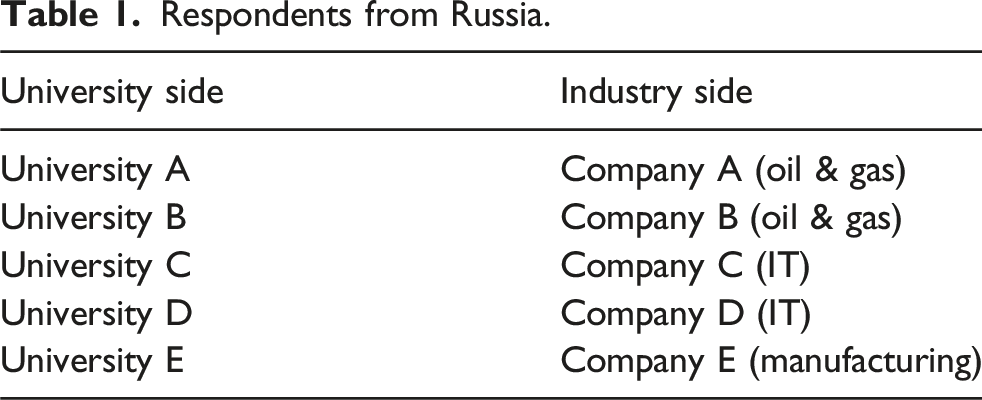
Respondents from Russia.
Respondents from China.
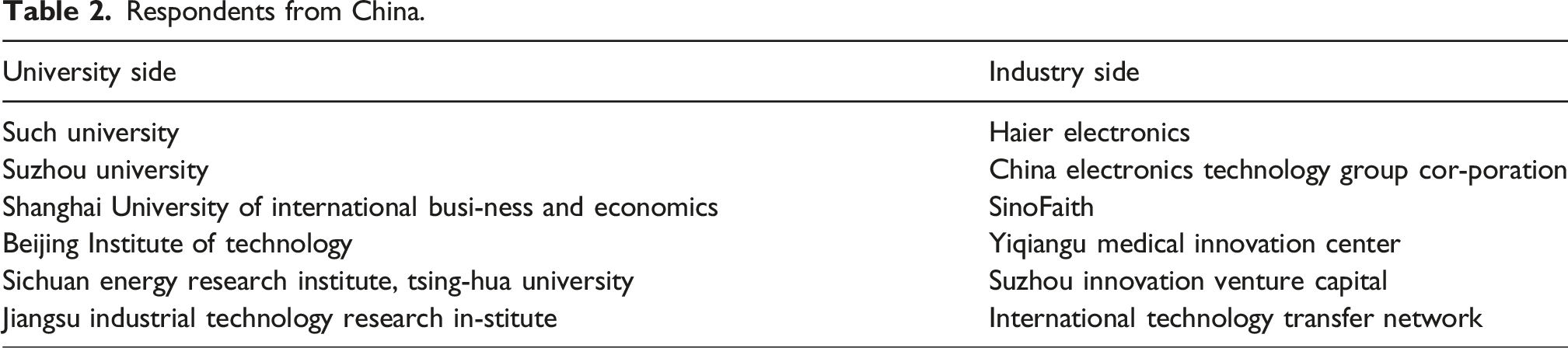
The respondents from the company side are of mid to high level managements in innovation or investment department, from the university side, they are working in technology commercialization department or technology transfer office of the university. Interviews conducted in online or offline (in person format) in Chinese and Russian. Each interview lasted for 20-40 minutes. In total, we gathered 30 pages of interview transcript from Russian respondents, and 35 pages from Chinese respondents.
Data analysis
The data collected for this study analyzed from two aspects: from the university and industry side as well as from different contextual aspects on country level of China and Russia.
The current research uses both content and thematic analysis as a qualitative approach adopted from the semi-structured interviews to get a holistic understanding of the qualitative data. Qualitative study discovers the number of crucial terms and phrases which are related to university and industry collaboration in line with the obstacles, channels, and intermediaries. It is also of help in recognizing the pattern of data provided and comparing the data between the Russian and Chinese responses.
Additionally, the thematic analysis is also employed in order to study the qualitative part of the data in detail. This method is based on identifying, analyzing, and reporting the prevalent themes in the data and this, in turn, helps to capture the range of thought as well as the complexities of subjects’ perspectives. In the end, content analysis delivers a qualitative distribution of often-repeated words and phrases, while theme analysis results in a qualitative interpretation of what the stories reflect on.
By combining the approaches of material identification and the analysis of the content, the research aims to achieve a comprehensive understanding of the driving factors of university-industry collaboration within specific countries of China and Russia. It gives the researcher an opportunity to study both the explicit and implicit sides of the problem, thus leading to more enriched research and also giving a nuanced description to the topic.
Findings
Analysis of the interviews content shows three aspects that answered the three research questions, which are: the main barriers in the interactions between university and industry; the mechanisms used by university side and industrial side for collaboration; the role of intermediary agencies in the collaboration of university and industry. In this work, we are summarizing the interviews from four different sides, that are the Chinese university and institute side, Chinese industry side, Russian university and institute side and the Russian industry side, to discuss the commonalities and differences between them.
University and institute side from China
As the representatives interviewed from the university and institute side of China are from technology commercialization department, they are familiar and experienced in the process of technology commercialization.
Data shows that the respondents from university side think conflict of interests and different understanding of the goals of the collaboration as well as mismatched research direction and product and the readiness of the technology with the market needs are two major barriers in the interaction between university and industry. As respondent 1 from university A said: “…sometimes there are conflict of interest and mismatched goals when cooperating with the industry…”, in the meanwhile respondent 4 from university D said: “...differences in the goal and cooperation mechanism between us and the industry usually cause miscommunication and low productivity…”. Respondent 3 from university C said: “…to be honest, sometimes it’s really difficult to work with the industry, because they are looking for technology that can bring direct income, and our research might be too advanced for them…” showed mismatched technology readiness and market needs, as respondent 2 from university B also points out: “...obstacles our university faces when working with the industry usually consist of the mismatch of research direction and market needs and the low technology readiness level for industrialization…”. Respondent 5 from institute E also points out: “...there are difficulties...including sometimes misunderstanding of the application of new technology…”. Other barriers mentioned by the respondents can be summarized as: intellectual property rights in R&D projects as respondent 6 from institute F said: “...sometimes there will also be differences with the industrial partner on the belonging and sharing of an IP or its protection, these kind of sensitive problem…”
University and institute side from China.
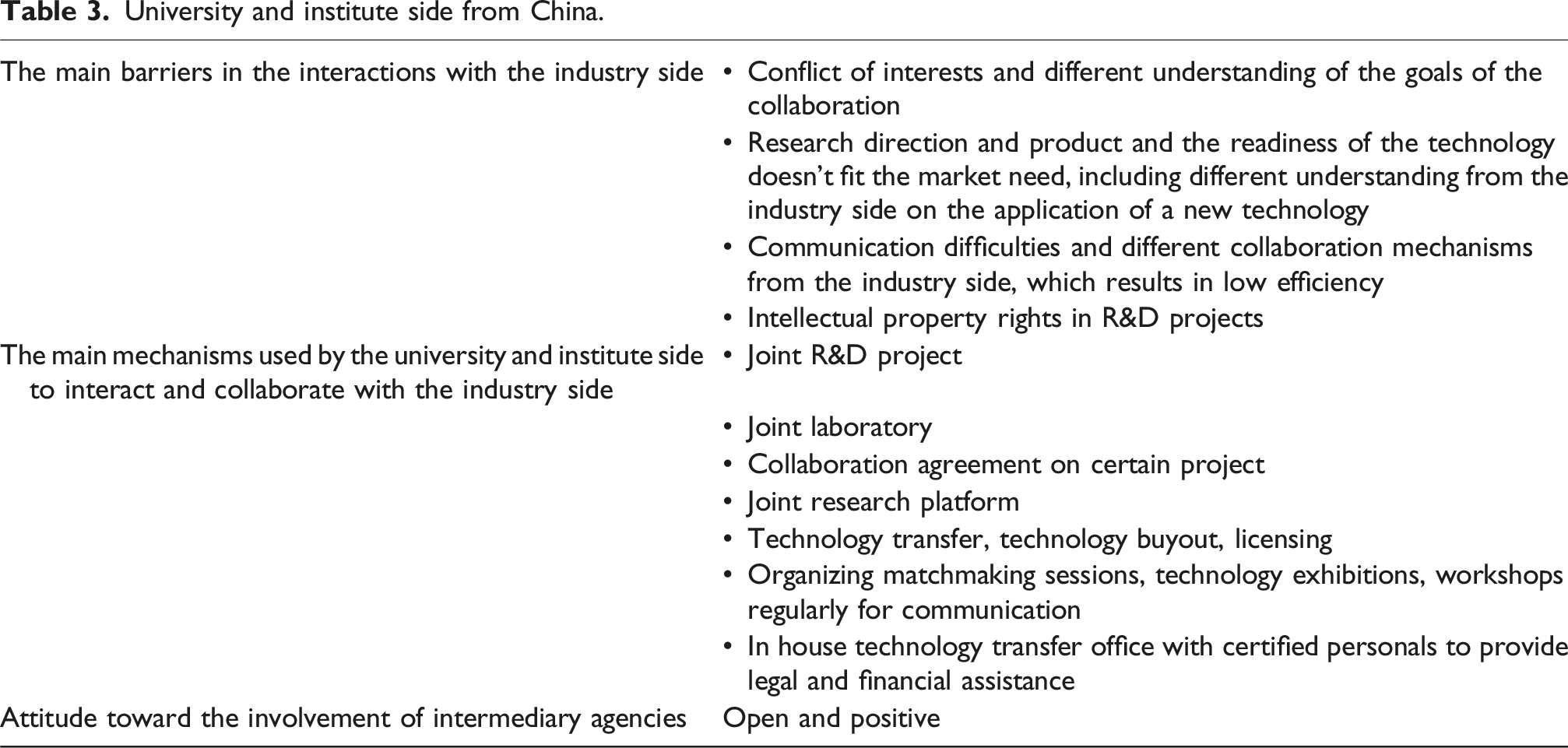
All the representatives of university and institute expressed open and positive attitude toward the involvement of intermediary agencies in the collaboration with the industry side, as intermediaries act as a bridge that can close the gap between the university and industry side while they also would be able to provide additional expert services such as legal or financial assistance. Though as the same time, most of the university representatives also expressed caution on choosing the qualified intermediary to cooperate with, in fear of the intermediary’s competency and credibility.
Industry side from China
Respondents from the industry side of the companies that was interviewed are in the innovation or investment department, wherein they understand the internal and external innovation process of the company.
Industry side from China.
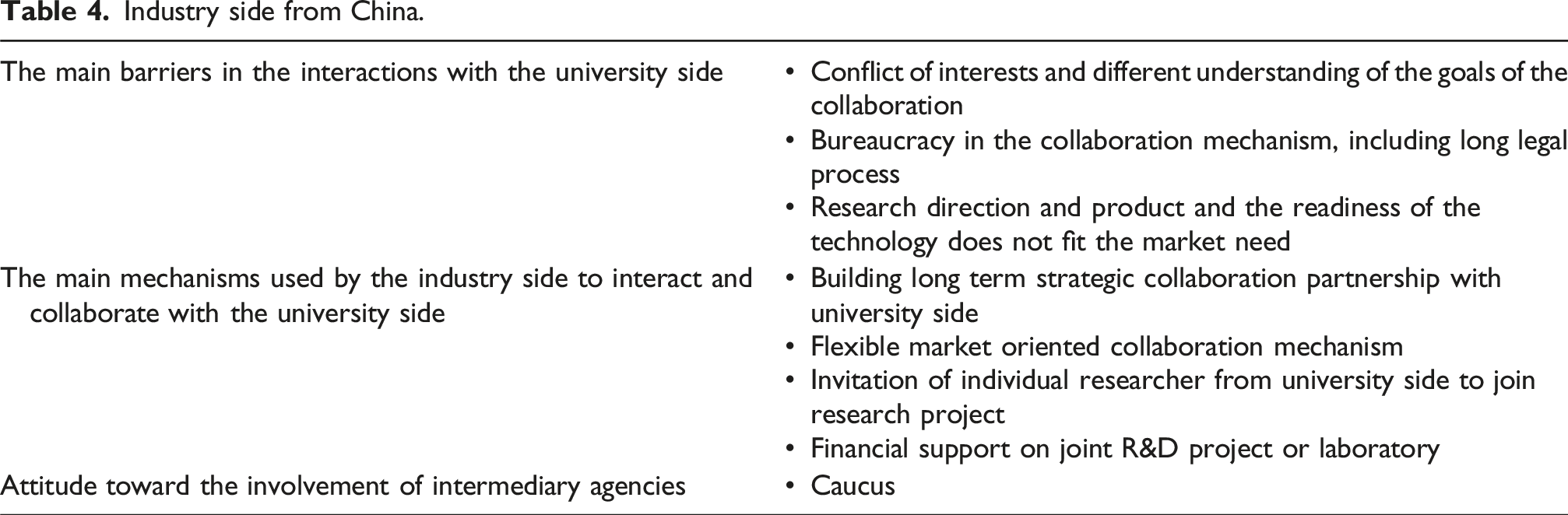
Data indicates that the mechanisms industry uses to collaborate with the university side varies from the university’s. They “...prefer working under a strategic collaboration partner structure with the university which means we will build a long term, stable strategic cooperation with the university…” (respondent 1, company A). Some of them “...are usually flexible when working with universities, so that we are more focused on market demand and commercialization…” (respondent 2, company B). One of the respondents points out that they generally work with universities more on a human resource level, since they “...invite researchers to join our projects to help us solve critical problem…” (respondent 3, company C). Other respondent stated: “...we will provide financial support and join in R&D, market research and business model building to make sure the product enters the market quickly and the return of our investment is good…” (respondent 4, company D).
The representatives from the industry side are more caucus on using intermediary in their collaboration with the university side than the university representatives. Only when the resource and the expertise of the intermediary is clearly needed, and the qualification and reputation of the intermediary proved, then would they are willing to collaborate with intermediary.
University and institute side from Russia
University and institute side from Russia.
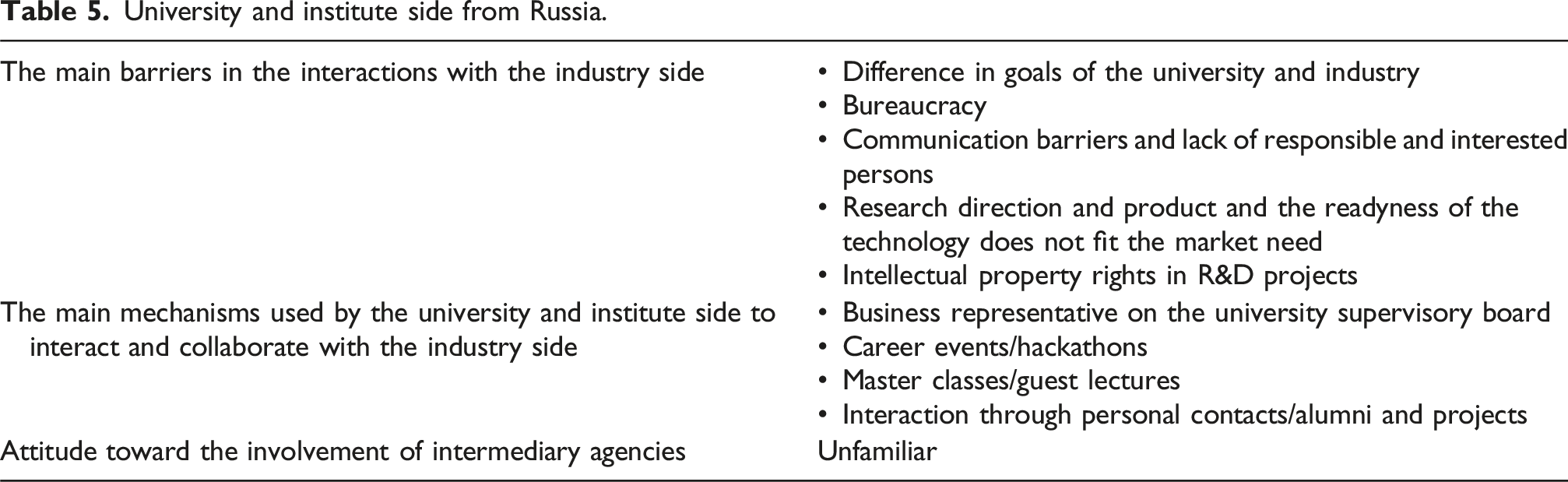
Mismatched research direction and market needs and dispute on IP right are other barriers stated by respondent 4 from university D as they point out: “...university cannot change educational program as fast as industry changes and basically cannot meet the needs of industry as fast as it required by industry needs...besides, there is always dispute on intellectual property rights”.
Data shows that Russian university collaborate with industry more on the educational and human resource capacity. One of the universities has “...business representative on the university supervisory board…” (respondent 1, university A), some of the universities “...regularly organize career events or hackathons with industrial partners…” (respondent 3, university C), “...other educational program includes master classes and guest lectures for corporate partners…” (respondent 4, university D). Other collaboration might be on a personal level, as respondent 5 from university E points out: “...some of our projects are connected through personal contacts or using alumni network…”.
The respondents from Russian university and institute expressed the lack of use of the intermediary in their collaboration with the industry side. Some raised the question of needing an intermediary party to the university, but did not bare any result. For some representative, individual experts were hired, although the result was not significant.
Industry side from Russia
Industry side from Russia.
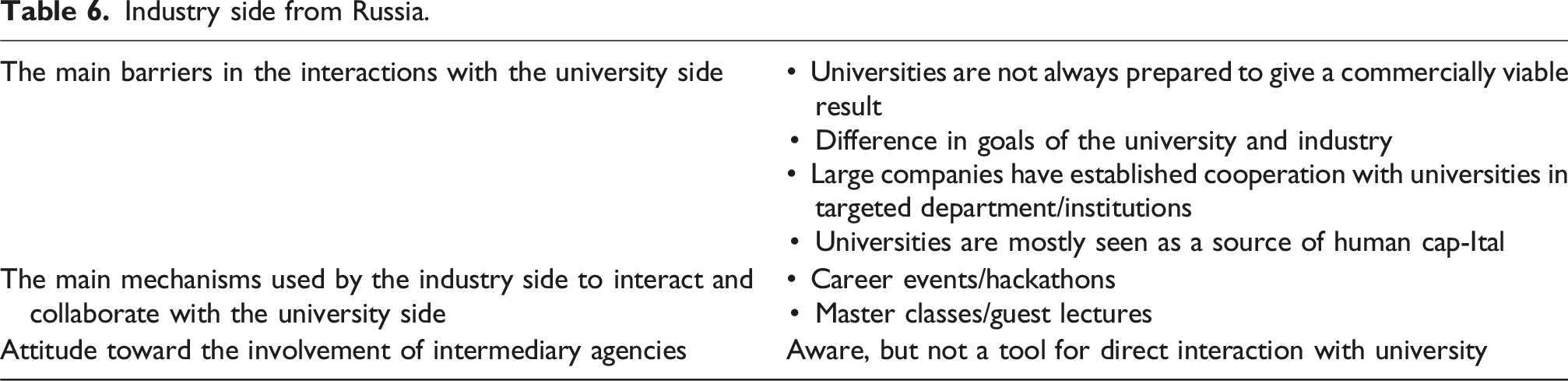
Methods of cooperation with universities from the industry side are limited and dependent on the initiative of the university. Respondent 2 from company B points out: “...we usually just participating in university events such as hackathons or career day…”. In the meanwhile, “...some universities would design educational program for their industrial partners…” (respondent 3, company C).
The respondents from the Russian industry side do not consider intermediaries as a direct tool for the communication with universities. The Russian industry representatives expressed their acknowledgement on intermediaries as a company development tool for experience sharing, to share technology commercialization knowledge and experience, but did not consider using them as a tool for direct interaction of University-Industry relations.
Discussion
The results of the analysis of the barriers and difficulties within academia and industry collaboration processes in two different China and Russia contexts, are presented below.
According to viewpoints from objectives in China, universities, academia, enterprises, servicers etc. Own similar predicaments on cross boundary connections, include different perspectives on technology transfer outputs, and crisis of confidence and communication. Universities set their technology transfer offices and teams to push the development of science and technology when industrial institutions are trying to make profits from those achievements soon. As a result, technologies those universities are willing to commercialize could not fit the requirements of markets, even though they have high potentials on facilitating long-term growths on social economies.
Universities benefit from their proven working systems and clear expectations on technology transfer, which means they are able to establish effective collaborative measures, such as school-run third party teams like Tsinghua University’s Beijing Tsinghua Industrial R&D Institute. Apart from internal departments, these institutions own the role to reach science and technology resources in universities, complying by regulations and directly guidance from the school. As the precondition, universities’ stable operation and lower competition make them happen. However, industrial entities, for instance, a startup, should deal with its diversified problems such as capitals, human resources, industrial upgrading etc., so that they would be less active (although they could be more flexible), and easier to leave the program unfinished.
As for those third-party institutions, universities seem to own higher intentions to purchase required services. Their feedback on this issue focus more on publicity and successful cases of those institutions, instead of collaborative necessities. According to interviews’ results, universities would rather pay for solutions, leading by their employed IP, law, or event’s organizers, because their capitals from public and private sectors are planned more on research, study and communication tasks. In the meaning time, industrial institutions are giving their misgivings to third-party services, because they could obviously increase their cost on technology commercialization. Industrial institutions tend to need more evidence on using third-party services, as they are not holding their own technology transfer offices and know little about planned achievements of a specific institution.
Furthermore, third-party technology transfer institutions in China have their own characteristics. Sometimes they work more on raising talents, holding events and operating online platforms, instead of comprehensive services on matchmaking and licensing etc., because these former tasks could be easier to apply for funds from government departments.
Cases and interviews from Russia yield similar results. In universities side, apart from those barriers discussed above, Russian universities are showing less interest in technology commercialization due to their goals. Referring to economic and politic conditions around world, Russia owns less active local market and demands, so that their universities would choose to focus more on research instead of collaborating with industry. As a consequence, universities deliver talents to work in enterprises, instead of setting groups to hold technologies and work closely with enterprises.
Due to quantities and qualities of intermediaries in Russia market, universities show less interest in using third party services as well, some of them are hiring experts to work on these issues, but it is also hardly productive.
Following those features of universities, industrial side happens to struggle more in Russia, as they could get support only in talents and technologies without clear collaborative willingness and required resources. Some big enterprises are able to establish relationships with departments and teams in universities, or even send people to the board, when startups and small, medium enterprises could only work on technology commercialization by themselves. Some industrial institutions would work with intermediaries to fix their lack of potential specific experience, but these services take no relations in their collaboration to universities and academia.
Overall, it became more evident that university-industry collaboration in China made more considerable progress when compared to the one in Russia. This development is undoubtedly intertwined with the macro environment that also functions on the basis of national economic development strategies which shape the competitive landscape. In China the national state policy is paying a special attention to innovation and technology which includes “Made in China (2025)” Plan and creates an environment which promotes UIC. The promotion of high-tech fields reforms reflect a robust intellectual property rights system while a startup culture helps develop a vibrant entrepreneurial ecosystem. Both are vital factors in achieving this advancement.
While macro-environment of Russia is completely different as it experienced sanctions and thus the autonomous technology and innovation development was a result. This provides an opportunity for in-house industrialization through academia-industry partnerships but this is still burgeoning compared to the Chinese all rounded system.
Both countries try to improve UIC by putting their own macro conditions to work while each encounters its particular difficulties. The challenge in China is to keep the pace and effectively deal with the scale of its innovation efforts, while the concern for Russia is is that to expertly exploit its fundamental research in academia for industrial application in the current difficult international economic situation. These macro environmental factors are generally being considered when exploring different nations’ tactics to implement university-industry partnerships.
Benefiting from comprehensive expectation and condition, university side and industry side in China would prefer to set partnerships with each other, their markets could also tell clear demands to technology transfer behaviors. In order to establish collaborative relationships, both sides in China would be possible to provide capitals and talents. There are more available third-party services on laws, IP, and investments etc. In China market, so that universities and industries would consider containing them as part of technology transfer and commercialization processes, although industrial institutions take more cautious due to business considerations. Russian universities are less active on confirmed technology transfer approaches, they are sending talents to industry side instead of set partnership themselves. Some enterprises would seek to get consultation services from universities, with the form of lectures and training. Both sides in Russia takes few interests on working with intermediaries.
Theoretical and practical implications
This study contributed to the literature in the following ways.
Research indicated that the market-related aspects were not the only factors that influenced the success (outcomes) and willingness of university-industry collaboration (UIC) in technology transfer and commercialization. These factors were not immediately disclosed by the respondents. The study comes up with the fact that both institutions in China and Russia share similar barriers to their collaboration, for example, goal misalignment and bureaucracy, but different strategies and policies in operation bring different results. This implies that although the wider economic backdrop is always important, the particular drivers affecting the UIC’s involvement and performance including its institutional strategies and regulation system, appear to be more imbedded on the economic policies of the given countries. While previous researches studied affective factors for university technology transfer in Korea (Min & Kim 2014), East Asia countries (Singh et al., 2015) or specific areas in Malaysia (Subramonian & Rasiah, 2016), this study provides a different perspective on the barriers and mechanisms of university technology commercialization with evidence from China and Russia from both the university and the industry side.
Secondly, intermediaries could have an important role in facilitating technology transfer and commercialization, as they own unique abilities regarding to typical universities and industrial institutions. However, these third-party institutions should concentrate more on their service qualities, and try to improve their capacity on technology transfer process (e.g. matchmaking, licensing, negotiation) instead of the goal of striving for support from government departments. The same was said in previous study, where it was pointed out that for developing Asian economies, it is imperative that government policy is not solely aimed at inducing universities to invest more resources into technology commercialization activities, but also complement with appropriate public policies to enhance the absorptive capacity of industry as well as to enhance knowledge transfer links between the two sectors (Singh et al., 2015).
From practical point of view, since it is difficult to control political issues, which may cause serious negative shifts to their R&D and technology commercialization foundations, policy makers could work on enhancing their cross-border technology transfer collaborations with their strategical partners in the world, so that they could together reduce the internal predicaments. Overall, more qualitative research and case studies are required to deliver further conclusions, as well as to find efficient solutions against existing barriers to university-industry collaboration on emerging markets.
To synthesize the empirical findings and provide a structured overview of the identified barriers, Figure 1 presents a conceptual framework derived from qualitative thematic analysis of interviews. The framework integrates organizational, technological, and institutional barriers across university and industry perspectives in China and Russia. Conceptual framework of barriers in university–industry collaboration derived from qualitative thematic analysis.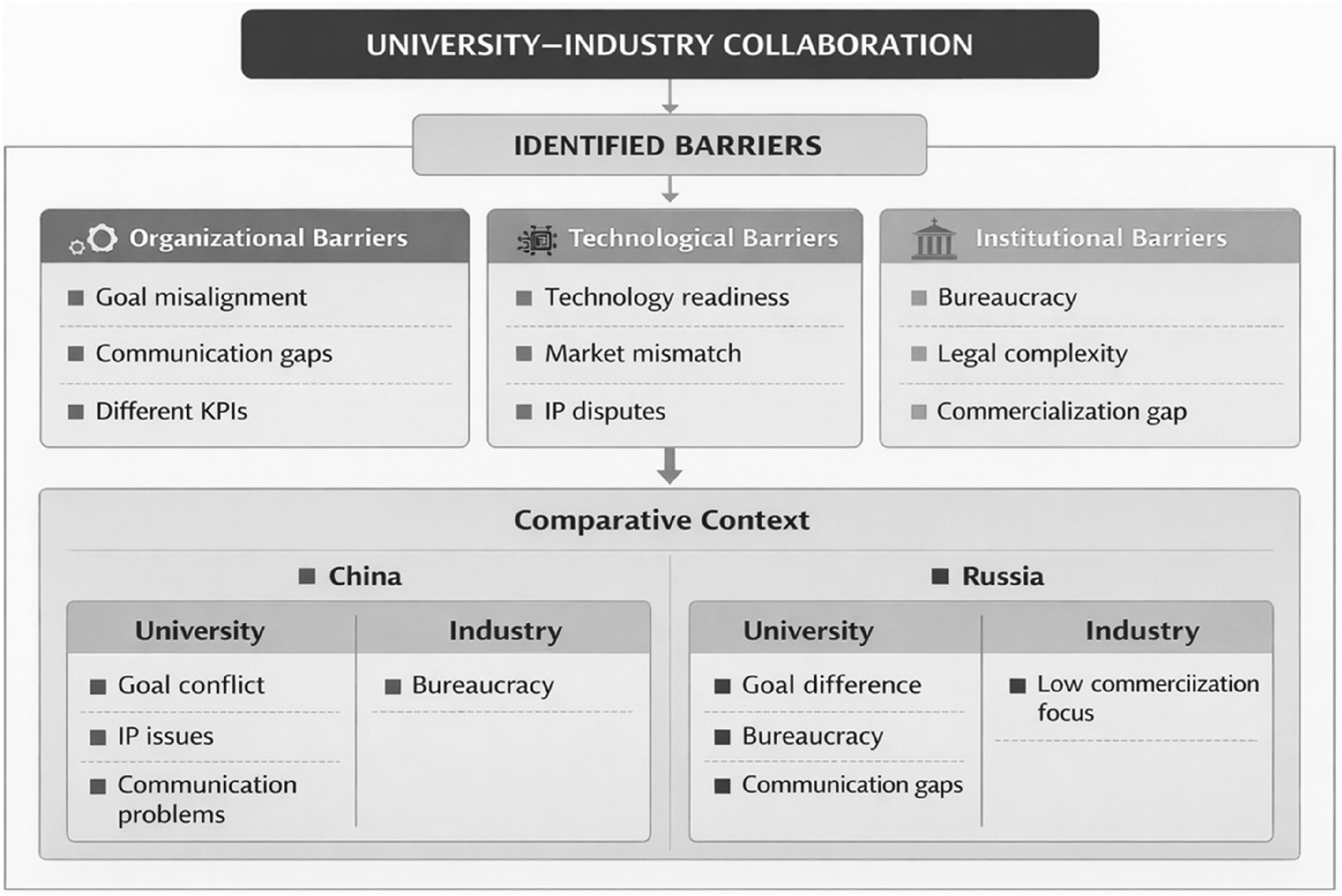
The framework summarizes the main patterns identified in the findings section and illustrates how structural differences between university and industry actors generate multiple categories of barriers affecting collaboration effectiveness.
Recent research published in Industry and Higher Education demonstrates the value of comparative analytical approaches for integrating qualitative findings and identifying causal patterns in university-industry collaboration (Townes, 2026). Rather than presenting findings separately, comparative analytical synthesis enables a clearer understanding of how contextual factors shape collaboration dynamics. ju8.
Building on this approach, the present study integrates findings across China and Russia into a comparative analytical framework. The analysis indicates that while organizational barriers such as goal misalignment and communication challenges appear in both contexts, institutional environments influence the manifestation of collaboration difficulties. In China, structured innovation systems and intermediary mechanisms shape collaboration processes, whereas in Russia institutional rigidity and commercialization challenges play a more prominent role.
Conclusion
University-industry collaboration related to technology transfer and commercialization in China and Russia has similar barriers, however, two countries have different progress on setting the mechanisms. As the main barriers, universities and industries are not holding same goals on technology commercialization, when universities taking technology commercialization as part of R&D and science and technology improvement, and industries need new technology to become new products for profits. Under this divergence, universities would consider more on necessities on commercializing specific technologies, since industries should confirm the potentials outputs and payback period of the collaboration. As a result, universities always prefer stable and controlled mechanism, and enterprises have more flexible plans.
There are further barriers, such as the lack of effective communications through interaction process and high risks on technology commercialization outcome, however, intermediaries as third-party services could be solutions of these barriers. In China, since universities and industries have their own willingness and shortages on dealing with specific issues within technology transfer and commercialization processes, they are both active to work with intermediaries to deal with required issues, such as IP, laws, events, matchmakings etc., and these third-party services should show their qualities and significantly effective abilities to win over businesses. However, in Russia, both sides show less interest in collaborating with intermediaries, because the qualities and quantities of these institutions in Russia are not good enough for consideration.
Footnotes

Funding
The authors received no financial support for the research, authorship, and/or publication of this article.
Declaration of conflicting interests
The authors declared no potential conflicts of interest with respect to the research, authorship, and/or publication of this article.