






Abstract
The purpose of this paper is to explore employers’ views of the benefits of providing university-level placements. While numerous studies have analysed the impact of placements on students, their impact on employers has rarely been considered. The focus of the paper is on employers providing short in-curriculum placements outside of structured extra-curricular internship schemes for Geography and Environmental Science students. Employers participated in semi-structured interviews and thematic analysis was undertaken. The benefits most commonly discussed by employers are students bringing new perspectives to the employer, students supporting employers’ recruitment ‘pipelines’, and students providing employers with additional capacity for work. The context in which the employer works is shown to be important in influencing the benefits that employers receive from engaging with university-level placements, and the study shows that developing placements in ways which make the most of students’ skills and strengths can help to ensure that placements are a mutually beneficial experience for students and employers.
Introduction
While numerous studies have explored the impact of university-level work placements on students their impact on employers providing placements has rarely been investigated. Benefits reported to students include enhancing their academic performance (Duignan, 2003); supporting students to further develop their career planning, which includes both reinforcing pre-existing career goals and opening up new horizons (Mello et al., 2021; Tennant et al., 2018); helping students to make links between theories taught at university and industrial practice (Tennant et al., 2018); supporting students’ skill development (Fleming et al., 2021; Mello et al., 2021; Pereira et al., 2020; Silva et al., 2018); enhancing students’ self-efficacy, confidence, and their perceptions of their skills and capabilities (Edwards, 2014; Jackson, 2019; Tennant et al., 2018; Wilton, 2014); and providing students with insights into workplaces and workplace culture (Fleming et al., 2021). Indeed, it is well-established that employers view the work experience, skills, and personal attributes of candidates as important, and so workplace experience from placements is viewed as being beneficial to students during recruitment processes (Irwin et al., 2019). Undertaking work experience has also been shown to reduce graduate unemployment rates (Silva et al., 2018).
This paper investigates employers’ perceptions of the impact of providing university-level placements, an issue which has been the subject of only a small number of earlier studies. The focus is on employers providing placements in the UK for Geography, Earth, and Environmental Sciences students. All of the placements took place within the curriculum, and so contributed to students’ degree programmes, and all were outside of structured large-scale extra-curricular internship schemes. This study is part of a broader research project at the University of Birmingham which investigates student and employer participation in Work-Based Learning within Geography and Environmental Sciences. The broader project analyses its impact on the personal and professional development of students, its impact on employers, and investigates whether there is equity in placement opportunities for students. While the term Work-Based Learning is often applied to a broad range of placement- and non-placement activities (Dean, 2023; Major, 2016), the focus of this paper is on curricular work placements. The issues of challenges for employers in engaging with placements are mostly beyond the scope of this paper, and another paper based on this research project explores the issue of employers’ perceptions of barriers for engaging in placements for students (Batty et al., 2026). When the impact of placements for employers has been considered this has sometimes been through the lens of students’ perspectives of what they did during their placements, rather than being based on the views of employers directly. This study addresses this gap by exploring employers’ own perspectives on the impact of hosting placements. University-level placements are experienced by both employers and students, and given that providing placements necessarily requires at least an investment of time from employers, it is essential that employers’ perspectives on the benefits of working with students are explored and understood in more detail. This paper shows that it is important for universities and employers to work together closely to ensure that the structure and content of placements take account of the advantages and limitations of different durations of placements, and include activities for students which will most effectively utilise students’ skills and strengths.
Literature review
Key themes within the literature review.
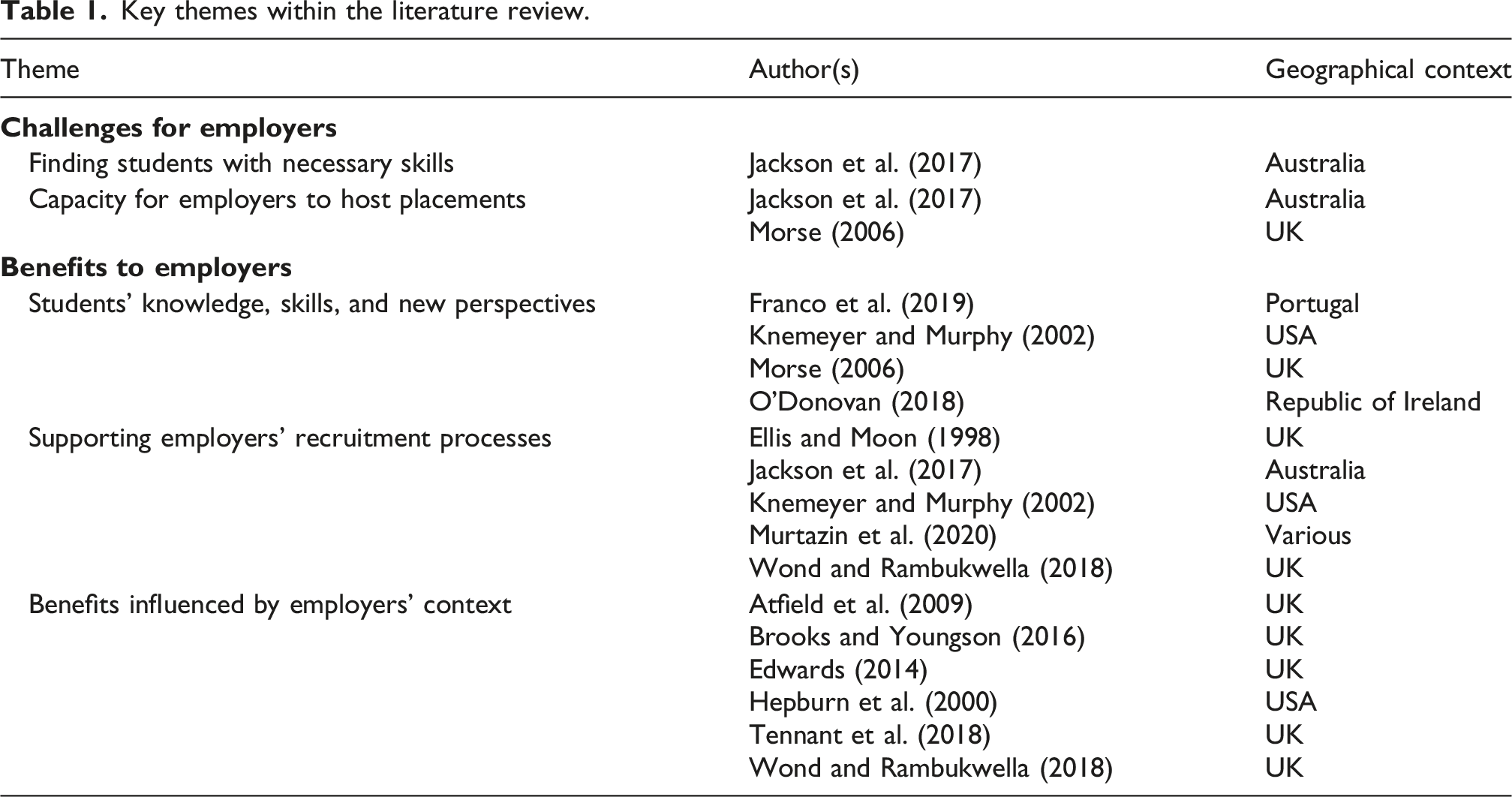
The main benefits to providing placements reported by employers are the knowledge, skills, and new perspectives that Higher Education students bring to their placements; students being a ‘pipeline’ (i.e. source) of potential future employees; and, in some cases, placements providing employers with additional capacity for work. Several studies have argued that students’ knowledge and skills have a positive impact on employers. Working in a Portuguese context, employers reported that despite placement students sometimes having minimal prior workplace experience, providers nevertheless benefit from students’ specialised knowledge (Franco et al., 2019). It should be noted, however, that this view was based on students’ perceptions of their placement experiences rather than on research with employers directly. O’Donovan’s (2018) study of placements focused on the design and manufacture of wood-based products, and was likewise based on students’ perceptions of their time on placement. Semi-structured interviews with students demonstrated a ‘clear pattern of two-way learning and knowledge sharing’ through placements. This had broader benefits to the provider beyond the work undertaken by students during their placements, as O’Donovan noted that it was frequently reported that students were able to share and implement their knowledge and skills ‘in ways that were of benefit to the organisation’s operations and practices’. This suggests that students were able to bring new perspectives and ideas to their placement providers, an idea which was also important in Knemeyer and Murphy’s USA-based study (2002), in which employers reported that internship students provided new ideas for their organisations. Placement providers in Moorse’s UK-based study (2006) likewise reported that they were challenged to think differently by students, and students brought an external perspective to the host organisation.
Several studies have highlighted that engaging with university-level placements and Work-Based Learning brings benefits to employers’ recruitment processes. While one noted that some employers ‘simply view placements as a chance to tap a source of high-quality labour at below market rates’ (Ellis and Moon, 1998), most studies have focused on the ‘pipeline’ of potential future employees provided through placements, and the opportunity to assess possible applicants’ skills before they apply for a longer-term role. Employers in Jackson et al.’s study, for example, stated that the creation of a suitable talent pool was the main reason for engaging in Work-Integrated Learning (Jackson et al., 2017), and the employers who participated in Knemeyer and Murphy’s (2002) study also reported that the most important employer benefit of internships was to aid full-time hiring. Work-Based Learning has also been seen to help employers to recruit students through non-traditional pathways (Murtazin et al., 2020). Employer participants in Wond and Rambukwella’s (2018) UK-based cost-benefit analysis of the value of placements to employers reported that placements provided the opportunity for employers to ‘test’ the skills of students prior to recruitment.
The placement provider’s context also seems to be relevant to the benefits they derive from engaging with placements. In a UK context it has been noted that students help placement providers to have the capacity to undertake additional projects, particularly during busy periods (for example in the agricultural sector), acting as ‘an additional pair of hands’, and, in the case of the arts and media sectors, placement providers have reported that they are sometimes reliant on a continued supply of students to keep their organisations running on a day-to-day basis – a situation which seems to be particularly acute for small employers (Atfield et al., 2009; Wond and Rambukwella, 2018). Other benefits of placements to employers reported less commonly include supporting the development of the skills, knowledge and experience of staff members at the placement provider, through managing, mentoring, and planning placement experiences, and the opportunities placements provide for employers to develop relationships with universities (Atfield et al., 2009). There has also been some analysis of the relative benefits of short placements compared to long-term ‘sandwich’ or ‘year industry’ placements, albeit only from the perspective of the benefits to students. Brooks and Youngson (2016) have argued that structured sandwich placements provide personal learning development opportunities for students that are not necessarily available to those people working for organisations on a part-time basis, and Hepburn et al. (2000) have argued longer periods of service learning are more beneficial to participants than short service-learning opportunities. Conversely, it has been noted that there are benefits to short-term placements for students, especially when there are structured opportunities for students to reflect on the skills developed during their placements (Edwards, 2014; Tennant et al., 2018). The impact of the duration of placements will therefore be considered from employers’ perspectives below, as this has not been done previously.
Research methods
The project received ethical approval in 2019 by the University of Birmingham Research Ethics Committee (approval reference ERN_19-1919), and data were collected in the 2019-20 and 2021-22 academic years. The study began prior to the Covid-19 pandemic and data collection was paused in 2020-21 as placements were prevented or severely restricted during this academic year because of UK government advice and university policy. 36 employers who had recently provided short placements for Geography and/or Environmental Science students were contacted and invited to participate in the study, and 21 employers responded to the invitation. Data were collected using semi-structured interviews. All 21 employers had hosted placement students (one or two per year) on short-term (one or 2 days per week for 12 weeks) placements in the 2019-20 or 2021-22 academic years. Participants were from the private, public, and charitable organisations (14 had charitable status), and included organisations in areas of the labour market both directly and indirectly related to Geography and Environmental Sciences, including from the charity, construction, creative arts, environment, heritage, and local government sectors. All placements took place in the UK, even if the provider had operations globally, and all were outside of ‘formal’ and structured extra-curricular internship schemes. Of the participants, 14 had fewer than 250 employees and were classified as Small- and Medium-sized Enterprises [SMEs]. Of these 14, eight had fewer than 10 employees and so were classified as Micro-Enterprises (UK Government, 2015). Interviews were held in the spring of 2020 and 2022 using online video conferencing software (Zoom); interviews were recorded and the video conferencing software’s AI tool was used to transcribe the interviews, with the transcriptions subsequently edited by researchers to ensure that they were accurate. Participants were self-selecting. The interview questions focused on demographic information (employment sector, size of organisation, and number of placement students), barriers for employer in hosting placements, employers’ views on the equity of opportunity for students to undertake placements, and their views on the benefits of placements for both students and employers.
The qualitative nature of the research necessarily resulted in a relatively small sample size. All the students involved were from Geography and Environmental Sciences disciplines, and the placement providers were all UK-based, which may limit the generalisability of the study. As participants were self-selecting, it could be argued that providers who had enjoyed a positive placement experience would be more likely to volunteer to be part of the study, and it has been noted that self-selecting sampling may lead to sampling bias, or over- or under-representation within studies (Sarfo et al., 2022). The conclusions presented below must, therefore, to some extent remain provisional, and some of the issues discussed would benefit from further exploration. Having said that, participants were from both large and small organisations and a range of employment sectors, and the sample is representative of the types of organisations who provided placements within the degree programmes on which this study is based. Semi-structured interviews were undertaken with students’ primary point of contact at their placement provider, which meant that participants were able to speak about their own experiences of hosting placements directly. Indeed, the relatively small sample enabled ideas to be explored with participants in an in-depth way, and as the study included employers of different sizes and from a range of employment sectors, there are strong reasons to believe its conclusions are applicable beyond Geography and Environmental Sciences disciplines.
Interviews were coded by two researchers using an inductive approach (Thomas, 2006), and each interview was coded by the researcher who had transcribed the interview. No software was used for the coding at any stage. The coding was used to develop themes, and during the analysis of the coding it was noted that participants had reported that hosting placement students provided opportunities for employers to reflect on their practice. Additional thematic analysis of the impacts of providing university-level placements on employers was therefore subsequently undertaken by a different researcher, to explore this idea in more detail. This phase of data analysis used the ‘reflexive thematic analysis’ approach to the development of themes set out by Virginia Braun and Victoria Clarke (Braun and Clarke, 2006, 2019, 2021; Braun et al., 2019). Code generation (both semantic and latent) in this phase of data analysis used a combination of inductive and deductive approaches, i.e. while the starting point of the analysis was the data, and no pre-existing codes or theoretical frameworks were applied to that data, the researcher’s knowledge of the existing literature on the impact of placements on placement providers influenced both the generation of codes and the development of themes. This is explained here to help the reader understand the researcher’s starting point, along with their role in interpreting and narrating the data, and so to ensure transparency about the qualitative data analysis process and reporting of that data. While the number of occurrences of a theme in the interview sample is noted throughout the discussion that follows, this was not the only criterion for theme development, and is not intended to apply quantitative data analysis to ‘reflexive thematic analysis’ (Braun and Clarke, 2015). Nor is noting the frequency of themes intended to indicate that some themes are more important than others; rather, the frequency of themes within interviews is noted to show which themes were discussed most commonly by employers, and so help the reader make sense of the data.
Results and discussion
Summary of the themes and connections to the current literature.
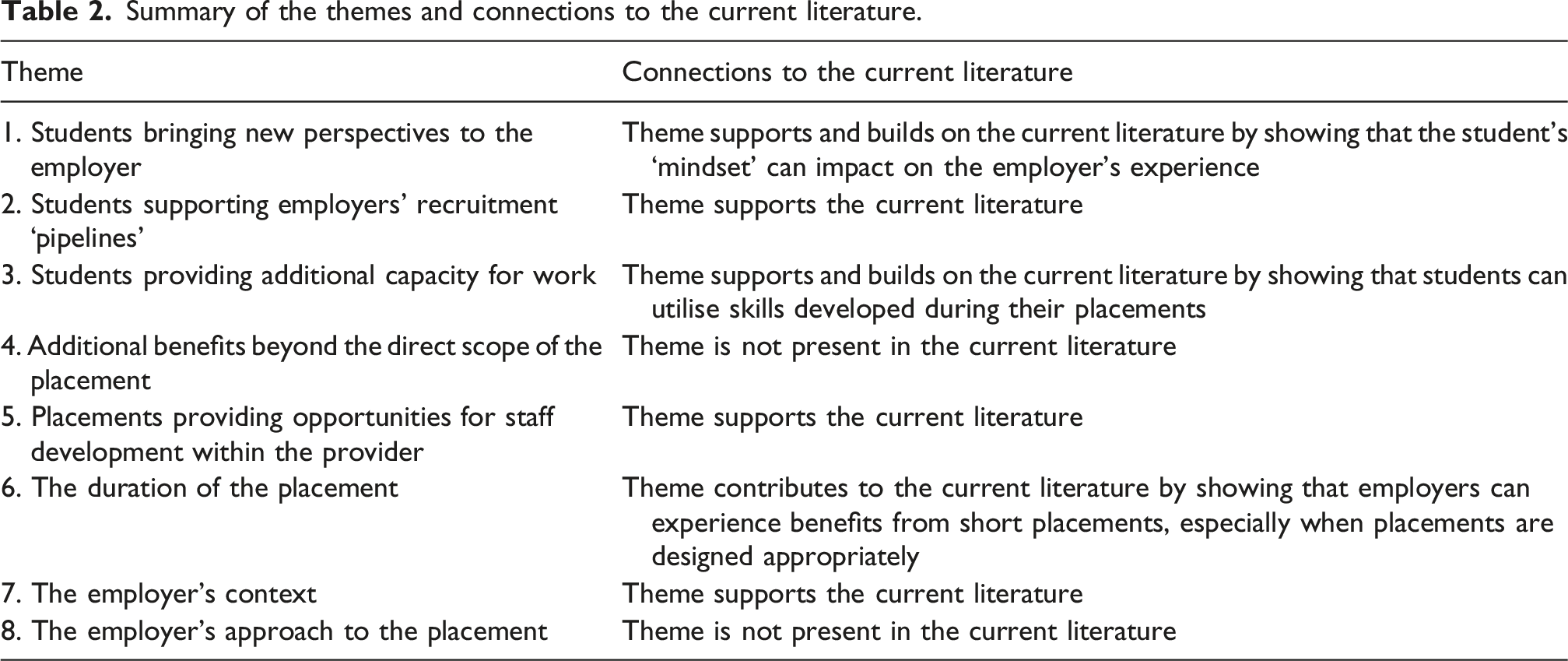
While themes 1-6 are analysed in discrete sections within the text below, themes 7 and 8 are mainly analysed throughout the text when relevant to do so because they influenced the employer’s experience of the other themes. Four employers indicated that there were benefits to engaging with university-level placements, but did not specify what those benefits were, and so are not included in the analysis below (Participants 9, 12, 15, and 17). While data collection took place before and during the Covid-19 pandemic, apart from brief references to placement activities sometimes taking place online, employers did not report that the impact of the pandemic (especially students working remotely) made a significant difference to the benefits of placements. Consequently, the impact of the Covid-19 pandemic is not included within the themes.
Theme 1: Students bringing new perspectives to the employer
Students bringing new perspectives to employers was the most common theme in this project and was developed from six of the 21 interviews. There are four elements to this theme: students encouraging employers to reflect on their activities through the new perspectives they bring to their placements, their curiosity, and the questions they ask; the attitudes that students display during their placements; students’ technical (primarily digital and research) skills; and the employer’s approach to the placement. One employer noted that ‘it was really good to have a student come in and see the organisation from a different perspective’ (Participant [P] 3). This idea which was discussed in more detail by another employer: ‘[Students] always tend to ask really good questions about okay “why is this so complicated?” “why is it not simple like this?”, and I'm like “oh that's a really good point that, you know”, and even for me having to distil my knowledge down into something that's quite simple, sometimes can force you to have a different perspective, which is really useful and stops me over complicating things for myself.’ (P2)
Participant 2 also stated that the short timeframe of the placement has an impact on what students can work on, saying that ‘I can’t give them something that’s billable deliverable [because] the timescales just aren’t right, but [students] do provide a lot of impact and helping out’. We have seen in the literature review that it has sometimes been argued that long-term placements are more beneficial to students than short placements, and these comments suggest that the duration of the placement likewise has an impact on the employer’s experience of it: this idea will be explored in more detail in theme 6. Participant 3 also noted challenges in engaging with placements. They said that it was important to ensure that what the student did enabled them to complete their university assignments based on the placement, and that it was sometimes difficult to work out what was needed for this, which highlights the importance of strong two-way communication between the universities and placement providers. Despite this, Participant 3 felt that hosting placements had a positive impact on the employer generally, and on their own individual practice, because of the new perspectives brought by students. This suggests that the employer’s approach to the placement (theme 8) is important to the success of that placement, and that in this case meeting the students where they are in their professional development and thinking beyond core (‘billable’) workplace tasks, helped the employer to benefit.
The importance of meeting students where they are in their professional development, and on drawing on the skills and strengths that university-level students bring to workplace settings, was also implicit in other interviews. Another employer noted that while it was not always possible for students to do project work, the employer provided their placement students with research projects because they recognised that students were ‘professional researchers’. This employer also noted that students’ ‘energy and enthusiasm and new approaches to things’ were beneficial (P16), which implies that the individual characteristics of placement students – in this case their mindset – may also influence the extent to which the placement is deemed to be successful by the employer. The idea that a student’s mindset influences the benefits an employer receives is not present in the current literature. Another employer reported that students’ engaging in research was beneficial because it helped employers to develop projects (P4). Research skills were also mentioned by an employer, who said that they were able to adapt the content of the placement based on their students’ research interests and what was needed for their university courses (P21). An employer with a large (described by the employer as mainly ‘older’) volunteer based reported that having people ‘with different ideas and different perspectives is really, really useful’ (P7). Two employers also highlighted students’ digital skills as being valuable to them: one said that their placement student produced a report on social media during their placement, which was helpful as the organisation’s Board of Trustees were not regular social media users (P3); another said that the students ‘are digital natives, unlike probably the majority of the team, so [their] focus is technology and they can look at it from a different perspective to ourselves’. This employer also felt that ‘having [students’] experience and their viewpoints on different areas makes you focus differently on your own projects’ (P11). In both these cases university-level students were able to compliment the skills and strengths of existing staff members and volunteers, which reinforces the idea from the existing literature on this topic that an employer’s context is important in influencing the benefits that they will receive from a placement. Unlike earlier studies (for example Atfield et al., 2009), however, the interviews suggest that not only is the size of the placement provider and their sector important in influencing how they benefit from placements, but perhaps more important are the attitudes and mindsets of the individual(s) managing placements. Indeed, the interviews suggest that when employers ‘meet students where the students are’ and focus students’ activities on key strengths and skills that students bring to their placements, then employers are more likely to benefit from those placements. It is therefore important that employers and universities work together closely to develop placement opportunities that will enable students to most effectively utilise their skills and strengths.
Theme 2: Students supporting employers’ recruitment ‘pipelines’
This theme is important in the current literature on the impact of placements on employers, and the theme was developed from five of the 21 interviews. One employer with over 500 employees said: ‘I think that [universities] should really carry on with [placements]. I mean it helps employers as well, understanding the student world, I think [is] really useful. I think you have to do some convincing some places, but it's worthwhile. (P1)
It is interesting to note that colleagues can sometimes take ‘some convincing’ to engage with placements, which shows the importance of understanding the benefits for employers of hosting university-level placements, especially for employers who do not have formal and structured internship schemes. This reinforces the work of Jackson et al. (2017), where just over a third of employers who participated in their study said that engaging staff was challenging, very challenging, or extremely challenging. Another employer reported that an important reason for their organisation to provide placements was to ‘increase awareness of the business’ (P6), and Participant 7 likewise felt that there was ‘a word of mouth benefit [in offering placements because] once we get students in there working, then there’s a possibility that this generates interest from other people within their peer group or the students that might be interested in work placements themselves’. The context in which this employer is working is once again relevant here (theme 7): this placement provider does not have a formal extra-curricular internship scheme and works extensively with volunteers. The employer is therefore unlikely to be well-known by students, and so informal or ‘relational’ placement experiences may be helpful in increasing awareness of what the employer does, thus supporting its future ‘pipeline’ of volunteers. From a student perspective this also has the benefit of opening up new horizons in relation to career goals, in this case experiencing alternatives to large organisations, which we have seen is an important part of the literature on the impact of placements on students (Mello et al., 2021; Tennant et al., 2018).
A large employer said that engaging with placements ‘really helps’ them because placement students sometimes stay on and continue to work with the organisation after the end of the placement (P8). Recruitment of students after the end of the placement was also mentioned by another employer (Participant 2), who felt that their organisation’s recruitment ‘pipeline’ still benefited from placement students even when those students were not recruited directly to the organisation. The employer said: ‘From a company perspective, they like getting workplace students in because not only does it give students the opportunity but it allows us to kind of sound out our potential future graduate pipeline. And, you know, getting good graduates in is really important business and showing people you know what life is like [at the employer], even if that particular placement student doesn't take a role with us. You know, students have heard of [the employer] and that they consider it’ (P2).
The interviews therefore support the idea in the current literature that placements bring potential benefits to employers’ recruitment processes, for example helping employers to recruit students through non-traditional pathways (Murtazin et al., 2020), and that the creation of a talent pool is an important reason for employers to engage in Work-Integrated Learning (Jackson et al., 2017).
Theme 3: Additional capacity for work
This theme was developed from five of the 21 interviews, and the context in which the employer works is important in relation to how they experienced students’ providing additional capacity for work (theme 7). Participant 3 reported that a challenge for them is that they are a small organisation with relatively few staff. They said that ‘what [the placement students] did is genuinely useful to us, [and] helps our work on a day-to-day basis’. They reported that students undertook a wide range of activities, and implied that the content of the placement was determined by the employer’s immediate needs, noting that this ‘may’ be ‘because we don’t have just volunteers’. A small organisation similarly noted that the research undertaken by their placement student would not have happened if they had not provided that placement (P10). This was reinforced by another small organisation, who said that having placement students was ‘really useful’ and that ‘a lot of work we physically can’t do without them really’ (P21). Similar comments were made by another small organisation, who reported that the ‘general support’ provided by placement students was ‘quite useful help’ (P20).
A colleague from a large employer, but who worked personally within a small team which, they said, was ‘extremely busy’, felt that hosting placement students ‘worked very well’ as the students provided the small team with additional capacity. They gave an example of a time when students were very helpful with dealing with ‘an emergency’ that occurred part way through their placements, and which provided the opportunity for students to deploy the skills that they had developed earlier in their placements (P5). The employer’s context is once again important within this theme: all but one of the employers within this theme were small organisations, and the one participant who worked for a larger organisation was working within a small and ‘extremely busy’ team. This suggests that placements bringing additional capacity for work is particularly beneficial for small organisations, or in situations where limited workplace capacity makes it is difficult for colleagues to have the space to think beyond immediate day-to-day activities. While Atfield et al. (2009) have shown that sometimes employers – especially small employers within the arts and media sectors – can be reliant on a continued supply of students to keep their organisations running, and while Wond and Rambukwella (2018) mention that placement students support employers with ‘projects’, the idea that students utilise the skills developed throughout their placement is not discussed in the current literature. Placements focused primarily on providing additional capacity for work did not appear to limit the value of the placement experience for students, at least according to the employers interviewed here. All of the employers in this theme said that their students benefitted from doing placements – Participant 5, for example, said that students ‘do get a lot out of [their placements]’ and said that they had acted as a referee for placement students – and so within the content of this study at least, placements appeared to be a mutually beneficial experience for students and employers, including when the content of placements was focused primarily on supporting the day-to-day activities of the employer.
Theme 4: Additional benefits beyond the direct scope of the placement
Four employers reported that placements can result in benefits beyond the direct scope of the placement, something not noted in the current literature, and so which makes an important contribution to that literature. Once again, the employer’s context was important in relation to how they experienced this benefit (theme 7). Employers talked in a more exploratory way within theme 4, as the benefits to them were necessarily less direct and tangible compared to other benefits. Participant 1 said that the work undertaken by their placement student was ‘good for us’ and ‘a kickstart into a new area that we wanted to branch into’. The idea that the work produced by students might have value beyond the immediate benefits to the placement provider, and might be built upon in the future, was also noted by another employer, who said: ‘Sometimes students might come to us on our work involves a small research project which may have an intrinsic value in itself, as a research project, but it also opens up avenues of research opportunities for us in the future as well. So it opens our eyes to the possibility that they may not otherwise be aware of. (P7)
Two employers with over 500 employees, felt that placements could have indirect benefits to providers. When asked about the impact of placements and the value that students bring, one employer said that for them ‘it’s kind of an indirect thing’. They felt that students might come back to the placement provider for further tuition or help in the future and that this led to a ‘kind of long-term gain’ (P19). The other employer said that although the work undertaken by their placement student was similar to work done previously within their organisation, the approach taken during the current placement was different to what had been done before. This, they said gave ‘an exposure for us to the kind of work that could be done, it was somewhat exploratory. So in that vein, it’s helped us to understand what can be done by a student at the undergraduate level, and also [what] could be done with the kind of work that she was doing as well’ (P13). Three of the four employers whose interviews contributed to the development of this theme had over 500 employees, and the fourth had around 20 employees plus approximately 60-80 volunteers, which suggests that having the space and capacity to think beyond immediate and day-to-day tasks with a direct and immediate benefit may be more straightforward for larger organisations providing placements.
Theme 5: Placements providing opportunities for staff development within the placement provider
While this theme could have been developed as a sub-theme of theme 4 (additional benefits beyond the direct scope of the placement), it was decided to present it as a theme in its own right because it was discussed in a less exploratory way compared to theme 4, and because the benefits to staff members appeared to be more tangible. The theme was developed from one interview. It has already been noted that Participant 16 said that students often bring research skills and ‘new approaches’ to their placements. Having done so the employer reported an additional benefit, i.e. beyond the tasks that students were engaged with: ‘There's also benefits to our more junior staff, in terms of managing other people as resources, you know, managing students, giving them a brief, checking in on them and all that kind of stuff. It's a good opportunity for our graduates and people with a few years experience to get some people management, task management skills in a low pressure [setting] (P16).
The idea that working with placement students can support the skill development of individual members of staff within the provider has also been reported in a previous study, which argued that the management experience gained by employees in planning placements or mentoring people on placement was ‘the most frequently mentioned benefit relating to improved skills, knowledge or experience of existing staff’ (Atfield et al., 2009). This included when placements were of a very short duration, which suggests that even if this limits the content of the placement, and, therefore, the amount of work that can be done, placement students can contribute to employers in other ways, ensuring that the placement is a mutually beneficial experience for both students and employers. It is important for universities and employers are aware of this potential benefit to the employer, so that it can be built into the design of future placements.
Theme 6: The duration of the placement
We have seen that there has been debate over the relative impact of 12-month compared to shorter placements for students (Brooks and Youngson, 2016; Edwards, 2014; Hepburn et al., 2000; Tennant et al., 2018). This issue is not considered from the perspective of employers within the current literature, and so this study contributes to this debate. Five interviews were relevant to this theme. While employers reported that the short duration sometimes impacted on what students did during their placement, all reported one or more benefits to engaging with university-level placements: for example, we have seen that a short placement meant that one employer could not give students a ‘billable deliverable’ (P2, theme 1) the same employer said that engaging with students brought new perspectives to them, and supported their recruitment pipeline (P2, theme 2). It has previously been argued that while it takes time to set-up a placement, dialogue between placement providers and students, focusing on workplace tasks that are appropriate for a placement, and involving students in so-called ‘real’ workplace activities, can help to ensure that both students and employers benefit from placement and other Work-Based Learning activities (Clark and Zuka, 2016; Fleming et al., 2021; Morse, 2006). This study reinforces the importance of this approach as all of these ideas were present in the interviews.
The employer’s approach to placements was important in relation to the benefits they derived from short placements (theme 8). Thorough planning, which included providing students with discrete tasks which could be completed in the time available, seemed to make it more likely that the provider would benefit from the placement. One employer noted the potential challenges of short-term placements, especially those that took place remotely during the Covid-19 pandemic, by saying that ‘the general barrier [for short-term placements] is the short amount of time to make a meaningful impact especially when it’s a remote placement’. But they also said that a ‘really crucial point [is] that a lot of preparation has to happen from everyone to make this work’ and that ‘it needs a bit of thinking about, how to make [the placement] work’ (P1). This idea was further developed by another employer, who noted that they ‘gave [the student] quite specific tasks to try to add some value to things that we felt were manageable and defined within, you know, a 6-week period’ (P9). Another employer (P16), who we have seen felt that placements provide continuous professional development opportunities for staff, likewise reported that the scope of the placement and the pre-placement planning were also important in ensuring that short placements are successful. They said ‘because [students] are there for such a short period of time, they were not necessarily able to move us forward unless we are setting [them up with] some very specific tasks which probably requires more planning from our side’. This employer also acknowledged that it was ‘a big ask for students to come in and get up to speed and then be where we already are without a defined scope’ and went on to say that ‘I think the length is okay’. Another employer likewise said that it was important not to ‘just give [students] the tea to make’. They said that ‘I will give [students] a very specific project that I know needs doing and make sure that the student has the support to deliver; I need it to be done, and if I need it to be done then its going to have impact’. The employer also said that they ‘recognise that when you get somebody new like that, you need to give them something tangible [so] that they can have results quickly’ (P18).
The debate about the relative impacts for students and employers of short compared to long placements is important in the current literature and would benefit from being explored more fully. From a student perspective this is because short-term placements enable students unable to undertake a 12-month placement to have a placement experience, and so support equity of access to placements (Edwards, 2014). From an employer perspective, this theme has important implications for practice, as it suggests that when employers have a clear view of the potential benefits and drawbacks of short placements, and work within structural limitations to maximise the benefit – i.e. by taking time to plan tangible and specific activities that can be achieved by students quickly, and then supporting students appropriately to complete these activities – this can help to ensure a mutually beneficial placement experience for students and employers. The context in which the employer works (theme 7) may be important here, and this would also benefit from further exploration in future studies: only one of the employers within this theme was an SME, and none of the employers in this theme reported challenges in workplace capacity, which could suggest that there is more scope for large employers to undertake the kind of pre-placement planning described above.
Themes 7 (the employer’s context) and 8 (the employer’s approach to the placement)
These themes have already been explored within the analysis of themes 1-6, above. This has shown that small employers or teams with limited capacity are more likely to focus the content of placements on activities with direct, tangible, and immediate benefits to the employer. Careful planning of the content of placements by employers, for example focusing on tasks which can be completed by students successfully within the time available, can help to ensure that placements are mutually beneficial experiences for employers and students. Indeed, when employers take account of where students are in terms of their professional development, and provide opportunities for students to utilise the skills and strengths they bring (for example research and digital skills), this can help providers to gain benefits from placements.
Conclusions
The themes developed from the interviews have important implications for the policy and practice of universities and placement providers if they are to develop placements which support students’ skills and wider professional development while enhancing employers’ activities. The study shows that thorough and purposeful planning of the placement can make a huge difference to the employers’ and students’ placement experiences. It shows that employers should develop placements in ways which meet university-level students where they are in relation to their professional development, and which make the most of the skills and strengths that they can bring – especially curiosity, new perspectives, research skills, and digital skills. Planning activities which are suitable for the timeframe of the placement, and providers supporting students appropriately to undertake these activities, has likewise been seen to help students make a meaningful contribution. Furthermore, considering benefits beyond the direct placement outputs, for example seeing placements as an opportunity for mentoring or line management thereby supporting the professional development of early-career staff, can help the employer to extract added value from engaging with university-level placements. It is essential that employers and universities work together closely to apply this learning to the development of future placements. If employers feel confident that they will benefit from hosting placements they are arguably more likely to commit the time investment needed to provide placements.
All the employers interviewed for this study reported that there were benefits of hosting placements, and the themes within the interviews build upon the limited current literature. This study provides further evidence of employers benefitting from the new perspectives and curiosity that students can bring, and employers using placements to support their recruitment ‘pipelines’. The study also reinforces the idea that students can provide employers with additional capacity for work, and that this is especially important for small employers. But the themes developed from the interviews also go beyond the current literature in important ways. We have seen that the approach taken by the employer, especially the person managing the placement, has a large impact on the benefits the employer receives from the placement experience. We have also seen that providers can experience additional benefits beyond the initial scope of the placement, and that the approach taken by the students can influence the employers’ experience. The study has also made an important contribution to the debate on the impact of short-compared to long-term placements by showing that employers can benefit from short placements, especially when they are developed carefully in ways which take account of the potential limitations of a short placement. By employers and universities working together closely to develop placement opportunities appropriate for the specific skills and strengths of university-level students, recognising the advantages and limitations of different types and durations of placement experience, and identifying ways to work most effectively within any limitations of placement structures, we can ensure that placements are a positive and mutually beneficial experience for both students and placement providers alike.
Footnotes
Acknowledgements
We would like to thank Samantha Sandilands for undertaking some of the interviews.

Ethical considerations
This study was approved by the University of Birmingham Research Ethics Committee (approval reference ERN_19-1919.) on 7 January 2020.
Consent to participate
Participants gave written and verbal consent before starting interviews.
Funding
The authors disclosed receipt of the following financial support for the research, authorship, and/or publication of this article: This project was funded by a University of Birmingham Education Enhancement Fund award.
Declaration of conflicting interests
There are no potential conflicts of interest with respect to the research, authorship, and/or publication of this article.
Data Availability Statement
The datasets generated during and/or analysed during the current study are not publicly available because the researchers did not receive permission from research participants to share them in this way, but are available from the corresponding author on reasonable request.