






Abstract
The design of effective Driving Questions is widely recognised as central to Project-Based Learning (PBL), yet educators lack a systematic methodology for formulating them in discipline-specific contexts. This article presents a methodology for designing PBL Driving Questions in computing-oriented Applied Mathematics programmes. Grounded in pedagogical research, labour-market requirements, and practice-based analysis of early project formulations, the methodology identifies recurrent formulation errors and proposes a coherent set of specific and verifiable criteria for avoiding them. Each criterion is linked to intended educational outcomes and to the development of hard, soft, and self-skills. The article also introduces a structured template for constructing Driving Questions and illustrates its use through examples from authentic PBL implementation. The methodology has undergone multi-year empirical piloting and provides educators with a practical framework for designing well-structured, product-oriented, and curriculum-aligned PBL tasks.
Keywords
Introduction
Project-Based Learning (PBL) is an educational paradigm in which students acquire the necessary knowledge and skills through sustained teamwork on real-world, practically meaningful projects (Chen and Yang, 2019; Guo et al., 2020; Lavado-Anguera et al., 2024; Strobel and Van Barneveld, 2009). Over the past 2 years, the relevance of PBL has increased markedly: educational leaders now position it as a key post-pandemic engagement strategy, and analytical reviews in Forbes and Social Studies (December 2024 - January 2025) include it among the “critical trends”, highlighting the need for interdisciplinary STEAM solutions and the cultivation of competencies that cannot be automated by AI (Hendricks, 2024; Marr, 2024). Since PBL denotes a broad approach rather than a prescriptive methodology, its core principles can - and do - take various forms even within a single discipline, let alone across different fields (Guo et al., 2020).
The most challenging phase of PBL is formulating the project’s Driving Question (DQ) 1 (Markula and Aksela, 2022; Mentzer et al., 2017; Ssali et al., 2025). Difficulties in crafting a well-defined project task frequently lead educators to abandon PBL implementation, despite its widely recognised effectiveness (Mӓkelӓ et al., 2023; Zhang and Ma, 2023). Surveys show that over 70% of educators experience difficulties in locating or developing well-structured tasks that align with curricular requirements (Baines et al., 2021).
A poorly formulated task is virtually impossible to transform into a successful project. The literature offers no guidelines for task formulation or clear criteria that such tasks should meet. A review of existing studies shows a lack of a systematic operational approach to developing a Driving Question in discipline-specific contexts. The analysis revealed that: (1) In many cases, a clear Driving Question is not formulated, and only a general theme is provided. (2) There is significant ambiguity in the set of criteria that project task formulations should satisfy. (3) The criteria are stated too generally (e.g., authenticity, openness, complexity, etc.), leading to difficulties for educators in understanding and implementing them. (4) No step-by-step methodologies exist for developing a Driving Question that would systematically support the attainment of educational objectives (Haatainen and Aksela, 2021; Lavado-Anguera et al., 2024; Markula and Aksela, 2022; Wilson, 2021).
It is evident, however, that each discipline requires its own set of criteria and methodology. Moreover, different methodologies may be developed even within a single discipline (Markula and Aksela, 2022; Rogers et al., 2011).
In applied mathematics, educators encounter specific challenges when formulating project tasks because of the inherently abstract nature of the subject. Such tasks must link mathematical abstractions with real-world practice, requiring educators to possess expert knowledge in relevant domains (e.g., physics, economics, biology). Furthermore, applied tasks often demand real data and/or access to necessary resources, and securing such access can itself pose a significant challenge.
Previously, we developed a PBL methodology for students enrolled in the “Intelligent Data Analysis” university programme majoring in Computational Applied Mathematics (Akhiiezer et al., 2023). It should be noted that the proposed methodology pertains to the major rather than its individual courses, which renders it unique. This approach enables more effective attainment of the programme’s educational objectives. In (Akhiiezer et al., 2023), we outlined the overarching project workflow and defined the roles of each participant in the process. In the present article, the term computing-oriented Applied Mathematics refers to Applied Mathematics programmes in which mathematical modelling is systematically combined with programming, data analysis, and the development of software or software-hardware solutions.
The present study aims to develop and substantiate a detailed methodology for selecting and formulating project tasks within PBL for computing-oriented Applied Mathematics, supporting the systematic design of Driving Questions that promote the achievement of the core educational objectives of project-based learning.
Analysis of typical mistakes in PBL problem statement and formulation
Characteristic methodological errors in formulating applied mathematics problems in PBL.
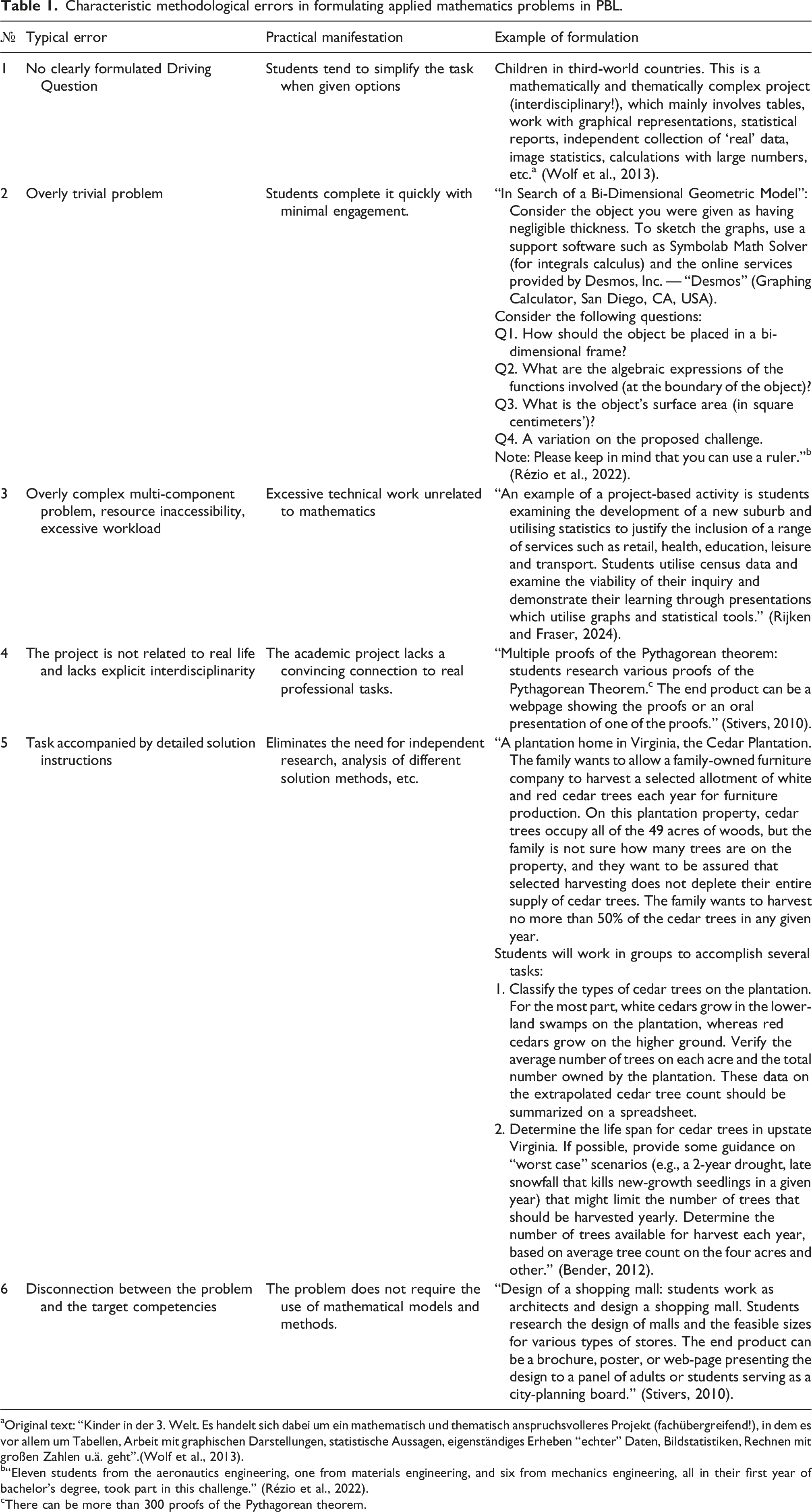
aOriginal text: “Kinder in der 3. Welt. Es handelt sich dabei um ein mathematisch und thematisch anspruchsvolleres Projekt (fachübergreifend!), in dem es vor allem um Tabellen, Arbeit mit graphischen Darstellungen, statistische Aussagen, eigenständiges Erheben “echter” Daten, Bildstatistiken, Rechnen mit großen Zahlen u.ä. geht”.(Wolf et al., 2013).
b“Eleven students from the aeronautics engineering, one from materials engineering, and six from mechanics engineering, all in their first year of bachelor’s degree, took part in this challenge.” (Rézio et al., 2022).
cThere can be more than 300 proofs of the Pythagorean theorem.
These errors indicate a fundamental methodological gap: the absence of sufficiently specific and verifiable guidance for formulating PBL problems in applied mathematics. Existing descriptions of authenticity, interdisciplinarity, openness, and complexity provide important general principles, but they do not offer a practical procedure for determining whether a particular project formulation will function effectively in a specific disciplinary context. A literature-based analysis is therefore an important starting point, but it needs to be complemented by practice-based evidence from actual project implementation. The following section examines such evidence from early project formulations and explains how it provided the empirical rationale for developing the Driving Question criteria.
Empirical rationale for developing the driving question criteria
In addition to analysing examples of PBL tasks presented in the literature, the methodology was developed through the examination of our own early project formulations. At the initial stage of PBL implementation, project tasks were designed mainly in accordance with general principles emphasized in the PBL literature: the task should be authentic, interdisciplinary, practically meaningful, and supportive of teamwork (Guo et al., 2020; Markula and Aksela, 2022). However, the first project cycles showed that these characteristics provided only a general direction and were not sufficiently specific and verifiable for designing tasks in computing-oriented Applied Mathematics. Features such as authenticity, interdisciplinarity, and teamwork did not, by themselves, reliably distinguish a methodologically sound Driving Question from an externally convincing but pedagogically weak formulation. More precise and checkable criteria were therefore needed for the preliminary evaluation of Driving Questions.
To analyse the early projects, the teaching team used materials systematically collected for each project: the initial problem statement received from the Customer in natural language, the final Driving Question, the project specification, the software product, the technical report, the presentation, the video recording of the public defence, brief Customer feedback, and students’ post-project reflections. These materials made it possible to compare the initial project idea with how the task functioned in the project process: whether it stimulated independent inquiry, required substantive mathematical analysis, supported the work of all team members, corresponded to students’ level of preparation, and led to a practically meaningful outcome.
Particular attention was paid to unsuccessful or substantially revised early formulations. This analysis showed that a task could appear applied or interdisciplinary while still failing to fulfil the educational function of PBL. Some tasks had a convincing applied context but, in practice, were reduced to plotting functions, finding extrema, calculating a volume, or applying a standard formula. In such cases, the applied narrative served mainly as an external framing of a conventional academic exercise rather than as a source of a genuine problem situation. Other tasks required the development of a software product but did not involve non-obvious mathematical modelling and could be completed by one strong student; as a result, teamwork became largely formal.
Another group of difficulties concerned misalignment with the programme’s intended learning outcomes. Some formulations shifted the focus toward engineering, design, or narrowly technical development, thereby losing a clear connection to the mathematical models and methods specified in the curriculum. Others, by contrast, contained a mathematical core that was too simple and did not create productive difficulty for students at the relevant stage of study.
After each project cycle, the teaching team compared the initial formulations with the process of project implementation and the final artefacts. The analysis focused on cases in which a project was completed too quickly, was carried out mainly by one participant, was broken down into sequential stages that forced part of the team to wait, did not require substantive mathematical modelling, was weakly connected to a real Customer need, or did not correspond to students’ current level of preparation. Students’ post-project reflections were used as an additional source of information about task difficulty, distribution of work, sufficiency of time, the need to master new methods independently, and students’ perception of the relationship between mathematics and real-world practice.
This analysis enabled moving from general pedagogical principles to a more rigorous procedure for the preliminary evaluation of project tasks. Unsuccessful formulations were treated not as isolated organizational failures, but as indicators that specific qualities were missing in the Driving Question itself. The next stage of the study, therefore, involved identifying a set of operational requirements for project tasks. These requirements are presented in the following section as a system of criteria for formulating PBL Driving Questions.
Core requirements for the PBL project problem
Based on an analysis of contemporary pedagogical and psychological methodologies (González-Pérez and Ramírez-Montoya, 2022; Graesser et al., 2022; Mohammed and Ozdamli, 2024), employer requirements for potential employees’ soft- and hard-skills (Poláková et al., 2023; Taguma et al., 2023; Yong and Ling, 2023), the rapid advancement of AI capabilities, and within the framework of the Applied Mathematics Specialty Standard (Ministry of Education and Science of Ukraine, 2018) and the learning outcomes of the “Intelligent Data Analysis” educational programme (Educational Programme, 2023), we have formulated the following criteria that a PBL project problem in computing-oriented Applied Mathematics programmes must satisfy:
Criterion I. Market-Ready Product: The result of the project should be a software or software-hardware product ready for a presentation on the market.
Criterion II. Applied relevance: The problem should have a relevant applied nature.
Criterion III. Interdisciplinarity: The solution to the problem should require applying knowledge from different domains.
Criterion IV. Implicit mathematical modelling: The problem must entail mathematical modelling that is not evident from the problem statement.
Criterion V. Decomposability: The problem can be decomposed into several separate, independently running subproblems (students within the team should be able to work in parallel).
Criterion VI. Team-based working
Criterion VII. Alignment to Curriculum: The models and methods used to solve the problem correspond to the curriculum.
Every problem submitted by a potential Customer is first evaluated against these criteria. In most cases, the raw problem will not meet all of them, since real-world Customers often lack awareness of academic curricula and student proficiency levels. A committee of educators reviews the Customer’s initial problem statement: if it can be revised to satisfy all criteria, the formulation is modified and confirmed with the Customer; otherwise, it is rejected. Once the Customer approves the revised version, the official PBL project Driving Question will be issued. The sequence of steps for this formulation process is depicted in Figure 1 as a BPMN diagram (International Organization for Standardization, 2022). Scheme of the driving question forming process.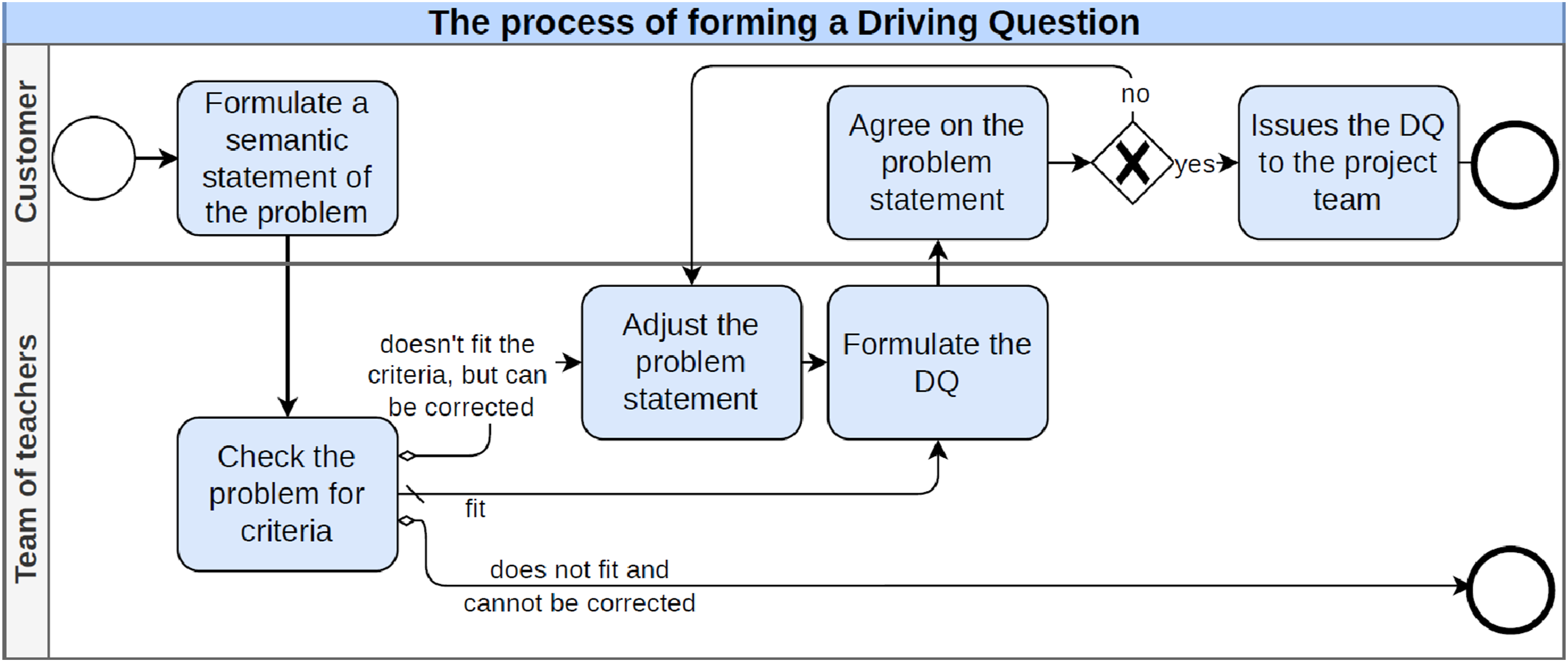
Next, we justify each criterion and show how the absence of each criterion may weaken the pedagogical function of the project task and reduce the likelihood of achieving the intended educational objectives. To this end, consider the following example problem that meets all criteria:
The remaining sections describe and substantiate each criterion. In each case, we also present a modified version of the original formulation that fails to satisfy the criterion under consideration.
Criterion I. Market-ready deliverable
Project outcomes (artifacts in PBL terminology (Bender, 2012)) are the tangible or digital products produced during project execution. Artifacts prove that students have undertaken specific work, investigated the problem, and proposed solutions. They document learning outcomes and provide a means of demonstrating the work accomplished.
Since the majority of graduates of the “Intelligent Data Analysis” (Educational Programme, 2023) programme pursue careers in IT companies upon completion, the primary project outcome is a finished software product - ideally one that is market-ready. The ability to develop from concept to a complete product, to package, present, and defend one’s work, constitutes one of the key hard skills required for successful employment in the IT industry. Therefore, upon project completion, the project team must deliver the following artifacts: (1) A software product (application or web service) or a software–hardware system. (2) A technical report containing the project specification, description, and justification of chosen methods and algorithms, as well as a detailed overview of the developed software product. (3) A written report and an accompanying presentation.
Consequently, each project culminates in what in PBL terminology is called an Authentic Achievement (Bender, 2012), namely, a deliverable with genuine significance beyond the classroom. The presence of an Authentic achievement demonstrates to learners the practical value of the theoretical knowledge they have acquired and substantially enhances motivation in the study of specialized subjects. Moreover, a coherently completed project accompanied by the specified artifacts can be the basis for subsequent, more advanced projects.
Why do some pieces of knowledge endure for a lifetime, while others quickly fade? The answer lies in how the learning process unfolds and how information is received. The degree to which educational material is retained can be assessed using Bloom’s Taxonomy (Figure 2), a conceptual ladder of cognitive processes in learning through which learners progress step by step (Anderson et al., 2000; Bloom, 1984). According to this taxonomy, there are six levels of cognitive learning: Remembering, Understanding, Applying, Analyzing, Evaluating, and Creating. Progression through these levels must occur sequentially. Activities associated with the highest level, Creating, can be highly motivating, evoking deep satisfaction from producing something original and spurring further creative work (Bloom, 1984). Illustration of Bloom’s Taxonomy with the integral project outcome (PBL Authentic Achievement) positioned at the top level, “Creating”, in accordance with the methodology presented.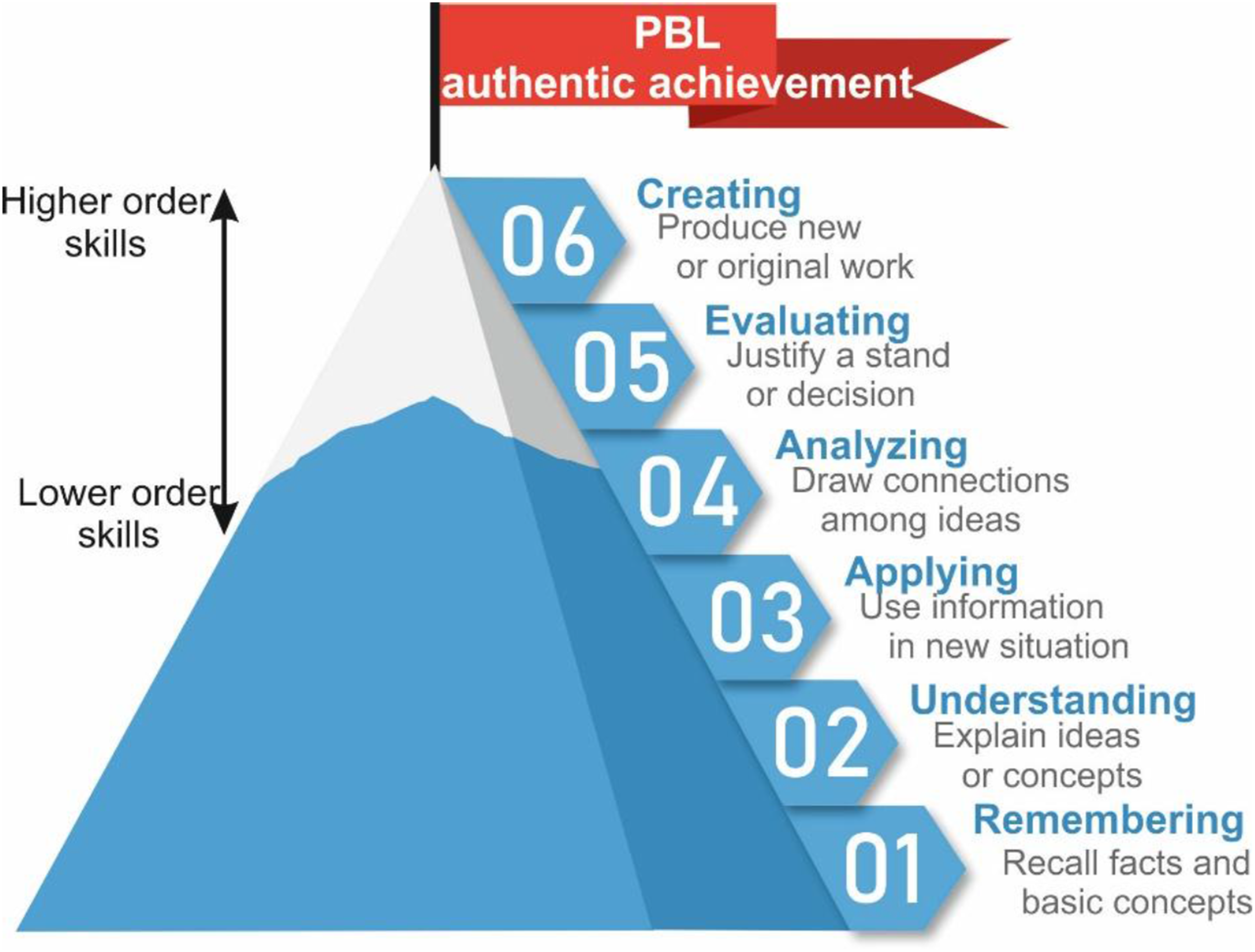
In PBL, at the early stages of a project, students master foundational levels such as Understanding and Applying knowledge, and as they delve deeper into the project, they progress to higher levels. In the overwhelming majority of PBL studies, project work is structured so that learning reaches at best the Evaluating level.
In our methodology, the requirement to develop software that addresses a specific Customer problem is designed to support students’ progression through all cognitive learning levels, up to the highest - Creating an original product. Knowledge constructively acquired by students through direct engagement in the project is more likely to be consolidated in long-term memory than knowledge acquired through purely reproductive instructional activities (lectures, practical exercises, and laboratory sessions).
Furthermore, the final software product reflects not only practical hard skills but also students’ capacity for higher-order cognitive thinking, making the project a critical component of their educational experience.
Requiring the software product to be market-ready introduces additional demands on the developed software, requirements not typically imposed on academic assignments, such as a carefully designed user interface, high-quality visual design, and comprehensive supporting documentation (project specifications, user manuals, etc.). This expectation compels students to take a responsible approach to interface and design development (given the market’s preference for an “intuitive” interface) and to conduct thorough testing. To finalize these details, the project team must engage in Customer communication, thereby cultivating client-oriented work practices, flexibility, and adaptability - qualities highly valued by employers.
Developing the supporting documentation also hones students’ skills in producing discipline-specific texts - technical reports, project specifications, and the like—which enhances their marketability, as such experience is ordinarily acquired only through on-the-job training in an IT company. The project team presents the software at a public defence, preparing a presentation and an oral report. In doing so, they develop crucial skills such as showcasing their product in the best possible light, explaining its functionality clearly and concisely, and speaking confidently before an unfamiliar audience.
Below is a modified version of the original problem statement that fails to satisfy Criterion 1:
Reason: The requirement to develop a software or software–hardware system is omitted, and the format for presenting the layout is unspecified. As stated, this could only result in a paper drawing rather than a deployable product.
Criterion II. Applied relevance
One of the fundamental requirements for PBL problems is their authenticity (Bender, 2012). Our methodology has reinforced this requirement: the problem must possess contemporary applied relevance. The distinction between a merely authentic problem and one with applied significance lies in the degree of its connection to current practical challenges and professional demands. While authentic problems can be adapted for instructional use without necessarily reflecting up-to-date significance, applied problems correspond to the present needs and trends within the students’ discipline. Such problems relate directly to ongoing challenges in industry, science, or technology (in our case, the IT industry).
Accordingly, this requirement aims to ensure that students are effectively prepared for future professional roles in the IT sector and to enhance their prospects for successful employment.
IT companies expect our graduates to be capable of solving specific, contemporary problems, making this criterion mandatory. Unlike academic exercises and tasks, which are usually simplified and abstracted, real-world problems demand an integrated approach, including data collection, analysis, model development, and interpretation of results. Furthermore, data may be incomplete or inaccurate, and conditions may vary. By engaging with such problems, students learn to critically analyze issues, devise solution strategies, and test and refine their approaches.
Student motivation and engagement also increase markedly when participants know their project addresses a problem posed by a specific real-world Customer (i.e., they know the “name” of the Customer). Crucially, this arrangement allows students to interact professionally with an industry representative. As a result, students appreciate the significance of their work, since the project outcome may deliver tangible benefits in industry or research. In our experience, approximately 30% of the software products developed through these projects were subsequently adopted by Customers in industrial or scientific contexts. Such outcomes demonstrate not only the students’ professional preparedness but also the successful application of acquired knowledge in real-world settings - an essential objective of the educational programme. This adoption rate is particularly notable given that many of these projects were undertaken by first- and second-year students. Furthermore, a project can evolve into a startup with sufficient student initiative and engagement.
A modified version of the original Driving Question that fails to satisfy Criterion II is:
Reason: Using gas lamps for street lighting has lost its contemporary relevance, rendering the problem non-applicable.
From this discussion of Criterion II, the requirement for interdisciplinarity in problem formulation naturally follows.
Criterion III. Interdisciplinary scope
Contemporary applied problems often necessitate expertise in diverse fields such as physics, engineering, biology, and economics. This requirement fosters the development of interdisciplinary thinking, which is particularly critical in today’s world, where many challenges demand a holistic approach and collaboration among specialists from multiple domains.
A specialist in Intelligent Data Analysis must possess deep knowledge in mathematics and computer science, while swiftly acquiring domain-specific expertise when addressing practical problems, reflecting the “learn to learn” principle (European Commission, 2018; The Organisation for Economic Co-operation and Development, 2020a). Working with real-world data involves not only data processing and analysis but also understanding the context in which the data was generated. Consequently, successful project implementation requires foundational knowledge in related disciplines and the capacity to assimilate new subject areas rapidly.
In the proposed methodology, project problems are designed so that their resolution requires not only mathematical and programming competencies but also knowledge from other domains. This design encourages learners to independently seek, evaluate, and apply information from disparate fields, thereby cultivating critical thinking and integrative knowledge skills. Furthermore, students must learn to engage with domain experts, preparing for such interactions by drafting a list of pertinent questions. As such, the interdisciplinary approach not only enhances the ability to integrate diverse forms of knowledge but also prepares future professionals for the dynamic demands of the contemporary job market, where cognitive flexibility and adaptability are paramount. The interdisciplinary nature of project problems thus contributes to developing a key 21st-century skill: autonomous learning (The Organisation for Economic Co-operation and Development, 2020a).
Furthermore, the interdisciplinary approach plays a vital role in fostering critical thinking. Students learn to critically analyze information from various fields, compare and synthesize data, contributing to the development of analytical skills and the capacity to solve complex problems. Interdisciplinary projects also stimulate creative and innovative thinking, as students seek unconventional solutions by combining knowledge and methods from different disciplines.
Modified version of the original problem statement that fails to satisfy Criterion III:
Reason: Mathematically, this is a problem in discrete mathematics - specifically, the minimum spanning tree problem on a graph - and therefore lacks interdisciplinarity. In the original formulation, the optimality criterion is cable cost; thus, an edge’s weight depends on both the cable’s physical length and its physical characteristics (material, resistivity, and cross-sectional area). Allowing variation in cable characteristics, first, significantly alters the mathematical nature of the problem, and second, renders it interdisciplinary, since its solution requires knowledge of both mathematics and physics.
Criterion IV. Implicit mathematical modelling
Since the methodology is developed for students in computing-oriented Applied Mathematics programmes, all projects must incorporate a dedicated mathematical modelling phase. Depending on the project, this may involve modelling objects, processes, decision-making procedures, etc. To ensure that students acquire the intended skills - creativity, analytical thinking, the ability to analyze unfamiliar domains, patience, persistence, and so on - the solution (mathematical model, parameter-computing algorithms, optimization routines, etc.) must not be immediately apparent, as is common in standard laboratory exercises. During problem approval, the teaching team must design a “skeleton” solution - at least one viable approach - and confirm its alignment with course objectives.
To avoid trivialization, any project whose solution can be generated instantly by a large language model or extracted from existing documentation is deemed unsuitable. In such cases, the problem should be more complex (for example, by introducing real data sets, additional constraints, etc.).
Note that the non-obviousness of solutions in applied problems may arise from two sources: the choice of mathematical model and inherent data uncertainty. Real-world data are characterized by variability, outliers, missing values, and incomplete feature-space coverage, all of which demand sophisticated, multi-stage processing strategies.
From a pedagogical standpoint, problems with an obvious solution are appropriate for the initial mastering of methods but do not prepare students for professional practice. In contrast, applied problems that closely replicate industrial scenarios cultivate skills in managing uncertainty, critical analysis, and decision-making. Such projects help build a portfolio, thereby enhancing graduates’ competitiveness.
Modified version of the original problem statement that fails to satisfy Criterion IV:
Reason: Specifying the village map as a graph eliminates the need to develop a mathematical model.
Criteria V and VI: Decomposition and team-based work
In the IT industry, the ability to tackle complex problems that require collaborative effort—and that rarely can be solved by one person alone - is essential. Such teamwork often yields more innovative solutions and higher-quality products. This phenomenon, known as collective intelligence, is actively investigated and recognised across multiple disciplines, including psychology, sociology, and cognitive science (Malone and Bernstein, 2015). Research demonstrates that groups frequently arrive at more accurate and effective decisions than individuals, thanks to the diverse expertise and perspectives each member contributes. This collaborative model generates a unique dynamic where participants capitalize on their strengths and approaches. Psychological studies further confirm that groups achieve a more comprehensive understanding of a problem and its potential solutions by integrating multiple viewpoints and methodologies.
Therefore, employers value professionals who can effectively collaborate with colleagues, address their assigned subproblems, and integrate those outcomes into the overall project. Because our methodology emulates the workflow of an IT development team, it is essential to establish conditions that compel project-group members to cooperate to solve the problem successfully. Consequently, the problem itself must inherently facilitate this cooperation. To this end, the teaching team deliberately embeds, at the problem-formulation stage, the option to decompose the problem into parallelizable subproblems. Thus, each team member is responsible for a specific subproblem throughout the project lifecycle. By satisfying this criterion, students acquire teamwork skills and a broad spectrum of soft skills - conflict resolution, time management, delegation, communication, collaboration, and accountability. Parallel work on subproblems necessitates continuous student interaction and coordination, thereby naturally fostering these competencies.
A trivial way to allocate subproblems is for a single individual to complete them. To prevent this, we impose a time constraint (Criterion VI: impossibility for one person to complete the problem within the allotted timeframe), which forces project-group members to optimize the distribution of subproblems. Once students have decomposed the main problem, they determine which subproblems can be addressed in parallel and which must be solved sequentially. They then assign subproblems to (1) distribute the workload roughly evenly among all team members and (2) meet the project deadline. In this process, students learn to plan their time and to work on subproblems concurrently, enhancing their productivity and preparing them for real-world environments where time management is critical.
The decomposition process is non-trivial: students must designate a leader and assign responsibility for each subproblem. Equally important, subproblems are interdependent, and every team member must understand the solution to each subproblem at every stage. These interactions are discussed in collective meetings and overseen by a mentor; further details will be presented in the following article of this series.
The primary factors influencing project decomposition are the available time, the number of required artifacts, and the composition of the project group. The highest level of decomposition may correspond to the project artifacts themselves. Furthermore, creating each artifact can be decomposed into subproblems - for example, the development of the programme’s user interface versus its computational core.
Thus, executing a project that satisfies the decomposition criterion gives students experience akin to real-world professional practice in the IT industry, where project success hinges on the ability to collaborate and integrate individual contributions into a unified, coherent product.
Modified version of the original problem statement that fails to satisfy Criterion V:
Reason: This problem cannot be decomposed, as its solution requires only a single algorithm.
Criterion VII. Curricular alignment
In Ukraine, each specialty is governed by standards that define the set of learning outcomes candidates must achieve upon programme completion (Ministry of Education and Science of Ukraine, 2018). Collectively, all curricular components are directed toward these outcomes. We conducted an analysis and quantitative evaluation of outcome attainment by comparing traditional curriculum components with those provided by our PBL methodology through a review of course syllabi. The analysis showed that whereas each traditional component covers approximately 25–30% of the prescribed outcomes on average, components grounded in our PBL methodology achieve coverage of over 80%.
University programme directors should conduct verification of Criterion VII.
It should be noted that students should not be assigned a problem that significantly exceeds the scope of their curriculum. Two negative consequences may follow when learners encounter material or concepts well beyond their preparation. First, students who attempt to master a highly specialized domain may focus on aspects unrelated to their core curriculum. This misalignment can lead to a disconnect between expected outcomes and the actual knowledge and skills they acquire. Second, such a problem may induce cognitive overload and comprehension difficulties, thereby reducing learning effectiveness and potentially causing frustration.
Modified version of the original PBL problem statement that fails to satisfy Criterion VII:
Reason: This formulation omits the term “electrical cable,” thereby implying the design of a complete electrical distribution system - including switching and mounting equipment, fuse networks, switches, grounding design, etc. Such a formulation shifts the problem from applied mathematics to electrical engineering, making it inconsistent with the programme’s curriculum.
Template for constructing the PBL problem statement
We have developed a problem-statement template that functions like a modular constructor, enabling the formulation of an effective PBL Driving Question that satisfies all of the criteria outlined above. According to this template, the Driving Question is expressed as a single sentence, the structure of which is shown in Figure 3. Template for formulating the PBL Driving Question for the “Intelligent Data Analysis” programme, with examples of real-world problems.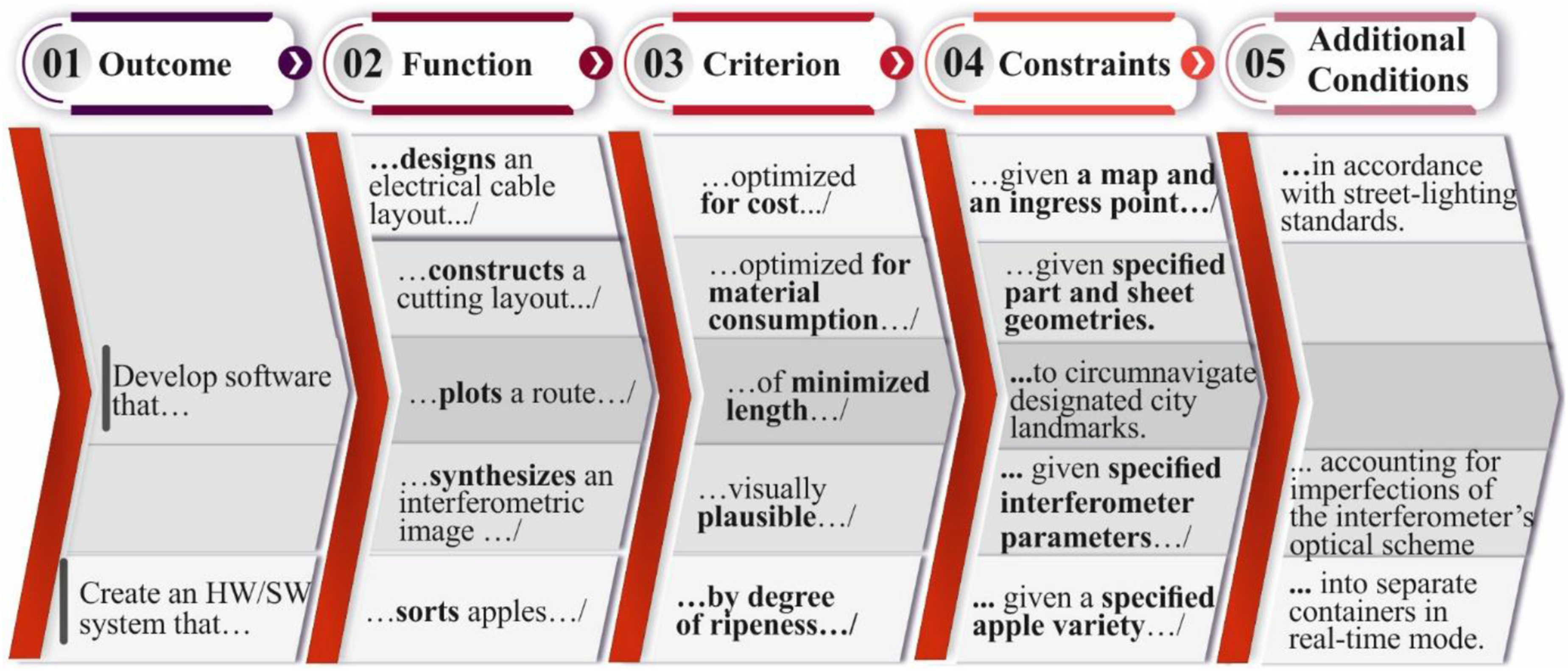
The formulation must include the following components: 1. Outcome, 2. Function, 3. Criterion, 4. Constraints, and 5. Additional Conditions. Each component corresponds to a segment of the sentence that conveys the following semantic content:
Outcome is an Authentic Achievement as a software product or a software-hardware system. Specifying a concrete outcome establishes a clear target for students, which is crucial for goal-directed learning. According to Locke and Latham’s goal-setting theory, specific and challenging goals yield higher motivation and performance than vague or simple ones (Chen and Yang, 2019; Locke and Latham, 1990). Clarity of the expected outcome reduces cognitive load and enables more efficient allocation of cognitive resources.
Function is the primary function the software (or software–hardware (SW/HW) system) must perform.
Criterion is a condition that a correct solution must satisfy.
Constraints are constraints on input data and the outcome. This component serves two essential purposes: first, constraints are intrinsic to any real-world problem; second, they allow for fine-tuning problem complexity. Working within set constraints forces students to think both creatively and critically. These constraints not only enhance their problem-solving skills but also cultivate the ability to operate under realistic limitations - an essential competence for their future professional practice.
Additional Conditions are secondary requirements - compliance with regulatory documents, Customer preferences, reference data, etc. - commonly encountered in real-world scenarios. These conditions should not substantially alter the underlying mathematical model or solution algorithms. As an optional element, this component increases the template’s adaptability and provides another lever for adjusting problem complexity. Incorporating additional conditions readies students for the reality that standards, national regulations, and legislative frameworks often govern professional tasks. It equips them with the vital skill of navigating such requirements in professional life.
It should be noted that a single Driving Question may include multiple functions and multiple criteria.
By specifying these five components, one obtains a ready-to-use Driving Question that contains all the information the project team needs to begin work. Figure 3 presents five example Driving Questions - each line corresponding to one component - that conform to this structure. These examples are drawn from actual student projects carried out between 2020 and 2023.
All Driving Questions are deliberately stripped of concrete data to develop students’ critical thinking, information-retrieval abilities, client-communication skills, and other competencies. According to the methodology in (Akhiiezer et al., 2023), once the Driving Question is received, the project team embarks on a domain exploration phase to prepare for the Customer meeting and to formulate all clarifying questions before drafting the technical specification.
To illustrate how a customer’s initial request can be evaluated against the proposed criteria and reformulated through the Driving Question template, we present a case from our implementation practice concerning an apple-sorting project. The Customer initially described the need as a system for separating sweeter apples intended for jam from more acidic apples intended for juice. This request was practically meaningful but methodologically vague, since sweetness and acidity were not directly specified as measurable input parameters, and the apple variety was not defined. During methodological reformulation, the task was translated into the following Driving Question: “Create an HW/SW system that sorts apples by degree of ripeness, given a specified apple variety, into separate containers in real-time mode.” The constraint concerning apple variety was essential, because visual indicators of ripeness differ substantially across varieties; without this constraint, the classification task would have exceeded the intended level of complexity for the student cohort. The final project output was a functioning HW/SW prototype that included a conveyor simulator assembled from available materials, a camera for real-time image acquisition, classification software, and a stepper motor that redirected apples according to the software output. The prototype was demonstrated during the public defence, and the project subsequently resulted in a peer-reviewed publication (Galuza et al., 2021). This case illustrates how the template helps transform an initially vague Customer request into a feasible, product-oriented, mathematically meaningful, and curriculum-aligned PBL task.
Recommendations for Driving Question formulation
This section provides practical recommendations for formulating Driving Questions and supporting the PBL process, derived from an analysis of common methodological errors and aimed at enhancing the effectiveness of project-based learning.
When issuing the Driving Question and throughout project work, educators should: (1) Refrain from supplying additional informational resources when the Driving Question is issued (this would negate Criterion IV). In the traditional PBL approach, educators often hold a discussion immediately after presenting the Driving Question and distribute resources (links to websites, books, lecture notes, etc.) containing the information needed to solve the problem (Bender, 2012). This practice leads students to replicate prescribed procedures without conducting a comparative analysis of alternatives, thereby undermining the development of critical thinking and independent research strategies. (2) Prohibit students from independently altering the Driving Question during project execution. Although some methodologies permit modification of the problem statement or allow students to select their own Driving Question after an initial domain exploration (Condliffe et al., 2017; da Rocha and Nogueira, 2025), in most cases, this results in oversimplification: the project is reduced to familiar models, which shrinks the students’ zone of proximal development and limits competency growth. Instead, any problem refinement should occur at the beta-testing stage, with changes initiated by an industrial partner (Customer). This approach preserves the project’s complexity while providing an authentic experience of negotiating requirements with an external Customer.
For educators integrating project-based learning (PBL) into the Applied Mathematics curriculum who face difficulties sourcing problems from real Customers, we recommend seeking collaboration with: • Local enterprises (industrial manufacturers, IT companies, banks, insurance firms, etc.); • Incubators and business accelerators that support startups and small businesses; • Research centers and laboratories; • Other departments within your own or partner universities (Driving Questions can be formulated around internal institutional needs, for example, automating administrative workflows, analyzing student engagement data, or developing campus-management software).
Additionally, we advise actively attending: • Industry conferences and exhibitions, where you can meet company representatives and learn about the challenges they are trying to solve; • Online freelancing and project platforms (such as Upwork, Freelancer, or Toptal), where organizations post tasks and projects for freelancers. These tasks can be adapted into PBL Driving Questions for students.
Systematic application of these recommendations helps projects maintain an appropriate level of cognitive challenge and authenticity, thereby enhancing their educational value and boosting graduates’ professional competitiveness.
Discussion
The contribution of this study should be understood in relation to existing PBL task-design frameworks. Concepts such as authenticity, interdisciplinarity, teamwork, and labour-market relevance are already well established in the PBL literature; however, they often remain too general to guide the formulation of concrete project tasks in a specific disciplinary context. The originality of the proposed methodology lies in translating these broad principles into a coherent set of specific and verifiable criteria and a structured template for designing Driving Questions in computing-oriented Applied Mathematics. In this sense, the methodology is not intended to redefine PBL or the concept of a Driving Question, but to provide a discipline-specific procedure for transforming customer problems stated in natural language into mathematically substantive, product-oriented, team-based, and curriculum-aligned project tasks.
Correspondence between PBL Driving Question Criteria and the Skills they provide.
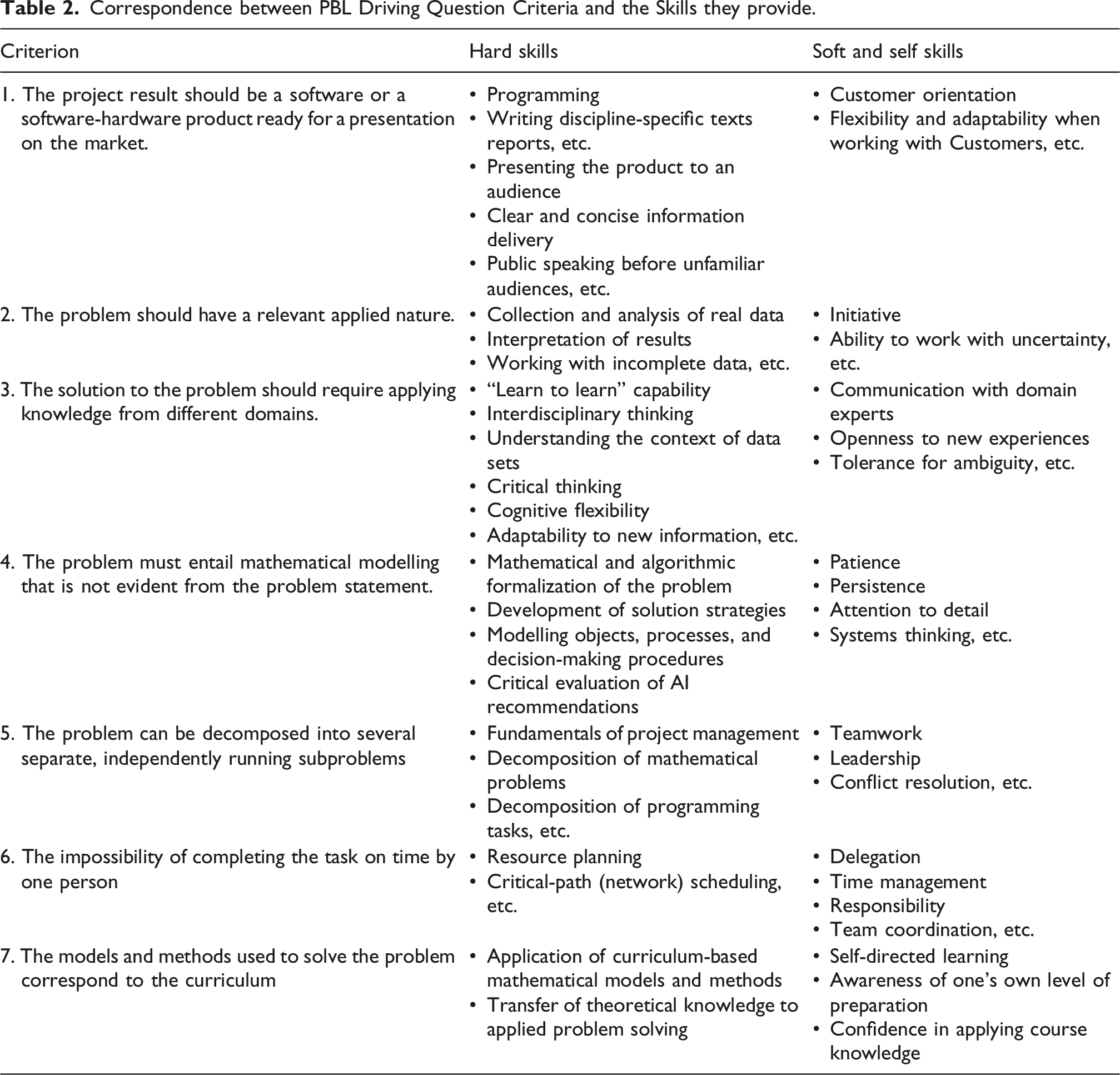
Table 2 demonstrates that the proposed set of criteria collectively addresses a broad spectrum of skills essential for a Computational Applied Mathematics specialist. Criterion VII differs from the previous criteria in that it primarily functions as a curriculum-alignment and feasibility criterion. However, it is included in Table 2 because it also supports the transfer of course-based knowledge to applied problem solving and helps maintain the project within a productive level of difficulty.
In addition to the criteria, we have developed a unified, structured template to help instructors avoid errors in Driving Question formulation and provide direction for all subsequent project-based activities. The PBL Driving Question template significantly streamlines the formulation process by: • Facilitating the standardization of both the problem-development process and the overall PBL instructional workflow; • Reducing educators’ time investment in question formulation through a clear structure that guides them step by step in creating a criterion-compliant Driving Question; • Providing a checklist of mandatory Driving Question components; • Enabling the creation of Driving Questions at varying levels of complexity, tailored to students’ differing proficiency levels.
Problem complexity can be substantially adjusted via the template’s two final components - Constraints and Additional Conditions. Moreover, according to Lev Vygotsky’s theory, maximal educational effectiveness is achieved when problem complexity is balanced at the edge of the Zone of Proximal Development (Van de Pol, Volman, and Beishuizen, 2010). Within this zone, skills first develop “between” learners and then internalize into individual cognitive processes. At the same time, Driving Questions should be pitched just above students’ independent capabilities while still remaining within achievable limits.
Thus, the combination of a clearly defined set of criteria and a unified template establishes the foundation for several methodological and practical advantages of the developed driving-question methodology: • The criteria set - each explicitly linked to specific learning outcomes - serves as a “quality filter.” A poorly formulated Driving Question not only fails to develop the targeted competencies but also creates a false sense of goal completion: knowledge is retained only until the next assessment and then quickly dissipates from working memory. By leveraging Bloom’s cognitive pyramid hierarchy, the methodology intentionally guides students to the Create level, thereby transferring knowledge from short-term to durable long-term memory, unlike traditional “exam-driven rote learning,” in which superficially acquired material is often forgotten immediately after the test. • The methodology is embedded within the framework of contemporary labour-market requirements. In designing the template and criteria, we took into account forecasts from the International Labour Organization, 2023, SFIA Foundation, 2025, The Organisation for Economic Co-operation and Development, 2020, UNESCO Institute for Lifelong LearningShanghai Open University, 2023, WEF, 2025, with particular emphasis on the Framework for 21st Century Learning (The Partnership for 21st Century Learning, 2019) and the concept of a growth mindset (Dweck, 2016). As a result, our graduates demonstrate not only a solid mathematical foundation but also alignment with contemporary labour-market requirements. According to surveys of our stakeholders and industry partners who currently employ our graduates, they exhibit, among other competencies, flexibility, leadership, and the ability to quickly master new technology stacks, and their overall productivity surpasses that of other early-career professionals. • The structured template for formulating the Driving Question functions as a practical standardizing tool. It supports consistency of educational practices when scaled across different courses; reduces methodological errors through its clear structure; and streamlines educators’ construction of Driving Questions and students’ grasp of the problem’s essence. • Students tackle real-world, contemporary problems submitted by industry Customers and formulated to reflect the sector’s actual needs. In doing so, they produce tangible deliverables - software or software–hardware solutions - that are incorporated into their showcase portfolio. Possessing such a portfolio provides clear evidence to prospective employers of a graduate’s ability to apply knowledge effectively in real-world settings, thereby significantly enhancing their competitiveness in the labour market.
The methodology presented in this study is the result of long-term practice-based refinement within programme-level PBL implementation. The criteria and the Driving Question template were iteratively revised on the basis of actual project cycles, student reflections, educators’ observations, Customer feedback, and analysis of project artefacts. From 2018/2019 to 2025/2026, this implementation involved 196 students, 51 qualitatively distinct project problems, 12 educators, and 15 industry and research partners serving as Customers. Additional feedback was obtained from employers who hired graduates trained under this methodology; this feedback indicated strong preparedness and work-related skills among these alumni.
The caliber of these projects is such that several have yielded peer-reviewed publications (Galuza et al., 2019, 2021; Savchenko et al., 2021).
Student reflections indicated the high motivational value of the methodology: an overwhelming majority of respondents consider PBL in the proposed format the optimal way to master applied mathematics, as it provides a direct link between theory and practice.
The scope of the proposed methodology should also be specified. The criteria and template were developed for a programme in which applied mathematics is closely connected with programming, data analysis, and software development. Therefore, the methodology should not be interpreted as directly applicable to all Applied Mathematics programmes without adaptation. In programmes where project outcomes are not expected to take the form of software or software-hardware products, several criteria, especially those related to market-ready deliverables and software development, may require modification.
Thus, within computing-oriented Applied Mathematics programmes, the developed methodology combines a clear methodological framework, pedagogical adaptability, and alignment with real IT-industry demands. It offers a practical approach for supporting the systematic design of PBL Driving Questions under conditions of rapid technological change.
Conclusions
In this study, we have proposed a discipline-specific methodology for selecting and formulating PBL Driving Questions for university students in computing-oriented Applied Mathematics programmes. The key achievements of this study are: (1) Typical errors commonly made in the formulation of mathematical PBL problems have been identified and categorized through the analysis of numerous existing cases. For each category, it is shown how such errors reduce the effectiveness of PBL. (2) A coherent set of criteria for evaluating and formulating PBL project problems has been developed and theoretically substantiated. Practice-based analysis further showed that the absence of any criterion creates specific methodological risks that may weaken the pedagogical effectiveness of the PBL process. (3) A clear correspondence between each criterion and specific learning outcomes has been established. Adhering to these criteria supports the purposeful and effective development of both professional competencies and metacompetencies defined in the academic curriculum. (4) A formalized template for PBL Driving Questions formulation has been developed and piloted, offering a standardized structure that helps reduce methodological errors and supports more consistent educational outcomes. Examples of Driving Questions designed using this template and criteria are provided. (5) Reliable sources for generating project problems have been identified, ensuring the applied relevance of the developed projects.
Overall, the proposed methodology addresses a critical gap in PBL practice by offering a systematic and transferable approach to Driving Question development for computing-oriented Applied Mathematics. It provides educators with a practical framework for systematically and replicably designing PBL Driving Questions.
Footnotes
Acknowledgements
The authors would like to express their gratitude to all staff members and students of the Department of Computer Mathematics and Data Analysis of the National Technical University “Kharkiv Polytechnic Institute” for their participation in the project work.

Consent for publication
The authors declare that they have all read and approved the final version of the manuscript and give their consent for its publication in the Industry and Higher Education.
Author contributions
Funding
The authors received no financial support for the research, authorship, and/or publication of this article.
Declaration of conflicting interests
The authors declared no potential conflicts of interest with respect to the research, authorship, and/or publication of this article.