







Abstract
Why do democracies sometimes fight long, politically divisive wars that end poorly? I argue that electoral accountability, induced by party competition, can sometimes promote this and other tragic outcomes. To demonstrate this, I analyze a bargaining model in which one state is conceived of as a unitary actor while the other consists of a government and an opposition that is motivated both by electoral ambition and concern for the national interest. Perhaps surprisingly, it is the opposition’s concern for the national interest that causes the most tragic outcomes, as they may choose not to advocate peace when doing so would prevent war so as to avoid undercutting the government’s bargaining position. I close with a discussion of why the United States appears to be particularly prone to such tragic outcomes, treating the Vietnam War as an illustrative example.
1. Introduction
Why has the United States so frequently involved itself in wars that drag on and on, prove unpopular, draw legislative opposition, and fail to produce clear victory? On average, democratic states tend to fight wars that are shorter and more likely to end in victory than the wars fought by non-democracies. 1 Since 1945, the median duration of an interstate war that involved a democracy other than the United States was approximately 1.5 months. The majority of such wars also ended in clear victory. 2 Yet the United States has fought five interstate wars in that time, and only one produced a quick victory. 3
Leaders of democracies are thought to be held accountable for policy outcomes to a greater degree than are leaders of other regime types, and it is this accountability that supposedly explains the tendency for democracies to abstain from wars they cannot win quickly and easily (Bueno de Mesquita et al., 1999, 2003; Reiter and Stam, 1998, 2002). 4 Yet if the reason that the United States defies the overall trend is a lack of accountability, it is difficult to explain why the Korean War brought an end to Truman’s presidency and the Vietnam War Johnson’s. Indeed, as I’ll argue later, one of the primary reasons Johnson escalated US involvement in the Vietnam War appears to be his fear of being held accountable for the decision not to do so. Thus, whatever makes the United States different from other democracies, it almost certainly is not that US presidents are insulated from the pressures of domestic politics. In fact, in this article, I argue that tragic outcomes are likely to occur as a result of electoral accountability that would not otherwise occur.
It is striking that the wars in Korea, Vietnam, Iraq, and Afghanistan each began with widespread support in Congress. 5 This stands in contrast to the expectations of extant claims about the relationship between domestic politics and decisions over war and peace. Specifically, it raises the question of why clear Congressional support for war failed to facilitate a peaceful resolution to the precipitating crises. 6
Of course, one might argue that legislative support was not compelling in these particular cases because the domestic consensus was not seen as stable. This would not be unreasonable, since all but one of these wars later saw Congressional calls for withdrawal. 7
However, this only raises the question of why wars that prove so difficult to win often attract widespread support early on, with opposition emerging later.
In short, electoral politics are intimately caught up with the dynamics of the wars fought by the United States, but domestic political forces do not seem to be allowing the US to avoid unnecessary wars even when the nation is relatively unified in support of war. Nor do domestic political factors appear to be promoting quick, easy victories for the US. 8
I argue that one of the very defining features of democratic governance, namely the regular and open competition for higher office among established political parties before a partially attentive audience, may itself be sufficient to ensure that elites will, under certain conditions, adopt behaviors that they know full well will produce tragic outcomes. Specifically, I analyze a bargaining model and discuss three key results where, due to electorally induced concerns for credit-taking or blame-shifting, the government and the opposition both behave in such a way as to promote tragic outcomes, by which I mean the occurrence of wars that would not otherwise occur or at least would not otherwise last as long. These results collectively explain both how signals from the opposition might lack credibility and why democracies might fight prolonged wars they have little hope of winning.
First, while I find that the opposition’s signal can indeed sometimes be informative, the model indicates that this is only the case when the course of fighting, should war occur, would favor the democratic state. Opposition signaling does not appear to prevent wars that would favor the foreign adversary.
This may strike the reader as counter-intuitive. After all, these are the very wars we might most expect electorally induced concerns for accountability to prevent. The key to this result lies in the effect opposition behavior has not only on the likelihood that the government and the foreign adversary would reach an agreement, but also the effect opposition behavior has on the terms thereof. When the course of fighting is expected to favor the foreign adversary, should the opposition advocate peace, they leave the government with very little incentive to fight. To do so would only result in a war that would fast become a huge political liability. Thus, advocating peace ensures that the foreign adversary can get the government to accept far less favorable terms. If the opposition cares not only about electoral considerations but also the national interest, as I assume to be the case, then they will be disinclined to put the government in a position where it will have little choice but to accept highly unfavorable terms. But since the opposition will thus tend to advocate war regardless of how important the issue is, their support reveals no information.
Second, I find that the opposition is sometimes willing to support wars it fully intends to turn against shortly after fighting begins, and that their willingness to support such wars at all can itself be a cause of war. The intuition here is that when the opposition advocates a peaceful resolution of the crisis, they implicitly accept that they will share responsibility with the government for the terms of any such agreement. By advocating the use of force, they partially distance themselves from any agreement the government might nonetheless accept, leaving the government more responsible for any terms that might be reached. Suppose then that it is common knowledge that the course of fighting would favor the foreign adversary. In such cases, the government will be less inclined to accept unfavorable terms after the opposition advocates war than if they advocated peace. Should the opposition advocate war, then, the foreign adversary will only be able to secure agreement by offering terms that compensate the government for the domestic consequences of accepting. Depending on how costly such a venture would be, the foreign adversary may prefer provoking war instead.
Third, the opposition will sometimes withdraw their support after the fighting begins despite knowing that doing so will cause the government to fight a long war that it would otherwise have been willing to end early or even avoid altogether. That is, I identify cases where the government and the foreign adversary would be sure to reach an agreement if the opposition advocated peace, and the government would be sure to fight a short war is the opposition were to advocate war and continue to support the war once it was underway, yet the opposition will nonetheless choose to advocate war initially and then quickly turn against it after fighting begins.
In each of these cases, the results critically depend upon the relationship between electoral accountability and the range of agreements each side would prefer to war. If we are to understand the relationship between domestic politics and war, I argue, we must also consider how domestic politics impacts the likely terms of peace.
The model also sheds light on why the United States appears to be uniquely prone to fighting long, politically divisive wars that it has little hope of winning. A key condition for such wars to occur in equilibrium is that the loss of utility associated with incurring the costs of war be sufficiently low. Few states in the international system have the ability to project power far enough to fight wars in regions too remote to be vital to their security interests. 9 Put differently, the puzzle may be less with why the United States is prone to fighting long, politically divisive wars it has little hope of winning, than why other democracies are not, and the answer may simply be that they don’t have the same resources.
I proceed in four steps. In Section 2, I discuss the link between opposition behavior and accountability. In Section 3, I present the formal model. In Sections 4–6, I discuss each of the three claims in turn. In Section 7, I discuss the empirical implications before briefly discussing the Vietnam War as an example of the dynamics highlighted by the model in Section 8 and concluding in Section 9.
2. Accountability, domestic opposition, and war
Much of the literature in international relations assumes that leaders of democracies are unconditionally held accountable for the consequences of their policy choices. This is quite reasonable as a first approximation. After all, Ferejohn (1986) argues that when the public engages in blind retrospective voting, they create the optimal incentive structure for governments. 10 Moreover, much of the literature on economic voting assumes that voters respond more or less uncritically to the state of the economy. 11 Given this, it is only natural that scholars would assume the same when it comes to foreign policy outcomes.
However, it is worth noting that blind retrospective voting does not always encourage encourage optimal policy-making. Woon (2012) sets up experiments with all the key features of the model in Fox and Shotts (2009) and finds that even when it is not in their self-interest to do so, voters base their decisions primarily on retrospective evaluations of policy outcomes. That is, voters can minimize the chance of reelecting an ideologically extreme leader who will implement socially harmful policies in the future by adopting alternative strategies, yet the subjects in Woon’s experiments still relied on the simple heuristic of blind retrospective policy evaluations. They punished incumbents for selecting policies that produced bad outcomes even when doing so created a long-term incentive for ideologically extreme leaders to implement their preferred policies rather than advancing the public interest. 12 Similarly, Healy and Malhotra (2009) find that while voters reward governments for disaster relief spending, they do not reward disaster preparedness. Taken together, these results strongly suggest that voters respond in straightforward, simplistic ways to realized outcomes, showing little regard for whether their behavior creates perverse incentives.
There is also growing evidence that democratic publics are more likely to hold their governments responsible in the presence of elite disagreement, such as when members of the legislature advocate a different policy. 13 , 14 This may be because individuals do not know whether a policy is at odds with their views until they receive cues from like-minded elites. 15 Or perhaps voters do not believe that replacing the government with the opposition will actually provide a check against poor decision-making in the future unless the opposition went on the record as opposing the government’s policy. 16
In light of these arguments with respect to voting behavior, it is appropriate that Schultz (1998, 2001) focuses on the behavior of the opposition party. He argues that when democratic states lack resolve, the opposition will generally oppose the use of force in order to position themselves to benefit should the government nonetheless escalate the crisis. As a result, in those cases where the opposition instead advocates the use of force, the target state can infer that the government’s threats are more credible. This makes resistance less likely.
Ramsay (2004) identifies roughly similar results, using a more flexible model that does not assume a priori any relationship between opposition behavior and the probability that the leader remains in office. He finds that so long as the opposition values both winning office and securing more favorable international outcomes, their endorsement (or lack thereof) conveys information, and thereby strictly reduces the probability of war.
These models provide an important advance over previous work. However, in neither model can the domestic political implications of the expected outcome of war influence the terms of settlement reached by the government and the foreign adversary. In (1998, 2001), the behavior of the opposition influences the government’s expected value for war, but not the size of the concessions offered by the target state (if any). 17 Similarly, in Ramsay (2004), the foreign adversary’s optimal proposal is largely a function of each side’s probability of winning, though in his model the foreign adversary’s beliefs about the cost likely to be incurred by the incumbent government when fighting a war also play a role.
Put simply, both authors focus exclusively on the impact of opposition on the foreign adversary’s beliefs about the government’s value for war, without considering how the opposition’s behavior might influence the terms that will be offered or accepted.
Of course, by their very definition, all models are simplifications. If an assumption does not bias the model towards its particular substantive conclusions, there is little sense in criticizing a model for being less than perfectly accurate in its portrayal of reality. 18 The question then is whether treating the terms of agreement as independent of domestic political considerations is of consequence to our primary substantive conclusions.
As I hope to demonstrate here, it is. The results I derive stand in stark contrast to those of Schultz (1998, 2001) and Ramsay (2004), and, as we will see, each of them depends at least in part upon the impact of the opposition’s statements on the government’s willingness to accept or reject a given proposal.
There is another important feature of the models found in Schultz (1998, 2001) and Ramsay (2004) that is not present here—wars are treated as instantaneous events. As such, no actor faces any decisions once war begins, and there is no opportunity for the opposition to change its position. Note, though, that Schultz, (2001: 69, n. 8) states, ‘Of course, bargaining does not end once a war begins, and a natural extension of the work here is to consider how domestic political factors influence states’ assessments during wars’. I do precisely this, allowing the domestic opposition to reconsider its position towards wars that it initially advocated fighting.
Note, however that some of the key differences between my results and those identified by Schultz (1998, 2001) and Ramsay (2004), particularly those concerning the conditions under which opposition rhetoric can credibly reveal information about the democratic state’s resolve, would emerge from a bargaining model that treated war as a costly lottery, provided domestic politics was allowed to affect the terms of agreement the government accepts.
The question of whether to treat war as a costly lottery or dynamic process does not necessarily have any impact on our understanding of the conditions under which wars occur. To be sure, we must model war as a process if we are to explore the relationship between decisions states make during war and the duration of war though. 19 I model war as a dynamic process rather than a costly lottery here because this allows me to explore the effect of opposition behavior not only on the onset of war, but also war duration. This allows me to address the puzzle outlined above—why is it that the United States is prone to fighting long, politically divisive wars that fail to produce clear victories?
I turn now to presenting a model that allows opposition rhetoric to influence not only accountability, but also the terms that will be offered during crisis bargaining.
3. The model
Some foreign adversary, F, and the government of some democratic state, G, dispute the division of some good or bundle of goods, such that at least one state is dissatisfied with the status quo, which is assumed to lie at 0. The game begins with the legislative opposition in the democratic state, O, advocating either a peaceful resolution of the crisis, which is denoted ‘p’, or advocating war, denoted ‘w’.
I do not allow O to directly affect G’s ability to conduct policy, but do assume that the opposition can influence the government’s payoffs indirectly in a manner to be specified more fully below. 20 However, I do not treat the payoffs for G and O as zero sum. Rather, I assume that both G and O care about their relative electoral prospects, which puts them in direct competition with one another, yet also both derive utility from outcomes that allocate more of the good to their nation, and both suffer from seeing their nation incur cost in war. 21 This is important, as one of the key insights of the model is that it is precisely because the opposition values the national interest that some of the most tragic outcomes occur.
After observing O’s position, F then proposes terms to G, denoted x ∈ [−1, 1], where x reflects the distributive outcome from the perspective of the democratic state. That is, positive values of x indicate a favorable shift away from the status quo and negative values indicate an adverse shift. The foreign adversary receives −x in the event that an agreement is reached since it prefers to see the status quo shift in the opposite direction.
To ease exposition, I refer the reader at this point to Table 1, which contains each of the outcomes and the associated payoffs for each player.
Outcomes and payoffs.
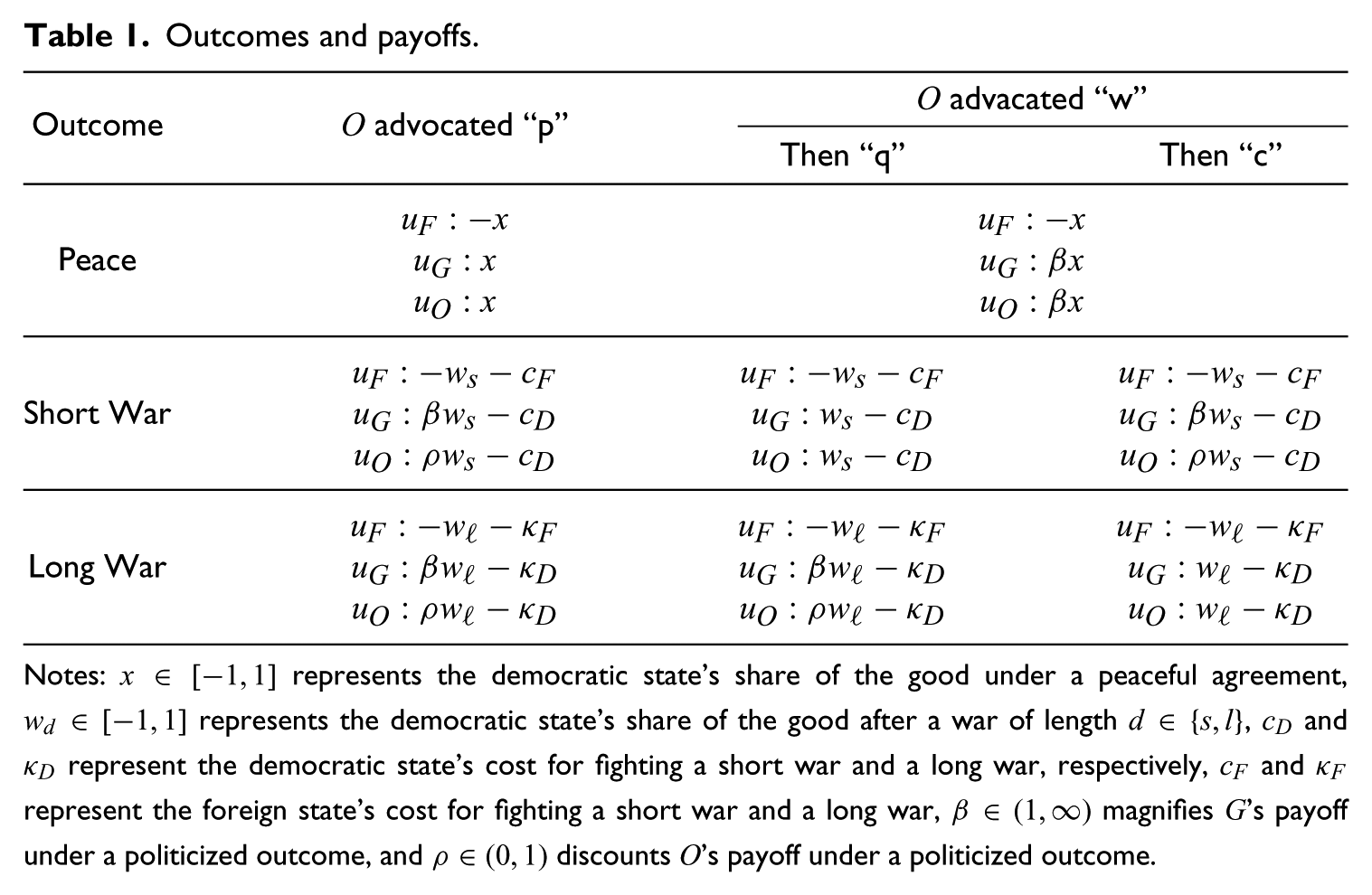
Notes: x ∈ [−1, 1] represents the democratic state’s share of the good under a peaceful agreement, w d ∈ [−1,1] represents the democratic state’s share of the good after a war of length d ∈ {s, l}, c D and κ D represent the democratic state’s cost for fighting a short war and a long war, respectively, c F and κ F represent the foreign state’s cost for fighting a short war and a long war, β ∈ (1, ∞) magnifies G’s payoff under a politicized outcome, and ρ ∈ (0,1) discounts O’s payoff under a politicized outcome.
If G accepts, the game ends peacefully, and the good is divided in accordance with F’s proposal. If G rejects F’s terms, a war begins. Then, after some period of time, G will decide whether to quit or continue fighting. However, if O initially advocated war, O may reevaluate their position prior to G making this decision. That is, if O initially advocated ‘w’, once G rejects F’s terms, O can then either advocate quitting, ‘q’, or continuing, ‘c’. 22 Regardless of O’s position, when G rejects F’s terms then later quits fighting, a short war results, whereas the war is assumed to be a long war if G continues fighting. The outcome of a short war, from the perspective of the democratic state, is denoted w s ∈ [−1, 1], while the outcome of a long war is denoted w l ∈ [−1, 1]. Again, F receives the opposite of what the democratic state receives, such that −1 is the best possible outcome for F while 1 is the best distributive outcome for G and O.
Implicitly, therefore, I have assumed that the length of the war, should one occur, is chosen unilaterally by G, without F being allowed to influence the war’s duration. 23
If G does not do what O advocates, the outcome of the game will be politicized. When the outcome is politicized, G’s subjective value for the distributive outcome gets magnified while O’s is attenuated, such that G finds favorable outcomes more attractive and unfavorable ones less so when they are politicized. This reflects an assumption that the salience of the issue will be increased and the electorate will be more attentive when the outcome differs from that which O advocated. In other words, though O is assumed to always benefit from the distributive nature of outcomes that are advantageous for their nation, the electoral implications detract from O’s value for these outcomes when G will be able to turn the outcome of the game into a wedge issue electorally. Similarly, though O always suffers to some degree from adverse shifts in the status quo, if the outcome of the game is politicized, that loss will be partly mitigated by the knowledge that the electorate will punish G to the benefit of O. Note that this formulation ensures that O prefers any positive outcome, even if it benefits G electorally, to any negative outcome.
More formally, G and O derive utility based both on the actual distributive outcome and the political context in which that outcome was reached. Specifically, if G accepts F’s proposal after O announces ‘w’, delivering peace when the opposition advocated war, G receives βx and O receives ρx, where β ∈ (1,∞) and ρ ∈ (0,1). Note that multiplying x by β makes good outcomes better and bad outcomes worse for G, since βx > x for x > 0 and βx < x for x < 0. In contrast, ρx < x if x > 0 and ρx > x if x < 0.
F’s payoff is simply −x whenever G accepts, regardless of what O advocated.
Should a war occur, regardless of whether its outcome is politicized, I assume that both G and O incur cost c D > 0 if the war is relatively short and κ D > c D if it is relatively long. Similarly, F incurs cost c F > 0 from a short war and κ F > c F from a long war.
As is typical in such models, the cost terms represent the subjective loss of utility, and thus reflect not only the financial and human costs of war, but also the state’s willingness to bear such costs. That is, a war fought over an unimportant issue might entail significant loss of utility even if relatively few fatalities are incurred, while hefty tolls might nonetheless be associated with a relatively minimal loss of utility if suffered in pursuit of vital interests.
For most of the key results, G, O, and F all understand that war will shift the status quo in F’s favor. However, I will at times contrast cases in which war is expected to shift the outcome in F’s favor with cases where war is expected to shift the status quo in a direction favorable to the democratic state. 24 , 25
Note that I have implicitly assumed that the electorate in the democratic state knows less than F does. Specifically, for some of the key results, it is critically important that the government expect to be punished for accepting unfavorable agreements when the only alternative is to fight a war that will not go well. I thus implicitly assume that the public does not appreciate that G could not have delivered better outcomes by behaving differently, nor do they realize that O’s behavior might be insincere in the sense that they might advocate outcomes that they know are not in the nation’s interest purely to differentiate themselves from the government and thereby shift the blame for an unfavorable outcome onto G. However, as discussed above, there is considerable evidence that voters do indeed uncritically reward or punish the outcomes that they observe, without much regard to the perverse incentives that such behavior might create.
However, I assume that F is nonetheless uncertain about the democratic state’s resolve. More formally, the democratic state’s resolve can be either relatively high, in which case c
D
=
Though initially uncertain about the democratic state’s level of resolve, F may learn from O’s pre-war statements. Therefore, I begin my presentation of the results by addressing the impact of O’s initial statement on F’s beliefs about c D and κ D .
4. Opposition (un)willingness to reveal information
We now take up the question of whether the behavior of the opposition can reveal information about the democratic state’s resolve.
27
More formally, we are interested in the existence of perfect Bayesian equilibria where O advocates ‘p’ when
Before we discuss such equilibria, it is useful to establish a few preliminary results.
Lemma 4.1 implies that if w s > 0 and w l > 0, should O advocate ‘w’, F always selects values of x that G accepts with positive probability. This does not mean that war cannot occur in equilibrium. But it does mean that F is willing to bargain in good faith, in the sense that wars only occur when F takes a risk that does not pay off. Put differently, faced with uncertainty over what G will or won’t accept, F may select values of x that G rejects when relatively resolved. 29 However, should war result under such circumstances, F will experience ex post regret. The same need not be true after O announces ‘p’, however, particularly if the costs of war are sufficiently low.
The intuition behind this result is that if O advocates war but G accepts F’s proposal, then G enjoys most of the credit for the terms of the agreement, receiving βx. Since G is negotiating from a position of strength, the agreement is likely to be favorable, i.e. x > 0 and thus βx > x. Therefore, F need not offer terms that are as generous as they otherwise would have to be in order to induce agreement. But when O advocates peace, G has something of an incentive to reject any given x, since any war that results will be politicized and thus will pay electoral dividends. Therefore, in order to get G to accept and thereby forgo the opportunity to turn a battlefield victory into an electoral advantage, F must offer unduly generous terms. If the costs are sufficiently low, F may prefer fighting a war to doing this.
Lemma 4.2 is the mirror image of Lemma 4.1. When w s < 0 and w l < 0, if O advocates ‘p’, G has no choice but to accept terms that would otherwise be unappealing. They do so in attempt to avoid fighting a war that would produce an unfavorable settlement for which they would receive most of the blame. Put differently, when the course of fighting would favor the foreign adversary, O ironically acts against the national interest when O advocates peace. This may sound counterintuitive, but consider G’s bargaining position when choosing between peaceful outcomes for which they will not be held accountable and a war for which they will—under such conditions, F can force G to accept very unfavorable terms. It is for this reason that F has no incentive to deliberately provoke war.
If O advocates ‘w’, however, G can escape being held accountable for the (unfavorable) outcome of the war by fighting, but will take the blame for the terms of any peaceful agreement they accept instead. Thus, enticing G to accept requires F to compensate G for the electoral punishment they will face. Since F expects to do well in the war, F may not be willing to do so, particularly if the costs of war are sufficiently low.
These two results highlight the importance of focusing on the effects of concerns for credit-taking and blame-shifting on the bargaining process itself. In deciding whether to advocate war or peace, O must consider not only what information they may reveal to F but also how their statements influence G’s willingness to accept or reject any given terms.
We are now ready for our first key result.
Proposition 4.3 refers to cases where short wars might result if F gambles with its choice of x, but where F and G would be guaranteed to reach a peaceful agreement if F’s uncertainty is removed. Thus, if O’s initial statement reveals the democratic state’s type, wars that would otherwise have occurred will be prevented. Such equilibria only exist if the course of fighting would favor the democratic state. Put differently, Proposition 4.3 tells us that democratic publics cannot expect the strategic behavior of the opposition to prevent those wars that are most likely to end unfavorably for their nation.
It is O’s concern for the national interest that drives this result. When the course of fighting would favor F, O has no incentive to advocate peace because doing so puts G in a very weak bargaining position and thereby ensures that F will force G to accept very unfavorable terms. If O instead advocates ‘w’ and then subsequently advocates ‘q’, the terms of any negotiated agreement will be politicized, while the outcome of a short war would not be. As a result, F will be forced to propose more palatable terms if it is to secure agreement. O thus advocates fighting a war it knows will not go well, and which it fully intends to later oppose, because doing so puts the government in a better bargaining position and because its outcome will be better for O than having G accept what F would have otherwise proposed.
5. Waiting out the opposition
It is worth discussing further the possibility that O might, after a short period of fighting, come to oppose a war they initially supported. Since I have assumed that the values of w s and w l are known by all three players from the outset, this reversal in position cannot be attributed to new information being revealed by battlefield outcomes or the like. 30 Here, there are conditions where O advocates ‘w’ despite fully intending to later advocate ‘q’. In this section, I discuss how this phenomenon may itself be the cause of short wars, irrespective of F’s beliefs about the democratic state’s resolve. Then, in the next section, I show that O may have an incentive to withdraw their support for war even when they know that by doing so, they will cause G to dig its heels in and fight a long war that could have been avoided had O advocated peace from the outset.
The equilibrium described by Proposition 5.1 exists when w
s
< 0, w
l
< 0,
Under such conditions, O advocates ‘w’ regardless of type, because advocating peace forces G to accept extremely unfavorable agreements. Worse still, the country will suffer an unfavorable outcome for which O will be unable to hold G accountable, as O will have favored peace over war and G will have done as O advocated. Because O will instead advocate war, regardless of their nation’s resolve, F does not learn anything from O’s statement. Yet, that won’t matter in this case, since F is willing to propose terms it knows G is certain to reject. Once the inevitable war occurs, O will advocate quitting, and G will do so. And this will leave O better off than O would have been if O had advocated peace.
Note that G’s value for a negotiated agreement when O advocates ‘w’ is βx, where βx < x since F has every incentive to set x < 0 when w s < 0. Put differently, G’s outside option is a short war that favors F. Therefore, the only terms G can expect F to offer will also favor F. But since G will not be held accountable for the outcome of a short war, whereas they would be held accountable for the terms of any peaceful agreement, if F is to avoid a war, F cannot propose terms that are too unpalatable. As a result, F may prefer provoking a war, provided the total costs of a short war are sufficiently low.
In essence, Proposition 5.1 indicates that F can be better off waiting until O provides the political cover for G to accept an unfavorable settlement that reflects the battlefield status quo rather than attempting to secure an agreement from G for which G will be forced to accept most of the blame, because the only way to get G to accept such an agreement is to offer terms that do not reflect the expected outcome of war. F knows that G will be held accountable for the terms of any agreement once O advocates war, and F also knows that O has every incentive to advocate war because O cares enough about the national interest that O will not allow F to force G to accept overly harsh agreements. G’s desire to avoid being held accountable, O’s desire to avoid saddling the nation with extremely unfavorable terms, and the relatively low costs of war, all work together to ensure that the best terms F can secure from even the less resolved type of G will be less attractive to F than a short war will be. Thus, O’s behavior ensures a war that would not otherwise occur.
Two important features of the model drive this result. First is the assumption that O can ensure that the public holds G accountable for the distributive character of a peaceful agreement by advocating war, even though fighting a war that is certain to favor F is not in the public’s interests. The public would have to commit to not punishing governments for bad outcomes to which the opposition objected for such outcomes to be avoidable. Our current understanding of voter behavior suggests that the public cannot promise this.
Second is the assumption that G can trust that it will not be held equally accountable for the unfavorable nature of w s when O advocates war but then advocates quitting. This is consistent with recent evidence concerning electoral outcomes (Arena, 2008).
6. Long, politicized wars
Suppose again that if war occurs, the course of fighting will favor the foreign adversary, or w s < 0 and w l < 0. Suppose, however, that while the war will not go well, it will not be overly costly. 31 This leads us to our next key result.
Informally, Proposition 6.1 identifies conditions under which, provided the democratic state is relatively resolved, we expect to observe a long, politically divisive war whose outcome will favor the foreign adversary. Moreover, this outcome could have been avoided had O advocated peace. Had O done so, F would have proposed terms that G would accept regardless of type. Of course, those terms would be especially unfavorable to the democratic state, even relative to the eventual outcome of the long war. Thus, from the perspective of the public, O’s behavior is not sub-optimal. That is, when I refer to this outcome as tragic, I mean that in the sense that a greater loss of life will occur than could have been the case, but this need not necessarily mean that peace would have been preferable to war. Insofar as extant claims lead us to expect that democracies will rarely fight long wars that end poorly, this is an important result. But I do not wish to misrepresent it.
It may be helpful here to consider a numerical example. Suppose that w
s
= −0.9, w
l
= −0.2, β = 2,
If O were to advocate peace and G were to reject F’s terms, G would choose between βw
s
− c
D
= −1.85 and βw
l
−
If O were instead to advocate war, only to later advocate quitting, G would face a choice between w
s
−
Note, however, that w
l
−
Put differently, though it sounds counterintuitive to say that the opposition will advocate war only to subsequently turn against it when they know that this will produce a long war that will end poorly, and further know that they could have prevented war by advocating peace at the outset of the crisis, such behavior is not nearly as perverse as it sounds. It leads to an outcome that is worse than the status quo, and that involves a greater loss of life than would have been the case if the opposition had advocated peace, but which is not worse than the only realistically available alternative. It is important therefore to consider not only whether war occurs and whether that war will end favorably, but the terms that might be reached in lieu of war. If advocating peace prevents war only by forcing the government to accept outcomes that leave the nation even worse off than war would have, it is unsurprising that the opposition might advocate war instead.
For this equilibrium to obtain, a few important conditions must be met. First, F must remain relatively confident that the democratic state is unresolved even after observing O advocate war. Of course, since O does so regardless of type in this equilibrium, this simply means that F’s prior belief, ϕ, must be relatively high.
Further, it cannot be true that F would have become particularly optimistic about its prospects of facing a less resolved opponent had O deviated from the equilibrium and advocated peace. This means that F’s off-the-equilibrium-path belief cannot be too small.
Finally, the implications of politicizing the crisis cannot be arbitrarily small.
More specifically, for the equilibrium described in Proposition 6.1 to obtain, O must be willing to advocate war despite fully intending to advocate quitting the war once it is underway. When the democratic state is relatively high in resolve, the choice facing O is clear. If O advocates peace, they will share the blame with G for an agreement that F will have crafted deliberately so as to leave G no better off than G would have been had G rejected it and fought a long, politicized war whose outcome would favor F. Put differently, O will be forced to share G’s value for an incredibly unattractive outside option. In contrast, if O advocates war, only to withdraw their support for war by calling on G to quit, though this will ensure that G will in fact fight a long, politicized war that will ultimately favor F—something that O has no particular reason to desire, in the abstract—the eventual outcome will at least prove electorally beneficial to O. Moreover, the distribution of the contested good will be less unfavorable. From G’s perspective, these two outcomes are equivalent, since, in each case, G receives βw
l
−
The decision facing O when the democratic state is relatively low in resolve is also more or less straightforward. In such cases, O knows that, regardless of whether they advocate peace or war, G will accept F’s terms, since F will choose values of x that ensure this to be the case. O’s decision to advocate war under such conditions is driven both by the desire to see G take the blame for the terms of the agreement and the fact that, precisely because G is more willing to reject proposals for which they must accept most of the blame, F will propose more palatable terms if O advocates war. That is, both electoral ambition and concern for the national interest encourage O to advocate a war that would have ended poorly if it were to occur, yet which will not actually occur in equilibrium anyway.
It is worth noting that if voter decisions were insensitive to elite rhetoric, the key results identified here would not emerge. In the limit, as β → 1 and ρ → 1, the behavior of the democratic state converges to that of a unitary actor and the model becomes a straightforward extension of standard bargaining models. However, we have ample evidence that voter decisions do indeed depend on elite rhetoric, as discussed above.
Note that, despite some apparent similarities, the behavior described by Proposition 6.1 is not ‘gambling for resurrection’ 33 . In this model, by assumption, the government knows how the war will end. Their decision to fight a long war, then, cannot accurately be characterized as gambling in any meaningful sense. It is, however, true that such wars only occur when the outcome of a long war, though unfavorable, would be less unfavorable than that of a short war. Otherwise, no value of κ D would be low enough to justify continuing to fight.
Also note that, while I have focused on the possibility of tragic results because they are of particular interest, the model does not suggest that democracies are never expected to fight short wars in which they receive favorable outcomes. All of the preceding results pertain strictly to cases where factors outside the control of G ensure that a favorable outcome cannot be achieved. While such cases exist, I do not intend to suggest they are the only cases that exist. Rather, they constitute a particularly theoretically important subset of cases upon which it is useful to focus so as to establish results that stand in stark contrast to those of the extant literature linking domestic politics to patterns of war and peace.
7. Empirical implications
One might argue that there is value simply in demonstrating the possibility that democracies might sometimes fight long, politically divisive wars that end unfavorably, and that they might do so not as the result of an accident or personality defects on the part of those in power but because a defining feature of the democratic process itself creates incentives for such outcomes. After all, having observed empirically that democracies tend to fight (interstate) wars that they win quickly and easily, many authors have argued that domestic accountability encourages such behavior. The preceding discussion is sufficient to demonstrate that accountability, particularly in the form that we expect to observe in modern electoral democracies, need not produce such outcomes. And this alone should encourage us to reconsider the explanations that have been put forth for such empirical regularities.
Nonetheless, I believe the model provides more than a mere possibility proof. I argue that it sheds light on the puzzle with which we began—the tendency for the United States, in particular, to fight long, politically divisive wars that end poorly.
The model provides a rationale for such cases particularly when the democratic state would suffer relatively low costs for fighting yet is unlikely to prevail militarily. For many states, these two conditions are not particularly likely to occur together.
Since World War II, colonialism has become increasingly economically inefficient (Gartzke and Rohner, 2011), and so the great powers of Europe gradually abandoned their empires. Moreover, most of the world’s democracies have come to rely upon the United States to provide their security. Accordingly, they spend less on defense than they otherwise would (Lake, 2007). 34 Moreover, most of the world’s democracies have settled their outstanding border disputes (Gibler, 2007). As a result, most of the world’s democracies lack both the incentive and capability to project power beyond their immediate borders, and have little reason to come into conflict with their neighbors.
Note, however, that other democracies have had both global interests and the resources necessary to fight prolonged wars against stubborn insurgencies. The era of decolonization in particular provides several examples of extrastate wars that broadly exhibit the patterns anticipated by the model. Notable examples include the French Indochina War and the Algerian War of Independence.
This points to another important factor. Most of the long wars that the US has fought were wars of counterinsurgency, whether they began as such or not. 35 Note that Lyall (2010) addresses the question of whether democracies make inferior counter insurgents, as some have argued, and finds that, democracies are no better nor worse at counter insurgency warfare than non-democracies. 36 Put differently, democracies are no better nor worse at fighting wars of counterinsurgency, but are prone to selecting themselves into the types of counterinsurgencies that are the most difficult to win. Such behavior points to a significant shortcoming in extant accounts of the relationship between domestic accountability and decisions regarding war and peace.
The model developed here provides an explanation for why democracies are more prone to fighting long wars that end poorly when it comes to wars of counterinsurgency than traditional interstate wars. Wars of counterinsurgency are characterized both by a lower chance of success and lower levels of intensity. That is, they represent cases where w s and w l are likely to be negative, but κ D is likely to be relatively low. Thus, the model provides a stylized account of general patterns of behavior that have been observed historically.
But to further illustrate the empirical relevance of the model, I turn now to a brief discussion of the quintessential example of a democratic state fighting a long, politicized war that it had no hope of winning—the Vietnam War.
8. The Vietnam War
A detailed and thorough discussion of US involvement in Vietnam lies outside the scope of this analysis. I focus here particularly on the extent to which the conditions under which the Johnson administration escalated the war correspond to those anticipated by the model. To be sure, factors such as mission creep and the domino theory must be part of any complete account of the war’s escalation, and even within the realm of domestic politics, many have argued that Johnson believed that shoring up his anti-communist credentials by fighting a war in Vietnam would buy him the political capital necessary to enact the Great Society. 37 Again, I stress that the goal of this discussion is not to provide a definitive and complete account of the escalation of the war in Vietnam, but to assess the degree to which the escalation can serve as a stylized example of the dynamics highlighted by the model.
There are three important claims I wish to make here. First, that Johnson knew from the outset that the prospects for victory were negligible. Second, that his decision to escalate the war was motivated, at least in part, by a desire to avoid the punishment of being held accountable for the only peaceful outcome that was made available to him–that accountability is worth worrying about when choosing peace as well as war. Third, the positions taken by members of Congress collectively can be interpreted as the legislative opposition, writ large, having advocated first war then later an end to the war.
With respect to the first point, stark evidence comes from Lady Bird Johnson’s diaries. Presidential historian Michael Beschloss interviewed Lady Bird Johnson, and she told him of how concerned she was at the time, since Johnson was ‘in a real emotional decline in 1965, which had to do with the fact that he knew … [the] war would destroy him, his presidency and badly harm the country’, and had told her, Things are not going well here … Vietnam is getting worse day by day. I have the choice to go in with great casualty lists or get out with great disgrace. It’s like being in an airplane and I have to choose between crashing the plane or jumping out. I do not have a parachute (Beschloss, 2002)
Excerpts from secret tapes Johnson recorded paint a similar picture. A conversation he had with newspaper publisher John Knight is worth quoting at length.
What do you think we ought to do in Vietnam?
I never thought we belonged there. Now that’s a real tough one now, and I think President Kennedy thought at one time we should never, that we were overcommitted in that area.
Well, I opposed it in’54. But we’re there now, and there’s only one of three things you can do. One is run and let the dominoes start falling over. And God Almighty, what they said about us leaving China would just be warming up, compared to what they’d say now. I see Nixon is raising hell about it today. Goldwater too. You can run or you can fight, as we are doing. Or you can sit down and agree to neutralize all of it. But nobody is going to neutralize North Vietnam, so that’s totally impractical. And so it really boils down to one of two decisions–getting out or getting in. …
Long-range over there, the odds are certainly against us.
Yes, there is no question about that. Anytime you got that many people against you that far away from your home base, it’s bad (Moyers, 2009).
While Johnson does invoke the domino theory, we see that he is particularly concerned about what the Republicans will say if he accepts the hand he’s being dealt by North Vietnam. He is even clearer about this point in a conversation with Senate Armed Services Chairman, Richard Russell, who expressed the view that Vietnam wasn’t ‘important a damn bit’ and told Johnson, ‘Frankly, Mr. President, if you were to tell me that I was authorized to settle it as I saw fit, I would respectfully decline’, and, It’s a, it’s a, it’s the damn worst mess I ever saw, and I don’t like to brag. I never have been right many times in my life. But I knew we were going to get into this sort of mess when we went in there. And I don’t see how we’re going ever to get out.
Johnson largely agreed with Russell, telling him, ‘I don’t think the people of the country know much about Vietnam and I think they care a hell of a lot less’. However, he went on to note that ‘The Republicans are going to make a political issue out of it, every one of them, even Dirksen’(Moyers, 2009).
Consistent with the model, then, Johnson appeared to believe that the US public was not deeply engaged with the issue, but would hold him accountable because the Republicans would politicize his decision not to go to war.
With respect to the domestic opposition, Congress was initially unified in support. The Gulf of Tonkin Resolution, which authorized the president to use any means he deemed necessary to repel any armed attack against the forces of the United States and to defend any governments in Southeast Asia that opposed communism and was thus interpreted by the Johnson administration as an authorization for war, passed without a single dissenting vote in the House and a mere two nay votes in the Senate (Kenworthy, 1964).
The Vietnam War would ultimately prove nearly as unpopular with both parties. In 1970, the Gulf of Tonkin Resolution was repealed in the Senate by a vote of 81 to 10 (Finney, 1970). Of course, by then, Johnson was out of office. But there is clear evidence that a majority of Congressional Democrats advocated pursuing a negotiated settlement and withdrawal from Vietnam as early as 1965, prompting Gerald Ford to say that Johnson ‘must not yield’ to those Democrats in Congress ‘who would abandon the free people of South Vietnam’ (New York Times, 1965). And once it becomes clear that Congressional Democrats oppose continuing the war, public opinion polarizes (Zaller, 1992: 102–104).
In the model, the democratic state consists of two actors: the government and the opposition. In reality it is rarely meaningful to speak of a single opposition. Here, we see that the question of whether certain outcomes will or won’t be politicized depends upon the behavior of members of more than one political party. Specifically, Johnson fears that allowing South Vietnam to fall will elicit criticism from Republicans, while the decision to escalate the war ultimately brings opposition from members of his own party.
A more nuanced model might consider two distinct opposition actors: one that is known to have generally dovish views and one that is known to have generally hawkish views. Such a model would still allow for variation in whether different outcomes would be politicized, but it might assume that peaceful outcomes can be politicized so long as the hawkish actor advocates war and that war outcomes can be politicized so long as the dovish actor advocates ending the war. In this article, I have not allowed for such rich possibilities, as the model is already relatively complicated. But the fact that Johnson’s fear that the Republicans would hold him accountable for ‘losing’ Vietnam the way Truman ‘lost’ China, yet was ultimately undone by anti-war elements of his own party, is not inconsistent with the current model. The important point is that the key result of the model requires an expectation that the government would be held accountable for accepting the only peaceful outcome available and that legislative support for the war be withdrawn during the war, thereby ensuring that the government will also be held accountable for the outcome of the war. While the actors responsible for each of these concerns are not the same, it seems clear that, in broad strokes, this is indeed what we observe with respect to the war in Vietnam.
Again, to be clear, the path to US involvement in a ground war in Vietnam is a complex one, and it began decades earlier. The preceding discussion is not intended to offer a full account. However, a few stylized facts stand out. First, Johnson was not confident about victory, despite his public statements. His comparison to choosing between staying in a plane that is going down or jumping out without a parachute is quite revealing. Second, Johnson was concerned about the domestic political implications of allowing South Vietnam to fall, and he anticipated that Goldwater and Nixon would use Vietnam against him. Third, the war enjoyed widespread support from Congress initially, but it only took a few months before members of the president’s own party began to advocate an end to the war.
Though many other factors were at play, this brief discussion suggests that the conditions highlighted by the model as being likely to result in a long, politicized war that ends poorly were largely in place in 1964 and 1965.
9. Conclusion
Democratic states are often assumed to make better policy choices than do other states. The power of the opposition to hold the government accountable is thought to enable democratic states to credibly signal their resolve, at least when their threats carry the support of the domestic opposition. Yet the United States has all too frequently fought long wars that initially attracted widespread support but later proved politically divisive.
I have argued that the open competition for office that characterizes electoral democracies can produce such outcomes. Specifically, I outlined three results whereby wars occur in equilibrium, or last longer in equilibrium, than would be true absent electoral concerns. Taken together, the results explain why clear pre-war support from the opposition might fail to signal resolve, and why democracies might fight wars that are certain to end poorly.
It is important to note that none of these outcomes arise as a result of errors in decision-making, incompetence, or a blind adherence to ideology. While all of these forces may be at work in actuality, it is not clear that we must invoke such factors when trying to explain why democratic states fight prolonged wars that visit massive suffering upon their people only to eventually accept unfavorable war outcomes. The incentives produced by democratic political institutions, when coupled with the uncertainty endemic to international relations, are themselves entirely sufficient to produce such outcomes.
At least, they are if we assume that the electorate votes based on outcomes that actually obtain, without regard to whether their behavior creates perverse incentives. As discussed above, current scholarship on retrospective voting suggests that this is a reasonable assumption to make about voter behavior.
As the brief discussion above illustrates, the model’s predictions are consistent with certain elements of the historical record that cannot be readily reconciled with extant claims. Rather than asking why the United States does not behave the way other democracies do, we could just as easily ask how other democracies have avoided the tragedies that have so often befallen the United States. The answer may have more to do with a lack of resources and opportunities than it does greater levels of accountability.
Besides challenging our conception of the conflict behavior of democracies, this analysis highlights the importance of focusing on bargaining dynamics. Many of the key results can only be understood after considering the impact of the opposition’s behavior on the range of agreements preferred by the government to war and thus on the terms that are likely to be offered by the foreign adversary. If we are to understand war, we must first improve our understanding of the alternatives to it.
Footnotes
Acknowledgements
The author thanks Ken Schultz, Navin Bapat, Kyle Joyce, Nicholas Nicoletti, Anna Pechenkina, Scott Wolford, Jon Woon, his colleagues at Buffalo, and the attendees and fellow panelists from the 2010 meeting of the American Political Science Association for valuable feedback. I would also like to thank Glenn Palmer, Doug Lemke, Michael Berkman, Adam Berinsky, Jeff Carter, Scott Gartner, Zeev Maoz, Kris Ramsay, Jason Reifler, Dan Reiter, Randy Siverson, Patricia Sullivan, and Eitan Tzelgov for valuable support and feedback on related projects. Any remaining errors are my own.
1.
See, inter alia, Bennett and Stam (1996, 1998) and Reiter and Stam (1998,  .
.
2.
Duration and outcomes taken from . The wars are: the Israeli War of Independence; the Sinai War; the Assam War; the Second Kashmir War; the Six Day War; the War of Attrition; the Bangladesh War; the Yom Kippur War; the Turco-Cypriot War; the First Lebanon War; the Falklands Islands War; the Azeri-Armenian War; the Cenapa Valley War; and the Kargil War.
3.
I speak, of course, of the Persian Gulf War. In contrast, the Korean War lasted more than 3 years and ended in a stalemate; the Vietnam War lasted 8 years and resulted in a stalemate at the time of US withdrawal, and outright defeat in the end; the interstate portions of the wars in Iraq and Afghanistan were short and successful, but the postwar counterinsurgency campaigns have been lengthy, costly, and, relative to stated aims, have produced mixed results at best.
4.
5.
The Iraq War proved somewhat divisive even prior to its start, but note that the Iraq War Resolution received support from nearly 40% of Democrats in the House (New York Times, 2002) and roughly 60% of those in the Senate (Washington Post, 2002).
6.
See Schultz (1998, 2001). However, see also , who develops a relatively similar argument which nonetheless differs in an important respect: in the equilibrium of interest, opposition behavior reduces the probability of war regardless of whether they endorse the government’s policy or not. Thus, the fact that several US wars occurred in the face of opposition support does not challenge Ramsay’s argument the way it does Schultz’s.
7.
The Korean War became deeply politicized, but not because of pressure to end the war so much as criticisms of the administration’s handling of the war, particularly a perceived insufficient commitment to supplying US forces with adequate ammunition.
8.
It is perhaps worth noting that the evidence supporting claims that democracies more efficiently signal their resolve and are more likely to select themselves into wars that can be won quickly and easily is perhaps not that overwhelming in either case to begin with. Schultz (2001) analyzes 31 cases of extended-immediate deterrence, of which there were only five instances of opposition. With respect to war outcomes, Bennett and Stam (1998) argue that democracies are only advantaged in short wars (with autocrats being more likely than democrats to win wars that last more than 18 months). Consistent with this, Slantchev (2004) finds that democracies are more likely to win their wars, but this effect is driven entirely by the propensity to fight shorter wars, as short wars typically result in victory for the initiator. Ramsay (2008) finds that the association between democratic initiator and victory disappears when wars involving Israel are excluded, which is particularly disconcerting given that Israel did not experience its first peaceful transfer of power from until after the wars in question occurred. Finally, several authors in challenge the claim that democracies are more likely to win their wars.
9.
There have, of course, been other democracies that had global capabilities—the colonial powers of Western Europe. And if we expand our focus to include extrastate wars, as none of the studies touting the virtues of democracy have done, we find numerous instances of long, politically divisive wars where the conditions were ripe for defeat, such as the French-Indochina War, the Algerian War of Independence, and the Franco-Tunisian War.
10.
However, see Canes-Wrone et al. (2001) and , who identify conditions under which retrospective voting might create perverse incentives.
11.
See, inter alia, Erikson et al. (2002), Fiorina (1981), and Lewis-Beck and Stegmaier (2000). However, see Duch and Anderson (2000) for evidence that individual errors in economic perceptions cannot be assumed to cancel out, yielding unbiased aggregate perceptions, and see Powell and Whitten (1993) and on the importance of clarity of responsibility.
12.
See also Achen and Bartels (2004) and for evidence that voters reward and punish elected officials for events they have no reason to reward or punish them for.
13.
Zaller (1992) provides a unified theory of mass opinion which emphasizes the importance of elite disagreement, including detailed analysis of opinion during the Vietnam War. See Howell and Pevehouse (2008) for evidence of the link between Congressional behavior, media coverage, and public opinion. See Berinsky (2007, 2009) on the importance of opposition behavior in explaining public support for war from World War II to Iraq. Arena (2008) demonstrates that since World War II, democratic governments have been more likely to be rewarded (punished) for victory (defeat) in war when the opposition criticized the war while it was ongoing. argue that public support for war responds more or less uncritically to (projected) victory, but nonetheless find that electoral decisions are driven by attributions of blame.
14.
Presidential scandals in the US are more likely to occur when the political environment is inviting for opposition allegations of scandal (Nyhan, forthcoming). Unless presidents are more likely to engage in dubious acts precisely when they are most likely to be criticized for doing so, opposition behavior thus seems critical for fostering accountability over non-policy events as well.
15.
Lupia (1994) provides strong evidence that voters can rely upon elite cues as a shortcut in determining whether to support policies. demonstrates that cues improve decision making even when there is uncertainty over the motives of the sender of the cues.
16.
17.
Specifically, the government receives a share of the good directly proportional to its probability of victory in the event of war. This division is identified by several authors as particularly conducive to peace in unitary actor models (Fey and Ramsay, 2011). However, the logic by which this result emerges in such models does not necessarily extend to settings where actors value both the division of the good produced by an agreement and the domestic political implications of accepting said agreement.
18.
See Primo and Clarke (2007) and for forceful expositions of this view.
19.
See, inter alia, Filson and Werner (2002), Slantchev (2003), Powell (2004), Smith (1998), Slantchev and Leventoğlu (2007), Wagner (2000), and .
20.
21.
22.
For simplicity, I assume that the opposition cannot credibly support a war that they previously opposed. This need not be the case, of course. However, none of the primary results discussed here would differ if O was allowed to advocate continuing a war they never wanted, given that I primarily focus on cases where the outcome of the war is going to be unfavorable for the democratic state.
23.
Most models that treat war as a dynamic process do not make this assumption, instead requiring both sides to agree for a war to end, or introducing an exogenous probability of collapse in each period. However, I have analyzed a more complicated version of this model where either side may attempt to quit, such that long wars only occur if and only if both sides choose to keep fighting. Moreover, I assumed that if a state quits while the other side is willing to keep fighting, the state that quits forfeits full control of the good (such that F can impose an outcome of −1 or G an outcome of 1), unless they are willing to pay additional costs to lock-in the battlefield status quo. All of the key results presented here emerge from that more realistic model, though under narrower conditions. The version presented here might therefore be considered a special case of the more general model—one where F is implicitly assumed to never prefer quitting to continuing and, in the event that G is unwilling to continue fighting, G is nonetheless willing to pay the cost to lock-in any gains made on the battlefield. Note that the United States has continuously done more or less this on the Korean peninsula, and sought to do so for a brief time after withdrawing from Vietnam via a policy of bombing North Vietnam whenever it attempted to invade South Vietnam.
24.
Note that Schultz (1998, allows the government of the democratic state to choose to maintain the status quo. Critically, in this model, when F expects to gain from war, G cannot simply choose to unilaterally lock-in the status quo. I believe this setup better reflects the anarchic nature of the international system, but it is worth stressing that the tragic results reported here critically depend upon the assumption that G cannot avoid seeing the status quo shift in F’s favor when it is common knowledge that F could profit from starting a war.
25.
In principle, both sides might expect a short war to favor one side and a long war the other. I will focus on cases where the degree to which war would favor one side or the other might depend on its duration, but the question of who will benefit does not. That is, I will focus on cases where either w s < 0 and w l < 0 or w s > 0 and w l > 0, but will ignore cases where w s < 0 and w l > 0 or w s > 0 and w l < 0.
26.
Note that highly resolved states suffer a relatively low subjective loss of utility, whereas less resolved states incur greater subjective costs. Note that I make no assumption about the relative ordering between
27.
In Schultz (2001), war occurs in equilibrium if and only if the government stands firm after the target resists a challenge when the opposition did not support using force. When the opposition opposes using force, this allows the target to rule out the possibility that the cost of war for the democratic state is below a certain threshold. This does not eliminate the possibility that the government will stand firm, but it does reduces the risk sufficiently that the target will resist. When the opposition supports the use of force, the target’s posterior belief about the government’s resolve no longer justifies resisting, and thus the probability of war in equilibrium is zero. In contrast, the bargaining protocol in is similar to that here. War occurs if and only if the incumbent government rejects the proposal offered by the foreign adversary. In the separating equilibrium Ramsay discusses, the opposition’s statement always allows the foreign adversary to rule out the possibility of a range of types, and thereby reduces—but does not eliminate—the risk of war. Signals of support do not reduce the probability of war any more or less than signals of opposition.
28.
The perfect Bayesian equilibrium (PBE) solution concept requires that player’s beliefs be weakly consistent with Bayes’s rule, and their strategies be sequentially rational. That is, F must update their prior belief, ϕ, in accordance with Bayes’s rule wherever possible, and set x optimally given those updated beliefs.
29.
See Fearon (1995) and Powell (1996, for more on how war can occur despite the existence of agreements mutually preferred to war when states lack complete information.
30.
Though of course such factors may well cause reversals in the opposition’s position empirically.
31.
See the online appendix for a more precise statement of the values of κ D required to sustain the equilibrium discussed in this section.
32.
Note that the implicit assumption that O is capable of politicizing a war it initially supported to the same degree as one it opposed from the outset is not necessary for this result. If I were to use
33.
See Downs and Rocke (1994) and .
34.
That is, many of the world’s democracies–and more than a few non-democracies–have engaged in the security–autonomy tradeoff (Morrow, 1991), granting the US control over their domestic or foreign policies in exchange for protection.
35.
In this respect, the argument advanced here does not provide a particularly compelling account of the Korean War. While domestic political factors may explain why the US remained in the war as long as it did, even after the likely outcome became clear, it is unlikely that the outcome was known ahead of time, given China’s surprise entry. See for an explanation of why the US did not believe China’s pre-war threats.
36.
When democracies fight wars of counterinsurgency, they are more likely to do so away from home, and distance is a key predictor of success in wars of counterinsurgency.