







Abstract
Observing substantial variations in Senate confirmation durations, existing studies have tried to explain when the Senate takes more or less time to confirm presidential nominees. However, they have largely ignored the president’s incentives to nominate someone who he expects will be delayed and do not specify conditions under which delay occurs. To improve on existing literature, I develop a dynamic model of presidential appointments in which the Senate decides whether to delay as well as whether to confirm the nominee. The model shows that the president rationally chooses a nominee who he expects the Senate will delay if the status quo belongs to a certain interval in a one-dimensional policy space. Moreover, the president sometimes chooses a nominee who may fail to gain confirmation after a delay. Finally, the effects of important factors on expected confirmation duration are analyzed: most interestingly, as presidential popularity increases, the Senate takes longer to confirm the nominee.
1. Introduction
“The judiciary depends not only on funding, but on the judges, to carry out that mission…. Over many years, however, a persistent problem has developed in the process of filling judicial vacancies. Each political party has found it easy to turn on a dime from decrying to defending the blocking of judicial nominations, depending on their changing political fortunes” (Roberts, 2010: 7).
As the above quote indicates, the Senate often does not act quickly to confirm judicial nominees despite the urgency of filling vacancies. When Chief Justice Roberts wrote the year-end report in which this quote appears, 96 of the 876 Article III judgeships in the Federal Judiciary were vacant. His predecessor, William Rehnquist, expressed a similar concern more than 10 years earlier, writing in his 1998 annual report that “vacancies cannot remain at such high levels indefinitely without eroding the quality of justice” (Rehnquist, 1998).
However, while numerous vacancies are a result of confirmation delays, some nominations are processed quickly. For example, Evan Wallach was nominated by President Barack Obama on 28 July 2011, to the US Court of Appeals for the Federal Circuit. He was confirmed 99–0 by the Senate about three months later on 8 November 2011. His confirmation was quick, considering that the average duration of the confirmation process for Obama’s appellate court nominees was 258 days, as of August 2015. Observing such variation in the duration of the confirmation processes raises the following question: why are some nominations confirmed quickly while others wait for months, or even years, to be confirmed?
Existing studies suggest various conditions under which delay occurs. First, ideological disagreement between the president and the Senate may cause delays. When the ideological gap between the president and the Senate is large, the president is less likely to make a nomination which the Senate prefers to the status quo. Thus, the Senate might be reluctant to confirm the nomination swiftly (McCarty and Razaghian, 1999; Primo et al., 2008; Shipan and Shannon, 2003). Second, senators may block nominations to gain leverage in bargaining over other policy issues, such as legislative bills, the budget, executive branch acts, or another appointment (Binder and Maltzman, 2002; Console-Battilana and Shepsle, 2009; Goldman, 1997; Shipan and Shannon, 2003). Third, the Senate may take more time to make its decision if the nominee is underqualified (Epstein et al., 2006; Martinek et al., 2002). Finally, the Senate may sometimes use delay as a purposeful strategy to defeat presidential nominees (Bell, 2002; Bond et al., 2009).
Although previous studies have provided valuable insights into why delay occurs, some unanswered questions remain. First, studies have tended to focus on the reasons the Senate delays its decision, while ignoring the fact that it is the president who made the nomination which he probably expected to be delayed. Is delay unavoidable under certain conditions such as severe ideological conflicts between the president and the Senate, or the court with vacancies being ideologically balanced? Or, is it the president’s strategic choice to achieve his policy goal?
Second, why do some nominations fail to gain confirmation after a long delay? In the literature on bargaining, the most common explanation for delays or bargaining failures is asymmetric (or private) information between players (e.g. Admati and Perry, 1987; Kennan and Wilson, 1990; see also Hollibaugh, 2015). However, uncertainties on preferences are likely not the main cause in this situation because the president sometimes nominates the same individual repeatedly even when the Senate had enough time previously to consider the nomination but did not take an action on it intentionally. From 2005 to 2014, there were 94 appellate court nominees. Among them, 15 candidates were nominated three times or more, seven of the 15 nominees were eventually confirmed, and the rest failed to gain confirmation. If the issue is not his uncertainty about the Senate’s preference, what incentives drive the president to submit nominations he knows the Senate will likely not favor?
Third, while previous studies suggest that the president sometimes chooses moderate nominees to gain a quicker confirmation (McCarty and Razaghian, 1999), it is not clear when the president might make such choices. What are the conditions under which the president makes ideological compromises to gain quicker confirmations? What makes the president rationally give up potential policy gains and aim for faster policy changes instead?
To answer these questions, I develop a dynamic model of presidential appointments. To capture the dynamic feature of the confirmation process, there are two periods with two players, the president and the Senate. In the model, after the president chooses a nominee, the Senate first decides whether to make its final decision in the first or the second period and then decides whether to confirm at the decided period. The Senate pays some costs if it does not confirm the nomination, the magnitude of which, it is assumed, is positively correlated with the president’s popularity (Krutz et al., 1998; Bond et al., 2009; Johnson and Roberts, 2004).
Following the insights from existing literature, the model incorporates the incentives for the Senate to delay nomination in order to gain leverage when bargaining over other policy issues, such as other appointments, legislative bills, the budget, or executive branch acts (Binder and Maltzman, 2002; Console-Battilana and Shepsle, 2009; Goldman, 1997; Shipan and Shannon, 2003). Indeed, plentiful anecdotal evidence suggests such a motivation for delay. First, in many cases, nominations are delayed for a long time without good reason and then confirmed unanimously. For example, Albert Diaz of North Carolina was unanimously confirmed to the Fourth Circuit after about 13 months of delay. Why did the Senate delay so long if no one opposed the nomination? A potential reason is that the Senate waited until an additional bargaining opportunity arose. Second, the president often renominates the same individual who failed to gain confirmation in the previous Senate, even when the new Senate is more hostile. Surprisingly, however, sometimes these individuals gain confirmation by the new Senate. For example, James L. Dennis was first nominated by President Clinton during the 103rd Congress in which the Democratic party occupied 57 seats of 100 in the Senate. However, he failed to gain confirmation by the end of the 103rd Congress. Clinton renominated him in the 104th Congress in which the Democratic party had only 47 seats. Interestingly, the nomination was successfully confirmed after eight months. Finally, senators sometimes hold dozens or even hundreds of nominees hostage until their demands are satisfied. On April 13, 2011, for example, Republican Senator Lindsey Graham vowed to block President Obama’s judicial nominations over $40,000 in port funding. In the end, Majority Leader Harry Reid had to promise to provide the money to escape the threat. All these incidents indicate that confirmation delays are not exclusively about ideology. The Senate has incentives to delay confirmation in some cases, hoping for an additional gain from bargaining on other issues. To get his nominees confirmed, the president may sometimes make concessions.
To incorporate the Senate’s incentives to block nominations for additional bargaining gains, I assume that if a decision is delayed until the second period, there is a positive probability that the Senate will gain policy concessions from the president in exchange for confirmation. By incorporating the possibility of future bargaining opportunities in the model, I can systematically analyze how this affects the president’s choice of nominees and the Senate’s decision.
The model produces several important results. First, the president rationally chooses a nominee who the Senate will surely delay if the status quo belongs to a certain interval specified subsequently. In particular, the president chooses policy gain over quicker confirmation when the status quo is not too far from his ideal point. Moreover, the president sometimes chooses a nominee who may fail to gain confirmation after a delay. Specifically, in equilibrium, the Senate may receive a nomination that it will confirm only if there is an additional bargaining benefit. Thus, the nomination will fail with the probability that such a bargaining opportunity does not take place. Finally, I analyze the effects of important factors on expected confirmation duration: most interestingly, the more popular the president is, the longer it takes for the Senate to confirm the nominee. Although it may seem counter-intuitive, the model shows that the president is less likely to make ideological compromises as his popularity increases. As a result, the Senate is more likely to be reluctant to confirm the nomination.
2. Model
2.1. Setup
Two players, the president (P) and the Senate (S), play a two-period appointment game. The policy space

where
There are two periods,
After the president makes a nomination, the Senate decides whether to delay its decision to the next period or not. If it decides not to delay, it confirms or rejects the nomination. If it delays its decision until
The random variable B captures the concession the president may need to make in other policy areas to get his nominee confirmed. As mentioned previously, by dragging out the confirmation process, the Senate may benefit when bargaining with the president over legislative bills, the budget, executive branch acts, and other appointments (Shipan and Shannon, 2003). The president would make concessions to the extent that the new appointment is still beneficial to him. Specifically, if the new appointment brings a policy outcome which is just as good as the status quo, the president would not want to concede anything more. On the contrary, if the new appointment is going to bring much better policy outcomes to the president, he would be willing to give up more. To reflect this,
The Senate pays some political costs c for rejecting a presidential nominee in any period, and
After the nomination is confirmed, the policy outcome is realized at the nominee’s ideal point x.
5
If the confirmation fails, the status quo q is maintained. Players get their policy utility at each period and discount their future utilities with discount rate
2.2. Results
In this subsection, I present the results of the model. The solution concept is Subgame Perfect Equilibrium. Despite the simple structure of the game, the equilibrium is rich enough to show how dynamic considerations affect players’ optimal choices. The president has an incentive to avoid a delay to get immediate policy gains. However, he may be willing to wait if he can gain a lot more in the future. On the other hand, the Senate has an incentive to delay its decision to attain an additional bargaining benefit. If the president’s choice is much better than the status quo, however, the Senate may want to confirm the nominee without delay for immediate policy gains. In equilibrium, both players behave optimally by considering their dynamic utilities. As I show later in this section, since both explicitly take into account the effect of delay on their utilities, the conditions for delay can be clearly specified by analyzing their equilibrium strategies.
Without loss of generality, I assume that the Senate’s ideal point is at zero (i.e.,

This assumption about the status quo rules out multiple equilibrium paths. Since the set
As is typical in finite sequential games, this game can be solved using backward induction. For a complete description of the equilibrium, the players’ contingency plans in every subgame should be specified. However, for practical purposes, it is sometimes safe to ignore subgames that are never reached in equilibrium. In this game, the president never chooses x in some ranges, and the Senate’s response for such x has no important substantive meaning. Thus, in the rest of the paper, I ignore some of these subgames that are never reached on the equilibrium path. Proposition 2.1 formally states the range of x that the president might choose in equilibrium.
See the online appendix for proofs of all propositions. Note that Proposition 2.1 states that
I now begin with the Senate’s strategy. The Senate prefers a nominee who is ideologically proximal. As the Senate’s expected utility is continuous in the nominee’s ideal point, it is natural for the Senate to use a threshold strategy in equilibrium. Proposition 2.2 summarizes the Senate’s equilibrium strategy. As mentioned previously, the Senate’s strategy is described only for x such that
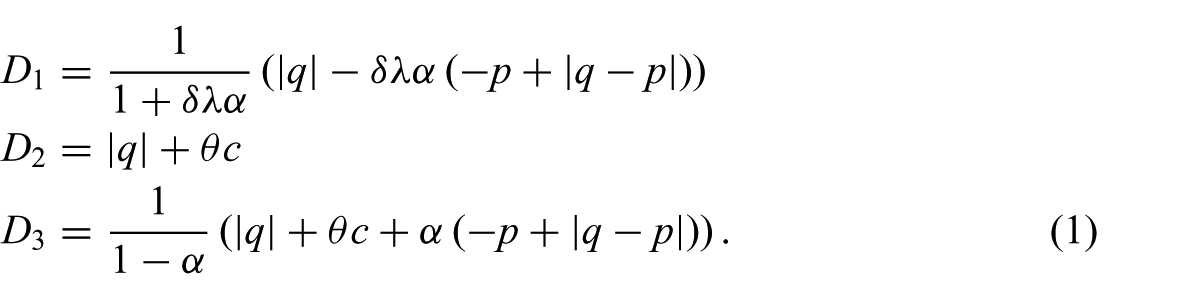
Note that

Figure 1 illustrates an example of the Senate’s decision. If the nominee’s ideal point x is closer than the first threshold
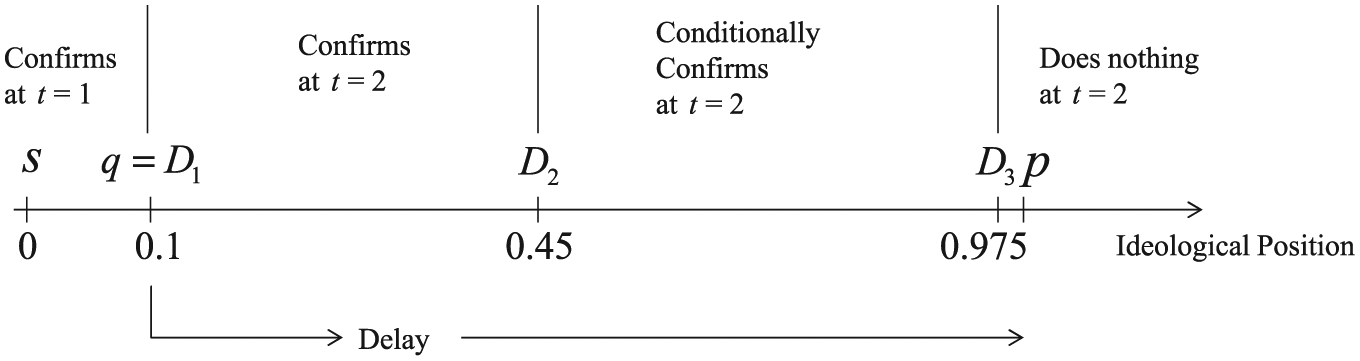
Example of Senate’s decision. (Note: assumes s (the Senate’s ideal point) =0, p (the president’s ideal point) =1, q (the status quo)
Next, if the nominee’s ideal point x is farther than the first threshold
If the nominee is ideologically more extreme than
Finally, if the nominee’s ideal point is much farther from the Senate’s ideal point s than the status quo, then the Senate delays, and does nothing about the nominee at
Given the Senate’s strategy, the president chooses the nominee’s ideological position, x, optimally. The president’s equilibrium strategy is complicated because, given q, the president’s expected utility is not continuous in x. This occurs because, as x moves, the Senate suddenly changes its decision from not delaying to delaying, and from confirming for certain to confirming only if
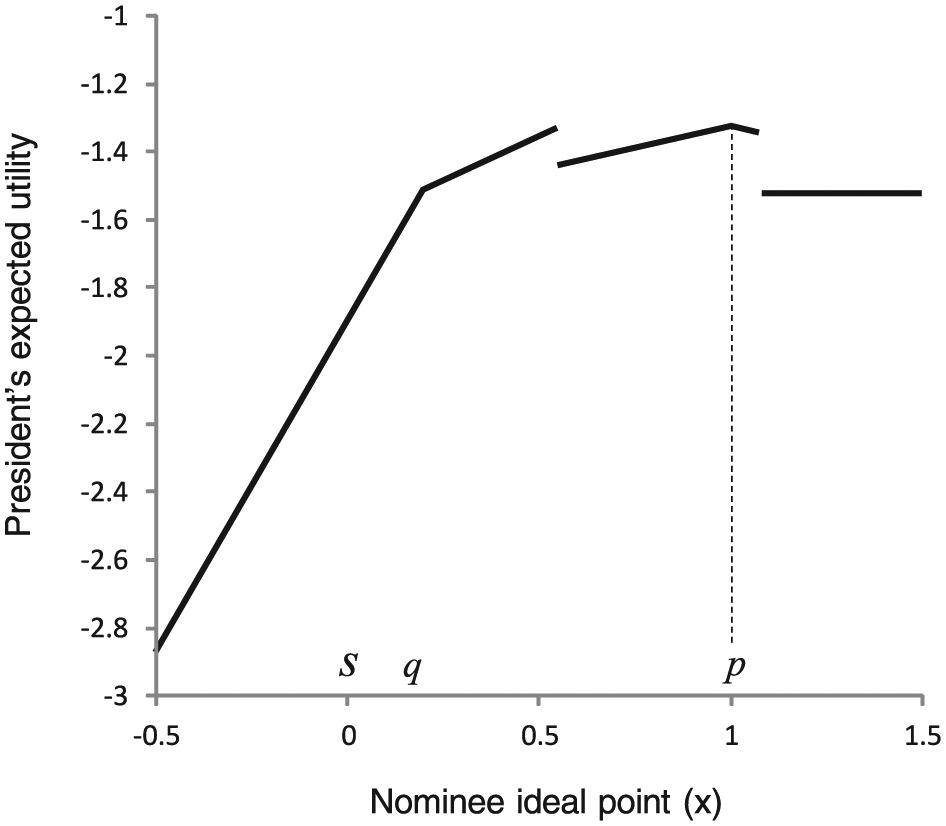
President’s expected utility from nominating a candidate with ideal point x. (Note: assumes q (the status quo)
The president’s equilibrium strategy divides X into several intervals, and the president’s best choice depends on the interval to which q belongs. The president’s best choice is continuous in q in each interval, but not between adjacent intervals. Moreover, the number of the intervals varies depending on parameter values. Proposition 2.3 describes the president’s strategy.
For sufficiently small q, the president chooses a nominee with ideal point
As q increases up to s, the president plays
As q increases from s, the president plays
Figure 3 graphically shows the president’s equilibrium strategy under the same parameter settings as in the previous example. As stated in Proposition 2.3, the president can pick his ideal point if the status quo is sufficiently small. Then, as q increases up to s, he plays
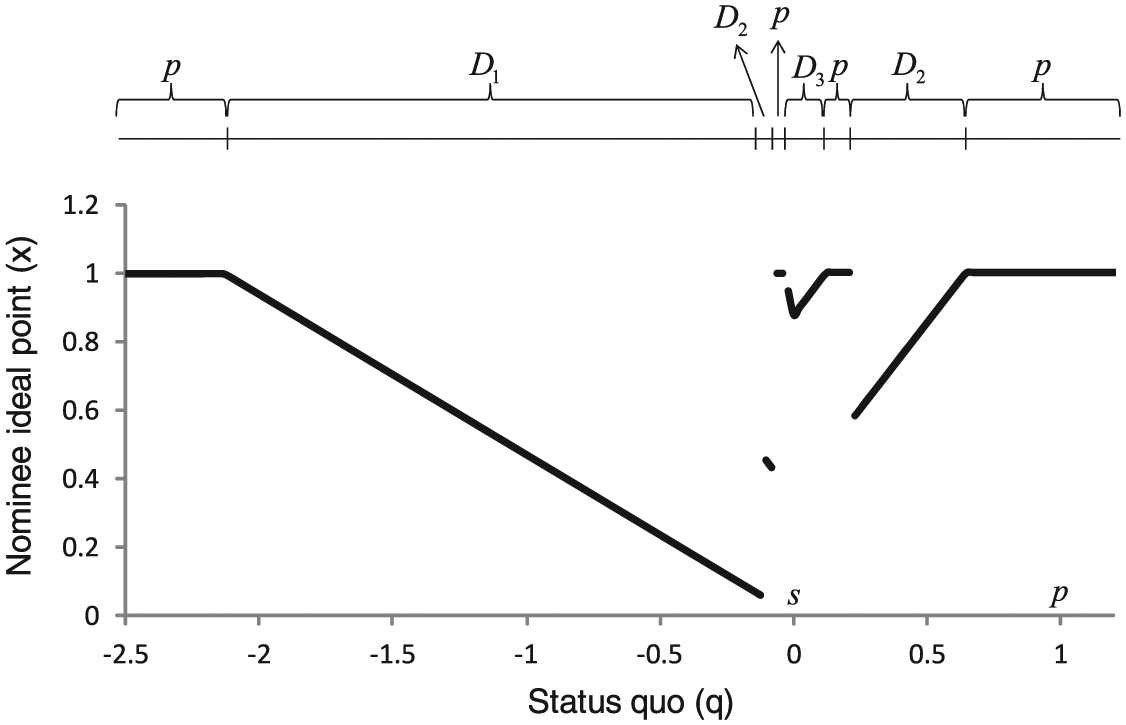
President’s equilibrium strategy. (Note: assumes s (the Senate’s ideal point) = 0, p (the president’s ideal point) =1,
From Proposition 2.3 and Figure 3, it is clear that the president may play
Next, it is worth mentioning that the president’s best choice of x as a function of q is not symmetric around

Example of the president’s choices of x for two symmetric status quos around the Senate’s ideal point. (Note: assumes s (the Senate’s ideal point) =0, p (the president’s ideal point) =1,
If so, why does the president choose a worse ideological position for
McCarty and Razaghian (1999) suggest that the president sometimes chooses moderate nominees to achieve a quicker confirmation. Under which conditions, however, is the president willing to make such trade-offs? Both the Senate’s and the president’s utilities are affected not only by the Senate’s final decision on the nomination but also by its decision of whether to delay or not. Thus, when making a nomination, the president has to worry about the ideological cost of delay as well as the Senate’s confirmation decision. My model shows that the cost of delay is not constant, as it varies depending on the position of the status quo. The president nominates someone with a moderate ideal point to avoid delay when the status quo is to the left of the Senate and far enough away from the Senate’s ideal point. Proposition 2.4 provides more precise conditions.
From the equilibrium strategies of the president and the Senate, conditions for delays now can be specified. Proposition 2.4 characterizes the area of the status quo in which delay occurs. I call this the delay area.
1.
2.
Proposition 2.4 states that the delay area is
First, the delay area is wider than the interval between the ideal points of the president and the Senate under all parameter settings. One might naturally expect a delay when the status quo is between the president’s and the Senate’s ideal points, because any movement from the status quo will make either player worse off. On the other hand, it might not be clear why delay occurs when the status quo is to the left of the Senate’s ideal point (i.e.,
Next, as the ideological distance between the president and the Senate increases, the delay area becomes wider. Why does the ideological gap matter? Whenever the status quo lies between the ideal points of the president and the Senate, if the president attempts to move the status quo closer to his ideal point, no matter how slightly, the Senate will delay its decision because it prefers the status quo. To maintain the status quo as long as possible, the Senate has an incentive to delay. Because the status quo is close enough to the president’s ideal point to make the president bear the ideological cost of delay in this case, the president is willing to wait until the second period to get a better policy outcome. This result is consistent with the existing empirical findings in the literature (Asmussen, 2010; Binder and Maltzman, 2002; McCarty and Razaghian, 1999; Shipan and Shannon, 2003; Williams, 2008).
Importantly, this implies that a rational president chooses policy gain over quicker confirmation when the status quo is not too far from his ideal point, providing a theoretical micro foundation for existing claims and findings in the literature. For example, Binder and Maltzman (2002) argue that the greater the ideological difference between the Senate and the president, the longer it takes for the Senate to confirm the nomination because the Senate prefers slower movement on ideological foes. Their argument implicitly assumes that the president always appoints someone who shares his ideological view regardless of the ideological position of his opponent or the status quo, even when this causes excessive delay. However, the president may account for the Senate’s preference and decide to minimize the cost of delay. My model shows that he makes such choices when the status quo is too far away and too costly to maintain. In contrast, when the status quo is between the ideal points of the two players, the president can afford to wait. Thus, my analysis verifies that, even if the president behaves rationally, delay is more likely to occur as the ideological disagreement between the president and the Senate deepens.
Finally, the delay area widens when the Senate’s rejection cost c, increases. As c increases, the president’s advantage over the Senate increases as implied in the literature that popular presidents can influence senators’ decisions via mobilization of their constituents (Krutz et al., 1998; Bond et al., 2009; Johnson and Roberts, 2004). If the president tries to nominate someone extreme, the Senate will not defeat the nomination because of the high cost. At best, it will delay and confirm the nominee later. Knowing this, the president does not make ideological compromises even when the status quo is quite far from his ideal point because his policy utility can be greatly improved in the second period when c is high. Therefore, the delay area expands.
With the delay area characterized in Proposition 2.4, I now analyze the impacts of the model parameters on the expected duration. To see the impact of the ideological distance between the president and the Senate on the expected duration, I assume that the status quo, q, the president’s ideal point,

where

The first implication is that as the ideological distance between the president and the Senate increases, the Senate is more likely to delay its decision. Second, interestingly, as the Senate’s rejection cost increases, the Senate is more likely to delay its decision. Because the Senate’s rejection cost is positively correlated with the president’s popularity, the confirmation duration will be longer when the president is more popular. As discussed previously, this is because a highly popular president will be willing to wait to get his preferred nominee confirmed, exploiting the fact that the Senate will eventually need to accept the nominee to avoid blame. Finally, the effect of the ideological distance between the president and the Senate depends on the Senate’s rejection cost. Specifically, when the rejection cost is high, the ideological disagreement between the players does not have much effect on the delay decision, whereas it has a greater effect when the rejection cost is low.
In addition to the implications on confirmation duration, the model produces implications on confirmation success. Proposition 2.6 shows the impact of z and c on confirmation success.
The proposition states an intuitive result that the nominee is more likely to be confirmed if the Senate and the president are ideologically close or if the president is popular.
9
In equilibrium, the president never nominates someone who will be rejected by the Senate for certain. Rejection may occur when the president chooses a somewhat extreme x while expecting to buy off the Senate in other policy areas.
10
Since the opportunity to buy off the Senate arises with probability
When the Senate is ideologically distant, the president may need to make a concession to the Senate in other policy areas to get his nominees confirmed. As the Senate’s rejection cost c becomes higher, however, the president can move the status quo much closer to him without gambling on the chance to buy off the Senate because the Senate will confirm the nomination as long as its utility loss from the confirmation is less than the rejection cost. Thus, the safer option becomes more attractive to the president in this case. To maximize his policy gain, the president would rather choose a nominee who can be confirmed for certain without additional payment.
Combining the results from Propositions 2.5 and 2.6 produces an interesting implication that candidates nominated by highly popular presidents will be more likely to stay longer in the confirmation process but eventually will get confirmed. A president with high popularity chooses a relatively extreme nominee, but the Senate will have to confirm the nominee in the end whether or not it can gain additional bargaining benefits so as not to incur high political cost. The Senate can maintain the status quo at best by delaying, but it may not be able to gain leverage over other issues when facing a popular president.
3. Conclusions
In this paper, I provide an institutional explanation for senatorial delays in the judicial confirmation process. Using a dynamic model, I identify the conditions under which the president makes a nomination that the Senate has an incentive to wait to confirm. Delays do not occur simply because the Senate does not want to support the president’s nominee of choice, as often alleged. Rather, they occur when the president is able to bear the ideological cost of delay and tries to maximize his policy gain despite the cost.
The model can be applied to other judicial appointments or to non-judicial presidential appointments. It will be interesting to see whether the model’s implications are supported by data on federal judge appointments, executive branch appointments, or appointments to independent boards.
Footnotes
Acknowledgements
I am thankful to Nicole Asmussen, Gregorio Caetano, Mark Fey, David Primo, Jesse Richman, Lawrence Rothenberg and Youngchae Lee for helpful comments and advice. I also thank the co-editor and the two anonymous reviewers for insightful suggestions. All remaining errors are my own.
Declaration of conflicting interests
The author(s) declared no potential conflicts of interest with respect to the research, authorship, and/or publication of this article.
Funding
The author(s) disclosed receipt of the following financial support for the research, authorship, and/or publication of this article: This work was supported by the National Research Foundation of Korea Grant funded by the Korean Government (grant number NRF-2014017781).
Supplementary material
The appendix is available online at this web address: https://sites.google.com/site/jinheejo7/home/JO2015_Appendix.pdf?attredirects=0&d=1.