







Abstract
Partisan voters are optimistic about electoral outcomes: their estimates of the probability of electoral success for their party are substantially higher than the average among the electorate. This has large potential implications for political bargaining. Optimistic electoral expectations make costly bargaining delay look more favourable, which may induce partisans to punish their party for agreeing to a compromise rather than waiting, for example by not turning out to vote. Party decision makers should take this into account when bargaining. We set up and analyse a simple game theoretic model to explore the implications of partisan optimism for political bargaining. We show that increased optimism among a partisan group leads to a stronger bargaining position for their party, but may hurt its electoral prospects. Another main finding is that even high levels of partisan optimism do not in themselves cause inefficient bargaining delay.
1. Introduction
Both opinion polls and more solid empirical evidence strongly suggest that voters’ electoral expectations vary systematically with their political preferences. Poll numbers from the last three US presidential campaigns show that partisan voters on either side were much more likely than independents to believe that their party’s candidate would win. 1 Delavande and Manski (2012) demonstrate that, during campaigns for US presidential and statewide elections in 2008 and 2010, citizens stating that they were likely to support a particular candidate estimated his or her probability of winning to be 20 to 30 percentage points higher than likely supporters of the opposing candidate. Other empirical studies find the same general phenomenon (Dolan and Holbrook, 2001; Krizan et al., 2010; Ladner and Wlezien, 2007; Miller et al., 2012).
Systematic divergence of electoral expectations between voters with opposing political preferences could have important effects on political bargaining. When supporters of a party evaluate important political bargaining outcomes, they are likely to take into account the electoral outlook for the next election. A particular outcome will be less well received among partisans the better they believe their party will do in the next election, because this makes the alternative of delaying the agreement look better (assuming that a better electoral outcome translates into more bargaining power). With the realistic assumption that partisans are less likely to make financial contributions, volunteer, and turn out to vote when they are less satisfied with bargaining outcomes, this implies that a party with optimistic supporters will demand more in the bargaining process in order not to hurt its electoral prospects. Thus, partisan optimism about electoral outcomes has the potential to significantly influence political bargaining processes, even if politicians themselves do not have biased expectations.
In this paper we explore the implications of partisan voters’ electoral optimism for high-stakes political bargaining by setting up and analysing a simple game theoretic model. The specific framing of the model corresponds, in a stylized way, to main aspects of the negotiations over fiscal consolidation plans in both the US and Europe after the financial crisis of 2008. Given their wide-ranging consequences and the high level of public attention they received, these negotiations serve as natural recent examples to consider when exploring the effects of voters’ electoral expectations on political bargaining. However, the insights we derive are not limited to this setting as the model can easily be reformulated to describe bargaining over other major policy measures. Further, the modelling framework is also potentially useful for the study of a much wider array of situations where several actors bargain in the shadow of electoral incentives and biased expectations. For example, these actors could be parties in a coalition, factions within a party, or national leaders engaged in international negotiations.
In the model, two parties play a two-period bargaining game with costly delay. An election after period one determines the distribution of bargaining power and political office rents in period two. A main feature is that, after an agreement in period one, the outcome of the election depends on partisan voters’ evaluations of the bargaining outcome, which are biased because of partisan optimism about the electoral outcome had a period one agreement not been reached. Therefore, partisan optimism matters for parties’ bargaining behaviour in period one even though the parties themselves are not optimistic. The level of optimism in each partisan group is parameterized, which allows us to explore how optimism levels on either side of the political spectrum influence bargaining outcomes.
We show that even high levels of electoral optimism among both partisan groups do not in themselves lead to costly delay in agreement. Intuitively, this is surprising because a more optimistic partisan group demands a better bargaining outcome, which again makes their party demand more in the bargaining process in order not to hurt its electoral prospects. However, if both groups of partisan voters are very optimistic, the parties are able to reach a period one agreement that does not satisfy either group and thus does not change the electoral prospects of either party. In an extension of the model we show that partisan optimism can lead to inefficient delay if parties are negatively affected by partisan dissatisfaction beyond the electoral consequences, for example because they care about financial contributions beyond their effect on electoral outcomes or because low partisan enthusiasm about the party’s current representatives makes them more vulnerable to challenges in primaries or internal elections.
A full equilibrium analysis of the model reveals that bargaining outcomes are highly dependent on partisan optimism levels. Particularly interesting findings are that an increase in electoral optimism among one partisan group will result in a (weakly) better bargaining agreement for that side, but may imply worse electoral prospects for the party. So increased optimism among its partisans is a mixed blessing for a party. It benefits from the better bargaining outcome, but will in some cases incur a net utility loss due to lower expected future office rents.
Going a little beyond the model, our findings have interesting implications for the question of how political leaders should try to manage expectations among partisans. They suggest that expectation management is very much a delicate issue because increased partisan optimism can have both positive and negative consequences. Immediately, it seems attractive for a party to boost the optimism level among its partisans because this leads to a better bargaining position, but such a strategy may backfire and lead to future electoral losses.
In relation to the existing theoretical literature on political bargaining, the main contribution of our model is that it adds electoral incentives generated by partisan voters’ electoral expectations to a simple legislative bargaining model. The explicit focus on electoral incentives makes it related to Groseclose and McCarty’s 2001 model of the politics of blame where an agenda setter wants a veto player to appear extreme to an incompletely informed moderate electorate (or median voter). The veto player wants to appear moderate. These incentives distort the outcome relative to standard veto bargaining, 2 for example a veto is possible in equilibrium even when there exist agreements that both sides prefer to the status quo. Our model complements Groseclose and McCarty’s in the sense that it considers the incentive for each party to keep their partisans satisfied to avoid electoral consequences rather than the need to appeal to moderates. 3
In international relations, models of crisis bargaining before domestic audiences have helped explain how leaders’ threats can become credible because of, for example, the electoral costs of backing down (e.g. Fearon, 1994, 1997; Smith, 1998). To our knowledge, the possible effects of audience optimism about conflict outcomes have not been explored, although Fearon (1995) and others 4 have considered optimism among leaders. Further, our main setup differs from an international setting because dissatisfaction among both partisan groups does not lower the aggregate utility of the parties. One of them will win the election, whereas leaders from different countries might both lose. It is, however, interesting to note that partisan optimism makes higher bargaining demands credible for the parties in much the same way that audience costs can make leaders’ threats credible.
The research mentioned so far is related to our model because of the general assumption that audiences matter for bargaining processes. Other studies are related to the central behavioural aspect of our model: partisans are optimistic about electoral outcomes and this influences their evaluations of bargaining outcomes. Ortoleva and Snowberg (2015) study a model of political belief formation and find that underestimation of the correlation between personal experiences leads to overconfidence in citizens’ political beliefs. They do not directly consider beliefs about electoral outcomes, but a similar mechanism for the formation of electoral expectations could generate the kind of partisan optimism that we study here.
Passarelli and Tabellini (2013) explore the role of emotion in political unrest and its implications. Two fundamental assumptions are that individuals are more likely to engage in political unrest if their group is treated unfairly and that a self-serving bias influences group members’ notion of fairness: they estimate their position in society to be more common than it really is. While the context is different, this resembles the behaviour and beliefs of partisans in our model. They are more likely to punish their party if they are not satisfied with their share of the cake and their reference point is upward-biased because of partisan optimism, which may well originate in the conviction that their political preferences are more common in the population than they really are.
Finally, and more broadly, this paper can be seen as a contribution to the growing literature using formal modelling to explore how empirically well-documented deviations from standard rationality assumptions influence political outcomes. For example, modellers have studied the implications of expressive voting (Feddersen and Sandroni, 2006a,b), fear (Lupia and Menning, 2009) and trial-and-error decision-making (Bendor et al., 2011).
2. The model
Two political parties, L(eft) and R(ight), bargain over how to finance a major new policy measure, for example a fiscal consolidation plan. It can be financed either by new taxes or by cuts in existing government spending. We let
There are three types of voters: L-partisans, R-partisans and independents. They all agree that the policy measure should be implemented as soon as possible, but the two partisan groups disagree on how it should be financed. L-partisans prefer the policy measure to be financed by taxes, while R-partisans prefer it to be financed by spending cuts. Independents are indifferent.
The bargaining takes place over two periods. If an agreement t is reached in period one, the final utilities of the two types of partisans are, respectively,

The behaviour of independents will be exogenously defined, so we will not model their preferences explicitly. The policy measure is less efficient the later it is implemented, so delay is costly. More precisely, if an agreement is not reached until period two, the final utilities of the partisans are discounted by
The bargaining procedure is simple. The agenda setter makes an offer
The parties have the same preferences over bargaining outcomes as their supporters. On top of this, they also care about office rents. Each party’s utility from period two office rents is

Note that we use lower-case u for partisans’ utilities (policy utility) and upper-case U for parties’ utilities (policy utility plus utility from office rents).
The outcome of the election at the end of period one depends on the voting behaviour among the two groups of partisans and the independents. If the rate of turnout is similar for the opposing partisan groups then the election will be decided by the independents. On the other hand, if there is a substantial difference in turnout rates between the partisan groups, then this decides the election and the independents are irrelevant. For example, if L-partisans are generally more enthusiastic about their party than R-partisans at the time of the election and therefore turn out in higher numbers, then L will win.
As this paper focuses on the consequences of partisan beliefs and behaviour, the behaviour of independents will be exogenously defined. The independents will, no matter what the period one bargaining outcome is, break for L with probability
Since independents are indifferent with respect to the financing of the policy measure, it is natural to assume that their voting behaviour is the same after any agreement. The assumption that their voting behaviour in case of delay does not depend on the offer that R rejected is less natural. It could be argued that independents should be less likely to break for L the less it offered to R, because then L is seen as being more responsible for the delay. However, any specific voting behaviour depending on the rejected offer would be somewhat arbitrary because of the independents’ indifference to the content of the agreement, and since our purpose in this paper is to explore the consequences of partisan optimism, we prefer to keep the independents’ voting behaviour the same no matter what happens in period one. 5
The partisans are primarily forward-looking. If there is anything at stake in the election they will turn out to vote for their party in high numbers. Therefore, if the parties do not reach a bargaining agreement in period one, turnout will be high among both partisan groups and the election will be decided by the independents. If an agreement is reached in period one, all voters are indifferent with respect to the electoral outcome. We assume that partisans will then decide whether to vote or not based on a retrospective evaluation of the bargaining outcome. An outcome that a partisan group generally finds satisfactory will lead to enthusiasm and a high level of turnout. A non-satisfactory outcome will lead to lower turnout. Thus, an agreement that only satisfies one partisan group will result in the corresponding party winning the election.
Both direct and indirect mechanisms can contribute to the link between partisan evaluation of a bargaining outcome and turnout in the following election. Clearly, some dissatisfied partisans may well directly punish their party on election day by not turning out to vote. Other partisans will still turn out to vote, but instead show their dissatisfaction with their party’s performance by contributing less financially or spending less time volunteering. This can weaken their party’s ability to turn out the part of their base that is harder to get to the polls.
A central aspect of the model is how partisans decide whether an agreement is satisfactory or not. It is natural to assume that they compare their utility from the agreement to their estimated expected utility in case of delay. If their actual utility is higher than their estimated utility without a period one agreement, then they are generally satisfied and will turn out to vote in high numbers. Otherwise, they are dissatisfied and turnout among the partisan group will be low.
If an agreement is not reached in period one, the winner of the election will take it all in period two (since the policy measure is worthless after period two, the follower cannot credibly decline any offer, which means that L will make the period two offer
One plausible reason for partisan optimism is that members of each partisan group overestimate the likelihood that independents will break for their party. This is consistent with the so-called false consensus effect (Ross et al., 1977), that is, the tendency of individuals to believe that their own preferences, judgements and beliefs are more common in the population than they really are.
Because of partisan optimism L-partisans will, after a period one agreement t, be satisfied with the agreement and therefore turn out to vote in large numbers if

Note that the estimated expected utility of delay on the right-hand side is higher than the true value

Define

Then turnout will be high among L- and R-partisans if, respectively,

and it will be low if we have the opposite inequalities. In the case of equality, we assume that both high and low turnout is possible. Table 1 summarizes how partisan turnout levels and the outcome of the election depend on the period one bargaining outcome.
Partisan turnout and electoral outcome.
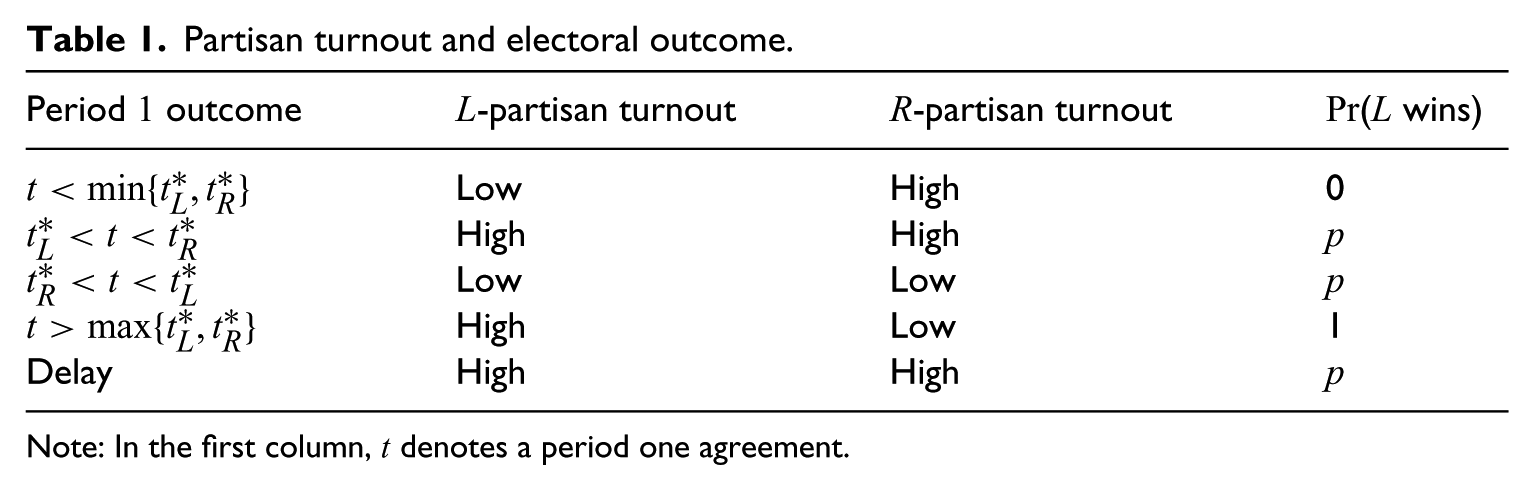
Note: In the first column, t denotes a period one agreement.
The parties are completely informed about how voting behaviour depends on the period one bargaining outcome. In particular, they are fully aware of the partisan optimism on either side, but they do not themselves have optimistic beliefs. So when they bargain they take into account that partisans are biased and that this is common knowledge among the parties, but they use the objective win probabilities to make their decisions.
There is plenty of anecdotal evidence indicating that politicians involved in important political bargaining situations take into account possible partisan reactions to the outcome and their electoral consequences. For example, it has been widely reported that the 2011 negotiations over a so-called grand bargain on deficit and debt reductions between, primarily, the Obama White House and the Republican leadership of the House of Representatives were heavily influenced by each side’s considerations of how to ‘sell’ an agreement to its partisan base. 6 So there is good reason to believe that party leaders are well informed about partisans’ beliefs and expectations and that this matters substantially for bargaining decisions.
Clearly, the way we model voting behaviour is not fully microfounded. However, our primary aim is to study how partisan optimism affects high-stakes political bargaining and we think that our model is suitable for this purpose, at least as a reasonable first step. It incorporates the well-documented empirical regularity that partisans overestimate the probability of electoral success for their party in a model where partisans are forward-looking and therefore turn out in high numbers when the stakes are high, while they vote retrospectively based on subjective evaluations of past performance when future stakes are low.
While our focus here is explicitly on partisan optimism about electoral outcomes, there may well be other reasons why partisans demand more from a bargaining agreement than their true expected utility of delay. For example, ideologically rigid individuals are often strongly against the act of compromise itself. Thus, the modelling setup could well be more generally applicable to bargaining situations where partisans’ reactions are important to politicians.
A diagram of the model is shown in Figure 1. It includes all decision nodes for the two parties, while voting behaviour is, for simplicity, black boxed. For all possible outcomes, the utilities for the two parties are specified. The utility for each partisan group is simply the policy part of their party’s utility. Note that the period two offer is denoted
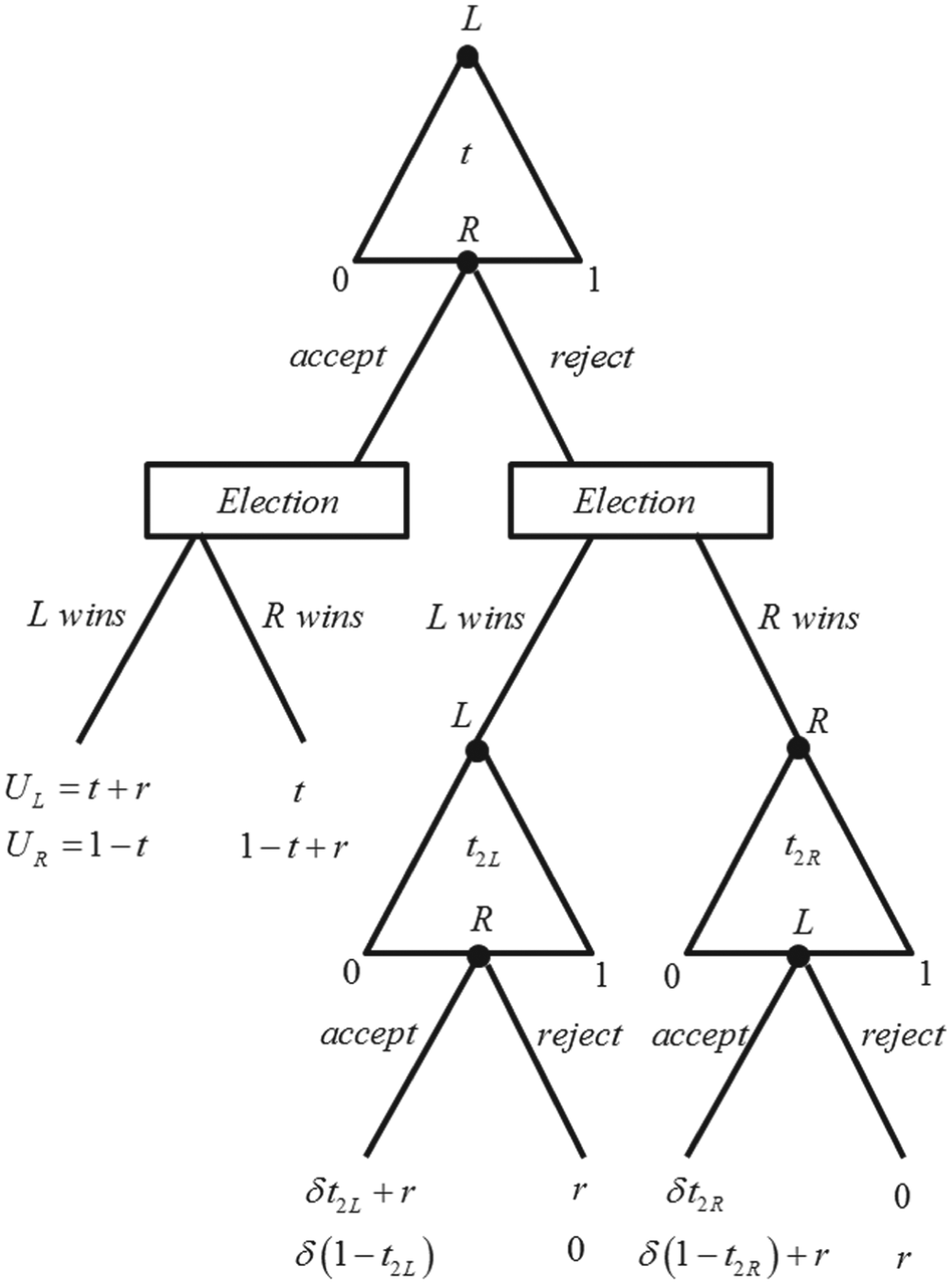
The model.
2.1. Costs of partisan dissatisfaction and optimistic parties
The model presented above is our main model and will be analysed first. After that we will consider an extended model where dissatisfaction among partisans hurts a party beyond the negative effect on the probability of success in the general election. There are several reasons why this may be the case. For example, it is likely that dissatisfied partisans contribute less to their party financially and the party may well care about financial support beyond the positive effect on its electoral prospects. The additional negative effect of partisan dissatisfaction could also come from a higher risk that the party’s current leaders or representatives are challenged and potentially defeated in primaries or internal elections. While this will not necessarily hurt the party more broadly, it is clearly a risk for the party decision makers involved in the bargaining and it is their preferences that matter in the bargaining process. The surprising defeat of former US House Majority Leader Eric Cantor to the relatively unknown Tea Party candidate David Brat in a 2014 Republican primary election in Virginia highlights this risk.
We model the additional negative effect of partisan dissatisfaction by introducing a cost
Finally, in the main model we assume that party decision makers have objective electoral expectations. We find this to be a natural assumption. Party elites are typically experienced in electoral politics and have much stronger incentives to be well informed than voters, so they should be able to overcome wishful thinking. Nevertheless, media coverage during and after the 2012 US presidential and congressional campaign suggests that unjustified optimism about the outcome was widespread among top Republicans. 8 If optimistic beliefs among party elites are possible so late in highly polled campaigns, they are clearly also possible earlier in the electoral cycle. Thus, while we believe that severe unjustified optimism among party elites is closer to being the exception than the rule, 9 it does make sense to explore what happens in the model if party decision makers happen to be as optimistic as their partisans. We will do so in the final part of the following section. This also serves to illustrate the fundamental importance of the assumption from the main model that partisan voters are optimistic about electoral outcome while parties (party leaders) have objective beliefs.
3. Equilibrium behaviour and implications
Since we have already specified voting behaviour, we can consider the model as a dynamic game of complete information with only the two parties as players. We will solve the model for all subgame perfect Nash equilibria.
First, as already noted, the stage two subgames are easy to solve. The follower’s utility of rejecting the agenda setter’s offer is zero, so the follower will accept any offer (we assume that the follower accepts if indifferent). Thus, the unique outcome of each stage two subgame is that the agenda setter offers nothing to the follower (i.e.

So the parties will reach an agreement in period one precisely if L makes an offer that provides R with an expected utility of at least
If partisans were not optimistic about the probability that independents will break for their party (which corresponds to
Thus, it is already now clear that partisan optimism matters for parties’ incentives and therefore for the outcome of the bargaining game. However, for low levels of optimism (measured by
We split the analysis into two cases,
3.1. Full equilibrium analysis
Consider first the case

If L offers

which is equivalent to

So there are offers

which is equivalent to

Clearly, if there are offers above

We summarize our results for the case
Suppose
Suppose
(In the boundary case
It is remarkable that L can use a sufficiently high optimism level among R-partisans to reach an agreement that provides both more policy utility and better electoral prospects than simply offering just enough to make R-partisans satisfied. The reason is that a high
A related observation is that partisans’ upward-biased beliefs about their party’s chance of winning can sometimes be a self-defeating prophecy. In the parameter region of Proposition 2, R will lose the election with certainty only when R-partisans are sufficiently optimistic. After the equilibrium analysis we will explore in detail how the utilities of parties and partisans depend on
We now move on to the case

R will accept and turnout will be low among both partisan groups. This provides L with more utility than delay, so it is better for L than any higher offer, because such an offer will make R reject. Further, any lower offer will clearly make L worse off, so the offer above is indeed optimal.
Then suppose

If this condition is satisfied, L will clearly make the highest acceptable offer:

Our results for the case
1. Suppose
2. Suppose
3. Suppose
(In the boundary case
Figure 2 shows how the equilibrium outcome depends on the optimism parameters


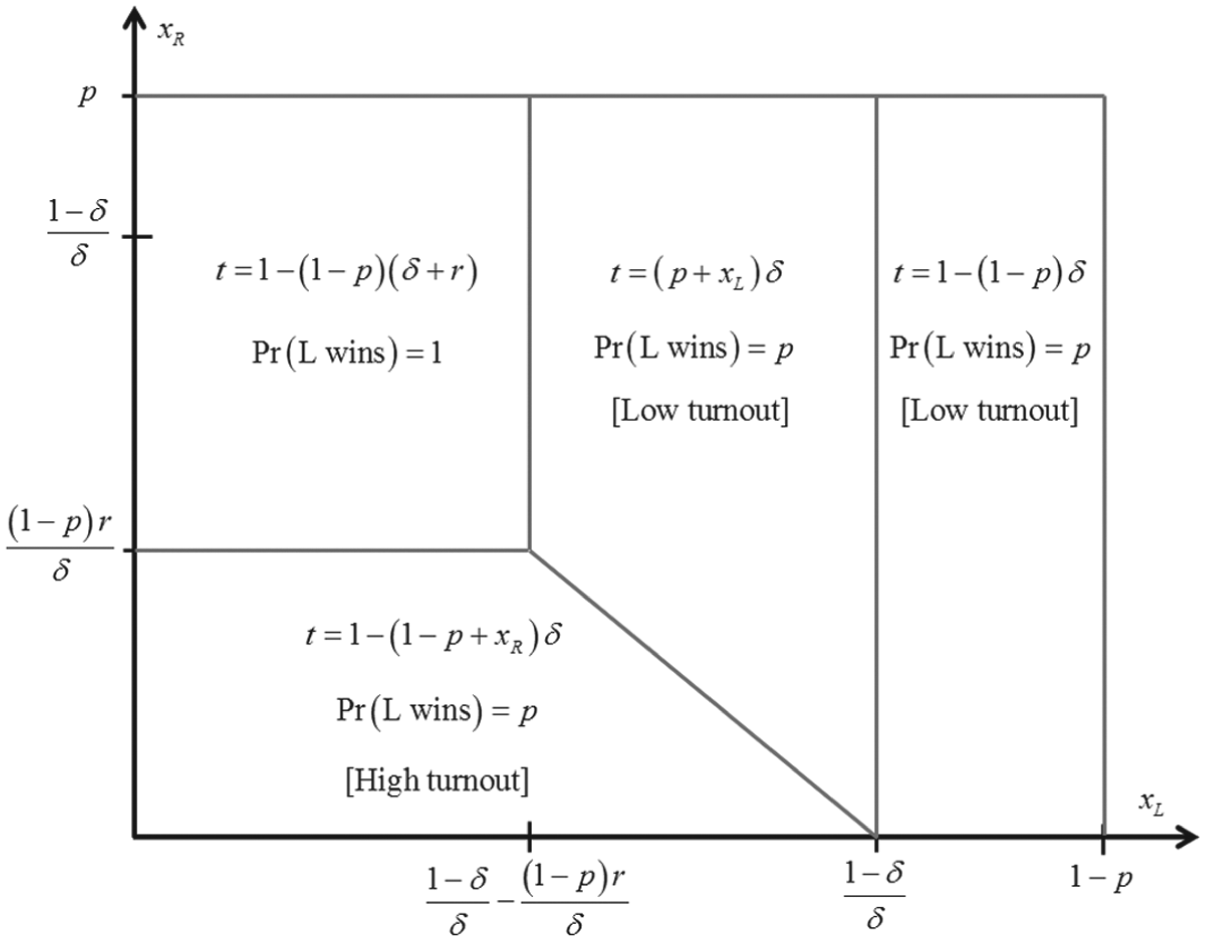
Equilibrium outcomes for the main model under the parameter restrictions (1) and (2).
The content of (1) is that R’s expected office utility in the case of delay is lower than the aggregate cost of delay. This condition is necessary for the existence of the type of equilibrium where L wins the election with certainty, that is, the equilibrium outcome in the top left-hand region of Figure 2. If the condition is not satisfied, then the efficiency gain from a period one agreement is not large enough that L can use it to compensate R for an electoral loss, and therefore this type of outcome is not possible in equilibrium.
Condition (2) corresponds to a lower bound on
3.2. Implications of increased partisan optimism
In this section we assume that the parameter restrictions used for Figure 2 are satisfied and use the equilibrium results displayed in the figure to explore the implications of increased partisan optimism.
Intuitively, it seems reasonable to expect R to do better the more optimistic its partisan group is. A higher policy utility is required to satisfy a more optimistic partisan group and R should be able to use this to credibly demand a better offer from L. Further, we know that increased optimism will not lead to costly delay. However, counter to intuition, an increase in
Suppose

So for relatively low levels of optimism for R-partisans, the effect of an increase in
At
Figures 3 and 4 illustrate, respectively, the equilibrium offer t and the resulting expected utility for R as a function of
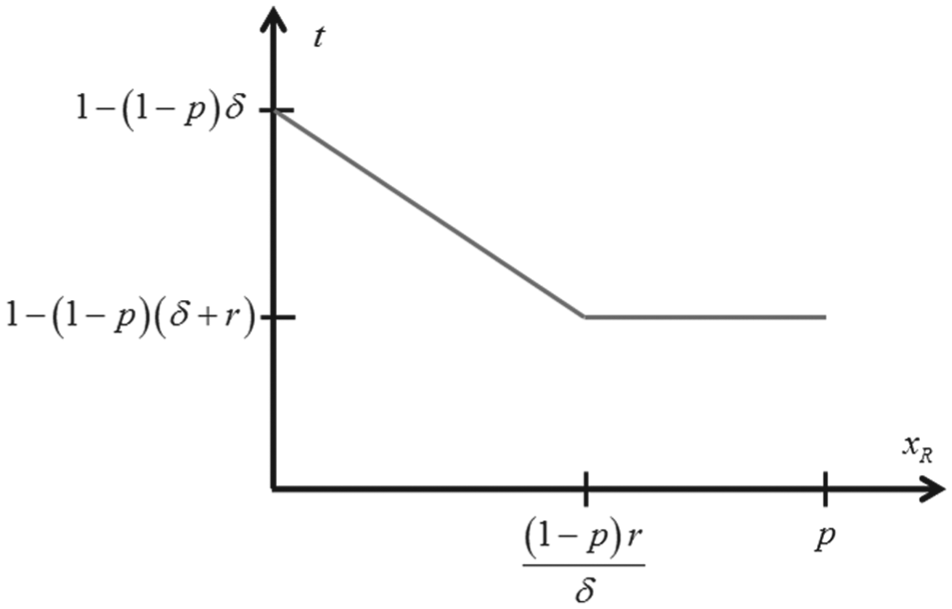
Equilibrium offer t as a function of
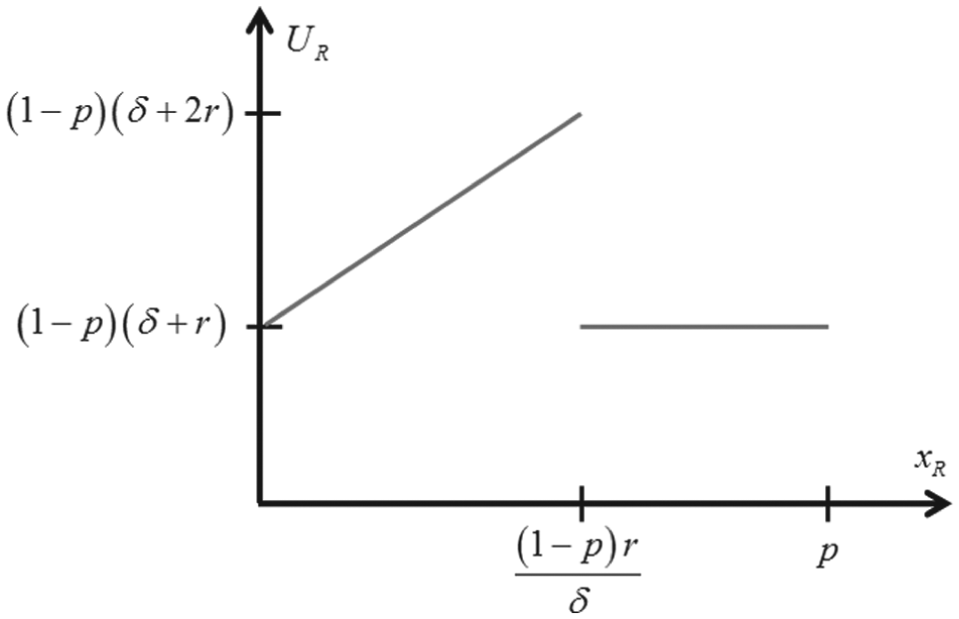
R’s expected utility in equilibrium as a function of
For L it is also the case that an increase in optimism among its partisans can lead to a decrease in equilibrium utility. For any fixed
Figures 5 and 6 show how, respectively, the equilibrium offer and L’s expected utility in equilibrium depend on
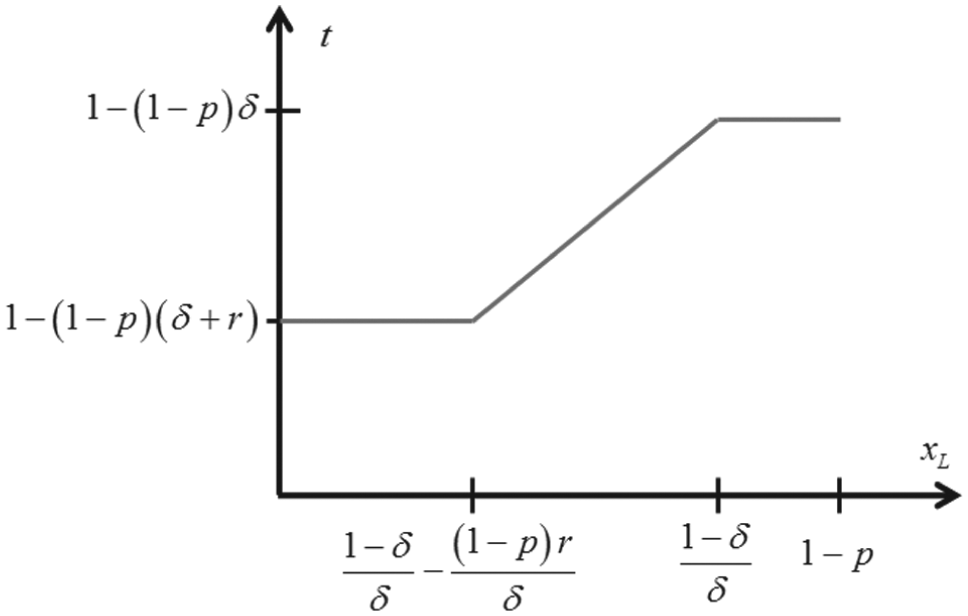
Equilibrium offer
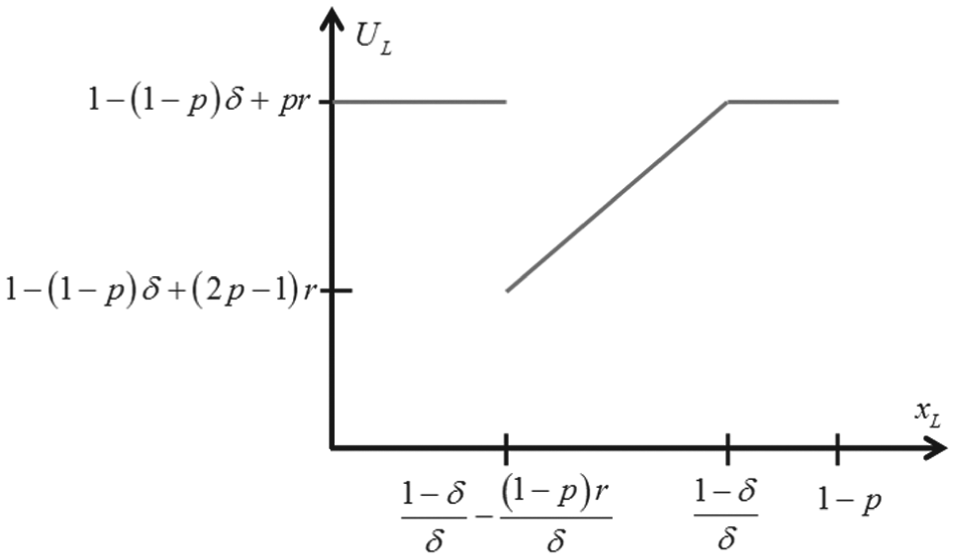
L’s expected utility in equilibrium as a function of
To sum up, each party will in some situations be hurt by increased optimism among its partisans. This is because partisans’ higher electoral expectations will, somewhat paradoxically, sometimes lead to a lower probability of winning for the party. On the other hand, increased optimism will never hurt the partisan group itself; in fact it will often lead to a bargaining outcome that is strictly better for the group.
Our findings have some interesting implications for the issue of parties’ management of electoral expectations among their partisans. A standard insight (which does not come out of our model because of our simplified modelling of voting) is that expectation management is important during campaigns because partisans’ perceptions of how close the election is will matter for their turnout decisions. That is, a party will not want its partisans to be too optimistic or pessimistic about the outcome because this will lead to lower turnout. Our results suggest that parties’ incentives to manage partisans’ electoral expectations are present not only during campaigns but also throughout the electoral term, because the expectations matter for political bargaining processes. Further, they also suggest a new reason why a party does not want its partisans to be too optimistic, namely that a high level of electoral optimism could well make them dissatisfied with bargaining outcomes and therefore less likely to turn out on election day.
The result that partisans always weakly benefit from being more optimistic implies that, within the model, there is no incentive for them to overcome the wishful thinking that leads to optimistic electoral expectations. So, in this sense, the partisan optimism bias is consistent with the outcome of the model. Of course there could be other incentives for partisans to overcome their bias, so we do not want to overstate the importance of this observation. Still, it is comforting that there is no direct inconsistency between the central behavioural assumption of the model and the equilibrium outcome.
3.3. Direct costs of partisan dissatisfaction
In the main model, whether or not partisans are satisfied with a bargaining agreement matters for the electoral outcome, but it does not directly affect parties’ utilities. However, as explained earlier, parties may well care about partisan (dis-)satisfaction beyond its effect on their electoral prospects. Therefore, we now consider an extended model where it is directly costly for a party if its partisans are not satisfied. The cost is assumed to be the same for the two parties and is denoted by c.
The extended model can be analysed similarly to the original model, and the analysis is only slightly more complicated. Here we focus on the most important results; the complete equilibrium results can be found in the appendix.
First note that if

Thus, delay is always inefficient for the parties in the sense that their aggregate utility after a period one agreement is higher than after delay, even if the agreement makes both partisan groups dissatisfied.
Figure 7 shows the equilibrium outcomes of the extended model under the following parameter restrictions:



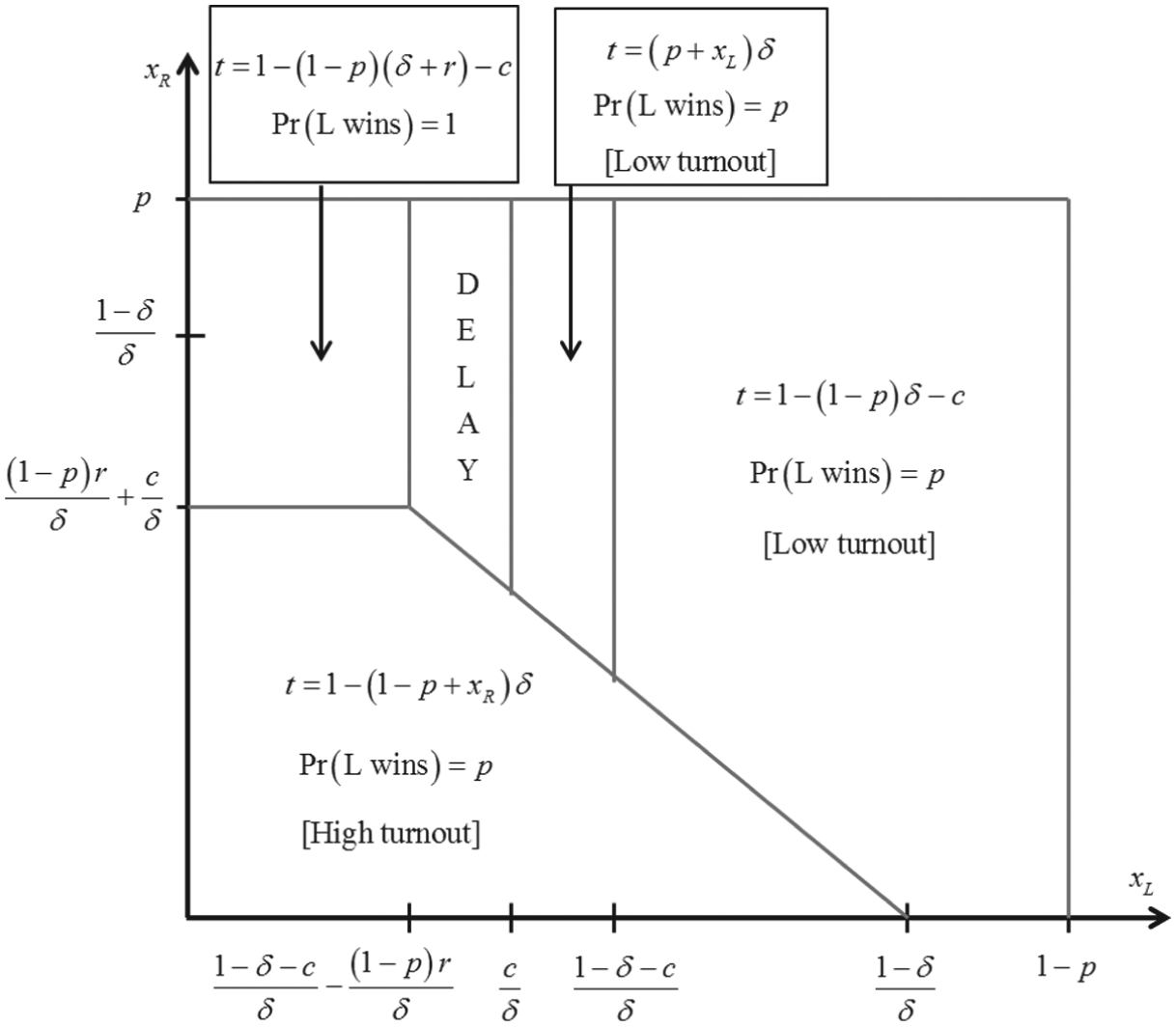
Equilibrium outcomes for the extended model under the parameter restrictions (3), (4) and (5).
The inequalities (3) and (4) are primarily chosen to facilitate easy comparison with the outcomes of the main model as depicted in Figure 2 ((3) is stronger than (1), but for
To a large extent, Figure 7 looks qualitatively similar to Figure 2. However, there is delay in equilibrium when

In words, this means that there will be delay when the following three conditions (one for each of the inequalities) are satisfied. First, there are no agreements that will satisfy both partisan groups. Second, L-partisans have to be sufficiently optimistic about L’s electoral prospects that it is not possible for L to make an offer that R will accept and only L-partisans will be satisfied with. Third, optimism among L-partisans cannot be so high that the best possible offer for L that makes R accept and both partisan groups dissatisfied provides more expected utility for L than the outside option of delay.
The underlying reason why inefficient delay is possible in equilibrium is that the partisan optimism on either side restricts the possibilities of sharing the parties’ aggregate utility from a period one agreement. In part of the parameter space there are no agreements that provide each party with at least its expected utility of delay. In the main model (
The area with delay in Figure 7 grows with c, which is quite intuitive and suggests a monotone relationship between the direct costs of partisan dissatisfaction and the risk of delay. Another prediction is that a sufficiently high aggregate level of partisan optimism is necessary for delay. However, it should be noted that the model does not predict a clear relationship between partisan dissatisfaction and delay. In particular, an increase in
One of our arguments for introducing a direct cost of partisan dissatisfaction was that it could serve as a reduced-form way of modelling that party decision makers are more vulnerable to challenges from within the party, for example in primaries, when partisans are not satisfied with their performance. Thus, we would expect this extended model, and in particular the finding that inefficient bargaining delay is possible, to be more relevant when there are groups within the parties that have both the will and the strength to credibly challenge party leaders and representatives. The obvious recent example is the Tea Party faction in the Republican party, which has, often successfully, challenged a number of establishment congressional candidates in Republican primaries. So our model suggests that the risk of inefficient bargaining delay increases with the existence of such strong factions that are critical of the party establishment.
Finally, a more minor consequence of introducing direct costs of partisan dissatisfaction is that the parameter area where only R-partisans are dissatisfied (which implies that L wins the election with certainty) shrinks, which also means that the area where a period one agreement is reached and both partisan groups are satisfied grows. This happens because a direct cost of partisan disappointment makes R demand more to accept an offer that will only satisfy L-partisans.
3.4. Optimistic parties
We now go back to a setup without any direct costs of partisan dissatisfaction and introduce the assumption that parties (i.e. party decision makers) are, like partisans, optimistic about electoral outcomes. More precisely, we assume that each party has exactly the same belief about independents’ voting behaviour as its partisans. Thus, L (R) believes that independents will break its way with probability
First, behaviour in the stage two subgames is clearly not affected by parties’ optimistic beliefs, so, as in the main model, we get

This implies that L will prefer delay to any period one agreement

which implies that L prefers delay. Similarly it follows that R will prefer delay to any period one agreement
From these observations it immediately follows that there will be delay in agreement when
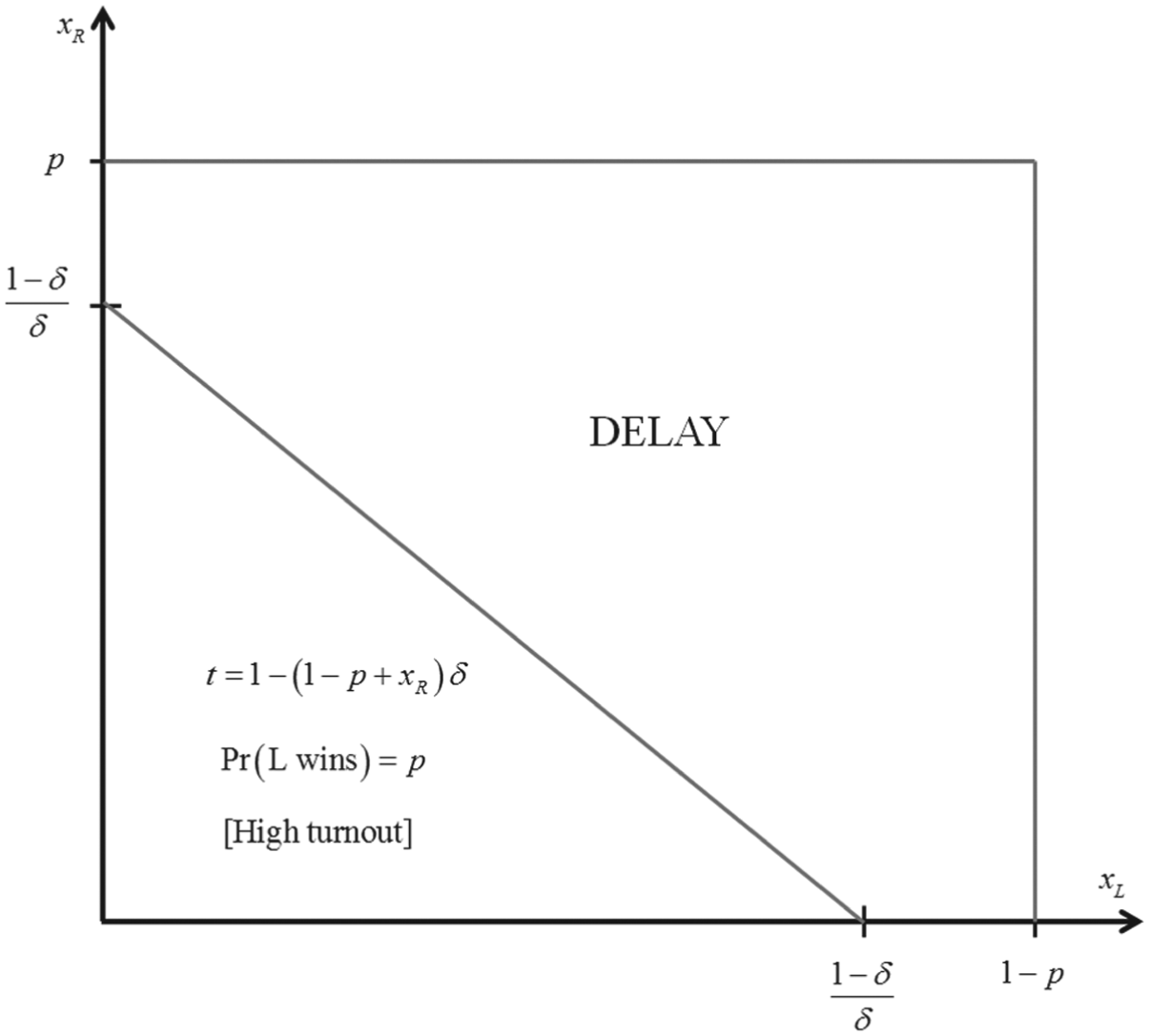
Equilibrium outcomes with optimistic parties.
Inefficient delay when parties are sufficiently optimistic is not a surprising result. Optimism about electoral outcomes implies that each party is optimistic about its outside option (expected utility from delay), and when the perceived outside options are high enough then there are simply no agreements that are acceptable to both parties. This basic insight is also well known from the literature (see e.g. Fearon, 1995), so this brief section primarily serves to illustrate how our modelling relates to standard insights on bargaining and optimism. In particular, it highlights the fundamental difference between situations where party decision makers with correct beliefs bargain before an audience of optimistic partisans and bargaining situations where the decision makers themselves are optimistic.
4. Conclusion
We have demonstrated that partisan optimism about electoral outcomes can significantly influence political bargaining processes. While the model is evidently stylized, we think that our results provide a solid first step in understanding how this well-documented bias among partisan voters influences the behaviour of politicians and how this translates into policy and electoral outcomes.
Particularly interesting findings were that increased optimism among a partisan group leads to a stronger bargaining position for the party and therefore better policy outcomes, but may hurt the party’s electoral prospects. Another important observation was that, in the main model, inefficient delay of agreement is not possible in equilibrium, even with high levels of partisan optimism. However, in the extended model where partisan dissatisfaction is directly costly for each party, inefficient delay is possible as an equilibrium outcome. Finally, we also demonstrated how the situation from our main model where fully rational parties bargain while taking into account that partisan voters have optimistic electoral expectations leads to fundamentally different outcomes than if party decision makers themselves are optimistic.
An important general lesson from our model is that voters’ perceptions can have important effects on policy outcomes. Studies of voter perceptions typically focus on measurement, explanation, and/or effects on voting behaviour. These are clearly important issues in their own right, but we suggest that future research should also go one step further and rigorously explore how voter perceptions matter for incentives in the legislative and executive branches and thus for policy formation. In our view, behavioural formal models will be a very useful tool for such research, both for careful exploratory thinking about the mechanisms that may link perceptions and policy outcomes and for more explicit generation of hypotheses that can be tested empirically.
Footnotes
Appendix
Proof of Proposition 1.
If
Declaration of conflicting interests
The author(s) declared no potential conflicts of interest with respect to the research, authorship, and/or publication of this article.
Funding
The author(s) received no financial support for the research, authorship, and/or publication of this article.