







Abstract
This paper studies pork barrel spending in a model where two symmetric parties compete for an electorate consisting of groups which have different ideological preferences. In equilibrium, party electoral promises decrease with voter ideological biases, and a “swing voter” outcome emerges. In this context, a problem of exclusion from party transfer plans arises which depends on ideology distribution. Groups with extreme ideological preferences are excluded from these plans, and also within moderate groups a share of voters receives a nil transfer from the parties. This exclusion problem is generally reduced if a transformation of the electorate occurs which decreases the polarization of the distribution of ideology.
1. Introduction
In electoral campaigns, parties competing for parliamentary seats debate a wide set of issues, which range from the role of women in society to agricultural subsidies for honey. In this variegated landscape, a distinction is possible between ideological issues and tactical issues. This distinction is essentially based on how free the parties are to take a specific position on these issues.
The position of a party on ideological issues is essentially fixed, and is determined by its history and background. These issues in fact characterize the broad political view of a party, which is not easily changed from one election to the next. They may be economic, as in the case of the programmatic redistribution defined in Dixit and Londregan (1996), or non-economic, as in the case of abortion and gun control.
Parties, however, are free to choose any position on tactical issues, without being constrained by previous stands taken in the past or by their own cultural identity. Tactical issues are mostly economic, and specially concern preferential transfers to some voters. These transfers, often called pork barrel spending, may take several forms, ranging from subsidies or taxes for particular districts to the location of military bases.
Both ideological and tactical issues have prominent roles in electoral competition. On the one hand, in fact, tactical issues represent the main tool to increase the vote share of a party. Since the positions on pork barrel spending are not fixed and can be easily varied, these preferential transfers are mainly used to poach votes from competitors. On the other hand, ideological issues remain an important element in voter preferences. An ideologically biased voter benefits from the sole fact of voting for the party which promotes her preferred ideological issues, and is less responsive to pork barrel spending. 1
The present paper studies the interaction between ideological and tactical issues and focuses on its effects on the allocation in the electorate of party preferential transfers. The analysis extends the deterministic voting model by Myerson (1993), and considers the case of an electorate formed by groups of voters who have different ideological preferences, where two symmetric parties compete in an election by simultaneously announcing a transfer plan for the public budget. 2 In the campaign, each voter is offered a transfer by the parties, and electoral competition is a sort of vote-buying activity.
In this framework, if an ideologically biased voter casts her votes for the party whose ideological issues are the closest to hers (i.e. the affiliated party) she obtains, by this sole fact, a given benefit. The size of this benefit measures the intensity of the ideological bias, which is nil in the case of swing voters. Voting for the party whose ideological issues are the furthest to hers (i.e. the opposition party) however does not provide utility or dis-utility either.
In the elections, voters compare the utility which results from summing the benefits provided by the ideological bias and by the offer of their affiliated party, to the utility deriving from the offer of the opposition party. Then they sincerely vote for the party which offers the highest level of utility.
The equilibrium of this redistribution game is characterized here, and the effects on party transfer plans of changes in the distribution of ideology in the electorate are studied. In the Appendix a generalization to the case of asymmetric distribution of ideology is also provided.
The focus of the analysis is on the outcomes of electoral competition in terms of the distribution of the public budget across groups. In particular, I study the expected transfers to voters with different ideology bias, and the degree of exclusion from party transfer plans, which is the circumstance where some voters receive a nil transfer from a party. The exclusion from pork barrel spending characterizes the platforms of both parties. This fact is the most important consequence of introducing ideology into electoral competition.
In equilibrium, party transfer plans conform to the results of the “swing voter” theory. Each voter receives an expected transfer, both from the affiliated and from the opposition party, which decreases as the size of her ideological bias increases. Moreover, in each group some members receive a nil transfer from the parties, whose number increases as the ideological bias of the group gets larger. Lastly, on the most extreme fringes of the electorate, there are groups which are not targeted by pork barrel spending.
So in the present setting, the electorate is split into two. There is one fraction of the electorate which comprises the battlefield of the electoral competition, and another which is not targeted by pork barrel spending and is not contested by the parties.
This fact has important consequences on the effects on party transfer plans, of changes in the polarization of ideology distribution. A decrease in polarization, which does not change the total size and the composition of the election battlefield but only affects groups which are not contested by the parties, has no effect on party transfer plans. On the other hand, a decrease in the polarization of ideology which only affects contested groups, and does not alter the total size and composition of the election battlefield, causes a decrease in party expected transfers and in the degree of exclusion from party transfer plans. These effects also follow from a decrease in polarization, which shrinks the share of the electorate where no competition takes place, and increases the size of the groups in the election battlefield without affecting its composition.
1.1. Related literature
This paper belongs to the strand of the literature which adopts the analytical framework developed by Myerson (1993) to study in a deterministic voting setting, the effects of political competition on a range of issues, including public deficits (Lizzeri, 1999) inequality (Kovenock and Roberson, 2008; Laslier, 2002; Laslier and Picard, 2002), campaign spending regulation (Sahuguet and Persico, 2006), inefficient redistributive policies (Crutzen and Sahuguet, 2008; Kovenock and Roberson, 2009a) and the provision of pure (Lizzeri and Persico, 2001, 2005) and local public goods (Magnani, 2010). The analysis builds mainly on the work of Kovenock and Roberson (2008), who studied the effect of loyalty on electoral competition and party transfer plans. I complement their findings by studying a dimension of political preferences which has been neglected in the literature mentioned above (i.e. voter ideology).
Ideology is here introduced in a way which is similar to that adopted by Magnani (2010). In this model, two parties compete in a redistribution game and must decide whether to include in their electoral platforms a local public good which supplies a fixed benefit to a group of voters. By allowing for the existence of more than two groups in the electorate, the present framework generalizes this analysis, even though in a different setting.
In the present setting, ideologically biased voters who vote for the affiliated party obtain a fixed benefit which has one main effect on the outcome of the electoral competition. In the electorate, some people, or even entire groups of voters, are excluded from party transfer plans. A similar result is also obtained, in a different context, by Kovenock and Roberson (2009b), who study a dynamic game where the parties decide the allocation, across different states, of campaign expenditures which act as a form of investment. In each state, in fact, the incumbent party, which won in the previous elections, obtains a head-start advantage in the next campaign. In this setting, states with no incumbency advantage receive positive allocations with certainty, while states with incumbency advantage are not targeted by either party with positive probability. As a consequence, an outcome where at least one state is excluded from campaign spending allocation is possible after the elections.
In Kovenock and Roberson (2009b) the exclusion problem is a possibility which only emerges ex-post. In the present setting, however, this problem is certain and emerges ex ante, (i.e. before the implementation of party transfer plans) because some groups receive a nil transfer with probability 1. This follows from the fact that the value given by the parties to each group of voters is endogenous and depends on party budget constraints. The circumstance where the fixed benefit deriving from ideology (which also represents an entry cost for the opponent party) is sufficiently large to discourage the competition in these groups is allowed. In Kovenock and Roberson (2009b), on the contrary, the parties do not face a budget constraint, and the value of each state is exogenous and is assumed to be larger than the advantage of the incumbent party. The present analysis thus extends the results by Kovenock and Roberson (2009b) to the case where the parties face a budget constraint.
The issue of electoral competition with ideologically biased voters is analyzed by another strand of the literature originating from the seminal contribution by Lindbeck and Weibull (1987). In a probabilistic voting setting, Dixit and Londregan (1996) consider a model where party ability to target the voters is limited. There are different groups, characterized by a specific distribution of ideology, whose members must receive the same electoral promise from each party. The authors characterize the conditions which lead to a “swing voter” outcome or to a “machine politics” outcome in redistributive policies. In a similar framework, a recent paper by Krasa and Polborn (2014) studies the effects of ideology on the size of government.
A common feature of probabilistic voting models is the fact that party offers are homogenous within each group while group members are heterogeneous. My analysis adopts a different point of view, which makes it possible to account for the evidence, reported in several studies, of a widespread adoption of micro-targeting in campaign spending. 3 In the present setting, in fact, there are homogeneous groups and perfect discrimination which allows party transfer plans to target each voter in the electorate. It thus provides a new insight on the effects of ideology on electoral competition, which complements the previous findings of the probabilistic voting literature.
1.2. A Comparison between ideology and loyalty
The problem of exclusion from party transfer plans, which characterizes the results of the present analysis, is highlighted in the comparison between the effects of ideology and of a different feature of voter preferences: i.e. loyalty.
The analysis of electoral competition in an electorate with heterogeneous voter loyalties to political parties is performed, as mentioned above, by Kovenock and Roberson (2008). In their framework, loyalty concerns the ability of a party to manage the public budget, and its propensity toward corruption and embezzlement. These aspects jointly define the “discount factor” which a voter applies to the electoral offers of a party, and captures the effects of its credibility (or perceived valence) and of the “leaky bucket” used for pork barrel spending. 4 Loyalty is thus a multiplicative term which causes the marginal productivity of money of the affiliated party to be higher than that of the opposition party in loyal groups.
In the present framework, ideology enters additively into the utility function, and generates for the voter who votes for the affiliated party an additional benefit which adds to that deriving from pork barrel spending. What marks the difference between loyalty and ideology thus is what they apply to. Loyalty affects voter “perception” of party offers and its effects are proportional to the offers themselves. Ideology, on the other hand, pre-exists party offers, and independently generates a utility.
This fact has two main effects. The first is that the ideology bias defines an entry cost which the opposition party has to pay in order to obtain the vote of an ideologically biased voter. The offer of the opposition party must be in fact large enough to counterbalance the benefit provided by the ideology bias. As a consequence, if the entry cost exceeds its appraisal of the vote of an ideologically biased voter, the opposition party does not contest these votes. The second effect is that the ideology bias permits the affiliated party to obtain the vote of every ideologically biased voter who receives the same offer from both parties. This happens both when party offers are strictly positive and when party offers are nil.
These effects of ideology significantly affect party transfer plans which, as a consequence, are quite different from those obtained in equilibrium in a setting with loyal voters. In this case, Kovenock and Roberson (2008) find in fact that in loyal groups, an optimal strategy for the opposition party entails concentrating pork barrel spending in a subset of its members in order to poach these votes from the affiliated party. A share of the group thus is frozen out and receives a nil offer, but this share never reaches
In this context, the affiliated party makes strictly positive offers to all the voters of its loyal groups. This happens for two reasons. The first reason is that the share of the group which is frozen out by the opposition party is random. The second reason has to do with the fact that where a loyal voter receives a nil offer from both the affiliated party and the opposition party, a tie occurs and she chooses each party with the same probability. As a consequence, the affiliated party has to make a strictly positive offer to all the voters in its loyal groups in order to obtain the votes of people frozen out by the opposition party.
These features of party transfer plans exclude that in an electorate with loyal voters, there are people who receive a nil offer both from the affiliated party and from the opposition party. Under the assumption that post election policies are the outcome of a probabilistic compromise, 5 this also means that neither a whole group nor part of a group ever expects to obtain a nil transfer after the elections.
However, this does not happen in the presence of ideology, even though in this context too the opposition party freezes out a share of the groups which are ideologically biased. The reason is that, unlike what happens in the presence of loyalty, when an ideologically biased voter receives the same nil offer from both parties, no tie occurs and she chooses the affiliated party due to the additional benefit provided by the ideology bias. The affiliated party can thus exploit this advantage by also freezing out a share of its partisan group, and by increasing the resources targeted at other segments of the electorate where electoral competition is harsher. As a consequence, within each ideologically biased group, there is always a share of voters who are excluded from both the transfer plan of the affiliated party and the transfer plan of the opposition party. Furthermore, if a probabilistic compromise shapes post election policies, there are always members of ideologically biased groups who receive no transfer after the elections.
Moreover, in groups where the entry cost defined by the ideology bias is higher than the appraisal which the opposition party makes of each of these votes, electoral competition does not take place. Both parties indeed make to every member of the group a nil offer, and the affiliated party obtains these votes thanks to the ideology bias. In this way, groups which are more ideologically biased are excluded from party transfer plans.
The exclusion problem affects the members of ideologically biased groups which are contested by the parties and are in the battlefield of electoral competition, but also involves entire groups which are relegated outside the battlefield of elections. In both these cases, the people who receive a nil transfer after the elections are, in a sense, expropriated from the “surplus” generated by electoral competition. In the most ideologically biased groups of the electorate, where the entry costs for these “vote markets” are particularly high, the affiliated party becomes a “monopolist”.
The distribution of ideology thus defines where in the electorate the competition between the parties takes place. This further implies that changes in the distribution of ideology which affect groups outside the battlefield of electoral competition need not affect party transfer plans. But in a setting with only loyalty, every change in loyalty distribution necessarily affects party transfer plans since the whole electorate is the battlefield of electoral competition.
The paper outline is as follows. Section 2 describes the model. Section 3 characterizes the equilibrium of the game and analyzes party transfer plans. Section 4 studies the effects of changes in the distribution of ideology. Section 5 concludes.
2. The model
The model analyzes the competition between two symmetric parties running for office in an election, and includes two stages. In the first stage, Party A and Party B simultaneously present electoral platforms to which they credibly commit. In the second stage, elections are held and voters cast their votes.
Electoral platforms include a transfer plan for the public budget, which defines a non-negative offer for each voter. The transfer plan specifies, for generic voter v, the quantity of a homogeneous good which Party i (
In planning transfers, the parties are opportunistic, and allocate public money in order to maximize vote shares,
Voters are ideologically biased toward the parties, and this allows identification of different groups in the electorate. Groups whose members support Party A are included in the set
Each group,

when Party A (i.e. the affiliated party) makes an offer

when an offer
The parties have complete information over voter preferences and adjust their transfers according to the size of the ideology bias. A strategy for Party i,

where

When elections are held, votes are cast simultaneously. People vote sincerely, and choose between Party A and Party B. A strategy,

Where a tie occurs, voters choose each party with the same probability.
3. Equilibrium analysis
The game is sequential and is solved by backward induction. Consider initially the elections stage, and note that, in equilibrium, each voter chooses the party which offers the highest utility.
Analyze now the first stage, where party electoral platforms are defined. In order to characterize the equilibrium for this redistribution game, and exploit results from previous literature, it is useful to adopt the approach developed by Sahuguet and Persico (2006). This requires establishing an equivalence between the maximization problem faced by the parties, and that of two players who simultaneously bid in n independent all-pay auctions. This equivalence is proven in the Appendix.
A well-known result in the all-pay auction literature is that equilibria in pure strategy only exist in special circumstances. This result extends to the present setting, and poses problems which are discussed below.
In order to study the equilibrium mixed strategies of the redistribution game, I focus on the cumulative probability function
Given these remarks, Party A‘s maximization problem is
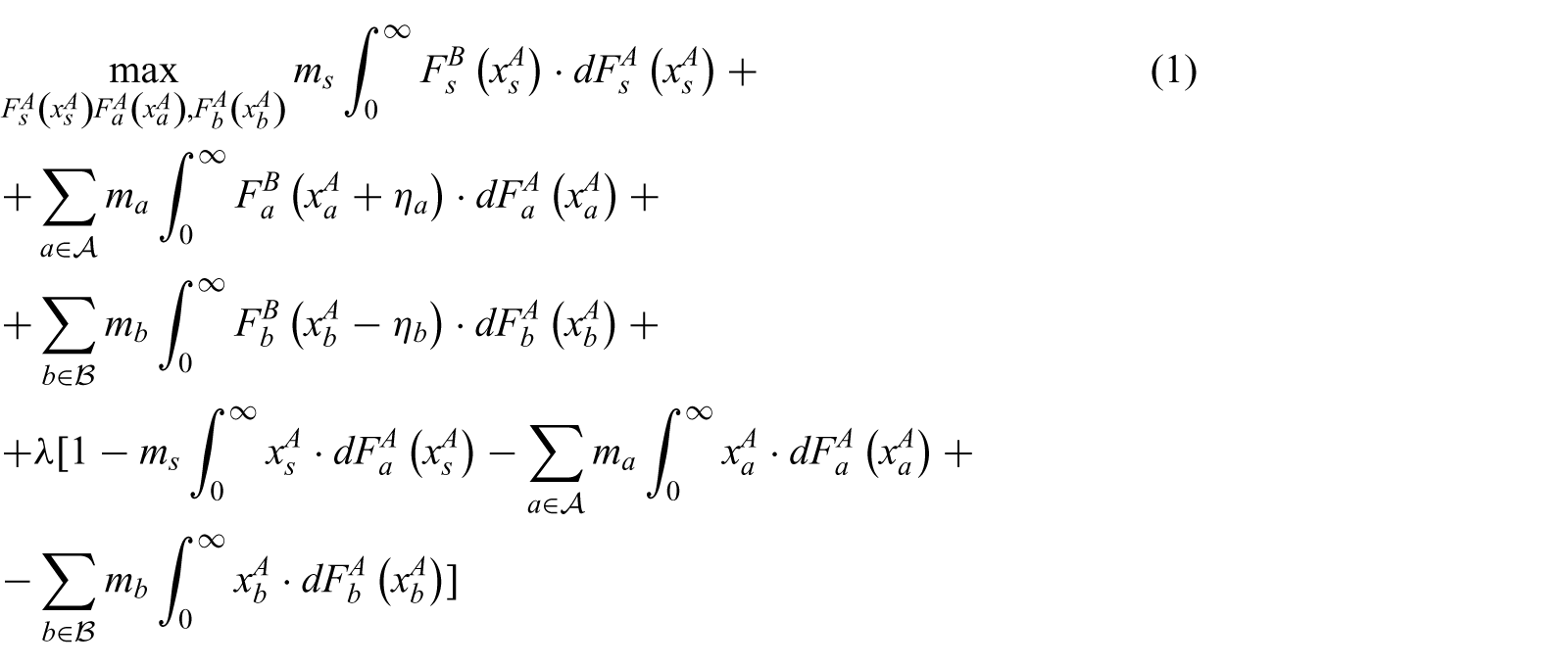
Party B‘s maximization problem is symmetric.
In this framework, the Lagrangian multiplier attached to party budget constraint
Note now that in an ideologically biased group k, the opposition party must pay an entry cost
In this context, the difference between the entry cost,

If
If

over the support
Party B makes a nil offer with probability

over the support
If
In the swing voter group, Party i (

Party vote shares are
Proof. See the Appendix. □
Consider now the equilibrium for the redistribution game.
The sets

Proof. Consider the characterization of set

is satisfied, which, using simple algebra, can be rewritten as inequality (2).
Note now that the left-hand side of inequality (2) is fixed while the right-hand side increases as the size of
This allows us to use a recursive method to identify group t. For a given distribution of ideology, we can check whether inequality (2) is satisfied for the group in
Once
Uniqueness of the equilibrium follows from uniqueness of party strategies for every given
In this context, the parties are symmetric when the whole electorate is considered, and in fact they adopt symmetric equilibrium strategies. Electoral competition, though, becomes asymmetric within the groups (except for the swing voter group) because the ideology bias defines a head-start advantage for the affiliated party. A similar framework also characterizes the setting studied by Kovenock and Roberson (2008), where the presence of loyalty changes the marginal productivity of money of the affiliated party, and causes competition between the parties to become unequal within the groups.
Both in the setting with loyal voters and in the setting with ideologically biased voters, the opposition party responds to this inequality by focusing pork barrel spending on a subset of voters. This subset, where the opposition party is able to compete on equal terms with the affiliated party, shrinks as the advantage of the affiliated party increases. But the contested share of a loyal group never falls to zero. This happens however in the presence of ideology, where groups outside the battlefield of elections are not contested by the opposition party.
The reason is that in the setting with loyal voters, the opposition party does not face any constraint on the amount of resources targeted at specific groups; this amount is freely adjusted by varying the size of the targeted subset. But in the setting with ideology there is a constraint on resource allocation which prevents the amount of resources targeted at an ideologically biased group from falling below a given threshold. In fact, even when contesting a single member of an ideologically biased group, an offer of at least
A further element which characterizes party strategies in a setting with ideologically biased voters is the fact that the affiliated party, with positive probability, promises a nil offer to the members of groups which are ideologically biased toward it. This never happens in a setting with loyal voters.
The reason for this difference has to do with the multiplicative nature of loyalty, which causes the advantage of the affiliated party to be proportional to the size of the offer. This circumstance is crucial when both the affiliated party and the opposition party make the same nil offer to a loyal voter. In this case, the advantage of the affiliated party disappears and a tie occurs where both parties have the same probability of obtaining the vote of the voter. Since risking a tie is not optimal, the affiliated party never makes a nil offer to its loyal voters.
On the contrary, in the presence of ideology, the advantage of the affiliated party is independent of its offer. Hence, if party offers are equal and nil, the head-start advantage is unchanged and a tie cannot occur. The affiliated party simply obtains the vote thanks to the ideology bias. This circumstance allows the affiliated party to exploit the fact that the opposition party makes nil offers to ideologically biased voters by also making a nil offer with some positive probability to these voters. Savings on resources in fact, permit an increase in the size of the transfers targeted at other segments of the electorate, where electoral competition is harsher.
3.1. Party transfer plans and ideology
Consider how party transfer plans are affected by the size of the ideology bias in the groups included in the battlefield of elections. Note that in groups outside this battlefield, all members receive the same nil transfer from both parties, independently of the size of the ideology bias. Focus initially on party unconditional expected transfers.
Proof. By the equilibrium strategies characterized in Lemma 1, each member of a group

from Party A, so that

Party B‘s unconditional expected transfer is

so that

Both parties thus reduce the unconditional expected transfers to the voters in group k, as the size of

holds, since

This quantity is positive if
The argument for a group
Party i‘s unconditional expected transfer to a swing voter is

□
This description of the effects of ideology conforms to the “swing voter” theory. Voter groups with stronger ideological preferences are, in fact, less rewarded than those with weaker preferences, while swing voters obtain the most.
In this context, the unconditional expected transfer promised by the opposition party is the largest, and the difference with that of the affiliated party reaches a maximum when the ideology bias equals
In groups where the ideology bias is small, competition is widespread, and an increase in the ideology bias only causes a small increase in the share of the group which is frozen out by the opposition party. The additional advantage for the affiliated party, generated by the increase in the ideology bias, is sizable, since the number of the members of the group who are contested by the opposition party remains large. As a consequence, the reduction in the expected transfer of the affiliated party is larger than that in the expected transfer of the opposition party, and this causes the gap between them to widen.
Further increases in the size of the ideology bias which lead to exceeding the threshold
The fact that some groups, and some voters within ideologically biased groups, are “frozen out” by the parties is an important feature of party transfer plans. In this context, the opposition party whose valuation of ideologically biased votes is the lowest, adopts the strategy of focusing pork barrel spending on a share of them in order to poach some votes from the affiliated party. This element of the equilibrium strategies is standard in this type of contest, and also characterizes party strategies in Kovenock and Roberson (2008)’s setting with loyal voters. But here the affiliated party too freezes out a share of its ideologically biased groups. This element is peculiar to the present setting, where the ideology bias enters additively into voter preferences. 10 A problem of exclusion from the transfer plan thus, emerges for both parties, whose width is measured by the share of the electorate whose utility is driven down to the reservation level (i.e. 0).

Proof. Straightforwardly follows from Corollary 2. □
The degree of exclusion from a party transfer plan largely depends on the distribution of ideology among voters, and defines the extent to which the benefits generated by pork barrel spending are spread in the electorate. Hence
Consider now party conditional expected transfers.
Proof. By the equilibrium strategies characterized in Lemma 1, the members of a group

so that

so that
The members of groups which are more ideologically biased receive the highest conditional expected transfers from the opposition party. This is the case because the entry costs required to contest these votes are also the highest. But the conditional expected transfers of the affiliated party decrease as the size of the ideology bias increases. Indeed, as the entry cost increases, competition in ideologically biased groups gets lower and the affiliated party reduces its conditional expected transfers to these voters.
4. The effects of polarization of ideology distribution
This section includes a comparative static analysis on the effects of symmetry-preserving transformations in the distribution of ideology. The focus is on changes in the degree of polarization. The reason is that these changes produce outcomes in terms of expected transfers and exclusion from party transfer plans, which are peculiar to the present setting and show differences with the case of loyal voters.
Two types of change are considered here. The first type is a battlefield-preserving transformation which does not affect the composition or the total size of the sets
Consider initially the class of battlefield-preserving transformations, and focus on the effects of transformations in groups which are not contested by the parties. A first result immediately emerges.
Proof. Straightforwardly follows from Theorem 1. □
Analyze now a different battlefield-preserving transformation which affects the degree of polarization of ideology distribution. Consider the case where, within the battlefield of electoral competition, there is a shift of voters from a group with a large ideological bias, to a group with a small ideological bias. According to the axioms stated by Esteban and Ray (1994), after this transformation, any “reasonable” measure of polarization should record a decrease in the polarization of ideology. 11
a reduction in party unconditional and conditional expected transfers;
a decrease in the degree of exclusion from party transfer plans.
Proof. Consider the first derivative of the inverse of the Lagrangian multiplier with respect to

The first term in inequality (3), in fact, is positive. The second term, however, is negative. Note that by Theorem 1, inequality (2) is verified for

and a decrease in polarization also causes a decrease in party monetary appraisal of each vote.
This has some straightforward consequences on party expected transfers. Consider without loss of generality, a group

A reduction in

Lastly, party conditional expected transfers decrease, since

Consider the degree of exclusion from Party A‘s transfer plan, and note that

holds
13
, implying that the effects on

since
A decrease in polarization causes a reduction of the degree of exclusion from party transfer plans. This decrease has two conflicting causes. On one hand, the decrease in
Consider now the circumstance where a battlefield-altering transformation of the distribution occurs, which changes the total size of the set
a decrease in party unconditional and conditional expected transfers;
a decrease in the degree of exclusion from party transfer plans.
Proof. If there is a shift of voters from group
Consider now the change in the degree of exclusion from Party A‘s transfer plan. The effects of a change in

The effects of a change in

or substituting

The degree of exclusion from Party A‘s transfer plan thus decreases. In order to see why
A decrease in ideological polarization, which increases the share of the electorate where the ideological bias is below a given threshold, causes a reduction of the average level of entry barriers to ideologically biased groups. This happens in both the cases described above, and results in an increase in party shadow costs of money because the opportunities for a profitable use of each dollar in the public budget are enhanced. Competition becomes more widespread, and in fact, the degree of exclusion from party transfer plans is reduced. As a consequence, the share of voters frozen out by electoral competition and the size of expected transfers are also reduced.
There is a further circumstance where a decrease in ideology polarization occurs: i.e. when shifts of voters across groups also cause the composition of
5. Final remarks
This paper studies electoral competition between two parties in the presence of ideologically biased voters. The ideology bias here defines the entry cost which the opposition party needs to pay to have a positive probability of obtaining the vote of an ideologically biased voter.
In this context, a “swing voter” outcome emerges for party transfer plans, and party expected transfers decrease along with the size of voter ideological biases. Furthermore, in equilibrium, a problem of exclusion from party transfer plans emerges. Within each ideologically biased group, a share of voters, whose size increases along with the size of the ideology bias, in fact receives a nil transfer from the parties. On the most extreme fringes of the electorate, it may even be the case that the whole group is excluded from party transfer plans.
This fact has one main consequence: the distribution of ideology in the electorate is, to some extent, ineffective at influencing the transfer plans chosen by the parties. Changes in the ideology bias or in the size of the most extreme groups in the electorate may in fact have no effect. This makes it hard to assess the effects on party transfer plans of changes in the distribution of ideology.
Some results can be obtained by focusing on changes in distribution which involve the degree of ideological polarization. In this context, a decrease in ideological polarization which affects the battlefield of election, without altering its composition, although its size may vary, results in a reduction of expected transfers in every contested group. The degree of exclusion from party transfer plans moreover decreases.
Footnotes
Appendix 1
Declaration of Conflicting Interests
The author(s) declared no potential conflicts of interest with respect to the research, authorship, and/or publication of this article.
Funding
The author(s) received no financial support for the research, authorship, and/or publication of this article.