







Abstract
In this paper we consider a multi-party electoral competition model in which parties, which care both about implemented policy and their electoral performance, strategically promise a redistribution scheme while their social ideologies are considered to be known and fixed (differentiated parties). Voters, who differ both in income and in social ideologies, vote sincerely for the party that they cumulatively like the most (that is, taking into account both the redistribution scheme proposals and parties’ social ideologies). Formal analysis of this game uncovers a moderates-vs-extremists equilibrium: parties with moderate social ideologies tend to favor generous redistribution in order to capture the votes of the poor majority, while parties with extremist social ideologies are more likely to be non-competitive in the economic dimension by proposing policies that do not reflect the interests of the poor. An implication of this result is that, ceteris paribus, an increase in income inequality should lead to an increase in the cumulative vote share of moderate parties and, hence, in a decrease in party-system fragmentation.
Keywords
1. Introduction
The relationship between social ideologies and redistributive outcomes has recently received renewed attention mostly in the context of two-party elections (e.g. Krasa and Polborn, 2012, 2014). The main idea in this literature is that if parties are less flexible in determining their platforms as far as social issues are concerned compared with their redistribution promises, then voters’ preferences on social issues should be relevant in determining which redistribution schemes parties promise. Lindbeck and Weibull (1987), Dziubiński and Roy (2011), Krasa and Polborn (2012, 2014), and Matakos and Xefteris (2017) consider two-party models, such that parties have fixed positions on the social ideology dimension and promise redistributive schemes (or public goods) in order to improve their prospects of success in forthcoming elections, and show that indeed equilibrium redistributive schemes are sensitive to changes in the distribution of voters’ social ideologies. In these models parties generally end up promising identical redistribution schemes 1 and these results are perfectly robust to considering that parties may be partially policy motivated. This is so because since Calvert (1985) we know that when only two parties compete, a party may affect the implemented policy to its satisfaction only by increasing her vote share: office and policy motives are aligned to a great extent.
In contrast, very little is known regarding how redistribution promises should look like when many differentiated parties take part in electoral competition. Does it still hold that all parties will want to offer the same redistribution scheme as in two-party systems? Do equilibrium redistribution promises depend on whether parties have policy preferences or not? In case parties offer in equilibrium distinct redistribution schemes, which parties should be anticipated to promise more generous redistribution? Which parties should be expected to favor less-generous redistribution schemes? Moreover, since equilibrium existence and uniqueness arguments are not always straightforward in such differentiated candidates games, even in the two-party case (Matakos and Xefteris, 2017; Xefteris, 2015), what happens when more than two parties (or candidates) compete? For instance, is a pure strategy Nash equilibrium likely to exist?
In this paper, we try to answer these questions by studying a model of electoral competition under the simplest possible electoral rule (plurality) among four parties which have fixed and known social ideologies and which strategically promise a redistribution scheme in order to affect both policy outcomes and their vote share. Each voter has well-defined preferences both regarding parties’ social ideologies and about parties’ redistributive schemes and votes for the party which offers the bundle that the voter likes best, exactly like in the papers that we have already discussed. That is, the main difference of our approach compared with the previous ones is that we consider a larger number of parties and more general objective functions.
Considering that parties’ social ideologies are symmetrically distributed about the center of the policy space we uncover a strong moderates-vs-extremists result: the two socially extremist parties meet in promising no redistribution at all while the two moderate parties promise generous redistribution. That is, in multiparty systems, socially moderate parties tend to offer economic policies that benefit the poor and socially extremist parties tend to promise economic policies that do not reflect the interests of the poor. The intuition behind our main result is as follows. Since Dixit and Londregan (1995, 1996) we know that, in the context of two-party electoral competition, parties have an incentive to woo the poor voters by promising generous redistribution because their votes are relatively cheaper to “buy.” However, in the context of bidimensional multiparty electoral competition, where parties also care about the implemented social ideology, a new dynamic arises: socially extremist parties have strong incentives to behave strategically in order to bring the implemented social ideology closer to their own. As a result, an extremist party promises, in equilibrium, a less-generous redistribution scheme, compared with the socially moderate ones, in order to avoid cannibalizing the vote share of the moderate party with which it has closer ideological affinity on the non-economic dimension.
The prediction that socially extremist parties propose economic policies that do not reflect the interests of the poor majority is arguably intriguing and should be treated with caution in order to avoid misinterpretations. When the majority of voters is relatively socially moderate and socially moderate parties propose popular and similar economic platforms, socially extremist parties know that: (a) they cannot win, independently of the economic platform that they propose, and (b) their strategy can influence only the implemented social policy by affecting which of the two moderate parties ranks first in the election. Hence, they choose unpopular economic platforms in order to bring the implemented social policy as close as possible to their ideal one. In a sense, socially extremist parties have incentives to be non-competitive in the economic issue and, hence, they endogenously become niche parties. 2 Indeed, one could have a more elaborate model in which parties choose both economic policy and assign different weights to different issues, but the addition of an extra strategic dimension would only complicate the analysis without interfering with the existing dynamics: extremist parties would still wish to be non-competitive in the economic dimension. i
This result has several implications at least as far as European parliamentary politics are concerned. Most European democracies have multiparty systems with two large moderate parties and a number of smaller, and usually niche, parties in the periphery of the political spectrum that focus on specific policies such as the environment, or the relationship with the EU. Thus our model helps explain some features of multi-party European politics. For instance, in the 2015 parliamentary election in the UK, in a typical example of a niche party behavior, the strongly euroskeptic UKIP, if one treats parties’ position towards the EU as the second dimension, 3 run on a platform of very low taxes and redistribution, while the mildly euroskeptic Conservatives, under the leadership of David Cameron, run under the platform of one-nation conservatism which involves considerable redistribution towards the poorer segments of society. Another example of this type of non-monotonicity in proposed tax policies, predicted by our model, comes from the Greek 2015 parliamentary election where the two extreme parties (on the pro- and anti-EU dimension), the populist right-wing Independent Greeks party and the liberal To Potami party, run on a low taxes platform, focusing mainly on issues of European identity, while the more moderate ones (on the EU dimension), such as New Democracy and Syriza, proposed relatively more redistribution (and taxation) and focused primarily on the economy.
Moreover, the qualitative part of this finding, socially moderate parties tend to offer more generous redistribution than socially extremist ones, is robust to voters’ and parties’ social ideologies not being absolutely symmetrically distributed about the center of the policy space, to the two dimensions being correlated, 4 to parties caring to any arbitrarily small degree about the implemented social policy, 5 and to alternative electoral systems (proportional representation (PR)). What changes, of course, is that in equilibrium the two moderate parties win elections with different probabilities: if, for example, the socially liberal extremist offers more redistribution, but still strictly less than both moderate parties, then this will give an electoral advantage to the moderate socially conservative party. As a result, extending the results to cases with such asymmetries allows our model to provide some insight into electoral patterns observed in many European party systems. For example, if extreme socially liberal parties have a floor on their redistribution proposals, perhaps because the two dimensions are correlated, then our model can explain the right-wing electoral advantage in Germany (few left-wing chancellors in recent years), France (only two left-wing presidents during the Fifth Republic) and Italy (dominance of the right until the recent crisis). As a result, our theoretical framework can be useful both in helping us understand the mechanisms behind the emergence (and electoral success) of niche parties, a feature that is quite common in many European parliamentary democracies, and also in shedding some light into some particular features of European politics (e.g. the recent electoral advantage of the right).
Since, in equilibrium, both in the symmetric and the asymmetric case, different parties offer different redistribution schemes, and, since different voters have different preferences regarding redistribution (which originate form the fact that they might have different incomes), it is straightforward that two voters with the same social ideology need not be voting for the same party: the share of poor voters that vote for the socially moderate parties is larger than the share of rich voters who vote for these parties. This observation dictates that the cumulative vote share of socially moderate parties, which, in most cases, negatively relates to the fragmentation of the party system, is correlated with the exact degree of income inequality of a given society. Following the argument laid by Piketty (2014), take the case of a society where inequality is rising as the income of the very rich is rapidly increasing relative to that of the rest, for simplicity call them the poor, and consider our equilibrium, where moderate parties offer more generous redistribution schemes than the extremist ones. Then our model makes a direct prediction on the exact relationship between income inequality and the fragmentation of the party system: party-system fragmentation decreases with inequality. In the last part of our paper we present some rough empirical evidence which back up the identified relationship.
The remaining of the paper is organized in the following way: in section 2 we introduce our theoretical model, in section 3 we present the results of the formal analysis, in section 4 we discuss empirical implications of our findings, and, finally, in section 5 we present our conclusions.
2. Theoretical model
We consider a model of electoral competition among four parties, taking place in a two-dimensional policy space. We name those dimensions as social ideology and economic policy, respectively (see also Groseclose, 2007; Krasa and Polborn, 2012; Stokes, 2005). 6 Following the literature on differentiated candidates (Dziubinski and Roy, 2011; Krasa and Polborn, 2010, 2012, 2014; Matakos and Xefteris, 2017; Xefteris, 2015) we assume a framework, where the four parties differ in their fixed social ideology position, while in the second dimension (economic policy) they strategically choose the tax rate, and the implied level of redistributive spending, in order to maximize their utility. Moreover, in our set-up, parties have mixed office and policy, motives while the preferences of the voters in both dimensions are heterogeneous. Finally, both dimensions are continuous.
2.1. Political parties
We formally define the parties’ social ideology positions in the

where l is the position of the extreme libertarian party, L is the position of the moderate socially liberal party, A is the position of the moderate socially conservative party, and a is the position of the extreme authoritarian party. These positions are fixed and we will henceforth refer to each party by its social ideology position
Each party’s social ideology position is assumed to be public knowledge. Furthermore, each party will propose a tax rate which uniquely identifies a specific redistribution scheme: the budget must be balanced and, hence, the total amount of redistributive transfers should always equal the total revenues raised through taxation. Formally, each party p proposes a tax rate
We assume that parties care both about their vote share (office motives) 7 and also about the social ideology of the winner (policy motives). 8 Formally, their utility function takes the following form:

where
2.2. The voters
Each voter is characterized by her social ideology,
We employ a standard balanced-budget redistribution scheme (Meltzer and Richard, 1981). That is, under a flat tax rate

This is identical to the individual redistributive transfer. Therefore, the utility of an

where
Then, the resulting utility of income for a poor voter, given transfer

whereas, for a rich one it is

Since the left-hand side of both inequalities is the utility of income after redistribution, while the right-hand side is the utility of income when redistribution is zero, we can deduce that all poor voters prefer the highest possible tax rate
2.3. The voting game
We consider a voting game with three stages. All information is publicly available and known ex ante to all agents. The solution concept we employ is Nash equilibrium. The three stages of the game are as follows.

The winning party is denoted by

3. Equilibrium analysis
3.1. Social ideology dominates
In this section, we analyze the case where social ideology is dominant, that is, we assume that
Before presenting our formal results, it is useful to define the function that measures the maximum gain in votes for a party, as a function of q and of its tax rate differential (mark-up) with respect to one of its neighboring parties: this will help us pin down the voters who are indifferent between any two parties. First, define the tax rate differential for a party p as

The first component is the gain in votes from the poor voters for a party proposing excess taxation
Function
We can now characterize in Proposition 1, with the help of those two results, the equilibrium in the case where social ideology is dominant. 15
This result simply says that when the social issue is sufficiently important for voters, that is,
The intuition behind this result is as follows. First, due to the diminishing marginal utility of income, poor voters are more responsive to generous redistribution (the marginal rate of substitution of income for social ideology is relatively higher for a poor voter). Second, a very high nominal tax rate does not always imply very aggressive redistribution. In fact, whenever the share of poor voters q is very low, even for extremely high values of
However, then, why all parties do not make identical tax proposals, in equilibrium, in order to target the poor as Lemma 1 would seem to imply? Lemma 2 provides the answer: even if it proposes maximum redistribution, an extremist party can never win the election. Instead, it cannibalizes the vote share of the moderate party which is closer to its social ideology, thus causing the victory of the more remote, in social ideology terms, moderate party, which, in turn, brings the implemented social ideology farther away from its ideal point. That is, extreme parties face a trade-off between their office motives (vote-maximization pushes towards high redistribution promises) and their ideological (policy) motives which trigger their strategic behavior in an attempt to manipulate the electoral outcome and the implemented social ideology (policy motives push towards low redistribution promises). Here the assumption about M comes into play: by making the social ideology dimension more pronounced, it guarantees that any gains, in terms of vote shares, that extremist parties score by proposing more redistribution cannot be offset by the loss, in social ideology terms, caused by the victory of a more distant moderate party. As a result, when the social ideology dimension is sufficiently important, that is, when M satisfies the above condition, and the two moderate parties are expected to be very close as far as their winning prospects are concerned, extremist parties know that by proposing a higher tax they can only increase their vote share by a little: social ideology matters a lot to the voters. At the same time though, they are actually helping the moderate party they like the least to win. Given that in our framework parties also care about the social ideology of the winner (policy motives), extremist parties are better off proposing no redistribution at all.
Further note that the equilibrium of Proposition 1 is robust to considering that parties not only care about social ideology but also about the implemented economic policy. In the pure strategy equilibrium that we have characterized above an extremist party, whatever its platform choice is, can never win, the winner of the election is always on of the two moderate parties, and, hence, it cannot change the implemented redistribution in equilibrium. At the same time, if a moderate party changes its redistribution promise, then it can only cause the other moderate party to win with certainty. As a result, neither a moderate nor an extremist party can single-handedly alter the implemented redistribution in equilibrium. In other words, given profile
While this result appears to be robust and offers a clear picture of the forces that are in operation in this model, it raises a question. It is often the case that in actual elections not only do extremist parties not abstain from making generous redistribution promises, but quite the contrary they try to compete with the more moderate parties in this dimension. Obviously, the special case presented above cannot capture this element of electoral competition. Nevertheless, the general case presented below certainly does so in a more realistic manner.
3.2. General case
One complication of considering the more general case, where social ideology still matters but is not dominant, in a game with discontinuous payoffs, is that an equilibrium in pure strategies need not exist. As social ideology becomes less important for voters compared to redistribution (and taxes), the incentives of extreme parties to behave strategically diminish. Proposition 2 generalizes our equilibrium characterization for the case of mixed strategies and shows existence of a symmetric mixed-strategy Nash equilibrium for values of M such that
In an equilibrium where the two extremists employ proper mixed strategies, their tax rate proposals are, in expectation, strictly less than those of the two moderate ones.
17
Nevertheless, there is still a strictly positive probability that the two extreme parties propose a tax rate other than zero. In fact, the mixed-strategy equilibrium offers a very intuitive interpretation in the framework of repeated elections. It can be seen as the frequency with which extreme parties propose some (non-zero) redistribution.
18
When the social issue becomes of little importance (this is equivalent to M being large enough) the incentives of all parties to make generous redistribution promises dominate and one can trivially show that, in equilibrium, all parties assign probability mass almost equal to one arbitrarily close to
Finally, let us make two brief comments here. The first one is related to the assumption that there are only two classes in our model: rich and poor voters. While this assumption is made for expositional simplicity, one can see that our general result (equilibrium characterization in Proposition 2) does not depend on the discrete income distribution that we have employed. By inspecting the proof of Proposition 2, it becomes clear that our formal argument does not depend, at all, on the assumption that the income distribution is discrete. As a result, it can be generalized for a broader class of continuous income distributions. 20
The second one relates to the number of competing parties. One might worry that our result is sensitive on the number of parties that we have assumed. While this is a reasonable worry, our mixed strategy equilibrium allows us a closer look. Consider the case where
3.3. The asymmetric case
So far, we have studied the symmetric case. That is, we have assumed that parties occupy symmetric positions, over the social ideology dimension, and that the distributions of the two groups of voters are also symmetric. Yet, one would like to known whether the main qualitative features of the equilibrium that we have characterized, namely that extremist parties propose less redistribution than the moderate ones, are robust to introducing such asymmetries. In this section, we briefly elaborate on three possible sources of asymmetry: the case in which the poor are more socially liberal (conservative) than the rich, what we call correlated dimensions, the case where there are more socially liberal (conservative) parties at the one extreme, and the case where some parties face asymmetric restrictions in the economic dimension and the amount of redistribution they can propose. Here, we will argue that, as long as such asymmetries are mild, and by mild we mean that
Despite recent evidence that both (socially) liberal and conservative voters reward parties for increased government spending and redistribution (e.g. Kriner and Reeves, 2012), it can be the case that social ideology conditions voters’ preferences for redistribution. For instance, socially conservative voters might be relatively poorer and, hence, they might prefer more redistribution. One can try to model this social ideology-dependent (and fixed) component of redistribution, by assuming that the distributions of the rich and poor voters are not symmetric in the
To see why this is the case, note that it will still be a strictly dominant strategy for both moderate parties to promise more redistribution in order to increase their vote shares. Similarly, the two extremist parties will face the same dilemma as before: how many votes will they be willing to sacrifice in order to strategically manipulate the outcome by boosting the chances of electoral success of the most proximal moderate party? The trade-off faced will be the same in nature. Yet, this time it is not identical in magnitude for the two extremist parties. As a result, just like in Proposition 2, the game admits no pure strategy equilibrium. Rather, we will have a non-symmetric equilibrium in mixed strategies which will involve the two moderate parties choosing pure strategy
In general, the key point to note when considering any asymmetric case is that, in the spirit of Lemma 2, our results hold qualitatively if the two sufficiently differentiated in the social ideology dimension moderate parties, note, though, that
Finally, consider the case in which different parties face different (i.e. asymmetric) constraints regarding their redistribution promises. For example, some parties might be constrained, by their founding charters or principles, to have a “floor” in their redistribution proposals, and, hence those parties might be inclined to propose more generous redistribution than the others. Without loss of generality, consider the case that socially liberal parties, which tend to represent the poor voters more often, are constrained by their founding principles to always propose a certain level of redistribution: that is, there is a “floor”,
3.4. Comments on the assumptions of the objective functions
In this section, we briefly discuss how the assumptions we have made about the smoothness of the two, the policy and the vote share, components of the utility function affect our results. First, note that both components of a player’s payoff function can be discontinuous in own strategy for certain parameter values and strategies of the other players. Consider the following examples that illustrate this point. When the two moderate parties propose
Of course, one should stress that not both of these possible discontinuities bring along the same amount of complications in our formal analysis. Moderate parties have a dominant strategy (
A natural question is, how would our analysis look like if we had instead a less smooth measure of electoral success: if, for example, parties cared about policy in the same manner they do now and only the winner of elections was rewarded with some additional utility. In such a case, the equilibrium of Proposition 1 would be intact: moderate parties would still stick to proposing the highest possible redistribution since by doing that each has probability
In fact, considering that parties care about vote share rather than just winning makes our result stronger in three ways. First, since extremists parties can never win when moderates propose popular policies, a partially policy motivated extremist party has no incentives to propose a popular redistribution policy when it is partially win motivated. In contrast, when it cares about vote share, it has certain gains when it does that. Showing that, despite these non-negligible gains in electoral performance, the extremist party is still (overall) better-off by being non-competitive in the economic dimension, is arguably more solid than just showing the same result for the case in which an extremist party has no gains at all from proposing a more popular economic platform. Second, it aligns with institutional characteristics in most multiparty systems: parties usually receive state subsidies, broadcasting time in public media and other gains depending on their electoral performance. Hence, it is natural to assume that in such frameworks parties do not care crudely about winning or not but have incentives to be voted by as many voters as possible, even if they cannot affect their win prospects. Finally, when moderate parties become “too similar”, then it is natural to expect that extremist parties should not want to sacrifice their electoral performance to bring the implemented social policy only a little bit closer to their ideal one. This is well captured by Proposition 2 and would not hold if parties cared crudely about winning: for any distance, even an infinitesimal one, between the two moderate parties, the strategy profile of Proposition 1 would constitute an equilibrium making our argument arguably less realistic and relevant for real-world politics.
3.5. Robustness to different electoral institutions: Proportional rulesand coalitions
So far in the analysis we have assumed that the party that wins most votes implements its platform (social ideology and tax proposal). That is, we have implicitly assumed simple plurality (or the first past the post (FPTP) rule) and, hence, we have implicitly excluded the possibility of a coalition government being formed. Instead, we have only briefly mentioned in the introduction that our equilibrium characterization, and thus comparative statics results as well, do not depend on the institutional architecture (the type of electoral rule) because the incentives for strategic behavior and the trade-off between votes and ideology outcomes, that the extreme parties face, are also present in any other institutional set-up.
In this section, we address these issues directly by examining what happens when we introduce the proportional rule which, in turn, allows for coalition governments. Before presenting the result, we need to comment that we will only provide a characterization result that is similar to that of Proposition 1. We shall not address issues of uniqueness of equilibrium here, since the aim is to demonstrate that the equilibrium we have characterized in Proposition 1 can arise even if we vary the institutional set-up. Then, the comparative statics predictions that we will derive from that equilibrium will be robust to considering different electoral rules. To fix ideas further, we make some extra assumptions on the institutions and the process of coalition formation which are in line with the literature that studies PR systems (see, e.g., Austen-Smith and Banks, 1988; Baron and Diermeier, 2001; Gamson, 1961; Kalandrakis, 2015; Laver, 1998; Laver and Shepsle, 1990; Riker, 1962; Troumpounis and Xefteris, 2016).
The first assumption is straightforward and very common in the literature of coalition formation. The remaining two are also fairly intuitive. As it is commonly the case, the plurality winner becomes the formateur and is responsible of forming a coalition (for the electoral benefits of the most voted party in PR elections, see Ansolabehere et al., 2005; Matakos and Xefteris, 2015; Snyder et al., 2005). Also since in our model parties care not only about winning or being part of a coalition but also about social ideology, it is normal to assume that they care about the outcome that each potential coalition will implement. Hence, the formateur will strictly prefer to form the coalition that minimizes the distance between its ideal point and the policy of the coalition. This means that its most likely coalition partners are its spatial neighbors (in the social policy dimension). In particular, note that, for sufficiently large values of
Two brief comments with respect to the equilibrium characterization of Proposition 3 are now in order. Firstly, we note that this equilibrium need not be unique. In fact, non uniqueness is not a problem in the following sense: the purpose of this section is to demonstrate that the identified equilibrium feature (moderates-vs-extremists) is robust to alterations of the institutional architecture (from plurality to proportionality and coalitions). Since our purpose is to show that our equilibrium characterization, where moderate parties always propose more redistribution than the extreme ones, and the resulting comparative statics analysis do not depend on the choice of particular electoral institutions, it suffices to show that an equilibrium with those characteristics exists under proportionality. That is exactly what we have shown in Proposition 3. Issues related with the full characterization of the complete set of Nash equilibrium for every possible institutional arrangement (and coalition formation process) are beyond the scope of our analysis. Hence, we defer them for future work.
Second, the reason that those alterations in the institutional architecture do not affect our equilibrium characterization is that the main drivers of our result remain intact: the trade-off between getting more votes (office motivation) and altering the policy outcome (policy motivation) and the strategic behavior of extreme parties that this trade-off triggers. Much like in the standard case, extreme parties would be again shooting themselves on the foot (by causing a disfavored change in the policy outcome) if they over-compete with moderate parties on the economic (redistribution) dimension. Of course, Assumption 2 is critical in this respect as it guarantees that the plurality winner of the election should participate in any post-electoral coalition that is formed. As a result, extreme parties, once more, act strategically in order to manipulate the policy outcome and bring it closer to their ideal point (by attempting to alter the winning coalition). Moreover, the strategic behavior of extreme parties can have an additional justification: it is not only ideological (policy) motivations, by inducing the formation of a coalition more favorable to them, but also office motivations, they can themselves participate in government via the coalition, that drive their strategic behavior. Consequently, the trade-off and our point are strengthened further.
4. Empirical and welfare implications
In the previous section we characterized our moderates-vs-extremists result. But what are the implications of this result on political competition, party-system stability and welfare? Conventional wisdom suggests that an increase in income inequality might lead to greater party-system fragmentation and increased electoral support for extremist parties. Nevertheless, our formal arguments presented above seem to contrast this view, especially in the context of multi-party electoral competition.
In order to see this point better, in this section we perform a comparative statics analysis of our equilibrium. That is, we will examine how electoral fragmentation (or else party-system fragmentation) varies with changes in the distribution of wealth and the level of inequality (proxied by M in our model)
26
within a particular society. First, following Rae (1971) and Laakso and Taagepera (1979), we need to define electoral fragmentation in our context. Given

Then, we calculate the electoral fragmentation index,

and

Hence, we can compute

We can, then, rewrite F as a function of q and

where
The intuition behind this result is clear. Since, in equilibrium, both parties L and A offer the same tax (redistribution) scheme, it follows that the identity of the (poor or rich) voter who is indifferent between those two parties (denoted by
Moreover, without making the claim that we provide a comprehensive test of our theoretical prediction, note that our results also seem to be supported by empirical evidence (Figures 1 and 2). In Figures 1 and 2, we plot the relationship between income inequality (measured by the popular Gini coefficient) 28 and electoral fragmentation (measured by the Rae (1971) index as detailed above) or, alternatively, electoral support for moderate parties. 29 As one can see, there is a clear negative relationship between inequality and electoral fragmentation: a positive one when we use the vote shares of moderate parties instead. Thus, our findings clearly bring into question the often popular, yet not fully backed-up by evidence, view that high income inequality is associated with high electoral support for extreme (right or left) parties and thus more fragmented and polarized party systems (Esteban and Ray, 2011).
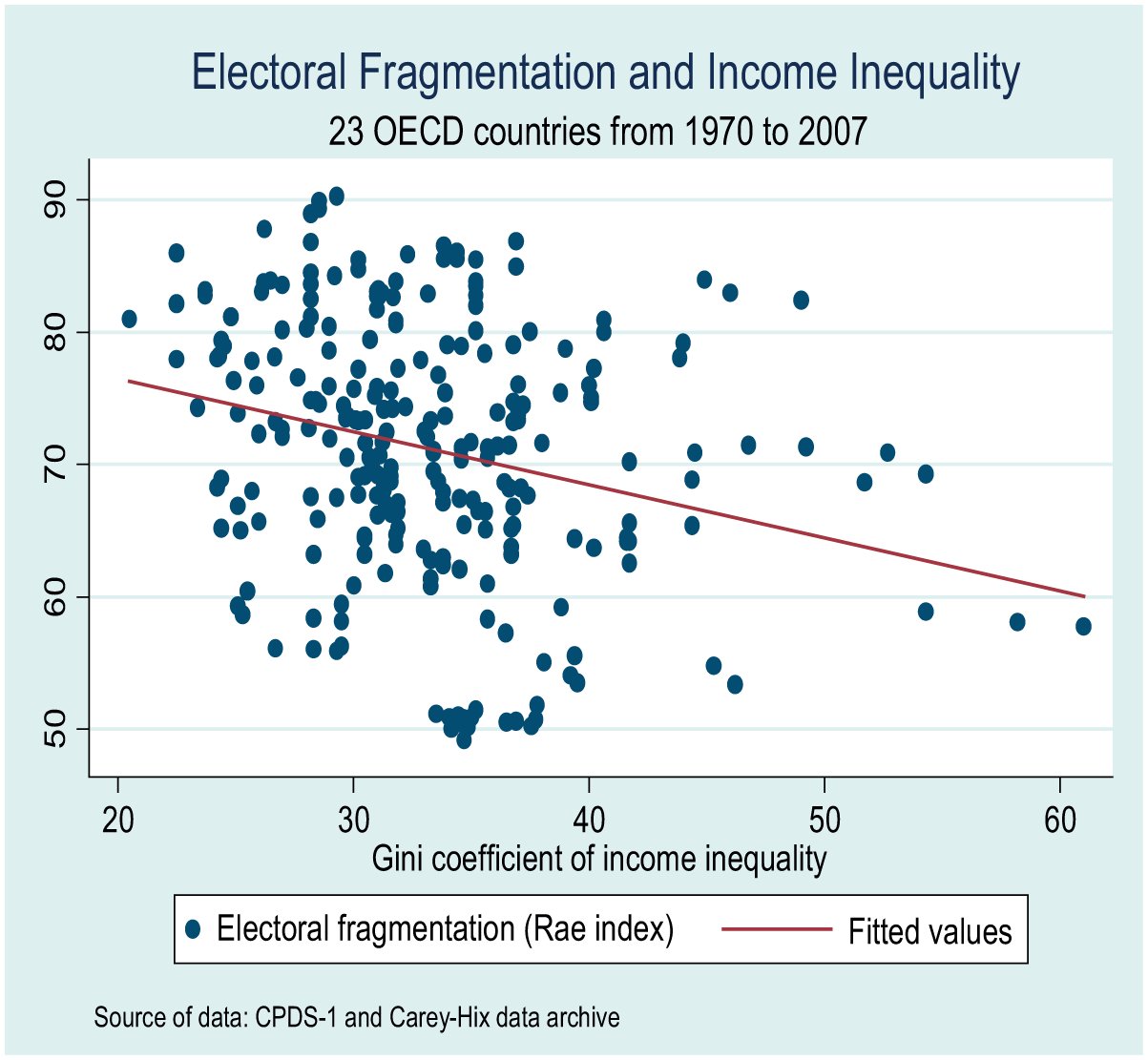
The relationship between electoral fragmentation (measured by the Rae index) and income inequality (measured by the Gini coefficient) in 23 Western OECD democracies (1970-2007).
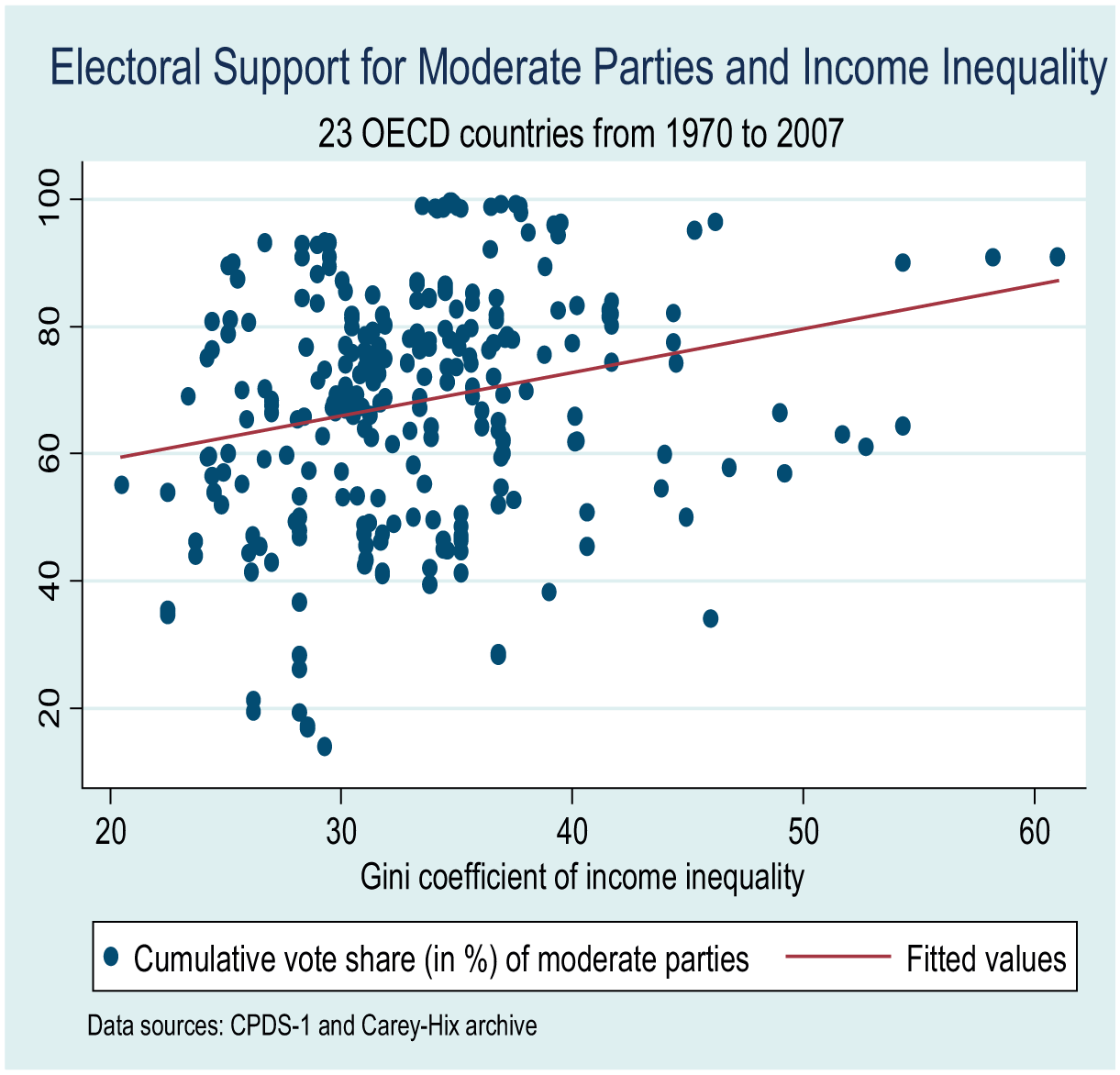
The relationship between electoral support (in %) for moderate parties and income inequality (measured by the Gini coefficient) in 23 Western OECD democracies (1970–2007).
5. Final remarks
In this paper, we have studied a model of multi-party electoral competition in two dimensions (economic policy and social ideology) where parties are differentiated. Our equilibrium analysis revealed a very strong moderates-vs-extremists result which was found to be robust to various alternative specifications considered. The political implications of our findings are twofold. On the one hand, our results highlight the fact that socially moderate parties are more likely to propose more generous redistribution and economic policies that mostly favor poor voters. On the other hand, our model provided a prediction regarding the relationship between income inequality and party-system (electoral) fragmentation that starkly contrasts the current narrative that has extremist parties benefiting the most from high income inequality. That is, our equilibrium prediction, which is not refuted by the data, suggests that it is the centrist and more moderate parties that tend to benefit from increased inequality.
The latter finding, arguably, casts a shadow of doubt to the widely accepted assertion that the recent rise of extreme right or left parties in many European countries can be attributed solely to high levels of income inequality experienced recently. This, in turn, implies that additional factors, which might have been overlooked, also can be partially responsible for the increased electoral success of such extreme parties in many recent elections across Europe. Perhaps reasons related to some intrinsic characteristics of those party systems can explain better this phenomenon instead of rising levels of income inequality. In fact, our model suggests that income inequality certainly is not the “silver bullet” when it comes to providing an explanation of this recent success of many extreme parties: if anything, our results point to the opposite direction. As a result, we are in need of alternative explanations that can account for this phenomenon.
Of course, this is not to imply that income inequality is irrelevant to this debate. Rather its importance might hinge on particular aspects of the party system such as, to name only one, the ability of opposition parties or special interest groups to place limits on taxation (e.g. Wolton, 2015). Consider, for example, the case where constitutionally inscribed fiscal rules, independent fiscal authorities or special interest groups can limit the ability of political parties to choose their desired redistributive schemes. Then it may be no longer the case that centrist parties can attract the votes of the poor by proposing generous redistribution, as was the case in our model. Ultimately, the overall effect of income inequality on the structure of the party system and the chances of electoral success of extreme parties seems to be ambiguous and, perhaps, depends on a series of other parameters as well as the structural characteristics of the party system. In light of these findings, our work calls for a better understanding of the role of special interest groups in the case of multi-party elections.
Footnotes
A. Appendix
Acknowledgements
We would like to thank the participants at various seminars at the University of Warwick, the University of Rochester, the 2013 Annual MPSA Conference, the 2013 APSA Annual Conference, and the 2010 Public Economics UK Annual Conference, for useful comments and suggestions. Konstantinos Matakos would also like to thank Bhaskar Dutta and Ben Lockwood for insightful suggestions and comments, and Torun Dewan, Sharun Mukand, Carlos Noton, Francesco Squintani, Philip Reny, Vera Troeger, Tasos Kalandrakis, John Duggan, and Michail Rousakis for useful discussions. Konstantinos Matakos gratefully acknowledges financial support from the AG Leventis Foundation. All errors remain ours.
i.
Note that our results align with the empirical regularity of niche party existence (that is, of parties that do not compete in the economic dimension) without assuming that these parties actually care about economic policy less than mainstream parties do. This observation is of independent interest since it establishes a correlation between a party’s extremity in non-economic issues and whether it is a niche party or not.
Declaration of Conflicting Interests
The author(s) declared no potential conflicts of interest with respect to the research, authorship, and/or publication of this article.
Funding
The author(s) received no financial support for the research, authorship, and/or publication of this article.