







Abstract
This paper studies the effects of cultural identity on electoral and policy outcomes when voters are “behavioral.” Building on the evidence that voters assess political or economic events through the lens of their partisan identifications, we analyze an election between two office-motivated candidates in which voters over-reward or under-punish the candidate that shares their cultural identity. Focusing on issues with cultural as well as distributional implications for voters such as immigration and the cultural divide based on nativism as the source of identity politics, we find that the candidates’ equilibrium policies are always preferred by the electorally dominant cultural group to the policy that would be optimal if policies only had distributional consequences. We also show that candidates do not necessarily target their own cultural bases in equilibrium. Furthermore, stronger identity politics increases policy polarization. Our findings contribute to the debates on the decoupling of voting behavior from economic interests, and the rise of immigration, trade protectionism, or engagement with global governing institutions as electoral issues that can shift historical voting patterns.
1. Introduction
Partisanship and identity politics are playing increasingly important roles across the politics of Western democracies. 1 Moreover, cultural identity and values are increasingly replacing more traditional lines of division such as income as the bases on which partisanship and identity politics are defined. For instance, in a recent survey of political values among American voters, the Pew Research Center (2017) found record gaps between Democrats and Republicans in their attitudes toward the role of government in helping the poor, immigration, or the value of diplomacy in conducting foreign affairs, while demographic gaps have remained more or less constant.
Evidence suggests that voters assess political and economic events through the lens of their partisan identities. 2 In this paper, we study the effects of cultural identity politics on electoral and policy outcomes when voters judge candidates’ policy platforms subjectively. We demonstrate how candidates can take advantage of the cultural divisions in the electorate through strategic policy choices. As a theoretical contribution, we introduce such “behavioral” voters to an otherwise-standard Downsian model to generate equilibrium policy divergence and novel results on voter targeting.
In their seminal book, Campbell et al. (1960) state that “identification with a party raises a perpetual screen through which the individual tends to see what is favorable to his partisan orientation. The stronger the party bond, the more exaggerated the process of selection and perceptual distortion will be.” Experimental evidence such as in Chen and Li (2009) supports this view, indicating that individuals are more likely to reward and less likely to punish another individual they share a group identity with. However, even though growing identity politics is a widely documented phenomenon, the policy implications of voters’ identity-based assessments of candidates have received scant attention within a theoretical setting. Given the evolving nature of partisanship toward identity politics and its influence on voting behavior as summarized in Figure 1, this constitutes our focus in this paper.

Identity politics and voting behavior.
We consider issues with cultural as well as distributional consequences in order to illustrate the role cultural identity plays in voting behavior and policy-making. Examples of such issues include immigration, trade protectionism, foreign aid, acceptance of refugees, or engagement with supranational institutions such as the United Nations. These issues increasingly define partisanship, as evidenced by, for instance, a Pew Research Center survey that had reported in 1994 that
The model features two office-motivated candidates who compete for the support of a culturally divided electorate. Each candidate has a fixed characteristic that represents her core ideology (reflecting her preference for, for instance, welfare programs or gun control), is defined by a cultural identity that is either open or nativist, and strategically chooses a policy to maximize her vote share. As explained previously, this policy can represent restrictions on immigration, trade protectionism, foreign aid, etc. Each voter is also described by his core ideology and his cultural identity as either open or nativist, where this identity drives preferences for the cultural implications of the policy. For instance, a nativist voter would be opposed to the cultural presence of immigrants in the society. Upon observing the candidates’ core ideologies, cultural identities and policy platforms, voters vote sincerely for their preferred candidate.
The voters’ core ideologies are uniformly distributed on some interval. On the other hand, although all voters agree on their assessments of the distributional consequences of the policy, their preferences regarding its cultural aspects depend on their cultural identity. Furthermore, based on the evidence that their cultural identity-based attachments guide voters’ judgments, we let the relative weight with which voters evaluate the cultural versus the distributional aspects of a given policy depend on the candidate. This dependence takes the form of amplifying voters’ cultural utility or disutility from a given policy when it is proposed by the candidate whose exogenous identity conforms with the policy’s cultural affiliation. We make the additional assumption that a policy’s cultural affiliation is determined relative to an exogenous reference point such as the status quo or a policy based on recent historical experience.
Our behavioral voting assumption implies that a policy deemed nativist based on the reference point yields greater (lower) cultural utility to the nativist voters and greater (lower) cultural disutility to the open voters if it is proposed by the nativist (open) candidate. Likewise, an open policy yields greater (lower) cultural utility to the open voters and greater (lower) cultural disutility to the nativist voters if it is proposed by the open (nativist) candidate. For example, voters may be divided based on their cultural attitudes toward immigrants, in which case nativist voters would reward a restrictionist immigration policy more when proposed by the nativist candidate. Likewise, if voters are divided based on their nationalist stands on trade, protectionist voters may be more receptive to trade agreements if a protectionist administration leads the negotiations.
In equilibrium, candidates target the swing voters from each cultural group to maximize their vote shares. A novel implication of our model is that it is possible in equilibrium to vote against a candidate despite preferring both her core ideology and policy to the other candidate’s. Such voting behavior may be observed if the candidates’ cultural identities are sufficiently strong that the behavioral implications of cultural identity politics dominate the fundamental issues of concern to the voters. In particular, a voter may over-reward or under-punish the policy of the candidate that shares his cultural identity to such an extent that his fundamental preference for the core ideology and policy of the other candidate may no longer matter. Accordingly, our model can account for recent cross-voting electoral phenomena such as working class Obama–Trump voters or previous Labour voters supporting Brexit.
In contrast to the symmetric equilibrium of the standard Downsian model, cultural identity politics leads to policy polarization when voters are behavioral. Moreover, the equilibrium of our model features the possibility of both cross-voting and targeting of the rival’s cultural base, phenomena that most standard models cannot simultaneously capture. By incorporating identity politics into a Downsian framework, we offer a model in which two important contemporary observations related to increasing policy polarization between candidates and the weakening of existing voter alignments can simultaneously arise in equilibrium.
We find that the candidates’ equilibrium policies are always preferred by the electorally dominant cultural group to the policy that would be optimal in the absence of a cultural component to voting. 6 In other words, the electorally dominant group always succeeds in manipulating policies toward its preferred cultural direction in equilibrium, distorting them away from the unique optimum that maximizes all voters’ consumption utilities.
Our results indicate that a candidate does not necessarily target her own cultural base in equilibrium. Specifically, while it is possible that the open candidate proposes the more open and the nativist candidate proposes the more nativist policy in equilibrium, this ceases to be the case when a cultural group cuts sufficient slack to its own candidate in a way that allows her to target the opposite group. Overall, although candidates always take positions on the same side of the policy that would be optimal in the absence of a cultural component to voting, whether they lean deeper into their own base or target the opposite cultural group by exploiting their base’s partisan loyalty depends on the type of equilibrium. The relative strength of distributional versus cultural motives behind the candidates’ optimal policies guides their sorting on the policy spectrum.
We find that the candidates respond to greater cultural divisions (or more intense cultural preferences) in the electorate by increasing their targeting of the electorally dominant group. The same result is obtained if the cultural aspects of the policy gain prominence with regards to all other concerns in voting decisions. 7 Moreover, equilibrium policies move in the preferred direction of the voter group whose cultural preferences intensify relative to the other group. For instance, our model predicts more open policies in response to media coverage on successful integration programs for immigrants if this leads to deeper cultural support from the open voters and milder opposition from the nativist voters. In addition, we find that policies become more polarized as identity politics strengthens (i.e., as voters over-reward or under-punish the candidate that shares their cultural identity to a greater extent), increasing the intensity of behavioral voting.
In response to growing identity politics, our model predicts the decoupling of the candidates’ vote shares to a greater extent from their core ideologies, a traditional basis of electoral division. We argue that the saliency of culturally tinted electoral issues can transform the nature of electoral competition by offering identity politics as a way for a candidate to overcome her disadvantage due to her core ideology. For instance, a traditionally right-wing candidate in terms of economic ideology can gain vote share among left-wing voters if her cultural identity allows her to capitalize on an electoral issue such as immigration. Accordingly, our results can shed light on how cultural identity politics and behavioral voting based on it can pave the way for shifts in traditional voting patterns.
The rest of the paper is organized as follows. Following a discussion of the related literature in the next section, Section 3 describes the model, Section 4 contains the main analysis and results of the paper, and Section 5 concludes.
2. Related literature
The contributions this paper aims to make are two-fold. First, we focus on cultural divisions among voters as an increasingly important source of identity politics and analyze the policy implications. Second, we introduce identity-based assessments of candidates’ policies as a novel basis for behavioral voting.
A recent and growing literature is focused on understanding the causes and effects of political extremism and populism. Among these studies, the most closely related are those by Eguia and Giovannoni (2019), who explain extremism as a tactical investment by a party into its future ability to offer an alternative to mainstream policies, and Diermeier and Li (2019), who explain polarization as an outcome of the voters’ tendencies to respond more to policy deviations by their own party. A model of populism that also considers voters’ reference-dependent preferences is provided by Panunzi et al. (2020), who study an election between an incumbent and a riskier opponent and obtain in equilibrium that the risky opponent can put together a coalition of rich and economically disadvantaged voters by proposing lower taxes. In addition, Karakas and Mitra (2020) offer a model of how income inequality can propel support for outsider candidates. 8 In this paper, we offer an alternative take on extremism by focusing on culturally tinted electoral issues such as immigration to explain policy extremism as the strategic response of candidates to the existing cultural divisions in the electorate.
There exists a large body of literature on reconciling the convergence prediction of the classical Downsian model with the observed policy polarization in politics. In this vein, traditional models with valence in which all voters have the same preferences for the candidates’ qualitative characteristic, such as those from Ansolabehere and Snyder (2000), Groseclose (2001), Aragones and Palfrey (2002), and Schofield (2004), produce a mixed strategy equilibrium with expected policy divergence. 9 This happens as the valence-advantaged and disadvantaged candidates possess different incentives on mimicking each other’s policies. Although the candidates’ fixed core ideologies in our model constitute a valence term, each voter also has a core ideology and, ceteris paribus, prefers the candidate with a core ideology closer to his. 10 Based on our assumptions on the distribution of these core ideologies in the electorate and the candidates’ vote shares, we establish the existence of a divergent equilibrium, where this divergence ensues not in expectation owing to the candidates’ valence differences but owing to behavioral voting based on the candidates’ cultural identities in a pure strategy equilibrium.
More specifically, we build a voting model based on Lindbeck and Weibull (1987) with differentiated candidates as in Krasa and Polborn (2014) that can generate policy divergence. Krasa and Polborn (2014) study electoral competition between two office-motivated candidates that differ not only in their fixed characteristics but also in their abilities to provide a public good, while voters have both economic and social preferences. As is the case in this paper, they establish the dependence of equilibrium policies on the voters’ social as well as economic preferences. We build on this literature by introducing cultural identity as a novel source of candidate differentiation that constitutes the basis for the voters’ identity-based assessments of the candidates’ policies. Unlike valence, the candidates’ cultural identities are not additively separable from policies in the voters’ utilities in our model, affecting how voters evaluate policy platforms and consequently leading to policy divergence. 11
Dixit and Londregan (1996), who study pork-barrel spending when voters have partisan loyalties and the parties are differentiated in their targeting ability, provide a closely related model to ours. They find that each party targets the voter group it has a targeting advantage with, which we also show holds in equilibrium under certain conditions. If the parties also differ in their ability to levy taxes on different voter groups and this advantage dominates, each party taxes the voter group that they can tax more efficiently, to the benefit of other groups. In contrast, such an equilibrium in which each candidate targets the other’s core voter group (i.e., cross-targeting) does not require an additional source of candidate differentiation to obtain in our model. Specifically, we show that cultural identity politics and its behavioral voting implications are sufficient for obtaining in equilibrium observations such as cross-targeting by the candidates and cross-voting by the voters. 12
An extensive literature documents the growth in identity politics. In this paper, we study the electoral and policy implications of this trend when cultural attachments guide voting behavior. In this regard, related studies that analyze the effects of social identities include Akerlof and Kranton (2000), who apply their seminal idea to various different strategic settings, Glaeser et al. (2005) on the parties’ incentives to energize their base through policies based on religious identities, and Dickson and Scheve (2006) on identity-based appeals by candidates during campaigns. Closely related papers include those by Grossman and Helpman (2020), who study electoral competition over trade policy in an environment in which social identity trends result in changes to trade policy, and Besley and Persson (2019), who model identity politics as instigating a feedback mechanism between policies and political preferences to find that immigration policies reflect the power of nationalism in the society. 13
The behavioral focus of our model builds on a growing literature in behavioral political economy. For example, Levy and Razin (2015) analyze elections when voters fail to consider the correlation in their sources of political information and find that this cognitive bias may in fact improve information aggregation. Diermeier and Li (2017) ask whether accountability through elections is still viable when voters are forgetful and answer in the affirmative. Nunnari and Zapal (2020) provide a model in which voters focus disproportionately on policies over which the proposed options show more disagreement. To the best of the authors’ knowledge, ours is one of the first papers (along with Diermeier and Li, 2019) to study partisan evaluation of candidates’ policies as a behavioral problem.
3. The model
Two office-motivated candidates compete for the support of a continuum of voters. Each candidate has a fixed characteristic that represents her core ideology, is defined by a cultural identity, and announces a policy before the election. The candidates fully commit to implementing their policy announcements in case of their election. Based on the candidates’ core ideologies, cultural identities, and policy commitments, voters vote sincerely for their preferred candidate.
3.1. Basics
We denote the fixed core ideology of candidate
In addition, each candidate
Before the election, each candidate
Similar to the candidates, each voter
3.2. Payoffs
We focus on policies that have distributional as well as cultural consequences for the voters. For instance, although voters may perceive immigration to have an effect on their wages, it also adds new members to the society. Hence, we expect voters to evaluate an immigration policy based on both economic and cultural grounds. 16
Although voters within each cultural group have the same preferences on the cultural consequences of a candidate’s policy, they differ in how they value her core ideology. We also simplify by assuming that all voters share the same preferences on the distributional effect of the policy. 17
Accordingly, the utility that voter

where
The function
The function
We assume that voters evaluate the cultural consequences of a policy relative to a common reference point
Identity politics, which we interpret as the voters’ attachment to the candidate that shares their cultural identity, forms the basis of our behavioral assumption: the cultural utility (or disutility)
Formally, because

and

where
3.3. Discussion of the main assumptions
To reiterate, each candidate
Voters are divided based on their like or dislike of the cultural consequences of the policy, which captures their nativism or openness. The behavioral aspect of our model is due to identity politics, which implies that voters have a partisan attachment to the candidate that shares their cultural identity, and either over-reward or under-punish this candidate’s policy depending on its affiliation.
We motivate the assumption that voters assess the cultural consequences of a given policy differently depending on the candidate proposing it in two different ways. First, there exists widespread evidence that partisanship and identity influence voters’ assessments of various political and economic outcomes. For instance, Bartels (2002) and Gerber and Huber (2009) document and analyze the phenomenon that voters positively judge the state of the economy based on whether their party holds the executive branch. 19 More generally, Chen and Li (2009) demonstrate using an experiment that participants are more likely to reward and less likely to punish a member of their group respectively for good and bad behavior. In this paper, we build on the evidence that partisanship influences voting behavior and that voters’ cultural identities constitute an important source of their partisan affiliations to motivate the candidate-specific policy assessments that we assume voters perform. 20
Our second motivation is based on theories of intent. It has long been recognized that people evaluate actions by taking into account the intent and motives they perceive behind them. 21 Accordingly, we argue here that voters might consider the candidates’ perceived intentions when evaluating policies. For instance, upon observing a nativist policy proposed by an open candidate, voters may deduce that the candidate’s “heart is not in it” and not be as energized, positively or negatively, by the policy’s nativism.
Our model implies that the nativist (open) candidate has an unambiguous policy advantage with the nativist (open) voters whenever the two candidates propose the same policy, regardless of where this policy lies relative to the reference point. At the same time, even while her cultural identity shapes the relative weight with which the cultural versus the distributional aspects of her policy are evaluated, our model allows a candidate the ability to influence this weight through her policy choice.
4. Equilibrium
Equation (1) suggests that voters’ policy utility is candidate-specific. Thus, in our set-up, a voter does not necessarily vote solely based on his core ideology and therefore always for the same candidate when the two candidates propose the same policy. This is because the different degrees to which the candidates emphasize the distributional versus the cultural aspects of the same policy may result in voters switching their votes depending on the policy proposed. 22 The following remark illustrates this property that voter preferences have in our model.

As this policy becomes more open, the nativist voter’s cultural utility
In this case, what makes the nativist voter switch his vote from the open candidate
Based on this preliminary, the following section characterizes equilibrium voting behavior.
4.1. The swing voters
A swing voter of group
Given

Based on (5), we can define the function

uniquely defines the group-
To see how the nativist and open swing voters are influenced by the candidates’ different cultural identities, first suppose

for
When the candidates adopt different policies, our behavioral assumptions yield novel implications of voter behavior that are difficult to obtain using traditional models. For instance, suppose
Although each group’s swing voter is still determined by the voters’ core ideologies and policy utilities as in the standard models, the cultural components of the policy utilities here are weighted according to the candidates’ cultural identities. As described previously, this gives rise to voting behavior that might seem detached from the candidates’ core ideologies or strategic platforms, and instead driven by identity politics. This insight is the primary motivation for modeling a candidate’s non-policy characteristic (or valence)
Building on this analysis, the following section characterizes the candidates’ equilibrium policy choices.
4.2. Optimal policy platforms
We assume that the office-motivated candidates are vote share maximizers. Given the voters’ optimal voting behavior as described in the previous section, candidate

and candidate

The vote shares in (8) and (9) that the candidates maximize in equilibrium are weighted sums of support from the nativist and open voters, where a group’s weight is determined by its size (
In the following analysis, we let

so that candidate
Note that the candidates’ vote share functions as given in (8) and (9) are continuous. However, they are not differentiable at the reference point
Our first main result asserts the existence of a unique pure strategy equilibrium and provides a general description of the candidates’ equilibrium policies. 24
Proposition 1 states that a candidate’s optimal policy is more open than the policy
There are two separate forces acting on the results in Proposition 1: the first is a dominant group effect, as a result of which the equilibrium policies are biased in favor of the dominant electoral group. This is a well-known effect and is a consequence of the Lindbeck and Weibull (1987) structure of the model. More specifically, whenever the open voters dominate the nativists in terms of size and ideological density, both candidates’ optimal policies will be skewed in the open voters’ preferred cultural direction. Fundamentally, it is the presence of a cultural divide in the electorate as manifested by different cultural utility functions for open and nativist voters that gives rise to this effect.
The second force is a polarization effect, which is novel and is a consequence of identity politics. As voters perform candidate-specific policy assessments by over-rewarding or under-punishing the candidate they share a cultural identity with, candidates affect voters’ policy utilities differently on the margin, leading to an asymmetric equilibrium. This polarization effect does not exist in the basic Lindbeck–Weibull framework, where candidates face the same optimality conditions and equilibrium is symmetric. While the dominant group effect shifts both candidates’ policies in favor of the electorally dominant group, the polarization effect ensures that they choose different policies while remaining in the preferred policy side of the dominant group. To reiterate, the Lindbeck–Weibull structure is solely responsible for the dominant group effect while identity politics produces the polarization effect.
Note that the strategy profile
On the other hand, equilibrium would be symmetric (but not necessarily at the strategy profile
4.3 Targeting
The relative position of the consumption utility maximizer
The unique pure strategy equilibrium may belong to one of two classes of equilibria based on the relative positions of the policies
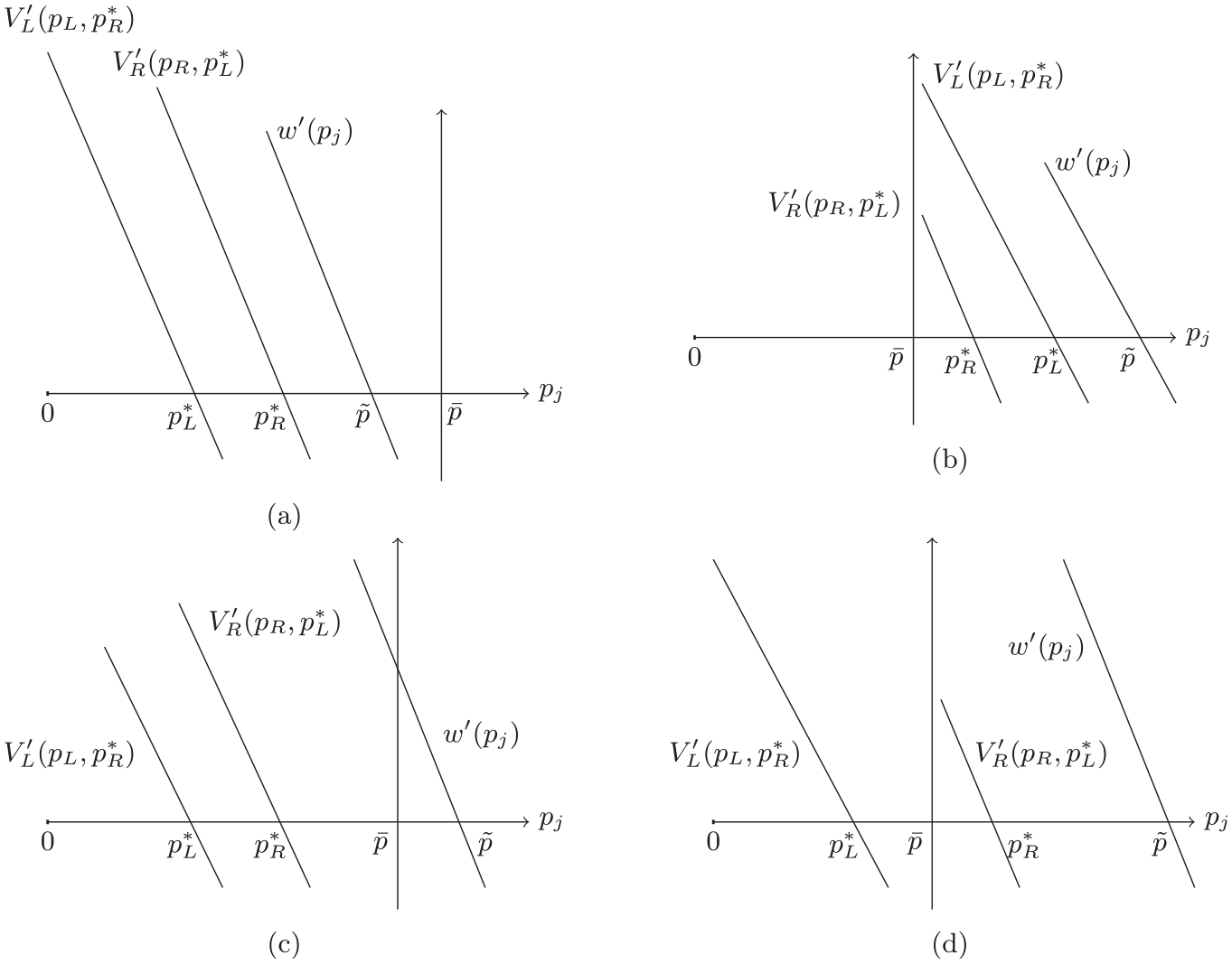
Possible equilibria when
We begin our characterization of equilibrium targeting by focusing on the first of these two classes of equilibria, which we denote a Type 1 equilibrium and illustrate in Figure 2(a) (for the case in which open voters dominate nativists). In a Type 1 equilibrium, candidates’ policies unambiguously carry the same cultural affiliation. Specifically, assuming
Proposition 2 states that the open candidate always adopts the more open policy in a Type 1 equilibrium, regardless of the ranking between the electoral importance of the two voter groups. The open candidate elevates her partisan advantage with the open voters by targeting them to a greater extent than the nativist candidate finds optimal, whereas the nativist candidate plays to her advantage with the nativist voters by proposing a less open policy.
For instance, in Figure 2(a), we have
In a Type 1 equilibrium, the divergence between the marginal cultural utilities that voters receive from candidates
We denote this second class of equilibria as Type 2 and, again assuming
If
If
Equilibrium policies
We denote the equilibrium described in part (a) of Proposition 3 in which there exists discrepancy between the electorally dominant voter group and the one that is targeted by the candidates a Type 2A equilibrium. For instance, in Figure 2(b), the equilibrium policies are between
In contrast, if
Similar to Proposition 2, part (b) of Proposition 3 indicates that the open candidate proposes the more open policy in a Type 2 equilibrium in which equilibrium policies that are more open (nativist) than
To summarize, the analysis has established that each candidate’s optimal policy lies below the policy
Note that if
4.4 Comparative statics
In this section, we explore the effects of changes to the depth of the cultural division in the electorate and the strength of identity politics on equilibrium policies and the candidates’ vote shares. Then, we relax the assumption that open and nativist voters have equally intense cultural preferences. We focus for clarity on optimal policies not at the reference point.
The following proposition focuses on the implications of a deeper cultural divide in the electorate as manifested in greater values of
Proposition 4 indicates that equilibrium policies become more open as the cultural divide in the electorate deepens whenever the open voters are electorally dominant. In the opposite scenario, candidates respond by increasing their targeting of the nativist voters through more restrictive policies. This arises as the vote share effect of the greater disutility nativist voters receive from a given policy due to more intense cultural preferences exceeds the corresponding effect of the open voters’ greater cultural utility.
Moreover, greater values of
The parameter
Next, we investigate how equilibrium policies would be affected by stronger identity politics. In our model, stronger identity politics implies voters over-rewarding or under-punishing the candidate that shares their cultural identity to an even greater extent. Technically, this trend can be captured by an increase in
Proposition 5 indicates that regardless of the ranking between the electoral importance of the two voter groups and the type of equilibrium, the distance between the equilibrium policies
More specifically, in a Type 1 or Type 2B equilibrium in which
Finally, we relax the simplifying assumption that
The shock to the parameter
Whereas the former example would be captured in our model by an increase in
Corollary 1 indicates that equilibrium policies become more open as all voters increase their appreciation of the cultural aspects of the policy, whereas they get more restrictive in response to an opposite shock. Furthermore, it states that in an equilibrium in which candidates target their own bases, the open candidate’s vote share increases as a result because she is the candidate proposing the more open policy. Intuitively, what benefits the open candidate in such an equilibrium is the elevation of her more open policy in the eyes of the voters.
Proposition 4 and Corollary 1 both summarize the conditions under which the open candidate’s vote share increases (and, consequently, the nativist candidate’s vote share decreases) in response to shocks to the cultural divide in the electorate. However, note that a candidate’s vote share is determined jointly by her core ideology and policy choice, and therefore the winning candidate depends not only on the voters’ policy evaluations but also on the distribution of core ideologies among both open and nativist voters.
5 Conclusion
This paper has studied the effects of cultural identities on candidates’ policy proposals and vote shares when voters are behavioral. Although voters care about the candidates’ core ideologies and policies, they evaluate these attributes through the lens of identity politics. Specifically, voters either over-reward or under-punish the candidate that shares their cultural identity. Focusing on policies with cultural as well as distributional consequences for the voters, and the cultural divide based on nativism as the source of identity politics, the model allowed for voting behavior ostensibly detached from the candidates’ core ideologies and policy platforms.
Our main results indicate that behavioral voting based on identity politics creates policy polarization, and stronger identity politics that translates into more intense behavioral voting exacerbates this outcome. We find that equilibrium policies are always biased in the cultural direction that the electorally dominant voter group prefers. However, we also find that candidates do not necessarily target their own cultural bases in equilibrium and that the cultural affiliation of equilibrium policies need not agree with the cultural identity of the electorally dominant group.
With a focus on demonstrating the powerful pull of identity politics, this paper provides a theoretical foundation for understanding the observed decoupling of voting behavior from traditional lines of division such as economic ideology. The results further suggest that culture-based alignments between a voter group and a candidate that propels that candidate to office may lead to the adoption of economic policies that oppose the interests of even a majority of the members of that voter group. Thus, we aim to highlight a channel through which identity politics can create an alliance between voter groups and candidates that is grounded not in economic ideology or policy interests but in behavioral traits.
Our analysis can be extended in various directions with potentially interesting results. First, although we take as given the saliency of culturally tinted policies as an election issue, it is reasonable that a candidate who would benefit from exploiting cultural divisions could take actions to influence the saliency of an issue. In other words, saliency of a policy such as immigration or protectionism as an election issue might itself be endogenous. Second, although we characterize how the saliency of issues such as immigration creates policy effects based on the existing cultural divide in the electorate, it is also possible that feedback effects may exist from policies to the voters’ cultural identities, core ideologies, or to other policy areas. Finally, we believe that adding a campaigning stage to our model during which the candidates may choose the focus of their rhetoric on the policy between its distributional and cultural aspects in order to influence the behavioral weights with which their policy proposals are evaluated would be a valuable extension.
Footnotes
Appendix
Proof of Proposition 1. Note that the candidates’ vote share functions as given in (8) and (9) are continuous. Given the strategy set
Given that
which can be written as
First, suppose
Second, suppose
Finally, if
In sum,
To see that
Based on (12), the necessary and sufficient condition for the optimality of an interior
As
Proof of Proposition 2. The necessary and sufficient condition (13) for the optimality of
for
First, consider a Type 1 equilibrium such that
Proof of Proposition 3. For part (a), first consider a Type 2 equilibrium such that
Second, consider a Type 2 equilibrium such that
The proof of part (b) is identical to the proof of Proposition 2 if
For part (c), first note that equilibrium divergence in cultural affiliation is impossible by Proposition 1 when
Proof of Proposition 4. Implicitly differentiating (13) with respect to
for
As
In a Type 1 or Type 2B equilibrium, the inequality
Proof of Proposition 5. Note that
In a Type 1 equilibrium,
In a Type 2A equilibrium, in contrast, we have
Proof of Corollary 1. In the absence of imposing
Implicitly differentiating equation (18) with respect to
for
As
and
Given
Acknowledgements
We thank the seminar participants at SUNY Binghamton, the 2018 Great Lakes Political Economy Theory Conference, the 2018 Canadian Public Economics Group Meeting, the 2019 DC Political Economy Center Research Workshop, Chinese University of Hong Kong, and the 2019 Barcelona GSE Summer Forum. In particular, we are grateful to Kristy Buzard, Wiola Dziuda, Hugo Jales, Abdul Shifa, Al Slivinski, Konstantin Sonin, and Richard Van Weelden for their detailed comments. We are also indebted to two anonymous referees and the editor John Patty for very useful suggestions.
Declaration of conflicting interests
The author(s) declared no potential conflicts of interest with respect to the research, authorship, and/or publication of this article.
Funding
The author(s) received no financial support for the research, authorship, and/or publication of this article.
