







Abstract
Judges, scholars, and commentators decry inconsistent areas of judicially created policy. This could hurt courts’ policy making efficacy, so why do judges allow it to happen? I show judicially-created policy can become inconsistent when judges explain rules in more abstract terms than they decide cases. To do so, I expand standard case-space models of judicial decision making to account for relationships between specific facts and broader doctrinal dimensions. This model of judicial decision making as a process of multi-step reasoning reveals that preference aggregation in such a context can lead to inconsistent collegial rules. I also outline a class of preference configurations on collegial courts (i.e., multi-member courts) in which this problem cannot arise. These results have implications for several areas of inquiry in judicial politics such as models of principal-agent relationships in judicial hierarchies and empirical research utilizing case facts as predictor variables.
A wide range of observers have noted particularly inconsistent rules being produced by courts across several areas of the law. For example, legal scholars complain the U.S. Supreme “Court’s numerous [federal] preemption cases follow no predictable jurisprudential or analytical pattern” (Dinh, 2000). 1 Political commentators criticize the Court’s “Establishment Clause decisions that have been, in the words of Alice in Wonderland, curiouser and curiouser,” and hope the Court will “leaven with clarity the confusion it has sown” (Will, 2019). Supreme Court Justice Clarence Thomas bemoans “an Establishment Clause jurisprudence in shambles,” claiming the Court’s “jurisprudence has confounded the lower courts and rendered the constitutionality of displays of religious imagery on government property anyone’s guess… ” (Utah Highway Patrol Assoc. v. American Atheists Inc., 565 U.S. 994 (2011) at 994, Thomas, J., dissenting).
Courts’ policies are implemented by others, from lower courts applying appellate court rules, to outside actors enforcing judicially created policies (Maltzman et al., 2000, 5). When courts’ rulings are unpredictable, and their rules are confusing, it impedes these actors’ ability to implement judicial policies. Moreover, inconsistency in legal doctrine reduces judicial legitimacy (Landa and Lax, 2009, 959). Why would courts create confusing policies that endanger judicial legitimacy and their efficacy as policymakers? Perhaps judges are free to act relatively unconstrained (e.g. Segal and Spaeth, 2002), and current court members simply prefer outcomes inconsistent with prior cases. Or perhaps courts’ decisions are well explained by pronounced rules, even when scholars and commentators believe an area of the law is in disarray (Segal, 1984). Maltzman et al. (2000) explain that bargaining over opinion content among justices may produce results inconsistent with what we might otherwise expect. However, none of these accounts explain why courts’ descriptions of their decision rules do not provide clear guidance for lower court judges and other policy enforcers.
I use a social choice theoretic model to show preference aggregation on collegial courts can result in inconsistent rules when judges communicate policy in terms of subjective criteria that depend on objective facts. 2 That is, judges often explain rules using a low number of abstract determinations that in turn are derived from specific facts of cases. I show this kind of multi-step reasoning in appellate review can result in inconsistent collegial rules.
For example, in Fourth Amendment search and seizure cases, the constitutionality of police conduct can depend on (1) the intrusiveness of the search or severity of the seizure, and (2) whether the police had the requisite level of suspicion (e.g. probable cause) required to support such conduct. The court must determine how intrusiveness and police suspicion translate into outcomes, and further use the specific facts of cases to determine the level of police suspicion: “As the Court recognizes, determinations of probable cause and reasonable suspicion involve a two-step process. First, a court must identify all of the relevant historical facts … and second, it must decide whether … those facts would give rise to a reasonable suspicion justifying a stop or probable cause to search” (Ornelas v. United States, 517 U.S. 690 (1996) at 700–701, Scalia, J., dissenting).
To make this even more concrete, consider the case Terry v. Ohio. In Terry, a police officer observed Terry and two compatriots suspiciously “casing” a store. Although he had no other information about the men, he believed a robbery was imminent, and “feared ‘they may have a gun”’, so he approached them, stopped them, and frisked them for weapons. He found weapons on Terry and one of the other men, and they were convicted of weapons charges. These concrete events that happened, and the evidence collected, are the specific facts of the case, or the “historical facts” as Justice Scalia puts it. While the Court did not find these facts amounted to probable cause, they said the evidence of criminal conduct amounted to “reasonable suspicion”. Again, though the Court did not find these facts constituted an arrest, the seizure of Terry did constitute an investigatory stop. These findings are the abstract determinations I mentioned above, which I will call doctrinal facts throughout the article. The Court announced investigatory stops may be justified by reasonable suspicion; in other words, the Court updated doctrine.
When courts engage in such multi-step reasoning, opportunity for inconsistency in the resulting collegial rules arises, even when all the judges possess well-behaved preferences. The problem arises because with multiple levels of judgment or preference aggregation, judges can agree on outcomes while disagreeing on the proper justification for that outcome, so that applying the reasoning relied on by a majority coalition in any one case can be inconsistent with collegial outcomes in other cases. This source of inconsistency in the law is understudied despite related results in the literature (e.g. Kornhauser, 1992; Landa and Lax, 2009) because models have left unexplored the interaction between disagreements over doctrine and disagreements over intermediate legal determinations, or doctrinal facts. 3
This mechanism leading to doctrinal inconsistency raises implications for some areas of research in judicial politics. For example, there is a large literature that uses case facts as explanatory variables in empirical models of judicial behavior (e.g. Segal, 1984; Richards and Kritzer, 2002; Bartels and O’Geen, 2015; Epstein et al., 2018). Studies utilizing doctrinal facts may ignore that individual judges can have different determinations of their own on such doctrinal facts, while if only historical facts are used, important inconsistencies in the reasoning presented by courts can be obscured. There is also a large literature on principal-agent relationships in judicial hierarchies (e.g. Cameron et al., 1994; Westerland et al., 2010; Baker and Kornhauser, 2015). This paper raises an important question for future research of these relationships: the decision to engage in the multi-step reasoning studied here is itself a strategic decision. If the appellate court defers to trial court findings of doctrinal facts, this multi-step reasoning does not occur. (See also the appendix titled “Deference to Trial Court Findings” for discussion of situations in which appellate courts may even revisit findings on historical facts, another setting in which such multi-step reasoning can occur). For example, in the Ornelas decision quoted above, the Supreme Court resolved a circuit split over whether findings of probable cause should be reviewed de novo or with deference (in favor of de novo review), resulting in multi-step reasoning in Fourth Amendment cases. When will collegial appellate courts choose increased control over trial court agents, even with the risk of the type of doctrinal inconsistency studied here, rather than defer to agents’ findings? 4
After a short survey of the substantive literature, I provide a brief overview of related models before detailing the setup of a model that allows for courts’ multi-step reasoning. I then show why inconsistency in the law can result when appellate courts communicate policy this way, as well as when they can safely do so while maintaining clear policy; I illustrate these results with a simple Fourth Amendment example.
Causes and Consequences of Inconsistency
If an appellate court’s “jurisprudence [confounds] the lower courts” and makes the proper decision in future cases “anyone’s guess” (Utah Highway Patrol Assoc., 565 U.S. at 994, Thomas, J., dissenting), the court will be less effective as a policy maker. Such inconsistency also raises normative concerns—crafting an inconsistent doctrine leaves citizens potentially less empowered to assert their rights (since they can’t tell when they apply). Nevertheless, legal scholars highlight time and time again various doctrines that have grown inconsistent, from death penalty jurisprudence (Robinson and Simon, 2006) to First Amendment jurisprudence (Post, 1995) to federalism jurisprudence (Drahozal, 2004).
Empirical work has well documented the effects of unclear doctrine on courts’ policy-making efficacy. Spriggs (1996) argues administrative agencies will be more likely to follow Supreme Court opinions that offer clearer guidance, and finds evidence that agencies more closely follow opinions that were more specific and explicit. Westerland et al. (2010) hypothesize that unclear signals from the U.S. Supreme Court will lead to lower compliance by the appellate courts, finding an increased number of concurrences indeed reliably correlated with lower compliance.
Empirical work has also uncovered some causes of inconsistency or complexity in judicial behavior. Collins (2008) finds individual justices’ choices are more variable in complex cases. Owens and Wedeking (2011) use text analysis methods to measure the cognitive complexity of court decisions, 5 finding, for example, that some justices provide clearer guidance in their opinion than others on average, and that majority opinions are less clear than dissents, perhaps due to the bargaining entailed in crafting a binding precedent (1032–1033; Maltzman et al., 2000).
Related theoretical work includes the discovery of the “doctrinal paradox” (Kornhauser, 1992) and its extension (Landa and Lax, 2009), 6 as well as work on rules vs. standards (e.g. Clark, 2016; Lax, 2012). The doctrinal paradox shows that outcomes depend on whether judges on collegial courts decide cases by majority vote over outcomes or by majority vote over intermediate determinations, such as whether police had probable cause. Interestingly, Kornhauser (1992, 447) explicitly envisions the cases as coming from a fact space that the judges must then map to these intermediate conclusions, but does not model how the judges make these intermediate determinations; accounting for this step in judicial reasoning is one of the principal technical contributions of this article.
However, Kornhauser (1992) assumes legal rules are fixed, while appellate courts themselves create legal rules. So Landa and Lax (2009) instead assume the intermediate conclusions are fixed, but allow each judge on a collegial court to have their own preferred legal rule. With this setup, the paradox that arises is that the rule implied for the court is different if the judges directly vote over rules or vote over outcomes in cases. Additionally, “it might not be possible to form the same type of rule for a court as a whole as any individual judge might have. That is, to the extent that individual rules are each representative of coherent legal philosophies, it may not be possible to construct a similarly principled collegial doctrine” (949). This captures a type of legal incoherence, and I build on these two models to additionally capture uncertainty, or the type of incoherent policy that renders the proper decision in a case “anyone’s guess” as Justice Thomas complained.
The rules vs. standards literature tackles a separate but related issue to the doctrinal inconsistency I study. These studies seek to explain when judges will issue specific policies and when they will use vague policy. For example, Staton and Vanberg (2008) shows courts may use vague rules to prevent observed noncompliance with rulings by ideologically divergent governments or to allow leeway to governments that are ideologically aligned with the court.
Most on point for the present article in this vein are Clark (2016) and Lax (2012). Clark studies the trade-off between an opinion that clearly disposes of cases closely related to the present case and an opinion that is less precise but has more impact on dissimilar cases. Clark finds judges will be more precise when the instant case is most representative of potential disputes and when they anticipate being able to issue additional clarifying rulings in the future. This analysis starts from the important point that judges generally cannot specify a complete mapping from cases to outcomes in a single opinion. The import of Proposition 2 below, detailing the general susceptibility of doctrine to inconsistency, involves this issue; inconsistency has real bite precisely when judges cannot perfectly map every potential future dispute to an outcome.
Lax (2012) considers the ability of an appellate court to promulgate a bright-line rule that depends only on an objective fact, or a standard based also on a subjective dimension such as severity of the weather. In this context, we may say bright-line rules are specific or precise, whereas standards based on a subjective dimension are less precise, either because the Court cannot perfectly observe the subjective dimension or because it is difficult to specify doctrinal requirements on that dimension. In the first case, standards are preferred despite their vagueness when the ability to observe the subjective dimension is relatively higher, or there is lower risk of ideologically opposed lower courts. In the second, standards can be attractive despite imprecision if the weight placed on the subjective dimension in the Court’s preferences is high enough, or if the cost of writing more precise opinions is low enough. This provides a nuanced account of incentives to rely on potentially vague doctrine, but again, does not wrestle with inconsistency in doctrine.
Evidence exists that courts’ policy-making efficacy depends on legal clarity, and normatively we may expect courts to consistently interpret legal rights. Empirical work has uncovered some correlates of lack of clarity in the law, and theoretical work has shown conditions under which judges may choose vagueness over precision and clarity. I extend models of case-based adjudication (Kornhauser, 1992) and rulemaking (Lax, 2007) to show an explanation for inconsistent doctrine embedded in legal reasoning: Judges generally engage in multiple steps of judgment aggregation, and this multi-step reasoning provides more opportunity for inconsistency in aggregation than previous models have accounted for.
Rule Making on Collegial Courts
I use a case space model to study rule making on collegial courts (Lax 2011). A case space model considers the set of all possible cases, or factual scenarios, a court could be presented with, and represents judicial policy as dividing that space into outcomes. That is, the set of possible cases is divided into two sets: the set of cases where plaintiffs win and the set of cases where defendants win; or, the set of cases where government activity is permissible, and the set where it is unconstitutional.
In a traditional case space model, the court is presented with a case
I will use as a running example the constitutionality of a seizure of a person—an investigatory stop or an arrest—under the Fourth Amendment. 9 The Fourth Amendment to the U.S. Constitution provides the “right of the people to be secure … against unreasonable searches and seizures, shall not be violated…” (U.S. Const. Amend. IV). However, courts “must evaluate the reasonableness of a particular search or seizure in light of the particular circumstances” (Terry v. Ohio, 392 U.S. 1 (1968) at 21). For example, while arrests require probable cause, investigatory stops are less intrusive seizures that require only “reasonable suspicion” (Terry).
So, we might think of the case space dimensions as the doctrinal concerns of the level of police suspicion and severity of the seizure; an example of a rule in such a space is depicted in Figure 1a. In this example, there are some seizures so severe they could never be found constitutional, some circumstances under which there is so little evidence of criminality that no seizure could be constitutional, but as long as the seizure is sufficiently not severe and the police have sufficient certainty that criminal conduct has occurred, the judge will find the seizure was constitutional.
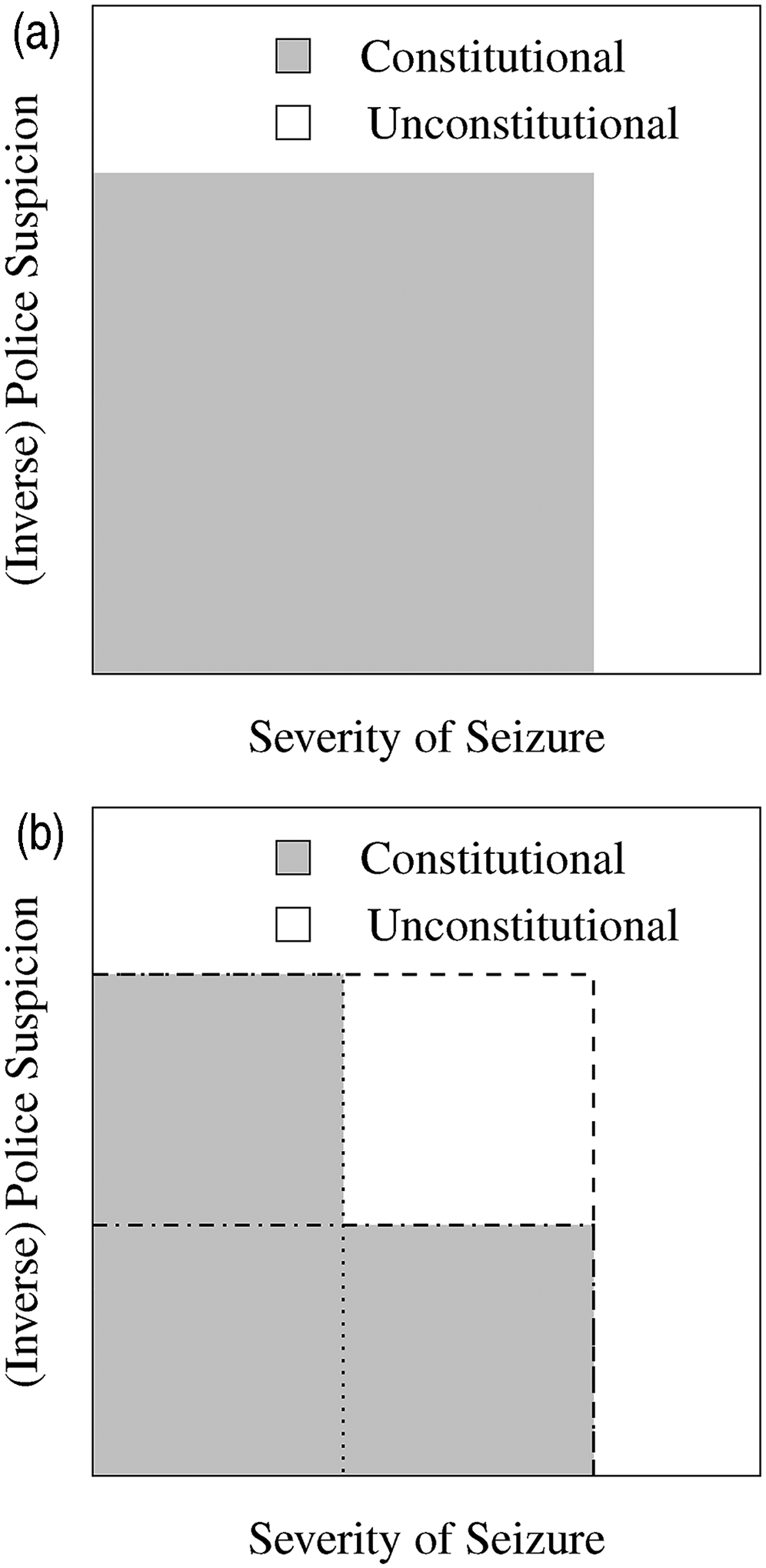
An example individual rule and ICR for Fourth Amendment police seizure cases. The case space is comprised of two dimensions: severity of the police seizure, where larger values indicate a more intrusive seizure, and inverse police suspicion, where larger values indicate less certainty that criminal conduct has occurred.
Judges on collegial courts decide cases by majority rule over dispositions. The implicit collegial rule, or ICR, is the mapping between cases and outcomes that results from these majority votes over outcomes (Lax, 2007, 595). In other words, the ICR represents “the law.” 10 An example of a three judge panel’s individual preferences and the resulting ICR is depicted in Figure 1b. In this case the judges’ preferences aggregate to an ICR in which for the lowest range of police suspicion, no seizure is warranted, for a moderate range of police suspicion low levels of seizure are permissible, and at the highest range of police suspicion a much broader range of seizures are found constitutional.
Case space dimensions that capture high level doctrinal concerns are generated from historical facts, as Justice Scalia discusses in the Ornelas exerpt quoted in the introduction. As Lax (2007) explains, “in equal protection cases … the dimensions might include (1) how ‘suspect’ the class invoked is … (2) how compelling the state interest is … and (3) how necessary the classification is …Ȯr, these dimensions could be broken down further” (594). While the technology of traditional case space models can be used to model decisions based on historical facts, doctrinal concerns, or both, it lacks the ability to model the relationship between doctrinal concerns and the dimension of historical facts they are derived from. Abstracting away from this relationship is useful for analyzing other aspects of judicial decision making. However, to understand why outside observers are confused by judicial doctrine, it will be useful to separately represent the high dimensional space of all possible historical facts and the lower dimensional doctrinal space, and the relationship between these spaces.
A legal case presented to a court can be uniquely identified by its historical facts, such as whether a person seized by the police was placed in handcuffs or not, or how long a person was detained. We will say there are
A set of judges
Unfortunately, as we will see, judges can disagree not only over doctrine, but how historical facts map onto doctrinal facts.
12
Not only could judges disagree whether a particular type of police seizure needs to be supported by probable cause or only by reasonable suspicion, but they could disagree about whether the historical facts support a finding of probable cause or not. So, we add the last moving part to the model: each judge
In sum, each judge’s preferred disposition is thus determined by
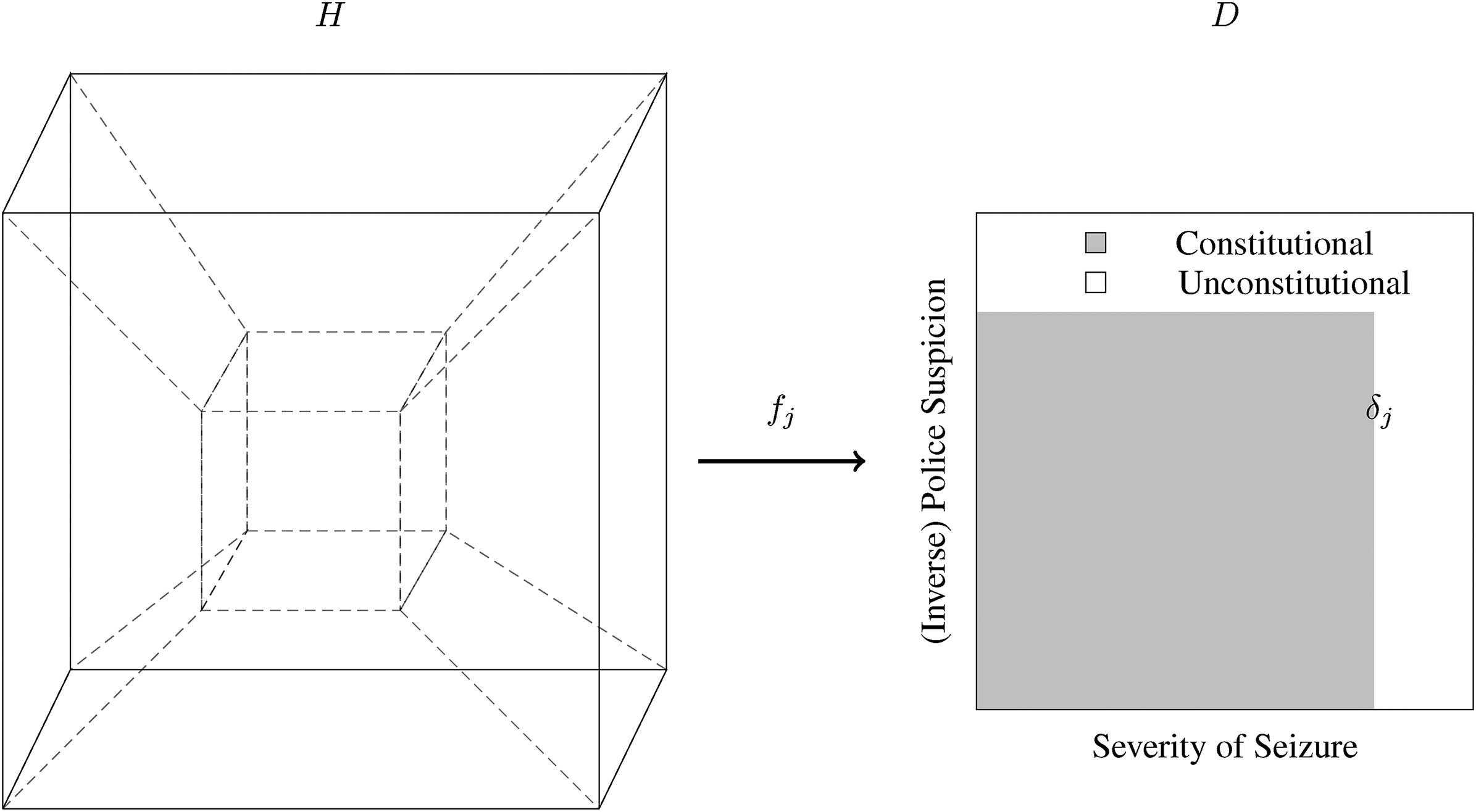
Assigning outcomes by translating a fact space to a doctrine space. A judge
Judges decide cases by majority vote over outcomes. Similarly to Landa and Lax (2009), define an outcome set as specifying the outcome (
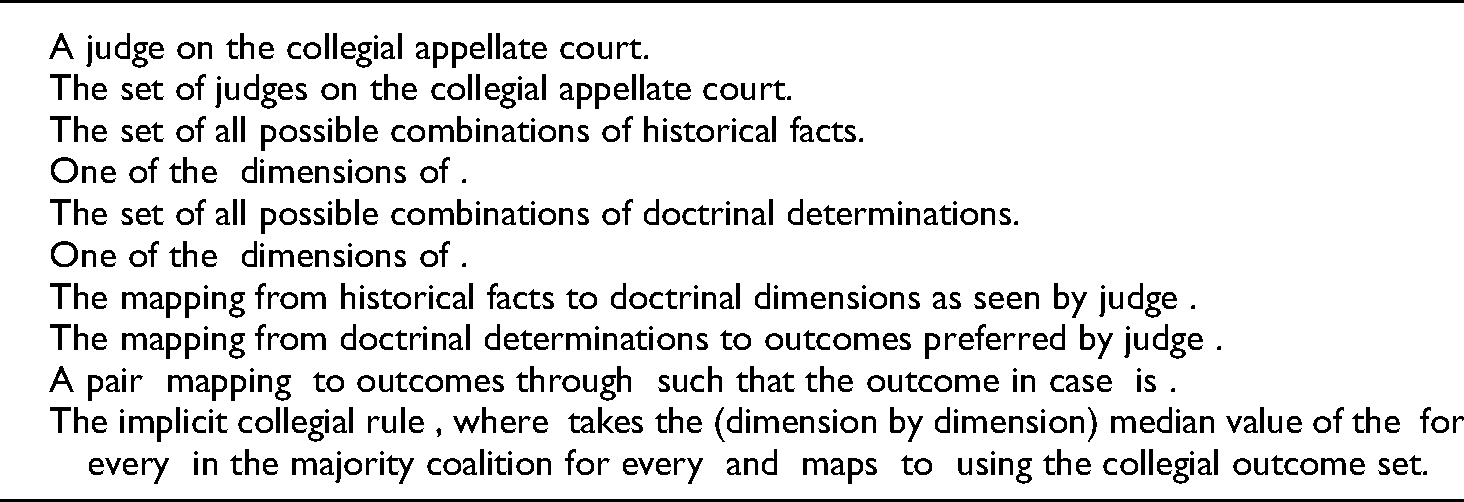
Notation Used.
Let us start with the simplest case, where the judges happen to agree on doctrine; that is,
Three types of doctrines in particular will be of interest, both because they are common types of legal doctrines and because of their aggregation properties. Call a doctrine 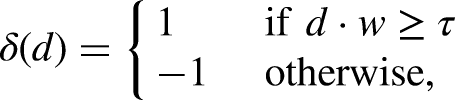
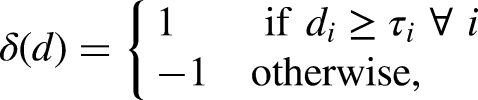
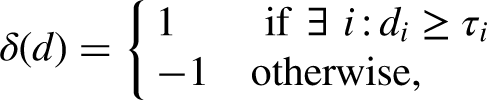
Then we can state the following:
If all
Call the situation in the first sentence of Proposition 1 a “shared balancing test.” Then let
If
The implications of Proposition 2 explain a structural reason embedded in our common law system for inconsistent doctrine. Because the judges are engaging in multi-step reasoning to determine case outcomes, in general the court’s opinions taken as a whole can be inconsistent in the sense that doctrine is not monotonic in the findings of legal facts. To understand why such monotonicity is crucial, consider a situation in which we have not observed the court’s rulings in all of (the infinite number of) the potential cases, nor has the court completely revealed in its opinions
Moreover, when the revealed outcomes show
Let us make this example concrete, with
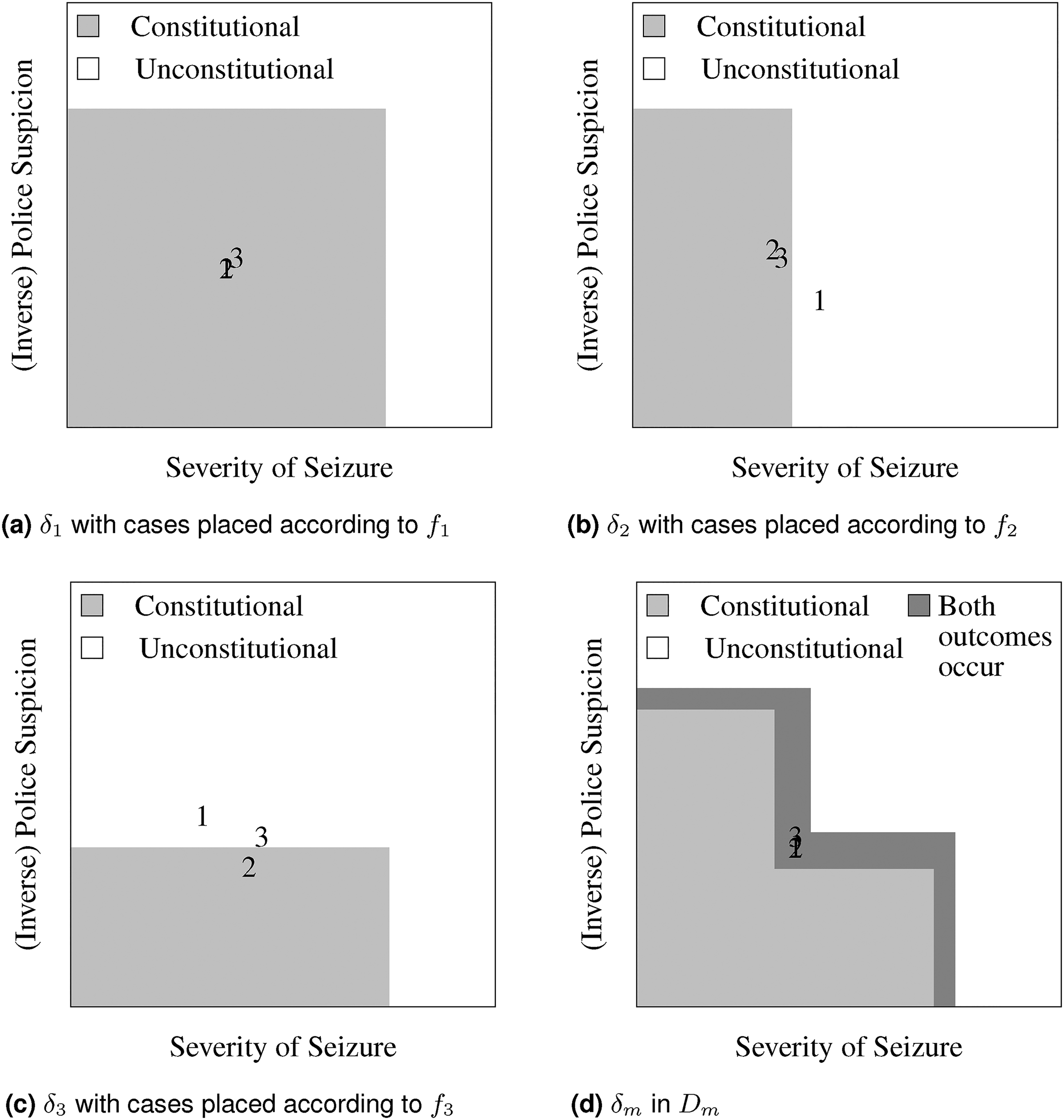
An example of an inconsistent doctrine. The doctrine space is comprised of two dimensions: severity of the police seizure, where larger values indicate a more intrusive seizure, and inverse police suspicion, where larger values indicate less certainty that criminal conduct has occurred. The judges all have preferred monotonic doctrines and monotonic fact-finding functions; the judges’ preferred rules are depicted in panels (a)–(c). However, the implicit collegial rule is inconsistent as depicted in panel (d). In each panel, the three cases from Table 3 are labeled with their identifying number.
Doctrines and fact-finding functions for the judges on the collegial court.

Example cases showing inconsistency.
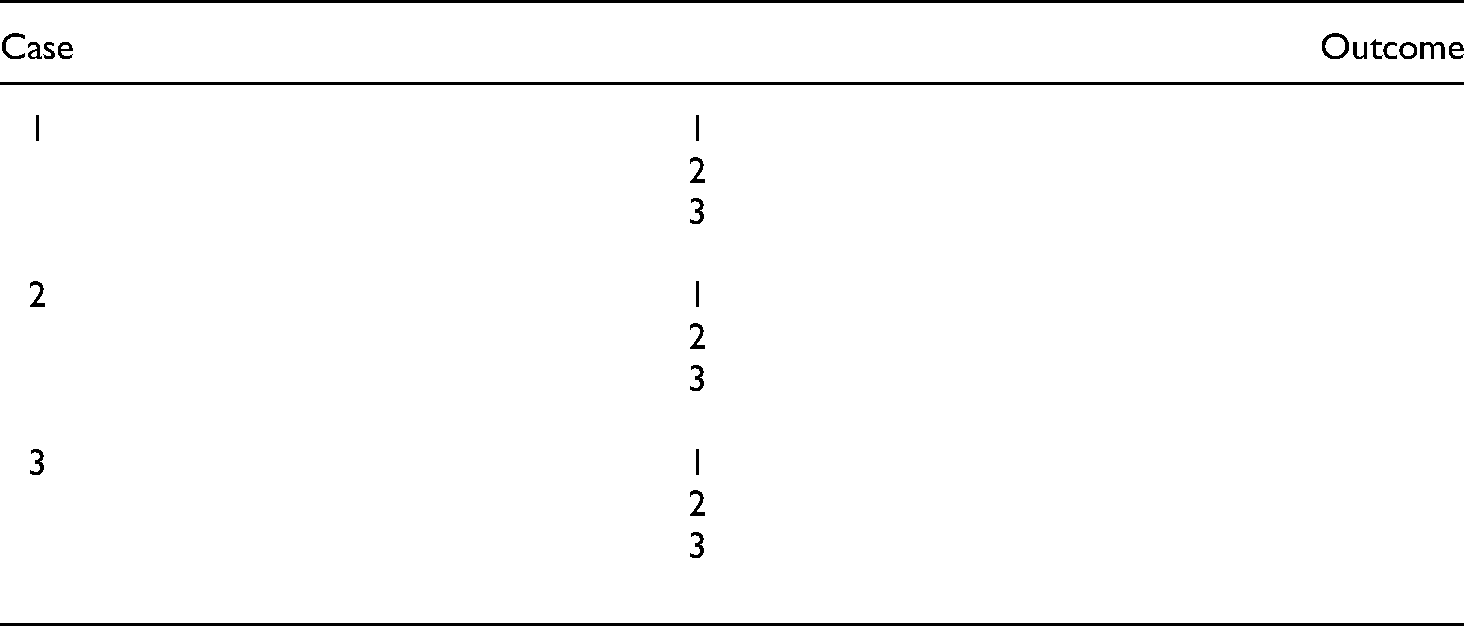
We can highlight a few specific cases to make this easier to see. Consider the cases listed in Table 3; these cases are labeled with their number in Figure 3. In case 1, both judges 2 and 3 find the case satisfies one element of their disjunctive test (though different ones), so both vote for outcome
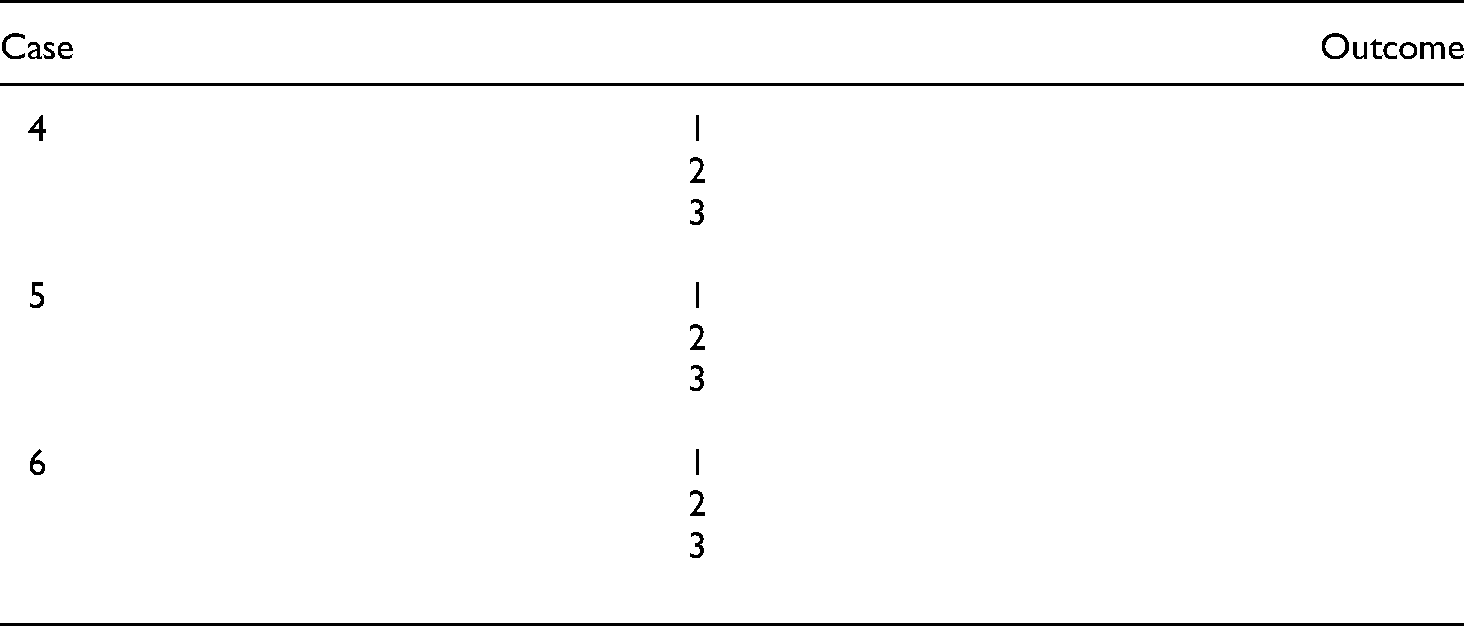
Not only is the implicit collegial rule inconsistent, the collegial outcome set is also not monotonic in any of the judges’ projection of historical facts into doctrine space, as depicted in Figure 4. Table 4 singles out three more cases for consideration, all of which are labeled in the panels of Figure 4. Cases 4 and 5 cause inconsistency under both
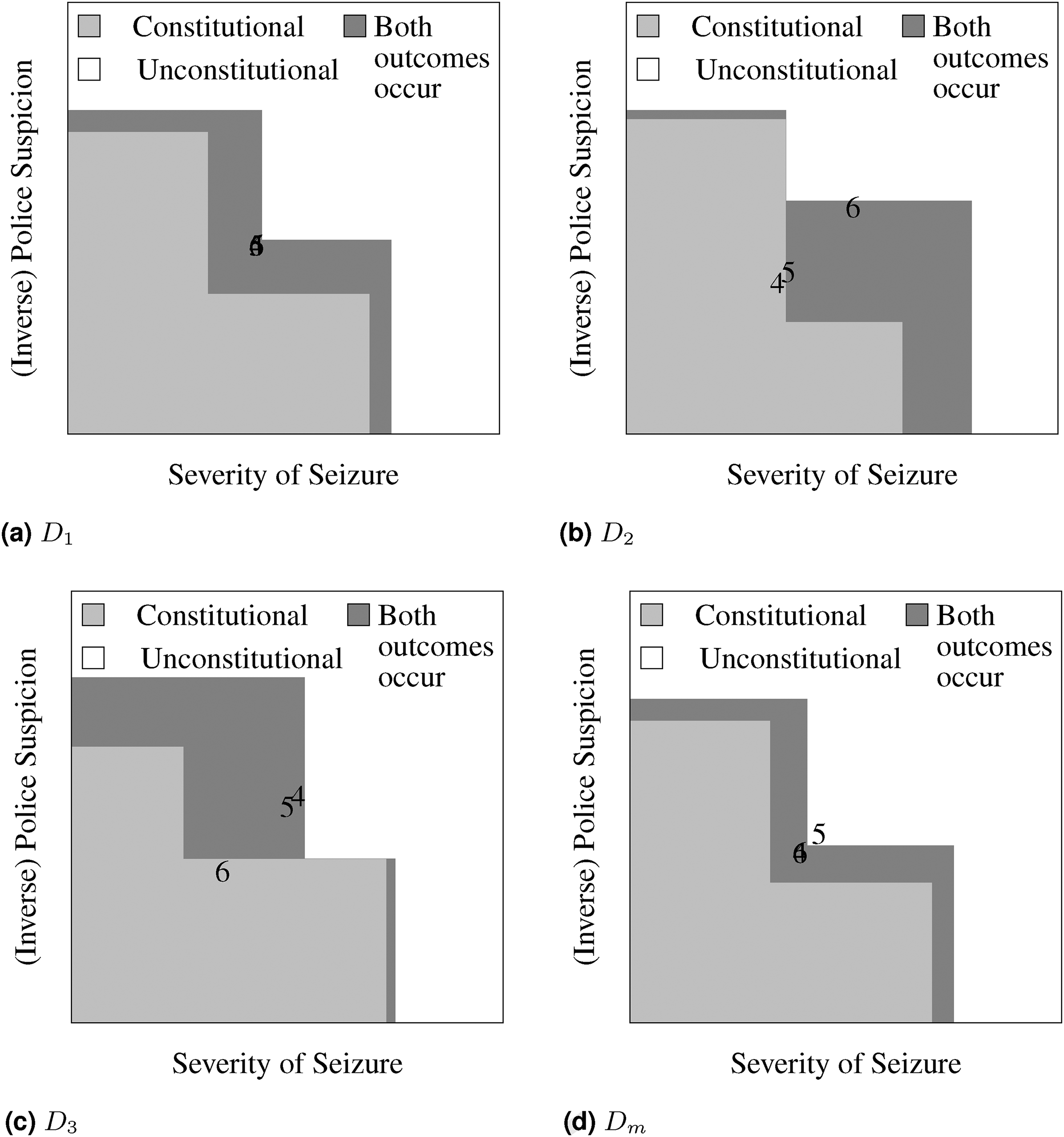
An example of an inconsistent doctrine. The doctrine space is comprised of two dimensions: severity of the police seizure, where larger values indicate a more intrusive seizure, and inverse police suspicion, where larger values indicate less certainty that criminal conduct has occurred. The judges all have preferred monotonic doctrines and monotonic fact-finding functions, but the collegial outcome set is not monotonic in any of the judges’ projection of historical facts into doctrine space, or even the projection taking the dimension-by-dimension median placement of the majority coalition in every case.
Further example cases showing inconsistency.
Of course, in this example, the structure of
In other words, judges often cannot create general doctrinal statements in terms of
Legal inconsistency is a problem, both for judges as policy makers, since agents and outside actors cannot follow or implement rules they do not understand, and for the public, who might normatively expect consistent application of legal rights. The prior literature offers explanations for inconsistency in individual judges’ choices and their preferences (e.g. Collins, 2008; Maltzman et al., 2000) or for lack of precision in doctrine (e.g. Clark, 2016; Fox and Vanberg, 2014; Lax, 2012; Staton and Vanberg, 2008). Some sources of inconsistency in doctrine have been highlighted by Lax (2007) and Landa and Lax (2008, 2009); by expanding on such case-space models to account for judges’ multi-step reasoning, I highlight a new source of legal inconsistency. When we allow for disagreement over both how historical facts should be aggregated to doctrinal dimensions and how the doctrine space should be partitioned into outcomes, the resulting judgment and preference aggregation among judges displays inconsistency even under strict assumptions about how well-behaved the individual judgments and preferences are. The general presence of the danger of this inconsistency explains why so often, courts’ doctrines become inconsistent (Drahozal, 2004; Post, 1995; Robinson and Simon, 2006; Will, 2019).
This model also raises implications for other areas of judicial politics research. Related to research on the principal-agent relationship between appellate courts and trial courts, when will collegial appellate courts defer to lower court agents’ placement of cases in dotrine space to avoid this source of inconsistency on doctrine, and when will they exert more control despite the danger of doctrinal inconsistency shown in this article? For empirical research that uses case facts as explanatory variables, care should be used to recognize that individual judges can have different determinations of their own on such doctrinal facts, and if only historical facts are used, important inconsistencies in the reasoning presented by courts may be obscured.
Footnotes
Acknowledgements
I would like to thank Randall Calvert, Keith Schnakenberg, Jim Spriggs, Lee Epstein, Morgan Hazelton, Jordan Carr Peterson, and the anonymous reviewers for their helpful comments. A previous version of this paper was presented at the 2019 Annual Meeting of the Midwest Political Science Association.
Declaration of conflicting interests
The author(s) declared no potential conflicts of interest with respect to the research, authorship and/or publication of this article.
Funding
The author(s) received no financial support for the research, authorship and/or publication of this article.
