






Abstract
This article integrates two strands of game-theoretical literature, one on delegated bargaining and the other on compliance, to explain the failure of the two key military dispute-settlement agreements between Russia and Ukraine. While both strands of literature analyze principal–agent problems, they reach contrasting conclusions about the role of transparency and the public’s role in securing agreements and ensuring compliance. We reconcile these perspectives by distinguishing analytically between agreement and compliance efficiency. Although closed-door delegated bargaining can improve the efficiency of reaching an agreement, we demonstrate that the efficiency of compliance hinges crucially on the level of public trust in the delegate. This implies that public mistrust of Ukraine’s delegate in the Minsk negotiations undermined compliance with the two Minsk agreements. Nonetheless, our simulation results also show that effective compliance is still attainable: even an agreement with only moderate efficiency can be upheld provided that public trust in the delegate is not too low.
Introduction
Following Russia’s annexation of Crimea in March 2014, the eastern Ukrainian regions of Donetsk and Luhansk became the epicenter of a military conflict between pro-Russian and Ukrainian forces (Atland, 2020; Wittke, 2019). Amid escalating hostilities, an informal meeting was convened in June 2014 during the 70th anniversary of the D-Day celebrations, involving representatives from France, Germany, Russia, and Ukraine. This meeting established the Trilateral Contact Group for military conflict resolution, meeting in multiple rounds of closed-door delegated bargaining. 1 The secret negotiations culminated in the signing of two Minsk military dispute-settlement agreements in September 2014 and February 2015. 2 Despite provisions for a ceasefire and the withdrawal of heavy weapons from the front line, pro-Russian forces continued to attack the Ukrainian-held city of Debaltseve, forcing Ukrainian troops to withdraw. The situation deteriorated further when Ukraine failed to implement agreed-upon constitutional reforms that would have granted self-governance to Donetsk and Luhansk. These failures, alongside mounting military tensions, ultimately escalated into Russia’s so-called “special military operation” against Ukraine in February 2022.
After the two Minsk dispute-settlement agreements failed, the escalating military conflict raises pressing questions about bargaining over an agreement that both sides will comply with. Although scholarship on bargaining and compliance has made substantial theoretical advances (e.g., Allee and Huth, 2006; Chaudoin, 2014; Dai, 2002, 2005; Fearon, 1995; König and Mäder, 2014; Martin and Simmons, 1998; Meade and Stasavage, 2008; Morse and Pratt, 2022; Stasavage, 2004, 2007), these works adopt contrasting views on transparency and the role of the public. Bargaining models identify a trade-off between rigidity and stability in the design of dispute-settlement agreements (Fearon, 1998; Rosendorff, 2005), and the work of Stasavage (2004) predicts bargaining inefficiency when delegates engage in posturing in open-door bargaining. By contrast, compliance theories argue that transparency is essential for public oversight, which enhances compliance efficiency by deterring violations through electoral punishment for government defection (Fearon, 1994; McGillivray and Smith, 2000). This article aims to reconcile these diverging perspectives by examining how the type of bargaining procedure interacts with public trust in the delegate to generate compliance efficiency.
Confronted with an escalating military conflict with Russia, we focus on the Ukrainian side to understand the puzzling failure of the first and second Minsk military dispute-settlement agreements. Drawing on the seminal work of Stasavage (2004, 2007) on closed- versus open-door delegated bargaining, we extend the principal-agent model to investigate the conditions for compliance with the Minsk agreements in Ukraine (Dai, 2006, 2007; König and Lu, 2020). Although an informed public can enhance compliance efficiency (Carrubba, 2009; Chaudoin, 2014; Mansfield et al., 2002), it remains unclear whether this mechanism also applies to delegated bargaining over military dispute-settlement agreements, particularly when the public is highly sensitive to issues of national sovereignty and the perceived trustworthiness of its bargaining delegate (Fang, 2008, 2010). To address this question, we specify agreement and compliance payoffs for different types of delegates, where the compliance payoff increases with the degree to which the public views the delegate as unbiased.
Our analysis of the two Minsk military dispute-settlement agreements, which were concluded after several secret rounds of closed-door delegated bargaining, examines the conditions that shape compliance with such agreements. Beyond well-established explanations emphasizing bureaucratic capacity (e.g., Chayes and Chayes, 1995; Mbaye, 2001; Mitchell, 1994; Tallberg, 2002; Young, 1979), sanctioning mechanisms (e.g., Downs et al., 1996; Fearon, 1998), and the influence of other states and international organizations (McAllister and Schnakenberg, 2022; Tingley and Tomz, 2022), we show that compliance is also critically shaped by the procedural interaction between the delegate and the public, and a minimum level of public trust in the delegate is essential for compliance to occur. Unlike Stasavage (2004), who highlights the heightened failure risk through public posturing of the delegate in open-door bargaining, our analysis underscores how public concerns about Ukraine’s delegate in closed-door delegated bargaining—Leonid Kuchma, a former Ukrainian president who politically survived several votes of no confidence initiated by opposition parties in the early 2000s (Wittke, 2019)—undermined prospects for compliance.
Our model demonstrates the conditionality of public support for dispute-settlement agreements, reinforcing insights from political economy models of compliance (e.g., Dai, 2002, 2005, 2006, 2007; Hollyer and Rosendorff, 2011; Mansfield et al., 2002; Milner and Rosendorff, 1996, 1997). Our first proposition holds that the conditional probability of compliance with the two Minsk agreements was higher under closed- than open-door delegated bargaining. This result is consistent with empirical research identifying multiple advantages of closed-door delegated bargaining, which enhances bargaining efficiency and flexibility (Brandsma and Meijer, 2022; Finel and Lord, 1999; Hafner-Burton et al., 2016; Hafner-Burton and Victor, 2016; Leino, 2017), reduces incentives for public posturing (Prat, 2005; Stasavage, 2004), encourages the expression of dissenting views (Meade and Stasavage, 2008), minimizes risks of public misinterpretation (Florini, 1998), helps resolve the “disclosure dilemma” (Carnegie and Carson, 2018, 2019, 2020), decreases uncertainty (Keohane, 1984), preserves institutional norms (Busch and Pelc, 2010; Busch and Reinhardt, 2006), protects national security (Thompson, 1999), improves deliberative quality (Naurin, 2007), and limits the influence of private interests (Carnegie, 2021), among others.
Our second proposition demonstrates that the advantages of closed-door delegated bargaining are conditional on public trust in Ukraine’s delegate at a time when the country was transitioning toward democracy. The likelihood of compliance diminishes when the procedural costs generated by public mistrust outweigh the efficiency and disclosure benefits associated with closed-door delegated bargaining (Buchanan and Keohane, 2006; Carnegie and Carson, 2018, 2019; Gibbs, 1995; Tallberg et al., 2013). We argue that this dynamic was particularly salient in Ukraine’s context, where concerns over national sovereignty and the delegate’s credibility were especially pronounced. In line with existing empirical research on compliance (e.g., Cheibub et al., 2010; Chiba et al., 2015; Dai, 2005; Leeds, 1999, 2003; McAllister and Schnakenberg, 2022; Simmons, 2009; Tingley and Tomz, 2022), we conclude that public mistrust was decisive for Ukraine’s adherence to the Minsk agreements, thereby illustrating the tension between the procedural demands of compliance and the expectations of democratic accountability.
In the remainder of the article, we revisit the framework of Stasavage (2004) on open- versus closed-door delegated bargaining and extend it to the study of compliance with dispute-settlement agreements. Our extension differentiates the compliance payoffs associated with distinct types of delegates in order to specify the conditions under which compliance is likely. We proceed by outlining our theoretical arguments and propositions, followed by an exploration of their empirical implications through simulation. We show that higher compliance likelihood is associated with fewer concessions and stronger public perceptions of the delegate’s trustworthiness. Finally, we discuss broader implications for the future of compliance, both in the unresolved military conflict between Russia and Ukraine and in comparative research on how bargaining procedures shape compliance with international agreements. Note that we use the Minsk case as an illustrative application of the model’s mechanism rather than as a direct test.
Bargaining agreement with(out) compliance
Research on war-to-peace transitions identifies numerous obstacles to achieving durable peace, including diverging interests (Jarstad and Sisk, 2008), organizational inertia (Stedman et al., 2002), weak enforcement (Walter, 1997), failed external guarantees (Paris, 2004; Walter, 2002), and ineffective monitoring (Hampson, 1996). A central theme in this literature is the credible commitment problem inherent in international agreements: warring parties have strong incentives to renege during the transition from war to peace because each side can profit from exploiting the opponent’s temporary vulnerability (Bekoe, 2008). This dynamic is often conceptualized as a prisoner’s dilemma, in which mutual compliance is collectively optimal but individually risky (Fortna, 2004; Werner and Yuen, 2005).
In her comprehensive analysis of civil war settlements, Walter (2002) shows that resolving the underlying issues is insufficient for successful negotiations. Peace agreements endure only when parties can establish credible guarantees for the terms of the settlement, typically involving third-party security assurances and robust enforcement mechanisms. Likewise, Hartzell and Hoddie (2007) argue that power-sharing institutions, whether territorial, political, military, or economic, function as critical commitment devices that reassure former adversaries and enhance the durability of peace. Fortna (2004) further demonstrates that the design and content of cease-fire and peace agreements, along with the presence and configuration of peacekeeping missions, substantially influence the likelihood that peace will endure.
Our analysis complements this literature by shifting the focus from the design of post-conflict institutions to the procedural and informational conditions under which agreements are bargained and perceived. Whereas existing research highlights how the design of power-sharing arrangements, third-party guarantees, and peacekeeping missions mitigate credible commitment problems at the interstate or inter-party level, we underscore the role of delegation and transparency for public trust in shaping compliance. In our model, the distinction between open- and closed-door delegated bargaining affects how domestic audiences update their beliefs about whether their delegate is biased or unbiased. These shifts in the public’s belief influence the perceived legitimacy of the agreement and public support for compliance. Thus, while the substantive terms of a settlement matter for the durability of peace (Fortna, 2004), we argue that procedural information about how these terms are negotiated is also crucial for understanding variation in compliance.
We use the Minsk dispute-settlement bargaining to illustrate this mechanism, focusing on how the interaction of delegation and transparency shaped public trust and Ukraine’s compliance behavior. Shortly after the signing of the first Minsk agreement in September 2014—just months after Ukraine’s democratic transformation during the Maidan revolution—public concerns about a dispute-settlement agreement with Russia under President Vladimir Putin intensified. Pro-Russian forces in Donetsk and Luhansk launched an offensive against the Ukrainian-held city of Debaltseve and unilaterally held elections in November 2014, a month before the timeline mandated by Ukrainian law. Although Ukrainian grievances toward Russia were already pronounced following the annexation of Crimea in March 2014, the further military escalation raises important questions about Ukraine’s incentives for non-compliance with the two Minsk dispute-settlement agreements.
We argue that Ukraine, which was undergoing a democratic transformation, faced severe principal–agent problems between the public and its delegate. To halt the military conflict with Russia, both the delegate and the public shared the objective of reaching an agreement. Yet, widespread public concerns about the delegate’s potential drift undermined compliance with an agreement. These concerns are well documented in contemporary opinion surveys. 3 Many Ukrainians believed that the delegate had made excessive concessions to Russia in order to secure an agreement, thereby eroding public support for the two Minsk dispute settlement agreements. These dynamics help explain their failure and reflect the broader challenges Ukraine faced in sustaining public support while navigating high-stakes dispute-settlement agreements.
Delegated bargaining on dispute settlement under uncertainty
To better understand how these principal-agent problems contributed to compliance failure with the two Minsk military dispute-settlement agreements, we build on the work of Stasavage (2004, 2007), who originally examined the trade-off between transparency and agreement efficiency in open- versus closed-door delegated bargaining. We extend this framework by analyzing the interactions between delegates
To model a compromise sufficient for the approval of a dispute-settlement agreement, we consider a one-dimensional policy space
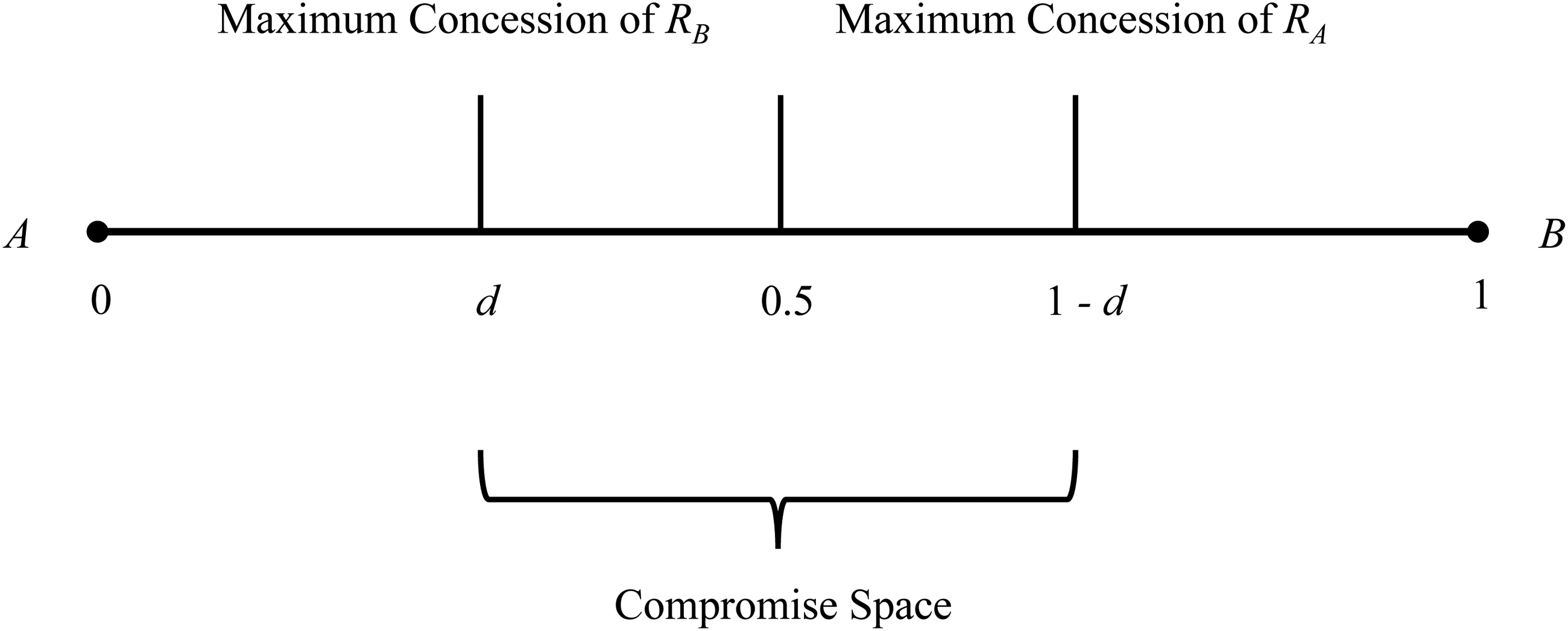
Illustration of bargaining compromise between
During the bargaining, information about the disagreement payoffs can hardly be exact; otherwise, a delegate can take advantage and offer to the other the minimal acceptable proposal, which will always be accepted (Schneider and Cederman, 1994). Following Stasavage (2004), we model this information asymmetry by introducing a private signal
The overall bargaining protocol can be summarized as follows:
Nature determines the type of The bargaining procedure (open- or closed-door) is chosen, and In open-door bargaining, both proposals If the proposal is no worse than the minimal acceptable compromise of the other side, the proposal will be accepted; otherwise, both sides receive disagreement payoffs. Depending on the type of the bargaining procedure, the public of
At the bargaining stage, A truthful strategy involves making proposals A posturing strategy of proposing A drifting strategy of proposing
The public of

In Equation (1), the probabilities
To summarize, bargaining outcomes are strongly influenced by the interaction of delegates’ strategies and by what the public can infer from the procedure in place. In open-door delegated bargaining, a trade-off emerges between transparency and agreement efficiency: greater transparency enhances belief updating but increases the risk of bargaining failure due to public posturing. In closed-door delegated bargaining, the two-level logic of compliance requires balancing bargaining efficiency with the need to maintain public trust in the delegate—an equilibrium that, when unmet, may help explain the failure of dispute-settlement agreements.
Drawing on the game-theoretical compliance literature that emphasizes the enforcing role of the public (Dai, 2005, 2007), we posit that a sufficient level of public trust
Building on the delegated bargaining model outlined above, which incorporates delegates’ strategies and types, the public’s prior belief, and the procedural mechanisms for belief updating, we extend the framework by specifying compliance payoffs for each type of delegate. As before, we distinguish between two types of
Delegate



To simplify the analysis, we initially treat
Although our primary focus is to explain, from the Ukrainian side, the puzzling failure of the two Minsk military dispute-settlement agreements negotiated through closed-door delegated bargaining, we also consider whether an alternative outcome might have been feasible under open-door procedures. Because delegates may strategically misrepresent their type to mitigate public mistrust, our equilibrium analysis differentiates between pooling equilibria (Appendix B.1) and separating equilibria (Appendix B.2), in which different types of delegates adopt either identical or distinct proposal-making strategies.
Arguments and propositions
In contrast to Stasavage (2004), we find that a pooling equilibrium with truthful proposal-making exists and can sustain compliance in open-door delegated bargaining. 10 Nevertheless, there are considerations weighing against the feasibility of open-door procedures in the context at hand. In particular, the high risk of public posturing in Ukraine’s volatile transitional period makes successful negotiations under transparency unlikely (Stasavage, 2007). Following the Maidan revolution, Arseniy Yatsenyuk became prime minister and later became associated with the People’s Front party, which accused former President Yanukovych of refusing to restore the 2004 Constitution. Yanukovych, in turn, publicly criticized the opposition for failing to relinquish occupied territories, while Yatsenyuk blamed Russia for refusing to guarantee an agreement to regulate the crisis in cooperation with the European Union. 11
A second argument emerges from our separating equilibrium analysis, in which the two delegates adopt different proposal-making strategies. In closed-door delegated bargaining where the public observes only the agreement

The conditional probability of compliance with the Minsk dispute-settlement agreements was higher in closed-door than in open-door delegated bargaining.
Our proposition underscores the efficiency advantages of closed-door delegated bargaining in reaching a compromise that does not preclude compliance. We now turn to the question of whether this relation is mediated by public trust
Because belief updating does not occur in pooling equilibria, we rely on comparative statics to examine the relationship between closed-door delegated bargaining and compliance within the separating equilibria. In particular, we focus on cases in which a closed-door solution exists—that is, when an unbiased delegate adopts a truthful strategy and a biased delegate adopts either a drifting or posturing strategy. As demonstrated in our comparative statics (see the first proof in Appendix B.3), when

The effect of closed-door delegated bargaining on compliance is mediated by public trust: it increases when public trust is high and decreases when public trust is low.
Despite the failure of the two Minsk military dispute-settlement agreements, our arguments and propositions reveal a fundamental trade-off between agreement efficiency and public trust in shaping compliance under closed-door bargaining procedures. To explore the empirical implications of this trade-off, we simulate the probability of compliance as a function of increasing agreement efficiency and varying levels of public trust. 13 We hypothesize that, in closed-door delegated bargaining, the influence of the public’s perception of the delegate’s type diminishes as agreement efficiency increases when public trust is low, but intensifies when public trust is high. For intermediate levels of trust, we expect the relationship between agreement efficiency and public perceptions of the delegate to be indeterminate.
Our simulation distinguishes among low (0.1), middle (0.5), and high (0.9) levels of public trust

Figure 2 presents the simulated results for the two separating equilibria that arise only in closed-door bargaining: a truthful proposal-making strategy by an unbiased delegate and a drifting or posturing strategy by a biased delegate. The curves plot the probability of compliance on the vertical axis against different levels of agreement efficiency on the horizontal axis, conditional on low, medium, or high levels of public trust.
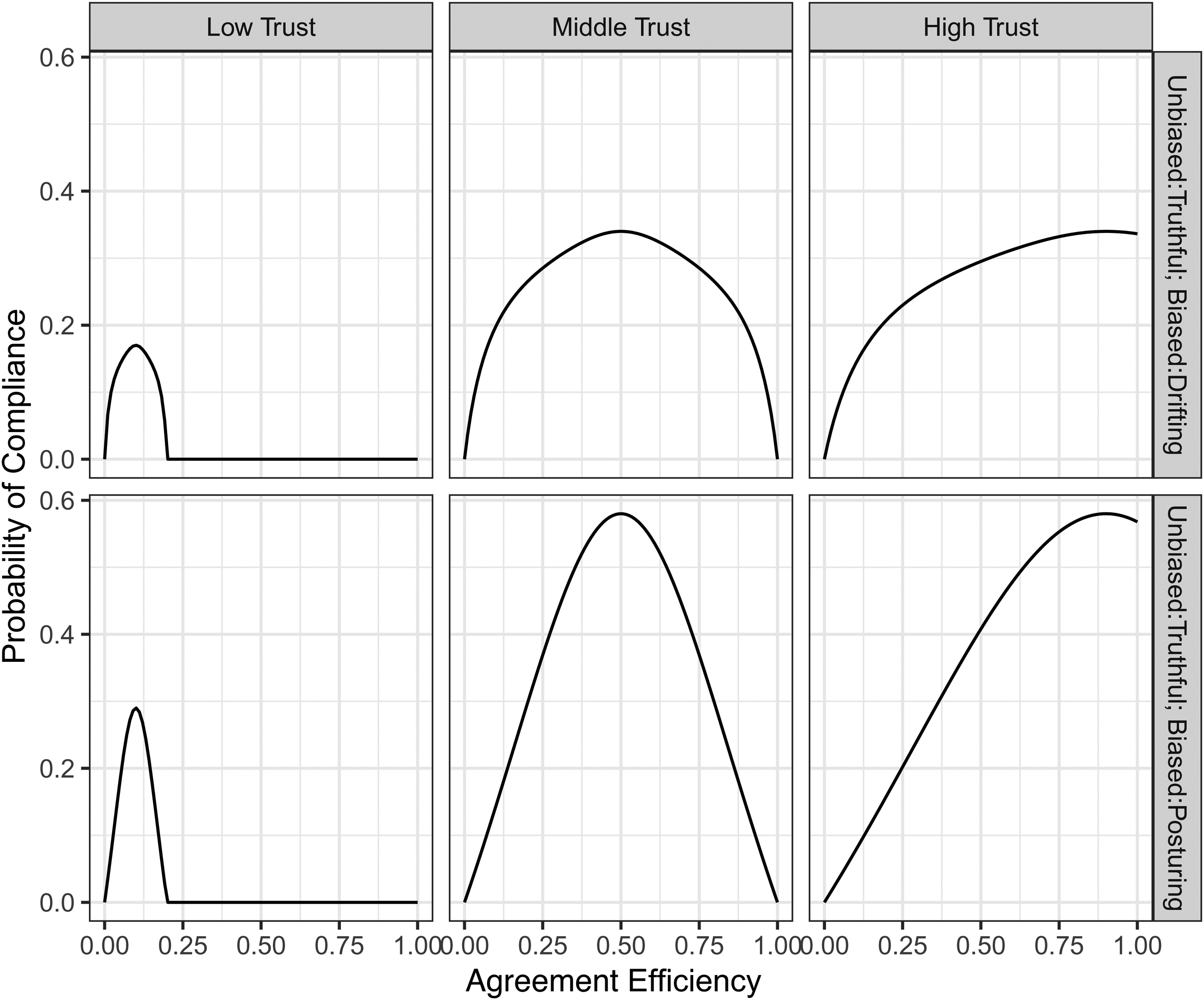
Probability of compliance with different levels of public trust and efficiency. Note: We specify low (0.1), middle (0.5), and high (0.9) level of public trust, and simulate the probability of compliance based on Equation 7 as the average probability with biased and unbiased delegates in different equilibrium scenarios when signal equals
When public trust is low (first panel), increases in agreement efficiency in general reduce the probability of compliance, particularly when the public perceives the delegate as biased. As expected, a biased delegate who postures produces a higher likelihood of compliance than one who drifts. Yet even in this challenging environment, agreement efficiency close to the low-trust level produces a modest increase in the probability of compliance.
In the high-trust scenario, the efficiency of the agreement dominates public concerns over delegate bias, yielding substantially higher compliance probabilities in closed-door delegated bargaining. Again, compliance is more likely when the biased delegate postures rather than drifts.
In the medium-trust scenario, the relationship becomes less linear: moderate levels of agreement efficiency can generate compliance probabilities comparable to those observed at full efficiency under high trust. This result implies that faithful compliance can be achieved only when a careful balance between agreement efficiency and public trust is maintained. In practice, however, sustaining this balance is difficult–an insight reflected in the failure of the two Minsk agreements.
Our analysis sheds light on the puzzling failure of the two Minsk military dispute-settlement agreements. On 11 February 2015, participants of the Trilateral Contact Group and representatives of Donetsk and Luhansk signed a ceasefire agreement scheduled to take effect on 15 February 2015, and subsequently incorporated into United Nations Security Council Resolution 2202 (2015) (Trilateral Contact Group, 2015). Yet, the Ukrainian public mistrusted Leonid Kuchma, who signed the Minsk agreements (Wittke, 2019). Public opposition was particularly strong to Provision 11 in the “15-point peace plan”, which called for constitutional reforms granting special autonomy to two eastern regions. On the other side, Provisions 4 and 9 posed serious challenges for pro-Russian separatists, requiring local elections under Ukrainian law and the restoration of Ukrainian control over its borders. Russian President Vladimir Putin also signaled dissatisfaction with the proposed ceasefire date, which would have prevented pro-Russian forces from capturing the strategic Debaltseve area–a critical route between Donetsk and Luhansk.
It is important to note that structural factors also contributed to the failure of the Minsk agreements, independently of the legitimacy mechanism our model identifies. Pro-Russian forces continued offensive operations during the nominal ceasefire period, the sequencing of border restoration and constitutional reform was contested from the outset, and no credible third-party enforcement mechanism existed. Our model speaks to intentional compliance–the public’s willingness to support the agreement—rather than to these structural obstacles. We treat the two mechanisms as operating in parallel: even had the structural conditions been more favorable, compliance by Ukraine would also have required a domestic public willing to support the agreement. Whether the legitimacy deficit alone would have been sufficient to produce failure is a question that cannot be settled from a single case.
To account for the conditions under which the Minsk agreements were negotiated, we extend the delegated bargaining model of Stasavage (2004, 2007) by focusing on principal–agent problems on the Ukrainian side, with two distinct delegate types negotiating the dispute-settlement terms. Our propositions show that, depending on the level of public trust in Ukraine’s delegate, the structure of the bargaining procedure, whether open- or closed-door, significantly influences the likelihood of compliance. Given the threat of escalating conflict with Russia, our findings may offer insights for future dispute-settlement efforts. The mechanism through which public distrust of Kuchma contributed to compliance failure operates at a specific institutional level. Implementation of Provision 11–the core contested obligation–required a constitutional amendment granting special autonomy to Donetsk and Luhansk, which in turn required a two-thirds supermajority in Ukraine’s Verkhovna Rada. Members of parliament representing constituencies with strong anti-Kuchma sentiment faced strong electoral incentives not to support an amendment that their constituents perceived as the product of a biased negotiation. This is not a claim about diffuse public opinion blocking implementation directly, but about a specific constitutional veto point that could only be cleared if a legislative supermajority judged the agreement legitimate. Public distrust of the delegate made that calculation difficult, regardless of the agreement’s substantive terms.
Although Leonid Kuchma is unlikely to represent Ukraine in future negotiations, the continued military escalation has not improved the conditions for open-door procedures. Such transparency would make posturing likely and agreement failure more probable. Closed-door thus remains the more promising procedure, but it requires a minimum level of public trust in the delegate. Our findings highlight a conditional trade-off between agreement efficiency and public trust: while closed-door enhances efficiency and discretion, even moderate levels of public trust may be sufficient to support compliance.
More broadly, our analysis addresses intentional compliance rather than technical implementation or long-term settlement stability. Technical implementation depends on administrative capacity and resources that are outside the scope of our model, while stability concerns the enduring durability of settlements and the avoidance of renewed conflict. We show that transparency and prior trust shape intentional compliance by affecting belief updating about the delegate’s bias. These compliance decisions constitute one important micro-foundation of settlement stability, but they do not exhaust the broader set of factors determining whether peace endures. While our analysis emphasizes the trade-off between agreement efficiency and public trust for compliance, failures may also arise from the general difficulty parties face in reaching compromise in highly contested military disputes. When this occurs, dispute-settlement agreements may be insufficient to alter the behavior of the conflicting parties (Gilligan and Johns, 2012)–potentially leaving the status quo unchanged and allowing even technically compliant behavior to violate core norms of the agreement (Búzás, 2018). Future research should examine whether closed-door bargaining affects the scope and depth of agreements and how this, in turn, shapes different forms of compliance.
We believe the insights from our analysis also apply to other non-military international agreements involving some degree of secrecy (Kucik and Pelc, 2016; Voeten, 2005; Vreeland, 2003). For example, the IMF frequently substitutes formal dialogue with informal, concealed negotiations among like-minded actors (Chwieroth, 2013; Stone, 2008). Similarly, the European Union’s ordinary legislative procedure relies heavily on informal “trilogue” meetings among the European Commission, Council presidency, and European Parliament. Our analysis suggests that although closed-door bargaining offers efficiency advantages, it comes at the expense of transparency and accountability–features that can undermine compliance when public trust in the delegate is low.
Supplemental Material
sj-pdf-1-jtp-10.1177_09516298261454889 - Supplemental material for Compliance with negotiated military dispute settlement: A procedural dilemma for conflict resolution between Russia and Ukraine
Supplemental material, sj-pdf-1-jtp-10.1177_09516298261454889 for Compliance with negotiated military dispute settlement: A procedural dilemma for conflict resolution between Russia and Ukraine by Xiao Lu and Thomas König in Journal of Theoretical Politics
Footnotes

Funding
The authors received no financial support for the research, authorship, and/or publication of this article.
Declaration of conflicting interests
The authors declared no potential conflicts of interest with respect to the research, authorship, and/or publication of this article.
Supplemental material
Supplemental material for this article is available online.
Notes
References
Supplementary Material
Please find the following supplemental material available below.
For Open Access articles published under a Creative Commons License, all supplemental material carries the same license as the article it is associated with.
For non-Open Access articles published, all supplemental material carries a non-exclusive license, and permission requests for re-use of supplemental material or any part of supplemental material shall be sent directly to the copyright owner as specified in the copyright notice associated with the article.
