






Abstract
This article examines the theme of love in Jubilees, suggesting that the author distinguishes between two types of love: ‘eye-appeal’ and ‘moral-appeal’—that is, that based on a person's attributes as expressed through ethical conduct. The first consists of a three-stage cause and effect process in which a person's outward appearance elicits erotic feelings that frequently lead to transgression of the law. In systematically depicting this sin as a violation of a recorded authoritative instruction Jubilees highlights the gravity of love/desire kindled by eyesight, which threatens the social order. In contrast, love based on moral-appeal is depicted as flourishing within the marriage bond and grounding familial harmony. The scheme is exemplified in the Jubilean reworking of the Jacob–Rachel–Leah triad and Reuben's relation with Bilhah, together with other references to love introduced by the Jubilean author.
1. Introduction
The study of the ‘rewritten Bible’ texts discovered at Qumran has become a burgeoning field within academia over the last twenty years (cf. Falk 2007; White Crawford 2008; Zahn 2011). Among the texts falling in this category, Jubilees—represented by 14 Hebrew manuscripts found at Qumran as well as a complete version in Geʿez—has drawn a significant measure of scholarly attention. 1 Despite the fact that the theme of ‘brotherly love’ has been investigated in depth (cf. Albeck 1930: 45–46; Doran 1989: 5–11; Lambert 2004: 88–91, 99–101; Livneh 2011; van Ruiten 2012: 263–69), other aspects of ‘love’ (fqr) have remained largely unexamined. 2 The following comments regarding the love between men and women in Jubilees are presented as a modest contribution to the discussion of the meaning(s) attributed to the phenomenon by the author and the ideology they reflect. 3
Before turning to a detailed analysis of the relevant passages, a few general remarks are in order. Firstly, while Jubilees—like its primary biblical source—only makes occasional reference to love between men and women, its ‘love stories’ frequently differ quite substantially from the Pentateuchal narratives. Thus, for example, Jubilees passes over Isaac's love for Rebecca in silence, likewise omitting any mention of Shechem's love for Dinah. Conversely, it states that Reuben ‘loved’ Bilhah (Jub. 33.2) and that Potiphar's wife ‘loved’ Joseph (Jub. 39.5). Likewise, while the pseudepigraphic author follows Genesis in depicting Jacob's love for Rachel, he also portrays Jacob as ‘loving’ Leah (Jub. 28.1–32.24; 36.21–24).
The Jubilean narratives imply that love derives either from the visual appearance of the ‘beloved’—thus bearing a sexual signification—or is a result of his/her moral conduct. 4 The three ‘love stories’ which fall into the first category involve a man and a woman with whom—according to Jubilees—the former is legally prohibited from having relations. The ‘eyeing’ of a wo/man and the ‘love’ this act elicits thus lead to transgression against the cardinal laws regulating illicit marriage/sexual relations. In contrast, Jacob's love for Leah—which develops after their marriage and is due to her ‘perfect ways’—is intimately linked to Leah's and Jacob's performance of familial duties and maintenance of familial harmony. Thus, while ‘eye-appeal’ love based on outward appearance threatens the socio-legal order, ‘moral-appeal’ love deriving from a wife's righteous behavior fosters a well-ordered society. 5
Let me begin by examining those Jubilean texts which exemplify ‘eye-appeal’ love, after which I shall discuss Jubilee's depiction of Jacob's love for Leah.
2. Love Based on Outward Appearance
This group of texts contains three instances of love: Jacob's love for Rachel, Reuben's love for Bilhah, and Potiphar's wife's love for Joseph (Loader 2007: 201). 6
2.1. Jacob's Love for Rachel (Jubilees 28.1–32.34)
The Jubilean account of Jacob, Rachel, and Leah begins long before Jacob encounters the two sisters. 7 While Rebecca and Isaac perceive Jacob's journey to Haran as an appropriate solution to Jacob's bachelorhood (Jub. 25.3; 27.8–11; cf. Gen. 27.46–28.9)—in line with the Genesis narrative—the Jubilean author presents it as a plan conceived by Jacob five years prior to his stealing of the birthright:
Mother, I am now nine weeks of years [= 63 years] and have known no woman. I have neither touched (one) nor have I even considered marrying any women [sic] of all the descendants of Canaan's daughters. For I recall, mother, what our father Abraham ordered me—that I should not marry anyone from all the descendants of Canaan's house. For I will marry (someone) from the descendants of my father's house and from my family. Earlier I heard, mother, that daughters had been born to your brother Laban. I have set my mind on them for the purpose of marrying one of them. (Jub. 25.4–6) 8
This extra-biblical passage, which introduces the theme of Jacob's marriage to Laban's daughters, emphasizes the importance of endogamy—an idea that informs the Jacob–Leah–Rachel narrative. 9 The latter text states that Jacob ‘set out on foot and came to the eastern land, to Laban, Rebecca's brother. He remained with him and served him in exchange for his daughter Rachel for one week’ (Jub. 28.1; cf. Gen. 29.1–20). Jubilees omits the scene by the well when Jacob lays his eyes on—and opens his mouth to—an unfamiliar lass. 10 At this juncture of the Jubilean story, Jacob thus appears to be guided by legal considerations rather than love/desire (Halpern-Amaru 1999: 42), going directly to Laban's house and arranging a marriage contract—seven years of service in exchange for Rachel. Without explaining why Jacob—who undertakes the long journey in order to marry one of Laban's daughters—chooses Rachel, the Jubilean story then proceeds to the consummation of the marriage at the end of the seven years. Ignoring the notation that the seven years seemed to Jacob ‘but a few days because of his love’ (cf. Gen. 29.20), it proceeds to describe Jacob's asking for the wife for whom he has served—subsequently noting that Laban took ‘his older daughter Leah’ and gave her ‘to Jacob as a wife’ (Jub. 28.3). 11
As in Genesis, after ‘coming in’ to his bride, Jacob discovers her identity and objects to the subterfuge (Jub. 28.4; cf. Gen. 29.25). Only at this juncture does the narrator finally reveal why Jacob had specifically requested Rachel: ‘For Jacob loved Rachel more than Leah because Leah's eyes were weak, though her figure was very lovely; but Rachel's eyes were beautiful, her figure was lovely, and she was very pretty’ (Jub. 28.5). 12 This passage conjoins Gen. 29.17–18a—‘Leah had weak eyes; Rachel was shapely and beautiful. Jacob loved Rachel’—with Gen. 29.30: ‘He loved Rachel more than Leah’—albeit altering some of the details. 13
The Jubilean expansion explains that the sisters’ beauty is a matter not of contrast but of degree: both Leah and Rachel possess lovely figures—but Rachel is more beautiful. 14 The Jubilean author also explicitly correlates the degree of the sisters’ ‘good looks’ with the measure of Jacob's love: ‘For Jacob loved Rachel more than Leah because Leah's eyes were weak…’ (my italics). Hereby, he reinforces the idea of ‘eye appeal’ as arousing the love/desire implied in the biblical story (Gen. 29.17–18). 15 The link between eyesight and love is further stressed by the expansion of the motif of Leah's ‘weak eyes’ (תזבד םיניﬠ) by way of contrast. In explaining that Jacob's love was aroused by Rachel's beautiful eyes, the Jubilean author suggests that the eyes of both the love-subject and the love-object play a role in the kindling of love. 16
While in the Hebrew Bible the notation of Rachel's beauty and Jacob's consequent love precedes the marriage contract, the Jubilean storytelling narrates the arrangement and fulfillment of Jacob's marriage first (Endres 1987: 100; Halpern-Amaru 1999: 43–44). In this way, all mention of ‘eyesight’ and ‘love’ is delayed until the author has safely married the patriarch to an appropriate woman from his extended family. ‘Eye-appeal’ and ‘love’ affairs are—quite literally—put second.
While this reconstruction reflects the Jubilean author's value system—namely, that marriage should be endogamous rather than based on ‘eye appeal’—it also juxtaposes Jacob's love with Laban's excuse for giving Leah to Jacob. Although Jubilees cites Laban's pretext for deceiving Jacob—‘It is not customary in our country to give the younger daughter before the older one’ (Jub. 28.6; Gen. 29.26)—it also pointedly states that this prohibition is not merely a local custom but a divine law ‘ordained and written on the heavenly tablets’. 17 According to the Jubilean author, the Israelites are thus ‘neither to take nor give the younger before giving precedence to the older because it is very wicked’ (Jub. 28.6–7). Had it not been for Laban's deception, Jacob would therefore in fact have entered into an illicit marriage. As suggested by the syntax and sequence of events, the root of this (almost-committed) violation is ‘eye-appeal’ love—a type of passion clearly possessing a negative valence. The juxtaposition of the notation of Jacob's love for Rachel with the prohibition against marrying the younger sister thus implies a three-stage process of cause and effect: ‘eyeing’ a woman elicits ‘love/desire’, which in turn potentially engenders ‘transgression of the law’. 18
Although this threefold scheme is not biblical, the link between eyesight and love—as between seeing and offending—is evident in the biblical texts themselves, not surprisingly commonly occurring in the context of eyeing a wo/man. The original Jacob–Leah–Rachel narrative links ‘eye appeal’ and ‘love’, Joseph's lithe body and Bathsheba's ‘eye appeal’ leading their ‘beholders’ to commit adultery (Gen. 39.9–19; 2 Sam. 11). 19 While the Jubilean view that this type of love leads to violation of the law may be influenced by the story of Amnon and Tamar—according to which Amnon's love for his sister ultimately ends in ‘a vile thing’ (2 Sam. 13.12)—Jubilees ‘detailed presentation of the wrongdoing in legal terms is unique, particularly in its reference to the heavenly tablets. 20
2.2. Reuben's love for Bilhah (Jubilees 33.1–20)
Although the biblical narrative concerning Reuben and Bilhah only consists of a single verse—‘While Israel lived in that land, Reuben went and lay with Bilhah, his father's concubine, and Jacob heard of it’ (Gen. 35.22)—Reuben's deed is also alluded to in Jacob's blessings (Gen. 49.3–4) and 1 Chron. 5.1. In both these cases, the reference is characteristically negative.
The Jubilean author expands these short passages, adding—among other details—the fact that ‘When Reuben saw Bilhah, Rachel's maid—his father's concubine—bathing in water in a private place, he loved her’ (Jub. 33.2). 21 As scholars noted early on (e.g. Heinemann 1954: 24), the motif of beholding a woman in the process of her ablutions most likely reflects the story of David's adultery with Bathsheba (2 Sam. 11). 22 The Jubilean author, however, uniquely attributes ‘love’ to Reuben and Bilhah's relationship. 23 Interposing the reference to Reuben's ardor between his initial view of her bare flesh and his entrance to her ‘lying alone in her bed and sleeping in her tent’ (Jub. 33.3), he thereby indicates that ‘love’ here signifies desire stimulated by (e)spying. In similar fashion, he portrays Reuben as the catalyst for the chain of subsequent events. 24
Accentuating the critical attitude towards Reuben's deed evident in both Jacob's blessing in Genesis 49 and 1 Chronicles 5, he then proceeds to depict Reuben's relations with Bilhah via legal terms taken from Leviticus and Deuteronomy—such as ‘uncovering the covering of a father's wife’ (Jub. 33.10; cf. Lev. 20.11; Deut. 23.1). 25 The prohibition against having relations with one's father's wife—which Reuben violates—being ‘written and ordained on the heavenly tablets’ (Jub. 33.10; cf. 33.11) whose contents were revealed to and written down by Moses (Jub. 33.18)—the ordinance is thus related both to earthly and heavenly writing, thereby underscoring its significance and authority.
The Jubilean retelling of the Reuben narrative consequently shares similar features with its reworking of the biblical account of Jacob and Rachel. In both episodes, eyesight elicits love, which (almost) leads to sexual misconduct. 26 Both stories depict the misdeed in legal terms, specifically linking the law in question with the heavenly tablets.
2.3. Potiphar's wife's love for Joseph (Jubilees 39.1–11)
As is well known, sight/vision constitutes a central theme in the biblical narrative concerning Joseph and Potiphar's wife. The textual sequence indicates that the eyes serve as the inflamers of sexual desire, the portrayal of Joseph as ‘well built and handsome’ being followed by the statement: ‘And after a time his master's wife cast her eyes on Joseph and said “Lie with me’” (Gen. 39.6–7).
Jubilees introduces a number of changes and additions into this passage: ‘Now Joseph was well formed and very handsome. The wife of his master looked up, saw Joseph, loved him, and pleaded with him to lie with her’ (Jub. 39.5). In omitting the formula ‘and after a time’ (הלאה םיךבה ךהא יהיז), the author juxtaposes the depiction of Joseph's beauty with Potiphar's wife's act of ‘beholding’, thereby reinforcing the link between the two phenomena. 27
While the biblical narrative assumes that outward appearance evokes desire, it does not make this presumption explicit. By inserting the reference to Potiphar's wife's ‘love’ for Joseph between her ‘seeing’ and ‘pleading’, the Jubilean author directly links love with eyes/sight. 28 This connection is also attested in the biblical story of Jacob, in which Rachel's ‘eye appeal’—portrayed in very similar fashion to Joseph's—is juxtaposed with an allusion to Jacob's love (cf. Gen. 29.17–18; 39.6). The affinity between love and the feminine entreaty to ‘lie with me’ in Jubilees may reflect the story of Amnon and Tamar, Amnon's love for his sister resulting in the solicitation: ‘Come, lie with me, sister’ (2 Sam. 13.11). 29 Here, too, the extra-biblical insertion of the term ‘love’ thus demonstrates the influence of various biblical texts.
Although the biblical story of Joseph and Potiphar's wife's solicitation is followed by Joseph's refusal to engage in any sexual relations, it also portrays Joseph's principal concern as lying with his master's ingratitude—his words concluding with the statement that sleeping with Potiphar's wife would be a sin against God (Gen. 39.8–9). Jubilees focuses exclusively upon the latter theme:
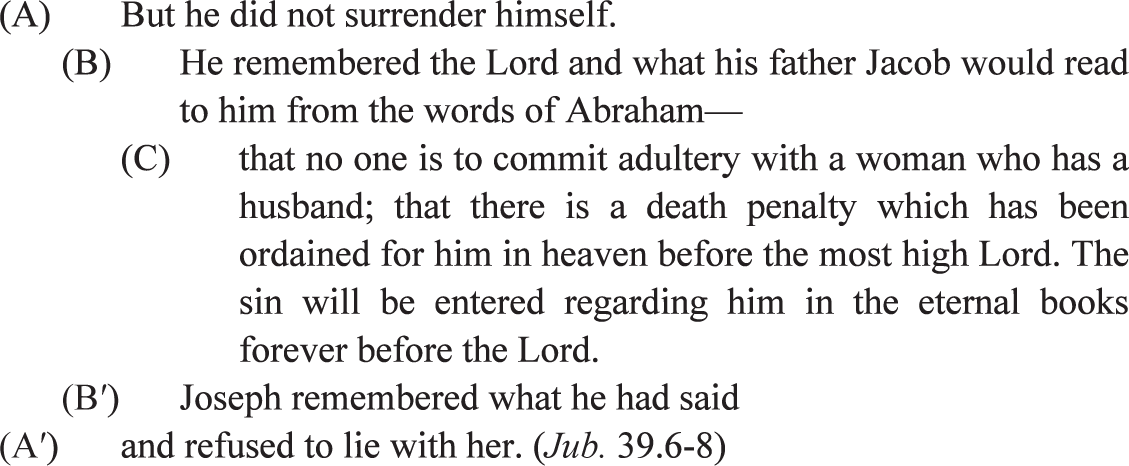
As indicated by the above arrangement, Joseph's reply is structured chiastically, his ‘remembering’ of Abraham's words (B, B″) being framed by his refusal to lie with Potiphar's wife (A, A″). At the center (C) lies Abraham's instruction—namely, that adultery is forbidden, the sinner being ordained to death and the transgression being entered in ‘the eternal books…before the Lord’. This configuration stresses the legal prohibition against adultery as the reason for Joseph's abstinence—the importance of this injunction being highlighted via its association with the earthly and heavenly writings. 30
While the juxtaposition of Potiphar's wife's wiles and Joseph's response in both Genesis and Jubilees underscores the difference between the two figures, the Jubilean reworking of this text places particular emphasis on the disparity between ‘following one's eyes’ and ‘remembering the law’. The latter theme appears to derive from Num. 15.39: ‘… You will remember all the commandments of the LORD and do them, and not follow the lust of your heart and of your own eyes’. 31
This analysis demonstrates that the three-stage process reflected in the Jubilean accounts of Jacob–Rachel and Reuben–Bilhah is also evident in the Joseph story: ‘eye appeal’ elicits love, which in turn induces grave transgression of the written law.
3. Love based on feminine righteousness
Jacob's love for Leah (Jub. 36.21–24) differs from the three cases discussed above. Firstly, this love is between a married couple. While the author of Jubilees retains the designation of Leah as ‘hated’ in his retelling of the Jacob–Rachel–Leah account (Jub. 28.12; cf. Gen. 29.31, 33), in his subsequent description of Leah's burial he states that Jacob ‘loved her very much from the time when her sister Rachel died’ (Jub. 36.23). 32 Secondly, despite the fact that—according to Jubilees—Leah possessed a ‘very lovely’ figure (Jub. 28.5), Jacob loves her because of her ‘perfect ways’.
The latter theme is developed over three verses:
All her sons and his sons came to mourn with him for his wife Leah and to comfort him regarding her because he was lamenting her. For he loved her very much from the time when her sister Rachel died because she was perfect and right in all her ways 33 and honored Jacob. In all the time that she lived with him he did not hear a harsh word from her mouth because she was gentle and possessed (the virtues of) peace, righteousness, 34 and honor. As he recalled all the things that she had done in her lifetime, he greatly lamented her because he loved her with all his heart and with all his person. (Jub. 36.22–24) 35
This account is striking first of all in its deviation from the biblical characterization of Leah. Rather than portraying her as a quiet, respectful wife, she willfully commands Jacob: ‘You are to sleep with me, for I have hired you with my son's mandrakes’ (Gen. 30.16). Genesis likewise never explicitly states that Leah was loved by her husband, nor does it mention any mourning for Jacob's wives (cf. Gen. 35.19–20; 48.7; 49.31)—and certainly none of a familial lamenting by Jacob and all his sons. Jubilees ‘insertion of these themes into his account—and their intertwining—is unique to this reworking.
The theme of Jacob's mourning of Leah because of his great love for her is stressed by its repetition in the opening and conclusion of the report. In between these two verses, the reasons why Jacob loved Leah so deeply are adduced. Unlike his love for Rachel, Jacob's love for Leah is due not to her ‘eye appeal’ but to her conduct—in particular, her exemplary comportment within the family. Two chains of adjectives/nouns describe her deportment, both sealed with the theme of ‘honour’: ‘she was perfect, and right…and honored Jacob’ and ‘she was gentle and possessed (the virtues of) peacefulness, righteousness, and honor’. Sandwiched between these encomia is the declaration: ‘He [Jacob] did not hear a harsh word from her mouth’, which elucidates the two general statements.
This portrayal echoes wisdom sayings regarding the good/bad wife—‘It is better to live in the desert than with a contentious, vexatious wife’ (Prov. 21.19; cf. 25.24) or ‘The woman who respects her husband will be seen by everyone as wise. But a loud-mouthed, scolding wife can be recognized as a battle trumpet signaling attack’ (Sir. 26.26–27) (Skehan and Di Lella 1987: 345). In the context of the Jubilean literary setting, this observation implicitly contrasts Leah's behaviour with Rachel's. While Jubilees represents the barren Leah as being jealous of her sister (Jub. 28.20)—in parallel to Rachel's jealousy of Leah (Jub. 28.16; cf. Gen. 30.1)—it highlights the divergent consequences. Her jealousy leading Rachel to quarrel with Jacob—‘Give me children’ (Jub. 28.16; cf. Gen. 30.1)—only at this point does she present him with her maid. 36 Leah, on the other hand, gives ‘her maid Zilpah to Jacob as a wife’ without any word of complaint (Jub. 28.20). Jubilees likewise omits the mandrake story—including Leah's harsh words therein. 37 Thus, according to the Jubilean Jacob–Rachel–Leah narrative, Rachel in no sense rivalled Leah's achievements in maintaining the cardinal Jubilean virtue of familial harmony. 38
Significantly, the Jubilean text posits an implicit correlation between the two sisters’ respective conduct and the depth of Jacob's love towards each of them. While both Leah and Rachel are said to be ‘loved’—in different stages of Jacob's life—Jacob loves Leah ‘very much’ and ‘with all his heart and with all his person’ (Jub. 36.22, 24), in contrast to merely ‘loving’ Rachel (Jub. 28.5, 12). 39 The lack of any indication in Jubilees of Jacob's lamenting Rachel when she dies (cf. Jub. 32.34) also contrasts with the two references to Jacob's mourning Leah because of his love for her (Jub. 36.22, 24). 40 The respect Leah demonstrates towards Jacob is thus rewarded by her husband's love. 41
This reworking of the biblical text clearly reflects the Jubilean author's preference of ‘moral appeal’ over ‘eye appeal’, outward appearance representing an illegitimate criterion for choosing a bride—who might transpire to be a disrespectful wife (cf. Prov. 11.22). In line with the portrayal of the ‘virtuous wife’ of Proverbs, the author of Jubilees implies that countenance is deceptive and beauty illusory: a woman is truly to be praised and valued for her righteousness (cf. Prov. 31.30).
4. Conclusion
This analysis of examples of the theme of ‘love’ in Jubilees demonstrates that the author makes an initial distinction between love deriving from ‘eye appeal’ on the one hand and ‘moral appeal’ on the other—subsequently differentiating between the love between an unmarried couple and that between man and wife. These two determinations are interrelated, ‘eye-appeal’ love only occurring between men and women not married to one other and ‘moral-appeal’ love flourishing exclusively within the marriage bond. A third—related—disparity relates to the gender of the love-subject: while both men and women may love on the basis of beauty, ‘moral-appeal’ love belongs predominantly to the male realm, wives customarily being expected to ‘honor their husbands’ without necessarily loving them.
‘Eye-appeal’ love—that is, desire—is consistently related to grave transgression of the law; it bears a characteristically negative valence. While this is unsurprising in the context of Reuben's lying with his father's concubine or Potiphar's wife's attempt to seduce Joseph—incidents which are subject to criticism already in the Hebrew Bible—the sympathetic biblical portrayal of Jacob's love for Rachel is upended in Jubilees. Although not ignoring Jacob's love for Rachel, the Jubilean author omits the story of their encounter by the well, reduces the number of occurrences in which Jacob expresses his love for Rachel, and postpones the first allusion to ‘love’ between them until Jacob has already married an appropriate bride from his family line. Hereby, he indicates that legal considerations—especially endogamy—rather than spontaneous love elicited by ‘eye appeal’ constitute the only proper grounds for marriage. The implicit analogy between Leah and Rachel further points to ‘eye-appeal’ love as an illegitimate criterion for wedlock, the beautiful Rachel transpiring to be a somewhat disrespectful wife. Finally, according to Jubilees, Jacob's love for Rachel almost leads him to violate a divine law by entering into an illicit marriage with a younger sister. The implications of Jacob's love for Rachel thus parallel those of Reuben and Potiphar's wife, all three stories exhibiting the same three-fold cause-and-effect scheme of ‘eyeing’ a wo/man, ‘loving’ him/her, and (almost) violating a written statute. While the three-stage pattern is based on various biblical texts that link appearance with love and/or depict ‘looking’ as leading to sin, Jubilees is unique in its systematic definition of transgression as violation of a recorded authoritative instruction. The gravity of love/desire kindled by eyesight is thereby accentuated by the fact that it is condemned by the ‘heavenly law’.
As these examples illustrate, Jubilees embodies the view that the socio-legal order is threatened when the eyes form the principal instruments of love. This conclusion—which emerges from the narratives of ‘eye-appeal’ love—is further stressed by their contrast with the passage depicting Jacob's love for Leah as deriving from her ‘perfect ways’. This type of spousal love is deep and, drawing in its wake the analogous observance of the familial duty of mourning, consolidates the existing social order. Jacob's lamenting over Leah's death and his memories of ‘all the things that she had done in her lifetime’ thus jointly demonstrate the ideal relationship between man and wife. A wife is to honour her husband and maintain domestic peace by refraining from contention. When she acts thus, she ensures that her husband will love her ‘with all his heart and with all his person’.
Footnotes
1.
In addition to the Geʿez, a Latin translation of a substantial number of verses from Jubilees has also survived, together with citations—or close parallels—from Jubilees embedded in the Greek and Syriac editions. For a detailed discussion of the various versions of Jubilees, together with an English translation, see VanderKam 1989. For its date and provenance, see VanderKam 1997: 3–24. Cf. also the recent bibliographies to Jubilees in Oliver and Bachman 2009: 123–64 and  : 441–68.
2.
While ב״הא occurs 16 times in Genesis–Exodus, fqr (‘to love’) is employed 57 times in Jubilees. (No concordance for Jubilees exists for Geʿez, the statistical data are derived from a manual count of the occurrences of fqr in VanderKam's critical edition [1989, I].) The equivalence between fqr and ב״הא is apparent from 4Q223–224 2 ii 5, 18, 22 (= Jub. 35.13, 20, 22 respectively)—fqr also regularly rendering ב״הא in the Geʿez translation of Genesis. As VanderKam notes (1977: 91–95), the Geʿez translation of Jubilees closely reflects the Hebrew original. Although notes the centrality of ‘love’ in Jubilees, she does not examine all the occurrences of the term and/or determine its meaning(s).
3.
4.
5.
‘The physicality and emotional intensity of the love in Jubilees has a destabilizing potential’ (Grossman 2009: 94–95). For the way in which the social context determines whether love bears a positive or negative valence in the Hebrew Bible, see : 8–10.
6.
Both Loader (2007: 201) and : 110–11) also note that the Jubilean author adduces the element of ‘love’ in his reworking of the stories of Reuben and Joseph precisely before sexual relations are about to take place.
7.
For detailed studies of this narrative, see Endres 1987: 73–77, 100–11; Halpern-Amaru 1999: 42–46, 64–73, 90–102; and : 262–73.
8.
9.
This accentuates a notion highlighted in Gen. 29 itself, of course. For the central place of endogamy in Jubilees, see Jub. 20.4; 22.16–20, 30; 34.20–21 (Werman 1997; : 68–91).
10.
This elision corresponds to the earlier Jubilean portrait of Jacob as refraining from touching any woman possibly legally prohibited to him. Jacob's avoidance of illicit sexual relations in order to obey the law echoes Joseph's conduct (Jub. 39.1–11; cf. Gen. 39.9–19): see Section 2.3 below. : 100) notes that Jubilees also omits other betrothal scenes by the well (see Gen. 24; Exod. 2.15–22) that suggest that Isaac's and Moses’ marriages (in Moses’ case to a Midianite, no less) are the result of ‘eyeing’ women, thereby adducing legal considerations—and endogamy in particular—as the primary criteria for wedlock; see also below.
11.
Gregory's (2008: 104) statement that ‘… the author of Jubilees never seems to undermine the biblical motif of Jacob's intense love for Rachel’ is therefore inaccurate. The second section of Jacob's demand—‘…that I may cohabit with her’ (Gen. 29.21)—is omitted in the Jubilean retelling, in accord with the earlier portrayal of Jacob as modest (cf. Gen. R. 70.18) (: 100).
12.
‘Weak eyes’ renders the Hebrew phrase תזבד םיניﬠ Cf. : 380–38, 391).
13.
Following Endres (1987: 102–103) and contra : 46) that the Jubilean reworking does not retain the words ‘he loved Rachel more than Leah’ (Gen. 29.30).
14.
15.
16.
Kugel (2012: 139–40) notes that Leah is portrayed as ‘very lovely’ while Rachel is merely ‘lovely’—thereby suggesting that Jacob was attracted to Rachel purely on the grounds of appearance. For eyes as signifying beauty, see 1 Sam. 16.12. For a woman's eyes as arousing a man's love, see, e.g., Cant. 1.15; 6.5; 7.5. Cf. also the seductive role played by women's eyes in Prov. 6.25, Sir. 26.9, and 4Q184 1.13—wherein, unlike Rachel in Jubilees, the female figures are portrayed as actively tempting men (: 172–73).
17.
This designation typically underscores the status and authority of the law in Jubilees (García Martínez 1997; : 389–400). Additional prohibitions relating to illicit marriage/sexual relations are also inscribed on the heavenly tablets: see Jub. 30.9; 33.10 (cf. 39.6). See Sections 2.2 and 2.3 below.
18.
In light of this conclusion, it is difficult to accept : 268–69) that ‘Jubilees shares with Genesis a positive stance towards female beauty. There is nothing here [i.e., in Jacob's story] of the dangers of sexual attraction’ (p. 201). While Jubilees does not admonish fe/male good looks per se, it indubitably points to the potentially destructive results of ‘eyeing’ them—thus introducing into the Jacob narrative a view attested in such texts as Gen. 39.6–20 and 2 Sam. 11. See also below.
19.
For the causal link between eying a woman and taking her as a wife, see Gen. 6.2; Deut. 21.11. The motif of the eyes as instigators of wrongdoing is common in the Bible and Second Temple Jewish writings: see Num. 15.39; Deut. 4.19; Ezek. 6.9; CD 2.7; 1QpHab 5.7; 11Q19 59.14. In some cases, eyesight is specifically associated with sexual misdeeds: see Gen. 34; Judg. 14.1–4; Sir. 9.8; 26.9; 41.20–21; T. Reub. 3.10–4.2; 5.6; T. Jud. 17.1–2; T. Iss. 7.2; L.A.B. 18.13–14; 43.5; cf. Mt. 5.27–30; 6.22–23; 18.9; Mk 9.47–48; Lk. 11.34–36 (Lachs 1987: 97–98; : 65–67).
20.
The three-stage pattern resembles the reworking of the account of the sons of heaven and daughters of men in the Book of Watchers (1 En. 1–36). There, the beholding of the ‘beautiful and comely’ daughters of men is said to elicit the angels’ ‘desire’—in turn causing them to commit ‘a great sin’ (1 En. 6.1–3; cf. T. Reub. 5.6). Jubilees is unique, however, in depicting this as the violation of a recorded authoritative instruction.
21.
For a detailed discussion of the story of Reuben and Bilhah in Jubilees, see Shinan and Zakovitch 1983; Kugel 1995; Halpern-Amaru 1999: 108–12; Rothstein 2004: 371–79; Loader 2007: 196–200; : 73–82.
23.
While a similar depiction of Bilhah appears in T. Reub. 3.11, this contains no mention of Reuben's love for her.
24.
Wintermute (1985: 119) and Halpern-Amaru (1999: 110–11 n. 22) both render ʾafqara (‘to love’) here as ‘desire’ (cf. Rosen-Zvi 2006: 71). For the negative valence of the term ‘love’ here, see : 196.
25.
Cf. also Lev. 18.8; Deut. 22.22; 27.20.
26.
As suggested above with respect to the Jacob–Rachel narrative (Section 2.1), this presentation has clear biblical roots. As : 71) remarks, ‘The format found in Jubilees is thus faithful, mutatis mutandis, to the typical biblical narrative of sexual sin: a man “sees” a woman, “desires” or “loves” her beauty, and acts on this desire…’
27.
As Kugel (1990: 41) demonstrates, the biblical sequence—namely, the description of Joseph's beauty followed by the phrase ‘and after a time’ and then the notation of Potiphar's wife's eyeing Joseph—constitutes a ‘small irregularity…that…seemed to require an explanation’ (cf. Kugel 1990: 28–93; : 126–28). Unlike some Jewish sources (cf. Gen. R. 87.1) that elucidate the phrase ךהא יהיז הלאה םיךבה via an aggadic midrash, the author of Jubilees simply omits them, thereby smoothing out the narratival sequence.
28.
Goldmann (1956: II, 296) renders the verb ʾafqara by the Hebrew דעת, thereby suggesting an erotic connotation (cf. Wintermute 1985: 128; : 110–11 n. 22). Like Jubilees, Josephus’ rewriting of the story makes Potiphar's wife's drive explicit: ‘For his master's wife was disposed amorously to him because of his handsomeness.’ (Ant. 2.41 [trans. Feldman]).
29.
The story of Amnon and Tamar (2 Sam. 13) does not juxtapose the themes of love and pleading, however.
30.
Cf. : 183–84. While the love stories relating to Jacob–Rachel and Reuben–Bilhah depict the heavenly tablets as records of the laws, here they also serve as a registry of human deeds. See the references in n. 17 above. As in Jubilees, the brief reference to Joseph in 1 Macc. 2.53 also describes his experience in Potiphar's house in terms of fulfilling the law: ‘Joseph in his distress kept the commandment’.
31.
Num. 15.39 is also reworked in Abraham's last testament: ‘They are not to commit sexual offences (by) following their eyes and their hearts…’ (Jub. 20.4).
32.
While portraying Leah as ‘hated’, the Jubilean author utilizes various strategies to elevate her status within the marriage bond even prior to Rachel's death (: 42–46, 64–73, 97–99). Although Tamar is also depicted in Jubilees as the object of her husband's ‘hatred’—‘He hated (her) and did not lie with her because his mother was a Canaanite woman and he wanted to marry someone from his mother's tribe’ (Jub. 41.2)—the grounds are different in these cases. Jacob's hatred is related to his wives’ outward appearance, while Er's derives from his (evil) wish to marry a Canaanite. Likewise, whereas Er's hatred leads to his abstention from sexual relations with Tamar, Jacob's hatred of Leah does not prevent him from fulfilling his spousal duty. The parallelism between the hating ‘husbands’ thus presents Jacob in a positive light.
33.
VanderKam: ‘behavior’. The designation ‘perfect’ has been partially preserved in 4Q223–224 2 III 18: העי]טּח (VanderKam and Milik 1994: 95–140). Cf. the portrayal ‘perfect and right in all her ways’ with ךיבדדב החא םיעת (Ezek. 28.15) and םיעת (e.g. Ps. 119.1; Prov. 11.20; this phrase is also common in the sectarian writings from Qumran: e.g. 1QS 8.10, 9.2; 1QSa 1.28; 1QM 14.7). Leah's depiction parallels the Jubilean portrayal of Jacob: ‘.he is righteous in his way. He is perfect; he is a true man’ (Jub. 27.17; cf. 19.13) (: 504).
34.
VanderKam: ‘truthfulness’.
35.
Cf. the encomium of Sarah at her burial in Philo (Abr. 245–54). Unlike Leah's depiction in Jub. 36.21–24, however, Philo portrays Sarah as ‘loving’ her husband—a virtue exhibited by the good wife, as attested in Greco-Roman literature and epitaphs: cf. Dionysius of Halicarnassus, Ant. rom. IV 82.1; Pliny the Younger, Letters 4.19; CIL 12.1211; CIL 12.1221.
36.
The Jubilean reworking of Rachel's complaint omitting the words ‘or I shall die’ (Gen. 30.1), her objection is thereby softened in line with the author's tendency to depict the patriarchs/matriarchs in a positive light and their familial relations as harmonious (cf. Halpern-Amaru 1999: 64–65). While the author thus implicitly hints that Rachel is worse than Leah in some aspects, he does not seek to portray her as a bad wife—as is also evident from his treatment of the story of the theft of the teraphim (Jub. 29.1; 31.2); see : 110.
37.
Following Endres (1987: 106), : 67 and n. 52) notes that the Jubilean author regards the mandrake scene as offensive.
38.
39.
40.
According to the Jubilean chronology, Jacob loved Leah for 24 years and Rachel only 21; see Jub. 28.2, 10; 32.33; 36.21 (Halpern-Amaru 1999: 71–72; : 109–10).
41.
Women in the Hebrew Bible are customarily not portrayed as loving their husbands, this phenomenon being far more common among the male figures (Brenner 1997). While Jubilees follows this tendency, it also imputes ‘honour’ to the women. The relationship between a wife and her husband therefore parallels that between children and parents: parents are expected to love their children, children to honour and respect their parents. Cf. the interpretation of Exod. 20.12 in m. Ker. 6.9: ‘But: Sages have stated: The father comes before the mother under all circumstances, because both he and his mother are liable to pay honor to his father’ (: 581).