






Abstract
This article focuses on the history of reception of the Story of Melchizedek, an original Greek composition from Late Antiquity, among Syriac-speaking Christians during the Middle Ages. For the first time the original Syriac text, English translation and discussion of three different witnesses to this apocryphal work in Syriac is provided, namely (1) the abbreviated translation of the Story incorporated into Catena Severi (ninth century), (2) the Pseudo-Athanasian excerpt found in ms. Vatican Syr. 159, and (3) the brief discourse entitled Melchizedek the Priest.
1. Introduction
The figure of Melchizedek, who is mentioned in the Hebrew Bible only briefly (Gen. 14.18–20; Ps. 110.4), captured imagination of many generations of Jewish as well as Christian readers and interpreters of Scripture. 1 One of the most imaginative outcomes of this fascination that came to us from the period of Late Antiquity is the Greek composition known as the Story of Melchizedek, a work that presents an extended account of the life of the priestly king. 2
The content of the Story could be summarized briefly as follows: 3 Melchizedek is introduced as one of the two sons of Melchi, the pagan king of the city of Salem. One day the father orders Melchizedek to bring some cattle as offerings to the idols. While on his way, Melchizedek contemplates the sun, moon and stars in heaven and comes to the conclusion that there is only one true God, who created them and to whom sacrifices should be offered. When he returns home without the cattle and tries to persuade his father to become monotheist, the king gets enraged and decides to sacrifice one of his sons. As the king and the queen cast lots to choose which of the two sons should be sacrificed, the lot falls to the latter and she saves Melchizedek. While preparations for the sacrifice of his brother are being made, Melchizedek flees to Mount Tabor and prays there to God for the evildoers to be punished. His prayer is answered and the whole city and its population, including his family, are swallowed up by the earth. After that Melchizedek spends seven years leading an ascetic life on Mount Tabor, wandering naked and eating plants. After seven years, God sends Abraham to the mountain in order to meet Melchizedek, to bring him back to the human world, and to receive a blessing from him. Obeying God's orders, Abraham meets Melchizedek, cuts his long hair and nails, and clothes him. After three days, Melchizedek descends from the mountain with a horn of oil and blesses Abraham, whose name at this point is changed from Abram to Abraham. The narrative concludes with an excursus in which the absence of information about Melchizedek's parents in the Bible and the typological significance of his sacrifice of bread and wine as a prefiguration of Eucharist are explained, and in which the council of Nicaea is evoked.
The Greek version of the Story survives in a considerable number of textual witnesses that reveal a great degree of variability. Jan Dochhorn, who is currently preparing a critical edition of this work and who has carried out the most thorough overview of its diverse textual tradition so far, lists twenty-nine Greek manuscripts produced between the eleventh and nineteenth centuries, in which various versions of the Story appear. 4
Among the most important and well-attested versions of the Story is the one in which its authorship is ascribed to Athanasius, the famous fourth-century bishop of Alexandria. One early representative of this version became known to scholars as a result of its inclusion in the corpus of Athanasian writings by Jacques-Paul Migne. 5 Another important version of the Story is incorporated as a separate chapter into a larger historiographical composition, the Palaea Historica (c. ninth century). Comparable in its length to the Pseudo-Athanasian version, it appears there under the title Περί τοῦ Μελχισεδέκ. 6
In addition to these main versions, two other witnesses of the Greek tradition of the Story have been published. In his article, Dochhorn has edited the Greek text entitled Βίος καὶ ἱστορία τοῦ Μελχισεδέκ from ms. Paris, Bibliothèque nationale de France, Gr. 1083 (sixteenth century). 7 This composition is shorter in size than the Pseudo-Athanasian version, to which it exhibits certain affinity, although there is no explicit mention of Athanasius as the author. Another and, so far, the shortest Greek version of the Story comes from the so-called Joshua Roll, an illuminated Byzantine manuscript from the tenth century (Rome, Biblioteca Apostolica Vaticana, Vat. Palat. gr. 431). On the back of this roll, there are a number of brief Greek texts added during the thirteenth century. One of these is a significantly abbreviated version of the Story, whose title and content likewise display no connection to Athanasius. 8
It has been suggested recently by Pierluigi Piovanelli that one can single out three main recensions of the Story, namely, the Pseudo-Athanasian one, that of the Palaea and that of ms. BNF, Gr. 1083. 9 Yet, taking into account that most of this material requires further investigation, it still remains to be seen whether such tripartite division does justice to the fluid textual tradition of this work.
There seems to be a consensus among scholars that Greek was the original language of the Story. As for the milieu and time of its composition, their opinions differ. Whereas some scholars argued that it might be an originally Jewish composition that later on was reworked by Christians, 10 a more prevalent opinion among the students of the Story seems to be that it is an originally Christian work that was composed in Palestine, most likely, during the late fourth or early fifth century. 11
The Story enjoyed a remarkable popularity through the Christian world during the Middle Ages and deserves to be considered as one of the most widely spread apocryphal works. The fact that besides Greek, it is attested in Latin and in almost every language of Oriens Christianus, namely Coptic, Syriac, Arabic, Armenian, Georgian, Slavonic and Romanian, testifies to the text's popularity. 12
The main aim of this article is to contribute to the history of reception of the Story among Syriac-speaking Christians. With that goal in mind, I will present for the first time the original Syriac text, English translation and discussion of three different witnesses to this apocryphal work in Syriac: the complete Pseudo-Athanasian version of the Story, the Pseudo-Athanasian excerpt found in ms. Vatican Syr. 159, and the brief discourse entitled Melchizedek the Priest.
2. Pseudo-Athanasius, Story of Melchizedek
The most important witness for the Syriac tradition of the Story is the complete version of this work, ascribed to Athanasius of Alexandria, which is found incorporated into the West-Syrian exegetical composition often referred to as Catena Severi. 13 Strictly speaking not a representative of the genre of catena as it is known in Greek, this work is an exegetical compendium that was produced by the monk Severus from the Monastery of St. Barbara in the vicinity of Edessa in the year 861. This selective commentary on the books of the Old and New Testament is based mainly on the works of Ephrem the Syrian, Jacob of Edessa and John Chrysostom, but includes material from several other authors as well.
The catena of Severus, only parts of which have had been published until now, is preserved in a number of manuscripts. The oldest and best textual witness of Severus’ work is ms. Vatican Syr. 103,
14
a monumental exegetical collection produced a few decades after the completion of Severus’ project by the monk Simeon of Hisn Mansur from the Monastery of the Seven Martyrs near the city of Perrhe. Simeon did not merely copy the work of Severus, but expanded it further by including the complete text of the Commentary on the Octateuch of Jacob of Edessa, and by adding in the marginal glosses extracts from various Greek and Syriac authors. The Catena is found in at least five more manuscripts: Dayr al-Suryan Syr. 15 (tenth/eleventh century);
15
British Library Add. 12144 (copied from Vatican Syr. 103 in the year 1081);
16
Mingana Syr. 147 (1899
Among these, only four manuscripts contain the Story of Melchizedek.
20
In ms. Vatican Syr. 103, our text appears on ff. 20r-20v. It is preceded by another text dealing with Melchizedek, an excerpt from Jacob of Edessa, entitled ‘On Melchizedek, the priest of God, and on his race’ (ff. 19v-20r), and is followed by another excerpt from Jacob, ‘On God's visitation of the house of Abraham, and on what happened and was said there’ (ff. 20v-21r). Its title, written in the red ink, introduces what follows as an abbreviated version of the ‘Story about Melchizedek’ by Athanasius of Alexandria. On the left margin of fol. 20r, there is a long quotation from the work ‘On the Indications of Places’ ( ) by Epiphanius of Cyprus, which discusses the geographical location of the city of Salem, over which Melchizedek ruled according to Gen. 14.18. The quotation is similar in its content, though not in the exact wording, to §74 of the Syriac version of Epiphanius’ On Weights and Measures.
21
Presumably, it is one of the excerpts added to Severus’ work by Simeon of Ḥisn Manṣur.
) by Epiphanius of Cyprus, which discusses the geographical location of the city of Salem, over which Melchizedek ruled according to Gen. 14.18. The quotation is similar in its content, though not in the exact wording, to §74 of the Syriac version of Epiphanius’ On Weights and Measures.
21
Presumably, it is one of the excerpts added to Severus’ work by Simeon of Ḥisn Manṣur.
In the three other witnesses of the catena, the Story occupies the same place as in ms. Vatican Syr. 103: mss. Mingana Syr. 147, ff. 61r-62r; Harvard Syr. 123, ff. 94v-95v; Dayr al-Suryan Syr. 15, ff. 7v-7r. One peculiar feature of the last manuscript is that the quotation from Epiphanius, which appears in the margin of ms. Vatican Syr. 103, is incorporated here into the main body of the Catena and seems to follow our text. 22
In what follows, the Syriac text of the Story is given according to ms. Vatican Syr. 103. It is accompanied by variant readings from mss. Mingana Syr. 147 (M) and Harvard Syr. 123 (H). In order to make comparison with the Greek version easier, division of the text into paragraphs follows that of Dochhorn's re-edition of the Pseudo-Athanasian version. 23
Syriac text:
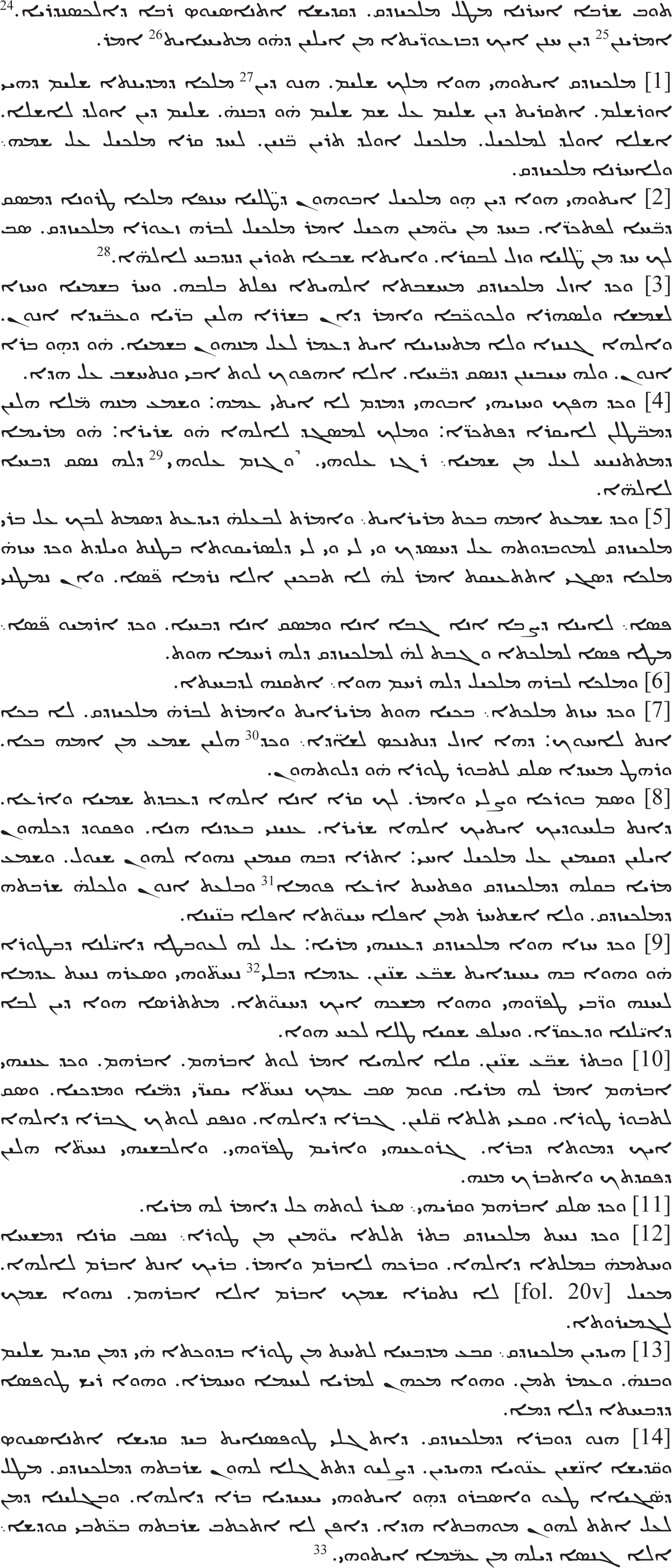
Translation:
Again, another story about Melchizedek, by the holy Athanasius the Great of Alexandria. We recount in brief from what that one recounted at length.
[1] Melchizedek was the king of Šnalem. This one is the king of the city of Šnalem, which indeed is Jerusalem. Šnalem was called after the name of that Šnalem, who built it. Šnalem then begot Ašnla, Ašnla begot Malkel, Malkel begot two sons. Malkel called one (of them) after his name, and another—Melchizedek.
[2] The boys’ father Malkel was a pagan, a tyrannical king, who offered sacrifices to idols. On one of the days Malkel thus said to his younger son Melchizedek, ‘Take with you one of the boys, and go to the herd, and bring seven bulls, so that we might sacrifice them to the god’.
[3] And when Melchizedek went away, a divine thought came into his heart. And he gazed upon the heaven and saw the sun, and the moon, and the stars, and said, ‘If these truly are created and made (things), and there is a hidden and invisible God, who dwells above them in the heaven, the one who created them, and it is to him that we ought to offer sacrifices, then I should return to my father and we shall reflect on this’.
[4] And when he returned, and his father saw that he brought nothing with him, and heard from him these words that abolish the honour of idols, and (that) he exhorts to worship that true God, who is exalted and who rests above the heaven, he (i.e. the father) became very angry with him, and threatened 34 him that he will offer him as a sacrifice to the gods.
[5] And when his mother heard that, she wept bitterly. And she said to her husband, ‘I know that you have put it into your heart to destroy my son Melchizedek because he defied you. Woe to me, woe to me! For I bore (the child) and gave birth in vain!’ And when the king saw her, that she grieved very much, he said to her, ‘Do not cry, but let us cast lots and if the lot will fall how I wish, (then) I shall choose and I shall offer up the sacrifice’. And when they cast the lots, the lot fell to the queen, and she chose Melchizedek, whom she loved.
[6] And the king prepared his son Malkel, whom he loved, for sacrifice.
[7] And when the queen saw (it), she wept bitterly, and she said to her son Melchizedek, ‘Are you not weeping for your brother, for behold, he is going to be sacrificed to the demons?!’ And when he heard these (words) from his mother, he wept. And at once he rushed and went up to Mount Tabor that was near them.
[8] And he knelt, and he prayed and said, ‘I am calling you, O God, who made the heaven and earth (and) who alone is the true God, hearken to me this time and command concerning all those who are rising against my brother Malkel—let the place where they are standing become for them Sheol!’ And the Lord heard the voice of Melchizedek, and the earth opened (its) mouth and swallowed them and the whole tribe of Melchizedek. And not even animals or buildings were left there.
[9] And when Melchizedek saw that the Lord heard him, he entered the thicket of trees on that mountain and lived in it as a solitary for seven years, until his garments wore out, and his hair grew down to his loins, and his nails grew long, and his skin became like that of animals. He, then, used to sustain himself with the pith of trees and with roots, and instead of drinking (water) he used to lap up the dew.
[10] And after seven years, the divine voice said to Abraham, ‘Abraham!’ And when Abraham answered him, the Lord said to him, ‘Rise, take with you precious garments and a razor, and go up to Mount Tabor. And cry out three times “Man of God!” And the man of God, having a wild appearance, will come out towards you. Shave him, and clip his nails, and clothe him in these garments that I have ordered you about, and be blessed by him.'
[11] And when Abraham went up and cried out for him, he did to him everything that the Lord said to him.
[12] And when after three days Melchizedek went down from the mountain, he took a horn of oil and signed it, 35 according to the word of God. And he blessed Abram and said, ‘Blessed are you, Abram, by God. From now on, your name will not be called Abram, but your name will be perfect, (i.e.) Abraham.'
[13] Then Melchizedek set up an altar beneath the mountain, in that place that formerly was Salem, and he built it, and he dwelt there. And he was offering bread and wine to the Lord. And he became the first prefiguration of the bloodless sacrifice. 36
[14] Such is the manner of life of Melchizedek, which was revealed figuratively through the holy Athanasius and the holy ascetics of that time, who were praying that the genealogy of Melchizedek would be revealed to them, because many erred and thought him to be the only-begotten son of God. And it is through the revelation from above that this gift came to them, that even though his generation was not written down in the holy Scriptures, his descent, however, was from the nations.
Commentary:
As indicated by its title, the Catena Severi presents an abbreviated version of the Story. Indeed, a comparison between our text and the Greek version of Pseudo-Athanasius reveals that the former lacks a number of words, phrases and even whole sections found in the latter. The most extended parts of the narrative that have been omitted by the Syriac editor are the description of the second return of Melchizedek to his father (6.1–3), the exchange between Abraham and Melchizedek (11.3–6), and the second exchange between God and Abraham (12.3–8). It appears that the Syriac editor did not limit himself merely to abbreviating the original narrative of the Story. There are several occasions when he would augment or rework it. To bring an example, one could mention the identification of the city of Šnalem as Jerusalem (§1) and the explanation of how and why the genealogy of Melchizedek was revealed to Athanasius and his fellow ascetics (§14).
In the absence of a critical edition of the Greek text of the Pseudo-Athanasian version, it is difficult to establish with certainty whether any given case of the Catena version deviating from the Greek text is a result of the editorial intervention or reflects a different Vorlage. What could be said at this point with certainty is that the Syriac version of the Catena does not exhibit strong textual affinity to any of the Greek versions of the Story that have been published so far. For instance, the genealogical succession Šnalem–Ašnla–Malkel–Melchizedek and Malkel (§1) has no exact parallels in the Greek witnesses. Likewise, the explanation of the discovery of Melchizedek's genealogy as a result of God's revelation answering the prayers of Athanasius and his fellow ascetics (§14) sets the Syriac version apart from the Greek tradition of the Story.
The question of the Greek prototype behind our text thus remains open. Only publication of a proper critical edition of the Pseudo-Athanasian version of the Story would shed further light on this issue. Another question that cannot be answered at the present moment is whether the Syriac editor of the Story was abridging an already existing Syriac translation or whether he was doing it directly, while translating the work from Greek. Moreover, the absence of a critical edition of the Catena Severi as well as a detailed analysis of its compiler's method prevents us from even trying to make a learned guess at whether this abbreviator might be Severus himself or whether he had included into his work an already abridged version of the Story.
The City of Šnalem as Jerusalem
The Greek text of the Pseudo-Athanasian Story does not provide information about location of the city of Melchizedek, named Σαλὴμ. The Syriac editor removes this ambiguity by glossing Šnalem as Jerusalem. In doing that, he is following a well-established exegetical tradition, both Jewish and Christian, that identified Salem of Gen. 14.18 as Jerusalem. Thus, already Flavius Josephus, in his Jewish War, relates that Melchizedek ‘gave the city, previously called Solyma, the name of Jerusalem’. 37 The connection between Salem and Jerusalem is made explicit also in such later Greek versions of the Story as the ones incorporated into the Chronicon Paschale (74.12, 14) and into the Palaea Historica (38.2). In Syriac literature, this exegetical tradition is attested already during Late Antiquity, via the Syriac translation of the sixth book of Jewish War, 38 and of several other Greek works, whose authors quote Josephus, such as Eusebius’ Onomasticon and Epiphanius’ On Weights and Measures. 39 In fact, there might be a genuine exegetical rationale for this gloss to be added, since there existed several alternative geographical traditions regarding the location of the biblical Salem in antiquity. 40 One of them located it in the vicinity of Shechem. Based on interpretation of the Hebrew adjective םלֵשָׁ in Gen. 33.18 as toponym by the translators of Septuagint and of several other biblical versions, including the Peshitta, this geographical notion gained some currency also among Syriac-speaking Christians, found in the Syriac translations of both Eusebius’ Onomasticon and Epiphanius’ On Weights and Measures. 41
Revelation of Melchizedek's genealogy
The narrative of the Pseudo-Athanasian Greek version does not disclose its origin besides pointing out Athanasius as the author. The Syriac version goes beyond that by relating in §14 that the information about Melchizedek's genealogy was revealed by God to Athanasius and his fellow ascetics, who were praying to obtain this knowledge. While there seems to be no exact parallel to this claim in Christian sources from Late Antiquity or early Middle Ages, there are at least two similar narratives in which the information about Melchizedek's human origins is obtained through divine revelation. Both these narratives were known to Syriac-speaking Christians already during Late Antiquity and, thus, could be used by the Syriac editor of the Story as a model for constructing his own version of this event.
One of them is found in the Greek collection of monastic sayings, known as Apophthegmata Patrum. In the Alphabetical Collection of this work (Δ.8), a story is told by Abba Daniel about a certain Egyptian ascetic ‘who in his simplicity, said that Melchizedek was the son of God.’ It was only the tactful intervention of Cyril of Alexandria that helped to extricate the venerable monk from this wrong belief. Aware that the holy man was ‘a worker of miracles and that all he asked of God was revealed to him’, the archbishop of Alexandria pretended that he himself is troubled by the question whether Melchizedek is the son of God or not, and asked him to pray to God to reveal the truth. The monk agreed and after the three days, during which he withdrew and prayed, came with the answer that ‘Melchizedek was a man’. The reason for that conclusion was that God shown him in a vision ‘all the patriarchs in such a way that each one, from Adam to Melchizedek, passed before me’. 42 We know that a Syriac version of this story was in circulation from the sixth or seventh century on, since it was included into some Syriac versions of Palladius’ Historia Lausiaca. 43
An alternative account of the revelation of Melchizedek's origins is found in Pseudo-Zacharias’ Ecclesiastical History, a sixth-century chronicle, composed by a West-Syrian writer. In the beginning of this composition, while discussing the chronology of Abraham's life, the historiographer relates about Epiphanius that he wrote a tractate against the heresy of Melchizedekians, where the bishop of Cyprus claims that ‘he had a vision’ ( ), in which the names of Melchizedek's parents were revealed to him, as well as his Canaanite origins.
44
), in which the names of Melchizedek's parents were revealed to him, as well as his Canaanite origins.
44
Melchizedek as the Son of God
Whereas the Greek narrative presents itself as directed against those who might think that Melchizedek ‘has no beginning of days’ (12.7), the Syriac version relates that God revealed the origins of the priestly king because many in the times of Athanasius ‘erred and thought him to be the only-begotten son of God’ (§14). While the former could refer to any of those who claim for Melchizedek a divine status, the latter's wording is aimed more specifically against those who equate him with Christ. These two different descriptions could be understood as referring to two different groups within the broad spectrum of Christian heterodox movements from antiquity. Thus, the Greek version makes one recall those heterodox teachers who ascribed Melchizedek a divine status but did not identify him with Christ, such as the Roman banker Theodotus (second century), who taught that Melchizedek was ‘the greatest power, and that he was greater than Christ’, 45 or certain Hierax from Egypt (third century), who thought him to be the Holy Spirit. 46 As for the Syriac version, it is concerned with the Christians, who identified Melchizedek with Christ and to whom the orthodox heresiographers and polemists from the fourth century on would habitually refer using the umbrella term ‘Melchizedekians’. 47 It appears that at some point this heterodox notion made its appearance in Syria-Mesopotamia, where its earliest mention is connected with the name of certain John of Apamea, who was active during the fifth or early sixth century. 48
3. Pseudo-Athanasian Excerpt
Another example of the reception of the Story in Syriac comes from ms. Vatican Syr. 159, a West-Syrian anthology that was produced in several stages during the period from 1622 to 1628. 49 The part of the manuscript that contains our text was written by Ephrem Phigānā, a monk and presbyter from the West-Syrian convent of Abu Galeb in the region of Gargar in Northern Mesopotamia, during the years 1622–1623. 50 The anthology comprises a large and diverse assortment of theological, liturgical, hagiographical, exegetical and apocryphal works in Syriac and Garshuni, including the Book of Treasures by Jacob bar Šnakko, homilies of Ephrem, John Chrysostom and Moses bar Kēphā, the Infancy Gospel of Thomas, the Apocalypse of Paul and the Apocalypse of Peter. Besides these and other large compositions, a significant part of the collection is occupied by what Paul Peeters characterizes as ‘un pěle-měle de pièces disparates’, 51 that is an assemblage of short excerpts of various thematic focus. One of such pieces, which appears on ff. 241r-241v (originally numbered ff. 108r-108v), is an excerpt from the ‘History of Melchizedek’ by Athanasius. It is preceded by another brief text that presents the genealogy of Virgin Mary, 52 and is followed by the riddle about an ink pen, composed in the meter of Ephrem. 53
The existence of this witness of the Story was signaled by Stephen Robinson. 54 Whereas the Syriac text of the excerpt was never published, its German translation, made by Stefan Schorch, has been included in the anthology of the various versions of the Story published by Christfried Böttrich. 55 In what follows, the Syriac text is presented according to ms. Vatican Syr. 159.
Syriac text:
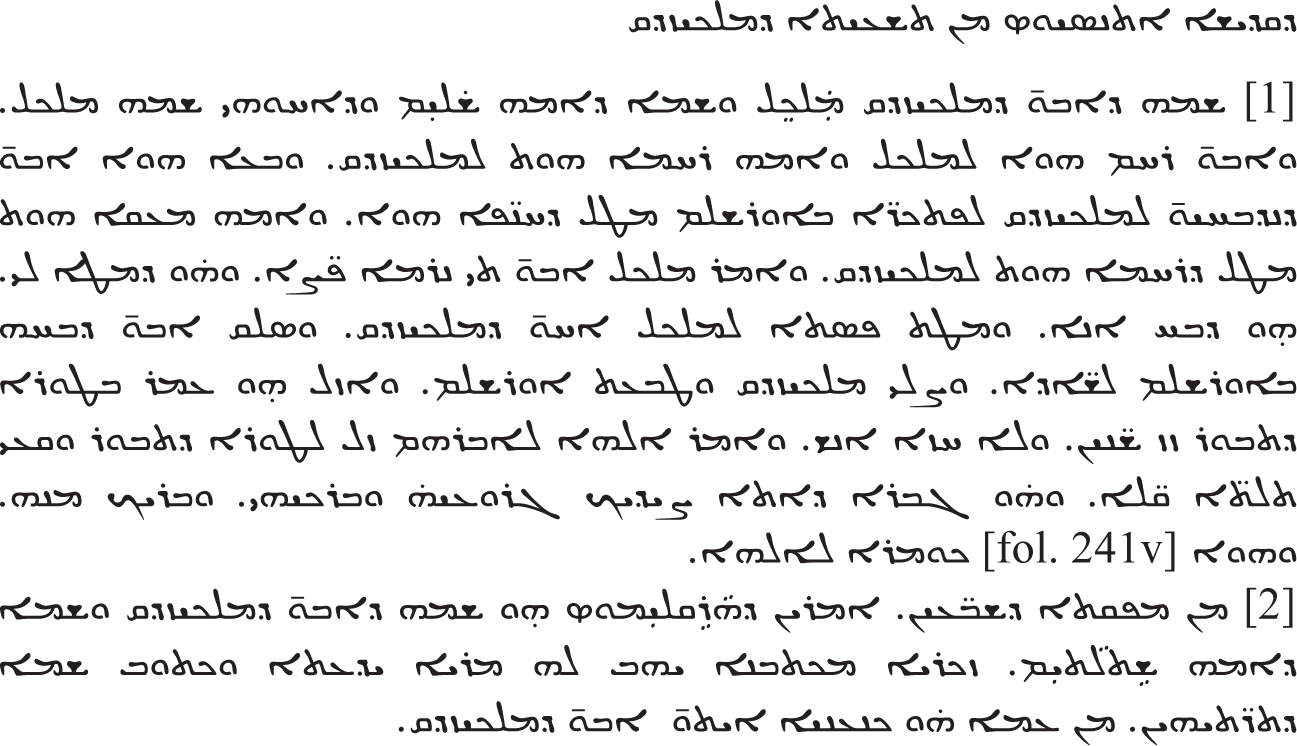
Translation:
From the story of Melchizedek by the holy Athanasius.
[1] The name of the father of Melchizedek is Malkel and the name of his mother—Šnalim, and the name of his brother—Malkel. And his father loved Malkel and his mother loved Melchizedek. And his father wanted to offer Melchizedek as a sacrifice to the idols in Jerusalem, because he was a pagan. 56 And his mother was distressed, because she loved Melchizedek. And his father Malkel said, ‘Come, let us cast lots, and the one that falls to me—him I will sacrifice.’ And the lot fell to Malkel, the brother of Melchizedek. And his father went up (and) sacrificed him to the demons in Jerusalem. And Melchizedek prayed, and Jerusalem sank. And he went and dwelt on Mount Tabor for seven years, and he saw no human being. And God said to Abraham, ‘Go up to Mount Tabor and cry out three times. And that man, who will come to you—shave him, and bless him, and be blessed by him.’ And he was priest of God.
[2] From the translation of the Seventy: they say that the name of the father of Melchizedek is Hareqlimos, and the name of his mother—Šnetlatim. The Lord gave to the writer Zacharia knowledge and he wrote 57 down the names of both of them. The father of Melchizedek was from the Canaanite nation.
Commentary:
The excerpt, whose title relates that its content comes from Athanasius’ ‘Story of Melchizedek’, could be divided into the two sections. In the first and main part, a concise biography of Melchizedek is offered, which follows the main narrative outline of the Story and includes most of its elements, such as: (1) the genealogy of Melchizedek; (2) the decision of Melchizedek's pagan father to sacrifice him; (3) the casting of lots by his parents; (4) the sacrifice of Melchizedek's brother Malkel and destruction of his native city; (5) the anchoretic life of Melchizedek on Mount Tabor; (6) God's order to Abraham to visit Melchizedek. The brief second part presents an alternative tradition regarding the names of Melchizedek's parents, purportedly derived from the Septuagint.
There is nothing in this very concise paraphrase of the Story that might made one think that its author relied on the Syriac version of the Catena Severi as his source. There are, in fact, several cases of disagreement between the two accounts, which render such a scenario rather implausible. For instance, the identification of Melchizedek's mother as ‘Šnalim’ could not be derived from the Catena version of the Story, where she is anonymous and ‘Salem’ is the name of Melchizedek's great-grandfather. Moreover, the statement that the father of Melchizedek had actually carried out the sacrifice of his son before their city was swallowed up seems to contradict the narrative of the Catena version. Finally, this retelling of the Story lacks such important episodes, found in the Catena version, as the discovery of monotheism by Melchizedek and the meeting between him and Abraham.
The Names of Melchizedek's Parents
Whereas the genealogical information about the parents of Melchizedek bearing the names ‘Malkel’ and ‘Šnalim’ in part 1 is in agreement with the original Greek version of the Story, part 2 augments it with an alternative tradition, which identifies his father and mother as ‘Hareqlimos’ and ‘Šnetlatim’. This information is said to be revealed by God to a certain ‘writer Zacharia’. The immediate source of this tradition could be found in the sixth-century Ecclesiastical History of Pseudo-Zachariah Rhetor. In the beginning of this work, the historiographer relates that ‘Epiphanius, the bishop of Cyprus, when he wrote a tractate about the heresy of Melchizedekians, taught in it, as he defended himself before Aristarqetis, that he saw in a vision that the mother of Melchizedek was called Šnalti'el and his father—Heraqlēm, and he was from the nation of Canaanites’. 58 The closest parallel to this story in the corpus of Epiphanius’ genuine writings is found in the Panarion, in the chapter dealing with the heresy of Melchizedekians. There, Epiphanius tries to refute the heretics’ claim of the divine origins of this biblical figure by asserting, among other things, that his human genealogy is, actually, known: ‘some have said that his father was a man called Heracles (‘Hρακλᾶν), and his mother was Astarth (Άστάρθ), the same as Astoriane (Άστοριανήν)’. 59 It is unlikely that the author of Pseudo-Zacharias's Chronicle relied directly on the Panarion. It seems more probable that he used some intermediary Syriac source, where this genealogical tradition was placed into a new narrative framework and the name of Melchizedek's mother was changed to ‘Šnalti'el’. In the Middle Ages, this exegetical tradition gained currency among both West-Syrian (cf. Jacob of Edessa, Comm. in Oct.; 60 Dionysius bar Ṣalībī, Comm. in Gen. 14.18; 61 Barhebraeus, Schol. in Gen. 14.18 62 ) and East-Syrian (cf. Īšnω'dād of Merv, Comm. in Gen. 14.18; 63 Henanīšnω’ bar Sarošnway 64 ) interpreters.
The Canaanite origins of Melchizedek
The idea of the Canaanite descent of Melchizedek could be traced back to the Jewish exegetical tradition of the late Second Temple period. Thus, Josephus characterizes him as ‘a Canaanite chief (Χαναναίων δυνάστης).
65
This notion becomes well entrenched in the Christian exegetical tradition from the fourth century on. One finds it in the treatise On Melchizedek by Eustathius of Antioch, who relates that the biblical monarch was ‘a Canaanite by race’ (Χαναναίων το γένος).
66
Likewise, Jerome expresses a similar opinion concerning Melchizedek's ethnicity in one of his letters (Ep. 73.1). The earliest mention of Melchizedek's Canaanite pedigree in Syriac sources seems to be found in the writings of John of Apamea, a monastic author from the first half of the fifth century. In the Fourth Dialogue with Thomasios, John rejects the identification of Melchizedek with Shem (espoused, among others, by Ephrem the Syrian) and claims him to be ‘from the stock of Ham’ ( ) and ‘from the descendants of Canaan’ (
 ).
67
Later on, in the sixth century, in addition to the passage from Pseudo-Zacharias, quoted above, we see Jacob of Serugh referring to him as ‘a Canaanite' (
).
67
Later on, in the sixth century, in addition to the passage from Pseudo-Zacharias, quoted above, we see Jacob of Serugh referring to him as ‘a Canaanite' ( ) in his mēmrā On Melchizedek.
68
During the medieval period, one finds this exegetical tradition in the works of West-Syrian (cf. Dionysius bar Ṣalībī, Comm. in Gen. 14.18;
69
Barhebraeus, Schol. in Gen. 14.18
70
) as well as East-Syrian (cf. Īšnω'dād of Merv, Comm. in Gen. 9.25–27;
71
Īšnω’ bar Nūn, Quest. 19
72
) interpreters.
) in his mēmrā On Melchizedek.
68
During the medieval period, one finds this exegetical tradition in the works of West-Syrian (cf. Dionysius bar Ṣalībī, Comm. in Gen. 14.18;
69
Barhebraeus, Schol. in Gen. 14.18
70
) as well as East-Syrian (cf. Īšnω'dād of Merv, Comm. in Gen. 9.25–27;
71
Īšnω’ bar Nūn, Quest. 19
72
) interpreters.
4. Anonymous Discourse on Melchizedek the Priest
The third case of the reception of the Story among Syriac-speaking Christians is that of the anonymous brief discourse entitled Melchizedek the Priest that appears in a number of West-Syrian manuscripts containing works of Moses bar Kēphā, a prominent theologian and exegete from the ninth century. 73
In his dissertation on the Festal Homilies of Moses bar Kēphā, James Coakley has pointed out four manuscript witnesses for this work: British Library Add. 21210; Harvard College Library, Syr. 41; Mingana Syr. 112; Mardin, Orthodox A. 74 To these one should add also mss. Mardin, Dayr al-Zafaran 236 and Midyat, Bar Saumo Library 7. It has to be noted, however, that a systematic examination of all existing textual witnesses for Moses’ homilies, 75 especially those in non-Western collections, may bring forward additional examples of this discourse.
One of the earliest attestations of our text comes from ms. British Library Add. 21210. 76 This manuscript was produced in the year 1272 by the West-Syrian scribe Abraham bar Yūḥannān bar Yaldā from the village Šnalmat (modern Šnarmen) near the city of Šnūšn (the ancient Susa) in the Khuzestan province of Iran. It is an anthology that contains a diverse assortment of works. The largest part is taken by the festal homilies (turgāmē) of Moses bar Kēphā and excerpts from various other works by him, which are followed by several short works on liturgical matters by other West-Syrian authors. The text that interests us appears on fol. 62v, in the midst of Moses’ festal homilies, placed between two homilies dedicated to New Testament figures: On the Leprous Man and On the Woman That Had an Issue of Blood.
There are two points to be made in connection with the work in question. First, in distinction from the preceding and following compositions that are explicitly attributed to Moses, neither its title nor its content make such an attribution. Second, similarly to another brief account on fol. 53v, entitled On the Wood of Which the Holy Cross Was Made, 77 Melchizedek the Priest is written by the scribal hand that differs from that of the main body of the anthology. William Wright, who distinguishes three different scribal hands at work in the manuscript, characterizes it as ‘a more modern hand’, without trying, however, to date it with a greater precision. 78 What could be said so far, thus, is that these two texts, each a page long, were added to the main body of the manuscript at some point later than the thirteenth century, in order to fill out the two blank folios.
Another West-Syrian manuscript, where our discourse appears, is Harvard Syr. 41. 79 Dated to the year 1809/10, it was written at the Monastery of the Cross near the village of Ḥaḥ in Ṭur ‘Abdin (see the colophon on fol. 244v). The manuscript contains an assortment of exegetical and other works of West-Syrian authors, mainly of Moses bar Kēphā. Our text appears on ff. 213v-214r, placed between the same two homilies of Moses as in ms. British Library Add. 21210, i.e. On the Leprous Man and On the Woman That Had an Issue of Blood.
Our discourse is attested in two other West-Syrian manuscripts, both of which are dated to the beginning of the twentieth century. One of them is ms. Mingana Syr. 112, produced in the year 1905 by the scribe Malke bar Gawrēye Šnmuni in in the town of Midyat, in Mardin province of Turkey. 80 It is a collection of West-Syrian liturgical works, the largest part of which is occupied by the festal homilies of Moses bar Kēphā. Melchizedek the Priest appears on ff. 65v-66r, placed between the same two homilies of Moses as in ms. British Library Add. 21210, i.e. On the Leprous Man and On the Woman That Had an Issue of Blood. Like the latter manuscript, Mingana Syr. 112 also includes the short anonymous account on the origins of the Wood of the Cross among Moses’ homilies (ff. 54v-55r). Likewise, in distinction from the surrounding them turgāmē, neither of these texts contains references to Moses as their author.
Another modern manuscript in which the discourse appears, is Mardin, Dayr al-Zafaran 236. Produced by the monk Abraham in the famous West-Syrian Saffron Monastery (6 km south east of Mardin) during the year 1914 [see fol. 303]), it comprises, for the most part, various works of Moses bar Kēphā, such as his commentaries on the Eucharist, on Baptism, on the ordination of bishops and presbyters, and several others. Our text appears on ff. 338–342, after the anonymous account on the origins of the Wood of the Cross, which is identical to that of ms. British Library Add. 21210, mentioned above. It is followed by the mēmrā On the Consecration of Myron by Moses bar Kēphā.
Finally, ms. Midyat, Bar Saumo Library 7 seems to be the latest manuscript that contains our discourse. Produced by the scribe Yūḥannān in the year 1956 in the city of Midyat (see p. 565), it is a collection of the festal homilies of Moses bar Kēphā. The discourse appears on pp. 172–174, placed between the same two homilies of Moses as in ms. British Library Add. 21210, i.e. On the Leprous Man and On the Woman That Had an Issue of Blood.
In what follows, the Syriac text of the discourse is given according to ms. British Library Add. 21210. It is accompanied by variant readings from mss. Harvard Syr. 41 (H), Mingana Syr. 112 (M), and Dayr al-Zafaran 236 (D). The version of ms. Bar Saumo Library 7 is identical to that of ms. British Library Add. 21210, with the exception of several minor spelling variants. 81
Syriac text:
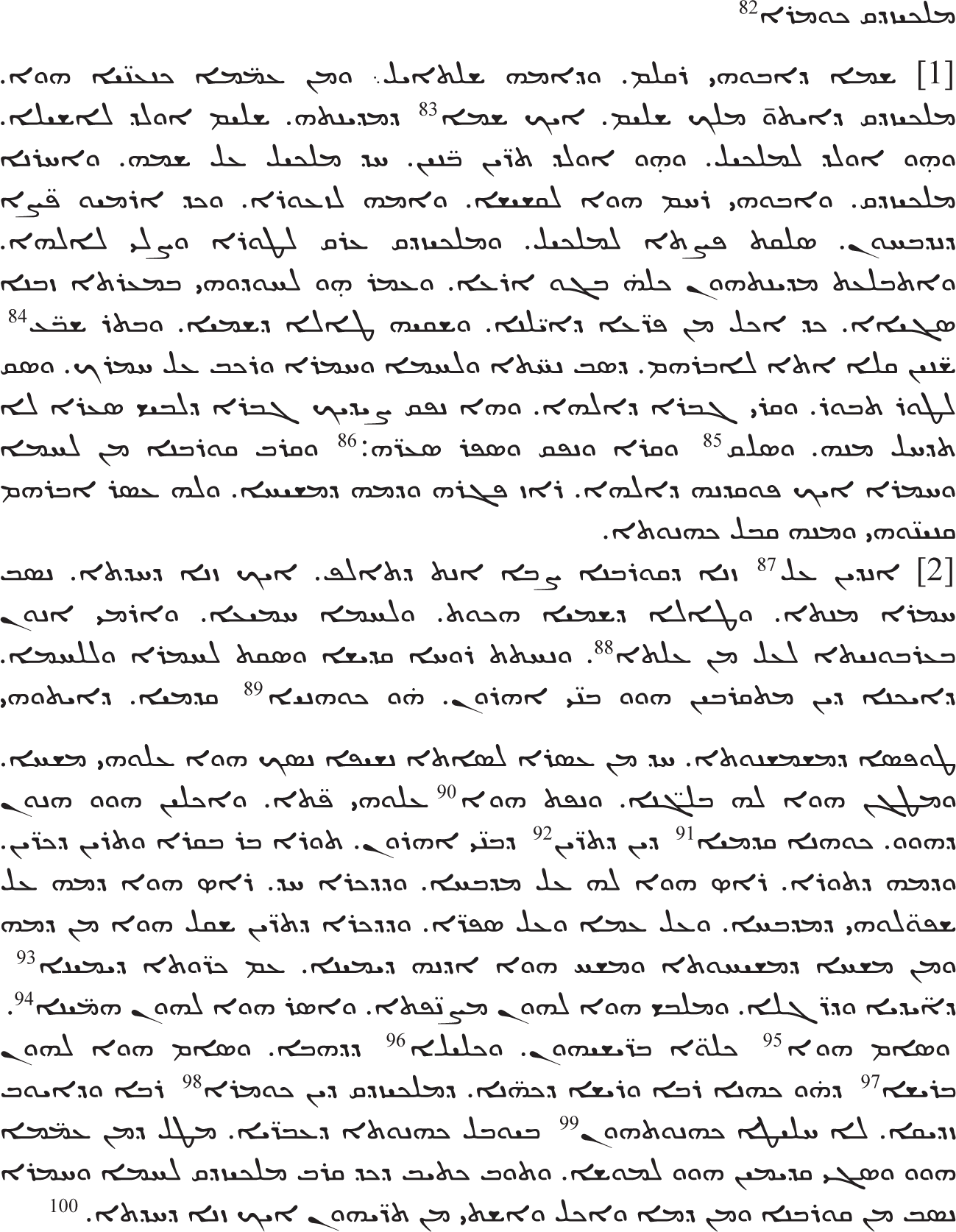
Translation:
Melchizedek the priest.
[1] The name of his father is Raqlem, and that of his mother—Šnalti'el. And he was from the Canaanite nations, that is Melchizedek, who is the king of Šnalem, as (was) the name of his city. Šnalem begot Asila, and he begot Malkel, and he begot two sons, one—Malkel, after his name, and another—Melchizedek. And his father loved the elder one, while his mother—the younger one. And when they cast lots to sacrifice (them), the lot fell to Malkel. And Melchizedek fled to the mountain and prayed to God. And the whole city of theirs was swallowed up inside the earth. And he dwelt alone in a cave for a long time, while eating fruits of the trees and drinking the dew of heaven. And after seven years a voice came to Abraham, ‘Take the garments, and bread and wine, and ride your donkey. And go up to Mount Tabor, and call the man of God. And behold, a man dressed in hair will come out toward you, do not be afraid of him.’ And he (i.e. Abraham) went up, and called, and he (i.e. Melchizedek) went out, and he cut his hair. And he (i.e. Melchizedek) offered a sacrifice of bread and wine, in accordance with the command of God—the mystery of the body and blood of Christ. And Abraham gave him a tenth part of his possessions, and received from him priesthood.
[2] If you wish to learn about the manner of (his) offering, he took, after the manner of the New (Testament), a portion of wine, and likewise heavenly dew, and leavened bread, and put them in a cup upon the altar. And the Holy Spirit descended and breathed upon the wine and the bread. As for how the sons of Aaron offered sacrifices, 101 i.e. that former priesthood, which is a prefiguration of the deacon's office: one 102 would pour oil upon one-tenth of the measure of fine (flour), 103 and bake from it cakes, and would soak in it pieces (of bread), and everyone who was there would eat. Another former ministry of the sons of Aaron—a bull and two rams. And one would sprinkle the blood of the bull upon the altar, and the blood of one of the rams would be sprinkled upon the base of the altar, and upon the people and the scribes. As for the second ram, one would take some of its blood and some of the anointing oil, and besmear his right ear, together with the thumbs of the right hands and the big toes of the right feet. And one would put on them turbans, and gird them with sashes, and tie headdresses on their heads, and put the golden crown of the great priest and high-priest on their head. 104 The priesthood of the great priest Melchizedek and of the righteous Job, however, has nothing to do with the succession of the priesthood of Hebrews, because they were from the nations and were much earlier (in time) than Moses. And, again, it is written that when Melchizedek offered bread and wine, he took from the offering and from the blood, and ate and drank from both of them, after the manner of the New (Testament).
Commentary:
The discourse could be divided into the two main parts. The first one provides a concise biography of Melchizedek, which follows the main narrative outline of the Story and includes most of its elements, such as: (1) the genealogy of Melchizedek; (2) the casting of lots to sacrifice one of their two sons by his parents; (3) the flight of Melchizedek to Mount Tabor and destruction of his native city; (4) the ascetic way of life of Melchizedek; (5) God's order to Abraham to visit Melchizedek; (6) the meeting between Abraham and Melchizedek.
In the second part, an exposition on the nature of Melchizedek's sacrifice is offered, based on the typological relationship between this biblical episode and the Christian sacrament of Eucharist. The main message of this section, which includes an elaborate description of the sacrifices performed by the Aaronite priests, is that of superiority of the primeval non-Jewish priesthood, reinaugurated by Jesus, over that of the Jews. It is conveyed through the hierarchical dichotomy of the Levitical priesthood and the alternative pre-Mosaic priesthood, embodied in such figures as Melchizedek and Job.
Like in the previous case of the Pseudo-Athanasian excerpt from ms. Vatican Syr. 159, it does not seem likely that the author of Melchizedek the Priest made a direct use of the Syriac version of the Catena Severi in his portrayal of this biblical figure. There are several discrepancies between the two accounts that make such scenario improbable. Thus, while describing the ascetic life of Melchizedek on Mount Tabor the discourse relates that he was living in a ‘cave’ and eating ‘fruits’, whereas according to the Catena version he was living in the ‘thicket of trees’ and eating the ‘pith of trees and roots’ (§9). In the former, Melchizedek is said to be ‘dressed in hair’ when he meets Abraham, whereas in the latter he is described as having ‘a wild appearance’ (§10). Finally, while the discourse does refer to Abraham giving tithes to and receiving priesthood from Melchizedek, the Catena version is silent about this aspect of their encounter.
The Names of Melchizedek's Parents
Similarly to the excerpt from ms. Vatican Syr. 159, our author augments the original genealogical framework of the Story, where the father of Melchizedek bears the name ‘Malkel’, with an alternative tradition, which identifies his father and mother as ‘Raqlem’ and ‘Šnalti'el’, the former being a corrupt form of ‘Heraqlēm’.
Melchizedek's Offering as a Prototype of Eucharist
The discourse elaborates further the typological link between the sacrifice of Melchizedek and the sacrament of Eucharist, found in the Pseudo-Athanasian Greek text of the Story (13.3) as well as in the Syriac version of the Catena Severi (§13). Among the earliest Christian authors to make such connection one should mention Clement of Alexandria (Strom. 4.25). 105 In the Syriac Christian tradition, this interpretation of Melchizedek's offering is attested from the fifth/sixth century on (cf. Jacob of Serugh, On Melchizedek; 106 Cave of Treasures 28.11). During the Middle Ages, it becomes quite common in the West-Syrian tradition (cf. Jacob of Edessa, Comm. in Octat.; 107 Dionysius bar Ṣalībī, Comm. in Gen. 14:18; 108 the Book of Life 109 ), while, occasionally, it is found also in the works of East-Syrian writers (cf. Īšnω'dād of Merv, Comm. in Heb.; 110 Gannat Bussāme 111 ).
In distinction from the version of the Catena, in which the relationship of Melchizedek's sacrifice to Eucharist is conceptualized in terms of prefiguration, our discourse seems to put an even greater emphasis on the sacramental character of the former by referring to it as rāzā, ‘mystery’, a loaded Syriac term which among other things serves as a terminus technicus for the sacrament of Eucharist.
112
Furthermore, the details of the description of the sacrifice performed by Melchizedek, who is said to mix in the cup three different components, i.e. wine, ‘heavenly dew’ and leavened bread, likewise betrays indebtedness of the author of the discourse to the Syriac liturgical tradition. Thus, the use of leavened bread ( ) in the sacrament of Eucharist is common to both West-Syrian and East-Syrian sacramental tradition.
113
As for the enigmatic ‘heavenly dew’ (
) in the sacrament of Eucharist is common to both West-Syrian and East-Syrian sacramental tradition.
113
As for the enigmatic ‘heavenly dew’ ( ), this component alludes most probably to the water, with which the communion wine is diluted.
114
A similar tripartite division of Melchizedek's offering is found in some versions of the Pseudo-Athanasian Greek version of the Story.
115
), this component alludes most probably to the water, with which the communion wine is diluted.
114
A similar tripartite division of Melchizedek's offering is found in some versions of the Pseudo-Athanasian Greek version of the Story.
115
Priesthood of Abraham
In the concluding sentence of part 1, the scriptural statement about Abraham giving Melchizedek tithes (Gen. 14.20) is augmented with the claim that after this the patriarch ‘received from him priesthood’ ( ). Whereas the Hebrew Bible does not refer to Abraham as priest explicitly, on more than one occasion the patriarch is depicted performing acts, which could be classified as priestly, such as the building of an altar between Bethel and Ai (Gen. 12.7–8) or the offering of animal sacrifice (Gen. 15.9–11). Under the influence of these biblical passages, as well as of the episode of Aqedah (Gen. 22), the image of Abraham as priest began to develop in Jewish circles already during the Second Temple period.
116
Although not very common in Christian exegetical tradition, application of the priestly imagery to Abraham does appear in works of several Greek Fathers, including John Chrysostom.
117
As for Syriac Christianity, there are a number of poetical compositions from Late Antiquity whose authors cast Abraham as priest in the context of the Binding of Isaac. One of the first to do so was Narsai (fifth century), who refers to Abraham as ‘new priest’ (
). Whereas the Hebrew Bible does not refer to Abraham as priest explicitly, on more than one occasion the patriarch is depicted performing acts, which could be classified as priestly, such as the building of an altar between Bethel and Ai (Gen. 12.7–8) or the offering of animal sacrifice (Gen. 15.9–11). Under the influence of these biblical passages, as well as of the episode of Aqedah (Gen. 22), the image of Abraham as priest began to develop in Jewish circles already during the Second Temple period.
116
Although not very common in Christian exegetical tradition, application of the priestly imagery to Abraham does appear in works of several Greek Fathers, including John Chrysostom.
117
As for Syriac Christianity, there are a number of poetical compositions from Late Antiquity whose authors cast Abraham as priest in the context of the Binding of Isaac. One of the first to do so was Narsai (fifth century), who refers to Abraham as ‘new priest’ ( ) in the mēmrā On the Revelations to Abraham.
118
Slightly later, Jacob of Serugh describes the patriarch as ‘courageous priest’ (
) in the mēmrā On the Revelations to Abraham.
118
Slightly later, Jacob of Serugh describes the patriarch as ‘courageous priest’ ( ) and imagines him to be ‘dressed in the attire of priest’ (
 ) in the mēmrā On Abraham and His Types.
119
Likewise, the author of the anonymous mēmrā On Abraham calls him ‘priest’ (
) in the mēmrā On Abraham and His Types.
119
Likewise, the author of the anonymous mēmrā On Abraham calls him ‘priest’ ( ),
120
whereas in the anonymous dialogue poem On Abraham and Isaac, the latter exhorts his father to build a pyre for his sacrifice ‘like a priest’ (
),
120
whereas in the anonymous dialogue poem On Abraham and Isaac, the latter exhorts his father to build a pyre for his sacrifice ‘like a priest’ ( ).
121
).
121
Melchizedek's Priesthood vs Aaronite Priesthood
In part 2, the author presents a hierarchical dichotomy between the priestly ministry of Melchizedek (and Job) and that of the Aaronite priests, where the former is independent of and more ancient than the latter. It includes a detailed description of the sacrifices performed by Aaronite priests, based on such biblical passages as Lev. 5.11, 8.1–30, and Exod. 29.1–28. Although not stated explicitly, this dichotomy is meant to demonstrate the superiority of the bloodless spiritual offering performed by Melchizedek over the animal sacrifices prescribed by the Hebrew Bible and, thus, of the Christian sacraments over Jewish rituals. This apologetical strategy goes back to the New Testament itself, where the author of the Epistle to the Hebrews argues in ch. 7 that Melchizedek's priesthood, which is anterior and superior to that of Levi and his descendants, has found its fulfillment in Christ, whose priesthood supersedes the Aaronite one. 122 This motif is well attested in the works of West-Syrian authors (cf. Jacob of Serugh, On Melchizedek; 123 Moses bar Kēphā, On Priesthood; 124 Dionysius bar Ṣalībī, Comm. in Gen. 14:18 125 ); it can also be found used by East-Syrian writers (cf. Īšnω'dād of Merv, Comm. in Heb.; 126 Gannat Bussāme 127 ).
Aaronite Priesthood as a Prototype of the Deacons’ Ministry
One of the earliest Christian authors to make a connection between Aaronite priests and Christian deacons was Origen, who links the latter to the Levites of the Old Testament. 128 In Syriac tradition, this motif is attested in the Syriac Didascalia Apostolorum, whose author on several occasions draws a parallel between the two ministries, while claiming at some point that ‘the priests and Levites now are the presbyters and deacons’ (ch. 9). 129 This typology appears also in the tenth-century West-Syrian reworking of the Syriac Commentary on the Liturgy from the fifth century, according to which ‘the deacons fulfil the place of the former Levites, and for this reason they fulfil all the roles in the church’. 130
Priesthood of Job
The biblical book of Job does not present its main protagonist explicitly as a priest. One might, however, come to such conclusion on the basis of verse 1.5, which relates that Job would ‘offer burnt offerings’ (MT תוֹלעֹ הלָעֱהֶזְ, Peshitta  ) on behalf of his children, doing so on a regular basis. Indeed, this avenue has been explored by Syriac exegetes, as one can see from the Commentary on Job, transmitted under the name of Ephrem. In the introductory section of this work, it is related that the munus triplex of Job, identical to that of Jesus, includes the office of priesthood, together with that of kingship and prophecy: ‘For Job was king, and priest, and prophet of the nations… You recognize that he was a priest from (the fact) that he offered sacrifice intended for his sons.'
131
) on behalf of his children, doing so on a regular basis. Indeed, this avenue has been explored by Syriac exegetes, as one can see from the Commentary on Job, transmitted under the name of Ephrem. In the introductory section of this work, it is related that the munus triplex of Job, identical to that of Jesus, includes the office of priesthood, together with that of kingship and prophecy: ‘For Job was king, and priest, and prophet of the nations… You recognize that he was a priest from (the fact) that he offered sacrifice intended for his sons.'
131
In the end, the question of the authorship of our discourse should be addressed in brief. As noted above, neither its title nor its text provide information about its possible author. One might think, as a working hypothesis, that since in all examined manuscripts this text is transmitted together with the works of Moses bar Kēphā, it might also come from the pen of this West-Syrian writer. In fact, Abraham, the scribe of ms. Dayr al-Zafaran 236, did regard it, as well as the account on the origins of the Cross, to be authored by Moses. That could be inferred from the note he makes on fol. 342, introducing the last piece of his anthology, a brief biographical text about Moses, ‘Until now—interpretations of Moses bar Kēphā’. 132
It remains to be seen whether he was right or not. There are several preconditions for making any further progress in verifying this identification. One of the major obstacles impeding such an undertaking is the fact that many works that comprise Moses’ œuvre are still unpublished. 133 Of particular importance would be a critical edition, accompanied by a thorough investigation into its complex textual tradition, of the tractate On Priesthood, one of several West-Syrian theological compositions that were transmitted under the names of both Moses bar Kēphā and his contemporary John of Dara, interchangeably. 134 Only the Maronite recension of this important work, ascribed to John Maron, has been published so far. 135 Moreover, given the fact that Melchizedek plays such an important role in Hebrews 7, it would be obligatory to examine how this biblical figure is dealt with in the commentaries on the Epistle to the Hebrews by such West-Syrian authors as Lazarus of Qandasā, Moses bar Kēphā and Dionysius bar Salībī, all of whom are still unpublished. 136
5. Conclusion
A number of recent studies have addressed the question of how extra-biblical and non-canonical material about biblical figures that originated in antiquity continued to be transmitted and used by Syriac-speaking Christians during the medieval period. 137 My investigation into the afterlife of the Greek Story of Melchizedek in Syriac Christian tradition contributes to this field of research. The three examples of the Story's reception bear witness to the lasting interest in this apocryphal composition among the Syriac Christians of the Muslim Near East.
We have seen that the Story was available to Syriac readers at least from the second half of the ninth century, when its abbreviated version was incorporated into the Catena Severi, and continued to hold their interest, at least in the case of the discourse on Melchizedek the Priest, well into the twentieth century. All three cases, discussed above, demonstrate that far from being passive transmitters Syriac editors approached the Story creatively and did not feel constrained to rework it, adapting the received narrative to the needs of the moment, exegetical as well as theological. It is noteworthy that there seems to be more than one channel of transmission of the Story in Syriac. In favour of that speaks the fact that neither the Pseudo-Athanasian excerpt nor the discourse on Melchizedek the Priest provide evidence of textual dependence on the Catena version of the Story in their presentation of Melchizedek's biography.
Finally, there are several aspects of the Story's reception in Syriac that deserve further exploration. One of them is related to the fact that all three cases under consideration come from the West-Syrian tradition of Syriac Christianity. As yet, I have not been able to find convincing evidence for an East-Syrian exegete or theologian who was acquainted with this apocryphal work. It remains to be seen whether this disparity is accidental or whether it might reflect some deep-lying differences between exegetical approaches of the two confessional communities. Another avenue of research worth pursuing in connection with the Syriac versions of the Story is how they, especially the Pseudo-Athanasian version, are related to the Christian Arabic witnesses to this work, none of which has been published so far. 138
Footnotes
1.
On Melchizedek in the Bible, see A.K. Chan, Melchizedek Passages in the Bible: A Case Study for Inner-Biblical and Inter-Biblical Interpretation (Berlin: de Gruyter, 2016). On the history of interpretation of this figure in ancient Judaism and Christianity, see F.L. Horton, The Melchizedek Tradition: A Critical Examination of the Sources to the Fifth Century A.D. and in the Epistle to the Hebrews (SNTSMS, 30; Cambridge: Cambridge University Press, 1976); B.A. Pearson, ‘Melchizedek in Early Judaism, Christianity, and Gnosticism’, in M.E. Stone and T.A. Bergren (eds.), Biblical Figures Outside the Bible (Harrisburg, PA: Trinity Press, 1998), pp. 176–202; P. Piovanelli, ‘“Much to Say and Hard to Explain”: Melchizedek in Early Christian Literature, Theology, and Controversy’, in A.A. Orlov and G. Boccaccini (eds.), New Perspectives on 2 Enoch: No Longer Slavonic Only (Studia Judaeoslavica, 4; Leiden: Brill, 2012), pp. 411–29; G. Bardy, ‘Melchisédech dans la tradition patristique’, RB 35 (1926), 496–509; 36 (1927), pp. 25–45.
2.
For general information, see S.E. Robinson, ‘The Apocryphal Story of Melchizedek’, JSJ 18.1 (1987), pp. 26–39; J. Dochhorn, ‘Die Historia de Melchisedech (Hist Melch) – Einführung, editorischer Vorbericht und Editiones praeliminares’, Le Muséon 117.1–2 (2004), pp. 7–48; Ch. Böttrich, Geschichte Melchisedeks (JSHRZ, Neue Folge; Band II: Weisheitliche, magische und legendarische Erzählungen, 1; Gütersloh: Gütersloher Verlagshaus, 2010); P. Piovanelli, ‘The Story of Melchizedek with the Melchizedek Legend from the Chronicon Paschale: A New Translation and Introduction’, in R. Bauckham, J.R. Davila and A. Panayotov (eds.), Old Testament Pseudepigrapha: More Noncanonical Scriptures (Grand Rapids: Eerdmans, 2013), I, pp. 64–84.
3.
The summary is based on the Pseudo-Athanasian version, on which see below.
4.
Dochhorn, ‘Die Historia de Melchisedech’, pp. 16–21.
5.
PG 28 (1857), cols. 523–30. Migne's edition is based on ms. Paris, Bibliothèque nationale de France, Gr. 1336 (11th c.). This text has been reedited, alongside a number of variant readings, by Dochhorn, ‘Die Historia de Melchisedech’, pp. 28–33. For an English translation, see Robinson, ‘Apocryphal Story’, pp. 28–31, and Piovanelli, ‘Story of Melchizedek’, pp. 77–81.
6.
For the Greek text, see A. Vassiliev, Anecdota Graeco-Byzantina: Pars Prior (Mosquae: Universitatis Caesareae, 1893), pp. 206–211. It has been republished, alongside with a number of variant readings, by Dochhorn, ‘Die Historia de Melchisedech’, pp. 35–40. For an English translation, see W. Adler, ‘Palaea Historica (“The Old Testament History”): A New Translation and Introduction’, in Bauckham, Davila and Panayotov (eds.), Old Testament Pseudepigrapha, I, pp. 585–672 (613–16).
7.
Dochhorn, ‘Die Historia de Melchisedech’, pp. 42–47.
8.
For the Greek text and German translation, see P. Schreiner, ‘Die Prachthandschrift als Gebrauchsgegenstand: theologische und wirtschaftsgeschichtliche Notizen auf dem Verso des Josua-Rotulus (Vat. Palat. gr. 431)’, Österreichische Akademie der Wissenschaften, Anzeiger der philosophisch-historischen Klasse 134.1 (1997–99), pp. 43–62 (47–50).
9.
Piovanelli, ‘Story of Melchizedek’, pp. 65–66.
10.
Cf. Robinson, ‘The Apocryphal Story’, pp. 31–36; Böttrich, Geschichte Melchisedeks, pp. 62–65.
11.
See, most recently, Piovanelli, ‘Story of Melchizedek’, pp. 69–73; for references to earlier scholars who held this opinion, see p. 70 n. 30.
12.
For an overview of this material, see Dochhorn, ‘Die Historia de Melchisedech’, pp. 21–27; Böttrich, Geschichte Melchisedeks, pp. 16–29. For the Latin tradition, see also S. Pelle, ‘A Preliminary Study of the Historia de Melchisedech in the Latin West’, Apocrypha 24 (2013), pp. 57–90.
13.
See L. van Rompay, ‘Severos, Commentary of the Monk’, in S.P. Brock et al. (eds.), Gorgias Encyclopedic Dictionary of the Syriac Heritage (Piscataway, NJ: Gorgias Press, 2011), p. 367; D. Kruisheer, ‘Ephrem, Jacob of Edessa, and the Monk Severus: An Analysis of Ms. Vat. Syr. 103, ff. 1–72’, in R. Lavenant (ed.), Symposium Syriacum VII: Uppsala University, Department of Asian and African Languages, 11–14 August 1996 (Orientalia Christiana Analecta, 256; Rome: Pontificio Istituto Orientale, 1998), pp. 599–605; R.B. ter Haar Romeny, ‘Ephrem and Jacob of Edessa in the Commentary of the Monk Severus’, in G.A. Kiraz (ed.), Malphono w-Rabo d-Malphone: Studies in Honor of Sebastian P. Brock (Gorgias Eastern Christian Studies, 3; Piscataway, NJ: Gorgias Press, 2008), pp. 535–57.
14.
For a description, see S.E. Assemani and J.S. Assemani, Bibliothecœ Apostolicœ Vaticanœ codicum manuscriptorum catalogus. Partis primœ, tomus tertius, complectens reliquos codices chaldaicos sive syriacos (Rome: Ex typographia linguarum orientalium, 1759), pp. 7–28.
15.
See S.P. Brock and L. van Rompay, Catalogue of the Syriac Manuscripts and Fragments in the Library of Deir al-Surian, Wadi al-Natrun (Egypt) (OLA, 227; Leuven: Peeters, 2014), pp. 73–80.
16.
See W. Wright, Catalogue of Syriac Manuscripts in the British Museum, Acquired since the Year 1838 (3 vols.; London: Trustees of the British Museum, 1870–72), II, pp. 908–14.
17.
See A. Mingana, Catalogue of the Mingana Collection of Manuscripts now in the Possession of the Trustees of the Woodbrooke Settlement, Selly Oak, Birmingham (3 vols.; Woodbrooke Catalogues, 1–3; Cambridge: W. Heffer & Sons, 1933, 1936, 1939), I, cols. 335–40.
18.
See M.H. Goshen-Gottstein, Syriac Manuscripts in the Harvard College Library: A Catalogue (HSM, 23; Missoula, MT: Scholars Press, 1979), p. 85.
19.
See Goshen-Gottstein, Syriac Manuscripts, pp. 87–88.
20.
In its present condition, ms. British Library Add. 12144 lacks about twelve quires at the beginning. However, as has been established by Lucas van Rompay, the missing quires survived being incorporated into ms. Dayr al-Suryan Syr. 15; see Brock and van Rompay, Catalogue of the Syriac Manuscripts, pp. 79–80. As for ms. Harvard Syr. 116, it seems to contain an abridged version of Catena. Thus, on fol. 33v the excerpt from Jacob of Edessa, identical to ‘On Melchizedek, the priest of God, and on his race’, which comes before the Story in ms. Vatican Syr. 103, is followed by the brief excerpt on ‘God's promise to Abraham about Isaac’ from Ephrem, identical to the one on fol. 18v of ms. Vatican Syr. 103.
21.
See J.E. Dean, Epiphanius’ Treatise on Weights and Measures: The Syriac Version (Studies in Ancient Oriental Civilization, 11; Chicago: University of Chicago Press, 1935), pp. 115 [Syr.], 75 [trans.].
22.
See Brock and van Rompay, Catalogue of the Syriac Manuscripts, p. 74. Unfortunately, this manuscript was not available to me, so my observations are based on its description provided by Van Rompay.
23.
Dochhorn, ‘Die Historia de Melchisedech’, pp. 28–33. It is followed by Böttrich and Piovanelli in their translations of this version.
24.
M H
25.
M H
26.
M H
27.
M H omitted.
28.
M H
29.
H omitted.
30.
M H
31.
M H
32.
M H
33.
M H omitted.
34.
Or ‘decreed’.
35.
I.e. made the sign of the cross over it.
36.
I.e. Eucharist.
37.
Bell. 6.438; ed. H.S.J. Thackeray et al., Josephus (LCL; 10 vols.; London: William Heinemann, 1926–65), III, pp. 500–503. Cf. also Ant. 1.10.2.
38.
See A.M. Ceriani, Translatio Syra Pescitto Veteris Testamenti ex codice Ambrosiano sec. fere VI photolithographice edita (2 vols.; Mediolani: J.B. Pogliani, 1876–83), II, p. 679.
39.
For the former, see S. Timm, Eusebius von Caesarea. Das Onomastikon der biblischen Ortsnamen (Texte und Untersuchungen zur Geschichte der altchristlichen Literatur, 152; Berlin: de Gruyter, 2005), p. 106; for the latter, see Dean, Epiphanius’ Treatise, p. 75.
40.
For references, see Dochhorn, ‘Die Historia de Melchisedech’, p. 12 n. 14.
41.
See Timm, Eusebius von Caesarea, p. 104; Dean, Epiphanius’ Treatise, p. 75.
42.
PG 65, col. 160; trans. B. Ward, The Sayings of the Desert Fathers: The Alphabetical Collection (Cistercian Studies, 59; Kalamazoo: Cistercian Publications, 2nd edn, 1984), p. 54.
43.
For the Syriac text, see P. Bedjan, Acta martyrum et sanctorum (7 vols.; Paris–Leipzig: Otto Harrassowitz, 1890–97), VII, pp. 313–14; for an English translation of Bedjan's text, see E.A.W. Budge, The Book of Paradise, Being the Histories and Sayings of the Monks and Ascetics of the Egyptian Desert by Palladius, Hieronymus and Others: The Syriac Texts, according to the Recension of ‘Anân-Îshô’ of Běth ‘Âbhě, Edited with an English Translation (Lady Meux Manuscript, 6; 2 vols.; London: W. Drugulin, 1904), I, pp. 420–421. Cf. also E. Sachau, Verzeichniss der syrischen Handschriften der Königlichen Bibliothek zu Berlin (2 vols.; Die Handschriften-Verzeichnisse der Königlichen Bibliothek zu Berlin, 23; Berlin: A. Asher & Co, 1899), II, p. 561. For a recent discussion of the Syriac versions of Palladius, see S.P. Brock, ‘Saints in Syriac: A Little-Tapped Resource’, Journal of Early Christian Studies 16.2 (2008), pp. 181–96.
44.
Hist. Eccl. 1.3; ed. E.W. Brooks, Historia ecclesiastica Zachariae Rhetori vulgo adscripta (CSCO, Syr. III.5–6; 4 vols.; Louvain: Typographeo Reipublicae, 1919, 1921, 1924), I, pp. 13–14. For more on this account, see the commentary to the Pseudo-Athanasian excerpt below.
45.
Hippolytus, Ref. 7.36; trans. F. Legge, Philosophumena, or The Refutation of All Heresies (2 vols.; Translations of Christian Literature, Series I: Greek Texts; London: SPCK, 1921), II, pp. 94–95. Cf. also Pseudo-Tertullian, Adv. haer. 28.
46.
See Epiphanius, Panarion 55.5.2–5.
47.
See on them G. Bardy, ‘Melchisédéciens’, in Dictionnaire de théologie catholique (Paris: Letouzey et Ané, 1928), X, pp. 513–16; H. Stork, Die sogenannten Melchisedekianer, mit Untersuchung ihrer Quellen auf Gedankengehalt und dogmengeschichtliche Entwicklung (Forschungen zur Geschichte des neutestamentliche Kanons und der altkirchlichen Literatur, 8; Historische Studien zum Hebräerbrief, 2; Leipzig: D. Werner Scholl, 1928); Horton, Melchizedek Tradition, pp. 90–114.
48.
See J.M.F. van Reeth, ‘Melchisedech, le roi qui n'a pas d'âge et son grand interprète Jean d'Apamée’, in Vieillesse, Sagesse et Tradition dans les civilisations orientales (Acta Orientalia Belgica, 13; Bruxelles: Société Belge d'Études Orientales, 2000), pp. 135–50. For more evidence on this group in Syriac sources, see S. Minov, ‘Syriac Christian Identity in Late Sasanian Mesopotamia: The Cave of Treasures in Context’ (Ph.D. diss.; The Hebrew University of Jerusalem, 2013), pp. 85–86.
49.
Written in Serto script, the text is laid out in two columns. The tome contains 470 folios. For a description, see Assemani and Assemani, Bibliothecœ Apostolicœ Vaticanœ, pp. 307–19.
50.
See P. Peeters, Évangiles Apocryphes. II. L'Évangile de l'Enfance. Rédactions syriaques, arabe et arméniennes traduites et annotées (Textes et documents pour l'étude historique du christianisme; Paris: Auguste Picard, 1914), pp. xiii–xiv.
51.
Peeters, Évangiles Apocryphes, p. xiv.
52.
Inc.: (fol. 241r, col. 1).
53.
Inc.: (fol. 241v, col. 1).
54.
Robinson, ‘Apocryphal Story’, p. 27.
55.
Böttrich, Geschichte Melchisedeks, p. 121.
56.
Read as singular, instead of plural.
57.
Read instead of
58.
Hist. Eccl. I.3 – ed. Brooks, Historia ecclesiastica Zachariae Rhetori, I, pp. 13–14.
59.
Pan. 55.2.1; ed. K. Holl and J. Dummer, Epiphanius II: Panarion haer. 34–64 (Die griechischen christliche Schriftsteller der ersten drei Jahrhunderte, 31; Berlin: Akademie Verlag, 2nd edn, 1980), pp. 325–326; trans. F. Williams, The Panarion of Epiphanius of Salamis, Books II and III. De Fide (Nag Hammadi and Manichaean Studies, 79; Leiden: Brill, 2nd edn, 2013), p. 79. In some manuscripts of Panarion the name of Melchizedek's father is spelled as Hρακλαάμ.
60.
ms. Vatican 103, fol. 37v –
61.
W. Boyes, ‘The Commentary of Dionysius Bar Salibi on the Book of Genesis’ (Ph.D. diss.; University of Chicago, 1930), p. 154.
62.
M. Sprengling and W.C. Graham, Barhebraeus’ Scholia on the Old Testament. Part I: Genesis – II Samuel (University of Chicago, Oriental Institute Publications, 13; Chicago: University of Chicago Press, 1931), pp. 52–53.
63.
J.M. Vosté, and C. van den Eynde, Commentaire d'Išno'dad de Merv sur l'Ancien Testament, I: Genèse (CSCO, 126; Syr., 67; Louvain: L. Durbecq, 1950), p. 147.
64.
See the entries ‘Epiphanius’ and ‘Melchizedek’ in the dictionary of Bar Bahlūl; ed. R. Duval, Lexicon syriacum auctore Hassano bar Bahlule (Collection orientale, 15–17; 3 vols.; Paris: Typographeo Reipublicae, 1888–1901), I, col. 261, II, cols. 1094–1095.
65.
Bell. 6.438; ed. Thackeray et al., Josephus, III, pp. 500–501.
66.
B. Altaner, ‘Die Schrift Π∊ρὶ τoῦ M∊λχισ∊δέκ des Eustathios von Antiocheia’, Byzantinische Zeitschrift 40 (1940), pp. 30–47 (35).
67.
W. Strothmann, Johannes von Apamea. Sechs Gespräche mit Thomasios, Der Briefwechsel zwischen Thomasios und Johannes und Drei an Thomasios gerichtete Abhandlungen (Patristische Texte und Studien, 11; Berlin: de Gruyter, 1972), pp. 55 [Syr.], 148–49 [trans.].
68.
P. Bedjan, Homiliae selectae Mar-Jacobi Sarugensis (5 vols.; Paris–Leipzig: Otto Harrassowitz, 1905–10), V, p. 164.
69.
Boyes, Commentary of Dionysius Bar Salibi, p. 154.
70.
Sprengling and Graham, Barhebraeus’ Scholia, pp. 52–53.
71.
Vosté and van den Eynde, Commentaire d'Išno'dad de Merv, p. 129.
72.
E.G. Clarke, The Selected Questions of Ishω bar Nūn on the Pentateuch: Edited and Translated from MS Cambridge Add. 2017 (SPB, 5; Leiden: E.J. Brill, 1962), pp. 28–29.
73.
See on him, J.F. Coakley, ‘Mushe bar Kipho’, in S.P. Brock et al. (eds.), Gorgias Encyclopedic Dictionary of the Syriac Heritage (Piscataway, NJ: Gorgias Press, 2011), p. 300; J. Reller, Mose bar Kepha und seine Paulinenauslegung nebst Edition und Übersetzung des Kommentars zum Römerbrief (Göttinger Orientforschungen, I. Reihe: Syriaca, 35; Wiesbaden: Otto Harrassowitz, 1994), pp. 21–90.
74.
J.F. Coakley, ‘The Homilies of Mošne bar Kepha on the Early Chapters of the Gospels’ (Ph.D. diss.; University of Cambridge, 1977), p. 66 n. k.
75.
The most comprehensive list is provided by Reller, Mose bar Kepha, p. 78.
76.
For a description, see Wright, Catalogue of Syriac Manuscripts, II, pp. 876–82.
77.
Introduced as
78.
Wright, Catalogue of Syriac Manuscripts, II, p. 877.
79.
For a description, see Goshen-Gottstein, Syriac Manuscripts, p. 53.
80.
For a description, see Mingana, Catalogue of the Mingana Collection, I, cols. 271–73.
81.
I am most grateful to the Hill Museum and Manuscript Library at Saint John's University, Collegeville, MN ( ) for the permission to access this manuscript and ms. Dayr al-Zafaran 236 via their Vivarium web site. The information about the manuscript's date and contents is based on their description in the Library's on-line catalogue.
82.
M
83.
H
84.
D
85.
M omitted.
86.
H
87.
M omitted.
88.
D
89.
H D
90.
H omitted.
91.
D omitted.
92.
D
93.
D omitted.
94.
H
95.
H +
96.
H
97.
M D
98.
M
99.
D
100.
M+
101.
Read instead of
102.
I.e. an Aaronite priest.
103.
Cf. Lev. 5.11.
104.
Cf. Exod. 29.1–28; Lev. 8.1–30.
105.
For more examples, see E. Grypeou and H. Spurling, The Book of Genesis in Late Antiquity: Encounters between Jewish and Christian Exegesis (Jewish and Christian Perspectives, 24; Leiden: Brill, 2013), pp. 225–26.
106.
Bedjan, Homiliae selectae, V, pp. 165–66.
107.
As preserved in Catena Severi, ms. Vatican Syr. 103, fol. 19v.
108.
Boyes, Commentary of Dionysius Bar Salibi, p. 154.
109.
R.H. Connolly and H.W. Codrington, Two Commentaries on the Jacobite Liturgy by George Bishop of the Arab Tribes and Moses Bar Kepha: Together with the Syriac Anaphora of St. James and a Document Entitled The Book of Life (London: Williams & Norgate, 1913), pp. 125 [Syr.], 121 [trans.].
110.
M.D. Gibson, The Commentaries of Isho'dad of Merv, Bishop of Hadatha (c. 850 A.D.), in Syriac and English (5 vols.; Horae Semiticae, 5–7, 10–11; Cambridge: Cambridge University Press, 1911, 1916), V.l, p. 154 [Syr.], V.2, p. 111.
111.
G.J. Reinink, Gannat Bussame. 1: Die Adventssonntage (CSCO, 501–502; Syr., 211–212; 2 vols.; Louvain: Peeters, 1988), pp. 70 [Syr.], 84 [trans.].
112.
See E. Beck, ‘Symbolum-Mysterium bei Aphraat und Ephräm’, Oriens Christianus 42 (1958), pp. 19–40; I.H. Dalmais, ‘“Raza” et sacrament’, in P. de Clerck and E. Palazzo (eds.), Rituels. Mélanges offerts à Pierre-Marie Gy, O.P. (Paris: Cerf, 1990), pp. 173–82.
113.
On an alternative tradition, current among Armenians, according to which Melchizedek offers unleavened bread, see M.E. Stone, Armenian Apocrypha Relating to Abraham (SBL Early Judaism and its Literature, 37; Atlanta: Society of Biblical Literature, 2012), pp. 99–100.
114.
For the West-Syrians, cf. Dionysius bar Ṣalībī, Comm. in liturg. 6.10; ed. J. Labourt, Dionysius Bar Ṣalībī. Expositio liturgiae (2 vols.; CSCO Syr., II.93; Paris: Typographeo Reipublicae, 1903), pp. 27–28 [Syr.]. For the East-Syrians, cf. īšnω'yahb IV, Quaest. 48; ed. W.C. van Unnik, Nestorian Questions on the Administration of the Eucharist, by Isho'yabh IV: A Contribution to the History of the Eucharist in the Eastern Church (Haarlem: Joh. Enschedé en Zonen, 1937), pp. 170–71.
115.
Cf. ms. C, where Melchizedek offers ‘bread, wine, and water’ (ἄρτoν καὶ oἶνoν καὶ ὕδωρ); Dochhorn, ‘Die Historia de Melchisedech’, p. 33 n. 64.
116.
For references and discussion, see J.S. Siker, Disinheriting the Jews: Abraham in Early Christian Controversy (Louisville, KY: Westminster John Knox Press, 1991), pp. 25–27; M. Himmelfarb, A Kingdom of Priests: Ancestry and Merit in Ancient Judaism (Jewish Culture and Contexts; Philadelphia: University of Pennsylvania Press, 2006), pp. 56–57; A.A. Orlov, Heavenly Priesthood in the Apocalypse of Abraham (Cambridge: Cambridge University Press, 2013), pp. 138–41.
117.
Cf. Hom. 2 Cor. 3 (PG 61, col. 417); Hom. Matt. 9:37 (PG 63, col. 517). For more examples and a discussion, see D.E. Tonias, Abraham in the Works of John Chrysostom (Emerging Scholars; Minneapolis: Fortress Press, 2014), pp. 116–23. For more references to this motif in Greek sources, see S.P. Brock, ‘An Anonymous Syriac Homily on Abraham (Gen. 22)’, Orientalia Lovaniensia Periodica 12 (1981), pp. 225–60 (252).
118.
A. Mingana, Narsai doctoris syri homiliae et carmina (2 vols.; Mosul: Typis Fratrum Praedicatorum, 1905), I, p. 65.
119.
Bedjan, Homiliae selectae, IV, pp. 71, 84.
120.
Brock, ‘Anonymous Syriac Homily’, p. 234, §4.
121.
S.P. Brock, Soghyatha mgabbyatha (Holland: Syrian Orthodox Archdiocese of Central Europe, 1982), p. 10.
122.
See Horton, Melchizedek Tradition, pp. 152–64; G. Granerød, ‘Melchizedek in Hebrews 7’, Biblica 90.2 (2009), pp. 188–202.
123.
Bedjan, Homiliae selectae, V, pp. 169–70.
124.
Published by A.H. Becker, ‘The Discourse on Priesthood (Bl Add 18295, ff. 137b-140b): An Anti-Jewish Text on the Abrogation of the Israelite Priesthood’, JSS 51.1 (2006), pp. 85–115 (100–102). On this work, see below n. 135.
125.
Boyes, Commentary of Dionysius Bar Salibi, pp. 154–55.
126.
Gibson, Commentaries of Isho'dad of Merv, V.l, p. 153 [Syr.], V.2, p. 110.
127.
Reinink, Gannat Bussame, I, pp. 103 [Syr.], 100 [trans.].
128.
Cf. Hom. in Jer. 12.3; Hom. in Jes. Nav. 2.1. For more examples, see references in the entry on λ∊νὶτης in G.W.H. Lampe, A Patristic Greek Lexicon (Oxford: Clarendon Press, 1961), p. 798.
129.
ed. A. Vööbus, The Didascalia Apostolorum in Syriac (4 vols.; CSCO, 401–402, 407–408; Syr. 175–176, 179–180; Louvain: Secrétariat du CorpusSCO, 1979), pp. 389 [Syr.], 393 [trans.]).
130.
ed. S.P. Brock, ‘An Early Syriac Commentary on the Liturgy’, JTS
131.
ed. J.S. Assemani, P. Benedictus, and S.E. Assemani, Sancti patris nostri Ephraem Syri opera omnia quæ exstant, Grœce, Syriace, Latine (6 vols.; Rome: Typographia Pontificia Vaticana, 1732–46), II, p. 2.
132.
133.
For a comprehensive inventory of Moses’ works, accompanied by the list of manuscripts, see Reller, Mose bar Kepha, pp. 63–79.
134.
See M. Breydy, ‘Les compilations syriaques sur le Sacerdoce au IXe siècle: Jean de Dara’, in F. Graffin and A. Guillaumont (eds.), Symposium Syriacum, 1976: célebré du 13 au 17 septembre 1976 au Centre Culturel ‘Les Fontaines’ de Chantilly (France) (Orientalia Christiana Analecta, 205; Rome: Pontificium Institutum Orientalium Studiorum, 1978), pp. 267–93.
135.
M. Breydy, La doctrine syro-antiochienne sur le Sacerdoce dans sa version Maronite (Jounieh, Lebanon: Institut für Religionswissenschaft und Theologie Internationales Forschungszentrum für Grundfragen der Wissenschaften Salzburg, 1977). The Syriac text and English translation of a portion of this work that features polemic with a Jew has been published in Becker, ‘The Discourse on Priesthood’. For the identification of this text as a part of the tractate On Priesthood, see G. Herman, ‘Note on the Recently Published Discourse on Priesthood (BL Add. 18295, ff. 137b–140b)’, JSS 54.2 (2009), pp. 389–91. Becker's text corresponds to ch. 29 of the Maronite recension (ed. Breydy, La doctrine syro-antiochienne, pp. 65–71).
136.
See on these J.C. McCullough, ‘Early Syriac Commentaries on the New Testament’, Near East School of Theology Theological Review 5 (1982), pp. 14–33, 79–126.
137.
See W. Adler, ‘Jewish Pseudepigrapha in Jacob of Edessa's Letters and Historical Writings’, in R.B. ter Haar Romeny (ed.), Jacob of Edessa and the Syriac Culture of His Day (Monographs of the Peshitta Institute Leiden, 18; Leiden: Brill, 2008), pp. 49–65; D.G.K. Taylor, ‘The Patriarch and the Pseudepigrapha: Extra-Biblical Traditions in the Writings of Kyriakos of Tagrit (793–817)’, in F. Briquel-Chatonnet and M. Debié (eds.), Sur les pas des Araméens chrétiens. Mélanges offerts à Alain Desreumaux (Cahiers d'études syriaques, 1; Paris: Geuthner, 2010), pp. 35–61; L.I. Lied, ‘Nachleben and Textual Identity: Variants and Variance in the Reception History of 2 Baruch’, in M. Henze and G. Boccaccini (eds.), Fourth Ezra and Second Baruch: Reconstruction after the Fall (JSJSup, 164; Leiden: Brill, 2013), pp. 403–28.
138.
For the references to manuscripts, see G. Graf, Geschichte der christlichen arabischen Literatur. Band 1: Die Übersetzungen (Studi e Testi, 118; Città del Vaticano: Biblioteca Apostolica Vaticana, 1944), pp. 204–205. To Graf's list one should add also ms. Paris, Bibliothèque nationale de France, Syr. 206, ff. 5v-7v; see H. Zotenberg, Manuscrits orientaux. Catalogues des manuscrits syriaques et sabéens (mandaïtes) de la Bibliothèque nationale (Paris: Imprimerie nationale, 1874), pp. 156–59. I thank Flavia Ruani for making this manuscript available to me.