







Abstract
Jubilees 3:27–31 explains the command to cover one’s nakedness, and the connections with animal speech help to elucidate the reasons for this law. Jubilees implies a sort of equality/solidarity between humans and animals due to their sin/impurity. Even though God does not directly address the serpent with speech, Jubilees portrays animals as more rational than in Genesis, as they originally talked and conversed with each other and apparently also with humans. This shared rationality and identity between all animals results in all losing their speech. Animals are portrayed in Jubilees with more rationality, culpability, and even solidarity with humans than in Genesis. The one exception is that animals are not allowed to cover their nakedness, and yet they still end up in a more positive light than the nations, who are willfully uncovered and in shame.
Keywords
Introduction
The book of Jubilees rewrites and elaborates on the book of Genesis and parts of Exodus. 1 For the most part, Jubilees paraphrases and condenses the biblical text while placing it within a framework of haggadic, chronological, and legal material. 2 Many of the additions to the text of Genesis seem to result from a need to harmonize parts of the Hebrew Bible and/or explain the origins of later Torah legislation, both of which are done in Jub. 3:27–31. 3
In addition, Jub. 3:27–31 contributes to all four of VanderKam’s proposed purposes of the book of Jubilees. 4 In regard to the chronological system and calendar, “on that day” is noted three different times (vv. 17, 27, 28). The importance of Torah and covenant is supported by the halakhah on nakedness (cf. Exod. 20:26; 28:42). 5 Separation from impurity is referenced by the lack of covering of nakedness by the surrounding nations. The Edenic origin of the priestly line is emphasized when Adam offers incense 6 and is dressed in the garments of a priest by God himself. 7
Jubilees 3:27–31 also discusses the previous ability of animals to speak to each other, but this communication aspect of the passage is usually mentioned only briefly and is rarely connected in any way to the halakhah on nakedness. Instead, most scholars consider this passage to be a reaction or resistance to Hellenism and the apparently rampant nakedness in society that affected the attitudes of even the most conservative Jews. 8
Few scholars have analyzed the picture of animals within the book of Jubilees, as the issues of nakedness and Eden as a temple are more important to the dating of the book. 9 Thus, this article attempts to look at the issue of animal speech in Jubilees, especially as to the function of Jub. 3:27–31 in relation to animal rationality/sentience, comparable accountability with humans, and culpability. I contend that the reality of animal speech makes animals more rational and communicative than in Genesis, is used as a comparison/contrast for improper human behavior (animals are in solidarity with each other and with humans), speaks to the ancient understanding of animal culpability/accountability, and is key to understanding the meaning of the subsequent legal passage in Jubilees 3 that is not present in Genesis.
Analysis of Jub. 3:27–31
I will first examine the structure of the passage, especially as it relates to Jubilees 3 as a whole and in relation to the picture of animals it presents, and will compare it with the account in Genesis 3. Next, I will consider what Jub. 3:27–31 means for animals in regard to their speech/rationality, comparable accountability with humans, and culpability for wrong actions. Finally, I will conclude by summarizing the reasons for the connections between loss of animal speech and the command to cover nakedness.
Structure in relation to animals
Although Ruiten has suggested a three-part structure to this passage, 10 after further examination the following modified block parallelism (A1, A2; B1, B2; C1, C2; D1, D2) emerged from my study.
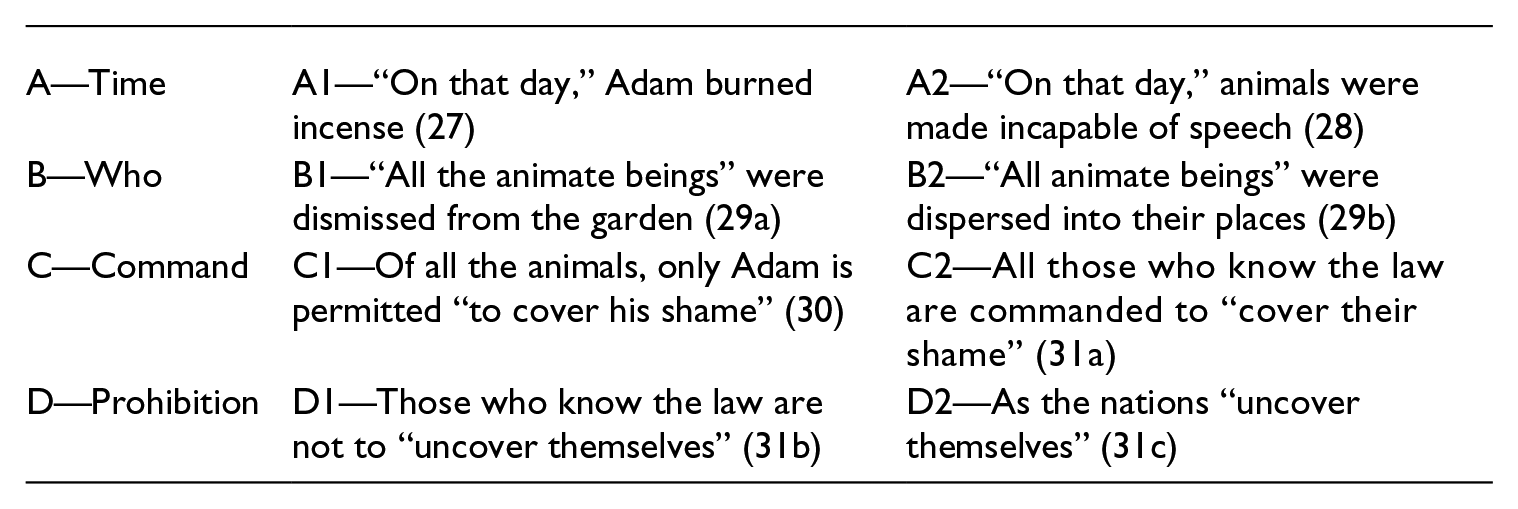
The exact time given for the animals’ loss of speech follows the same time frame given for Adam’s burning of incense. This prioritization of chronology reflects Jubilees’ usual pattern and purpose, unlike the focus in Genesis on the event itself rather than the exact date of its occurrence. Verse 29 also has two parallel sentences regarding who is involved in dismissal and dispersal from the garden. In this case, Adam is included with the animals by the phrase “all animate beings.” The commands in vv. 30 and 31a return to distinguishing between Adam and other creatures. In v. 30, Adam is permitted to cover his shame, but the animals are not; v. 31a turns this permission into a command. The rest of v. 31 consists of a prohibition not to uncover one’s shame (a double negative), this time distinguishing between the descendants of Adam who know the law and the nations who uncover themselves (seemingly through disregarding the law, rather than through ignorance of it).
Further parallels with Jub. 3:17–26 strengthen the prominence of this structure for vv. 27–31. Verse 17 begins with the specific time frame (“on the second month, 17th day”) 11 and continues by describing “all the fruits,” which is at least a verbal similarity with the phrase “all the animate beings” in v. 29. In vv. 21 and 22, Eve “covered her shame,” and Adam “covered his shame,” paralleling the commandment given in v. 31a to cover nakedness. 12 Finally, God clothed the humans and dismissed them (v. 26), which is a contrasting parallel to the nations who do not cover themselves (v. 31).
Although it may seem at first that those who do not know the law in v. 31 include the animals, v. 30 implies that animals do have some knowledge of the law. The animals are simply described as naked, but as not “permitted” to cover their shame, implying that they realize their lack of clothing in comparison with humans, at least on some level. Although this would likely not apply to all creatures (as there is a hierarchy of sentience even among animals), a parallel with the nations is clear, along with the hint of a continuum concerning knowledge of the law in God’s creation, with Jews at the top. 13
Comparison with Genesis 3
In comparison with Genesis, the author of Jubilees does a lot of gap-filling in this passage, providing information concerning animals that is not found in Genesis, often resulting in the harmonization or resolution of apparent contradictions. 14 The priesthood of Adam is made much more explicit, as he actually offers sacrifices and is clothed in priestly garments. Jubilees thus establishes Eden as a place of ritual purity and even a sanctuary (cf. Jub. 4:25; 2 Enoch 69–72), even though no mention is made of animal sacrifice. 15 Jubilees also underlines the requirement to wear clothes as a divine command (no longer just for priests, as in Exod. 20:26; 28:42), by addressing why only humans wear clothes. The separation between Adam and other impure nations (that act like the animals, only worse) is also a focus in this passage in contrast to Genesis. 16
In addition, Jubilees omits and changes some of the details in the narrative of Genesis. First, Jubilees downplays the consequences of human sin, even suggesting that death resulted from the sin of angels and/or demons (e.g. 7:20–24). 17 Second, Jubilees 3 condenses the curses for both the serpent and the humans, in comparison with Genesis. 18 Within the curses, Jubilees gives no rationale for the curse of the serpent, the serpent is not compared with the other animals, no enmity between the serpents and humans is mentioned, and God gives no physical consequences to the serpent. Indeed, God does not even address the serpent directly, and v. 23 says only that “the Lord cursed the serpent and was angry at it forever.” In v. 26, God specifically uses animal skins to make clothing for Adam and Eve before dismissing them from the garden.
In light of many of the above suggestions of human moral superiority over animals, v. 28 is even more surprising. The author of Jubilees writes, on that day the mouths of all the animals, the cattle, the birds, everything that walks and everything that moves about were made incapable of speaking because all of them used to converse with one another in one language and one tongue.
The author of Jubilees assumes that animals talked to one another, but lost that ability after sin. Contra Genesis (1:29–30; 9:2–4), Jubilees seems more interested in the words from the mouths of the creatures than in what food they are to put in their mouths. Thus, concerning animal speech, Jubilees should be contrasted more than compared with Genesis.
Animal rationality
Although our modern mind-set finds this concept of animal conversation somewhat fantastical, the biblical record, like Jubilees, is not silent on the matter. In addition to the speech of the serpent in Genesis 3, the Bible also portrays Balaam’s donkey as speaking to him in Numbers 22. Indeed, the narrator does not portray the donkey with speech patterns or formulas common in folklore or biblical nature personification, but as a self-aware and round character, 19 who brings awareness of sin to her owner in a clear and honest manner. 20 The donkey’s mouth is “opened” (פתח), which also fits with the idea in Jubilees of animals originally having speech, not being given speech. In contrast, animals in other ancient Near Eastern texts only talk in human speech to deities or other animals, not humans. 21
The Bible also portrays animals as crying out in suffering and praise to God, using verbs normally applied only to human speech. In Job 38:41 and Ps. 147:9, baby birds cry out (קרא) to God for lack of food. In Jonah 3:7–8, animals along with humans are to fast and cry out (קרא) to God for deliverance from the destruction of Nineveh (cf. Rom. 8:22). Joel 1 depicts animals as the only ones lamenting (אנח) and articulating their needs (ערג) to God. Psalms 148 and 150 portray all living things as praising (הלל) God (cf. Rev. 5:13). Animals even honor (כבד) God at times when humans do not (Isa. 43:20), and Job 40–41 depicts the Leviathan as making a covenant (כרת) with God.
However, Jubilees portrays animals as even more rational than in the Bible. Language is important to Jubilees and is original to creation. Thus, it seems that even animals spoke Hebrew in the beginning. 22 Targum Neofiti (Genesis 11:1) may also hint that animals could speak with humans and each other: “and all the inhabitants of the earth were of one tongue and one speech, and in the language of the Temple they used to converse, for through it had the world been created in the beginning.”
Others writing around the time of Jubilees also unquestioningly accepted the idea of original animal speech. Josephus notes that at that time, “all the creatures spoke a common tongue” (Jewish Antiquities 1:41; cf. 1:50). Philo concurs, “it is said that, in olden times … snakes could speak with a man’s voice” (On the Creation of the World, 156). The Life of Adam and Eve (37:1–3) records the story of a serpent biting Seth while he was walking with Eve. Eve curses the serpent because it was not afraid to set itself against a human as the image of God, but the serpent “answered in a human voice: ‘O Eve, is not our enmity against you?’” 23
Various theories in early Christianity about what this speech might have entailed range from actual conversation between humans and animals, 24 to the ability of humans to understand animal modes of communication, 25 to the animal speaking the words put in its mouth by either Satan or God. 26 Thus, Jubilees 3 is not alone in attributing greater rationality and communication to animals than most modern commentators allow. However, despite current scientific research on animal language and speech that also suggests that many animals “talk” to each other and sometimes even other species on a fairly regular basis, 27 even exhibiting empathy and self-awareness, 28 any hint of animal speech is usually ignored, anthropomorphized, or even mocked when scholars consider theological and biblical pictures of animals. 29
Animal accountability in solidarity with humans
Animals are not only more rational in Jubilees, but the author also portrays them with a similar level of accountability for their actions as humans. 30 In Jub. 3:27–31, God allowed only Adam to cover his nakedness, not the animals. This seems to imply that the animals desired on some level to cover their nakedness, but were not permitted. However, along with Adam, all humans are commanded by the law to cover their nakedness. Since the nations do not cover their shame, Jubilees condemns them even more than the animals. At least the animals have a valid reason for being naked, but the nations have no excuse for disobeying the law.
This comparison/contrast between the two different groups of humans should not be considered an out-of-context addition by a later redactor. 31 Instead, the punishment given to animals for their part in causing humans to sin seems to remind the narrator about the nadir to which the nations have descended through their nakedness. Adam and Eve covered their shame when they realized that they were naked. The animals appear to have wanted to cover their shame as well. But the nations blatantly refuse to cover their shame, and indeed actively “uncover themselves” (3:31). 32
However, this portrayal of animals as more righteous than the nations conflicts with the greater punishment that animals receive: complete loss of speech and actual prevention from wearing clothes. Jubilees does not give a clear reason for this, but two possibilities arise from a closer examination of the text. First, Jub. 3:16 may provide a hint, noting that Adam would “guard the garden against birds, animals, and cattle.” This apparent explanation for the use of the word שׁמר in Genesis 2:15 seems to be the only way that Jubilees could understand the meaning of Adam’s charge to “guard” the garden. In actuality, the Hebrew verbs in Genesis 2:15 are the same words often used together for the duties of the priests in relation to the Temple (Num. 3:7–8; 8:26; 18:5–6). It is intriguing that, given Jubilees’ focus on the origin of the priesthood, this connection does not seem to be made here. Instead, the subsequent deception by the serpent influences Jubilees’ interpretation of Genesis. It appears as if some of the animals may not have been allowed in the garden, but the serpent snuck in anyway, and disaster resulted.
33
Perhaps the serpent, as the wisest of all the animals, either led the way of a rebellion or was best able to trick the humans because of its wisdom.
34
The L.A.E. concurs that the serpent is responsible for the deceit on some level: And the devil spoke to the serpent, saying, “I will tell you a word whereby you may have profit … I hear that you are wiser than all the beasts … Rise up and we will cause [Adam] to be cast out of paradise.” (16:1–5; cf. 3 Bar. 9:7)
35
If this is the case, Jubilees also implies that the animal expulsion from the Garden, or at least the dispersal of the animals into the places “which had been created for them” (3:29), was actually a return to the states at the beginning of creation, rather than a new situation. 36 In addition, the text could imply some sort of disorder among the animals, or at least an intended eventual change after God dismissed them, that was a part of God’s original plan.
The second possibility is that, in some way, the punishment of all animals because of the snake parallels that of the punishment of all humans because of Adam’s sin. Most scholars interpret the expulsion of the animals along with Adam and Eve as resulting from the use of speech by the serpent to tempt Eve. Because the snake spoke in words, all animals are no longer allowed to talk. 37 This corporate solidarity among the animals is perhaps the reason that Jubilees includes less accusation of the snake than in Genesis. Jubilees may not see a devil in the snake’s speech, and so all animals are punished as a group in Jubilees, rather than as a single species as in Genesis.
This second case seems more likely in the context of the passage. “All animate beings” are dismissed together from the garden, already implying solidarity between humans and animals, so it would make sense that a similar solidarity would exist among animals as a group (3:29). 38 In addition, as the next section shows, Jubilees 3 aligns with Jubilees 10, where the conversing together in one tongue led to a unifying insurrection and rebellion that God had to deal with by confusing human tongues. Here, in Jubilees 3, the animals are portrayed as directly involved in leading humans to sin, so the punishment goes beyond confusion of tongues to loss of speech altogether.
Animal culpability
Just as animals are accountable in comparable ways to humans, even with a sense of corporate solidarity with each other and with humans as fellow animate beings, Jubilees portrays animals as culpable for wrongdoing, even sin and corruption, just like humans. As noted above, the parallels between Jubilees 3 and 10 suggest a greater significance to the loss of animal language in Jub. 3:27–31. The combination of initial unity in language, subsequent loss of language, and dispersion by God, as seen in the following chart, suggests an intentional correlation. Perhaps this is even why Jubilees omits Genesis 10, as the loss of one universal language happened already with the animals. 39
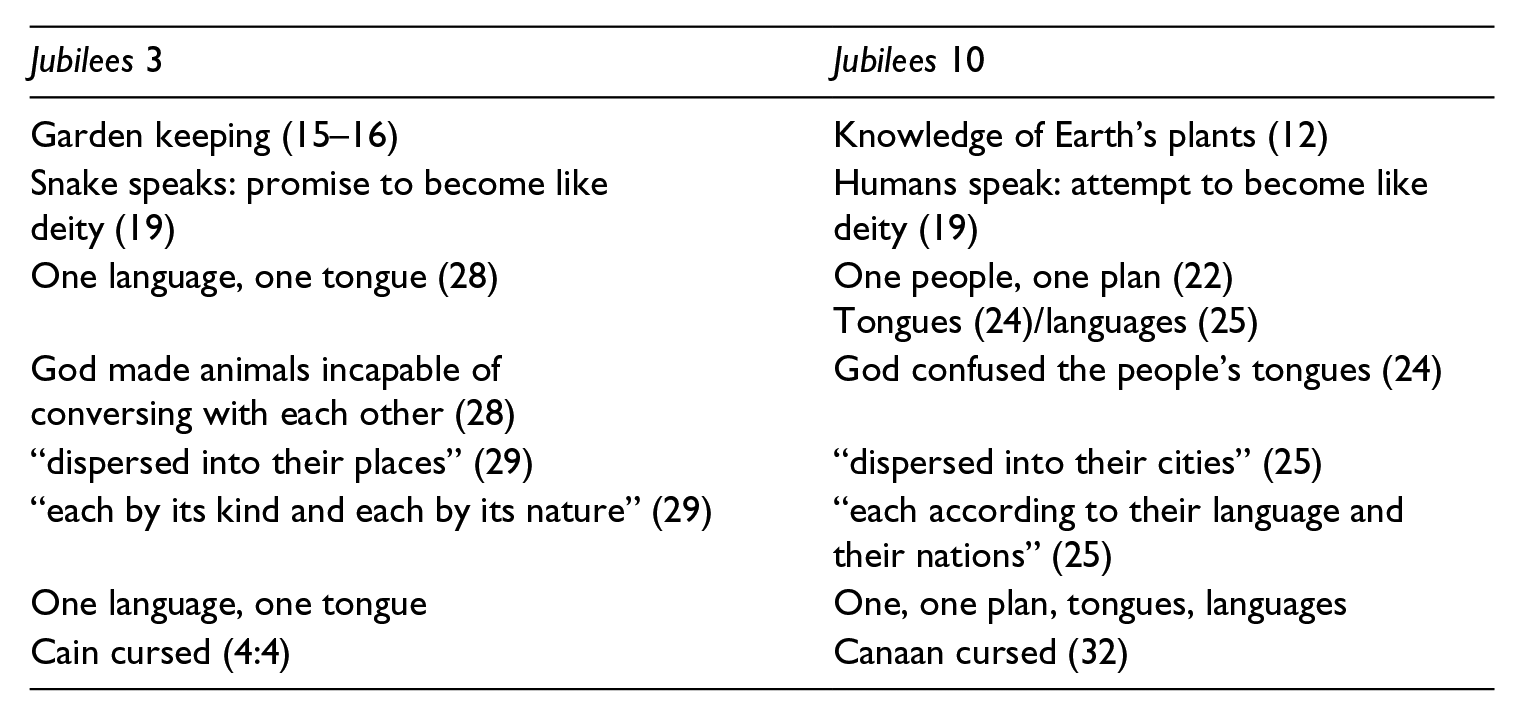
The connections between the speech of the serpent and the speech of the humans involve becoming like God. This idolatrous attempt seems to be the main reason why the punishment in each case is so harsh. 40 From one language and one tongue, the animals are no longer able to speak with each other, or even speak at all. The one plan and one language of the humans in Jubilees 10 turns into confusion, where the people are no longer able to speak with each other or understand other tongues and languages. In both cases, dispersion occurs in groups, according to similarities between them. God himself does the punishing in each case, increasing the weight of culpability and sin.
The similar outcome for humans at Babel shows the low point to which humans had reached, and it conversely increases the accountability and rationality ascribed to animals. 41 Jubilees 10 explains the diversity of kinds of humans, thus suggesting that Jubilees 3 originally posited much more similarity and companionship between differing species of animals. 42
Most scholars separate the prohibition on nakedness and the culpability of animals, explaining that Jub. 3:27–31 only notes the punishment of animals because they were used to tempt humans. However, the text gives the reason for the loss of animal speech as “because all of them used to converse with one another in one language and one tongue” (3:28). This hints at animal culpability concerning unity of speech, whether the animals devised some sort of an evil plan to take over humanity (just as humans did at Babel to God), or are simply associated with the serpent’s sin because they could all talk together. Other ancient interpreters see the culpability of animals as a possibility as well, implying that animals were in some way responsible for the sin of humans by acquiescing to evil. 43
Thus, although Jub. 3:27–31 does not directly state that animals commit sin, the scope of their punishment, the comparison to human idolatry at Babel, and the similar punishment given to humans and animals in Eden, all suggest that Jubilees portrays animals as more culpable for their wrong actions than Genesis does.
Other relevant passages in Jubilees
Although Jubilees 3 contains the only direct mention of animal speech in Jubilees, there are several other passages that shed light on animal rationality, the solidarity between humans and animals, and animal culpability/accountability.
In Jubilees 11, Prince Mastema sends ravens to destroy the agricultural efforts of humans and reduce them to poverty. However, Abram has a special gift to influence the ravens to leave human fields alone. 44 Interestingly, Abram not only chases away the birds but also speaks to them and commands them to “return to the place from which you came” (11:19). Under normal circumstances, birds do not go far away from abundant food for long, even when chased. But in the case of Abram, “all of the ravens returned (to their place),” implying that the ravens also understood Abram’s words. 45
Thus, in Jubilees 11, the animals understand human speech and obey human commands. Although the ravens were originally doing wrong by eating the humans’ food, they did not resist Abram’s command to return to their place. This “place” might even refer back to Jub. 3:29, which states that all the animals were dispersed “into the place(s) which had been created for them.” Perhaps this obedience of the ravens, even though belated, can be contrasted with the disobedience of Abram’s family, which both precedes and follows the story of the ravens (11:2–6; 12:1–8). In Jubilees 11, the ravens are not only more rational than in Genesis, but are also contrasted with the unfaithful humans and portrayed as accountable for their actions and more righteous than Abram’s idolatrous and unbelieving family.
Esau’s reply to Jacob in Jubilees 37 also refers to animal sentience and possible speech. He proclaims, Neither mankind nor animals have a true oath which they, once they have sworn, have sworn (it as valid) forever. Every day they aim at what is bad for one another and at each one killing his enemy and opponent. (37:18)
Thus, Esau contends that neither humans nor animals can keep their promises. However, he then proceeds to base his argument on the consistency of animal behavior and characteristics. For instance, he notes that “if wolves make peace with lambs so that they do not eat them or injure them; and if they have resolved to treat them well, then there will be peace in my mind for you” (37:21). In other words, Esau justifies his desire to kill Jacob by the perpetual hatred present between prey and predator. Because many animals do not make peace or befriend each other, Esau believes that Jacob also “will hate me and my sons forever” (37:19). Although this hyperbolic reasoning does not raise animals above the level of humans, Esau is at least equating them and their sinful natures (in breaking oaths) with humanity on some level. Again, Jubilees portrays animals as rational and culpable for their actions, even being accountable on a comparable level to humans concerning relationships and oaths.
Both Exodus and Jubilees consider animals to be a part of the children of Israel, as well as Egyptian households. Jubilees 48:5 notes that God brought many plagues on Egypt, including killing “their first-born of men and cattle” (cf. Exod. 11:5; 12:12), but destroyed none of the Israelites, “from cattle to mankind to dogs” (Jub. 49:4; cf. Exod. 11:7). Interestingly, these and other texts suggest that companionship/solidarity between humans and animals was one of the reasons that God punished and/or blessed animals along with humans (Jub. 20:9–10; 23:17–18; 44:3; 50:7, 12).
The book of Jubilees also illustrates this capacity for companionship between humans and animals when Adam observes the relationships between the animals (3:1–4). In contrast to Genesis, Jubilees portrays the naming of the animals as an opportunity for Adam to discover his own needs for a companion, rather than as an apparently mistaken attempt on God’s part to find a companion for Adam. After seeing the togetherness and camaraderie between the animal pairs, Adam longs for someone of his own kind to be in relationship with. 46
In addition, Jubilees heightens the sinfulness and corruption of “all animate beings” before the flood (5:2), again connecting human and animal accountability. Although it seems that the animals committed injustice only after the demons and humans had done so (7:23–24), Jubilees still presents animals as having “corrupted their prescribed course, and (that) all of them—everyone that was on the earth—had acted wickedly” (5:3). 47 The punishment for animals is analogous with punishment for humans, interconnecting animal sin with human sin, and also hinting at the notion of solidarity among all living things as in Eden. In the flood story, Jubilees focuses more on the rationality and human-like accountability of animals than Genesis does, perhaps to more clearly exonerate God for destroying all life in the flood.
However, unlike Genesis, Jubilees does not include animals in the covenant God makes with Noah. 48 This initially might seem to counteract the notion of greater animal rationality and accountability in Jubilees, but Gilders makes an intriguing connection that resolves this contradiction. He states concerning the Noahic covenant that “a covenant made—in theory—with all humankind [in Genesis], becomes a covenant only with Israel [in Jubilees]. God’s universal commitment to the whole of creation finds expression in a special commitment to one part of humanity.” 49 Thus, what might initially seem to make animals more inferior than in Genesis actually serves to denigrate the rest of the nations to the level of animals and, once again, in some way equates animals to humans. Therefore, in the rest of Jubilees, just like in Eden, animals are rational, culpable for their sinful actions, and at least equally accountable with the nations.
Conclusion
Jubilees 3:27–31 explains the command to cover one’s nakedness, and the connections with animal speech help to elucidate the reasons for this law. Several lines of interpretation are interwoven in this passage, relating back to the purposes of Jubilees; one explanation of the commandments regarding nakedness is not sufficient to make sense of all the aspects of the text concerning animals. First, Jubilees implies a sort of equality/solidarity between humans and animals due to their sin/impurity, stating that “all animate beings were dispersed—each by its kind and each by its nature—into the place(s) which had been created for them” (3:29–30). Jubilees thus groups Adam among the other animals as being dispersed from the garden into the place created for him. Second, in the law itself, the Jews are not to uncover themselves, in order to separate themselves from the nations who do. Thus, the nations are portrayed as even worse than the animals, who at least have an excuse for not covering their shame—God does not permit them to do so. Third, Adam is also to be distinguished from the animals, who share the judgment of no longer being able to speak with one another. The parallels between Jubilees 3 and 10 imply solidarity between animals and humans, but even greater culpability of animals than humans, as animal speech caused humans to sin. Jubilees 3 thus heightens the importance of Torah prohibitions on idolatry: human rebellion results in loss of a single language, while animal rebellion results in loss of language altogether.
Thus, although Jubilees 3 initially seems to present a somewhat conflicted view on animal sentience (in that the focus in Jub. 3:27–31 seems to be on ritual purity and the priesthood of Adam), upon closer inspection, the author highlights and includes animals throughout the passage in surprising ways. Despite the portrayal of Eden as a sanctuary, Adam does not offer animals as sacrifices in this passage. God directly forbids animals from covering their nakedness, in contrast to humans, but then dismisses animals and humans together from the garden. Even though God does not directly address the serpent with speech (perhaps as retribution for its use of speech to deceive), Jubilees portrays animals as more rational than in Genesis, as they originally talked and conversed with each other and apparently also with humans. This shared rationality and identity between all animals results in all losing their speech. Animals also share identity/companionship with humans, in that all creatures are dismissed from the garden together, but animals are more culpable for their actions in Jubilees than in Genesis, as God punishes all of them for the snake’s involvement in human sin.
Thus, animals are portrayed in Jubilees with more rationality, culpability, and even solidarity with humans than in Genesis. The one exception is that animals are not allowed to cover their nakedness, and yet they still end up in a more positive light than the nations. Apparently, despite the greater culpability and punishment ascribed to the animals in the narrative of the fall, the author of Jubilees would rather become a mute and naked animal than to be found like the nations, willfully uncovered and in shame.
Footnotes
Declaration of conflicting interests
The author(s) declared no potential conflicts of interest with respect to the research, authorship, and/or publication of this article.
Funding
The author(s) received no financial support for the research, authorship, and/or publication of this article.
1.
Most evidence points to the writing of Jubilees originally in Hebrew in the 2nd-century BCE. See J.C.VanderKam, Textual and Historical Studies in the Book of Jubilees (HSM 14; Missoula: Scholars Press, 1977); J.C.VanderKam, “The Putative Author of the Book of Jubilees,” Journal of Semitic Studies, 26, 1981, pp. 209–17; R.H.Charles, The Book of Jubilees or the Little Genesis (London: Adam and Charles Black, 1902); J.Kugel, Traditions of the Bible: A Guide to the Bible as It Was at The Start of The Common Era (Cambridge: Harvard University Press, 1997), and many others. All translations are from J.C.VanderKam (ed.), The Book of Jubilees, vol. 2 (CSCO 511; SA 88; Louvain: E. Peeters,  ).
).
2.
For further discussion on this, see J.T.A.G.M.van Ruiten, Primeval History Interpreted: The Rewriting of Genesis 1-11 in the Book of Jubilees (JSJS 66; Leiden: Brill, 2000); M.Segal, The Book of Jubilees: Rewritten Bible, Redaction, Ideology, and Theology (JSJ Sup 62; Leiden: Brill, 2007); J.C.VanderKam, “The Scriptural Setting of the Book of Jubilees,” Dead Sea Discoveries, 13, 2006, pp. 61–72; F.G.Martínez, “The Heavenly Tablets in the Book of Jubilees,” in M.Albani, J.Frey and A.Lange (eds), Studies in the Book of Jubilees (TSAJ 65; Tübingen: Mohr Siebeck, ), pp. 243–60.
3.
4.
5.
Ruiten notes that “the halakha concerning the covering of nakedness is even written in the heavenly tablets” (Primeval History Interpreted, 88).
6.
7.
L.Ravid, “Purity and Impurity in the Book of Jubilees,” Journal for the Study of the Pseudepigrapha, 13, 2002, pp. 61–86; M. Himmelfarb, “Earthly Sacrifice and Heavenly Incense: The Law of the Priesthood in Aramaic Levi and Jubilees,” in R.Boustan and A.Y.Reed (eds), Heavenly Realms and Earthly Realities in Late Antique Religions (Cambridge: Cambridge University Press, ), pp. 103–22.
8.
W.Loader, Enoch, Levi, and Jubilees on Sexuality: Attitudes toward Sexuality in the Early Enoch Literature, The Aramaic Levi Document, and the Book of Jubilees (Grand Rapids: Eerdmans, 2007), p. 292. Other reasons given for the law against nakedness are many and varied. Some scholars find this to be a polemic against Hellenism (J.Goldstein, “Jewish Acceptance and Rejection of Hellenism,” in E.P. Sanders (ed.), Jewish and Christian Self-Definition. Vol. 2: Aspects of Judaism in the Graeco-Roman World [Philadelphia: Fortress, 1981], pp. 64–87), whereas others see an inner-Jewish polemic, as Qumran had other prohibitions against nudity (Segal, The Book of Jubilees, p. 321). A very specific argument suggests that nakedness in antiquity was culturally complex and finds that male nakedness was wrong only when next to a holy place or in front of subordinates; female nakedness was only improper if males saw it (M.Satlow, “Jewish Constructions of Nakedness in Late Antiquity,” Journal of Biblical Literature, 116, 1997, pp. 429–54; L.M.Epstein, Sex Laws and Customs in Judaism [New York: Ktav, 1948]). Apparently, priests went to a Gentile gymnasium that was near a temple (Ruiten, Primeval History Interpreted, 88; cf. 1 Macc. 1:14, 15; 2 Macc. 4:9, 12–15). Others critique the ruling priesthood as simply being impure in general or make a more sectarian indictment (L.H.Schiffman, “Halakhah and Sectarianism in the Dead Sea Scrolls,” in T.Lim (ed.), The Dead Sea Scrolls in Their Historical Context [Edinburgh: T&T Clark, ], pp. 123–42). For further discussion on impurity, see M.Himmelfarb, “Sexual Relations and Purity in the Temple Scroll and the Book of Jubilees,” Dead Sea Discoveries, 6, 1999, pp. 11–36; J.C.VanderKam, “Viewed from Another Angle: Purity and Impurity in the Book of Jubilees,” Journal for the Study of the Pseudepigrapha, 13, 2002, pp. 209–15; J.Milgrom, “The Concept of Impurity in Jubilees and the Temple Scroll,” RevQ, 15, 1993, pp. 277–84; C.Werman, “The Concept of Holiness and the Requirements of Purity in Second Temple and Tannaitic Literature,” in M.J.H.M.Poorthuis and J.Schwartz (eds), Purity and Holiness: The Heritage of Leviticus (JCPS 2; Leiden: Brill, 2000), pp. 163–79; Ravid, “Purity and Impurity.”
9.
Satlow, “Jewish Constructions of Nakedness”; L.R.Ubigli, “The Historical-cultural Background of the Book of Jubilees,” in G.Boccaccini (ed.), Enoch & Qumran Origins: New Light on a Forgotten Connection (Grand Rapids: Eerdmans, 2005), pp. 137–40; J.J.Collins, “The Epic of Theodotus and the Hellenism of the Hasmoneans,” Harvard Theological Review, 73, 1980, pp. 91–104; VanderKam, ‘Origins and Purposes’; J.Baumgarten, “Purification after Childbirth and the Sacred Garden in 4Q265 and Jubilees,” in G.J.Brooke and F.G.Martínez (eds), New Qumran Texts and Studies (STDJ 15; Leiden: Brill, ), pp. 3–10.
10.
Ruiten, Primeval History Interpreted, p. 106.
11.
For discussion on the apparent conflicting chronologies within Jubilees, see VanderKam, Jubilees 1-21, pp. 223–4.
12.
13.
As will be shown later, the culpability of animals also implies some sort of knowledge of the law (e.g. Genesis 9:5, 6; Exod. 19:13; Lev. 20:15–16; Jubilees 5; 7; 37; 50).
14.
Ruiten, Primeval History Interpreted, p. 110.
15.
I.Fröhlich, “Enoch and Jubilees,” in G.Boccaccini (ed.), Enoch and Qumran Origins: New Light on a Forgotten Connection (Grand Rapids: Eerdmans, ), p. 146; P.T.Lanfer, “Allusion to and Expansion of the Tree of Life and Garden of Eden in Biblical and Pseudepigraphical Literature,” in C.G.Evans and H.D.Zacharias (eds), Early Christian Literature and Intertextuality, vol. 1: Thematic Studies (SSEJC 14; London: T&T Clark, 2009), p. 99. Scott notes that the emphasis on expulsion from the Garden parallels the exile of Israel from the land, and just as in Jub. 1:13, 19, the text is concerned that Israel in exile will act like the nations (On Earth as in Heaven: The Restoration of Sacred Time and Sacred Space in the Book of Jubilees (JSJSup 91; Leiden: Brill, 2005), p. 135.)
16.
Loader, Enoch, Levi and Jubilees, p. 148.
17.
Scott, On Earth as in Heaven, p. 136. Jubilees also omits Genesis 3:8–13, where God seems innocent and uninformed. For other comparisons and contrasts between Jubilees and Genesis, see J.T.A.G.M.van Ruiten, “The Creation of Man and Woman in Early Jewish Literature,” in G.Luttikhuizen (ed.), The Creation of Man and Woman: Interpretations of the Biblical Narratives in Jewish and Christian Traditions (Themes in Biblical Narrative Jewish and Christian Traditions 3; Leiden: Brill, ), pp. 34–62.
18.
C.Werman notes that Adam’s punishment is much less, including God not being angry with him (Jubilees, pp. 187–8).
19.
Howard notes that “remarkably, rather than point to the fiery supernatural being blocking the road, the donkey appeals to the companionship—albeit a companionship forged through servitude—she and Balaam have shared. She puts her own subjectivity first …. The fullness of the donkey’s characterization at this point in the story contrasts with the deflation of Balaam’s importance” (“Animal Speech as Revelation,” in N.C.Habel and P.Trudinger (eds), Explaining Ecological Hermeneutics [SBL Sym 46; Leiden: Brill, 2008], p. 27). Savran contends that the donkey speaks in a natural manner, clarifying Balaam’s confusion rather than complicating it, exhibiting a deeper understanding of human–divine relationships than Balaam, even asking to save her master. The donkey is “the exemplar of obedience and submission to divine authority” (“Beastly Speech: Intertextuality, Balaam’s Ass, and the Garden of Eden,” Journal for the Study of the Old Testament, 64, , p. 51).
20.
Targum Neofiti (Num. 22:30) expounds on this with the following words of the donkey: “where are you going, wicked Balaam? O foolish one! If you are unable to curse me, an unclean beast who will die in this world and will not enter the world to come, how much less are you capable of cursing the sons of Abraham, Isaac, and Jacob for whose future merit the world was created and whose merit attaches to them?” 2 Peter 2:15–16 also hints at the donkey’s role in accusing Balaam.
21.
Howard notes an exception in an Egyptian tale, where a snake aids the shipwrecked sailor and “prophetically assures him that he will soon reach home again” (“Animal Speech as Revelation,” p. 23).
22.
VanderKam sees this possibility as well, referencing Jub. 12:26 about Hebrew as the language of creation (Jubilees 1–21, p. 229). Ruiten notes that “it was universally believed among Jews that Hebrew was the primitive language of man … God also spoke Hebrew when creating the world” (Primeval History Interpreted, p. 107). See also j. Megillah 1:11; Targum Pseudo-Jonathan Genesis 11:1 (“and all the inhabitants of the earth were of one tongue and one speech and one counsel”).
23.
The Syriac Testament of Adam lists many creatures and the hours of the day in which they praise God, including fish, flying creatures, and every animal. Wisdom of Solomon 15:18–16:1 also talks of differing levels of animal rationality, “and the Egyptians worshiped the most hateful animals, which are worse than all the others when judged by their lack of intelligence.” Although an allegorical/metaphorical use of animals, the Animal Apocalypse of 1 Enoch at least implies that animals have different characteristics and responses to certain situations and can express this in some fashion.
24.
For instance, John of Damascus wrote that “before the fall … the serpent was on intimate terms with man, associating with him more than all the rest and conversing agreeably with him” (Orthodox Faith 2.10). See also Ephrem the Syrian, Commentary on Genesis 2.9.3.
25.
Ephrem the Syrian theorized that “the serpent posed the question in his mind and speech was given to it” (Commentary on Genesis 2.16.t).
26.
For example, Severian of Gabala contends that “since it was a creature who held such great closeness to humanity, the snake was a convenient tool … when the devil noticed the snake’s intelligence and Adam’s high opinion of it … the devil spoke through the snake so that Adam would think that the snake, being intelligent, was able to imitate even human speech” (On the Creation of the World 6.2).
27.
B.Hölldobler and E.O.Wilson, The Ants (Cambridge: Belknap Press, 1990); S.J.Shettleworth, Cognition, Evolution and Behavior, 2nd ed. (Oxford: Oxford University Press, ).
28.
29.
30.
VanderKam hypothesizes that animal culpability may be greater than for humans, as they all spoke with each other before sin, but none spoke after sin, unlike humans (Jubilees 1–21, p. 229).
31.
Contra Segal, The Book of Jubilees.
32.
The Ethiopic text of v. 30 indicates that it is a divine gift for humans to be able to clothe their nakedness (VanderKam, Jubilees 1–21, 230).
33.
Ephrem the Syrian follows this line of thought, stating that “Satan was not permitted to send any of the Angels … nor to come himself to Adam in the Garden, neither in human appearance nor in a divine vision … rather, a serpent was allowed to come to them which, although clever, was utterly despicable and hideous” (Commentary on Genesis 2:18). Perhaps because the serpent was unclean, its presence would make the garden sanctuary impure, unlike the other animals that were allowed inside (hinted in 3:29).
34.
35.
Even though Veenker contends that the snake seems less of a moral agent than in Genesis, he argues that the snake must talk to absolve God of the “charge of an unjustified cruelty to an innocent animal,” still implying that it is responsible for the deceit on some level (“That Fabulous Talking Snake,” p. 270).
36.
Loader, Enoch, Levi and Jubilees, p. 283. Scott contends that the expulsion in Genesis seems irreversible and applies only to Adam, but that Jubilees significantly expands the MT by repeatedly emphasizing the fact of expulsion, in vv. 27, 29, and 32 (On Earth as in Heaven, p. 134).
37.
For instance, see Ruiten (Primeval History Interpreted, p. 107).
38.
VanderKam notes that the word for “nature” in Jub. 3:29 is the same as the word for the “origin of the woman” in 3:5 (Jubilees 1-21, p. 229).
39.
Ruiten (Primeval History Interpreted, p. 348) notes this connection, but does not detail the similarities.
40.
Liber Antiquitatum Biblicarum (6.4; 7.5) implies that the snake was idolatrous as well because of the comparison. Chronicles of Jerahmeel expounds on L.A.B. by noting that “when they began to build the tower, the Lord confused their speech and changed their form to the form of monkeys … in this way their evil designs were frustrated” (30:5). This change into animals seems to parallel the greater culpability and idolatry of animals in Jubilees.
41.
Stuckenbruck compares Jub. 3:27–31 and 10:26, noting that both entail “the breaking up of one mode of communication into many in accordance with each kind and location of animal” (“The Book of Jubilees and the Origin of Evil,” in G.Boccaccini and G.Ibba (eds), Enoch and the Mosaic Torah: The Evidence of Jubilees [Grand Rapids: Eerdmans, ], p. 307).
42.
Ruiten, Primeval History Interpreted, p. 107.
43.
For instance, the Apocalypse of Moses 16:4 states that “the devil said to him: ‘do not fear, only become my vessel, and I will speak a word through your mouth by which you will be able to deceive’.” In addition, Ephrem the Syrian states that God punished and judged the serpent, implying some sort of culpability, also contending that “at the end, at the time of resurrection, God will require that animals return all they ate from the flesh of man” (Commentary on Genesis 2.29.t; 6.15.1–2). The Letter of Aristeas forbids birds that “dominate by their own strength and who find their food at the expense of the aforementioned domesticated birds, which is an injustice” (pp. 144–7). All of these texts imply culpability for animals.
44.
Knowles notes that “the effectiveness and authority of young Abram’s prohibition is repeatedly emphasized” (“Abram and The Birds in Jubilees 11: A Subtext for the Parable of the Sower,” New Testament Studies, 41, 1995, p. 146). Crawford’s creative explanation of this passage in relation to Genesis 15:11, while intriguing, contains some convoluted and eisegetical evidence, so I find it unconvincing for the most part (“On the Exegetical Function of the Abraham/Ravens Tradition in Jubilees 11,” Harvard Theological Review, 97, , pp. 91–7).
45.
VanderKam points out that they are not able to speak anymore, so they make “inarticulate, ugly sounds” although they obey Abraham (Jubilees 1–21, p. 435).
46.
Philo states that “to the first man … they [the animals] were indeed rather like military forces and allies [and in that sense a’ help’]” (Questions and Answers in Genesis 1:18). Loader concurs, noting that, in Jubilees, “the focus is less on helper and more on companion” (Enoch, Levi and Jubilees, p. 286).
47.
Gilders notes that all animals “followed the lead of the demigods and humans in committing injustice” (“Blood and Covenant: Interpretive Elaboration on Gen 9:4-6 in the Book of Jubilees,” Journal for the Study of the Pseudepigrapha, 15, 2006, p. 106). See also J.T.A.G.M.van Ruiten, “The Interpretation of The Flood Story in The Book of Jubilees,” in F.G.Martinez and G.P.Luttikhuizen (eds), Interpretation of the Flood (Themes in Biblical Narrative 1; Leiden: Brill, ), pp. 66–85.
48.
49.
W.K.Gilders, “The Concept of Covenant in Jubilees,” in G.Boccaccini and G.Ibba (eds), Enoch and the Mosaic Torah: The Evidence of Jubilees (Grand Rapids: Eerdmans, ), p. 187. On a similar note, Scott links the exile of Adam with that of Israel and sees the trajectory between the primeval sanctuary and eschatological Temple on Zion to “suggest that the final resolution to both exiles converges in the future restoration of Israel” (On Earth as in Heaven, p. 135).