







Abstract
This article proposes an integrative analysis of the ouranology of 3 Baruch. This apocalyptic work, properly read, manifests complex ouranological conceptions well integrated not only into early Jewish literature and Hellenistic thought, but also into later mystical traditions. The unique worldview of the book has heretofore given rise to a complex set of interpretive problems; the detailed comparative approach of the present article not only provides a reasonable solution, but also sheds light on the cosmological conceptions of other early Jewish documents and the traditions lying behind them.
,לעילוי נשמתם של רעיי ומוריי ברוך ברמן וברוך שוורץ .יהי זכרם ברוך This article proposes an integrative analysis of the ouranology of 3 Baruch. Its aim is not only to provide the solution for a complex knot of problems arising in connection with the unique worldview of this book, but also, by means of such a solution, to shed light on the cosmological conceptions of other early Jewish documents and the traditions behind them.
Tri- or bipartite cosmos?
The physical world of 3 Baruch consists of earth and heaven; no mention of the netherworld is made. Hades (ch. 4–5) and the sources of fruitful waters (10:6-9) are all in heaven. The rivers are mentioned (2:1G; 4:7G; 4:5 S), 2 but their abyssal sources are not referred, and the word “abyss,” even in a figurative sense, never appears. If 3 Baruch still reflects the tripartite cosmos, it is not the three realms of the Mesopotamian and ancient Israelite models as defined in Ex 20:4 and Deut 5:8: “heaven above,” “earth beneath,” and “water under the earth,” but rather the three realms of those Psalms that consistently have the “sea” instead of the “water under the earth” (Pss 8:7-8; 33:6-8; 36:5-6; 69:34; 96:11; 104:1-2; 135:5; 146:6). This “sea” is reachable from both earth (4:7G; 4:5 S) and heaven (4:6G; 4:4 S; 5:1), and must include the River (Oceanus) dividing the two (2:1G).
Earth
In distinction to 1 Enoch, 3 Baruch contains almost no geographic descriptions. Exceptions to this are the list of rivers (4:7G; 4:5 S), belonging rather to the water system, a few topographic details about Jerusalem and the area (T:2G), and mention of Babylon (1:1 S). There may possibly be an implicit reference to the three “kingdoms” of the terrestrial realm, that is, earth, water, and air, in the introduction of the three cosmic beasts, probably corresponding to these spheres: Hades (“Behemoth on thousand mountains”), the sea dragon (Leviathan), and the gigantic bird (Ziz-Phoenix).
We must also take into account that when Baruch observes something, it does not necessarily mean that the object is situated in the heaven in which he stands. In this case, Dragon and Hades might have been on earth below, while the sun and Phoenix could have been higher in the third heaven (cf. esp. 7:2G), with Baruch himself in the second. Thus, in the Apocalypse of Abraham, the visionary from the seventh heaven explicitly observes earth and the contents of the lower firmaments (cf. Nag Hammadi Apocalypse of Paul; Cicero, De Republica 6.19).
Waters
Hydrology, and especially the water circle integrating terrestrial as well as celestial waters, is among the primary concerns of 3 Baruch. It includes the uncrossable River (Oceanus) separating heaven from earth (2:1G). Being thus located between the two realms, the Sea is filled by earthly rivers from the one side while being drunk by the celestial Beasts from the other. The terrestrial rivers and the sea by themselves may constitute a closed cyclic system (as Eccl 1:7 and Aristotle’s Meteorology), but it is rendered open by two supernatural factors. Rain and dew (or at least the fruitful ones) come from a celestial basin (10:6-9), so that in order to dispense superfluous water being accumulated this way (and thus probably to prevent a new deluge) the celestial Beasts must drink a regular portion from the Sea on a daily basis (4:6G; 4:4 S; 5:1). The novelty of this system, probably implied also in the stories about the drinking beasts in rabbinic texts (Leviathan and Behemoth of Lev. Rab. 2.10; Pesiq. Rab Kah. 6.1; Pesiq. R. 16.4; 48.3; Tan. Pinehas 12; Num. Rab. 21.18), is the fact that the ultimate water collector, the abyss-tehom, is located in heaven. Thus, the terrestrial water system is integrated into the cosmic one.
Heaven
Form of heavens and “horizontal ascent”
Heaven, especially in its connections to physical and moral life on earth, is the chief object of Baruch’s exploration. It is not flat, but hemispheric, and the “foundations of heaven” are separated from the “ends of earth” by the River (Oceanus) encircling earth (2:1).
“Foundation (or ‘firmament’) of heaven” (CS ѹтврьжденїѥ небесї) must designate here a construction supporting the lowest heaven (like in 1 En. 18:3, 5, 8, 13; 33:1), rendering Gk στερέωμα, στήριγμα (Heb רקיע). The combination as a whole is an exact equivalent of Gk τό στερέωμα του̑ οὐρανου/ Heb רקיע השמים of Gen 1:20, which is “separating water from water” (Gen 1:6). Here it probably separates the Ocean River from the heavenly waters above (treated in 4:6; 10:2). The “foundations of heaven” are known to 2 Sam 22:8 (Heb מוסדות השמים); Job 26:11 (Heb עמודי שמים). The furthest ends of the earth touch the hemispheric heaven (Deut 4:32; cf. Deut 30:4; Is 13:5; Jer 49:36; Ps 19:7; Neh 1:9; cf. CAD I.240 and E.79). Enoch saw “the ends of earth whereon heaven rests, and the portals of the heaven open” (1 En. 31:1-2; cf. 1 En. 17-18; etc.; Apoc. Paul 21; 31; and passim). According to Rabbinic views, heaven and earth “kiss each other” at the horizon, and between the water above and that below there are but two or three fingerbreadths (t. Hag. 2.5; Gen. Rab. 2.4). Rava bar Hana was also shown where heaven and earth meet, and there also was, although not a door, a heavenly window (b. B. Bat. 74a). Similarly to 3 Baruch the foundations of heaven are set on the Ocean River in Pirqe R. El. 3.6: Hooks of heaven are linked to the waters of the Ocean [אוקינוס], since the waters of the Ocean are between the ends of heaven and the ends of earth. And the ends of heaven are spread above the water of the Ocean, as it is written, “He sets the rafters of his lofts in the waters” [Ps 104:3]. From inside heaven is like a basket [קופתא] and it goes up like a tent …
Thus, everything Baruch observes is located between the hemispheres (cf. “airs” of the heavens in Asc. Isa. 8:1 and 9:1), and thus not necessarily higher than the surface of the gates of the sun. This means that the tour could be also not a literal ascent but a horizontal motion between the gates at the lower “ends of heavens.”
Picard has suggested that Baruch’s movement might have been horizontal. 3 Indeed, there is no clear designation of an upward travel of Baruch. In the two cases where vertical movements of angels are mentioned the terminology is equivocal. Michael supposedly comes up and down between the gate of the last mentioned heaven and some unmentioned destination behind it in order to bring their angelic offerings (κατέρχεται in 11:4; ἀπη̑λθεν in 14:1; κατη̑λθεν in 15:1) and angels carry the sun’s crown up to heaven (ἀναφέρουσιν εἰς τὸν οὐρανόν in 8:4). The verbs κατέρχομαι, ἀπέρχομαι and ἀναφέρω are the only indications of the vertical movement between the heavens (and they are applied not to Baruch, but to angels). In fact, ἀπέρχομαι more frequently means “leave, depart,” κατέρχομαι may mean either “come” or “return,” 4 and ἀναφέρω may mean “carry,” not necessarily with a connotation of a vertical motion. Cf. also the biblical usage of Heb עלה “go up,” when the destination is a place of offering. Thus, the horizontal motion between the “walls” of hemispherical firmaments might be implied. Baruch must have used one of the 365 gates on the horizon, through which the sun proceeds in its rising and setting (see below). This means that he entered heaven in the lowest point of the celestial vault over the horizon, and there was no need for a vertical flight. Probably the same is true for some other early apocalypses, for example, the Apocalypse of Zephaniah. Horizontal motion is characteristic for Hekhalot texts, which might be also a rudiment of a single heaven conception known from 1 Enoch, and so on. 5
Heavenly gates and intercelestial openings
Doors (Gk θύρα CS двьри) leading to specific heavens are mentioned in 2:2 (first heaven), 3:1 (second heaven), 4:2 S (third heaven). The entrance to the fifth heaven, inaccessible for Baruch, is named differently from the previous openings through which he passed. It is called “gate” (Gk πύλη, CS врата) in 11:5 (in pl.) and 15:1. In 14:1 and 17:1 probably the same entrance is called “door.” In 11:2 the fifth gate is designated as “gate-tower” (Gk πυλών). In 6:13, we have “365 gates of heaven” (τὰς τριακοσίας έξήκοντα πέντε πύλας του̑ οὐρανου̑). Note also the “Beautiful” Temple gate (τὰς ὡραίας πύλας) mentioned in T2.
The terms “gates” and “doors” for heavenly openings interchange also in the Bible.
6
Doors of heaven are attested first in Gen 28:17 (שער השמים); Ps 78:23 (דלתי שמים) and possibly in Gen 7:11, 8:2 as ארובות השמים; Cf., for example, also 3 Macc 6:18; 1 En. 9:2, 10; 34-36; 72-82; 2 En. 13-16; 4 Ezra 3:19; T. Levi 5:1; T. Abr. (A) 11-12; Apoc. Zeph. 3:5-9; Asc. Isa. 6:6-9; Rev 3:8; 4:1; 4Q213a fr. 1 2.18. The explicit etymology of Babel is “the gate of god” (especially appropriate for the story of Gen 11:1-9; see on the Tower of Babel in 3 Bar. 3:5 below). Among the main function of the celestial gates
8
must be enabling the travel of luminaries under the firmament (on this see “365 gates of heaven” of 6:13 below). The route of the spirits to the netherworld as described by Homer, also includes both Oceanus, and the gates of the sun: Hermes, the Helper, led them down the dank ways. Past the streams of Oceanus they went, past the rock Leucas, past the gates of the sun and the land of dreams, and quickly came to the mead of asphodel, where the spirits dwell. (Od. 24:10-14)
Although single and multiple gates are mentioned in the sources above, 3 Baruch belongs to a very narrow group of documents that explicitly mention gates between heavens. Seven gates on the way from heaven to the netherworld appear in the Sumerian account on the descent of the goddess Inanna (ANET 56.218-72), and a gate of the high heaven is known to Adapa, Nergal and Ereshkigal, and Etana. The gate of the third heaven is mentioned in Apoc. Paul 19 (probably based on 3 Baruch or on common sources) and Asc. Isa. 10:24. Gates between heavens are found also in Nag Hammadi Apocalypse of Paul. Less clear is 4 Ezra 3:19, where God’s Glory enters through four probably subsequent gates, and the Testament of Levi, where a gate of some heaven is mentioned only once (most probably of the third; 5:1), while for the first heaven it is said that it “was opened” (2:5). Gates regularly divide between Palaces in Hekhalot literature.
Solar openings, fixed stars, and revolving heavens
After the description of the sun charioteer (6:1-2) we learn on “365 gates of heaven” (G; “ 65 doors of heaven” S) opening before the sunrise (6:13). The main function of these gates must be enabling the travel of luminaries under the firmament. 9 The sun enters through the gate in Ps 19; cf. “outgoings of mourning” in Ps 65:8 (as in 3 Bar. 6:13). Ancient and common Near Eastern beliefs underlie this conception. Both in Egypt and Mesopotamia people believed that luminaries needed gates to enter the sky. Doors for luminaries in eastern and western horizons appear in both Egyptian sources (e.g. Coffin Text 696; cf. “doors of the horizon” in Pyramid Text 246), 10 and Mesopotamian ones (e.g. “great gates on both sides” opened by Marduk in Enuma Elish 5; Shamash opening “the portals of the sky” at his rising; 11 Akkadian cylinder seal BM 89110). 12 Cf. “the gates of the sun” of Homer (Od. 24.12). Such gates are known to other apocalypses as well: “And they showed me the calculation of the movement of the sun, and the gates through which it goes in and out. Since these are the great gates which God created to be an annual horologe” (2 En. 15:3).
Ms B in 6:13 has “50 doors of [or “and”?] five heavens.” Karpov, relying upon the evidence of Origen concerning the treatment of seven heavens in the Book of Baruch (see below), supposes that this reading may go back to the original “50 doors of seven heavens,” that is, 50x7, according to 350 days of a Pentecontad calendar including seven periods of 50 days. 13
However, it is more probable that G here has the original version. The solar year of 365 days (based on the addition of five epagomenal days to the ancient solar year consisting of 12 months of 30 days each) was known already in early Babylon and Egypt. 14 Greeks knew it at least since Thales (Diogenes Laertius 1.27), and it was part of the official Roman calendar from the time of Caesar. It is mentioned in early Jewish sources (e.g. Philo, Quaest. Gen 1.84) and referred to by Gnostics: 365,000 years in the world are a single year in the realm of light, while one day in the realm of light is a 1000 years in the world (Pistis Sophia 99); cf. five great archons in charge of 360 other archons (ibid. 136; 139) and 365 angels of Nag Hammadi Apocryphon of John 11:25; 19:3. “365 days of the sun” (שס"ה ימות החמה) were well known to Rabbis (t. Nazir 1.3; Sifra Behar 4; Lev. Rab. 51; b. Ar. 9b; etc.). The solar year of 1 Enoch, Jubilees, and Qumran has 364 days (1 En. 72-75; 82:11; Jub. 6:32; cf. 11Q Ps (11Q 5) 27.6-7; 4Q540 1.2).
Not only the full solar year, but even the same number of heavenly openings is known to Rabbis: “The Holy One created 365 windows for the world to use: 182 in the east, 182 in the west, and one in the middle of the firmament, from where (the sun) went out in the beginning of the Creation” (שלש מאות וששים וחמש חלונות ברא הקב"ה שישתמש בהן העולם מאה ושמונים ושתים במזרח ומאה ושמונים ושתים במערב ואחת באמצעו של רקיע שממנו יצא מתחילת מעשה בראשית; y. Rosh. HaSh. 2.58a). Pirqe R. El. 5 explicitly links the number of the gates and the length of the solar year, stating that in the firmament there are “366 windows, through which it (the sun) emerges and retires” (ובשס"ו החלונות יוצא ונכנס) “according to 366 days of the solar year” (כנגד שס"ו ימות שנת החמה).
Why would the sun need a separate gate for every day? The rationale of 365 gates will be clear, when we consider that the points of the sunrise and the sunset are constant only from the human point of view and only in relation to earth. In the heavenly sphere circulating around the static earth these points would differ every day. This was a conception of “the learned of the nations” as defined in the following baraita: The learned of Israel say, “The sphere stands firm, and the zodiacs revolve.” The learned of the nations say, “The sphere revolves, and the zodiacs stand firm” [חכמי ישראל אומרים גלגל קבוע ומזלות חוזרין וחכמי אומות העולם אומרים גלגל חוזר ומזלות קבועין]. (b. Pesah. 94b)
16
So Plato (Rep. 10; Tim. 38c-e) and Aristotle (e.g. De caelo II.8 (289b-290b)).
Moreover, the rotation of 3 Baruch’s heaven may be deduced from the statement that the stars are fixed to heaven (9:8), while their motion relative to earth is obvious. As the rebellious stars are “bound” in 1 En. 18:15-16; 21:6, so also “the stars are suspended” (οἱ ἀστέρες κρέμανται) in 3 Baruch. Aetius tells that the Pre-Socratic Anaximenes held that the stars were fastened like “nails” in the “crystalline” sphere of the sky (2.14.3; DK 13 A14), and Empedocles believed that the fixed stars were attached to the sky in distinction to “wandering” planets (2.13.11; DK 31 A54.). “Fixed star” in Greek and Latin became a technical term (Gk ἀπλανής; Lat stellae inerrans/inerabilis), which was known also to Jewish authors of Pr. Jac. 16 and b. Pes. 94b (מזלות קבועין). This conception also accounts for the change in the sun’s position relative to the stars. Thus, 365 gates must be located along the moving circle of the horizon.
Wright supposed that “although the text does not mention it, there are presumably 365 corresponding gates on the western horizon through which the sun exits each evening.” 17 There is no need for such a presumption, since according to the reconstruction above, all gates are distributed evenly around the horizon, and thus all gates in turn serve both purposes. In distinction to the Enochic system of six gates (in fact, a total of twelve; see 2 En. 13-14), defined by Wright as “more economical and sophisticated” than the “rather amateurish” system of 3 Baruch, 18 the system of 3 Baruch better harmonizes the daily motion of the stars with the constant location of sunrise and sunset. 19
It is still unclear why all the gates must be opened every day. This prompted Gaylord to suggest that “the sun passes through all 365 gates every day.” 20 This could have been plausible if there were 365 firmaments. Cf. Basilides’ teaching about 365 heavens and their archon Abrasax (Gk Ἀβρασάξ; the numerical value of this name also is 365; Irenaeus, Haer. 1.24.3-7; cf. 11.16.2; Hippolytus, Ref. 7.26.6). 21
Thus, the round line of the horizon, where the Oceanus and heaven meet, is holed with 360 gates of heaven. From the fact that the gates are said to open at the sunrise and must serve the sun’s movements, we can infer that the hemisphere revolves horizontally, and that the sun passes each day of the solar year through a different opening, in order to continue to rise and set constantly in the east and west. Another indication of the revolving of heaven is the fact that otherwise we would be unable to explain the visible motion of the fixed stars, which are “suspended” on it.
Thickness of heavens and mystical tunnels
Long journeys of 30 (2:2-3), 60 (3:1-3) and 185/187 (4:2) days are mentioned only for the first three heavens. b. Hag. 13a speaks of journeys of 500 years between earth and heaven, as well as between heavens: “From earth to the firmament there is a journey of 500 years, and the thickness of the firmament is a journey of 500 years, and so too between all firmaments”; cf. b. Pes. 94a; y. Ber. 9.12.13a.
The text does not clarify whether (1) the journey is after entering the door or (2) it is, similarly to the long journey of b. Hag. 13a cited above, the way to the heavenly door, which (being “very large”) is seen from beneath or (3) most probably, it may be a journey inside the gate through the thickness of heaven estimated in 3 Baruch “as great as the distance from earth to heaven” (2:5G; or as the width of earth in S) or “as (the distance from east to west” (2:5 S). Since Baruch’s journeys through the subsequent heavens are longer (3:1; 4:2; 11:2), their firmaments must be even more massive. In light of these descriptions the door must be in fact a long tunnel resembling, on the one hand, straight tunnel-like gates in broad walls widely found in the land of Israel in different periods, 22 and on the other hand, well documented mystical and clinical experiences of travel to the other world through a tunnel. 23
Series of heavens
The scene at the celestial gate, where Baruch observes the celestial rite of retribution (ch. 11-16), is a culmination of the whole vision, the last and the longest of its sections:
It effectively combines the main themes of the apocalypse: the individual eschatology as a substitute for the restoration of Jerusalem and the Temple; the existential limits to the human efforts to attain transcendence; the emphasis on good works as the only means to access to God’s glory; and the divine maintenance of the cosmic order.” 24
To this may be added also the consolatory message of the unceasing existence of the heavenly Temple liturgy, which is immune to destruction, in contrast to the earthly Temple service. 25
This scene takes place at the ultimate point of Baruch’s ascent. The uniqueness of 3 Baruch’s ouranology among other early Jewish and Christian writings lies in the fact that the visionary reaches the fifth heaven as his final destination, and does not mention any additional firmaments. At the same time, referring to different stages of the ascent and the heavenly structure in general, the text abounds with inconsistencies and contradictions, both between the two versions, and internally within each.
There is an inconsistency in the numbering of the heavens: G speaks of the first (2:2), second (3:1), third (10:1), and then the fifth heaven (11:1), omitting the fourth. S gives numbers to the first two heavens (2:2; 3:1) and then the fifth (11:1), but omits both the third and fourth.
Other indications of intercelestial transfer do not conform to the numbering and are not consistent between the versions. These indications are as follows: celestial gates, a journey through the gates, and a plain behind the gates. Celestial gates or doors signal ascents in G and S: the first (2:2), the second (3:1); the fifth (11:2; the same gate is mentioned also in 11:5; 14:1; 15:1; 17:1) and in S also the third (4:2; the heaven unnumbered). Journeys appear three times in both versions: for the first (2:2), the second (3:1) and the third ascent (4:2; the heaven unnumbered). Plains signal four ascents in G—the first (2:3), the second (3:3), the third (4:3; the heaven unnumbered) and the fourth (10:2, 4, and 5; the heaven numbered as the third). S has “plain” only twice: in the first (2:3, 4, 5) and the third (4:3) ascents, while on the second there is “great chamber” and in the fourth “mountain” instead of “plain.”
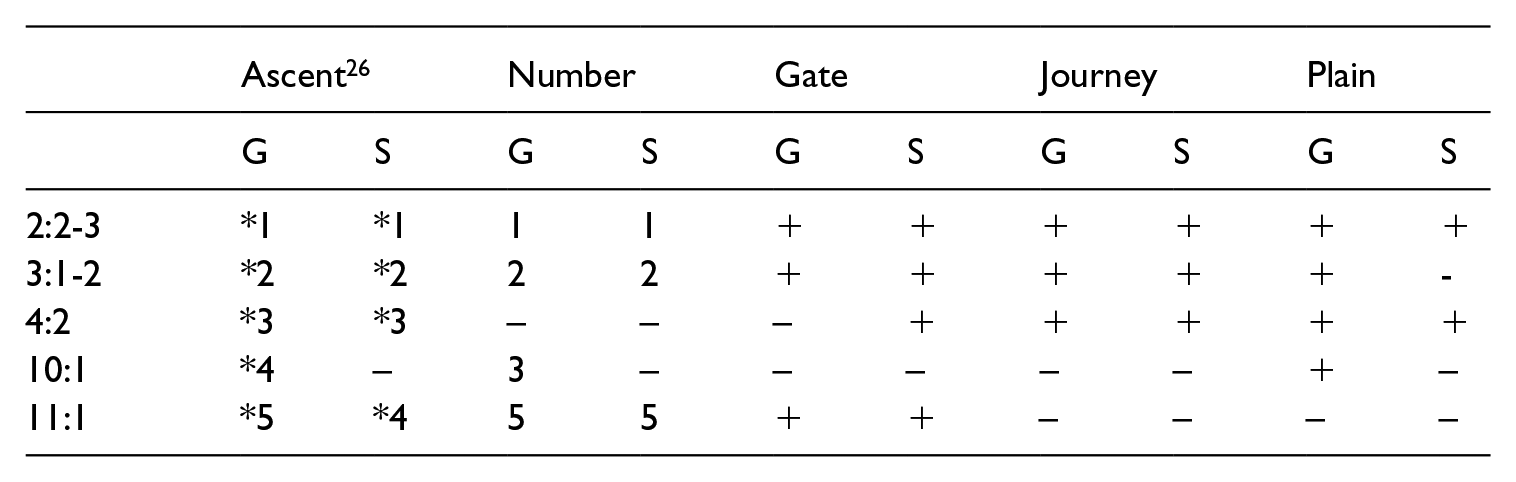
Additional confusion in numbering, and in the order of transitions, is caused by 7:2, where G says that “the sun passes in the third heaven” (7:2G; only the heaven of the “lake of birds,” beyond the luminaries, is numbered as “third” below; 10:1G), while S relates the route of the sun to “what I have shown you is in the first and second heavens” (7:2 S), although previously the three inter-celestial transitions are mentioned in both versions.
At least some of these problems could be explained by negligence during editorial interventions. It looks as though the ouranology presented in the prototext was not satisfactory or detailed enough for later redactors. The situation could be complicated by the fact that some of the larger fragments, containing among other things indications of intercelestial transitions, may be suspected as having been interpolated. In this case, the subsequent editorial emendations could come to compensate for the problems that arose as a result of these interpolations. Fortunately, the emendations were not consistent enough, and rudiments of the initial text have been preserved. Moreover, the two extant redactions (Greek and Slavonic) present different stages of this elaboration. These two factors enable us at least to glimpse into the original cosmology of the writing. The main questions we are trying to answer are as follows: (1) how many firmaments were in the heaven of 3 Baruch, (2) to what point has the visionary ascended, and (3) how do these data vary between the late redactions (reflected in the extant texts of G and S) and their prototext (to the extent we can reconstruct its elements). As we will see below, depending on different interpretations, the extant versions may reflect seven- or fivefold celestial structures, while the prototext must have referred to another, probably older, model of three heavens (or “two plus one”) 27
Non-complete ascent
Did Baruch enter the last mentioned heaven, whatever the original number of heavens may have been? As we can see from the table above, the description of Baruch’s ascent to the last heaven offers no indications of an intercelestial transfer, such as those that appear after his entry into the other heavens: only the gate is mentioned but neither a journey through it, nor a plain or anything behind it. 28 Although these indications are not consistently used with other heavens as well, this is the only case in which both indications are absent in both versions. One more difference of the last heaven from the previous ones is the term used to designate its opening. It is the only one called “gate” (Gk πύλη; CS врата) or even “gate-tower” (Gk πυλών) in distinction to “doors” (Gk θύρα, CS двьри) above.
Harlow suggests that “although Baruch’s passage is not explicitly noted, it is nevertheless clearly implied in 11:5-8.” 29 In fact, this assumption is not necessary. According to the plain meaning of the text, Baruch does not enter the fifth gate, which must be the final limit of Baruch’s ascent. A rationale of the non-complete ascent may be found in the conceptions of inaccessible supercelestial realm and/or inner shrine of the celestial Temple.
God is known to reside above the heavens (Ps 57:6, 12; 108:6; 113:4; Job 11:8; 22:12). An extra heaven exceeding the typological number of seven is found mainly as the eighth heaven added to the most popular sevenfold structure (see “Alternative Cosmologies” below), but the idea could be applied to any number of heavens. The authenticity of this popular concept was defended by Origen: Celsus in the next place alleges that “certain Christians, having misunderstood the words of Plato, loudly boast of a ‘supercelestial’ God, thus ascending beyond the heaven of the Jews.” … nor was the philosopher the first to present to view the “supercelestial” place; for David long ago brought to view the profundity and multitude of the thoughts concerning God entertained by those who have ascended above visible things, when he said in the book of Psalms: “Praise God, you heaven of heavens and you waters that be above the heavens, let them praise the name of the Lord.” I do not, indeed, deny that Plato learned from certain Hebrews the words quoted from the Phaedrus [27], or even, as some have recorded, that he quoted them from a perusal of our prophetic writings, when he said, “No poet here below has ever sung of the super-celestial place, or ever will sing in a becoming manner,” and so on. (Cels. 6.19)
The concept of the supercelestial world could be interlaced with the idea of the celestial Sanctuary and its inner shrines. The supercelestial “intelligible world” as opposed to “sense-perceptible heaven” were regarded by Philo as counterparts of accessible and inaccessible areas of the terrestrial sanctuary: The simple holy [parts of the Tent different of the Holy of Holies] are classified with the sense-perceptible heaven, whereas the inner [parts], which are called the Holy of Holies, [are classified] with the intelligible world. (Philo, Quaest. Exod. 2.94)
Josephus also states that the Tent was “an imitation of the nature of the universe” with its “heaven set apart to God”: It happened that such an arrangement of the Tent was also an imitation of the nature of the universe [μίμησιν τη̑ς τω̑ν ὅλων φύσεως]. For its third part, which is within the four pillars, which was inaccessible to the [ordinary] priests like heaven set apart to of God [ὡς οὐρανὸς ἀνει̑το τῳ̑ θεω], while the twenty cubits, just as earth and sea are accessible to men, were thus consigned to the priests alone. (Ant. 3.123)
On the Tent or Temple as a kind of microcosm cf. also Philo, Spec. Leg. 1.12.66; Josephus, Ant. 3.181; Pesiq. R. 5; Num. Rab. 12.13.
As noticed by Harlow, there are a number of dramatic elements in this scene, such as (1) dialogues (not only between Baruch and his guide, but also between angels), (2) entrances and departures of Michael and three groups of angels (some signaled by different sounds; see 11:5; 14:1), (3) presupposed off-stage reality, for which Michael leaves and from where he comes back.
30
This dramatism is also characteristic for liturgical performances. The Temple imagery and semi-priestly activity are obvious in this scene, and the writing must refer to the widely known motif of the celestial Temple.
31
Baruch receives his revelation at the gates of the destroyed earthly Temple (T:2), and its ultimate scene takes place at the gates of the indestructible celestial Temple.
32
This may explain why, in contrast to the previous heavens, when the gate opens here, Baruch and his guide do not pass through it, but wait for the chief angel to descend and greet them. Just as restrictions apply to attendants of the earthly Temple, the protagonist does not have access to the inner shrines of the heavenly Temple, to which only the priests (angels), or even only to the high priest (Michael), are permitted entry. Not only the Temple of Jerusalem had forbidden areas (for gentiles, women, profane Israelites, ordinary priests, and even the high priest for the most of the year), but also many pagan temples had their sacra inaccessible for the profane or impure.
33
Celestial sites inaccessible to humans, or to most humans, are mentioned in Gen 3:24 and 1 En. 19:3. Even the visionaries of a higher level of initiation, who in distinction to Baruch were allowed to ascend higher or at least to see the Glory, are said to have stopped at some earlier stage. Enoch stops before the gate of the “second house,” although observing the Divine Glory dwelling in it from outside (1 En. 14:25). Moses does not reach the Throne, probably visiting only the lower heaven, where, like Baruch, he is shown the celestial sources of water (Bib. Ant. 19:10). Angels prevent Moses’ ascent (b. Shab. 88b-89a; Pesiq. R. 20; cf. an Aramaic poem ‘Angele Meroma describing how Moses is trying to enter the gates of heaven, but is kept out by angels.
34
Ministering angels “sought to thrust away” R. Akiba during his ascent (b. Hag. 15b). Paul stops in the gate to the third heaven, which similarly to our gate has inscriptions—“golden letters”—on it. The gate restricts entrance to those “who have goodness and purity of body” (Apoc. Paul 19; cf. 24). Hekhalot tours are known to be aborted before the gate of the sixth or seventh palaces, the most dangerous points for those who are “unfit to see the King and his Throne” (Hekh. Zut. ##408-409; Hekh. Rab. #259). Indeed, “at the entrance to the seventh Palace stand and rage all heroes” (Hekh. Rab. #213). All these may witness that the “gate standing” could be a topos of describing apocalyptic experience and moreover could define the status of a visionary, cf. “R. Akiba said, ‘Ben Azai was found worthy and stood at the gate of the sixth Palace’” (Hekh. Zut., ms New York 23a). In the following parable a Palestinian Amora R. Yudan might imply and even polemicize against such a “gate standing” pending angelic intercession: If a human has a patron, and then he finds himself in trouble, he does not enter his [patron’s] house suddenly, but he comes and stands in his patron’s door and calls his servant or a member of his household [אלא בא ועמד לו על פתחו של פטרונו וקורא לעבדו או לבן ביתו] and says, “So-and-so is standing at the door of your court.” He may be let in, and he may be not. But the Holy One is not so. If trouble comes upon a person, let him cry neither to Michael or to Gabriel, but let him cry unto me, and I will answer him. This is the meaning of the verse: “Whoever calls on the name of the Lord will be delivered” [Joel 2:32]. (y. Ber. 9.13a)
35
However, our author seems not to share this conception, and the visionary is deprived of direct communication with God. His ultimate vision is the “gates of prayer,” an image also well attested in Jewish literature. Lamentations ascend to the “gate of heaven” in 1 En. 9:10. Heavenly gates open in the constant time (the 10th hour of night) to receive the prayers of men (T. Adam 1:10 cited in 6:13 S).
The theme of the “gates of prayer” (Heb שערי התפילה), their opening and closing, is well developed in Rabbinic sources. These gates are also known to be periodically opened and closed (cf. 3 Bar. 11:2 and 5), and the schedule of their opening hours was an object of talmudic discussion (y. Ber. 4.7c; b. Ber. 32b; Pesiq. Rab Kah. 24.2; Pirqe R. El. 35; cf. תפילת נעילה of the Day of Atonement service in b. Yoma 87b and “the gates of light and prayer” in Sefer Raziel 441). Baruch’s evidence on the openings of the gate is not superfluous since some, as R. Eleazar, even believed that “from the day on which the Temple was destroyed the gates of prayer have been closed” (b. Ber. 32b). 36
Harlow suggests that the abrupt ending of the ascent is designed intentionally to frustrate the readers’ expectations of a climactic Throne theophany. It is prepared in the previous narrative by the “aborted theodicy” of the Prologue, the aborted ascent of the Builders (ch. 2-3), the declared distance of sinful humanity from God’s Glory and even from the Glory of the sun (ch. 4 and 6). The purpose of the abrupt termination of the ascent, according to Harlow, is to polemicize against the conceptions of anthropomorphic depictions of God and angelic transformations of visionaries, 37 and against anticipation of the restoration of the Temple service. “The abrupt ending functions to subvert and thereby reorient the religious expectations of the readers.” 38 Harlow compares the conclusion of Baruch’s tour to the abrupt ending of the Gospel of Mark, where the expectation of arisen Jesus is frustrated. 39 Although the text itself hardly contains any hints to the dissatisfaction of the visionary, in the context of other major apocalypses Harlow’s interpretation is plausible. Alternatively, it may be that the “gates of prayer” and the retribution mechanism connected to it were the intentionally ultimate objects of the ascent, which is thus not “abrupt,” but just less advanced in comparison to theophanic and apotheotic mystic experiences. This understanding would be in complete accordance with the text, on the one hand, but a unique motif for the genre, on the other.
The very selection of Baruch as a seer may reflect a connection between the “incomplete” nature of the revelation in this work, which lacks theophany and apotheosis, on the one hand, and the dubiousness or second-rate status of Baruch as a prophet, on the other. In contrast to most other visionaries, our seer does not experience transformation or enthronement, 40 and does not even receive access to the “the highest heaven” (11:3 S), 41 nor does he see the Throne of Glory. There is also no mention of Baruch having entered Paradise or having seen the Tree of Knowledge that he discusses with an angel (4:8G/4:6Sff.). He probably does not even ascend in corpore (see 17:3G).
Similarly, in contrast to other sources, only in 2 Baruch is the protagonist presented as a full scale prophet, even linked in his characteristics to Moses and overshadowing Jeremiah. 42 Elsewhere, Baruch is either a non-visionary or at most a “minor” one. In distinction to most other visionaries, Baruch is more a sage, a successor of prophets, than a prophet par excellence. 43 In Jer 45 and in 4 Baruch, he receives an oracle only through the mediation of Jeremiah. 44 In Jer 45:5, Baruch was warned not to seek “great things” (whatever this may mean). In 1 Baruch, he is merely a sage and a community leader. Baruch does not figure in the Lives of the Prophets (although he was regarded as a prophet by Eusebius in Pr. Ev. 10.14.6 and by Origen in Hom. Jer. 8.5). 45 He is mentioned in a probably negative (although vague) context together with another prophetic disciple, Gehazi, in CD 8:20. Rabbinic literature also indicates his semi-prophetic status. The Rabbis debated as to whether Baruch was a prophet at all: “Baruch was greatly distressed because he did not receive the prophetic spirit” (Mek. Bo Intr.), though some did recognize him as a prophet (Sifre Num 78; Sifre Zut. 75 on Num 10:29; y. Sot. 9.24b; b. Meg. 14b; Seder Olam 20). See also the conception of קיצרי הנבואה applied to minor prophets following Jeremiah, identified as the “last of all the prophets” (Pesiq. Rab Kah. 13.14).
Martha Himmelfarb states, “3 Baruch stands apart from the other apocalypses … in its rejection of the possibility of the visionary’s achievement of angelic status.” In distinction to Enochic tradition or the Ascension of Isaiah, he is not even equal to angels; thus, he addresses the angel “Lord.” 46 However, in light of the above, it is most probable that we are not dealing here with a polemic against the Enochic tradition, but rather with a case of a minor hero coexisting with the tradition, a special kind of more modest and limited mystical experience. The exclusiveness of Enoch’s visionary experience is formulated as “no man will see as I have seen” (1 En. 19:3; cf. Dan 10:7). Note that 3 Baruch does not stipulate that more advanced ascent would be unfeasible: we may infer that it was possible for those whose names are written on the last gate (unless this refers to dead individuals; 11:2 S). The situation may be compared to higher and lower levels of initiation into practices of Hellenistic mysteries. Cf. the use of the term “mysteries” in 3 Baruch, including “great” and “greater” mysteries promised (but probably not shown) to him (1:4 S; 1:6; 1:8G; 5:3 S; 17:1 S) and the “Lesser” and “Greater Mysteries” as known from Eleusis, as well as the use of these terms applied to Jewish revelatory activity by Philo (Leg. All. 3.33.100; Cher. 14.48-49; Sacr. 15.60; 16.62). 47
Number of heavens
Seven heavens
Seven heavens and abrupt ascent
The cosmology of seven heavens is the most developed model in early Jewish and Christian traditions. 48 This idea might be rooted in different ancient traditions and could be also linked to the sevenfold structure of the Temple of Jerusalem as described in m. Kel. 1.6-9, which lists 10 areas of increasing holiness in the Land of Israel, of which seven refer to the Temple: (1) heyl, an area on the Temple mount forbidden to gentiles and to those defiled by the dead (שאין עובדי כוכבים וטמא מת נכנסים לשם), 49 (2) the court of women, (3) the court of Israel, (4) the court of priests; (5) area between the altar and ulam (בין האולם ולמזבח), (6) Sanctuary (היכל), and (7) the Holy of Holies. 50 The celestial Temple has a sevenfold structure in the Qumranic Songs of the Sabbath Sacrifice. The seven palaces of the Hekhalot literature must also be rooted in these traditions.
Theoretically 3 Baruch could imply a sevenfold celestial structure, where Baruch was allowed to reach only the gate before the fifth heaven. This hypothesis would accord with a schema of a three-chambered celestial Sanctuary, parallel to the terrestrial one, consisting of ulam, hekhal, and devir. In this scenario, Baruch would have reached the fourth heaven, the last before the celestial Sanctuary including three more heavens. Cf. the series of seven divided into groups of four and three in Rev 6:1-8; 8:13.
In a similar manner, the visionary of the Apocalypse of Paul travels only to the third heaven, though the texts speaks of additional ones (at least seven, see ch. 29). 51 The same model is found in b. Hag. 12b: “Till this place [seventh heaven] you may discourse, from here onwards you have no permission to discourse.” The highest “holy” heavens are explicitly distinguished from the low ones (two in the recension a, and three in the recension b) in the both versions of T. Levi 3:3 (see below). Similarly to 3 Baruch only on these lower firmaments is it said that they were seen by Levi (2:7-8), while the rest are probably only described by the guiding angel (3:1-8). In the Ascension of Isaiah, the five lowest heavens have characteristics different from the higher two. Only in the lower five does Jesus have to disguise himself during his descent: “And you shall make your likeness like that of all who are in the five heavens” (10:9). There are more differences: “And he [angel] said to me, ‘From the sixth heaven and upwards there are no longer those on the left, nor is there a throne placed in the middle, but [they are directed] by the power of the seventh heaven, where the One who is not named dwells’” (8:7).
Seven heavens and abridged version. Another alternative is to suppose that the initial text of 3 Baruch did include seven heavens, and described a complete ascent to that ultimate seventh heaven. Several points may be adduced in favor of this hypothesis, but they are not conclusive:
Origen attests to the existence of a “book of the prophet Baruch,” in which there are “very clear indications of the seven worlds or heavens” (septem mundis uel caelis; Princ. 2.3.6). However, we cannot be sure that our text is meant, and moreover, the term “world” never appears in 3 Baruch.
The vision of “the Glory of God” is repeatedly promised (4:2 S; 6:12; 7:2; 11:2; 16:6 S), but not fulfilled, if “the Glory of God” is to be considered as referring to a Throne theophany. It could have been contained in the lost conclusion. For counterarguments see comm. to 4:2 S.
The last promise to see the Glory occurs in S at the very end of the vision, along with other unfulfilled promises (16:6 S; in previous translation—16:4 S). It has been suggested that this is part of an abridged ending completely omitted in G. 52 This interpretation derives from a mistake in translation. On this see comm. to 16:6.
Michael’s movements to and from higher heaven(s) (11:6; 14:1-15:1) demonstrate that there are more heaven(s) beyond Baruch’s ultimate stop before (or according to some interpretations—in) the fifth heaven. This argument would count in favor of the existence of heaven(s) beyond the fifth, only if Baruch is considered to have entered the fifth heaven, which seems to contradict the plain meaning of the text (see above for parallels). Otherwise, Michael’s movements attest only to the existence of the fifth heaven beyond Baruch’s standpoint before its gate.
The concluding chapters have more Christian interpolations than the earlier sections, which could be taken as an indication of a more thorough reworking (including abridgement). 53 Moreover, there is a total lack of an eschatological agenda (including issues of national concern, as restoration, etc.), contrary to expectations for the conclusion of a work in this genre. In combination with obvious interpolations of Christian passages in the last chapters, this may speak in favor of abridgement due to the “Christianization” of the text. However, “Christianization” of the text need not be taken as an indication of abridgement; in most other Jewish apocalypses preserved by Christians such materials have successfully survived.
The only textual argument in favor of the abridgement theory is verse 11:2: “We cannot enter until Michael, the key-holder of the Kingdom of Heaven, comes (οὐ δυνάμεθα εἰσελθει̑ν ἕως ἔλθῃ Μιχαὴλ…). The use of the word ἕως ‘until’ presupposes that the entrance to at least the fifth heaven is expected or at least possible for Baruch. 54
Alternative cosmologies
Although the cosmology of seven firmaments is the most widely attested in Jewish tradition, various deviations from this number are also attested. Even though the plural form of Heb שמים, rendered by the plural also in LXX, could give an idea of the plurality of heavens, may ancient sources are not aware of this or ignore it (thus all texts of the Bible, 1 Enoch; 4 Ezra; Testament of Abraham; Apocalypse of Ezra; Vision of Ezra; Revelation). Structures of two heavens (שמים ושמי שמים) were known to b. Hag. 12b (according to R. Yehudah bar Ilai, as opposed to the sevenfold model of Resh Lakish); Deut. Rab. 2.32 (6:4); Midr. Pss. 114:2. Three heavens are found in T. Levi (α) 2:6-10; 2 Cor 12:2 (if it is a full ascent); Apoc. Sedr. 2:3-5. Eight heavens, known to Apoc. Abr. 19:6 55 and b. Hag. 13a (cf. eight celestial spheres of Plato, Rep. 10.614-621), were especially popular with Gnostics (cf. Poim. 26; Hip. Arch. 95.13-96.3; Apocryphon of John 11:4; Irenaeus, Haer. 1.30.4-5; Epiphanius, Haer. 1.5.2; 40.2.3; 26.10.1-4; Clement of Alexandria, Strom. 4.162.1; Origen, Cels. 6.21-22). There are eight heavens in Reuyot Yehezkel, where the eighth it is called “the Throne of Glory.” These cosmologies, stressing the extra-transcendal character of God even in relation to the celestial realm, are in fact a modification of the schema of the seven heavens plus one supercelestial firmament as an abode of God (although in some sources above there is one more additional realm beyond the eighth). Ten heavens appear in 2 En. (only J) 22; 20:3; Gnostic Apoc. Paul 22-23; cf. Poim. 26 (similar to 2 Enoch in many aspects); Origen, Cels. 6.25 (Ophitic diagram). Seventy two firmaments are mentioned in Gnostic 1 Apoc. James 26. Basilides taught on 365 heavens (Irenaeus, Haer. 1.24.3-7; cf. 11.16.2; Hippolytus, Ref. 7.26.6). The number may rise to 955 (3 En A48:1; Masekhet Hekh. 7 (Bet HaMidr. 2.45)).
Five (or four plus one) heavens. Picard suggested an original five heavens cosmology in 3 Baruch, based upon structural literary analysis. 56 Harlow objects: “The proposal that 3 Baruch envisions a five-heaven cosmology falters for the lack of a convincing precedent or analogy, the absence of any rationale for the number five …” 57 The only parallel was proposed by Wright: a fragmentary Apocalypse of Zephaniah A (cited in Clement of Alexandria, Strom. 5.11.77), which also does not mention any higher heaven then the fifth (at least as far as we can judge from the preserved fragment).
In fact, additional parallels and analogies for the proposed cosmology of five heavens (or a reference only to five lower heavens) can be adduced, along with a plausible rationale. In Coptic-Ethiopic Ep. Apost. 13, 58 Jesus ascends directly to the fifth heaven and does not proceed higher. 59 However, the Apocalypse of Zephaniah and Epistola of Apostles both may depend upon the sevenfold model similar to Asc. Isa. 8-10, which clearly divides between the five low and two high heavens (cf. above). The model of five plus an additional “highest of all [heaven], where dwells the Great Glory, far above all holiness” may be ascribed to T. Levi (α) 3:1-8 according to one possible interpretation (see below). Notice also that in b. Hag 12b-13a the description of the first five heaven, containing inter alia ministering angels and Michael, is separated by a digression from the highest two.
Whereas the number “seven” does not feature in any numerical symbolism in 3 Baruch, “five” plays an important role in the account of the “Five Trees” in 4:7 S. There are five trees of Eden planted by five (chief?) angels (4:7 S; four angels of Presence and the fallen angel Sataniel; see comm. to 4:7 S: Angelic staff). An hierarchy of eons called “Five Trees” is mentioned in Pistis Sophia 1.1 and 10; 2.86; 3.95; and passim; cf. also the Untitled Text in the Bruce Codex 4. On this and on Gnostic and Manichaean pentads, referring also to the heavenly realm, see comm. to 4:7 S: Five Trees of Eden and “Incurable Folly.” Sometimes the number of angelic classes and/or archangels corresponds to the number of heavens; cf. seven classes and seven heavens in 1 En. 61:10; ten heavens and classes in 2 En. (J) 20:1 (here interchanging with five and nine), 20:3; 22; three and three formula in Konen 26-27. 60
Origen refers to a “Book of Baruch” in order to demonstrate that the terms “heaven” and “world” are synonymous (Princ. 2.3.6). 61 In addition to the universally known scheme of five planets, modifications preserving the number five are known in later periods, from the “five worlds” of Proclus (Theol. 7.1-2; see below) to medieval concepts of hierarchical five worlds or celestial spheres. Maimonides spoke of “five spheres” (kurra) referring to a tradition of “early mathematicians (Moreh Nev. 2.9). Other kinds of hierarchies of five worlds are attested in Sephardi mystical cosmography and, independently, in the works of Hasidei Ashkenaz. See Abraham bar Hiyya, Megillat ha-Megalleh (pp. 22-23); Elhanan ben Yakar, Commentary to Sefer Yetsira 183-198 (ascribing the concept to “the tradition from the days of ancient prophets” המסורת מימי הנביאים הקדמונים), Pseudo-Saadia Commentary on the Sefer Yetsira 94d. 63 Cf. also the “five worlds” of the Sufis as witnessed by Qashani (FN 3). Gershon Scholem suggested that the independent kabbalistic traditions must have gone back to some “lost pseudepigrapha.” 64
The hierarchy of sacral areas modeled according to the Temple structure may accommodate a scheme of five areas even better than one of seven (see Seven heavens: abrupt ascent above), if the celestial world is divided according to the five groups which had their own areas on the earthly Temple mount: (1) gentiles, (2) women, (3) men, (4) priests, and (5) the high priest. In 3 Baruch angelic priests appear only in the fourth heaven (court of priests), and only Michael has access to the fifth heaven (Holy of Holies). The heavenly Temple is found in the fifth heaven (named Shehaqim) according to Reuyot Yehezkel (cf. b. Hag. 12b cited below). 65
The proposed system of five heavens could actually reflect a “four plus one” scheme, involving an additional supercelestial realm, similarly to the eightfold schemes discussed above. The number “four” is attested in celestial divisions of 1 En: “four quarters of heaven” (76:12); “four hollow places” where the souls dwell (22). “The heaven [created on the fourth day] in its turn was ordered with a perfect number, the four” (Philo, Opif. 15.47). The quadriads may be connected to the concept of the four elements. 66 Philo, as well as other Hellenistic scientists, adds the “fifth element,” “a wonderful and divine essence” (i.e. ether or quinta essentia of the Greeko-Roman science), of which heaven is made (Quaest. Gen. 3.2). The whole world is divided according to these elements: “The universe also receives a division into five parts. For the world is one and quintuple, and is appropriately divided by celestial, empyreal, aerial, aquatic and terrestrial figures and presiding Gods” (Proclus, Theol. 7.1-2). The same could have been applied to heaven alone: God’s “Glory passed through the four gates of fire and earthquake and wind and ice, to give the Law to the seed of Jacob” (4 Ezra 3:19). If the subsequent gates are meant, there may be four heavens corresponding to fire, earth, air, and water. 67 The elements may be connected to the hierarchy of heavens and their angels in Apoc. Abr. 15-19, although in a different order: earth, air, water (as dew?), fire. The lowest heaven Abraham can see from the seventh heaven above is the fifth one with “the elements of earth” obeying “the incorporeal spiritual angels” of the sixth heaven, who in turn “carry out the orders of the fiery angels who were on the eighth firmament.” The seventh heaven contains also dew, as well as fire and light (19:4-9). The hierarchy of earth, water, fire, air, and ether may correspond in the same order to the accounts of the Builders (first heaven), Sea Serpent, sea and rivers (second heaven), luminaries (third heaven), soul-birds (fourth heaven), and the inaccessible realm (fifth heaven). 68 The tetrad of elements in the same order integrated into seven plagues of Rev 16, beginning with earth (16:2), salt and fresh waters (16:3-4), the sun and fire (16:8), and finishing with air (16:17). Cf. the angels responsible for different elements in Rev 14:18 (“the angel in charge of the fire”) and 16:6 (“the angel in charge of the waters”). 69
Three (three plus one) heavens and textual history of 3 Baruch
It is possible that the original version of 3 Baruch had a scheme of three or “three plus one” heavens, which was corrupted or intentionally changed during the transmission of the text.
Textual arguments
The suggestion helps to settle several textual problems:
In G the last heaven visited by Baruch is numbered as “the third” (10:1G), while the next heaven is designated as “the fifth” (11:1 in both versions). At least one of the numbers must have been emended, or alternatively both were inconsistently interpolated to the previously unnumbered descriptions (on the parallels for the phenomenon see below). The following considerations support the hypothesis that the reading of 10:1G is a remnant of an older structure.
The numbering of 10:1G accords with the hypothesis of the duplication of the Builders account (see introductory comm. to ch. 3), which duplicates also the description of the lower heaven. Without the second account of the Builders, the number of the heavens before the last gate reduces to three.
This numbering is corroborated by 7:2 S, stating that all previous visions including the sun took place in the lower two heavens. In this case, the words “in the third heaven” of 7:2G might be either interpolated (in order to harmonize with the duplication of the account of the Builders) or, less probably, they may imply that Baruch sees the luminaries of the third heaven from his observation point in the second one (as Abraham sees different heavens from the seventh in Apoc. Abr. 19).
The inconsistent (probably interpolated) numbering of heavens throughout the book contradicts other indications of the intercelestial transfer of the visionary (see the table above): both versions mention only three celestial journeys (2:2; 3:1; 4:2) and three gates (three before the last in S and a total of three in G; 2:2; 3:1; 4:2; 11:2). However, taking into account also the duplication of the account of the Builders (including 3:1), there will be a “secondary” indication to the ascent only for the first (Builders-Demons) and the second (Beasts and luminaries) heavens, while the transfer to the third heaven (Lake of Birds) is indicated only by the “plain” and a number in G, and is not indicated at all in S (see Two heavens below).
To summarize, (1) lectiones difficiliores of 7:2 S and 10:1G both witnessing two heavens instead of three until 10:1 are the rudiments of the prototext; (2) the second account of the Builders (3:1-5a) is a duplication; (3) the inconsistent numbers—”third heaven” of 7:2G and the “fifth heaven” of 11:1—are interpolated, probably with other numbers of heavens throughout the book.
In this case, the Builders occupy only one lower heaven, Lights and Beasts are in the second heaven (in accordance with 7:2 S), and the Lake of Birds is in the third (in accordance with 10:1G). Both the Serpent and Lights (especially the moon) situated in the middle heaven are known to divide between higher and lower realms in different sources (for the moon see introductory comm. to ch. 10; for the Serpent see Origen, Cels. 6.25; Eusebius, Pr. Ev. 1.10.45-53 cited in the introductory comm. to ch. 4).
Precedents for original form
The system of three heavens is attested in Jewish sources: in T. Levi (α) 2:6-10; Midr. Pss. 114:2; and probably in 2 Cor 12:2 and Apoc. Sedr. 2:3-5, where visionaries arrive to the third heaven, and no higher heaven is mentioned. 70 For the Apocalypse of Sedrach, it is probable that the third heaven is the highest, since there the visionary can “speak to God face to face” (2:4). The three stages of the ascent probably appear also in 1 En. 14 (the fiery wall of 14:9 and two concentric houses in 14:10-17). Another trace of the “three plus one” heavens cosmology may appear in 4 Ezra 3:19 (cf. another interpretation above), where the Sinai theophany is described as a gradual descent of God’s Glory through four subsequent gates. It may mean that it comes (1) from the highest fourth heaven, or (2) from the supercelestial abode above the highest third heaven, or (3) from the middle fourth heaven (of total seven; cf. the heavenly Temple on the fourth heaven in b. Hag. 12b; b. Zeb. 62a; b. Menah. 110a). 71
Bousset tried to trace the threefold celestial system back to the Persian model of the three firmaments with the Paradise located above them. 72 Zoroastrians believed that a just soul crosses three levels (even called “heavens”) in order to reach the highest divine realm. 73 The scheme may even be older, since although the typical ancient Near Eastern systems normally had only one heaven, Enuma Elish has more than one level above the sky, and the three heavens system (parallel there to three terrestrial surfaces) is also attested among other multicelelstial systems in Mesopotamia (see Akkadian texts in KAR 307 and OA 8196). Some interpret the biblical expression שמי השמים “heaven of heavens [in dual. tant.]” as referring to the Babylonian conception of the celestial realm divided to “the upper,” “the middle,” and “the upper heavens” inhabited by Anu (cf. the terminology of T. Levi 2:7, 3:1, and 3:4 below). 74 A Hellenistic Egyptian depiction of the goddess Nut and the god Geb dated by the Ptolemaic period presents a structure of three hemispheres (two of Nut and one Geb). 75 Wright considers it a product of “Egypto-Greek symbiosis” of the Hellenistic period (analogous to the Jewish-Hellenistic synthesis of our text). 76
The contents of the first four heavens of a total of seven described by Resh Lakish in b. Hag. 12b is very similar to the heavens of 3 Baruch, if interpreted as above. In both sources, the luminaries are located in the second heaven, “in which sun and moon, stars and constellations are set”; rain and dew of the third heaven in 3 Baruch correspond to manna in Talmud; and the inaccessible realm beyond the last gate, where Michael brings the angelic offerings corresponds to the fourth heaven, “in which [the heavenly] Jerusalem and the Temple and the altar are built, and Michael, the Great Prince, stands and offers up thereon an offering.”
Precedents for reworking
The tendencies of (1) numbering previously unnumbered heavens and (2) the standardization of the number of heavens according to the most common sevenfold models may be traced in the textual history of the Testament of Levi and 2 Enoch. Similarly, in the Life of Adam and Eve we have a version that is reticent about the number of heavens (Vita), and another that gives the number seven (Apoc. Mos. 35:2).
There are several ways to calculate the amount and numbering of heavens in T. Levi 2-3. Two recensions α and β have two different amounts which are widely recognized as three and seven correspondently. However, two verses 3:5 and 7 begin with Gk ἐν τῳ̑ μετ' αὐτὸν, which may be read either as “in the one next to it,” and thus as introducing an additional heaven each, or as “in the same [heaven] with it,” thus referring to the heaven already introduced above. 77 The picture is complicated even more, since the two lowest heavens in 3:1-2α may appear again at the end of the next list (we call it the “repetition version” below). Alternatively, the next list may refer to additional heavens above the two lower ones (as in the recension β; we refer to this as the “differentiating version”). Thus, these two alternatives create four different ways to count the heavens in the recension α and two in the recension β.
Recension α
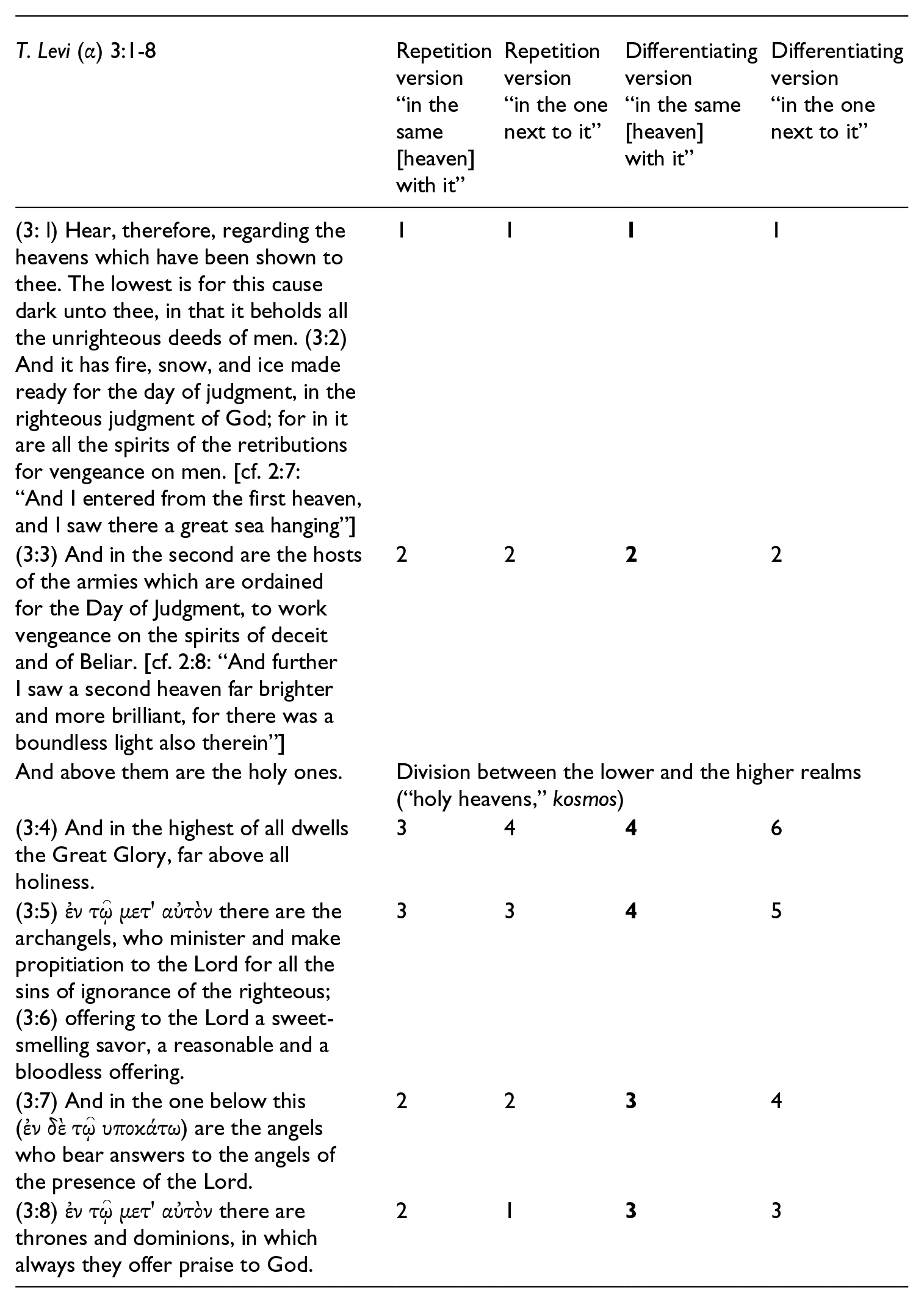
The schema in the third column (presenting the “three plus one” heavens cosmology) looks the most logical: (1) different (even contradictory) descriptions refer to different heavens and (2) ἐν τῳ̑ μετ' αὐτὸν of 3:5 and 8 functionally differs from ἐν δὲ τῳ̑ ὑποκάτω of 3:7. 78 The description of specifically higher heavens in descending order is not unique: it is attested in Apoc. Abr. 19 (describing heavens from the seventh to the fifth); cf. also the descent of Jesus in Asc. Isa. 10. The redactor of β must have slightly emended the text above in order to adjust it to the seven heavens scheme.
Rescension β (main discrepancies with recension α have been placed in italics)
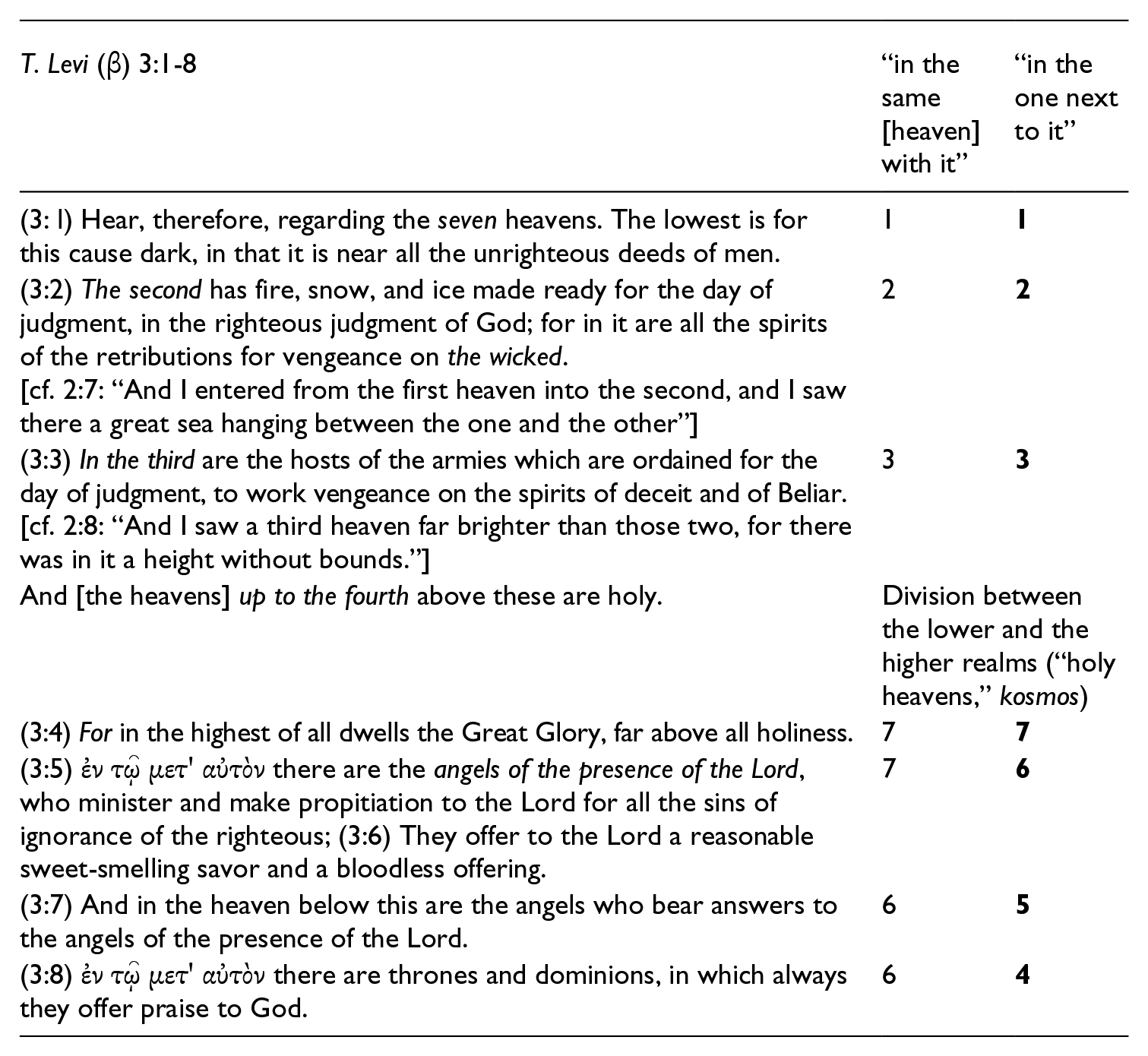
The numbering of heavens in verses 3:1 and the end of 3:3 indicate that β, by declaring the seven heavens scheme, (1) did not hold to the “repetition reading” (proposed by modern scholars for α) and (2) most probably understood ἐν τῳ̑ μετ' αὐτὸν as “in the one next to it” (otherwise, it would lack the description of the fourth and the fifth heavens). Both assumptions must give six heavens also in α (cf. the fourth column of the previous table), and they enabled the emendation of α in accordance with the popular sevenfold scheme by just two changes: inserting numbering inside coherent descriptions and splitting the description of the first heaven into two. Rescension α was considered original by Charles, Bietenhard, and Kee, among others, 79 while De Jonge suggested an opposite development: from seven to three, corrupted under the influence of 2 Cor 12). 80 Despite De Jonge, it would be more difficult to imagine why and how β could be emended to α (except the possible influence of 2 Cor 12).
The Testament of Levi, in contrast to 3 Baruch, has been preserved in both earlier and later versions. It provides us with a model of a redactional process similar to that proposed for 3 Baruch. There is the same tendency (of multiplication of heavens) and the same method (of inserting numbering). In both cases, editors have left their fingerprints, although in 3 Baruch the redactors’ technique is more transparent, because it is less consistent (for the obvious reason that the emendation involved not a short chapter, but an entire book).
A similar relationship is observed between the two recensions of 2 Enoch: the longer recension (J) has 10 heavens, and a shorter one (A) has seven. Also there seem to have been some intentional correction in this text, from 10 heavens, which is rather rare (although attested also in Gnostic Apoc. Paul 22-23; cf. Poim. 26; Origen, Cels. 6.25 (Ophitic diagram); Num. Rab. 14) to a more common seven. An inconsistent interpolation of an ordinal number of a heaven most probably took place in the Greek Apocalypse of Ezra: at the beginning, “the first heaven” is mentioned, although there is no further evidence of the multiple heavens system.
Rationale of three heavens. Both the Testament of Levi and 2 Enoch share the conception of the division of heavens to two groups, shared probably with the Hellenistic cosmologies distinguishing between the irregular ouranos and higher kosmos 81 and in accordance with the concept shared by Jews and Greeks that “the impure is not meet and right to be in contact with the pure” (Plato, Phaedo 67b).
In 2 Enoch, the Paradise of the third heaven divides between “corruptible” and “incorruptible” (8:5), while the seven “stars” have their spherical routes in the middle zone of water dividing between the upper light and the lower darkness (2 En. 27:3; cf. “the light is being separated from the darkness” and the middle position of the luminaries in 3 Bar. 6:13). The highest heavens are explicitly distinguished from the low ones in both versions of T. Levi 3:3 (two heavens in the rescension α, and three in the rescension β). The first heaven is “dark,” because “it beholds all the unrighteous deeds of men” (3:1). In 3 Baruch the sun is similarly defiled, “because it beholds the lawlessness and unrighteousness of men” in 3 Bar. 8:5). In the Testament of Levi both lower heavens are inhabited by the demonic “spirits of the retributions for vengeance,” “spirits of deceit and of Beliar” (3:2-3). Similarly, in 3 Baruch, the lower two heavens are inhabited by chimeric Builders and “dark and impure” Hades (3 Bar. 2-3). In the Testament of Levi above the lower heavens “there are the holy ones” (3:3). 82 In 3 Baruch, the superlunary heaven has “pure” birds and probably purificatory waters (see comm. to ch. 9 and 10). Note that in all three compositions the lower group consists of two heavens.
Three heavens and Temple areas. As well as other divisions discussed above, the threefold division could well be modeled according to either (a) the four elements or (b) the Temple areas:
In the former case, (1) earth corresponds to earth, while the rest “three plus one” elements correspond to the “three plus one” celestial structure: (2) air: the firmament of the demonic Builders—demons, “spiritual ones”—abiding in the lower heaven known as “air” (Gk ἀήρ “air” means also “lower visible sky”; in LXX it renders exclusively Heb שחק “cloud,” “sky”; cf. CS аеръ in this meaning in Apoc. Abr. 15:5); (3) fire: firmament of Lights and fiery Hades; (4) water: the Lake of Birds, the source of the celestial rain and dew; (5) aether—the inaccessible firmament beyond the last gate.
In the latter case, the firmaments correspond to (1) the Women’s Court, (2) the Court [of Israel] (עזרה), and (3) the Court of Priests or (1) the Court, (2) the Sanctuary, and (3) the Holy of Holies. 83 The latter partition would also be consonant with the “two plus one” model described below.
Two (two plus one) heavens
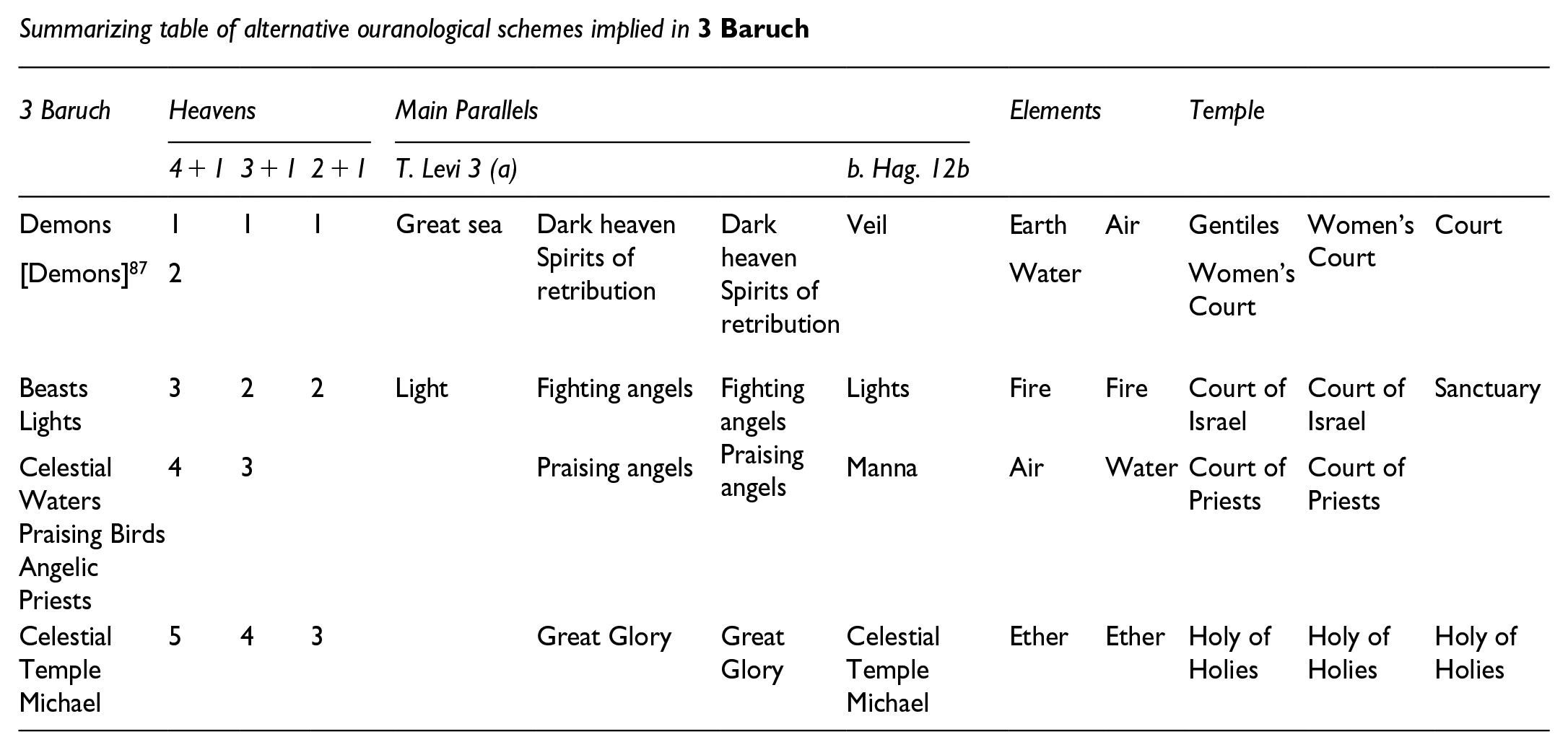
If to accept the hypothesis that (1) the second Builders account was interpolated and that (2) the numbering of heavens was added to previously unnumbered descriptions (see above), then the Slavonic recension, which in many cases reflects an earlier stage of the text development than the extant Greek one, witnesses only two heavens before the last gate and the supercelestial realm beyond it. The table below summarizes all the indications of intercelestial transfers throughout the book, ignoring ch. 3 and the numbering of the heavens:
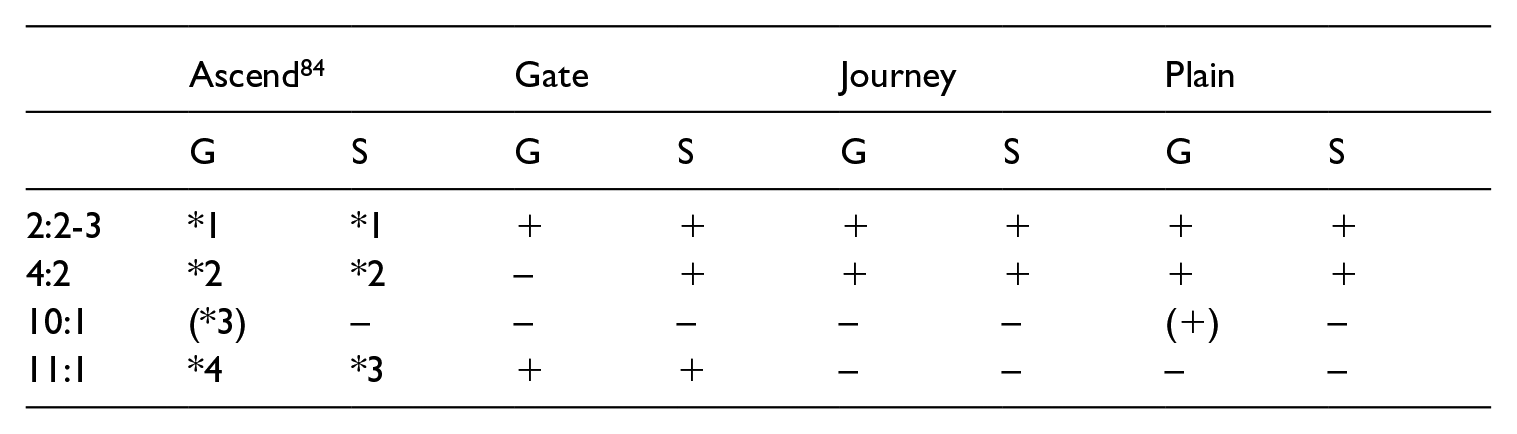
Even for G, the transfer to the “third” heaven is signaled only by the “plain” (which could substitute for “mountain” of S). For S there are consistently only two lower heavens: two gates, two journeys, and two plains. Moreover, 7:2 S explicitly speaks only of two heavens: “what I have shown you is in the first and second heavens.”
This scheme may go back to a biblical conception of שמי השמים, which may refer to two or three heavens understood as “heaven of heaven” or “heaven of heavens” (Deut 10:14; 1 Kgs 8:27; Neh 9:6; Ps 148:4; 2 Chr 2:5; 6:18). 85 Thus, it was interpreted by R. Yehudah bar Ilai: “There are two heavens, as it is written, ‘Heaven, heaven of heaven, earth and everything in it, all belong to God’ (Deut 10:14)” (b. Hag. 12b; cf. Deut. Rab. 2.32 (6:4) Midr. Pss. 114:2 knows of both variations: the concept of two heavens based on Ps 68:34(33): “who rids upon the heaven of ancient heaven,” and the alternative view that there are three heavens, referring to “the heavens (understood as dual) and the heaven of heavens (above them)” of 1 Kgs 8:27. The same conception may be ascribed also to T. Levi (a) if interpreted according to the scheme of the first column (see the table above). The stages of Enoch’s tour in 1 En. 14:8-18 can also be interpreted according to this model: heaven, “house,” and the second “house” with the Throne corresponding to the supercelestial realm. In the Ethiopic Apoc. Pet. 17, Jesus ascends to the second heaven with Moses and Elijah (however, there are may be more heavens). The scheme most similar to this understanding of 3 Baruch is brought in the Nag Hammadi Apocryphon of James, where disciples follow Jesus through the first two heavens and are not allowed to the third. 86
A cosmology of “two plus one” heavens may serve an additional raison d’être of 3 Baruch within the Christian tradition where it would have provide a Christian reader with the detailed descriptions of the first two heavens, thereby complementing 2 Corinthians and Apocalypse of Paul, where the first two heavens are entirely ignored.
Conclusion
3 Baruch, properly read, shows complex ouranological conceptions well integrated not only into early Jewish literature and Hellenistic thought (like the concepts of an open hydrosystem, a revolving celestial (hemi)sphere, or the fixed stars), but also into later mystical traditions (such as the ideas of “horizontal ascent” and the “mystical tunnel”).
The ouranology of 3 Baruch is a result of editorial reworking. The original text must have had three (or even two) such spaces between the firmaments below the highest heaven inaccessible for Baruch: (1) the lower impure heavens contain satyr-like Builders (probably demons) and Hades (2-5); (2) the realm of the luminaries (where defilement is still possible; 8:4) separates the lower heavens from (3) the higher pure heavens, known in other sources as “holy” or “incorruptible,” where the sun’s crown and the soul-birds are purified (probably in the celestial lake; 8:4). In addition to the aspect of purity, this division may gain additional support by linking up with views of the afterlife. Every one of these heavens might contain one station in the celestial ascent of the soul-birds: Hades as a final stage for the wicked (4:5G); the lake as a waiting abode for the righteous (10:5G); and the eternal resting place in “the Kingdom of Heaven” behind the gate of the last firmament visited by Baruch (11:2).
Summarizing table of alternative ouranological schemes implied in 3 Baruch
Footnotes
Declaration of conflicting interests
The author(s) declared no potential conflicts of interest with respect to the research, authorship, and/or publication of this article.
Funding
The research leading to these results has received funding from the German-Israeli Foundation (project “Visitors from Heaven, Visitors to Heaven: Judaeo-Christian Encounters and the Last Lingua Sacra of Europe”), the European Research Council under the European Union’s Seventh Framework Programme (FP7/2007–2013) / ERC grant agreement no. 263293, and the Israel Science Foundation (grant no. 450/07).
1.
The research leading to these results has received funding from the German-Israeli Foundation (project “Visitors from Heaven, Visitors to Heaven: Judaeo-Christian Encounters and the Last Lingua Sacra of Europe”), the European Research Council under the European Union’s Seventh Framework Programme (FP7/2007–2013) / ERC grant agreement no. 263293, and the Israel Science Foundation (grant no. 450/07).
2.
Hereafter G designates the Greek rescension of 3 Baruch and S—the Slavonic one.
3.
“Observations,” p. 79.
4.
LSJ, 925, s.v., I.4 and II.
5.
It is known also to Pesiq. Rabbati describing Moses’ tour in heaven: “Moses was walking in heaven like a person going on earth” (Halperin, Faces, p. 292).
6.
Although the phrase “doors of the gates” in Judg 16:3; 1 Sam 21:14, etc. indicates that the two words might diverge in their meanings.
7.
Oblath identifies also סולם of Gen 28, rationally translated as “ladder”, with a celestial “vertical” gate (“To sleep”).
8.
Although in 3 Baruch probably not of the gates of the lower heavens, since the sun passes here above the lower firmament (see comm. to 7:1).
9.
Another function, to receive the virtues/prayers of men in mentioned in 11:5 below (cf. T. Adam 1:10).
10.
Faulkner, Coffin, 2.261; idem, Pyramid, 1.59, #246; 1.281, #667A Brovarski, “Doors,” pp. 107–10; Keel, Symbolism, p. 24; Wright, Heaven, pp. 19–20.
11.
Frankfort, Cylinder, p. 58; Wright, Heaven, p. 34.
12.
Keel, Symbolism, p. 23. Cf. Heimpel, “Sun,” pp. 132–40; Frankfort, Cylinder, pt. 18a; Wright, Heaven, pp. 33–4.
13.
Karpov, “O kalendare;” cf. Morgenstern, “Calendar.”
14.
Samuel, Ptolemaic, p. 76.
15.
Cf. the sun likened to a ship with 365 ropes (solar year) and to a ship with 354 ropes (lunar year; Midr. Pss. 19.3); cf. Eccl. Zut. 1; Yal. Eccl 967. Probably following the same logic, there are 12 gates of heaven in 2 En. 13 and 14 (according to the number of zodiacs and months). Biblical Enoch is taken to heaven on his 365th birthday (Gen 5:21-24).
16.
In the continuation of this passage, R. Judah the Patriarch objects to the latter view: “We have never found the Bull in the south nor the Scorpion in the north, and were it as the learned of the nations declare, the position of the constellations would constantly change” (b. Pesah. 94b).
17.
Wright, Heaven, p. 168. Cf. this idea with y. Rosh HaSh. 2.58a cited above.
18.
See Note 17.
19.
The astronomy of 360 solar gates (of which, as in y. Rosh. HaSh. 2.58a and par. above, 180 are in the east and 180 on the west) combined with the conception of the fixed stars (as in 3 Bar. 9:8) and 365 days of the year, is elaborated in detail in Bundahishn 5 B, probably based on early Babylonian astrology: “… For there are 180 windows [rōzan] in the East and 180 in the West, (put) in Harburz. Every day the Sun comes in through one window and goes out by one window. The bonds and the movement of the Moon and the fixed stars and planets are all to it. Every day it shines on three and a half continents (at any one time). As is obvious to the eye, twice each year day and night are equal, for at the Primordial Battle, when (the Sun) went forth from the first asterism of the Lamb, day and night were equal, at the time of spring; and afterwards, when it reaches the first asterism of the Crab, the days (are) longest, at the beginning of summer; when it reaches the (first) asterism of the Balance, day and night (are) equal, at the beginning of fall; when it reaches the first asterism of the Goat, the nights (are) greatest, at the beginning of winter; when it reaches the Lamb anew, day and night are again equal. As, from when it goes forth from the Lamb until it reaches the lamb again, in 360 days and those five intercalary days, it comes in and goes out through the same windows. The (exact) window is not stated (here), for if it had been stated, the demons would have known the secret and could planned (their) damage …” (5 B.3-6). I thank Dan Shapira for this new translation with comments, and Reuven Kuperwasser for the reference. See also MacKenzee (‘Zoroastrian’, pp. 517–8) and the scheme of the revolution of the sun on p. 519 ibid. The cosmology of Bundahishn shares also other, more or less universal, motifs with 3 Baruch (celestial dragon, celelstial demons, sun chariot, etc.).
20.
Gaylord, Slavonic, p. 81.
21.
Przybylski, “Role.”
22.
See Herzog, Stadttor, pp. 89–156.
23.
See. e.g., Zalecki, Accounts, pp. 36, 106, 121–2, 168; Blackmore, Troscianko, “Physiology.”
24.
Harlow, Baruch, p. 148.
25.
Wright, Heaven, p. 174.
26.
In these columns the ascents are numbered in the order of appearance of any indication of an ascent.
27.
More on cosmology, including ouranological issues, see Introduction.
28.
Thus Wright (Heaven, p. 172).
29.
Harlow, Baruch, p. 147 (cf. 36). The view is shared among others by James (“Baruch,”li); Hughes (“Baruch,” 527); Ryssel (“Baruch”); Collins, Apocalyptic, p. 199.
30.
Harlow, Baruch, p. 147.
31.
For the widely developed motif of the heavenly Temple see, for example, Philo Spec. Leg.1.12.66; 2 Bar. 4; T. Levi 5; Rev 7:15; t. Yoma 4:6; Mek., Yitro (Bahodesh 9); Gen. Rab. 1.4; 69.7; b. Yoma 54b; b. Sanh. 94b; Pesiqta R. 20.4; Tan. Naso 19; Tan. Qedoshim 10; Tg. Isa 1:l-6; Tg. 1 Chr 21:15. Cf. McNicol, “Heavenly.” See also introductory comm. to ch. 12. See also commentaries below.
32.
Thus Wright, Heaven, p. 174.
33.
Bickerman, “Warning,” p. 389, n. 12.
34.
Ginsburger, ‘Introductions’, pp. 15–6, 186–94; Heinemann, ‘Seridim’, pp. 363–5.
35.
The parable must be regarded in a wider context of the customary prayer to and worship of angels. On this and on angelic intercession see in comm. to ch. 12 and to 11:4.
36.
Altogether this and similar sayings—as “Since the day that the Temple was destroyed, a wall of iron has intervened between Israel and their father in heaven” (b. Ber. 32b)—might have given an alternative explanation for the abruptness of the ascent in the post-Destruction world. For other celestial gates in 3 Baruch see 2:2; 6:13.
37.
Cf. Himmelfarb, Ascent, p. 87.
38.
Harlow, Baruch, 76, pp. 53–76.
39.
See Note 38, p. 55.
40.
Similarly to other so called “quasi-mystical” apocalypses, which contain only descriptions of the celestial world (Wolfson, ‘Mysticism’, p. 194; Himmelfarb, Ascent, p. 91).
41.
Cf. the same term in 1 En. 72:5.
42.
Wright, “Evolution,” p. 272.
43.
Thus Wright, “Baruch the Ideal Sage.” In this he may be close to the figures of the later sages-visionaries of the Hekhalot literature, although their apocalyptic ambitions were less limited.
44.
Although the placement of the oracle in LXX Jer 51 might hint that he was supposed to succeed Jeremiah (so Bogaert, “Baruch”).
45.
It is difficult to judge whether the existence of a Gnostic Book of Baruch by Justin known from Hippolytus’ Refutatio 5.21 (where Baruch is a name of an archon) has anything to do with the popularity of Baruch as a mystic figure. Probably there is no connection.
46.
Himmelfarb, Ascent, p. 87. Cf. comm. to ch. 12.
47.
Cf. also the hierarchy of initiates in Mythraic mysteries. On Jews and Hellenistic mysterial cults, see Goodenough, By Light; cf., e.g., Lease, “Jewish.”
48.
See 2 En. (A) 3-31; T. Levi (b) 3; Apoc. Mos. 35:2; Asc. Isa. 9; Quest. Ezra A 19-21; T. Hez.; Apocalypse of Paul; 3 En. 17:1-3; 18:1-2; Gen. Rab. 6; 19.7; Lev. Rab. 29.11; Num. Rab. 12.6; 13.2; Deut. Rab. 2.32; b. Hag. 12b; b. Shab 156a; Abot R. Nat. (A) 37.110; Cant. Rab. 5.1; Pesiq. Rab Kah. 1; 24; Pesiq. R. 5; 15; 20.4; Tan. B. 3.37-38; Tan. Pequde 6; Naso 15; Pirqe R. El. 19; Midr. Pss. 9.88; 109.471; 148.538; Midr. HaG. 1.14-15 (Exod 7:1); Masekhet Hekh. 4.5 (Bate Midr. 2.42); Reuyot Ezekiel (Bate Midr. 2.129-30); Midr. Konen (Bet HaMidr. 2.53); Seder Rab. deBereshit 5-6; 21-26. (Bate Midr. 1.29); Sefer Raziel 343. Cf. also Quran 17:44; 65:12; 78:12.
49.
Cf. the River that bounds the first heaven and “which no one can cross, nor any alien breath” (3 Bar. 2:1).
50.
See Morray-Jones, “Paradise Revisited.”
51.
Yarbro Collins, Cosmology, p. 109.
52.
So Bauckham, “Hell,” pp. 372–4.
53.
So James, “Baruch,” p. lxx.
54.
For the detailed survey of the hypothesis see Harlow, Baruch, pp. 36–41.
55.
See Kulik, Towards, p. 143; Poirier, “Ouranology.”
56.
Picard, Apocalypsis, pp. 76–7; “Obseravariones,” p. 94; ‘Autres’, pp. 28–29. Cf. Wright, “Cosmography,” pp. 340–2.
57.
Harlow, Baruch, p. 75; see pp. 44–46; cf. “A weakness in his [Picard’s] theory is that he does not explain why five rather than three or seven heavens are enumerated” (Yarbro Collins, Cosmology, p. 105).
58.
Dated by the 2th-3rd cent.; probably used by Commodian (3rd cent).
59.
Similarly Abraham was taken directly to the highest seventh heaven (before the supercelestial eighth heaven) (Apoc. Abr. 19:4ff).
60.
There may also be a connection to the Builders’s account in ch. 2-3. At some stage, the fifth heaven became an abode of God’s Presence as a result of the Builders’ transgression according to the Rabbinic story about the gradual departure of the Presence from the first to the seventh heaven in the course of history (Gen Rab, 19.7; Num Rab, 13.2; Pesiq. R. 5.7).
61.
Unde quidam volunt globam lunae vel solis ceterorumque astrorum, quae planh/taj vocant, per singula mundos nominari; sed et ipsum supereminentum quem dicunt a)planh/ globum, proprie nihilominus mundum appelari volunt <…> Denique etiam Baruch prophetae librum in assertinis huius testimonium vocant, quod ibi de septem mundis uel caelis euidentius indicator.
62.
Vida, “Commentary,” p. 192.
63.
See Scholem, “To the Study;” Epstein, From the Jewish Antiquities, pp. 231–37.
64.
“… fast sicher angenommen, daß beide Zuegen von einander unabhängig und daher auf eine ältere gemeinzame Quelle zurückgefüren seien” (Sholem, “Reste,” p. 182),”Ich möchte die Vermutung aussprechen, daß dieses Stück aus demselben Buch stammt wie das Schema der fünf Lichtwelten, und daß wir als diese Quelle eines der für uns verlorenen Pseudepigraphen… zu betrchten haben” (Sholem, “Reste,” p. 188). Note also certain similarities in the compound of the “worlds” in the above sources and the heavens of 3 Baruch, like the location of Hades in the second, sources of light in the third, angels in the fourth, and God’s Glory in the fifth heaven.
65.
See Gruenwald, Apocalyptic, p. 128ff.
66.
Cf. also a hierarchy of four metals, from Hesiod’s four ages (Op. pp. 106–201) to the four kingdoms of Dan 2, or the four as a Pythagorean perfect number (Yarbro Collins, Cosmology, p. 92).
67.
Although here the four portals for the phenomena of weather may be meant (as in 1 En. 36:1, p. 76), since different meteorological phenomena and/or luminaries can be found in the same heaven (T. Levi 3:2; 2 En. 3:3-6; 5:1-2; 6:1; 1 En. 76); see Stone, Fourth Ezra, p. 72.
68.
Cf. the idea of Apuleius that every element must have a creature proper to it (Deo Socr. 8). Cf. Philo: “Those then that are affected by motion, inducing change of place, which we call animals, are attached to the most important portions of the universe; the terrestrial animals to the earth, the animals which swim to the water, the winged animals to the air and those which can live in the flame to the fire” (Plant. 3.12).
69.
On the plagues of Rev 16 and the Hellenistic motif of the four elements, see Yarbro Collins, Cosmology, p. 106; eadem, “History.”
70.
On 2 Corinthians see Young, ‘The Ascension Motif’ p. 90.
71.
Cf. Moses of In Rabbinic sources, who ascents through the gates of seven heavens in order to receive the Torah (Pesiq. R. 96b-98a [ed. Friedmann]; Chr. of Jerahmiel).
72.
Yarbro Collins, Cosmology, p. 22; Bousset, Himmelreise, pp. 136–69, 229–73.
73.
Panaino, “Uranographia.”
74.
Yarbo Collins, “Seven,” p. 64; Lambert, “Cosmology,” pp. 58–59; Livingstone, Mystical, pp. 82–86. Cf. also late Bronze or early Iron Age cultic stands from Taanach that have several registers one above the other. The sequence of four registers of one of them “could be interpreted as a way of using a three-dimensional piece to portray graded sacredness that become more intense as on progresses from <…> chaos to an ordered cosmos <…> the topmost register portrays the shrine itself with its inner sanctum, the cella” (Keel, Uehlinger, Gods, pp. 158–9, figure 184). Among other images the stand has a tree (ashera?) and a winged solar disk. Some find a griffin in its upper tier, together with the sun (Taylor, “Yahwe,” p. 35).
75.
See Keel, Symbolism, p. 34, figure 30.
76.
Wright, Heaven, p. 103.
77.
See Wright, Heaven, p. 261.
78.
Cf. Wright (Heaven, p. 461) suggesting the latter argument in order to reject the scheme of the second column.
79.
Charles, Testaments, p. 27; Bietenhard, Himmliche, pp. 3–4; Kee, “Testaments,” 1.788.
80.
Jonge, Studies, pp. 45–62.
81.
Andersen, “2 Enoch,” p. 116, n. 81.
82.
“The holy ones,” Gk ἅγιοί may also be not קדושים as angels, but “holy heavens” in distinct of lower two heavens; cf. Wis 9:10: “O send her [Wisdom] out of thy holy heavens, and from the throne of thy glory, that being present she may labor with me, that I may know what is pleasing unto thee.” “High, holy, and eternal heaven” appears in 1 En. 15:3.
83.
Cf. different divisions of the Temple area juxtaposed to the celestial world proposed by Morray-Jones, “Paradise,” 204; cf. Maier, Kultus, p. 127; Milik, Black, Enoch, pp. 40–1 and 231–6. Cf. also a threefold division of Paradise in Abot R. Nat. B 43; Maase deR. Yehoshua b. Levi (Gaster, “Sefer”).
84.
In these columns, the ascents are numbered in the order of appearance of any indication of the ascent.
85.
See Yarbo Collins, Cosmology, pp. 23–4.
86.
Cf. Josephus discussing the symbolism of the Tent divided into three areas according to the structure of the whole universe (but just heaven), among which the third is inaccessible for humans: “For by dividing the Tent, which is thirty cubits long, into three parts, and designating two of them for all the priests as a place accessible and in common, he signifies the earth and the sea, for these also are accessible to all. But he earmarked the third part for God alone because of the fact that the heaven also is inaccessible to men” (Ant. 3.181).
87.
Probably interpolated.