







Abstract
The title “King from the Sun”—in the sense of a deliverance royal figure that will come from the Sun—appears repeatedly within apocalyptic literature throughout varied historic periods, albeit in slightly different depictions. We shall consider for this analysis how coming “from the Sun” and “from the East” are not synonymous and how the personalities, so to speak, of these anointed kings in the sources differ from one another. The present article examines and compares the usage and significance of the title in the Sibylline Oracles (Sib. Or. 3.652-656 and Sib. Or. 13.147-171) and in other oracular texts from the Hellenistic and the Roman periods (the Oracle of the Potter, which is Egyptian and Apoc. El. (C) 2.44-46, which is not a Sib. Or. passage). This parallel is drawn not only due to the fact that we are dealing with different primary materials, but also because in each case a different referent is intended—the “King from the Sun” is a different savior in each of the texts examined.
Introduction
This article deals with the appearance of the theme of the “King of the Sun,” of the “King [coming] from the Sun” (ἁπ ̓ ἠελίοιο), its leitmotifs, and developments since its origin to the moment it gets a wider significance, that is, in the Roman-Hellenistic period. Nonetheless, it must be borne in mind that the term was not first coined in this proposed time frame: it also appears in the Egyptian royal (that is Pharaonic) literature long before that, 1 as a reference to the king of Egypt being related to a solar cult (which involved two basic deities, Amun and Re). 2
Although the Egyptian materials seem more heterogeneous in form than the Sibylline Oracles (Sib. Or.), they shall likewise be found in very fragmentary states—which allows for varying interpretations and conclusions. On the whole, we shall attempt to draw a comprehensible comparison of these messianic references, in order to better understand how they relate to one another and their long-lasting societal effects.
Egyptian cosmic eschatology
The Oracle of the Potter (OP)
3
is perhaps the earliest reference of an apocalyptic (or rather “messianic”
4
) usage of the concept “King from the Sun.” Besides the Demotic Chronicle and the Oracle of the Lamb, that is the piece of work that concerns us most at this first moment. The most relevant passages in the OP appear toward the end:
And then Egypt will increase, when for fifty-five years he who is well-disposed, the king [,] the dispenser of good,
As it has been mentioned before, this source features a king arriving from the Sun, in a context that is most likely related to the Revolt of Harsiesi (which ended in 130 B.C.E. leaving a barren Egypt in its wake) or soon after (even if our manuscript document is much later). The main theme is the disarray of all things in Egypt (that is society and nature) and the subsequent reflourishing of the nation under this divine ruler.
This king “born of the Sun” is another epithet for “born of Re,” in reference to the Pharaoh. Even though we cannot exactly determine the scope of the “dispenser of good” role based on this passage alone, it is possible that this “King from the Sun”—or even “Priest from the Sun” that acted as a ruler—had either a combative or preacher function in this scenario, maybe both. As it stands, we can accurately trace the origin of these expressions to ancient Egyptians, for it appears first in proper primary sources such as the OP. 6 Interpolations may have been made in the text as in the final form in which we have it, since the Demotic text is from the third-century B.C.E. 7
Another related aspect to this theme in this text is narrated in the following passage:
“Alexandria will become a desolate place and the “good spirit” (Agathos Daimon) and Knephis (a form of the Theban god Amon) will go to Memphis instead.”
8
Now Memphis was a former capital in decline during Hellenistic, Christian, and Arab times, but still in existence; so the idea that the King from the Sun (Helios, in Burstein translation) goes to Memphis can be explained as an almost internal reference for the author of the OP. Nevertheless, the righteous king in this particular text will first appear in Heliopolis (Alexandria) and then move to Memphis, which makes it possible to conclude that the author of the OP is really concerned with Pharaonic solar mythology and its representation.
Furthermore, the “Dialogue between Atum and Osiris” (present among the “Coffin Texts” from the First Intermediate Period, that is 2181–2055 B.C.E.) offers wording and prospects in common with the OP but presents a different ending, almost two millennia earlier:
And I—Atum is speaking—will destroy all that I had created, and the earth will return to the primordial water, the Flood, as it was in the beginning. I will remain alone together with Osiris after having changed in other forms, to wit forms of serpents that men do not know and gods do not see.
9
Here—in a very complicated tradition 10 —a new end is foretold in order to have a new and prosperous beginning. All the traditions are, however, very much king-centered and coupled with the cosmos ordering principle of the journey of the Sun. 11 This means that for Egyptians before the Hellenistic period, or for the writing resistance papers after that, spatial and temporal aspects of the Sun were also valuable. 12
In short, the so-called Egyptian apocalyptic literature develops—from what has come down to us—themes that may go back as far as 2000 B.C.E., although timely updated to fit the many different invaders that brought disgrace to Egypt. In this sense and regarding our theme in this article, it can be said that the idea of a royal/solar savior had been refined and even edited since the Demotic texts and the OP. 13
Sibylline cosmic eschatology and the “King from the Sun”
Apart from the OP, the theme of the “King from the Sun” in the Hellenistic and Roman periods appears mostly in Greek-originated oracular literature, such as the Sib. Or. The Sib. Or. consist of a collection of roughly twelve books plus fragments, distributed among two groups of manuscripts: Ω plus ϕ and ψ. 14 These were organized in an editio princeps by Charles Alexandre in the nineteenth century 15 ; however, it is Johannes Geffcken’s edition of 1902 that remains the standard academic edition for the Greek regarding the Sib. Or. 16 John J. Collins’ entry in Charlesworth’s Old Testament Pseudepigrapha 17 remains the standard English translation. 18
The eschatological overtones of a king that comes “from the sun” or “from the city of the sun” appear a number of times in the Sib. Or. (3:652, 13.151. 164) and in the (Christian) Apoc. El. (C) 2:39-46. 19 Other passages of interest appear on Sib. Or. 8 (with special regard to astral troubles in an apocalyptic context) and in the textually messy Sib. Or. 14.172-214. 20
In Sib. Or. 3:652-656, the king is in every respect a messianic protagonist—he will bring peace and not war and will do so by divine will, not his own. He will need to kill some people and impose oaths on others but all for the general good of the eschatological imperative. Again, this king from the Sun is established as an Egyptian king; but he could well be any Eastern ruler willing to “set things right” and make Rome—who perpetuated the glorification of war—pay for her misdeeds 21
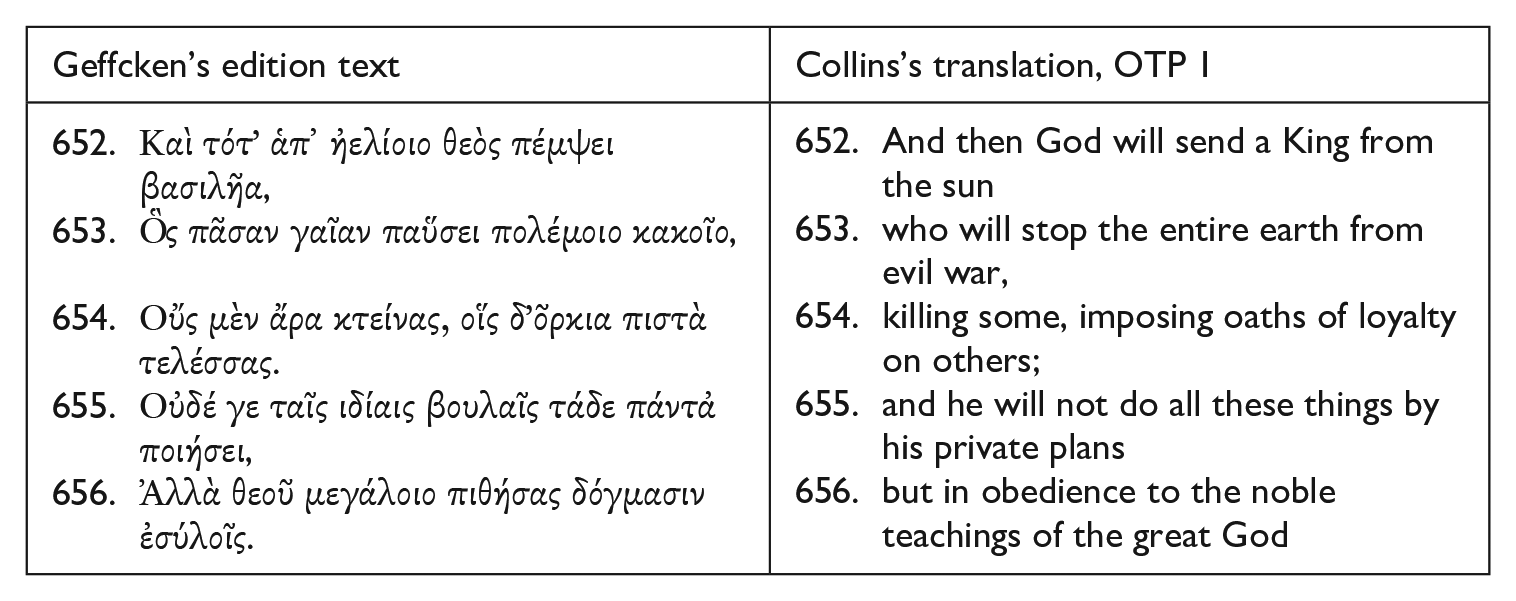
The third book of the Sib. Or. is—coupled with the fifth—arguably the most studied of all the collection. The context of the passage above begins, more immediately, on Sib. Or. 3.601, with a series of prophecies of woe. There, “a great king from Asia” is mentioned but in an altogether different context: he is a blazing eagle who will do much harm. Collins argues that this reference to an “evil king” that comes from Asia referred first to the Hyksos (an Asian-Semitic group of kings who ruled Egypt around 1500-1600 B.C.E.) and, in later contexts, was recycled to refer to first the Persians and finally to Antiochus IV Epiphanes (a Seleucid king who ruled the Hellenistic-Syrian kingdom from 175 to 164 B.C.E. and greatly attempted to suppress Judaism). However, it makes more sense to think of the “blazing eagle” as Rome, who was the enemy bringing destruction to many nations during their imperialistic era. 22
In the passage above, the king is portrayed as this noble and selfless savior whose only interest is to save the people of misfortune by God’s will alone, but that pristine depiction is not always the norm. For instance, the words in Sib. Or. 13.147-171 refer to Odenath of Palmyra not as a distinguished liberator (or as the “hero of the book” in Collins’ opinion), but rather he is characterized by a series of dubious expletives:
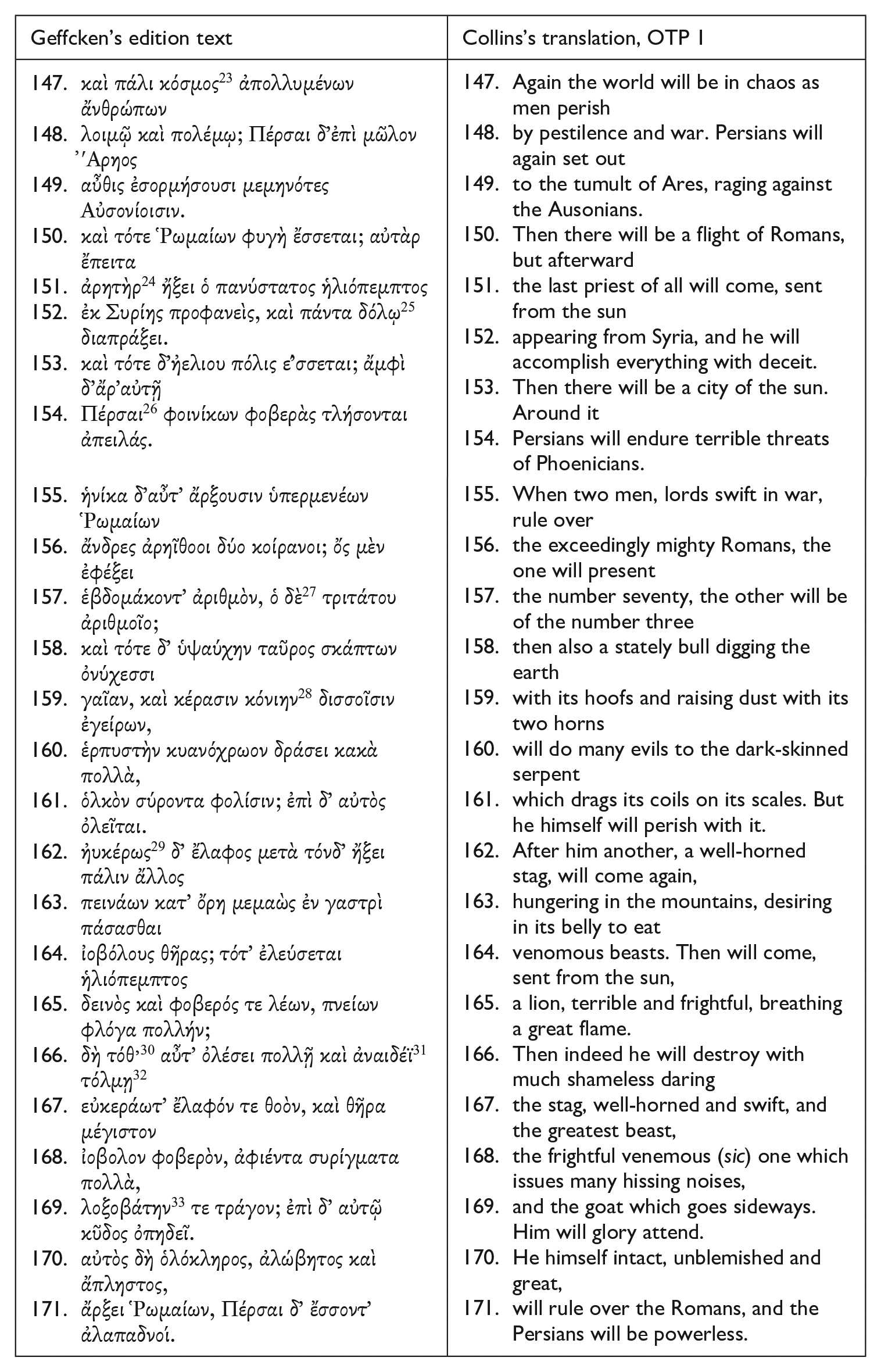
Besides being described as a ruthless justice bearer, Odenath was allowed to use the title Imperator (rather, Imperator totus orientis, or “Emperor of the whole East”) by Gallienus in 262 34 as the sibyllist considered him “unblemished and intact” in character. Given that Odenath was dead by 267, 35 Sib. Or. 13—or at least those last verses—must have been written before that date. Odenath is also acknowledged as “breathing a great flame”—possibly meaning, in the context, that he won easily over Roman and Persian rivals. 36
The best analysis of Sib. Or. 13 (with special regard to the role of Odenath) is still that of Potter. 37 Potter calls our attention to a number of factors. First, he states—quite correctly, in my opinion—that Sib. Or. 13 portrays political events from the point of view of the common man in the streets, probably someone in a Syrian town around 267 C.E. Second, he remarks that Sib. Or. 13.155-171 covers “at least nine years in fourteen lines (the last two concerned with the future glory of Odaenathus 38 ).”
This rushing of events might suggest that the writer of this section wanted to “update” his vision of the Roman world (compare the lack of discussion of the years between 253 and 260 to the thorough treatment of the previous twenty years 39 ), which was a necessity due to the victory of Odenath over the Persians (line 169: “Him will glory attend”). This “king” is more correctly described as a “Priest from the Sun,” showing that the sibyllist writer knew about solar cults in Palmyra.
In short, Sib. Or. 3 and Sib. Or. 13 must have been not only talking about very different characters, but also must have been written by very different people in their particular circumstances/agendas. In the first text, the savior king is an unidentified royal/messianic figure, who has been linked to a range of possible rulers from Ptolemy VI (a figure benevolent to the Jews, and it is reasonable to assume that this Oracle was written by a Jewish sibyllist) to a future savior who will avenge the East. This king, regardless of who he is, is a modest figure and happy to act accordingly to God’s will.
Now in the second text, the “King from the Sun” is also a royal figure identified as a priest (“the last priest of all,” an eschatological overtone—“Ἀρητήρ [. . .] πανύστατος 40 ”), yet he receives other attributes: he was said to accomplish everything “with deceit” and “shameless daring” (δόλωμα and ἀναίδεια &0x002B; τόλμα) and to overcome his troubles as a man of action by means of his own resourcefulness (an indication that this writer, most likely a Christian sibyllist, knew what was happening in the East during the turmoil in the third-century C.E. 41 ). This king is a “frightful lion” who will “do many evils” in order to fulfill his savior role.
Hence, a connection of these texts with Egyptian royal myths is not simple to be made. The figure of Sib. Or. 13 is fierce (he “breathes flames,” also in 13.165) and can hardly be compared to the tame executor of God’s will and avenger of the East described in the Sib. Or. 3. We shall thus move on to another possible linking aspect between these ancient traditions.
Messianism and the Sun
The Sun is a spatial reference in both Egyptian religion and in Egyptian apocalyptic lore, which will keep appearing and changing as time passes. However, messianic expectation, while also having a spatial dimension (the Messiah must come from somewhere, after all), seems to be lacking in the texts examined (with the exception of the OP). In other words, there are plenty of references to a “city of the Sun” as a refuge to all woes, but there is not always a particular reference to a king figure who will see to the salvation of the people.
This geographical awareness—now coupled with some messianic references—appears as well in the Roman-Hellenistic texts we have observed so far: it is described vaguely in Sib. Or. 3, where it is a mere location in the narrative, and in Sib. Or. 13, where it is a concrete place, Palmyra, and the ruler is a concrete person, Odenath. This idea is reinforced when compared to the other passages dealing with the “city of the sun” in Apoc. El. (C) 2:46: it is the place whence a king shall rise.
This last reference is generally taken to be Heliopolis but could be reminiscent of the “city of the Sun” from Aristonicus, some centuries before the redaction of the Apocalypse of Elijah. Aristonicus deployed the notion of a city of the Sun as a way of settling the score with Rome, after the dubious will of Attalus III (who bequeathed his domain of Pergamum to Rome, ending its sovereignty). However, just as the East—or the land of the rising Sun—is a complicated and nuanced concept, so is the antagonism of Rome versus “Eastern” powers.
Yet, these indications have little of the cosmic appeal present in Egyptian lore—it seems that the kings of the Sun must only come from somewhere, like any other king; the East is the place of choice due to the nature of the “settling of accounts” between East and West (more detailed in the Conclusion of this article). It is not completely clear in which sense they come from the Sun: as the place by definition of the restoring of order, be it in a messianic or futuristic sense, or by consequence of their past deeds and actions (Odenath in Sib. Or. 13). No simultaneous spatial and temporal references appear here as the moving factor, other than a vague intention by the sibyllists of placing the locus of victory in their own area—the East, understood always in the examined passages as a place mistreated by Western powers.
Nonetheless, Messiahs always seem to come from the East, the land of the Sun. The king expected in Sib. Or. 3.652-656 is not the first example of this expectation, since the term ἀφʼ ἡλίου ἀνατολῶν can be found in Isa 41:2; 25 LXX: “from where the Sun rises.”
42
41:2: τίς ἐξήγειρεν ἀπὸ ἀνατολῶν δικαιοσύνην ἐκάλεσεν αὐτὴν κατὰ πόδας αὐτοῦ καὶ πορεύσεται δώσει ἐναντίον ἐθνῶν καὶ βασιλεῗς ἐκστήσει καὶ δώσει εἰς γῆν τὰς μαχαίρας αὐτῶν καὶ ὡς φρύγανα ἐξωσμένα τὰ τόξα αὐτῶν [. . .] 41:25: ἐγὼ δὲ ἤγειρα τὸν ἀπὸ βορρᾶ καὶ τὸν ἀφ᾽ ἡλίου ἀνατολῶν κληθήσονται [. . .]
This passage refers, in unequivocal terms, to King Cyrus, hailed as a messiah (see Isa 45:1-3 LXX:
οὕτως λέγει κύριος ὁ θεὸς τῷ χριστῷ μου Κύρῳ οὗ ἐκράτησα τῆς δεξιᾶς ἐπακοῦσαι ἔμπροσθεν αὐτοῦ ἔθνη καὶ ἰσχὺν βασιλέων διαρρήξω ἀνοίξω ἔμπροσθεν αὐτοῦ θύρας καὶ πόλεις οὐ συγκλεισθήσονται / ἐγὼ ἔμπροσθέν σου πορεύσομαι καὶ ὄρη ὁμαλιῶ θύρας χαλκᾶς συντρίψω καὶ μοχλοὺς σιδηροῦς συγκλάσω / καὶ δώσω σοι θησαυροὺς σκοτεινούς ἀποκρύφους ἀοράτους ἀνοίξω σοι ἵνα γνῷς ὅτι ἐγὼ κύριος ὁ θεὸς ὁ καλῶν τὸ ὄνομά σου θεὸς Ισραηλ.
Cyrus also makes an appearance in Sib. Or. 3.286-287. However, where Cyrus is a past figure in Isaiah, part of an ex eventu prophecy, the “king from the Sun” in Sib. Or. 3.652-656 is an eschatological figure, yet to come and act. Unlike the Kings from the Sun in Egyptian apocalyptic texts—which refer to a restoration of a righteous king and society, as things were before the awful Persian and Greek periods—Sib. Or. 3.652 and Apoc. El 2:44 refer to a future savior. 43
Whereas Cyrus is only an anointed Gentile who is the instrument of God’s will, the other “kings of the Sun” may or may not be so docile, and even if they act in a messianic way, they lack the title. This is also true in the Oracles of Hystaspes (OH), where a powerful liberator coming “from the Heavens” is described, but he is in no way tame and merciful as can be seen in the following passages:
For Hystaspes, whom I mentioned above, maintains, after having described the injustice of this last century, that the pious and faithful, once they are separated from the wrongdoers, will raise their hands to the sky with tears and lamentations and beseech the fidelity of Jupiter (fidem Jovis). And Jupiter will look upon the earth and hear the voices of the people and exterminate the godless ones.
44
God would hear them and send the Great King from heaven (regem magnum de caelo), who would snatch them away and free them and ruin all the godless ones by fire and sword.
45
“Western” examples fit the same pattern: the story of Eunus, the slave who led the rebels during the Servile War in 135 B.C.E. prophesized that he would be king one day—and he came from the East too, Apamaea in Syria, and venerated a goddess whose husband, Hadad, was himself a solar deity. 46
Buitenwerf argues that the phrase ἁπ ̓ ἠελίοιο alone could be understood as just “from the East,” without the “ἀνατολῶν.” 47 It makes sense, but this should be regarded with care even if we have precedents for that interpretation in Homer (πρὸς ἠῶ τʼ ἠέλιόν τε) meaning literally “towards dawn and the sun.” 48 But the Homeric reference, by comparison to ours, has no ideological connotation: it is a mere indication that the sun rises at dawn, hence from the East, a plain natural fact. The East is not in itself a special, magical, or sacred place whence divinely appointed kings come. This interpretation of Eastern things results from a layer of meaning attributed to (some) people, otherwise it is a mere natural phenomenon.
The same can be said of Cyrus—he comes from the East because Persia is the East in relation to the Jews, not the other way around. Perhaps the whole concept that “Kings from the Sun” are, first, identical to “kings from East” and, second, that they are sacred by their very nature begins there.
This makes more sense when one thinks that Sib. Or. 3 is more than likely the product of a Jewish sibyllist in most of its parts 49 and that Sib. Or. 13 is Christian. 50
Other ancient authors present similar pictures. Phlegon of Tralles, in his Mirabillia, says that Athena will send Ares “from Asia.” 51 But while Phlegon’s marvelous utterance can be ascribed to a period of awful East–West relations, namely the Mithradatic Wars, it is not necessarily a statement that someone divinely empowered to set things right must come from where the sun rises. 52
Stopping malignant war and acting with deceit: Some remarks on how two Kings from the Sun act
Some partial conclusions may be tendered. The Egyptian “King of the Sun” is a figure rooted in the past who will bring back “good things” to the much-disfigured land of Egypt. The “kings of the Sun” in Sib. Or. 3.652 and Apoc. El. (C) 2:44 are future figures. But Odenath, the object of Sib. Or. 13.147, from the point of view of the narrative, is a figure from current times (that is. his attributes are what appear as an ex eventu prophecy). For hermeneutic purposes there are all sorts of indications in the text of Sib. Or. 13.147 that he (Odenath) already came (but has not yet died), so he can be either understood as someone also belonging to the future (what the sibyllist wants its readers to believe here, it seems) or that he is a present figure.
In any case all the figures discussed (the main ones in Sib. Or., the secondary ones in OH and OP), all have a trait in common: they will stop war. The “Kings from the Sun” discussed in this article will either restore peace (Sib. Or. 3.652, Sib. Or. 13.147, OP, OH) or get involved in some turmoil that, in the end, will eventually bring peace (Apoc. El. [C] 2.51-53). The appearance of the “king that will arise in the city which is called ‘the city of the sun’” is linked to future disturbances in the land. In the Apocalypse of Elijah, these things will take place when he flees to Memphis with the Persians (Apoc. El. [C] 2:46). Some figures will follow divine commands (Sib. Or. 3.652, OP, OH), while others will act of their own accord—Sib. Or. 13.147 and Apoc. El. (C). Some will come from a Jewish or Christian background (Sib. Or. 3.652, Apoc. El. [C], OH) and two from other backgrounds (Sib. Or. 13.147 and OP). In the final analysis, there is no relation between meekness in fulfilling God’s commands and having a Jewish or Christian background.
In the end, who comes from the Sun?
A more suitable parallel may be found in the OH: “And then God shall send a king from the sun, who shall cause all the earth to cease from disastrous war.” 53 This is unambiguous: just as in Sib. Or. 3.652-656, we have the statement that the king will be sent by God, 54 will come from the Sun, and will stop disastrous (that is, malign or evil) wars.
This last characteristic is identical to that of the king in Sib. Or. 3—O ̔̀ ς πᾶσαν γαῖαν παὕσει πολέμοιο κακοῖο. In the text of Hystaspes, quoted by Lactantius in his Divine Institutes where several sibylline passages are also quoted verbatim, including Sib. Or. 3.652-653 (DI 7.18.2-3), it appears thus: “Also another Sibyl: ‘And then God shall send a king from the sun, who shall cause all the earth to cease from disastrous war.’” 55 It could be that since Lactantius is speaking in a context of Sibylline and Hermetic prophetic utterances he knew perfectly well that passage of the Sib. Or. and was just repeating, almost verbatim, an old idea. 56
In sum, the representations of the figure of the king who is coming from the Sun can be roughly divided in two groups: (1) OP, Sib. Or. 3, and OH, where he is indeed a king, comes from the Sun, and obeys divine commands (this would include Isaiah too) and (2) Sib. Or. 13 and Apoc. El (C), where he is an all too human figure coming from a geographical location, namely a “city of the Sun.” Accordingly, since in Sib. Or. 13 this king is a human figure who has already appeared, we know that he is Odenath and that his city—in the East, it is true—is Palmyra.
The city in Apoc. El (C) remains unnamed but it is very doubtful that there are either connections to Egyptian royal mythology or to Aristonicus’s “city of the Sun” here. Collins remarks that since Apoc. El (C) is an Egyptian text “The literary tradition regarding that native king obviously plays a part in the righteous king from the ‘city of the sun’ (2:46) who comes to power in Memphis and introduces ‘abundant well-being’ (2:52) [. . .] in the OP.” 57
And yet a reading of Apoc. El (C) 2:46-52 does not match this:
In those days, a king will arise in the city which is called “the city of the sun,” and the whole land will be disturbed. (He will) flee to Memphis (with the Persians) [. . .] Even the remnant, who did not die under the afflictions, will say, “The Lord has sent us a righteous king so that the land will not become a desert.” “He will command that no royal matter be presented for three years and six months/The land will be full of good in an abundant well-being.” “Those who are alive will go to those who are dead, saying, “Rise up and be with us in this rest.”
The period of 3 years and 6 months reflects Dan 7:25; otherwise, the rest of the phraseology of the author remains, in our opinion, too vague for it to be linked directly to any Egyptian royal mythology. “Abundant well-being” is also too vague an idea, spread throughout kingship in the Ancient East and, of course, expected from Hebrew and their Christian-messianic offshoot kings as well. 58 Again, Memphis was in steep decline when the author of Apoc. El. (C) wrote his lines and was more likely a familiar place in the region that he knew (he was far less interested in world affairs, as they could be understood, then the sibyllists). 59 There is no reason to think that reference to the old, Pharaonic Memphis is intended. On the other hand, the reference to the former “rulers of Egypt [. . .] because your day has passed” may be a remembrance from Hebrew bondage as told in the Pentateuch.
Conclusion
As final considerations, we may advance some issues regarding the figure of the “King from the Sun.” Judging from the earliest evidence from the OP, not to mention Pharaonic titles themselves, the title is an Egyptian invention. It appears only in much later texts related to Anatolia or Asia at large. However, it is precisely those later usages that interest us here: the reference in Sib. Or. 3.652-656 and Apoc. El. 2:46 on one side and Sib. Or. 13.147-171 on the other. This happens because the first two references relate to an indistinct figure in the future, who displays strong messianic character. The “King from the Sun” in Sib. Or. 13 is, on the other hand, a fierce ruler who is acting at the time of writing (since the sibyllist shows nothing about his death), and one whom we know fairly well: Odenath of Palmyra. It is fair to say that he is the last “King from the Sun,” or from the East. His representation blends messianic features with other features that we know from historic sources (he is deceitful when it comes to war, for example—a reference to his guerrilla warfare against the Persians).
Another, very important issue is to try to understand how this title or its variations—“King from the Sun,” “king born of the Sun,” “king sent from the Sun,” even the “last priest of all sent from the Sun”—were used over and over again following their Egyptian royal origin to Jewish and Christian contexts. It would require a close study of how an idea was appropriated and then given other meanings by peoples other than Egyptians; in short, the history of an idea.
It is fair to say that this history—in the sense of a documented trajectory from Pharaonic texts to the everyday man in Sib. Or. 13—is an almost impossible task: it would involve knowledge of how “upper class” concepts were taken by commoners in various times and places in antiquity, and there are just no sources for us to dwell upon that. But given their messianic-apocalyptic roles, it seems reasonable to ascribe to the “King of the Sun” in the examined sources a trajectory similar to that of the concept of Messiah: the latter also began in a moderate, if not completely human sense, and grew up to become a supernatural nature. 60 This can be seen in the role of Cyrus, examined above. If the “King of the Sun” displays messianic-apocalyptic traces, as the title does, it can be rightly understood in two parallel schemes; first, that of the Messiah figure (of which it would be just a particular case); second, that of the East taken as a whole as an ancient, traditional, and worthy deposit of wisdom and good (that is traditional) values, deprived of its honor by the parvenus from the West, beginning with the Greeks and going on with Roman imperialism.
A further development of this last idea finds a fascinating and not yet fully appreciated consequence in the changing of frontiers of vengeance further East: in Sib. Or. 13, reprisal is granted not against Rome or Greece, but toward a power placed further in the depths of Asia, Sassanid Persia. Odenath performs his deeds against an opponent worthy of his deceitfulness, according to the sibyllist. 61
But is Odenath a priest or a king? The reference to him in Sib. Or. 13 is as a priest coming from the Sun. But the author must have known that he was a king of sorts, regardless of the confusing titles used by him or bestowed upon him by the Romans. In every other source that mentions Odenath, from the Historia Augusta to Zonaras (not to mention epigraphical sources) Odenath is treated as a king, a royal figure on a par, most of the time, with Roman emperors of the time. Furthermore, Odenath appears in a sequence typical of sibyllists naming Roman emperors. To interrupt this sequence with a “priest” makes little sense—unless the priest quoted would also be a royal figure, as is the case. Odenath may be aptly called, then, the “last king from the Sun”—the last royal-solar-messianic figure in a line of similar ones that appear throughout messianic-apocalyptic literature, Jewish, Christian, or pagan.
Footnotes
Acknowledgements
A very special thank you note is due here to Lorenzo Di Tommaso and Giovana L. Braga, for helping the author improve his English and clarify his ideas.
Declaration of conflicting interests
The author(s) declared no potential conflicts of interest with respect to the research, authorship, and/or publication of this article.
Funding
The author(s) received no financial support for the research, authorship, and/or publication of this article.
1
2
The issues relating to Egyptian pharaonic ideology and foreign rule appear in two other important sources that, however, would take us too long to analyze in depth here. These are the Demotic Chronicle and the Oracle of the Lamb. The Demotic Chronicle, in spite of its name, is a series of prophecies with oracular utterances intermixed See Roberto Gozzoli, The Writing of History in Ancient Egypt during the First Millennium BC (ca. 1070-180 BCE) (London: Golden House Publications, 2006), 284-86. If dating of the several layers of text can correctly be ascribed to the end of the third-century B.C.E., we have perhaps the earliest reference to a savior king that comes after the Greeks (Demotic Chronicle, 8th Stanza). Cf. observations by Edda Bresciani, “Note di toponomastica: i templi di Mn-nfr, Wn- ) for the most recent translations of the Oracle of the Lamb. It should be noted that the copy is from Roman times but internal dating can be traced back to the eighth-century B.C.E. The first column of the Oracle of the Lamb also presents a world in disarray; the reference to a rule of fifty-five years, also to be found in the Oracle of the Potter, is found in the Oracle of the Lamb as well; this fifty-five year period of a good ruler is what follows two years of a disastrous one, who was never conclusively identified. In the Oracle of the Lamb, there is no link between an “unlawful” king and divine punishment; the story of the Lamb is placed under a particularly unfortunate king, Bocchoris. The lamb is not a savior “coming from the Sun” but says that it will comeback, in the future, to restore good order in the land of Egypt.
3
See Ludwig Koenen, “Die Prophezeiungen des ‘Töpfers,’” Zeitschrift für Papyrologie und Epigraphik 2 (1968): 178–81 for the problems regarding the fragments of the OP (mostly the Rainer Papyrus) for the idea of past misdeeds toward Egypt being corrected; see also by Ludwig Koenen, “The Prophecies of a Potter: A Prophecy of World Renewal Becomes an Apocalypse,” in Proceedings of the 12th International Congress of Papyrology, ed. Deborah H. Samuel (Toronto: Hakkert, ). A fresher approach can be found in Gozzoli, The Writing of History in Ancient Egypt during the First Millennium BC (ca.1070–180 BC). The text of the OP is discussed in further detail below, see note 11.
4
Gozzoli, The Writing of History, 304.
5
There are different copies of the manuscript of the OP and some observations are in order here, besides what has already been said above: a slightly different translation than the one presented here can be found in Stanley M. Burstein, ed., The Hellenistic Age from the Battle of Ipsos to the Death of Kleopatra VII (Cambridge: Cambridge University Press, ), 136–38: “The river, [since it will not have] sufficient water, [will flood], but (only) a little so that scorched-will be [the land –] but unnaturally. [For] in the [time] of the Typhonians [people will say] ‘Wretched Egypt, [you have been] maltreated by the [terrible] malefactors who have committed evil against you.’ And the sun will darken as it will not be willing to observe the evils in Egypt. The earth will not respond to seeds [other natural disasters and themes of a world turned upside down follow] [. . .]
6
This is correctly remarked by Riuwerd Buitenwerf, Book III of the Sibylline Oracles and Its Social Setting. With an Introduction, Translation and Commentary (Leiden: Brill, 2003), 272–73.
7
Ever since the days of the Religionsgeschichtliche Schule, the OP has evoked comparison with Jewish apocalyptic texts. Such is the case with the first one to use the term apocalyptic related to a kind of Egyptian literature, see Chester McCown, “Hebrew and Egyptian Apocalyptic Literature,” HTR 18 (1925): 357–411. Many of the issues that appear as problems in our own times are in McCown’s text solutions, as a matter of fact. The Oracle of the Lamb may have been completed after Harsiesis as well, defeated by Ptolemy VIII (170–116 B.C.E.).
8
Of course, the idea of a “King from the Sun” was appropriated by the Lagids, as is evident from parts of the Rosetta Stone as well as other epigraphic material: “In a hieroglyphic stele dated to 311 B.C., Alexander IV is described as ‘chosen of the sun, son of the sun.’ On the Rosetta Stone, Ptolemy V is described as the son of the sun ‘to whom the sun has given victory.’ [. . .] Momigliano [. . .] suggests that in Sib. Or. 3, as in the Potter’s Oracle, the King from the Sun is anti-Ptolemaic. This view ignores the association of sun mythology with the Ptolemies and makes a strained distinction between the seventh king and the King from the Sun. Momigliano’s thesis that the oracle was written in support of the Maccabean revolt suffers from the lack of any clear reference to the Maccabees.” See Collins, “Sibylline Oracles,” OTP 1.356. It should be noted that although the idea is almost unanimously referred to Pharaonic Egypt, or even the Lagid one, the late dating of the passages discussed in this article points to anti-Greek or anti-Roman propaganda (even if this is done in an indirect way, as the praising of Odenath in Sib. Or. 13).
9
A slightly different translation can be found in Jan Assmann, Death and Salvation in Ancient Egypt (Ithaca: Cornell University Press, 2005), 136.
10
Eberhard Otto, “Zwei Paralleltexte zu Totenbuch 175,” Chronique d’Égypte 37 (1962): 249–56.
11
This king-centeredness would apply to Daniel as well; see Jan Bergman, “Introductory Remarks on Apocalypticism in Egypt,” in Apocalypticism in the Mediterranean World and the Near East. Proceedings of the International Colloquium on Apocalypticism. Uppsala, August 12–17, 1979, ed. David Hellholm (Tübingen: Mohr Siebeck, 1983), 56, 59.
12
Bergman, “Introductory Remarks,” 59.
13
As a general introduction to the theme of Egyptian apocalyptic—particularly in the light of our article theme—a text that is highly recommended is Vilmos Wessetzsky, “Zur Deutung des ‘Orakels’ in der sogenannten Demotischen Chronik,” Wiener Zeitschrift für die Kunde des Morgenlandes 49 (1942): 161–71.
14
For a recent overview of the versions and manuscripts, see Lorenzo DiTommaso, “The Sibylline Oracles (Jewish),” in The Wiley-Blackwell Companion to the Old Testament Apocrypha and Pseudepigrapha, ed. Randall Chesnutt (Malden: Wiley Blackwell, forthcoming).
15
For the Sib. Or., the editio princeps still is that of Alexandre, in two volumes. See Charles Alexandre, Oracula Sibyllina (Paris: Firmin Didot Frères, 1841. Vol. 1 and from the same author and publisher, 1843. Vol. 2).
16
Johannes Geffcken, Die Oracula Sibyllina (Leipzig: J.C. Hinrichs, 1902); this has been used throughout this article, sometimes compared, when necessary, to the edition of Aloysius Rzach, Oracula Sibyllina (Prague: F. Tempsky/G. Freytag, 1891). Translations follow those by John J. Collins in Charlesworth’s Old Testament Pseudepigrapha—OTP—or eventually my own. See James H. Charlesworth, ed., The Old Testament Pseudepigrapha (New York: Doubleday, –1985), 2 vols. For classical texts, I have used Loeb Classical Library editions online.
17
Henceforth, OTP 1.
19
Translation follows that of Orval S. Wintermute, Apocalypse of Elijah in OTP 1.
20
Jeanmaire relates these verses to the character of Zenobia, wife of Odenath of Palmyra and later queen of that city, to the idea of the despoina, “a similar theme that appears in [Virgil’s] IVe Eclogue.” See Henri Jeanmaire, La Sibylle et le retour de l’age d’or (Paris: Ernest Leroux, 1939), 66–67, 81.
21
That Rome will pay more times for its misdeeds than the original acts is a theme well explored in modern scholarship: see Elemér Kocsis, “Ost-West Gegensatz in den jüdischen Sibyllinen,” Novum Testamentum 5 (1962): 105–10 and Hans G. Kippenberg, “‘Dann wird der Orient herrschen und der Okzident dienen’. Zur Begründung eines gesamtvorderasiatischen Standpunktes im Kampf gegen Rom,” in Spiegel und Gleichnis. Festschrift J. Taubes, ed. Norbert W. Bolz and Wolfgang Hübener (Würzburg: Königshausen & Neumann, 1983), 40–48.
22
The eagle appears as eschatological motif in other apocalypses too; see 4 Ezra 11 and as an omen in Suetonius’ Vespasian 8, also coming from the East: “[. . .] acieque Betriacensi, prius quam committeretur, duas aquilas in conspectu omnium conflixisse victaque altera supervenisse tertiam ab solis exortu ac victricem abegisse”/“[ . . .] and on the field of Betriacum, before the battle began, two eagles fought in the sight of all, and when one was vanquished, a third came from the direction of the rising sun and drove off the victor.” Collins lists Cambyses, Artaxerxes III, and Antiochus Epiphanes as successors to the Hyksos in this role, but the reference to the eagle has, in my opinion, strong Roman overtones.
23
Alexandre remarks that ms. H (Munich, Bayerische Staatsbibliothek, gr. 312, from 1541 and belonging to the Ω family) has “ἄκόσμος” here.
24
LSJ: poet. for “ἱερεύς”; Alexandre notes, in a footnote, that it could also mean “ῥυτήρ”; LSJ, someone or something that stretches a bow or the strap that holds a horse (coherent with that much of Roman Empire Odenath held together in the East). The apparent continuity between the concepts of “king” and “priest” regarding Odenath will be seen below.
25
LSJ: “δόλωμα,” trick, deceit.
26
Alexandre observes here that ms. H and the majority of mss. have πᾶσαι but Πέρσαι makes more sense and goes better with “Phoenicians” (that is, Palmyrenes).
27
Rzach’s edition has ὅς δὲ here, see Rzach, Oracula Sibyllina, 213.
28
Rzach’s edition has κέραεσσι κόνιν here, see Rzach, Oracula Sibyllina, 213.
29
Alexandre’s edition has ἑυκέραος here.
30
Alexandre’s edition has δὴ τότε here; Rzach has καὶ τότε δ ̓ αὐ̄τ ̓, see Rzach, Oracula Sibyllina, 214.
31
LSJ: “ἀναίδεια,” shamelessness.
32
LSJ: “τόλμα,” perhaps recklessness; “daring” is suitable too.
33
Alexandre’s edition has τοξοβάτην.
34
See the interesting text of Michel Gawlikowski, “L’apotheóse d’Odeinat sur une mosaïque récemment découverte à Palmyre,” Comptes rendus des séances de l’Académie des Inscriptions et Belles-Lettres 149 (2005): 1303.
35
Versions of his death are several and contradictory and appear in several sources: in Historia Augusta, Thirty Tyrants, “Odenathus” 6, Odenath is killed by a cousin of his, Maeonius; in Zosimus’ New History I.39 Odenath was killed in Emesa “in a conspiracy, while celebrating someone’s birthday”; Syncellus (ninth century) states that he was killed by another individual bearing the same name (Odenath), who was instantly killed by his bodyguard (this happened while trying to relieve the siege of Heraclea Pontica by the Goths). Eusthatius of Epiphania, a Byzantine historian from the sixth century quoting a very dubious source also endorses the assassination theory without naming the killer. Zonaras’ History has perhaps the best-known version, that Odenath was killed by a nephew after a brawl during a hunt—somewhat similar to the version in the Historia Augusta (Zonaras, History, XII.24).
36
This is a small mistake by Collins—the Parthians had been overthrown by the blooming Sasanians some forty years before Odenath’s exploits, but this translation may also reflect the standard rhetorical usage of Parthians = Persians.
37
David S. Potter, Prophecy and History in the Crisis of the Roman Empire: A Historical Commentary on the Thirteenth Sibylline Oracle (Oxford: Clarendon Press, ). Good as Collins’ translation in OTP 1 is, Potter goes deeper regarding Sib. Or. 13 since his is a full-length commentary on the whole book, with special attention to the turmoil in third-century Roman world.
38
The most common way of transcribing Odenath’s Aramaean name among Classicists. Either form “Odenath” or “Odaenathus” is acceptable, the latter being more in accordance to Roman sources such as the Historia Augusta. See Potter, Prophecy and History, 142.
39
Potter, Prophecy and History, 151.
40
LSJ: “ἀρητήρ,” one that prays; poet. for “ἱερεύς”; “πανύστατος,” last of all; for the very last time.
41
According to Collins, “Sibylline Oracles,” OTP 1.453: “At the end the Sibyl prophesies that Odenath will be ‘intact, unblemished, and great,’ and will rule over the Romans (vss. 170f.). The oracle then can be understood as political propaganda in praise of Odenath.” This is something we also agree upon; see further Potter, Prophecy and History in the Crisis of the Roman Empire.
42
Buitenwerf, Book III of the Sibylline Oracles, 273.
43
As correctly observed long ago by Eddy, The King Is Dead, 338.
44
Lactantius, Divinae Institutiones, ed. Jacques-Paul Migne, PL VII.18.2 (Paris: Garnier, 1864). Digitized by Harvard University, 2007 (accessed on 3 March 2022).
45
Lactantius, Divinae Institutiones, VII.17.11.
46
For more information on Eunus and particular aspects of this revolt, see Diodorus Siculus, Library of History, 34.
47
Buitenwerf, Book III of the Sibylline Oracles, 274.
48
Homer, Iliad XII.239; Odyssey IX.26, as correctly remembered by Buitenwerf, Book III of the Sibylline Oracles, 274.
49
As Collins and Buitenwerf agree.
50
Collins allows the possibility of Sib. Or. 13 being Jewish if not—as is most likely—Christian; it does not look like the work of a Pagan even if somehow endorsing the feats of one; see Collins on Odenath, “Sibylline Oracles,” OTP 1.453.
51
Asia is the place from where the sun rises (ὅθεν ἡλίου ἀντολαί εἰσιν). Collins maintains the distinction between “from the Sun” and “from the East”; they are not synonyms. Buitenwerf argues that this cannot be drawn as a sharp limit, which is also correct when considering the use of the term ἀπηλιώτης. See John J. Collins, Between Athens and Jerusalem: Jewish Identity in the Hellenistic Diaspora (Grand Rapids: Eerdmans, 2000), 93. See also Buitenwerf, Book III of the Sibylline Oracles, 274. Phlegon’s tales begin in the story of the Roman general Publius, ravaging in a trance after defeating Eastern forces: “O my country, what a baneful Ares Athena will bring you/When you ravage Asia with its great wealth and return to Italian soil and the garlanded cities” Phlegon of Tralles’ Mirabillia, III.8 in William Hansen, Phlegon of Tralles’ Book of Marvels. Translated with an Introduction and Commentary (Exeter: University of Exeter Press, ), 34, 101–12. For the Greek text and full explanation of manuscript tradition on Phlegon, see Alessandro Giannini, Paradoxographorum Graecorum, Reliquiae recognovit, brevi adnotatione critica instruxit, latine reddidit Alexander Giannini (Milan: Istituto editoriale italiano, 1965), “ὦ πατρὶς, οἷον σοι λυγρὸν φέρει Ἄρη Ἀθήνη, ἡνικα πορθήσας̓ Ἀσίην πολύολβον ἵκηαι Ἰταλίην ἐς γαῖαν ἐυστεφάνους τε πόληας,” 188.
52
53
Vicente Dobroruka and Robert A. Kraft, “Oracles of Hystaspes,” in Old Testament Pseudepigrapha: More Noncanonical Scriptures, ed. Richard Bauckham, James R. Davila, and Alexander Panoyatov, vol. 2 (Grand Rapids: Eerdmans, forthcoming), see especially the section on Lactantius, Divine Institutes, VII 7.18.2-3. The plural form (“Oracles” and no longer just one “Oracle of Hystaspes”) is a conscious choice from the part of the redactors of these fragments: it seems there are different oracles under the same guise—much as it happens with the Sib. Or.—when one is talking about Hystaspes in Justin, Clement, and Lactantius.
54
55
See Sib. Or. 3.652-653. “Item alia Sibylla: Καὶ τότ᾽ ἀπ᾽ ἠελίου πέμψειε θεὸς βασιλῆα, Ὃς πᾶσαν γαῖαν παύσει πολέμοιο κακοῖο [. . .],” almost identical in Alexandre’s edition of the same section: [. . .] ἀπ ̓ ἠελίοιο Θεὸς πέμπψει [. . .].
56
Collins, “Sibylline Oracles,” OTP 1.453. Lactantius is, after all, 100-150 years older than Sib. Or. 3 at the terminus post quem—the book cannot have been composed after 265, since it does not refer to the death of Odenath.
57
Collins, “Sibylline Oracles,” OTP 1.724.
58
Eddy, The King Is Dead, 324.
59
The same can be said of Apoc. El. (C) 2:44: “In those days, blood will flow from Kos to Memphis [. . .]” The city of Kos depicted here is not the Greek island, but rather the Arabic city of Qus, ancient Apollinopolis Parva. The worldview of the author of Apoc. El. (C) was indeed very local. See Wintermute, “Apocalypse of Elijah,” OTP 1.743, and Georg Steindorff, Die Apokalypse des Elias (Leipzig: J.C. Hinrichs, ), 84.
60
The traditional study in this field, much as Eddy was regarding spiritual resistance to Hellenization, is that of Norman Cohn, Cosmos, Chaos and the World to Come (New Haven: Yale University Press, ). Cohn presents a broad—perhaps a too broad but still necessary reading—scheme of how the “original” combat and creation myths of the Ancient Near East gave rise to the Messiah figure as a supernatural power.
61
This theme of Persians (or Parthians, for that matter) is a traditional trope: it can be found in many examples in antiquity. Polybius does so regarding the fides punica of the Carthaginians (who are, after all, depicted as Easterners placed by Fortune near Rome, near enough to become burdensome and challengers for world dominion). Josephus uses similar stereotypes while dealing with the “treacherous” Parthians and the death of Herod’s brother. Cf. Polybius, I.88; V.104 among others; Josephus’ Jewish War I.272.