







Abstract
This article focuses on the role of political parties for policy making, and it traces the development from party preferences over coalition positions to policy proposals. The main argument is that parties with more similar preferences agree on more encompassing sets of policies, and that if a coalition formulates a policy in its agreement the chances for a policy proposal are higher. However, the need to negotiate the coalition agreement with other parties mediates the influence of partisan preferences. The article is based on a qualitative content analysis of documents as well as expert interviews from three West European countries and focuses on higher education policy. The results show preferences of governing parties influence policy proposals also in situations of coalition government. Furthermore, coalition agreements are found to be central documents in policy making as they limit veto capacities and indicate where substantial policy change is likely.
Keywords
Introduction
Parties and their preferences are one factor that influence policy making (Pollitt and Bouckaert, 2004). Especially with regard to legislative processes and the upstream activity of policy formulation, parties in government have a dominant role (Capano et al., 2015; Zohlnhöfer, 2009). Therefore, the preferences of governing parties as well as the positions of the government are key factors that influence policy making. While the importance of the government and the parties composing it is often acknowledged in policy studies, there is a lack of detailed analysis of the role of partisan preferences for policies, especially relating to the role of the coalition agreement for subsequent policy making. This relationship is the puzzle motivating this article, which acknowledges that multiple factors matter for policy making, but concentrates explicitly on the role of partisan preferences.
In majoritarian one-party governments, preferences of parties and positions of the government are similar as the government is a unitary partisan actor. However, in consensus democracies that are governed by coalitions; the relationship between the two is complex. Here the transfer of partisan preferences to coalition positions is mediated through negotiations between parties and thus more veto players are involved (Zohlnhöfer, 2009). With the transfer of partisan preferences being less direct, these circumstances are especially interesting when analyzing the role of partisan preferences for policy making. Since the negotiations preceding government formation make a direct enactment of partisan preferences less likely, it is necessary to distinguish between preferences of the governing parties and positions of the government as they are represented in the coalition agreement.
In doing so, this article argues that preferences of governing parties and coalition positions have different implications for policy making. The policies described in the coalition agreement represent an alignment of interests and serve as agenda for the incoming government, which is also relevant for the perception of a government's performance (Zohlnhöfer, 2009). It thus creates a situation of “anticipatory” (Peters et al., 2001: 15f) or pre-negotiated policy making as the governing parties agree on a policy that is then included in their government agenda increasing the chances for a subsequent policy proposal. Contrary to that, in situations of “reactive” (Peters et al., 2001: 15f) or ad hoc policy making, when an issue rises to the agenda that has not been included in the coalition agreement and thus is not pre-negotiated, it is more likely that parties retreat to their electoral preferences making an agreement less likely.
The contribution of this article is to investigate how parties, and their preferences, influence policy making in coalition governments, and in how far coalition agreements help to translate preferences into policies. The article highlights both the formation of coalition positions and the interplay between partisan preferences and coalition positions in policy formulation. The focus is on the questions how partisan preferences relate to coalition positions, and how partisan preferences as well as coalition positions influence policy proposals. To limit the scope of analysis, it stops at the stage of policy proposals.
Since policy making is a sectoral activity, the above considerations will be investigated in a specific context, higher education policy. Recent changes in this area, among others concerning its increased relevance for modern societies (Gornitzka and Maassen, 2014), make higher education a more salient and politicized issue (Jungblut, 2016). At the same time, academic knowledge on the role of parties for higher education policy is still limited (Garritzmann and Seng, 2015). To address this, the study employs qualitative analyses of manifestos, coalition agreements and policy proposals, as well as semi-structured interviews with party officials in three west European consensus democracies: Norway, the Netherlands, and the German Bundesland of North-Rhine Westphalia (NRW).
The following section presents the theoretical framework and expectations. Afterward, the specificities of the case are addressed and data as well as methods employed in the study are introduced. The next sections will present the analysis of the data and the final section will summarize the article and offer conclusions.
From election manifestos to coalition agreements and policies
Public policy theories often focus on the complex interplay between structure and agency. The role of political parties is often marginalized in these theories, since parties are seen as just one among many different factors that are taken into consideration (Pollitt and Bouckaert, 2004). However, those theories also acknowledge the potential of parties to disrupt stability (Zohlnhöfer, 2009). In the Advocacy Coalition Framework, for example, a change in government is seen as one form of an external event that can lead to more radical change (Jones and Jenkins-Smith, 2009).
These arguments provide links to the party politics literature that puts a focus on the importance of partisan actors for policy. The partisan hypothesis expects political parties to compete with specific election programs for votes and offices and afterward, if they are in government, follow up on them, because they will be held accountable in the next election (e.g., Hibbs, 1977).
In this, election manifestos play a key role as they are the way in which parties make their policy preferences transparent (Budge, 2001). However, the transfer from partisan preferences to policies does not happen directly. Especially in multi-party consensus democracies one seldom finds a single party in government, but rather coalition governments of several parties. In these circumstances, parties have to agree on a common set of policies, outlined in their coalition agreement (Müller and Meyer, 2010; Strøm et al., 2008). This creates the possibility that “pure” partisan preferences get “diluted,” and that the direct one-to-one enactment of preferences into policies becomes more unlikely.
The role of coalition agreements
The challenges of governing successfully will be harder to overcome in a situation where several parties have to agree on a government program, as each party is a veto player with its own interests (Zohlnhöfer, 2009). Since parties that plan to form a coalition will have to consolidate their manifestos to form a coalition agreement that is acceptable to all parties, they will have to mediate between their own partisan identities and the potential benefit of finding a common denominator with the other parties to be able to form a government (Bergman et al., 2013). The results of these inter-party negotiations, coalition agreements, are ex-ante tools that limit conflicts and disincentivize defection (Indridason and Kristinsson, 2013).
Therefore, party preferences as outlined in the manifesto can be seen to be mediated through coalition agreements which, due to their character as agenda for the upcoming government, have higher chances to be enacted than “pure” partisan preferences of the participating parties (De Winter and Dumont, 2006). Therefore, one has to conceptually distinguish partisan preferences that are laid out in the manifestos and coalition positions that are formulated in the coalition agreement.
There are three main explanations for the emergence of the positions in a coalition agreement: (1) the coalition promotes positions of the median party, (2) the party that holds the respective ministry dictates positions in a given policy area, and (3) positions emerge out of negotiations among parties (Martin and Vanberg, 2014). The third explanation is generally found to have the strongest explanatory power (see e.g., Martin and Vanberg, 2014; Müller and Meyer, 2010) and thus will also be the starting point for this analysis. In this understanding, coalition agreements serve two functions. First, they set the agenda for the incoming government and reduce potential conflicts and uncertainty between partners (Strøm et al., 2010; Timmermans, 2006). Second, coalition agreements also help to reduce intra-party conflicts. As the parties have committed themselves ex ante to the program laid out in the agreement, they can use it to limit defection (Bergman et al., 2013).
When deciding with whom to form a coalition, parties with similar policy proposals in their manifestos are more likely partners (Döring and Hellström, 2013). While cooperating parties with similar policies are more likely to find a common plan for a joint government that appeal to members of both parties, they do not need to agree on all parts in all policy areas. In negotiations for a common agenda, parties have to take into consideration the trade-off between policy gains related to realizing their partisan preferences and office gains related to the ability to provide personnel for executive positions. This calculation can be seen as a function of the distance of the partisan preferences of the negotiating parties and the office-related payoffs (Sened, 1996). Given the trade-offs between policy and office gains a minimal-winning coalition with the smallest ideological distance between the participating parties conceptually represents the most attractive government choice, as this maximizes the office gains and limits the costs linked to policy distance between the parties (Axelrod, 1970; Martin and Stevenson, 2001). Therefore, in cases where an increase in policy gains is trumped by decreasing office gains, parties might prefer a coalition with less participating parties but a greater policy distance regarding some issues over decreased policy distance and an increased number of governing parties.
Regarding the level of detail of specific sections of the coalition agreement, one can find two opposing sets of explanations in the literature. First, as ideological heterogeneity between parties increases the potential for policy drift and defection, more diverse preferences on an issue will call for coalition positions to be prescribed in greater detail (Indridason and Kristinsson, 2013; Müller and Meyer, 2010). Second, as coalition agreements are the result of complex negotiations, policies that are embraced by all participating parties have a higher chance of being included in the agreements (Schermann and Ennser-Jedenastik, 2014; Strøm and Müller, 1999). Thus, ideological homogeneity between the parties should lead to a greater level of detail in the coalition agreement.
One can therefore formulate two opposing expectations for the analysis: (1) It can be expected that more similar preferences of parties in a coalition on a specific policy area lead to encompassing positions in the coalition agreement (expectation 1a) and (2) it can be expected that more diverging preferences of parties in a coalition on a specific policy area lead to encompassing positions in the coalition agreement (expectation 1b).
Pre-negotiated versus ad hoc policy making
An encompassing policy agenda outlined in a coalition agreement represents a situation that is favorable for policy change, as the number of veto players that have to agree to a policy proposal by the government is lower due to the previous negotiations (Müller and Meyer, 2010). Furthermore, coalition agreements have agenda-setting power and are highly relevant for government policy making (Strøm et al., 2010; Timmermans, 2006). This form of policy making can thus be described as pre-negotiated (Peters et al., 2001). Even though it is not a given that there will be an output that is equivalent to the goal described in the coalition agreement, due to problems linked with the implementation of policies (Strøm et al., 2010), there is a high likelihood of a policy (re-)formulation. Therefore, it can be expected that if an issue is addressed in a coalition agreement, there is a greater chance that there will be a policy proposal to follow it up. However, due to the nature of the coalition agreement, this proposal will follow the position of the coalition, as outlined in the coalition agreement, and not the preferences of one of the parties (expectation 2).
Contrary to that, if an issue rises on the agenda that has not been pre-negotiated, the government has to apply ad hoc policy making (Peters et al., 2001). These situations are often initiated by shocks, as issues demand the attention of the government that have not been foreseen or deliberately ignored in the coalition negotiations (Peters et al., 2001; Zohlnhöfer, 2009). In such a situation, where there is no agreed upon position of the government, governing parties can fall back on their partisan preferences and promote those. This leads to a larger number of veto players (Zohlnhöfer, 2009), especially if the parties have addressed the emerging issue in their manifestos with differing preferences. This allows the parties to distinguish themselves from the other governing parties and please their membership by highlighting partisan preferences. It can thus be expected that if an issue is not addressed in the coalition agreement, but appears on the agenda, the governing parties will promote partisan preferences and thus it is less likely that there will be an agreement and a government policy proposal (expectation 3).
The case of higher education policy, research design, and data
As policy making is a sectoral activity (Pollitt and Bouckaert, 2004), the expectations will be put to a test focusing on higher education policy. This policy area was chosen because the knowledge about partisan dynamics in this area is still limited and the scholarly debate far from settled (Garritzmann and Seng, 2015). Furthermore, higher education has always fulfilled key functions for societies and especially in today's knowledge economies it is becoming more central also in providing policy solutions for other areas (Gornitzka and Maassen, 2014). At the same time, higher education became an area of increasing political saliency, due to the growth of participation rates, larger parts of public budgets being spend on higher education as well as a growing amount of trans- and international policy coordination.
This growth in salience is accompanied by a growing politicization of higher education policy and an inclusion in political discussions both regarding societal re-distribution and the relationship between the state and its public sector (Jungblut, 2015). This influenced partisan competition on higher education, which has increased over time. Thus, higher education is a policy sector that can be argued to be representative for those policy areas that are more specialized and characterized by a medium level of salience.
To analyze partisan preferences and coalition positions in higher education policy, this article uses a two-dimensional framework (Jungblut, 2016). This framework structures partisan preferences along (1) a re-distributive dimension that assesses how parties position themselves with regard to higher education's potential for re-distribution (e.g. Ansell, 2010), as well as (2) a control dimension that captures the form of public governance used to steer higher education. This second dimension reflects arguments from the politics of public management reforms that claim that the introduction of new public management has opened up the state–public sector relationships and offers parties a new possibility to politicize discussions on public governance arrangements (Gingrich, 2015; Pollitt et al., 2007).
These two dimensions are operationalized for the analysis using four indicators each. For the re-distributive dimension they cover different aspects of the socio-economic impact of higher education, including (1) public higher education funding, (2) private higher education funding, (3) access to higher education as well as (4) the student support system. For the second dimension, the indicators cover different forms of public sector steering conceptualized by Olsen (1988) as well as Gornitzka and Maassen (2000). They distinguish between the (1) dominance of the government in controlling higher education, (2) autonomy of higher education institutions to steer themselves, (3) steering through stakeholder and interest group negotiations as well as (4) steering through market mechanisms.
Methodologically, this article focuses on unpacking and analyzing certain milestones in the policy process and thus employs a qualitative comparative research design that uses a limited number of cases to create conceptual understanding of an area that is not yet sufficiently conceptualized (Lijphart, 1971). To do so, it employs a qualitative content analysis based on the above framework using a coding scheme that includes codes measuring proposed increase, decrease, or stability for each indicator. 1 A single coder coded the data, and three months after the initial coding an intra-coder reliability test was conducted using 10% of the corpus. Based on Holsti's method, the proportion of agreement was .80 and Krippendorff's alpha was calculated at .798 (Hayes and Krippendorff, 2007; Holsti, 1969).
Two different types of data are used for the analysis. The main data are documents. These include written documents for all three steps of translating partisan preferences: election manifestos, coalition agreements as well as policy proposals. 2 As mentioned before, the analysis performed will stop at the stage of policy proposals. On the one hand, because policy proposals are seen as texts in their own right (Pollitt and Bouckaert, 2004). On the other hand, the implementation of policy introduces additional complex challenges that are beyond the scope of this article. Moreover, to get a better understanding of the role of these documents in the enactment of partisan preferences and to gain more insights into the actor's motivation, semi-structured interviews have been conducted with experts for higher education policy from the large party of the left as well as the large party of the right in each country. 3
The countries included in the analysis are all parliamentary consensus democracies that are regularly governed by coalitions. To assure a comparative structure of political conflict lines as well as a similar role of coalition agreements in the political process (Strøm et al., 2008) the regional focus is on north-western Europe. The comparability of societal conflict lines is important because they shape party systems and the way in which parties position themselves, assuring a comparability of party manifestos (Lipset and Rokkan, 1967). Regarding the role of coalition agreements, it is important to point out that, for example, in southern Europe coalitions tend to use junior ministers from other parties to control ministers instead of drafting detailed coalition agreements, which therefore fulfil a different task. Thus, the results of this study are limited in their geographical transferability.
The three jurisdictions included are Norway, the Netherlands, and the German Bundesland of North-Rhine Westphalia (NRW). 4 The time frame for the analysis includes two subsequent recent elections in each country that led to differing government coalitions. By including two elections in the data, the empirical basis for the analysis is broadened and with the change in governing coalitions also specific partisan factors in coalition agreements are minimized. Finally, the change in government in all three cases allows investigating the dynamics that follow a shift in the composition of government.
From manifestos to coalition agreements
Overview of the content of manifestos, coalition agreements, and policy proposals

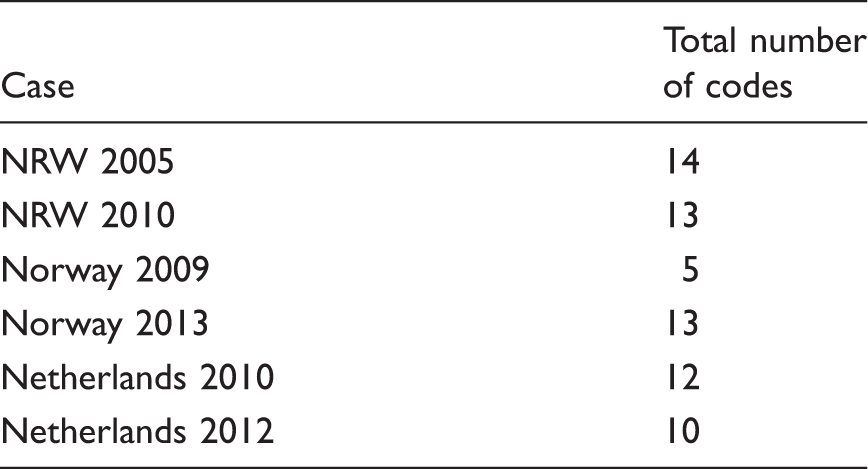
The two coalitions from NRW include the Christian Democrats (CDU) and Liberals (FDP) in 2005 as well as the Social Democrats (SPD) and Greens (Grüne) in 2010. In the first coalition, both parties had already very similar electoral preferences before they entered government. This is due to the joint preparation of the higher education parts in the manifestos prior to the election, an issue that will be addressed in the next section. Because of this prior agreement, only minor proposals from the manifestos are not reflected in the coalition agreement, making it rather encompassing. It included positions like the introduction of tuition fees as well as a comprehensive deregulation of the higher education sector through increased institutional autonomy and more use of market mechanisms. Also the 2010 coalition shows a high level of consensus between the two parties as well as between the manifestos and the coalition agreement. This is due to the fact that both parties opposed the policies of the previous coalition and ran for elections on a platform to roll back most changes. Therefore, also the 2010 coalition agreement outlines major changes in higher education policy, including abolishing tuition fees as well as re-tightening the link between government and higher education.
The Norwegian coalitions include the 2009 center-left coalition between the Social Democrats (AP), the Socialist Left Party (SV) as well as the Farmers' Party (SP), and the 2013 center-right coalition between the Conservatives (Høyre) and the populist-right Progress Party (FrP). Contrary to the previous cases, the Norwegian coalition of 2009 is an example for more diverging preferences. First, the participating parties show no common preference on the control dimension. Second, also on the re-distributive dimension they only agree to increase student support and access to higher education. In that sense, also this case supports expectation 1a, as it shows that parties with more divergent higher education preferences create a less detailed coalition agreement. The parties of the 2013 center-right coalition show more similar preferences on both dimensions. As a result, the coalition agreement provides a much more encompassing set of positions.
The Dutch coalitions are the 2010 coalition between the Christian Democratic Appeal (CDA) and the conservative liberal VVD as well as the 2012 coalition of the VVD and the social democratic PvdA. The latter coalition of two ideological somewhat distant parties can be seen as an example of the previously mentioned cases where office gains of a coalition with only two parties were strong enough to overcome policy distance between the parties. The manifestos of the parties in the 2010 coalition show a substantial amount of agreement in higher education on both dimensions. In the only area with opposing positions (student support) the parties manage to agree on a compromise that gives credit to both preferences, leading to a comprehensive set of positions in the coalition agreement. The manifestos of the 2012 coalition show more conflicting preferences. On the control dimension, the parties only manage to agree to increase the autonomy of higher education institutions. On the re-distributive dimension, they negotiate a compromise between their conflicting preferences. For PvdA's support of the reform of the student support system, VVD agrees to limit tuition fees and to keep means-tested grants for low-income students.
Total number of codes per coalition agreement
Pre-negotiated and ad hoc policy making in higher education
It is conceptually expected that the question whether a partisan preference is transferred into a coalition position affects the chance for a policy proposal. To illustrate this process, this section will provide empirical examples that show how different policy proposals have been formulated, both in situations of pre-negotiated and ad hoc policy making. There are two examples of pre-negotiated policy making: The comprehensive higher education reform in NRW and the reform of the student support system in the Netherlands.
The higher education reform in NRW was part of the government program of the incoming CDU and FDP coalition in 2005. After decades in opposition, both parties prepared their higher education preferences for their manifestos in a parallel and partly joint process. The FDP as the smaller party played a key role in this, influencing the positions of the CDU. The reason for this lies in the central position of the later state minister for education. Due to the high level of agreement between the higher education parts of the parties' manifestos, the translation of partisan preferences was rather smooth. In other areas [of the coalition agreement] we had intense fights […] but concerning higher education policy we could more or less copy what we had in our manifesto […] Respondent 1
Content wise, the policy consisted of two parts. First, the government introduced for the first time general tuition fees of up to 1000 EUR per year. Second, they increased the level of subsidiarity by de-coupling the steering of higher education from the government and granting institutions more autonomy. The solid parliamentary majority of the coalition, the detailed pre-agreed policy, and the determent minister created a situation, where the coalition managed to translate nearly all of their ambitions into policy. The legal changes that were made in this framework included among others the introduction of lump sum budgets, the creation of university boards, and a general decentralization of decision making in higher education governance. […] we have de-coupled the higher education institutions […] turned them into independent public corporations […] so that decisions could be taken autonomously on-site […] Respondent 1
This rather radical change in policy sparked significant opposition. Especially the introduction of tuition fees led to student protests and opposition parties that strongly opposed the policies. Because of this the policies of CDU and FDP sparked a joint reaction of the SPD and the Greens, who entered the following elections with similar higher education preferences that focused on rolling back the reforms. After winning the elections, even though they only governed with a minority government, the SPD and the Greens used the support of the socialist Left Party to abolish tuition fees. This symbolized the importance that higher education policy had in the framework of the coalition. […] it [higher education policy] played a central role in the coalition negotiations, because the discussion about abolishing tuition fees was rather prominent and thus it became a central topic. Respondent 2
The coalition agreement turned out to be a central document and replaced the election manifestos as the yardstick for political activity. […] such a coalition agreement is really important […] it is always very relevant when there is no unity […] then you open the document and check what is exactly written in there […] the election manifesto is not important anymore, because it is not the basis for the government's activities […] Respondent 2
Although both SPD and Greens agreed on rolling back the policies concerning the autonomy of higher education institutions, the proposal of the respective law took more time and was only finalized after an early election in 2012 gave the coalition a majority in the parliament. Additionally, even with their majority in parliament the SPD and Greens were not able to undo all prior changes. […] actually we also wanted […] to abolish the university boards […] and if you look where we started and with which ideas we politically motivated the people [in the manifestos] and what we have now as a result, than this is no bad law but still light-years away. Respondent 2
This inability to completely roll back the previous government's policies can be linked to two factors. First, contrary to abolishing tuition fees, rolling back the governance arrangements required more thorough legal changes and thus took more time. Moreover, the proposal to retrench the autonomy of universities encountered severe opposition from the higher education sector. Combined with the long process of formulating the policy proposal, the opponents of the roll-back had more time to spark a public debate about the government's proposition. In this CDU and FDP linked the rather specific and not very salient question of how to steer higher education to more general questions about the relation between government and public sector. Overall, the success of the well-orchestrated changes in higher education policy of the CDU and FDP government and the following roll-back of the SPD and Green government can be linked to the detailed political program outlined in the coalition agreements.
The reform of the student support system in the Netherlands is an example where two ideologically distant parties collaborated. The idea of the reform is to transform the grant-based student support scheme into a loan-based scheme, while using the gained public funds for investments in the quality of higher education. The idea for this policy can already be found in several election manifestos for the 2010 elections, but only after the 2012 election and the coalition agreement between VVD and PvdA a policy proposal addressing all students was developed. Even though both parties stated in their election manifestos that they were in favor of the policy, they did so for very different ideological reasons. […] the changing of the [student] financing, […] we both had that in our programmes. Which you would say: Hey, that is strange. It is a right-wing and a left-wing party, and they both have it. But we have it for different reasons. We [VVD] have it, because we want to spend tax money effectively, and they [PvdA] have it because they say: It is more equal if you do not give financial support to richer kids […] Respondent 3
In detail, the VVD saw the policy as a good way to free public funds to invest in the quality of higher education: What we had on our agenda is that even in the current recessionary times where the budgets had to be cut, that we have tried, and we have succeeded not to reduce the education budgets, but what we think is that actually there is space within the budget to bring money from […] support for students […] but use it for education. […] Respondent 3
PvdA, however, shared the need for additional investments in the quality of higher education, but mainly because this offered more possibilities for social mobility: […] if you have a very good education system, it means people can get jobs. And that is very important for a party like mine on the left, a social-democratic party, to give people the opportunity to develop themselves […] if it [a policy change] is limiting people to start working on their future, to start an education, then it is a problem for us. […] Respondent 4
These ideological differences between parties increased the importance of the coalition agreement as a uniting factor. Since both parties approached the policy from a different ideological starting point, the prearranged agreement took priority over election manifestos. […] the coalition agreement is the leading one, because it is already quite a large agenda. And to get this through is the highest success parameter. Respondent 3
A second uniting factor that bridged the ideological differences between parties was the existence of a report from an experts' committee, the so-called Veerman report from 2010, and a follow-up white paper with the title “Quality in Diversity” that framed the discussion on higher education policy. There is an overall strategy […] which was made up by the field [of higher education] itself in 2010 […] this strategy document, which has a lot support in the field. So the institutions and everybody says: This is the way to go. […] actually most parties including PvdA, our colleagues, they support this strategy […] Respondent 3
Due to the existence of this strategy document and the broader agreement to invest more public funds in the quality of higher education, the opposition from stakeholders of the higher education system as well as other parties was limited.
Both examples highlight the importance of including a policy in the coalition agreement to increase the chances of a policy and limit the veto-potential, even in situations where parties have diverging ideological foundations. However, especially the Dutch case also shows that once the coalition agreement is formulated, partisan preferences have to step back and let the coalition position take precedent.
Besides situations in which a policy has been agreed upon in the coalition negotiations prior to the government's term, there are also incidents in which issues rise to the agenda without a preexisting agreement. An example for such a process is the proposal of the Norwegian government to introduce tuition fees for students from outside of the European Economic Area (EEA).
The government that took office in 2013 is based on a minority coalition of Høyre and FrP. While only these two parties are officially part of the government, they rely on an informal coalition with the liberal Venstre and the Christian-democratic KrF to create a necessary majority in parliament. Because the government does not have a majority at the Storting [the Norwegian parliament], we need to work with Venstre and KrF, […] which are supporting parties following the government's policy […] Respondent 5
One of the first political landmarks of the new government was the introduction of a revised budget for the year 2014. In this process, the government included provisions allowing Norwegian higher education institutions to charge tuition fees from non-EEA students. A key rationale for this proposal was the attempt to harmonize Norway's tuition policy with its Nordic neighbors (Christensen et al., 2014). While the proposal to charge tuition fees from non-EEA students might seem only a minor issue, it is remarkable due to three reasons. First, the initiative was not part of the coalition agreement and thus not a part of the political priorities of the coalition. Second, the initiative breaks with the “free-of-charge” principle of Norwegian higher education (Christensen et al., 2014). At the same time, the proposal fits with the ideological approach of the governing parties in relation to economic policy. Thus, it can be seen as an example for a clash of different policy logics (Gornitzka and Maassen, 2014) and therefore as a far-reaching policy shift, even if it only affects a minority of students. Finally, also the way in which the policy was put forward, without prior debates and consultation of the higher education sector, breaks with the tradition of the transparent Nordic model of policy making (Christensen et al., 2014).
The policy met strong resistance from the higher education sector. The opposition parties, who already in their manifestos declared their principal disagreement to any form of tuition fees, joined the group of opponents. […] maybe they [Høyre and FrP] want to do something about the paying upfront students from abroad, from outside EU. That is the difference. And none of the other parties like that. Respondent 6
Finally, also the two parties that previously declared their general support for the policies described in the coalition agreement, Venstre and KrF, rejected the proposal and thus no policy change was proposed. After the failure of the proposal in 2013, the governing parties embarked on the same path at the end of 2014. They introduced a similar proposal in the framework of the 2015 budget, they were again met with strong resistance and their attempt failed.
The failure of both attempts to introduce tuition fees underlines the importance of including reforms in the coalition agreement. Even though the two governing parties agreed to introduce the policy, they did not highlight it in the coalition agreement. Therefore, the parties supporting them in parliament (Venstre and KrF) retreated to the anti-tuition preference emphasized in their manifestos and, especially after the strong resistance from the higher education sector, opposed the policy.
Conclusion
This article provides a detailed analysis of three milestones in the transfer of partisan preferences to coalition agreements and the subsequent policy making. To illustrate this, the article focused on higher education policy in three European countries. The main argument was that in cases where a coalition expresses a policy position in its agreement (pre-negotiated policy making) the chances for a follow-up are relatively high, while in situations where an issue appears on the agenda that has not been addressed (ad hoc policy making), parties retreat to their electoral positions making a policy less likely. Due to their function as agenda for the incoming governments, coalition agreements are argued to be important indicators for a government's policy-making activities.
The article formulates four conceptual expectations, which afterward have been tested on empirical examples. The analysis supported the expectation that more similar preferences of parties in a coalition lead to encompassing parts in the coalition agreement. In the case of pre-negotiated policy making, the article showed that it is more likely that the government position is followed up by a policy. However, due to the nature of the coalition agreement, this policy follows the position of the coalition, instead of the preferences of one of the parties. In the case of ad hoc policy making, parties were found to promote their partisan preferences and thus a policy proposal is less likely.
The results clearly show the relevance of political parties and their preferences for policy formulation also in situations of coalition government. At the same time, the coalition agreement is found to be an important tool for policy change in multiparty consensus democracies. While partisan preferences are central in the process of coalition formation, the coalition agreement indicates where substantial policy change is likely. Thus, a conceptual differentiation between partisan preferences and coalition positions is necessary. Moreover, if a policy is included in the coalition agreement, it gains salience since following up on it becomes important for parties, as they will be held accountable by voters. Therefore, this article suggests that instead of assessing the chance for policy change merely based on the percentage of ideological turnover in a coalition, as proposed for example by Sabatier (1998), one should rather focus on the breadth and level of detail of the coalition agreement. In general, the results support a stronger focus on political parties in public policy analyses, including also coalition agreements, which due to their public nature represent easily accessible data.
The analysis shows that in both situations of pre-negotiated policy making, significant higher education reforms followed the outlined positions in the coalition agreements. While in NRW, the introduction of tuition fees and the de-regulation of the relationship between higher education and the state were implemented by the 2005 coalition, the 2010 coalition abolished tuition fees again and partly retightened the link between the state and higher education. Both policy changes have been implemented by ideologically homogenous coalitions that previously agreed on policies in their coalition agreements. In the Dutch case, the changes in the student support system by the coalition of the liberal VVD and the social democratic PvdA show that even in cases where parties might have differing ideological foundations, a settlement in a coalition agreement can help to overcome these differences and propose a joint policy.
Additionally, the example for ad hoc policy making illustrates the dynamics in cases, when a coalition tries to propose a policy that has not been pre-negotiated. The two-time failure of the Norwegian government to introduce tuition fees for students from outside of the EEA underlines the importance of addressing the intended policy in the coalition agreement. In the Norwegian case, the proposal never made it to the parliament since it became clear that parties whose support was necessary to realize the policy withdrew their support and instead promoted their partisan preferences, which were contradicting the government's proposal.
Although, the article focuses on a specific policy area, it is reasonable to assume that the results also hold for other areas of public policy with comparable political salience, as the employed concepts are derived from general findings of the literature. However, the nature of the policy area might lead to different political interactions (Pollitt and Bouckaert, 2004) and policies that classically have a higher salience, such as fiscal or labor market policies, could follow different dynamics than higher education policy. Furthermore, this article is based on a qualitative approach, as this was seen as appropriate for unpacking certain milestones in the policy process; however, this puts a limit on the number of cases included in the analysis. Thus, follow-up research on a larger scale, possibly using quantitative methods to analyze the level of detail of coalition agreements and subsequent changes in policy, would be advisable. Additionally, as ad hoc policy making leaves more room for disruption, agency might matter more in these circumstances. Therefore, it is possible that, for example, the role of ministers is more pronounced in these circumstances. Also this relation demands further analyses.
Footnotes
Acknowledgements
The author would like to thank Peter Maassen, Åse Gornitzka, Martina Vukasovic, Meng-Hsuan Chou, and Julian Garritzmann for their very helpful comments on earlier versions of this article. Finally, I would like to acknowledge the constructive and helpful comments of two anonymous reviewers.
Declaration of conflicting interests
The author(s) declared no potential conflicts of interest with respect to the research, authorship, and/or publication of this article.
Funding
The author(s) received no financial support for the research, authorship, and/or publication of this article.