







Abstract
This article applies Aucoin's paradigm of New Political Governance derived from the comparative literature on Westminster systems to review changes in the UK machinery of government during the Coalition era from 2010 to 2015. The paper examines whether coalition government imposed ‘checks and balances’ that prevented Conservative ministers from enacting a further wave of New Public Management-style reforms of the permanent bureaucracy comparable to New Political Governance. The central argument of the article is that the institutional resilience of Westminster systems, particularly their capacity to safeguard norms of public service impartiality and non-partisanship in the face of the politicisation and externalisation of the policy-making process, has been underestimated. Nevertheless, Aucoin's concerns about the erosion of non-partisan affiliation in the civil service of the Anglophone countries remain apposite.
Introduction
The Canadian public administration scholar, Peter C. Aucoin (2012), argued that Westminster systems have been destabilised in the last three decades by the rise of ‘New Political Governance’ (hereafter NPG) that is undermining the non-partisan affiliation of the public service in ‘Anglophone’ countries. 1 Aucoin (2012: 177–78) applied his analysis of a paradigmatic shift in governance and public management to four key Anglo-liberal states: the United Kingdom (UK), Canada, Australia and New Zealand. He concluded that only New Zealand was able to resist the influence of NPG reforms since it had a proportional electoral system and had experienced multi-party government, imposing ‘checks and balances’ on the growth of externalisation and politicisation in the permanent bureaucracy (Aucoin, 2012). 2 Drawing on the comparative literature on Westminster systems, this article poses two research questions in light of Aucoin's work. How far did NPG impact on Whitehall during the Cameron coalition government from 2010 to 2015; and crucially, did the ‘coalition effect’ impose limits on the spread of NPG reforms?
The UK Conservative-Liberal Democrat coalition provides an intriguing case-study. On the one hand, the dominant Conservative partner came to power with a comprehensive reform programme intended to impose a ‘next wave’ of New Public Management-style (NPM) reforms on the British state. The reform agenda had thematic similarities to Aucoin's NPG: it sought to re-impose political control over the machinery of government while conceding operational autonomy to implementing actors at ‘street-level’. On the other hand, Cameron's Administration was comprised of two parties, the outcome of a coalition agreement following an election where no party was able to attain an overall majority. The majoritarian nature of the Westminster system, in which power is concentrated at the heart of a unified executive, was temporarily superseded by the formation of the coalition (Lipjhart, 2012).
As Matthews and Flinders (2017: 2) attest, ‘the normative assumptions of Westminster majoritarianism had been qualified’, by the outcome of the 2010 election; the coalition meant the Liberal Democrats sought to exercise a ‘restraining effect’ on Conservative ministers (Goes, 2016: 93). In coalitions, it is usually the case that, ‘power is more dispersed and government policies arise from negotiations’ (Gay et al., 2016: 119). The Westminster model's ‘rules of the game’ emphasising territorial centralisation, executive dominance, majoritarian democracy and indivisible parliamentary sovereignty (Flinders, 2010; Lipjhart, 2012) had been qualified. In practice, the structural power of the PM and his advisers was undermined by the fact that another party had Cabinet ministers in five Whitehall departments, with a political base in the strategic centre of the Cabinet Office. Hazell (2012: 68) has concluded that as a consequence, ‘The Coalition required a revival of Cabinet Government’.
The contention of this article is that the institutional resilience of Westminster systems, their capacity to protect prevailing norms of impartiality and non-partisanship, has been under-estimated in much of the comparative literature. That said Aucoin's initial concerns about the impact of structural changes intended to politicise and externalise the policy process are still relevant. For several decades, analysts have warned that the traditional ‘Whitehall model’ was breaking down (Campbell and Wilson, 1995; Page, 2010). New Labour apparently continued the assault on the permanent non-partisan civil service (Aucoin, 2012; Fleischer, 2009). In the government machine the Coalition inherited, Cabinet government had seemingly been undermined; power was amassed at the centre in Number Ten; there were perceived to be too many ill-conceived initiatives; presentation took precedence over the substance of policy; lines of accountability were increasingly confused by the creation of new public bodies and delivery agencies; the culture of target-setting clashed with the emphasis on quasi-markets in public sector delivery. As a consequence, Labour's reforms raised a fundamental question about the impact of politicisation, namely how to, ‘protect public service professionalism and to set limits to the partisanship of public servants’ (Mulgan, 2007: 508). According to Aucoin’s (2012) hypothesis, ‘checks and balances’ should be observable in Whitehall from 2010 to 2015, as witnessed in the New Zealand system from the late 1990s. The key issue is whether the Coalition after 2010 stemmed the decline of the traditional Westminster–Whitehall system by halting the adoption of further changes associated with NPG.
The NPG
According to Aucoin (2012: 185–188), NPG has four elements. Firstly, the ‘integration of governance and campaigning’: its hallmark is the centralisation and concentration of power in the PM's Office. The desire for ‘message control’ creates an imperative to govern from the centre (Bakvis and Jarvis, 2012: 16). This undermines both cabinet government and the impartial, non-partisan civil service. Governance is ‘politicised’ by ‘continuous partisan campaigning’ (Aucoin, 2012; Bakvis and Jarvis, 2012: 16).
The second element is the growth of political advisory staff relative to the permanent civil service. Political advisers become more influential than either senior civil servants, or even ministers (Grube, 2015). Political staff comprise a ‘critical mass’ within the government bureaucracy, regarding the tradition of impartial, non-partisan public service sceptically as, ‘an obstacle to be overcome’ (Bakvis and Jarvis, 2012: 16; Grube, 2015). Meanwhile, officials' monopoly over policy advice is openly challenged. Political advisers marginalise civil servants and enforce a ‘funnelling effect’ where options are kept off the policy agenda if viewed as electorally disadvantageous; advisers help ministers to prevent departments being ‘captured’ by bureaucratic vested interests (Eichbaum and Shaw, 2007: 456).
Thirdly, senior civil service appointments are personalised. To be rewarded with promotion, officials have to be ‘enthusiastic’ about the government's agenda (Bakvis and Jarvis, 2012: 16). This process ensures that senior civil servants are more likely to perceive themselves as ‘personal agents’ of the PM; the desire for advancement ensures they are ‘eager to please’ their political masters. The permanent bureaucracy has to comply with the elected government's political goals and objectives.
This leads inevitably to a fourth criteria: a government machine that is ‘promiscuously partisan’ (Aucoin, 2012): openly and explicitly supportive of the government's political policy agenda. The norms of ‘impartial loyalty’ are displaced in favour of ‘partisan loyalty’ (Bakvis and Jarvis, 2012: 17). Civil servants are expected to advocate government policies, persuading external stakeholders and the media that the government's approach is legitimate and deserving of support (Aucoin, 2012: 189).
We can summarise Aucoin's NPG framework by suggesting it necessitates both greater politicisation and externalisation of the policy process and machinery of government (Craft and Halligan, 2015: 2–3). As a consequence, ‘In Anglo-American democracies in particular, career public servants were subject to an assault by politicians that was unprecedented in this century’ (Aucoin, 1995: 113, cited in Peters and Savoie, 2012: 31).
Aucoin argues that NPG arises as governments across the western world are wrestling with a host of new problems from the pressures of managing the mass media to demands for greater transparency and openness. NPG builds on earlier concepts of ‘governance’ which emphasised the dispersal of authority and the fragmentation of state capacity: an increasingly complex ‘polycentric’ administrative landscape marked by the erosion of vertical bureaucratic hierarchies leads ministers to rebuild capacity and political control at the centre of the state (Peters, 2005; Rhodes 1997). Aucoin's four elements of NPG provide more relevant criteria for mapping change in Westminster systems than the ‘Whitehall paradigm’ proposed a generation ago by Campbell and Wilson (1995).
This article draws on seven years of research, a recent set of semi-structured elite interviews with key actors in Whitehall, and a range of secondary sources including parliamentary and think-tank reports to examine change in the Westminster system under the Coalition according to Aucoin's four NPG criteria. 3 The article proceeds in the following way. The next section briefly reviews the Conservative party's approach to public management as the dominant coalition partner. The article then draws on empirical evidence to assess the evolution of the Westminster system in the UK from 2010 to 2015. What follows subsequently is a critical discussion of the efficacy and relevance of Aucoin's NPG framework to understanding changes in public administration and governance in Westminster systems.
NPG under the conservative-led coalition
The Conservatives came to power in 2010 with an agenda to create a ‘Post-Bureaucratic State’ (PBS). Their manifesto averred that under Labour, ‘bureaucratic control has replaced democratic accountability’, while the ‘hoarding of power by … unaccountable officials in Whitehall [had] damaged society by eroding trust’ (2010: 73). The manifesto set out a series of reforms 4 that consolidated and reinforced core features of NPM, initiated in earnest in the UK from the mid-1980s.
Across the Anglophone countries, a frequent complaint had arisen that officials were not sufficiently responsive to ministers (Eichbaum and Shaw, 2007: 454). Under Francis Maude, the Cabinet Office Minister, public administration was to be reconfigured according to, ‘rational choice design principles’ (Eichbaum and Shaw, 2007: 454). Maude's reforms recognised that while on the ‘supply-side’, civil service and public sector capacity was shrinking and needed to be augmented by new actors, on the ‘demand-side’ there was a desire for greater political control of the non-partisan bureaucracy (Gourgas, 2016).
NPG was consistent with previous NPM reforms since the emphasis was on intensifying political control over the state. It was the non-partisan bureaucracy that was perceived to be an obstacle to ‘good governance’ (Peters and Savoie, 2012: 30). Maude averred that the relationship between ministers and officials should be anchored in the ‘principal-agent’ theory of public service motivation. The ‘principals’ are ministers who commission advice; the ‘agents’ are officials who provide that advice (Le Grand, 2006: 56). In NPM, political representatives take decisions and formulate policy while public servants implement policies in conjunction with ‘street-level’ agents (Bakvis and Jarvis, 2012). This approach, derived from public choice theory, understands bureaucracy as having interests that are counter to those of politicians (Bakvis and Jarvis, 2012; Niskanen, 1971).
As such, Maude's blueprint encapsulated in the 2012 Civil Service Reform Plan was a reaction against an earlier generation of NPM reforms which enlarged, ‘the relative powers of bureaucracies and non-political actors’; managers had been left ‘free to manage’ while states created autonomous public bodies outside the direct control of political representatives (Peters and Savoie, 2012: 30). In their 2010 manifesto, the Conservatives rhetorically embraced the end of the ‘command and control’ state, expressing a wish to move away from the power-hoarding approach. In practice, however, the post-bureaucratic state meant the reinforcement of political dominance alongside the separation of policy and management, as public administrators were held to account by a centralised performance regime. Ministers' grip over the policy process would be enhanced by the creation of Extended Ministerial Offices (EMOs) alongside greater contestability, breaking the civil service monopoly over policy advice. By 2010, the Conservatives thus had a governance agenda that was consistent with Aucoin's NPG, subsequently incorporated into the 2012 Reform Plan. The central issue addressed in this article concerns whether the reality of coalition government prevented the Conservatives from enacting that reform programme, as apparently occurred in New Zealand from the late 1990s?
Integration of governance and campaigning
On the first of Aucoin's criteria, there is limited evidence that power was further centralised in the Coalition years to facilitate a partisan ‘permanent campaign’ style. The claim that Number Ten Downing Street acquired greater structural power in order to enforce ‘message control’ is relatively weak. Here the ‘coalition effect’ was significant although in opposition Cameron had already criticised the growth of outside advisers and the centralisation of prime ministerial power: Politicians, and the senior civil servants and advisers who work for them, instinctively hoard power because they think that's the way to get things done. Well we're going to have to kill that instinct … We need to end the culture of sofa government where unaccountable spin doctors in Number 10 … toss around ideas and make up policies not to meet the national interest but to hit dividing lines or fit the news cycle. So we'll put limits on the number of political advisers. (IfG, 2014: 13) Special adviser numbers 2010–2015. PM: Prime Minister; DPM: Deputy Prime Minister.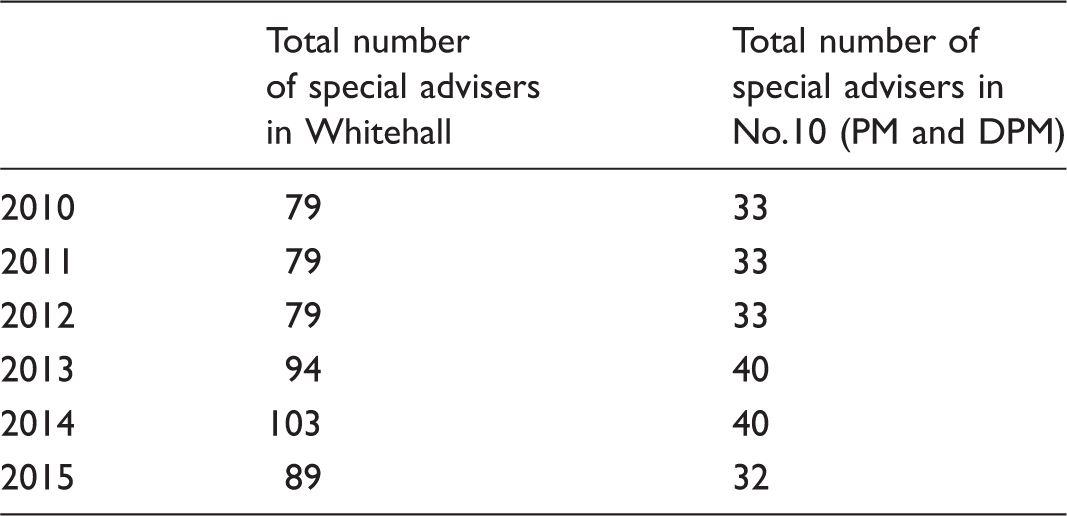
In late 2011, a beefed up ‘policy and implementation unit’ was re-created, but it was more modest in personnel and scope than anything witnessed at the centre of government during the New Labour era (Hazell, 2012). A ‘collegiate’ style of government prevailed with more Cabinet meetings and an enhanced role for Cabinet committees: ‘The imperatives and dynamics of coalition made that a necessity’ (Theakston, 2015: 6).
The coalition entailed negotiation between parties; this made collegiate decision-making essential, enhancing the role of the Economic and Domestic Secretariat (EDS) in the Cabinet Office. The civil service: ‘reacted very quickly. [They] quite smartly created mechanisms to deal with the fact you had two parties operating’. 7 Number Ten reverted to ‘light touch’ co-ordination. As one official remarked: ‘Inevitably coalition has placed a greater reliance on using the cabinet committees and machinery’ (Hazell, 2012: 54). The Cabinet met more frequently and for longer (Paun et al., 2010). Jeremy Heywood, the most senior Whitehall official, attended political meetings of the PM's ‘quad’ (comprising David Cameron, George Osborne, Nick Clegg and Danny Alexander).
There was not only a coalition effect on the concentration of power in the PM's Office, however. Peters and Barker insisted in the mid-1990s that governmental policy formation, ‘has become a very large game which almost any number can play’ (Gouglas, 2016: 3). The policy landscape in the UK was increasingly ‘polycentric’ involving a pluralised and horizontal network of actors (Craft and Howlett, 2012: 85; Hajer, 2003). This perspective of the dispersion of authority in policy-making and implementation is difficult to reconcile with claims of the vertical centralisation of power in Number Ten. Even where prime ministers attempt to centralise control, they find that power easily slips from their grasp operating with ‘rubber levers’ not attached to much beyond Whitehall.
Coalition was undoubtedly a factor in qualifying and curtailing NPG's reach. As importantly, in contrast to Francis Maude, Cameron was a reluctant reformer of Whitehall: he believed civil service reform was likely to dissipate energy, and often regarded senior civil servants as allies. Despite radical rhetoric, the Coalition government did not advance proposals for major restructuring of the Whitehall machinery; few plans emerged to consolidate or merge departments. The departments simply got smaller. The ‘cull’ of the quangos turned out to be a damp squib (Dommet and Flinders, 2015).
Political staff
Neither is there much robust evidence that in relation to politicisation, Whitehall moved further towards NPG after 2010. Many interviewees also reported mutually respectful relationships between ministers and civil servants. For instance, Iain Duncan Smith, Secretary of State at DWP from 2010 to 2016, recognised that, ‘ministers and civil servants need to work closely together for problem-solving’.
8
The BIS Permanent Secretary, Martin Donnelly (2014), concurred: It is not a given that an incoming Minister, perhaps of a different political party, probably of a different temperament and outlook from her or his predecessor, should immediately trust official advice. To add value for Ministers across government requires the foundation of a relationship of mutual trust, built on professional respect, and evidence of competence, and able to handle the pressure of events.
Moreover, Cameron underlined his trust in the civil service by ensuring that Jeremy Heywood was the most senior figure in Number Ten. Instead of appointing a political Chief of Staff with powers to instruct civil servants, Heywood remained the dominant figure. To one observer: That to me look[ed] like a classic 1970s Cabinet Secretary role of the kind that appears in Bernard Donoughue's diaries. The Cabinet Secretary is the powerbroker in Whitehall and is there to do the PM's bidding.
11
Neither was it obvious that the civil service monopoly over policy advice got weaker. In reality, it has been changing for over a century. Since the 1970s, Whitehall has been forced to become more accepting of external advice. One former official avers: There has never been a period where the civil service had a monopoly of policy in Britain, absolutely never. Even in the highpoint of very assertive cabinet secretaries and a central civil service, you had an endless stream of many academics going in and out of government. You had strong research departments in the parties, you had whole networks and sources flowing into policy from think-tanks … I don't buy this story that there was a monopoly and then it was broken open by special advisers and think-tanks.
13
To lead the debate challenging both civil servants who are often not very good at doing more than following steers and aren't used to the idea that they are supposed to be thinking themselves. It required some good special advisers who both worked with the civil servants to give them confidence and also challenged us as ministers to look at what might be wrong about our proposals.
15
The civil service has been very reactive and often fails to get ahead of the game. They do very little scenario-planning or analysis and so they are often ill-prepared. Ministers used to get really frustrated because they wanted the civil service to come up with lots of ideas, but they just couldn't provide them.
17
The tendency for bright, young and wholly inexperienced officials to hold great sway over key areas of public policy for short periods of time, before being moved up the next rung of the ladder, creates discontinuity and immaturity in policy-making. One of the main troubles of the [Civil] Service has been that, in achieving immunity from political intervention, a system was evolved which until recently was virtually immune from outside pressures for change. Since it was not immune from inside resistance to change, inertia was perhaps predictable. (HMG, 1968: 14) After the 2010 election … the turnover of civil servants working on higher education was accelerated by austerity-related re-organisations and reductions in staff. In the crucial three months between August 2010 and October 2010 – during which the independent review of Higher Education Funding and Student Finance (the Browne review) completed its work, submitted its report to Government, and published its findings – BIS had three different people filling the Permanent Secretary role. In short, there was no institutional memory on which to rely. (Hillman, 2016: 331) Commission high quality advice from outside the civil service on ministers' priority policy areas; draw directly on the thinking, evidence and insight of external experts; and achieve a potentially broader and more radical range of options than ministers would receive internally.
21
Think-tanks tend to over-estimate their importance; they rarely produce genuinely new ideas. Also they cannot produce detailed or really rigorous thinking about policy. Most new thinking is actually internally generated in the civil service.
24
Policy officials are always desperate for new ideas, new insights, new evidence: the key thing is that their advice has to be read by ministers. Advisers cannot rewrite or censor policy submissions. Submissions go direct to the minister.
25
Personalisation of appointments
Aucoin's framework highlighted the tendency under NPG for civil service appointments to be ‘personalised’. Certainly, ministers after 2010 wanted greater influence over permanent secretary appointments. As PM Cameron sought to take the final decision in appointing top mandarins, but was resisted by the Civil Service Commission. After 2010, permanent secretaries were more likely to be replaced when a new Secretary of State was appointed, as occurred with David Bell at the Department for Education. As Freeguard et al. (2015: 62) note, Nick Macpherson at the Treasury was the only permanent secretary in 2015 who had been in post five years previously; five departments appointed three different permanent secretaries between 2010 and 2015. The former Cabinet Secretary, Lord Butler, criticised ‘churn’ among permanent secretaries (Agbonlahor, 2013). A special adviser recalled there were three different permanent secretaries in his department in three months during 2010. 27 According to an insider, ‘Permanent secretaries got moved on; there was quite a turnover in the 2010–2015 period’. 28
Maude initially signalled his interest in the New Zealand system of direct appointment on fixed-term contracts (Paun et al., 2010). Nonetheless, the 2012 Plan diluted the proposals: traditionalists did not want civil servants reporting directly to Parliament, and were nervous about any hint of politicisation. Officials fought off attempts to give ministers the final say in appointing civil servants (Normington, 2013). Instead, the PM made the decision from a shortlist approved by the Civil Service Commission. Moreover, where officials were replaced in Whitehall, it was by regular civil servants, not ‘outsiders’. Where permanent secretaries moved on: The replacements were invariably career civil servants; for all the moaning, ‘oh we want someone from outside’, it was very seldom truly someone from outside. They've been people who've come in as Director-Generals or second permanent secretaries to do particular functions and then moved into the mainstream, like Stephen Lovegrove at Defence. He was regarded as someone who had learnt the ways of Whitehall … usually an insider or quasi-insider got the top jobs.
29
The civil service has brought in people to run things, HMRC and social security, mainly because these are much more complicated organisations. What the state is trying to do is not as straight forward as in the past. If you are dealing with pensions the Attlee world was a very straight forward one … now it's a heavily discretionary state … [the civil service] has adapted slowly but it's adapted.
30
This approach was not without risks in protecting the integrity of the Westminster system of governance. Aucoin (2012: 194) points out that departmental boards in Whitehall merging politics and management have been of concern to the permanent civil service, bringing non-executive appointees directly into departments. Departmental boards were championed by Maude; they are chaired by the Secretary of State and supported by up to four non-executive directors, usually from the private sector, underlining the ongoing influence of NPM-style reforms. 31 Boards had a mandate to ‘scrutinise policy delivery’ and monitor departmental business plans, but they put ministers in charge of departmental management and enabled external appointees to interfere in policy-making and implementation, as well as personnel and financial management (McClory, 2013).
One former permanent secretary admitted: ‘Patronage got significantly worse after 2010 in appointments to public bodies and agencies’. 32 There was a growing fear that to gain promotion, officials would no longer speak truth to power (Wildavsky, 1979). A report by the National Audit Office (NAO) into the Department for Education under Michael Gove in 2011 found that among civil servants, ‘There is a lot of fear. Staff feel if they put their heads above the parapet they will be seen as an awkward character who could be got rid of’ (Garner, 2011). The evidence of civil service resistance to personalisation can be seen in, ‘the increased use of letters of dissent from permanent secretaries where they formally registered their disagreement with advice that the secretary of state has overridden’. 33 By early 2013, it was apparent that relations between politicians and officials had deteriorated to ‘a new low’ following the West Coast mainline ‘debacle’, alongside a series of high profile disputes between mandarins and their political superiors (Watts, 2013).
There is undoubtedly evidence that the personalisation of appointments increased in Whitehall after 2010 consistent with Aucoin's concept of NPG; however, proposals to give the PM and Secretaries of State greater control over the appointment of permanent secretaries were resisted. It was not clear that this was a specific ‘coalition effect’; rather opposition was mobilised within the civil service which still saw itself as a ‘custodian’ of the public interest upholding the proprieties of the British constitution, while protecting the norms of non-partisanship and impartiality at the heart of the Northcote–Trevelyan tradition. 34
Promiscuous partisanship
The allegation that civil servants in Westminster systems are becoming more ‘promiscuously partisan’ is the most contested of Aucoin's claims. Rhodes (Grube, 2015: 306) insists that, ‘Nowadays, senior civil servants speak in public almost as often as ministers’. They are prepared to articulate the government's political priorities. At the same time, the ‘formal guidelines’ contained in the Civil Service Code, ‘leave little room for the civil service to resist pressure to actively justify government policy’ (Grube, 2015: 307).
The shift towards ‘promiscuous partisanship’ is difficult to substantiate in the UK context, however, while the facts are hardly clear-cut. There are unquestionably signs that civil servants are under greater pressure to respond to the whims of politicians. As one permanent secretary recounts: Policy-based evidence making was endemic. We do things too quickly even if they are sensitive … the pressures on government to deliver quickly are so strong. It is microwave not slow cooker government … The civil service is becoming more transactional.
35
Moreover, key developments in UK governance emphasised the importance of separating civil servants institutionally from partisan influence. For example, Margaret Hodge, the former Chair of the House of Commons Public Accounts Committee (PAC), insisted that civil servants should, ‘unambiguously answer to Parliament’. In a speech in 2016 she declared: The old convention of civil servants being accountable to ministers who are accountable to parliament is broken. It worked when Haldane invented it after the First World War when there were only 28 civil servants in the Home Office. Today, despite the cuts, there are 28,000. (Civil Service World, 2016)
A critique of NPG in the UK case
The qualified majoritarianism of Coalition government was certainly a factor in undermining Maude's 2012 reforms as highlighted by Aucoin's NPG framework. Nevertheless, the evidence for Aucoin's hypothesis is hardly unequivocal.
Firstly, there was no indisputable coalition effect on Whitehall. Although Cameron's Administration was a coalition, in reality the Conservatives were the predominant power. There are many different types of coalition government, which makes generalisations about the impact of governing through coalition arrangements especially problematic. There was no Deputy PM's office to rival Number Ten: the Liberal Democrat leader, Nick Clegg (2016), bemoaned the lack of institutional resources at his disposal. The majoritarian nature of Whitehall did not change fundamentally, as civil servants worked to their Secretary of State instead of reporting to coalition ministers from different parties: the Cabinet Secretary was determined to avoid separate ‘power centres’. 36 Neither is it apparent that ‘checks and balances’ arising from the Coalition made the non-partisan impartiality of the public service more resilient. If the Conservatives had been determined to force through a governance reform agenda aligned with NPG, they would have had scope to do so.
The second point is that the major driver of change in governance after 2010 had little to do with dilution of Westminster's majoritarianism; it related to the dramatic reduction in head-count and the shrinking of Whitehall departments. This scarcely featured in earlier accounts of NPG: Aucoin's article was first published in 2011 before the impact of austerity on the UK permanent bureaucracy became evident. As the graph illustrates below, civil service numbers began to decline sharply although the proportion of employees who were senior officials increased marginally from 1% to 1.2% (Figure 1).
37
Estimated civil service staff numbers 1945–2015.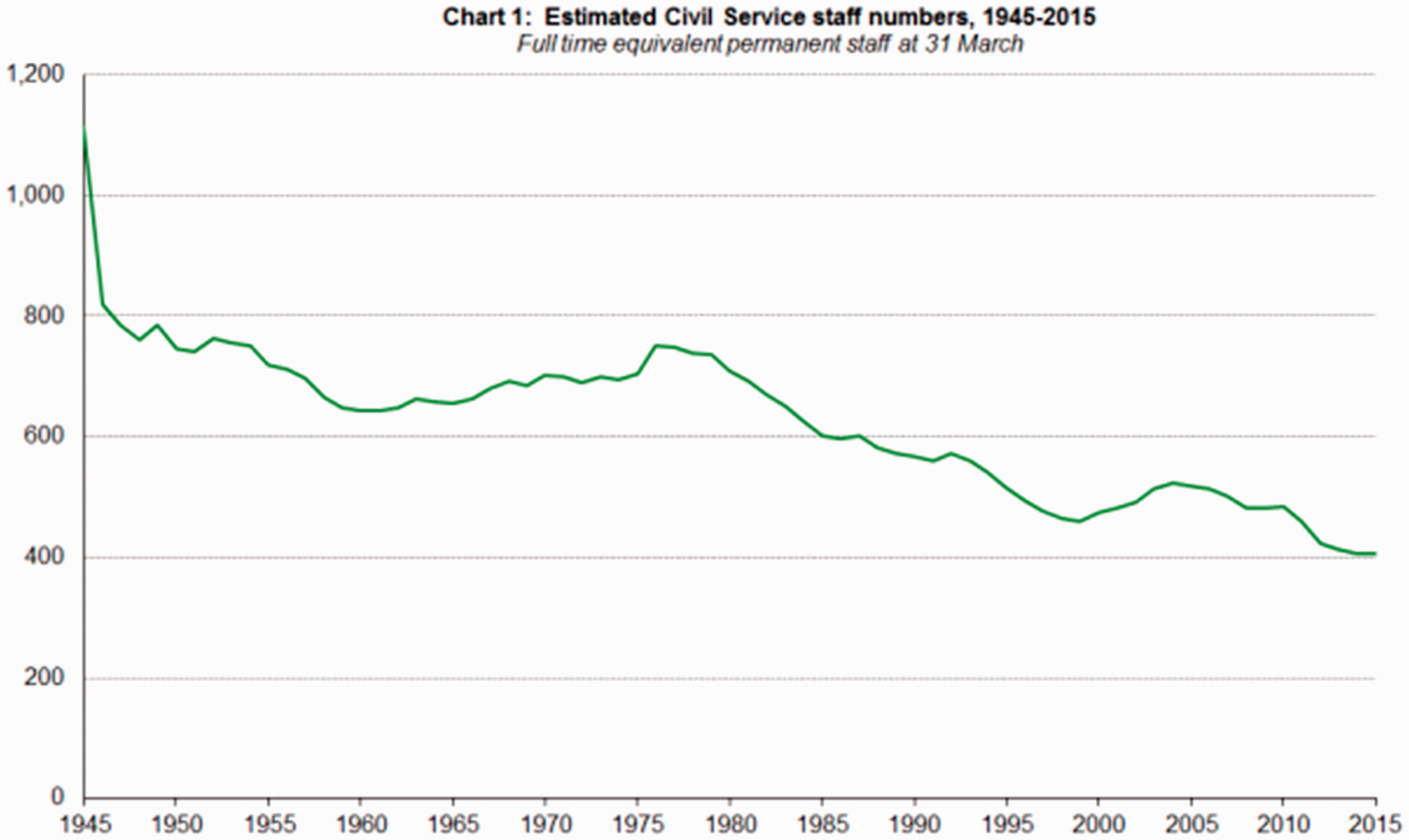
A major report on the Treasury's role in handling the aftermath of the 2008 financial crisis underlined the risks posed by the wave of cuts and Whitehall restructuring. The ‘fiasco’ over the West Coast mainline, where the franchise tendering process had to be re-started following a successful legal challenge by the train operating companies, exposed major problems in departments. As the Laidlaw report (2012: 62) subsequently noted: The previous ‘Rail’ Director-General, the Policy Director, the Rail Service Delivery Director and the Procurement Director all retired in December 2010 and only the Policy Director and the Rail Service Delivery Director were replaced, resulting in a loss of both ‘corporate memory’ and individual commercial experience. In implementing substantial cost savings…the DfT significantly reduced its headcount, the number of contractors used and its use of external consultants … organisational restructuring at the DfT resulted in a lack of clarity in roles and responsibilities and in associated accountabilities...These deficiencies adversely impacted the DfT’s effectiveness in identifying and/or resolving flaws in the franchise process. (2012: 64)
Thirdly, Aucoin's concept of NPG underestimates the enduring strength of the bilateral relationship between ministers and officials in Westminster systems. Despite tensions, the ‘public service bargain’ between politicians and civil servants in Whitehall has not unravelled. This bargain was the central pivot of resistance to structural changes that sought to extend politicisation and externalisation in the machinery of government. There was radical transformation elsewhere: for instance, after 2010 the UK became the second largest public sector outsourcing market in the world (Smith and Jones, 2015). But the bilateral relationship between ministers and officials emerged relatively unscathed. Governments were not prepared to follow-through on reforms of the public bureaucracy, as Hood (2007: 12) acerbically writes: We have seen this movie before – albeit with a slightly different plotline – with a rash of attempts to fix up the bureaucracy, with the same pattern of hype from the centre, selective filtering at the extremities and political attention deficit syndrome that works against any follow through and continuity.
Theakston (2015) concludes that while Cameron was frustrated by institutional obfuscation, he chose not to embark on a crusade to shake up Whitehall. Cameron acknowledged that was difficult to achieve: ministers have a close working relationship with civil servants; officials know the ‘small p’ politics inside Whitehall's byzantine decision-making structures. Ministers cannot afford for trust to break down. Moreover, Cameron was always, ‘uninterested in reform of structures and systems’; his adviser Steve Hilton failed to persuade him of their importance; 38 Francis Maude was a ‘true believer’ but like previous PM's, when civil service reform was mentioned, ‘[Cameron's] eyes tended to glaze over’ (D'Ancona, 2014). The PM lacked ‘reforming zeal’; he was ultimately unwilling to take on, ‘the bureaucratic forces that militated against significant policy change’ (Ashcroft and Oakeshott, 2016: 378–384).
Conclusion
One seasoned Whitehall observer concluded that despite structural reform, ‘the permanent bureaucracy is remarkably resilient’. 39 The Coalition had an impact since having two parties operating in government required systems of collegiate decision-making; more controversial initiatives to politicise policy-making would have been difficult, although not impossible, to implement.
As Aucoin acknowledged, there are sources of resistance in Westminster systems that limit NPG's influence, however, which are separate from the ‘coalition effect’. These ‘veto points’ include the strength of civil service commitment to impartiality and non-partisanship reinforced by the enduring ties between officials and ministers. Bureaucrats are not passive agents incapable of blocking or resisting change: Aucoin's NPG framework does not acknowledge the extent to which civil servants are able to employ well-honed political and problem-solving skills to derail initiatives that apparently undermine the Northcote–Trevelyan norms of meritocracy and public service. This paper's argument is that the institutional resilience of Westminster systems has been under-estimated. Nonetheless, Aucoin's original concerns about the erosion of non-partisan affiliation in Anglophone civil service systems remain apposite.
All the key Anglophone countries including Australia, Canada and New Zealand, as well as the UK, have experienced turbulence and conflict around the non-partisan public service bureaucracy in recent decades. In this climate, ‘the propensity for perceptions of politicisation to grow becomes almost unavoidable’ (Grube, 2015: 318). Yet it is not yet clear that NPG has been the dominant factor driving institutional change. This case-study of an archetypal Westminster system indicates Aucoin's framework is a valuable heuristic device, but requires updating as a framework for the comparative analysis of changing patterns of bureaucratic governance in the Anglophone countries in two key respects. Firstly, Aucoin's account of NPG must be developed to address empirically the impact of structural changes in the permanent bureaucracy arising from seven years of austerity in the UK state. Paradoxically, the austerity programme has undermined the objective of ministers in rebuilding political capacity at the centre of the state due to the shrinkage of head-count and operating budgets. And secondly, at the theoretical level, greater attention must be paid to understanding civil servants as reflexive, purposeful and capable actors who are, more often than not, as shrewd and calculating as their political masters.
Footnotes
Declaration of conflicting interests
The author(s) declared no potential conflicts of interest with respect to the research, authorship and/or publication of this article.
Funding
The author(s) received no financial support for the research, authorship and/or publication of this article.