






Abstract
One of the central pillars of Vygotsky’s contribution to social science is his concept of mediation: the process through which the social and the individual mutually shape each other. His rich, complex and challenging texts focus on a nuanced notion of mediation that was not necessarily visible to those active in the command-and-control climate of the Stalinist era. The article focuses on this notion of the lack of visibility in mediation.
Introduction
This article is concerned with Vygotsky’s concept of mediation: the process through which the social and the individual mutually shape each other. Mediation is, without doubt, one of the central pillars of his contribution to social science and yet some aspects of the concept remain elusive and somewhat under-explored. Reading and interpreting Vygotsky’s writing is a notoriously challenging task. The original texts are themselves rich and complex. They afford a multiplicity of stimulating avenues for exploration and development. James Wertsch (2007) points out in his paper on mediation, the political nature of the circumstances in which Vygotsky and others such as Shpet started to fashion ideas on mediation. They were grappling with the notion of mediation which was not necessarily acknowledged by or visible to participants in the activity in which it occurred. This notion of lack of visibility in mediation constitutes the focus of my attention here. Accordingly the article will commence with a discussion of the distinctions drawn between types of mediation in the literature that emanates from within psychologies concerned with accounts of social formation. The distinction between explicit and implicit mediation outlined by Wertsch (ibid.) is the point of departure here and the section concludes with a discussion of the ways in which some forms of implicit mediation become explicit. This is then followed by a discussion of mediation from the perspective of a sociology of cultural transmission which is compatible with a Vygotskian account. The analysis of power and control that forms the core of Basil Bernstein’s analysis and, along with this, the socially oriented linguistics of Ruqaiya Hasan both acknowledge indebtedness to the Vygotskian heritage and yet seek to extend the notion of implicit mediation into what they term invisible mediation. The article concludes with a consideration of the way a philosophy of ‘the space of reasons’ extends further the consideration of the situation in which mediation occurs. In this way the article moves from a socially oriented psychological analysis through a sociological consideration of matters which are finally opened to philosophical reflection. This approach involves the selection of contributions that share epistemological and ontological assumptions. The literature that has been considered shares certain aspects of a common worldview albeit with differing degrees of specificity as to what counts as the ‘social’ in an approach to the social formation of mind.
The development and expansion of the concept of mediation
The concept of mediation has developed far beyond the original notion of psychological tools. Contributions from disciplines as seemingly diverse as philosophy, cognitive psychology and neurophysiology have given rise to the possibility of reconsidering the original Vygotskian position. This concept on which so much of the thesis depends has gained support from a wide range of contributions. A model of dynamic interplay between discourses and other artifacts, mental representations and patterns of neurological activity in the formation of human thought has started to evolve. Discussion of the constraints and control over those discourses and other artifacts which are available socially in particular cultural contexts and which have specific historical origins and commitments gives rise to sociological considerations of production and distribution. Biological constraints and limitations are also to be understood in a robust model of the way in which social, cultural and historical factors exercise a formative effect on human development. Crucially the emphasis on the human use of tools, signs/artifacts for self-creation removes the dialectical Vygotskian model from the domain of crude social determinism. Van der Veer (1996) further argued that Humboldt with reference to linguistic mediation and Marx with reference to tool use and social and cultural progress influenced Vygotsky’s concept of culture. He suggested that the limitations in this aspect of Vygotsky’s work are with respect to non-linguistically mediated aspects of culture and the difficulty in explaining innovation by individuals.
When writing in the language of what Wertsch (2007) terms explicit mediation Vygotsky (1978) announces the importance of psychological tools as cultural artifacts which could be used to ‘control behaviour from the outside’. Because this auxiliary stimulus possesses the specific function of reverse action, it transfers the psychological operation to higher and qualitatively new forms and permits the humans, by the aid of extrinsic stimuli, to control their behaviour from the outside. (Vygotsky, 1978: 40)
Figure 1 as reproduced in Cole (1996) and many other publications represents the possibilities for subject–object relations. They are either unmediated, direct and in some sense natural or they are mediated through culturally available artifacts. In much of the literature the term ‘tool’ is used in place of artifact as here and in Cole (ibid.). Cole suggests that tool is most appropriately handled as a subcategory of artifact. I intend to discuss both the concept of tool as it appeared in the original writing and artifact as something that is imbued with meaning and value through its existence within a field of human activity.
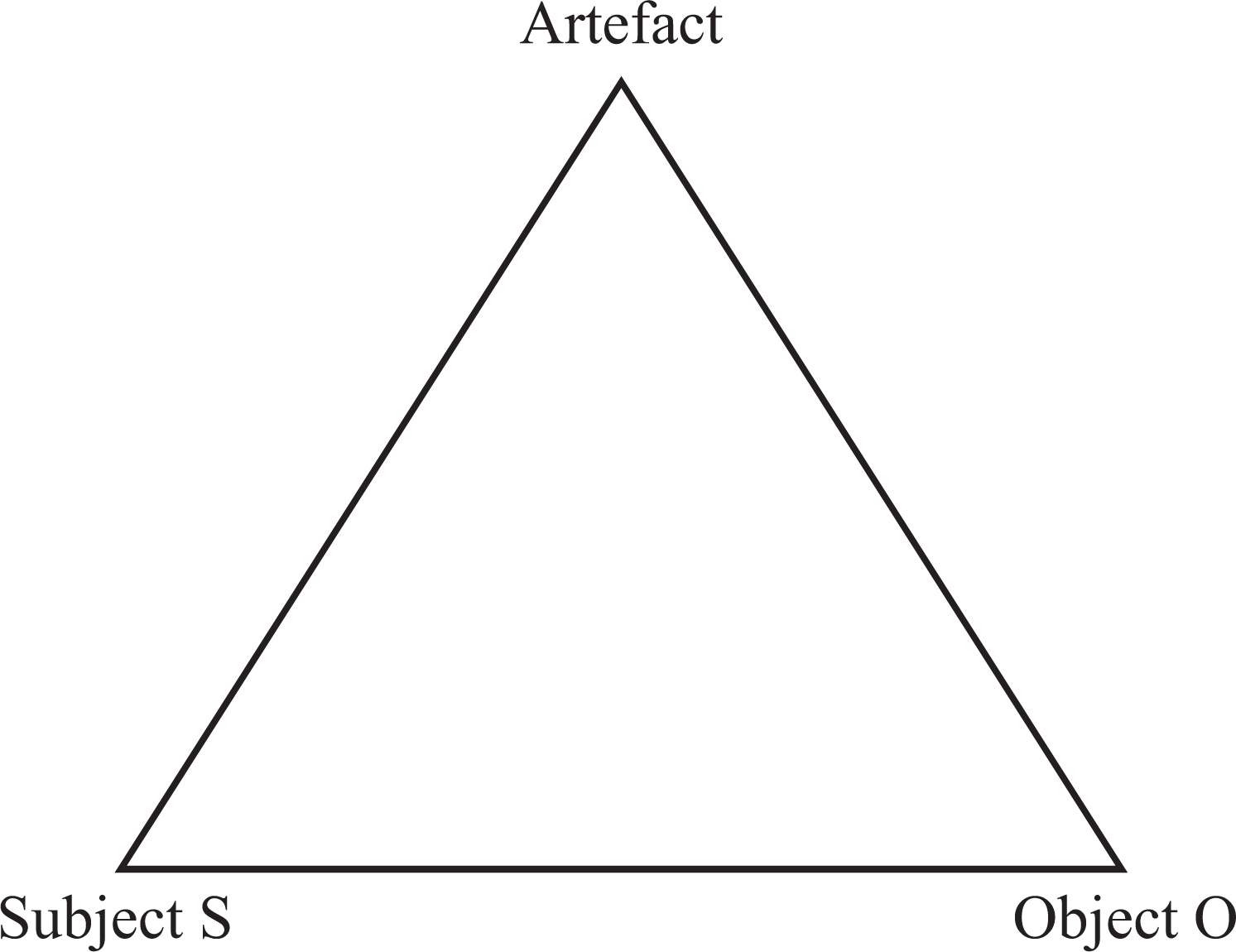
From Cole’s Cultural Psychology, Figure 1 illustrates the possibilities for subject–object relations.
From Vygotsky’s perspective the use of psychological tools …introduces several new functions connected with the use of the given tool and with its control; abolishes and makes unnecessary several natural processes, whose work is accomplished by the tool; and alters the course and individual features (the intensity, duration, sequence, etc.) of all the mental processes that enter into the composition of the instrumental act, replacing some functions with others (i.e., it re-creates and reorganises the whole structure of behaviour just as a technical tool re-creates the whole structure of labour operations). (Vygotsky, 1981: 139–40)
Prawat (1999) argues that Vygotsky’s later work offers a mediational account of meaning-making which is also social, embodied and transactional. This position is elaborated by Kozulin (1998) who discusses three possible generators of consciousness. Where Prawat speaks of social, embodied and transactional, Kozulin speaks of history, interaction and internal cognitive schematizations. There are tensions between the two positions: Kozulin’s emphasis on history which is not made explicit in Prawat’s use of the term ‘social’; Prawat’s use of ‘transaction’ has a more dialectical turn than ‘interaction’ within Kozulin’s work; and ‘schematizations’ is much more specific than embodied. While differences of emphasis are clear, there remains an agreement about the existence of multiple levels of representational activity which occurs in between and within persons.
Vygotsky was arguing that humans master themselves through external symbolic, cultural systems rather than being subjugated by and in them. This emphasis on the self-construction through and with those tools that are available brings two crucial issues to the foreground. First, it speaks of the individual as an active agent in development. Second, it affirms the importance of socio-cultural context in that development takes place through the use of those tools that are available at a particular time in a particular place. He distinguished between psychological and other tools and suggested that psychological tools can be used to direct the mind and behaviour. In contrast, technical tools are used to bring about changes in other objects. Rather than changing objects in the environment, psychological tools are devices for influencing the mind and behaviour of oneself or another. Vygotsky saw tools and symbols as two aspects of the same phenomena: a tool being technical and altering ‘the process of a natural adaptation by determining the form of labour operations’, a sign being psychological and altering ‘the entire flow and structure of mental functions’ (Vygotsky, 1981: 137).
In the discussion of memory and thinking that constitutes chapter 3 of one of the more widely available collections of his writing Mind in Society, Vygotsky stipulates that radical transformations take place in the relationships between psychological functions as a result of such mediated psychological activity. He suggests that ‘for the young child, to think means to recall; but for the adolescent, to recall means to think’ (Vygotsky, 1978: 51). Human memory is seen as a function that is actively supported and transformed through the use of signs.
Just as a mould gives shape to a substance, words can shape an activity into a structure. However, that structure may be changed or reshaped when children learn to use language in ways that allow them to go beyond previous experiences when planning future action…once children learn how to use the planning function of their language effectively, their psychological field changes radically. A view of the future is now an integral part of their approaches to their surroundings. (Vygotsky, 1978: 28) A particular feature of the Russian intelligentsia was the importance they attached to literature, which they saw not only as the ultimate embodiment of culture but as the most concentrated form of life itself. Literary characters were routinely judged by the Russian intelligentsia as real social and psychological types, while political and historical debates were commonly conducted in the form of literature and about literature. (Kozulin, 1990: 22–3)
The understanding of artifacts carrying out different functions, being both material and ideal and circulating between inner and outer worlds in which meaning is developing presents a complex, layered, dialectical view of human engagement with the world which carries with it a significant methodological challenge for research which aims to study processes of artifact-mediated formation of mind.
The dual process of shaping and being shaped through culture implies that humans inhabit ‘intentional’ (constituted) worlds within which the traditional dichotomies of subject and object, person and environment, and so on cannot be analytically separated and temporally ordered into independent and dependent variables. (Cole, 1996: 103) …implicit mediation typically does not need to be artificially and intentionally introduced into ongoing action (as in explicit mediation). Instead, it is part of an already ongoing communicative stream that is brought into contact with other forms of action. Indeed, one of the properties that characterizes implicit mediation is that it involves signs, especially natural language, whose primary function is communication. In contrast to the case for explicit mediation, these signs are not purposefully introduced into human action and they do not initially emerge for the purpose of organizing it. Instead, they are part of a pre-existing, independent stream of communicative action that becomes integrated with other forms of goal-directed behavior. (Wertsch, 2007: 183)
Märtsin (2012) is concerned with the ‘invisibility’ of ways in which different mediators are used to work on the minds of others. What is implicit for some may be explicit for others. This opens the door for an analysis of power and control in practices of mediation. For as Märtsin (ibid.) notes:
…it is only when we understand how culture becomes invisibly transmitted in our ordinary everyday interactions and how our social positions in the world come to impact the ways in which we perceive and act in the world that we can start to understand how we become meaning-making creatures that can perform certain acts of thinking, feeling and behaving in the world. (Märtsin, 2012: 438) Because of the ephemeral and fleeting nature of these (implicit) forms of mediation, they are often ’transparent’ to the unwary observer and are hence less easily taken as objects of conscious reflection or manipulation. (Wertsch, 2007: 183) a rupture that halts ongoing action and stimulates reflection…in which the actor’s taken-for- granted mode of action breaks down and the actor has to question both the resources being used and their mode of use overlapping or contradictory representations where the action orientation associated with one representation stimulates the alternative action orientation the gaze of others, such as when hearing one’s own utterances provides enough distance from those utterances to stimulate reflection upon those signs as mediators being used the very efficacy of the resource stimulates awareness of the resource e.g. when a novel is found to be a useful resource by active reflection upon the relations between the novel and his own life narrative socially sanctioned moments of creativity, when the traditional constraints upon action are removed as in play. (See Gillespie and Zittoun, 2010: 51–2)
Here we have a clear case on the part of Gillespie and Zittoun for providing some insight into the ways in which ‘different mediators are used by others to work on the minds of others’ as called for by Märtsin (2012). These contributions may be seen as a possible account of some of the ways in which ‘word meaning changes and develops’ (Vygotsky, 1987: 245): The relationship of thought to word is not a thing but a process, a movement from thought to word and from word to thought. Psychological analysis indicates that this relationship is a developing process which changes as it passes through a series of stages…The movement of thinking from thought to word is a developmental process. (Vygotsky, 1987: 250)
A sociological perspective on mediation
For Hasan (2002) and Bernstein (2000) visible semiotic mediation mediates a specific category of reasoning, a certain range of technical concepts, and a particular relation to the physical phenomena of the world whereby the world is classified and categorized in a certain way (Hasan, 2002: 152). Whereas what they term ‘invisible semiotic mediation’ is concerned with the ways in which unselfconscious everyday discourse mediates mental dispositions, tendencies to respond to situations in certain ways, and how it puts in place beliefs about the world one lives in, including about phenomena, both those that are supposedly in nature and those that are said to be in our culture (Hasan, 2002).
Wertsch’s (2007) account of implicit mediation echoes, but does not quite coincide with, some of Bernstein’s (2000) work on invisible mediation. Wertsch (1998) has advanced the case for the use of mediated action as a unit of analysis in social-cultural research because, in his view, it provides a kind of natural link between action, including mental action, and the cultural, institutional and historical context in which such action occurs. This is so because the mediational means, or cultural tools, are inherently situated culturally, institutionally and historically. However, as he had recognized earlier the relationship between cultural tools and power and authority is still under-theorized and in need of empirical study (Wertsch and Rupert, 1993). This recognition is an important step forward from the original Vygotskian thesis which as Ratner (1997) notes did not consider the ways in which concrete social systems bear on psychological functions. He discussed the general importance of language and schooling for psychological functioning; however, almost certainly because of his premature death, he failed to examine the real social systems in which these activities occur. The social analysis is thus reduced to a semiotic analysis which overlooks the real world of social praxis (ibid.). Nonetheless, some notable writers in the field have recognized the need for such a form of theoretical engagement (e.g. Hedegaard, 2001; Makitalo and Säljö, 2002).
Makitalo and Säljö enter into the challenge of accounting for the breadth of social, cultural and historical influences through the study of categories arguing that an important window on the creation of social orders may be gleaned from the study of processes of categorization. They suggest that once produced, categories become an important feature of the regulation of institutional activities: …we have argued that language categories are produced within collective practices to serve as mediational means (Wertsch, 1991). They are also used by people as constitutive resources in such practices. Through the sedimentation of traditions of argumentation, categories have been produced to form collective ways of understanding people, actions, events, and social practices. Institutionalization implies that categories serve as tools in the process of accounting for the relation between the collective and the individual. Categories are manifested in the concrete infrastructure of organizations – in documents, administrative routines, databases, and other tools. In this sense, they are embedded in political, economic, social and material circumstances. (Makitalo and Säljö, 2002: 64)
Hjörne and Säljö also studied institutional reasoning, and how events and people are categorized. They considered categories as historically emerging tools for coordinating social action and for mediating between collectives and individuals and they examined argumentation in institutional settings. This was undertaken as a longitudinal case study of the Swedish system of pupil welfare conferences. They found high levels of ambiguity and competing ways of representing the child’s problems in that participants in these meetings were forced to be quite flexible when connecting the broad range of contradictory behaviours and attitudes to categories. One of Hjörne and Säljö’s (2004) conclusions was that the classification carries with it significant consequences for children and their participation in schooling. This research provides a way of thinking about interpersonal processes as they are enacted in institutions. The question remains as to whether the way in which institutions are structured requires more analysis both at specific points in time and as they change through activity with time.
Makitalo and Säljö (2002) argue that as we talk, we enter the flow of communication in a stream of both history and the future (ibid.: 63) and that researchers need to have some definition of the situation or activity at hand (ibid.: 66). If activities are to be thought of as ‘socially rooted and historically developed’ how do we describe them in relation to their social, cultural and historical contexts of production? If Vygotsky was arguing that formation of mind is a socially mediated process, then what theoretical and operational understandings of the social, cultural, historical production of ‘tools’ or artifacts do we need to develop in order to empirically investigate the processes of development? Bernstein has suggested that the metaphor of the ‘tool’ itself serves to attract attention away from the relation between its structure and the context of its production (Bernstein, 1993: xvii).
These questions concerning the production of artifacts or tools would appear to be a matter of some priority for the development of the field, as so much of the empirical work that has been undertaken struggles to connect the analysis of the formative effect of mediated activity or tool use with the analysis of tool or artifact production. I intend to try and invoke an account of the production of psychological tools or artifacts, such as discourse, that will allow for exploration of formative effects of the social context of production at the psychological level. This will also involve a consideration of the possibilities afforded to different social actors as they take up positions and are positioned in social products such as discourse. This discussion of production will thus open up the possibility of analysing the possible positions that an individual may take up in a field of social practice. I will use the following statement as a device with which to open a debate about the relationship between principles of social production, regulation and individual functioning: The substantive issue of the theory is to explicate the processes whereby a given distribution of power and principles of control are translated into specialised principles of communication differentially, and often unequally, distributed to social groups/classes. And how such an unequal distribution of forms of communication, initially (but not necessarily terminally) shapes the formation of consciousness of members of these groups/classes in such a way as to relay both opposition and change. The critical issue is the translation of power and control into principles of communication which become (successful or otherwise) their carriers or relays. (Bernstein, 2000: 91)
Lemke (1995) argues that as communication plays a critical role in social dynamics, then social theories about discourse should point the way to a dynamic, critical, unitary social theory. He suggests that while linguistics furnishes theories of description and psychology provides theories of mind both tend to ignore the social functions of language and the social origins of human behaviour. He laments the lack of progress in advancing this agenda:
Unfortunately, most theories of discourse are not social theories. Indeed most theories of discourse are mainly linguistic and psychological, paying relatively little attention to the question of who says what when, why, and with what effects. The social context of discourse, and issues of discourse as social action are largely ignored. Instead discourse is mostly seen as the product of autonomous mental processes, or it is simply described as having particular linguistic features. (Lemke, 1995: 62) …both a developed conceptual syntax and an adequate language of description. Terms and units at both these levels in Bakhtin’s writings require clarification; further, the principles that underlie the calibration of the elements of context with the generic shape of the text are underdeveloped, as is the general schema for the description of contexts for interaction. (Hasan, 2005: 135) …the socio-genetic process of semiotic mediation appears to occur in a social vacuum and the overall shape of the interaction or its context is never invoked as in any way consequential to the outcome. Of course, Vygotsky often mentions ‘the school’ but, in an avowedly socio-cultural theory of mental development, there seems to be no concern with the social significance of this critical site for interaction. Under the label semiotic mediation of mental life, there lurks a complex structure of relations, none of which is probed, let alone integrated into the theory. (Hasan, 2012: 85) Very complex questions are raised by the relation of the socio to the linguistic. What linguistic theories of description are available for what socio issues? And how do the former limit the latter? What determines the dynamics of the linguistic theory, and how do these dynamics relate, if at all, to the dynamics of change in those disciplines which do and could contribute to the socio? If ‘socio’ and linguistics are to illuminate language as a truly social construct, then there must be mutually translatable principles of descriptions which enable the dynamics of the social to enter those translatable principles. (Bernstein, 1996: 151–2)
In Engeström’s (1996) work within activity theory the production of the outcome is discussed but not the production and structure of the tool itself. The rules, community and division of labour are analysed in terms of the contradictions and dilemmas which arise within the activity system specifically with respect to the production of the object. The production of the cultural artifact, the discourse itself, is not analysed in terms of the context of its production; that is, the rules, community and division of labour that regulate the activity in which subjects are positioned.
Bernstein (1996) refined the discussion of his distinction between instructional and regulative discourse. The former refers to the transmission of skills and their relation to each other, and the latter refers to the principles of social order, relation and identity. Whereas the principles and distinctive features of instructional discourse and its practice are relatively clear (the what and how of the specific skills/competences to be acquired and their relation to each other), the principles and distinctive features of the transmission of the regulative are less clear as this discourse is transmitted through various media and may indeed be characterized as a diffuse transmission. Regulative discourse communicates the school’s (or any institution’s) public moral practice, values, beliefs and attitudes, principles of conduct, character and manner. It also transmits features of the school’s local history, local tradition and community relations. Pedagogic discourse is modelled as one discourse created by the embedding of instructional and regulative discourse. This model of pedagogic discourse provides a response to one of the many theoretical demands which have remained unfulfilled in the post-Vygotskian framework. The rejection of the cognitive/affective dualism which Vygotsky announced was not followed by a model within which a unitary conception of thinking and feeling could be discussed and implemented within empirical research.
Bernstein (1999) moved his analysis to the internal principles of the construction and social base of pedagogic discourses. Having provided a theory of the construction of pedagogic discourse he moved to an analysis of the discourses subject to pedagogic transformation. This move will be of particular significance when this body of theory and its language of description are brought to bear on the discussion of the relationship between everyday and scientific concepts as outlined in Thinking and Speech. The analysis outlined by Bernstein (1999) allows for greater differentiation within and between the forms identified by Vygotsky. The analytical power of the distinctions made between vertical and horizontal discourses and hierarchical and horizontal knowledge structures provides research with an enhanced capacity to provide descriptions that capture the delicacy of the forms and their interrelation.
The mediational process is one which neither denies individual or collective agency nor social, cultural, historical influence. At the very heart of Vygotsky’s (1987) thesis is the argument that the introduction of new tools into human activity does more than improve a specific form of functioning, it transforms it. Tools, such as language, are cultural, historical products which mediate thinking and feeling and are in turn shaped and transformed through their use in human activity. It is through tool use that individual/psychological and cultural/historical processes become interwoven and co-create each other. Vygotsky links the development of consciousness to semiosis, and specifically to linguistic semiosis, and thus links the specifically human aspects of our practical and mental life to socio-historical contexts. (Hasan, 2005:135–6) Participation in social practices, including participation in discourse, is the biggest boot-strapping enterprise that human beings engage in: speaking is necessary for learning to speak; engaging with contexts is necessary for recognising and dealing with contexts. This means, of course, that the contexts that one learns about are the contexts that one lives, which in turn means that the contexts one lives are those which are specialised to one’s social position. (Hasan, 2005: 153)
A philosophical perspective on mediation
The notion of the artifact, which subsumes that of the psychological tool, raises questions about the relation between the ideal and the material. Bakhurst (e.g. 1995) has done much to clarify the contribution of the Russian philosopher Ilyenkov to our understanding of the framework within which so much of the Russian perspective on mediation may be read. The idea of meaning embodied or sedimented in objects as they are put into use in social worlds is central to the conceptual apparatus of theories of culturally mediated, historically developing, practical activity. He provides an account of the way in which humans inscribe significance and value into the very physical objects of their environment (ibid.: 173). A theory of mediation through artifacts infers that in the course of human activity meaning is sedimented, accumulated, or deposited in things. These meanings are remembered both collectively and individually. Thus as Cole (1996) reminds us, cultural artifacts are always material and ideal and Leander provides an illustration of their embedded nature: A broad definition of artifact as any mediational means…would not draw sharp distinctions between semiotic and material artifacts for various reasons. It is difficult not to find at least some material dimension in all mediational means; even sound waves are material…Secondly, the materiality of artifacts is always deeply embedded in their ideational (cultural and historical) meanings…Third, transformations between semiotic and material realizations of any artifact are in constant flux, as are the realizations of any artifact as internal (e.g., mental models, scenarios) or external (charts, diagrams, materials tools). (Leander, 2002: 202)
Wertsch (1998) emphasizes that tools or artifacts such as ‘conventional’ stories or popular histories may not always ‘fit’ well with a particular personal narrative. As ever with a Vygotskian account there is no necessary recourse to determinism. Wertsch suggests that individuals may resist the way in which such texts ‘shape their actions, but they are often highly constrained in the forms that such resistance can take’ (ibid.: 108). This emphasis on the individual who is active in shaping a response to being shaped by engagement with cultural artifacts is central to the Vygotskian argument. The relative emphasis on agency (whether individual or collective [Wertsch, 1998]) and the affordances (Gibson, 1979) that social, cultural and historical factors offer form the stage on which the development of new and improved forms of thought is enacted.
Vygotsky’s (1978) accounts of mediation by tools or artifacts and of the social origins of higher mental functioning may be read solely in terms of a movement from exchange between people to the development of individual competence. This reading ignores the origins of artifacts themselves. They are the products of individual and collective endeavour. ‘Like Ilyenkov after him, Vygotsky recognises that as much as culture creates individuals, culture itself remains a human creation’ (Bakhurst and Sypnowich, 1995: 11).
As Bakhurst and Sypnowich imply, ways of thinking and feeling may be influenced and shaped by the availability of cultural artifacts which are themselves the products of mediated activity. Here is the challenging matter. It is all too easy to drift into an account of determinism either social or individual. As Derry (personal communication) suggests: ‘the difficulty is finding a form of words to avoid making agency invisible while not diminishing the great benefit of sociological accounts in alerting us to regularities’.
Both Bakhurst (e.g. 1995) and Derry (e.g. 2013) have been arguing that a philosophy of the ‘space of reasons’ in which human action is located is a vital contribution to the development of a richer understanding of the Vygotskian notion of mediation. Derry (ibid.) discusses this matter from a philosophical perspective on teaching. After McDowell she argues that concepts are located in a ‘space of reasons’ which may be beyond the conscious awareness of learners. This space implicitly mediates the process of learning:
…teaching involves providing opportunities for learners to use concepts in the space of reasons within which they fall and within which their meaning is constituted. Participation in this space does not presuppose a full understanding of a concept; rather, what is needed to start with is no more than an ability to inhabit the space in which reasons and the concept operate. (Derry, 2013: 230) What matters is that teachers do not simply introduce concepts that feature in particular fields of knowledge without exploring the connections between them with their students. Since, in the light of material inference the relations between concepts are determinate, attention must be paid to the structure of knowledge, to the fact that concepts stand in particular relations to one another depending upon the particular domain in which they function. (Derry, 2013: 232) When we enter human life, it is as if we walk on stage into a play whose enactment is in progress – a play whose somewhat open plot determines what parts we may play and toward what denouements we may be heading. Others on stage already have a sense of what the play is about, enough of a sense to make negotiation with a newcomer possible. (Bruner, 1990: 34)
Conclusion
This article has been concerned with aspects of the process of mediation that are not always visible to participants in an activity or those who study their actions. Arguably this invisibility blunts the instruments of examination that social science can bring to bear on studies of the cultural historical formation of mind. Wertsch (2007) has provided a cogent argument for a distinction between explicit and implicit mediation with an appreciation of the ways in which sign meaning develops and in so doing he talks of the point at which that which was implicit may become explicit and open to conscious reflection. Bernstein (2000) and Hasan (2005), using the terms ‘visible’ and ‘invisible’, ground an account of the development of sign meaning in an analysis of the social practices in which it develops and the implications of different forms of social positioning of participants in that practice. They provide a sociology of the distinction in which the ‘everydayness’ of a social practice both differentially positions individuals and mediates their experience of that practice. In so doing they also introduce a language of description and analysis that could be used to study those aspects of mediation that do not make the transition to an explicit form which carries with it the opportunity of conscious reflection which Werstch describes.
Derry and Bakhurst provide a broader philosophical backdrop to this account through the introduction of an understanding of the space of reasons that such practices inhabit. They provide a superordinate level of analysis within which the implications of different modalities of practice discussed by Bernstein and Hasan may be seen to operate, if and only if a researcher is equipped with appropriate theoretical and methodological tools. This potentially constitutes a higher order of invisibility than that related to the particularities of a specific modality of social practice. Just as the same action may take on a different meaning within different modalities of practice, so different modalities of practice may take on different potential meanings in different spaces of reason.
My suggestion is that the term ‘implicit’ has been used to discuss forms of mediation that may well become explicit at moments in time. However, there are forms of mediation that may not become explicit until some considerable time has elapsed. Historians and philosophers enable us to understand the mediational effects of the spaces of reasons which obtained in the past. The development of a richer understanding of Vygotsky’s concept of mediation is a multidisciplinary endeavour. If we are to gain more control of our histories and ourselves we need to develop better tools with which to scrutinize what will otherwise remain invisible.
Footnotes
Acknowledgement
I am very grateful to Jan Derry and Ian Thompson for their commentaries and to Sarah Cox for clearing up the mess I make with a word processor.