







Abstract
An ethnographic or ethnomethodological turn in the history of the human sciences has been a Holy Grail at least since Cooter and Pumphrey called for it in 1994, but it has been little realized in practice. This article sketches out some ways to explore the reception, use and/or co-production of scientific knowledge using material generated by mediators such as mass-market paperbacks, radio, TV and especially newspapers. It then presents some preliminary findings, tracing the prevalence and, to a lesser extent, use of selected social-science concepts in the USA and the UK from the 1930s to the 1970s.
For at least 20 years now, historians of science have been calling for an ethnographic turn in their discipline but have largely failed to realize it. In a supposedly influential article in 1994, Roger Cooter and Stephen Pumfrey observed that ‘the effects of even the most obvious mechanisms for the transmission of scientific knowledge and culture’ were still ‘shrouded in obscurity’; critiquing the ‘diffusionist model’, based on assumptions of ‘cultural lag’ between expertise and popular consciousness, a ‘trickle-down’ effect and a largely passive, receptive audience, they called instead for a Latourian ethnomethodology of the scientific text to reveal a social history of the scientific imagination (Cooter and Pumfrey, 1994: 237, 248–50, 256). Fifteen years later, in a special issue of the journal Isis, their followers complained that such an ethnographic turn had not yet happened – historians of science were not yet comfortable with mainstream social and cultural history, the attractions of rich and easy pickings in the archive of expertise were still too powerful, or perhaps the still dominant Foucauldian and even Latourian perspectives gave too little room for agency (Daum, 2009: 328; Pandora, 2009: 347; and see Cooter and Pumfrey, 1994: 245–6). There’s not a lot of evidence that much has changed in the 5 or 6 years since, though more progress seems to have been made for the 19th than for the 20th centuries.
And historians of social science find themselves in a similar situation. Frequent calls for an ethnographic turn, here too, prove easier to make than to implement. Consider two recent books in the field that I admire very much (for other achievements). Mike Savage’s rightly influential Identities and Social Change in Britain Since 1940, published in 2010, sets out to investigate the co-production of identity through the ‘intersection between various experts and different groups of people’, but ends up by focusing instead on the expert discourses themselves – thus his subtitle, ‘the politics of method’ (Savage, 2010: x–xi). Savage does, however, provide a fruitful account – albeit a sketchy one – of a new technical middle class that integrates its handling of social-science concepts into its own identity (ibid.: 19–20, 64–9, 76, 83–5). Similarly, Mark Greif’s The Age of the Crisis of Man performs a brilliant anatomy of the expert discourse of the ‘crisis of man’ after the Second World War, but his promised account of its ‘vernacularization’ rests almost entirely on his own expert literary criticism of some canonical novels (Greif, 2015: 104, 108, 319). Historians of social science, it seems, are prey to the same frailties and temptations as historians of science – discomfort with mainstream social and cultural history, addiction to expert archives, subjection to the theoretical schemas of a Foucault, or at least his vicar amongst historians, Nikolas Rose (see, for a critique along these lines, Brückweh et al., 2012 and Raphael, 2012).
In what follows I want to propose some topics for research, some methods, and some tentative contextualizations for a full-blooded ethnographic turn – or, more properly an ethnomethodological turn, that aims to get at the commonsense of everyday life – in the history of social science. While clearly I cannot execute that turn myself in a short article, I can offer here a research agenda which I hope to take up myself in future and that may open a dialogue with others sharing my aspirations. Such an agenda will not only point to new sources and methods but also suggest a chronology for the rise and fall of the language of social science in everyday life, focused on the mid-century decades from the 1930s to the 1970s. I will be focusing on one aspect of this question, on which my own research hinges, that is, on the vernacularization of social-science language in everyday life, and on the Anglophone world which I know best, led by the culture on which social science is said to have had the earliest and most wide-ranging impact, that is, America’s, and taking Britain as a useful comparator, as a supposed laggard relative to the USA.
The vernacularization of social science
Social science, of course, as many scholars have noted, impinges on everyday life in the 20th century in multiple ways, and probably with greatest intensity between the 1930s and the 1970s. At the highest level of abstraction – in systems theorists from Parsons to Foucault to Luhmann and Latour – social science is a crucial handmaiden of the power/knowledge complex, locating and neutralizing potentials for disorder, setting norms and causing people to internalize them, though by what means it works this magic is not always clear (and is nowadays much disputed). In the flattest, least hierarchical version, Latour’s, the ‘enrollment’ of people by social science just happens, without the authorization of power, but is nonetheless ubiquitous: ‘The social sciences have disseminated their definition of society as effectively as utility companies deliver electricity and telephone services’, Latour writes, by means as various as ‘newspapers, college education, party politics, bar conversations, love stories, fashion magazines, etc….In the developed world, there is no group that does not have at least some social science instrument attached to it.’ Here Latour seems to be closer to Foucault in exposing the con trick by which social science edits actors’ categories and substitutes its own reified idea of the ‘social’ – ‘Actors have many philosophies but sociologists think that they should stick to only a few’ – although he also posits his actor-network theory as an ethnographic method designed to restore the visibility of a much richer repertoire of meaning-making (Latour, 2005: 4, 34, 40–1, 49–52, 230–2, 257–8).
Closer to the ground, social science is, as Latour notes, present in many places, deploying many instruments. Perhaps the best known and best studied is advice literature – the kind of thing provided by clergy before the 20th century, by social scientists (though more commonly by journalists, pop writers, and physicians) subsequently. Here an interesting question is how far advice – on baby and childcare, for example, or marriage or career or ‘personality’ or ‘success’ – really relies on new forms of expert knowledge at all, or, as Mathew Thomson has often argued for Britain, simply carries over moral, spiritual or religious teachings, or even modernizes them, sometimes in hardly altered language (Thomson, 2006, 2012). Then there are, also relatively well studied, instruments or techniques of social science that are applied to everyday life, without necessarily penetrating it very deeply: the opinion poll, the social survey, the interview, the test, and so on. Here an essential guide is Sarah Igo’s The Averaged American, which argues persuasively that these instruments not only measured Americans, but also – with repeated application and publicity – could induce them to measure themselves. These techniques may only have systematized what was perhaps a peculiarly American (or possibly just a modern) tendency to compare oneself against a peer group, ‘other-direction’, superseding an inner-direction guided by tradition or Scripture. But they certainly did so in a social-scientific idiom, inciting the prioritization of ‘norms’ over values, with ‘norms’ themselves increasingly set by social-scientific pronouncements (Igo, 2007: esp. 261–2 on self-rating, 267–77 on community building; cf. Mead, 2004[1948]; Riesman et al., 2001[1950]: 70–9).
If the advice literature may be thought to swing too far away from social science, these techniques perhaps swing too close to it, that is, to social science pur sang rather than the versions that propagate through everyday life. Many social-science instruments are applied without the knowledge of their subjects, or indeed without the publicity accorded the Kinsey Report, which provides Igo with her most fertile territory. Some of her other subjects, such as the Lynds’ book Middletown, while it reached a wide enough audience, nevertheless remained less than proverbial. Searching for an impingement of social science on everyday life that is neither too lowbrow to be social science nor too highbrow to affect everyday life, I discuss here only one possible vector, the use in everyday life of terminology that is undeniably rooted in the technical language of social science, what one might call the vernacularization of social science. My aim is similar to Raymond Williams’ in his celebrated Keywords: A Vocabulary of Culture and Society (Williams, 1983), but Williams focused mostly on long-established vernacular terms that are then inflected by social science rather than the technical vocabulary of social science itself which is then inflected by use; famously, for example, the way in which ‘culture’ changes meaning under pressure in part from anthropology and Leavisite literary criticism. As Williams’ successors note, the expansion of higher education and other democratizations of academic knowledge may have introduced more technical language directly into the vernacular (though see my doubts about this below) (Bennett et al., 2005: xix).
To give an indication of what I mean, consider this (admittedly rather contrived) passage of social commentary, written in vernacular English that would have been comprehensible to educated British and American readers in the second half of the 20th century. A male child born in 1900 went through a number of recognizable lifecycle
1
changes. In infancy his personality was shaped by separation anxiety
2
or the Oedipus Complex,
3
with a danger of later developing narcissism.
4
After surviving the rigours of childhood he then had to endure adolescence,
5
a rite of passage
6
that often triggered an identity crisis.
7
On entering early adulthood, he might seek social mobility
8
and an improved lifestyle
9
in an increasingly affluent society,
10
though this would require delayed gratification
11
and possibly a high IQ
12
(morons
13
need not apply), according to the norms
14
of meritocracy,
15
and it would be imperilled by conspicuous consumption.
16
In the 1930s, thanks to the influence of the mass media,
17
he could be tempted by the charisma
18
of a totalitarian
19
leader, or by the messianism of a superpower,
19
or be subject to social engineering.
20
By the 1950s, though it’s a stereotype, he was no doubt headed for a mid-life crisis.
22
Stress
23
was everywhere. His complaints would be privately diagnosed by a clinician as psychosomatic,
24
but he’d get a pill and benefit from the placebo effect.
25
Social change registered all around him like a culture shock.
26
His standard of living was threatened by upheaval in the Third World,
27
or by his own sense of relative deprivation.
28
In the 1960s, he could at least join an encounter group,
29
get some feedback
30
or even empathy
31
from his peers who shared his frame of reference,
32
and enjoy counterfactual
33
speculation about the life he might have lived: maybe he could make it real by a self-fulfilling prophecy.
34
But no, he was too risk-averse.
35
Hey – isn’t this all rather ethnocentric?
36
Would he have the same problems if he hailed from a minority group?
37
And don’t get me started on gender roles.
38
Mediators of vernacular social science
How did this language enter everyday life, when, by what means, and with what effects? Any process of vernacularization requires special attention to the mediators, through whom expert discourse passed to reach and be assimilated by the public. To some extent, the experts were themselves the mediators. The extension of higher education meant that, especially in the USA which was far ahead of the curve, growing numbers of the public had direct contact with academics at formative periods of their life – after the Second World War, about a third of the entire 18–21 year-old age cohort in the USA. In conditions of mass higher education, we don’t need to consider academic discourse any longer as purely an elite discourse. But even in the UK, where participation rates remained much lower until the 1990s (as low as 5% as late as 1960, and lower still for women) there was pressing demand for and access to academic discourse in the mass market. The so-called Flynn effect – rising measured intelligence and growing comfort with symbolic and analytic modes of cognition – kicks in even where there is less formal education, thanks to ‘more cognitively demanding jobs, cognitively challenging leisure, a better ratio of adults to children, richer interaction between parent and child’ and in general the ‘greater complexity of everyday life in the modern world, including its visual culture and its demands for faster information processing’, especially in the period since the Second World War (Flynn, 2012: 15, 36–40, 95–6, 102–3).
For British adults largely unexposed to higher education, the principal means of directly accessing academic language in our period came through the innovation from the 1930s of the mass-market non-fiction paperback book (the main focus of my own current research). Pelican Books from 1937 set about reprinting academic texts and commissioning popularized versions from academics and formed a growing proportion of Penguin paperback sales in the post-war years. A Mass-Observation study in 1947 found that a third of all adults bought paperbacks, and nearly half of them bought Penguins, including large numbers of so-called ‘artisans’ as well as the middle classes (neither of whom would have had much exposure to higher education, unlike in the USA) (Mass-Observation, 1947: 38–40, 83–6, 96; I interpret the findings rather differently from the authors of this report, who define both Penguin readers and working-class readers very narrowly). Something like a million Pelicans a year were sold during the war, rising to multiple millions by the 1960s. While it is hard to find statistics differentiating Pelicans from Penguins, Pelicans were said to constitute 10% of the nearly 10 million sales in wartime and a rising proportion of sales after the war, which totaled 30 million by 1970 (Joicey, 1995: 127). 39 They included many classic academic titles selling hundreds of thousands of copies each, well beyond the student and graduate market.
Americans at first lagged behind in reading non-fiction paperbacks. Around 1950 even college graduates in America were less likely to be book-readers than the general public in Britain (Asheim, 1959: 26). But over the course of the 1950s they caught up, thanks in large part to the Pelican Books spinoff, Mentor Books, the American pioneer of the mass-market, non-fiction paperback, not through bookshops as in Britain but through magazine retailers – thus ultimately reaching many more readers through bus and train stations, drug stores and newsstands, coffee shops, smoke shops and variety stores. By 1960 it was possible to buy serious non-fiction titles in at least 25,000 outlets across the country, a far wider reach than was attained by the better-known ‘quality paperbacks’ beginning to be sold in college bookstores and the new urban superstores. Through all of these outlets a few important works of social science were able to clock up sales of over a million copies in the period between 1945 and 1970, notably David Riesman’s The Lonely Crowd and Ruth Benedict’s Patterns of Culture, probably the top titles in the social-science bestseller list. In both countries, psychology and anthropology sold particularly well; in the USA, philosophy; in the UK, history and literature. Social science, in general, sold better to this mass market (both a student and a more casual market in the wider range of outlets such as newsstands) than did hard science, politics or economics (Mandler, 2019).
Between them, higher education and paperback books provided some direct access to academic discourse for up to half of the general population in both Britain and America, but that contact would have been concentrated at one stage of the life-cycle and otherwise sporadic and hit-and-miss. It is very hard to assess how far these courses and texts contributed to the language of everyday life. To get closer to vernacularization, we need to turn to the mass media, and especially to the new opportunities opened up by digitization of mass-media sources. So far digitization has been used by media historians to track vernacularization principally through books, especially by means of the Google ngram, which assesses historical incidence of words and word-chains in books. In Figure 1 we can see the way in which usage of the term ‘social science’ took off among American authors from around 1920 and among British authors around 1960, with American usage peaking around 1970 and then dropping off while British usage continues to rise to higher levels still at least until 2000. However, in pursuing vernacularization the ngram has only limited utility: it counts only books, and it counts each book equally, no matter how many copies were in circulation; furthermore, it is hard to drill down and examine the incidences and their contexts. Historical incidence of the use of ‘social science’ in (a) American books and (b) British books.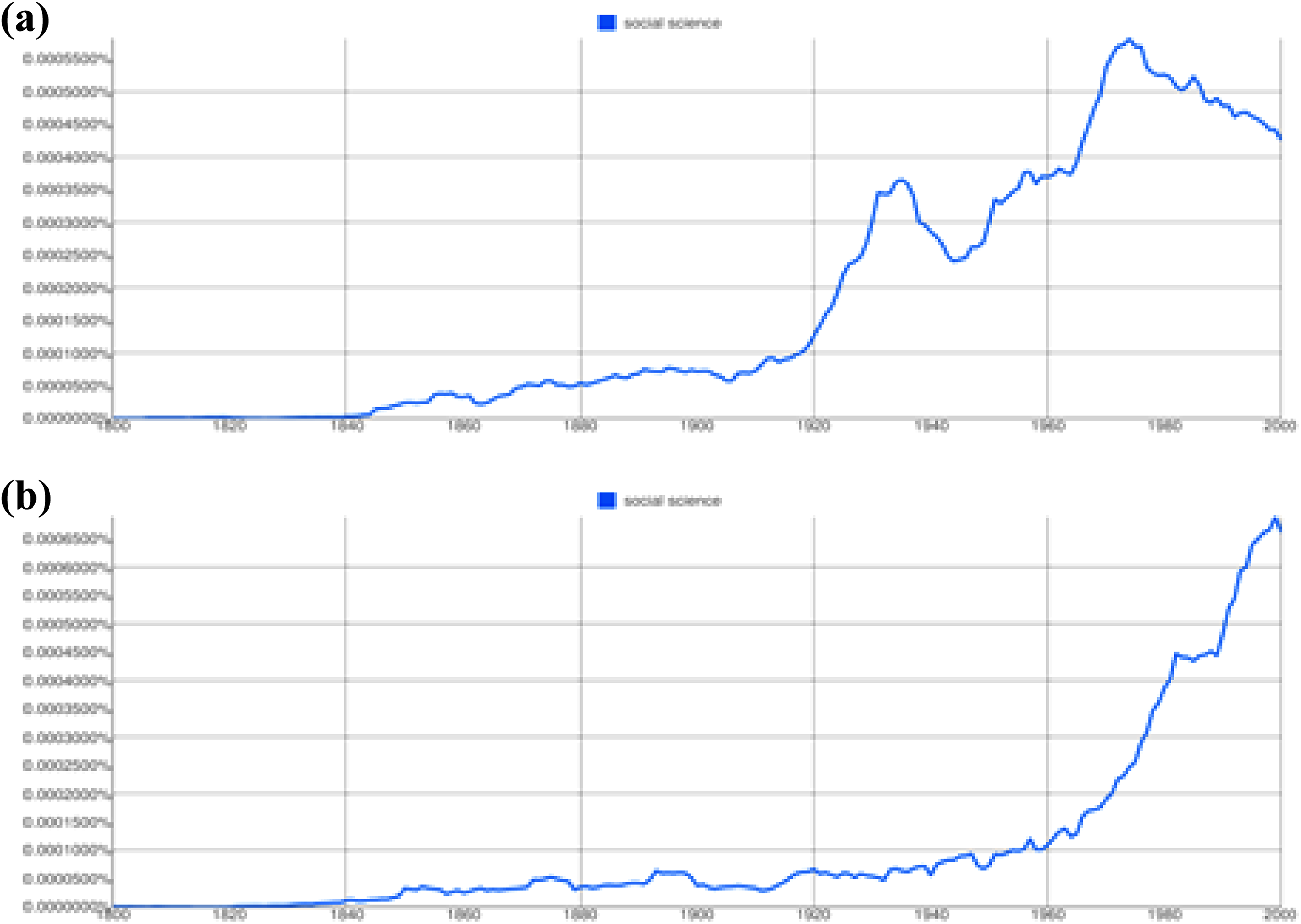
In a search for deeper penetration into everyday life, newspapers have many advantages over books for our purposes: we know more about their circulation and thus about their readers (number and type), they reach a wider range of people and, most importantly, they maintain a more consistent presence in everyday life, at the breakfast table, on the commuter train, at teatime and before dinner. As Benedict Anderson and Michael Billig have shown, they have considerable potential both to shape and reflect ‘banal’ consciousness of a discursive construct such as ‘national identity’; the same must be true of the range of discursive constructs that interest us here (Anderson, 1991: 33-6, 61-3; Billig, 1995). Even without measuring incidence as a proportion of all text, as the ngram does, a longitudinal study of simple incidence over time in newspapers can give us a good sense of how present a concept might have been in everyday life and how its presence changed across the heyday of the daily newspaper in the 20th century.
A social-science concept that has thoroughly penetrated everyday life, such as Erikson’s ‘identity crisis’, might appear in a daily newspaper like The New York Times, selling up to half a million copies daily to an educated readership in the Greater New York region, as frequently as once a week by the 1970s or ’80s (Figure 2; the Y-axis in Figures 2 –6 represents incidences per year); ‘conspicuous consumption’, a little less (Figure 3).
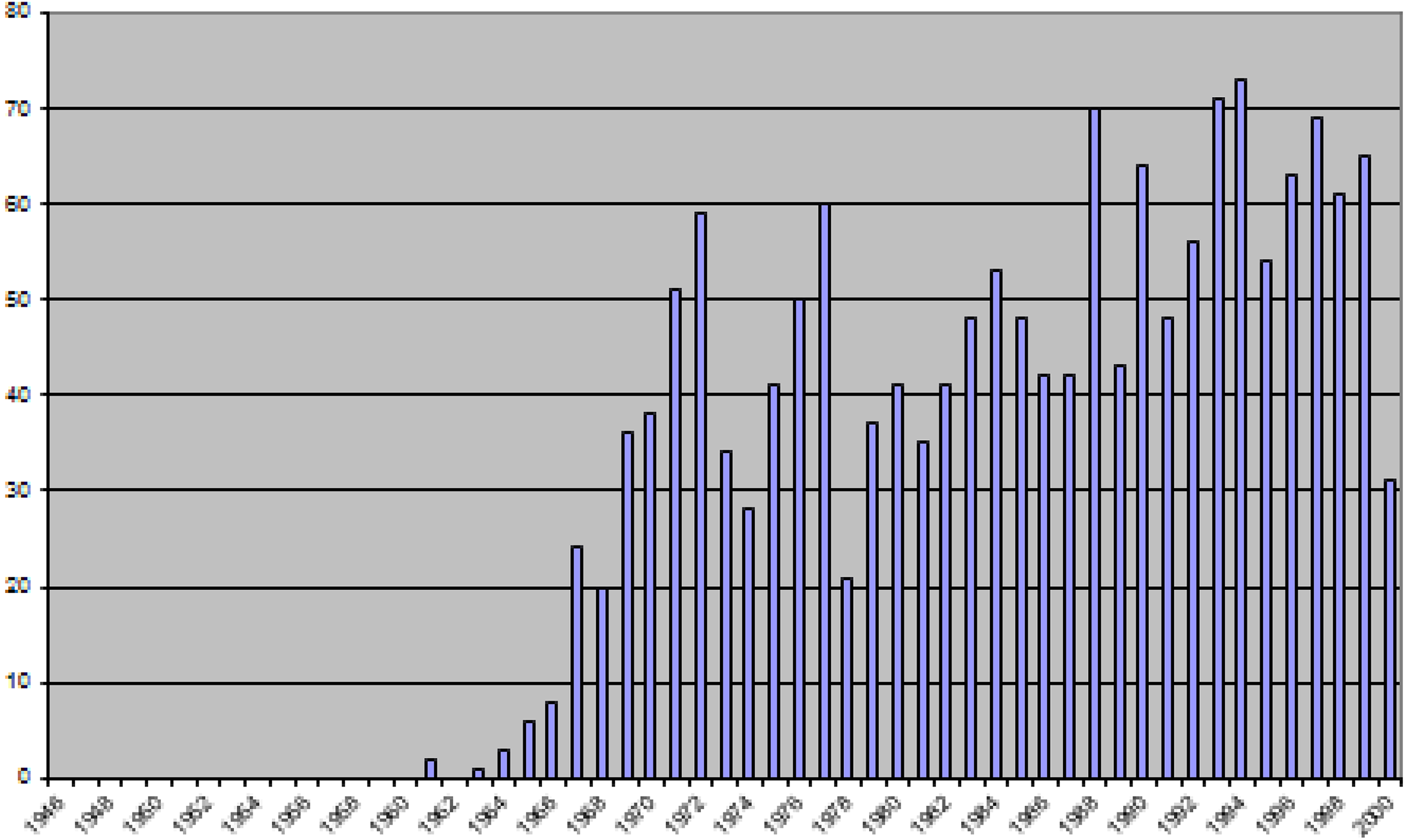
‘Identity crisis’, The New York Times.
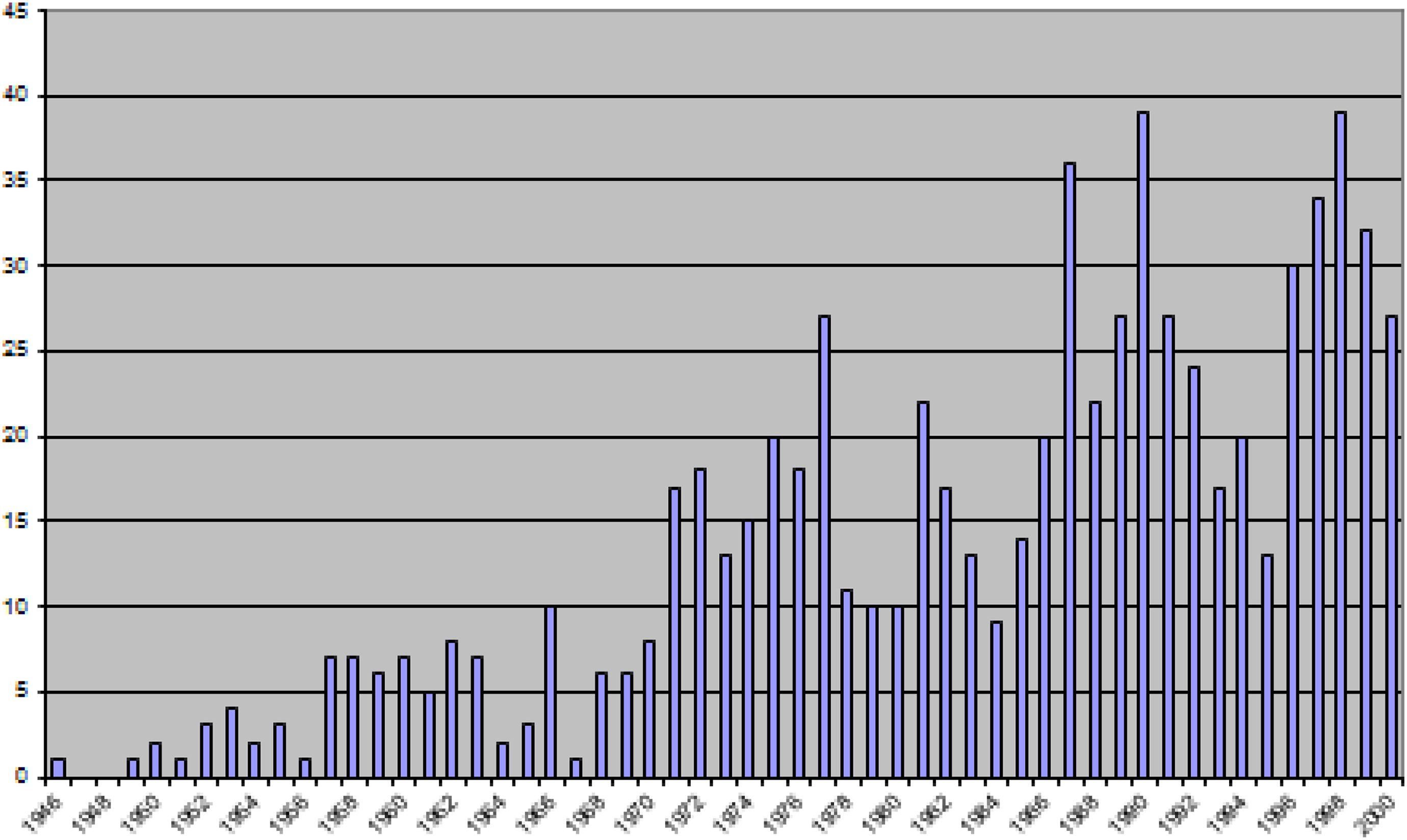
‘Conspicuous consumption’, The New York Times.

‘Super-ego’, The New York Times.
‘Oedipus complex’, The New York Times.
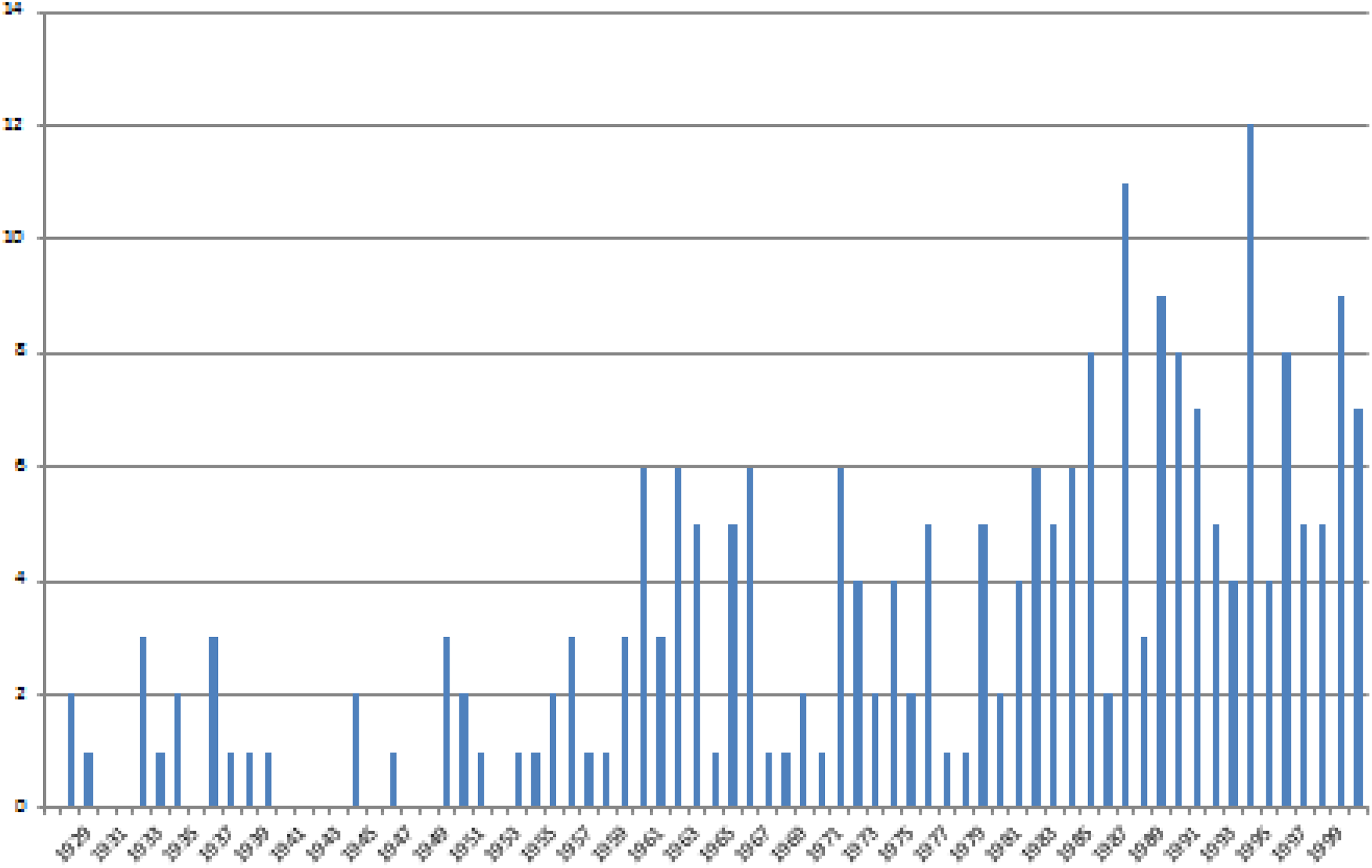
‘Oedipus complex’, The Guardian and The Observer.
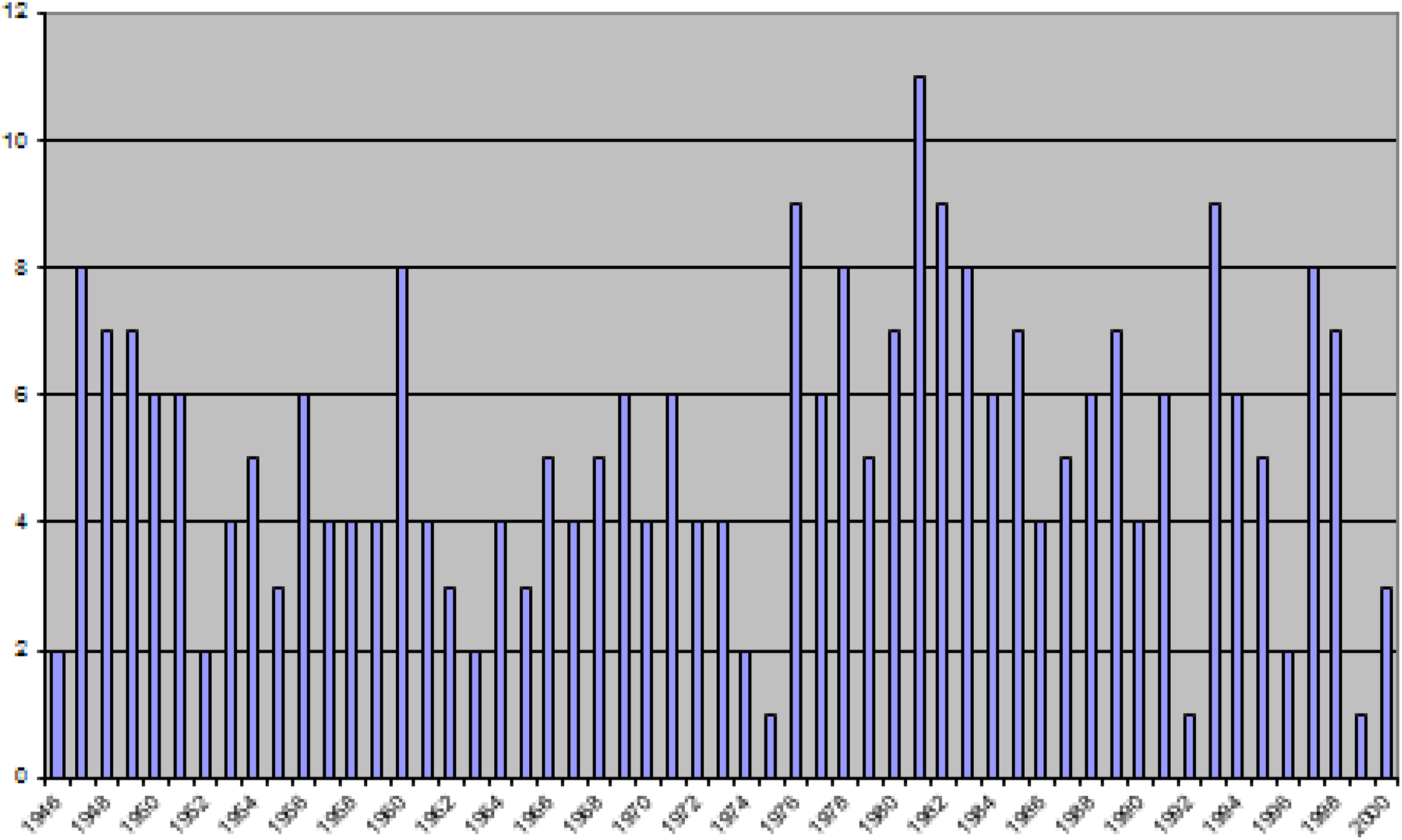
More technical terms from psychoanalysis, such as ‘superego’ (Figure 4) or ‘Oedipus Complex’ (Figure 5), were present frequently enough that we assume readers knew vaguely what they meant, but they had been less thoroughly vernacularized; this may have meant that their meanings stuck closer to their Freudian origins.
As one might expect, the daily The Guardian and the Sunday The Observer, even taken together, give less and later exposure to their UK audiences to this Freudian language, despite their close association with the social sciences more generally, although this lag has been made up for by the end of the century (Figure 6).
Interestingly, however, this Freudian language does not enter everyday life until after the Second World War even in the USA, although the historiography on the expert discourse (relying at best on magazines) argues for an earlier diffusion, in the interwar period (e.g. Hale, 1971: 397; 1995; Rapp, 1988; Richards, 2000; Zaretsky, 2004). ‘Oedipus Complex’ appears first in The New York Times in 1919 and ‘superego’ in 1928, but they are rarely mentioned more than once a year before 1945, and nearly always in the narrow context of reporting on Freud himself – much as you would have found in The Guardian or The Observer in the same period. All of these papers cater to a highly educated audience. But there is evidence too of social-science terminology in the tabloid press, reaching quite a different audience, where the terminology is less prevalent, but is still present, evidence that it is recognized, though not necessarily respected. ‘Oedipus Complex’ appears occasionally from the 1960s onwards in The Daily Mirror and The Daily Express, and ‘identity crisis’ in the same papers from the 1970, even in Reg Smythe’s ‘Andy Capp’ cartoon strip in the Daily Mirror (21 May 1980).
Clearly, tracking incidence and use of social-science terms in daily newspapers is a massive task which I have only begun to undertake. It is much harder still to track incidence and use in radio and television, though voice-recognition software will make this easier in future. Certainly, we know that the BBC was a major vector of social-science language, reaching very large audiences especially on the Home Service. The BBC made an increasingly self-conscious effort to channel the views and language of social science to the general public as it became evident in the 1960s that social science was not only academically important, but also popularly accessible. While Reith Lecturers in the 1950s were likely to be scientists or humanists, in the 1960s for the first time they included social scientists, such as the social psychologist G.M. Carstairs, who was invited in 1962 to report on ‘the latest psychological and sociological research developments and trends’. 40 Less well-known but nearly as potent was the public-service obligation on US radio broadcasters that prevailed before the Second World War, and that led to explicitly diffusionist programming such as NBC’s Have You Heard This?, a regularly recorded dinner-party conversation about science, and Answer Me This, ‘a social-science-based question-and-answer program’. Similar public-service obligations were taken up, more briefly, by US television in the 1950s (Goodman, 2011: 56, 311).
The uses of vernacular social science in everyday life
A close examination of use and context in such mediations can tell us a great deal, but it is clear that much of this material is still susceptible to a straight diffusionist reading. It doesn’t go very far (though as I’ll suggest in a moment it goes some way) to reaching the actual uses and meanings of the language of social science in everyday life by ordinary actors. This is, as ever, the Holy Grail of cultural history, not easily attainable. We can make some progress by assessing the range of experts’ own motivations in broadcasting their technical discourses. The historiography of social science in its early years did not consider a very wide range of motivations, dominated for some time by a ‘social control’ or ‘social engineering’ paradigm which tended to assume that the purposes of social science were quasi-authoritarian and showing relatively little interest in its effects: the assumption was that social science was a tool of ‘governmentality’ and that people just had to fit into the shapes created for them by it. But those days are gone, and the historiography is now open to a healthy range of expert motivations which also affords a wider range of uses. For example, the enhanced consciousness of culture and society created by social scientists is now not only viewed as a means for ‘adjustment’ (fitting citizens for the peculiar demands of their society) but also as fostering either personal autonomy (as David Riesman had hoped) or an awareness of the social determinants of personal problems (C. Wright Mills’s ‘sociological imagination’, which he hoped would trigger social action) (Thomson, 2001; cf. Lemov, 2005: 231–2, 238–9). Similarly, social science is no longer exclusively presented as a vehicle for the disenchantment of the world; it is now offered also as a force for re-enchantment, offering scope for users to envisage alternative worlds, much as Michael Saler has proposed for science fiction, which of course drew on social-science discourse for its counterfactuals (Saler, 2012). Neil Postman thought social science had taken over the roles formerly performed by novelists and social historians, ‘a form of storytelling’ that provides ‘the powerful metaphors and images of our culture’ (Postman, 1992: 12–18). It can be playful, gossipy, competitive, reflexive and inter-subjective, liberating. With the advent of cultural studies in the 1950s and ’60s, it could pose a direct challenge to cultural hierarchy, and from the 1960s (and as with Riesman and Mills earlier) it sought to criticize as much as to propagate prescriptive expertise. Above all, in a world of rapid change and too much choice, it could be used to navigate change (both in private life, in those rapidly multiplying life-course ‘crises’, and in public life, as a tool for democracy) and to assess choice, though of course the aggressive marketing of expertise meant that it could exacerbate the problem of choice even as it sought to manage it (di Leonardo, 1998: 165–8).
These are mostly uses of social science being proposed by social scientists themselves or their historians. Where can we find ordinary people testifying directly to their own uses? One fruitful source that I have already used a lot myself emerges from their negotiations with the mediators. The paperback publishers, for example, kept their ears to the ground to try to anticipate what texts more people would find most useful. Although they had their own motivations which guided their reprintings and commissions, they were also businessmen who needed to follow the market. As it happens, for these publishers, who were mostly progressives, following the market was a political as well as a commercial imperative. As the Pelican publisher Billy Williams wrote to the Mentor publisher Victor Weybright in 1946, they shared a strong conviction in ‘“an intangible element of self-education” in the fact that people have to select their books’. 41 An element of surprise here – with the consumers calling the shots – was seen as a positive virtue. Pelican were surprised to find that their bestsellers, in addition to the familiar history and literature titles, included many psychology titles, both ‘self-rating’ books like Hans Eysenck’s Test Your IQ and more academic books on the psychology of childhood and adolescence, clearly seen as high-grade advice literature. Mentor were surprised to discover in the 1950s a rich vein of American interest in philosophy and, relatedly, in non-Western religions, scoring runaway successes with editions of the Koran, the Gita and the teachings of Buddha. Far more than is the case in natural science, social science engages in a feedback loop with its readers (who are also its subjects), something even more true of the mediators, whose loyalties often lie closer to the readers than to the scientists (Isaac, 2009).
It is also possible to track ‘linguistic drift’ in the uses of those social-science phrases in the newspapers, as vernacularization distances them to different degrees from the meanings originally attached to them by experts. When ‘identity crisis’ first appears in the papers in the late 1960s, it does so in its original sense, referring to the process of negotiation by which an individual defines him or herself in relation to a group, especially in periods of rapid change; adolescents, students and Negroes in some early references, pointing to its utility for immediate purposes in mediating new group identities. In 1968 Erikson ruefully acknowledged the vogue by wondering whether ‘some of our youth would act so openly confused and confusing if they did not know they were supposed to have an identity crisis’ (quoted by Nisbet, 1968: 1). But as we enter the 1980s and ’90s, when the term itself remains prevalent, we find that this original meaning is slipping away. Increasingly the term is applied not to individuals but to groups themselves and even to inanimate objects – in 1990, for example, to women’s magazines, the Nike corporation, Catholic priests, the Mafia, country music and environmentalists. By this point it is hardly ever applied to the relationship between the individual and the group and has thus lost nearly all of its original meaning.
Because their content changes daily, newspapers are relatively sensitive barometers of everyday life, more so than books. Nevertheless, they are still mediations rather than direct testimonies from users (or, at least, testimonies only from a certain kind of user, the journalist). In order to get direct testimony from more users we need to move beyond the contents of books and newspapers to ancillary sources, such as letters to the authors or the editors. Here the researcher is limited by the chance preservation of substantial caches of readers’ letters, or by the more selective preservation of letters that caught the attention of authors and editors for purposes of their own. Some good work has been done in this area by Stephanie Coontz on correspondence to Betty Friedan, and Sarah Igo on correspondence to Alfred Kinsey. My own scrutiny of readers’ letters reveals, for example, that many of the consumers of psychology and anthropology on both sides of the Atlantic were isolated young men, seeking detailed information about sexual practices. Similarly, as correspondence to Betty Friedan shows, many of the readers of The Feminine Mystique (1.5 million in total in paperback) were isolated young women, who had been whisked away from higher education by marriage and were seeking to pick up the thread. They wanted to read about themselves, of course, but they also just wanted the stimulation that reading psychology and sociology provided – a phenomenon of which Friedan as a journalist was well aware, and that had incited her to write the book in the first place, again seeking not to secure ‘adjustment’ for her readers but to disrupt it (Coontz, 2011: 29, 30, 34, 65, 106–7, 147–8; Friedan, 2010[1963]: 250–3).
After modernism
What can be said about possible similarities and differences between this period I have been covering, the 1930s to the 1970s, and the period since? It is often now asserted that the high-modernist period of the mid-20th century began to give way to an ‘age of fracture’, in which the mass market broke up, identities fragmented, and expertise went at a discount (Rodgers, 2011). So far as the media I have been assessing go, there is much truth to this. While the number of titles continues to grow, adult non-fiction book sales in money or unit terms have been in continuous decline for at least the last ten years, even allowing for e-books. While we can all name some outstanding bestsellers – Levitt and Dubner’s Freakonomics, Kahneman’s Thinking Fast and Slow, Piketty’s Capital in the 21st Century – there are fewer big-sellers and a much longer ‘long tail’ of niche titles (Anderson, 2008; Berrett-Koehler Publishers, 2016). Newspapers are of course in terminal decline. On the other hand, there are many new media to take their place, whose contents I have not even started to plumb. It is also said that the relationship of these new media to expertise is fundamentally different to that of the high-modern media of the mid-20th century. We are said to be today in an age of knowledge co-production, where pure knowledge is at a discount, more knowledge is produced in the act of application, knowledge-production and diffusion have become entangled, expert discourses have only highly specialized audiences, and most knowledge is ‘diffuse, opaque, incoherent, centrifugal’ (Gibbons et al., 1994: 3–5, 83; Nowotny et al., 2001: 1–20, 50, 104–5, 108–10; Bensaude-Vincent, 2009: 362–3). That may be, but if we study the high-modern media of the mid-20th century ethnographically, we may find more knowledge co-production already present then, with knowledge-production and diffusion already entangled, yet without the high degree of fragmentation and incoherence attributed to postmodern knowledge-production. It would be all too easy to assume that high-modern knowledge production was hierarchical and diffusionist if we stick to a diffusionist model of research – but wouldn’t that just be a self-fulfilling prophecy?
Footnotes
Declaration of conflicting interests
The author declared no potential conflicts of interest with respect to the research, authorship, and/or publication of this article.
Funding
The author received no financial support for the research, authorship, and/or publication of this article.
