







Abstract
It was no accident that the first neuroscience community, the Neurosciences Research Program (NRP), took shape in the 1960s at MIT, the birthplace of cybernetics. Francis O. Schmitt, known as the founding father of the NRP, was a famous biologist and an avid reader of cybernetics. Focusing on the intellectual and institutional context that Schmitt was situated in, this article unveils the way that the brain was conceptualized as a distinct object, requiring the launch of a new research community in the US. In doing so, this article moves beyond the dominant narratives on the triumph of molecularization of the brain at the beginning of neuroscience. Instead, it argues that what brought researchers together in the name of neuroscience was not just a molecule but an aspiration to develop biological theories of the brain/mind, which resonated with biologists in a postwar context and was materialized through support for basic research. The article highlights the tension over the computerization and molecularization of the brain, which shaped the interdisciplinary gathering of neuroscientists in the context of growing interest in basic research. Thereby, this article reveals the rise of theoretical concerns in brain science that reflect the distinct desires and concerns of biologists in the US at an intellectual and institutional level. By revisiting the launch of the NRP with a focus on Schmitt, the article sheds light on the historical contingencies in launching the new community as neuroscience in the US and their meaning for the locality and transiency of (inter)disciplinarity in brain science.
In 1962, three dozen scientists gathered at MIT to launch ‘a new science of human mind’: neuroscience. 1 The participants came from a wide range of disciplines, including biophysics, biochemistry, neurology, and psychology. The study of the mind and brain had been an ongoing interest in all those disciplines. However, it was only in the 1960s that the need to combine their efforts and build comprehensive neuroscience was raised, resonated, and realized. 2 As a result, the Neurosciences Research Program (NRP) was formed at MIT to promote ‘coordinated efforts … in the interpretation and evaluation of the flow of new information’ on the mind and brain. 3 It was the first moment at which the new term, neuroscience(s), was coined as a new scientific study. To lay a foundation for this new study, the NRP’s core members, which consisted of about 20–30 researchers, periodically held meetings, to which they invited other future neuroscientists. Calling itself an ‘invisible college’, 4 the NRP aimed to ‘bridge the conceptual gaps between the highly disparate conventional disciplines … [and] provide a theoretical and heuristic basis’ for brain and mind studies. 5 From the 1960s to the 1980s, more than 2000 researchers participated in the NRP. Though the number of members fluctuated from year to year – with an especially drop in the 1970s following the establishment of the Society for Neuroscience – the NRP played a crucial role in the history of neuroscience by creating and consolidating the term neuroscience as the name for the modern study of the brain and mind.
To date, historians have focused on the way the pathological brain/mind invoked various ways of understanding and practicing in the brain and mind sciences (Guenther, 2015; Harrington, 2019; Herman, 1996; Pols, 2001; Whooley, 2019). During World War I in particular, soldiers and civilians exhibited a variety of neurological and psychological disorders in its extreme environments. Their symptoms often fell outside of existing diagnostic categories. In treating these inconsistent and unexpected disorders, which were considered to be a national security problem, neurologists, psychologists, psychiatrists, and physiologists put their effort into building their own therapies and treatments (Geroulanos and Meyers, 2018; Harrington, 2019; Herman, 1996). This led to the heterogeneous development of practices and techniques in the brain and mind sciences in the early 20th century. Because of this heterogeneity, according to Stephen T. Casper and Delia Gavrus, historians have struggled to trace a single, unified genealogy of neuroscience. Casper and Gavrus therefore encouraged historians of mind and brain scientists to instead focus on its fragmented and marginal stories (Casper and Gavrus, 2017). Though focusing on the heterogeneity of brain and mind scientists is valuable, however, we must not lose sight of their search for homogeneity. It should be remembered that the NRP came out of a desire to find common ground among brain and mind scientists in a postwar context, encompassing those who studied both the pathological and the non-pathological brain/mind.
What brought the NRP researchers together in the name of neuroscience? According to Yvan Prkachin, it was the ‘NRP’s molecular vision’, which included the aspiration to ‘unify brain sciences through reduction to a molecular truth’ (Prkachin, 2021: 26). Sociologists Nikolas Rose and Joelle Abi-Rached also stressed the establishment of the NRP as a moment in which a ‘neuromolecular gaze’ came to be molded and institutionalized (Abi-Rached and Rose, 2010; Rose and Abi-Rached, 2013). Against the backdrop of the growing influence of molecular biology since the 1930s (De Chadarevian and Kamminga, 1998; Kay, 2000), this ‘neuromolecular gaze’ was understood as a way of bringing reductionistic molecular approaches to the center of brain science. This molecular gaze was what seemed to bond various NRP researchers together. Francis O. Schmitt has been spotlighted as the central figure in forming this vision (Adelman, 2010; Magoun and Marshall, 2003; Swazey, 1975). Known as the NRP’s founding father, Schmitt was a famous biophysicist at MIT, recognized for his microscopic studies on muscles and nerves in the 1940s. Schmitt received scholarly attention as an important figure for his use of tools for molecular biology and biophysics (Adelman and Smith, 1998; Rasmussen, 1997, 2002). By highlighting the role and impact of Schmitt, therefore, previous scholars have depicted the NRP and the field of neuroscience as the legacy of the molecularization of the brain (Abi-Rached and Rose, 2010; Casey, 2017; Prkachin, 2021; Stadler, 2016).
However, it should be noted that Schmitt stated that ‘to understand the organization and functioning of the central nervous system, particularly the brain (the most complex of any system known to science), it became apparent to [him] that it would be necessary to utilize information from many disciplines in addition to [his] own field, molecular biology’ (Schmitt, 1992: 439). Establishing the NRP was in fact Schmitt’s late-career project, which he began after becoming an institute professor at MIT. For Schmitt, this appointment meant a ‘whole new phase in [his] professional career’, as the old ‘tour of duty was over’ (Schmitt, 1990: 213). While Schmitt is often characterized simplistically as the pioneer of molecularization in neuroscience, a much more nuanced investigation helps to reveal his underlying motivations and aspirations in creating the NRP. As Schmitt has been analytically at the center of characterizing the beginning of neuroscience, this article revisits the way Schmitt chose the brain as his later-career project and examines its impact on the NRP. By regarding Schmitt and the NRP as a means of illustrating the character of neuroscience in the 1960s, the article investigates the historical conditions in which an interdisciplinary gathering of neuroscientists was initiated and institutionalized, reflecting certain desires and concerns of biologists in the US.
After World War II, biologists witnessed a rapidly increasing amount of governmental funding in the life and health sciences (Appel, 2000; Hannaway, 2008; Rasmussen, 2018; Scheffler, 2019). Yet, as epitomized at the National Academy of Sciences–National Research Council’s Biology Council meeting in 1954, in which Schmitt also participated, concerns were raised about the need to balance different biological disciplines. By exploring the intellectual and material context in which Schmitt emphasized the value of interdisciplinary gathering when forming the NRP, this article unveils what interdisciplinarity – conceived as a means of solving problems in other fields (Cohen-Cole, 2007; Graff, 2015; Mody and Choi, 2013; Weingart and Stehr, 2000) – meant to biologists and neuroscientists in the 1960s.
By bringing together an interdisciplinary group in the NRP, what Schmitt emphasized most was to establish a ‘theoretical and heuristic basis’ for studying the brain in a situation where ‘there are yet no theories … for understanding the brain’. 6 At the time when the NRP was underlining the lack of theoretical understanding of the brain, however, there remained another group of scholars who claimed to have already developed an important theory of mind and brain in the 1950s: cyberneticians. It is notable that the NRP, the first neuroscience community, took shape at MIT, the birthplace of cybernetics, known as the science of communication and control. The brain, considered to have the most effective and efficient mechanism of controlling information, had received considerable attention from cyberneticians. Historians of science have examined how comparisons between the brain and a computer, and associated metaphors, played out in the minds of electrical engineers, computer scientists, and mathematicians in cybernetics or artificial intelligence (Abraham, 2016; Cohen-Cole, 2014; Edwards, 1997; Kay, 2001; Kline, 2015). However, few studies have explored how this brain–computer metaphor influenced the way biologists thought of the brain and the development of neuroscience. While scholars have spotlighted the meaning of computing metaphors in other biological fields, such as genetics, cell biology, and molecular biology (De Chadarevian, 1996; Kay, 1997, 2000; Keller, 1995, 2002; Reynolds, 2018), neuroscience remains less examined. 7 Yet it is interesting to see that Schmitt was an avid reader of cyberneticians’ writings and subscribed to their journals and bulletins. Schmitt considered Norbert Wiener, the famous cybernetician, as ‘a close personal friend’ (Schmitt, 1990: 207). As a biologist at MIT seeking to understand the nervous system, Schmitt found the cyberneticians’ claim of a theory of brain and mind intriguing, though not entirely satisfying. In this context, as this article shows, Schmitt aspired to develop an alternative biological theory of the brain by facilitating an interdisciplinary gathering in the name of neuroscience.
Against this backdrop, the NRP aimed to be a ‘new and strange system’. 8 Its emphasis on ‘new[ness] and strange[ness]’ implied not only an intellectual aspiration but also an organizational conviction. The NRP sought the ‘freedom of inquiry’, and to be an organization that would ‘spend money’ instead of ‘mak[ing]’ money. 9 With a desire to invigorate a theoretical discussion on the brain, the NRP made efforts to prevent interventions from the government or funding agencies. Schmitt asserted that the NRP ‘do[es] not wish to be “programmed”’, and that patenting, for example, ‘would be the kiss of death to our work’. 10 Early in his career, Schmitt had actively collaborated with government and industry (Rasmussen, 2002). When launching his NRP project, however, Schmitt tried to move away from his old organizational practices. That was why he resisted making the NRP as a typical ‘big science’ with huge government funding (Galison and Hevly, 1992; Hallonsten, 2016). In other words, the NRP was not just a random gathering of researchers and resources. It was deliberately shaped and managed in a way to encourage a distinctive way of thinking, communicating, and collaborating among neuroscientists. This article explains how, though the NRP distanced itself from profitable or patentable research, it was able to draw on considerable funding for basic research from the National Institutes of Health.
This article consists of three sections. The first section examines the intellectual and institutional context in which Schmitt shaped his ideas on the nervous system as a biologist. On the one hand, it highlights Schmitt’s interest in neuronal communication as a research subject, which was shaped by a growing debate on its process, known as the ‘soup and spark war’. On the other hand, it illuminates the National Academy of Sciences–National Research Council’s Biology Council meeting as a medium to explore the shaping of Schmitt's view on biological methods. With this understanding of Schmitt’s research interests and perspective on biological studies of the nervous system, the second section reveals what it meant for Schmitt to study the brain not only as an MIT biologist who was well aware of cybernetics, but also as a devout Lutheran. This section underlines that studies on communication were of interest not only to biophysicists or biochemists, but also to cyberneticians. By analyzing the impact of this on Schmitt, this section reveals how the brain came to be conceptualized as a distinct object requiring a new academic community in the late 1950s.
The final section explores the launch of the NRP, which inaugurated a new academic community in the name of neuroscience. By analyzing the way this interdisciplinary gathering was designed and deployed in the form of the NRP, this section illuminates the rise of theoretical concerns in brain science at the beginning of neuroscience. It also examines what enabled the NRP to ‘spend money’ while focusing on theoretical investigation of the brain. To historians, the 1960s are remembered as the ‘heyday of congressional support for basic research’ (Appel, 2000: 144; Marcus and Bix, 2007; Pielke, 2012). In the context of increased government support for basic research in the US, the NRP was established with a particular intellectual aspiration and organizational conviction. In sum, by revisiting the launch of the NRP with a focus on Schmitt, this article argues that what brought researchers together in the name of neuroscience was not just a molecule. Instead, it argues that it was an aspiration to develop biological theories on the brain/mind, which resonated with biologists in a postwar context and was made possible by support for basic research in the US. The article thus moves beyond the grand narrative of molecularization in neuroscience, as well as simplistic characterizations of Schmitt. The molecularization of the brain was a salient trend in the 20th century, but it was never monolithic. The NRP was founded amid tensions over the computerization and the molecularization of the brain. By revealing the intellectual and institutional foundation of the NRP, this article sheds light on the historical contingencies in launching neuroscience in the US, and their meaning for the locality and transiency of (inter)disciplinarity in brain science.
A need for balance in biological studies
Schmitt received his PhD in 1927 in physiology under the supervision of Joseph Erlanger at Washington University in St. Louis. Erlanger was a physiologist well known for his studies on action potential, which occurred as a result of a change in polarity across the membrane of a nerve fiber (Erlanger and Gasser, 1930, 1937). As a means of transmitting signals from one neuron to another, the action potential was considered to be crucial evidence of electrical signs of nervous activity. Erlanger and his colleague, Herbert Spencer Gasser, ultimately received a Nobel Prize in Physiology or Medicine in 1944 for their research on the relation between the velocity of action potential and the diameter of nerve fibers. Influenced by his advisor, Schmitt studied electrical activity in nerve and muscle fibers in the 1930s.
In the early 20th century, Erlanger and Gasser were at the center of a debate between pharmacologists and physiologists. The debate was about how two neurons exchanged signals and interacted with each other in spite of the physical gap that existed between them. Ever since the Spanish scientist Santiago Ramon y Cajal had visualized the shape of neurons in the 19th century, scientists had known that there was a physical gap between neurons, as shown in Figure 1 (Ramon y Cajal, 1934; see the small dotted black box in the figure). 11 Many researchers were therefore occupied in examining the communication mechanism between neurons.
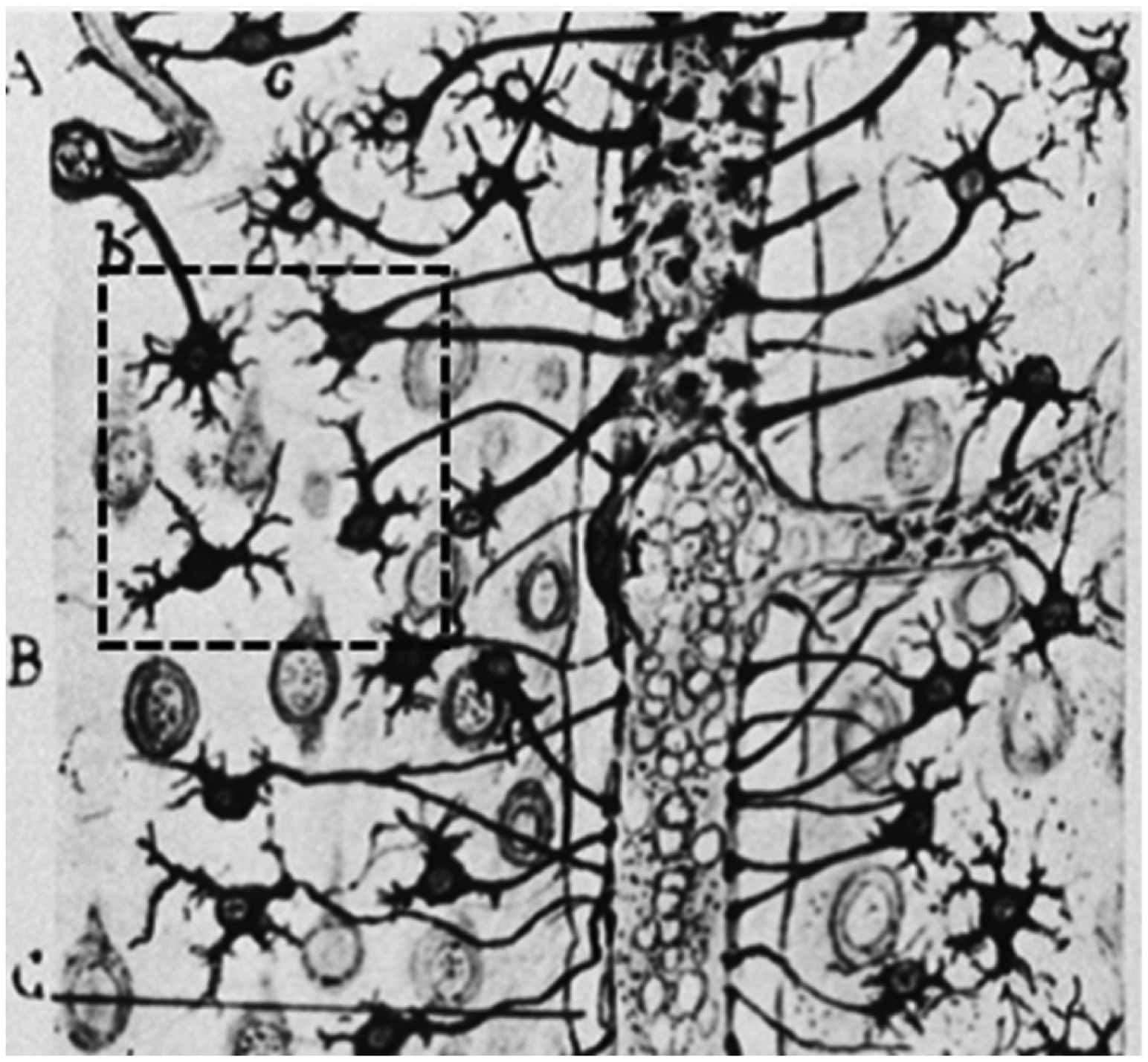
Cajal's illustration of 'discrete neurons' (Ramon y Cajal, 1934). Source: The National Library of Medicine Digital Collection.
Two different ideas were in conflict regarding this question, known as the ‘war of the soup and the spark’ (Valenstein, 2005). The first idea – the ‘soup’ – was mainly promoted by pharmacologists, who argued for the primacy of chemical reactions between neurons. The other – the ‘spark’ – placed a greater emphasis on electrical transmissions than on chemical reactions. This debate was demanding and continued into the late 1950s.
Erlanger was a ‘spark’ researcher who delved deeply into studying various activities of the electrical signals in the nervous system, and Schmitt, as Erlanger’s student, followed this approach. While spark proponents concentrated on the study of electrical signals, advocates of the soup argument looked for chemical elements – which would later be known as neurotransmitters – and their movements between neurons. Amid this debate, Schmitt wrote his dissertation on his observation of the re-entry phenomenon, which showed the bidirectional movement of an electrical signal in a strip of a heart muscle, and graduated in 1927 (Schmitt, 1927).
Three years after earning his PhD, Schmitt returned to Washington University in St. Louis as an assistant professor of zoology. 12 In this period, he began to investigate relations between electrical signals and chemical reactions. Though stressing the role of electrical transmissions, he speculated that both electrical and chemical interactions were crucial in enabling communication between neurons. He thought that Erlanger had been concentrating too much on the spark side, and Schmitt instead tried to raise awareness of the need to study relations between the spark and the soup. From this middle position, Schmitt pursued his research by studying, for instance, the impact of oxidative processes on bioelectrical phenomena in the nerve (at the functional level) or by observing the structure of nerve fibers that influenced the movement of electrical signals and chemical entities (at the structural level). For this, he utilized many instruments, such as an electronic amplifier, cathode ray oscilloscopes, and an electron microscope. In particular, his remarkable proficiency in using X-ray diffractions and electron microscopy earned him considerable attention in the late 1930s.
Schmitt’s research caught the attention of Karl T. Compton, president of MIT and a well-known experimental physicist. From the 1930s, Compton put great effort into transforming MIT from a ‘problem-solver for industry’ into an ‘elite research university’ (Lécuyer, 2010: 75). In the early 1900s, MIT had established its institutional identity in close relationship with burgeoning industrial patrons. This had resulted in the institution focusing more on industrial science than on fundamental science (Leslie, 1994; Servos, 1980). However, with the rise of the Depression, the foundations of many of the university’s industrial patrons were shaken. By problematizing MIT’s close relation with industry, Compton succeeded in becoming president in 1930. He then began emphasizing the need to invigorate the basic and fundamental sciences at MIT.
After becoming president, Compton prioritized ‘education in fundamental principles’ over ‘a mere “technical education”’ (Lécuyer, 2010: 71). In light of this, Charles Norton, an industrial physicist who was then head of the department of physics, was replaced by John Slater, a molecular physicist with a theoretical background (Kaiser, 2010). 13 For biology, Compton sought to ‘bring to that department the study of life science as nearly as possible at the molecular level’ (Schmitt, 1990: 119). Compton was a person who believed that ‘physical laws which formulate the relations of matter and energy in the life-less world also apply to these relations in the world of the living’ (Compton and Bunker, 1939: 8). He hoped the new Department of Biology and Biological Engineering at MIT would break from the old descriptive tradition and incorporate advanced physical approaches. Compton chose Schmitt to lead this department.
In 1941, Schmitt accepted an invitation to lead the new department at MIT (Adelman and Smith, 1998: 346). When he arrived, however, he was surprised to discover that the department occupied a relatively minor position at MIT. He remembered that ‘[MIT] alumni, friends, and visitors continue[d] to express surprise that we offer[ed] undergraduate instructions in biology’. 14 As the department head, Schmitt concentrated his efforts on cultivating the popularity of the biological sciences at MIT. For example, by adjusting the department’s direction in the postwar period, members of the biology faculty tried to embrace the ‘return of physicists and physicians’. 15 They thought that ‘[since] research in … physics and engineering science ha[d] been far promoted during the war, the application of the developed techniques [would] be of great interest in biology and applied biology’. 16 Eventually, in 1955, MIT’s biology department was reorganized in a way that allowed ‘molecular biology [to be] further developed’ (MIT Libraries, 2020).
As a department leader as well as a researcher, Schmitt critically witnessed this growing popularity of molecular biology and biophysics. Though Schmitt himself utilized many physical instruments in his research, he thought that overemphasis on the value of physical approaches and physical instruments would not benefit the field of biology in general. In 1952, when he was still the department chair, Schmitt gave a talk on the ‘situation to which physics has come in its attempt to understand the universe’. He asked, ‘While successful expansion of such lines may lead to great advances in our knowledge of cell physiology and control of disease, does it greatly expand the horizons of biology?’ 17 He wondered whether ‘coherent theoretical biology exists today [even] after 200 years of research’. 18 His concern for theoretical biology resulted from his view on the lopsided development of biological studies. In 1954, he stated that ‘in many phases of biological and medical science, the emphasis during the last half-century has been analytical [which had resulted in] the development of biochemistry and more recently biophysics’. 19
Schmitt cautiously speculated that it might be time to ‘turn … from the analytical aspect of modern biology to a study of organismic biology’.
20
He addressed the value of ‘dealing with the organism as a whole, [while] avoid[ing] fragmentation, and study[ing] properties of the whole organism in relation to its fellow organisms’.
21
When a wide range of biological studies, including organismic biology, came to be integrated, Schmitt thought that this would offer the ‘possibil[ity] for a biological theory or principle to be an enormous influence on civilization’.
22
In his view: There is no reason why such theoretical studies should not be proceeding while the more obvious, analytical investigations based on the physical and chemical properties of partial systems goes on to full fruition. It is the scientists’ chief obligation to be a good (especially an original) scientist, let the chips fall where they may. In my opinion, the biologists may, by the development of the more theoretical, as well as the more obvious, applied research, profoundly influence the human race.
23
Schmitt stated that ‘life science, in spite of the spectacular advances in molecular biology, [was] at a stage comparable to mid-19th-century, classical physics … [because] there [was] yet no a comprehensive and powerful theoretical biology comparable to theoretical physics begotten of the relativity theory and the quantum theory’. 24 A ‘powerful theoretical biology’ was what he ultimately wanted to see. To this end, in his view, a wide range of different biological studies had to be nurtured in a balanced way.
In the 1950s, Schmitt was not the only advocate of more theoretical studies in biology. In 1954, the Biology Council of the Division of Biology and Agriculture was established at the National Academy of Sciences–National Research Council to examine ‘the balance between underdeveloped and overstressed specialties within biology’. 25 At this Council, Schmitt gained a sense of not only the value of gathering different biological researchers but also its difficulties. Including Schmitt, there were 19 prominent biologists from diverse backgrounds – from microbiologists to behavioral scientists – including Paul Weiss from the Rockefeller Institute for Medical Research; Ernst Mayr, an evolutionary biologist from Harvard University; the behavioral scientist Ralph W. Gerard; the plant physiologist David R. Goddard; and Jackson W. Foster, a microbiologist from the University of Texas. 26 Mainly led by Weiss, this Biology Council examined the overall national policy for biology in the US and lasted about four years.
The Council’s main concern was to find a way to nurture biology in a balanced way. At its first meeting, Weiss stressed that ‘biology is narrowing down, not only in a few lines of research techniques but also in research objects. We are needlessly confining ourselves to a very small selection of biological objects.’ 27 The amount of research funding itself was less of a concern. Foster showed ‘a great deal of satisfaction’ with the government’s growing support for the life sciences. 28 Indeed, after World War II, funding for life and health sciences increased rapidly. For example, total funding of the National Institute of Health (NIH) more than tripled, from $8 million in 1947 to $26 million in 1948, and then doubled to $52 million in 1949. In this context, Mayr said that ‘the problem is not that we have too much money, but that it is equally distributed’. 29 The problem that biologists faced in the 1950s was, therefore, its proper distribution among different biological studies. Schmitt added that ‘we have been speaking as though there was an obvious relation between the amount of money and good research. An individual can be spoiled by money. I don’t think you would find research proportional to funds.’ 30
Though all had slightly different ideas on where the balance should be and what direction the future of biology should take, they agreed that ‘we want planning, but planning without enforcement, planning that will compare to the drawing of a map through the wilderness’. 31 By stressing ‘planning without enforcement’, they asserted the need for a bottom-up initiative based on consensus among biologists instead of governmental agencies’ top-down policies. Yet, before talking about biologists’ consensus, it turned out that it was even hard to start a discussion on who biologists were. They struggled to find some common features that would bring all different biologists together under the auspices of biology. Therefore, in 1955, the Council decided to convene the ‘Concepts in Biology’ conference to first figure out who biologists were by clarifying common ‘concepts’ all biologists shared. Twelve biologists attended, some of whom were the participant of the 1954 first meeting like Schmitt, Weiss, and Mayr.
The meeting started on an alarming note: ‘Conceptual maturation has not kept pace with empirical development’ and ‘losing, to a certain extent, [of biologists’] claim to becoming a full-fledged science … with a well-established theoretical basis and statements’. 32 Ernest Caspari, a behavior and developmental geneticist, commented that ‘the biologists themselves, in their organizations and institutions, have a very large number of societies and felt themselves much more closely identified with those societies than they feel themselves as biologists’. 33 The discussion centered on what made ‘biology’ distinctive from other fields like physics and what it meant to do ‘biological’ studies, which led to the question of who the ‘biologists’ were. Ernst Mayr asked ‘what it is we have in common, what makes us biologists’. 34
The participants tried to answer these questions by finding common concepts among biological studies. 35 So, each participant introduced five crucial concepts (and statements) in their fields and figured whether they could find common ground. They divided themselves into three groups – structure, function, history – to sum up those basic statements and concepts. There was also an abortive attempt to define terms, for example, ‘organization’, ‘function’, and ‘order’. However, the question of ‘what is unique to biology’ was not easily settled. Even a simple word, like organization, had multiple definitions depending on the research field. J. N. Spuhler at the University of Michigan questioned ‘whether biology [itself] is too broad as well as the problem of unifying it’. 36 Ralph W. Gerard, the chair of the conference ‘confess[ed] to a certain sense of frustration’, while lamenting, ‘Why are we failing to communicate with each other to that extent?’ 37 The Council, which tried to shape the united biologists’ opinions on national policy of biology, became a place where each biologist found out how diverse biologists were and how difficult it was to find common ground.
For Schmitt, the Council meetings were good ‘opportunit[ies] to conceptualize along lines which perhaps normally we would not be stimulated to do so’. 38 It led Schmitt to think about the possibility of gathering heterogeneous researchers in biology and facilitating communication among them. However, the ‘realistic value of all this business [at this meeting]’ was in question. 39 For him, ‘rather than to strive so hard to make some kind of a sophisticated statement of the content of biology which is defensible, etc., it would be much more important to find out what we think are now the real battle lines in the life sciences.’ 40 Instead of all life sciences, he thought it might be more productive and effective to focus on certain ‘battle lines.’ 41 By focusing on certain ‘battle lines’, Schmitt expected that the balanced development of biology could be realized, which would result in a theoretical breakthrough in biology. In this context, in the late 1950s, Schmitt brought up the brain as the true battle line.
Understanding communication in the brain
In 1955, Schmitt became an institute professor, the highest appointment at MIT, and resigned as department chair. Being an institute professor meant more than an administrative promotion for Schmitt. As he noted the ‘appointment gave me the freedom to carry on my research program in the way I thought best.… I [became] free to engage in new kinds of activities’ (Schmitt, 1990: 186). It was no coincidence that Schmitt began to direct his efforts toward forming a new brain research community after being an institute professor. With this appointment, a ‘whole new phase in [his] professional career’ began as his ‘tour of duty was over’ (ibid.: 187, 213). From the late 1950s, Schmitt set out in a new direction that was more than an extension of his earlier research.
The brain, to Schmitt, was ‘a scientific terra incognita’ (Schmitt, 1990: 201). He recalled that ‘investigation of the highest levels, e.g., the human brain and the behavior it subserves, were of great interest to me but … I had had little experience with the subject’ (ibid.: 207). Although he had studied neurons, most of them were located in a peripheral nerve – not in a central nerve like the brain. Nevertheless, he was quite sure that ‘particularly the brain (the most complex of any system known to science) … it would be necessary to utilize information from many disciplines in addition to my own field’ (Schmitt, 1992: 439). He chose the brain as his next research subject not because he knew much about it, but because few things had been clarified about it. For Schmitt, it seemed to be a good testing ground for bringing different biological studies together. In addition, in the late 1950s, the brain was a new battle line in the spark–soup conflict. When he said a ‘battle line’ in the Council’s meeting, it was more than rhetoric.
In the soup–spark battle of the 1950s, more convincing results supported the primacy of chemical reactions in neuronal communication. The discoveries of neurotransmitters, like acetylcholine and norepinephrine, were influential. In 1952, a famous physiologist, John Eccles, switched from the spark to the soup side (Valenstein, 2005: 129–31). From the mid 1950s, the battle line leaned toward the soup side, which was not exactly a pleasure for Schmitt – though he recognized interactions between chemical and electrical signals. Schmitt was not totally satisfied with the soup-sided researchers’ ideas; even in the 1980s, he speculated the idea of ‘informational substances’ or ‘parasynaptic transmission’ while accepting the role of ‘neurotransmitters’ and ‘synaptic transmission’ (Schmitt, 1990: 331). However, in the 1950s, most of the researchers, including Schmitt, conducted research on peripheral nerves. Central nerves were less studied, as they were difficult to observe, especially those in the brain. Therefore, against the backdrop of this growing popularity of soup side researchers and their peripheral nerve studies, a central nerve came to be a new battle line in the battle. For physiologists, it did not make sense that, at least in the brain, chemical reactions, which were presumably slow, took primary control of the brain’s fast reactions. In the late 1950s, both spark and soup side researchers were reluctant to claim the priority either of chemical or electrical interactions in communication mechanisms in the brain – a ‘scientific terra incognita’ to biologists, as Schmitt said.
Communication was, however, a topic of interest not only in biology but also in mathematics and computer science (Cohen-Cole, 2014; Edwards, 1997; Kline, 2015). From the late 1940s, especially at MIT, a growing group of scholars claimed to have developed a general theory of communication including that for the brain: cyberneticians. Trained mainly as mathematicians, physicists, and electrical engineers, cyberneticians pointed out five key elements of communication: information source, transmitter, channel, receiver, and destination. To them, all the communication mechanisms could be characterized in terms of feedback mechanisms, which had an input and output with continuous feedback loops. The brain was no exception to this explanation. All of human perception, recognition, and cognition was regarded as the result of communication that the brain controlled by responding to inside and outside signals (Galison, 1994; Shannon, 1948; Wiener, 1948). Both in the scholarly literature and in the media, the brain was often depicted as the fastest and most effective feedback control machine (Laurence, 1948; Plumb, 1958). Cyberneticians generalized this idea as ‘information and communication theory’.
Schmitt was in the middle of these endeavors when the MIT campus emerged as one of the birthplaces of cybernetics. Schmitt was aware of emerging ideas of cybernetics and its advocates, including Norbert Wiener as well as Claude E. Shannon. Indeed, Norbert Wiener, the famous cybernetician at MIT, was ‘a close personal friend of [Schmitt]’ (Schmitt, 1990: 207). In 1960, Schmitt, as an organizer of the MIT luncheon seminars, invited Wiener to speak on the ‘fast fundamental transfer processes in aqueous biomolecular systems’. 42 From Schmitt’s perspective, Wiener ‘fill[ed] the blackboard with mathematical equations’ to explain the nature of communication (ibid.). After the lecture, Schmitt sent a letter to Wiener reiterating that it ‘had a very strong impact not only on those of us with a special interest in the field, but also on the students and colleagues in the Boston area generally … [so] it would be highly desirable to make some aspect available to others’. 43 In addition, when Wiener was promoted to institute professor at MIT in 1959, Schmitt sent a congratulatory message, urging him ‘drop-in whenever [he] can’ as ‘there are many things I [Schmitt] would like to discuss with you [Wiener]’. 44 Schmitt himself was a member of the American Society for Cybernetics and received the related information. It is notable that Shannon eventually joined the NRP. 45
Schmitt found the cyberneticians’ theory interesting since it invoked the role of electrical signals in communication processes. However, at the same time, as a biologist, he thought it showed a lack of biological understanding. For instance, when conceptualizing the mechanism of communication between two entities, cyberneticians often assumed that those two entities had the same properties, thus focusing on their signal change. However, in biology, primary entities of communication like proteins and molecules could not be seen as having the same properties. Chemical affinities were known to play a crucial role in the chemical reactions of peripheral nerves. Therefore, he thought that ‘without some way of recognizing and developing the science of information theory at the molecular and atomic level … it seems to me that we are going to fall mighty short.’ 46 Schmitt suspected that without the consideration of the ‘essence of some of the “living” aspects of the organism’, cyberneticians’ theory, especially when it comes to the brain, could not but be insufficient. 47 In this regard, he thought of developing a new, or at least, modified information and communication theory by providing a better biological understanding of the basis of the communication of the brain that would consider dynamic and idiosyncratic biological features and phenomena.
To Schmitt, neither chemical nor electrical nor cybernetic explanations alone could explain the mechanism of communication in the brain. Combining them was important. One of his research notes in 1963 shows how much Schmitt was, on the one hand, affected by language such as ‘transducer’, ‘transmitter’, ‘message’, ‘signaling’, and ‘information’ in interpreting neuronal communication, while, on the other hand, struggled to find a distinctive biological mechanism or basis of communication that would also contribute to discussions of ‘cognition’ or ‘consciousness’.
48
He speculated his ideas with drawings as shown in Figure 2, where Schmitt pondered on how the brain received and processed information and what biological structures sustained this path of fast transfer: Suppose that the molecule of neuronal protein, neuronin, constitutes the ‘personality’ and memory of the neuron by which each neuron type may make its activity felt. It would be a transducer resembling the coherer of a telephone transmitter when activated by the sound waves of the human voice speaking into the transmitter. It would transmit the message of each neuronal type.… In a sense, each neuron which is active in the process is ‘listening in’ to the message of other neurons.… Quite possibly cognition depends upon the mutual listening in – and ‘talking’ – of millions or billions of neurons wired into the ‘silent (!)’ areas of the cortex.… Consciousness or self-awareness may result from a switching-in produced by the elaboration of certain molecular species (biogenic amines?) which mediate current flow through vast cortical areas.
49
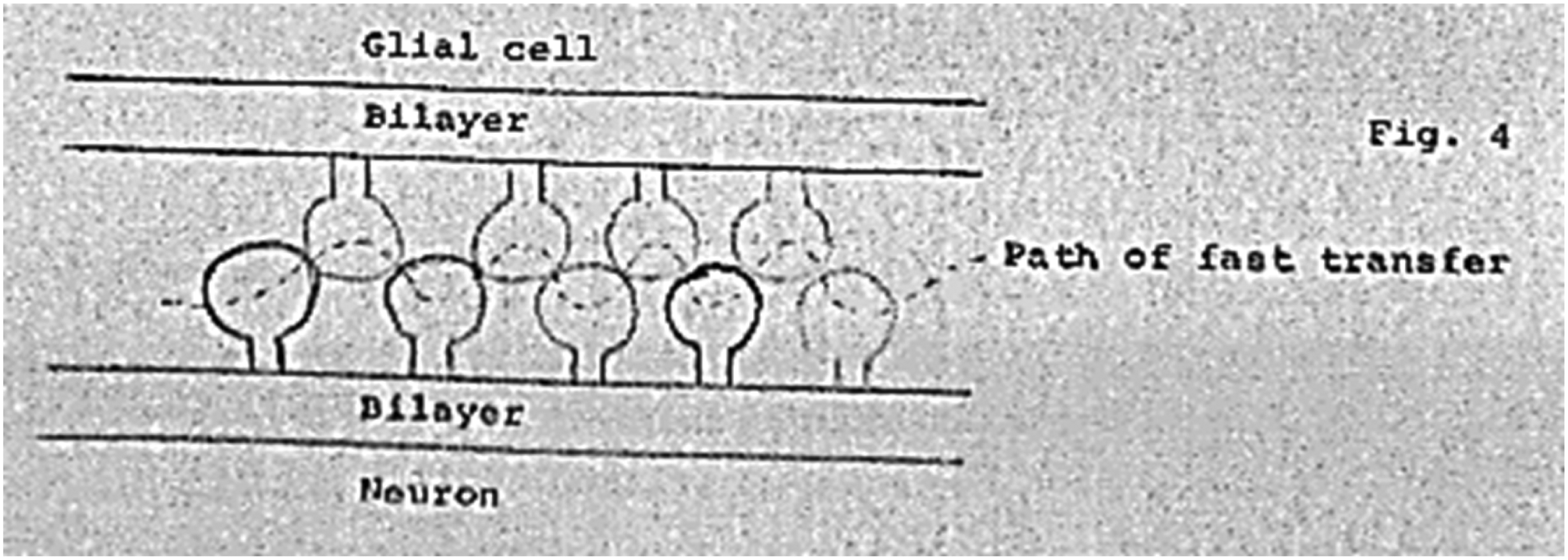
Schmitt's idea of the 'path of fast transfer'. Source: 'Idea Notes', February 22, 1963, MIT Archives.
In short, by revealing a fundamental communication mechanism in the brain, Schmitt hoped to contribute not only to the new battle line in the soup and spark battle but also to improve information and communication theory. To this end, a wide variety of biological studies was needed and welcomed to Schmitt beyond his own expertise. He further expected that this ‘new research in the life science may force a more meaningful definition of words so frequently used by theologians such as ultimate, inner, ground of being, spiritual’. 50 A deeper understanding of communication in the brain would have implications beyond science and technology. Born into a devout Lutheran family, Schmitt was a religious person as he recalled that ‘my life has been characterized by a major professional interest in science, particularly the life sciences, but also in religion and theology as a lay participant in numerous conferences’ (Schmitt, 1992: 438). Studying the brain also had religious significance for Schmitt.
At the First Lutheran Church seminar, he laid out ‘great challenges of modern biology’ that would have significance both in biology and religion. 51 He raised issues like ‘memory, homing, interpersonal communication, psychiatry, telepathy’. 52 What Schmitt highlighted here was the nature of communication between living beings and its relation with such as mind, empathy, memory, and consciousness. While ‘modern biology’ could answer those questions, Schmitt thought that biology could have an impact on the world ‘as much or possibly much more than did the revolutions in physics’. 53 To this end, he thought that science and religion should have a close dialogue. According to him, a ‘meaningful dialogue’ could be realized when ‘attempting to comprehend “ultimate” realities through science … based on man’s limited mental – and perhaps spiritual – capabilities’. 54
Therefore, Schmitt’s choice of the brain as his core project in the late 1950s resulted from both his personal and his professional interest, as a believer as well as a biologist, and a growing societal interest on the nature of communication. The brain stood at the intersection of many peoples’ interests not only from physiologists, pharmacologists, biologists, mathematicians, electrical engineers, computer scientists but also from theologians and the public. According to Schmitt, the 1960s also witnessed that ‘communication often fails between scientists in the same specialties as well as in different disciplines, between scientists and mass media of communication … and between these median and the public’ (Schmitt, 1964). 55 Given this ‘communication crisis’, the brain was considered an area where biologists could suggest that researchers ‘turn to nature for guidance’ (ibid.: 2). In result, the brain caught Schmitt’s attention as the most urgent and greatest challenge in biology that would guide science, religion, and US society in the 1960s.
The brain and the Neurosciences Research Program
In January 1962, during the regular meeting of the National Institute of General Medical Sciences (NIGMS), for which Schmitt served as a committee member, he arranged a meeting to outline his idea for making a new brain science with the launch of the NRP. The attendants included Ernest Allen, the associate director of the NIH (whom Schmitt had already broached his idea), Richard H. Bolt from the National Science Foundation, Orr Reynolds from the Department of Defense (the future head of NASA), and Colonel H. E. Savely from the US Air Force. 56 Schmitt recalled that ‘when [he] started the Neurosciences Research Program, [he] was advised by a leading philanthropist to ‘think big’.… In those days, a large part of the ‘bigness’ was in the form of grants from large federal agencies’ (Schmitt, 1990: 207). In the early 1960s, big science was a widely discussed topic.
The 20th century witnessed an exponential increase in research funding, the number of scientists, the size of laboratories, and the scale of scientific instruments. In 1961, Alvin M. Weinberg, a nuclear physicist, stated that ‘big science is here to stay’ cited the sheer amount of scientific activity (Weinberg, 1961: 161). In Little Science, Big Science, de Solla Price showed statistical evidence drawn from numerical indicators, such as the total number of scientific journals, and noted that ‘the state called Big Science actually mark[ed] the onset of those new conditions that [would] break the tradition of centuries’ (de Solla Price, 1963: 28). From the 1960s, the meanings of big science were intensely debated: whether it would be good or bad for science and for society or, in a more nuanced way, how it would shape the production of scientific community and knowledge (Aronova, 2014; Galison and Hevly, 1992; Hallonsten, 2016).
The launch of the NRP was in the middle of these debates over the desired size and environment for scientific activities. To the founding members of the NRP, Schmitt insisted that the NRP would ‘not [be] an arm of any Government agency, any university, any particular group, certainly not of industry; it is a group of men who have self-organized’. 57 He emphasized that the NRP ‘do[es] not wish to be “programmed”’. 58 In the 1960s, it was not difficult for Schmitt to see examples of programmed policies or initiatives for research projects (i.e., programmed at an intellectual level focusing on a particular goal or at an organizational level operating a hierarchical system). At MIT, researchers in cybernetics and artificial intelligence often carried out large-scale projects shaped by governmental agencies like DARPA (Edwards, 1997; Kline, 2015; Leslie, 1994). At Harvard, the new research community, cognitive science, was formed as the university’s center in 1960 (Cohen-Cole, 2007). In comparison with those initiatives – which to Schmitt looked like an arm of the government agency or university – the NRP hoped to represent a self-organized community of researchers.
This did not mean that the NRP would resist any support from the government and university. What Schmitt wanted was an unprogrammed support and funding for the NRP. It is notable that from the 1960s, researchers witnessed the ‘heyday of congressional support for basic research’ (Appel, 2000: 144). Conceptualized as a research conducted without any specific goals, basic research received increased attention in the US especially after the launch of Sputnik (Marcus and Bix, 2007; Pielke, 2012; Schauz, 2014). The National Science Foundation increased funding for life sciences (basic research) from $1.2 million in 1953 to $41.7 million in 1963. The NIH declared their budget portion of 37.6% used for basic research in 1963 and NASA for 73%. Schmitt launched the NRP in this context of growing attention on the value of basic research. In order for the NRP to cultivate its best value, Schmitt believed that this new community, in the name of neuroscience, should distance itself from the traditional big sciences. 59 The NRP would not be big, but it would be powerful enough with revolutionary discovery.
Thus, at the founding meetings, it was decided to gather no more than 25–30 people as the NRP’s core associate members. They would, however, represent all different fields of studies pertaining to the brain. The fields of interest included: biochemistry, biophysics, chemical physics, developmental neurology, general and comparative neurology, computer science, information theory, mathematics, molecular biology, molecular electronics, instrumentation, neuroanatomy, neurochemistry, neurology, psychiatry, psychology, neuropharmacology, neurophysiology, quantum chemistry, solid state physics, and so on. 60 Figure 3 shows the domain of neurosciences, drawn by Schmitt, consisting of all different levels of behavior, brain, brain cell, organelle, molecule, submolecule as well as the aspects of structural, functional, evolutional, developmental, and modeling. 61 For example, cyberneticians’ research was categorized as a recent behavioral-level modeling area. In this context, the plural term – neurosciences – was coined instead of the singular form – neuroscience – for this new study.
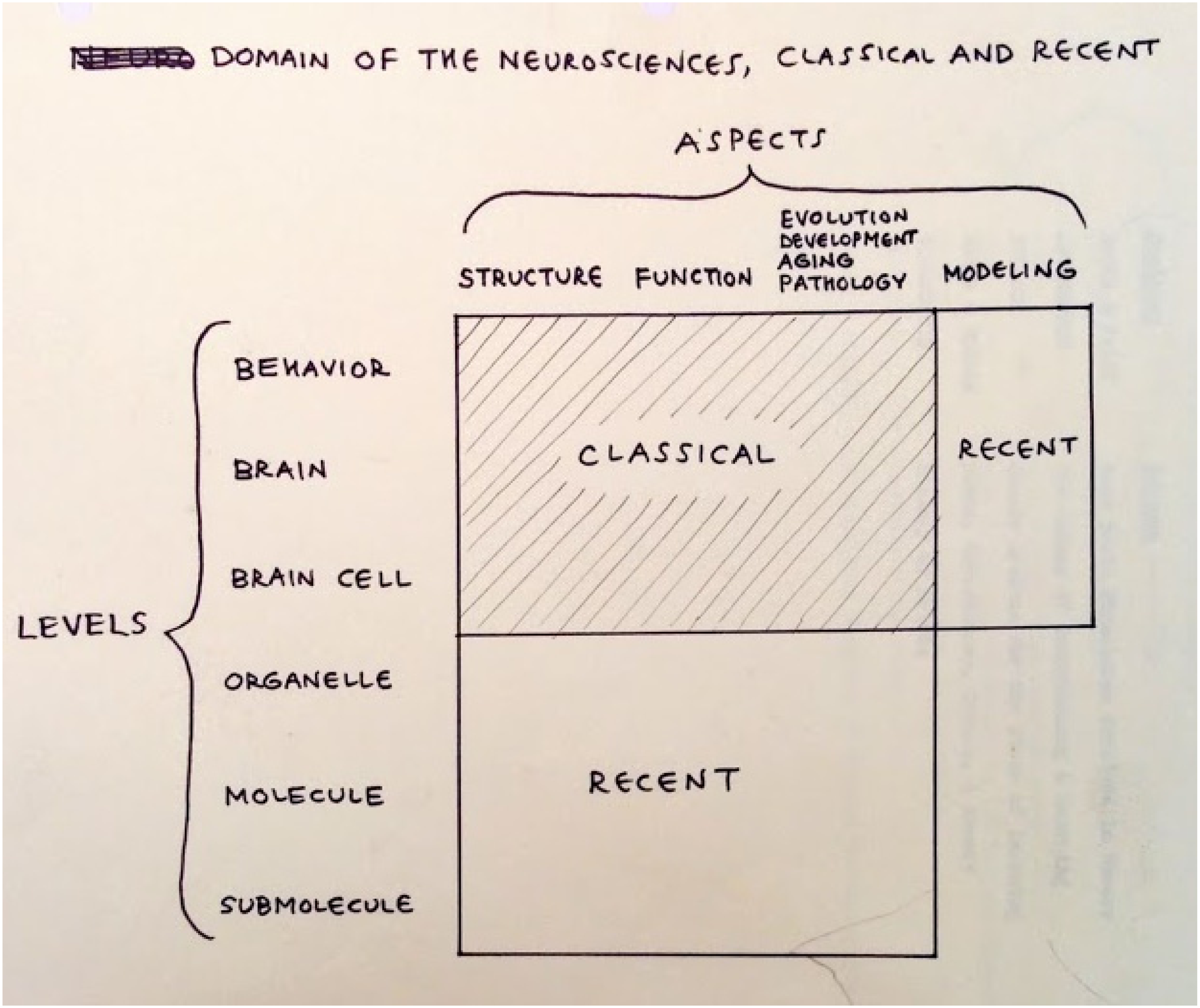
The 'domain of the neurosciences'. Source: [NRP Early History] MENS Project Meeting, 1 February, 1962, MIT Archives.
The NRP would be a ‘new and strange system’ that pursued ‘a new science of human mind’. 62 To arrive at a powerful biological theory, a few but very talented scholars were needed. This idea shaped the way of constraining the number of associates, choosing the right scholars as the associate, and deciding its governing structure and funding mechanism. Schmitt limited the number of main associates to ‘not more than 25’ and the criteria for selection concerned not just a candidate’s research excellence but also the balance of the group. 63 The nominees were discussed at the executive meeting and some candidates were rejected because they did not maintain the balance of the group. For example, a comment like ‘No, one person. We have two electrophysiologists who have an interest in psychology’ was often addressed. 64 Since the NRP consisted of a few scholars, a candidate’s personal characteristics mattered. It was important to choose people who were willing to and able to interact and whose research could be shared. 65 Some could not be nominated because they were considered ‘less flexible’, ‘rigid’, or ‘highly opinionated’. 66
As a result, from 25 universities and 15 different disciplines, about 30 scientists became the core associates for the NRP. Among them were Paul A. Weiss, Humberto Fernández-Morán, John B. Goodenough, Claude E. Shannon, and Robert Galambos. Sponsored by MIT, the NRP’s headquarters was located on the third floor of the House of the American Academy of Arts and Science in Cambridge. In March 1962, Schmitt submitted the grant application to the NIH. The application highlighted a need to solve the ‘dichotomous development’ in studying the brain and received an initial grant for five years. 67
In the grant application, the NRP clearly stated its ‘emphasis of the non-profit aspect’ and expressed a desire to ‘avoid [any] tendencies to divert the program because of potentially profitable technical or scientific advances’. 68 Despite the imaginable clinical application of brain science and its possible profitability, the NRP’s ultimate goal was more of theoretical development in brain science. The priority was ‘to spend money not to make it’. 69 In relation to patents, Schmitt argued that ‘patenting of results would be the kiss of death to our work’. 70 This attitude precluded close cooperation with either government or industry. To achieve such independence, the NRP founding members formed their private corporation and drafted incorporation papers. The NRP wanted ‘freedom of inquiry to be absolutely free, nonprofit operation’. 71 Only then would it be possible for theoretical considerations to be nurtured for brain science.
In this context, when Leroy G. Augenstein, an associate member, raised the possibility of getting NASA to fund the NRP, Schmitt hesitated, fearing that NASA would be involved in competition with Russia. At the executive meeting, Schmitt mentioned that ‘[he was] told that “the bright guys” in Russia are wondering about the mind’. 72 Schmitt used to save news clippings about Russia’s use of mind control as a weapon in the Cold War. Worried about possible attempts to direct brain research in a negative way, Schmitt thought that ‘the absolute weapon [would] not [be] a missile or other hardware but the mind’ whose studies would ‘be capable of creating still more dreadful weapons’. 73 There was concern that NASA could develop another form of big science that rallied researchers to compete with Russia in the making of a mind weapon. Based on concerns with NASA’s direction, the NRP decided not to apply for NASA funding in that first year. The NRP sought for studying the brain, ‘under the aegis of no one ([even] such as MIT or Harvard)’ instead of being ‘programmed’ by certain goals, ideas, or money. 74
Nevertheless, they were able to find supporters and run their program thanks to a particularly favorable situation for basic research in the US. The pilot funding of the NRP was derived from the NIGMS, newly created at the NIH in 1962. The NIGMS has been seen as ‘indicative of the new public significance given to basic research at the NIH’ (Appel, 2000: 141). Before the launch of NIGMS, the NIH categorized and funded researches according to particular diseases like cancer, allergy, and mental diseases (Cantor, 2008; Harden, 1986; Park, 2008; Pickren and Schneider, 2005). The NIH’s disease-oriented system symbolized its way of valuing biological research in relation to clinical implications. However, in the late 1950s, by establishing the division of General Medical Sciences, which embraced a wide range of research that did not fall into the NIH’s disease categories, the NIH decided to expand its interest toward non-clinical research. The NRP, which aimed to create a new community, neuroscience, was regarded as basic research that could be supported by NIGMS. In other words, the NRP was able to be materialized in this social and institutional setting that was conducive to basic research in the US.
Launched in 1962, the NRP aimed to ‘resemble the highly developed brain … [the way] the brain codes, stores, and reads out what it learns’ (Schmitt, 1964: 15). It meant that the NRP was to be the central information receiver, synthesizer, and provider in brain science. To play a role as a receiver, the NRP first encouraged its members to share their materials to the NRP library. Though there was some opposition as it might burden a scholar, in the end, the NRP library was built as a symbol of the NRP’s emphasis on communication. 75 In addition, to perform as the synthesizer, the NRP held two or three days of Work Sessions, which were followed by the Intensive Study Programs. The NRP’s work sessions, organized every other month, aimed to facilitate interdisciplinary dialogue by proposing a topic to be addressed across the disciplines. The topics were chosen in advance by the associates members as shown in Figure 4. 76 The criteria for selecting the topic included: ‘Was there an opportunity to promote communication between scientists who were not, but who should have been, talking to each other about such subjects?; Was the research area bogged down in conflicting data and/or conceptual problems that might have been clarified by getting experts to work on them collectively?; Did the topic fit in with the NRP’s goal of balancing its program across the molecular, cellular, neural, and behavioral levels of the organization of the nervous system?’
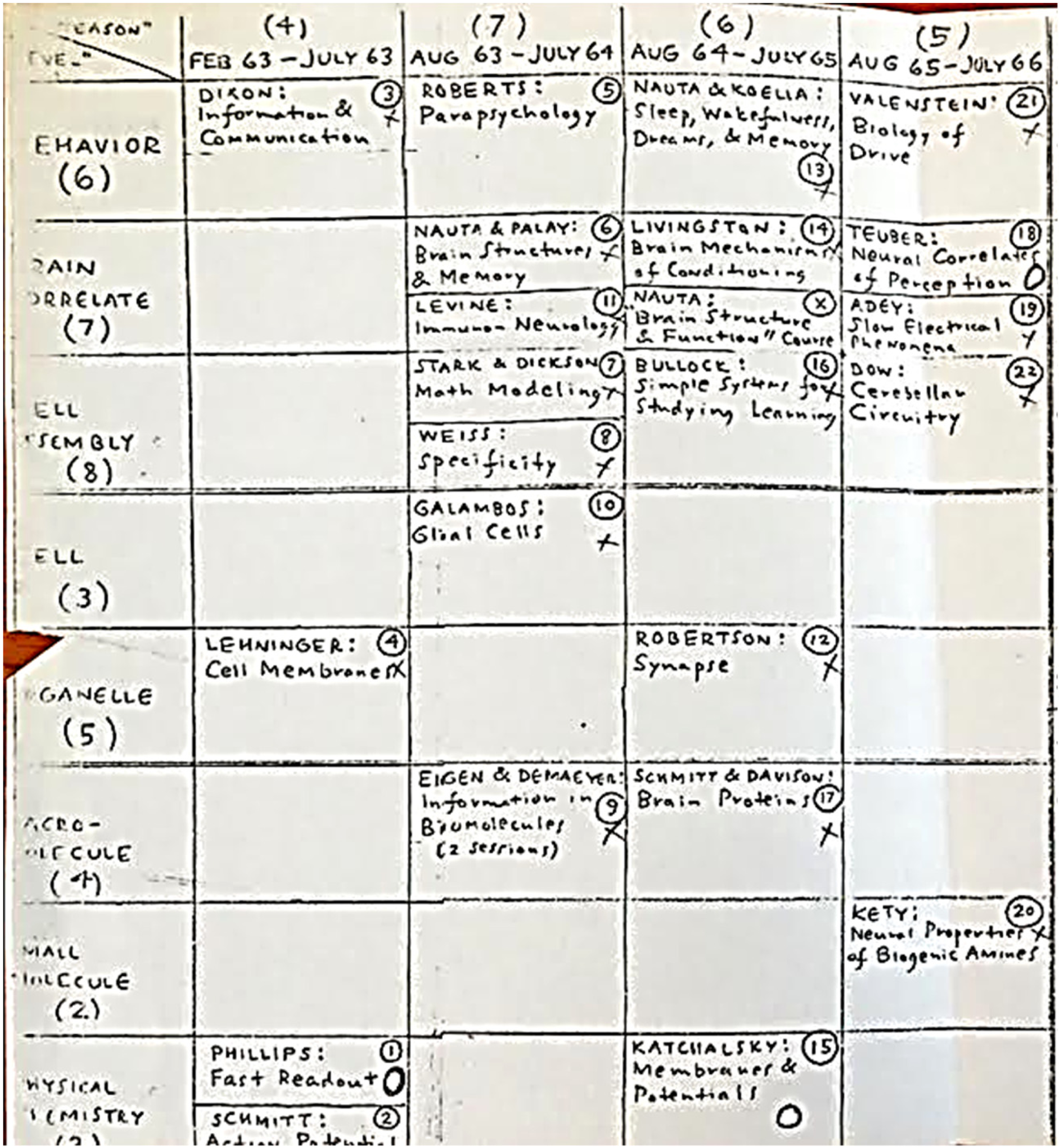
An example of the plan for the NRP's Work Sessions (1962). Source: 'The Plan of Work Sessions', MIT Archives.
After the Work Sessions, there was a month-long Intensive Study Program, to which a number of select participants were invited to promote deeper interaction. This was the site of efforts to ‘not only to retrieve many bits of information but also to interpret them from many points of view and even to integrate them into a consistent map’. 77 By doing so, the NRP hoped to perform the ‘brain’s evaluative and integrative functions’ (Schmitt, 1964: 15). Like the brain, which selectively chose and processed valuable information, the Intensive Study Program aimed to integrate interdisciplinary dialogue at NRP. All the results of interactions and integrations were published in the newsletter, the NRP Bulletin, and Intensive Study Program Books. Thereby, the NRP hoped to be the provider of brain science. Ultimately, the NRP aspired to be the brain of brain researchers in the name of neuroscience.
In the 1970s, Schmitt went on world tours to disseminate the work of the NRP and recruit eminent researchers to become associates or speak at meetings. His world tour, however, did not mean that Schmitt wanted to facilitate a wide-ranging international collaboration. He put more focus on finding a few original ideas outside the US to include them in the NRP discussions. Described as a ‘small, closed circles of scientific men’, the NRP carefully drew an intellectual and social boundary for the new brain science (Marshall et al., 1996: 303). 78 Nevertheless, it became a seed of the formation of the Society for Neuroscience (SfN), now the world’s largest academic society for neuroscientists. Having praised the NRP for ‘laying the foundation [and] bringing the field to the point with [this] Society would be possible’, the SfN was formed in 1969 while maintaining a continuity with the NRP by keeping the new term, neurosciences (Braslow, Meldrum, and Selya, 2014: 7). 79 Though the SfN decided to use its singular form to ‘denot[e] a single, unified field’ (ibid.: 15), they made it clear that the value of diversity fostered in the NRP would be continuously nurtured, affirming the ‘vision of neuroscience as a synthetic science field’ (ibid.: 22). How to manage and maintain this vision and the diversity in neuroscience remained to be the problem of the next generation of neuroscientists.
Conclusion
In 2017, Science released a series of articles in a special section entitled ‘Neuroscience: In Search of New Concepts’, which aimed to draw attention to the lack of conceptual coherence and theoretical breakthroughs in contemporary neuroscience. The neuroscientist Yves Frégnac stated that ‘the search for a unified theory … remain[ed] at a rudimentary stage for the brain sciences’, lamenting that neuroscientists had focused only on creating massive amounts of empirical data (Frégnac, 2017: 471). In 2018, a special symposium was held, entitled ‘Big Theory Versus Big Data’, sponsored by the Max Planck Society and the Cognitive Neuroscience Society. The symposium raised the question of whether ‘the colossal datasets [neuroscientists] now enjoy [would] solve the questions we seek to answer, or … we need more “big theory” to provide the necessary intellectual infrastructure’ (‘Big Theory Versus Big Data’, n.d.). While raising this need for theoretical concerns in neuroscience, however, few remembered that the beginning of neuroscience had stemmed from a desire to develop a revolutionary theory of the brain, which influenced the way the NRP was designed and shaped. As this article has shown, in light of the rise of information theory, the changing frontline of the soup and spark war, and the dominance of molecular biology, Schmitt sought to mobilize various eminent scholars in the name of neuroscience and establish a new revolutionary biological theory of the brain. It is time to remember this history and ask what brought about this theoretical concern in the 1960s in neuroscience, and also how it gave way to other practices or emphases in neuroscience in the late 20th century.
The emergence of a new community of ‘neuroscientists’ reflected a renewed attention and interest in the brain that had legitimated the mobilization of new economic and social resources for it. From the 1950s, the brain – and especially its communication mechanisms – received attention in the US from many researchers, including physiologists, pharmacologists, mathematicians, and computer scientists. For physiologists and pharmacologists, the brain was a new battle line in their soup–spark battle in the late 1950s. Given the growing evidence for the primacy of chemical reactions between neurons in a peripheral nerve, a central nerve came to the fore. For mathematicians and computer scientists, the brain was regarded as an effective and efficient entity for communication and control. Understanding communication in the brain was thus a common interest of many researchers in the US from the late 1950s. It was no coincidence that the NRP was established in this period at MIT. For Schmitt, who was a spark-sided biologist and a devout Lutheran, studying the brain allowed him to challenge the growing influence of soup-sided researchers, question cyberneticians’ general information theory, and even deepen understanding of some theological concepts. These multifaceted potential and contingent implications of brain research were what underpinned the launch of the new research community in the 1960s. To understand the beginning of the NRP is to understand the meaning of the brain to researchers in the 1960s. In addition, a particularly favorable funding situation for basic research in the early 1960s in the US enabled and supported the establishment of the NRP. It was amid this particular intellectual, economic, and political situation in the 1960s US that the new community of ‘neuroscientists’ began to take shape, with the term still used today to refer to the modern study of the brain.
By historically situating the launch of the NRP, this article has moved beyond the dominant narrative on the triumph of molecularization of the brain at the beginning of neuroscience. What brought researchers together in the name of neuroscience was not just a molecule. In the late 20th century, the molecularization of the brain was certainly a phenomenon. Yet, it was a phenomenon that resulted from the way neuroscience evolved in subsequent years, rather than its predominant cause. The transformation of neuroscience in the late 20th century would require further in-depth study. As this article has highlighted, a tension over the molecularization and computerization of the brain characterized the beginning of interdisciplinary gathering at the NRP. With the goal of nurturing theoretical discussions of the brain, the NRP deliberately gathered multiple research areas, perspectives, and areas of expertise. This affected the way the NRP organized itself: its members, programs, and activities. Thereby, the NRP ultimately aspired to be the brain of brain researchers: the receiver, synthesizer, and provider in brain science. Whether this ideal vision of neuroscience was realized or changed needs further study, but it is clear that the interdisciplinarity of neuroscience was not accidental but carefully designed and embedded in the field from the beginning. It embodied the specific desires and concerns of researchers at the intellectual and institutional levels, cultivated by the surrounding environment in the US. Using the case of NRP, this article has highlighted the locality of interdisciplinarity in neuroscience and the need for further study of its plasticity in various countries to capture distinctive desires and concerns in modern brain science. 80
Footnotes
Declaration of conflicting interests
The author declared no potential conflicts of interest with respect to the research, authorship, and/or publication of this article.
Funding
The author disclosed receipt of the following financial support for the research, authorship, and/or publication of this article: This work was supported by the National Research Foundation of Korea (grant no. 2020S1A5B5A16082494).
