







Abstract
This article analyzes the historical emergence of a decidedly cinematic approach to social-scientific experimentation: The shift from a model of inquiry in which film serves as a tool to record kinetic events generated under experimental conditions to one in which experimental situations are arranged and filmed narratively to maximize their demonstrative power. This evolution becomes starkly visible when one compares the pioneering use of film by Wolfgang Köhler in his studies of chimpanzee intelligence on the eve of World War I with the techniques that his protégé and colleague Kurt Lewin would adopt in the 1920s and refine in the 1930s. By the time Lewin produced his famous motion picture of democratic and authoritarian “group atmospheres,” and in active dialogue with developments in avant-garde filmmaking, an unabashedly cinematic mode of social-scientific inquiry had become acceptable. This mode of inquiry aligned the production of laboratory events with codes of documentary filmmaking recognizable to mass audiences, so as to speak more directly to those audiences’ political stances. The article draws on this history to reflect on the revelatory power of modes of experimentation that establish a genuine relationship with the medium in which they seek to make social phenomena manifest.
Movement as an experimental heuristic
Film and other motion-recording technologies played a marginal role in the emergence of the social sciences, but they often catalyzed new experimental approaches to the problems the social sciences purported to tackle. This is most evident in the case of psychology, the first social science to develop an explicitly experimental program—or, rather, the first discipline to attempt a full experimentalization of the social. As psychologists pursued the idea that genuine social phenomena could be generated under controlled conditions, film became a crucial means of attesting to the reality and demonstrative power of the events unfolding within the laboratory.
The significance of film for the field is that, at its core, experimental psychology had a kinetic understanding of reality and of its manipulation, as motion was typically the key outcome of an experimental intervention and the crucial measure of its effect. The first psychological laboratories borrowed their notion of experimentation from the then fashionable science of physiology, and were set up to provoke and register telltale displacements in human and animal bodies, from minute changes in the diameter of the pupil to variations in the geometry of animal locomotion (Danziger, 1983, 1994; see also Cartwright, 1992; Curtis, 2015; Schmidgen, 2011). The ability to observe behavior “under controlled conditions,” or to conduct investigations of human affairs “in an experimental manner,” often meant, above all else, the power to direct and document the movement of bodies.
This kinetic understanding of reality established a dialectic relationship between the scope of experimental inquiry and the technical means of motion recording. New capabilities to register movement redefined what sort of kinetic effects were granted analytical significance, and the question of what constituted a meaningful experiment became inextricably linked to the affordances (and limitations) of different motion-recording technologies. Specifically, and most relevantly for this article, the evolution of psychology towards modes of experimentation that allowed the manifestation of distinctively social phenomena ran in parallel with the progressive adoption of film as a crucial component of the research apparatus (Blatter, 2015; Schultz-Figueroa, 2023).
This article explores this evolution through an examination of the cinematographic work of Wolfgang Köhler (1887–1967) and Kurt Lewin (1890–1947), two pioneers in the experimentalization of the social who also advanced the use of film as a research tool. Köhler and Lewin are both crucial figures in 20th-century psychology, and each is associated with an influential and highly idiosyncratic paradigm of scientific inquiry. Köhler is best known as one of the founding fathers of Gestalt psychology, and as the author of an ambitious program of investigation into the correlation of physical and psychological processes (Ash, 1998). Lewin, who early in his career was often described as a Gestaltist by virtue of his close affiliation with Köhler and the Psychological Institute in Berlin, would go on to formulate a powerful vision of a thoroughly experimental social science capable of operationalizing the key political questions of the time (Binder, 2023; Marrow, 1977).
Yet in addition to their distinguished individual careers, Köhler and Lewin can also be seen as contributors to the development of a unified experimental system. This system was predicated on a far-reaching kinetic heuristic: the notion that patterns of locomotion generated in experimental settings could reveal genotypic qualities of the moving actor—originally, individuals; eventually, and more consequentially, groups. This orientation towards the revelatory power of collective kinesis led Köhler and Lewin to adopt film as research tool and means of public demonstration.
Köhler used film to document the studies of chimpanzee intelligence that he conducted during his stint as director of the Anthropoid Research Station of the Royal Prussian Academy of Sciences on the island of Tenerife. The research Köhler conducted there is a canonical piece of early 20th-century primatology, and a dramatic example of the use of film to record and decipher experimental situations. In these investigations, Köhler uses movement in physical space to discriminate between merely instinctive and truly intelligent or “insightful” chimpanzee behavior. In this context, film became for Köhler a crucial device for visualizing qualitatively different forms of animal intelligence, and possibly the emergence among chimpanzees of a distinctively collective mode of problem-solving.
Lewin continued and expanded Köhler's kinetic understanding of reality and its filmmaking implications, first during his stint as a Privatdozent at the Psychological Institute and, after his migration to the United States in 1933, as a refugee scientist applying experimental psychology to the defense of the liberal-democratic order. Throughout this period, Lewin integrated film ever more deeply into his investigations of the psychological “field,” and by the time he conducted his famous studies on democratic and authoritarian “social climates” or “group atmospheres,” the camera had become the definitive observer of experimental situations. Not only did he arrange laboratory events for the benefit of a cinematographic eye, but he demonstrated the crucial conclusion of his study—the superiority of democracy over autocracy—in the medium of cinema.
The trajectory of social-scientific filmmaking linking Köhler and Lewin thus reveals the transition from tool to medium of creative expression; that is, from the use of a particular research instrument to document social phenomena to the invention of formats of investigation capable of manifesting certain qualities of social life in a manner that would be persuasive, or at least recognizable, to a mass audience.
Insight in motion
The book Wolfgang Köhler wrote about his experiments in Tenerife, Intelligenzprüfungen an Menschenaffen (translated into English in 1925 as The Mentality of Apes), contains seven photographic plates (Köhler, 1921b). These depict chimpanzees engaged in some of Köhler's intelligence tests—stacking crates to reach a high-hanging fruit, connecting rods to pull food towards their cage, etc. The published images are often retouched to accentuate the profile of an ape or to sharpen the contrast between an object and its background.
At least one of those images, however, the last in the series, is not a photograph but a film frame. The plate (Figure 1) shows a group of four chimpanzees reaching for a banana that hangs from a wire over their heads. One of the chimpanzees, Grande, stands on two precariously stacked crates, and stretches its arms towards the piece of fruit. A second chimpanzee, Sultan, appears to be supporting the crate on which Grande stands. A third companion, Konsul, is raising its arms, gesturing “vividly … at the moment of highest tension” (Köhler, 1921b: 121), while a fourth ape squats nearby, pressing a hand to its mouth.
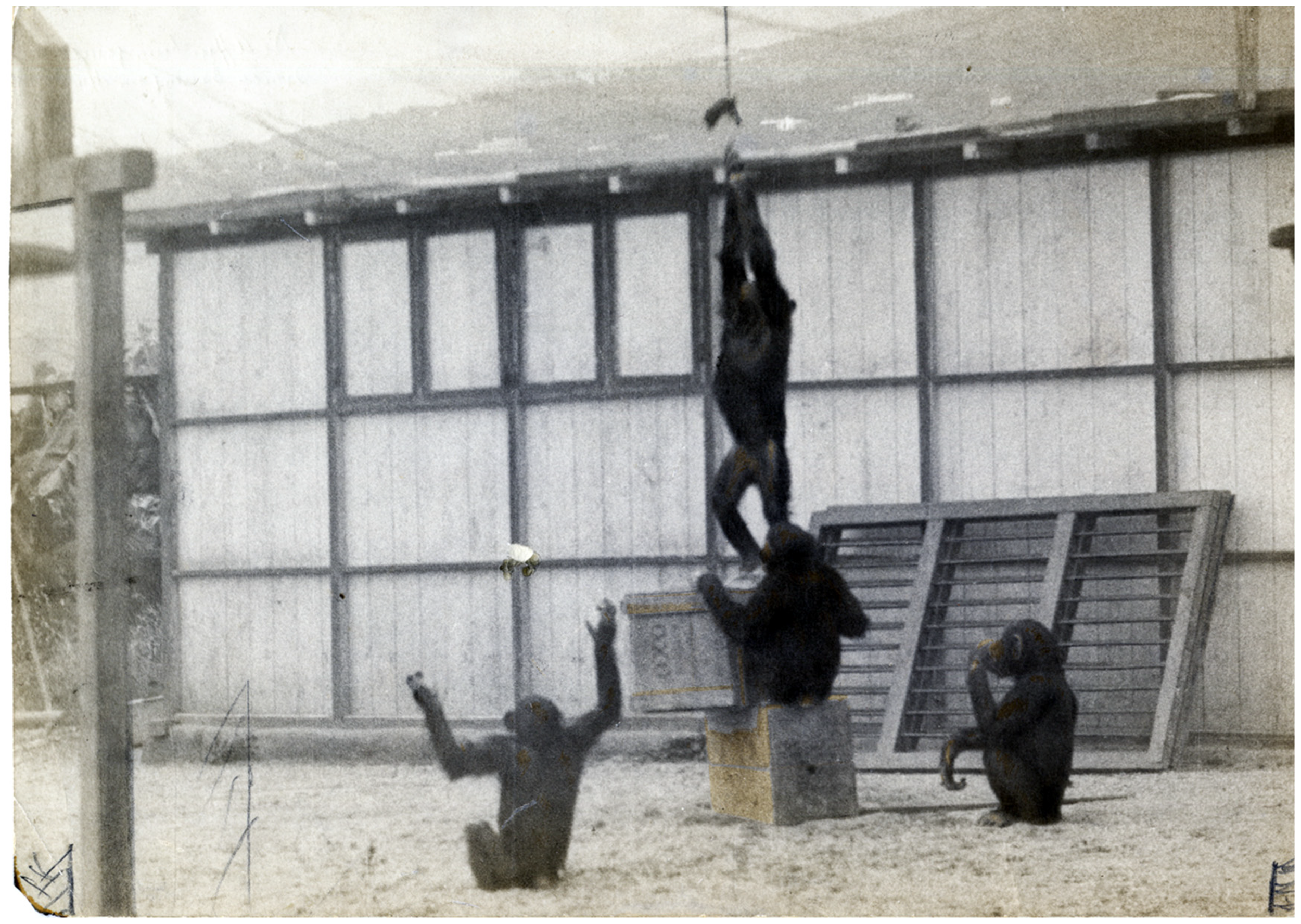
“The Apes in collective building (from the book)” [“Die Affen beim gemeinsamen Bauen (aus dem Buch).”]
The image serves to illustrate a crucial but ambiguous passage in Köhler's text. After demonstrating the ability of chimpanzees to display insightful individual behavior, Köhler faced, seemingly unexpectedly, the question of whether they could also act collectively in a manner that suggested intelligent cooperative action. The plate captures the culmination of one of Köhler's experimental runs, that “moment of highest tension” when the small structure built by the chimpanzees holds together just long enough to allow Grande to reach the target. Is this an example of chimpanzees acting as a unified group, Köhler wonders, or are we witnessing a mere aggregation of independent individual behaviors?
The presence of a film frame at this juncture in the book raises a number of questions. Not only why would Köhler use film—an expensive and cumbersome technology of scientific observation at the time—to document the experiment, but, more intriguingly, what was unfolding at this precise moment in his investigations that he thought a film frame could capture better than a still photograph?
When it started operations in 1913, the Anthropoid Research Station of the Royal Prussian Academy of Sciences was one of the most advanced ethological field stations in the world. The facility, created to allow observation of apes under climatic conditions similar to those of their natural habitats, was built around a large “playground” covered with wire netting and designed to give the chimpanzees “the greatest possible freedom of movement.” Next to the playground stood the “ape house,” where eight chimpanzees were kept, and a small research laboratory that housed sophisticated visual and audio recording equipment (Rothmann and Teuber, 1915: 1–20). 1
The station's first Director, Eugen Teuber, made ample use of the photographic equipment. The images he and his wife Rose shot in Tenerife tend to show him in close interaction with the chimpanzees, trying (in his own words) to “familiarize” the animals with the researchers and their research apparatuses. Teuber's intention was to closely observe and record the chimpanzees’ gestural language, including their vocalizations, in order to identify emotions and gauge their intelligence in interactive contexts. Photographic and filmic records were expected to create a visual record of the animals’ expressions. “Of particular importance,” Teuber wrote in his research plan, “is the observation of expressive movements [Ausdrucksbewegungen], both facial ones (happiness, sorrow, affection, jealousy, hatred, etc.), and those of arms and hands.” 2
When Wolfgang Köhler arrived as new director of the station in December 1913, he introduced a radically new approach to the question of animal intelligence. Rather than focusing on the chimpanzees’ expressions or gestural language, Köhler would try to clarify the extent of their intelligence by placing them in experimental situations that shared a key design feature: in all of them, the most linear route to a desirable object—typically food—was blocked or unavailable, forcing the chimpanzee to discover a “detour” or “roundabout way” [Umweg] to the goal. In these tests, Köhler argued, the chimpanzee was confronted with problems “which, in place of the biologically-determined way, necessitate a complicated geometry of movement towards the objective” (Köhler, 1925: 11). If they were able to trace this more circuitous and less impulsive trajectory, the animals would be displaying an intelligent understanding of the situation.
There were times, however, when the chimpanzee found the way to the solution/reward after a series of repetitive and essentially blind trial-and-error efforts. Köhler described this as “a successful chance solution” (Zufallserfolg) driven by a purely instinctive reaction and characterized by a fragmented kinetic pattern. A successful chance solution consists of an agglomeration of separate movements which start, finish, start again, remain independent of one another in direction and speed, and only in a geometrical summation start at the starting point, and finish at the objective. (Köhler, 1925: 17)
In contrast, a completion of the task denoting intelligence came to the chimpanzee as a flash of “insight” and left a distinctive spatial and temporal trace. “The genuine achievement [echte Leistung] takes place as a single continuous occurrence, a unity, as it were, in space as well as in time; in our example as one continuous run without a second's stop, right up to the objective” (Köhler, 1925: 16–17; Figure 2). Instinctive behavior, in other words, moved in straight lines and reached its object (if at all) in a halting, syncopated fashion. Intelligent or insightful behavior, on the other hand, traced a different and highly characteristic (and, to Köhler, more elegant) pattern. “No one could mistake the difference in the two kinds of movements” (Köhler, 1925: 17).
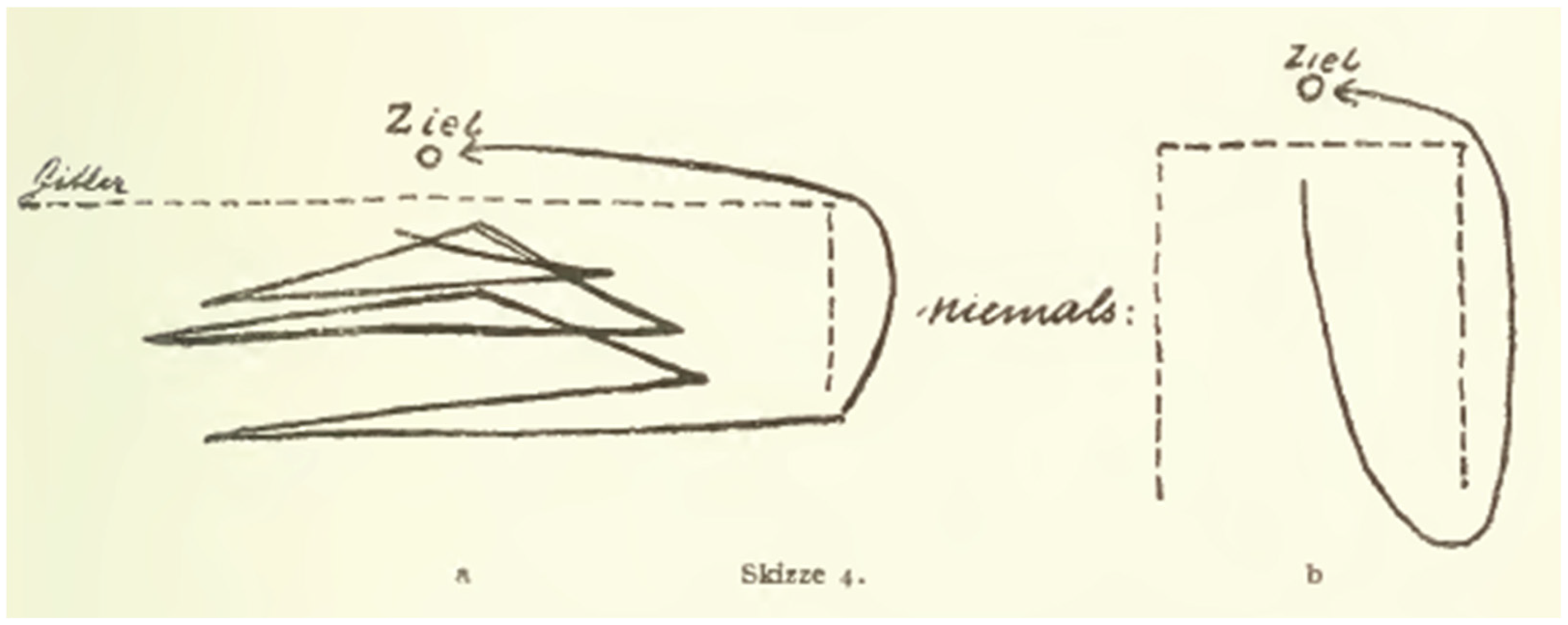
Different movement patterns in the solving of experimental tests (Ziel = goal). Left: “successful chance solution”; right: “genuine achievement.”
Köhler's kinetic heuristic had wide-ranging implications. Firstly, it sidestepped altogether the question of language—or, more specifically, the ability to use symbols—as the hallmark of intelligent behavior. Köhler's experimental approach displaced the locus of investigation from the face-to-face interaction of researcher and research subject—Teuber's original focus—to the independent display by the latter of patterns of movement that could allow an external observer to discriminate between truly insightful and merely instinctive behavior. 3
Second, for a detour experiment to truly test the cognitive capabilities of the chimpanzee, it was necessary for the animal to be able to “survey” (überschauen) the experimental situation as a whole. Chimpanzees, Köhler noted, should be able to see the “situational value” of every element of the experimental setting, for only then would they have a chance to display intelligent behavior by identifying the circuitous solution to the problem at hand. Köhler was critical of intelligence testing methods that confined animals in secluded spaces and only allowed them to observe one end of the experimental apparatus—the ropes and levers of the classic “puzzle boxes,” for instance. For the same reason, he also rejected the tendency of psychologists to place animals in mazes “over the whole of which there is no general survey from any point inside” (Köhler, 1925: 18). 4
Köhler understood the surveyability or legibility of an experimental situation in strictly visual terms. The chimpanzee, he argued, was “the slave of its own optic field”; its intellectual capacities were restricted to the visual clues afforded by its most immediate physical surroundings. Still, by comparison to the methods of animal intelligence testing then in vogue, Köhler's emphasis on the need to allow a shared vision of the experimental setting implied a new kind of collusion between researcher and research subject in the creation of evidence. As Mitchell Ash pointed out, Köhler's approach transformed “the experimenter–subject relation [into] a partnership for the production of ‘good’ phenomena” (Ash, 1998: 160). This partnership required, if not cooperation, at least a degree of “sympathy” (Schultz-Figueroa, 2023) on the part of the researcher towards the researched animal, in order to design an experimental situation that would allow the latter to reveal its true potential. 5
Finally, Köhler's epistemology of the detour accorded the motion picture camera a crucial function in the experimental set-up. It generated a visual record of the trajectory of movement displayed by chimpanzees while in pursuit of their goals, allowing repeat observation and analysis. By shifting the focus towards animal locomotion, Köhler was adapting his research question—intelligence—to the capabilities of his most advanced research apparatus: the motion picture camera. And, by using film as the key form of evidence, he was aligning his investigations with some of the most cutting-edge work in German science at the time (Curtis, 2015). The footage Köhler shot in Tenerife would be essential in persuading scientific audiences of the reality of the phenomena he had observed in Tenerife, in particular of those “genuine achievements” that challenged entrenched assumptions about the limits of non-human primate intelligence. 6
Köhler produced at least five short films during his stay in Tenerife (Kalkofen, 1975). Each film lasts a couple of minutes at most and depicts chimpanzees completing a task. In all cases, the cinematograph is positioned within the station's playground or immediately behind the wire net. Generally, the structure of the task serves to organize the cinematic scene, with the piece of fruit, for instance, providing the centering device for the camera. In one of the short films, Köhler appears briefly, showing the chimpanzees a banana before hanging it from the roof of their playground. There is no record of how the chimpanzees responded to the presence of the camera, but in the surviving footage they show no interest in the film-recording equipment.
In notes meant to explain the content of the five films, Köhler reveals that they do not depict the first successful attempt made by the chimpanzees but rather a rehearsal of tasks with which the animals were by then already familiar. “The reason for this,” he argues, is of a thoroughly practical nature. The first execution of such an action tends to occur suddenly, often after a long period of perplexity [Ratlosigkeit] or behavior of little interest, in a fortunate moment. If one wanted to record the behavior of the animals in new situations, it would be necessary to use an enormous quantity of film material before arriving to the unpredictable point in time when a few minutes of interesting behavior finally appear.
7
Köhler is clear about the economics of scientific filmmaking and the constraints it imposed on the design of experimental situations. “In order to minimize costs,” he noted elsewhere, “one should not make recordings of completely uninfluenced animal behavior, but rather under predetermined conditions that would steer their conduct with some predictability in the desired direction” (Köhler, 1921a: 81–82). Yet even if the footage depicts operations that the chimpanzees had successfully accomplished before, in the completion of these tasks they still produce the pattern of movement characteristic of a “genuine achievement.” That is, despite the lack of spontaneity, Köhler argues, the chimpanzees are displaying the kinetic clues of insightful behavior, and this was the essential object of the film recording. “There is enough to watch in these cases” (Köhler, n.d.: 1).
The last of these five short films is the source of the photographic plate that illustrates the crate-stacking experiment in Intelligenzprüfungen. The footage shows the four chimpanzees scrambling crates until they build a structure stable enough to allow Grande to climb on it and reach the banana. Despite its brevity and graininess, the film retains all its power. One is struck by the apparent coordination of the chimpanzees’ actions, a collective choreography that reaches its climax as Grande grabs the piece of fruit and Konsul raises its arms in what seems, to the untrained eye, a gesture of celebration. This impression of coordination is enhanced by the rapid assembly of the crates: the progression of the chimpanzees’ constructive effort, combined with the convergence of their bodies around the newly built structure, creates a strong semblance of cooperation. 8
In his discussion of the scene, however, Köhler cautions against precisely this interpretation. We should not “read too much,” he warns, into the peculiar pattern of collective movement displayed here by the chimpanzees. “Sometimes the behavior of the animals strongly resembles collaboration in the strictly human sense, without, however, entirely carrying conviction” (Köhler, 1925: 175). In particular, “[we] must not suppose that this ‘collective building’ represents any systematic collaboration, with any strict division of labor among individuals” (p. 172). The caption that accompanies the image in the English-language version of the book hints at this subtle—but, to Köhler, crucial—distinction: “Building altogether [sic] (but not in common).” 9
The crux of the matter, for Köhler, is that the chimpanzees—and particularly Sultan, which he considered the most intelligent of the lot—are incapable of altruistic behavior, which makes truly collaborative or cooperative behavior impossible. The apparent coordination of movements is simply a reflection of the animals’ innate empathy, he argues; the seemingly supportive movements of Sultan and Konsul merely express “the compelling urge that seems to overwhelm the chimpanzee who is a spectator” (Köhler, 1925: 174), not their partaking in a genuinely collaborative effort.
Regardless of the persuasiveness of this argument, there is in this passage an unusual eagerness in Köhler's voice. It is as if the cinematograph had revealed a form of behavior—or rather, a pattern of collective kinesis—strongly but misleadingly suggestive of collaborative group action, and he felt obligated to rein in this reading. For the first time in the book, the text attempts to challenge or at least qualify the visual record: Köhler's extended analysis of the scene is meant to neutralize the strikingly powerful impression of collaborative group behavior that the film recording—and the film frame that accompanies the text—conveys.
In addressing the question of whether the crate-stacking experiment had revealed authentic cooperation or merely individuals acting “altogether,” Köhler was exploring wholly new terrain. For what this question effectively required was a full-blown typology of collective states, which Köhler was unequipped to tackle, let alone clarify experimentally. At the time, mainstream experimental psychology was interested in the ability of individual animals to establish associations between stimuli, response behaviors, and the resulting pain or pleasure (Thorndike's 1898 book Animal Intelligence was subtitled An Experimental Study of the Associative Process in Animals). In his crate-stacking experiments, Köhler was after an entirely different and far more elusive form of associationism: the nature of the links that chimpanzees establish among themselves in pursuit of a goal. The specific quality, in other words, of the collective that emerged in response to a task.
The use of film at this particular juncture in Köhler's investigations suggests that he thought the question might have a kinetic answer; one that could be obtained by discriminating between different patterns of collective locomotion in the same way that movement allowed him to draw a sharp distinction of form between insightful and merely instinctive individual behavior. Köhler's hesitation to “read too much” into the visual record implies, however, that this heuristic of movement had reached here a limit. The opposition of straight line and roundabout way might have been sufficient to characterize different kinds of individual action, but no such clear geometric binary existed to separate group cooperation from a mere aggregation of selfish or impulsive behaviors. The pattern of collective kinesis captured by the motion picture—a faint visual echo of which remains in the film frame he used to illustrate this section of the book—seemed to hold the key to this problem, yet Köhler appeared unsure of how to decipher its meaning.
Expressive movement and field theory
Köhler left Tenerife in 1920, after being stranded on the island for the duration of the war. Upon his return to Germany, he was appointed professor of philosophy and director of the Psychological Institute at the University of Berlin, then a leading center of psychological research in the German-speaking world. Köhler continued to lecture on animal intelligence well into the 1930s, and he often accompanied his lectures with projections of the footage shot in Tenerife, but he would never again use film (or apes) in his investigations.
The Psychological Institute would, however, provide a hospitable home for the further development of film recording in experimental situations, particularly in the hands of Köhler's protégé Kurt Lewin. Appointed Privatdozent at the institute in 1921, Lewin would advance over the following decade a research program driven by two interrelated goals: a dynamic theory of personality that incorporated a holistic understanding of the individual's environment, and an effort to ground that theory in a formal characterization of space. Both elements would come together in Lewin's “field theory,” a program of inquiry that sought to account for changes in the direction of behavior by reference to the constitution of the individual's psychological environment or “life space” (Lebensraum). 10
Throughout his work in the 1920s, Lewin understood the psychological life space as an energy field constituted by a set of forces or “vectors” linking the individual to different objects. An object in this approach is any entity, material or ideational, that is psychologically present to the individual at any given moment in time. Every such object is affectively charged, carrying a positive or negative “valence” for the individual in question. The attractive or repulsive power that an object exerts over the individual can be described in terms of that individual's psychic movement towards or away from it, and that movement has a visible correlate in the motion or orientation of the individual's body.
Lewin's notion of the “field,” or the “total field,” expanded Köhler's epistemology of the detour beyond the binary of straight line and circumvention. The spatial geometry of movement is still the key heuristic, but Lewin emphasizes the strictly topological (mathematical) dimension of space, in contrast to Köhler's fundamentally physical approach. Furthermore, what movement discloses here is not an actor's cognitive or intellectual capacities—Lewin bypasses the question of intelligence or “insight” altogether—but rather the changing configuration of the individual's life space, and the effect of that configuration on the directionality of behavior. Finally, Lewin elaborates his concept of motion with reference to the kinetic qualities of children at play in natural settings, rather than the movement of chimpanzees in enclosed experimental sites (cf. Martin, 2003: 17–18).
It is obvious why a theory that centers on the identification of “vectors” and that does away with any internalized causal factor in favor of a spatial analysis of observed behavior would lend itself to cinematic translation. Even though Lewin was adamant that his understanding of space was topological, and did not refer to movement in physical space (for the definitive formulation of this position, see Lewin, 1936), his development of field theory runs parallel to the growing use of film-recording in his investigations (van Elteren and Lück, 1990). From the mid-1920s onwards, Lewin's lecture notes and several of his publications include extensive filmic material. 11 In fact, many graphic representations of key Lewinian concepts, such as “vector” or “valence,” seem to have required the mediation of the photographic image, typically a film frame (Figure 3). Thus, as the decade progressed, Lewin's descriptions become increasingly limited to what was directly visible to him—by which, he often means a motion picture camera. Cognitive, motivational, or introspective processes—in fact, any event not immediately apparent in the filmic record of an observation—disappear from the analytical repertoire and are replaced by an exclusive attention to the lines of displacement produced by a human body in motion. “I cannot see any other but a mystical meaning to find a motivation process ‘behind’ the field” (Lewin, 1933: 319).
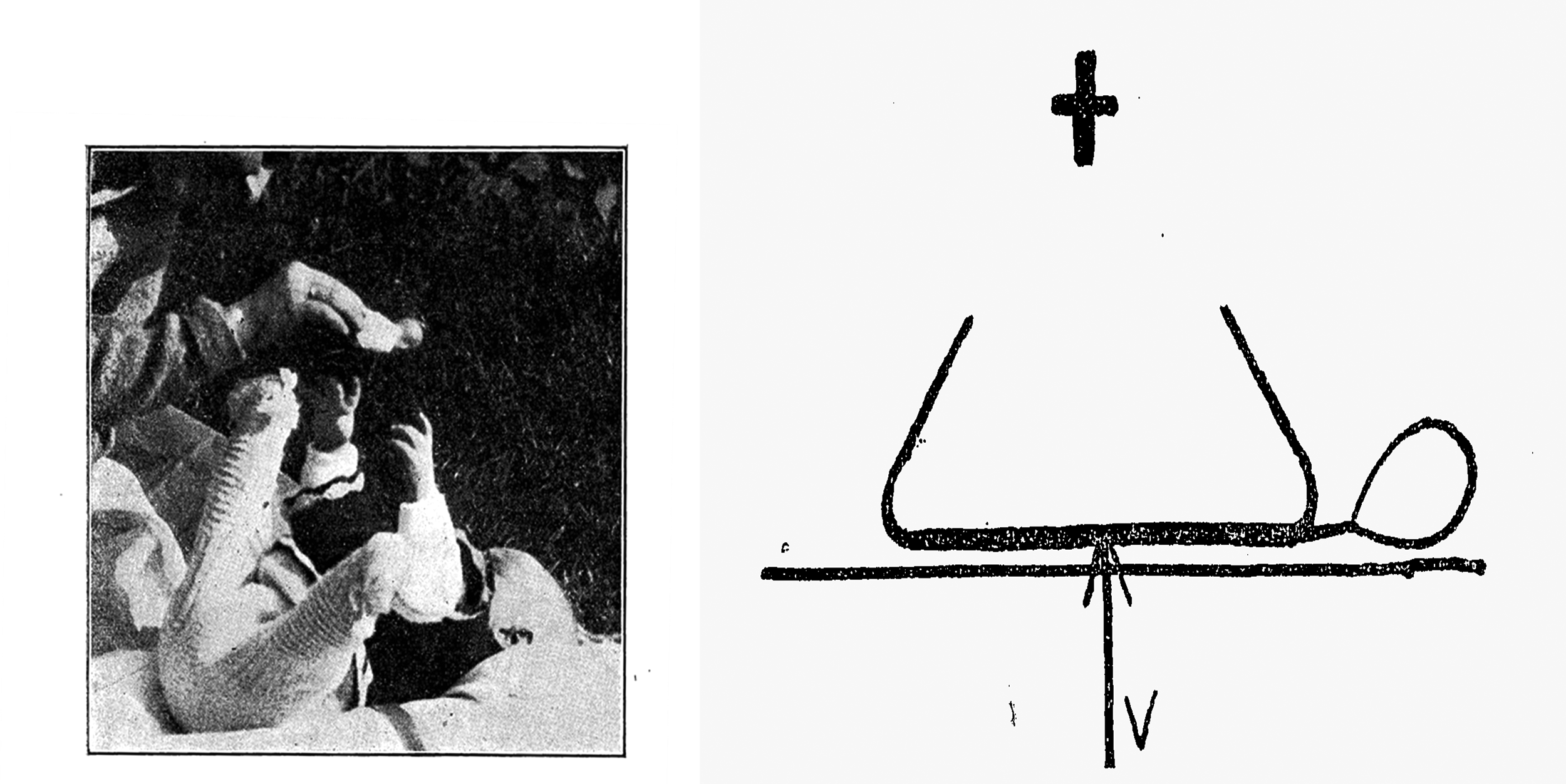
Kurt Lewin: Direction of a positive valence. “A six-month-old infant stretches arms, legs, and head toward a rattle or a spoonful of porridge in accordance with the direction of the vector (V).” Left: film frame; right: topological representation.
Most of the footage Lewin shot in Berlin depicts toddlers and children, in some cases members of his extended family, in everyday domestic situations. Often they experience small intrusions or changes in their surroundings—the appearance of a toy, the entrance or exit of a parent, etc. With the help of a frame-by-frame analysis, Lewin then analyzes small changes in gestures or expressions—his term of choice is Ausdrucksbewegung, or “expressive movement”—and uses these minute displacements to decipher shifts in the individual's life space (Figure 4).
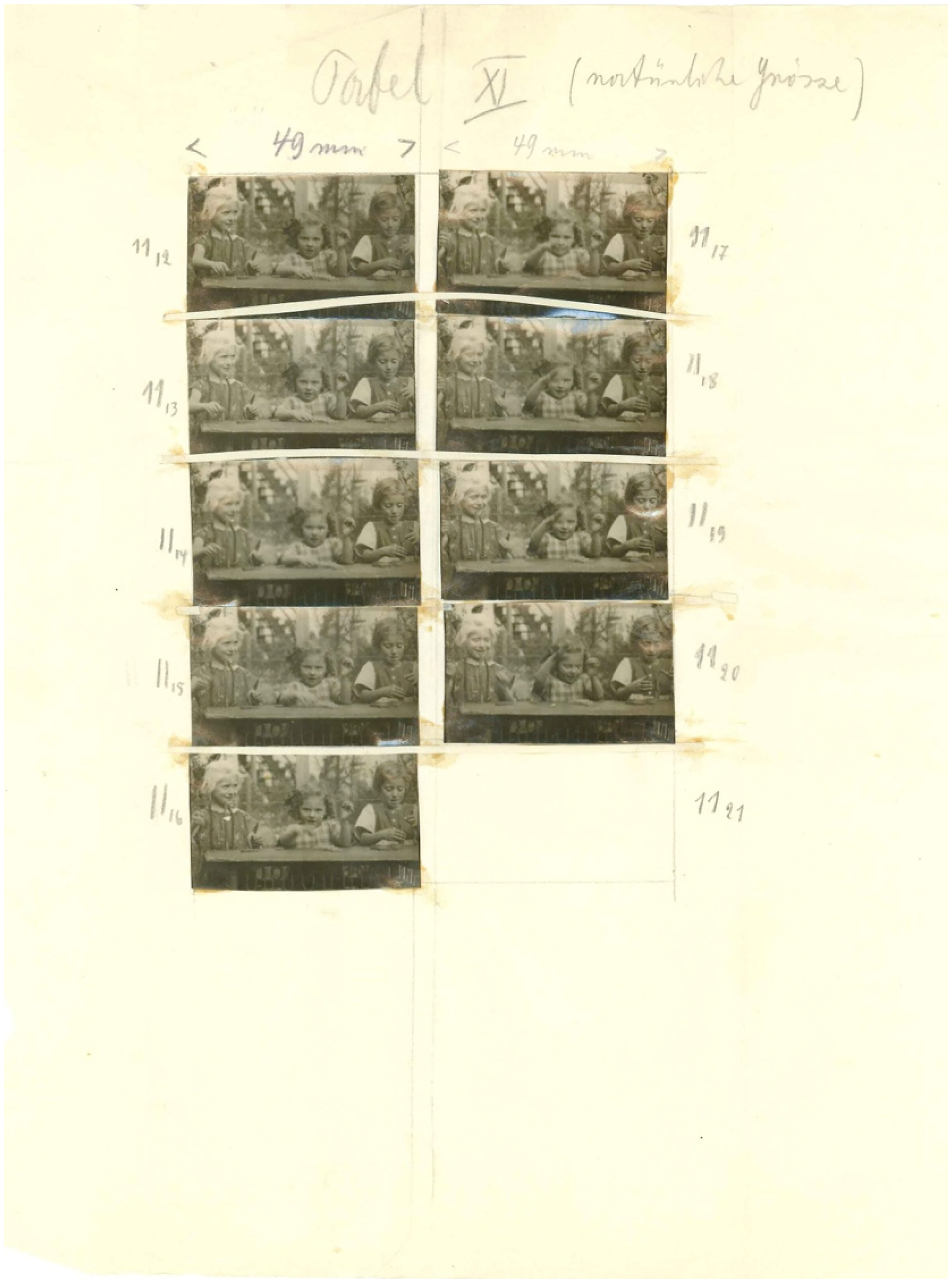
Film footage (“Verlauf eines Erschreckens” [Progression of a fright]) used by Lewin in “Kindliche Ausdrucksbewegungen” (1927).
What Lewin develops in these frame-by-frame studies is effectively a chronophotography of the psychological state of the individual, as expressed in the posture, gestures, and outward bodily disposition of the filmed subject. These observable kinetic events are the key to deciphering the always-evolving constitution of the individual's life space. “We don’t ask here about the ‘meaning’ of an expression,” Lewin writes in 1927, nor about its adequacy or inadequacy as “sign” or “symbol” of something that is being “expressed” in it. Rather, we consider the expression a psychophysical event like any other, and ask about the forces and factors in the total field that might have led to such an occurrence. (Lewin, 1927: 503)
12
In his cinematographic investigations, Lewin used a large 35 mm camera, property of the Psychological Institute. The limited maneuverability of this piece of equipment imposed significant constraints on the scope of empirical observation. The impossibility of transporting the camera without disrupting the recording, for instance, meant that the events had to unfold within locations that could be easily surveyed by a static observer. “The scene must play itself within a specific place, which ought to be well covered by the film apparatus” (Lewin, 1926: 419). And since the camera could only record continuously for about 6 minutes, “the experiment should have been arranged so as to allow the desired events to unfold within this time” (p. 419).
In addition to the professional recording equipment, in the second half of the decade Lewin began to use a hand-held 16 mm Kinamo camera—probably, a spring-driven Ica, the device that ushered in the era of “home movies” and amateur filmmaking (Kuball, 1980). The Kinamo allowed him to move and change position vis-à-vis the experimental scene as it unfolded, capturing multiple perspectives of the psychological field under observation as well as “unpredicted events, occurring in unexpected locations” (Lewin, 1926: 420).
As the range of technical motion-recording options expanded, so did the intended purposes of Lewin's filmmaking (Van Elteren, 1992). In his article “The Filming of Instinctive and Affective Expressions of Psychopathic Children” (Lewin, 1926: 414), Lewin emphasizes the value of film as both an instrument of “demonstration”—that is, a means of relaying experimental observations to others—and as a “foundation for some research problems.” In other words, film recordings not only served as a convincing visual record of what the researcher had observed in situ, but could also generate new theories about the dynamic evolution of the psychological field. 13
The power of film to articulate the key tenets of field theory became particularly evident to Lewin during his first visit to the United States. In September 1929, he travelled to New Haven to attend the Ninth International Congress of Psychology, where he delivered (in German) a lecture on “The Influence of Environmental Forces.” Lewin accompanied his presentation with the projection of two short films. The first one showed an 18-month-old girl, Hanna, attempting to sit on a stone without taking her eyes off it. Attracted by the positive valence of the stone, Lewin theorizes, Hannah is unable to take the detour (turning away from the stone first and approaching it backwards) that would allow her to sit on it. In the second film, a boy of similar age, Hans, accomplishes the same task without breaking his line of sight, by backing up against the stone while watching it between his legs.
Despite their brevity, the two films seem to have had a powerful effect on Lewin's audience in New Haven, and on the reception of his work in the United States more generally. Gordon Allport, who was present at the congress, noted how “to some American psychologists [Lewin's] ingenious film was decisive in forcing a revision of their own theories of the nature of intelligent behavior and of learning” (Allport, 1947: 8). Lev Vygotsky, also an attendee at Lewin's presentation, remarked that the motion pictures constituted a “demonstration” of the fact that the child was “bound in every action by situational constraints” (Vygotsky, 1978[1933]: 96).
By the time Lewin delivered his presentation in New Haven, innovative uses of film to elucidate experimental observations had become common in psychology; indeed, several of these innovations were showcased at the Yale congress. Lewin's session included a communication by Arnold Gesell, of the Yale Psycho-Clinic, on the use of “systematic photography” and “cinema analysis” in experimental investigations. 14 Another participant at the congress, Charlotte Bühler, would go on to develop an influential program of scientific filmmaking at the University of Vienna after visiting Gesell's laboratory-cum-studio at Yale. For Gesell, Bühler, and other experimentalists, film was a key technology for the study of child psychology—or rather, for the articulation of new psychological theories via controlled experimentation with children. 15
The growing sophistication of scientific filmmaking evident in this period placed a greater directorial burden on the researcher, and in this respect, the range of stylistic influences on Lewin's cinematography was particularly broad. Around this time, he started a correspondence with Sergei Eisenstein, the Soviet film theorist and director. Both had been introduced to one another by Alexander Luria, who had drawn Eisenstein's attention to Lewin's success in experimentally inducing circular movement in children (which Luria compared to the work he and Eisenstein were just then carrying out on the spiraling movement of individuals caught in hypnotic states). Lewin's films, Luria wrote to Eisenstein, would “strongly fortify your conjectures” (Luria, 1929, as cited in Bulgakowa, 1992: 163). 16
Eisenstein met Lewin when the Soviet director visited Berlin in November 1929 to deliver a lecture at the Institute of Psychoanalysis on the topic of Ausdrucksbewegung. As we have seen, this term was also central to Lewin's understanding of the relationship between physical and psychological changes, but it carried different connotations for each author. For Lewin, expressive movement described the motion that results from a clash of conflicting psychological forces, while Eisenstein's main interest was the role that deliberately constructed movement can play in triggering certain emotional or affective states. In his Berlin lecture, expressive movement refers to the power of the actor's movement to cause specific emotional reactions in the viewer—a power that in theatre hinges on the biomechanics of actorial motion, but that in cinema is mediated by composition and montage. Where Eisenstein's and Lewin's ideas intersected is in the fact that, for Eisenstein, an expressive movement, specifically that displayed by the actor on stage, is itself the result of a conflict between reflex and inhibition (Eisenstein, 1988b[1924]: 52). This idea had an easy translation into Lewin's field theory. What Eisenstein saw as the dialectical “collision” of contraries leading to an emotive change of expression (Eisenstein, 1988a[1929]), Lewin saw as a tension between different “field forces” or “vectors” resulting in visible changes in the direction of behavior (cf. Löffler, 2015: 209–218). In the correspondence that followed their meeting in Berlin, Lewin emphasized this affinity. “Of course,” Lewin wrote to Eisenstein in December 1929, “I have thought very long about your lecture. As you know, your theory of expression is to me more important than those of all psychologists.” 17
Lewin's fascination with Eisenstein's work signals his evolution towards a more explicitly cinematic approach to the production and postproduction of scientific film—and, very possibly, his growing interest in the power of montage to activate audience reactions. Furthermore, the Soviet Union provided Lewin with clear examples of a fruitful exchange between psychological theory and avant-garde cinema. Not only were film theorists and directors—Eisenstein in particular—borrowing ideas from contemporary psychology to reconceptualize sensory perception, emotional expression, and audience response, but Soviet avant-garde filmmakers were employing their skills in crafting visual representations of psychological theories for mass audience consumption; notably, in Pudovkin's film Mechanics of the Brain (1926), a cinematic synthesis of Pavlov's reflexology (Olenina, 2019). 18
Lewin's interest in using film to educate the lay public in the core tenets of field theory is evident in the 1931 movie Das Kind und die Welt (The Child and the World), the most complex and intriguing cinematographic production of Lewin's Berlin years. Shot on 35 mm film with synchronized sound, this hour-long motion picture describes the evolution of the “life space” of children from birth to 8 years of age. Most of the footage was shot in and around Berlin and includes long sequences of children playing in the courtyards of working-class tenement houses (van Elteren and Lück, 1990). 19
On the occasion of its first projection at the Hamburg Urania Theatre in February 1932, the psychologist William Stern noted the power of the film to bring to life Lewin's highly theoretical concepts (Stern, 1987[1932]). Yet, even if Das Kind und die Welt gave cinematic form to several of Lewin's key concepts, it is clear that Lewin was operating here as part of a larger filmmaking effort, which ultimately he did not direct or control. Some of the footage is clearly Lewin's (the young girl shown walking up and down steps, for instance, is Karin Köhler, Wolfgang Köhler's daughter), but other material seems at odds with Lewin's outlook. In particular, a final sequence showing older children marching in formation recalls the propaganda films of the era and has no correlate in Lewin's research output. Notably, the film was produced under the “artistic direction” of Eberhard Frowein, a prolific producer and screenwriter during the Weimar era who would go on to write the script for the 1941 Nazi film Ich klage an (I Accuse).
Das Kind und die Welt was shown in theatres due to its “cultural importance,” and it conforms to the conventions of the documentary Kulturfilm of the period. The film seeks to immerse the viewer in the everyday world of children, capturing them “in their natural environment” (Van Elteren, 1992: 603) with the help of a hidden or disguised camera. In pursuit of this effect of naturalistic immersion, Das Kind und Die Welt employs filmic strategies that are alien to Lewin's theoretical orientation. Most strikingly, the camera adopts at times the position and viewpoint of the child, to show the confining narrowness of the newborn's perceptual field and its progressive expansion as the child grows in age. In Lewin's terms, this amounted to placing the camera (and through the camera, the spectator) within the life space being represented, whereas in past and future films, Lewin always used the camera as an instrument to survey the experimental situation as a whole, thus placing the viewer outside the field under observation.
Regardless of its unstable admixture of theoretical exposition and illusionistic realism, Lewin's participation in Das Kind und die Welt proves his eagerness to make field theory visually accessible to general, nonspecialist audiences. As Helmut Lück notes, “towards the end of his Berlin period Lewin was able to present basic aspects of his field theory in a convincing visual form” (Lück, 1987: 401). Crucially, the peculiarly kinetic quality of Lewin's understanding of the psychological life space was now coupled with the use of the motion picture camera as the ultimate observer (Reichert, 2009). The further evolution of this mode of inquiry would be shaped by the urgent political circumstances that Lewin confronted in the 1930s.
Filming democracy in America
Lewin left Germany in 1933, a few months after the Nazi seizure of power. “I cannot imagine,” he wrote to Köhler, “how a Jew is supposed to live a life in Germany at the present time that does justice to even the most primitive demands of truthfulness” (Lewin, 1986[1933]: 46). “[E]ven though it will tear my life apart,” he continued, “I hope you will understand and approve of my attempt to find a place for me and my children where we can live an honorable life” (p. 47).
On his trip to the United States, Lewin took with him much of the footage he had shot in Berlin—about 50 reels of film altogether. His first academic appointment in the United States, a temporary position at Cornell University, afforded him the opportunity to continue his burgeoning cinematographic career. In collaboration with his émigré colleague Tamara Dembo and Cornell’s Home Economics Professor Ethel Waring, Lewin produced several films documenting the eating behavior of children. These films, now lost, featured situations where children were encouraged to change their eating habits under different forms of external influence or “social pressure” (a topic that Lewin would revisit in the early 1940s as part of his war-time research for the National Research Council's Committee on Food Habits). 20
In 1935, Lewin joined the faculty of the Child Welfare Research Station at the University of Iowa, in Iowa City. Over the following decade, the station would provide Lewin with a stable academic home and with an ideal platform to further his filmmaking career. A leading institution in the field of child psychology, the station was deeply immersed in contemporary debates over pedagogical method and education reform. Its characteristic intellectual approach, which Gordon Allport described as “situationist” (see Pandora, 1997: 107), staked out a middle ground between the biological and culturalist ends of the disciplinary spectrum, emphasizing the impact of environmental modifications on the cognitive capacities and developmental potential of children (Cravens, 1993). Significantly, the station also hosted a thriving program of photographic and film recording. 21
In Iowa, Lewin quickly shifted the focus of his research towards the experimental observation and manipulation of groups, a field of scholarship that he would later systematize under the rubric of “group dynamics” (Ash, 1992). For Lewin, the desire to turn groups into viable objects of experimentation was intimately connected to the role he hoped the social sciences would play in the defense of the liberal-democratic order. As fascism and anti-Semitism spread in Europe and in his adoptive country, Lewin's research came to focus squarely on the “experimental clarification,” as he put it, of the conditions that supported the flourishing of pluralistic and democratic social orders. The face-to-face group and, particularly, the small “club” of children engaged in constructive play became the model system with which he sought to elucidate the relationship between patterns of interpersonal exchange and the crystallization of different political forms. By extending field-theoretical constructs to the observation of small collectives, Lewin was seeking “to miniaturize the social and ideological issues of the time so that they could be experimented with” (Graumann, 1986: 92). He was also returning, in a roundabout way, to the question that bedeviled Köhler in Tenerife: how to elucidate the nature of social bonds within a group from a careful analysis of its pattern of movement. It was in relation to these questions that Lewin's cinematic ambitions achieved their maximum expression. 22
The most significant and best known piece of work of Lewin's Iowa period is the series of studies that he and his student Ronald Lippitt conducted between 1936 and 1939 on the creation and modification of “social climates” or “group atmospheres.” In these studies, small groups of children participated in constructive tasks under the supervision of an adult (typically, Lippitt or another of Lewin's graduate students) attempting to incarnate a specific style of direction or “leadership” (Lezaun & Calvillo, 2014). In the most elaborate version of the study—carried out by Lewin, Lippitt, and Ralph White—four clubs of five children each (all boys between 10 and 11 years of age) met twice a week over a 16-week period, alternating among “democratic,” “autocratic,” and “laissez-faire” styles of adult supervision. These styles were embodied by the adult leader through a set of bodily comportments and verbal patterns. In the case of democratic leadership, for example, the leader attempted “to make himself a member of the club in-group, leading from within the group structure, rather than dominating from a relatively out-group position” (Lippitt, 1940: 109). He offered “objective praise and criticism” on the work performed by the children, suggesting (but not mandating) ways of improving it—or, as Lippitt put it (p. 112), the leader “aided the children in their locomotion toward their own goals by helping them to bridge the difficult barriers, with information, advice, etc.”
According to Lewin, the groups displayed starkly different dynamics depending on the style of leadership to which they were subjected. Under democratic leadership, Lewin argued, clubs presented visibly lower levels of interpersonal aggression, a more stable group structure, and a higher level of productivity. In contrast, groups managed in an autocratic or laissez-faire fashion showed high levels of psychological tension and an unsteady engagement with the task. They also experienced frequent acts of violence or “scapegoating” against individual members. Crucially, these distinct patterns of collective life became manifest in different forms of group locomotion, and could be measured topologically in terms of the “space of free movement” afforded to the group and its members under each style of leadership (Lewin et al., 1939b).
Revealing these distinctive patterns of collective movement required a particular organization of the experimental space, observation protocols trained on the kinetic qualities of both individuals and groups, and a narratively minded composition and editing of the footage recorded in the course of the experiment. The studies unfolded within an enclosure created with wire and burlap walls in the attic of one of the university's buildings. There, Lewin implemented a demanding observation routine, with five observers facing each club and annotating its progress at 1-min intervals. In addition to these static observers, Lewin roved around the proceedings, camera in hand. The purpose of these multiple lines of oversight was to capture “the collective behavior of the group regarded as a dynamic unity” (Lippitt, 1939: 28). 23
Although the presence of the camera is not mentioned in any of Lewin's or Lippitt's publications (not even in Lippitt's 1940 PhD thesis, which deals at length with all the other modes of observation), the fact that Lewin chose to view the experiment through the camera's eye indicates the importance he attributed to film as a means of capturing that “dynamic unity.” Devoid of natural light, the attic operated as a makeshift film studio, arranged, furnished, and illuminated to facilitate interpersonal interaction and its adequate capture by the motion picture camera. The presence within the frame of the researcher playing the role of leader provided a visual anchor and key narrative device for the motion picture that would eventually emerge from the study.
Lewin and his collaborators presented footage from the Iowa experiment at several academic meetings, and in 1939, the University of Iowa's Department of Visual Education released a fully edited version of Lewin's footage under the title Experimental Studies in Social Climates of Groups. About 40 min in duration (1,200 feet of monochrome 16 mm film), the motion picture provides compressed versions of each of the atmospheres—“democratic,” “authoritarian,” and “laissez-faire”—and shows the changes in the clubs as they pass from one style of leadership to another. This was perhaps the most important message of the film: the speed with which the affective tenor of a group shifted as it was exposed to a different form of direction; in particular, how quickly the cohesion of a club operating in a democratic fashion would disintegrate when exposed to an authoritarian leader. “There have been few experiences for me as impressive,” Lewin wrote, “as seeing the expression in children's faces change during the first day of autocracy” (Lewin, 1939b: 31). 24
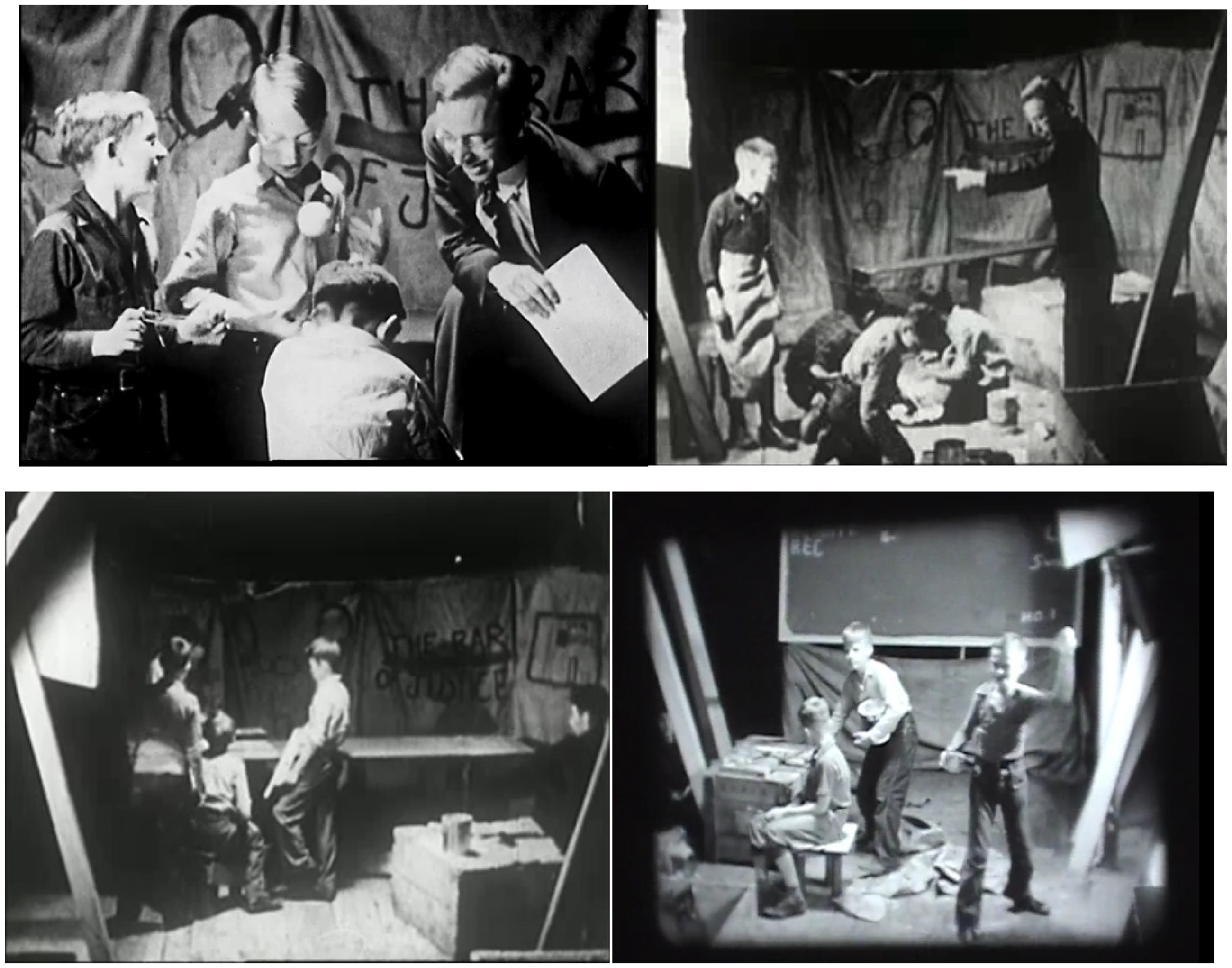
Frames from Experimental Studies in Social Climates of Groups (Lewin et al., 1939). Top left: tdemocratic group; top right: authoritarian group; bottom left: laissez-faire group; bottom right: snapshot of film outtake (children fighting).
What is perhaps most striking about Experimental Studies is the manner in which it seeks to appeal to the audience's emotions, and how this objective is built into the film's cinematic choices. This orientation is best seen in the visual narration of how a new “group atmosphere” emerges as soon as the children encounter a new style of direction. The sudden liveliness of a club that has just come under democratic supervision is expressed via shorter takes and greater variation in camera height and angle; the children's greater willingness to collaborate is captured by offering different angles of vision on the collective task. In contrast, when a democratic group enters an authoritarian “climate,” its members’ lack of “social responsiveness” is displayed through fewer, longer takes. In turn, the aloofness of the laissez-faire leader is mimicked by a distant camera that refuses to be drawn into the children's activities. 25
In all cases, the film accelerates the metamorphosis of each group, rendering visible in a couple of minutes processes of political transformation that took hours to unfold in the experimental situation, and which an observer would be hard-pressed to recognize in a natural setting (Figure 5). Given that the appearance of a new type of leader serves as the film's key narrative device, the obvious implication of Experimental Studies is that style of direction—as embodied by one of Lewin's students—is the catalyst for one or another kind of political order.
The film thus had several powerful political messages to convey beyond its value as visual record of a scientific experiment: that political order was not rooted in inherent psychological characteristics of the individual but was an emergent property of groups; that democracy was visibly superior to autocratic or laissez-faire regimes (in terms of both the degree of psychological satisfaction it afforded its members and the level of work productivity it enabled); and that, despite this objective superiority, democratic orders were exceedingly fragile achievements, prone to disintegrate quickly when a collective was exposed to a different style of leadership. 26
These messages resonated with tropes circulating widely in entertainment media at the time. Indeed, faith in the superiority of democracy tinged by apprehension at its vulnerability was a running theme in several popular Hollywood movies of the period. Films such as Gabriel Over the White House (1933), Mr. Smith Goes to Washington (1939), or Meet John Doe (1941) tried to express the vulnerability of the American political system to corruption and populism (Pause, 2023). The manipulability of human emotions and the speed with which a collective could adopt a radically different political disposition served to cast doubt on the resilience of representative forms of government. Thus, many of these movies shared with Experimental Studies a troublesome conclusion: that the preservation of a democratic order could not rely on received institutional forms or on the spontaneous self-organizing efforts of citizens, but required strong pro-democracy leadership (in the case of Gabriel Over the White House, a divinely inspired one). As Lawrence Levine writes in relation to several films of this era, “even in those many movies which do not openly advocate authoritarian rule, which in fact combat it, the thrust is toward the importance of the leader” (Levine, 1985: 182).
In 1939, the year Experimental Studies was released, the Committee on Motion Pictures and Sound Recording Devices in Instruction and Psychology of the American Psychological Association (APA) sought to formalize a distinction between “research” and “instructional” films. The former were expected to convey “the actual results of experimentation” and should, in the words of the committee, “observe all the conditions necessary for accurate reporting of data” (American Psychological Association, 1939: 758). By contrast, “instructional movies” (or “demonstration films,” as the committee also called them) were cinematic representations of scientific studies whose purpose was “not primarily to repeat an observation, but to teach its significance” (p. 758). In pursuit of this broader pedagogical purpose, “the instructional film may justifiably use any methods of dramatization which will help in the realization of its aim” (p. 758). With Experimental Studies, Lewin was operating in a clearly “instructional” manner. Although he and his colleagues showed portions of the film to academic audiences—and it was obviously important to them to convince their peers of the scientific quality of the study—this was clearly a film intended for the larger public, and one that adopted codes of filmmaking that would be recognizable to mass audiences.
Film had become a powerful tool to connect the events unfolding within the psychological laboratory to the challenges facing the broader polity. Yet making that connection required an unabashedly activist style of experimentation and filmmaking—a style that included a dramaturgical mise en scène, self-consciously theatrical performances on the experimental stage, and forceful editing. Experimental Studies does not pretend to capture the quotidian quality of social life—the unusual experimental set-up quickly dispels any sense of familiarity with the surroundings. What Lewin was after, both within the experimental enclosure and in the motion picture, was a concrete, purified manifestation of democratic political order, and of the laws governing its emergence and decline.
Conclusion
By the late 1930s, many social scientists were using film to record the phenomena they were arranging in their laboratories, but few were making movies—few, that is, were thinking narratively about experimental situations so as to materialize certain social phenomena and their cinematographic capture in accordance with codes of filmic storytelling that would be recognizable to a mass audience.
Lewin's cinematic output, culminating in Experimental Studies, shows the conditions necessary for this evolution: making sure that the experimental setting could operate as a studio and enable the movie camera to record the essence of the phenomena under investigation; conceiving of the sequence of experimental events narratively so as to create visual material that could be plotted along a storyline; placing the experimenter (or a surrogate) within the frame of the study to act as agent provocateur, the catalyst for the emergence of analytically significant incidents; and composing a motion picture in accordance with codes of montage that could engage the attention and affective response of a lay spectator.
Underlying these technical interventions was a set of deep-rooted theoretical assumptions, for Lewin was extending here Köhler's original intuition: that movement in space could disclose genotypic features of action and reveal essential differences in the make-up of actors. Directing and producing a motion picture was Lewin's solution to the problem that Köhler had encountered at the limits of his epistemology of the detour: if movement did indeed provide a powerful heuristic to discriminate between different modalities of action, how could one develop a precise morphology of collective states on the basis of a careful analysis of patterns of group locomotion generated under experimental conditions? Lewin's solution not only required more sophisticated motion-recording equipment but also a theory of expressive movement, a dramaturgical approach to the staging of experimental situations, and the application of a self-consciously directorial sensibility to the filming and editing of the events unfolding in the laboratory.
If Köhler conceived of the cinematograph as a recording instrument, by the 1930s, Lewin was able to embrace cinema as a means of expression. Not only did he attempt to produce distinctive instantiations of (miniaturized) social and political orders, but he produced them in and for cinema. The messages he wanted to convey were intended for the largest possible audience, and could only be visualized in the medium of film.
There was of course a price to pay for these innovations. Despite Lewin's wide-ranging influence in American social science, his approach to social-scientific filmmaking would become marginal in academic psychology after the war. In pursuit of an ideal of scientific objectivity that implied a radical “escape from perspective” (Daston, 1992), social scientists, and experimental psychologists in particular, reverted in their filmmaking to a sort of faux-naif observationalism—a style of visual documentation in which the camera tended to remain stationary, the experimenter exited the scene (or, if still within the frame, tried hard to pretend he was not acting), and cinematic time mimicked the linear, monotonous temporality of the experiment's chronological unfolding. The distinction the APA introduced in 1939 between “research” and “instructional” psychological films hardened into an epistemological divide. Drawing a clear line between the impartial reporting of scientific data and attention-grabbing storytelling—the line Lewin so productively crisscrossed in Experimental Studies—became crucial for the scientific legitimacy of the discipline. If, as Kurt Danziger argued, the social ontology implied by Lewin's experimental program became “utterly unassimilable” to American psychology after the war (Danziger, 1992: 309; see also Greenwood, 2003), the kind of social-scientific cinematography that characterized Experimental Studies became alien to a discipline that equated objectivity with detachment and that preferred to communicate its findings through the restrictive media of scientific prose and statistical data.
Yet Lewin's tradition of sophisticated social-scientific filmmaking would continue to flourish at the margins of the academic discipline, in movies that were unabashedly “instructional” and could therefore borrow more freely from genres of entertainment media. By the 1960s, it was almost impossible to police the boundary between films that sought to convey “the actual results of experimentation” and those that aimed “to teach its significance,” as televisual media came to pervade the experimental imagination of psychologists and of social scientists in general. 27
The program of scientific filmmaking that links Köhler's pioneering use of film in Tenerife and Lewin's motion picture of “group atmospheres” in his Iowa attic points to how the social sciences evolve to operate in new media. Theirs was a form of inquiry that stumbled, productively, on the specificity of collaborative (Köhler) and democratic (Lewin) locomotion, a puzzle that had originally emerged from the elusive qualities of social phenomena generated under experimental conditions. The elucidation of this question required formats of investigation and documentation adapted to the powers of cinema, and to the codes of interpretation that guided the reception of movies. By the time Lewin produced the most sophisticated cinematic expression of this research program, the successful demonstration of his key finding—the fragile superiority of democracy—required the emotional engagement of film audiences.
Footnotes

Funding
The author received no financial support for the research, authorship, and/or publication of this article.
Declaration of conflicting interests
The author declared no potential conflicts of interest with respect to the research, authorship, and/or publication of this article.