







Abstract
Sixteenth-century Florentines have left us a visual legacy showing them capable of imagining even the executions of criminals as redemptive deaths, with artistic representations of Christ’s own death and the martyrdoms of saints serving such interpretations. This article will look in detail at one such case, before asking whether there might be analogies to this construction of executions as ‘good deaths’ where other, less obviously dramatic kinds of dying are concerned. The comfort that Christian art about dying can give to the dying is its ability to help them imagine their union with Christ in whatever death they must undergo. On the premise that art about dying can be of fundamental assistance to the art of dying, the article proposes examples of works of Christian art that may address the ‘long dying’ so common in our own medically advanced societies, thereby proclaiming the reach and inclusiveness of the hope of redemption.
Death and dying feature in multiple ways in Christian art, but to begin to try to categorise the differing ways in which death is addressed in Christianity’s visual traditions is immediately to come up against the fact that to explore the process of dying is not always the same as to portray ‘the hour of our death’ (we might contrast images of Jacob on his death bed with images of the decollation of St John the Baptist, for example, and find ourselves affected in wholly different ways). Likewise, depictions of the condition of bodily deadness (Mantegna’s genre-defining Dead Christ, for instance 2 ) are often very different from visualisations of various kinds of post-mortem existence (images of heaven, hell or limbo).
There is also the significant question of how the living continue to relate to and interpret the dead, and the sort of art that is generated to help them do so. In some cases, this art—though in one sense ‘about’ death—would show neither dying, death nor deadness, but (say) moments of victory in the history of salvation, or the figure of Christ as the Good Shepherd. These are the kinds of image we see in wall paintings in the Roman catacombs and carved on early Christian sarcophagi.
The most depicted death of all in Christian art is, not surprisingly, Christ’s own. This presents complex possibilities for Christian artists, their patrons and their viewers, inasmuch as such images can be used to explore a death like our own (in ways that ask us to interpret our own deaths by contemplating it 3 ) or a death unlike our own (because more glorious, 4 or more ghastly 5 ).
Needless to say, it is impossible to do justice to any more than a handful of images and traditions in what follows, so instead I propose to look in particular detail at one unusual representation of a death. It is not the death of a saint but the execution of a condemned criminal. What is so remarkable about it is the way in which visual resources afforded by a long tradition of Christian art enable the representation of this death to carry a redemptive charge. 6
The execution in question took place in Florence in 1501. The criminal was a young nobleman named Antonio di Giuseppe Rinaldeschi, and his crime was defacing an image of the Virgin Mary on the outside of a church in the city by throwing horse dung at it. He was drunk, and the motivation for his impulsive deed was most likely to have been his grievance at the losses he had incurred earlier that night while gambling in a local hostelry.
It seems that his deed was observed, and his awareness of its seriousness appears to have impressed itself on him almost immediately, for he fled the city and tried unsuccessfully to take his own life. He was pursued and arrested the next day. He was tried by the powerful tribunal known as the ‘Eight’, found guilty of blasphemy, and executed eight days after his crime by being hanged from the window of the prison where he had been incarcerated (what is now the Bargello). This was a humiliating mode of execution reserved for the lower kind of criminal (by contrast, for example, with beheading). 7
Two very striking chains of events ensued, both of them continuing to involve works of art. 8 In the eight days between the crime and Rinaldeschi’s execution, it seems that miracles had already begun to happen in association with the ‘street Madonna’ whom Rinaldeschi had defiled. We can speculate about how this sudden inflation of the significance of the image, as it became thaumaturgical, might have affected Rinaldeschi’s actual sentence. The activity of the image could have been read as confirmation of Rinaldeschi’s crime: she had been goaded into action, so to speak, by the humiliation her image had undergone. Meanwhile, the enormity of the young man’s crime would have seemed ever greater as the image became ever more miraculous. Maybe his execution became increasingly necessary. The Madonna, in a sense, ensured his death. And yet he, with a strange circularity, was the cause of her celebrity.
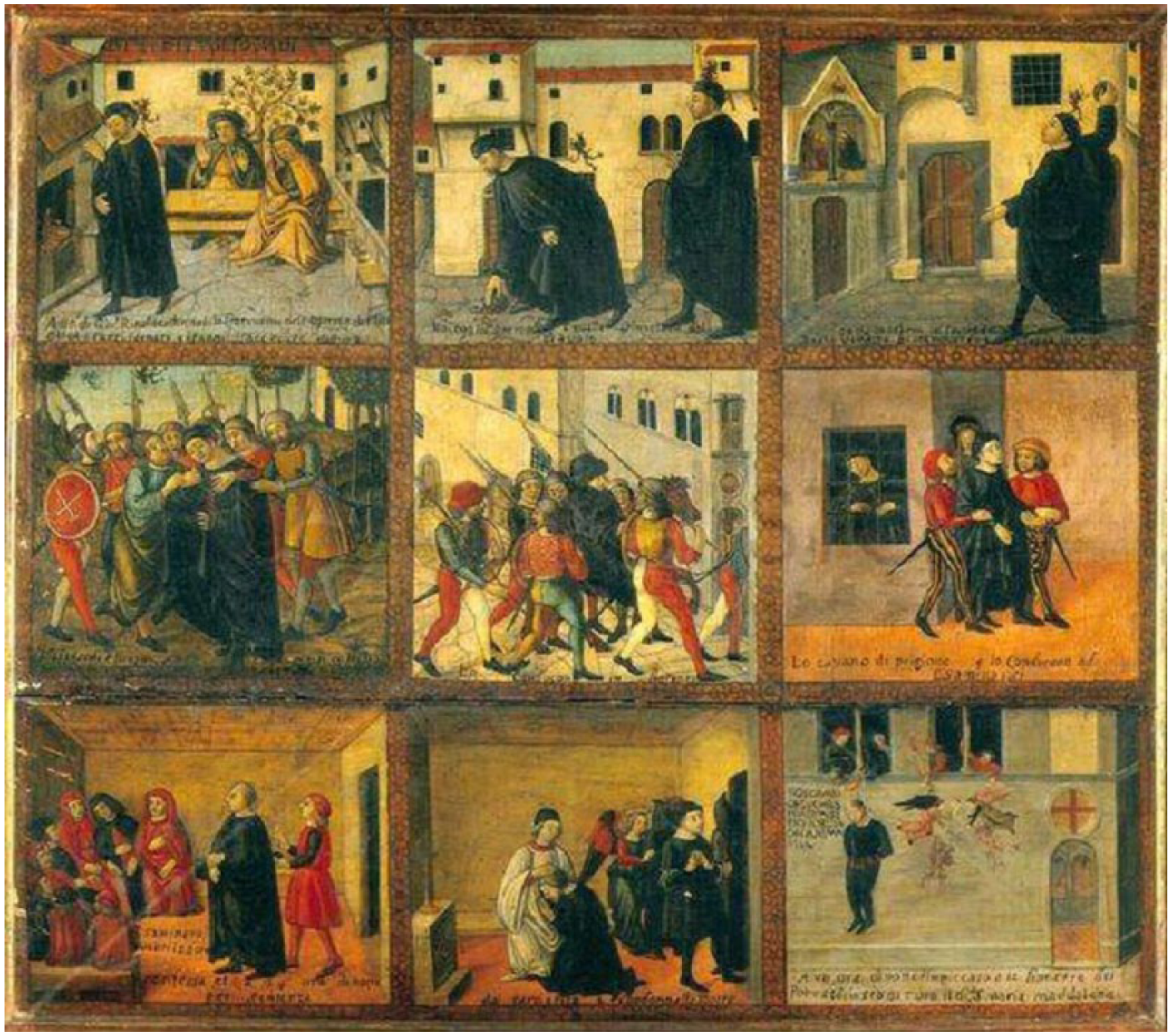
Only a year afterwards, the Madonna’s image would have a new oratory built to enclose it. Her increased dignity was cemented. But it is in this connection that the second remarkable (and art-related) chain of events unfolds. A set of nine wooden panel paintings were commissioned by the clergy of the church for use in the new space—possibly even as a sort of deep ‘predella’ connecting the altar in the new oratory to the (high-up) image above it, and at the very least to be displayed in conjunction with the image of the Madonna at certain times of year. These nine panels are a narrative sequence that tells the story of the crime, the arrest, the trial and the execution of Rinaldeschi. 9 The destinies of the nobleman and the image of the Madonna continued to be intertwined. He both defiled and aggrandised her; she in turn both accused and immortalised him. While of no great artistic distinction, the panels are an extraordinary creation in social and religious terms, giving an insight into the way that the collective imagination of the Florentines could interpret the experience of death, even a criminal’s death (perhaps even especially a criminal’s death), in a Christian perspective.
The panel depicting Rinaldeschi’s arrest is deeply indebted to traditional portrayals of Christ’s arrest in the Garden of Gethsemane. He stands unresisting, in a landscape of trees and vegetation, surrounded by soldiers, and bowing his head in what looks like an attitude of submission. The portrayal of his incarceration, meanwhile, recalls depictions of John the Baptist or Peter in prison; the portrayal of his trial recalls images of Paul, or (once again) Christ himself. In the final panel we see Rinaldeschi hanged from the window in full view of the city. The actual occasion was no doubt intended by the city authorities to be a visual demonstration of justice being done. However the artist, Filippo Dolciati, with whatever input he may have had from his patrons, has added a new layer of meaning: a further visualisation of another and higher justice that has the power to contextualise and even relativise the first. Angels and devils, flying in mid-air around the criminal’s body, are shown to be fighting for his immortal soul. Not only that, but the angels are shown to be victorious in this fight, for one of them has his soul (depicted, as is traditional in much Christian art, as a swaddled infant) and is carrying it upwards to heaven.
The display of this sequence of images at the very scene of the crime might not strike us as odd were it not for the fact that they show the perpetrator about to be welcomed into the company of the saints. There was, as Samuel Edgerton, Jr has shown, a long tradition in northern Italy of pittura infamante which showed hanged men, and which were displayed in public in order to augment or perpetuate their shame. However this is not just the record of a bad deed; it proposes a vision of redemption. Rinaldeschi’s story becomes part of the fabric of the new oratory built to honour the very image he dishonoured in a way that assimilates his fate to the fate of Christ himself, as well as of some of those New Testament heroes of the faith in whom Christ was mirrored. It is almost a sort of apotheosis.
A key factor in understanding the reasons for commissioning this work is probably Rinaldeschi’s penance, which is very clearly depicted in the penultimate panel of the sequence. He was sorry, and it saved him.
The scene in some of its details gives us a further insight into how this penance might have been fostered, for in the panel we see some hooded figures: members of one of the confraternities whose principal work was to accompany condemned criminals to their executions and to offer them spiritual solace. In Florence, the main confraternity of this kind was known as ‘The Blacks’ 10 (its equivalent in Rome was the Confraternity of St John the Baptist Beheaded). Penance was one of the things they sought to awaken in those they helped.
The members performed a demanding and impressive journey of accompaniment, saying prayers with (or for) the condemned, and in many cases holding painted tavollette, or paddle-shaped wooden boards with a handle at the base, for them to look at (one is visible in Dolciati’s image). Here we have a further indication of the importance of visual art for interpreting death in Florence during this period. These panels were intended to concentrate the mind of the criminal on Christ’s solidarity with them even in the circumstances of a criminal execution (Christ, after all, died a criminal death; the Baptist, similarly, was the victim of a political execution). The panels show such deaths, and the insertion of them between the criminal’s eyes and the death that was being prepared for them seems to have been a deliberate attempt to superimpose a sacred reading of their deaths on top of a merely judicial one; to give them the opportunity to believe their fate still narratable as part of a greater story of Christian redemption. Visual aids were being used to change the way that their experience could be constructed and in some cases come to terms with.
The outdoor Madonna, the nine-panel narrative painting, and the tavollette together give us a glimpse of the huge power of art to open imaginative options for a Christian community as it read and interpreted its everyday experiences, of life as well as of death. The ‘symbiotic cooperation’ that Edgerton has argued existed between art and law in late Medieval and Renaissance Florence needs to be extended in cases like this to acknowledge the role of religious faith too. Edgerton claims that between the thirteenth and seventeenth centuries, the ‘practitioners of both art and law—painters, sculptors, architects, lawyers, judges and police—could not have pursued their respective disciplines as they did without mutual interaction’. 11 His list of ‘practitioners’ fails however to include priests and members of confraternities (some of whom might also have been lawyers and judges, as well as merchants, councillors and others). Yet these complicate the picture in an important way for in their ecclesiastical roles they were not merely or always embodiments of ‘top-down’ civic authority but adherents to ‘bottom-up’ religious practices, which means that the art they commissioned and used was—likewise—not directly a tool of the city-state’s judicial systems. The stories told by works like the Rinaldeschi panels can cut across and even subvert the official propaganda of the legal authorities, showing us something of the wider collective perceptions of a Christian society.
Executions are, in this period at least, the most intensely visual form of death. They were a spectacle and a drama—and indeed the medium of theatre could be used in a comparable way to the Dolciati painted panels to invite the re-reading of a criminal’s death as an allegory of martyrdom. In 1451 it is recorded that a play depicting the beheading of John the Baptist was performed on the feast day of John’s martyrdom (29 August) at the Meadow of the Gate of Justice with, according to contemporaries, some 50,000 in attendance. 12 This was a site of actual executions; the overlaying of one spectacle on another would have prompted obvious associations. 13 Mitchell Merback’s claim that ‘the experience of seeing and imagining a body that was ravaged and bleeding’ could invoke ‘a constellation of religious doctrines, beliefs and devotional practices’ is borne out by such examples. 14 Likewise Kathleen Falvey in The Art of Executing Well argues for a profound relationship between rituals of public execution and the performance of passion narratives in Italy: ‘[s]uch examples, on the stage or on the way to the scaffold, took on deep meaning in an audience urgently concerned with the art of dying well’. 15
But the art of dying well is not restricted to this most visible form of death, and so in the final part of this article I propose to ask whether any of the things that can be learned from the way that executions were interpreted with the help of art (as in the Rinaldeschi case) can be extended to other and less obviously dramatic kinds of dying.
I think it can, if we isolate some key features of what the confraternities, and the commissioned panels, seemed to be aiming at.
They had a recurrent focus on the spiritual welfare of the dying person, and especially their final redemption.
Belief in the possibility of redemption for the dying person was premised on the confidence that whatever their spiritual condition they could still hope to ‘die in Christ’; that in their dying a mystical union with Christ could be effected.
This would be served by ensuring that their death was Christ-like in some way (and perceivable as Christ-like, especially perhaps by the dying person him- or herself).
Hence the concern to give the deaths specifically of criminals a martyr-like status. But there is of course no single paradigm of Christ-likeness. The Church holds that Christ-likeness is refracted through all saints’ lives, regardless of their age, sex, race, social status, or the manner of their death. So making it martyr-like may be one way of showing the goodness of a death, but there are other kinds of saints than the martyr, and so other kinds of good death.
The comfort that Christian art about dying can give to the dying is its ability to help dying people imagine their union with Christ in whatever death they must undergo. It is in this way that art about dying can be of fundamental assistance to the art of dying. One of the remarkable achievements of showing the Christ-likeness of criminal deaths—as the Rinaldeschi panels do—is to proclaim the sheer reach and inclusiveness of the hope of redemption. In these panels the death of the individual is set against an eschatological background. The limits and possibilities of Christian hope are tested precisely because this is not the death of a saint. In this sense, the images share interesting things in common with other visual experiments in the later Renaissance and Baroque periods, in which ugly and disfigured corpses are portrayed—often, but not always, Christ’s. Some will say such experiments indicate the ascendancy of a newly agnostic humanism, determined to de-romanticise the Christian vision of death and look squarely if disconsolately at its material effects. This is Julia Kristeva’s contention in Black Sun as she reflects on Hans Holbein’s image of Christ in the tomb. 16 But there may be other motivations in some of these images. The choice to depict the brute details of mortal bodies may be a deliberate testing of whether their resurrection and glorification can be imagined, with ‘yes, they can’ being a viable answer. We might think of the fascinating remnant of Rembrandt’s Anatomy Lesson of Dr Dejman which in its apparent visual reference to Mantegna’s Dead Christ asks us to see the disembowelled body (also, incidentally, the body of a criminal), whose upper skull has been removed to expose his brain, as more than a mere physical specimen. 17 Here (perhaps) is the very humanity into whose condition Christ has entered. In this body, ‘traces’ of Christ may be discerned by the viewer disposed to find them.
If Christ really does enter into the condition of bodily abjection that his Passion describes, and if he does descend even into hell, then what sort of faith is it that can only be confirmed by beautiful crucifixions? Gruesome images give their viewers the option to ask such questions, and perhaps to serve a more robustly realistic faith as a consequence. They do not necessarily signal a more disillusioned outlook on the world. So, then, criminal deaths and grim physical disintegrations can be beds of prospective hope.
The challenge that Michael Banner poses in his most recent book, The Ethics of Everyday Life, 18 is to ask whether there is much in the legacy of Western Christian art that can help us with the increased prevalence of ‘long dying’ in the developed nations. How might art help us to imagine that such deaths-by-dwindling can also be ‘holy deaths’? The fact that examples here are hard to find is itself, perhaps, confirmation of the challenge.
The suffering that attends the diminution of our powers (bodily and mental) finds resonances in art that depicts Job, for example, 19 and the Patriarchs—Jacob and (especially) Isaac—when, like Lear, they become ‘foolish fond old men’. 20 These are only images of hope inasmuch as these figures can be perceived as key figures in the pattern of redemption, and not outsiders to it even in their failing bodies and minds. More positive images may be found in the ‘Harrowing of Hell’ tradition, and especially in images where a venerably frail and ancient Adam and Eve are the first to be conducted into the light of resurrection fulfilment.
However, I am most deeply struck by the figures of Simeon and Anna, whose long waiting (in a ‘sequestered’ state which by some measures might parallel the sequestrations of the elderly that Banner highlights in contemporary Western societies) is made the occasion of extraordinary epiphany. What, so far as I have been able to find out, seems to be a distinctively Russian Orthodox iconographic tradition develops the representation of Simeon in an attitude of great intimacy, pressing his face to that of the infant Christ in a moving, non-identical repetition of the Virgin Eleousa tradition. 21 Possibly blind, in his old age, Simeon’s relationship with Christ through touch takes on even greater importance.
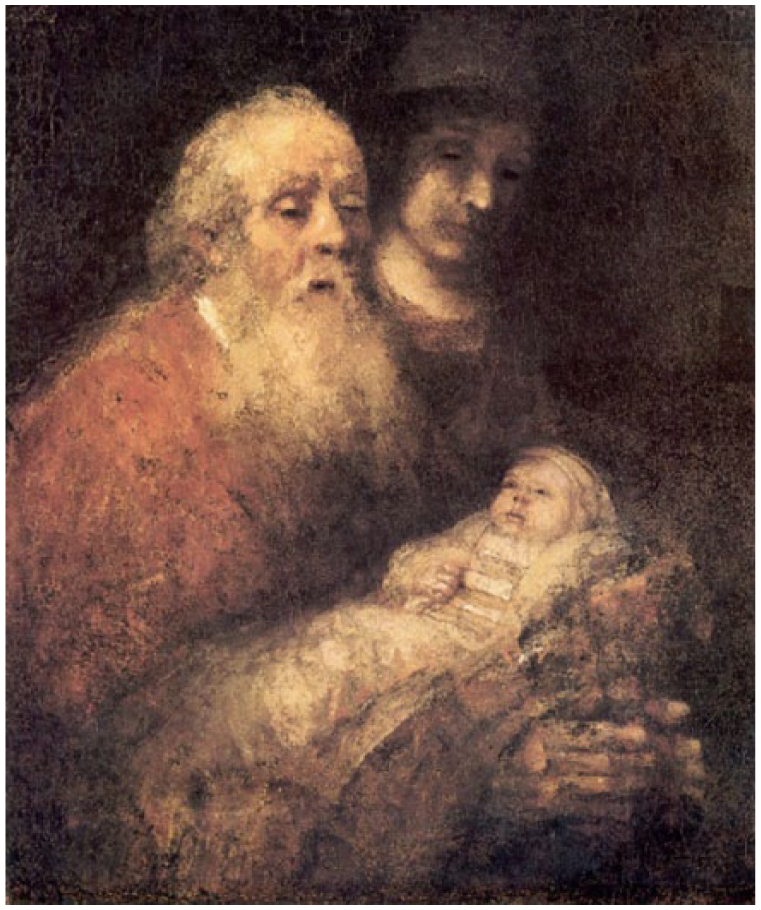
Whether wittingly or not, it is via Simeon that Rembrandt bequeaths to us one of the greatest Christian images of old age, and of the bestowal of blessing on those whose powers are failing and who are about to ‘depart’. In this, Rembrandt’s last painting, the open hands of Simeon suggest not just a priestly authority but also a strange, helpless inadequacy in their unrealised ‘hold’ on Christ, and yet into them is given the abundance of all life and light. As the young Virgin is Theotokos, so the ancient Simeon becomes Theodochos—the God-Receiver par excellence, because his powers are weak. I would venture that in an image like this we see a feat of Christian imagination analogous to that in the Rinaldeschi panels (though more brilliantly realised by artistic standards): a transformation of a hard death into an adumbration of glory.
Footnotes
1.
Rom. 6:8.

3.
.jpg)
6.
I am most grateful to my postgraduate student Lucinda Cameron for alerting me to this series of images, and for her research into them, to which I am indebted in what follows.
7.
See Samuel Y. Edgerton, Jr, Pictures and Punishment: Art and Criminal Prosecution during the Florentine Renaissance (Ithaca, NY: Cornell University Press, 1985), p. 135.
8.
These are discussed in detail in William J. Connell and Giles Constable, Sacrilege and Redemption in Renaissance Florence: The Case of Antonio Rinaldeschi (Toronto: Centre for Reformation and Renaissance Studies, 2005).
9.
The panels are reproduced in Connell and Constable, Sacrilege and Redemption, pp. 73–81.
10.
Its full dedication was to Santa Maria della Croce al Tempio.
11.
Edgerton, Pictures and Punishment, p. 13.
12.
As Kathleen Falvey points out, this is an astonishing figure if true, representing more than the entire city’s population. Kathleen Falvey, ‘Scaffold and Stage: Comforting Rituals and Dramatic Traditions’, in Nicholas Terpstra (ed.), The Art of Executing Well: Rituals of Execution in Renaissance Italy (Kirksville, MO: Truman State University Press, 2008), pp.13–30.
13.
Mitchell B. Merback argues that although execution did function as a means of state authority, it was also an important ‘quasi-religious ritual in which the community at large ushered the condemned culprit into death and thus a new “social” role’. The Thief, the Cross and the Wheel: Pain and the Spectacle of Punishment in Medieval and Renaissance Europe (London: Reaktion, 1999), p. 18.
14.
Merback, The Thief, the Cross and the Wheel, p. 19.
15.
Falvey, ‘Scaffold and Stage’, p. 29.
16.
Julia Kristeva, Black Sun, Depression and Melancholia, trans. Leon S. Roudiez (New York: Columbia University Press, 1989), pp. 121–22.
18.
Michael Banner, The Ethics of Everyday Life: Moral Theology, Social Anthropology, and the Imagination of the Human (Oxford: Oxford University Press, 2014).