







Abstract
A facile, single-step synthetic pathway leading to bifunctionalized polyhedral oligomeric silsesquioxanes (POSS) with two different reactive functional groups attached to the same cage structure, namely Vi-Cl POSS, is reported in this paper. The Vi-Cl POSS were synthesized through the cohydrolysis and cocondensation of (3-chloropropyl)trimethoxysilane, vinyltrimethoxysilane and propyltrimethoxysilane in ethanol media under acidic conditions, the number of vinyls and chloropropyls which attached to cage structure can be controlled by the monomers feed ratio of three kinds of trialk-oxysilanes. In this method, three different bifunctional polyhedral oligomeric silsesquioxanes were synthesized, including [Si8O12 (CH=CH2)(C3H6Cl)2(C3H7)5] (POSS1), [Si8O12(CH=CH2)2(C3H6Cl)(C3H7)5] (POSS2) and [Si8O12(CH=CH2)(C3H6Cl)(C3H7)6] (POSS3). Due to the reactive functional groups attached to the cage, these specific bifunctional polyhedral oligomeric silsesquioxanes can be copolymerized with other organic monomers by free radical polymerization, hydrosilylation reactions and atom transfer radical polymerization to obtain organic–inorganic hybrid nanocomposites, respectively. The outstanding advantage of cohydrolysis–cocondensation routes is that the substitution pattern of different substituents around the POSS cage can be precisely controlled.
Introduction
Polyhedral oligomeric silsesquioxanes (POSS) are thermally robust cages consisting of a silicon–oxygen core framework possessing alkyl functionality on the periphery.1,2 The nanosized cage-like molecules are usually given with the general formula [RSiO1.5]n, where R is functional or inert organic corner groups. For their nature, these compounds which can be seen as the smallest discrete particles of silica, bridge most of the up-to-date research topics in the field of organic–inorganic hybrid nanocomposites. POSS compounds also combine the excellent chemical properties of both inorganic silicas and organic molecules.3,4 Depending on the manner of the nanosize POSS cores incorporation (copolymerization, grafting or blending), the formation and the percentage loading of the POSS into a polymer matrix can result in significant improvements in a variety of physical and mechanical properties, such as tensile modulus, shear modulus, compressive strength, interfacial properties and so forth.5,6
POSS are generally prepared through either the acid- or base-catalyzed hydrolysis and condensation of trichlorosilanes or trialkoxysilanes. With this method, a large number of octafunctional POSS (T8R8) have been prepared, where R can be hydrogen atoms or any alkyls, alkylenes, aryls, arylenes and halide groups. 7 Furthermore, monofunctional POSS compounds (T8R7R′1), which possess one reactive R′ group and seven R inert groups, can be prepared by the addition of a chlorosilane or alkoxysilane to a corner-truncated cube species R7Si7O9(OH)3. 8 However, research on the syntheses of the special POSS compounds with two different functionalities on the same cage structure has rarely been reported. In the present study, an easy and efficient single-step procedure for the preparation of three various different bifunctional POSS compounds (POSS1, POSS2 and POSS3) is demonstrated. The number of functional groups attached to cage structure can be tuned by the monomer feed ratio of three trialk-oxysilanes. Owing to the presence of a great number of possible active functional group trialkoxysilanes and inert group trialkoxysilanes which can be used to construct the POSS cage structure, a huge class of novel bifunctional POSS can be derived from this approach. Moreover, bifunctional POSS which contain two different covalently bonded reactive functionalities are more suitable for polymerization, grafting, surface bonding and other transformations.
Experimental
Materials and instrumentation
Propyltrimethoxysilane (PTS, 98%), (3-chloropropyl)trimethoxysilane (CTS,98%) and vinyltrimethoxysilane (VTS, 98%) were purchased from Diamond Advanced Material of Chemical Inc. Absolute methanol, absolute ethanol, concentrated hydrochloric acid (36%) and tetrahydrofuran (THF) were purchased from Sinopharm Chemical Reagent Company. All of the above reagents were of analytical purity and used without further purification.
Fourier transform infrared (FT-IR) spectra were collected on a Spectrum One FT-IR spectrometer (Perkin-Elmer Cetus Instruments, Norwalk, CT); The 1H-NMR analysis and 29Si-NMR analysis were conducted on a Varian INOVA-600 spectrometer at 600 MHz, CDCl3 was used as solvent. X-ray powder diffraction (XRD) was collected on a D/MAX-IIIC X-ray diffractometer (Akishima-shi, Tokyo, Japan). The XRD pattern was taken from 2 to 80° (2θ value) with Cu Kα radiation (λ = 1.5406 Å, operating at 35 kV and 25 mA) at a scanning rate of 10° min−1. Thermogravimetric analysis (TGA) was performed under air flow at temperatures ranging from 25 to 800 °C at a heating rate of 10 °C min−1 using a Perkin-Elmer TGA-7 thermogravimetric analyzer.
Preparation of bifunctional POSS: POSS1 [Si8O12 (CH=CH2) (C3H6Cl)2 (C3H7)5]
Typically, 7.29 g deionized water, 86 mL absolute ethanol and 7.5 mL concentrated hydrochloric acid were added in sequence to a 250-mL flask and mixed to get a heterogeneous solution. Then, a mixed solution of propyltrimethoxysilane (PTS; 6.6 mL, 0.0375mol), (3-chloropropyl)trimethoxysilane (CTS; 3.5 mL, 0.02 mol) and vinyltrimethoxysilane (VTS, 1.5 mL, 0.01 mol) was added dropwise to the flask through the addition funnel over a period of 10 min with vigorous stirring. The solution was refluxed in an oil bath at 60 °C and the solution gradually turned turbid after several hours. The reaction mixture was maintained at 60 °C for 3 days with stirring until a white crystalline precipitate appeared. After the reaction, the solution was filtered and then the crystals were collected. The crude white product was washed twice with a solution of methanol/tetrahydrofuran (1 : 1) and dried under vacuum for 24 h at 100 °C. The final product was obtained with a yield of 31.5% (2.16 g). In the same manner as described for POSS1, by tuned the monomer feed ratio to n(PTS : CTS : VTS) = 3.75 : 1.1 : 2 and 3.8 : 1 : 1, POSS2 and POSS3 were synthesized with a yield of 31.2% (1.85 g) and 32.6% (1.84 g), respectively.
Results and discussion
The synthetic route leading to bifunctional POSS derivatives is shown in Scheme 1. In order to prove that the target compounds were obtained as the most relevant products, Fourier transform infrared, 1H-NMR, 29Si-NMR and XRD investigations were performed to confirm the structure of the products. Thermogravimetric analyses were also carried out to study the thermal stabilities and decomposition pathways of all these compounds.
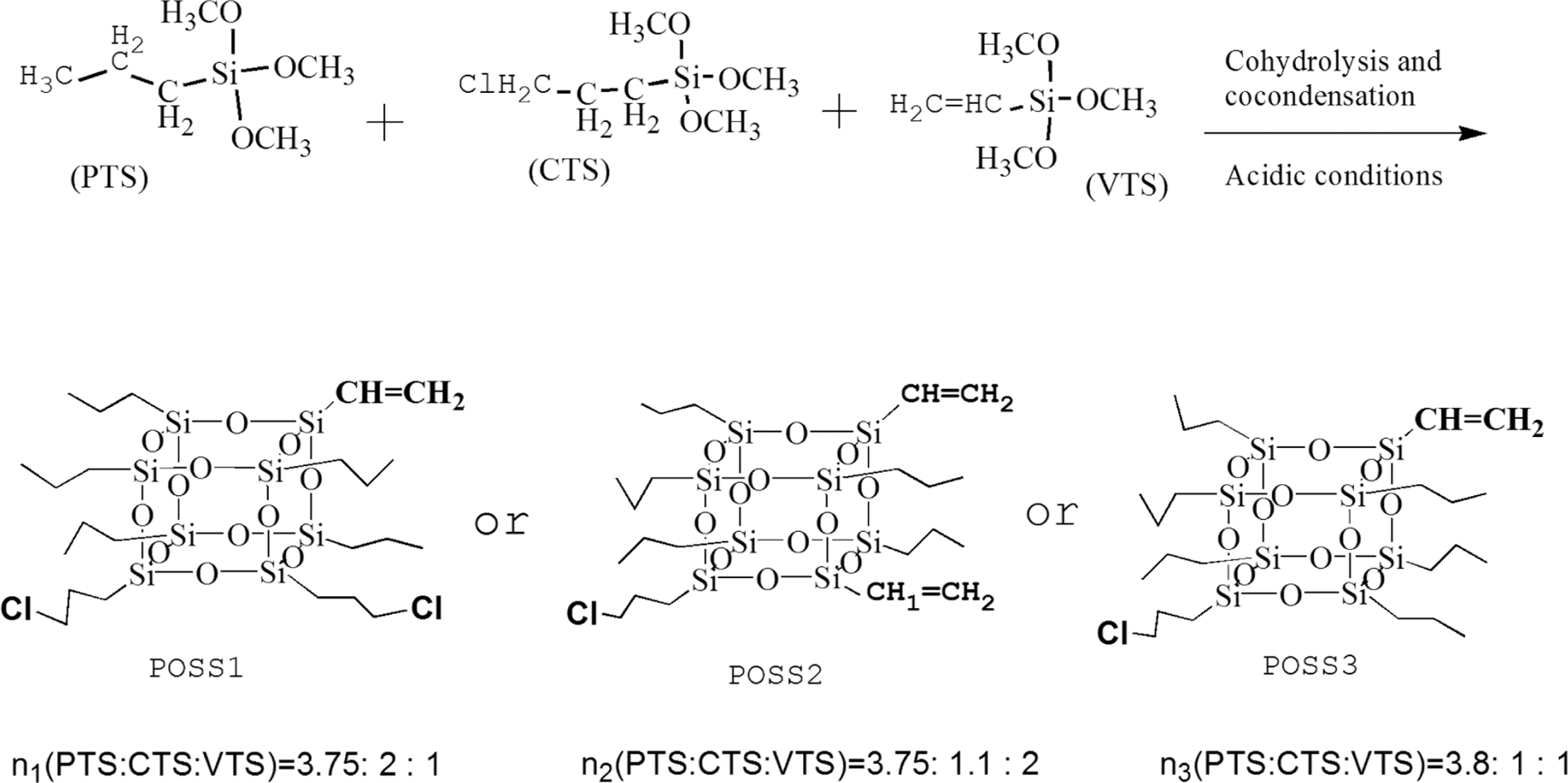
Synthetic routes of the bifunctional polyhedral oligomeric silsesquioxanes by cohydrolysis and cocondensation of propyltrimethoxysilane (PTS), (3-chloropropyl)trimethoxysilane (CTS) and vinyltrimethoxysilane (VTS) in ethanol solvent.
Figure 1 shows the FT-IR spectra of three bifunctional polyhedral oligomeric silsesquioxanes. As can be seen from the spectra, the FT-IR absorption spectra of the three compounds are quite similar. All spectra show a strong and symmetric characteristic absorption peak at 1113 cm−1 due to the stretching vibration mode of Si–O–Si bonds in silsesquioxane cages. 9,10 The peak appeared at 1604 cm−1 was attributed to the stretching vibration of vinyl groups, and the absorptions at 1275 and 1408 cm−1 were assigned to the bending vibration of vinyl groups. All these samples also displayed an absorption at 700 cm−1, which is the typical characteristic absorption that arises from the C–Cl bending of chloropropyl groups. Furthermore, the peaks occurring at 2873 and 2959 cm−1 came from the C–H stretching vibration of the propyl groups, while the C–H bending vibration of the propyl groups were located at 1221 and 1338 cm−1. The presence of these signals in the FT-IR spectra suggested that the three samples all contained the following characteristic groups, including Si–O–Si(cage), Si–CH2CH2CH2Cl, Si–CH =CH2 and Si –CH2CH2CH3.

FT-IR spectra of the bifunctional polyhedral oligomeric silsesquioxanes, POSS1, [Si8O12(CH=CH2)(C3H6Cl)2(C3H7)5]; POSS2, [Si8O12(CH=CH2)2 (C3H6Cl)(C3H7)5]; and POSS3, [Si8O12(CH=CH2)(C3H6Cl) (C3H7)6].
The 1H-NMR and 29Si-NMR measurements were performed in order to elucidate their microstructure more accurately. Figures 2 and 3 show the 1H-NMR spectra and 29Si-NMR spectra of the synthesized products in CDCl3. From the 1H-NMR spectra, the multiple resonance peaks of vinyl protons were observed around ∼6.06 ppm because of the coupling of hydrogen protons. 11 The proton signals of the propyl groups can be observed at 0.62ppm (b), 1.44ppm (c) and 0.96 ppm (d), respectively. Furthermore, the bands at 0.77 ppm (e), 1.85 ppm (f), and 3.53 ppm (g) are the characteristic peaks of the chloropropyl protons. 12 The proton signals of Si–OCH3 and Si–OH did not appear in the 1H-NMR spectra which revealed both the cohydrolysis and condensation reactions had been accomplished and the final cage structures were formed. 13 Furthermore, the intensity ratio of the 1H-NMR results also shows that composition ratio of Si–CH2–CH2–CH3, Si–CH2–CH2–CH2Cl and Si–CH=CH2 attached on the cage structure of the POSS1 compound was approximately 5 : 2 : 1, which was calculated through the integral areas of protons. By calculating the integration areas of protons equally, the 1H-NMR spectroscopic analyses also confirmed that the ratio composition of substitutional groups for the POSS2 and POSS3 compounds were in agreement with the assumed structure. Due to the various reactive activities of monomers in cohydrolysis and cocondensation reactions under acidic conditions, the feed ratio of the three kinds of trialkoxysilane monomers should be regulated to obtain the target products. Moreover, by controlling the monomers feed ratio to n(PTS : CTS : VTS) = 3.75 : 2 : 1, 3.75 : 1.1 : 2 and 3.8 : 1 : 1, POSS1, POSS2 and POSS3 were obtained, respectively.
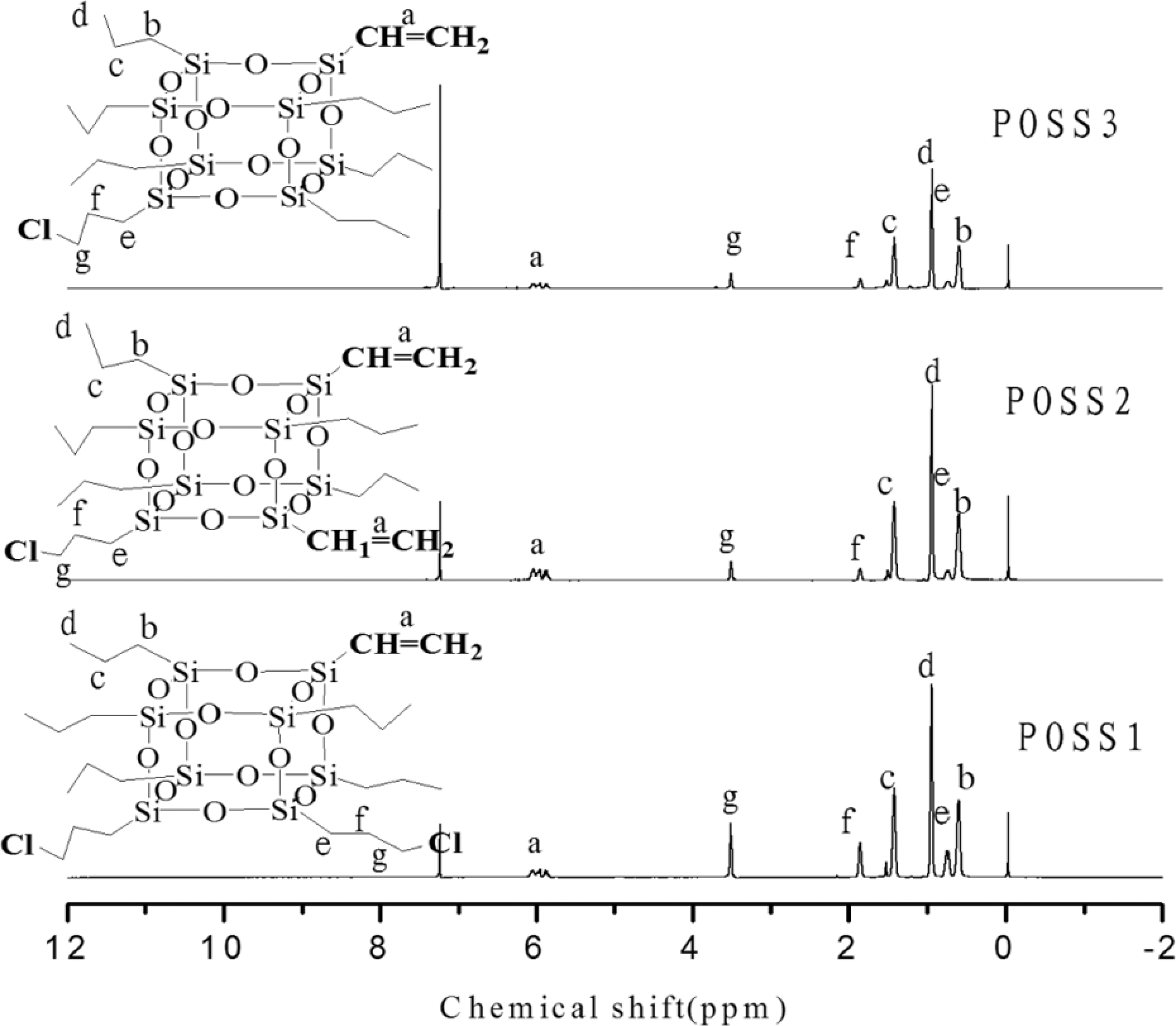
1H-NMR spectra of the bifunctional polyhedral oligomeric silsesquioxanes in CDCl3: POSS1, [Si8O12(CH=CH2)(C3H6Cl)2(C3H7)5]; POSS2, [Si8O12(CH=CH2)2(C3H6Cl)(C3H7)5]; and POSS3, [Si8O12(CH=CH2)(C3H6Cl) (C3H7)6].
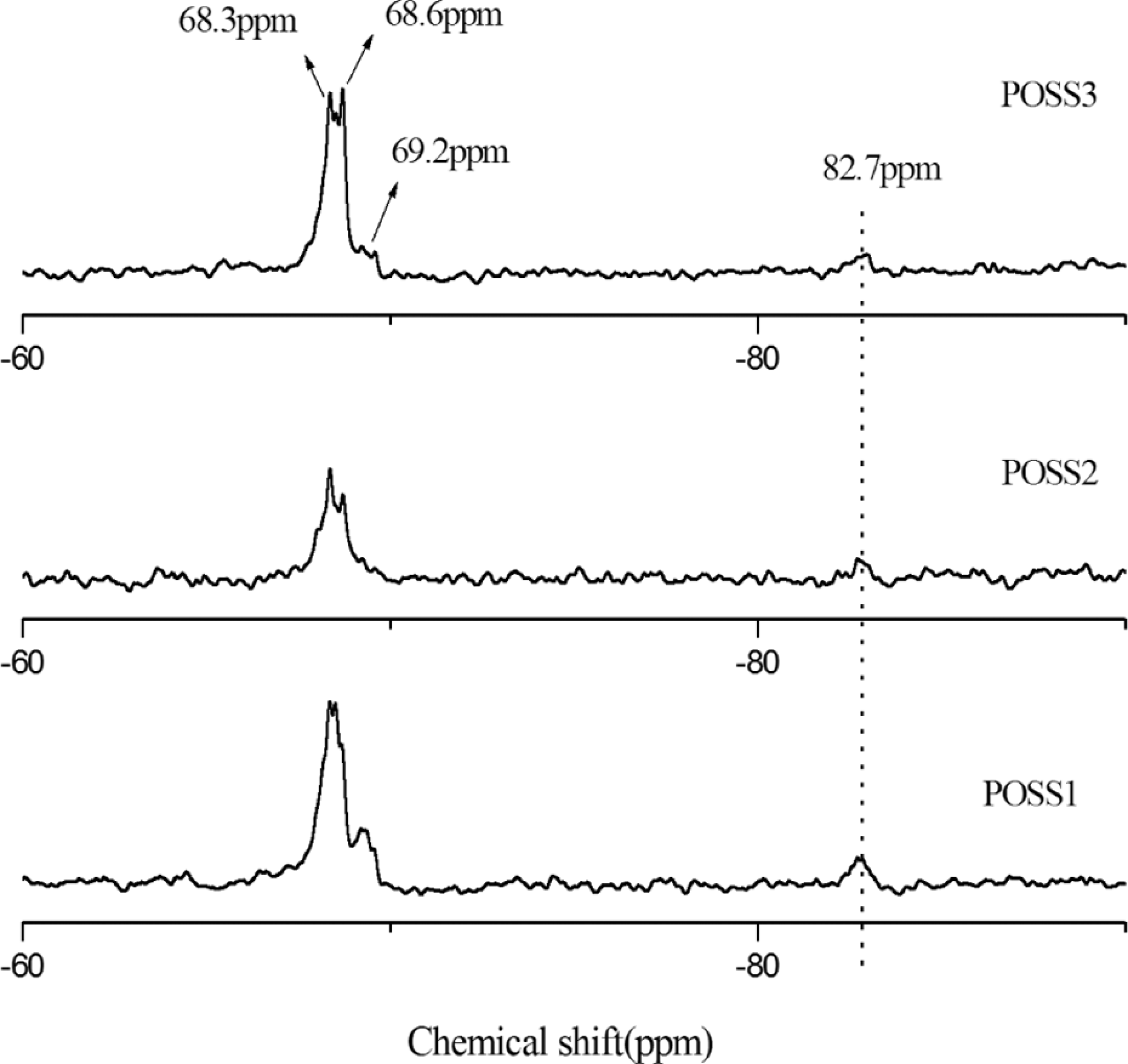
29Si-NMR spectra of the bifunctional polyhedral oligomeric silsesquioxanes in CDCl3: POSS1, [Si8O12(CH=CH2)(C3H6Cl)2(C3H7)5]; POSS2, [Si8O12(CH=CH2)2(C3H6Cl)(C3H7)5]; and POSS3, [Si8O12(CH=CH2)(C3H6Cl) (C3H7)6].
However, in the 29Si-NMR spectra of the three POSS compounds, the resonance at −82.7 ppm was assignable to the corner silicon atom connected with the vinyl groups. while the resonance at −69.2 ppm was ascribed to the silicon nucleus bonded to the chloropropyl groups and the peaks at −68.3 and −68.7 ppm were assigned to the remaining Si atoms bonded to the propyl groups. 14 The 29Si-NMR spectra in this study were partially enlarged in order to illustrate the resonance of silicon more clear and show the differences between these bifunctional POSS, So the resonances of silicon seems to be a broad signal. Actually, the resonances were sharp signals in the original picture (supporting information). On the basis of the results of 1H-NMR and 29Si-NMR spectra, it can be confirmed that the target compounds of the three bifunctional polyhedral oligomeric silsesquioxanes were successfully obtained.
The X-ray diffraction (XRD) patterns of the sample powders are shown in Figure 4. The XRD results showed the three samples to be crystalline with several sharp peaks. Among them, the XRD powder pattern for POSS1 shows peaks at 2θ = 8.6°, 11.6°, 20.4° and 21.1°, which corresponded to d-spacing of 10.1, 7.6, 4.3 and 4.2 Å, respectively. The peak corresponding to a d-spacing of 10.1 Å is caused by the size of the bifunctionalized POSS molecules whereas the other peaks were produced by the rhombohedral crystal structure of POSS molecules. 15,16 Furthermore, the diffraction patterns for POSS2 and POSS3 were exactly similar to that of the POSS1 compound. The highest intensity diffraction peaks at 2θ = 8.8° and 8.74° was observed in both samples and can be attributed to the overall dimensions of the POSS molecule. The XRD pattern for these bifunctional POSS shows sharp diffraction peaks as expected for highly crystalline compounds, and the products have rhombohedral structures. 17 –19
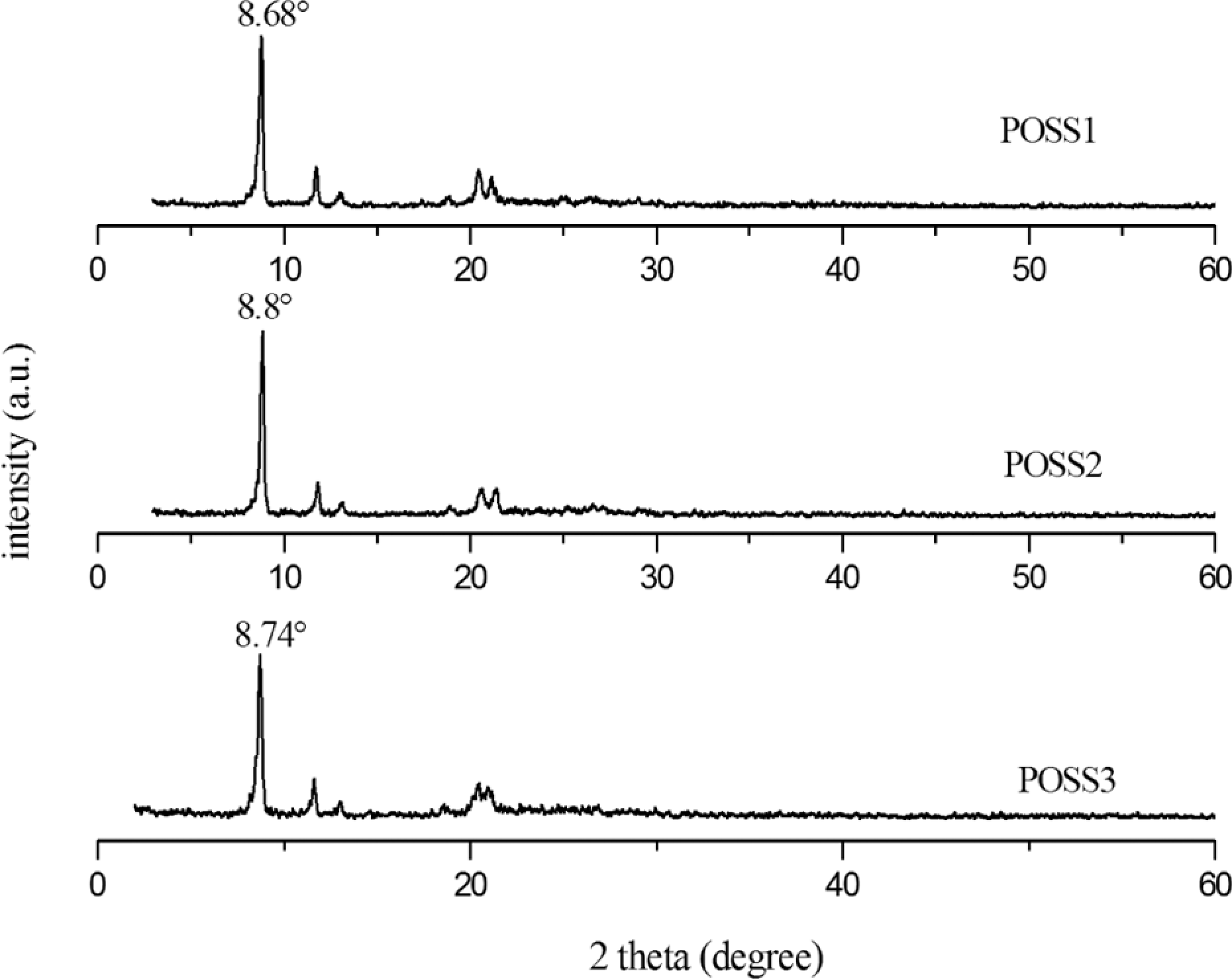
X-ray diffraction curve of the bifunctional polyhedral oligomeric silsesquioxanes.
In addition, the thermal properties of the products were also measured. The TGA curves of the target compounds carried out under air are shown in Figure 5. In the products, five kinds of main covalent bonds Si–O, C–C, Si–C, C=C and C–Cl separately possessed bond energy values of 460, 332, 347, 611 and 328 KJ mol−1. Hence, the degradation of the samples should start from initial cleavage of the C–Cl, C–C and Si–C bonds in the corner groups due to their lower bond energies. 20 The TGA curves of samples were quite similar and showed a significant thermal degradation from 200 °C. When the temperature was below 200 °C, the TGA curves displayed no significant change. The residual mass of POSS1, POSS2 and POSS3 separately corresponded to 54.0, 55.9 and 52.7%, whereas the expected results for complete conversion to SiO2 were 59.0, 62.9and 61.6%. It was obvious that the experimental values were slightly lower than the theoretical values, which was thought to be a result of the partial sublimation of the samples during testing. 21,22,23 Thus, it can be concluded that the mass loss not only resulted from the decomposition of the POSS cage but also the sublimation of the samples. 24,25
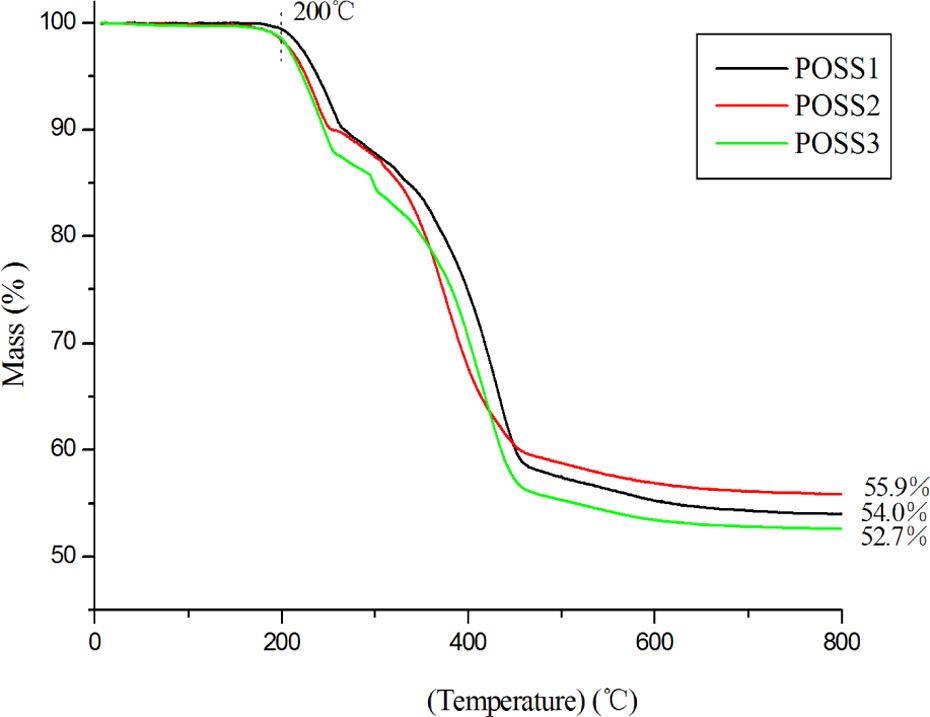
TGA thermograms of bifunctional polyhedral oligomeric silsesquioxanes at a ramp rate of 10 °C min−1 in the air flow.
Conclusion
A simple method to prepare bifuctional POSS through the cohydrolysis and cocondensation of three kinds of trialk-oxysilanes under acidic conditions by controlling the feed ratio of monomers is reported herein. The results of the study show that the domains of POSS cages were formed, and that the integral areas of protons in 1H-NMR spectra revealed that the composition ratios of the propyl, chloropropyl and vinyl groups attached to the cage structures corresponded to the assumed structures. Moreover, thermal gravimetric analysis under air flow indicated that the sublimation appeared to compete with decomposition and therefore the residual masses were slightly lower than the theoretical values that would be expected for complete conversion to silica. Herein, our study opens a new approach to achieve bifunctional POSS, due to the various functional groups attached on the POSS core, these specific POSS molecules can be functionally tuned and can easily be covalently linked into the polymer backbone to form hybrid polymers and nanocomposites.