






Abstract
A two-step route to an AB2 monomer that underwent polymerization via nucleophilic aromatic substitution to afford fluoro-terminated hyperbranched poly (aryl ether ketone)s (F-HPAEKs) was developed. The synthesis of 2,6-difluoro-4′-hydroxybenzophenone (AB2 monomer) was accomplished by the reaction of 2,6-difuorbenzoyl chloride with anisole, followed by deprotection of the phenolgroup with hydrobromide (HBr) in acetic acid. The polymerization of AB2 monomer in the presence of 4,4′-bis(2, 6-difluoro-benzoyl)diphenyl ether (B4 monomer) as a core molecule afforded F-HPAEKs with number-average molecular weights ranging from 5081 to 9964 Da and polydispersity index values ranging from 2.89 to 3.76. The presence of cyclic oligomeric species, formed by an intramolecular cyclization process, was a contributing factor to the relatively low molecular weights. The degree of branching (DB) of the HPAEK samples was estimated by a comparison of the 19F-NMR spectra of the polymer samples with those of a series of model compounds, and DB values ranging from 0.54 to 0.58 were determined. The glass transition temperatures for HPAEK samples were in the range of 157–176°C, as determined by differential scanning calorimetry.
Introduction
Branched polymers such as dendrimers 1 and hyperbranched systems 2 have received considerable attention in recent years because they possess an interesting blend of characteristics, including a large number of end groups, good solubility, and low intrinsic viscosity. The synthesis of dendrimers generally requires a stepwise approach with a purification process at each generation. Although the synthesis of dendrimer is somewhat time-consuming, they provide excellent samples for studies of fundamental properties. On the other hand, the synthesis of hyperbranched polymers could be carried out with one-pot procedures, which greatly reduce the time required for their synthesis. The tradeoff with hyperbranched polymers is that they tend to have less well-defined structures, statistical branching structures, and broad molecular weight distributions.
The synthesis of hyperbranched polymers could be achieved through a number of methods, including: (1) the polycondensation of ABn monomers, 3 (2) self-condensing vinyl polymerization, 4 –6 (3) A2 + B3 routes, 7,8 A2 + BB′2 routes 9,10 and AA* + B2B* routes. 11,12 The present authors’ recent efforts have been focused on the synthesis of hyperbranched poly(aryl ether ketone)s (HPAEKs) with controlled molecular weights (M n). Hawker and Chu 13 previously reported the synthesis of HPAEKs via an AB2 monomer, and control of HPAEKs’ M n by adding B3 monomer. The authors’ group also synthesized HPAEKs via the A2 + B3 or A2 + BB′2 approaches. 9,10 However, the M n of HPAEKs was adjusted by controlling the feed ratio of A2 and B3 or A2 and BB′2. To the best of the authors’ knowledge, HPAEKs prepared via the AB2 + B4 method have not yet been reported. This work describes an efficient route to HPAEKs via an AB2 type monomer (2,6-difluoro-4′-hydroxybenzophenone), and subsequent polymerization in the presence of B4 monomer as a core molecule. The effects of the presence or absence of B4 monomer on the M n, PDI and other properties of HPAEKs prepared via the AB2 route are discussed.
Experimental
Materials
2,6-Difuorbenzoyl chloride, aluminum chloride, anisole, diphenyl ether, hydrobromide, tetramethylene sulfone (TMS) were obtained from commercial sources and used as received. 1,2-Dichloroethane were washed with concentrated sulfuric acid, distilled water, dilute alkaline solution, and again distilled water in sequence. Finally, 1,2-dichloroethane was dried over anhydrous calcium chloride. K2CO3 and Na2CO3 were dried at 120°C for 24 h before being used for polymerization. 2,6-Difluoro-4′-methoxybenzophenone, 13 2,6-difluoro-4′-phenoxybenzophenone (terminal model compound), 9 2-fluoro-4′,6-diphenoxybenzophenone (linear model compound) 9 were synthesized according to the procedure described previously (Scheme 1).

Synthesis route of terminal (a) and linear (b) model compounds.
Measurements
Mass spectra (MS) were performed on an AXIMA-CFR laser desorption ionization flying time spectrometer (COMPACT). IR spectra (KBr) were measured on a Nicolet Impact 410 Fourier transform infrared spectrometer. 1H-NMR and 19F-NMR spectra were recorded on a Bruker 510 NMR spectrometer (500 MHz). Gel permeation chromatograms (GPC) using polystyrene as a standard were obtained on a Waters 410 instrument with N, N-dimethylformamide as an eluent. Differential scanning calorimetry (DSC) measurements were performed on a Mettler Toledo DSC821e instrument at a heating rate of 10°C min−1 under nitrogen. Thermal gravimetric analysis (TGA) were determined in a nitrogen atmosphere using a heating rate of 10°C min−1.
Synthesis
Synthesis of 2,6-Difluoro-4′-hydroxybenzophenone (AB2 monomer, Scheme 2)

Synthesis route of AB2 monomer.
A mixture of 2,6-difluoro-4′-methoxybenzophenone (10 g, 40.3 mmol), glacial acetic acid (90 mL), and 48% HBr (60 mL) was heated at reflux for 8 h. The reaction mixture was cooled and evaporated to dryness, distilled water (400 mL) was added, and the mixture was extracted with ether (3 × 150 mL). The combined extracts were evaporated to dryness. The crude product was purified by recrystallization from benzene to give 2,6-difluoro-4′-hydroxybenzophenone as a white solid: 85% yield. Mp: 181°C; MALDI-TOF MS: m/z = 234; 1H-NMR (DMSO-d6 , ppm): δ = 10.78(s, 1H, Ha), δ = 7.67–7.70(d, 2H, Hc, J = 14.5), δ = 7.60–7.64(t, 1H, He, J = 12.75), δ = 7.24–7.30(t, 2H, Hd, J = 13.25), δ = 6.90–6.94(d, 2H, Hb, J = 14.5); 13C-NMR (DMSO-d6 , ppm): δ = 113.0(2C, Cb), δ = 116.8(2C, Ch), δ = 117.6(1C, Cd), δ = 128.6(1C, Cf), δ = 133.1(2C, Cg), δ = 133.4(1C, Ca), δ = 158.6,160.6(2C, Cc), δ = 164.6(1C, Ci), δ = 187.2(1C, Ce).
Synthesis of 4,4′-bis(2,6-difluoro-benzoyl)diphenyl ether (B4 monomer, Scheme 3)

Synthesis route of B4 monomer.
6.8 g of diphenyl ether (40.0 mmol), 26.8 g of anhydrous aluminum chloride (0.20 mol) and 60 mL of dichloroethane were placed in a 250 mL three-neck flask, which was equipped with an additional funnel and a calcium chloride drying tube. The solution of 14.173 g of 2,6-difluorobenzoyl chloride (90 mmol) and 15 mL of dichloroethane was slowly dripped into the flask while stirring. After the addition was complete, the reaction mixture was stirred for 48 h at room temperature. A small amount of distilled water was added very slowly to the reaction mixture and stirring continued for 15 min. The reaction mixture was then poured into 250 mL of distilled water, which was extracted with dichloromethane. The organic layer was collected, washed with distilled water, dried over sodium sulfate, filtered and evaporated. The crude product was recrystallized from methanol with active carbon to afford 4,4′-bis(2, 6-difluoro-benzoyl)diphenyl ether as a white solid: 75% yield. Mp: 180°C; MALDI-TOF MS: m/z = 450; 1H-NMR (DMSO-d6 , ppm): δ = 7.89–7.93(d, 4H, Ha, J = 14.5), δ = 7.65–7.75 (quintet, 2H, Hb), δ = 7.29–7.35 (m, 8H, Hc and Hd); 13C-NMR (DMSO-d6 , ppm): δ = 113.1(4C, Cb), δ = 117.2(2C, Cd), δ = 120.4(4C, Ch), δ = 133.0(4C, Cg), δ = 134.0(2C, Cf), δ = 134.2(2C, Ca), δ = 158.7,160.7 (4C, Cc), δ = 161.4(2C, Ci), δ = 187.9(2C, Ce)
Synthesis of fluoro-terminated hyperbranched poly (aryl ether ketone)s (F-HPAEKs, Schemes 4 and 5)

Self-condensation reaction of AB2.
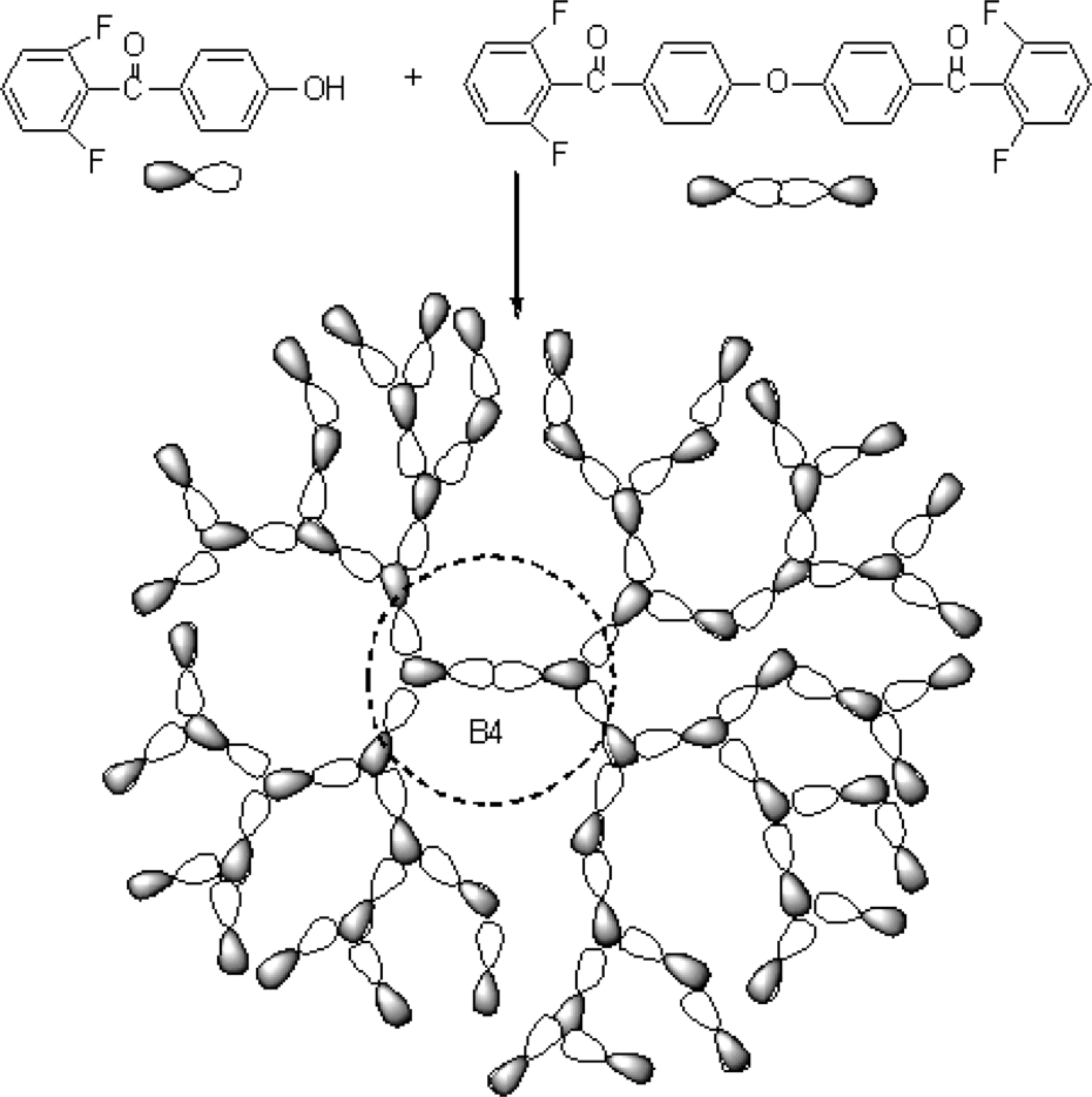
Reaction of AB2 and B4.
A typical experimental procedure was as follows: AB2 monomer (3.51 g, 15 mmol), B4 monomer (0.135 g, 0.2 mmol), K2CO3 (1.104 g, 8 mmol) were dissolved in TMS (15 mL) and toluene (10 mL) in a 50 mL three-necked flask fitted with a nitrogen inlet, a thermometer, a Dean-Stark trap, and a mechanical stirrer, and the apparatus was purged with nitrogen. The reaction mixture was heated at reflux for 2 h to ensure complete dehydration. After removing toluene, the reaction mixture was heated to about 220°C for 8 h under a nitrogen atmosphere. After being poured into deionized water (500 mL), the precipitate was collected by filtration. The crude product was reprecipitated from deionized water into ethanol twice to give fluoro-terminated hyperbranched poly (aryl ether ketone) as a gray solid: 80% yield.
Results and discussion
The AB2 monomer containing two fluoro groups and one phenolic group was successfully designed and synthesized. As illustrated in Scheme 2, AB2 monomer was synthesized by a Friedel–Crafts acylation reaction, followed by deprotection of the phenolic group. The chemical structure of AB2 monomer was confirmed by MS, 1H-NMR (Figure 1) and 13C-NMR spectroscopy (Figure 2).

1H-NMR spectrum of AB2 monomer.

13C-NMR spectrum of AB2 monomer.
The core molecule B4 monomer was synthesized by Friedel–Crafts acylation reaction in order to control the molecular weight (M n) of the F-HPAEKs, as presented in Scheme 3. The chemical structure of B4 monomer was confirmed by MS, 1H-NMR (Figure 3) and 13C-NMR spectroscopy (Figure 4). Polymerization of AB2 with different mole ratio of B4 (mol.% of 100 : 0, 75 : 1 and 25 : 1) in the presence of K2CO3 in TMS at 150–220°C for 6 h produced three F-HPAEKs with different M n.

1H-NMR spectrum of B4 monomer.

13C-NMR spectrum of B4 monomer.
Synthesis of F-HPAEKs is shown in Schemes 4 and 5. The chemical structure of F-HPAEK was approved by IR, 1H-NMR and 19F-NMR. The bands at 3066 cm−1 (Ar–H stretching), 1675 cm−1 (C=O stretching) and 1112 cm−1 (–O– stretching) are the characteristic absorption bands of hyperbranched poly (aryl ether ketone)s. In addition, the bands around 1237 and 1277 cm−1 were attributed to the stretching of terminal fluoro groups in F-HPAEKs. These results indicate that F-HPAEKs had been prepared successfully. Figure 5 displays the signal assignments of 1H-NMR spectra of F-HPAEKs in DMSO. The broad aromatic signals between 6.7 and 8.0 ppm are typical of a hyperbranched poly (aryl ether ketone).

1H-NMR spectra of the fluoro-terminated hyperbranced poly(aryl ether ketone).
Figure 6 depicts the signal assignments of 19F-NMR spectra of F-HPAEKs in DMSO. The two main signals at −113.8 and −114.5 ppm are assigned to the terminal and linear units of the F-HPAEKs (see the DB section for a discussion of these assignments), respectively. The small upfield signal present at −115.2 ppm is assigned to cyclic dimer. This assignment is based on the observation of a signal present at −106.0 ppm for proton α in the analogous cyclic dimer prepared from 3,5-difluoro-4′-hydroxydephenyl sulfone, as reported by Himmelberg and Fossum. 14 .

19F-NMR spectra of the fluoro-terminated hyperbranced poly(aryl ether ketone): (a) AB2 : B4 = 100 : 0; (b) AB2 : B4 = 75 : 1; (c) AB2 : B4 = 25 : 1.
The results about the number-average molecular weights and the polydispersity indexes of F-HPAEKs are shown in Table 1. The molecular weights of the three different F-HPAEKs were determined by GPC analysis calibrated with linear polystyrene standards. Hyperbranched polymers with the core molecule B4 are generally expected to exhibit the lower molecular weight in comparison with their analogues without the core molecule B4. Moreover, the M n of hyperbranched polymers further decreases with increasing the content of the core molecule B4. There are two potential reasons that the M n decreases with the increase in the content of the core molecule B4. On the one hand, the presence of the core molecule B4 resulted in the higher DB of F-HPAEKs compared to the absence of the core molecule B4, followed by the shorter branches or the smaller hydrodynamic volume for F-HPAEKs. On the other hand, the observed gradual decrease in M n values might be the result of a competing intramolecular cyclization process. If small cyclic structures are formed, they could reduce the molecular weight by consuming monomer or acting as additional core molecules. Intramolecular cyclization has been observed in the synthesis of a number of hyperbranched polymers, such as poly(ester)s, 15 poly(siloxysilane)s, 16 and poly(ether ketone)s 17 prepared from AB2 monomers. The tetrahedral geometry of 2,6-difluoro-4′-hydroxybenzophenone (AB2 monomer) most likely enhances the formation of low molecular-weight cyclic species.
Reaction conditions and results of polymerization.

Differential scanning calorimetry (DSC) was used to characterize the thermal transition and the results of DSC are shown in Table 1. The results of DSC revealed that the polymers were amorphous in structure. Moreover, shorter branches of hyperbranched polymers with the core molecule B4 and the increase of the degree of branching, probably caused the decrease of T g compared to hyperbranched polymer without the core molecule B4. Thermal gravimetric analysis of the polymers show a high thermal stability with more than 95% of their mass (T d5) retained up to 430°C, as proven in Table 1.
The DB for the F-HPAEKs prepared in this study was estimated by the determination of the relative number of dendritic, linear, and terminal units present in the polymers via the use of NMR spectroscopy. Unfortunately, the 1H-NMR spectra of the terminal, linear and dendritic units (Figure 5) could not be used to determine the DB for F-HPAEKs. However, a straightforward estimation of the DB for F-HPAEKs was achieved via the use of 19F-NMR spectroscopy. According to a modified version of the DB equation (Equation (1)) presented by Hawker and Chu,
13
in which T is the number of terminal units and L is the number of linear units, the DB value (DB) can be determined without the number of dendritic units being determined directly:
The 19F-NMR spectra of F-HPAEKs are shown in Figure 6. From these spectra, the most downfield signal for F-HPAEKs is assigned to the terminal unit, and the more upfield signal is assigned to the linear unit. The DB value was then estimated for F-HPAEKs, and the values are listed in Table 1. It was found that the DB for hyperbranched polymers with the core molecule B4 was slighter higher than that for hyperbranched polymer without the core molecule B4.
Conclusions
A two-step synthesis of an AB2 monomer for an efficient synthesis of F-HPAEKs was developed. The polymerization of AB2 monomer under typical nucleophilic aromatic substitution conditions provides the corresponding F-HPAEKs with M n values ranging from 5081 to 9964 and PDI values ranging from 2.89 to 3.51. Polymerization reactions performed at the creation of the B4 core molecule or the higher concentrations of the B4 core molecule led to F-HPAEKs with lower M n values because of the higher degree of branching and the presence of intramolecular cyclization. The DB values for F-HPAEKs were determined to be between 0.54 and 0.58 on the basis of 19F-NMR chemical shifts of model compounds. The F-HPAEKs samples displayed T g values ranging from 157 to176°C and 5% weight losses up to 430°C in nitrogen.
Footnotes
Acknowledgments
The authors gratefully acknowledge financial support of this research by Jilin Province Science and Technology Development Program of China (20096022).