







Abstract
A new diamine monomer, 2,2′-bis(4-aminophenyl)-5,5′-bibenzimidazole (BAPBI), has been simply synthesized via a one-step reaction procedure of 4-aminobenzoic acid and 3,3′-diaminobenzidine in polyphosphoric acid (PPA) at 190°C. A series of sulfonated copolyimides (SPIs)-containing benzimidazole groups have been prepared by random copolymerization of 1,4,5,8-naphthalenetetracarboxylic dianhydride, BAPBI, 4,4′-bis(4-aminophenoxy)biphenyl-3,3′-disulfonic acid and nonsulfonated diamines in m-cresol at 180°C. Transparent and tough SPI membranes are obtained by solution cast method. The SPIs show high decomposition temperatures (∼300°C) of sulfonic acid groups, indicating good thermal stability. Covalent cross-linking was successfully achieved by treating the SPI membranes in PPA at 170°C for 10 h. The covalently cross-linked SPI membranes show much improved radical oxidative stability due to the synergic action of the covalent cross-linking and the incorporation of benzimidazole groups into the polymer structure. The covalent cross-linking is also favorable for improving the hydrolytic stability of the SPI membranes. However, the proton conductivity decreased to some extent because the sulfonic acid groups had been partially consumed during the process of covalent cross-linking.
Keywords
Introduction
Polymer electrolyte membrane fuel cells (PEMFCs) have been identified as the most promising power sources for vehicular transportation and for other applications requiring cleaning, quiet and portable power. Polymer electrolyte membrane (PEM) is one of the key components of a PEMFC system. Current state-of-the-art PEMs used in practical systems are sulfonated perfluoropolymers, typically DuPont’s Nafion, which have high proton conductivity and high chemical and electrochemical stability. However, some drawbacks such as high cost, low working temperatures and high methanol permeability of the perfluoropolymers seriously limit their industrial application. In the past decade, a great variety of low-cost sulfonated hydrocarbon polymers have been developed as alternative PEMs to replace Nafion. The hydrocarbon membranes are generally cost-effective and many of them even have higher proton conductivity and higher mechanical strength than Nafion. 1 –30 However, in comparison with Nafion, most of the sulfonated hydrocarbon polymers have a drawback of poor chemical stability, in particular, the radical oxidative stability which has been identified to be the main reason for PEM degradation. 31 Membrane swelling is another problem associated with many sulfonated hydrocarbon membranes, that is, the membranes highly swelled due to the high ion exchange capacities (IECs) which are essential to achieve high proton conductivity. It is highly desired to develop new PEMs with high proton conductivity, high mechanical strength, low swelling ratio and high chemical stability.
Aromatic polyimides (PIs), known for their high thermoxidative stability, high mechanical strength and modulus, excellent electrical properties and superior chemical resistance, have found wide applications in industry. In the past decade, six-membered ring sulfonated polyimides (SPIs) have been extensively studied as potential PEMs because of their structural varieties and excellent thermal and mechanical properties. 20 –30 The hydrolytic stability of the imide rings of the SPIs can be greatly improved using the sulfonated diamine monomers with high basicity (amino groups) for polymer synthesis. With regard to the issue of radical oxidative stability, recently we have found that the synergic action of the incorporation of benzimidazole groups into polymer backbones and the covalent cross-linking is very effective for improving the radical oxidative stability of the SPIs. 32 The SPIs were prepared from an imidazole containing diamine monomer, 2-(4-aminophenyl)-5-aminobenzimidazole, which was synthesized via multiple-step reaction procedures. To investigate a facile synthetic approach, in this study, a new benzimidazole group containing diamine monomer, 2,2′-bis(4-aminophenyl)-5,5′-bibenzimidazole (BAPBI), has been simply synthesized via a one-step reaction procedure. A series of BAPBI-based SPIs have been prepared and the properties of the covalently cross-linked membranes have been investigated.
Experimental
Materials
4-Aminobenzoic acid (ABA) and 3,3′diaminobenzidine (DAB) were purchased from Acros (Ceel, Belgium). 1,4,5,8-Naphthalenetetracarboxylic dianhydride (NTDA) was purchased from Beijing Multi Technology Co., Ltd (Beijing, China). 9,9-Bis(4-aminophenyl)fluorene (BAPF) was purchased from Aldrich (St. Louis, USA). 1,3-Bis(4-aminophenoxy)benzene (BAPBz) was kindly supplied by Changzhou Sunlight Medical Raw Materials Co., Ltd (Changzhou, China). 4,4′-Bis(4-aminophenoxy)biphenyl-3,3′-disulfonic acid (BAPBDS) was synthesized according to our previously reported method. 23 Polyphosphoric acid (PPA, phosphorus pentoxide assay: 80%), phosphorus pentoxide, triethylamine (Et3N), m-cresol, dimethyl sulfoxide (DMSO), N,N-dimethylacetamide (DMAc), 1-methylpyrrolidone (NMP) and benzoic acid were purchased from Sinopharm Chemical Reagent Co., Ltd. (Shanghai, China). NTDA was dried at 160°C in vacuo for 20 h before use. DMSO, DMAc, NMP and Et3N were distilled under reduced (for DMSO, DMAc and NMP) or normal (for Et3N) pressure and dried with 4A molecular sieve prior to use. Other reagents were used as received.
Synthesis of BAPBI
To a 100-mL dry 3-neck flask equipped with a nitrogen inlet and outlet and a mechanical stirring device were added 35 g of PPA and 12 g of phosphorus pentoxide. The mixture was stirred and heated at 80°C till phosphorus pentoxide was completely dissolved. After cooling to room temperature, 2.143 g (10.0 mmol) of DAB and 2.743 g (20.0 mmol) of ABA were added to the flask. The reaction mixture was stirred at room temperature for 0.5 h and then heated at 190°C for 20 h. After cooling to ∼60°C, the reaction mixture was poured into ∼500 g ice/water. The resulting precipitate was collected by filtration and then magnetically stirred in ∼5 wt% sodium bicarbonate overnight under nitrogen flow. It was filtered and the solid was thoroughly washed with deionized water and finally dried at 80°C under vacuum for 10 h. White solid of 3.83 g was obtained, yield: 92%. Melting point (by differential scanning calorimetry): 225.6°C. The thermogravimetric curve is shown in Figure 1. The first stage weight loss (∼8%) ranging from room temperature to ∼130°C is due to the evaporation of the absorbed moisture. Such a weight loss corresponds to 2.0 water molecules per BAPBI molecule. Elemental analysis for C26H20N6·2.0H2O: Cal.: C, 69.0; H, 5.31; N, 18.6. Found: C, 66.4; H, 5.60; N, 17.7.

TGA curve of the BAPBI monomer in nitrogen at a heating rate of 10 K min− 1. BAPBI: 2,2′-bis(4-aminophenyl)-5,5′-bibenzimidazole; TGA: thermogravimetric analysis.
Polymerization
The experimental procedures for the synthesis of sulfonated poly(benzimidazole imide)s are described as follows using the copolymer NTDA-BAPBDS/BAPBI/BAPF (5/1/1, by mole) as an example.
To a 100-mL completely dried 3-neck flask were added 1.056 g (2.0 mmol) of BAPBDS, 20.0 mL m-cresol and 0.80 mL of Et3N under nitrogen flow with stirring. After BAPBDS was completely dissolved, 0.1664 g (0.4 mmol) of BAPBI, 0.1392 g (0.4 mmol) of BAPF, 0.7504 g (2.8 mmol) of NTDA and 0.683 g (5.6 mmol) of benzoic acid were added. The mixture was stirred at room temperature for a few minutes and then heated at 80°C for 4 h and 180°C for 20 h. After cooling to room temperature, the highly viscous solution mixture was diluted with additional 10.0 mL m-cresol and then poured into 200 mL of acetone with stirring. The fiber-like precipitate was filtered off, washed with acetone and dried in vacuo at 80°C for 10 h.
Membrane formation and proton exchange
The SPIs in their triethylammonium salt form were dissolved in m-cresol (∼5 wt%) followed by casting onto glass plates and heating at 110°C for 10 h. The as-cast films were soaked in methanol at 60°C for 20 h to remove the residual solvent and then were immersed in 1.0 M sulfuric acid at room temperature for 3 days for the proton exchange. The resulting films were thoroughly washed with deionized water till the rinsed water became neutral followed by drying in vacuo at 120°C for 20 h.
Measurements
Fourier-transform infrared (FT-IR) spectra of the polymer membranes with thickness of about 10–30 µm were recorded on a Perkin-Elmer Paragon 1000PC spectrometer (Perkin-Elmer, Waltham, Massachusetts, USA). Proton nuclear magnetic resonance (1H NMR) spectra were recorded on a Varian Mercury Plus 400 MHz Instrument (Palo Alto, California, USA). Thermogravimetric analysis (TGA) was performed in air with a TGA 2050 Instrument (TA Instruments, New Castle, Delaware, USA) at a heating rate of 10°C min−1. Prior to TGA measurement, the polymer samples were preheated at 120°C for 15 min. The inherent viscosities (η inh) were measured in m-cresol with an Ubbelohde viscometer (Interglassware, Shanghai, China) at 30°C. Tensile measurements were performed with an Instron 4456 Instrument (Instron Co., Canton, Massachusetts, USA) in ambient atmosphere at a crosshead speed of 5 mm min−1.
Water uptake measurements were carried out by immersing the membranes (0.2–0.3 g per sheet) in deionized water at 80°C for 5 h. Then the membranes were taken out, wiped with tissue paper and quickly weighed on a microbalance. Water uptake S was calculated from

where W d and W s refer to the weight of dry (before immersion in water) and wet membranes, respectively.
Proton conductivity was measured using a four-point probe electrochemical impedance spectroscopy technique over the frequency range from 100 Hz to 100 kHz (Hioki 3552).
24
A sheet of the SPI membrane (proton form) and two pairs of blacken platinum plate electrodes were set in a Teflon cell. The cell was placed in either a thermocontrolled humid chamber for measurement at relative humidity (RH) lower than 100% or distilled deionized water for measurement in liquid water. The resistance value was determined from the high-frequency intercept of the impedance with the real axis. Proton conductivity was calculated from the following equation

where d is the distance between the two electrodes, t s and w s are the thickness and width of the membrane and R is the resistance value measured.
Results and discussion
Monomer and polymer synthesis
The novel benzimidazole-based diamine monomer, BAPBI, was readily synthesized via a one-step reaction of ABA with DAB in PPA at 190°C (Figure 2) at a high yield (92%). The chemical structure of the synthesized BAPBI was characterized by 1H NMR (Figure 3(a)) and carbon nuclear magnetic resonance (13C NMR; Figure 3(b)) spectra as well as elemental analysis (see Experimental section). As shown in Figure 3(a) and (b), the peak assignments and the integral area ratio of the peaks are just consistent with the chemical structure of the BAPBI. The chemical structure of the BAPBI was also characterized by the FT-IR spectrum (not shown). The characteristic absorption bands at 3500–2700 cm− 1 (–NH stretching of imidazole rings) and 1640 cm− 1 (C=N stretching) indicate the presence of imidazole rings. The characteristic absorption bands at 3430 cm− 1 and 3350 cm− 1 are due to the N–H stretching of the primary amino groups (overlapped with that of imidazole N–H stretching). The characteristic absorption bands at 3070 cm− 1 (C–H stretching of benzene rings), 1608 cm− 1 and 1494 cm− 1 (C=C stretching of benzene rings) indicate the presence of benzene rings.
Synthesis of BAPBI. BAPBI: 2,2′-bis(4-aminophenyl)-5,5′-bibenzimidazole.
(a) 1H NMR and (b) 13C NMR spectra of the synthesized BAPBI in DMSO-d 6. BAPBI: 2,2′-bis(4-aminophenyl)-5,5′-bibenzimidazole; DMSO: dimethyl sulfoxide; 1H NMR: proton-nuclear magnetic resonance; 13C NMR: carbon-nuclear magnetic resonance.
A series of novel SPIs were synthesized via the random condensation polymerization of NTDA with BAPBDS, BAPBI and BAPF (or BAPBz) in m-cresol in the presence of benzoic acid and triethylamine at 180°C for 20 h (Figure 4). The selection of BAPBDS as the sulfonated diamine monomer is based on the consideration that the BAPBDS-based sulfonated polyimide membranes have been proved to have excellent hydrolytic stability, 23 while BAPF and BAPBz were used to provide activated benzene rings for covalent cross-linking. 33
Synthesis of the SPIs containing benzimidazole groups. SPI: sulfonated copolyimide.
The reduced viscosities are 2.04, 1.94, 0.93, 1.87 and 2.41 dL g−1, respectively, for SPI-1, SPI-2, SPI-3, SPI-4 and SPI-5 in m-cresol at a polymer concentration of 0.5 g dL−1 at 30°C. All the synthesized SPIs in their triethylammonium salt form are soluble in m-cresol but insoluble in other organic solvents such as DMSO, DMAc or NMP. After proton exchange treatment, all the SPIs became completely insoluble in all the tested solvents. All the SPIs could form transparent and tough membranes by solution cast method indicating that high molecular polymers have been successfully synthesized.
Covalent cross-linking
The synthesized SPIs contain the acidic sulfonate groups and the basic benzimidazole groups leading to ionic cross-linking due to the acid–base interaction. Because the protons are tightly bonded to the benzimidazole groups which seriously restrict the proton transport, the ionic cross-linking density must be controlled at a low level (low fraction of the BAPBI relative to the BAPBDS) to ensure high proton conduction. To achieve low swelling ratio, covalent cross-linking is needed which is a common method to suppress membrane swelling and to improve membrane stability. We have previously reported that sulfonated polymer membranes of which chemical structures contain activated benzene rings can be readily cross-linked by immersing the membranes in phosphorus pentoxide in methanesulfonic acid (1:10 by weight) at 80°C or PPA at elevated temperatures (e.g. 180°C) for a period of time. 33 –35 The cross-linking mechanism is based on the phosphorus pentoxide-catalyzed condensation reaction between the sulfonic acid groups and the activated benzene rings. The key merit of this cross-linking technique is that it is unnecessary to introduce special cross-linkable groups into polymer structure but just to use small part of the sulfonic acid groups and thus complicated synthetic procedures are avoided. Moreover, the resulting cross-linking bond, sulfonyl, is highly stable which is very helpful for improving the durability of the membranes. By controlling the molar ratio between the sulfonated monomer and the activated benzene ring-containing monomer as well as the cross-linking conditions (temperature, time, etc.), the cross-linking density can be readily controlled. In this study, we found that all the SPI membranes could be covalently cross-linked by immersing them in PPA (assay: 86% P2O5) at 180°C for 10 h judging from the fact that the membranes became completely insoluble in m-cresol on heating after being converted into their triethylammonium salt form.
Figure 5 shows the FT-IR spectra of the covalently cross-linked and the noncross-linked SPI-3 membranes. Apparently, the two spectra are almost identical. However, careful examination of the relative intensities of the absorption bands revealed that the bands at 1092 cm−1 and 1024 cm−1 (O=S=O stretching of sulfonate groups) became weakened after the covalent cross-linking treatment. This is because the sulfonic acid groups have been partly consumed during the process of covalent cross-linking as discussed above. Since the benzene and naphthalene moieties are extremely stable, the characteristic absorption band at 1582 cm−1 due to the C=C stretching of the aromatic rings can be used as the internal standard. Thus, the intensity ratio of the absorption band at 1092 cm−1 or 1024 cm−1 to the band at 1582 cm−1 just reflects the content of the sulfonic acid groups. It is found that the covalent cross-linking caused a decrease in the intensity ratio by 29.4% based on 1092 cm−1 or 27.7% based on 1024 cm−1. This is consistent with the loss of IEC (28.3%) as will be discussed later.
FT-IR spectra of the covalently cross-linked and the noncross-linked SPI-3 membranes. SPI: sulfonated copolyimide; FT-IR: Fourier-transform infrared.
Thermal stability
Figure 6 shows the TGA curves of the covalently cross-linked and the noncross-linked SPI-1 and SPI-2 membranes in nitrogen. The small weight loss (<2%) in the range from room temperature to ∼200°C is attributed to theevaporation of the trace amount of absorbed moisture in the samples due to the incomplete drying. The weight loss in the range ∼300–500°C is due to the decomposition of the sulfonic acid groups. From the weight loss values at this stage, the weight content of sulfonic acid groups is estimated to be 18.4% for the SPI-1 without covalent cross-linking, which is roughly close to the theoretical value (17.7%). For the covalently cross-linked SPI-1, the weight content of sulfonic acid groups is estimated to be 16.3%. The lower sulfonic acid content of the covalently cross-linked sample is due to the fact that small part of the sulfonic acid groups have been consumed during the covalent cross-linking process as has been discussed in the foregoing section. Similar phenomenon has been observed with other SPIs. The TGA data indicate good thermal stability of the SPIs.
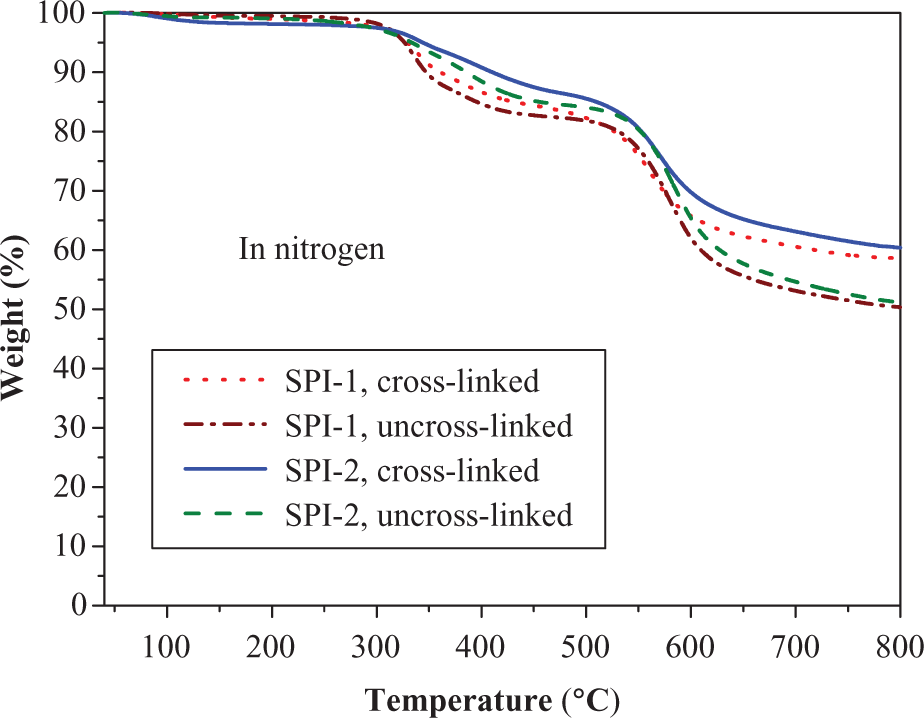
TGA curves of the covalently cross-linked and the noncross-linked SPI-1 and SPI-2 membranes in nitrogen at a heating rate of 10 K min−1. SPI: sulfonated copolyimide; TGA: thermogravimetric analysis.
Chemical stability
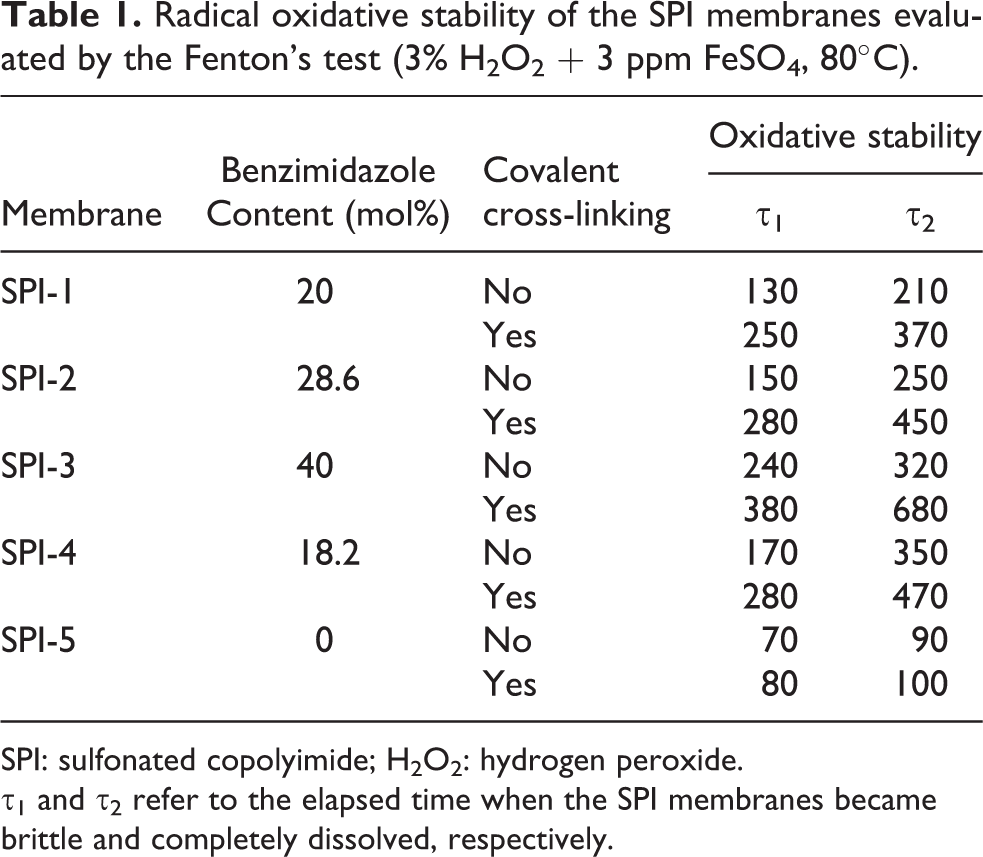
It has been proved that the radical oxidation-induced polymer degradation is one of the main reasons that cause deterioration of proton exchange membranes. 32 Peroxide radicals (hydroxyl and hydroperoxy radicals) are formed in fuel cells due to the oxygen permeation through the membrane from the cathode side and reduction at the anode side. Therefore, it is very important to develop proton exchange membranes with high radical oxidative stability. The radical oxidative stability is usually evaluated by the Fenton’s test. In this study, the SPI membranes were soaked in 3% hydrogen peroxide containing 3 ppm FeSO4 at 80°C and the elapsed time when the SPI membranes became brittle (τ 1) or completely dissolved (τ 2) was recorded as the radical oxidative stability. Table 1 lists the Fenton’s test data of the SPI membranes. It can be seen that all the covalently cross-linked BAPBI-containing SPI membranes show much longer τ 1 and τ 2 than the corresponding membranes without covalent cross-linking. For example, the covalently cross-linked SPI-1 has a τ 1 of 250 min and a τ 2 of 370 min that are almost twice as long as that (τ 1 = 130 min, τ 2 = 210 min) of the membrane without covalent cross-linking. This indicates that the covalent cross-linking is very effective for improving the radical oxidative stability of the benzimidazole-containing SPI membranes.
Radical oxidative stability of the SPI membranes evaluated by the Fenton’s test (3% H2O2 + 3 ppm FeSO4, 80°C).
SPI: sulfonated copolyimide; H2O2: hydrogen peroxide.
τ 1 and τ 2 refer to the elapsed time when the SPI membranes became brittle and completely dissolved, respectively.
To investigate the effect of benzimidazole groups of BAPBI on the radical oxidative stability, the SPI-5 containing no benzimidazole group was synthesized and its radical oxidative stability was also investigated. As shown in Table 1, the SPI-5 membrane which contains no benzimidazole group has a τ 1 of only 70 min and a τ 2 of 90 min which are much shorter than those of the BAPBI-containing SPI membranes. Moreover, the SPIs with higher benzimidazole group content tend to have better radical oxidative stability. It should noted that for the SPI-5 membrane, the covalent cross-linking caused only slightly increased radical oxidative stability judging from a little longer τ 1 and τ 2 of the cross-linked membrane. This indicates that the synergic action of the covalent cross-linking and the incorporation of benzimidazole groups into polymer structure is responsible for the high radical oxidative stability of the SPI membranes.
Hydrolysis-induced polymer chain degradation is another important reason for the deterioration of SPI membranes. This is because water molecules can attack the carbonyl carbons in imide rings leading to disclosure of the imide rings in the first step and scission of polymer main chain in the second step. We have previously reported that the hydrolytic stability of SPIs is mainly determined by the basicity of the amino groups of the sulfonated diamines and the SPIs derived from the sulfonated diamines with higher basicity tend to have better hydrolytic stability. 20 –24 The hydrolytic stability is usually evaluated by the elapsed time when the SPI membranes became brittle after being soaked in hot water 20,21 or by the changes in mechanical strength after the stability test. 23,25 In this study, the hydrolytic stability test was performed by soaking the SPI membranes in boiling deionized water for 30 h and then immediately measuring the tensile properties of the sample membranes without any drying treatment. The tensile strength and the elongation at break of the SPI membranes in their fully hydrate state before and after the hydrolytic stability test are shown in Table 2. It can be seen that for all the SPI membranes, the tensile strength and the elongation at break decreased after the hydrolytic stability test indicating that hydrolysis-induced polymer degradation occurred during the period of the stability test. Moreover, the covalent cross-linking also affects the tensile properties of the SPI membranes. As can be seen from Table 2, the covalent cross-linked membranes generally show lower tensile strength than the corresponding noncross-linked ones. Usually covalent cross-linking can enhance the mechanical strength if the cross-linking density is properly controlled. The present study suggests that some unexpected degradation of polymer chains might occur during the process of the covalent cross-linking treatment. To understand the detailed reason, more work is needed. However, it must be noted that the covalent cross-linking of this study is still effective for improving the hydrolytic stability of the SPI membranes. For example, the covalently cross-linked SPI-1 membrane in its fully hydrate state still remained reasonable, that is high tensile strength of 15 MPa after the stability test, whereas the covalently noncross-linked membrane became so brittle that its tensile properties could not be measured.
TS and EB of the SPI membranes in their fully hydrate state before and after soaking in deionized water at 100°C for 30 h.
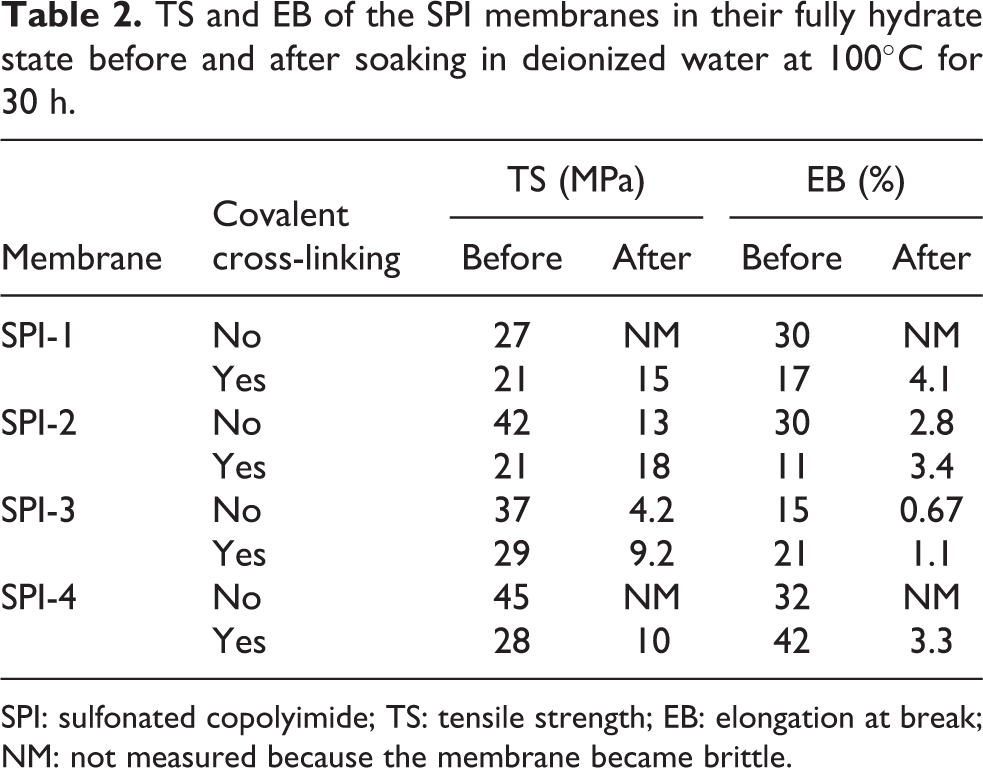
SPI: sulfonated copolyimide; TS: tensile strength; EB: elongation at break; NM: not measured because the membrane became brittle.
Water uptake and proton conductivity
Table 3 shows the IECs, water uptake at 100°C and proton conductivities in water at 80°C of the SPI membranes. The theoretical values of IEC in this table were calculated from the chemical formulae of the SPIs by deducting the part of the sulfonic acid groups bonded to the benzimidazole groups (one sulfonic acid group is bonded to one benzimidazole group) because the protons–benzimidazole interaction is too strong to allow proton transport. It can be seen that the covalent cross-linking caused a moderate reduction in IECs by a factor of about 10–30%. This is because the sulfonic acid groups have been partially consumed due the process of the covalent cross-linking. As a result, the proton conductivity and the water uptake also decreased to some extent after the covalent cross-linking.
IECs, water uptake at 100°C and proton conductivities in water at 80°C of the SPI membranes.
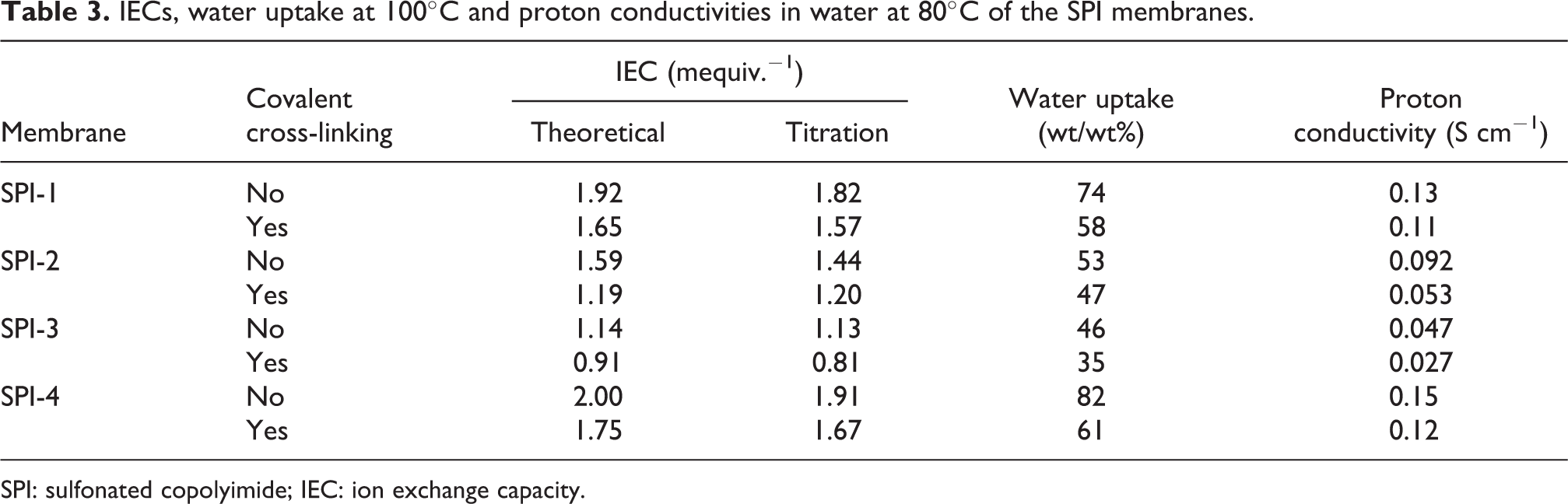
SPI: sulfonated copolyimide; IEC: ion exchange capacity.
Figure 7 shows the variation in proton conductivity of some SPI membranes as a function of RH at 60°C. It can be seen that for all the membranes the proton conductivity decreases rapidly with a decrease in RH. At high RH (e.g. 100%), the membranes generally show high proton conductivity. However, at low RH (e.g. 50%), the proton conductivity becomes rather low (<0.01 S cm−1). This is a common phenomenon that has been observed with many other sulfonated polymer membranes. 21 –29
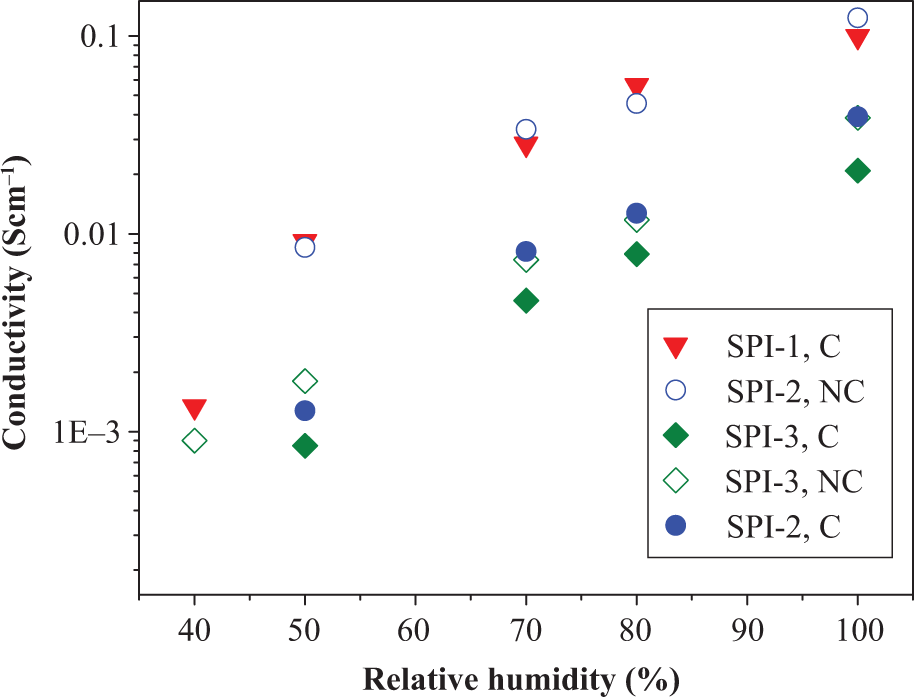
Variation in proton conductivity of the covalent cross-linked (C) and the noncross-linked (NC) SPI membranes as a function of relative humidity at 60°C. SPI: sulfonated copolyimide.
The variation in proton conductivity of some SPI membranes in deionized water as a function of temperature is shown in Figure 8. For all the membranes, the proton conductivity increased with an increase in the temperature. Based on the proton conductivity data shown in this figure, the apparent activation energies (ΔE a) of proton conduction of the SPI membranes were calculated to be in the range 10–14 kJ mol−1, according to Arrhenius equation. The ΔE a of the SPI membranes are close to that of Nafion 112 (12 kJ mol−1). 24
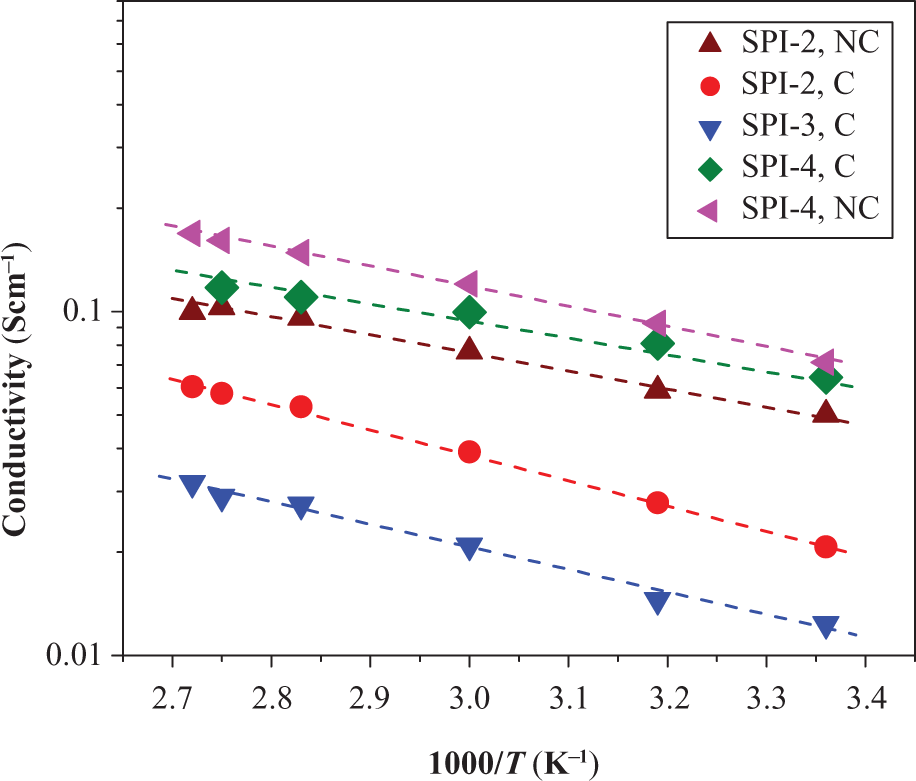
Variation in proton conductivity of the covalent cross-linked (C) and the noncross-linked (NC) SPI membranes in water as a function of temperature. SPI: sulfonated copolyimide.
Conclusions
A new imidazole groups containing diamine monomer, BAPBI, has been successfully synthesized by one-step reaction at high yield. A series of SPIs-containing benzimidazole groups have been prepared by random copolymerization of NTDA, BAPBDS, BAPBI and common nonsulfonated diamines. The resulting sulfonated copolyimides (SPIs) show good thermal stability. Covalent cross-linking has been successfully achieved by treating the membranes in PPA at 180°C for 10 h on the basis of PPA-catalyzed condensation reaction between the part of the sulfonic acid groups and the activated benzene rings of BAPF or BAPBz moieties. The covalent cross-linking led to significant improvements in radical oxidative stability of the SPI membranes due to the synergic action of the incorporation of imidazole groups and the covalent cross-linking. The hydrolytic stability of the SPI membranes was also improved due to the covalent cross-linking. However, the proton conductivity decreased to some extent because the sulfonic acid groups had been partially consumed during the process of covalent cross-linking.
Footnotes
Funding
This work was supported by the National Natural Science Foundation of China (Grant no. 20474037), the Shanghai Municipal Natural Science Foundation (Grant no. 08ZR1410300) and the Jiangsu Key Laboratory for Design and Manufacture of Micro-Nano Biomedical Instruments (Grant no. JSNBI201002).