







Abstract
In the present study, the combined effect of multiwalled carbon nanotube (MWNT) and organoclay in improving the flame retardancy and thermal stability was evaluated. A novel ternary nanocomposite (polymer/organoclay/MWNT) material based on polypropylene, organoclay and MWNTs has been developed. Higher degree of delamination of clay layers in ternary nanocomposites as compared to polymer/clay nanocomposites via x-ray diffraction and transmission electron microscopy analyses was evident, and also the network structure of MWNT and clay was evident. In ternary nanocomposites, the more intact network structure was also evident from the rheological assessment. Improved thermal stability and flame-retardancy characteristics were evident from thermogravimetric and cone calorimeter analyses. Also the scanning electron microscopic micrographs of char residue revealed a correlation with the cone calorimeter. The role of degree of graphitization of MWNTs on the flammability of nanocomposites was also confirmed from the analysis.
Introduction
Due to the tremendous mechanical, thermomechanical, and barrier properties, layered silicates-based clay is the first choice among nanomaterials to be used as filler for the polymers used in automotives. Wherein, the requirement of organoclays (organophilic clay), instead of unmodified clay, in order to achieve the exfoliation, has already been established. 1–3 Based on the organoclay, polypropylene (PP) nanocomposites account for more than half of all the plastic materials used in automobiles. However, world beneath the hood of any automotive is a harsh place, for example, engine enclosures/housing. Therefore, the materials used in these components are supposed to have high-thermal stability and flame-retardant characteristics.
The flame-retardant effect of the organoclay has been reported earlier. 4 The acidic amine and α-olefin, produced due to Hoffman elimination of these organic compounds, accelerate the degradation of polymer matrix. 5,6 However, this turns advantageous to flame-retardant effect of clay. This is because, the charring process is accelerated by the acidic catalytic sites of the layered silicates deriving from Hoffman reaction of the organic alkyl ammonium cations. 7 This carbonaceous char layer acts as an excellent insulator and mass transport barrier that slows the escape of the volatile product, generated during decomposition. Hence the organoclay may be used as flame-retardant filler. However, the vigorous bubbling of the decomposition products produced during combustion process results in the development of many cracks on the surface of char residue. This may limit its use for various applications.
Further, Isitman and Kaynak 8 have reported the flame-retardant effect of clay in combination with the organic flame-retardant compounds. However, the drawbacks like high density and requirement of high-loading content limit the use of organic flame retardant in various aspects.
Subsequently, the multiwalled carbon nanotubes (MWNTs) have been found suitable as flame retardant for polymer matrix, due to its high decomposition temperature (i.e. >500°C). 9,10 It was found that the MWNTs are capable of forming continuous but thin network structure protective layer without the formation of cracks that compromise the flame-retardant effectiveness. 8 This results in a significant reduction in heat release rate (HRR) with a MWNT mass concentration as low as 0.5%. 10,11 However, at high-loading content, MWNTs possess a tendency to bundle in the polymer matrix, which results in the formation of discontinuous layer of char residue after combustion. This discontinuous char layer consists of fragmented islands rather than continuous network protective layer. 12 Also, the low concentration of tubes may yield the similar fragmented island structure. Therefore, the formation of the network structure protective layer during burning with cracks or opening becomes crucial for the flame retardancy of nanocomposites. Based on in-depth literature studies, 13,14 it was found that the combination of MWNTs and organoclay provides another class of materials, with exploration as flame-retardant additives. 15,16 However, the effect of this combination on the soundproofing effect was reported earlier, which is nowadays a most required property of engine enclosures and housing.
In this study, a concept of combining MWNTs and organoclay as flame-retardant filler has been utilized, and the study was aimed to investigate the combined effect of MWNT and clay on the thermal stability and flame retardancy of polymer nanocomposites. While viscoelastic characterization of polymer nanocomposites can be used as a screening method for seeking effectively flame-retarded nanocomposites, the formation and stability of the network structure also require good spatial dispersion of the clay platelets and carbon nanotubes (CNTs) in the nanocomposites. Further, the graphitization degree (D g) of MWCTs after combustion of PP/MWNT and PP/organoclay/MWNT nanocomposites was calculated and a correlation between D g and flammability has been established.
Materials
PP was procured from M/s Haldia Petrochemicals (M110; Kolkata, West Bengal, India), having a density of 0.94 g cm−3 and the melt flow index of 11 g 10 min−1. The organoclay cloisite 15A (C15A), with a cation exchange capacity of 125 meq 100 g−1 clay, d 001 of 3.15 nm, modified with dimethyl, dihydrogenated tallow, quaternary ammonium, having a diameter of about 10–30 nm a length of 1010 μm was purchased from M/s Southern Clay Products, Inc. (Gonzales, Texas, USA). MWNTs of >98% purity and diameter of 80–100 nm were purchased from M/s Nanoshel, Intelligent Materials Pvt. Ltd (Panchkula, Haryana, India) and was purified in the presence of nitric acid. The compatibilizer used in this study was maleic anhydride-grafted PP (MAPP) (OPTIM-P425) having an anhydride content of 1.6–2.5% and density of 0.91 g cm−3 was purchased from M/s Pluss Polymers Pvt. Ltd (Gurgaon, Haryana, India).
Experimental
Preparation of nanocomposites
The nanoclay-reinforced binary nanocomposite (PP/MAPP/C15A) was prepared with a loading of 5 wt% of MAPP and 3 wt% of C15A using microcompounder (Micro 15; M/s DSM Xplore, Netherlands) at a temperature of 180, 185, and 185°C in front, middle, and rear zone respectively for 20 min as obtained from previous study. 17 This nanocomposite is termed as PP/MAPP/C15A for further discussion. The PP nanocomposites reinforced with 0.3 wt% of MWNT and 5 wt% of MAPP were prepared via melt blending technique using the microcompounder at a mixing parameter of 185°C in each zone with 50 rpm for 22 min. The loading of MWNT was taken as 0.3%, since it was obtained as the optimized composition from our previous study and the further increase in MWNT content does not provide enhancement in various properties because of the possible agglomeration of MWNT fibrils. This nanocomposite is termed as PP/MAPP/MWNT in the further discussion.
The ternary nanocomposites were prepared by mixing 3 wt% of MWNT with the PP/MAPP/C15A hybrid with a mixing time of 22 min at 180°C in all zones with 30 rpm, as optimized from the another part of our study. This ternary nanocomposite is termed as PP/MAPP/C15A/MWNT for further discussion.
X-ray diffraction analysis
Wide angle x-ray diffraction (WAXD) analysis was used to analyze the interlayer gallery spacing of nanoclays in the nanocomposites using Philips X’Pert MPD (Tokyo, Japan) with graphite monochromator and a copper (Cu) Kα radiation source operated at 40 kV and 30 mA. The x-ray radiation source having a wavelength of 1.54 Å (
Transmission electron microscopy
The samples were analyzed using transmission electron microscope (1200EX; JEOL, Tokyo, Japan). Thin section was taken from injection molded bar using microtome (EM UC6; M/s Leica, Wetzlar, Germany), under cryo conditions, for analysis. The sections were collected from water using 300 mesh carbon-coated Cu grids. Transmission electron microscopic (TEM) image was carried out at an accelerating voltage of 100 kV. Images were captured using a charged couple detector camera for further analysis using Digital Micrograph analysis software (Gatan, USA).
Thermogravimetric analysis
The thermal degradation temperatures and thermal stability of the PP and its nanocomposites were studied using a thermogravimetric analyzer (Q50; M/s TA Instruments, New castle, Delaware, USA). Samples of ≤10 mg were heated from 50 to 680°C at a heating rate of 10°C min−1, the corresponding initial, maximum, and final degradation temperature were calculated.
Rheological assessment
The samples were characterized with a modular advanced rheometer system (MARS III, Thermo Fisher Scientific, Bremen, Germany) in the frequency sweep mode using parallel plate fixtures of 25 mm in diameter at a gap of 1 mm. Dynamic frequency test was performed at 220°C and frequency sweep from 0.1 rad s−1 to 200 rad s−1 at a constant strain amplitude of 1%. Since, in order to investigate the formation of silicate network and extensive morphology, frequency sweep method is most often used. Corresponding storage modulus (G′), loss modulus (G″), and complex viscosity (η*) were determined as a function of frequency and the data were analyzed.
Cone calorimeter analysis
The cone calorimeter experiments were carried out at 50 kW m−2 heat fluxes with horizontal orientation of the samples having plates with dimension of 100 × 100 × 3 mm3 or cutted cables according to ASTM E1354 standard using dual-cone fire testing technology calorimeter (Fire Testing Technology, East Grinstead, UK).
Scanning electron microscope
Scanning electron microscope was carried out using EVO MA 15 (Carl Zeiss, Germany). The samples were prepared by gold coating prior to analysis. The filament voltage was set at 10–30 kV to make an image of the nanostructure.
Result and discussion
XRD analysis
In order to investigate microstructural configuration, the x-ray diffraction (XRD) pattern of the PP, its binary nanocomposites (PP/MAPP/C15A and PP/MAPP/MWNT) and ternary nanocomposites (PP/MAPP/C15A/MWNT) were analyzed as shown in Figure 1. In case of PP/MAPP/C15A nanocomposites, the peak corresponding to the intergallery spacing of the clay layers was slightly shifted toward lower diffraction angle (i.e. 2θ = 4.7°) with the corresponding d-spacing (d 001) of 1.63 nm than that of neat clay (i.e. 2θ = 7 and d 001 = 1.13 nm), revealing the intercalation of the polymer chains inside the clay galleries. In case of PP/MAPP/C15A/MWNT, the peak corresponding to d-spacing was further shifted toward lower angle than that of PP/MAPP/C15A, confirming the highly delaminated clay layers in ternary nanocomposites (i.e. PP/MAPP/C15A/MWNT). This may also be due to possible exfoliation of the clay layers in the ternary nanocomposites. 18 Further, the increased broadness of the peak (d 001) in case of PP/MAPP/C15A/MWNT as compared to PP/MAPP/C15A revealed the improved dispersion of clay layers in the ternary nanocomposites. Further, no remarkable change in the crystallinity of the binary (PP/MAPP/C15A and PP/MAPP/MWNT) and ternary nanocomposites was noticed.
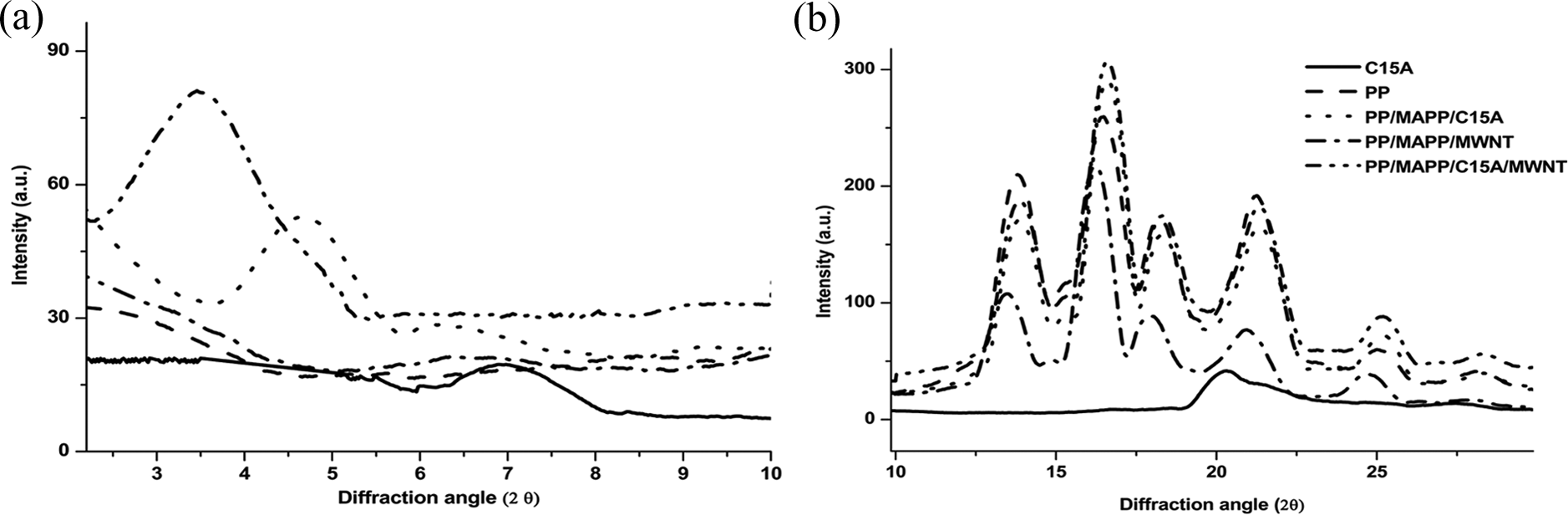
XRD patterns of nanoclay, PP, and its nanocomposites. XRD: x-ray diffraction; PP: polypropylene.
TEM
Figure 2 represents the TEM micrographs of the PP/MAPP/C15A, PP/MAPP/MWNT, and PP/MAPP/C15A/MWNT. The dark areas in the micrographs represent the clay particles whereas the gray region represents the continuous PP matrix. The micrographs of the PP/MAPP/C15A revealed the mixed morphology of intercalated and exfoliated clay galleries. Also there was an evidence of small aggregates of clay particles within the intercalated clay structures. However, in case of PP/MAPP/MWNT, the interconnected MWNT clusters were evident, resulting in the nonuniformly distributed MWNT particles. This may limit the utilization of intrinsic properties of MWNT in the nanocomposites.
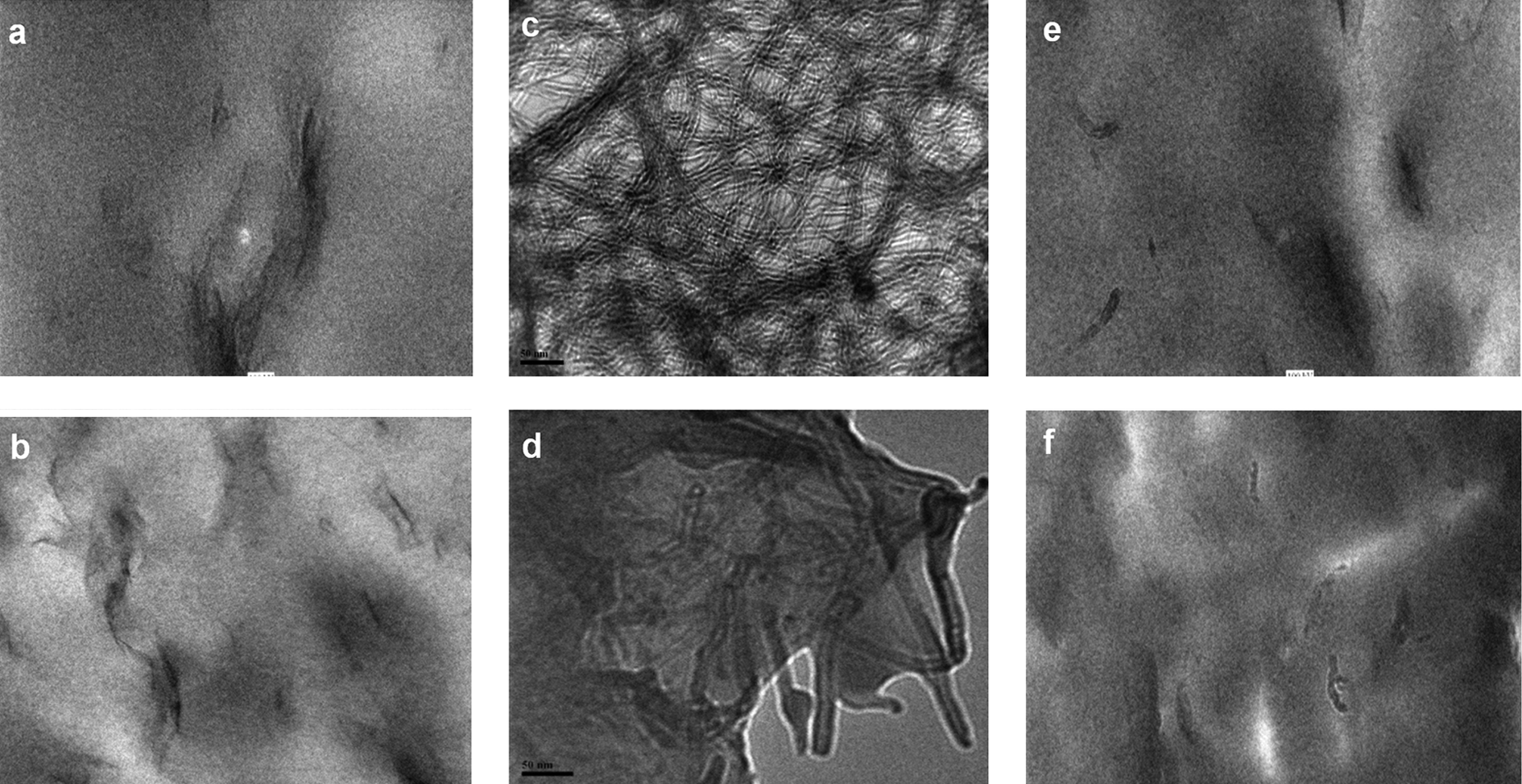
TEM micrographs of ((a) and (b)) PP/MAPP/C15A, ((c) and (d)) PP/MAPP/MWNT, and ((e) and (f)) PP/MAPP/C15A/MWNT. TEM: transmission electron microscopy; PP: polypropylene; MAPP: maleic anhydride-grafted polypropylene; C15A: cloisite 15A; MWNT: multiwalled carbon nanotube.
On the contrary, incorporation of MWNT as secondary filler in PP/MAPP/C15A nanocomposite revealed uniform dispersion of the MWNTs and clay layers within the PP matrix as compared to the PP/MAPP/C15A nanocomposites. Relatively higher degree of exfoliation was observed in PP/MAPP/C15A/MWNT nanocomposites. This might be due to insertion of MWNT within the clay layers, which might have resulted in the delamination of the clay layers. 14
Further, the network structure of clay layers and MWNT fibrils was also evident from the micrographs. This might be attributed to the disruption of bundled MWNT network due to its affinity with the clay layers. 14,19 Hence the MWNT clusters become isolated due to the presence of clay particle resulting in the formation of island as shown in Figure 3. Therefore, the more intact three-dimensional (3D) network is created restraining the polymer motion. These physical interactions and more confined network structure of ternary nanocomposites as compared to its binary counterparts (PP/MAPP/C15A and PP/MAPP/MWNT) have been further confirmed using rheological properties.
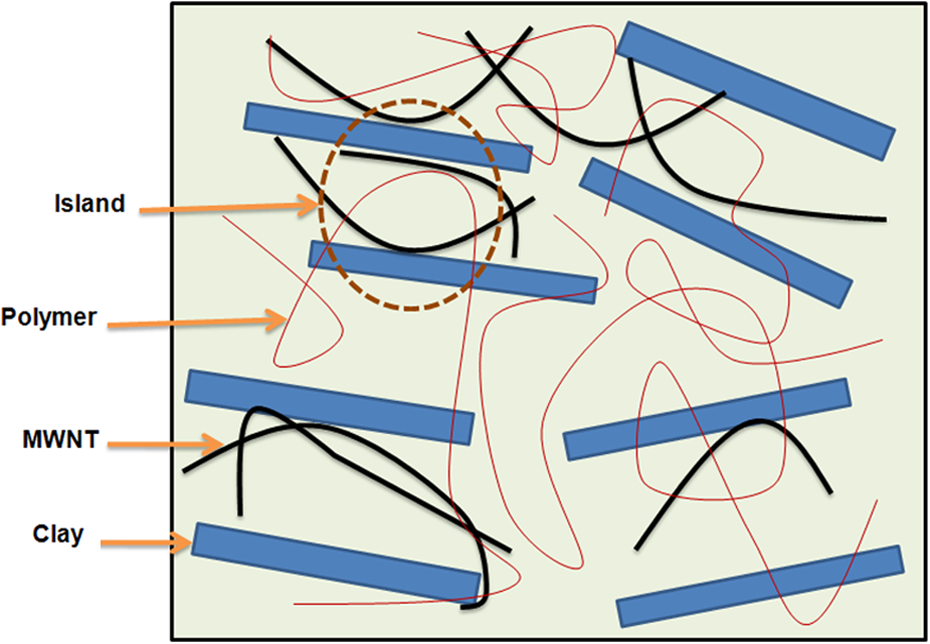
Mechanism of interaction between MWNT and nanoclay platelets.
Evidence of the network structure through rheological assessment
Formation of polymer chain and nanofiller 3D network in the nanocomposites is the main responsible factor to alter the flammability characteristics of the polymer. 20 Rheology is the efficient tool to determine the construction of networked structure in filler and polymer. Figure 4(a) and (b) represents the G′ and G″, respectively, of PP, its binary and ternary nanocomposites at 220°C. Not much difference in the G′ values of PP and nanocomposites could be noticed in high ω regime, revealing that the movement of partial polymer chains is not affected by the addition of organoclay and MWNTs.
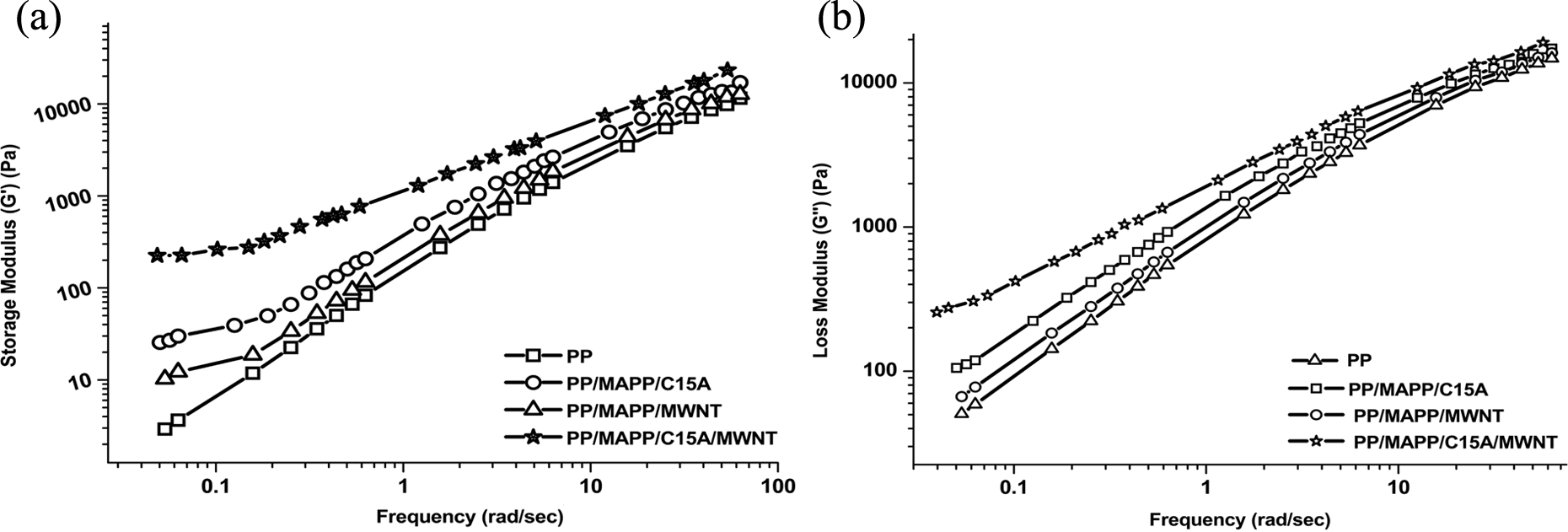
(a) G′ versus frequency and (b) G″ versus frequency of PP and its nanocomposites. G′: storage modulus; G″: loss modulus; PP: polypropylene.
However, G′ in the low ω regime reflects the relaxation and motion of whole polymer chains. The reduced slope of the G′ versus ω curve in case of PP/MAPP/C15A and PP/MAPP/MWNT as compared to neat PP indicates that a percolated filler network has been created, leading to the restricted free movement of PP chains due to spatially confined geometry. These networks may be in various forms as clay–clay network, clayMWNT network, MWNT–polymer–clay bridging, and polymer–polymer network.
Further, the minimal value of terminal slope of G′ versus ω was noticed in the ternary nanocomposites, indicating more intact percolated network structure has been created in PP/MAPP/C15A/MWNT nanocomposites as compared to its binary nanocomposite (i.e. PP/MAPP/C15A and PP/MAPP/MWNT). The similar trend was also noticed in case of G″ versus ω. A fast increase was noticed in case of G′ of all samples, revealing the greater sensitivity of the G′ versus ω curve toward reflection of networked structure. 21
Figure 5 shows the relation between viscosity and frequency. The higher viscosity of the ternary nanocomposites as compared to binary nanocomposites (PP/MAPP/C15A and PP/MAPP/MWNT) over the applied frequency region was evident, revealing the more effectively confined space and enhanced network structure responsible for improved flame retardant. The influence of the network structure on the thermal stability and flame retardancy was investigated in the further sections.
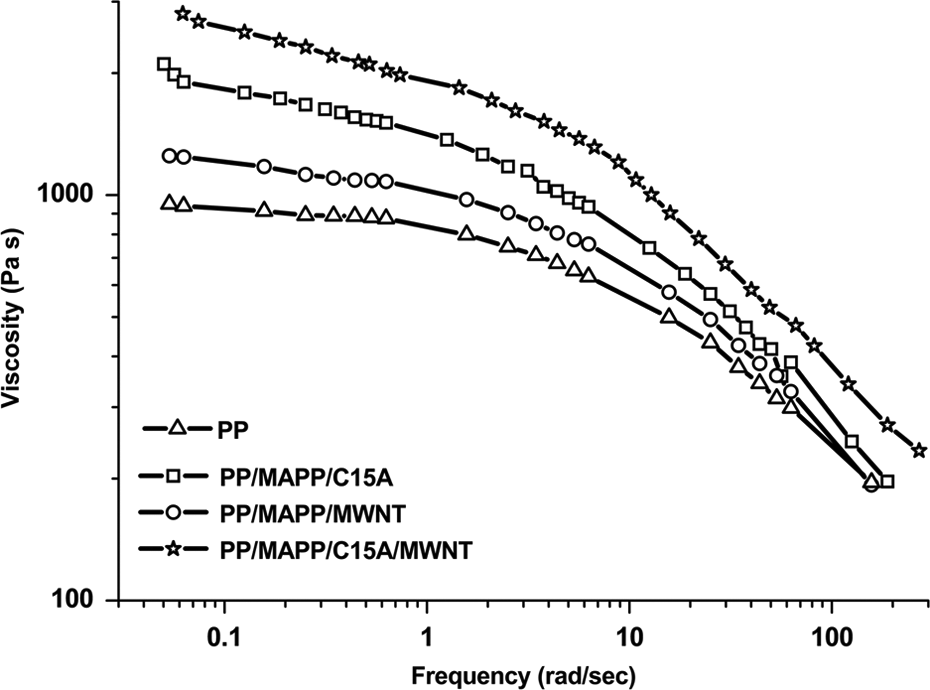
Viscosity versus frequency of PP and its nanocomposites. PP: polypropylene.
Thermogravimetric analysis
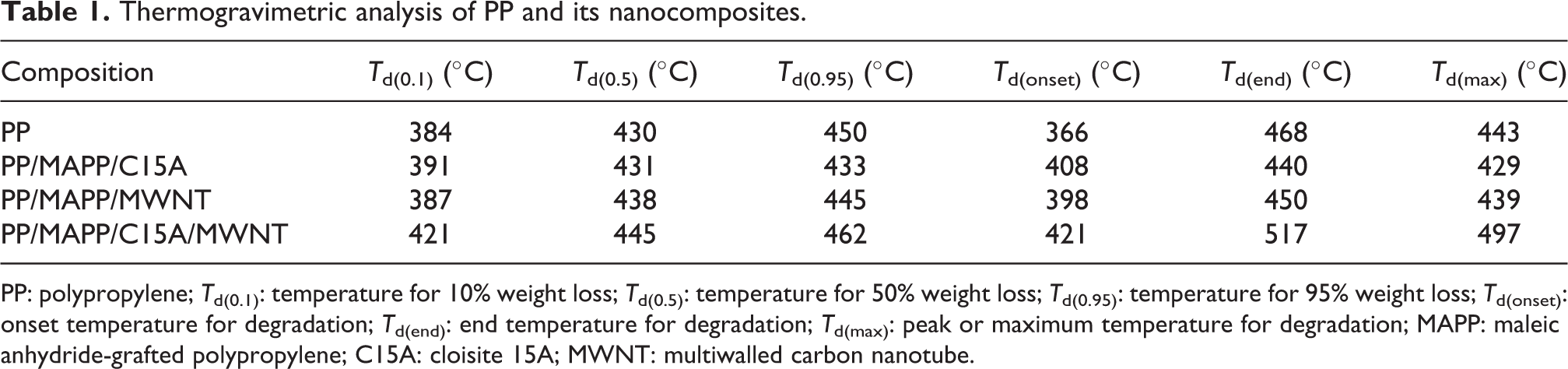
Thermogravimetric analysis (TGA) is widely used to characterize the thermal stability of polymers. The comparative study of thermal stability of PP, its binary and ternary nanocomposites in inert nitrogen atmosphere have been carried out through TGA. Table 1 shows the degradation temperature at different stages. The different temperatures have been reported as follows: T d(0.1), temperature for 10% weight loss; T d(0.5), temperature for 50% weight loss; T d(0.95), temperature for 95% weight loss; T d(onset), onset temperature for degradation; T d(end), end temperature for degradation; and T d(max), peak or maximum temperature for degradation.
Thermogravimetric analysis of PP and its nanocomposites.
PP: polypropylene; T d(0.1): temperature for 10% weight loss; T d(0.5): temperature for 50% weight loss; T d(0.95): temperature for 95% weight loss; T d(onset): onset temperature for degradation; T d(end): end temperature for degradation; T d(max): peak or maximum temperature for degradation; MAPP: maleic anhydride-grafted polypropylene; C15A: cloisite 15A; MWNT: multiwalled carbon nanotube.
T d(0.1) and T d(0.5) represent the initial thermal stability of the material. The values of T d(0.1) and T d(0.5) for PP/MAPP/C15A were found slightly higher than that of neat PP. This result was in accordance with the result reported earlier in the literaure. 22 The value of T d(onset) was found to be shifted toward higher temperature than that of neat PP. This is due to the reinforcing effect of nanosilicates, which may act as an insulating layer during onset of degradation.
However, the value of T d(0.95) was found to be lower than that of neat PP. This is attributed to the instability of char layers at high temperature and therefore it also starts degrading as polymer matrix. Similarly a noticeable decrease in the value of T d(end) and T d(max) was noticed as compared to PP. This behavior might be due to the reactivity of tertiary carbon atoms of PP, which can easily undergo abstraction of mobile hydrogen atom to form carbon radicals, which accelerate the thermal volatilization of PP at high temperature, 23 and this decrease is attributed to the conduction of heat due to intercalated structure 24 as was noticed in TEM micrographs.
The lower peak degradation temperature T d(max) also supports the fact that organoclay itself act as catalyst toward degradation of polymer matrix. This is because of the thermal instability of the salts, which is used to modify the layered silicate. Because at higher temperature, these organic salts decompose to yield an amine and an α-olefin via the Hofmann degradation reaction. 25,26
The decomposition of these organic entity causes the clay to return to organophobic status, which leads to polymer deintercalation in the clay galleries (interlayer area) and subsequent phase separation. With sufficient thermal decomposition, the well-constructed nanocomposites will return to microcomposite structure and all nanocomposites’ benefits are lost. 27,28 Hence, it is worth mentioning that nanosilicates act to aid heterogenous nucleation thus bringing forward the degradation of PP.
Further, in case of PP/MAPP/MWNT, the T d(0.1) and T d(0.5) represent the initial thermal stability of the material, which was also found higher than PP. This might be attributed to the fact that the presence of MWNT hinders the decomposition of PP in earlier stages of decomposition resulting in increased thermal stability. This is because, the decomposition of PP experiences free radical chain reaction 29 and the MWNTs may easily trap a number of free radicals leading to enhanced thermal properties. The value of T d(0.95) for PP/MAPP/MWNT was also found higher than that of neat PP. Similarly, the value of T d(onset), T d(end), and T d(max) was in favor of reinforcing effect of MWNT over the thermal stability of the polymer matrix.
From the comparative investigation, it was depicted that T d(onset) and T d(0.1) of the PP/MAPP/C15A was higher than that of PP/MAPP/MWNT. This might be attributed to the migration of MWNT fibrils toward the surface, leading to the formation of continuous but thin shielding network covering the entire sample. However, clay forms a thick char layer in case of PP/MAPP/C15A providing a shielding effect at earlier stages of degradation. Further, the values of T d(0.5), T d(0.95), T d(end), and T d(peak) of PP/MAPP/C15A were found to be lower than that of PP/MAPP/MWNT. This might be attributed to the difference in the nature of char layer formed in both cases. Although, the char layer formed in case of PP/MAPP/C15A will be thicker, but a possibility of discontinuity due to crack formation in the char layer at higher temperature reduces its sustainability to the temperature. 8 However, it exhibits that the thin char layer formed in PP/MAPP/MWNT does not possess a tendency to crack at high temperature, therefore, its tendency to sustain high temperature remains intact.
Thermal stability of ternary nanocomposites (i.e. PP/MAPP/C15A/MWNT) was investigated to understand the combined effect of both the nanofillers (i.e. C15A and MWNT). Much enhanced T d(0.1) and T d(0.5), and T d(0.95) values were obtained in case of PP/MAPP/C15A/MWNT as compared to neat PP and its binary nanocomposites.
The thermal stability of PP/MAPP/C15A and PP/MAPP/MWNT is lower than PP/MAPP/C15A/MWNT, which may be due to the presence of porous char layer with microcracks and less densed continuous char layer with less density, respectively. However, in case of ternary nanocomposites, the relatively tighter and denser char as compared to its binary counterparts results in highly delayed degradation of ternary nanocomposites. This is because some MWNT fibrils act as bridge and overlap the pores between clay layers and some MWNT fibrils get inserted between nanosilicate layers forming the sandwiched structure resulting in exfoliated clay layers as well. 13 The later effect also results in the enhanced T d(max) of PP/MAPP/C15A/MWNT, depicting the highly exfoliated morphology of ternary nanocomposites as compared to PP/MAPP/C15A. 24
Also the decomposition of all nanocomposites was found sharper, as can be seen from the short range of degradation temperatures, than PP, pertaining to a reduced range of decomposition for nanocomposites as compared with virgin PP. This supports the fact that addition of nanofiller improves the uniformity of the crystalline structure of the polymer matrix. Hence in ternary nanocomposites more uniformity of crystalline structure was evident from sharper degradation peak. This may also be attributed to the highly restricted thermal motion of polymer and MWNT in the intergallery of clay platelets. These results were in accordance with the findings reported earlier in the literature. 30
Therefore, it is evident that in order to increase the overall thermal stability of polymer matrix, a high degree of exfoliation accompanied with fine dispersion is required. In this study, this exfoliation was achieved with the incorporation of MWNT in PP/MAPP/C15A hybrids, which in turn resulted in improved thermal stability. Also, by correlating the rheological observation with TGA data, it is worth mentioning that the more intact network plays an important role in improving thermal stability of ternary nanocomposites.
Hence, it may be concluded that plate-like particles of high aspect ratio are not the only filler suitable for thermal improvement. Independent of aspect ratio nanoparticles with high specific area is also suitable entity for improving the thermal stability by absorbing radicals and high-polar groups. This mechanism involves the physical/chemical adsorption of volatile degradation product on particle surface. This imparts more thermal stabilization in the polymeric system. 14
Cone calorimeter analysis
To evaluate the fire retardancy of the system, cone calorimeter analysis was carried out for the samples. In case of neat PP at the end of test no residue was left, revealing the poor carbonization of PP. 13 Figure 6 represents the HRR of the PP and its nanocomposites. Different types of typical burning behavior give rise to characteristic curves of HRR versus time. 31
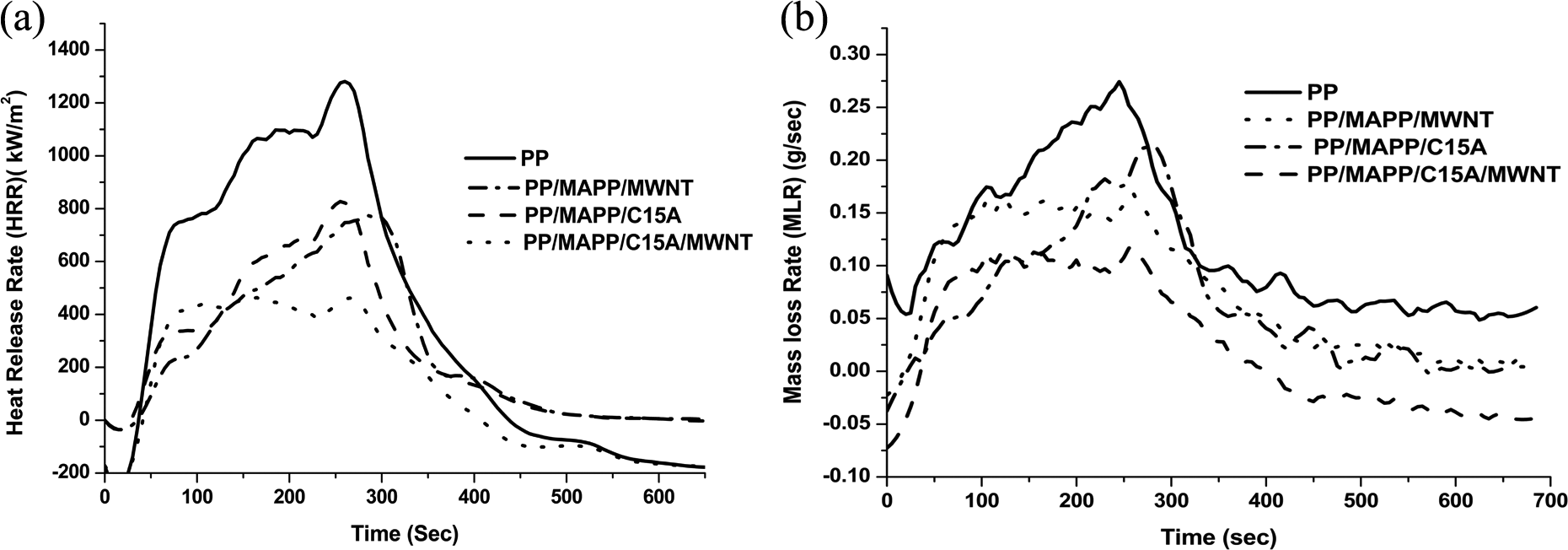
HRR versus time and (b) MLR versus time of PP and its nanocomposites. HRR: heat release rate; MLR; mass loss rate; PP: polypropylene.
The nature of the curve for neat PP revealed its noncharring behavior. The HRR of the PP/MAPP/C15A was found to be lower than that of neat PP over the whole burning period. This is attributed to the fact that the organic compounds (in this case, an ammonium salt with tallow group) present in the organoclay decompose to yield acidic amine and α-olefin via the Hofmann elimination reaction. 5,6 These acidic entities accelerate the degradation of polymer matrix. However, the thermal volatilization of degraded polymer is slowed by the labyrinth effect of the silicate layers in the polymer matrix. 4 This lowers the rate of diffusion of the degradation product into the gas phase. Subsequently the catalytic sites on the silicate surface might also change the thermal degradation reaction of polymer by changing the composition of the volatile products. Furthermore, air nanocomposites protect and stabilize against thermooxidation. This property is derived from the barrier produced by the diffusion of oxygen (O2) from the gas phase to polymer. 2 This barrier effect increases during volatilization because of the ablative reassembly of the silicate layers on the polymer surface, which is favored by thermal decomposition of the organoclay. Through oxidative dehydrogenation, O2 abstracts the allylic hydrogen atoms from the weakened C–H bond of the free radical carbon chain produced during PP decomposition, results in the formation of conjugated polyene. This polyene, further on heating, gets aromatized to form thermally stable charred structure. Hence it is worth mentioning that acidic catalytic sites of layered silicates derived from the Hofmann reaction of organoclay accelerate the charring process. Hence the organic groups present in the nanoclay favor the charring in the polymer nanocomposites, which forms the effective barrier against heat transport. 32 Further, the role of organoclay in charring is indirectly supported by the fact that charring is only effective in the nanocomposite. This might be attributed to the strong interaction between the polymeric chain and inorganic crystalline, which in turn prevents the thermal bond scission. The carbonaceous char structure on the surface acts as an excellent insulator and mass transport barrier that slows the escape of the volatile product generated during decomposition. However, the vigorous bubbling of the decomposition products during combustion process results in the development of many cracks on the surface of char residue. This is ascribed to the less entangled clay platelets in the intercalated/exfoliated nanocomposites, which is easily disrupted by the bubbles evolving from the interior of the sample. This leads to the enhanced HRR during the later stage of burning.
Therefore, it is evident that the HRR versus time curve of PP/MAPP/C15A exhibits the behavior of thick char forming material with an increasing trend toward the end of burning. This in turn represents the formation of thick char layer during combustion with an increased HRR in the end, indicating the cracking of char. 30
Further, a similar nature of the curve was seen in case of PP/MAPP/MWNT as of PP/MAPP/C15A. From the analysis, it was evident that the HRR of PP/MAPP/MWNT was lower than neat PP. This is because of migration of nanotubes toward the exposed surface during combustion provides the formation of thin but continuous network covering the whole sample. This protective layer consists mainly of MWNTs and acts as heat shield for the virgin polymer below the layer. 11 However, an increase in the HRR toward end of degradation was noticed. This might be attributed to the formation of discontinued char layer consisting of fragmented islands, revealing the nonuniformly dispersed nanotubes. This results in reduced flame-retardant effect of nanotubes at the end of burning. The formation of fragmented islands may be ascribed to low loading content. Further, a similar nature of curve has been noticed in case of PP/MAPP/C15A and PP/MAPP/MWNT and no remarkable difference could be noticed in HRR of both the nanocomposites. This reveals the fact that continuous but thin char plays a similar role as of thick char with crack toward the flame retardancy.
Furthermore, a much lowered peak HRR (PHRR) was noticed in case of ternary nanocomposites (PP/MAPP/C15A/MWNT) as compared to PP and both the binary nanocomposites. A decrease in PHRR indicates a reduction of burnable volatiles generated by the degradation of polymer matrix, such drop clearly indicated the flame-retardant effect of network structure created between nanoclay and MWNT particles and their “molecular” distribution throughout the matrix. Furthermore, the improved flame-retardant properties of PP/MAPP/C15A/MWNT was confirmed by the observation that the PHRR was spread over a much longer period of time than PP/MAPP/C15A and PP/MAPP/MWNT. Hence, it was evident that whole combustion process was slowed down in case of ternary nanocomposites as compared to their binary nanocomposites. This might be attributed to the fact that during combustion of ternary nanocomposites, MWNT runs across the clay layers, providing more effective thermally insulated 3D network, which prevents the polymer from external heat of flame. The migration of MWNT fibrils in between the clay layers is possible only in the presence of disentangled MWNT fibrils. Hence this observation reveals the disruption of MWNT network by the well-dispersed clay particles, thus preventing the bundling of nanotube, which is the major cause for the formation of fragmented islands on the surface of char residue.
Also the improved flame retardancy of PP/MAPP/C15A/MWNT was further confirmed by the reduced mass loss rate (MLR) as compared to that of PP, PP/MAPP/C15A, and PP/AMPP/MWNT. This again confirms the slow burning of ternary nanocomposites 33 revealing that some MWNT fibrils act as bridge and overlap the pores between clay layers as well as some MWNT fibrils are inlaid between clay layers and form a sandwiched structure, leading to formation of more intact network to prevent the material from the effect of flame. Henceforth, by correlating the rheological observation with the flame-retardancy characteristics, it can be concluded that confined structural network has contributed in the much enhanced flame retardancy of PP/MAPP/C15A/MWNT ternary nanocomposites. This depicts the combined action of MWNT and nanoclay particles toward the flame-retardant characteristic of polymer.
Morphology of char residue
Figure 7 represents the SEM micrographs of the char residue obtained after cone calorimeter test. The SEM micrograph of the residue obtained after burning of PP/MAPP/C15A showed the formation of a tight protective char on the surface, which blocks the thermal wave from penetrating down the surface. Moreover, carbonaceous layer was found to cover all the surfaces of the sample, thus reducing their MLR and HRR as compared to neat PP. However, the presence of cracks on the surface of char residue was clearly evident. This may be ascribed to the fact that the bubbles evolving from the interior of the sample push away the platelets to form openings throughout the layer. These opening may merge at a later stage to form cracks and pores. The presence of these openings/voids may further lead to higher HRR.
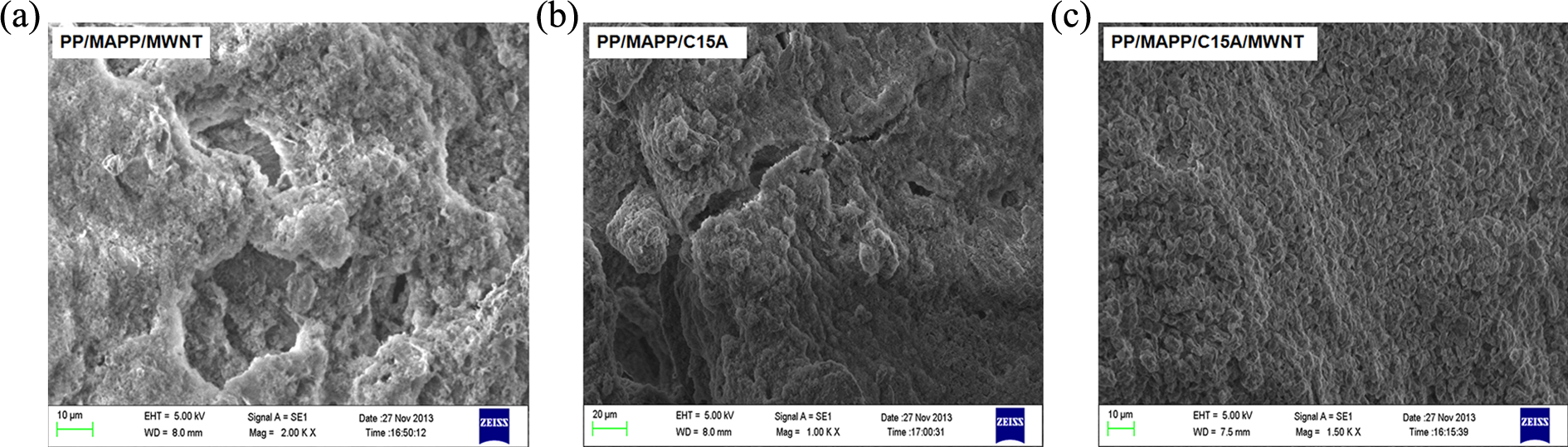
SEM micrographs of the residue of (a) PP/MAPP/MWNT, (b) PP/MAPP/C15A and (c) PP/MAPP/C15A/MWNT. SEM: scanning electron microscopy; PP: polypropylene; MAPP: maleic anhydride-grafted polypropylene; MWNT: multiwalled carbon nanotube; C15A: cloisite 15A.
In case of PP/MAPP/MWNT-reinforced nanocomposites, upon start of exposure to external heat flux and subsequent ignition of the polymer, MWNTs are rapidly migrated toward the exposed surface by the acts of surface free energy, resulting in the enrichment of the MWNTs at the surface to form a thin but crack free, continuous, and self-supportive protective layer leading to quiescent burning. However, the formation of islands on the surface of char residue was also noticed in the SEM micrographs. This was in accordance with the cone calorimeter observations.
The SEM micrograph of the residue obtained after burning of PP/MAPP/C15A/MWNT exhibited the much uniformly formed tighter and denser protective char layer without formation of crack and pores on its surface, this reveals the more intact network structure of clay–MWNT–polymer. Hence the charring effect in ternary nanocomposite is much higher than binary composite due to intimate contact between both the filler and polymer.
Measurement of D g
The flammability properties of the polymers and its nanocomposites depend on the microstructure of the char. D g of char residue is an important factor to be considered to evaluate the performance of char formed during burning of MWNT-reinforced polymer. D g is the transition extent of carbon material from turbostratic to graphitic structure. 34 Being the preferable tool for the characterization of carbon material, the char residue was characterized using XRD technique. The unburned MWNT, char residue of PP/MAPP/MWNT and PP/MAPP/C15A/MWNT, was characterized through XRD and shown in Figure 8 and also the D g was evaluated.
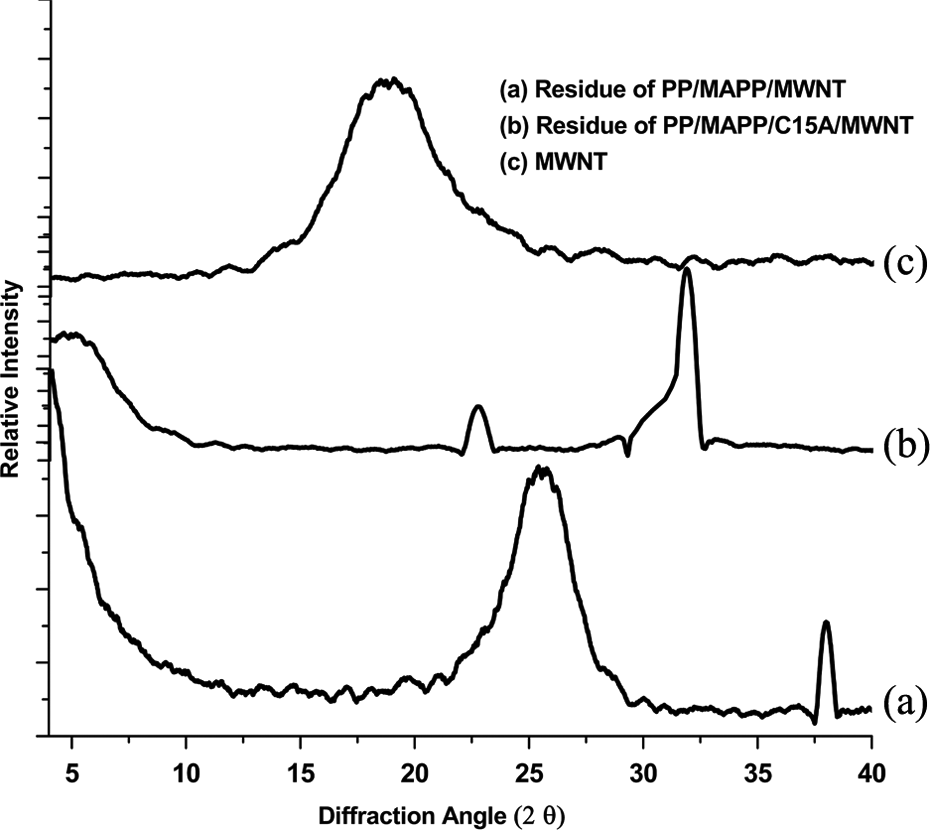
XRD pattern of the residue of (a) PP/MAPP/MWNT, (b) PP/MAPP/C15A/MWNT, (c) MWNT. XRD: x-ray diffraction; PP: polypropylene; MAPP: maleic anhydride-grafted polypropylene; MWNT: multiwalled carbon nanotube; C15A: cloisite 15A.
The 002 peak in the XRD pattern exhibits the information about micrographitic crystals of MWNTs.
35
D
g can be calculated using the following equation:
The interlayer spacing of fully nongraphitic is 0.3440 (nm), 0.3354 is the interlayer spacing of ideal graphitic crystallite, and d 002 is the interlayer spacing derived from XRD analysis. 27
Hence the analysis revealed that the char of PP/MAPP/MWNT exhibits much lower D g than that of PP/MAPP/C15A/MWNT. From the XRD pattern, it was depicted that the MWNT sample before burning does not possess graphitic carbon, exhibiting the presence of tubostratic carbons. Whereas, the d 002 value of PP/MAPP/C15A/MWNT was relatively closer to the 002 peak of ideal graphitic carbon than that of PP/MAPP/MWNT, indicating the higher D g in the PP/MAPP/C15A/MWNT ternary nanocomposites. This may be attributed to the expansion of aromatic nucleus during graphitization of MWNTs, which in turn is blocked by the exfoliated clay layers. This creates a tight and closed network between aromatic nucleus and clay layers, resulting in more intact graphitic structure than that of PP/MAPP/MWNT. 27
Another factor responsible for the higher D g in the ternary nanocomposites (PP/MAPP/C15A/MWNT) is the catalytic action of the clay toward the graphitization of MWNTs. The elements (iron, silicon, titanium, calcium, magnesium, aluminum (Al), aluminum oxide, and magnesium oxide) present in the clay react with the carbon to give aluminum carbide (Al4C3). The Al4C3 compound decomposes into the Al and graphitic carbon. 27
By correlating the TGA and cone calorimeter data with the D g, it may be concluded that the flammability properties of the ternary nanocomposites were dependent on the D g of the MWNT incorporated in the nanocomposites. Therefore, the hybrid effect of MWNTs and clay was evident in increasing the flame-retardant behavior of polymer nanocomposites. From XRD pattern, the absence of graphitic carbon was noticed in case of unburned MWNT, revealing the presence of only tubostratic carbons.
Conclusion
Ternary nanocomposites based on organoclay (C15A), MWNT, and PP matrix have been prepared via melt blending technique. An exfoliated morphology in the ternary nanocomposite (PP/MAPP/C15A/MWNT) was noticed from the XRD and TEM analyses. The interaction between clay and MWNT was noticed from rheological assessment, since a much confined networked structure was present in ternary nanocomposites. A phenomenal increase in the thermal stability in terms of delayed decomposition temperature was noticed for ternary nanocomposites as compared to neat PP and its binary nanocomposites. The high flame retardancy of ternary nanocomposites from cone calorimeter analysis was observed in terms of much lowered HRR and MLR. The SEM micrographs of char residue revealed uniformly formed dense char layer in case of ternary nanocomposites. However, the char layer of PP/MAPP/C15A was found to be thicker, accompanied with large cracks and pores and continuous but thin char layer was evident in case of PP/MAPP/MWNT. The high D g of the residue of PP/MAPP/C15A/MWNT revealed the correlation between the flame retardancy and D g as well as the catalytic effect of clay on the graphitization of MWNT.
Hence it was found that the presence of uniformly distributed organoclay layers help in the disruption of nanotube bundles and subsequently debundled nanotubes runs across the clay layers providing more effective thermally insulated 3D network by bridging and overlapping the pores between clay layers. Also the continuous crack-free char layer showed the strong MWNT–organoclay–polymer interaction in ternary nanocomposites as compared to both the binary nanocomposites.
Hence it may be conclude that presence of MWNT and organoclay together in the PP matrix shows a synergistic action toward improving the flame retardancy and thermal stability through various mechanisms.
Footnotes
Funding
This research received no specific grant from any funding agency in the public, commercial, or not-for-profit sectors.