







Abstract
Ionic liquid-based poly(vinyl alcohol) (PVA) proton-conducting polymer electrolytes are prepared using solution casting technique. The effect of adding 1-butyl-3-methylimidazolium iodide (BmImI) ionic liquid into PVA-ammonium acetate polymer system is investigated in this work. Ionic conductivity of polymer electrolytes is increased by two orders of magnitude upon inclusion of 70 wt% of BmImI. Addition of ionic liquid reduces the glass transition temperature and crystallinity of polymer electrolytes. Electrical double-layer capacitors (EDLCs) are assembled using dip-coating technique. The electrochemical properties of fabricated EDLCs are analysed using cyclic voltammetry.
Introduction
Recently, electrical double-layer capacitors (EDLCs) have received an upsurge interest because they have higher power density than lithium ion secondary batteries and higher energy density than conventional dielectric capacitors. 1 Other advantages of EDLCs are longer cycle life (i.e. up to >105 cycles), faster charge–discharge rate, higher ability to be charged and discharged continuously without any degradation and inexpensive. 2 EDLCs have a wide range of applications, ranging from low- to high-energy density applications. These applications are used in memory back up for biomedical and electronic devices, spaceships, hybrid electric vehicles and pulse laser technique. 3
An EDLC consists of a pair of electrodes and an electrolyte. Basically, the energy storage in an EDLC is based on the charge accumulation at the electrode–electrolyte interface. Porosity of electrode and conductivity of electrolyte are the main concerns in the development of EDLC. Carbonaceous materials are the common materials to be used as electrode in EDLC, such as activated carbon, carbon black, carbon nanotubes, carbon fibre, graphite and carbon aerogel. 4 Polymer electrolyte is the recent type of electrolyte to replace the harmful liquid electrolyte. Solid-state electrolytes can be either solid polymer electrolytes or gel polymer electrolytes or composite polymer electrolytes. Ionic conductivity is the main concern on the development of polymer electrolytes. Several approaches have been carried out to improve the ionic conductivity, for example, polymer blending, polymer modification, mixed salt system, addition of plasticizer, doping of filler and inclusion of ionic liquid. Addition of ionic liquid was chosen in this present work because of its attractive properties such as environmentally friendly, wide electrochemical potential window, excellent thermal stability, high ion content and superior electrochemical stability as well as strong plasticizing effect. Carbon-based electrodes and proton-conducting polymer electrolytes were prepared in this present work.
Experimental
Materials
Poly(vinyl alcohol) (PVA) (Sigma-Aldrich, St Louis, Missouri, USA), ammonium acetate (CH3COONH4; Sigma, Aizu, Japan) and 1-butyl-3-methylimidazolium iodide (BmImI; Merck, Darmstadt, Germany) were used as host polymer, salt and ionic liquid, respectively. All the materials were used as received.
Preparation of polymer electrolytes
PVA-based polymer electrolytes were prepared by means of solution casting. PVA was initially dissolved in distilled water. Appropriate amount of CH3COONH4 was subsequently mixed in PVA solution. To measure the ionic conductivity in the preliminary step, the ratio of PVA:CH3COONH4 has been varied. The highest ionic conductivity of 1.94 × 10⁻⁵ S cm−1 was achieved upon addition of 30 wt% of CH3COONH4. Hence, the weight ratio of PVA:CH3COONH4 was kept at 70:30. Then, different mass fractions of BmImI were added into the PVA-CH3COONH4 aqueous solution to prepare ionic liquid-added polymer electrolytes. The resulting solution was stirred thoroughly and heated at 70°C for few hours. The solution was eventually cast on a glass Petri dish and dried in an oven at 60°C to obtain a free-standing polymer electrolyte film.
Characterization of polymer electrolytes
Ionic conductivity studies
Freshly prepared samples were subjected to alternating current impedance spectroscopy for ionic conductivity determination. The thickness of the samples was measured using digital micrometer screw gauge. The impedance of the polymer electrolytes was measured using the LCR HiTESTER impedance analyser (model 3532-50; HIOKI, Japan) over the frequency range between 50 Hz and 5 MHz at ambient temperature. The measurement was taken by sandwiching the polymer electrolyte between two stainless steel blocking electrodes at a signal level of 10 mV. The ionic liquid-free and the highest conducting ionic liquid-added polymer electrolytes were used to fabricate EDLC.
Differential scanning calorimetry
Differential scanning calorimetry (DSC) analysis was performed using the universal analyzer (model 200; TA Instruments, New Castle, Delaware, USA), which consists of a DSC standard cell fuel cell as the main unit and universal V4.7A software. The whole analysis was conducted under nitrogen atmosphere at a flow rate of 60 mL min−1. Samples weighing 3–5 mg were hermetically sealed in an aluminium Tzero pan. The samples were heated from 25°C to 105°C at a heating rate of 10°C min−1 as a preliminary step. The heating process was maintained at 105°C for 5 min to ensure complete evaporation. After that, an equilibrium stage was achieved at 25°C. The samples were then heated from 25°C to 230°C and followed up with a rapid cooling process to −70°C at the preset heating rate. The samples were eventually reheated to 230°C at the same heating rate. Crystallization temperature (T c) was obtained in the cooling cycle. On the other hand, glass transition temperature (T g) and crystalline melting temperature (T m) were evaluated using the final heating scan with the provided software. I2, I3, I4 and I7 were the designations of the polymer electrolytes with the addition of 20, 30, 40 and 70 wt% of BmImI, respectively, whilst I0 was designated for the polymer electrolyte without the addition of ionic liquid.
Electrodes preparation
Activated carbon-based electrodes were prepared by dip-coating technique. The carbon slurry was prepared by mixing 80 wt% activated carbon (Kuraray Chemical Co. Ltd, Tokyo, Japan), 5 wt% carbon black (Super P; TIMCAL, Switzerland), 5 wt% multi-walled carbon nanotubes (Aldrich) and 10 wt% poly(vinylidene difluoride) binder (Aldrich) and dissolving them in 1-methyl-2-pyrrolidone (Merck). This slurry was stirred thoroughly for several hours at ambient temperature. The carbon slurry was then dip coated on an aluminium mesh current collector. The coated electrodes were dried in an oven at 110°C for drying purposes.
EDLC fabrication
EDLC cell was constructed in the configuration of electrode/polymer electrolyte/electrode. The EDLC cell configuration was eventually placed in a cell kit for cyclic voltammetry (CV) analysis.
EDLC characterization
CV analysis of EDLC was investigated using electrochemical analyzer (CHI 600D, CH Instruments, Austin, Texas, USA). The EDLC cell was evaluated at a scan rate of 10 mV s−1 in the potential range between 0 V and 1 V. The specific capacitance (C sp) of EDLC was computed using the following equation:

where i is the average anodic–cathodic current (A), s is the potential scan rate (V s−1) and m refers to the average mass of active materials, which is around 0.015 g.
Results and discussion
Ionic conductivity studies
Figure 1 depicts the ionic conductivity of polymer electrolytes with different mass ratios of BmImI. The ionic conductivity of polymer electrolytes increases gradually with mass ratio of BmImI, from 10 wt% to 60 wt%. However, there is an abrupt increase in ionic conductivity at the mass fraction of 70 wt% where the highest conductivity of 9.63 ± 0.01 mS cm−1 is achieved at room temperature. The ionic conductivity of this polymer electrolyte is increased more than two orders of magnitude compared with the ionic liquid-free polymer electrolyte. This is strongly related to the plasticizing effect of ionic liquid. This effect could soften the polymer backbone and hence enhance the flexibility of polymer chains, which promotes the ionic transportation in the polymer matrix. The plasticizing effect has reached the maximum extent in the polymer electrolyte containing 70 wt% of BmImI as it achieves the highest conductivity among all the samples. The ionic conductivity of the polymer electrolytes is basically governed by the number of charge carriers, mobility of charge carriers and charge of the charge carriers. However, the charge of the mobile charge carriers is the same in all the polymer electrolytes. So, this parameter is negligible. The most conducting polymer electrolyte has the highest flexibility of polymer chains. Therefore, it can boost up the mobility of the charge carriers and hence promote the ion dissociation in the polymer complexes. So, this conducting polymer electrolyte has higher mobility of charge carriers and more mobile charge carriers than other polymer electrolytes, which in accordance with higher ionic conductivity.
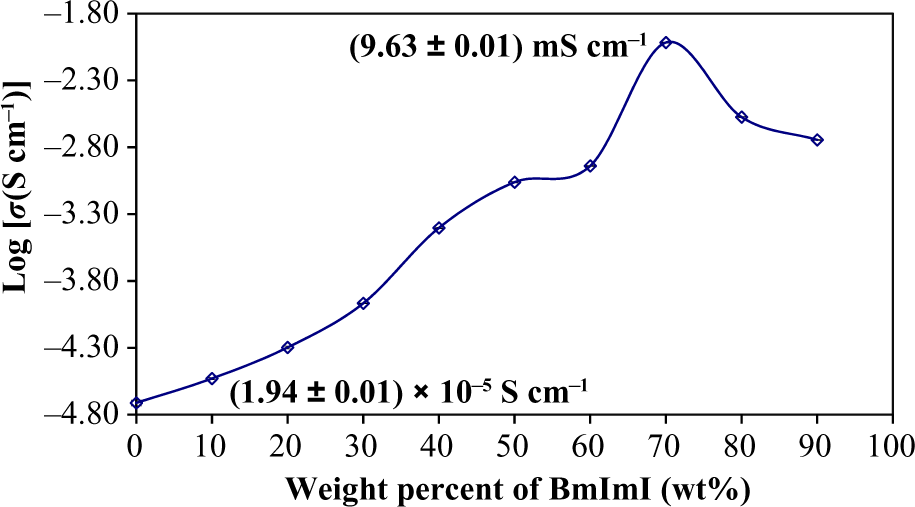
The ionic conductivity of polymer electrolyte with respect to the mass fraction of BmImI. BmImI: 1-butyl-3-methylimidazolium iodide.
The increase of ionic conductivity with the ionic liquid concentration is also due to the decreased T g, which is correlated to the flexibility of polymer chains. The transition from glassy state of the amorphous region to the rubbery state is occurred at low temperature. Therefore, the interaction between the coordination bonds becomes weaker upon addition of ionic liquid. As a result, the polymer chains are very flexible at low temperature. The charge carriers can be detached easily from the interactive bonding. These mobilized charge carriers are transported from one site to another adjacent vacant site for hopping mechanism. High dielectric constant of ionic liquid also contributes to high ionic conductivity. High dielectric constant can shield the cation–anion interaction in the polymer matrix and thus promote the ionic dissociation. Therefore, the number of mobile charge carriers for ionic transportation is also increased. Incorporation of ionic liquid also reduces the crystallinity of polymer electrolytes. Beyond addition of 70 wt% of BmImI, the ionic conductivity is decreased.
Differential scanning calorimetry
Figures 2 to 4 demonstrate the T g, T m and T c values obtained in the DSC curves. The T g of ionic liquid-free polymer electrolyte is around 46.58°C, as reported in our published article. 5 The T g of ionic liquid-added polymer electrolytes is decreased to sub-ambient temperature with the addition of ionic liquid. This finding deduces that addition of ionic liquid weakens the interaction in the polymer complexes and thus softens the polymer backbone. As a result, this can produce flexible polymer chains and eventually promote the ionic transportation, which is in accordance with high ionic conductivity. This theory can also be applied into the observation at which the T g of polymer electrolytes decreases as the mass fraction of ionic liquid is increased.
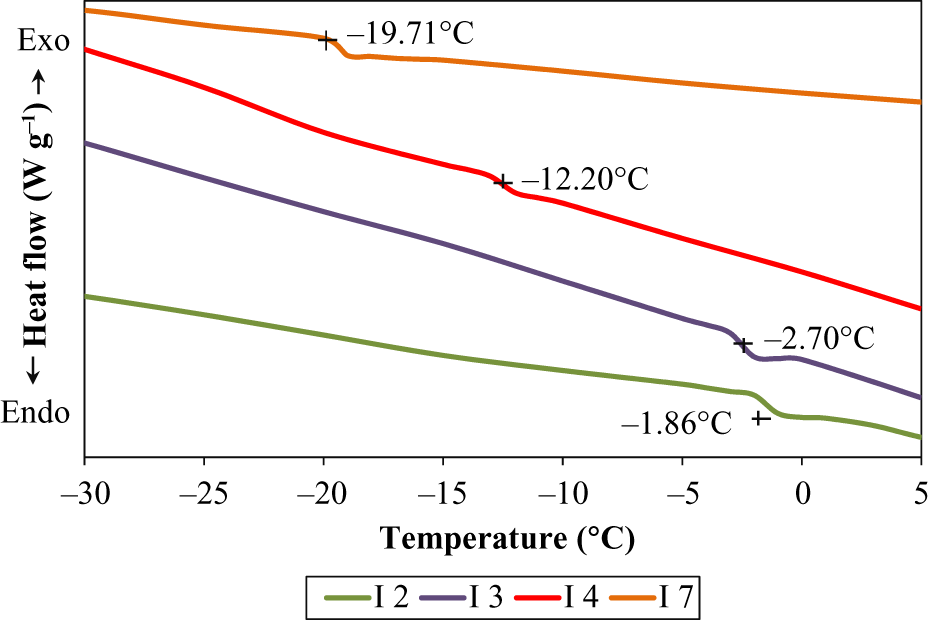
T g of polymer electrolytes. T g: glass transition temperature.
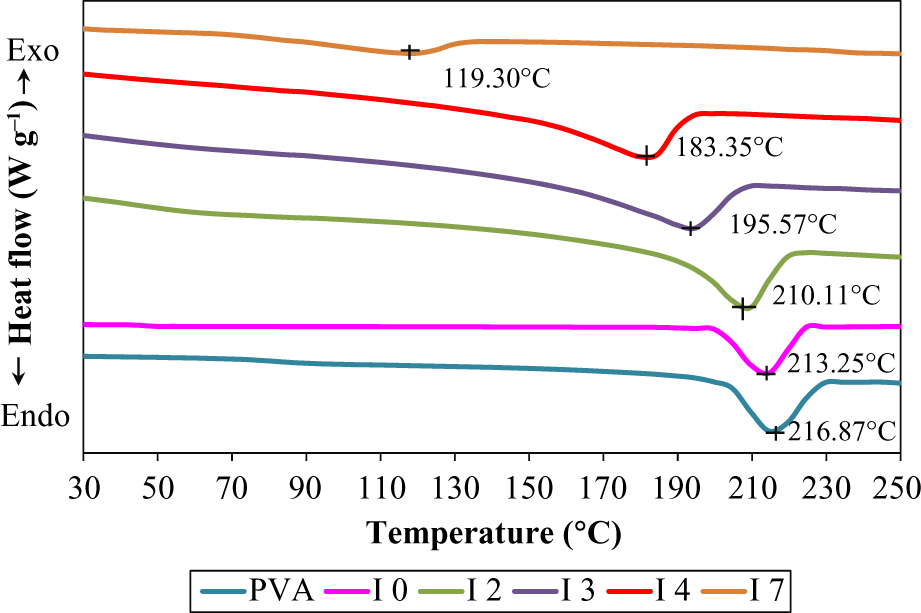
Crystalline T m of polymer electrolytes. T m: melting temperature.
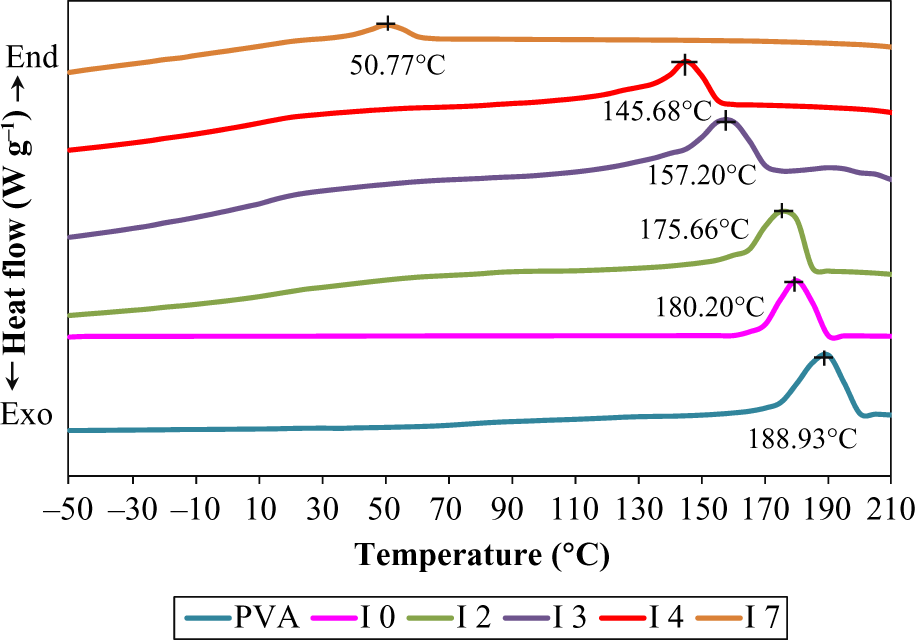
T c of polymer electrolytes. T c: crystallization temperature.
With the addition of ionic liquid, both T m and T c decrease with increasing mass loadings of ionic liquid. These results infer the reduced crystallinity of polymer electrolytes. This principle is proven by measuring the relative degree of crystallinity (X c) of polymer electrolytes. The relative X c is calculated from the melting endotherm using the following equation:
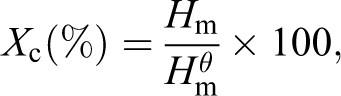
where ΔH
m denotes the heat of fusion of sample and
Heat of fusion of samples with their relative crystallinity.
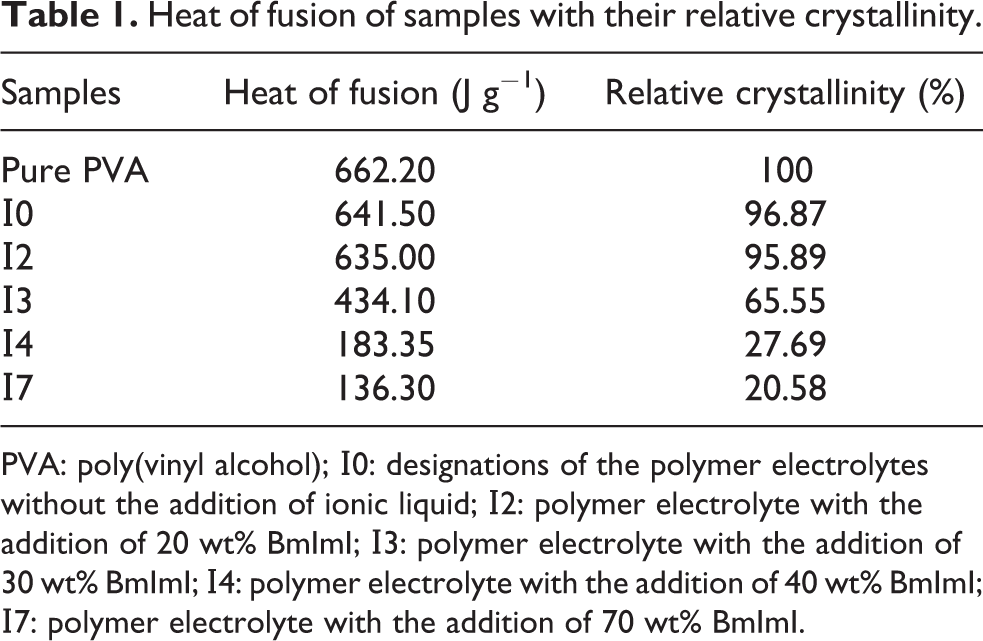
PVA: poly(vinyl alcohol); I0: designations of the polymer electrolytes without the addition of ionic liquid; I2: polymer electrolyte with the addition of 20 wt% BmImI; I3: polymer electrolyte with the addition of 30 wt% BmImI; I4: polymer electrolyte with the addition of 40 wt% BmImI; I7: polymer electrolyte with the addition of 70 wt% BmImI.
The relative percentage of crystalline region in the polymer electrolytes reduces with the concentration of ionic liquid. It is noteworthy that the most conducting polymer electrolyte has the lowest X c among all the samples.
Cyclic voltammetry
The CV curve of EDLC using ionic liquid-free polymer electrolyte shows a leaf-like shape with C sp of 0.14 F g−1, as reported in our published article. 4 Figure 5 portrays CV curve of EDLC using ionic liquid-added polymer electrolyte. Upon addition of ionic liquid into the polymer electrolytes, the C sp of EDLC is increased about 40,457% that is around 52.78 F g−1. In addition, the shape has been changed to the almost ideal box-like shape. Therefore, we conclude that impregnation of ionic liquid can improve the electrochemical properties of EDLC.
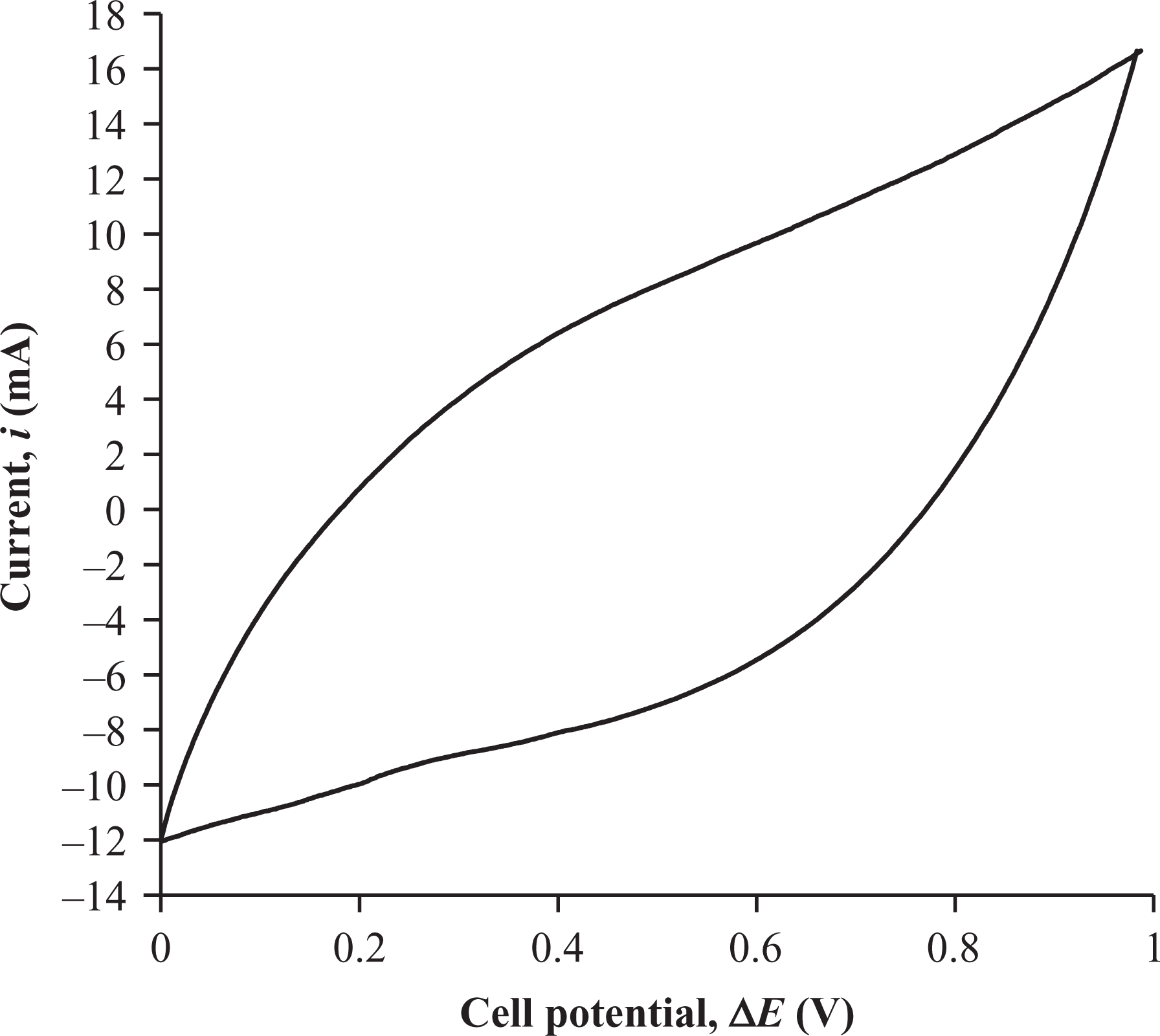
CV curve of EDLC-containing ionic liquid-added polymer electrolyte. CV: cyclic voltammetry; EDLC: electrical double-layer capacitor.
Conclusions
PVA-based proton conductors were prepared and investigated. Addition of ionic liquid not only improved the ionic conductivity of polymer electrolyte but also reduced the T g and crystallinity of the polymer matrix. Incorporation of ionic liquid also improved the electrochemical properties significantly. The EDLC using the most conducting polymer electrolyte exhibited the C sp of 52.78 F g−1, which is much higher than that of ionic liquid-free polymer electrolyte.
Footnotes
Acknowledgment
Author Chiam-Wen Liew gratefully acknowledges the ‘Skim Bright Sparks Universiti Malaya’ (SBSUM) for awarding scholarship.
Funding
This work was supported by ‘Peruntukan Penyelidikan Pascasiswazah (PPP), Universiti Malaysia’ (PV035-2012A), Fundamental Research Grant Scheme (FRGS) (FP024-2013A), Malaysia, and the University of Malaya Research Grant (UMRG program, RP001-2013A).