






Abstract
A new kind of composite membrane consisting of sulfonated poly(ether sulfone) (SPES), poly(vinylidene fluoride) (PVDF), and phosphotungstic acid (TPA) has been prepared and employed as the ion-exchange membrane for vanadium redox flow battery (VRB) application. The addition of the highly crystalline and hydrophobic PVDF effectively confines the swelling behavior of SPES/PVDF/TPA. The composite membrane exhibits one order of magnitude lower vanadium ions permeability and much better single cell performance compared to pristine SPES and Nafion 115 membranes. The single cell with SPES/PVDF/TPA membrane shows much lower capacity loss, higher coulombic efficiency (>97%), and higher energy efficiency (>82%) than which with Nafion 115 membrane. In the self-discharge test, single cell with SPES/PVDF/TPA membrane shows much longer duration in the open-circuit voltage decay than which with Nafion 115 membrane. With all the good performances and low cost, the SPES/PVDF/TPA membrane is expected to have excellent commercial prospects as ion-exchange membrane for VRB system.
Keywords
Introduction
New eco-friendly energy sources, such as solar, tides, and so on, are among the central topics of our times with the concerns of environment protection and energy shortage. However, these renewable energy sources are commonly unstable, and how to store them safely and efficiently has become a great challenge for their large-scale application. The vanadium redox flow battery (VRB), originally proposed by Sukkar and Skyllas-Kazacos, 1 has been receiving considerable attention in the last few years due to its technical benefits. These benefits include the long life cycle, flexible design, fast response time, and deep-discharge capability in energy storage system. As shown in Figure 1, 2 the structure of VRB single cell consists of two electrolyte tanks with V(II)/V(III) and V(IV)/V(V) electrolyte solution, two pumps, and a battery stack section where the redox electrode reaction takes place. As the key component of VRB, ion-exchange membranes are employed to separate the positive and negative electrolytes and complete the current circuit by transferring ions.
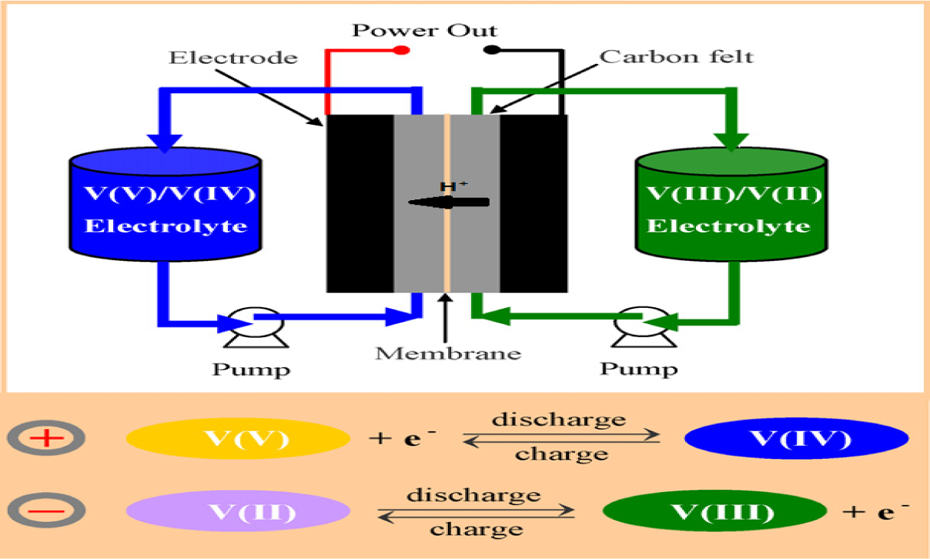
All-vanadium redox flow battery.
The ideal ion-exchange membrane should not only possess good proton conductivity and chemical stability but also possess low permeability for vanadium ions in order to minimize the cross mixing of these electroactive species. At present, perfluorosulfonic polymers, such as Dupont Nafion, are the most common membranes currently used in VRB due to their excellent proton conductivity and chemical stability. However, Nafion membranes suffer from their high crossover of vanadium ions, which further leads to capacity loss and energy efficiency (EE) decrease in VRB. 3 Hence, new alternative ion-exchange membrane materials are being sought. 4
Polymer blending is a facile and effective method for polymer modification. The compatibility of different polymer constituents would greatly affect the properties.
In this article, the sulfonated poly(ether sulfone) (SPES)/poly(vinylidene fluoride) (PVDF)/poly(ether sulfone) (PES) composite membrane for the application in VRB was prepared by solution casting method. The influence of PVDF and phosphotungstic acid (TPA) on the primary properties and chemical stability of the composite membrane was investigated in comparison with pristine SPES membrane and Nafion 115 membrane. The distribution of PVDF and TPA on the surface of the composite membrane was analyzed by scanning electron microscopy (SEM). The performance of VRB single cell with the composite membrane was evaluated according to the charge–discharge curves, columbic efficiency (CE), voltage efficiency (VE), and EE, and self-discharge curves in comparison with the Nafion 115 membrane.
The results show that the composite membrane has promising prospects for application in VRB system.
Experiments
Preparation of SPES/PVDF/TPA membrane
For preparation of SPES, 10 g PES in powder form was dissolved slowly in sulfuric acid (H2SO4; 98 wt%, 100 ml) and 20 ml camphorsulfonic acid (CSA) was added drop by drop at room temperature for 10 h. The SPES solution was then poured into a large excess of ice water to precipitate SPES. The solid SPES was washed several times with distilled water until the pH of the remaining retentate was nearly 7. The SPES was then dried at 100°C for 24 h to remove water completely before it was ready to be used.
SPES was dissolved in N-acetyl dimethylamine to form 10 wt% solution. Afterward, the PVDF and TPA were added into the solution and continuously stirred at 100°C for 3 h. The mixed solution was cast onto a glass plate by using a casting knife and heated to evaporate most of the solvent. After cooling to room temperature, the SPES/PVDF/TPA membrane was peeled off from the glass plate. Finally, the membrane was stored in deionized water after washing several times.
Membrane characterization
Thickness of membrane
The thickness is an important parameter for the membrane. In this work, the thickness of the membrane was measured by a micrometer. The dry sample membrane with dimensions of 3 × 3 cm2 was cut and used for the measurement.
Water uptake
The water uptake (Wu ) is one important property of the ion-exchange membrane. The dried membrane was immersed in H2O for 24 h at room temperature. After quickly wiping out the surface solution of the membrane by tissue, the weight of the swollen membrane was measured. In this work, the Wu was calculated according to the following equation 5

where W wet and W dry are the weight of the wet and dry membranes, respectively.
Ion-exchange capacity
The ion-exchange capacity (IEC) of the membranes is calculated by the following equation described by the literature 6
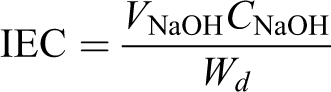
where V NaOH is the volume of the consumed sodium hydroxide (NaOH) solution and C NaOH is the concentration of the NaOH solution. Wd refers to the dried weight of the membrane.
Membrane with fixed weight was immersed in 1 M sodium chloride solution for 24 h to liberate all fixed H+ ions of the membrane into the solution. Afterward, the H+ concentration in the solution was titrated with 0.1 M NaOH solution.
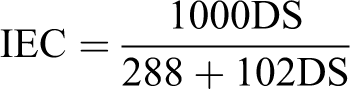
The degree of sulfonation (DS) was calculated by the following equation described by the literature 7
Proton conductivity
The resistance or conductivity of membranes in electrochemical systems can be measured by using data from EIS. In this work, the area resistance of the membrane was tested by alternating current (AC) impedance technique with Solartron 1296 impedance instrument. The proton conductivity (σ) was calculated by the following equation 8
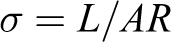
where L is the distance between the two electrodes, A is the actual contact area of sample membrane, and R is the sheet resistance of membrane.
Vanadium permeability
The permeability of V(IV) through the membrane was determined according to the literature. 9 The measurement device is shown in Figure 2. The right reservoir was filled with 25 ml 1.0 M vanadyl sulfate in 2 M H2SO4 solution, while the left one was filled with 25 ml 1.0 M magnesium sulfate in 2 M H2SO4 solution. Magnetic stirrers were used in both reservoirs to avoid the concentration polarization. The area of the membrane exposed to the solution was 3.14 cm2. Samples from the left reservoir were collected at regular time interval.
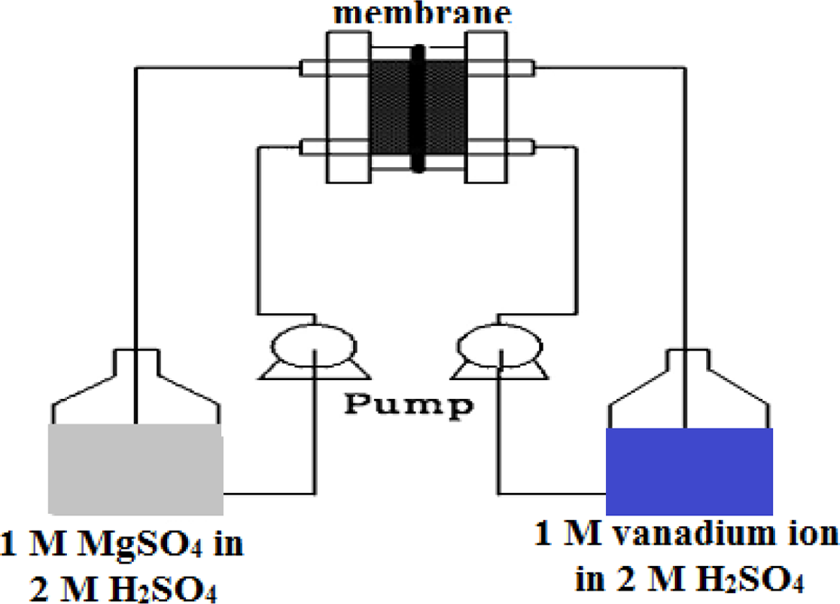
Device diagram for the measurement of vanadium permeability.
The concentration of V(IV) in sample solution was tested by ultraviolet–visible spectrometer (λ max = 765 nm). 10 Given that the change of V(IV) concentration in the right reservoir is so low that the relationship between V(IV) concentration in the left reservoir and time could be described by Fick’s diffusion law as the following equation

where VL is the solution volume in the left reservoir, A is the effective area, L is the thickness of the membrane, P is the permeability of V(IV), CR is the V(IV) concentration in the right reservoir, and CL is the V(IV) concentration in the left reservoir according to time t. The ion selectivity is determined by the ratio of conductivity and permeability. 11
Scanning electron microscopy
SEM (JEOL 630LV, Japan) was employed to observe the surface of composite membrane.
VRB single cell performance
The VRB single cell used test was fabricated by sandwiching a membrane with two carbon felt electrodes, clamped by two graphite polar plates. All these components were fixed between two stainless plates. 2.0 M V(II)/V(III) in 3.0 M H2SO4 solution and 2.0 M V(IV)/V(V) in 3.0 M H2SO4 solution, serving as negative and positive electrolytes, respectively, were cyclically pumped into the corresponding half-cell. The volume of electrolyte solution was 70 ml in each half-cell and the effective area of the electrode was 31.25 cm2. The VRB single cells were charged and discharged at a current density of 30 mA/cm−2. To avoid the corrosion of graphite polar plates and graphite felt electrodes, the charge–discharge voltages were limited between 1.6 V and 0.8 V.
Results and discussion
Primary properties of the membranes
Thickness, IEC, DS, tensile strength, and Wu of the membranes are summarized in Table 1. It can be observed that the IEC of the composite membrane decreases due to the decreasing numbers of SO3H groups per gram in the composite membrane; Wu of the composite membrane decreases upon the addition of PVDF. Considering the hydrophobic nature and high crystallinity of PVDF, it is reasonable that the addition of PVDF would extend the crystalline region of the polymer and suppress its water adsorption. 12 Compared to the Nafion 115 and SPES membranes, the composite membrane exhibits much higher tensile strength, which indicates that the PVDF can really reinforce SPES with better mechanical stability. It is considered that the adsorption and diffusion of water molecules in SPES mainly take place in hydrophilic region, induced by sulfonic acid groups, while the crystalline region formed from hydrophobic main chain provides the membrane mechanical stability. The addition of PVDF might improve the crystallinity of the polymer blends and further improve its mechanical stability.
Primary properties of the membranes.
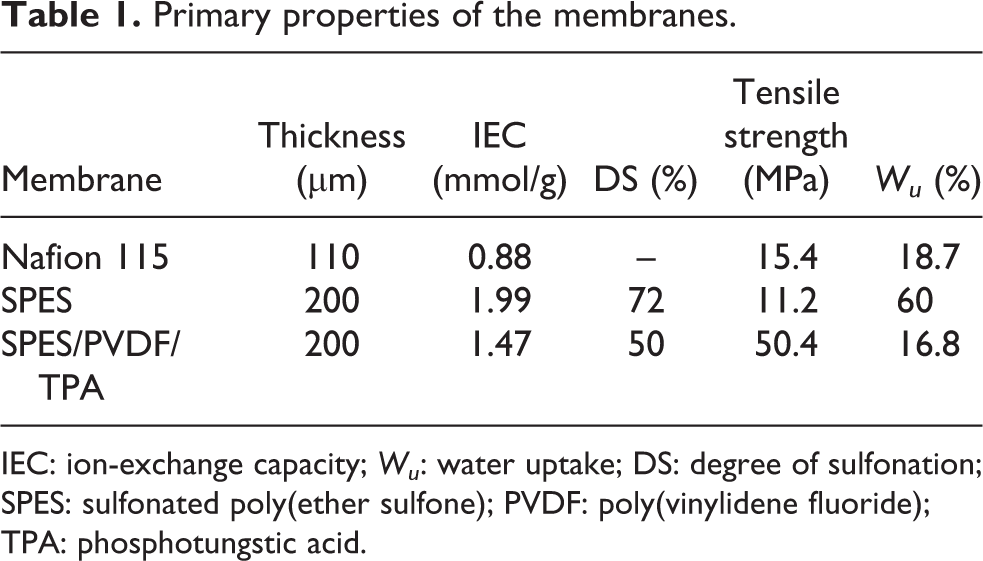
IEC: ion-exchange capacity; Wu : water uptake; DS: degree of sulfonation; SPES: sulfonated poly(ether sulfone); PVDF: poly(vinylidene fluoride); TPA: phosphotungstic acid.
Membrane morphology
The micrographs of membranes’ surface presented in Figure 3 reveal the morphology of the polymer blends. Pure SPES in Figure 3(a) shows a very smooth and a uniform surface. With the addition of TPA and PVDF, as shown in Figure 3(b), grains with size smaller than 1 μm are detected on the surface of membrane and it can be attributed to the aggregation and crystallization of PVDF and TPA in the SPES matrix. Miscibility gaps could hardly be observed in these polymer blends, indicating that SPES, PVDF, and TPA are highly compatible.
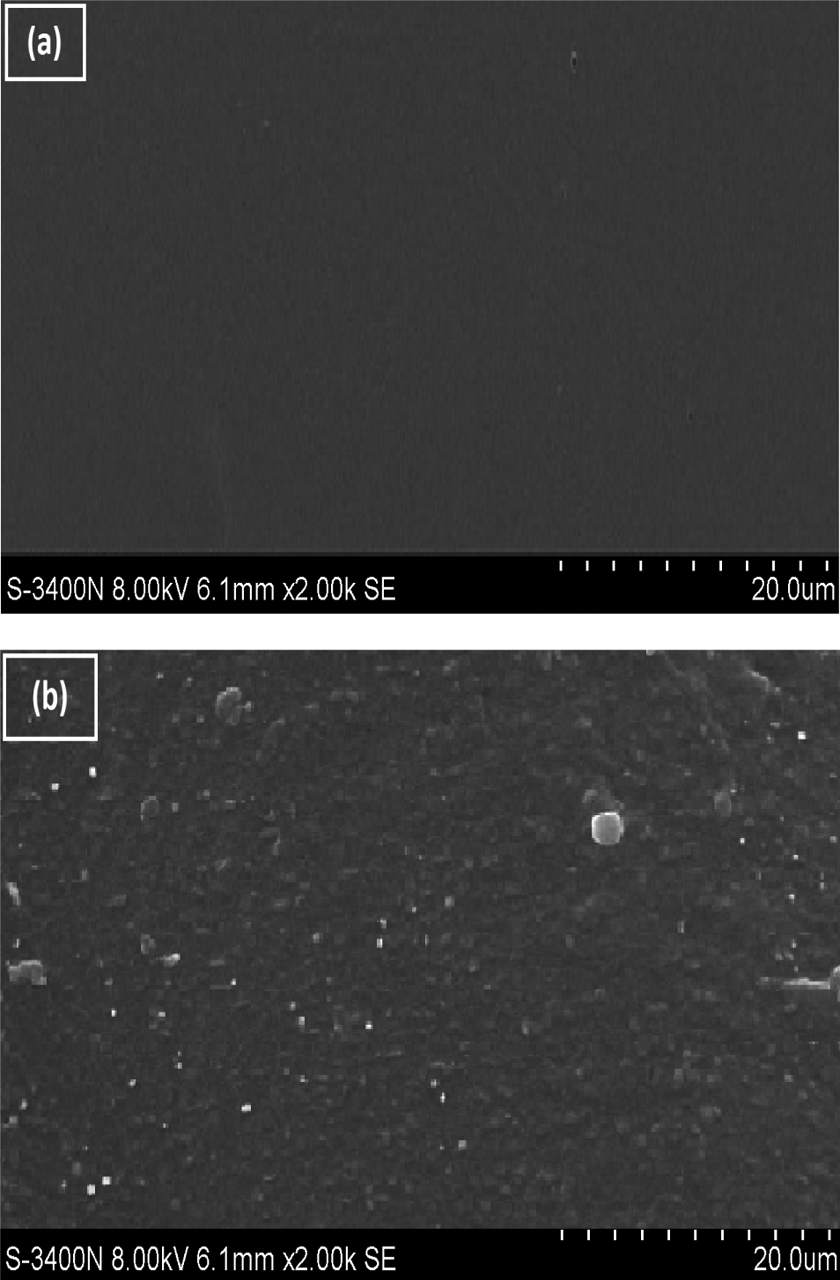
Surface of membranes. (a) SPES membrane. (b) SPES/PVDF/TPA membrane. SPES: sulfonated poly(ether sulfone); PVDF: poly(vinylidene fluoride); TPA: phosphotungstic acid.
Vanadium permeability
The permeation of vanadium ions is disadvantageous to the VRB system, because it will lead to self-discharge of the cell. The permeability (P) of vanadium ion was calculated and listed in Table 2 and Figure 4. It is found that the pure SPES-based membranes has lower P than that of Nafion 115 membrane. The decrease of P could be attributed to their different microstructures. Compared with the Nafion 115 membrane, the SPES-based membranes have smaller hydrophilic/hydrophobic separation domains. 13 For the SPES/PVDF/TPA membrane, the sharp decrease of P indicates that the inclusion of PVDF and TPA has big effect on the lower permeation. As discussed in the literature, 13 the crystallization of PVDF confines the swelling behavior of the membrane, which is closely related to its ion selectivity. With the inclusion of PVDF, swelling is subscribed in a certain extent. Table 2 shows that the proton conductivity of SPES/PVDF/TPA composite membrane is lower than that of Nafion 115 membrane, which is attributed to the bad proton conductivity of PVDF. The potential performance of VRB membranes is often evaluated according to the ratio of proton conductivity to permeability of vanadium ions defined as selectivity. Higher selectivity means better membrane performance. Table 2 and Figure 5 show that the selectivity of the SPES/PVDF/TPA membrane is dramatically higher than that of the Nafion 115 membrane.
Conductivity, permeability, and selectivity of the membranes.
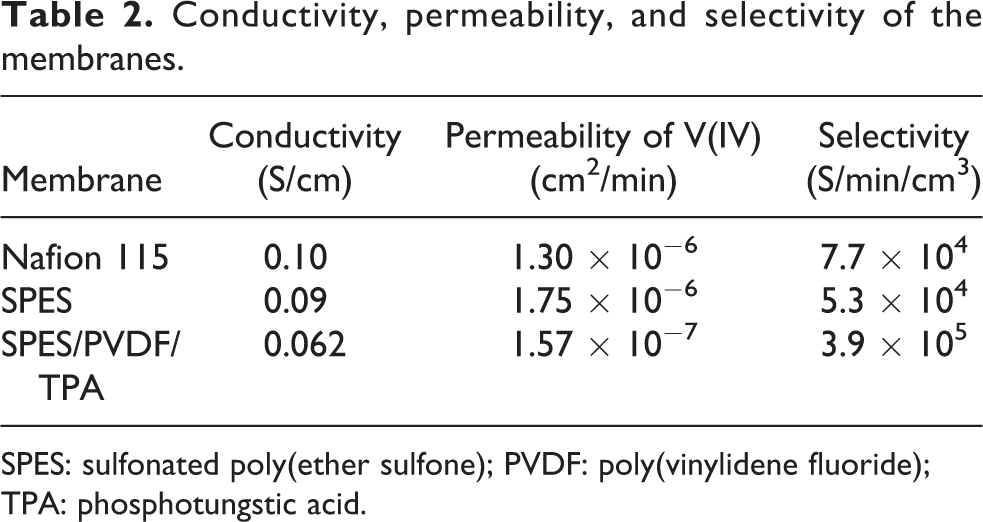
SPES: sulfonated poly(ether sulfone); PVDF: poly(vinylidene fluoride); TPA: phosphotungstic acid.
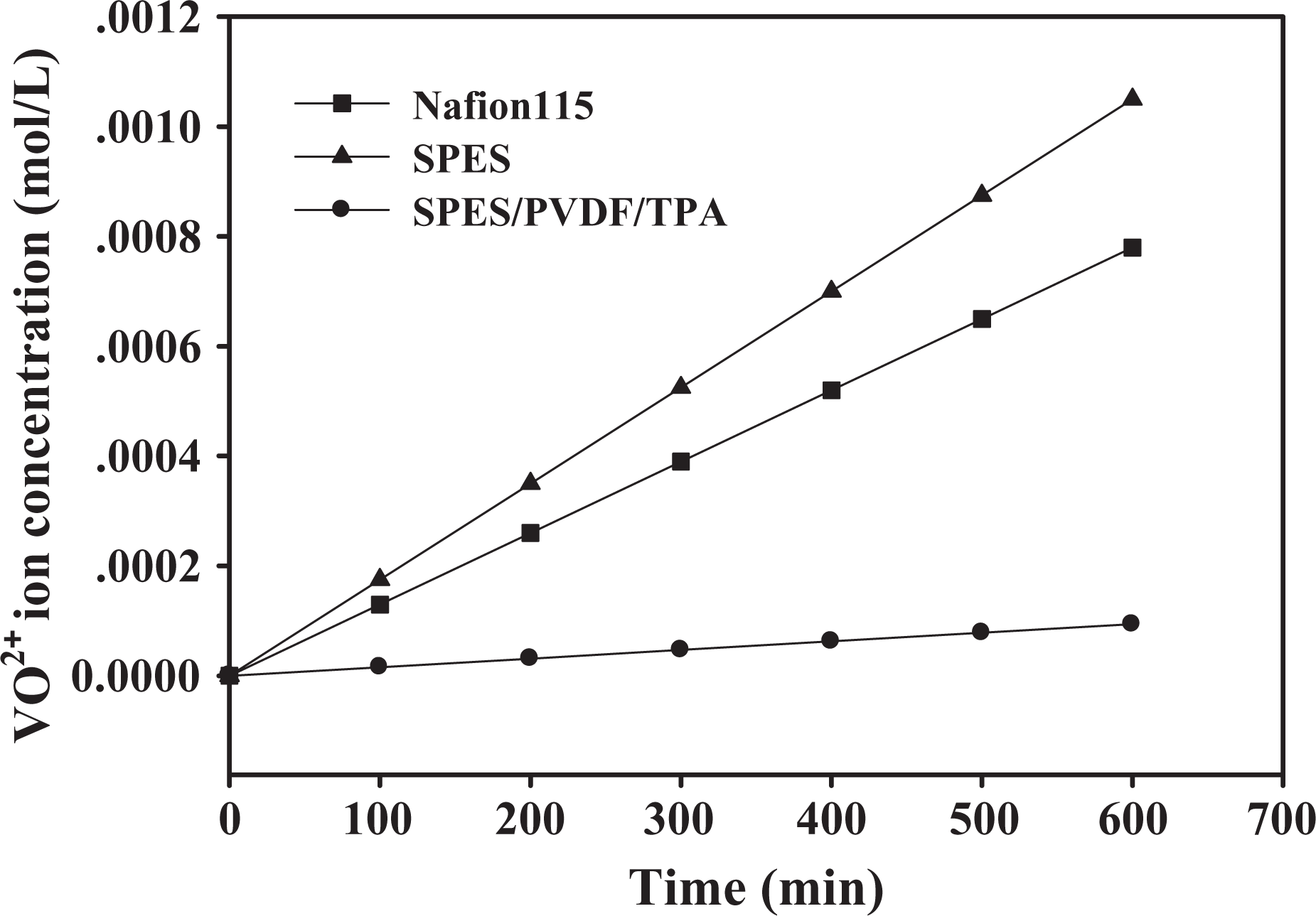
Permeability V(IV) concentration in the right reservoir of the permeation measuring device with SPES, Nafion 115, and SPES/PVDF/TPA membranes. SPES: sulfonated poly(ether sulfone); PVDF: poly(vinylidene fluoride); TPA: phosphotungstic acid.
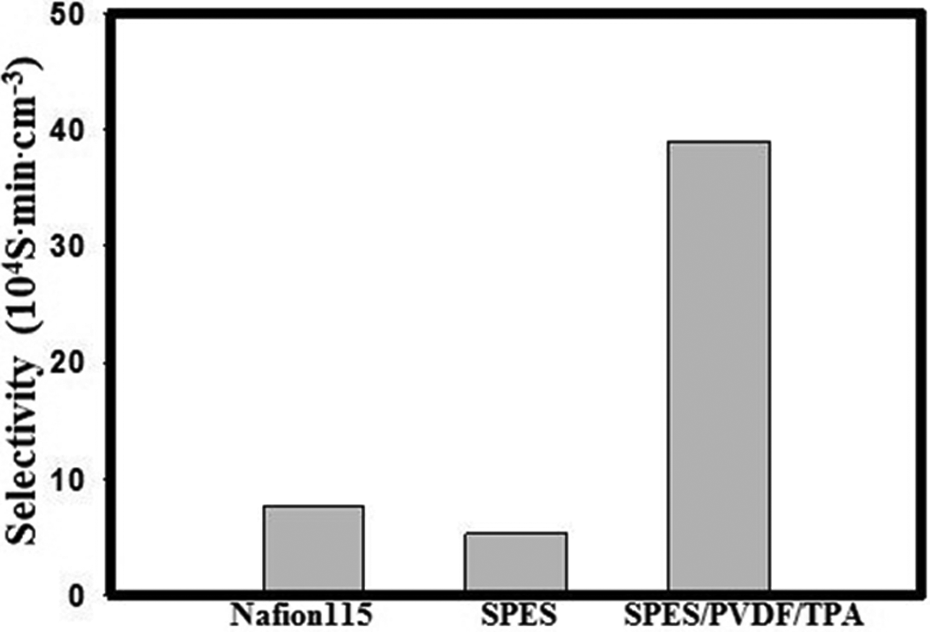
Selectivity of Nafion 115, SPES, and SPES/PVDF/TPA membranes. SPES: sulfonated poly(ether sulfone); PVDF: poly(vinylidene fluoride); TPA: phosphotungstic acid.
Single cell performance
Figure 6 reveals the charge–discharge curves of the VRB single cell employing SPES/PVDF/TPA and Nafion 115 membranes at 30 mA/cm2. The charge capacity of the VRB with SPES/PVDF/TPA membrane is lower than that of the Nafion 115 system, which is attributed to the lower proton conductivity. The discharge capacity of the cell with SPES/PVDF/TPA membrane is very near to that of Nafion 115 membrane, which is attributed to the significantly lower self-discharge of the cell with SPES/PVDF/TPA membrane resulting from the higher selectivity compared to the Nafion 115 membrane.
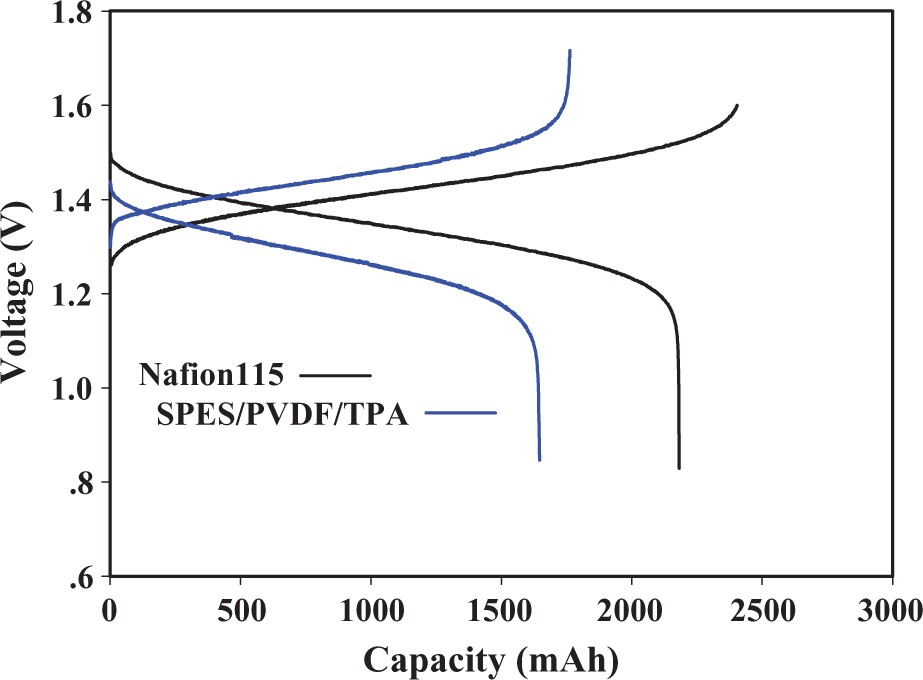
Charge–discharge curves of single cell with SPES, Nafion 115, and SPES/PVDF/TPA membranes, respectively. SPES: sulfonated poly(ether sulfone); PVDF: poly(vinylidene fluoride); TPA: phosphotungstic acid.
The results of average CE, VE, and EE of the single cell with SPES/PVDF/TPA and Nafion 115 membranes at a current density of 30 mA/cm2 for 100 cycles are listed in Table 3. The cell with SPES/PVDF/TPA shows high CE, about 8% higher than that with Nafion 115 membrane. Higher CE indicates less cross-mixing of vanadium ions. It is attributed to the lower V(IV) permeability of SPES/PVDF/TPA membrane.
Single cell performances at 30 mA/cm2.
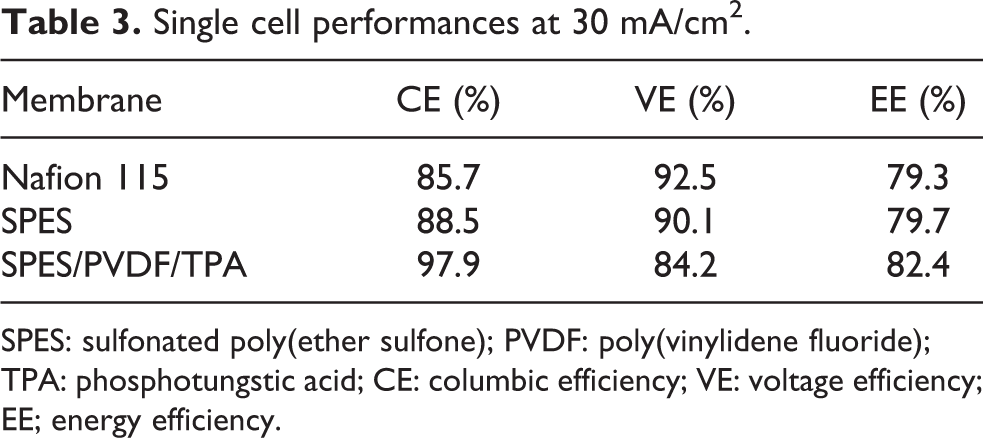
SPES: sulfonated poly(ether sulfone); PVDF: poly(vinylidene fluoride); TPA: phosphotungstic acid; CE: columbic efficiency; VE: voltage efficiency; EE; energy efficiency.
The cell with SPES/PVDF/TPA exhibits much lower VE compared with that of Nafion 115. This result is well matched with the higher sheet resistance of SPES/PVDF/TPA membrane.
EE is a key parameter to evaluate the energy conversion rate of VRB system. As EE is the product of CE multiplying VE, the membrane that performs higher EE possesses both high ion conductivity and low vanadium permeability. Therefore, SPES/PVDF/TPA membrane that exhibits the better EE is a better choice than Nafion 115 membrane for VRB from a comprehensive view.
Self-discharge test was conducted to investigate the transfer of vanadium ions across SPES/PVDF/TPA membrane and Nafion 115 membrane. In this test, 2.0 M V(II)/V(III) in 3.0 M H2SO4 solution and 2.0 M V(IV)/V(V) in 3.0 M H2SO4 solution were cyclically pumped into negative and positive half-cell, respectively. Self-discharge began at the state of charge of 50%. The process stopped when the open-circuit voltage (OCV) was lower than 0.8 V. As demonstrated in Figure 7, the capacity of the cell with SPES/TPA/PVDF membrane decreases much slower than that with Nafion 115 membrane. The entire self-discharge procedure of the single cell with SPES/PVDF/TPA membrane lasts for more than 150 h, while the OCV of the cell with Nafion 115 membrane comes down to 0.8 V in less than 55 h. This result reveals that SPES/PVDF/TPA membrane significantly reduces the permeation rate of vanadium ions which is well-matched with the test of permeability test.
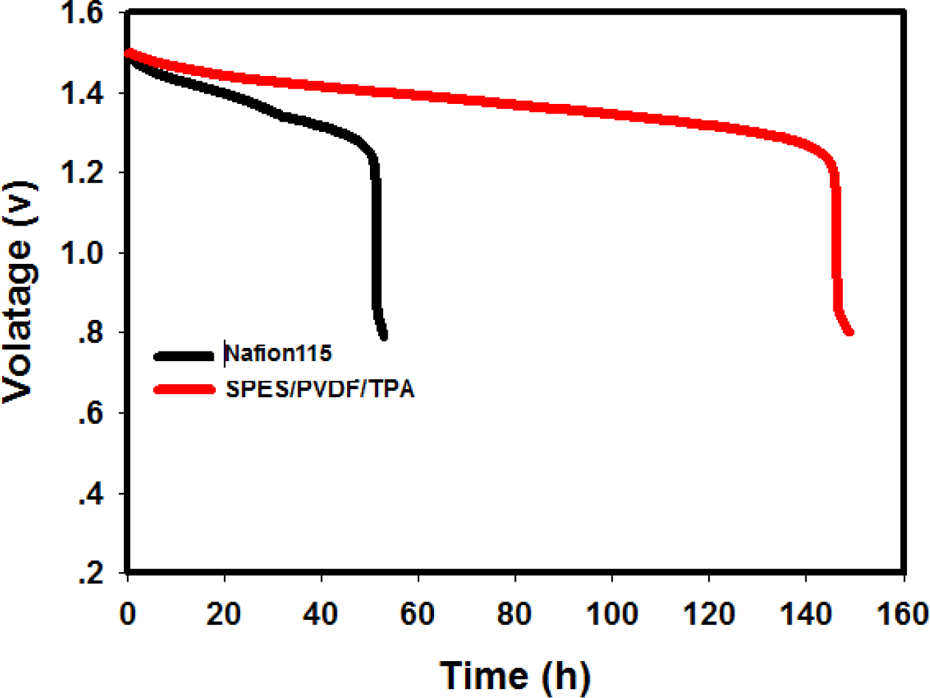
OCV decay curves of the cells with Nafion 115 and SPES/PVDF/TPA membranes. OCV: open-circuit voltage; SPES: sulfonated poly(ether sulfone); PVDF: poly(vinylidene fluoride); TPA: phosphotungstic acid.
Conclusions
In this work, an SPES/PVDF/TPA composite membrane has been prepared by hybrid solution casting method. The composite membrane shows much high selectivity and much lower permeability than that of Nafion 115 membrane and pristine SPES membrane. VRB single cell with SPES/PVDF/TPA membrane shows much higher CE and EE and much lower self-discharge rate than that with Nafion 115 membrane. Therefore, with all the good performances and low cost, the SPES/PVDF/TPA membrane is expected to have excellent commercial prospects as an ion-exchange membrane for VRB system.
Footnotes
Declaration of Conflicting Interests
The author(s) declared no potential conflicts of interest with respect to the research, authorship, and/or publication of this article.
Funding
The author(s) disclosed receipt of the following financial support for the research, authorship, and/or publication of this article: This work was supported by the scientific founding of Chongqing Municipal Science and Technology Commission (cstc2016jcyjA0148) and the scientific found of Yongchuan Commission Science and Technology (Ycstc2015nc4002).