







Abstract
Mathematical modeling was has been developed for the chain microstructure formation in the synthesis of copolyimides (CPI) by the one-pot high-temperature catalytic polycondensation from two diamines A and B (comonomers) and one dianhydride C (intermonomer) in molten benzoic acid at 140°C accomplished with different regimes of intermonomer loading. The kinetic scheme including the acylation of the amino group of both diamines with the anhydride fragment, decomposition, and imidization of two intermediate amido acid fragments was examined. The kinetic parameters of the acylation and imidization stages necessary for calculations were determined previously in independent experiments. The numerical solution of the system of kinetic equations for different regimes of intermonomer loading gave the calculated dependences of the change in time of the average block length, the current concentrations of amino- and anhydride groups, amido acid fragments (unstable dyads: AC1 and BC1), imide cycles (stable dyads: AC2 and BC2), and triads. The calculated values of the average block length and the chain microheterogeneity parameter (K m = 0.5) for the first three comonomer pairs at gradual intermonomer loading correspond to the multiblock microstructure of the chain. These values are in good agreement with the experimental values obtained from 13C NMR data for CPI based on the indicated diamines and 2,2-propylidenebis(1,4-phenyleneoxy)diphthalic dianhydride.
Keywords
Polyimides (PIs) are known as class of polymers possessing unique properties including high thermal and heat resistance, cryogenic resistance, excellent mechanical characteristics, and so on. 1,2 Many aspects of the chemistry of PI were considered in detail in monographs and reviews. 3 –7 The most part of data on the kinetics and mechanism of synthesis of linear PI relate to the two-stage method of synthesis in which polyamido acid is obtained at the first stage, and its chemical or thermal imidization is carried out at the second stage. At the same time, for the so-called “one-stage” high-temperature polycondensation (HTPC) 7 –10 in highly boiling solvents at 180–210°C, which is the second in significance method for PI synthesis, where the consecutive reactions of acylation and amido acid fragment imidization are carried out technologically simultaneously, only few works are known devoted to an analysis of the kinetics and mechanism, 11 –16 and all of them concern the synthesis of homopolyimides. In the case of copolyimide (CPI) preparation by HTPC method from two diamines and one dianhydride, or vice versa, it is of interest to find out the possibility to control the moieties distribution in chain because chain microstructure can exert a substantial effect on the properties of copolymers (CPLs). Kinetic investigation of CPI microstructure formation in HTPC process was not carried out. This type of process can be assigned as a variant of “interbipolycondensation” (IBPC) – a common type of process in which two comonomers of the same type react with one bifunctional binding monomer (so-called “intermonomer”) with complement reactive groups. The difference, however, is that CPI formation is not a one-step reaction but proceeds via a more complicated mechanism.
Theoretical analysis of the chain microstructure for an “ideal” IBPC process starting from symmetric comonomers with independent reactive groups was performed by Vasnev and Kuchanov. 17 It was established that CPLs with the random or multiblock moieties distribution can be obtained when definite regime of the intermonomer loading to a mixture of comonomers is used (one-shot or gradual loading). The microheterogeneity parameter Km calculated from the ratio of fractions of triads in CPL was used 18 for quantitative characterization of the moieties distribution in CPL. The conclusions of the IBPC theory were confirmed in practice in the synthesis of copolyesters by the low-temperature polycondensation from diacids, dichlorides, and a mixture of aromatic and aliphatic diols. 7 Multiblock CPLs (Km < 1) were obtained in this and other systems by the gradual introduction of the intermonomer in the cases (with the rare exception) where the copolycondensation conditions were close to those of the so-called “ideal” IBCP, 17 that is, the processes proceeded in one stage and satisfied the following conditions: complete irreversibility, absence of side reactions, homogeneity of the reaction system, and substantial difference in the activity of comonomers. According to the IBPC theory, the one-shot introduction of the intermonomer and both comonomers results in obtaining a random CPL (Km ≈ 1). In the case of reversible IBPC, only random CPL can be formed regardless of the ratio of the activity of comonomers and loading order of the components. 17 The irreversible and equilibrium reactions mentioned above represent two ultimate cases of IBPC: with very high and low equilibrium constants. At the same time, there are many polycondensation processes with intermediate equilibrium constants and systems in which the equilibrium is artificially shifted due to the removal of the low-molecular-weight by-products. In addition, many practically significant processes such as obtaining of CPIs involve more than one reaction. Synthesis of CPI by the HTPC method proceeds in two stages, and the first stage is reversible. 19
The mechanism of chain microstructure formation in CPI synthesis remains not well understood. In previous research works, 20 –22 it was shown that diblock copolyamido acid transforms into random CPI with five-membered imide cycles in a course of thermal imidization (180–200°C) both in solid state and in solution. The synthesis of CPI with five-membered imide cycles from two diamines and one dianhydride (intermonomer) by the one-stage HTPC (170—200°C, m-cresol) afforded CPL with the random microstructure, regardless of the order of intermonomer loading to the system. 20 –22 On the other side, in a case of PI with six-membered imide cycles, the authors succeeded in obtaining multiblock CPL using steady loading of intermonomer. These results were explained by influence of the by-reaction of interchain exchange reactions and different stabilities of the five- and the six-membered imide cycles to them. 20 –22 Nevertheless, the systematic kinetic investigation of the factors determining CPI microstructure formation was not carried out.
Recently, using the one-stage HTPC in a catalytic medium (molten benzoic acid (BA), 140°C) with gradual loading of the intermonomer, 23,24 we obtained multiblock CPI with five-membered imide cycles from two diamines and one dianhydride. In next experiments with the one-shot loading of the intermonomer, CPI with the random moieties distribution was obtained. These results seemed to be rather surprising for us. We have checked these results in a wide series of repeated experiments; this regularity was confirmed. So, it should be concluded that in spite of the fact that all above-described methods of CPI synthesis include the same collection of elementary reactions (acylation of amino groups by anhydride groups, decomposition, and imidization of amido acid fragments), the obtained products can differ in the chain microstructure, probably due to difference in the collection of the elementary reaction rate constants.
In this connection, the purpose of purpose of present work is modeling the process of CPI chain microstructure formation in synthesis CPI by the HTPC in molten BA and comparison calculated and experimental data.
Results and discussion
The components of the system are two bifunctional comonomers that do not interact with each other but react with the intermonomer. The reactive groups in the comonomers and intermonomer used in the synthesis of CPI based on them can be considered independent.
Further, following designations are introduced (see also Figures 1 and 2):
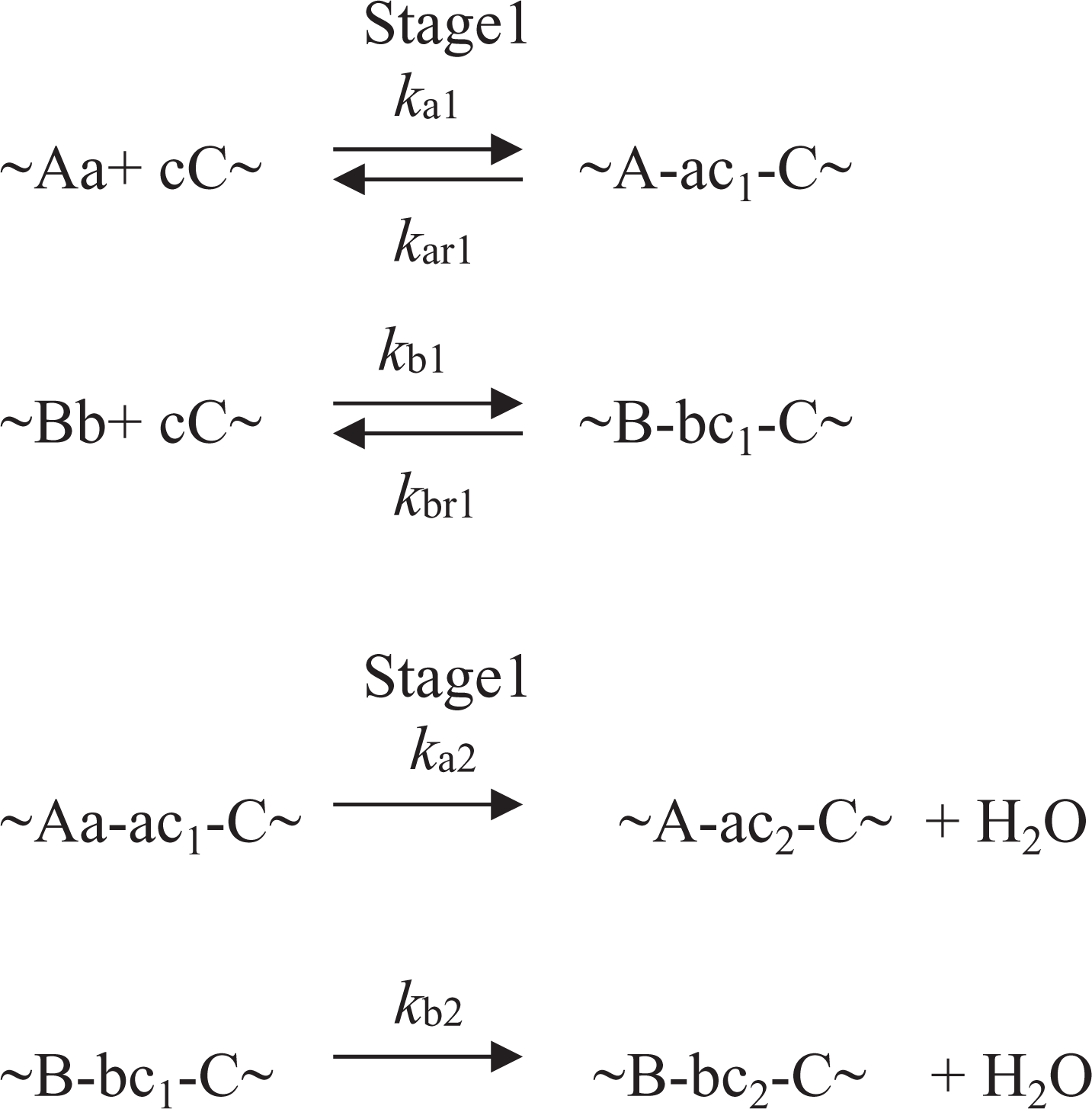
Kinetic scheme of imide cycles formation.
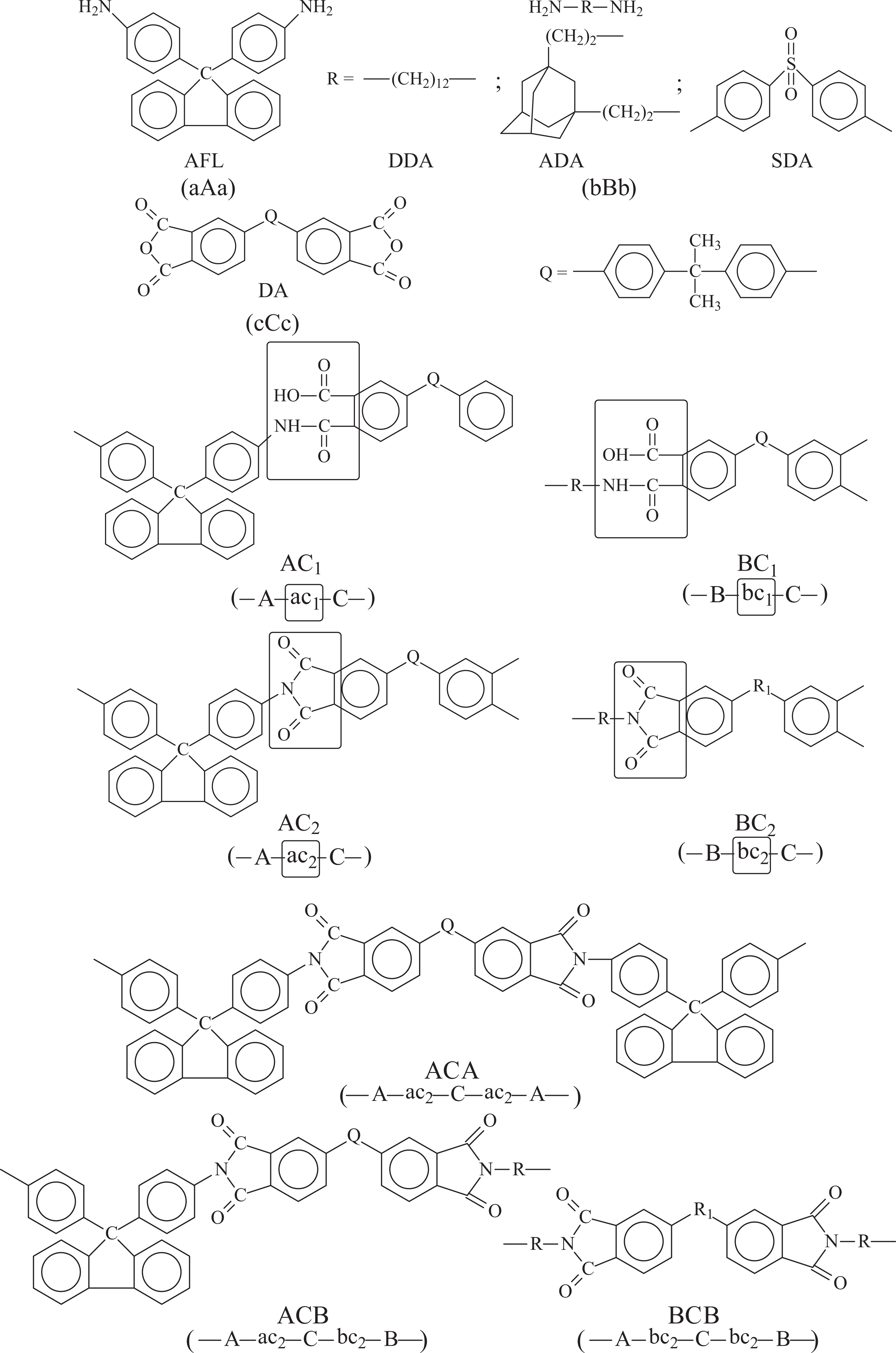
Designation of the structure fragments.
“A” and “B” are moieties of comonomers (e.g. diamines) and “C” is the intermonomer unit (e.g. tetracarboxylic acid dianhydride);
“a” and “b” are amino groups of comonomers “A” and “В” or terminal amino groups of oligomers, respectively; “c” are anhydride groups in the intermonomer or terminal groups in oligomers;
“ac1” and “bc1” are amido acid groups formed from groups “a” and “c” and “b” and “c,” respectively;
“ac2” and “bc2” are the imide cycles;
“AC1” and “BC1” are unstable dyads, that is, the fragments of chain: “∼A—ac1—C∼” and “∼B—bc1—C∼”;
AC2 and BC2 are stable dyads, the fragments of chain: ∼A—ac2—C∼ and ∼B—bc2—C∼;
“ACA,” “BCB,” “ACB,” “CAC,” and “CBC” are triads consisting of two corresponding stable dyads, for example, “ACA” render to the chain fragment ∼A-ac2-C-ac2∼A; “CAC” and “CBC” are terminal triads.
Triads are the simplest structure elements that can characterize the chain microstructure of CPL.
The process of CPI synthesis by HTPC includes the following main reactions
12,16,19,22,25
–27
: Acylation of amino groups (“a”, “b”) by anhydride groups (“c”) to form amido acid fragments “ac1” and “bc1”; Decomposition of amido acid fragments “ac1” and “bc1” to form the initial amine and anhydride groups (“a,” “b,” and “c”); Imidization of amido acid fragments “ac1” and “bc1” to form imide cycles “ac2” and “bc2”; Hydrolysis of imide cycles. However, since the synthesis of CPI in molten BA is carried out under the conditions of rigorous water removal due to purging of the system with an inert gas, the contribution of this reaction can be neglected, at least in the first approximation. For this reason, the side reaction of hydrolysis of anhydride fragments by water evolved upon imidization can be ignored for the same reason. So, the kinetic scheme of the process including main reactions (1)–(3) can be presented in the following form (Figure 1):
Figure 1 differs from the scheme of “ideal” IBPC by the fact that the formation of imide cycles from which a certain sequence of moieties is formed proceeds via two consecutive stages.
The first stage includes the backward reaction that potentially favors the “decomposition” of the ordered (multiblock) microstructure to shift microstructure to the side of random CPI.
To perform the quantitative analysis of the kinetic scheme, it is necessary to have the rate constants k a1, k b1, k ar1, k br1, k a2, and k b2 of the reactions entering the kinetic scheme. Since in the real synthesis of CPI the consecutive reactions of acylation and imidization are technologically inseparable and, hence, the direct determination of the corresponding reaction rate constants seems impossible, we used kinetic data obtained by us in model experiments. For series of diamines (Figure 1 and Table 1), the rate constants of acylation with phthalic anhydride in acetic acid (direct and reverse reactions) were measured at moderate temperatures (20–80°C, with the absence of imidization reaction) and extrapolated to 140°C. 26,28 The imidization rate constant for amido acid moiety of model compounds in AcOH at 140°C (in sealed ampoules) was taken from our earlier publication. 24
Comparison of Km values calculated in this work on the basis of independent kinetic data (obtained for model reactions) and experimental Km (13C NMR).
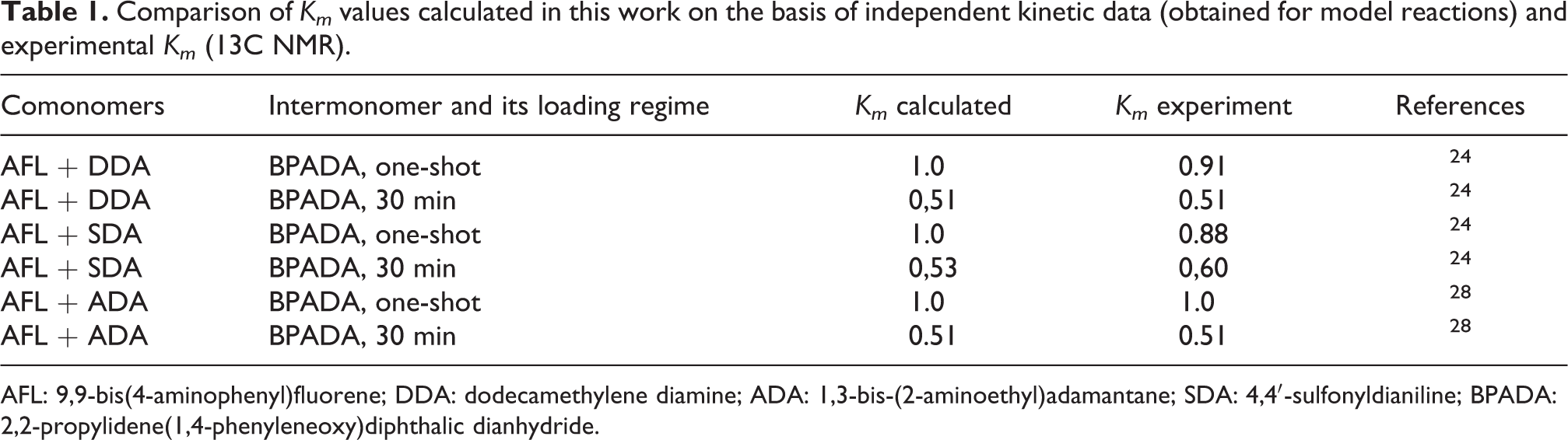
AFL: 9,9-bis(4-aminophenyl)fluorene; DDA: dodecamethylene diamine; ADA: 1,3-bis-(2-aminoethyl)adamantane; SDA: 4,4′-sulfonyldianiline; BPADA: 2,2-propylidene(1,4-phenyleneoxy)diphthalic dianhydride.
At 140°C, the constant rates of direct and reverse reactions of acylation stage in molten BA are extremely high – due to molten BA acts as powerful “bifunctional type” catalyst 29 facilitating intermolecular proton transfer which is limiting the elementary stage of reaction. This means that very fast exchange of every reactive component occurs (functional groups in free (“a” and ”b”) and bound (“ac” and “bc”) states in no dependence with the moment of the reactive component addition into reaction system). This fact is of great importance because it allows consideration of reaction system as “quasi-equilibrium” at any variant of intermonomer loading and, hence, to use simplified model of the process. Indeed, it allows using only the current concentrations of functional groups in different states (free groups, groups entering the amido acid fragments, and imide cycles) as variables—instead of huge massive of growing oligomers, each having its own history.
The CPI chain consists of definite stable dyads sequences (AC2 and BC2). The average block lengths (l A and l B) containing diamine moieties of the same type (A or B) can be used as a characteristic of the microstructure. Defining the length of blocks as a number of these moieties, we obtain the following equations for l A and l B:


where ac2 and bc2 are the concentrations of stable dyads; Ae , Be , CeA , and CeB are the concentrations of “terminal” moieties A, B and C that are ends of the sequences of stable dyads (blocks). In this case, CeA and CeB are the terminal units of the intermonomer forming stable dyads with moieties A and B, respectively. The following designations were accepted for the concentration of triads ACA, ВCВ, ACВ, CAC, and CВC: T ACA, T ВCВ, T ACВ, T CAC, and T CBC, respectively. The expressions for the concentration of terminal units are as follows:





The chain microheterogeneity parameter Km , which is usually used for the characterization of the microstructure of rather long chains with a negligible fraction of terminal units, is related to the block length by the equation:

The model for the calculation of the chain microstructure characteristics is the system of kinetic equations corresponding to the considered kinetic scheme. Independent variables are the concentrations of reactive groups a(t), b(t), and c(t), unstable and stable dyads ac 1(t), bc 1(t), ac 2(t), and bc 2(t), and triads.
The system of kinetic equations (9) –(20) is as follows:












The member “qc” in equation (11) corresponds to gradual loading of “c” groups. The equations for the rate of triad formation (16)–(20) take into account the rapidly established equilibrium in acylation stage. Note that an analytical solution can be written for the quasi-equilibrium reactions of the first stage; however, this solution is very cumbersome, and it is more convenient to remain the equations of the first stage in the general system of equations for the numerical solution.
The numerical solution of the above system of kinetic equations was obtained using the Maple® program or the experimentally determined values of rate constants (see Table 1).
The results of the calculations are presented in Figures 3 to 5 as plots of changing in time of the average length of blocks, current concentrations of amino groups, anhydride groups, amido acid fragments, and imide cycles, and concentrations of triads ACA, ACB, and BCB.
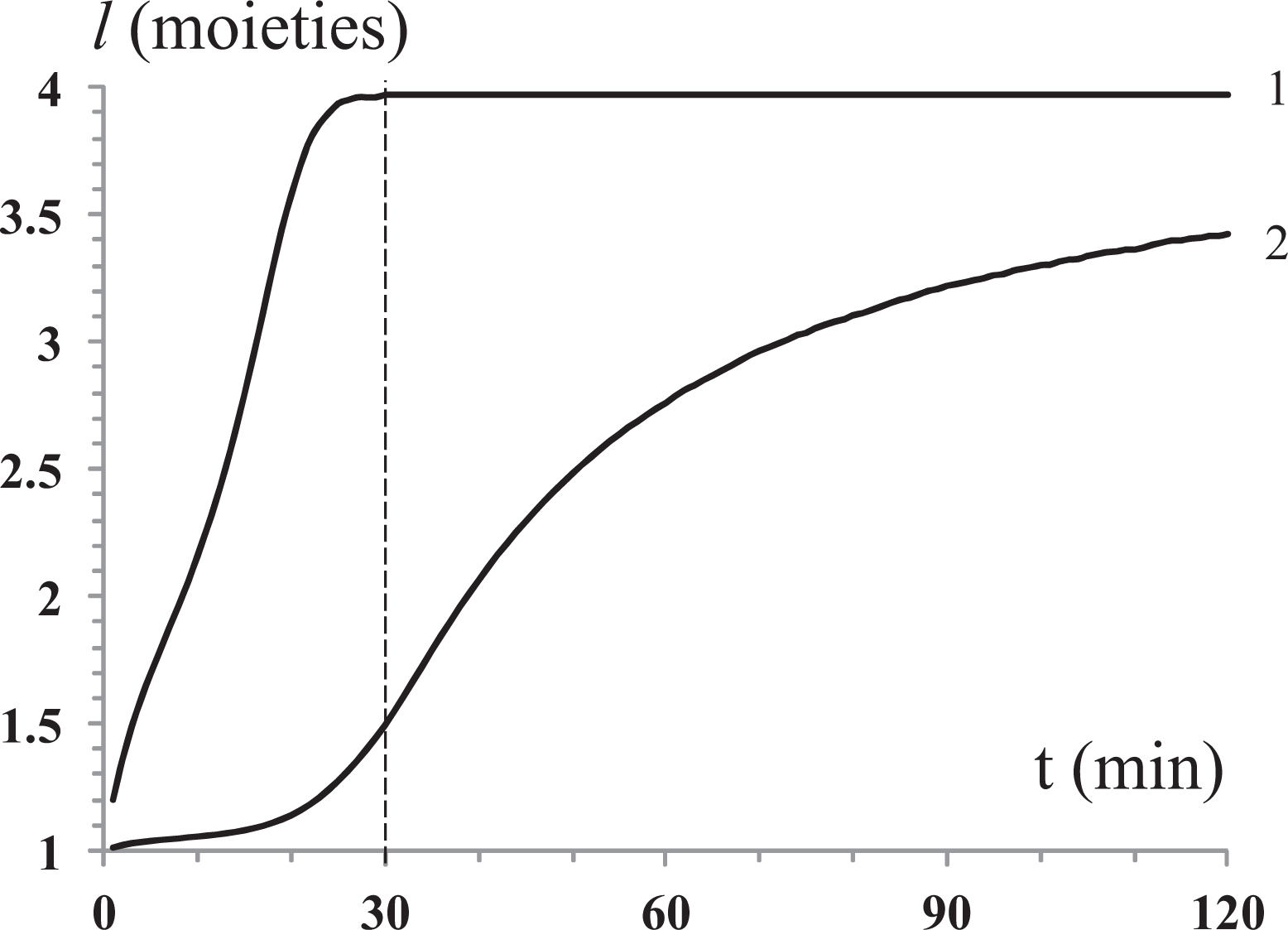
Change in the average length of blocks lA (1) and lB (2) in time with the gradual introduction of the intermonomer for 30 min. Dashed line corresponds to the moment of the end of intermonomer loading. Initial conditions: C 0(AFL) = C 0(DDA) = 0.3 mol l−1; C0(DA) = 0.6 mol l–1. AFL: 9,9-bis(4-aminophenyl)fluorene; DDA: dodecamethylene diamine.
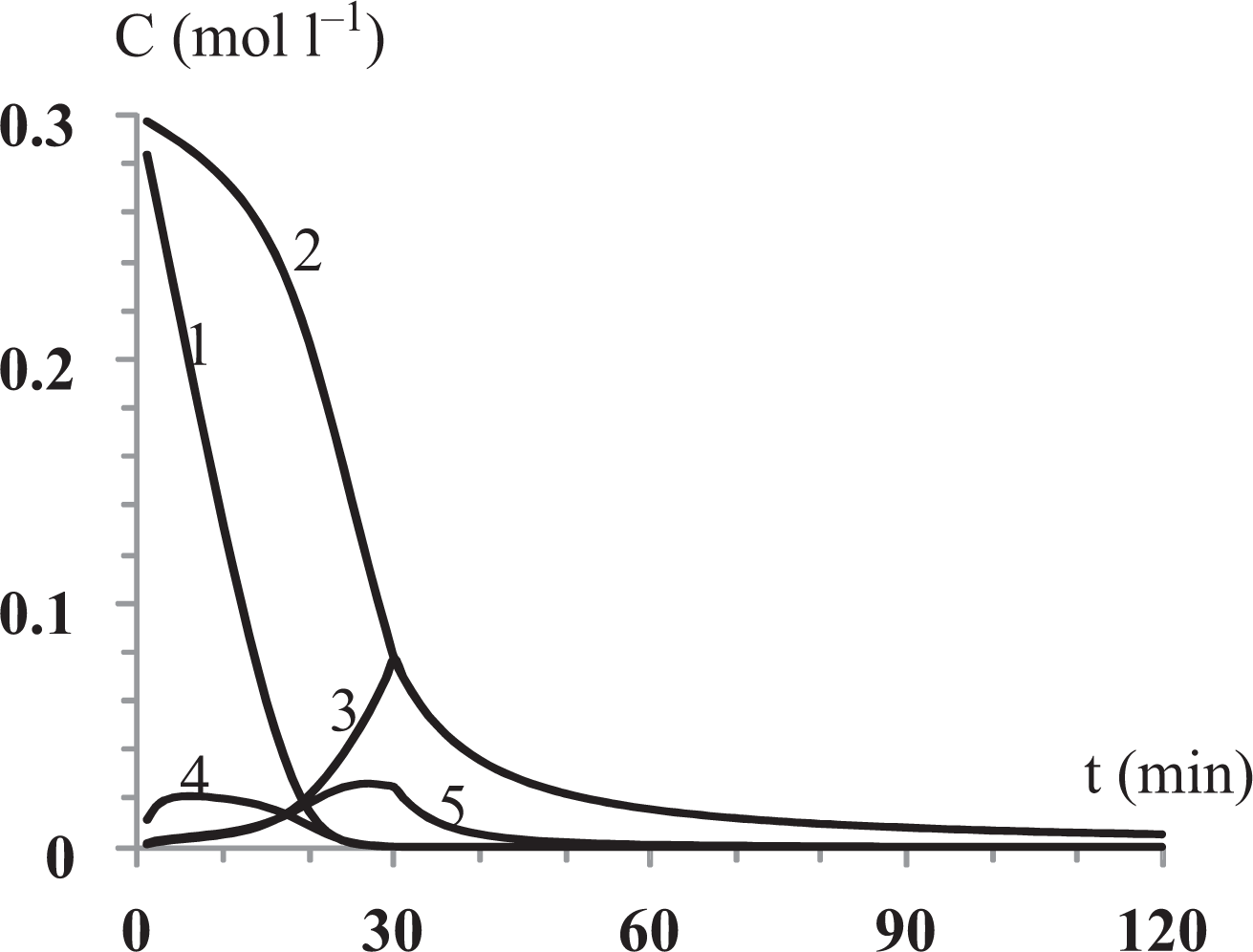
Calculated dependence of the change in time of the concentration of amino groups of comonomer A (1), amino groups of comonomer B (2), anhydride groups (3), and amino acid fragments (unstable dyads) AC1 (4) and BC1 (5).
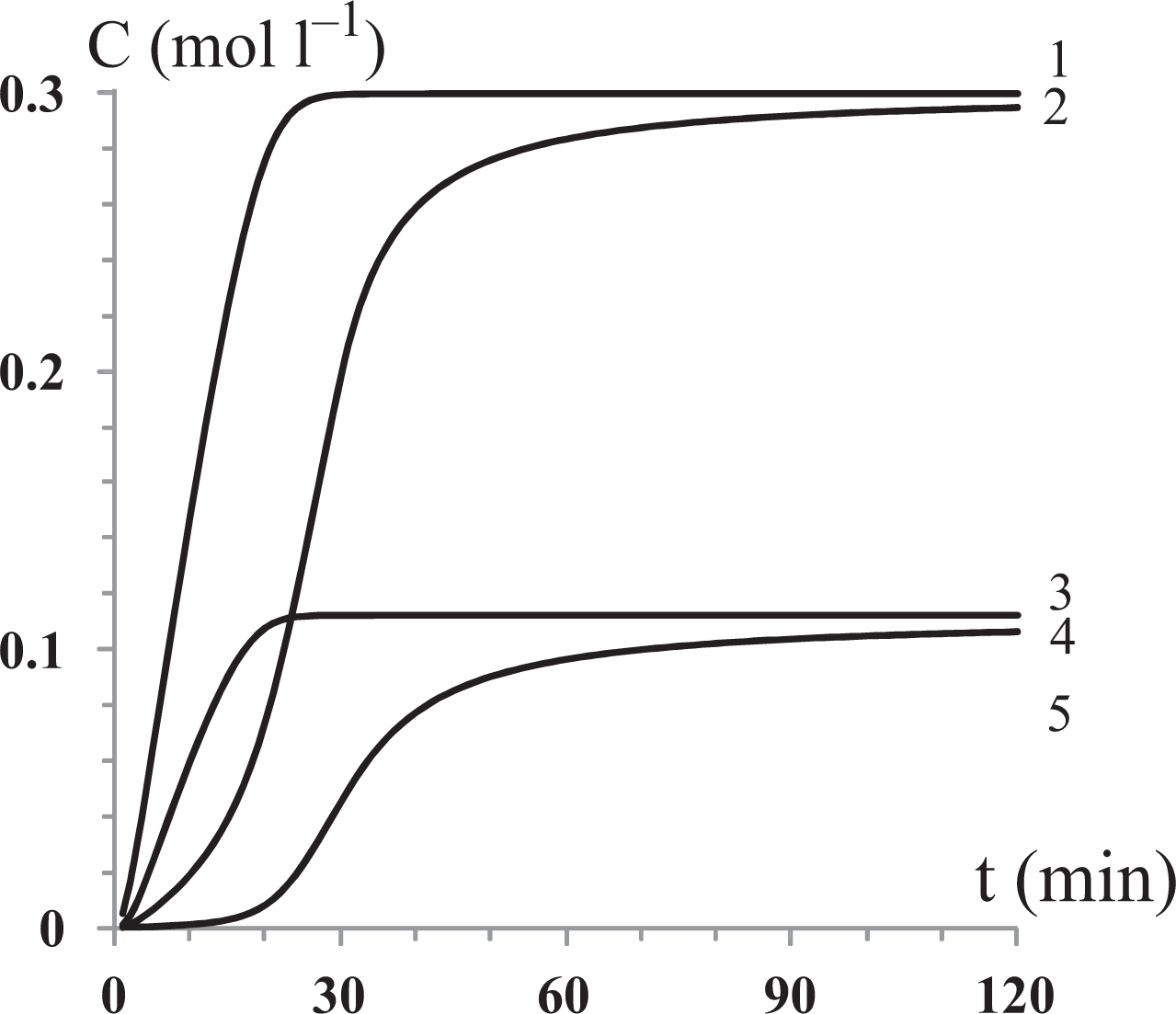
Calculated dependence of the change in time of the concentration of imide cycles (stable dyads) (mol l–1): 1, AC2 and 2, BC2; triads: 3, T ACA; 4, T BCB; and 5, T ACB.
In Figure 3, the kinetics of the average block length (l A and l B) growth for the gradual intermonomer loading within 30 min and overall time of CPI synthesis of 2 h is presented. It is seen that, already to the end of intermonomer loading, the block length l A reaches the almost constant value l A = 4 and further remains unchanged, whereas the average block length l B continues to increase till the end of the experiment; this corresponds to the formation of the multiblock microstructure. The different times till reaching the ultimate block lengths reflect the different reactivity of the comonomers.
The data for the consumption kinetics of amino and anhydride groups during the process are presented in Figure 4. It is seen that the consumption rates of the amino groups of the first and the second comonomers differ substantially. The maximum concentration of amido acid fragments ac 1 and bc 1 does not exceed 0.03 mol l−1, which is not more than 10% of the concentration of the initial amino groups. Thus, these groups are not accumulated in growing chains but are rapidly transformed into stable imide cycles.
For the one-shot loading of the comonomers and intermonomer, the average calculated length of the CPI block becomes equal to l A = 2 almost from the very beginning of the process, and the final value of Km = 1, which corresponds to the CPL with the random distribution of moieties. Thus, the main regularities of CPI microstructure formation in the synthesis in molten BA are similar to the regularities for the IBPC process.
The kinetic curve of changing in time of the concentration of imide cycles AC2 and BC2 (stable dyads) is presented in Figure 5. The change in time of the concentration of triads of different types T ACA, T BCB, and T ACB are also shown in Figure 6. The time of formation of the imide cycles from the more reactive monomer is shorter than that for the less reactive monomer.
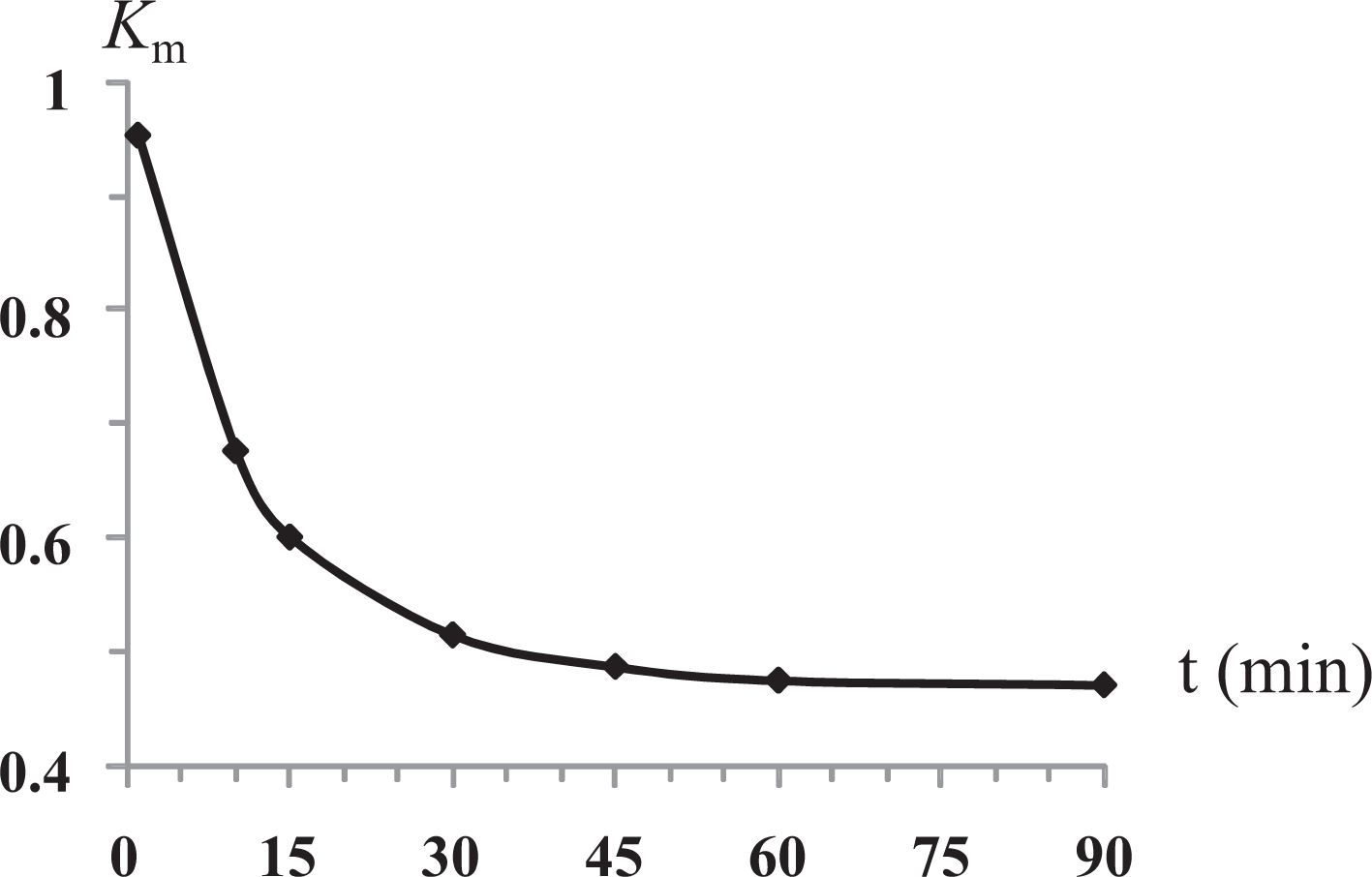
Parameter Km for CPI formed to the 120th min of the synthesis (calculation) vs. time of intermonomer loading t (min). CPI: copolyimide.
The use of the proposed model makes it possible to predict the change in the microstructure of the CPI chain by the variation of the conditions of CPI synthesis. The dependence of parameter Km for the final CPI on the duration of intermonomer (2,2-propylidene(1,4-phenyleneoxy)diphthalic anhydride) loading for system 9,9-bis(4-aminophenyl)fluorene–dodecamethylene diamine is presented in Figure 6. It follows from Figure 5 that for the considered system, the duration of intermonomer loading (t) exerts a substantial effect in the initial period from the very beginning to 15 min. In this period, Km of the final CPI changes from 1 to 0.6. When intermonomer is loaded for 30 min, the Km ∼ 0.5. The further increase in the loading duration exerts almost no effect on the value of Km . Thus, the analysis of the kinetic scheme of CPI synthesis by high-temperature polycondensation in a catalytic medium (molten BA) shows that it is possible to propose the mathematical model for the formation of the chain microstructure. The average length of blocks and microheterogeneity parameter of the chain of the final CPI were calculated using the rate constants for acylation, decomposition of amido acid fragment, and imidization determined for the model reactions.
The calculated Km values for three comonomer pairs are presented in Table 1. It is seen that calculated Km values are in correspondence with experimental Km values obtained from the 13C NMR data. It is shown that the proposed model can be used for the description of the dynamics of microstructure formation of the CPI chain directly in the course of the synthesis under different conditions of the process.
To conclude, in this work we have developed a mathematical model which confirms the possibility of controlling the moieties distribution in chain in a course of CPI synthesis in molten BA—by the choice the regime of intermonomer loading to the mixture of comonomers. Also, the model developed is useful to predict the CPI chain microstructure on the basis of data for the comonomers activity ratio of and to find out optimal conditions of synthesis. It also can be used to calculate the ratio of effective comonomers activity in molten BA from the data concerning microstructure of 13C NMR. One more advantage is that it is possible to follow not only current concentration of every component of reaction system and average polymerization degree at any moment but also the composition of growing oligomers directly in a course of CPI synthesis.
Footnotes
Declaration of Conflicting Interests
The author(s) declared no potential conflicts of interest with respect to the research, authorship, and/or publication of this article.
Funding
The author(s) disclosed receipt of the following financial support for the research, authorship, and/or publication of this article: This work was financially supported by the Russian Foundation for Basic Research (Projects Nos. 13-03-00915 and 16-03-01119).