






Abstract
Fibre-reinforced polymer (FRP) composites with thermosetting resin matrices are widely used in civil engineering (e.g. pultruded FRP plates and bars), and their thermal ageing behaviour is a concern when they are subjected to elevated temperatures (e.g. FRP chimney). In the present article, the effects of thermal ageing at 200°C and 250°C in air for up to 1000 h on mechanical properties and mechanism of the benzoxazine (Boz), bisphenol A dicyanate cyanate ester (BADCy), and 4,4′-bismaleimidodiphenyl methane (BMI) have been investigated. The effect of time in thermal ageing on structural and mechanical properties of the Boz/BMI/BADCy resin was deeply studied. The moisture absorption increases linearly with the square root of ageing time and it follows Fick’s second law. There are two main categories of reactions in thermal ageing: the first one is the post-curing process, which leads to a larger crosslinking density and a reduced interior stress; while the other is the formation of microcracks and thermal oxidation at the surface of the Boz/BMI/BADCy resin. The combination of the above factors leads to an increase–decrease variation in the mechanical properties. This work is believed to benefit the wide and safe application of a certain Boz/BMI/BADCy resin system in engineering application.
Introduction
Resin matrix composites boast high specific strength, favourable thermal and chemical stability, strong designability and excellent fatigue resistance, and thus they are widely used in lightweight vehicles, fuel savings and reduced emissions. 1 –4 Among them, cyanate esters, with high glass transition temperature (T g) and excellent mechanical strength, are widely employed in the high-tech industry, such as aircraft, rockets and delivery vehicles. 5 –10 It is well known that the thermal ageing can degrade the physical and mechanical properties and affect the performance of structures composed of resin, and this is of utmost concern in the use of resin in engineering structures. 11 –13
The effects of thermal ageing on the mechanical properties of the resin matrix composites have been recently investigated and significant variation in these mechanical properties was found. 14 –16 The thermal ageing test is usually carried out at temperatures less than 250°C in order to reduce testing time and fully assess the long-term performance of the resin matrix composites under service condition. It has been found that serious charring began to occur on the surface of the resin matrix composites at the temperature around 250°C. 17 However, to date, the opinions about the thermal ageing effects on mechanical properties of the resin matrix composites are inconsistent. Wang et al. found that the mechanical properties of the carbon fibre–reinforced bismaleimide composite decreased after being aged at 200°C for 1000 h, and they attributed it to chemical shrinkage and the mismatch in the coefficient of thermal expansion between carbon fibres and bismaleimide resin during thermal ageing. 18 On the other hand, Lowe et al. revealed that the mechanical properties of another carbon/bismaleimide composite decreased after subjected to ageing at 204°C and 250°C in air for nearly 30 weeks, which was thought to result from the formation of microcracks, and the increasing oxidation of the resin which weakens the matrix and the corresponding composite interfacial strength during thermal ageing. 19 Akay et al. reported that in the initial stage, there are matrix cracks mixed with smooth fibres, which implies the crack initiates at the fibre/matrix interface, propagates partially around the fibre and then across the matrix. After ageing, fibre/matrix interfacial debonding is the main failure mechanism. 20
Although considerable experimental works have been carried out on thermal ageing behaviour of the resin matrix composites and their structures, there are limited studies particularly focused on the barely visible thermal ageing damage. Such damage is not visually detectable and would reduce the strength of the composite significantly and cause catastrophic failure suddenly in thermal ageing event. And the investigation on the effects of thermal ageing on mechanical properties of the resin matrix is really rare, especially in the case of thermal ageing at 250°C. 21 Blend formulations of Boz/BMI/BADCy known as B-T resins are available, which are extensively used as engineering materials in aircrafts, reinforced plastics and injection moulding powders, as well as materials in electric motor coil windings, and so on. 22 So, it is essential to investigate the influence of long-term exposure at high temperature on the mechanical properties of the resin matrix which is going to be applied with any confidence.
In view of this background, the thermal ageing of the Boz/BMI/BADCy resin is studied as the first step in our series of investigations on the long-term performance of fibre-reinforced polymer at elevated temperatures. It is worth noting that the Boz/BMI/BADCy resin system has been studied in terms of thermal curing kinetics, dielectric properties and mechanical properties. 22,23 The present work was conducted specially to correlate the variation of the chemical structures, water uptake experiments, infrared analysis and mechanical properties of the Boz/BMI/BADCy resin, which was thermally aged for a relatively long term.
Experimental procedure
Sample preparation
The novel material was a cured system of resin. Regarding the reactants, bisphenol A dicyanate (BADCy) ester white granular crystal was purchased from Shangyu Shengda Biochemical Co., Ltd (Shangyu, China). 4,4′-bismaleimidodiphenyl methane (BMI) was purchased from Hubei Fengguang Chemicals, China. Bisphenol A Boz was synthesized from bisphenol A, aniline and paraformaldehyde according to the procedures previously described. 24 These chemical agents were used without further purification.
The ternary blends were prepared by the following steps: first, the molar ratio of BMI to BADCy was 1:1.9, and BMI and BADCy prepolymer was thoroughly blended at 160°C for 0.5 h with vigorous stirring; after that the prepolymer was cooled to 120°C, the Boz was added and then the ternary mixture was maintained with stirring for 0.5 h and a homogeneous liquid was obtained. The curing cycles were determined as follows: 150°C/1 h + 180°C/3 h + 200°C/2 h and post-cured at 220°C/4 h.
Thermal ageing process
Two ageing temperatures were chosen: first, 200°C was chosen as this allowed for comparison with other data sources often obtained at 200°C, and then an elevated temperature of 250°C was chosen to investigate the effect of accelerated ageing on the material. Such materials can be expected to experience temperatures of up to 250°C in actual service conditions and correspond to aerodynamic heating of an aircraft cruising at Mach 2.4. Thirteen kinds of ageing time of 0, 16 h, 25 h, 80 h, 200 h, 300 h, 400 h, 500 h, 600 h, 700 h, 800 h, 900 h and 1000 h for case I (ageing at 200°C) and case II (ageing at 250°C) were carefully characterized and analysed in this study.
Gravimetric measurement
The water absorption of a sample was determined according to ASTM D 570-98. Twelve specimens were applied to each case. Before hygrothermal ageing, the weight of each sample Wo was measured and recorded.
The moisture absorption content Mt is defined in equation (1)
where Mt and Wo are the sample weights at time t and initial state, respectively.
Fourier transform infrared
The samples aged for 1000 h in case I and case II together with the unaged resin were analysed on a Fourier transform infrared (FT-IR) spectroscope. FT-IR spectra were recorded on KBr pellets from 4000 to 400 cm−1 with a resolution of 4 cm−1 on a Nicolet iS10 IR (Waltham, MA, USA) spectrometer.
Thermogravimetric analysis
Thermogravimetric analyses (TGA) were performed using a Netzsch STA 449C (Selb, Germany) thermogravimetric analyzer at a heating rate of 10°C·min−1 under N2 atmosphere from 20°C to 800°C. The specimens aged in two cases after 1000 h and unaged resin were recorded.
Machine properties
Impact strength, flexural strength and modulus were performed according to GB/T2567-2008 on a testing machine (ZBC-50A Plastic Pendulum Impact Testing Machine and CMT-6303 Electronic Tensile Testing Machine, Shenzhen Sans Measurement Technology Co., Ltd, Shenzhen, China). Five samples were tested for each composition, and the results are presented as an average for the tested samples.
Scanning electron microscopy
The tensile fracture surface of specimens aged in three cases after 1000 h and the unaged resin were observed on a scanning electron microscope (TESCAN VEGA3 LMH, Czech). Data were collected at the accelerating voltage of 5.0 kV and working distance of about 5 mm. Prior to the characterization of scanning electron microscopy (SEM), the samples were sputter-coated with a thin layer of gold in vacuum to improve the electrical conductivity.
Results and discussion
Water absorption behaviour of unaged and aged resins
The Fickian diffusion model was used for fitting the water uptake data, as given in equation (2). 25
where D is the diffusion rate, M∞ is the equilibrium water uptake and l is a half of the specimen thickness, Mt is the moisture absorption content at time t.
For Dt/l 2 > 0.05, the above equation reduces to equation (3)
For Dt/l 2 < 0.05, the above equation reduces to equation (4)
The diffusion rate, D, was calculated using equation (4) from the slope of the water absorption curves versus square root of time once the equilibrium water uptake was obtained.
The water absorption kinetics for the three cases of the moisture absorption content versus the square root of thermal ageing time is presented in Figure 1. As seen in Figure 1, the curves present a linear part at the early stage of absorption while they tend asymptotically to the saturation point approximately after 200 h of exposure. Fick’s model shows satisfactory fit to the experimental data, with very good agreement at the saturation stage. The absence of significant difference in the kinetics of moisture uptake between the unaged and aged systems may indirectly imply a satisfactory stable of resins. Fickian fits are also indicated to determine whether the absorption follows the Fickian diffusion or not. Comparing the water uptake in the three case specimens for the same thermal ageing time, the water uptake in the unaged case specimens seems lower than that in the case Is and case IIs.

Water uptake for unaged and aged resins.
However, it is likely that the saturation levels of the case I and case II specimens would be the same for longer ageing times. It is expected that the longer thermal ageing time of the specimen needs less time to saturate. Under a steady condition, the saturation levels for the case I and case II specimens were reached in approximately 150 h, but those for the unaged specimen may be reached in longer than 300 h. Although the equilibrium water uptake for the case I and case II specimens was reached earlier than in the unaged specimen, the diffusion rate is higher. From a molecular dynamics study, the thermal ageing specimens have more spaces for the conformation (relaxation) of polymer molecules when water molecules were introduced into the polymer chain. Hence, the diffusion rate, especially for the higher water content, tends to increase as the aged temperature increases and is more likely to follow the Fickian diffusion. 26
Mechanical properties of unaged and aged resins
Figure 2 shows the effect of thermal ageing on the flexural strengths and impact strengths of the samples. For flexural strengths in three cases, the general situation is a short increase and a lasting decrease till the end. In the thermal stage of 0–25 h for all cases, the post-curing factor exerts more impact than the resin deterioration one with a small rise of flexure tensile. As time increased in all cases, the resin deterioration was the dominant factor, resulting in a continuous and prominent decrease in the thermal course.
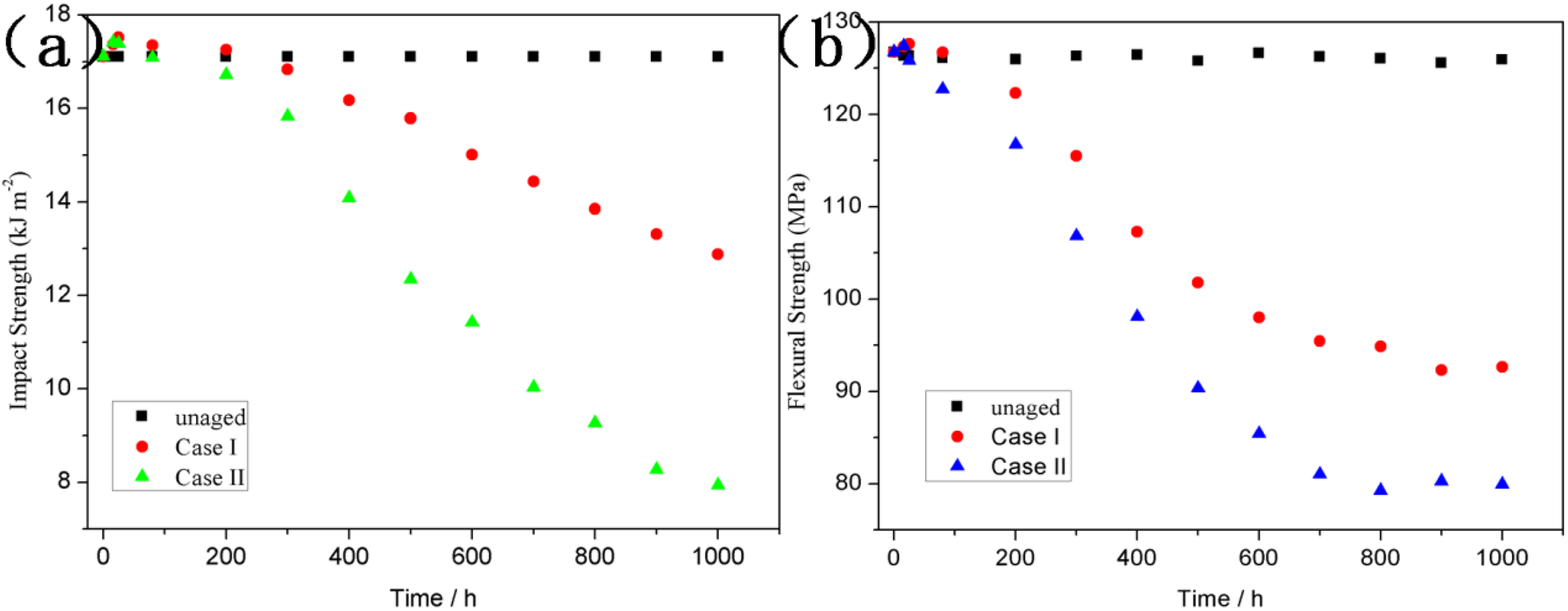
Mechanical properties of unaged and aged resins.
For impact strengths in three cases, the general situation is a short increase, a sequenced decrease till the end. At the first 25 h, the resin post-curing plays the leading role and then the resin deterioration influences the system more. With the combination of a series of factors, the resin system exhibits above tendency in flexural strengths and impact strengths.
It is observed that the unaged case specimens exhibit higher flexural strengths and impact strengths than the case I and case II specimens. The flexural strengths of the case I reduce from 126.7 to 92.6 MPa after thermal ageing for 1000 h. Meanwhile, the slope of the flexural strengths curve increases before 25 h, then keeps decreasing gradually from 100 h to 400 h and finally decreases rapidly again after 400 h, whereas the strength of aged specimen declines obviously owing to the macromolecular chain scission in the Boz/BMI/BADCy resin and formation of microcracks on the surface after long-term thermal ageing. The degradation of the mechanical property makes it much easier for the impactor to stick into the thermal ageing specimen at a lower contact force than original specimen.
Therefore, it can be concluded that the thermal ageing damages the mechanical properties of the Boz/BMI/BADCy resin. The reduction of the impact and flexural strengths was mainly attributed to the damage on the matrix and the crack may be partly owing to the oxidative decomposition of matrix caused by thermal ageing in Boz/BMI/BADCy.
To further understand the influence of thermal ageing on the mechanical properties mechanism, the fracture surfaces of the samples after impact tests were examined using SEM (Figure 3). Figure 3 presents SEM graphs of the fracture surface of Boz/BMI/BADCy, the case I and case II specimens. It can be observed that the fracture surface of the composite is rough (Figure 3(a)), and there exist a large amount of ductile sunken areas, exhibiting a typical rough feature and the matrix cracking is the primary failure mechanism consequently. Akay et al. reported that in the unaged carbon fibre composite, the fibres are still surrounded or adhered by the matrix and the matrix cracking is the primary failure mechanism. 20 For the case I specimens, as shown in Figure 3(b), the fracture surface of the composite has a crack, which implies that the crack initiates at the matrix. With the increase of thermal ageing temperature, the crack becomes larger, which is consistent with the reduced impact strength of Boz/BMI/BADCy systems. In the case II, as shown in Figure 3(d), with the thermal ageing temperature increased, bigger microcracks can be observed on the surface after thermal ageing for 1000 h at 250°C. The onset of the microcrack is mainly due to the development of irreversible chemical shrinkage, which is caused by the loss of moisture or volatiles and macromolecular chain scission in BMI resin. The shrinkage strain generates between internal and surface leading to the initiation of microcracks on the composite surface as shown in Figure 3. At the same time, the interface debonding may provide additional pathways for the penetration of oxygen into the heart of the structure. Therefore, the impact strength of the composite after thermal ageing is decreased. The features of the fracture surfaces of specimens accord well with the mechanical properties.

SEM of fracture surfaces of unaged and aged resins. SEM: scanning electron microscopy.
Thermal ageing on the chemical structures
In the present study, the thermal ageing temperatures considered aged at 200°C and 250°C, and the FT-IR measurements were mainly performed for Boz/BMI/BADCy samples to illustrate the variation of the chemical structures of the Boz/BMI/BADCy resin.
As shown in Figure 4, for the Boz/BMI/BADCy resin ageing at 200°C, there are no changes between the unaged sample and the 200°C ageing samples. This result indicates that the chemical structures of the Boz/BMI/BADCy resin have no thermal degradation occurred in ageing at 200°C. However, for the Boz/BMI/BADCy resin ageing at 250°C, the changes around 1518 cm− 1 infer that there is oxidation of methylene groups within the resin structure to form carbonyl groups. This is schematically shown in Figure 4, where the portion of the complex Boz/BMI/BADCy samples associated with the methylene linkage is shown. Also, the region around 1637 cm−1 suggests that there is degradation of saturated imide groupings and ester groupings occurring, probably caused by oxidation of the imide ring to yield a carboxylic acid derivative and the formation of carbonyl groups from the hydroxyl groups due to oxidation. 27,28 There are subtle differences in relative peak sizes and occurrences from Figure 4 analysis to show that these degradation mechanisms occur to different degrees. These differences are more pronounced in other closely related systems suggesting that degradation mechanisms may be temperature dependent. 19 Additionally, the figure shows that there are no changes between the interior region and the surface of the samples after ageing the same time, suggesting that the degradation mechanisms of the interior are similar to the surface at the temperature with the same time. The possible reaction schemes are summarized in Figure 5. 28 –30

FT-IR spectra of unaged and aged resins. FT-IR: Fourier transform infrared.

The ageing procedure of the Boz/BMI/BADCy resin. Boz: benzoxazine; BADCy: bisphenol A dicyanate cyanate ester; BMI: 4,4′-bismaleimidodiphenyl methane.
Thermal behaviour of unaged and aged resins
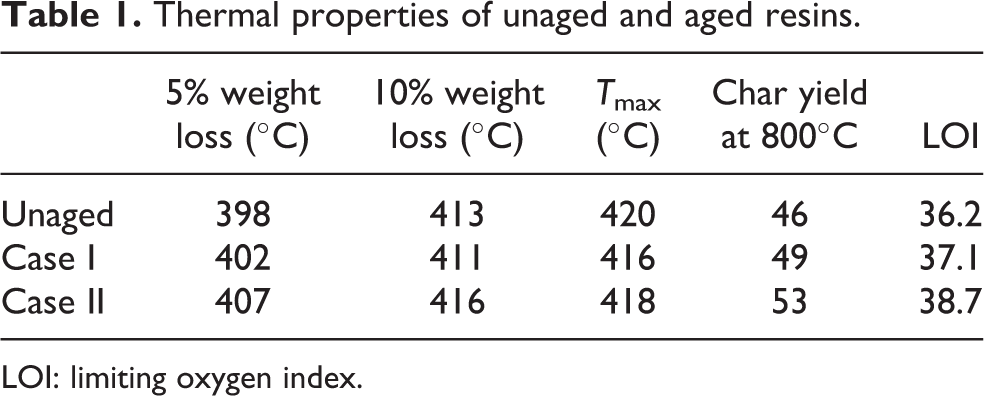
The TGA thermograms for Boz/BMI/BADCy resin, the case I and case II specimens provide information about the formation of the network structure and thermal stability of Boz/BMI/BADCy resin specimens. Figure 6 shows the thermal degradation of blends studied using TGA under nitrogen atmosphere. The onset temperature of 5% weight loss of Boz/BMI/BADCy resin was found to be 398°C, whereas those of 5% weight loss of the case I and case II specimens are noticed at 402°C and 407°C, respectively. The decomposition maxima for the case I and case II specimens are found to be 416°C and 418°C, respectively. In addition, the residual char yield of the Boz/BMI/BADCy resin was measured at 800°C in TGA curve, the results obtained for the case I and case II specimens are 49% and 53%, respectively. As seen, the higher temperature it is, the specimens lose weight later and gentle. It is mainly attributed to the decomposition of the flexible structure of the polymer network in the heat ageing process, which developed as a result of the addition of ether linkage of polybenzoxazines and bismaleimide. 31

TGA curves of unaged and aged resins. TGA: thermogravimetric analysis.
The data on the thermal characteristics of unaged and aged resins are presented in Table 1. Moreover, it is also possible to assess the flame retardant behaviour of these materials in terms of limiting oxygen index (LOI) values calculated using the value of char yield using the equation of van Krevelen and Hoftyzer (equation (5)). It is experimentally proved and generally accepted that the materials with high LOI values possess the superior flame retardant property. 32
Thermal properties of unaged and aged resins.
LOI: limiting oxygen index.
where CR is the percentage char yield of polymer remaining at 800°C. The LOI values for the case I and case II specimens are 37.1 and 38.7, respectively, based on their char yield. These LOI values are high when compared with that of conventional Bozs and it is inferred that the Boz/BMI/BADCy resin can be used as a non-halogen and non-phosphorus flame retardant material.
Conclusions
This article aims at understanding the effects of thermal ageing on the chemical structures, mechanical properties and mechanism of the Boz/BMI/BADCy resin. Based on the experimental results of FT-IR, TGA, SEM and mechanical property measurements, the following conclusions can be drawn: Along with the increase of ageing time, oxidation and molecular chain rearrangement were found to occur in the Boz/BMI/BADCy resin after aged at 250°C for 1000 h. Degradation of the mechanical properties of the Boz/BMI/BADCy resin can be attributed to the defects generated from oxidation, macromolecular chain scission of BMI resin and formation of microcracks, which were all induced by thermal ageing. In addition, the SEM analysis shows that the Boz/BMI/BADCy resin has distinct microcracks after aged at 200–250°C.
Footnotes
Declaration of conflicting interests
The author(s) declared no potential conflicts of interest with respect to the research, authorship, and/or publication of this article.
Funding
The author(s) received no financial support for the research, authorship, and/or publication of this article.