







Abstract
Freestanding poly(3,4-ethylenedioxythiophene) (PEDOT) nanowires (NWs) were synthesized using a facile, self-assembled, micellar soft-template method. Thermoelectric properties of the PEDOT NWs under different reaction conditions were measured, and optimal experimental conditions were confirmed. To obtain preferential thermoelectric performance, PEDOT NWs/graphene composite films with various graphene mass fractions were fabricated. The maximum power factor of the hybrids was observed to reach 42.0 μWm−1K−2 with 3 wt% graphene loading, corresponding to a 200% improvement compared with pure PEDOT NWs. The thermoelectric devices were investigated using the PEDOT NWs/graphene hybrids as a p-type leg and PEDOT NWs/nitrogen-doped graphene as an n-type leg. The device, in series, shows a preferable cooling effect with an approximate temperature decrease of 0.5°C after energization. Our work provides a novel means of fabricating n-type PEDOT hybrids and promotes their practical applications as thermoelectric coolers. These findings indicate a new means of developing high-performance, flexible, organic thermoelectric materials and devices.
Introduction
Thermoelectric (TE) materials have attracted increasing attention because of their potential applications in thermoelectric generators (TEG), energy harvesting systems, thermoelectric coolers (TECs) and sensors.1–5 Based on the mobility of solid internal carriers, TE materials can achieve conversion from the temperature gradient to voltage difference and vice versa. 6 Thus, TE devices do not have any moving parts, meaning they are free of mechanical vibration, which ensures a long lifetime. The performance of TE materials is governed by the dimensionless figure of merit ZT, which can be defined as ZT = S2σT/κ, where S is the Seebeck coefficient, σ is the electrical conductivity, κ is the thermal conductivity and T is the absolute temperature.
In the last several years, a rapid progress in organic TE materials, especially conducting polymer and their hybrids, has been observed.7–9 Conducting polymers with low thermal conductivity, low cost, low weight and high flexibility have been ideal candidates for inorganic TE materials.10–12 Nevertheless, organic TE materials have not been widely used in practical applications because of their low ZT, due to the strongly correlated TE parameters in conventional bulk materials.13,14 Fortunately, low-dimension materials have demonstrated their use as an effective way to significantly improve TE performance because the nanostructure can have similar electrical conductivity while notably reducing the thermal conductivity. 15 Recently, various low-dimension nanostructures, such as nanorods,16–18 nanotubes,19,20 nanoribbons21,22 and nanofibers,23–26 have been investigated. Particularly, low-dimension conducting polymer nanocomposites have attracted widespread attention. For example, Liang et al. 27 designed a unique sandwich structure with single-walled carbon nanotubes and polypyrrole NWs to obtain a maximum power factor of 21.7 ± 0.8 μWm−1K−2, which was approximately 987 times larger than pure polypyrrole NWs. Besides, Polyaniline NWs and nanorods doped with different acids have also been reported. 28 The mechanism of low-dimensional architecture improved TE properties can be elucidated to be higher density of states near the Fermi level, multi-layer interface phonon scattering, quantum confinement effect and modulation doping effect.29–31
Recently, flexible materials and wearable TE devices have obtained increasing attentions.32,33 Fiber-based flexible TE power generators, 34 Te NWs/RGO flexible TE films, 35 flexible SWCNTs-Te composite films 36 and flexible porous all-graphene TEGs 37 have been reported. Nevertheless, most of the conventional inorganic TE materials, such as Bi2Te3 and PbTe, are intrinsically rigid, resulting in limited application. 38 Therefore, conducting polymers and their hybrids, which possess good flexibility, have been investigated. For instance, PEDOT:tos-Silver TE modules, 39 PEDOT:PSS flexible bulky papers, 40 PEDOT:PSS flexible nonwoven fabric TE power generators 41 and SWCNT/PEDOT:PSS flexible composite films 42 have been reported. A typical TE device includes several thermocouples, which are composed of a series of alternant connected p-type and n-type elements. However, most of the current organic TE modules are simply fabricated by a uni-leg architecture, possibly due to the scarcity of n-type organic materials.43,44 Thus, searching for proper n-type organic materials is essential and urgent.
In this study, by a novel method, we incorporate two-dimensional graphene into one-dimensional PEDOT NWs to build up a thin film with a characteristic three-dimensional network structure. The interlaced NWs provide more conductive pathways for charge carriers in graphene, leading to a significant increase in electrical conductivity. Meanwhile, based on the mismatches in the vibrational spectrum between conducting polymers and graphene, the hybrid system possesses low thermal conductivity, which is beneficial to improving the ZT of the composites. More importantly, an n-type film, consisting of PEDOT NWs and nitrogen-doped graphene, was successfully fabricated. The TE device, composed of p-type leg and n-type leg, has also been developed to obtain flexible TEC devices. To the best of our knowledge, this work is the first to show PEDOT-based TEC devices with flexibility.
Materials and methods
Materials
3,4-ethylenedioxythiophene (EDOT, purity > 99%), sodium dodecyl sulfate (SDS, AR), graphene and anhydrous ferric chloride (FeCl3, AR) were purchased from Aladdin. Ethyl alcohol (AR) was provided by Tianjin Fengchuan Chemical Reagents Factory. Sodium dodecyl benzene sulfonate (SDBS, AR), polyethylenimine (PEI, 99%) and diethylenetriamine (DETA, 99%) were bought from Aladdin. Poly(3,4-ethylenedioxythiophene):poly(styrene sulfonate) (PEDOT:PSS, conductive grade) and sodium borohydride (NaBH4, ≥96%) were provided by Sigma Aldrich. All chemical reagents were used as received.
Preparation of PEDOT NWs
PEDOT NWs were synthesized from EDOT monomer with a cylindrical SDS micellar as the template. 45 The schematic illustration of the preparation procedure is shown in Figure 1(a). First, desired amounts of SDS (1.08 g) were dissolved in distilled water to form a micellar solution. An aqueous solution of FeCl3 (0.304 g FeCl3 dissolved in 10 mL water) was added into the above SDS solution to facilitate the transformation from spherical micelles to a cylindrical micellar with stirring at property temperature. Finally, EDOT monomer was slowly dropped into the micellar solution, and polymerization was subsequently induced by FeCl3. The whole reaction was carried out at 40–50°C with continuous stirring for 6 h. The obtained PEDOT NWs were washed via reduplicative centrifugal treatment and redispersion process with water and ethanol. In this paper, NWs with four different reaction conditions were prepared to select the property parameters with the highest electrical conductivity for the application in question. The detailed experimental parameters are shown in Online Supplemental Table S1.
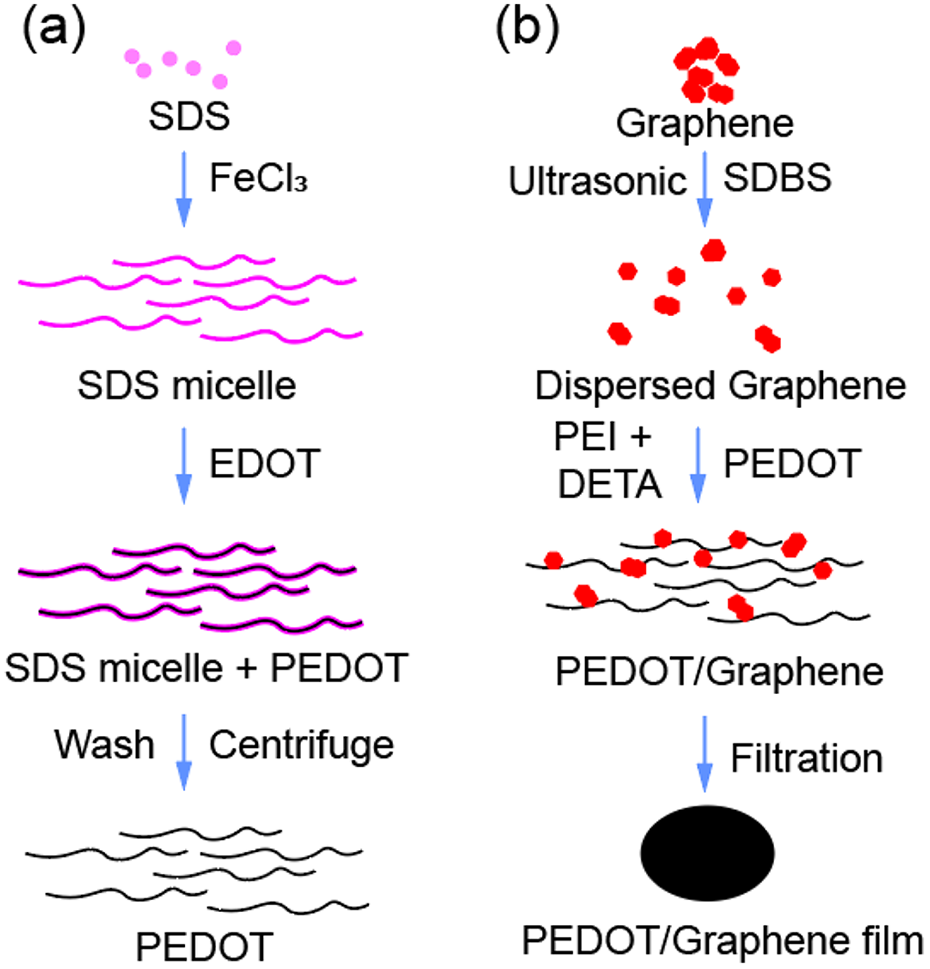
Schematic synthesis diagram for PEDOT NWs (a) and PEDOT NWs/graphene hybrid films (b).
Preparation of PEDOT NWs/graphene hybrid films
To fabricate p-type PEDOT NWs/graphene thin film, graphene was dispersed into an SDBS aqueous solution with ultrasonic processing for 2 h, and the homogeneous dispersion was introduced into the PEDOT NWs suspension for another 90 s probe sonication. The obtained mixture was vacuum-filtered onto a PTFE membrane and washed with excess water to remove the extra dispersant. The film was dried in air at 60°C.
Regarding the synthesis of the n-type PEDOT NWs/graphene film, Figure 1(b) shows the schematic illustration of the fabrication processing. First, mixtures of PEI and DETA with PEI:DETA ratios of 67:33 were dissolved in water and added into the as-prepared graphene solution. Moderate PEDOT NWs were incorporated into the above mixture and followed by ultrasonic processing to obtain uniform solution. Subsequently, the suspension was vacuum-filtered onto a PTFE membrane and washed with additional water. The obtained thin film was immersed in an aqueous 1 M NaBH4 solution for 18 h and dried in a vacuum oven at 60 °C.
Fabrication of TE devices
To prepare the TE device, the above films on a PTFE membrane were cut into rectangular pieces (8 mm in width and 30 mm in length). First, we fabricated a uni-leg TE module with two pieces of p-type PEDOT NWs/graphene films connected in series by silver paint and silver wires. We later prepared a thermocouple consisting of p-type and n-type composites in parallel.
Characterization
The electrical conductivity of PEDOT NWs and their hybrids was measured by a Hall effect testing instrument (Swin HALL8800). Samples were prepared as films by vacuum filtration and cut into rectangles (10 mm in length and 10 mm in width). For the Seebeck coefficient, a portable Seebeck coefficient tester (PTM-demo) was used.
Fourier transform infrared spectroscopy (FT-IR) was used to demonstrate the successful synthesis of PEDOT NWs in different reaction conditions using an FT-IR spectrophotometer (TENSOR37). X-ray diffraction (XRD) was performed to detect the characteristic peak of PEDOT and analyze full width at half maximum using a Rigaku D/MAX-gA diffractometer. X-ray photoelectron spectroscopy (XPS) was applied to investigate the elemental content and doping-level. Samples for XRD and XPS were powder dried in a vacuum oven at 60°C overnight. Scanning electron microscope (SEM) (Hitachi S-4800) was used to characterize the surface morphology of NWs. Transmission electron microscope (TEM) (Hitachi H-800), operating at an accelerating voltage of 120 kV, was used to observe morphologies of PEDOT NWs and their composites. Raman spectra of the NWs and their composites were recorded on a Raman microscope (Horiba Jobin Yvon Xplora) equipped with a 532 nm laser. Infrared images were obtained by an infrared imager (FLIR-E8) to characterize the cooling effect of the flexible TE devices.
Results and discussion
FT-IR and TEM were used to confirm the successful synthesis of PEDOT NWs (Online Supplemental Figures S1 and S2). XRD and XPS of the four NWs were also obtained to detect the microstructures (Online Supplemental Figures S3 and S4). The detailed analysis is included in the supporting information.
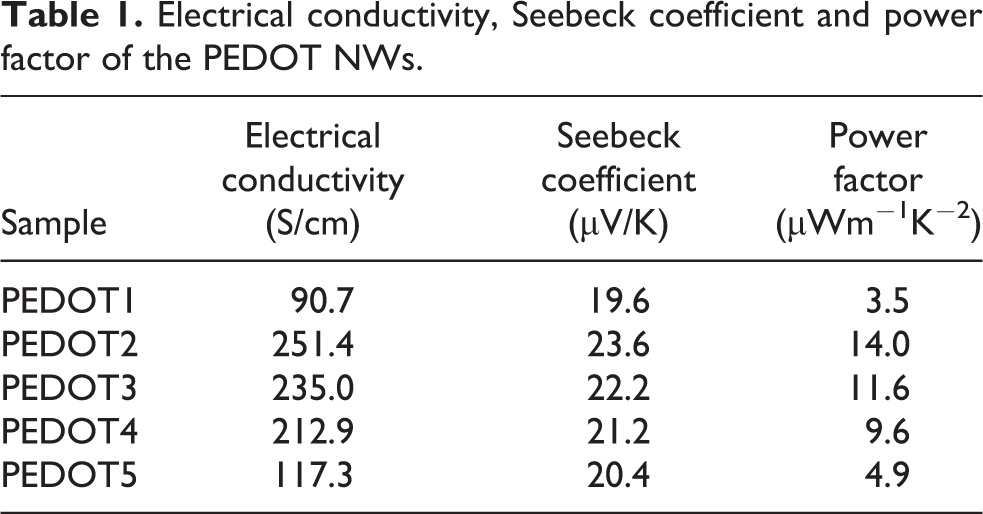
Electrical conductivity and Seebeck coefficient of PEDOT NWs were measured to count power factor (S2σ), which is usually used to evaluate the TE performance of the organic conducting polymer because of their low intrinsic κ (Table 1). It is obvious that PEDOT2 has the largest electrical conductivity (251.4 S/cm) and power factor (14.0 μWm−1K−2), which is consistent with the analysis achieved from XRD and XPS. We attributed this result to the more ordered structure and positive charges in PEDOT2. Hence, PEDOT2 was chosen for the following experiment. In addition, the electrical conductivity and Seebeck coefficient of commercial PEDOT:PSS, which was defined as PEDOT5, were also obtained as a comparison. It is inspiring that PEDOT2 has a better TE property than PEDOT5.
Electrical conductivity, Seebeck coefficient and power factor of the PEDOT NWs.
SEM was used to observe the surface morphology of PEDOT2 (Figure 2(a)). Visibly, the NWs formed an interlaced network, which is consistent with our previous conjecture. Figure 2(b) is the dispersion images of the four NWs, which are PEDOT1, PEDOT2, PEDOT3 and PEDOT4 from the left to the right, respectively. A homogeneous solution of NWs can be obtained after probe ultrasonic processing, although there is absence of PSS. Compared with traditional PEDOT:PSS dispersion, this work provides a novel idea to acquire solution processable PEDOT without the influence of insulative PSS, indicating the possibility of achieving higher electrical conductivity. Figure 2(c) is a picture of NWs film, which is flexible and mechanically robust, making it an ideal option for flexible TE devices.
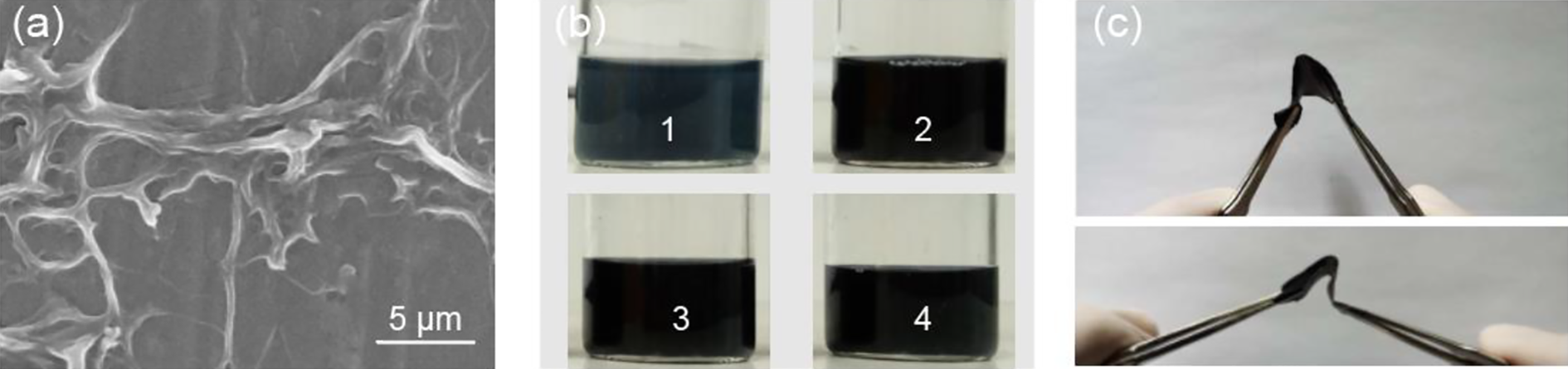
SEM of PEDOT2 (a), dispersion image of the four NWs (b) and photograph of flexible NWs film (c).
Subsequently, PEDOT NWs/graphene composites with diverse graphene mass fraction were prepared. The hybrids with 1 wt%, 2 wt%, 3 wt% and 4 wt% graphene are defined as G1, G2, G3, and G4, respectively. Figure 3 shows the TEM of the compound. It is apparent that graphene dispersed in NWs facilitates the formation of a reticular structure. Junctions and intersections between PEDOT NWs and graphene, which contribute to the enhancement of electrical conductivity, increase gradually with the addition of graphene. As the content of graphene increases, the more contact with NWs, the more channels for electrons to move, so the conductivity is improved. However, entanglement appears in the hybrids when the graphene ratio achieves 4 wt%, which is attributable to the aggregation effect of graphene. Therefore, G3 is speculated to have the best TE performance ascribed to the distinctive three-dimensional network, which provides more pathways for charge carriers.
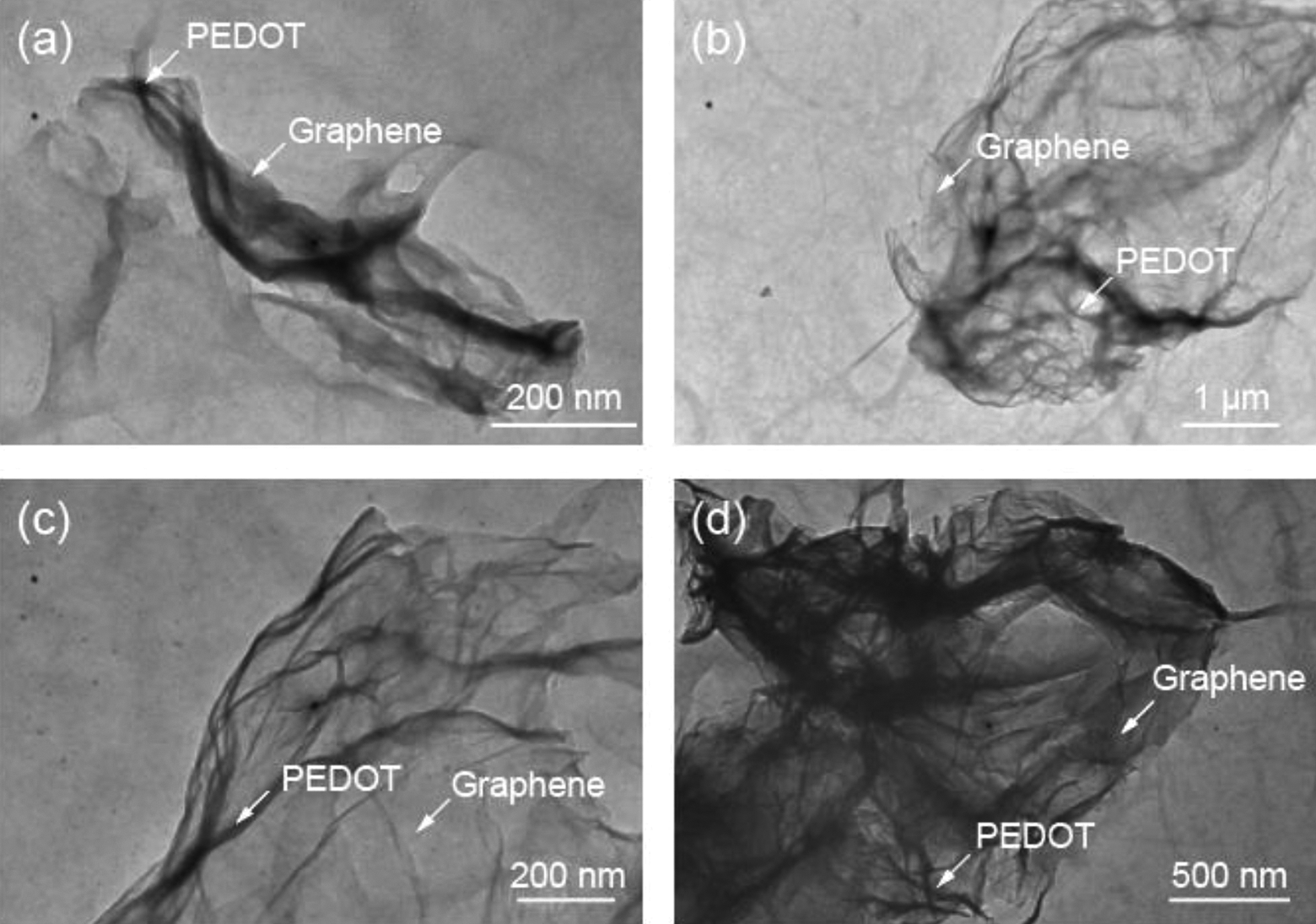
TEM of PEDOT NWs/graphene composites with diverse graphene contents for G1 (a), G2 (b), G3 (c) and G4 (d).
Raman spectra of PEDOT2 and NWs/graphene composites are obtained, as shown in Figure 4(a). The peaks approximately 1251 cm−1 and 1351 cm−1 are C–C inter-ring stretching and single C–C stretching. The Raman peaks near 1440 cm−1, 1520 cm−1 and 1558 cm−1 are assigned to the symmetric C=C stretching, anti-symmetric C=C stretching and anti-symmetric C=C stretching, respectively. Notably, the symmetric C=C stretching peaks for NWs/graphene hybrids have a slight shift to a lower wavenumber, which is attributed to the dielectric confinement effect. The energy changes induced by the surface effect will decrease the band gap, leading to an enhancement of electrical conductivity. Figure 4(b) shows the XRD spectra of PEDOT2 and PEDOT NWs/graphene composites. The obvious diffraction peak approximately 2θ = 25.9° corresponds to the characteristic peak of PEDOT. It is interesting that the broad peak of graphene near 21.5° disappeared in the composites, indicating that the graphene was well-dispersed after the sonicator processing. The FWHM of PEDOT2, G1, G2, G3 and G4 are 0.333, 0.314, 0.309, 0.276 and 0.295, respectively. It was observed that the hybrids with graphene have smaller FWHM values than that of pure NWs, demonstrating a strong interaction between graphene and PEDOT.
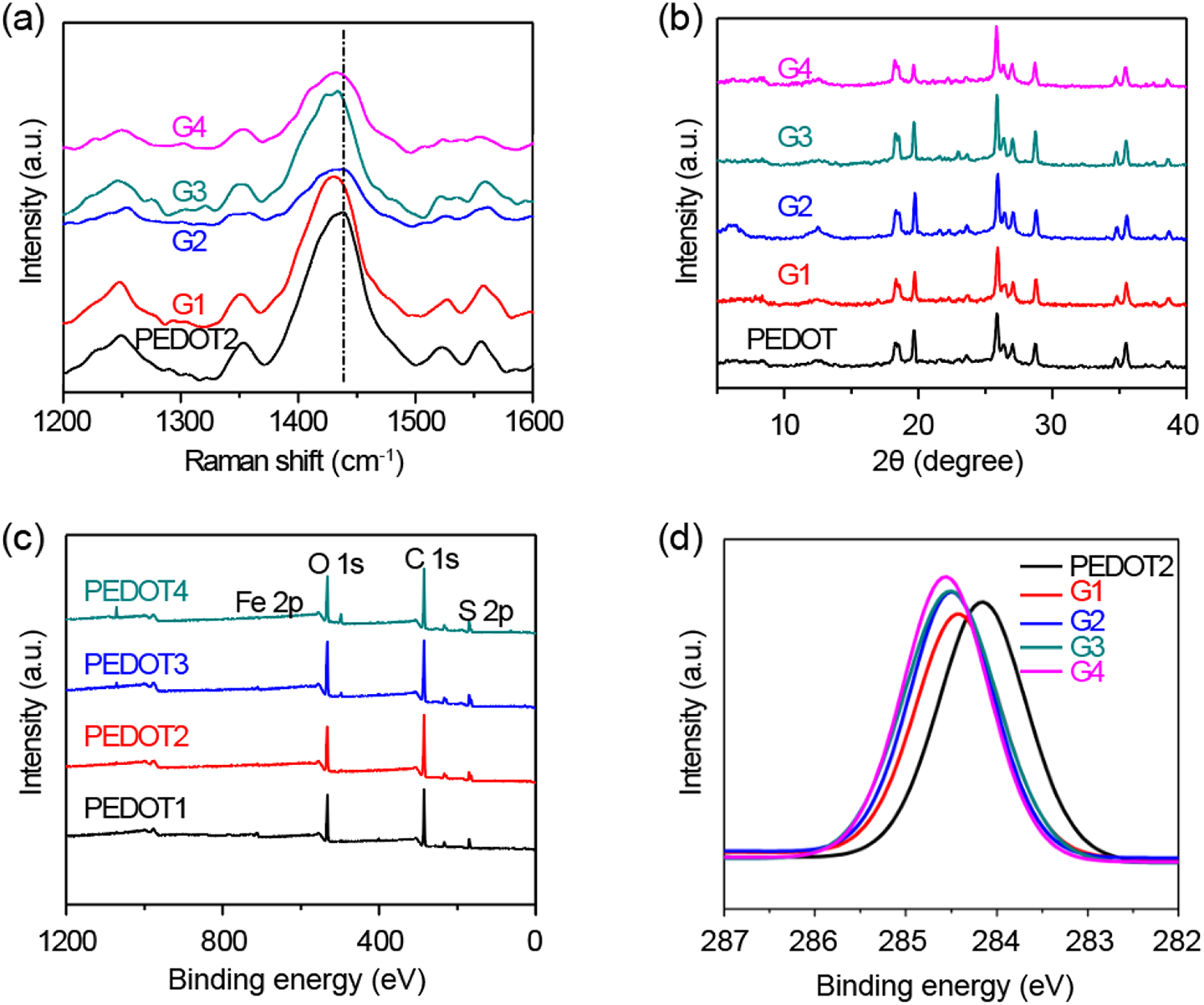
Raman spectra (a), XRD (b) of PEDOT NWs and their hybrids, full-scale XPS (c) and C1s core-level spectrum (d) of PEDOT NWs and their hybrids.
XPS measurements were carried out to investigate changes in the electronic environment after incorporating graphene. Figure 4(c) shows the full-scale XPS spectra of pure PEDOT NWs and PEDOT NWs/graphene hybrids. The main elements in all samples are the same, namely, C, O, S and Fe. To analyze how the graphene changes the composites’ properties, C1s spectra of the five samples was obtained. The C1s peak of the NWs and their compounds can be curve-fit into three peak components, corresponding to a C–S bond, C–O–C bond and C–C bond (Online Supplemental Figure S5). Figure 4(d) shows the C–C binding peaks of PEDOT2 and PEDOT NWs/graphene composites. It is apparent that the C–C bond of the samples has a typical binding energy at 284–285 eV. G1, G2, G3 and G4 show their binding energy peaks at 284.42 eV, 284.48 eV, 284.52 eV and 284.56 eV, respectively, which is higher than the 284.15 eV of the pure PEDOT NWs, indicating an interaction between graphene and the NWs. We note that the shift toward higher binding energy becomes more significant with the increasing graphene content, which may be the result of the larger contact area between graphene and PEDOT NWs. Moreover, the abundant π-electrons in graphene have a strong π-π interaction with the aromatic structure of PEDOT.
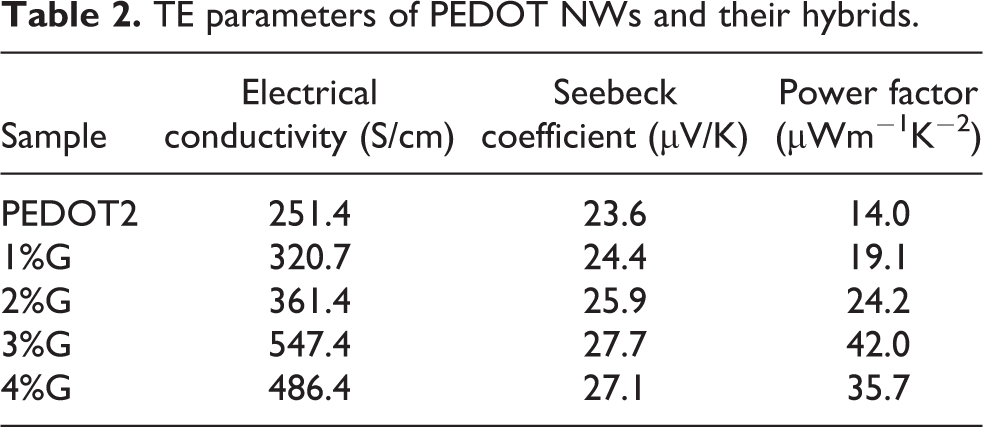
The electrical conductivity, Seebeck coefficient and power factor of PEDOT NWs and their composites were measured and calculated (Table 2). The addition of graphene promoted electrical conductivity and Seebeck coefficient of PEDOT2, which is in accordance with our previous TEM analysis. TE parameters of the composites achieve a maximum when graphene content is 3 wt%. Electrical conductivity, Seebeck coefficient and power factor of G3 is 547.4 S/cm, 27.7 μV/K and 42.0 μWm−1K−2, respectively, with an enhancement of 118%, 17% and 200% compared with pure PEDOT2 NWs. The electrical conductivity increase may be ascribed to well-percolated and new conductive pathways for charge carriers in graphene. For the Seebeck coefficient, the energy filtering effect originated from the presence of PEDOT NWs-graphene junctions was suggested to be a possible scenario. 46
TE parameters of PEDOT NWs and their hybrids.
In all the temperature range measured, the power factor of both samples increase with increasing temperature and the increase of the treated film is more quickly than that of the untreated one. Hence, the treated film has always had a greater power factor value than that of the untreated one. The power factor of the treated film with 3% graphene loading rises with temperature and reaches 11 mW m−1 K−2 at 300 K (Figure 5).
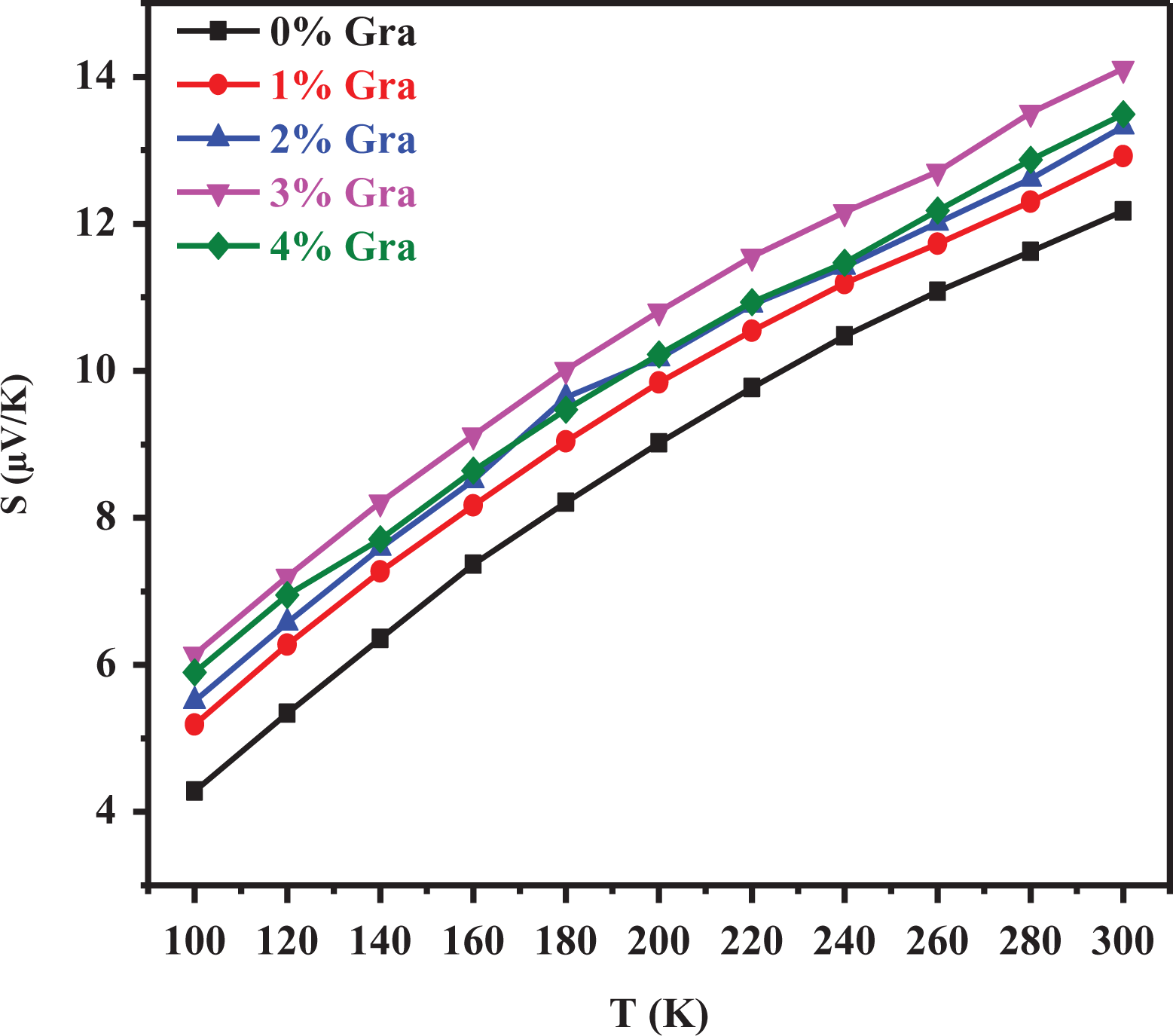
Temperature dependence of the Seebeck coefficient of free-standing PEDOT NWs films.
Composite films of NWs consisting of PEDOT and 3 wt% graphene were cut into rectangles and connected in series with silver paste and silver wires to fabricate the TE device (Figure 6(a)). Both ends of the samples were connected to a DC power supply unit to acquire the infrared thermal images of the module before and after energization. Temperatures at any point in the figure can be obtained through free FLIR tools. Figure 6(b) and (c) show the temperatures of the TE module before and after applying voltage. The samples show a temperature gradient from the heated end to the cooled end when impressed voltage is introduced. Additionally, the TE device possesses an apparent cooling effect when comparing temperatures at the four endpoints. Figure 6(d) is the partial analysis of the cooled end. The maximum, minimum and average temperature is 30.5°C, 30.2°C and 30.3°C, respectively. Compared with Figure 6(b), samples in Figure 6(c) show a decreased temperature of ∼0.5°C, demonstrating good TE performance of the composites. A TE device consisting of a p-leg and n-leg in parallel was also fabricated (Figure 6(e)). The p-leg is a hybrid of the PEDOT NWs and 3 wt% graphene, while the n-leg is a hybrid of PEDOT NWs/graphene composites with a mass ratio 1:1 of PEDOT NWs and nitrogen-doped graphene. Figure 6(f) and Figure 6(g) and (h) are infrared images before and after energization. A temperature gradient from the hot end to the cold end in the n-leg can be seen, while the temperature change in the p-leg is not obvious (Figure 6(g)). The reason for this phenomenon may be the immersion process of NaBH4, which generates bubbles and increases the film resistance. Thus, the p-leg, with a small resistance, can be seen as a conductor, resulting in an inconspicuous temperature change. Despite this, the n-type thin film has an obvious cooling effect. The average temperature of the cold end is 28.0°C, corresponding to a decrease of ∼0.3°C compared to the temperature prior to application of the power. Although the cooling effect is comparatively small, this method provides a novel idea for preparing n-type PEDOT composite films, since it is very difficult to make monocomponent n-type organic TE materials.
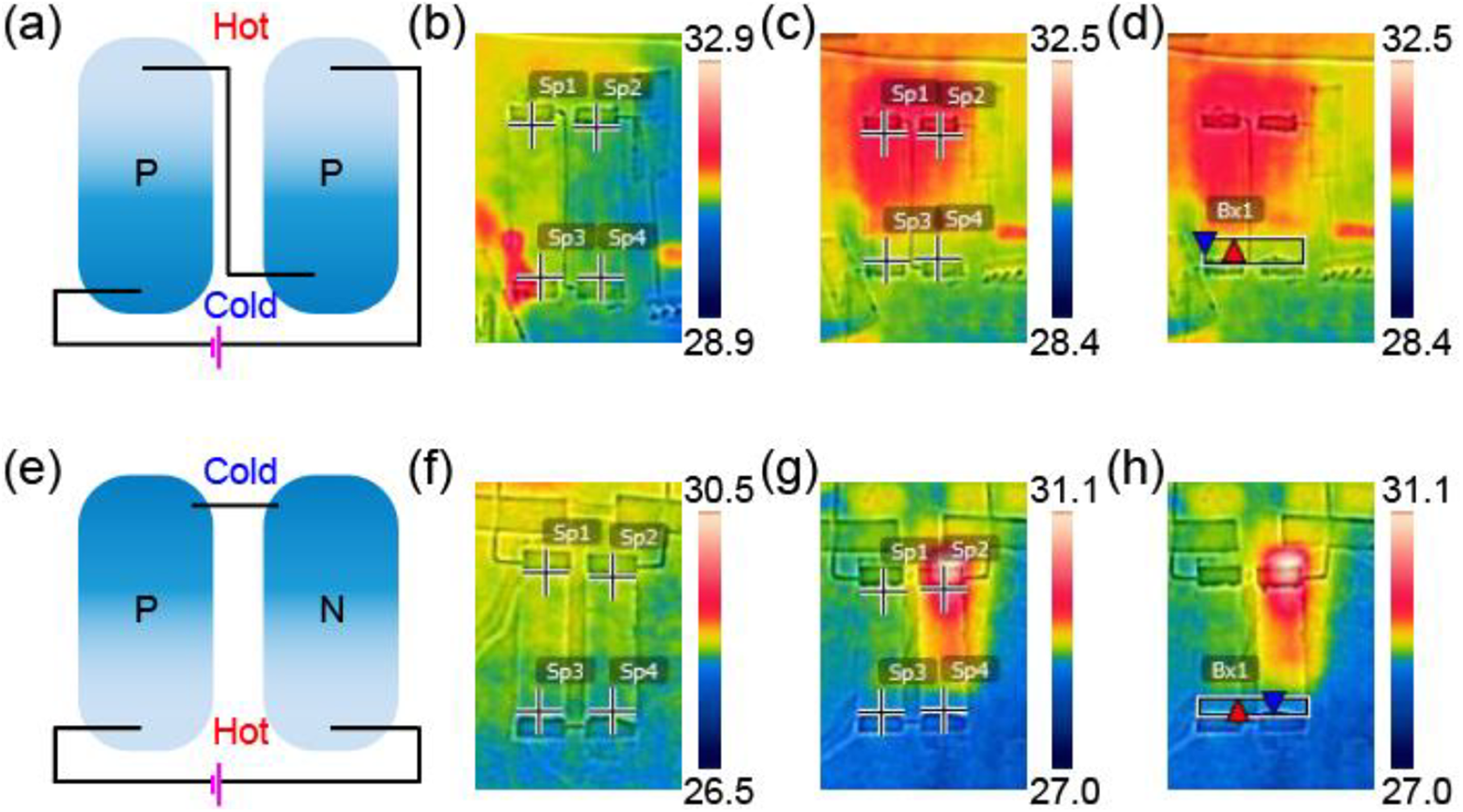
Diagrammatic sketch of TE device in series (a), infrared images before (b) and after (c and d) energization, TE device in parallel (e) and infrared images before (f) and after (g and h) energization.
Conclusions
Solution processable PEDOT NWs without insulated PSS were prepared successfully, and a proper reaction condition, which has the best TE performance, has been obtained. The maximum power factor of the PEDOT NWs achieves 14.0 μWm−1K−2 when the molar mass ratio is SDS:FeCl3:EDOT = 3:2:1, with SDS (200 mmol/L) and a reaction temperature of 50°C. Moreover, TE properties of PEDOT NWs/graphene hybrids, with different graphene mass fractions, were investigated. The power factor of the compound reaches a maximum at 42.0 μWm−1K−2 when the graphene content is 3 wt%, which is three times that of pure NWs. Most importantly, we developed a flexible TE nanodevice that consists of a p-type and n-type leg, which has a good cooling effect. This work opens a new avenue toward fabricating n-type organic TE composite materials and will facilitate the practical application of organic TE devices.
Supplemental material
Supplemental Material, supporting_information - Flexible thermoelectric nanodevices based on three-dimensional networks of poly(3,4-ethylenedioxythiophene) nanowires and graphene
Supplemental Material, supporting_information for Flexible thermoelectric nanodevices based on three-dimensional networks of poly(3,4-ethylenedioxythiophene) nanowires and graphene by Hai-Hui Liu, Meng-Qi Zhang, Zi-Han Tian, Peng-Fei Liu, Yan-Xin Liu and Xing-Xiang Zhang in High Performance Polymers
Footnotes
Declaration of conflicting interests
The author(s) declared no potential conflicts of interest with respect to the research, authorship, and/or publication of this article.
Funding
The author(s) disclosed receipt of the following financial support for the research, authorship, and/or publication of this article: This study was financially supported by the National Key Research and Development Program of China (grant no. 2016YFB0303000) and the New Materials Research Key Program of Tianjin (grant no. 16ZXCLGX00090).

Supplemental material
Supplemental material for this article is available online.
References
Supplementary Material
Please find the following supplemental material available below.
For Open Access articles published under a Creative Commons License, all supplemental material carries the same license as the article it is associated with.
For non-Open Access articles published, all supplemental material carries a non-exclusive license, and permission requests for re-use of supplemental material or any part of supplemental material shall be sent directly to the copyright owner as specified in the copyright notice associated with the article.
