







Abstract
In this study, we firstly used 1-carboxyethyl-3-methylimidazolium ionic liquid as a capping agent to terminate a binary linear polyimide containing different groups such as ether bonds, carbonyl groups, and fluorine, and prepared six kinds of polyimides capped with ionic liquids (IL-PI). The mechanical properties of the polyimide membranes capped with ionic liquids were higher than those of the uncapped polyimide membranes. The elastic modulus of polyimide membrane from 1,3-bis (4-aminophenoxy) benzene (BPDA) and 3,3′4,4′-benzophenone tetracarboxydianhydride (BTDA) by using ionic liquid as the end capping agent (IL-BPDA-BTDA) was 2012 MPa, which is about 70 times higher than that without the end capping agent. In a TG test, all polyimides capped by ionic liquids showed good thermal properties. The residual amount of the polyimides was more than 40% at 1000 °C, which was higher than the other uncapped polyimides. In conclusion, polyimide membranes with high temperature resistance and high mechanical strength were prepared through an ionic liquid termination method.
Introduction
Polyimide (PI) belongs to a class of polymers with multiple heterocyclic rings. 1,2 In recent years, hundreds of polyimides with different chemical structures have been studied. They showed different mechanical, thermal, and chemical properties. 2– 4 The modification of existing polyimides with better mechanical and thermodynamic properties has become the focus of research. 5,6 Jiang et al. 7 prepared sponge polyimide (PI) with bimodal interconnection pore ratio greater than 99% and density adjustable as high temperature stable polymer (between 7.6-10.1 mg/cm3). Fibroued polyimide sponges with high density (HDPISG) were prepared using a “self-gluing” concept. 8 The HDPISG have a density of up to 280 mg/cm3 and porosity >80%, and showed good breathability. The compressive strength increased significantly as the sponge densities increased. Beyond that, the HDPISG also possess excellent mechanical properties after thermal treatments and no loss of compressive strength can be seen after heating at 300°C for 30 h. Further study indicates that the HDPISG can maintain their main shape after carbonization. Wang et al. 9 added different amounts of trace diphenyl phosphate (DPhP) as plasticizer into the PI’s precursor for electrospinning. After imidization, phosphorous-containing electrospun PI nonwovens (PI-PX) were produced. The results indicate that the addition of DPhP significantly enhanced the mechanical and thermal properties of PI-PX. PI microfibers with diameter more than 2 µm were prepared from their PAA-salt in water mixed with low boiling point solvent, such as ethanol. 10 The single electrospun PI microfiber (S-EPIMF) showed excellent mechanical properties. Polyimide electrospun nanofibers (PIENFs) with excellent thermal and mechanical properties were used to reinforce the epoxy matrix by a vacuum-assisted hot-pressing procedure. 11 The results showed that owing to the superior mechanical performance of PIENFs and the strong interfacial adhesion, the PI/epoxy composites presented significantly mechanical improvement as compared to the pure epoxy.
In the past two decades, ionic liquids (IL) have attracted much attention due to their new and tunable physicochemical properties. 12 IL is usually defined as a liquid electrolyte consisting of ions with a melting point below 100°C (the standard for distinguishing molten salts from IL). 13 Based on the interaction between hydrogen bonds, Coulomb and van der Waals ions, IL has unique characteristics. They have excellent solubility and compatibility with many polymer materials. High thermal stability and chemical stability have become the research focus. 14,15 Ito et al. 16 prepared a series of composite membranes (SPI-NTF2 and SPI-PF6) composed of sulfonated polyimide (SPI) and ionic liquid (IL). As plasticizers of SPI, these IL make the composite film softer (lower Young’s modulus and higher elongation at break). However, the Young’s modulus of SPI-NTF2 (75) containing 75 wt% [C4mim] [NTF2] is still higher than 10 MPa, which is much higher than that of ordinary IL/polymer composites. ILFG/PI composites (IGPI) were prepared by filling polyimide (PI) with a certain amount of ionic liquid functional graphene (ILFG), and the thermodynamic properties were studied. 17 The synergistic effect of IL and graphene significantly improved the mechanical and thermal properties of IGPI. When the ILFG content is 0.4 wt%, the tensile strength and modulus of IGPI composites are 51.9% and 56.5% higher than that of pure PI respectively. The decomposition temperature of IGPI containing 0.4 wt% ILFG could reach 581.3°C at 5% weight loss (T5%), which is 52.6°C higher than that of PI.
Because IL has good compatibility in polymer matrix and can improve the physical properties of the polymer itself, so it can improve the physical properties of the polymer. In this study, we firstly capped the polyimide matrix with an ionic liquid, namely 1-carboxyethyl-3-methylimidazolium chloride (See Figure 1). Combined with the advantages of the polyimide matrix, the mechanical strength, thermodynamic properties, and membrane forming property of the membrane were improved, and an in-depth research was conducted.
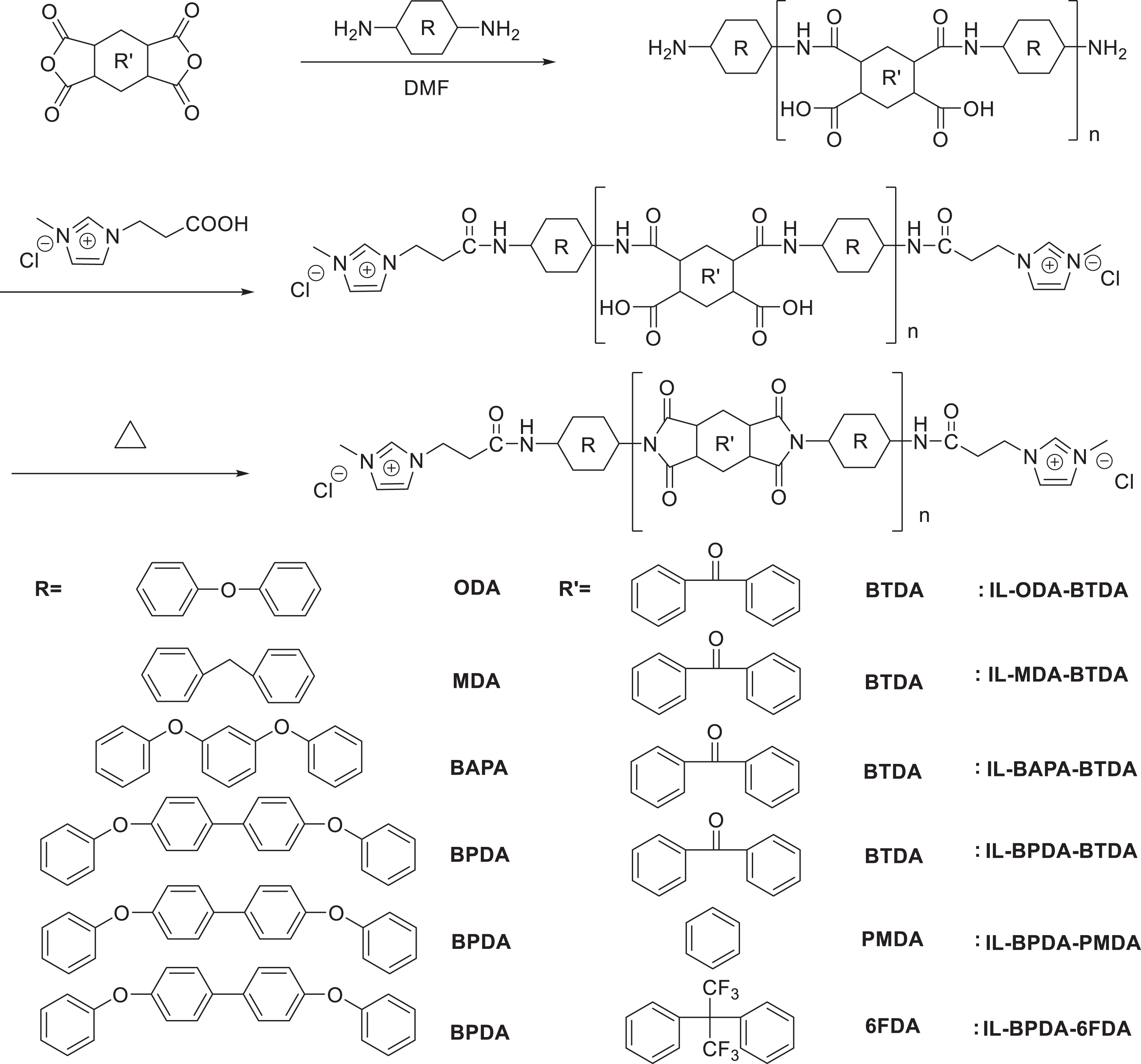
Synthesis route of ionic liquid-terminated linear polyimides.
Experimental section
Materials
The amines used in the preparation of the polyimide matrix in the experiment were 4,4′-diaminodiphenyl ether (ODA), 98% pure, Mw 200.24. 4,4′-diaminodiphenylmethane (MDA), 99% pure, Mw 198.28. 1,3-bis(4-amino Phenoxy) benzene (BPDA), 97% pure, Mw 368.43 and 4,4′-bis(4-aminophenoxy)-linked (BAPA), 98% pure, Mw 292.33. The anhydrides were used 3,3′4,4′-benzophenone tetracarboxylic dianhydride (BTDA), 96% pure, Mw 322.23. 4,4-(hexafluoroisopropylene) phthalic anhydride (6FDA), 99% pure, Mw 444.24 and pyromellitic anhydride (PMDA), 99% pure, Mw 218.12. All amines and anhydrides were purchased from Aladdin Biochemical Technology Co., Ltd. (Shanghai, China). N′N-Dimethylformamide (DMF) was bought from Comeo Chemical Reagent Co., Ltd. (Tianjin, China), 98% pure. 1-carboxyethyl-3-methylimidazolium chloride as the ionic liquid used in this study was purchased from Oric New Material Technology Co., Ltd. (Qingdao, China), 99% pure, Mw 190.63.
Polymer synthesis
Figure 1 shows the synthesis route of ionic liquid capped polyimides. The preparation process of polyimide film was described by that of IL-ODA-BTDA capped by ionic liquid as an example.
1.1 mol/mL of 4,4′-diaminodiphenyl ether (ODA) solution in DMF was placed in a reaction kettle. 1.0 mol of 3,3′4,4′-benzophenone tetracarboxydianhydride (BTDA) was added to the reactor in five parts every 15 min. The solution was stirred for 1 hour. 0.1 mol/mL of 1-carboxyethyl-3-methylimidazole chloride solution in DMF was added to the reactor. It was then stirred for 6 hours to fully react. The polymer solution was standed and defoamed to obtain the polyamic acid solution capped by ionic liquid.
Membrane formation and thermal treatments
Ionic liquid-terminated polyimide membranes were prepared using the solution casting method. The polyamic acid obtained above was evenly poured onto a clean glass plate to make the film uniform. The Spin Coater was used to prepare the membranes (the Spin Coater was purchased from Shanghai Sanyan Technology Co., Ltd. Shanghai, China; model SYSC-50). After casting, the membranes were placed in a vacuum oven and heated gradually from 80°C for 2 hours, up to 280°C for 8 hours to complete high-temperature cyclization to remove any residual solvent. 18 It was cooled to room temperature to obtain an ionic liquid-terminated polyimide membrane. The thickness of the membranes was with a thickness gauge.
Membrane characterization
Infrared spectra were recorded on a Fourier transform infrared spectrometer (Spectrum Two, PE company, Waltham, Massachusetts, USA). Mechanical properties were analyzed with a film tensile testing machine (XLW(PC)-500 N, Sumspring, Jinan, China) at 25°C. Thermogravimetry analyzer was used for a thermal performance test (TGA8000, Perkin Elmer enterprise management Co., Ltd. Shanghai, China. The flow rate of N2 was 40 ml/min, the heating rate was 5°C/min). The thickness gauge was purchased from Shanghai Liuling Instrument Factory, model was CH-1-B hand-type millimeter thickness gauge, the graduation value was 0.001 mm, the measurement range was 0–1 mm and the error was about ≤0.001 mm.
Results and discussion
Infrared analysis of polyimide membrane terminated ionic liquid
To verify whether the ionic liquid reacted with the polymer matrix, the FTIR spectra of the ionic liquid, the PAA, and the polyimide capped by the ionic liquid were analyzed and compared as shown in Figure 2. To prevent the ionic liquid not involved in the reaction from affecting the test results, the polymer matrix was washed in methanol for 7 days to remove the residual ionic liquid. Among them, the peak at 1665 cm−1 was the absorption vibration peak of –NH on the polyimide amide group, 19 which indicated the formation of PAA. The stretching vibration peak of C=N on the imidazole ring of ionic liquid is at 1597 cm−1 which shows that the polymer contains an imidazole structure. 20 After imidization, the stretching vibration peak of C–N in polyimide is at 1243 cm−1, 21 and the absorption peak of C=O in 1713 cm−1 was weakened, which proves that polyimide was formed. 22 However, the absorption vibration peak of –NH which should have disappeared at 1665 cm−1 still existed. This is due to a reaction between the carboxyl group in the ionic liquid with the amino group on the polymer end group to form the imide group. Additionally, the weakening of the absorption peak of C=O at 1713 cm−1 could also be attributed to the reaction between them, which proved the formation of the ionic liquid capped polyimide.
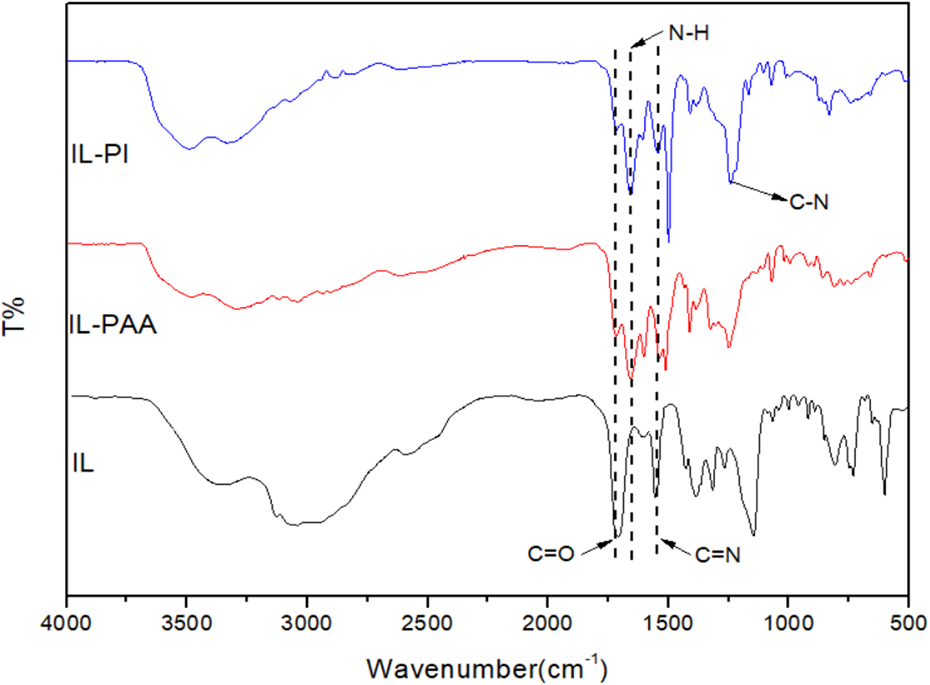
FT-IR spectra of IL, IL-PAA, and IL-PI (IL-ODA-BTDA).
Mechanical properties of ionic liquid-terminated polyimide membrane
Because the prepared polyimide membranes belong to thermosetting material, it is insoluble in solvents, so we could not use GPC to test its molecular weight. However, we use GPC to test the molecular weight of IL-PAA to express IL-PI molecular weight, because PAA is terminated, its molecular weight is equivalent to PI, as shown in Table 1.
Molecular weight of PAA and IL-PAA membrane.
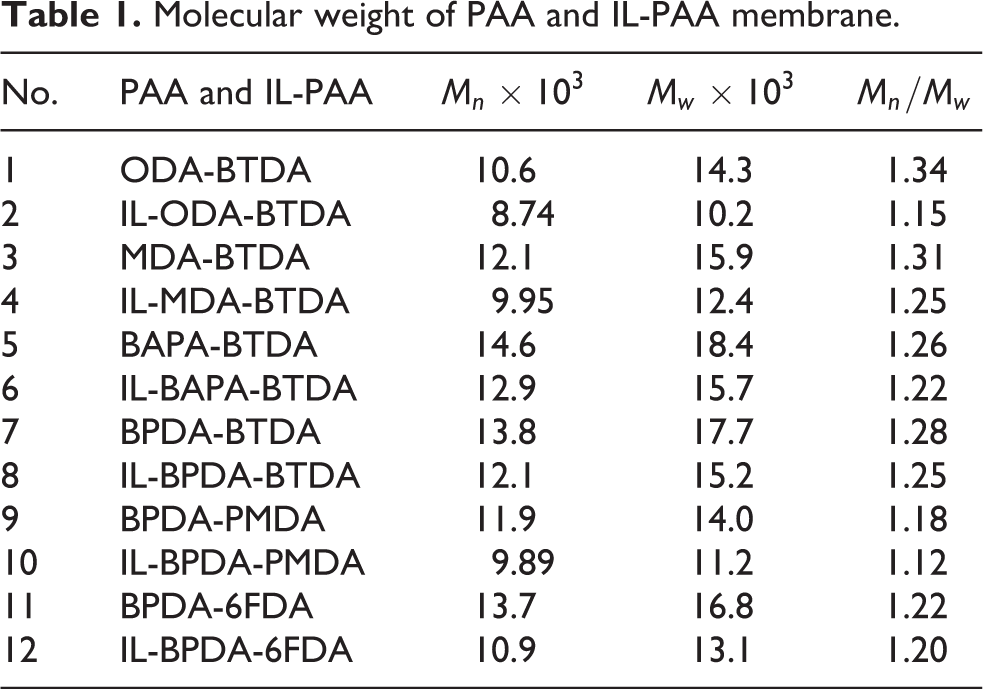
The
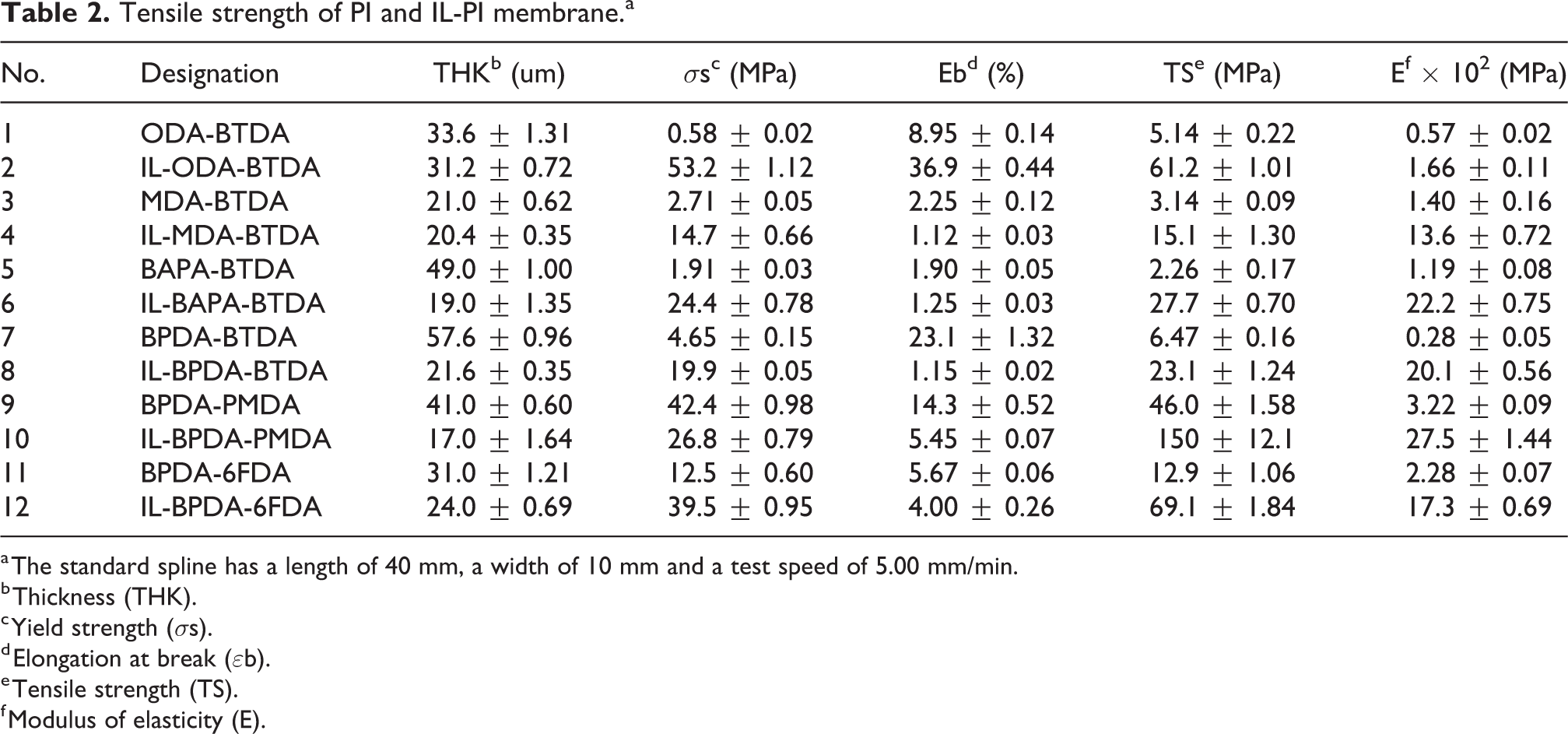
As shown in Table 2, the yield strength (σs), elongation at break (εb), tensile strength (TS), and modulus of elasticity (E) of the ionic liquid-terminated polyimide membranes were measured from the tensile strength test. To show the mechanical properties intuitively, Figure 3 corresponds to the column chart of TS and elastic modulus of pure polyimide and polyimide capped by ionic liquid.
Tensile strength of PI and IL-PI membrane.a
a The standard spline has a length of 40 mm, a width of 10 mm and a test speed of 5.00 mm/min.
b Thickness (THK).
c Yield strength (σs).
d Elongation at break (εb).
e Tensile strength (TS).
f Modulus of elasticity (E).
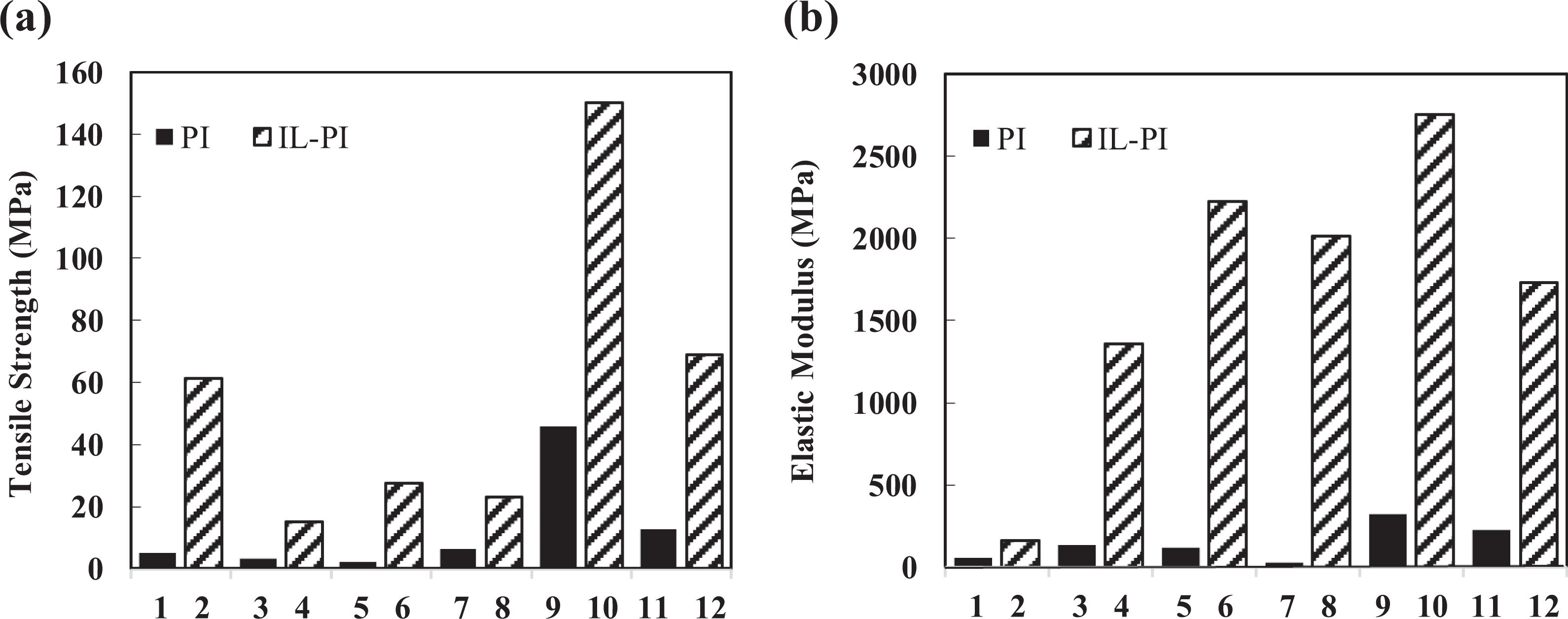
Column chart of mechanical properties of IL-PI and PI: (a) tensile strength, (b) elastic modulus (the abscissa corresponds to the serial number of the membranes in Table 2).
It can be seen from the test results that all kinds of IL capped linear polyimides show better mechanical properties than the corresponding pure polyimides. Among them, the TS and modulus of elasticity of all the polyimide films capped by ionic liquid had been improved. The TS of PI capped by ionic liquid (15.1–150 MPa) were higher than those of PI (2.26–46.0 MPa), which indicates an increase of three to six times (see Figure 3(a)). Among them, the TS of IL-BAPA-BTDA was 27.7 MPa, which was about 12 times higher than that of BPDA-BTDA (2.26 MPa). The elastic modulus of PI (28.00–322.3 MPa) increased 3–70 times by the end groups capped by ionic liquid (see Figure 3(b)). Among them, the elastic modulus of IL-BPDA-BTDA had reached 2012.17 MPa, which was about 70 times higher than that of BPDA-BTDA (Table 2, numbers 7–8). These showed excellent mechanical properties, and the mechanical properties of the capped polyimides were greatly improved.
We think that when IL was added to the polyimide matrix to cap at the end group, the unique electronic structure of ionic liquids would affect the arrangement of molecular chains, 23 thus increase orientation. At the same time, it would restrict the movement of polyimide chain segments, increase the degree of accumulation, and increase the interaction between molecules, so it improved the mechanical strength.
To study the effect of structure on the mechanical properties of polyimide, we prepared polyimide membranes capped by ionic liquid with a different number of benzene rings in the main chain (Table 2, numbers 1–12). The corresponding structure refers to Figure 1.
There were four benzene rings in the repeat unit of IL-ODA-BTDA and IL-MDA-BTDA, of which the elastic moduli were 165.8 MPa and 1356 MPa, respectively. There were five benzene rings in repeat unit of IL-BAPA-BTDA, and the elastic modulus was 2221 MPa. The elastic modulus of IL-BPDA-BTDA with six benzene rings in the structure was up to 2012 MPa, which had the highest lifting multiple of elastic modulus to compared with uncapped polyimide. All IL-PI showed excellent mechanical properties (Table 2, numbers 2, 4, 6, 8).
It can be found that with the increase of benzene rings in the repeating unit, the elastic modulus of polyimide after the end sealing of ionic liquid increased more prominently. We believe that with the increase in the number of benzene rings in the structure, the molecular chain would be more rigid. When the ionic liquid was connected to the two ends of the polyimide main chain as an end-capping agent, the structure of the ionic liquid itself would affect the movement of the polyimide chain segment. This connection increased the stacking degree, caused the whole main chain to be arranged in order, enhanced the rigidity of the main chain, and increased the binding force between the bond and the bond enhance. At the same time, due to the strong intermolecular forces of the ether bond in the main chain structure of polyimide, when the main chain was compressed, the binding force would become more obvious. Under the action of external forces, the polymer was difficult to destroy and therefore showed excellent mechanical properties.
In the case of the same diamine and different binary anhydrides. For the low elastic modulus of IL-BPDA-BTDA and IL-BPDA-6FDA compared with IL-BPDA-PMDA (Table 2, numbers 7–12), we believe that the large side-chain group of –CF3 in 6FDA could increase the chain spacing, reduce the filling efficiency of the polymer chain, change the rigid structure of the polymer, and weaken the intermolecular force, thus affecting some mechanical properties. 24 Compared with BTDA, PMDA had a benzene ring in its structure, but there were no other substituent groups on the benzene ring. Additionally, the main chain length was relatively low, and its intermolecular binding force was strong. When the ionic liquid was blocked at the end of the polyimide main chain, the molecular chain was compressed and the intermolecular forces becomes stronger, thus showing excellent mechanical properties. However, no matter the structure, it would not affect the role of ionic liquid in the polyimide matrix. When the polyimide was capped by the ionic liquid, its mechanical properties improved.
Thermal analysis of ionic liquid-terminated polyimide film
Table 3 summarizes the thermal stability of the ionic liquid capped polyimide films and pure polyimide films. In Figure 4(a) and (b) represent the TG spectra of pure polyimide films. The TG of polyimide film with different numbers of benzene rings in the main chain and different structures of anhydride is shown in Figure 4.
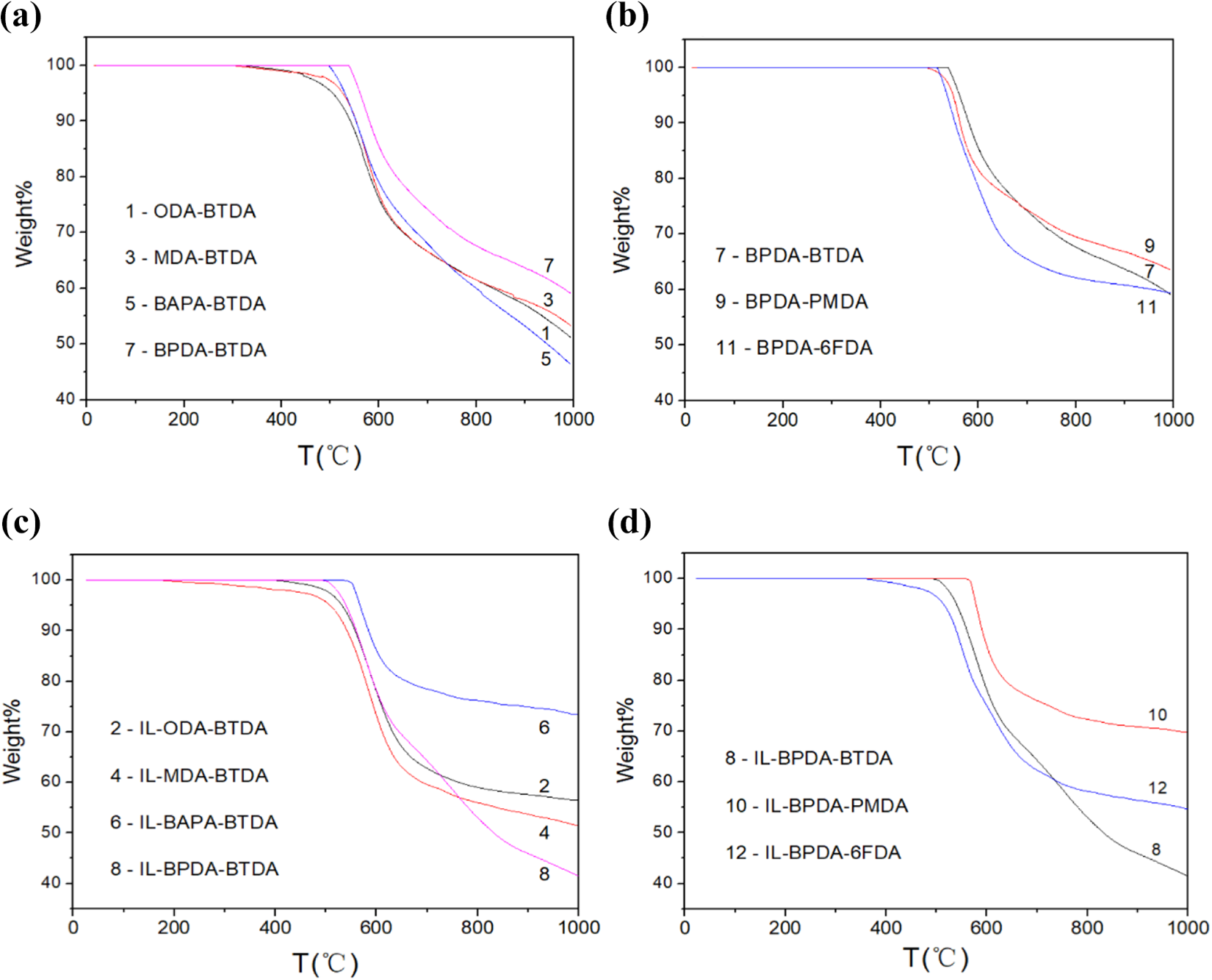
(a and b) TG spectra of pure polyimide films. The TG spectra of IL-PI film (c) with different number of benzene rings in the main chain and (d) with different structure.
Thermal properties of PI and IL-PI.
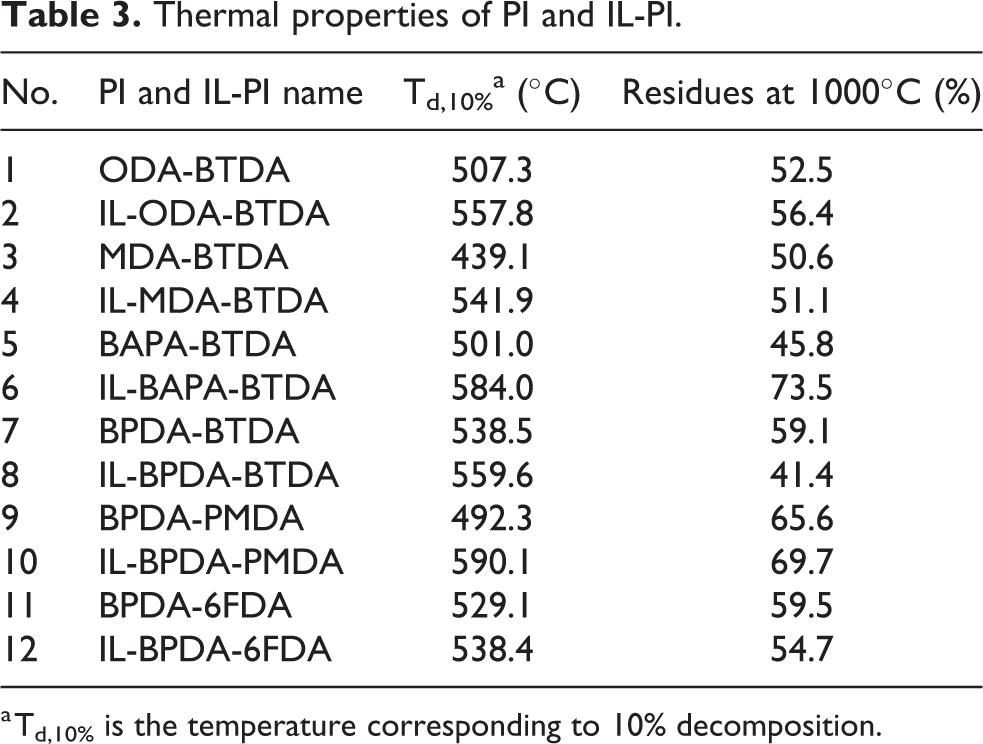
a Td,10% is the temperature corresponding to 10% decomposition.
In our study, all the types of polyimide films capped by ionic liquid show good thermal stability. The polyimide films showed only a 10% decomposition at a temperature range of 530–590°C, while showing a 40%–70% decomposition at 1000°C. The temperature of 10% of the pure polyimide membrane is 430∼540°C, and the residual content of 1000°C is 45%∼65%. The comparison shows that the thermal properties of polyimide after ionic liquid sealing is better than that of pure polyimide. The result therefore indicates the excellent thermal properties of these films.
In addition, Polyimides with the main chain structure containing phenylether have excellent thermal stability in our study. The decomposition temperature at 10% of IL-BAPA-BTDA was higher than those of IL-MDA-BTDA, IL-ODA-BTDA, and IL-BPDA-BTDA. We believe that the oxygen atom in the polyimide phenyl ether of IL-BAPA-BTDA could form a ring structure with the nitrogen positive ion in the imidazole group of the ionic liquid by hydrogen bonding. The intermolecular forces were therefore strengthened, and thus it showed thermal stability. 25 However, when the distance between the two oxygen atoms in the main chain was too long, this hydrogen-bonded ring cannot form. IL-MDA-BTDA had not which could not form cyclic hydrogen bond, so it showed low thermal stability.
In the case of the same diamine and different binary anhydrides, IL-BPDA-PMDA shows better thermal stability than IL-BPDA-BTDA and IL-BPDA-6FDA. Among them, the Td,10% of IL-BPDA-PMDA was 590°C, and the residual amount at 1000°C was 69%, which shows the excellent thermal stability. PMDA contained only one benzene ring, but no other substituent groups. PMDA showed a stable structure in the main chain of polyimide and strong bond strength. The –CF3 and ether bonds in 6FDA and BTDA were unstable, thus showing weak thermal stability.
Conclusions
In this study, we used 1-carboxyethyl-3-methylimidazolium chloride as an ionic liquid terminator to terminate linear polyimides and test their properties. The existence of ionic liquid would restrict the movement of the polyimide chain segment, increase the intermolecular interaction forces, and make the linear polyimides at the end show better mechanical properties than pure polyimides. The elastic modulus of IL-BPDA-BTDA was 2012 MPa, which was about 70 times higher than that of BPDA-PMDA (which was 28.00 MPa). The number of benzene rings and the types of anhydrides also affected the properties of polyimides. As the number of benzene rings increased, the mechanical properties increased. The monosubstituted anhydrides such as PMDA had excellent mechanical properties and thermal stability. This study provides a reinforcement method for polyimides.
Footnotes
Declaration of conflicting interests
The author(s) declared no potential conflicts of interest with respect to the research, authorship, and/or publication of this article.
Funding
The author(s) disclosed receipt of the following financial support for the research, authorship, and/or publication of this article: Financial and facility support for this research came from the Fundamental Research Funds in Heilongjiang Provincial Universities (135309503), the Natural Science Foundation of Heilongjiang Province, China (LH2019B032) and Innovative Research Projects for Postgraduates of Qiqihar University (YJSCX2019061).
