






Abstract
The study involves the processing of a novel poly [1, 4-phenylene-cis-benzobisoxazole] (PBO) fibre reinforced high-temperature thermoplastic composite with polyaryletherketone (PAEK) as the matrix. The PBO fibre and the PAEK film surface was modified using the method of argon and nitrogen plasma treatment. The investigation primarily focuses on evaluating the tensile properties of the fabricated laminates and correlating it with the effect of plasma treatment, surface characteristics, and its fracture surface. A 5% decrease in tensile strength was observed post argon plasma treatment while a 27% increase in strength was observed post nitrogen plasma treatment. The morphology of the failure surface was investigated by scanning electron microscopy and an interfacial failure was observed. Furthermore, the effect of plasma on the wettability of PBO fibres and PAEK film surface was confirmed by the Dynamic Contact Angle analysis and sessile drop method respectively. FTIR spectral analysis was done to investigate the effect of plasma treatment on the chemical structure on the surface. The results of the wettability study showed that the argon plasma treatment of the fibre surface increased its hydrophobicity while nitrogen plasma treatment resulted in the reduction of contact angle.
Introduction
Research in Aerospace and Nuclear technology has been focussed on ways to improve the mechanical and thermal properties of polymers for domain-specific applications since the 1960s. The result of such perceived research is the development of high-performance polymers such as Polyaryletherketone (PAEK), Polyetherimide (PEI), Polysulphone (PSU). The peculiar advantages the High-Performance polymers have over the engineering polymers include greater mechanical strength, chemical and thermal stability. The presence of heavy aromatic rings within the polymer chain imparts resistance to thermal and oxidative degradation resulting in increased mechanical strength and thermal stability. Composites processed by reinforcing fibres in High-Performance polymers are termed as High-Performance composites. The reinforced fibres may be carbon fibre or glass fibre, or even a high-performance polymer-based fibre such as PBO.1–3
Polyaryletherketones (PAEK) are high-performance thermoplastic polymer with superior mechanical and dielectric properties. The aromatic rings along with the oxygen linkages and ether groups significantly affect thermal stability and mechanical strength of the polymer positively. The processing temperatures of the polymer ranges between 350°C to 430°C. However, during the processing of composites with PAEK as a resin, the low surface energy of PAEK is not favourable for good resin-fibre interface and hence surface treatment of PAEK is necessary for good interfacial strength. 4
Poly(1,4-phenylene-cis-benzobisoxazole) (PBO), is a synthetic liquid crystalline aromatic polymeric fibres, with a potential application as reinforcement fibres in high-performance composites due to its superior mechanical strength, flame resistance, thermal stability and chemical resistance. 5 Some of the excellent properties of PBO fibres are summarised in Table 1. Some of the drawbacks of the PBO fibre include moisture absorption, smooth surface and surface inertness.6,7 The moisture absorption factor of the fibre can be mitigated by reinforcing it in a polymer, but this process requires the fibre to interact with the matrix. Surface modification has been considered as a method to enhance the surface properties to ensure good interaction between the PBO fibre and the matrix by the introduction of sufficient functional groups on the surface of the naturally inert fibre. The key advantage of the PBO/PAEK composite would be the higher service temperature when compared to the existing PBO/Epoxy composites along with the significant increase in strength, post optimisation of the interface between the fibre and matrix.
Physical properties of zylon fibre(AS).6

Several modification techniques to enhance the PBO fibre-matrix interfacial strength by improving the surface-wettability, roughness, free energy or functionalisation have been studied by various researchers. 7 Wu and Shyng 8 modified the surface of PBO fibre by treatment with methane-sulphonic acid. The results showed a considerable increase of ILSS in the PBO/epoxy composite prepared post-treatment. Gu et al. 9 modified the surface of PBO fibre by soaking the fibre in a solution of PPA and absolute ethanol followed by ultrasonic treatment to improve the hydrophilicity of the fibre surface. So and Young 10 studied the effect of heat treatment and corona treatment on the interfacial strength of PBO/Epoxy composite. The study showed that the ILSS of the PBO/Epoxy composite almost-doubled post corona treatment, while heat treatment showed an upward trend of up to 50% increase in ILSS. In a study by Tang et al., 11 reversible addition-fragmentation chain transfer (RAFT) polymerisation was used to form a dense random copolymer membrane on the surface of PBO fibres. The results from this study ensured better single fibre pull out strength of the PBO/cyanate-ester composites post-treatment. Further, in a study by Chen et al., 12 air atmospheric dielectric barrier discharge was applied to graft multi-carboxyl polyurethane (C-PU) designed and synthesised by introducing polar functional groups on the PBO fibre surface to enhance interfacial bonding. The results from the study showed improvement in the ILSS of the PBO/BMI composites. In a study by Gu et al., 13 the PBO fibre was surface functionalised by an initial coating of Lysozyme followed by polyhedral oligomeric silsesquioxane (POSS) grafting on the coated surface. The functionalised fibre was reinforced into Modified bisphenol A dicyanate ester (m-BADCy) resin. The surface functionalisation brought about an increase of 13% increase in ILSS of the laminate processed. In another study by Tang et al., 14 the resin was modified by introduction of a novel compound AEAF into the curing networks of BADCy resins through copolymerisation. The PBO fibre reinforced in the modified resin showed 16.6% improvement in the flexural strength when compared with the composite prepared without the resin modification. In a similar study by Liu et al., 15 BADCy resin was copolymerised with fluorine-containing epoxy-terminated PBO precursor. The modification resulted in a 21.4% increase in flexural strength when compared to pure resin. The above-mentioned methods of surface modification have shown significant positive results to improve the interaction between the fibre and matrix. The vulnerability of aging properties of PBO fibre when exposed to moisture and humidity is an important concern 16 and thus it is imperative that exposure to any chemicals to the PBO fibre must be substantiated with the aging behaviour of fibre post-treatment.
Plasma treatment has been found to be really effective in surface treatment and modification of various kinds of materials due to its ability to interact both at the physical and chemical level. 17 The advantages of the treatment process include uniformity and time consumption. The low pressure plasma is non-destructive to the bulk of the polymer. This would ensure that the material properties are retained post-treatment. 18 Another advantage of plasma treatment over other chemical methods of treatment is that the process is environmental friendly with no hazardous chemicals used during the process. The plasma treatment was chosen as the method of surface modification primarily to ensure that the bulk properties of the PBO fibre is not affected owing to its moisture vulnerability. 19 A study by Park et al. 20 showed that oxygen plasma treated PBO/Epoxy composites showed a significant increase in interlaminar shear strength (ILSS) when compared to that of untreated laminate. In a study by Liu et al., 21 the PBO/BMI composite laminates showed a 29% increase in ILSS post air plasma functionalisation of the PBO fibres. The study by Liu et al., 22 showed a 78% increase in the ILSS of PBO/Epoxy composite post argon plasma treatment in combination with siloxane coupling agents. In another study, 23 oxygen plasma was combined with POSS to functionalise PBO surface to improve the interfacial interaction in the PBO/Cyanate ester composite
In this study, we fabricate and examine a novel composite laminate which unites the advantages of PBO and PAEK, i.e. a composite material in which PBO fibre is reinforced in PAEK matrix. This is a pioneering study for PBO reinforced PAEK composite material. The film-fibre stacking method has been used to fabricate the laminate at 400°C. This method provides an over lying control over the volume fractions of the composite laminate by altering the thickness/number of films used in the fabrication process. PAEK is high-temperature thermoplastic and making uniform laminate of PAEK in respect of thickness is a challenging task and its processing with PBO fabric at elevated temperature with optimum pressure opens new horizon of research and it appears one of its first kind till date with complete novelty. The effect of argon and nitrogen plasma treatment on the tensile strength of the processed PBO/PAEK high-performance composite was examined. Further, the effect of plasma treatment on the PAEK film was studied through contact angle measurements by the sessile drop method. The effect of plasma treatment on fibre wettability was studied using the Dynamic Contact Angle Testing method using a Process tensiometer. FTIR analysis was performed to understand the effect of plasma treatment on the materials. FESEM was used to identify and characterise the mode of failure in the composite.
Experimental
Materials
PBO (tradename: Zylon AS type) fibres used in this study were supplied by Toyobo, Japan. The type of fibre used in the study was a 160gsm fabric with a plain bidirectional weave pattern. The resin used in this study was G-PAEK 1200G procured from Gharda Chemicals Ltd, Mumbai in the form of thin films of 0.1 mm thickness and a density of 1.31 g/cc. G-PAEK 1200G is based on Poly Ether Ketone, a high-performance polymer with a glass transition temperature of 152°C and a melting point of 372°C.
Plasma treatment
PAEK film and PBO fibre were plasma treated using the pulsed DC magnetron sputtering system. A schematic representation of the system is shown in Figure 1. The system contains a cylindrical vacuum chamber where the sample to be treated is placed. The substrate was cleaned thoroughly using acetone to remove any contaminants on the surfaces. The chamber was evacuated to a pressure of 5.0 × 10⁻³ mbar. Argon gas (99.99% purity) was introduced into the chamber at a flow rate of 12 L/min. Argon plasma was generated in an argon atmosphere and the operating pressure was 1.1 × 10⁻² mbar and the power provided was 9 W. The nitrogen plasma was generated similarly, but with a flow rate of nitrogen gas at 22 L/min and the power provided was 19 W. The duration of treatment for the fibres was set to 300 seconds while a comparative study was done for the effect of plasma treatment on PAEK Films on its contact angle. The glow obtained during both the treatments are shown in Figure 1.

A schematic diagram of the low pressure plasma treatment used for Argon and Nitrogen plasma treatment.
Sample preparation
Composite laminates of PBO fibres and PAEK films were processed by the film-fibre stacking method using High-Temperature Compression Moulding Press. A schematic description of the sample preparation work flow is provided in Figure 2. This method provides an option to control the volume fraction of the composite laminate by altering the thickness/number of films between the fibres. The stacked material was placed in the mould and processed at 400°C under a pressure of 5 bar. After 60 minutes of temperature hold, the sample was brought to room temperature naturally. Laminates of dimension 100 mm × 100 mm × 1 mm were prepared as shown in Figure 2.

Schematic representation of film-fibre stacking method used for processing of laminates along with the processed PBO/PAEK laminate and tensile test specimens post waterjet cutting.
Tensile testing
A universal testing machine (Zwick Roell Z010) was used to determine the laminate tensile strength. The laminates were machined by waterjet cutting to ASTM D3039 standards (Dimensions: 100 mm × 10 mm × 1 mm) to ensure minimal damage to the laminate as shown in Figure 2. The tensile properties of five samples from the prepared laminates were determined.
Wettability study
The wetting of a liquid onto a solid is governed by the balance of forces that result at the three-phase intersection of solid, liquid, and gas. The balance of the forces between the interacting phases can be determined by measuring the angle between the overlapping phases and this angle is termed as contact angle. The sessile drop method has been widely used to characterise the surface energy of a material. The basic principle of this method involves placing a droplet of liquid with known surface tension and calculate the contact angle made by the drop with the surface as shown in Figure 3. The effect of argon plasma exposure duration on the film was studied progressively. The obtained images from the sessile drop technique over PAEK films was processed using ImageJ software to highlight the edges.

Schematic representation of sessile drop method.
The wettability of a single fibre cannot be determined by the same process due to the size of a single fibre (7 microns). Thus an alternative principle, known as the micro Wilhelmy Plate method has been devised to evaluate the contact angle of single fibres. 24 The process involves pushing a single fibre into a liquid beaker and measuring the contact forces experienced by the fibre due to its interaction with the liquid as shown in Figure 4. The dynamic contact angles of PBO fibres were studied by a Process Tensiometer (KRUSS GmbH). Deionised water with a surface tension of 72.2 mN/m 2 was used as the liquid.
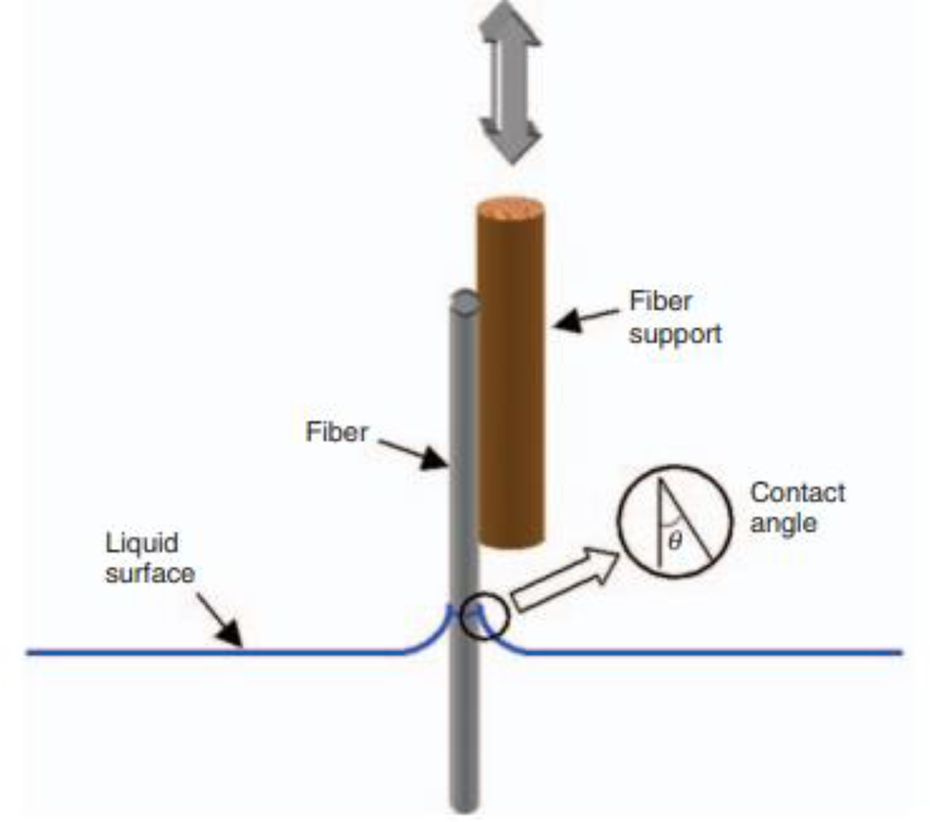
Micro Wilhelmy plate method of measuring contact angle. 24
FTIR
FTIR spectroscopy can be used to understand the presence of functional groups, the formation of bonds or the presence of impurities on the surface of a material. In this study, the effect of surface modification on the PAEK film as well as the PBO fibres were quantified using the FTIR analysis. The analysis was performed using Nicolet iS10 spectrophotometer with a spectrum range of 4000–400 cm−1
FESEM
The level of interaction between the fibre and resin was examined using FESEM. The PBO/PAEK fractured region after the tensile test was investigated using Zeiss Gemini 300. As the samples are non-conducting materials, they were coated with a thin conducting layer of gold to minimise charge and the microscope was operated under 5 kV. The FESEM photomicrographs of the fractured surface were used to determine the mode of failure.
Results and discussion
The main aim of the study was to determine the degree of change in the surface properties of the PAEK film as a function treatment duration and also to determine the effect of plasma treatment on the surface properties of PBO fibre.
The values of contact angle measured on the untreated PAEK film surface were estimated to be around 82° which is in concurrence to the literature available. A study by Przykaza et al. 25 showed that the contact angle of an untreated film was found to be 87.5°. The study further has revealed the process of plasma treatment of polymers increases their surface energy by introducing new surface groups which in turn increases the surface roughness on a micro-scale.25 Figures 5(a–f) and Figures 6(a–f) shows the sessile drop on the film with different argon and nitrogen plasma exposure time respectively. As seen in Figure 7, the contact angle came down from 82° on untreated film to 44° on the treatment of films for 30 seconds in case of exposure to nitrogen plasma while the contact angle came down to 58° in case of argon plasma. Subsequently, it was seen that the contact angle values relatively stabilised at 31° beyond exposure time of 180 seconds in case of nitrogen plasma while the same stabilised at 49° for argon plasma. Therefore, 300 seconds exposure time was selected as the standard exposure time for plasma treatment during the study. The increase in the surface wettability can lead to increased interaction between the fibre and matrix.

Contact angle of PAEK film with deionised water post argon plasma treatment (a) Untreated, (b) 60 seconds, (c) 120 seconds, (d) 180 seconds, (e) 240 seconds, (f) 300 seconds.

Contact angle of PAEK film with deionised water post nitrogen plasma treatment (a) Untreated, (b) 60 seconds, (c) 120 seconds, (d) 180 seconds, (e) 240 seconds, (f) 300 seconds.

Effect of the treatment time of plasma on contact angle of PAEK film.
The method used for determination of the advancing contact angle of PBO fibre is Micro Wilhelmy plate method. 26 This method uses the measurement of the force experienced by the fibre while penetrating the surface of a liquid to characterise its contact angle. The schematic representation of the setup is shown in Figure 4. The forces involved during the immersion of the fibre in a liquid of known surface tension are gravity (g), surface tension (Fw), buoyancy force (Fb) and the force recorded by the tensiometer (Fm). The balanced force equation is given by Eq. 1
The weight of the fibre is adjusted within the tensiometer and therefore the ‘g’ termed can be ignored. The surface tension and the buoyant force component can be expanded to the form of Eq. 2
where L denotes the perimeter of the interaction surface of the fibre with deionised was γlv denotes surface tension of deionised water (72.2 mN/m), h denotes the immersion depth and Δρ represents the difference in density between the fibre and the deionised water (0.54 g/cc) while θ is the static contact angle. For determining the advancing contact angle, a plot between Fm and h is plotted with the values recorded from the tensiometer as shown in Figure 8. Then a regression line is obtained for the scattered plot, and the intercept of the line provides the force experienced just at the contact of the liquid surface. The corresponding θ value for the force obtained from the intercept is termed as the advancing contact angle of the fibre.

Plot of wetting forces as a function of immersion depth for untreated and treated PBO fibre at an immersion velocity of 3 mm/min.
The values of advancing contact angle for untreated PBO fibre from Dynamic contact angle testing using Process Tensiometer was found to be 48.4°. A study by Wu et al. 26 found that the contact angle of PBO fibre was 51.7° with deionised water using a Cahn dynamic contact angle analysis system. Thus the obtained value for the advancing contact angle of untreated PBO fibre is in concurrence with available literature. Further, the advancing contact angle value for PBO fibre exposed to Argon plasma for 300 seconds was found to be 55.7°. This increase of hydrophobicity of the fibre in general post plasma treatment has been previously observed.27–29 The contact angle of carbon fibre was found to increase from 37° to 51.3° on exposure to argon plasma for 10 minutes in a study by Dilsiz et al. 27 The primary reason for such a phenomenon is due to the argon atmosphere used during the treatment. The plasma generated due to argon cannot introduce new functional groups on the surface of the fibre thus resulting in an increase in the hydrophobic character of the fibre. Ketonic and carbonyl linkages in the PAEK structure make the polymer inherently hydrophilic while the benzoxazole group in PBO is hydrophobic. Thus, through the results of the contact angle analysis, it can be understood that the argon plasma doesn’t introduce any new functional group, but intends to accentuate the inherent property of the material by surface modification. The advancing contact angle value for the PBO fibre exposed to Nitrogen plasma for 300 seconds was found to be 41.8°. This decrease in the contact angle of the fibre surface can be attributed to an increase in the surface energy of the fibre on exposure to nitrogen plasma.
FTIR analysis was conducted to further understand the effect of nitrogen plasma on the chemical structure of the surface. The FTIR spectrum for PAEK films have been reported and discussed previously in literature.30,31 The important highlights from the FTIR analysis as shown in Figure 9 included carbonyl stretching at 1650 cm−1 and skeletal ring vibration at 1584 cm−1, 1493 cm−1 and 1408 cm−1, while, the asymmetric stretching of the diphenyl ether group at 1223 cm−1 and 1156 cm−1, aromatic hydrogens in-plane deformation bands at 1156 cm−1 and 1047 cm−1, the diphenyl ketone band at 923 cm−1, the out of plane bending modes of the aromatic hydrogens (two overlapping broad bands) at 842 cm−1 and 839 cm−1 and a band at 760 cm−1. The FTIR spectrum of PAEK film post nitrogen plasma treatment showed no appreciable changes in the spectrum. There were only a few minor changes with the intensity but no new functional groups were introduced on the surface of the film. Similar results were obtained by Al Lafi et al. 31 where they studied the effect of ion irradiation on PAEK films. They concluded that the formation of new structures within the PAEK film was small even after large irradiation over the films. A study by Lu et al. 32 has shown that the effect of plasma treatment cannot be captured effectively by FTIR as the spectrum obtained is for the material present in 1–2 micrometres from the surface, but the effect of plasma treatment usually is in nanometres from the surface.

FTIR of untreated and nitrogen plasma treated PAEK film (300 seconds).
The FTIR spectral analysis of PBO fibre as shown in Figure 10 revealed Aromatic C-H stretch from benzene between oxazole rings at 3084 cm−1, Skeletal vibrations in the conjugated system/benzoxazole ring at 1408 cm−1 and 1364 cm−1, Aromatic C-H in-plane bending at 1104 cm−1, Asymmetric stretching of unsaturated cyclic ether at 1047 cm−1, Aromatic C-H in-plane bending at 1007 cm−1, Symmetric C-O-C stretching of cyclic ether at 923 cm−1 and Aromatic C-H out of plane bending at 816 cm−1. 33 Similar to the results from PAEK film, no considerable change was seen in the chemical structure of the fibre post plasma treatment. The depth of effect of the plasma treatment as discussed earlier is limited to the extreme surface of the material and therefore the FTIR analysis cannot effectively capture the changes due to the plasma treatment. The FTIR analysis provides further proof that the plasma treatment is a surface level modification process, and it doesn’t alter bulk material properties as mentioned previously.

FTIR of untreated and nitrogen plasma treated PBO fibre (300 seconds).
The tensile test results are shown in Figure 11 and the parameters extracted from the result are provided in Table 2. For the untreated laminate, the calculated mean tensile strength of samples was 580 MPa, mean Youngs Modulus was 6.07 GPa while the mean elongation to failure was 21%. For the argon plasma treated laminate, the calculated mean tensile strength of samples was 549 MPa, mean Youngs Modulus was 6.20 GPa while the mean elongation to failure was 13%. There was a 5.3% reduction in tensile strength post argon plasma treatment while there was a 2% increase in the Youngs modulus. Nitrogen plasma treatment showed a 27% increase in the tensile strength and a 12% increase in tensile modulus on comparison with that of the untreated laminate. The results are in concurrence to the results from the dynamic contact angle results for the fibre where it was found that argon plasma treatment increased the hydrophobicity on the surface of the fibre which would have negatively impacted the interaction with the matrix while the contact angle reduced in case of nitrogen plasma treatment. The peculiar characteristic of the failed samples was that the fibre remained intact while there was matrix cracking indicating a weak interface between the fibre and matrix in all the sample laminates. From the results of tensile strength, we can conclude that the interfacial strength could not be enhanced through argon plasma treatment while nitrogen plasma treatment enhanced the tensile strength of the laminate. The mode of fracture of the laminate was examined by the FESEM analysis

Comparison of tensile strength between untreated and treated laminates.
Obtained mean parameters from the tensile testing.

FESEM micrographs of the laminate fracture are shown in Figures 12 to 14. Figure 12 shows the micrographs of failure surface of the untreated laminate, Figure 13 shows the micrographs of failure surface of the argon plasma treated sample while the Figure 14 is the micrographs of failure surface of the nitrogen plasma treated sample. The figures show that failure was due to fibre and matrix debonding primarily while no fibre breakage was observed. Figure 12 exhibits a small amount of matrix debris (cohesive fracture) surrounding some PBO fibres. But a predominant adhesive fracture observed was the primary failure mode, even though this is not the desired failure mode. It can be seen from Figure 13 that there are points of cohesive failure within the matrix surrounding some PBO fibres. But the predominant mode of failure is an interfacial fracture between the fibre and matrix. It can also be seen from the figures that no fibre breakage or even reduction in the diameter of the fibre was observed. The weak interface results in an improper transfer of loading between the matrix and fibre leading to a premature failure of the interface and matrix due to stress aggregation. A study by Horst et al. 34 revealed that the possible cause of failure with matrix fibre debonding is the local stress intensity at the fibre ends. The improper transfer of loads results in the matrix bearing the majority of the loads, resulting in the elongation of the matrix phase. But elongation of the matrix requires contraction along lateral direction leading to increased stress on the interface of fibre matrix leading to an interfacial failure. Even though there was a considerable enhancement of strength due to nitrogen plasma treatment, the adhesive failure mode indicates that there is room for further improvement of the matrix fibre interfacial property for further enhancement of the mechanical properties of the fabricated novel high-performance composite.

FESEM image of PBO/PAEK fractured surfaces of untreated laminate.

FESEM image of PBO/PAEK fractured surfaces of argon plasma treated laminate.

FESEM image of PBO/PAEK fractured surfaces of nitrogen plasma treated laminate.
Conclusion
A novel high-temperature thermoplastic composite laminate with PBO as fibre and PAEK as matrix was processed by High-temperature Compression Moulding Press. Plasma treatment was used to modify the inert surface of the PBO fibre and to enhance the interfacial interaction between the fibre and matrix. Tensile testing of the laminates showed a drop of 5.3% in the strength post argon plasma treatment. Examination of the argon plasma treated PBO surface with respect to the untreated surfaces by contact angle testing showed that argon plasma increased the hydrophobicity of the fibre. Tensile testing of the laminates showed a 27% increase in the strength post nitrogen plasma treatment. This enhancement of the strength was further confirmed by the decrease in the advancing contact angle of the fibre post nitrogen treatment. Finally, the FESEM micrographs supported the claim that the failure was primarily due to interfacial failure as a result of weak interaction between resin and matrix even post plasma treatment. Thus, it can be concluded that PBO surface needs to be modified with a process that is more effective in functionalising the surface of the fibre in order to increase the interaction between the resin and fibre at the interface ensuring proper load transfer between the two components of the laminate.
Recommendation
XPS can be used to characterise the modified surfaces to find the change in the surface elemental composition, post surface modification.
Other plasma treatment based on oxygen or atmospheric air can be used to modify the surface of the materials and its effect of the interface between the PBO fibre and PAEK matrix can be studied.
Footnotes
Acknowledgments
We would like to extend our gratitude to Gharda Chemicals Ltd for providing material and financial support for the work reported in this paper.
Declaration of conflicting interests
The author(s) declared no potential conflicts of interest with respect to the research, authorship, and/or publication of this article.
Funding
The author(s) received no financial support for the research, authorship, and/or publication of this article.
