






Abstract
Ag@BN/phthalonitrile resin composites were prepared using highly thermally conductive BN modified by Ag plating. The effects of different contents of Ag@BN particles on the dynamic mechanical properties, thermal stability, and thermal conductivity of composites were examined. The results of Fourier-transform infrared spectroscopy, X-ray powder diffraction, scanning electron microscopy, and energy-dispersive X-ray spectroscopy analyses showed that Ag was successfully deposited on the surface of BN. The prepared Ag@BN was subjected to KH550 grafting treatment. With the increase in the content of Ag@BN/KH550, the storage modulus, thermal stability, and thermal conductivity of the composite increased. The storage modulus, decomposition temperature, and thermal conductivity of the Ag@BN/phthalonitrile composite with 20 wt.% Ag@BN/KH550 were 5.0 GPa, 539°C, and 0.80 W/(mK), respectively, which are 1.35, 1.18, and 3.33 times higher than those of pure resin, respectively. The compatibility and dispersibility of BN modified by Ag plating in phthalonitrile resin were effectively enhanced, thereby providing a potential candidate to be used at high-temperature devices with high thermal conductivity.
Introduction
Phthalonitrile resin is a matrix material with excellent properties such as a high energy storage modulus, glass transition temperature (T g ), thermal oxygen stability, and flame retardancy. Consequently, such resins are widely used in various fields including those pertaining to high-temperature devices of aerospace and integrated circuitry.1–4 However, the thermal conductivity of phthalonitrile resin is relatively low owing to the lack of electrons in the polymer and low crystallinity.5–7 In general, heat is mainly transferred through the movement of molecules or segments, but the movement of segments is limited in the case of macromolecular entanglement, which leads to a reduced thermal conductivity. The thermal conductivity of such materials can be effectively enhanced by preparing polymer-based thermally conductive composites by adding thermal conductive fillers, 8 such as metals9,10 (Cu, Ag, etc.), carbon materials 11 (graphite, graphene, carbon nanotubes, etc.), ceramic materials 12 (aluminum nitride, hexagonal boron nitride, etc.), and composite materials 13 (Al2O3@graphite, etc.).
Among these materials, hexagonal boron nitride (BN) is an ideal thermally conductive filler because of its low weight, excellent electrical insulation, high chemical stability, and high thermal conductivity.14–16 However, BN is not highly compatible with the polymer and disperses unevenly in the matrix, thereby deteriorating the thermal conductivity of the composites. 17 To enhance the dispersibility and compatibility of BN in polymers and achieve a higher filling amount, it is necessary to modify the surface of BN.18,19 Derradji et al. 20 prepared modified BN/phthalonitrile composites with different contents of untreated BN and a silane coupling agent. The thermal conductivity of the pure BN/phthalonitrile composites increased only slightly with the increase in the BN content. Furthermore, Xiao et al. 21 prepared copper phthalocyanine grafted BN nanosheets (CuPc-g-BN) and reported that the thermal conductivity of the composite reached 0.63 W/(mK) when the mass fraction of the modified BN was 10 wt.%. The abovementioned studies demonstrated that the addition of pure BN or simply modified BN could only slightly increase the thermal conductivity of phthalonitrile composites. Notably, coating the surface of an inorganic powder with metal can help enhance the wettability and dispersibility of the powder in the matrix. 22 Among metals, Ag is an effective coating material because of its high thermal conductivity and oxidation resistance. 23 Ha et al. 24 prepared polyvinyl alcohol composite films (Ag-GNPs-PVA) through a nano-silver modified graphite nanosheet by using the solution delay flow method. Compared with pure graphite nanosheet polyvinyl alcohol composite films (7.61 W/(mK)), the thermal conductivity of 10 wt.% Ag-GNPs composite films was 8.45 W/(mK). Wen et al. 25 prepared PCM composites based on lauric acid (LA) with Ag nanoparticle modified expanded graphite (Ag-EG) and noted that compared with EG/LA composite (1.56 W/(mK)), Ag-EG/LA composite exhibited enhanced thermal conductivities (2.85 W/(mK)).
Considering these aspects, a small amount of Ag was deposited on the surface of BN to obtain Ag@BN and improved its surface activity. Phthalonitrile resins were filled with highly thermally conductive Ag@BN that can effectively disperse in the resin. Subsequently, BN/phthalonitrile composites and Ag@BN/phthalonitrile composites were prepared. The effects of the content and dispersion of the thermal conductive BN on the thermal stability, thermal conductivity, and dynamic mechanical properties of the composite were examined.
Experimental Details
Materials
Anhydrous potassium carbonate (K2CO3, analytically pure (AR), >99.0%) was obtained from Tianjin Damao Chemical Reagent, China. Hexagonal BN (2500 mesh) was provided by Shandong Zibo Jingyi Ceramic Technology Co., Ltd., China. N,N-dimethylformamide (DMF, AR), ammonia (NH3·H2O, AR), formaldehyde (AR), 3-aminopropyltriethoxysilane (KH550, >98.0%), ethylene glycol (AR), and anhydrous ethanol (AR) were purchased from Tianjin Yongda Chemical Reagent Co., Ltd., China. 4-Nitrophthalonitrile (NPN, >98.0%), 2-Bis (4-hydroxyphenyl) propane (>99.0%), and silver nitrate (>98.0%) were obtained from Zhengzhou Alpha Chemical Co., Ltd., China. In addition, 4-amino phenoxy phthalonitrile (APPH, >90.0%) was prepared in our laboratory.
Preparation of bisphenol A phthalonitrile monomer
The monomer was prepared by first adding 2-bis (4-hydroxyphenyl) propane (2.60 g, 11.39 mmol), K2CO3 (2.80 g, 20.26 mmol), and dry DMF (50 mL) to a 250 mL three-necked flask. The solution was heated to 85°C and stirred for 0.5 h. The colorless reaction solution gradually turned reddish brown. Next, NPN (3.00 g, 17.33 mmol) was added to solution, and the solution was placed in a nitrogen (N2) atmosphere for 8 h. Finally, the reddish-brown solution was cooled to ambient temperature and poured into 300 mL deionized water. The product was repeatedly washed by suction filtration with ample deionized water until the filtrate became pellucid. The filtered product, that is, the 2-[4-(3-dicyanophenoxy) phenyl] propane monomer (BDPP), was dried overnight in a vacuum oven at 60°C. Proton nuclear magnetic resonance (1H NMR; 400MHz, deuterated dimethyl sulfoxide (DMSO-d6), δ): 8.10 (d, J = 8.75 Hz, H, ArH-1), 7.80 (d, J = 2.24 Hz, H, ArH-2), 7.38 (s, H, ArH-3), 7.36 (s, H, ArH-4), 7.13 (d, J = 8.52 Hz, H, ArH-5), and 3.37 (s, 3H, ArH-6). Fourier-transform infrared (FTIR; potassium bromide (KBr), cm−1): 3072 and 837 (ArC–H), 2976-2879 (-CH), 2236 (–CN), 1591 (ArC=C), 1250 (C–O–C). The reaction associated with the BDPP monomer synthesis is illustrated in Figure 1. Synthesis route of BDPP monomer.
Preparation and surface modification of Ag@BN
To prepare Ag@BN, 1.57 g of AgNO3 was fully dissolved in 36 mL of deionized water until a clear solution was obtained. Next, 9 mL of NH3·H2O was slowly added to the solution, and the solution was continuously stirred for 1 h until the solution became turbid and clarified. Subsequently, silver ammonia solution, that is, the silver-plating solution, was prepared. Moreover, 0.5 mL of formaldehyde and 2.5 mL of deionized water were evenly dissolved in 42 mL of ethanol, and the reducing agent solution was obtained.
AgNO3 was dissolved in a glycol solution, and 50 mL of AgNO3 solution with ethylene glycol having a solubility of 6 g/L was obtained. Subsequently, 10 g of BN was dispersed in the solution. The solution was subjected to ultrasound treatment for 1 h and mechanically stirred for 24 h at ambient temperature until the solution changed from milky white to brownish red. The activated BN was washed by deionized water three times, washed with ethanol three times, and dried at 60°C for 4 h to obtain a pink powder.
In addition, 10 g of activated BN was dispersed in 40 mL of the reducing agent solution, and 40 mL of the silver-plating solution was slowly added to the reducing agent solution and mechanically stirred at the ambient temperature for 3 h. The color of the mixed solution was yellow at first, then became earth yellow, and finally black. The black powder was washed using deionized water several times and dried at 60°C for 8 h. Subsequently, Ag-plated BN powder, that is, Ag@BN, was obtained.
Surface modification of Ag@BN was conducted according to the following procedure: 10 g of Ag@BN was homogeneously dispersed in 100 mL ethanol solution (ethanol/H2O = 95/5). Next, 5 mL of KH550 was added to the mixture, and the mixture was stirred at 70°C for 12 h. The modified Ag@BN was washed using deionized water and ethanol, three times with each liquid, and placed in a vacuum oven at 80°C for 24 h to obtain Ag@BN/KH550. The schematic description of chemical links obtained during the surface modification is shown in Figure 2. The chemical reaction during the surface modification.
Preparation of phthalonitrile composites
Ag@BN/KH550 particles with mass fractions of 5, 10, 15, and 20 wt.% were fully mixed with the BDPP monomer and APPH catalyst (10 wt.%). The mixture was transferred to an aluminum mold and degassed in a vacuum oven until the viscosity of the melting samples significantly increased, and the number of bubbles was adequately low. The samples were post-cured at 200°C for 2 h, 240°C for 2 h, 260°C for 2 h, 280°C for 2 h, 300°C for 2 h, and 320°C for 6 h in a muffle furnace.
Measurements
The 1H nuclear magnetic resonance (NMR) spectrum of the BDPP monomer was recorded using an NMR spectrometer (Bruker Advance 400 MHz, Switzerland) with DMSO-d6 as a solvent. The FTIR spectra (between 4000 cm−1 and 400 cm−1) of a series of BN powders and BDPP monomer were recorded using an FTIR spectrophotometer (AVATAR380, Nicolet, USA) via KBr pellets. The crystal structures of BN and Ag@BN were obtained using an X-ray diffraction instrument (XRD, D/MAX2500PC, Science, Japan). The morphology and dispersion of pure BN, Ag@BN, and the composites were observed using a scanning electron microscope (SEM, Smur4800, Hitachi, Japan) and supporting energy dispersive spectrometer (EDS, Smur4800, Hitachi, Japan). Thermogravimetric analysis was performed using a thermogravimetric analyzer (TGA, STA-449C, Netzsch, Germany) at a heating rate of 10°C min−1 in a N2 atmosphere with a flow rate of 100 mL min−1. The dynamic mechanical property was evaluated through a dynamic thermomechanical analyzer (DMA, Q800, TA, American) in the single cantilever mode with a driving frequency of 1 Hz and heating rate of 5°C min−1 from 50°C to 360°C. The thermal conductivity was recorded on a thermal conductivity meter (TC3000, Xiatech, China) at a voltage of 2.5 V at 25°C.
Results and discussion
Analysis of modified BN
FTIR analysis
Figure 3 shows the FTIR spectra of BN, Ag@BN, and Ag@BN/KH550. BN exhibited two notable characteristic absorption peaks, which pertained to the chemical bond deformation vibration absorption peak of B-N-B at 808 cm−1 and stretching vibration peak of the B-N bond at 1376 cm−1. After Ag plating, the OH absorption peak appeared at 3150–3350 cm−1, which indicated that BN coated with Ag particles exhibited a certain hydrophilicity and enhanced the chemical activity of the functional groups on the BN surface. No other new special peaks were found, indicating that there is a physical combination between the surface of BN and Ag. After Ag@BN was modified by KH550, the absorption peak of –CH2 appeared at 2900–2930 cm−1, and the peak of the Si-O bond appeared at 1130 cm−1, indicating that KH550 was successfully grafted on the BN surface. However, the position of the characteristic peak of the amino (3500–3000 cm−1) overlapped with that of the hydroxyl from water in the test environment (3700–3000 cm−1), so it was difficult to find the characteristic peak of the amino in Figure 3. FTIR spectra of BN, Ag@BN, and Ag@BN/KH550.
XRD analysis
Figure 4 shows the XRD patterns of BN and Ag@BN. The 2θ values of the BN diffraction peaks were 26.8°, 41.8°, 44.0°, 50.3°, 55.3°, 71.6°, and 76.1°, corresponding to (002), (100), (101), (102), (004), and (110) crystal planes of BN, respectively. After Ag plating on the BN surface, in addition to the original diffraction peak of the BN, only one diffraction peak of (111) crystal plane of Ag appeared at a 2θ of 38.2°, and there are no other impurity peaks or amorphous diffraction peaks, indicating the presence of Ag on the BN surface. XRD patterns of BN and Ag@BN.
SEM and EDS analysis
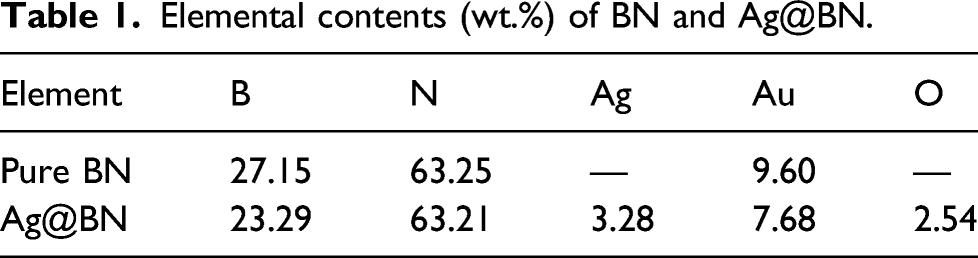
Figure 5 shows the SEM and EDS images of (a) pure BN and (b) Ag@BN. Table 1 presents the results of the analysis of the surface element content of pure BN and Ag@BN. As shown in Figure 5, the surface morphology of the Ag-plated BN particles was different from that of pure BN. Specifically, the surfaces of pure BN and Ag@BN were observed to be smooth and rough, respectively. According to the EDS energy spectrum analysis, only three elements, B, N, and Au, were present on the pure BN surface, with contents of 27.15%, 63.25%, and 9.60%, respectively (Au was sprayed in the energy spectrum test). After Ag plating, the contents of B and N on the Ag@BN surface decreased to 23.29% and 63.21%, respectively, and O and Ag elements appeared, indicating that Ag was formed on the BN surface and was slightly oxidized. SEM and EDS images of (a) and (c) pure BN, (b) and (d) Ag@BN. Elemental contents (wt.%) of BN and Ag@BN.
Dynamic mechanical properties of the composite
Figure 6 shows the dynamic mechanical properties of the Ag@BN/phthalonitrile composites. With the increase in the Ag@BN/KH550 content, the storage modulus of the composite gradually increased. When the Ag@BN/KH550 content is 5, 10, 15, and 20 wt.%, the storage modulus of the composite was 4.1, 4.4, 4.8, and 5.0 GPa, respectively. When the content was 20 wt.%, the storage modulus of the composite was 1.35 times that of pure resin (3.7 GPa). T
g
gradually increased with the increase in the Ag@BN/KH550 content, with values of 317, 321, 334, and 346°C at contents of 5, 10, 15, and 20 wt.%, respectively, corresponding to an increase of nearly 33°C against the value for pure resin (313°C). The increase in the storage modulus and T
g
of the composites could be attributed to the high dispersion and adhesion of Ag@BN/KH550 in the matrix, and the addition of BN in the resin could hinder the chain movement in the phthalonitrile resin. DMA curves of Ag@BN/phthalonitrile composites (a) storage modulus; (b) tan δ curves.
Section morphology of the composite
Figure 7 shows the SEM images of the cross-section morphology of the composites with 20 wt.% pure BN and 20 wt.% Ag@BN/KH550. As shown in Figure 7(a), pure BN was unevenly dispersed in the resin with large particle aggregates. This phenomenon occurred because the BN surface was chemically inert and exhibited a low compatibility with the polymer matrix, and agglomeration occurred during the composite process. Figure 7(b) shows the cross-section of the Ag@BN/phthalonitrile composites. The dispersion of Ag@BN/KH550 in the resin was enhanced. After being modified by Ag and KH550, the surface of BN exhibited organic lipophilic characteristics and a strong interface bonding force with the resin, which increased the compatibility and dispersion of Ag@BN/KH550 in the resin. SEM images of Ag@BN/phthalonitrile composites (a) pure BN; (b) Ag@BN/KH550.
Figure 8 shows the section morphology of the composites with different amounts of Ag@BN/KH550. The cross-section of pure phthalonitrile resin exhibited a smooth continuous phase. With the addition of Ag@BN/KH550, the original regular and smooth glass section of the composites transformed to an irregular fault with a rough surface and particle distribution, likely because of the exposure or embedding of Ag@BN/KH550 in the matrix. With the increase in the content of Ag@BN/KH550, the fault roughness of the composites increased, and the cross-section became uneven. When the Ag@BN/KH550 content was 15 wt.%, Ag@BN/KH550 in the resin was slightly agglomerated. Even at 20 wt.%, the BN was well dispersed in the matrix, indicating that the modified BN exhibited a higher dispersibility and compatibility with the resin and reduced the agglomeration at large filling amounts. SEM images of Ag@BN/phthalonitrile composites (a) pure resin; (b) 5 wt.%; (c) 10 wt.%; (d) 15 wt.%; (e) 20 wt.%.
Thermal stability of the composite
Figure 9 shows the thermogravimetric curve of the Ag@BN/phthalonitrile composites in the N2 atmosphere. The thermal stability of the composites increased with the increase in the Ag@BN/KH550 content. When 5, 10, 15, and 20 wt.% of Ag@BN/KH550 was added, the 5% (T5%) weight loss degradation temperatures were 474, 502, 539, and 640°C, respectively. The thermal stability was enhanced likely because the inorganic BN and metal Ag occupied a certain mass ratio in the resin and did not decompose at 1000°C. In addition, a heat conduction path was formed among Ag@BN particles to release part of the heat, thereby delaying the thermal decomposition of the resin caused by heat accumulation. TG curves of Ag@BN/phthalonitrile composites.
Thermal conductivity of the composite
Figure 10 shows the relationship between the thermal conductivity and BN mass fraction. The thermal conductivity of the phthalonitrile resin was only 0.24 W/(mK), and the thermal conductivity of the composite significantly increased with the increase in the BN content. When the content of pure BN was 20 wt.%, the thermal conductivity of the BN/phthalonitrile composites was approximately 0.68 W/(mK), 2.83 times that of the resin. When the Ag@BN/KH550 content is 20 wt.%, the thermal conductivity of the Ag@BN/phthalonitrile composites was approximately 0.80 W/(mK), 3.33 and 1.25 times higher than those of pure resin and BN/phthalonitrile composites, respectively. After Ag plating and KH550 grafting, the dispersibility and compatibility of the BN in the resin matrix were enhanced, and the uniformly dispersed thermal conductive particles promoted the formation of additional thermal conduction paths. Furthermore, because the thermal conductivity of Ag (429 W/(mK)) was higher than that of BN (33 W/(mK)), the thermal conductivity of the composites was further increased. Thermal conductivity of the composite.
Conclusions
A series of Ag@BN/phthalonitrile composites with an enhanced thermal and mechanical properties were successfully prepared by using highly thermally conductive Ag@BN as fillers. The results showed that Ag was successfully deposited on the surface of BN, and the dispersion of Ag@BN/KH550 in the resin was improved. With the addition of Ag@BN/KH550, the storage modulus, thermal stability, and thermal conductivity of the composites were significantly increased. This versatile method can facilitate the preparation of high-temperature polymer-based BN composites with an enhanced thermal conductivity and providing a promising candidate for application in high-temperature devices with high thermal conductivity.
Footnotes

Declaration of conflicting interests
The author(s) declared no potential conflicts of interest with respect to the research, authorship, and/or publication of this article.
Funding
The author(s) disclosed receipt of the following financial support for the research, authorship, and/or publication of this article: This work was financially supported by the National Natural Science Foundation of China (51573037); Natural Science Foundation of Hebei Province, China (E2019209514); and Higher Education Science and Technology Research Project of Hebei Province, China (QN2020228).