







Abstract
There is diversity in our stacks and cultural collections. How might an academic library present these differently from a museum or art gallery to create dynamic and inclusive exhibitions? This case study will examine the use of our library’s spaces to showcase its collections and art, which are often more representative of diverse populations than the campus at large, to present a theoretical and practical framework with which other libraries might exhibit their rich resources. As part of our theoretical discussion, we will take up such practical issues as displaying cultural work in a non-museum setting, anticipating possible resistance and cultural challenges, and exploring partnerships between art curators and academic librarians. We also hope to show how such exhibits can forge new relationships with teaching faculty and foster more meaningful interactions with students and community users. Additionally, the Afrofuturist exhibit and art installation presented in this article will show how a library can be purposeful in art and artifact displays that reflect the institutional commitment to inclusion and diversity and support student retention efforts.
Science fiction master, Samuel Delany said, ‘we need images of tomorrow; and our people [Black people] need them more than most. Without an image of tomorrow, one is trapped by blind history…’ (Delany, 1984: 35). Researchers have documented that Black students often experience alienation while navigating predominately White campuses. These students ‘frequently reported feeling alone, not part of the campus community, both in and out of the classroom’ (Feagin and Sikes, 1995). It should follow then, that predominantly White institutions (PWI) have a responsibility to engage with students and faculty of color in a meaningful way to recognize their presence and contributions on campus. The library is the ideal place to initiate these efforts.
An academic library is ‘a centralized information service and assistance hub to meet the research, teaching, and learning needs of the wider university community’ (Turner et al., 2013: 227). It is a point of high visibility and convergence for students, faculty, and other users to conduct individual academic activities and attend meetings and classes, and it is a point of interest for Admissions tours. The first floor of Schaffer Library is a high-traffic corridor, taking library users to the circulation desk to check out/return materials. A reference desk is centrally located to facilitate individual research consultations, and our Learning Commons offers group collaboration spaces, public printers, and computers. The campus Writing and Language Centers, located on the second floor of the library, draw students from many different disciplines to the library building. All of these factors contribute to the idea of the library as a hub, a destination for a variety of users and activities. Hence, it was our library’s physical centrality that made it a suitable space to reach the broadest possible audience for our exhibitions. Coupled with the philosophy of the library being a place for ‘informal learning’ (Cox, 2018: 1077) and drawing inspiration from Erinn Batykefer, Laura Damon-Moore, and Christina Jones’ Library as Incubator Project, we purposefully transformed the library space into a point of access for art, exhibition, and activism. We used its centrality to immerse our users in the Black speculative aesthetic. Students work and study amid art and information. The communal space of the library offers our students equal access to information and equal access to images, both provocative and neutral. Thus, Schaffer Library, at Union College, utilized our distinctive collections to present the exhibit Black Space: Reading (and Writing) Ourselves into the Future, and invited artist and academic Stacey Robinson to display and to create concurrent artwork in the exhibit Branding the Afrofuture, for the library’s ongoing Art Installation Series as a way to mitigate the legacy of alienation and address the lack of racial/ethnic representations in campus art and exhibitions.
Founded in 1795, Union College is a private liberal arts college with an engineering program. A predominantly White male institution for over 175 years, Union eventually admitted women in 1970. Schaffer Library, Union’s main library, was once the only library in Schenectady, New York, USA (Somers, 2003). While public libraries have typically been welcoming and inclusive places, academic libraries have traditionally been a little more exclusive, often limiting public access. Presently, Schaffer Library serves a campus community of 2200 students and 216 faculty, and continues to welcome community users. Union’s history is well-documented in Schaffer Library’s archival documents, in its portraits of College notable alumni and faculty, and in the art collections that it has amassed over its 224-year history. Like many institutions with an exclusively White past, Union is now working tirelessly to cultivate a welcoming and inclusive campus community. Union’s initiatives to recruit more students and faculty from underrepresented communities are, on average, aligned with other US institutions of higher education. The current student population includes 3.7% Black, 7.2% Latinx/Latinidad, and 5.6% Asian. Faculty numbers remain problematic and less than satisfactory: 5.6% Asian, 4.9% African American, 2.8% Latino/Latina, 0.7% Native American/Alaskan, and 0.4% Native Hawaiian/Pacific Islander (College Factual, 2019). With greater racial/ethnic representation on campus, it is imperative to cultivate an inclusive and inviting environment that encourages creativity and thoughtful reflection, and is conducive to research and study, while making underrepresented groups feel safe and part of the community. The library – the center and the archive of intellectual history on campus – has a responsibility to be the kind of space that makes underrepresented students feel safe and part of the community.
Creating a welcoming environment
Creating a campus culture that does not further marginalize students of color is work that needs to be done in tandem with recruitment efforts. While ‘classrooms are places in which faculty and students create subcultures where learning is supposed to happen’ (Quaye and Chang, 2012: 89), the library is often the heart and central meeting place on most campuses. It is an extension of the classroom and also a place where learning happens. As Quaye and Chang (2012: 89) note, ‘many students of color find these spaces [the classroom] exclusive and marginalizing, which impedes their ability to learn’. As a space where students and faculty access and create knowledge, the library is poised to move beyond being an ‘extension of the classroom’ by reaching a broad number of students to create an inclusive super culture.
Leveraging the library space to help realize the college’s goals of diversity, the Access Services Librarian and the Curator of Art Collections and Exhibits sought to address the lack of racial/ethnic representation on campus through a multimedia exhibit and art installation that brought our diverse collections to the forefront. The exhibit Black Space: Reading (and Writing) Ourselves into the Future highlighted our library’s speculative book, film and music collections, while the art installation Branding the Afrofuture featured political and celebratory digital print collages with graffiti wall drawings to present Black cultural production through an Afrofuturist lens. We used Afrofuturism as a powerful, intentional mechanism to place Black/Brown images and traditionally marginalized perspectives at the center. These exhibitions established a place for students of color to be part of the narrative in a PWI and offered interpretive tools whereby Black intellectual and cultural production could take center stage for academic engagement.
Art exhibitions in the library
Established in 2014, the Art Installation Series identifies the library as the hub of campus, and promotes the concept of the library as a laboratory and incubator of learning and collaboration. Once a year, a contemporary artist is invited to create an art installation piece for the Schaffer Library Learning Commons. Students, staff, faculty, and the public are able to see the artist at work, observing the creative process in real time, and informally engaging with the artist as she or he creates. The artists have 4 days to complete their artwork culminating in an artist talk about the experience on the fifth day.
Rather than locating the Series in a traditional gallery or museum space, with the attendant problems such as the perception that these spaces are not for everyone (Trofanenko, 2006), we sought to bring the visual arts out of the rarefied gallery setting to meet students where they study and work, in a very deliberate way. Western museums that were established and funded by affluent European and American patrons have a reputation for being exclusive and unwelcoming (Trofanenko, 2006). Schaffer Library is a neutral and democratic space, not ‘owned’ by one department or discipline on campus. By inserting visual arts into this neutral space, nontraditional art viewers can interact with art. The impetus for bringing the artwork into the library is to make it a part of a student’s everyday experience. In the academic setting, it can prepare our students to understand visual images and the cultural messages that surround them. It was our hope that when students walk into office buildings, or boardrooms, they will understand that the visual art on the walls conveys a message about who has power. They will further understand that visual art selected for display matters. It can create a positive or unfriendly environment. For example, the White men prominently featured on the walls in offices and in hallways at venerable institutions like Union send a message of who had or has the power. The deliberate insertion of images that depict underrepresented communities, in public spaces like the library, temporarily disrupts the notion of power and privilege. It even suggests a new era of equal representation and balance of power.
An Afrofuturist collaboration
Selecting artwork that spoke to those communities that might not see themselves represented on campus was key to the selection of an exhibit theme. Schaffer Library was intentional in the selection of Afrofuturism as the theme for this exhibition. It was a topic that had the potential to touch on politics, culture, and notions of power especially at a PWI. An academic library’s mission is to make superlative resources accessible to its users, but Schaffer is also a teaching library. It is committed to information literacy instruction, to challenging prevailing notions of the dominant culture, and in this case, to normalizing images not typically represented at PWIs. Once an institution that excluded people of color, we assumed the role of occupiers and ‘took over’ the library with an Afrofuturist theme to deliver an important message to library users and to the wider community. By presenting Black intellectual and cultural production we wanted to articulate our [the library’s] commitment to – what is – the essence of Afrofuturist thought: namely that, Black people, once excluded, are now a vital part of this intellectual and creative community and they will be a vital part of the future at Union.
What is Afrofuturism?
In 1994, cultural critic Mark Dery coined the term Afrofuturism in his essay ‘Black to the Future’. In conversations with a triad of African American writers, Dery acknowledged that mainstream speculative narratives failed to include people of color. Working from an overlooked fact that a body of speculative works created by diasporic artists has existed for years, one could call the stories that address African American cultural themes, replete with ubiquitous technology, in a science fiction (SF) setting, Afrofuturism. Afrofuturism could thus be seen as giving a voice to the people whose past had once been narrated by somebody else, or whose presence had been erased from the mainstream SF all together. As further developed by the sociologist, Alondra Nelson, Afrofuturism is ‘challenging mainstream assumptions of a raceless future…explor[ing] culturally distinct approaches to technology’ (2019). Finally, Candice Frederick explains in an essay about the NYPL exhibition Unveiling Visions that Afrofuturism is ‘an aesthetic and political concept…it describes an emergent strand of black cultural production that combines SF elements to imagine alternative visions – sometimes reparative, sometimes not – of the black experience past, present and future. Afrofuturism short-circuits Eurocentric conceptions of identity, time and space’ (2015).
When taking over the library for the purposes of our exhibit, on these complex and challenging concepts, we went for maximum impact, just as Afrofuturism does. We fully immersed the library in Black speculative imagery and aesthetics. Our concurrent exhibitions created multiple entry points into the topic using music, film, books, and artwork. We intended to catch the eyes of passing library users by selecting an artist whose bright and inviting colors would draw new art viewers in to potentially difficult subject matter. The exhibitions effectively brought different faculty into the space to work with us and utilize the exhibitions. Our collaboration allowed us to exchange ideas about our respective fields, pedagogical strategies, and professional aspirations. As colleagues, we are now more knowledgeable about the unique rewards and challenges that are associated with our daily work. This awareness has deepened the mutual respect that we have always had for each other and spurred us on for future collaboration, drawing from the energy that was generated by the Afrofuturist exhibitions.
Black Space
The Black Space exhibit (Figure 1) featured contemporary books by authors, like Nnedi Okorafor, Steve Barnes, Nalo Hopkinson – to name a few; first edition books by Octavia Butler, WEB Du Bois, and Samuel Delany; archival reproductions of correspondence and manuscripts from George Schuyler and WEB Du Bois obtained from and exhibited with permission from the Schomburg Center for Research in Black Culture; album covers from Parliament Funkadelic, Earth, Wind, and Fire, Sun Ra, and Janelle Monae; and web images about science fiction, race, and representation. Adding further context and an aural layer of meaning, an exhibit playlist was curated to highlight Afrofuturist music to complement the objects in the exhibit cases. The playlist was loaded onto an iPad and secured in a stand for visitors to access. Headphones were attached so that visitors could listen to the music without disturbing library users who might be seated close by. The exhibit playlist, Afrofuturist Timescape, was recreated on Spotify for public access to the exhibit music content. Additional library resources were highlighted on a Libguide created for the exhibit and with the intention to facilitate future research. The Libguide includes a list of books relevant to the exhibit topic that are available in the library and web resources for further research. Much of the funding for the exhibit materials, research support, and assorted speaker costs came from a Mellon Our Shared Humanities Grant.
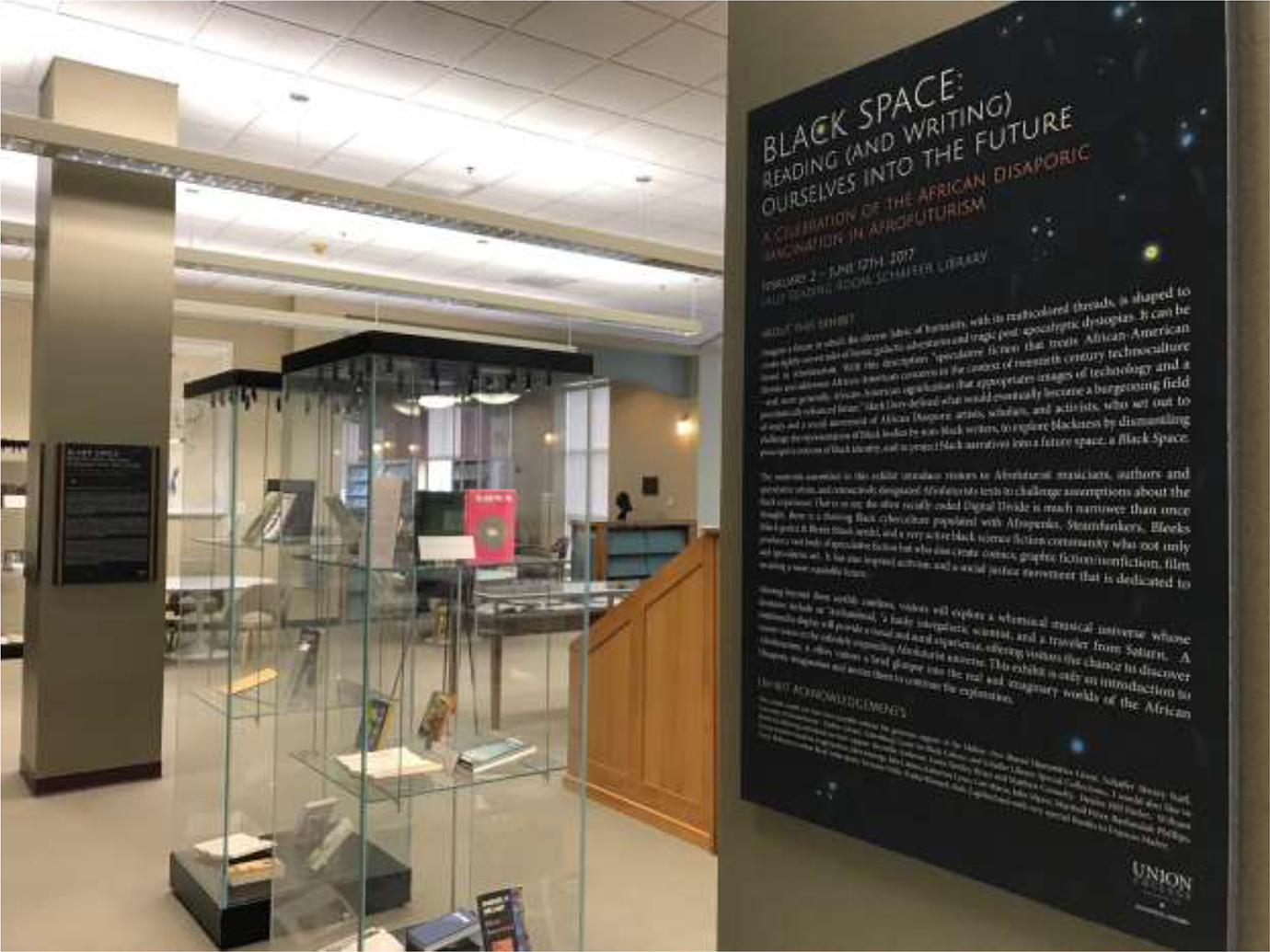
Black Space: Reading (and Writing) Ourselves into the Future. Exhibit. 8 June 2017, Schaffer Library Lally Reading Room, Union College, Schenectady, NY, USA. Image: Robyn Reed/Schaffer Library.
In addition to paper-based exhibition materials, clips from Sun Ra’s 1974 Afrofuturist film Space is the Place and the 1976 Parliament Funkadelic Live concert in Houston were played on a continuous loop in the exhibition space. Headphones were attached to the digital display monitor so that visitors could listen to audio. Several ancillary events were organized around the Afrofuturism exhibit to explore subthemes and gain deeper insight from the artists and scholars who write on the subject. Ytasha Womack, a key figure in the Afrofuturist movement, presented a talk on the origins of Afrofuturism at the opening reception. Two weeks later, a panel discussion was scheduled to showcase Black Speculative Arts Movement luminaries such as John Jennings (professor of Media Studies at University of California, Riverside and graphic artist), Reynaldo Anderson (professor of Humanities at Harris-Stowe State University and cofounder of the Black Speculative Arts Movement), and Rasheedah Phillips (attorney/Black speculative author and founder of the Community Futures Lab in Philadelphia). The students, faculty, and staff who attended this event were treated to a lively and stimulating discussion that ranged in topics from African Americans in the US space program to gentrification and new urbanism. It should also be noted that this event garnered a substantial local community presence.
Leading up to the opening of Black Space, we invited the campus community to participate in an Afrofuturist reading group. The reading group was designed to be an introduction to the current and retroactively identified Afrofuturist literature written by the authors featured in the exhibit, along with assays about the Black speculative genre. Participants were sent reading selections via email or obtained reading materials via a link to the library Libguide, mentioned previously. The reading group met four times over a period of 2 months to discuss the selections. These sessions were well attended by a diverse collection of faculty, students, staff, and alumni. Some faculty have gone on to include some of the reading materials in their courses. The exhibit events culminated in an Afrofuturist film series that was well attended by students, faculty, two visiting scholars, and members of the Schenectady community. The reading group and film series required another layer of planning, but it was worth the extra effort to offer such a comprehensive experience for an expansive and compelling theme like Afrofuturism.
Branding the Afrofuture
Parallel to the Black Space exhibition, the College Curator invited artist and academic Stacey Robinson to create a concurrent artwork, Branding the Afrofuture, as part of the library’s ongoing Art Installation Series. The Art Installation Series was developed by the College Curator to bring art into public spaces. It was designed on Jones’ principles of The Library as Incubator Project (2013). The annual series changes in focus and theme for each installation. Branding the Afrofuture featured political and celebratory digital print collages with graffiti wall drawings, highlighting contemporary Black visual art through an Afrofuturist lens, and brought Black and Brown bodies to the front of the library experience upon entering the building.
To accomplish this type of large-scale art installation project, one has to think like an artist. One has to view atypical or non-museum spaces as an opportunity to try ideas outside of a traditional gallery space and to embrace problems that the sheer scale of the Series would encounter. When selecting potential artists for the Series, the Curator was very judicious about whom to invite, as the artist would be creating in a public space on an academic campus. It was very important that the artist be comfortable with students, with being interrupted while working, and with being generous with their time. Of equal importance was that the artist should have completed a large-scale project, similar to our Series, before and that the project was accomplished in a short amount of time.
As a professor at University of Illinois at Champaign-Urbana, Robinson was well aware of the academic climate and was thus an ideal choice. Moreover, he viewed his artistic output very democratically and akin to the printed flyers from groups during the human and civil rights movements in the 1960s, such as the Black Panthers. He sees his prints as for everyone rather than exclusively for the art gallery industry (Figure 2).
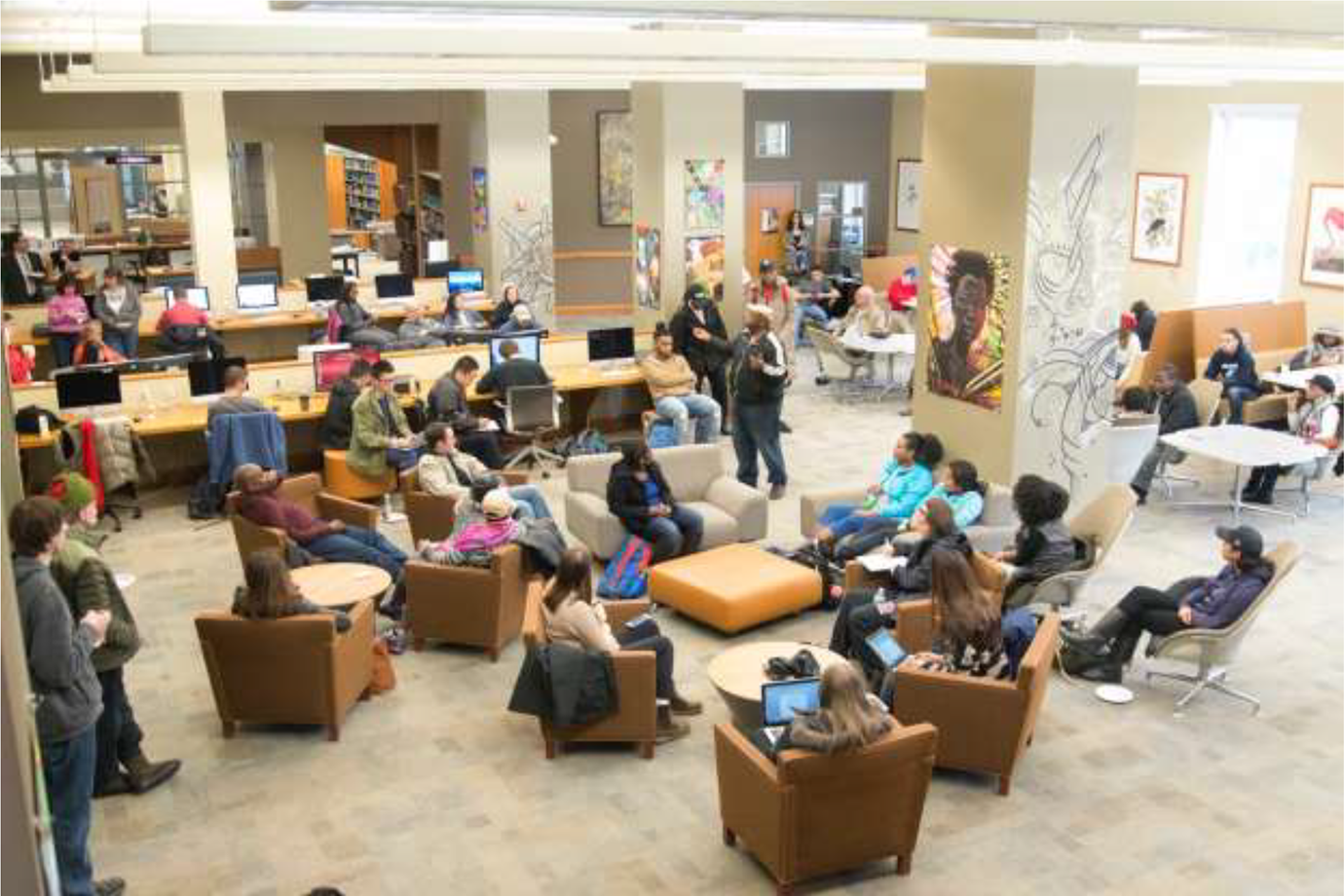
Branding the Afrofuture artist talk and reception with Stacey Robinson on 31 March 2017, Schaffer Library Learning Commons, Union College, Schenectady, NY, USA. Artwork: courtesy of Stacey Robinson. Image: Rebecca Fried/Shaffer Library.
Robinson thus did not shy away from political subject matter when creating his images. A number of digital prints he displayed embodied the Black Lives Matters movement, questioned mass incarceration of youth and the educational divide created by this practice, showed the trauma felt by colonialization and slavery, and examined the murder of unarmed Black boys and girls, men and women. To balance these fraught images, Robinson specifically used vivid, bold colors combined with the style of comic books and graphic novels to engage viewers with the more difficult content of his political message. At the same time, his collages juxtaposed an inspiring and positive place for African Americans in the future seen in prints such as ‘the rainbow one’.
Integration into the college curriculum
The overwhelming success of these exhibits was in part due to the partnerships that we developed with teaching faculty. Afrofuturist content was integrated into 11 courses that were taught over the period of three terms. Students in these classes read Afrofuturist content featured in the exhibit, were assigned response papers about exhibit themes and issues, and were encouraged to attend exhibit ancillary events. We were invited to deliver lectures about exhibit themes and asked to conduct exhibit tours for several classes. During the 2017–2018 school year, two students – both African American – were inspired to write their senior theses on Afrofuturism while the exhibits were still up. It is difficult to determine if there were students who specifically signed up for courses that included Afrofuturism content. Union’s trimester system made it difficult to align with course registration. Still, faculty in Africana Studies, the Modern Novel (English Department), and Film Studies actively promoted the Afrofuturist exhibits and associated courses. We do know that a dozen students, both White and BAME, indicated that they were excited to have taken classes with the Afrofuturist content.
Two years later, the exhibitions are still inspiring students. One White female student, who was in a class during the exhibition that had integrated Afrofuturist content, approached the librarian in the Fall of 2018 to ask if she would be one of her thesis advisers. This student completed her Honors Thesis – Interstellar Intersectionality: The Afrofuturist Critical Lens – in June 2019. She indicated that she was directly influenced by the Black Space exhibit in acknowledgments of her thesis, writing ‘A huge thanks to Robyn Reed who not only guided me through the far-off world of Afrofuturism, but also inspired my love for Afrofuturism through the Afrofuturist exhibition/panels she brought to the library my junior year’. In addition to examining Afrofuturism in her thesis, the same student submitted a creative fiction piece, inspired by Octavia Butler, as her senior project for her capstone class.
We sought these collaborations with faculty with the intention of reaching a variety of disciplines in an effort to engage as many students as possible. We hoped to reach students who might not otherwise be exposed to images and literature with an Afrofuturist lens in addition to creating the more inclusive space for Black students and other students of color. Classes varied widely, such as What is the Avant-Garde?, Sociology of Black Women’s Culture, Art & the State, and Technology and its Discontents, all embedded parts of the exhibitions in their curriculum. An example of the impact that the integration had on and the reaction from non-BAME students was demonstrated during a class visit. During the exhibit presentation in a class called Race, Politics, and Diaspora, students were asked to share their descriptions of the African continent – that is, its people, physical infrastructure, and other physical features. Most of the students in this predominantly White class described jungle or rural settings with savannas, wild animals, clay huts, and malnourished children. A discussion of these stereotyped descriptions ensued. It included a spirited exchange between a White male student from the United States and a Black female student from Ghana. The purpose of this exercise was to get students to think about how their images of Africa, replete with the notion that the continent is a single country, are misinformed and to dismantle their notions about the continent being ‘technologically backward’, ‘primitive’, and exclusively ‘poor’. The White male defended his image of Africa with the excuse that the US media was to blame for his misapprehension and misguided depiction. The Ghanaian student’s comments about her country and neighboring African nations were supported in the second part of the exercise where students were shown images of several African cities. When the city locations were revealed, most of the students were stunned to see cities like Accra, Nairobi, Cape Town, and Lagos complete with skyscrapers, ubiquitous technology, and even ‘Nollywood’, the Nigerian film industry. They discovered that the Black Panther’s ‘Wakanda’ does exist – to some degree –in the modern African metropolis. The presentation continued with a series of images depicting people of color in futuristic settings and a discussion of popular culture and Science Fiction (SF). After class, some students – all of whom were White – made it a point to say that they never thought about the absence of people of color in SF on television and in films until the discussion in class that day. It was gratifying to get feedback from the students in this class and to discover that we had raised their awareness. Afrofuturism remains fully embedded in several classes and we are confident it will continue in the future. The overall effect insisted that people of color have a place in the library, in predominately White classrooms, and at Union.
The campus and community response
The importance of Robinson’s work portraying representational and realistic figurative images cannot be emphasized enough. As the fifth show in the Art Installation Series, hosted in the library, Robinson’s exhibition was by far the most successful, in terms of student engagement and interest, as well as enjoyment by the public at large. This could be seen during his artist talk, attended by over 70 visitors, including a large contingent of students and community members. Visitors from the Schenectady community, not often seen on campus, felt welcome in the library Learning Commons. This was illustrated by the groups of prospective students and their families who brought out their phones upon arriving at the library to take pictures of the installation. Students overwhelmingly commented on the library suggestion boards in a positive way. Some comments include, ‘The artist’s talk was great! Love Schaffer’s efforts to highlight more diversity in the arts’. Another student told the Curator, while hanging Stacey’s work that, ‘this is my favorite artist of all the ones in the library, because of the political message’. This quote, in a response paper that was written by an Africana Studies student, ‘The depiction of black slaves as cyborgs and the idea that race is a technology never occurred to me. It’s a new critical way of looking at slavery that I never considered’, is the kind of reaction that we hoped to elicit from exhibit visitors.
Several classes toured the exhibits. The vast majority of these students were White. Feedback from these tours is entirely anecdotal but overwhelmingly positive. Students commented on the body of speculative work featured in the exhibits and were surprised to learn about Science Fiction written by (and about) people of color and that some of these works, such as the WEB Du Bois short story ‘The Comet’, have been around for quite some time. The popular culture elements of the exhibits were a natural draw for the students, particularly the Afrofuturist music. Students regularly asked for artists names from the Afrofuturist playlist. On more than one occasion, students asked for author and title recommendations. An exhibit bookmark was specifically designed to furnish exhibit visitors with a list of suggested readings and recommended authors not featured in the Black Space exhibit. Robinson sold 10 pieces from his show, to students and faculty. A quantitative breakdown of responses from White students and faculty does not exist; suffice it to say that the true purpose of these exhibits was to place Black and Brown people at the forefront of an important library exhibition. It was not our intention to make other students uncomfortable but it was important for library visitors to understand the importance of representation and to recognize that there are other narratives that should be acknowledged and presented. We wanted all students to be exposed to new ways of interpreting historical texts and images. And, to be empowered by the common tropes in Afrofuturist literature, not presented in mainstream texts, that they examined in the Black Space exhibit.
Robinson’s presence on campus was a dynamic one: in addition to his artist talk, he was a guest lecturer in four classes during the run of the exhibits and even spoke to a class via Skype after the exhibits had ended. He has since revisited campus on numerous occasions. New events were planned and added to the initial programming associated with the series a year after the original week Robinson was scheduled to spend on campus. A political discussion, entitled Black Space, Exploring the Politics of Afrofuturism, featured a number of on-campus panelists, including a student, as well as Robinson, who discussed how pivotal his artwork was to campus, the politics of representation, and the Afrofuturist movement. He has since discussed future projects with several faculty members in the visual arts department.
The overwhelmingly positive reaction to the exhibitions continues to have ripple effects. Regional scholars and curators were inspired by Robinson’s installation at Union and have since curated Afrofuturist exhibitions at their institutions. In Place of Now is at Sage College’s Opalka Gallery and includes Robinson as one of the exhibiting artists. Relationships with the wider Schenectady community were cultivated and strengthened as a result of these exhibitions, including one with a local art organization, Hamilton Hill Arts Center, which focuses on artists of African diaspora. Not only did members of the board and staff attend the panel discussions for Black Space but Robinson gave a presentation and demo for their after-school program. During their Sankofa: The Legacy 50th Anniversary celebration, the Librarian was asked to organize and introduce the films for the Afrofuturism film festival event.
Challenges
The library is not a museum or gallery; therefore different criteria must be considered when selecting art to display. One typically visits a gallery but the library space is designed for users to conduct research or study. Keenly aware that our potential library audience might not be well versed in the visual arts, we were prepared to omit artwork from the display that might not be suitable for a public space, particularly since library visitors are not making a choice to view the work as they might by walking into a museum. For example, one of Robinson’s installation pieces depicted a noose and other potential racially sensitive imagery. Concerned that this piece could be too racially provocative, the Curator reached out to the Librarian and the Dean of Diversity and Inclusion to discuss her concerns and get feedback. After careful deliberation, the Curator had a candid discussion with the artist, weighing the pros and cons of the inclusion of this piece. Ultimately it was mutually decided to omit the work from the exhibition. If the piece had been included in the exhibit, it would have required a carefully worded and explicitly written explanation about the artist’s intended meaning. This written explanation would have to be located immediately adjacent to the controversial work. Contact information would also been made available so that visitors could direct their questions and concerns to the Curator.
Practical advice
Library exhibits such as Black Space and Branding the Afrofuture give students of color a sense of belonging, in and outside of the classroom, and gives the library the opportunity to highlight issues that speak to them, and connect to the local community, particularly communities of color. Exhibiting Robinson’s work also offered the Curator a chance to amplify her vision for the exhibitions and permanent art collections at Union College. It afforded us the opportunity to display artists of color alongside the portraits of the wealthy White males, who are displayed across campus, reminding us of the College’s exclusionary legacy while making spaces more inclusive. The exhibitions allowed us to assert a more balanced visual representation of our community.
Much of the funding for these exhibitions came from a Mellon grant that Union was awarded for Our Shared Humanities. The grant funded travel and stipends for our speakers and artists as well as the purchase of first edition copies of WEB Du Bois’ Dark Water: Voices from within the Veil, Octavia Butler’s Wild Seed, and Samuel Delany’s Dhalgren for the exhibit. Further funding for additional exhibit materials, receptions, promotional materials, and exhibit expository panels came from the library. Generous funding such as the kind we received for these exhibitions will not always be available for future projects. Books and music in the library’s circulating collections and Special Collections could have easily been used for a less extensive exhibit.
As a result of the great success enjoyed by our concurrently programmed exhibitions in the library, our biggest takeaway was to use the Afrofuturist exhibitions as a model for future collaborations. During spring term 2019 and winter term 2020 we expect to use a similar template to focus on Latinx/Latinidad cultures, with student-produced ‘Zines’ featured in the library exhibit space and the sixth Art Installation Series featuring the first-generation Peruvian-American artist, Juan Hinojosa. We expect teaching faculty will use this concentrated effort to delve deeply into the cultural production of artists of Latin descent, residing in both Latin America and the United States, in much the same way as that of the Afrofuture exhibitions.
The exhibit and art installation served as a catalyst for dialogue on themes of social justice, fostered agency for students of color, and celebrated Black lives. We invited student groups and faculty to collaborate on events linked to the exhibit and installation, such as panel discussions, a reading group, and a film series. We created opportunities for all students to engage with library materials and artwork to tell their stories through research and other creative works. Of equal importance is our belief that the arts are a positive, enjoyable, and constructive way to introduce subjects to campus members who might not choose to engage with them. It gives a voice to diverse populations on a PWI campus. As we have seen, presenting art and other collections in the library has not only had very positive effects on the students, faculty, and staff who visited these exhibitions as well as those who benefited from the inclusion of Afrofuturist content in classroom activities and community activities. The impact that these exhibitions had on the community of color was affirming and meaningful. As mentioned earlier, students made it very clear that they were thrilled to see representations of Black and Brown bodies prominently displayed in the library. Further, students have asked if and when the library plans to curate more exhibits that highlight people of color.
Footnotes
Declaration of conflicting interests
The author(s) declared no potential conflicts of interest with respect to the research, authorship, and/or publication of this article.
Funding
The author(s) received no financial support for the research, authorship, and/or publication of this article.