







Abstract
In the context of rapid environmental change, research on adaptation politics highlights the role of power in socio-ecological change, offering insights on how authority, knowledge and subjectivity shape adaptation pathways. Less attention has been given to how authority emerges, subjectivities become politicized and transformative adaptation scales up. This paper addresses these limitations, drawing on a Deleuzian reading of subjectivity, prioritizing analytically immanent capacities and contradictory events. This framework is applied to the case of Pikine, an informal Dakar settlement, where intensifying floods in the 1990s were managed through drainage canal construction, authorized by the president. The paper links this decision to historical legacies and unexpected events, including floods, structural adjustments, the emergence of a coalition of youth organizations, and changing government authority. It invites policymakers to foster the self-organization capacity of emerging coalitions of vulnerable groups and to leverage the openings offered by moments of crisis.
I. Introduction
Climate change is exacerbating risks in cities across the world through extreme events, including floods.(1) With the world’s fastest urbanization rates, sub-Saharan cities are projected to drive the global stock of risk in the coming decades.(2) Residents living in informal settlements bear the biggest burden and are often excluded from decision-making processes.(3) Understanding how to foster the capability of marginalized groups to influence adaptation and development pathways will be essential to prevent the production of this risk.
Against a backdrop of climate adaptation research that privileges technocratic approaches to climate adaptation,(4) other voices have highlighted the politics of adaptation.(5) This body of work calls for a nuanced understanding of how power shapes socio-ecological transformations.(6) It illuminates differences in adaptation outcomes(7) and the contested nature of adaptation options.(8)
The literature on adaptation politics has examined power through the lens of subjectivity, questioning how authority and knowledge shape adaptation pathways.(9) This includes the authority of government institutions and experts involved in knowledge production.(10) Authority is posited as relational, involving a claim to power by those seeking to influence adaptation governance, and a recognition of their legitimacy by those being governed.(11) It draws on what Murray Li refers to as the “will to improve” of those being governed(12) and deploys an array of institutions and knowledge, internalized as truths, to orient individuals towards adaptation options.(13)
Authority requires continual renewal.(14) Its deployment does not foreclose the possibility of dissent(15) and the way this dissent is managed (re)produces the meaning of authority.(16) Material and discursive struggles, folding onto each other,(17) offer multiple sites for the (re)production of authority. While various forms of knowledge, referred to by some scholars as ‘knowledges’, are deployed tactically as a way to assert authority, their value is contingent on the situated and embodied experience of individuals and groups.(18) Coalitions of civil society organizations can play an essential role in contesting authority and (re)framing its responsibility in relation to the management of climate risk and urban development.(19)
Deploying a Deleuzian reading of subjectivity(20) (see Section IV), this paper extends the literature on adaptation politics in three ways. First, the notion of the Deleuzian subject(21) helps overcome the deterministic biases of Foucauldian strands of the adaptation literature,(22) which have explained the production of subjects as an outcome of government interventions. Second, it extends adaptation literature on the everyday and embodied praxis(23) by showing how life’s transformative potential can scale up and consolidate beyond the contingency of the moment. Third, this approach extends the way intersectionality has explained the negotiation of adaptation options,(24) by showing how intersectional identity axes emerge.
This paper argues that advancing the field of adaptation politics demands that socio-ecological change be apprehended as historically and geographically determined, while remaining open to the potential of emergent futures.(25) To this end, the paper offers an analytical framework (Figure 2) that recognizes authority and knowledge(s) as historical effects of the emergent capacity of socio-ecological matter(26) to self-organize. Knowledge and authority, in turn, orient these capacities to address specific problems. Observing them as effects of immanent capacities and territorialized relations justifies their multiple and contradictory nature. In this way, the framework explains the transformative potential of socio-ecological crises, which are understood as events that challenge established truths, knowledges and authorities, opening the space for future possibilities.
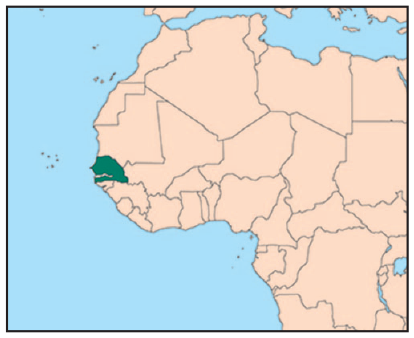
To make this argument, the paper analyses the case of Pikine, an informal settlement in Dakar, Senegal. Since 2005, Pikine has faced severe flooding. In 2012, national elections resulted in a new president who built a network of flood drainage canals. Rather than explaining this infrastructure as the result of the president’s authority, this paper examines the historical processes through which the political space to make this decision emerged. The Synergie des Acteurs pour l’Assinissement de la Banlieue,(27) or SAABA, a coalition of youth associations in Pikine, played a significant role in reshaping this political space.
Data collection for this case study was undertaken in June–August 2017 and October–December 2017. It involved 133 in-depth interviews with representatives of youth and women groups and government officials involved in Dakar’s flood politics. Five life-history interviews with members of SAABA and 10 focus group discussions, each involving two to five participants, were conducted. Research participants were selected purposively based on their involvement in Dakar’s adaptation politics through direct or indirect negotiations and contestations of government-sponsored infrastructure development projects. These methods contributed to an in-depth understanding of historical and situated perspectives, and insights on groups’ interactions. Interviews typically lasted two hours, ranging between one and four hours. They were conducted in French and Wolof, which was translated. Thematic coding was deployed for the analysis, using NVivo.
The paper proceeds as follows. Section II presents Pikine’s historical context. Section III examines how research on adaptation politics has conceptualized subjectivity and identifies ways this could be extended. Section IV develops an analytical framework to explain transformative adaptation, drawing on Deleuze’s work. Sections V–VII illustrate this framework through the Pikine case study. Section IX concludes.
II. Pikine, a Historical Context
Pikine is an informal settlement in Dakar with a dense population of 758,554 people distributed over an area of 41.76 km2,(28) poor-quality housing, informal land tenure and inadequate access to basic infrastructure.(29) Since 2005, Pikine has faced severe floods during the rainy season.(30) In 2009, 44 per cent of its population was affected by a flood event, some 1,500 houses were permanently abandoned, and economic losses were estimated at US $42 million.(31)
In 2012, presidential elections resulted in a new president, who prioritized the construction of a network of flood drainage canals (Figure 1). The president announced a 10-year flood management plan with a budget of CFA 720 billion (GBP 0.93 billion). Of this, CFA 66 billion (GBP 84.78 million), allocated for the initial phase, funded the flood drainage canals. The government initially contributed CFA 17 billion (GBP 21.83 million)(32) to this project.
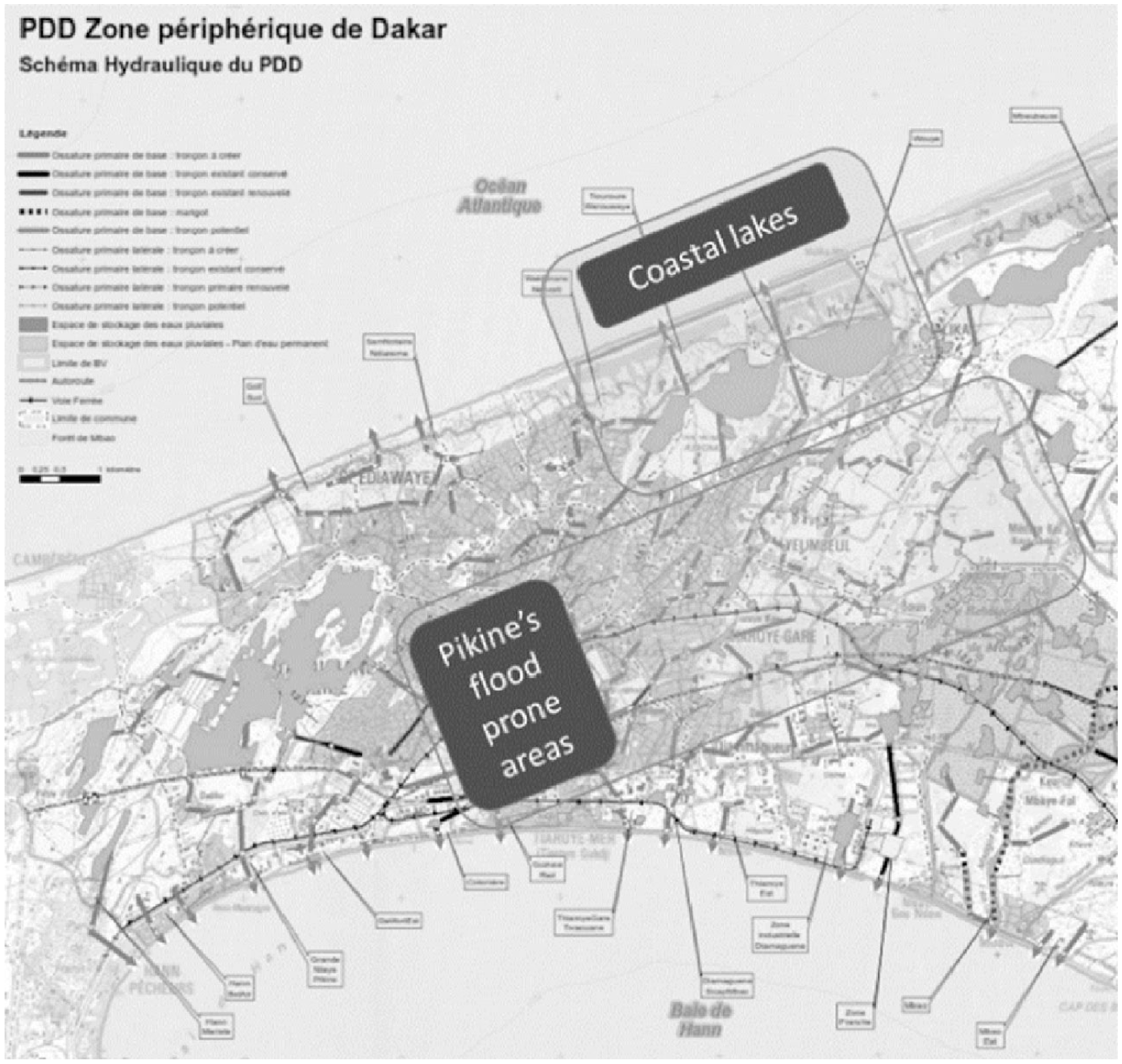
Pikine’s flood drainage master plan – 2009
SAABA, the coalition of youth associations, which had an interest in flood management, played a significant role in this decision. SAABA emerged from a base of more than 2,000 associations established in Pikine over previous decades.(33) Structural adjustment plans in the 1980s had led to the loss of public sector jobs and the provision of basic services in Pikine. This encouraged the young women and men to protest against the government, marking a shift in their relationship with the postcolonial state and its developmentalist ideology. The youth self-organized and mobilized through movements like Set-Setal (‘Be Clean – Make It Clean’) or Bul Faale (‘Don’t Care Too Much’), which promoted an autonomous youth identity and took care of local issues such as waste management.
The increasing flood severity through the 1990s amplified the political influence of the youth associations, which played an enabling role in implementing flood resilience programmes, encouraging ‘voluntary’ relocations of flood-affected residents. These resilience programmes fostered the legitimacy of local politicians and, in return, youth groups benefited from funds and permits to use public space, which strengthened their political influence over neighbours and families. This influence was particularly noticeable during the 2009 municipal and 2012 presidential elections. In 2007, the dissolution of Sopi, a large alliance of political parties governing Senegal, had led to the formation of the BSS (Bennoo Siggil Senegaal – United to Boost Senegal) coalition. Pikine youth partnered with the BSS during the 2009 and 2012 political campaigns and negotiated a greater investment in flood management. The BSS won the elections in the majority of Pikine municipalities and later in the national government.
Prior to the 2012 presidential elections, Pikine’s youth associations remained fragmented across municipalities. However, continuous conflicts between them related to flood management led to the formation of SAABA in the lead-up to the elections. SAABA advocacy shifted the government approach to flood management from emergency operations to the construction of flood drainage canals. For this, SAABA drew on technical and local knowledge to challenge the legitimacy of the government and the World Bank in relation to flood management. This forced a collaboration between them that secured funding for the infrastructure works.
III. Adaptation Politics and the Political Subject
Adaptation politics research has explained the shaping of adaptation pathways by focusing on the relationship between subjectivity and power.(34) This section identifies two strands in this literature and examines their merits.
First, the literature on adaptation(35) and disaster management,(36) influenced by governmentality studies,(37) has read subjectivity as an intended product of government programmes.(38) For instance, interventions promoting adaptation planning tactically deploy technologies of power and knowledge to orient at-risk subjects towards preferred adaptation options.(39) Community-based disaster management planning and risk assessments have produced responsible and risk-aware individuals, capable and willing to manage their own risk.
This approach has shown that subjectivities are produced over time, overcoming an imagined stability in this regard,(40) which has sometimes been assumed in vulnerability research.(41) However, two limitations remain. This analytical approach cannot explain how multiple regimes interact, as it focuses on one intervention pertaining to a specific knowledge-authority regime, whether neoliberal, environmental or authoritarian, to name a few.(42) Moreover, the approach cannot explain the emergence of adaptation pathways beyond historical determinations,(43) as it lacks attention to the subject’s self-affirming agency. Government interventions operate through the adaptive capacity of individuals, attempting to appropriate their agency.(44) While this perspective acknowledges the possibility of resistance,(45) it reads the intervention as the origin of socio-ecological change.
The second strand, feminist political ecology, has sought to overcome these limitations by focusing on embodied and everyday praxis as the site for the production of subjects.(46) The concept of (re)productive labour, including everyday chores of water collection,(47) tending plants, trees and animals(48) or cooking and eating,(49) has explained the gendering of bodies. Everyday negotiations of environmental management have been shown to be a site for the emergence of new political subjectivities.(50) The praxis of forest governance, for instance, has transformed the boundaries between subject positions such as the state, the environment and the citizenship.(51) A recognition of the contingency and territorialized multiplicity of the everyday makes it possible to rethink subjects as emergent,(52) decentring singular causes, such as a specific government intervention. This approach, however, provides no answers regarding how emergent change scales up, becoming hegemonic. This question demands an examination of how the fleeting existence of the everyday(53) translates into the tendency of subjects to re-emerge in particular ways, repeating hegemonic patterns.
The idea of internalization is helpful in establishing a relationship between the historical dependency of knowledge-authority regimes and the emergent potential of everyday praxis. The field of adaptation is composed of multiple, often competing, regimes of knowledge, authority and recognition.(54) These may be multiple axes of identity,(55) limiting adaptation options and shaping intersectional vulnerabilities; or competing epistemic communities, struggling to shape international adaptation politics.(56) Individuals and groups internalize these regimes, as power and violence are exercised over their bodies,(57) burying them as truths in the unconscious.(58) Once internalized in the subject’s psyche, these regimes can be elicited in everyday encounters, orienting them in patterned ways.(59)
Internalization is however what Butler calls an “ambivalent” process,(60) subjecting individuals, but also offering avenues for subversion. The lens of intersectional identity has proven helpful in explaining how a position within one identity axis can open negotiations in another, leading to unexpected adaptation outcomes.(61) This was the case, for instance, with cross-caste marriage among Maoist rebels in Nepal, who could negotiate caste expectations due to their ‘lateral’ identification as Maoists. While the approach reveals surprising negotiations across intersectional identity axes, it offers limited insight into how new axes can be produced. Such insight would explain not only how an existing field of subjectivities establishes the conditions for ambivalent adaptation struggles, but also how the field is transformed.
The paper turns now to a Deleuzian perspective on subjectivity to overcome these limitations. While scholars have on the whole been reticent to explore the analytical potential of Deleuzian-informed frameworks,(62) some have encouraged this perspective for its emancipatory potential.(63)
IV. The Deleuzian Subject
Drawing on a Deleuzian reading of subjectivity,(64) this section develops a framework (Figure 2) that explains adaptation pathways as a historical process where socio-ecological organizations and subjectivities emerge, giving way to unexpected forms. One such expression is the way floods and structural adjustment in Dakar contributed to the politicization of the youth and to new investments in flood mitigation infrastructure, which would have been questioned under neoliberal principles.
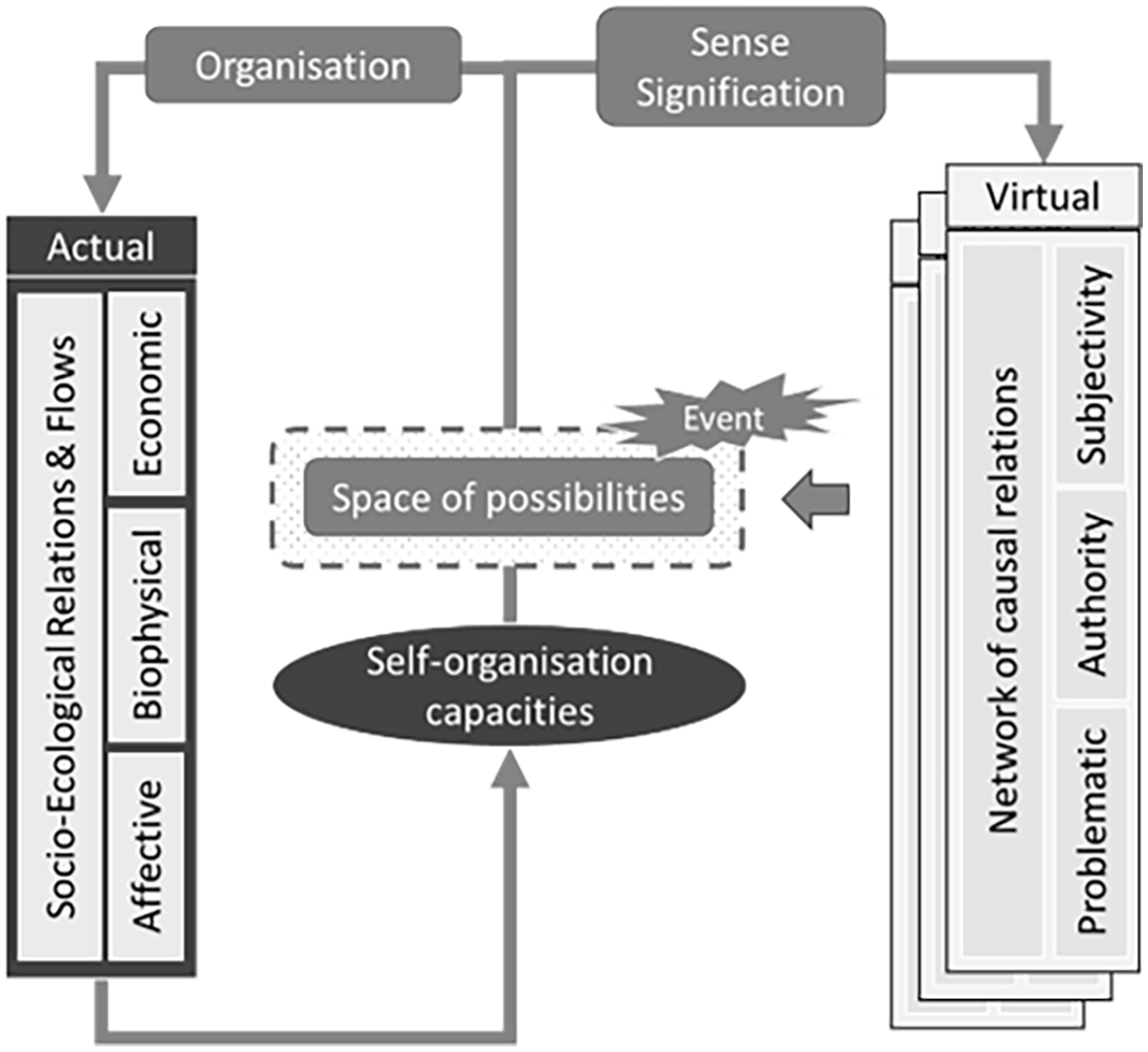
Analytical framework to explain transformative adaptation
This Deleuzian approach shows how transformative change emerges and scales up, while also recognizing its historical dependency. It illuminates how multiple structures – such as intersectional axes of identity and knowledge-authority regimes – interact, producing unexpected trajectories of change. It explains the emergence of identity axes without losing sight of how subjectivity tends to orient individuals in historically consistent ways. The rest of this section first examines how intensive forces and self-organizing capacities produce socio-ecological organizations. It then shows how subjectivities and knowledge result from intensive forces and their role in constraining the space of future possibilities without foreclosing it.
a. The actual plane: Socio-ecological relations and self-organization capacities
Deleuze and Guattari(65) posited an ontological field of intensive forces as the organizing principle of socio-ecological relations, such as the involvement of youth organizations in flood management. Intensive forces are the immanent capacity of socio-ecological matter to self-organize and differentiate, to orient and connect people and things in patterned ways.(66) Intensive forces can express the potentialities of socio-ecological matter, transgressing historical dependencies and opening social-ecological organization to new becomings.(67) Elizabeth Grosz(68) added to this definition, indicating that intensive forces are “internally determined”, which means that they emanate from socio-ecological matter, producing new forms of organization that are yet to be recognized. In Dakar, the youth self-organized, disentangling themselves from patriarchal and postcolonial networks. These networks still saw the youth as constitutive subordinates from which they drew political power, and yet the youth affirmed themselves to produce a new political subject. The framing of intensive forces extends the understanding of power within scholarship on governmentality (Section III), showing its immanence and potential to disrupt historical determinations, a phenomenon that has been recognized in the transformation literature.(69)
The field of geography has drawn from this theoretical framework in two ways. First, through the concept of assemblages,(70) scholars have highlighted the heterogeneity of the socio-ecological relations composing objects such as cities, disasters and markets.(71) However, Buchanan(72) has argued that a focus on the sub-components of system-like objects misses the analytical power of Deleuze’s work – that of the emergent self-organizing capacity of assemblages, giving impetus to new becomings.
Second, through the concept of affect,(73) geography has highlighted the relational and non-representational nature of socio-ecological change. Affect is defined here as a force that organizes bodies and things, while escaping representation and, therefore, recognition. Emerging from relations between people, places and animals, instances of affect such as joy(74) and enchantment(75) have changed the power of the assemblages from which they emerge to transform the scope of future possibilities.(76) Despite heated debates around the concept of affect,(77) Nightingale, Gonda and Eriksen(78) have argued that adaptation politics research could benefit from the concept by focusing on what affect can do, an analytical orientation which this paper endorses.
The concept of diagram is promising to harness these invitations, elaborate the framing of emergence, and explain how multiple structures interact, reproducing and disrupting adaptation pathways. Diagram refers to the patterned ways in which intensive forces tend to couple together,(79) structuring sequences of becoming and organization, without foreclosure. Diagrams therefore are not representations of the world, but rather internalized forces that generate socio-ecological change. In the case of Dakar, a diagram referred to as the ‘slavery-bond’ has organized relations between the youth, elders and religious leaders and disciples in relation to the state since colonial times (Section VI). The slavery-bond, expressed through a tendency to follow political advice coupled with a tendency to provide economic support, reproduced a patriarchal system that rendered the youth increasingly vulnerable to floods (Section V).(80)
Furthermore, the coupling of diagrams produces a surplus of self-organizing capacity(81) that is irreducible to that of their constitutive forces.(82) In other words, the coming together of intensive forces harbours a latent potential for unforeseeable becomings,(83) which underpins the concept of emergence. In the case of Dakar, floods and flood resilience programmes re-articulated the slavery-bond diagram discussed above in a way that contributed to producing the youth as a political subject with the ability to influence government decisions. With this in mind, socio-ecological change can be seen as an open-ended process emerging from the (re-)articulation of a multiplicity of diagrams.
Disaster research has deployed the framing of prevention and mitigation diagrams to explain strategic arrangements of forces that produced what Grove referred to as “logistical life” and “cultures of safety” to manage disasters in Jamaica.(84) This research is helpful to explain how intensive forces can be re-articulated and serve multiple strategic goals, showing that these strategic goals stabilize over time. It has less to say, however, about the conditions for the (re-)articulation of diagrams and how the surplus capacity emerging from these (re-)articulations can contribute to adaptation futures harbouring an emancipatory potential.
b. The virtual plane: Knowledge and subjectivity as effects
An analytical focus on intensive forces raises the question of the conditions for the possibility of their couplings and re-articulations. This paper draws on various accounts of the concept of the virtual plane of an assemblage to answer this question,(85) bringing into sharp focus the utility of knowledge and subjectivity in this regard.
Deleuze and Guattari(86) posited subjectivity and knowledge as effects of diagrams. As intensive forces couple together, they express a surplus of self-organizing capacity. These surpluses produce emergent forms of socio-ecological organization and new becomings. For instance, in a patriarchal diagram, such as the one in Dakar, as males become older, they become more authoritative. As older males become more authoritative, women and youth become increasingly marginalized and vulnerable to floods. This echoes one of the multiple ways in which age, gender and marginalization interact.(87)
Processes of becoming are sensed without a clear articulation of causality. For Deleuze,(88) socio-ecological organization is the result of a multiplicity of forces or diagrams. Hence causality cannot be traced back to any single organizing force. This echoes the non-representational nature of intensive forces. In Dakar, socioeconomic vulnerability was expressed as floods intensified. This raises the question of whether the problem for the youth was flood emergency management, the patriarchal system that produced flood vulnerability in the first place, or both.
However, as processes of becoming are repeatedly articulated, they become signified as a network of causal relations between subjects.(89) For the purpose of this paper, signification is understood as the process of knowledge production. In Dakar, ageing tends to be associated with growing authority, and the bodies of older males and the youth tend to self-identify and be recognized as subjects under a relationship of subordination, authority and care. In other words, becomings (e.g. ageing, empowering) are differentially sensed and ultimately signified as beings (e.g. elderly, youth). Beings are positioned in a relational matrix that establishes what to expect from each member of a pair (e.g. care, subordination), establishing the conditions for their recognition. This network is referred to by DeLanda as a virtual plane of an assemblage(90) and it represents the differential field of forces articulating interlinked processes of becoming as well as a relational field of subjectivities, or relations of authority and legitimacy in the context of adaptation.
Repetition is thus the condition for the production of knowledge and subjects.(91) This points us to enquire about the conditions of possibility for the diagrams that mobilize these recurrent processes of becoming. The network of causal relations constituting the virtual plane exerts what Buchanan calls a “power of selectivity” whereby the couplings of certain intensive forces are resisted(92) while others are insisted upon. For instance, collective youth frustration and anger against elders in power positions may be repressed and resisted in Dakar’s patriarchal system. On the other hand, kinship networks are regularly activated to influence elections and municipal governance. This explains the obduracy of certain socio-ecological organizations that tend to re-emerge over time.
The power of selectivity of the virtual thus delimits the possibility space of couplings. It orients self-organizing capacities towards specific problems, and therefore insists on a re-inscription of the virtual that coheres with history. It does not, however, determine the solution to these problems or emerging socio-ecological relations.(93) For instance, in the context of Dakar, the slavery-bond first articulated relations between the state, the elderly and the youth that produced a growing vulnerability to floods and saw flood emergency operations as a solution. Nevertheless, later, the slavery-bond re-articulated citizen–state relations, favouring the influence of the youth over the government and the construction of Pikine’s flood drainage canals. The virtual constitutes the structure of future possibilities(94) but offers an open-ended future.
The re-articulation of a virtual plane can thus lead to the emergence of transformative adaptation pathways – inexplicable from the viewpoint of its historical problematic. Deleuze(95) posited the concept of ‘event’ as becomings that are not ‘compossible’ with sequences of becomings sensed and signified before.(96) Such contradictions destabilize the internal coherence of the virtual’s causal network, signified subjects and problematic. Compossibility therefore defines the coherence between the meanings and significations produced by the various processes of becoming experienced in a socio-ecological field. For instance, with decreasing return periods and flood intensification in Dakar, Pikine’s youth rejected the government’s emergency operations as a legitimate flood response, arguing that flood events were no longer unforeseeable disasters. In a context of municipal and national elections, the mobilization of youth that ensued threatened the re-election of the government. Events thus open up the possibility of new couplings, which in turn can produce unexpected knowledge and subjects.
V. The Emergence of the Youth as a New Subjectivity
Structural adjustment plans (SAPs) in the 1980s made possible the weakening of patriarchal(97) bonds between youth, elders and the postcolonial state. Subsequently, poverty reduction programmes in the 1990s fostered the emergence of the youth as a new subjectivity. This section illustrates how these events opened up the possibility for the emergence of the youth’s self-organizing capacity, socio-ecological relations and identity narratives.
In Dakar, SAPs ended the state’s preferential civil servant appointments for educated youth, a practice used since independence to consolidate government legitimacy.(98) The SAPs constrained the state’s economic capacity, prompting a 1975–1984 civil service reduction(99) with a cut of about 4,000 positions in the 30,000-job para-public sector and a hiring freeze that reduced public employment by 2,000 in a 70,000-job pool.(100) In response, university students mobilized against the government in 1988. This has been interpreted as the youth’s rejection of the postcolonial project.(101) This event illustrates how the contradictions produced by the SAPs reduced the “power of selectivity”(102) of the virtual plane that articulates state-educated youth relations. The coordinator of SAABA’s Guinaw Rail Sud (GRS) youth association in Pikine explained that the government had closed the University of Dakar to repress student riots. This resulted in the discontinuation of student grants and encouraged students to self-organize to meet their financial needs. Some of these students resolved to establish informal schools for rural migrants in Pikine.
The SAPs had similar consequences for marginalized youth, opening space for self-organization, signification of their identity and the re-articulation of their relations with elders and Pikine’s built environment. Two youth movements illustrate this point. A member of SAABA’s Djidah Thiaroye Kao (DTK) youth association in Pikine explained that the youth living in the informal settlement had established the movement Set-Setal (‘Be Clean – Make It Clean’) in the 1990s. The movement self-organized to clean up the large amounts of waste that inundated Pikine at the time as a result of the municipal collapse that followed the SAPs.(103) Set-Setal also decorated Pikine’s public walls with local heroes, distancing themselves from the national identity and identifying with the local.(104) Also during the 1990s, the hip-hop movement, Bul Faale, loosened relations of authority between youth and elders, valuing youth expressiveness and individual agency over societal and family demands.(105) Bul Faale rejected traditional values such as patience and self-control in order to overcome the youth’s stereotypical submissiveness. These re-articulations of the virtual were filled by the emergence of new forms of organization such as sport and cultural associations, religious youth groups (dahiras) and women’s groups (mbotays). The youth increasingly showed their capacity to self-organize.
The deployment of the poverty reduction agenda facilitated the coupling of marginalized and educated youth. International development agencies started funding poverty reduction programmes in the 1990s. The coordinator of SAABA’s GRS association explained that his organization became the intermediary of development agencies (for instance Oxfam). The educated youth wrote project proposals and the marginalized youth facilitated the programmes’ ‘social mobilization’ through ‘sport and cultural associations’, mbotays and dahiras. Over a decade, repeating this pattern, poverty reduction programmes re-inscribed the virtual’s identity boundaries separating educated and marginalized youth.(106)
Indicative of the coming together of marginalized and educated youth was their emerging capacity to shape flows of aid. Traditionally, economic resources entering Pikine were shaped by patriarchal networks established along family and ethnic lines, and also shaped by local politicians. Elders, such as neighbourhood chiefs, tended to hold authority positions within these networks and to handle these resources. However, from the coupling of marginalized and educated youth emerged an intensive and affective force that transformed these flows. The head of one youth association in the Yembeul Nord neighbourhood described the event where his group challenged the local chief’s authority as a moment of heated intensity. During Ramadan, the chief had appropriated a religious ‘almsgiving’ given to the local community by the First Lady to acknowledge their suffering due to the floods. This event freed up an anger in the youth that helped to overcome any feelings of fear and shame, mobilizing the group to appear at the chief’s house to tell him that they would establish a local committee to handle external resources.
The youth’s emergent self-organization capacity allowed them to affect the legitimacy of authority figures and in turn mediate incoming resources. With this capacity, youth were emerging as a political subject, which the paper now turns to analyse.
VI. The Floods: A Milieu for the Mlignment of Youth and Political Groups
Growing flood severity and an increase in relief programmes intensified the youth’s capacity to affect Pikine’s adaptation politics. Flood programmes offered local governments the possibility to strengthen their legitimacy. However, the implementation of these programmes demanded forced evictions, which were not tolerated by international donors. The capacity of the youth to encourage ‘voluntary’ evictions, which were outside the purview of donors, became politically attractive. In response, the local government used its institutional authority to nurture and sustain youth associations. This section illustrates the coupling of intensive forces, such as the self-organizing capacities of youth and local politicians, from which a surplus capacity to persevere emerged.(107) These capacities showed an intensive nature, evoking the affect of fear and a sense of belonging that produced re-organization tendencies among Pikine’s population, rather than determining them.
The DFID-funded programme BRACED(108) involved the construction of a reservoir in 2016 in Diamalay, Pikine, where floodwater could be stored. The project, which was coordinated by Diamalay’s youth association, required the eviction of 27 families. The mayor explained that the association was helpful in “making those that had to leave understand that it was for the public interest”.(109) The project ultimately did not build the reservoir, and the municipal government strengthened its legitimacy by instead building a public school in the vacated area. The mayor rewarded the youth group with the construction of a football pitch in the same place. As the association had its origin in a sport and cultural association, this helped nurture in-group relations.
A member of the Diamalay youth association explained that their influence over evicted families resulted from two to three days of physical, repetitive and collaborative work, trying to evacuate the water that flooded their houses. This process gave families a growing sense of alignment with the youth, which was predicated on their shared and long-standing feelings regarding the “daily pain” and “ordeal” of living with the floods. This sense of unity helped SAABA’s members to “diffuse their willingness to resist, leaving their houses”. The capacity of the youth to wield an influence can be read as a result of its multiplicity.(110) On the one hand, as members of the flood-affected community, they shared a ‘compossible’ process of becoming, including kinship markers that allowed the flow of influence. On the other hand, the youth’s emergence as an independent political subject allowed them to deploy their organizing forces for interests contrary to those of the evicted families.
The eviction of eight of the families, however, showed a different alignment of forces. One of the women from this group of families explained ‘voluntary’ relocation in this way: “you are given a knife. You sharpen the blade. You are supposed to cut your own veins. It is going to hurt but you must cut them.” Their houses were marked with red dots without explanation. A sense of fear crept in during the months prior to the eviction. The women were advised to leave by the youth because their houses would be demolished anyway, and they would miss out on the government’s compensation.(111) The military appeared one night, and in the panic of the moment, asked the families to leave. Most left that night. Here, eviction forces also showed a multiple and affective nature, as in the case of voluntary evictions encouraged by youth groups through flood management operations. However, rather than being sensed as a unity to which evicted families belonged, they felt them as a unity from which escape was the only option.
a. The liberal democratic values and the ‘slavery-bond’: Virtual conditions for the coupling of diagrams
Two causal relations that constituted Pikine’s virtual plane contributed to delimit the space of possible alignments that re-articulated the socio-ecological relations discussed above. First, Senegal’s colonial forces inscribed citizen–state relations with liberal democratic values.(112) Youth movements in Senegal have repeatedly re-inscribed this meaning.(113) For instance, Y’en ai marre (‘Fed Up’), a contemporary youth coalition with origins in Bul Faale (Section V), developed a political agenda around good governance and responsible citizenship.(114) Second, the norm referred to as the slavery-bond predisposed the youth to accept the political advice of elders, in return for economic care and support. This norm can be traced back to the context of colonial contestation where Sufi leaders exerted political influence over disciples(115) (i.e. Ndiguel) with whom they held an economic relation through groundnut cultivation.(116)
Both of these causal relations were often interlinked in shaping how electoral politics operate. A representative of FSH, the largest women’s saving network in Senegal, explained that political choices in Senegal tended to align with the identity of party members (i.e. family ties, ethnicity and place of birth). Since local associations were also organized along these lines, they offered the possibility of block recruitment.(117) Here, elders occupied a privileged position in shaping elections, as they negotiated resources from political leaders in return for the political support they drew from these associations.
While the alignment of youth associations and local politicians reflects the coupling of these diagrams, the position occupied by the youth is not consistent with the slavery-bond. Along with the elders’ diminishing capacity to mediate economic flows (Section V), their political influence was also eroded. However, the slavery-bond, rather than being de-signified, coupled local politicians and the youth, who, directing flows of violence(118) and aid along identity lines, gained the ability to inscribe Pikine’s political identity. Insa (a pseudonym), a resident of Diamalay, explained that the way in which BRACED redeveloped Diamalay and selected families for eviction was guided by where the relatives of the youth association and the neighbourhood chief lived. As a result, Babacar (also a pseudonym), another resident of Diamalay, explained that the project had “divided the neighbourhood” physically and politically. The “people living in this side” “signed up to a different neighbourhood chief”.
VII. Local Elections: The Intensification of the Youth’s Self-Making Capacity
After the parliamentary elections in 2007, Sopi, a large alliance of political parties governing Senegal, dissolved. As described earlier, some of its members established BSS, a new alliance that ran against and defeated Sopi’s former leader in the 2009 municipal elections.(119) The BSS electoral victory relied on the support and alignment of Pikine’s youth.(120) The dissolution of Sopi illustrates how such an ‘event’ opened Pikine youth’s possibility space to become significant for Dakar’s adaptation politics, intensifying their immanent capacities. Notably, these capacities were the ability to produce an autonomous political judgement and to self-organize, to affect the political orientation of others and to act with stealth, leaving no trace of their doings. These capacities are illustrated empirically in this section.
Sopi’s dissolution reflects an event, a contradiction that could not be inscribed as part of Sopi’s democratic identity, leading to the decoupling of its constituent parts. Sopi’s leader, President Wade, was accused of wanting to “abdicate” in favour of his son, counter to the principle of democratic succession.(121) Furthermore, Wade had postponed the 2006 parliamentary elections, coupling them with the 2007 presidential elections. This exception to democratic rules demanded a rationalization. Wade argued that combining the two elections would save CFA 52 billion (GBP 72.3 million), allowing the funding of a house relocation programme for flood-affected populations. Despite accusations that he used the floods as an excuse to ring-fence a budget to “corrupt and buy off the consciousness [of many voters]”,(122) Wade protected his legitimacy vis-à-vis the electorate. This however had two implications. First, flood management became a condition for government legitimacy. Second, Wade lost credibility as a leader among Sopi’s members, leading to its dissolution and soon after to the emergence of the BSS. This illustrates the historical determination of Sopi’s virtual plane, and more generally that of Dakar’s electoral politics, which registered the effects of political struggles as conditions for their legitimacy and authority.
The 2009 municipal elections and the emergence of the BSS intensified the ability of the youth to shape Pikine’s political identity and its associated adaptation futures. Two elements are significant here. First, the presence of two competing political alliances (i.e. BSS and Wade’s party) rendered critical the alignment of youth associations for electoral results. The uncertainty opened up by this competition and the problematic of winning the elections directed the forces of both political alliances, opening space for the influence of Pikine’s youth associations.
Second, this intensification of potentialities was available to Pikine’s youth because of three of their immanent capacities. As discussed in Section VI, the capacity of Pikine’s youth associations to self-organize, mediate flows of aid and influence the evicted population allowed them to shape the authority of local politicians. In the context of the 2009 municipal elections, this capacity became effective in inscribing Pikine’s political identity. Furthermore, with a capacity to produce an autonomous judgement and orientation towards the political field, Pikine’s youth were able to align with existing political forces while furthering their own problematic – flood management. The leader of the GRS association argued that his association was autonomous and “difficult to politicize” because of the diverse identities of its members, involving “different political affiliations, ethnicities, educated and not”. A multiplicity of identities made co-option difficult, rendering the slavery-bond ineffective.
In the context of the 2009 municipal elections, these immanent capacities led to the alignment of youth groups and the BSS. The surplus power emerging from this coupling secured the victory of the BSS. Furthermore, the alignment of youth and local politicians produced new forms of organization that accelerated flows of funding earmarked for flood management.(123) In the case of the DTK, for instance, the mayor appointed a member of this local youth association as head of the Municipal Environmental Division. This type of integration of youth groups and municipal governments, which was prevalent across Pikine districts, allowed members of the youth associations to lobby mayors for further investments in flood management.
Despite the organizational hybrid formed by youth and BSS members in Pikine’s municipalities, the youth maintained an “ambivalent”(124) position with respect to the government and insisted on its own problematic. Disguised, Pikine’s youth attacked public buildings and authority figures in the lead-up to the 2012 presidential elections, demanding a more effective flood management. During this time, the discourse around flood management started to shift from demands for more investments in emergency operations to a permanent solution: the construction of a network of flood drainage canals. A member of the DTK’s youth association explained that the government was threatened: “[Protests] destabilize them, they can influence elections”. This raised the profile of the floods during the electoral campaign. The youth’s ability to act with stealth, simultaneously attacking the government legitimacy and acting as partners in government, allowed them to influence the political agenda of the presidential elections.
VIII. Pikine’s Flood Drainage Canals: Knowledge, Authority and Everyday Experience
In the lead-up to the 2012 presidential elections, the ‘problematic’ of building flood drainage canals had neither scaled up nor become a condition for the government’s legitimacy. For the canal construction to happen, the so-far fragmented alignments of youth associations and BSS politicians across Pikine districts had to come together to harness the capacity to signify this condition. In other words, the coming together of youth groups across Pikine gave rise to a collective capacity to inscribe the commitment to build the flood drainage canals as a condition for the legitimacy of the future government. Examining this process, this section shows how the intensification and alignment of a multiplicity of self-organizing capacities produced authoritative knowledge. In doing so, however, the section traces the ability of knowledge to shape the actions of organizations such as the government and the World Bank, illustrating the ‘power of selectivity’ of the virtual. This ability was found to be linked to the potential compossibility of knowledge being rejected by such organizations, which comes down to the implications that such an event would have for the organizations’ legitimacy and persistence.
As the presidential elections approached, Pikine’s youth associations remained fragmented across Pikine districts, and coupled along political, family and ethnic lines (Section VI). The floods produced a milieu where these lines could be re-signified. At the time, everyday life in Pikine involved living in waterlogged conditions for four to 12 months a year. Managing floodwater meant pumping a mix of sewage and rainwater from flood-affected areas to improvised reservoirs. This aroused intense anger between the youth associations that were leading emergency operations, as sewage frequently spilled over, inundating neighbouring districts. While conflicts were interpreted through the lens of historical identity rifts at first, the intensification of the floods and the shared everyday experience of living with them oriented youth groups to bridge across identity lines, establishing unexpected relations. It was a self-affirming action which cannot be explained by historical legacies.
This process led to the emergence of SAABA, a coalition of Pikine’s youth associations, and the production of a new problematic: the construction of Pikine’s flood drainage canals, which contrasted with previous youth demands of better-funded emergency operations. The leader of the Movement of Imams and Residents of Guediawaye(125) explained that SAABA’s membership, cutting across Pikine’s association base and government departments, granted access to a multiplicity of knowledges that proved politically helpful for two reasons.
First, SAABA’s transversal structure helped articulate Pikine’s subjugated knowledges,(126) which resonated with its constituencies, and threatened the government’s legitimacy in the context of the presidential elections. During the 2011 World Social Forum in Dakar, SAABA members produced the ‘Livre Blanc’, an advocacy document.(127) In it, they recalled Pikine’s collective memory of how the government evicted its residents from the city centre during the 1960s and 1970s, where they lived at the time, in order to build houses for middle-class civil servants in the vacated space. Invoking this history, SAABA accused the government of intentionally neglecting its flood management responsibilities to “allow the floods do their work” and “displace people”, so they could “redevelop the sites”. Having delayed the 2006 parliamentary elections, the government could not avoid its responsibility for flood management (Section VII). Categorizing citizens as “two types of Senegalese, the rich Senegalese and those in difficulty”,(128) SAABA questioned the government’s legitimacy. They re-affirmed Pikine’s rights saying that “we will never allow the land thugs to take our land”;(129) and calling for the construction of flood drainage canals.
Second, SAABA’s transversal structure, cutting across government institutions, also helped to align the World Bank (WB) with the government to jointly fund the construction of Pikine’s drainage canals. Three WB-funded programmes, implemented with the government, had earlier sought to bring Dakar’s drinking water into compliance with the World Health Organization quality standard. To that end, they reduced the extraction of Pikine’s underground water, which the Bank deemed to be polluted. This raised the water table and increased the flood risk. A WB-led impact study in advance of the project’s implementation had foreseen this risk. It included flood models showing the causal relationship between the programmes and potential floods in Pikine.(130) The discovery and dissemination of this narrative challenged the legitimacy of the Bank, attributing responsibility for the floods to them. SAABA was able to produce this evidence because some of its members drew on their identity bonds with government officials working for the National Agency for the Sanitation of Senegal, where the reports were held. SAABA also had connections with UrbaMonde, an international NGO with the capacity to produce flood models.
SAABA’s role in this situation reflected the alignment of a multiplicity of self-organizing capacities, including the ability to produce authoritative knowledge from a range of sources. The authority of this knowledge reflected the compossibility with Pikine eviction history, the 2006 electoral struggles, the authorship of projects’ impact assessment, and the widely accepted recognition of quantitative modelling among the donor community.
IX. Conclusion
This paper extends the body of research on adaptation politics that focuses on subjectivity, authority and knowledge(131) by drawing on the concept of the Deleuzian subject.(132) In so doing, it shows how adaptation trajectories emerge and scale up, conditioned by their history. This approach overcomes the limitations of theoretical approaches that reify the subject, as a historically stable position with already defined capacities; that look to the contingency of the everyday as the site for the production of the subject, without explaining how it amounts to transformative change; or those that underestimate the potentiality of local agency when examining government interventions. In the case of Pikine, this approach has shown how the idea of building flood drainage canals became an adaptation problem, tracing the co-evolution of socio-ecological forces and the potentiality of events that reshaped the meaning of authority and legitimacy.
The concept of intensity, through the coupling of immanent capacities, has explained identification, knowledge production and the re-organization of socio-ecological matter as emergent processes. Fear, anger and anxiety intensified as floods increasingly affected the Pikine population, and their capacities, such as the ability to act with stealth and mediate flows of aid and violence, became aligned. ‘Voluntary’ evictions ensued in neighbourhoods such as Diamalay. While these evictions tended to be organized along identity lines, the affective forces behind the re-organization of evicted families showed a non-deterministic nature.
While the intensity of affects (i.e. fear) that re-organized Diamalay’s neighbours were effective in forcing some families out, others resisted or returned. The embodied experience of living in this intense milieu eventually led to the re-signification of identity lines that limited SAABA’s emergence. Furthermore, the surplus capacity produced as a result of the coupling of Pikine’s youth associations and the coming together of SAABA has explained the emergent nature of subjectivity. Here, the coupling of a multiplicity of knowledge production capacities reshaped the space where the government could remain legitimate.
The concept of virtual plane has been helpful to capture the historical dependency of adaptation pathways. Understood as a historically signified network of conditions relating subjects, authority and knowledge, the virtual plane oriented self-organizing capacities to resolve a problem. For instance, liberal democratic values and the slavery-bond aligned youth groups and BSS politicians to win municipal elections and to increase public investment in flood management. The compossibility of knowledges, such as the collective memory of evictions and quantitative flood modelling, oriented the government and the WB to resolve the problematic of the construction of flood drainage canals.
Conceiving the virtual plane as a multiplicity of networks, subjectivities and problems allows for the possibility of an event, a contradiction in the virtual plane inscribed by the immanent capacities of socio-ecological matter. This offers a non-deterministic view on adaptation trajectories with the potential of surprising realignments, without revoking the analytical priority given to self-organizing capacities. For instance, SAPs and the poverty reduction agenda, responding to distinct problems, loosened the grip of patriarchal networks over the youth. However, predicting their subsequent politicization would have been difficult. It would have been still harder to anticipate the construction of Pikine drainage canals, which ran counter to the SAPs’ neoliberal philosophy of decentralizing risk management.
These findings imply that taking seriously the goal of adaptation means fostering alignments among coalitions of vulnerable groups, which can produce a surplus capacity to self-organize, express their identity, sense the adaptation field, produce autonomous judgements and affect the legitimacy of others. These are capacities with political implications. Practitioners and policymakers involved in adaptation need to come to terms with its political nature and to deploy interventions, tactically expecting and managing resistance, if they want to contribute to more progressive and inclusive futures. Interventions should resonate with historical conditions for the legitimacy and authority of institutions, identity groups and local knowledge production processes. They should also capitalize on the windows of opportunity opened by crises, and see the uncertainty left by the erosion of authoritative structures as a milieu for the intensification of vulnerable groups’ capacities.
Footnotes
Acknowledgements
I would like to thank Professor Mark Pelling for opening up the opportunity of this research and helping me challenge internalized assumptions that limited my analytical capacity. I cannot be more grateful for his mentorship. I would also like to express my gratitude to Dr Maria Rusca for her thorough reviews and thoughtful discussions over the years, from which I have greatly benefited and thoroughly enjoyed. I am extremely grateful for the countless conversations with Dr Pratik Mishra and Dr Peter McGowran, which have helped me advance my understanding of Marxist and Assemblage theory and brought me much pleasure. I am also indebted to the editor and three anonymous reviewers for their highly engaged reviews, which not only enhanced the quality of this paper but also improved my ability to communicate scientific research.
2.
7.
13.
19.
20.
21.
From a Deleuzian perspective the identity of the subject and its relation to other subject is emergent and cannot be pre-empted or produced intentionally.
22.
26.
The term socio-ecological matter refers to social and ecological relations, bringing them together into a single concept to highlight their interwoven nature. This concept challenges theory and practices that position nature as exterior to society, hiding the political nature of framing climate risk as a ‘natural’ effect of climate extremes instead of considering how social processes produce climate vulnerability.
27.
Coalition for the Sanitation of the Slums.
29.
35.
37.
38.
Governmentality research has shown how government programmes seek to shape the behaviour of residents through disciplinary and coercive measures, so they become responsible subjects.
45.
Death (2010);  .
.
52.
56.
61.
64.
70.
73.
Dawney (2011); Pile (2010); Thrift (2008); Thrift and Dewsbury (2000); Anderson (2012); Anderson (2006); Michael (1999); .
77.
Pile (2010); .
80.
Note the difference between the coupling of these tendencies and the signifier, ‘slavery-bond’, used to refer to them. These tendencies may exist regardless of whether they are noted. This coheres with the non-representational nature of intensive forces and leaves unresolved the question of knowledge production, which the next section examines.
85.
86.
89.
97.
The paper does not discuss the implication of patriarchy over gender relations. It focuses on how it shapes relationships between elders, the youth and the state. The effect of Senegalese patriarchy on the youth as a whole, both female and male, has been acknowledged in the literature. See Perry (2009); Prothmann (2018); .
104.
Ba (2016); .
108.
Building Resilience and Adaptation to Climate Extremes and Disasters programme.
109.
Words and sentences in quotes and italics have been drawn from interviews or focus group discussions with research participants. In each instance where quotes are used in the paper, sources are stated to allow the reader to reflect on their positionality.
111.
Social housing located 30 km from the city centre in a location without services or livelihood opportunities.
113.
Touré (2017); .
114.
115.
Sufi leaders in Senegal, especially those from the Mouride brotherhood, have historically played a dual role in shaping both agricultural and political landscapes. These leaders used their influence to mobilize collective labour from their disciples for groundnut production, a vital economic activity in Senegal. While leaders held land tenure, disciples gave their labour in return for economic compensation. The Ndigel was a directive or advice that carried spiritual and moral authority. In elections, a Ndigel guided followers’ political choices, demonstrating the leaders’ capacity to influence political outcomes.
118.
Violence refers here to the way in which youth groups contributed to materialize ‘voluntary’ evictions through threats and deception, explained in the previous section.
125.
The Movement of Imams and Residents of Guédiawaye (Mouvement des Imams et Résidents de Guédiawaye, MIRG) is a community-based organization in Guédiawaye, an adjacent administration unit to Pikine. It is known for its involvement in social and political activism, with a focus on advocating for the rights of the local population, promoting Islamic values, and influencing the broader sociopolitical landscape of the country.