Background: Genitourinary medicine clinics routinely offer asymptomatic
screening for heterosexuals with self-taken swabs. However in most clinics asymptomatic men
who have sex with men (MSM) are examined with clinician taken swabs. Self-taken rectal and
pharyngeal swabs in MSM have been found to be acceptable for Chlamydia
trachomatis (Ct) and Neisseria gonorrhoeae (Gc) screening.
Various clinics have now introduced asymptomatic pathways for this group to improve access
to sexual health screening.
Aim: Would clinically significant diagnoses be missed, or treatment delayed if
we did not examine asymptomatic MSM?
Method: A retrospective review of all MSM attendees was carried out between
July 2011 and July 2012. A proforma was developed to record patient diagnosis, clinical
findings on examination and treatment given.
Results: Of 920 MSM attendees, 476 would have fulfilled the criteria for an
asymptomatic screening pathway. A total of 21 (4.41%) cases had positive findings upon
examination. Perianal abnormalities were 1.05% (perianal warts n = 4, skin
tags n = 1). Other positive findings were penile warts (n
= 2), epididymal cyst (n = 1), variocele (n = 1),
unretractable foreskin (n = 1) and three dermatological findings (dry
meatus, abrasion on penis and penile erythema). Contact bleeding on proctoscopy was found in
two (0.42%) patients and seven cases (1.47%) of non-specific urethritis were also
identified. All nine cases had negative Gc and Ct results.
Conclusion: We found no diagnoses of clinical significance would have been
missed, or any treatment delayed, suggesting limited benefit of routine examination of
asymptomatic MSM. However the value of examining MSM may be of greater importance in
contrast to heterosexual men, when considering the perianal area and the difficulty in
self-examination. Advantages of an asymptomatic pathway include the potential to reduce
patient embarrassment, which may in turn lead to a greater readiness to attend for sexually
transmitted infection screening.
Background: The Health Protection Agency (HPA) have reported the number of
sexually transmitted infections diagnosed in men who have sex with men (MSM) continues to
rise. Of note, genitourinary medicine clinic data for 2011 showed gonorrhoea (GC) diagnoses
in MSM had increased by 61% and chlamydia (CT) diagnoses by 48% compared with 2010 figures.
A number of factors may have contributed, including increased MSM screening and wider use of
highly sensitive nucleic acid amplification tests (NAATs), especially when testing rectal
and pharyngeal sites in MSM. In our London clinic, extragenital testing with dual GC/CT
NAATs has been routine since 2009 in MSM.
Aim: We hypothesize there is no true rise in incidence in MSM and that recent
changes are a reflection of increased testing and widespread use of NAATs.
Methods: Retrospective annual comparison of all positive MSM GC and CT
infections identified by Aptima Combo2 (AC2; Gen-Probe, San Diego, CA, USA) between 2010 and
2012. The number of GC cultures and positivity rates were also compared.
Results: When comparing the positivity rates of GC and CT in MSM seen for
testing at our clinics there has not been a significant rise from 2010 to 2012. Actual
numbers of MSM with infections are higher; however this seems to reflect an increase in
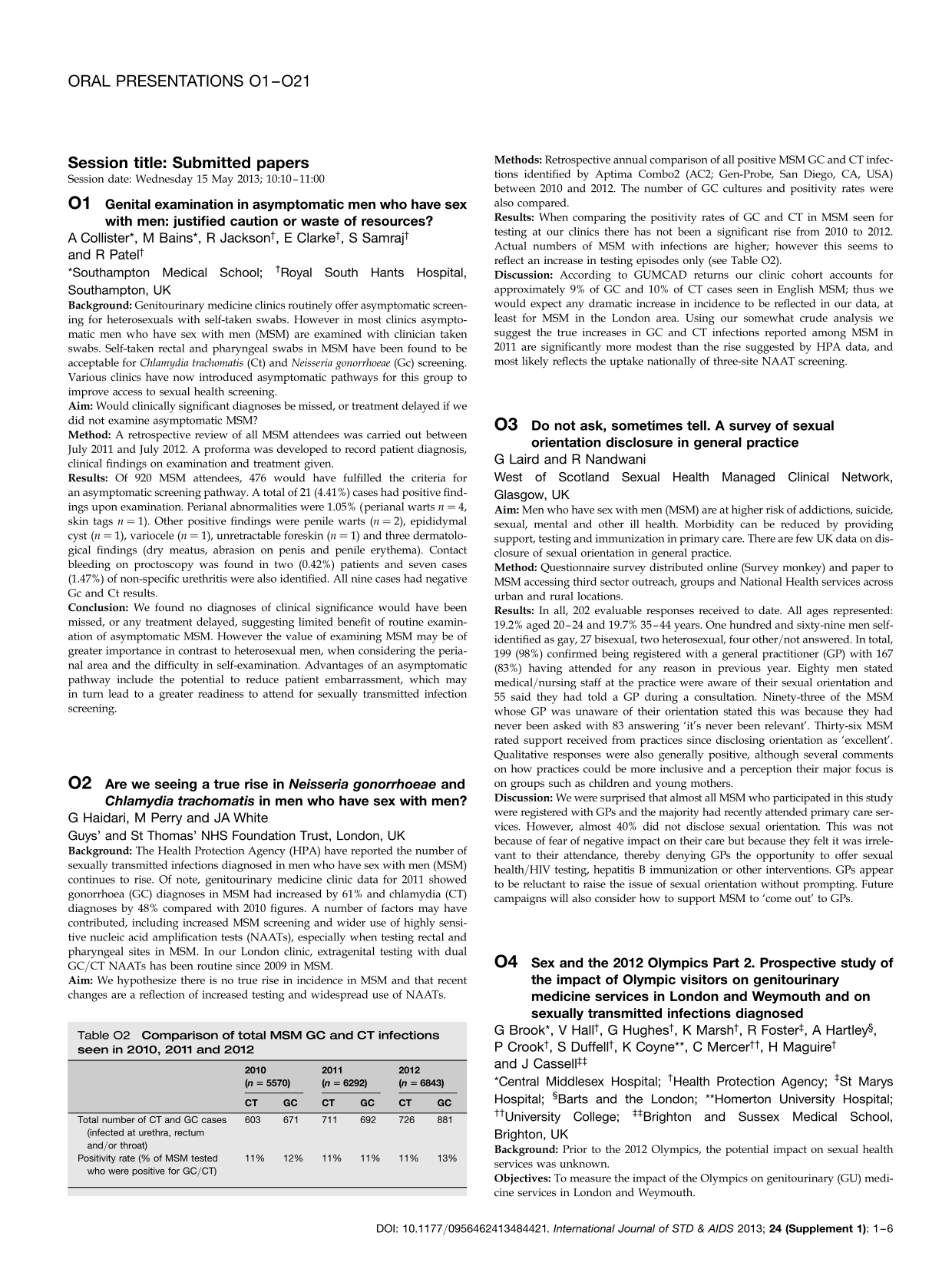
testing episodes only (see Table O2).
Comparison of total MSM GC and CT infections seen in 2010, 2011 and 2012
2010 (n = 5570)
2011 (n = 6292)
2012 (n = 6843)
CT
GC
CT
GC
CT
GC
Total number of CT and GC cases (infected at urethra,
rectum and/or throat)
603
671
711
692
726
881
Positivity rate (% of MSM tested who were positive for
GC/CT)
11%
12%
11%
11%
11%
13%
Discussion: According to GUMCAD returns our clinic cohort accounts for
approximately 9% of GC and 10% of CT cases seen in English MSM; thus we would expect any
dramatic increase in incidence to be reflected in our data, at least for MSM in the London
area. Using our somewhat crude analysis we suggest the true increases in GC and CT
infections reported among MSM in 2011 are significantly more modest than the rise suggested
by HPA data, and most likely reflects the uptake nationally of three-site NAAT
screening.
Aim: Men who have sex with men (MSM) are at higher risk of addictions,
suicide, sexual, mental and other ill health. Morbidity can be reduced by providing support,
testing and immunization in primary care. There are few UK data on disclosure of sexual
orientation in general practice.
Method: Questionnaire survey distributed online (Survey monkey) and paper to
MSM accessing third sector outreach, groups and National Health services across urban and
rural locations.
Results: In all, 202 evaluable responses received to date. All ages
represented: 19.2% aged 20–24 and 19.7% 35–44 years. One hundred and sixty-nine men
self-identified as gay, 27 bisexual, two heterosexual, four other/not answered. In total,
199 (98%) confirmed being registered with a general practitioner (GP) with 167 (83%) having
attended for any reason in previous year. Eighty men stated medical/nursing staff at the
practice were aware of their sexual orientation and 55 said they had told a GP during a
consultation. Ninety-three of the MSM whose GP was unaware of their orientation stated this
was because they had never been asked with 83 answering ‘it's never been relevant’.
Thirty-six MSM rated support received from practices since disclosing orientation as
‘excellent’. Qualitative responses were also generally positive, although several comments
on how practices could be more inclusive and a perception their major focus is on groups
such as children and young mothers.
Discussion: We were surprised that almost all MSM who participated in this
study were registered with GPs and the majority had recently attended primary care services.
However, almost 40% did not disclose sexual orientation. This was not because of fear of
negative impact on their care but because they felt it was irrelevant to their attendance,
thereby denying GPs the opportunity to offer sexual health/HIV testing, hepatitis B
immunization or other interventions. GPs appear to be reluctant to raise the issue of sexual
orientation without prompting. Future campaigns will also consider how to support MSM to
‘come out’ to GPs.
Background: Prior to the 2012 Olympics, the potential impact on sexual health
services was unknown.
Objectives: To measure the impact of the Olympics on genitourinary (GU)
medicine services in London and Weymouth.
Methods: Between 20 July and 16 September 2012, new registrants at GU medicine
clinics in London and Weymouth were asked to complete a survey to determine if they were
visitors to the Olympics from the UK and abroad. Surveys were linked to GU medicine service
records reported to the Health Protection Agency via GUMCAD (genitourinary medicine clinic
activity data-set).
Results: Provisional data show that 24 (69%) of the 35 clinics returned 12,347
completed surveys. Among respondents, 11,158 (90%) were local residents, 1081 (9%)
non-Olympic visitors and 108 (0.9%) Olympic visitors (OV). Survey participation was
12,347/37,704 (33%), so actual OVs may have been greater. Most OVs were seen in central
London clinics (52, 48%) and Weymouth (21, 19%), with the majority (66, 61%) attending
during the Olympics (27 July–12 August). During these dates, the percentage of new
registrants who were OVs reached a maximum of 9% in a week in one London clinic and 21% per
week in Weymouth.
Among OV respondents, 37 (35%) were non-UK residents and 59 (55%) were Olympic workers.
Compared with locals, OV were more likely to be men (74% versus 59%), in the 15–24 age range
(44% versus 36%) and ethnically white (83% versus 68%). There were no differences in sexual
orientation but a higher prevalence of acute sexually transmitted infections (STIs) among
OVs (12/108, 11.1%) versus locals (950/11,158, 8.5%) was reported. A total of 30 STIs were
diagnosed among OVs including non-specific urethritis (10, 9%), chlamydia (5, 5%), warts (5,
5%), herpes (4, 4%), gonorrhoea (3, 3%), molluscum (2, 2%) and scabies (1, 1%).
Conclusions: For the first time in the history of the Olympic games, the
impact of visitor attendance at sexual health clinics has been measured prospectively. OV
were seen in substantial numbers only during the games and had comparable STI rates to
locals. These data will prove valuable in planning the provision of future sexual health
services for cities with large-scale events.
Background: Proton-transfer reaction-time of flight-mass spectrometry (PTR-MS)
offers exciting new possibilities in clinical diagnosis through analysis of volatile organic
compounds (VOCs). In research settings PTR-MS has been utilized in headspace analyses of
microbial cultures, pharmacokinetic studies and breath analyses of patients with respiratory
infections, tumours and metabolic disorders. Advances in this field could ultimately offer
an ‘electronic nose’ which is minimally invasive and allows for near-patient testing.
Aim: Feasibility study to determine whether common genitourinary (GU)
infections exhibit distinctive emission patterns of VOCs using PTR-MS.
Methods: Headspace analyses of positive laboratory culture media for
Neisseria gonorrhoeae (GC), Candida albicans (CA) and
Trichomonas vaginalis (TV) were undertaken using PTR-MS and compared with
negative controls. This was followed by the recruitment of a small number of patients with
proven GU infections (CA N = 9, GC N = 1, Chlamydia
N = 2) and negative controls (N = 9). Vaginal, cervical
and throat swabs were analysed using PTR-MS.
Results: Principal component analysis (PCA) of VOCs emitted from pure
laboratory cultures for GC, CA and TV showed distinctive VOC profiles for each infection.
Initial findings on clinical samples also indicate partial discrimination of VOC emissions
between clinically positive specimens and negative controls. Further samples would be
required to reach a meaningful statistical outcome.
Discussion: Bacterial vaginosis and TV are known to produce characteristic
odours clinically, and the presence of VOCs in these conditions has been confirmed in
earlier studies using gas chromatography-mass spectrometry. PTR-MS offers enhanced
diagnostic capabilities through analysis of more complex gaseous mixtures in realtime
without the need to pretreat specimens. To our knowledge this is the first report of
distinctive VOC emission profiles from pure GC, CA and TV culture using PTR-MS. The
preliminary findings are being followed by a larger case control study.
Introduction: A case-note review of women presenting to our service documented
as trafficked for sexual exploitation was performed to gain an understanding of the
extensive needs of these vulnerable women.
Methods: From January 2007 to January 2013 women documented as trafficked were
identified. Baseline demographics, symptoms, sexually transmitted infection (STI) test
results and reproductive health issues were reviewed. Ongoing gender based violence (GBV)
and support agencies involved were also assessed.
Results: Thirty-eight women were identified with a mean age of 24 years
(15–41). Sixty-eight percent were from Africa with 32% from Eastern Europe, Asia and South
America. In total, 87% were brought directly to the UK. Women were exploited for one month
to 16 years with an average of 32 months. A total of 95% presented after disclosure and 97%
were referred from partner agencies. In total, 16% were symptomatic. STI prevalence was 2.5%
for HIV and gonorrhoea and 5% for Chlamydia and hepatitis B. Forensic examination was
performed in six women and there were four cases of female genital mutilation. Ten women
were pregnant at review with four opting for termination of pregnancy (TOP). Contraception
was declined in 50%. Thirty-two percent opted for long acting reversible contraception
(LARC) and 11% started combined oral contraceptive pill (COCP). GBV was ongoing with four
women coerced to return to prostitution, two women sexually assaulted and one woman subject
to domestic violence. In all, 84% were linked to the Trafficking Awareness Raising Alliance,
21% to social work and five young women were accommodated. Other agencies involved include
Barnardos, Scottish Guardianship Project, Compass, Scottish Refugee Council and Young
Women's Project. In total, 39% received counselling and 18% had documented general
practitioner input.
Conclusion: Although trafficked women appear to be a small proportion of the
patients seen in sexual health services they are an extremely vulnerable group with high
rates of STIs, unplanned pregnancy and ongoing GBV, requiring specialist multidisciplinary
input. Sexual health clinicians must continue to be aware of trafficking and build links
with health and social care partners to ensure the needs of these individuals are met.
Background: Female genital mutilation (FGM) is an issue of increasing concern
in the UK. An estimated 66,000 women in England and Wales are living with its consequences.
Delivery of sexual health services for this high risk, vulnerable cohort is complicated by
issues of stigma and poor access. In response to this, a new integrated multidisciplinary
sexual health and gynaecology FGM service was launched in October 2011 in partnership with a
local BME charity.
Methods: Retrospective analysis of all patients attending the service between
October 2011 and December 2012.
Results: Of 290 attendees, 96% were Somali. Mean age was 36 (14–75 years).
More than half (57%) required an interpreter. The majority (58%, 169/290) had female
children and 20 women reported having their daughters exposed to FGM abroad. Of the 290, 287
underwent sexual health review. Nineteen (7%) were HBsAg positive and 84 (29%) had cleared
hepatitis B virus. Late latent syphilis was diagnosed in 14 women (5%), one of whom was
pregnant. There were nine diagnoses of human papilloma virus, three of chlamydia, two of
herpes simplex virus-2 and one of Trichomonas vaginalis. Twenty-five women
(8%) were treated for pelvic inflammatory disease and 43 (15%) had proven urinary tract
infections. Women were treated promptly and partner notification completed. A health adviser
facilitated assessment and support of associated psychological issues. Gynaecological
complaints were very common, 108 women were referred to the Gynaecology FGM service for
assessment. Feedback has been very positive. In our most recent survey, all women said they
would recommend these services to other women in their community.
Conclusions: This service evaluation highlights the high burden of sexual ill
health borne by women with FGM. Our experience shows that routine sexual health screening,
support and gynaecological intervention can be implemented in dedicated FGM services. The
high prevalence of sexually transmitted infections and gynaecological morbidity emphasizes
the need for these patients to have access to comprehensive, integrated sexual health
care.
Background: Syphilis in pregnancy is associated with severe adverse pregnancy
outcomes (APO): late miscarriage, intrauterine death (IUD), preterm birth (PTB), stillbirth
(SB), congenital syphilis (CS) in up to 69%. Adequate treatment in pregnancy reduces APOs
and due to antenatal screening (ANS) and access to treatment in UK there were only 10 cases
of CS reported to the HPA from 1999 to 2007. Other severe APOs are also thought to be rare
so we were surprised by the number seen when we included syphilis in pregnancy in our MDT
meetings. This prompted a review of syphilis in pregnancy outcomes in our unit.
Methods: Cases of syphilis in pregnancy with an outcome between 2005 and 2012
were identified. Case-notes and results of mothers and babies were reviewed.
Results: Of 57 pregnancies in 39 women, 31 required treatment in current
pregnancy (all identified by ANS) and 16% had a severe APO: two IUDs at 20/40 and 21/40; one
PTB with neonatal death at 25/40; one PTB at 28/40 and one SB at 32/40. Mean gestation at
treatment was 18.6 weeks with severe APO and 20.8 weeks without APO. There was a
non-significant trend between rapid plasma reagin (RPR) nearest pregnancy outcome ≥1 in 16
and APO. In 26 of 57 cases maternal infection was adequately treated prior to pregnancy and
there were no severe APOs. There were no cases of CS in either group. As expected, treatment
in current pregnancy was associated with higher RPR (highest 1:128) compared with previously
treated (highest 1:4).
Discussion: Adequate syphilis treatment in pregnancy prevented CS and reduced
severe APOs but nearly one in six women still had a severe APO, likely due to permanent
damage to the placenta prior to treatment. While needing to be reassuring about positive
aspects of treating syphilis in pregnancy, it is important to give realistic expectations of
potential outcomes. Care pathways for urgent referral from ANS to genitourinary medicine are
essential to expedite treatment but women should be counselled that even with treatment
there remains a significant risk of APO.
Background: Hazardous drinking is common: reported by 50–60% of attendees at
unselective sexual health clinics. Hazardous drinking is associated with sexually
transmitted infection (STI) transmission, unintended pregnancy and sexual assault. An
Alcohol Brief Intervention (ABI), a motivational interview is effective at reducing
hazardous drinking but evidence is limited in sexual health clinics, women and younger men.
Motivational texting has been effective for other health promotion work but has not been
studied for alcohol.
Aim: The aim of the study was to compare the effect of three interventions on
hazardous drinking: an ABI, motivational texting and standard care.
Method: Attendees at the genitourinary medicine clinic in Aberdeen were
screened for hazardous drinking using the Alcohol Use Disorder Identification Test (AUDIT).
If consenting, they were randomized to one of the three arms. ABI and Standard Care were
delivered by the clinician the patient was seeing for their consultation. Texts were sent on
Friday evenings for 12 weeks. Follow-up was by phone at 4–6 months. Outcomes were: AUDIT
score, intercurrent STIs, sexual assault, regretted sex or use of emergency contraception,
the number of new sexual contacts, the acceptability of the intervention. Sample size
calculations and data analysis was done using Stata 11.1.
Results: In total, 989 eligible subjects were recruited of whom 611 (65% men)
completed follow up which was less than the target of 837. t-Tests showed a
statistically significant drop in AUDIT scores in the control (−1.8) and ABI (−1.95) arms in
women. In the men there was a significant drop in AUDIT scores in the ABI arm (−0.98). In
neither sex was there a drop in scores with texting. Men in the texting arm had a
non-significant increase in AUDIT score. In women all interventions were equally acceptable.
In men χ2 test showed that an ABI was significantly more acceptable than texting.
Neither arm was associated with an effect on sexual health outcomes.
Discussion: This large study has shown that an ABI reduces AUDIT scores in men
and women. Texting is ineffective.
Background: Alcohol misuse and poor sexual health are closely related.
Hazardous drinking in sexual health clinic (SHC) attendees often leads to risky sexual
behaviour. Few data exist on the feasibility of delivering a brief intervention (BI) for
alcohol misuse in a SHC.
Aim: To assess feasibility and acceptability of a BI to SHC attendees.
Methods: SHC attendees (≥16 years) were screened using AUDIT-C. Men scoring ≥5
and women scoring ≥4 were randomized to either receive BI or a standard alcohol leaflet
(usual care, UC). Clinical staff were randomized to receive BI training. Patients saw only
trained staff in BI arm and non-trained staff in UC arm. They completed the full AUDIT
questionnaire, alcohol diary and questions on sexual behaviour at baseline and follow-up.
Follow-up at six weeks and six months was largely by phone interviews. An intervention
fidelity check was carried out. Patients with AUDIT score >15 were initially excluded
then subsequently relaxed to >20.
Results: Of 664 patients screened 215 were eligible for randomization. In
total, 207 were included in the final analysis: 103 (BI) and 104 (UC). Mean age was 25
years, 66% were women, most were White, nearly 50% were employed fulltime and 27% were
students. Follow-up sample at six weeks and six months was 54% and 47%, respectively, being
slightly higher in the UC group although not statistically significant at either time. Both
groups reduced their alcohol consumption significantly but total alcohol units/week fell
more sharply in UC (P < 0.05). There was no significant difference in
sexual behaviour between the groups though evidence of decrease over time in partner
frequency was seen in both groups. Fidelity check showed that BI was delivered as intended
and added five minutes to the consultation. Staff views on BI were positive.
Conclusions: BI for alcohol misuse is feasible and acceptable in a SHC. The
study was not powered to detect outcome differences. Screening alone was sufficient to
influence drinking and sexual behaviour in both groups. Further research is needed to
optimize this intervention.
Background: We previously documented declining prevalence of Phthiris
pubis, the pubic louse, noting a significant decline in women in 2000 that
coincided with the introduction of extensive waxing techniques. This was followed by a
similar decline in men in 2003, thought to be due to reduced transmission from their female
partners.
Aims: To document ongoing trends in pubic lice prevalence in women,
heterosexual men and men who have sex with men (MSM).
Methods: Annual diagnoses (1997–2011) for chlamydia, gonorrhoea and pubic lice
from our clinic were obtained via KC60 data. Prevalence was calculated using total
new/rebook numbers.
Results: The prevalence of pubic lice has continued to decline from 2003. The
lowest level was in 2006 with only eight cases in 12,944 new patients. The curves of decline
between women, heterosexual men and MSM are almost parallel starting with women, followed by
heterosexual men then MSM. Comparing 2006 with 1997 there was a significant drop in the rate
of pubic lice in women (OR 0.09 [95% CI 0.00–0.68]), in heterosexual men (OR 0.11 [95% CI
0.04–0.30]) and in MSM (OR 0.10 [95% CI 0.00–0.79]), but there was a significant rise in
gonorrhoea (OR 3.18 [95% CI 2.55–3.95]) and chlamydia (OR 1.19 [95% CI 1.09–1.30]).
Conclusion: Our data show that despite continuing high rates of gonorrhoea and
chlamydia, the decline of the pubic louse continues. We previously related the decreased
prevalence of Phthiris pubis to deforestation of its usual habitat, as
women enjoy the pleasures of ‘trimming their bush’ or waxing practices such as the
Brazilian. However, it is increasingly unusual to see normal hair distribution in either sex
during a genitourinary medicine consultation. Recent trends indicate that gay and
heterosexual men are now also removing their back, buttock and pubic hair with the ‘back,
sack and crack wax’ which explains the more recent decline in prevalence in MSM. If current
hair removal practices continue, we suggest that the louse's days are numbered.
Background: Late diagnosis of HIV leads to poorer patient outcomes and higher
risk of onward transmission and rates of undiagnosed infection in the UK remain unacceptably
high. While HIV testing has been routine in genitourinary (GU) medicine since 2001, testing
has been opportunistic elsewhere until national guidelines recommended increased testing in
a broader variety of settings since 2008.
Aims: This study aimed to establish whether these initiatives have had an
impact on site of diagnosis, rates of late diagnosis and diagnosis of recent infection.
Methods: All new HIV diagnoses during 2000, 2006 and 2012 were characterized
with respect to: site of diagnosis, age, ethnicity, sexuality, CD4 count and seroconversion
symptoms at the time of presentation. Late diagnosis was defined as CD4 < 350 cells/μL
and recent infection as infection acquired within the previous year.
Results: Between 2000, 2006 and 2012 the proportion of new diagnoses made in
GU medicine decreased over time (74.3%, 63.2%, 42.2%; P < 0.001) while
increasing in primary care (2.7%, 12.5%, 21.2%) and community settings (0.0%, 8.3%, 12.9%).
Overall there was a decrease in late diagnosis (52.0%, 46.4%, 33.0%); this was most
significant in GU medicine settings (38.1%, 36.1%, 20.0%; P = 0.046). The
proportion of new diagnoses with recent infection significantly increased over time (24.3%,
31.0%, 45.2%; P = 0.005) as did the proportion of patients presenting with
seroconversion symptoms (16.7%, 47.2%, 55.3%; P = 0.011). Older patients
(>50 years) were more likely to be diagnosed in non-GU medicine settings than GU medicine
(P = 0.011) but there was no difference in ethnicity and sexuality
between the two groups.
Conclusion: We have shown a reduction in late diagnosis of HIV and an increase
in diagnosis of recent infection, contemporaneous with policies to broaden HIV testing to
non-GU medicine settings. Older individuals are significantly more likely to be diagnosed
outside of GU medicine. GU medicine teams are best placed to support HIV testing and need to
continue to support and enhance testing outside of sexually transmitted infection clinics in
order to reduce late diagnosis and rates of undiagnosed infection.
Background: There is limited evidence around the acceptability of pre-exposure
prophylaxis (PrEP) as an HIV prevention intervention to those most at risk of HIV in the
UK.
Aims: To explore the awareness of and willingness to use PrEP among gay and
bisexual men in Scotland.
Methods: Anonymous, cross-sectional survey of 17 gay commercial venues in
Glasgow and Edinburgh in May 2011 (n = 1515, 65.2% response rate). In
total, 1380 responses of HIV-negative men are included in the analyses. Awareness of PrEP,
willingness to participate in a PrEP research study and likelihood of using PrEP on a daily
basis were investigated and a thematic analysis of reasons (open-ended answers) for
unwillingness to use PrEP is included.
Results: In total, 30.5% of participants had heard of PrEP (n
= 431), with awareness associated with being aged older than 36 years and with having had an
HIV or STI test in the previous 12 months. Around half were willing to take part in a PrEP
research study (n = 687; 49.8%) or to take PrEP on a daily basis
(n = 747; 54.1%). In multivariate analysis, willingness to take PrEP was
associated with lower levels of education (secondary adjusted odds ratio [AOR] 1.5), regular
gay scene attendance (more than once a week AOR 1.63), ‘high-risk’ unprotected anal
intercourse (UAI) (AOR 1.78) and testing for HIV or STI in the previous 12 months (AOR
1.34). Most common reasons for not wanting to take PrEP were perceptions of low personal
risk of HIV (n = 46) and concerns with using medication as an HIV
prevention method (n = 45).
Conclusions: There is a willingness to engage with PrEP among a significant
number of gay and bisexual men in Scotland. The associations between sexual risk behaviour,
testing and willingness to use PrEP suggest that the awareness and management of risk will
be important considerations in future biomedical HIV interventions.
Background: The current Department of Health and BASHH first-line regimen is
lopinavir/ritonavir, tenofovir and emtricitabine (Truvada) for PEP after possible high-risk
exposure to HIV. Raltegravir-containing PEP has recently been shown to be safe and well
tolerated by a US group.
Objectives: This is a review of the use of raltegravir-containing PEP to
identify why and when this is initiated and its tolerability and safety.
Method: Pharmacy records identified eligible patients; these were compared
with 33 courses of first-line PEP in the same time period.
Results: From February 2010 to April 2012, 509 courses of PEP were prescribed;
33 (6.5%) raltegravir-containing PEP. In total, 18/33 (54%) of raltegravir-containing PEP
were initiated due to potential drug–drug interactions with ritonavir, 3/33 (10%) due to the
resistance profile of the contact and 12/33 (36%) due to intolerance of first-line regimen.
Patients switching due to drug intolerance were largely due to gastrointestinal side-effects
between days 1 and 16. Nineteen courses of raltegravir-containing PEP were commenced on day
1. Of 19 patients, 10 (53%) reported no side-effects by day 28 of treatment compared with
5/33 (15%) patients on first-line PEP. Of 14 patients, 12 (79%) on first-line PEP who were
switched to raltegravir-containing PEP reported improvement in their side-effects. There
were no significant liver or renal toxicities in the raltegravir group; three patients on
first-line PEP had a rise in their ALT.
Discussion: Raltegravir-containing regimens are safe and as well tolerated
when compared with first-line PEP. Switching to a raltegravir-containing regimen is
associated with a decrease in reported side-effects. Self-reported adherence is better if
patients are started on raltegravir. This study suggests that raltegravir-containing PEP may
be a preferred first-choice regimen.
Background: Clients completing self-taken histories (STH) may result in
greater clinical efficiency and improve quality of care.
Aim: Compare data from STH and clinician-taken histories (CTH) in an
integrated sexual health drop in clinic and review client acceptability of STH.
Methods: A STH proforma was developed that covered a complete integrated
sexual health background history. STH proformas were given to clients at our drop in clinic
prior to seeing a clinician. The clinician did not see the STH prior to seeing the client.
CTH and STH were compared. Clients completed a questionnaire about acceptability.
Results: Eighty-five STH were completed (50F and 35M). Age range 15–58 years.
Completion rates in men were 99% and in women 96%, lowest completion rates for a question
were 74% in women (on condom use) and in men 94% (on medication history). Eighty-four
clients completed acceptability questionnaires. Ninety-five were either happy or did not
mind completing the proforma. Five percent were uncomfortable answering questions on their
sex life, 8.6% were uncomfortable answering questions about abuse, drug and alcohol use.
Twenty percent were uncomfortable answering questions about their sex life in the waiting
room. Sixty-four CTH were matched with STH from EPR. Data were more complete on STH than CTH
especially in areas of routine sensitive enquiry (GBV) 100% versus 85% in men and 98% versus
79% in women.
Discussion: Clients found performing STH generally acceptable; however, 20%
were uncomfortable filling the form in the waiting room which may be due to concerns about
confidentiality. We are looking into ways for clients to fill information in kiosks or
online. In Scotland sexual health services are required to perform routine sensitive
enquiry; we have found that there was greater completion of this on STH than CTH. In a busy
service STH would allow clients to be asked these questions consistently and still allow
time to deal with their clinical issues.
Background: APTIMA Combo 2 (AC2) performs well for the detection of
Chlamydia trachomatis (CT) and Neisseria gonorrhoeae
(NG) from extragenital sites among men who have sex with men (MSM) but three-site (pharynx
(P), urethra (U), rectum (R)) testing is a cost pressure for services.
Aims: To determine the: (i) AC2 performance to detect CT and NG from a pooled
specimen; self-taken P and R samples added to first-void urine (PS) compared with standard
of care testing from individual sites (SC). (ii) Acceptability of PS among MSM.
Methods: MSM (symptomatic or contacts of CT/NG) attending two London
genitourinary medicine services were recruited. Demographics, sexual behaviour,
symptoms/signs and acceptability of PS were collected. Any positive AC2 test was considered
a true positive. Invalid sampling/unconfirmed equivocal results were excluded. Sampling
order was randomized and two methods (1 and 2) for pooling were compared with SC.
Results: In total, 627 MSM (43% HIV+) have been recruited, 65% (409/626)
symptomatic and 43% had unprotected anal sex in the last month. Of the 139 CT and NG
infections required for the study, 94 CT and 189 NG infections have been detected. Overall
prevalence of CT and/or NG was 46% (95% CI 42–49), co-infection 6% (40/626). Sensitivity of
PS and SOC to detect CT and NG exceeded 91% and 97%, respectively (Table 1). PS missed 22 infections (CT 6 (1 P, 4 R, 1
U) and NG 16 (11 P, 4 R, 1 U)). M1 was used in 20/22 (91%). In total, 21/22 (95%) were
single site infections. SC missed four infections (CT 3, NG 1). Performance of PS and SOC
was not significantly different (P = 0.68). MSM found PS acceptable (90%),
85% reported feeling happy to take their own samples at home.
NG (prevalence = 31% (N = 191))
CT (prevalence = 15% (N = 94))
Infection (N
= 626)
PS
SOC
PS
SOC
Overall sensitivity, % (95% CI)
92 (87–93)
99 (97–100)
96 (90–98)
98 (93–99)
Method 1, % (95% CI%)
90 (82–93)
99 (96–100)
94 (86–98)
97 (90–99)
Method 2, % (95% CI%)
96 (87–99)
100 (93–100)
100 (87–100)
100 (87–100)
Discussion: PS compares well with SOC and has the potential for significant
savings and improved access to testing. Sampling method or organism load may explain missed
infections.
Background: In 2011 gonorrhoea polymerase chain reaction testing on first pass
urine for men and self-taken vulvo-vaginal swab for women was introduced in the North of
Tyne area. In keeping with this, we began testing for gonorrhoea (GC) as part of the
National Chlamydia Screening Programme (CSP). To date, we have identified 71 cases of GC
which would likely have previously been missed.
Aims and objectives: The aim of this study was to estimate the incidence of GC
in those using the CSP. We looked at whether GC-positive patients attended genitourinary
(GU) medicine services for adequate follow-up and treatment. We wanted to identify whether
those testing positive were truly asymptomatic and whether GC was detected at extragenital
sites.
Methods: We obtained data from the North of Tyne CSP database as to how many
positive tests had been identified since the introduction of gonorrhoea PCR testing. We
identified those who had attended Newcroft GUM clinic and interrogated the corresponding
notes to obtain further information.
Results: Between March and December 2012, 12,853 tests were carried out as
part of the CSP of which 71 positive GC cases were identified (incidence 0.6%, 12 men, 59
women). Of these, 29 were also Chlamydia (CT) positive. Twenty-five GC-positive patients
attended Newcroft GUM service for treatment, of which nine were symptomatic. Of 25, 14 were
GC positive on either PCR or culture at extragenital sites (10 rectal, 8 throat).
Discussion and conclusions: Without the CSP most of these 71 cases of GC would
have gone undetected and untreated; the potential for spread of infection is huge. The
majority of GC cases were CT negative. These patients would previously have received
negative test results and research has shown this can lead to ongoing risk taking behaviour.
Sixty-eight patients subsequently attended GU medicine services. For many of these patients
this was their first visit and this provides an excellent opportunity for patient education
and promotion of what GU medicine clinics have to offer.
Background: Current UK guidance suggests testing for rectal Chlamydia (RC) in
men who have sex with men and commercial sex workers (guided by reported sexual behaviours);
there is insufficient evidence to recommend testing for RC in heterosexual women.
Aim: To observe the proportion of concurrent RC infection in women with
cervical Chlamydia (CC).
Methods: Prospective study aiming to enrol 100 patients. Untreated CC-positive
women were invited to take part. Reported sexual behaviours were confirmed. Women chose
either to have a physician-collected or self-taken rectal swab. Treatment was commenced with
single-dose azithromycin 1 g or seven days of doxycycline 100 mg twice/day. Those who were
RC positive and treated with azithromycin were invited/recalled for a test of cure. Samples
were tested with the Roche Cobas 4800 CT/NG PCR assay. Ethical approval was given by
Cornwall & Plymouth Research Ethics Committee.
Results: 77 patients have been recruited so far; 16 samples were
physician-collected and 61 were self-taken. Three samples were equivocal and have been
excluded from the analysis, leaving 74 samples for analysis.
56 out of 74 (75.7%, 95% CI, 65.9–85.5%) RC samples were positive and 18 were negative.
Only 15 (20%) women reported receptive anal intercourse (RAI). There was no difference in
the positivity rate whether RAI was reported (93%) or not (71%) (P = 0.07),
or whether swabs were physician-collected (69%) or self-taken (78%) (P =
0.47).
Positive RC
Average number of amplification cycles and
range – rectal
Average number of amplification cycles and
range – cervical
Upper limit of amplification cycles for
positivity
RAI
14
32.3 (range 25.5–38.0)
28.8 (range 24.1–31.4)
40
No RAI
42
32.3 (range 23.1–39.6)
29.0 (range 21.9–39.3)
40
Discussion: Reported behaviours may not be helpful in guiding RC testing. RC
may be acquired through practising RAI or via spread of infected secretions. Various studies
have shown higher treatment failure rates of RC with single-dose azithromycin versus seven
days of doxycycline. We do not know whether infection at multiple ano-genital sites in women
is associated with increased risk of subsequent re-infection. Clinical implications of RC in
women require further study.
Background: Since the widespread use of nucleic acid amplification tests
(NAAT) to diagnose Neisseria gonorrhoeae (GC), there have been few studies
looking at the proportion of heterosexual women with pharyngeal infection. Local clinic
protocol is to sample extragenital sites for GC NAAT in heterosexual women when there has
been recent sexual exposure. Local laboratory protocol deems that positive GC NAAT from our
service are not confirmed using a different nucleic acid target, even on extragenital
specimens. We aimed to investigate the value of performing extragenital sampling for GC NAAT
on heterosexual women in this scenario.
Methods: Women with a positive GC NAAT attending our general sexual health
clinic between January and July 2012 were included. Genital samples in women were either
vulvovaginal or endocervical. All specimens were tested on the Roche Cobas 4800.
Results: Forty women were included; all were heterosexual. Mean number of
sexual partners in the last three months was 1.4 (range 1 to <10). In total, 25 (63%)
women were found to have GC detected on NAAT of a genital sample (number taken = 38), 17
(43%) on a pharyngeal sample (number taken = 33) and 2 (5%) on a rectal sample (number taken
= 3). Twenty-one (53%) women were found to have a positive GC NAAT on genital specimen only
and 12 (30%) were found to have a positive GC NAAT on pharyngeal specimen only. No woman had
a positive rectal specimen only.
Conclusions: One-third of heterosexual women with a positive GC NAAT attending
our service were found to have infection on pharyngeal specimen only. This may indicate a
significant and previously unrecognized reservoir of infection. However, the possibility of
false-positive NAAT at this site due to cross-reactivity needs to be considered, especially
when not confirmed using a different nucleic acid target. Further work is needed to
investigate this finding but the routine sampling of the pharynx in heterosexual women
engaging in fellatio should be considered.
Background: Pharyngeal Chlamydia trachomatis (p-CT) is often
asymptomatic and can act as a reservoir for onward transmission of the infection.
Azithromycin is the treatment of choice for p-CT; however, limited data are available on its
effectiveness.
Objective: To examine the outcome of azithromycin treatment for patients with
p-CT.
Methods: Data were retrospectively collected on patients diagnosed with p-CT
at Whittall Street Clinic, Birmingham between July 2010 and July 2012. A subgroup of
patients who attended within six weeks for repeat p-CT screening and had no history of
re-exposure were studied further to assess treatment responses to azithromycin.
Results: Two hundred and twenty-six new episodes of pharyngeal CT were
diagnosed: 190 women and 36 men. Two hundred and thirteen (94%) patients were treated; 178
(83%) received azithromycin (24 men and 154 women), 23 (11%) doxycycline (men 12 and women
11) and 12 (6%) women received ofloxacin as part of treatment for pelvic inflammatory
disease. Sixty-two patients (29%) attended for a repeat screening within six weeks including
50 treated with azithromycin. Three (6%) women treated with azithromycin had positive repeat
p-CT tests. They subsequently tested negative after repeat treatment with azithromycin
(n = 1) and doxycycline (n = 2).
Conclusion: Azithromycin failed to treat 6% of cases of pharyngeal Chlamydia
in our cohort. Test of cure of patients treated with azithromycin for p-CT may be
justified.
Introduction: Few data are available regarding the optimal time to undertake a
test of cure (TOC) for Chlamydia trachomatis (CT) when using a nucleic acid
amplification test (NAAT). National guidelines state that ‘NAATs will detect residual
DNA/RNA even after successful treatment of the organism four to six weeks after treatment’.
Some recent data in men who have sex with men (MSM) suggest quicker transition to DNA/RNA
negativity in rectal CT infections. Deferring CT TOC until six weeks post-treatment is not
always practical and might also fail to distinguish early re-infection.
Aim: We sought to investigate how soon CT RNA becomes negative with treatment
by examining the results of dual NAAT testing performed for Neisseria
gonorrhoeae (GC) test of cure (TOC). In recent years, GC-infected patients have
been asked to return for TOC at three weeks and then two weeks post-treatment.
Method: A list of GC-infected cases was generated for 2011–2012. We extracted
all those who had CT co-infection and had TOC performed within 50 days of treatment with
Aptima Combo2 (Gen-Probe, San Diego, CA, USA). We tabulated their treatment date, TOC date
and CT TOC results.
Results: A total of 232 cases were available for analysis (see Table O21).
Chlamydia TOC results up to 50 days post-treatment for men and women by site of
infection
Heterosexual men (n =
32)
MSM (n = 172)
Women (n = 28)
TOC negative
TOC equivocal
TOC positive
Rectal
–
109
3
106
–
6
Throat
–
10
–
10
–
–
Urethra
32
53
1
77
2
6
Cervix/vagina
–
–
15
11
–
5
Of the TOCs done from 8 to 21 days after treatment 97/112 (87%) were negative. A higher
proportion of women (6/17; 35%) and heterosexual men (2/15; 13%) had positive TOCs in this
period compared with MSM (3/80; 3.8%).
Discussion: The large majority of CT TOCs are RNA negative after only three
weeks. Our results suggest that better responses are seen in MSM, where doxycycline
treatment is favoured at our centre. Further research investigating both time to CT RNA
negativity and overall treatment efficacy for all sites of CT infection is warranted.
Background: Barnados and the Child Exploitation and Online Protection Centre
have highlighted a growing concern about child sexual exploitation; the recent Rochdale case
and subsequent serious case review brought the issue to the forefront of the health and
social care agenda. Sexual health clinics provide a key opportunity for identifying those at
risk.
Case: A 17-year-old college girl with mild learning difficulties following a
relatively trivial disclosure was supported through a successful prosecution of her partner
for sexual exploitation and rape. Details emerged of an initially loving relationship
transforming into one of physical and emotional abuse, rape, hostage, filming, near
suffocation and being forced to re-enact violent pornography on herself and animals.
Attempts to leave were met with intimidation, threats of violence to her and her mother, and
disclosure of the films on Facebook. Engaging with her and gaining her trust was
challenging; disclosures were followed by retractions and denials, and moving her perception
of the relationship as ‘loving’ to the realization that it was abusive required skilled
support. The challenge for the MDT in balancing her right of autonomy against our increasing
concern for her safety and our responsibility under the law was difficult. We worked with
both a sexual violence organization and a Multiagency Referral and Assessment Committee. Our
work was instrumental in the prosecution that has led to a significant custodial sentence:
the judge publically acknowledged our MDT in his sentencing.
Discussion: This case illustrates how agencies can work effectively together
to protect a vulnerable young person. The learning points are: the opportunity to recognize
her situation could have been missed: a vulnerability checklist has been added to the clinic
proforma for all <18s. An ongoing training programme has been implemented for the MDT;
raising awareness and increasing confidence. Clinical pathways between all agencies have
been strengthened.
Background: The incidence of hypogonadism in men ≥30 years is around 5.6%.
Symptoms of erectile dysfunction (ED) or loss of libido may prompt attendance at
genitourinary medicine clinics, particularly if they have expertise in sexual dysfunction.
Testosterone replacement is recommended if serum level is ≤12 nmol/L. Azoospermia is
recognized as side-effect of testosterone therapy that can have devastating consequences for
men wishing to have children.
Aim: To describe a case series of testosterone-induced azoospermia treated
with clomiphene citrate 50 mg daily.
Results: Patient 1 is 40-year-old man who presented with chronic prostatitis.
After complaining of persistent loss of libido he was noted to be hypogonadal (testosterone
7.4 nmol/L). Six months after commencing intramuscular testosterone (Sustanon) his
testosterone was normal (18.8 nmol/L) and symptoms had resolved. His partner began trying to
conceive; however after one year fertility investigation found him to be azoospermic.
Testosterone was discontinued and he commenced clomiphene citrate 50 mg daily. His partner
fell pregnant within five months but had a miscarriage at 13 weeks. Patients 2 and 3 are
aged 31 and 38 years, respectively. They presented with loss of libido and ED and were noted
to be hypogonadal. Testosterone replacement with topical Testogel was commenced. Both men
were found to be oligospermic after failed efforts to conceive with partners. Testosterone
therapy was stopped and both were commenced on clomiphene citrate 50 mg daily. Patient 2 has
been receiving this for three months and is due semen analysis later this month. Patient 3
is five months into treatment and awaiting his second semen analysis after minimal initial
improvement in sperm quantity.
Discussion: Azoospermia is a potentially irreversible side-effect of
testosterone replacement. All men should receive counselling prior to initiation. Clomiphene
citrate has been successful in reversing azoospermia in one case; however, results of semen
analysis are awaited in other two patients.
Background: A multitude of rheumatological manifestations have been associated
with HIV infection and protease inhibitors themselves have been identified as causing
arthralgia, frozen shoulder and microcrystalline and aseptic arthritides.
Aims: We aim to raise awareness that Kaletra may be associated with Achilles
tendinopathy, an association not previously noted.
Methods: Two clinical case reports.
Results: We describe two cases: firstly a well 18-year-old man receiving
Kaletra/Truvada for HIV postexposure prophylaxis; secondly a 43-year-old HIV-positive man
receiving Kaletra/Truvada for HIV control. Both demonstrate a temporal relationship between
initiating Kaletra and developing pain and swelling around the Achilles tendon consistent
with Achilles tendinopathy. In the second case this was confirmed on magnetic resonance
imaging scan. Immediate and dramatic resolution of symptoms occurred upon switching of
Kaletra to an alternative agent. Both cases were reviewed by a specialist
HIV-rheumatologist.
Discussion: These observations may prompt clinicians to be aware of
rheumatological presentations in HIV, including adverse events related to antiretroviral
toxicity. It may also prompt clinicians and to consider a trial of an alternative agent in
individuals on Kaletra who experience rheumatological manifestations such as Achilles
tendinopathy. Potential adverse events must be reported so that our understanding of
antiretrovirals increases and aids decisions about the safest regimen to use for HIV
treatment and for postexposure prophylaxis.
Background: Sexually acquired reactive arthritis (SARA) is a systemic
inflammatory condition of acute aseptic peripheral arthritis within one month of a primary
infection, usually Chlamydia trachomatis (CT). Genital CT infections and,
more recently, rectal lymphogranuloma venereum have been reported as triggering infections.
Pharyngeal CT has not been associated with SARA in the literature.
Case report: A 32-year-old Black British man who has sex with men attended the
genitourinary medicine clinic with perianal discomfort for three days, attributed to a
recurrent episode of previously diagnosed herpes simplex (HSV). In addition, he had a
painful swollen knee. He denied throat or urethral symptoms. He was HIV positive and stable
on antiretroviral therapy (CD4 count 440 cells/μL, viral load <20 cells/mL). On
examination, he had a herpetic perianal ulcer and swollen hot right knee with a moderate
effusion. He was treated with oral aciclovir and non-steroidal anti-inflammatory drugs and
referred to the rheumatologists.
Results: Tests results were positive for HSV-2 DNA from the anal ulcer, and
pharyngeal CT was detected by Gen-Probe Aptima Combo2 (San Diego, CA, USA). No other rectal
or urethral pathogens were detected and at recall one week later he was treated for CT with
azithromycin (1 g stat). At this stage he was also noted on clinical examination by the
rheumatologist to have dactylitis of the right third and fourth metatarsals, in addition to
pre-patellar bursitis of the knee, consistent with SARA. He underwent ultrasound-guided
aspiration of the bursitis, and received intramuscular methylprednisolone to provide pain
relief for all joints involved. Results from the knee effusion aspirate were negative for
crystals and organisms as well as CT and gonococcal RNA (Gen-Probe).
Discussion: While case reports of urethral and rectal CT infection triggering
SARA exist, this is the first documented case of SARA associated with pharyngeal CT
infection. Further research is warranted to determine the prevalence of pharyngeal CT
infection in patients with reactive arthritis; genital CT screening alone might not
determine the causative infection and this might explain some cases of apparent ‘CT-negative
SARA’.
Background: Various subtypes of adenovirus cause inflammation of mucous
membranes such as eye, urethra and cervix.
Objective: We describe five cases presenting with urethritis in which
adenovirus was the causative agent.
Case reports: All five cases seen between June 2012 and January 2013, tested
positive for adenovirus. All were men. Three men identified as heterosexual, two as
homosexual, with a mean age of 25. All cases reported insertive oral sex 5–14 days preceding
onset of symptoms. Three men reported unprotected vaginal intercourse and cunnilingus in the
preceding 14 days. All patients complained of dysuria, four had mucoid urethral discharge
and four had meatitis. Conjunctivitis was present in all cases, two with constitutional
symptoms. Urethral Gram stain revealed polymorphonuclear cells. Adenovirus was identified in
all cases by polymerase chain reaction. Patients received empirical treatment for
non-specific urethritis (NSU). No other sexually transmitted infections were identified.
Symptoms cleared by 14 days.
Discussion: There were strong similarities in clinical presentations. All
cases followed a history of oral sex, an important risk factor for NSU where the microbial
agent is unknown. Sexual transmission seems the most plausible mode of acquisition of
urethral infection. Conjunctivitis may have occurred through autoinoculation or be related
to sexual activity.
Conclusion: Although an uncommon cause of urethritis, adenoviruses appear to
cause distinct clinical symptoms in men presenting with NSU. Oral sex appears to be a risk
factor. The presence of dysuria and conjunctivitis should alert clinicians to adenovirus as
a possible cause of NSU.
Background: Most cases of vaginal discharge are straightforward to diagnose
and treat. This case of persistent copious and malodorous vaginal discharge presented great
diagnostic difficulty and an unusual cause was found.
Objectives: To highlight the need for very thorough history taking and
observation of microscopy clues in diagnosis of refractory discharge.
Methods: A 37-year-old multiparous woman presented in October 2009 with a
three-day history of vaginal discharge. She gave no significant past medical or surgical
history. High vaginal swab microscopy showed lactobacilli and copious pus cells with no
features of bacterial vaginosis (BV). Chlamydia, gonorrhoea and Trichomonas tests were
negative. She re-attended one week later with much heavier, more odorous green discharge.
Vaginal microscopy was consistent with BV but pus cells were again seen in vagina and
endocervix. She then developed pelvic pain, severe midline deep dyspareunia and pyrexia. She
was treated for presumed pelvic inflammatory disease on two occasions with prolonged course
azithromycin followed by ofloxacin and metronidazole. She then mentioned a history of rectal
prolapse repair one year earlier but had no defaecation pain. Two weeks later she still had
heavy vaginal discharge again showing BV and pus cells. At her sixth visit she had copious
bright yellow mucopus seemingly from the endocervix and the same microscopy. With a presumed
diagnosis of pyometra and/or endometrial carcinoma, she was referred urgently to
gynaecology.
Results: Magnetic resonance imaging scan showed a 4 × 2.5 cm abscess between
the posterior vaginal fornix and rectum.
She was referred to the surgeon who had performed her laparoscopic rectopexy with mesh in
2008. The mesh was removed surgically and the patient remains asymptomatic.
Conclusion: Repeated finding of pus on vaginal microscopy might have alerted
us to an unusual cause of her symptoms. Delayed complications of pelvic surgery should be
considered as a cause of persistent vaginal discharge.
Background: BASHH released an updated UK guideline for the use of postexposure
prophylaxis for HIV following sexual exposure (PEPSE) in 2011 with fewer situations in which
PEPSE is recommended. Adhering to this guidance therefore has potential for
cost-savings.
Objectives: To compare local PEPSE prescribing to national recommendations,
and to assess rates of PEPSE completion and follow-up testing.
Methods: Details of patients prescribed PEPSE were collected prospectively
over a six-month period. Case-notes and blood test results were reviewed and data collected
over a follow-up period of 12 weeks after completion of PEPSE.
Results: From March–September 2012, 24 individuals were prescribed PEPSE from
our centre. In total, 14/24 (58%) were men who have sex with men (MSM), 5/24 (21%) women and
5/24 (21%) heterosexual men. The mean time from sexual intercourse to presentation was 34
hours (range 7–110, median 24 hours). In 8/24 the donor HIV status was positive. In total,
10/24 reported receptive anal sex, 4/24 insertive anal sex, 4/24 receptive vaginal sex and
5/24 insertive vaginal sex as the main route of exposure. One MSM reported semen exposure to
broken skin (see Table P1).
Outcomes of local PEPSE prescribing compared with national targets
Audit standard
Target (%)
Outcome (%)
Was target reached?
Baseline HIV test within 72 hours of presenting for
PEPSE
100
83
No
Prescribe within recommended indications
90
67
No
Administer PEPSE within 72 hours of risk exposure
90
96
Yes
Individuals completing 4 weeks treatment
75
67
No
STI testing at an appropriate time point
90
42
No
12 week post-PEPSE HIV test
60
29
No
Reasons for non-completion of PEPSE included non-attendance and the onset of side-effects
such as rash and diarrhoea. Only 7/24 individuals attended for an HIV test 12 weeks after
completion or cessation of PEPSE, none of whom tested positive for HIV.
Conclusions: Completion rates of PEPSE were low. Follow-up testing rates were
poor, both in those who completed treatment and who did not, despite this being a group at
presumed high risk of infection. This suggests that greater resources need to be invested in
patient education and recall. Further savings could be made by reducing the number of PEPSE
prescriptions which fall outside national guidance.
Background: In 2007 it was estimated that one-third of people living with HIV
in the UK did not know their status. To increase HIV testing in accordance with the 2008
BHIVA guidelines, this Regional Infectious Disease Unit introduced a policy in favour of
universal opt-out HIV testing and elicitation of a sexual history in all admitted
patients.
Adherence to this policy was unknown; therefore, we designed this audit to review HIV
testing and sexual history documentation. We designed educational and clinical
interventions, and re-audited to evaluate their effectiveness.
Aim: To evaluate the effect of interventions on sexual history documentation
and HIV testing.
Methods: Data were collected from all admissions during three weeks in
November 2011 and August 2012. Documentation of sexual history and HIV testing was collected
from the clinical notes.
After the first audit cycle, the results were discussed at a departmental meeting. An
educational handout was distributed to attendees and a ward round sticker was introduced as
a HIV test reminder. The results were analysed for significance using the chi-squared
test.
Results: Eighty-one patients' notes were reviewed in the first cycle and 92 in
the second. The results from patients unable to give a history were excluded from sexual
history documentation analysis. HIV-positive patients were excluded from HIV testing
analysis (see Table P2).
Sexual history documentation and HIV testing pre- and post-interventions
% of patients with a sexual history documented
% of patients tested for HIV
Age
1st audit cycle
2nd audit cycle
% change in sexual history
documentation
1st audit cycle
2nd audit cycle
% change in HIV testing
≤40
42 (8/19)
70 (14/20)
+28 (P = 0.08)
63 (12/19)
78 (14/18)
+15 (P = 0.33)
41–60
26 (7/27)
48 (11/23)
+12 (P = 0.11)
22 (4/18)
56 (10/18)
+24 (P = 0.01)
61–80
31 (5/16)
33 (8/24)
+2 (P = 0.89)
44 (7/16)
42 (11/26)
−2 (P = 0.93)
>80
17 (2/12)
0 (0/14)
−17 (P = 0.23)
7 (1/14)
21 (4/19)
+14 (P = 0.27)
≤80
32 (20/62)
43 (33/77)
+11 (P = 0.05)
44 (23/53)
56 (35/62)
+12 (P = 0.16)
Conclusion: This retrospective audit demonstrated that education and clinical
prompts can increase sexual history documentation and HIV testing. The interventions
significantly improved sexual history documentation in patients aged 80 and under. They also
significantly increased the rate of testing in patients aged 41–60, a potentially high-risk
and under-tested cohort. The introduction of these measures should be considered in other
departments to increase HIV testing in accordance with the BHIVA HIV testing guidelines.
Background: It is widely accepted that initiation of HAART (highly active
antiretroviral therapy) within 72 hours following an exposure to HIV may significantly
reduce the chance of acquiring HIV infection. We carried out this audit in the largest HSE
(Health Service Executive)-funded sexual health clinic in the Republic of Ireland for gay,
bisexual and transgender men, making it an ideal location to assess the uptake of
postexposure prophylaxis following sexual exposure (PEPSE) in the gay community in
Ireland.
Aims: To assess the uptake of PEPSE among a group of men who have sex with men
(MSM).
Methods: A retrospective chart review of all patients who received PEPSE
between October 2011 and July 2012 was undertaken.
Results: Thirty-one patients were identified, all MSM. Twenty-four patients
(77.4%) had previously attended the service, while seven patients (22.5%) attended for the
first time requesting PEPSE. Twenty patients (64.5%) were aged 39 and under. Twenty-five
patients (80.6%) were of Irish origin. The majority of patients had baseline HIV bloods
taken n = 27 (87%); however, four (13%) patients did not have bloods taken
pre-PEPSE. In total, 50% (n = 16) of patients reported non-use of condoms
during anal sex as the reason for requesting PEPSE. In all, 28% (n = 9)
were condom accidents. No documentation of risk occurred in 21% (n = 7).
Most documented the sexual intercourse as consensual n = 23 (71%). Most
patients were unaware of their partners’ HIV status, n = 25 (78%). In
total, 29 (90%) received Truvada and Kaletra with 24 completing the full course (77%).
Twenty-four patients (77%) had a four-week HIV test with 21 (67%) having a 12-week test.
Only one patient received two courses of PEPSE. All 31 patients tested HIV negative at
subsequent blood tests.
Conclusion: The uptake of PEPSE in our population of MSMs has been slow. Due
to suboptimal documentation a PEPSE proforma has been devised and a re-audit is planned.
Background: The human immunodeficiency virus (HIV) compromises the human
immune system and impedes its ability to fight infections. In Grampian, there are on average
35 new diagnoses of HIV made per year. These patients can be managed by either the
genitourinary (GU) medicine or Infection Unit (INFU) consultants. The ‘Healthcare
Improvement Scotland: HIV Service Standards’ recommends that all patients should be assessed
by an HIV specialist within two weeks of a positive HIV test result.
Aims: The main aim of this audit was to assess the proportion of newly
diagnosed HIV patients seen by a specialist HIV service within two weeks of positive HIV
test results. A secondary aim was to assess whether there were significant differences in
CD4 counts and viral loads of HIV patients at the GU medicine Clinic and INFU.
Methods: Data were obtained from case-notes at both INFU and the GU medicine
clinic. The study population was made up of patients being diagnosed with HIV between 1
January 2008 and 12 July 2012.
Results: Data from 52 patients were collected. Seventy-three of INFU
outpatients were seen within two weeks of HIV diagnosis, compared with 100% in GU medicine.
GU medicine patients underwent CD4 count and viral load testing earlier and had a higher CD4
count and lower viral load compared with INFU patients.
Conclusion: Steps need to be taken to address the issue of discrepancy between
GU medicine and INFU waiting times. The differences in CD4 count and viral loads are however
expected due to differences in the patient pool.
Introduction: Brighton and Hove has one of the highest HIV prevalences in the
UK. The Brighton Station Health centre is a primary care unit managed by Care-UK and has a
three-fold service model (general practitioner (GP) Practice, Walk-In Centre and Level 2
Sexual Health) opening 8:00–20:00 hours daily. The Sexual health clinic is clinically
governed by Brighton & Sussex University Hospital NHS Trust and this relationship
provides clear clinical pathways for access into HIV care. All newly diagnosed HIV patients
are referred to BSUH for specialist care and are ideally seen on the same day of result
given by BSUH. The BHIVA standards of care for people living with HIV 2013 state that people
who have a new diagnosis of HIV should be assessed by appropriately trained staff within two
weeks of a positive result. The aim of this study was to establish if we were meeting this
target.
Method: All new HIV diagnoses from February 2012 to December 2012 were
reviewed and the timeline from patients’ attendances for initial testing to informing the
patient of their result to the patients’ attendances in the local HIV Unit was measured.
Results: Seventeen patients were diagnosed by our service between the months
of February and December 2012. The median age was 28 years old. Fifteen were men who have
sex with men and two heterosexuals (1 African man and 1 Eastern European woman). Of 17, 7
(41%) were clinically defined as primary HIV infection. The mean time from testing to giving
a positive result was 6.6 days (1–14 days); the mean time for the entire timeline, from
being tested to being seen by an HIV specialist, was 7 days (1–15 days).
Conclusion: This study has shown that clinical pathways between primary care
(including services managed by alternative providers of medical services) and secondary care
can facilitate excellent quality of care for newly diagnosed HIV-positive patients.
Background: Many UK sexual health services are integrated, providing a
one-stop facility for contraception, sexually transmitted infections (STIs) and HIV testing.
The 2008 UK National Guidelines for HIV testing and the 2013 BHIVA Standards of Care
recommend HIV antibody testing for all patients attending sexual health services. However,
the Faculty of Sexual and Reproductive Healthcare does not give such guidance for patients
requesting contraception. We questioned whether the offer and uptake of HIV testing differed
between patients attending for genitourinary (GU) medicine or contraceptive reasons.
Aim: To assess the rates of offer and uptake of HIV antibody testing in an
integrated sexual health service against the 2008 National Guidelines recommendation of
universal offer of HIV testing and the DoH target of >60% test uptake.
Methods: A retrospective case-note review of patients attending an integrated
sexual health service without having an HIV test during 11 days in May 2012. Demographic
details, reason for attendance, offer of HIV testing and/or documentation of risk assessment
were identified.
Results: A total of 827 people had STI screening during the audit period. In
total, 77.5% had an HIV test. From the 186 patients who did not, 77 random case-notes were
reviewed. Fifty patients attended for GU medicine services, six for contraception and GU
medicine, and 21 for contraception only. HIV testing was offered to 96% of GU medicine
patients but to only 38% of those requesting contraception. HIV risk assessment was
documented in 61% of patients overall, but only in 5% of contraception patients.
Conclusion: Although our service met the standard for uptake of HIV testing
overall, there was a large disparity in rates of offer of testing and of HIV risk assessment
between GU medicine and contraception patients. Reasons may include the perception by staff
that patients attending for contraception are at lower risk for HIV. This study has led to
changes to clinic documentation to ensure that patients attending for all services have an
HIV risk assessment and are offered HIV testing.
Background: Significant advances in HIV medicine have improved prognosis of
HIV infection. There is now a need to shift management focus from a virological and
immunological stand-point to a more holistic approach aimed to improve the quality of life
of an aging HIV-positive population.
Objectives: This audit assesses and contrasts the performance of a specialty
genitourinary (GU) medicine clinic and a specialty Infectious Diseases (ID) Unit in the
routine investigation and monitoring of adult HIV-1-positive individuals against BHIVA
guidelines published in 2011.
Method: A randomized sample of 50 patients at GU medicine and 49 patients at
ID receiving HIV care who attended between 1 January 2011 and 31 March 2012 were selected.
Patients were stratified into four patient groups – newly diagnosed, antiretroviral therapy
(ART)-naïve, initiating ART and established on ART. Data collection was by retrospective
case-note review against relevant standards identified from the guidelines. Data analysis
was performed using Microsoft Excel 2007 and STATA 11.
Results: Of 22 key outcomes, GU medicine achieved targets for 11 whereas ID
achieved targets for eight. Both clinics perform well in HIV viral load and CD4 T-cell count
monitoring (GU n = 48/50 (96%); ID n = 49/49 (100%)).
Performance is poor in co-morbidity assessment such as CVD risk (GU n =
6/46 (13%); ID n = 5/49 (10%)). There is also a significant difference in
sexual history taking (χ2(1) = 65.66, P < 0.05) between the
two clinics. A key factor in this disparity is the difference in method of documentation of
patient consultations. Limitations to the data include disproportionate sample sizes in
stratified patient groups and small overall sample size.
Conclusion: Both clinics achieved targets for immunological and virological
monitoring of patients but did not achieve targets in co-morbidity assessment, sexual
history documentation and screening for co-infections. An integrated care-pathway that is
standardized to both GU medicine and ID should be implemented to ensure all elements in HIV
care are covered.
Background: HIV viral load (VL) assays used in clinical practice have improved
significantly in sensitivity over time. However there is also increased detection of VL
blips, of uncertain clinical significance. It is considered that at least some of these
blips are a consequence of the specific VL assay used.
Aims: To compare the relative frequency of VL blips when using the following
three assays in clinical practice: Roche HIV Taqman (Roche-1), Roche HIV Taqman version 2
(Roche-2) and Abbott RealTime (Abbott) assays.
Methods: A total of 247 patients from our centre who had their VLs measured by
the three different assays over a period of three consecutive years (each assay used for a
period of one year each), were included in the study. Notes were retrospectively reviewed
and data extracted on patient demographics, antiviral treatment regimens, VL results and any
documented explanation for a detectable VL for a patient stable on treatment. In our study,
VL blips were defined as a detectable VL < 1000 in a patient on treatment, with no
obvious documented clinical reason (e.g. treatment interruption).
Results: Over the study period, the 247 patients had a total of 902, 726 and
537 viral loads performed, respectively, on the Roche Taqman, Roche Taqman-2 and Abbott
RealTime assays. Considering the frequency of VL blips, relative to all detectable VLs,
there were significant differences between the three assays: 43% (161/374) for the Roche
Taqman, 48% (112/233) for the Roche Taqman-2 and only 25% (19/76) for the Abbott.
Conclusions: Roche HIV Taqman version-2 assay produced a significantly higher
rate of VL blips in clinical practice compared with the other two assays.
Background: The UK National Guideline for the use of postexposure prophylaxis
for HIV following sexual exposure (PEPSE) was updated in 2011. Local practice was modified
following the release of this guideline in order to reflect the new recommendations.
Aim: To audit our practice against the outcome measures detailed within the
2011 guideline. A previous audit had highlighted the need for a change in local practice and
a PEPSE proforma was introduced as a result of the initial audit in 2007.
Methods: A case-note review of 68 patients who attended for PEPSE between 1
March 2012 and 10 October 2012 was undertaken. This represents 53% of the total number of
PEPSE attendances within this time.
Results: The age of the patients ranged between 15 and 49 years, with an
average age of 29 years. In total, 54 (79%) were men and 14 (21%) women. Fifty-one (75%)
were either men who have sex with men (MSM) or bisexual.
Auditable outcome measure
Aim (%)
Result of audit (%)
Proportion of PEPSE prescriptions that fit within
recommended indications
90
96
Proportion of PEPSE patients having a baseline HIV test
within 72 hours of presentation
100
100
Proportion of PEPSE prescriptions administered within 72
hours of risk exposure
90
96
Proportion of individuals completing 4-week course of
PEPSE
75
44
Proportion of individuals seeking PEPSE undergoing
testing for STIs
90
73 (20% tested positive for an STI)
Proportion of individuals completing a 12-week post-PEP
HIV antibody/antigen test
60
29
Conclusions: In order to address the high DNA rate for the 12-week post-PEP
HIV test, we will be implementing a four-week phone call to all PEPSE patients to review
compliance and arrange appropriate follow-up. In addition, we advise that clinics such as
ours who defer the sexually transmitted infection (STI) screen to the two-week appointment
should offer an additional STI screen at presentation. Failing to do so means that a
significant number of STIs may go undetected.
Background: The UK national guideline for the use of postexposure prophylaxis
for HIV following sexual exposure (PEPSE) recommends that laboratory monitoring is
undertaken in all individuals at baseline and part-way through the PEPSE regimen.
Aim: To investigate the prevalence of abnormal laboratory results in
individuals on PEPSE undergoing monitoring as recommended in the national guideline.
Methods: We undertook a case-note review of 68 out of 129 patients who
attended for PEPSE between 1 March 2012 and 10 October 2012. Abnormal results at baseline or
part-way during PEPSE were recorded (see Table).
Results: One case of primary syphilis and one case of chronic hepatitis C were
identified at baseline. Forty-nine percent had antibodies against hepatitis B. Fifty
patients (73%) had a sexually transmitted infection (STI) screen, and 10 (20%) were
diagnosed with either chlamydia, gonorrhoea or non-specific urethritis. Only one patient had
to switch his PEPSE regimen due to rash and abnormal liver function tests (LFTs).
FBC
Renal
Hepatic
Lipids
Glucose
Urine
Baseline
1 elevated WCC (n = 65)
2 with reduced eGFR, 1 on creatine supplements
(n = 64)
7 raised ALT only, 1 raised ALP only, 1 both raised, 5
raised bilirubin only (n = 64)
1 raised total cholesterol (n = 9)
2 with raised random levels (1 already known to GP,
n = 9)
1 confirmed UTI, 1 with glycosuria (already known to GP,
n = 45)
2 weeks into PEPSE, new abnormal results
Nil (n = 48)
1 low phosphate, 2 reduced eGFR (n =
48)
2 raised ALT, 1 raised ALP (n =
48)
1 raised total cholesterol, not checked at baseline
(n = 3)
Nil (n = 7)
None tested
FBC, full blood count; EGFR, endothelial glomerular filtration rate: WCC, white
cell count; ALT, alanine transaminase; ALP, alkaline phosphatase; UTI, urinary tract
infection; GP, general practitioner; PEPSE, postexposure prophylaxis for HIV
following sexual exposure
Conclusions: Abnormal laboratory results due to PEPSE are uncommon, and
changed management only once in our cohort. However, a significant number of abnormalities
were detected at baseline, prior to starting PEPSE. We recommend that clinics dealing with a
large number of PEPSE request have a strategy in place for dealing with these abnormal
results.
Background: Although clinical evidence is emerging for the efficacy of
pre-exposure prophylaxis (PrEP) and treatment as prevention (TasP), there is limited
research on their acceptability among potential users. It is important to understand if
antiretrovirals (ARVs) for HIV prevention are acceptable to those most at risk of HIV.
Aims: This study explored the practical and ethical issues involved in the
acceptability of PrEP and TasP among those most at risk of HIV.
Methods: Four focus groups were conducted with people living with HIV and
three with HIV-negative and untested participants. The participants included gay and
bisexual men (n = 22) and with people from African communities
(n = 11) from four towns and cities in Scotland. PrEP and TasP were
briefly explained to participants, who were then asked to discuss these potential HIV
prevention options (for themselves and others). Interview data were transcribed verbatim and
analysed thematically.
Results: The age range of participants was 18–75 years. None of the
participants had heard of PrEP or TasP. Participants expressed a number of concerns around
the use of PrEP/TasP as an HIV prevention method and the following were identified as key
barriers to their use: HIV literacy and knowledge; trust and/or scepticism regarding the
effectiveness of PrEP/TasP; HIV stigma; attitudes towards the responsibility and culpability
in relation to HIV prevention and transmission.
Conclusion: Overall ARVs for HIV prevention were problematic for the
participants; at times because of a poor understanding of how they worked but more often
because of the psychosocial and sociocultural consequences of using them. This suggests the
need to further explore the complexities involved in the management of HIV risk and
prevention and how ARVs for prevention could affect existing social and sexual
inequalities.
Background: The background HIV prevalence in Manchester is 4.48 per 1000
population. Testing of general medical admissions for HIV is recommended by national
guidance and pilot testing projects elsewhere were successful in diagnosing new HIV
infections. Introduction of routine HIV testing of medical admissions was a permanent change
in clinical practice and both uptake and offer of testing is not universal at present.
Aims: This research investigates what factors explain testing behaviour
outside of conventional HIV services.
Methods: Qualitative study with semistructured interviews of key clinicians in
HIV and acute medicine in the hospital. Action research methodology and thematic analysis
were used to generate hypotheses to explain testing behaviour. Nine participants from key
groups were interviewed with saturation of themes used as the endpoint for data
collection.
Results: The major finding was that HIV stigma remains present in health-care
settings, although primarily by staff rather than patients. Misconceptions about HIV risk
and the misconception that offering a HIV test can cause harm were observed. Operational
factors such as ease of testing were also significant. Clinicians with managerial
responsibility considered cost whereas those without rarely saw cost as a testing barrier.
Exploration of themes regarding power, role modelling and training are considered. Junior
medical and nursing staff look to their senior colleagues for role modelling.
Conclusions: HIV stigma is unacceptable in modern clinical practice and
discriminatory practice is contrary to professional standards. However, evidence of these
behaviours means that further work and education are necessary to influence testing
behaviour and challenge misconceptions. HIV testing should be easy and reliable both in
practice as well as theory.
Background: Routine HIV testing of new general practice (GP) registrants and
acute medical admissions is recommended in areas of high HIV prevalence. In low prevalence
areas such as this, testing of at risk groups and patients with indicator diseases is
dependent on clinician awareness and willingness to discuss testing. Awareness raising
sessions have been held for both GPs and hospital staff.
Aim: We set out to assess the impact of training and awareness building on
testing trends since the publication of the National HIV Testing Guidelines in 2008.
Methods: Numbers of HIV tests requested from 2008 to 2012 were collected from
the laboratory data system and divided by referral source: genitourinary (GU), GP or
hospital (IP/OPD). Data were analysed in Excel.
Results: The majority of HIV testing took place within the GU clinic, with the
number of GP and hospital requests remaining low (mean requests per year; 2950 versus 452
versus 361, respectively). Comparing 2011/2012 with 2008/2009 data, there was a modest
relative increase in GU requests, with greater increases in tests sent from GP and hospital
settings (fold change; 1.1 versus 1.4 versus 2.5). While GU and hospital requests have
maintained growth over the period, GP requests peaked in 2010/2011 with a fall the following
year (fold change; 1.8 versus 1.4 in 2010/2011 and 2011/2012, respectively).
Discussion: We report rises in HIV requests across the three referral sources
investigated. The rise in GU tests could be due to increased patient numbers, but the
relatively greater increases in GP and hospital referrals may reflect greater awareness
following the publication of 2008 guidelines and local training sessions. The drop in GP
referrals and the overall small numbers of patients being tested suggests a need for more
work in the identification and willingness to test at-risk individuals. Ongoing data on
trends will help to identify whether testing is being embedded in practice.
Background: In 2007 BHIVA/BASHH/FSRH published guidelines on the sexual health
care of people living with HIV. Recommendations included the documentation of syphilis
serology three monthly; offer of sexually transmitted infection (STI) screen six monthly;
sexual health history taken annually and annual cervical cytology screening. An audit showed
the guidelines were often not followed and an action plan was drawn up which included
additions to the clinic letter proforma. This was developed for use at each clinic
attendance and results for, inter alia, CD4 count, viral load and hepatitis status are
entered in a standardized order. This gives an up to date summary of the patient's care
which is sent to the patient's general practitioner and a copy kept in the patient's
case-notes. A subsequent re-audit was undertaken after two years.
Method: As in the original audit, the case-notes of all patients attending HIV
clinics held during a specified month were examined for documentation of the four areas of
care. The results were compared with the national guidelines and the previous audit. It was
noted that the majority of clinicians seeing HIV patients remained the same over the two
audit periods.
Results: There was a considerable improvement in the documentation of offers
of cytology (increased by 54%) and syphilis serology (increased by 514%). The offer of STI
screen increased from 34% to 65%. However, documentation of sexual history taking was
unchanged at 38%.
Conclusion: The addition of ‘boxes’ on the clinic summary letter acted as
prompts to clinicians to check that cytology screening and syphilis serology testing have
been addressed and also led to better documentation. Conversely, the lack of standardized
recording of when a sexual health history has been taken may have contributed to a lack of
improvement in this area.
Background: The national HIV testing guidelines recommend routine HIV testing
for new general practitioner registrants and acute medical admissions in areas of high HIV
prevalence. In low prevalence areas such as ours, testing of at risk groups and patients
with indicator diseases is dependent on clinician awareness and willingness to discuss
testing. This can be based on clinician assumptions about at risk patients.
Aims: We aimed to review our recent new diagnoses and compare with national
and regional data to ascertain whether our local presentations reflect national and regional
trends to inform future training and awareness raising (see Table).
Method: Case-note review recent of newly diagnosed patients over the past 12
months. The following demographics were recorded: age, sex, risk category, marital status,
symptoms at diagnosis, referral source and ethnicity. This was then compared with similar
data from the Health Protection Agency.
Results: Results of case-note review.
Case
Age
Marital status
Risk
HIV-related symptoms
Testing source
Ethnicity
1
65
Married
MSM
Yes
GP
White British
2
44
Cohab
Contact HIV (HE)
No
GU (contact)
White British
3
48
Cohab
HE (UK)
No
GU (screen)
White British
4
56
Divorced
HE (Black African)
Yes
GP
White British
5
55
Single
MSM
No
GU (screen)
White British
6
20
Single
MSM
No
GU (STI)
White British
7
45
Single
MSM
Yes
GP
White British
8
46
Cohab
HE
No
GU (screen)
White British
9
53
Single
HE (Far East)
No
Hospital
White British
10
62
Married
Sexual assault
No
GP
White US
11
40
Single
MSM
No
GU (STI)
White British
12
64
Married
MSM
Yes
GP
White British
MSM=men who have sex with men; GU=genitourinary; GP=general practitioner;
HE=heterosexual exposure
Discussion: The ethnicity and age profile of patients diagnosed with HIV in
this area differ from both our regional and national data, being an older group, and with
less ethnic mixing. Diagnoses made outside of genitourinary medicine did not fall into
perceived risk groups, as in several of the cases referred from general practice the risk
history had not been ascertained initially and may have delayed diagnosis.
Background: The World Health Organization states all patients diagnosed with
tuberculosis (TB) should be tested for HIV regardless of risk or age.
Objective: The aim of this audit was to evaluate if this standard has been
achieved in two different settings including a large urban hospital clinic within a
multicultural city in the UK and a rural village mission hospital in Zambia.
Method: To audit the rates of HIV testing in 100 consecutive, TB-positive
patients’ records from both settings and use descriptive statistics to establish
relationships.
Results: The age ranges between Zambia and the UK were very different: 26% of
UK patients were over 60 years old compared with 8% of Zambian patients. Eighty percent of
UK TB patients were tested for HIV in comparison to 99% of TB patients in Zambia. Of the
patients tested in the UK, no patients were known to be HIV positive at baseline. One was
found to be HIV positive on testing. In the Zambian population 45 patients knew their HIV
status; 37 were positive. Testing revealed 13 more HIV-positive patients. Eleven UK patients
declined the HIV test.
Discussion: The differences between the rate of HIV testing in TB patients in
different settings could be due to a number of reasons including higher rates and awareness
of testing in Zambia, and doctors' perceptions of HIV risk in the UK. There is opportunity
for improvement of HIV testing in the UK.
Background: HIV infection and serious mental illness (SMI) frequently co-exist
and may be underdiagnosed. Baseline audit of psychiatric admissions in 2011 for the local
mental health centre suggests that <4% of admissions had completed an HIV test. We
present the outcomes of a pilot delivering routine opt-out HIV testing in mental health
services in this borough with population prevalence >8/1000.
Aim and objectives: To assess the uptake and outcome of opt-out HIV testing in
mental health services.
Methods: HIV testing was embedded into physical health checks in community
mental health clinics (01 January 2012–31 December 2012), and psychiatric inpatient
admissions (01 July 2012–31 December 2013).
Results: (1) A total of 26,802 patients were seen in community mental health
clinics. In total, 206/26,802 had a physical health check and 146/206 (70.8%) accepted HIV
testing. None tested HIV positive, although numerous health problems were diagnosed
including hypertension (n = 7), metabolic syndrome (n =
15), vitamin D deficiency (n = 23) and hyperprolactinaemia
(n = 47). Three known HIV-positive patients who had been lost to HIV care
re-engaged with HIV treatment. (2) In total, 469 patients were admitted to psychiatric
inpatient beds, of whom 338 consented to routine admission blood tests. Of 338, 117 (34.6%)
were offered and consented to HIV tests. One new HIV case was diagnosed (CD4 = 447), and one
new case of hepatitis B was diagnosed.
Discussion: Individuals accessing physical health checks find HIV testing
acceptable, with 71% of outpatients and 34.6% of inpatients accepting testing. The uptake of
physical health checks was <1%, despite a high level of medical morbidity among those
tested. Benefits included one early HIV diagnosis, three individuals re-engaging with HIV
care, one new case of hepatitis B, and 92 other previously un-diagnosed non-HIV-related
physical health problems. Despite complex barriers it is possible and beneficial to
implement routine HIV testing in services for people with SMI.
Background: Antiretroviral therapy (ART) choice in pregnancy should be based
on safety, tolerability and efficacy. Important factors are risk of preterm delivery (PTD)
and viral suppression at 36/40. Protease inhibitors (PIs) have been implicated in PTD and
lack of viral load (VL) suppression at 36/40. The most frequently used PI in these studies
was lopinavir (LPV/r).
Aim: To establish if PTD and viral non-suppression are associated with drug
classes and/or specific agents.
Methods: Retrospective analysis of the clinic pregnancy database maintained
since 2006.
Results: A total of 123 pregnancies with VL at 36/40 gestation; 32 (27%) not
suppressed to VL < 50 but only nine (7%) had VL > 400 necessitating C-section.
Non-nucleoside reverse transcriptase inhibitors (NNRTIs) had significantly lower mean VL at
36/40 compared with PIs (38 versus 2246; P = 0.04). No significant
difference in mean VL at 36/40 between those with VL<or>30,000 but those with VL >
30,000 did commence treatment significantly earlier at 20/40 compared with VL < 30,000 at
22/40 (P = 0.01). No significant difference between individual agents in
the >30,000 group. No significant difference in mean gestation at delivery between NNRTIs
(38.8/40) and all PIs (38.6/40) or NNRTIs and saquinavir (SQV/r) (39.4/40). Within PIs mean
gestation of delivery was significantly lower with LPV/r (37.8/40) compared with SQV/r
(P = 0.004) and ATZ/r (38.1/40) compared with SQV/r (P =
0.02). Mean CD4 at diagnosis of pregnancy was significantly lower in the NNTRI group
compared with SQV/r (352 versus 461; P = 0.008) but there were no other
significant differences between the groups.
Conclusions: Significant viral non-suppression (VL > 400) at 36 weeks was
uncommon at 7%. NNRTIs outperformed PIs in viral suppression at 36/40 with no significant
difference in mean gestation at delivery. Gestation was significantly shorter with LPV/r
than SQV/r. As SQV/r is now rarely used it is important to gather more data on other PIs.
Our study supports the use of NNRTIs where clinically appropriate, and suggests careful
choice of PIs in pregnancy.
Background: Antiretroviral therapy (ART) choice in pregnancy should be based
on safety, tolerability and efficacy. Important factors are risk of preterm delivery (PTD)
and viral suppression at 36/40. Protease inhibitors (PIs) have been implicated in PTD and
lack of viral load (VL) suppression at 36/40. The most frequently used PI in these studies
was lopinavir (LPV/r).
Aim: To establish if PTD and viral non-suppression are associated with drug
classes or specific agents.
Methods: Retrospective analysis of pregnancy database maintained since
2006.
Results: A total of 123 pregnancies with VL at 36/40 gestation; 32 (27%) not
suppressed to VL < 50 but only nine (7%) had VL > 400 necessitating C-section.
Non-nucleoside reverse transcriptase inhibitors (NNRTIs) had a significantly lower mean VL
at 36/40 compared with PIs (38 versus 2246; P = 0.04). No significant
difference was seen in mean VL at 36/40 between those with VL< or >30,000 but those
with VL > 30,000 commenced treatment significantly earlier at 20/40 compared with VL <
30,000 at 22/40 (P = 0.01). PTD rate and mean gestation of delivery: NNRTIs
11% and 38.8; saquinavir (SQV/r) 0% and 39.4; ATZ/r 13% and 38.1; LPV/r 26% and 37.8. No
significant difference was found between NNTRI and SQV/r. Within PIs mean gestation was
significantly longer with SQV/r compared with LPV/r (P = 0.004) and ATZ/r
(P = 0.02); and PTD rate was significantly lower with SQV/r than with
LPV/r (P = 0.005) and ATZ/r (P = 0.04). Mean CD4 at
diagnosis of pregnancy was significantly lower in the NNTRI group compared with SQV/r (352
versus 461; P = 0.008) but there were no other significant differences
between the groups.
Conclusions: Significant viral non-suppression (VL > 400) at 36 weeks was
uncommon (7%). NNRTIs outperformed PIs in viral suppression at 36/40 with no significant
difference in PTD compared with SQV/r. PTD was significantly higher with LPV/r and ATZ/r
than SQV/r. As SQV/r is now rarely used it is important to gather more data on other PIs.
Our study supports the use of NNRTIs where clinically appropriate, and suggests careful
choice of PIs in pregnancy.
Background: Vitamin D insufficiency is common in the UK and has been
associated with cardiovascular disease, type 2 diabetes, cancer and autoimmune conditions.
The importance of optimal vitamin D levels in HIV-infected patients is increasingly
recognized. Low levels have been associated with increased inflammation, lower CD4 counts
and an increased risk of disease progression in HIV-infected patients.
Methods: Three years ago our clinic began routine screening for vitamin D
deficiency in our HIV-infected patients. Subsequently we performed a cross-sectional study
of pretreatment serum 25-hydroxyvitamin D (25-OHD) levels in 100 randomly selected patients
from our HIV cohort. Patients were classified as having vitamin D deficiency (25-OHD <25
nmol/L, <10 μg/L), insufficiency (25–50 nmol/L, 10–20 μg/L) or optimal vitamin D levels
(>50 nmol/L, >20 μg/L). We reviewed the case-notes to look for trends in associated
markers and risk factors.
Results: Of the 100 patients there were 88 men, 12 women and the median age
was 45 (23–73). The results are given in the table.
Deficiency
Insufficiency
Optimal
Total (%)
10
36
54
Males (%)
70
92
88
Median age (range)
37.5 (23–73)
44 (22–73)
46.5 (23–65)
White British (%)
60
90
98
Prior AIDS diagnosis (%)
30
25
17
Median CD4 (range)
460 (192–970)
570 (136–1308)
557 (164–1336)
On treatment (%)
80
81
76
On efavirenz (%)
80
44
44
Winter/spring sample (%)
30
25
15
EGFR <60 mL/min/1.73 m2 (%)
0
3
7
Raised lipids* (%)
40
28
30
Hypertension† (%)
20
6
11
Smoker (%)
30
44
26
*Cholesterol >5 or Chol:HDL ratio >4
†BP>140/90
Conclusion: Almost half of our HIV-infected patients were found to have
vitamin D deficiency or insufficiency. Female sex, younger age, non-white ethnicity and
efavirenz use were observed more frequently in vitamin D deficient patients. This group also
had poorer lipids, blood pressure, median CD4 counts and more previous AIDS diagnoses.
Winter/spring samples and smoking were more prevalent, and renal impairment less prevalent,
in the deficient and insufficient groups combined. The high prevalence of vitamin D
deficiency found in our cohort supports ongoing screening, with consideration of the season,
in HIV-infected patients. While we currently advise our patients to seek treatment and
supplementation via their general practitioner the intended benefits of this remain unclear
and require further assessment.
Background: 2012 BHIVA guidelines recommend timely initiation of
antiretroviral therapy (ART) in patients with a CD4 count of <350 cells. We piloted a CD4
point-of-care testing (POCT) in the genitourinary (GU) setting at the point of HIV
diagnosis. The PIMA CD4 POCT has been shown to correlate well with laboratory performed
values.
Aim: Evaluation of the effect of CD4 POCT on patient management with regard to
timing of initiation of ART and opportunistic infection (OI) prophylaxis and patient
acceptability.
Methods: Parallel PIMA POCT and laboratory CD4 tests were performed in
patients newly diagnosed with HIV infection between December 2011 and April 2012.
Patient-completed questionnaires and case-notes were reviewed. Data were collected on CD4
count and time to commencement of ART and OI prophylaxis.
Results: Forty-four newly diagnosed patients received a CD4 POCT. Twelve
patients were symptomatic and 32 asymptomatic. The median CD4 count was 515 (27–1003) cells.
There was no significant difference between the lab and POCT-derived CD4 results overall
(P 0.146) or within various CD4 strata. Of patients who needed OI
prophylaxis, 8/8 and 1/1 patients commenced PCP and Mycobacterium avium intracellulare (MAI)
prophylaxis, respectively. Eight patients warranted ART initiation – their median CD4 count
was 241.5 (27–456) cells. Of these, 63% (5/8) commenced ART within two weeks of diagnosis
and 25% (2/8) within four weeks (one patient declined ART). Of patients who completed the
questionnaire 100% (8/8) strongly agreed that the test should be offered to all new HIV+
patients and 75% (6/8) felt reassured knowing their CD4 result.
Conclusions: First HIV outpatient appointments following a new HIV diagnosis
are usually booked ≥2 weeks after diagnosis. The delay to receiving laboratory derived CD4
results usually necessitates recalling patients for OI prophylaxis. CD4 POCT expedited the
commencement of OI prophylaxis and ART in 100% and 63% of cases, respectively. Such
timeliness may reduce HIV-related complications. POCT results were concordant with
lab-derived testing and proved acceptable to patients.
Background: Multiple guidelines and auditable outcomes exist for HIV-positive
adults. To improve compliance with these standards we implemented ‘annual reviews’, where,
at the appointment nearest their birthday, patients are assessed specifically with regard
to: change in medical and social history; lipid profile; partner/s and children;
immunization and serology; sexually transmitted infection (STI) screening, cytology and
contraception needs.
Aim/objectives: Does the record of the clinical care differ between patients
who have had an annual review and those who have not?
Methods: Electronic records of clinic attendees were reviewed retrospectively
and compliance against standards assessed. Two groups were identified – those who had at
least one annual review and those who had not.
Results: The records of 211 patients attending over a 12-month period were
analysed (approximately 60% of all patients under care). A total of 144 patients (68%) had a
formalized annual review, and 67 patients (32%) had not. Documentation of the following was
significantly more likely in those who had had an annual review: smoking and alcohol intake;
baseline chest X-ray; lipid profile; pneumococcal and flu vaccinations; offer of an STI
screen; HIV status of partners and children and contraception use.
Discussion: We believe that the annual review process has contributed to
improved clinical care. Time pressures and more pressing medical issues at routine visits
can result in difficulties meeting all standards. The criteria included in the annual review
help to facilitate a holistic approach of care for the patient including cardiovascular risk
assessment, detection of co-infections and timely vaccinations and ensures that untested
partners and children are not overlooked. We continue to further improve the process and
have subsequently added assessment tools for anxiety and depression and bone mineral
density.
Background: People living with HIV (PLWH) are recognized as having increased
risk of cardiovascular disease (CVD) compared with their aged-matched counterparts. As a
result, cardiovascular risk assessments are a key component of the review of the HIV
patient. There are many cardiovascular risk assessment tools available to the physician.
Results: The majority of the patients were men (81%). All the risk scoring
tools exhibited positive correlation with one another. The FRS and JBS2 tools correlated
strongly with each other at risks of less than 20%. Qrisk2 scores correlated less strongly
with FRS or JBS2, with a tendency to higher cardiovascular risk estimation. The CHIP risk
calculator correlated most strongly with Qrisk and less so with FRS or JBS2.
Conclusions: The diversity of cardiovascular risk scores of FRS, JBS2 and
Qrisk2 can lead to variations in the clinical management of the same patient. These
cardiovascular risk assessment tools have been validated in the HIV population. The CHIP
risk calculator was derived from data for HIV-positive patients. However, this only gives a
five-year estimated risk and a further estimation of 10-year risk can be achieved by
doubling this risk. This can lead to less precise estimation of the risk. Best practice can
be facilitated by recommending a standardized risk assessment.
Background: Postexposure prophylaxis following sexual exposure (PEPSE) is now
widely available and is given in accordance with the British Association for Sexual Health
(BASHH) guidance. Data from our Genitourinary (GU) medicine service suggested PEPSE
prescriptions did not always fit within recommended indications. Improvement in the quality
of PEPSE provision was sought by the use of a dedicated PEP clinic.
Aim: The aim was to audit PEPSE prescribing against BASHH auditable outcome
measures before and after the introduction of the dedicated PEP clinic.
Methods: A retrospective case-note review of 100 patients in a selected time
frame was reviewed. Fifty patients were selected prior to the introduction of the PEP clinic
and another fifty thereafter, between 10 July 2010 and 28 February 2011. Data were recorded
on Microsoft Excel.
Results: Of one hundred patients included in the audit, 95 were of White and
91 of UK origin. Fifty-three were men and 60 were heterosexual. Seventy-nine of the patients
who presented were between the age of 16–35 years. In only 52 cases was the recommended
PEPSE proforma used. Twenty-five of the index cases were reported to be HIV positive, 17 of
which were confirmed cases. Ninety-eight of PEP prescriptions were given in accordance with
BASHH recommended indications (90%), and 99 of PEP/PEPSE were prescribed within 72 hours of
exposure. All high-risk needle stick injuries were started within 24 hours. Ninety-six
patients had a baseline HIV test prior to starting PEP. All except one patient was on either
Truvada/Kaletra or Combivir/Kaletra combination. Fifty-nine percent (target 75%) of patients
completed their PEP course with 21 being lost to follow up, 20 did not complete treatment.
Of the 59 completing their PEP, 45 attended the dedicated PEP clinic.
Conclusion: Overall, there was good performance and PEP/PEPSE was prescribed
according to the guidelines. Use of a dedicated PEP clinic improved PEPSE prescribing and
completion rates. There were twice as many patients who did not complete their PEP before
the inception of the PEP clinic. This will be re-audited to incorporate the new PEPSE
guidelines.
Background: BASHH has recently issued guidance around partner notification
(PN) with four auditable outcome measures. The integrated sexual health service has recently
incorporated the Chlamydia Screening Programme (CSP) into its core services.
Aims: To ascertain whether PN standards are reached in both genitourinary (GU)
services and CSP with respect to patients attending either service with a new diagnosis of
chlamydia.
Methods: Fifty case-notes from patients attending GU services and 50 notes
from patients attending the CSP were analysed with respect to (1) discussion with a
health-care worker (HCW) with documented competency about PN, (2) documentation of evidence
of agreed contact action, (3) documented evidence of contact attendance as reported by index
patient or HCW within four weeks of index diagnosis and (4) documented evidence of contact
attendance as verified by an HCW within four weeks of diagnosis.
Results: Standard 1 was achieved in 99% of cases (BASHH standard 97%).
Standard 2 was achieved in 85% of cases (BASHH standard 97%). Standard 3 analysis showed
that overall 0.5 contacts/index case attended as reported by index patient or HCW – this was
0.6 in CSP and 0.38 in GU medicine (BASHH standard 0.6 contacts/index case). Standard 4
analysis showed overall 0.28 contacts/index case attended as verified by HCW – this was 0.34
in GU medicine and 0.22 in CSP (BASHH standard 0.4 contacts/per index case). Case-note
review showed that attempts to verify contact attendance at clinics outside the area as
reported by the index patient were unsuccessful.
Conclusion: Although PN in all areas of the service was addressed, there is a
need to improve documentation of contact action and communication within the integrated
service to verify local contact attendance. Of concern is the result of standard 4
especially the issue of verifying contact attendance outside the service. This standard
therefore may be difficult to achieve – a national re-audit of these standards would be
welcome.
Background:Trichomonas vaginalis accounts for 2% of genitourinary clinic attendances
in the UK. The number of diagnosed cases has been consistent between 1992 and 2003 and
globally there are approximately 174 million cases per year. However in the UK there have
been few clinical audit data regarding T. vaginalis in recent years.
Objectives: To review patient demographics of T. vaginalis in
three central London sexual health clinics, and to audit clinical standards against UK
guidelines.
Methods: Using electronic patient medical records, patients who had a positive
result for T. vaginalis, from culture plates and/or wet microscopy, were
identified between 1 January and 30 June 2012. These case-notes were retrospectively
reviewed.
Results: In total, 38,774 patients were seen between the three clinics during
the audit period, of which 89 patients were diagnosed with T. vaginalis.
Ninety-six percent (n = 85) were women with an average age of 33 years old.
In total, 40.4% of patients described themselves as White, 38.2% as Afro-Caribbean, 12.4%
Mixed background, 1.1% as Indian and 7.9% as other or not recorded. Investigations included
wet microscopy and culture plate. Seventy percent of patients were both microscopy and
culture positive for T. vaginalis. Wet microscopy was 81% sensitive.
Seventy-eight patients returned for a test of cure (TOC), and five (6%) patients were
T. vaginalis positive. Two of these patients required second- and
third-line therapies; three patients were given a second course of metronidazole. Contact
tracing occurred in 87% of patients; 56% of these patients confirmed at least one contact
had been treated in the last month.
Conclusion: Clinical demographic data have suggested incidence of T.
vaginalis is comparable in White and Afro-Caribbean populations in urban areas.
Wet microscopy and culture plates were both important in identifying the infection. More
needs to be done to ensure contacts are treated, to achieve the 60% national audit
target.
Background: Late 2011 saw an increase in the number of gonorrhoea (GC) cases
diagnosed in sexual health services in the north-east of England. Part of the response to
this was the local decision to perform GC nucleic acid amplification test screening on all
National Chlamydia Screening Programme (NCSP) specimens. In addition, a local enhanced
surveillance form was implemented to collect epidemiological information on all GC
diagnoses.
Aim: To assess the benefit of dual testing NCSP samples and describe any
differences between cases by referral route.
Methods: Two referral groups of GC patients: NCSP and other health-care
settings, from the North of Tyne area, were compared using the enhanced surveillance data.
Significance was inferred using Fisher's Exact Test.
Results: From March to October 2012, a total of 222 forms were completed.
Forty-five people were diagnosed with GC via the NCSP and 177 by health-care providers.
There was no difference between the two referral groups in terms of ethnicity, number of
sexual partners or contraception use; however, the NCSP group was significantly more likely
to be women, heterosexual and under 25. Those screened through the NCSP were also
significantly more likely to have a concurrent infection (44% versus 23%, P
< 0.01). Significantly fewer of the NCSP group were symptomatic (27% versus 53%,
P < 0.01). The NCSP group were also less likely to be culture positive
(7% versus 36%, P < 0.01), GC positive at an extragenital site (9%
versus 25%, P < 0.05) or to attend for a test of cure (TOC) (35% versus
59%, P < 0.05).
Conclusions: Patients diagnosed with GC through the NCSP had similar sexual
risk taking behaviours to those diagnosed in a health-care setting, which suggests that a
comparable level of health promotion messages are being received. This comparison also
suggests these patients to be more reluctant to attend traditional sexual health services as
fewer of them returned for a TOC. Dual testing of NCSP samples may be a feasible method of
reaching these people.
Background: Chlamydia control in England is based on management of positives
and their partners (partner notification) and on identifying asymptomatic infections in the
community (screening).
Aims: To describe the relative contribution of screening and partner
notification to control of chlamydia at different stages in the epidemic and evaluate
optimal resource allocation to each control.
Methods: Using pair approximation equations we investigate the efficacy of
control programmes for chlamydia on short timescales that are relevant to policy-makers. We
estimate prevalence, incidence and positivity in those screened and in their partners. We
combine these measures with a costing tool to estimate the economic impact of different
public health strategies.
Results: Increasing screening coverage significantly increases the annual
programme costs whereas an increase in tracing efficiency initially increases annual costs
but over time reduces costs below baseline, with tracing accounting for around 10% of
intervention costs. We found that partner positivity is insensitive to changes in population
prevalence due to screening, remaining at around 33%.
Conclusions: Maintaining efficacy of partner notification is cost-effective at
all stages of the epidemic (stable/declining prevalence) but becomes increasingly
cost-effective as control measures reduce the population prevalence.
Background: Genital Chlamydia trachomatis is the commonest
sexually transmitted infection in UK. It is asymptomatic in 80% of women and 50% of men,
thus easily overlooked. The cornerstone of sexually transmitted infection (STI) control is
prompt diagnosis and treatment in addition to effective partner notification (PN) to reduce
spread of infection into the community.
Aims and objectives: To assess whether the Sexual Health Clinic meets the
BASHH UK guidelines (2006) on Chlamydia, with regard to rates of PN and verification. The
standard of 0.43 ratio of traceable contacts per index case was the main auditable outcome
measure. Secondary outcomes were 100% for both documentation of discussion of PN with the
patient and the method of PN adopted.
Methods: A retrospective analysis of 50 patients with uncomplicated genital
tract Chlamydia seen over a six-month period in 2010/2011. Data were obtained from the
Blithe Electronic Pt Record with supplementary information on actions taken from health
advisers' written log.
Results: Of the 50 cases analysed the overall ratio of traceable contacts seen
per case was 0.62 (0.46 contacts verified by clinic health advisor and 0.16 verified by the
index case only). And 44 out of 50 cases (88%) had documentation of contact tracing
discussed with them. Of the 44 patients who engaged in PN all had documentation of method of
PN (100%).
Conclusions: This audit confirms that the SH clinic is performing favourably
in two out of three BASHH standards, and recommend improvement in discussion of PN and
documentation in record of every patient diagnosed with genital Chlamydia infection.
Background: Prior to the 2012 Olympics it was unknown what the impact on
sexual health services would be.
Objectives: To measure the impact of the Olympics on service use in
London.
Methods: Data were gathered from sexual health services in London over the
period July to September 2012 relating to contraception (tariff data-set and Brook
contraception clinics), sexual assault (The Havens), sex workers (Open Doors) and sexual
health advice (NHS Direct).
Results: Emergency contraception prescriptions at London contraception clinics
reporting to the tariff data-set rose by 20% (from 1086 to 1353) over the Olympic and
post-Olympic period as compared with the previous month. In the Brook London contraception
clinics there was a 9% rise (from 1209 to 1328) in attendance over the Olympic period
comparing 2011–2012. In the three main sexual assault services, between 1% and 7% of
reported incidents were in clients who were visiting the Olympics. In a survey of 102 sex
workers, 59% (59/102) reported fewer clients and 46% (46/102) reported more police
interference and brothel closures. Sixteen (16%) were new sex workers and 7% (7/102) came to
London specifically for the Olympics. NHS Direct calls for advice about sexual health fell
by 19% (from 741 to 622) over the four weeks of the Olympics but rose by 25% (from 622 to
828) in the month after the Olympics. This was mainly due to calls by women with vaginal
symptoms (from 112 to 184, 61% rise) and urinary tract problems (from 150 to 223, 67%
rise).
Conclusions: The impact of Olympics on non-genitourinary medicine sexual
health service use varied. Contraception service use was high and emergency contraception
prescriptions increased following the Olympics. Reported use of sexual assault services, sex
workers and NHS Direct was low during the Olympics but there was a large rise in requests
for sexual health advice afterwards. These data will prove valuable in planning sexual
health service provision for cities with large-scale events in the future.
Background: A diagnosis of hepatitis is not unusual in a genitourinary
medicine setting. The clinics are aptly placed to test individuals who might be at higher
risk of the infection. Chronic hepatitis is the most common diagnosis, Hepatitis B (HB)
accounting for the greater portion. Household transmission of HB is common and prevention is
crucial.
In England & Wales surveillance of hepatitis is the responsibility of the Health
Protection Agency. Effective surveillance enables Health Protection Units (HPUs) to ensure
appropriate follow up, contact tracing and referral to appropriate clinical teams for
management. Most genitourinary (GU) medicine clinics have robust protocols in place for
management of sexual contacts. Less clear to the HPU was the robustness of partner
notification of household contacts.
Aim: To determine if a need existed to follow up cases of HB identified in GU
medicine settings.
Methods: All six GU medicine clinics in the Thames Valley (TV) were contacted
by telephone in advance of sending out questionnaires to identify a key local respondent. A
web-based anonymous questionnaire was then sent to each key respondent. Non-responders were
followed up by phone. A 100% respondent rate was achieved.
Main findings:
All GU medicine clinics in the TV routinely offer testing to at-risk groups;
6/6 trace sexual contacts; 6/6 test sexual contacts; 5/6 vaccinate those at risk
(anti-HB negative);
3/6 trace household contacts;
6/6 inform index cases of risk to household contacts;
1/6 test household contacts;
4/6 advice household contacts to see general practitioner;
5/6 vaccinate household contacts at risk (anti-HB negative).
Conclusions: Good contact tracing and management of sexual partners of
HB occurs in TV GU medicine clinics. The contact tracing and management of household
contacts is incompletely performed by the clinics.
Recommendation: TVHPU would work with individual GU medicine clinics to agree
responsibility for the management of household contacts of HB.
Background: In 2008 a programme was implemented in the UK offering routine
human papillomavirus (HPV) vaccination to females aged 12–13 years. Through a catch-up
programme females born on or after 1 September 1990 were also offered vaccination. Opponents
suggest vaccination will lead to risk compensating sexual behaviour.
Aim: To investigate risk compensating sexual behaviour following HPV
vaccination and to compare differences in risk behaviour among vaccinated and non-vaccinated
women.
Methods: Women aged 16 and over who were eligible for HPV vaccination in the
UK programme were invited to complete a written questionnaire assessing risk compensating
behaviour. This was developed after preparatory research to understand the theoretical
constructs of risk compensation. It measured reported behaviour change, vaccine knowledge
and risk behaviour. Participants were recruited from three genitourinary medicine clinics,
five Brook centres and two schools. Percentages reporting risk compensation were computed
and groups compared using logistic regression adjusting for vaccination cohort.
Results: A total of 822 participants were recruited. In total, 73.5% (604)
received at least one dose of the vaccine and 22.5% (185) were unvaccinated. In total, 4.2%
(33) were unsure if they had been vaccinated. In all, 1.5% (9/590) of vaccinated women
reported they were risk compensating in their sexual behaviour, while 4.9% (29/591) reported
they had decreased sexual risk taking. Overall vaccinated women demonstrated less risk
behaviour than those who were unvaccinated; unvaccinated women were significantly more
likely to be current regular smokers (AOR = 1.87, 95% CI = 1.23–2.84) and to have had an
unplanned pregnancy (AOR = 1.76, 95% CI = 1.08–2.87).
Conclusion: Risk compensating sexual behaviour following HPV vaccination is
not widespread and vaccination encouraged more preventive behaviour among larger numbers.
Vaccinated women reported fewer risk behaviours than unvaccinated peers, suggesting
non-vaccination clusters with other high-risk behaviours.
Background: The Public Health Outcomes Framework (PHOF) includes a minimum
chlamydia diagnosis rate of 2400/100,000 (population 15–24) as an indicator of improved
health. Achieving this outcome will depend on the provision of adequate and appropriate
sexual health services in Local Authorities (LA). We used comprehensive national
surveillance data and spatial mapping techniques to explore the relationship between service
provision and diagnostic rates at LA level.
Aim: To investigate variation in the rate of chlamydial diagnoses in relation
to the provision of services and Office of National Statistics (ONS) area
classification.
Methods: Diagnoses of genital chlamydial infection recorded in Genitourinary
Medicine Clinic Activity Dataset and National Chlamydia Screening Programme (NCSP)
surveillance datasets for 2011 were aggregated to LA level and combined with the ONS
urban/rural classification. This information was analysed together with the number of
service types (e.g. pharmacy) and the total overall number of services registered with the
NCSP within each LA. Diagnostic rates were calculated using ONS population estimates for the
15–24 years age group. Data were analysed using multivariable negative binomial Poisson
regression. Spatial relationships were evaluated using geomapping software (ArcGIS 10).
Results: Increased chlamydia diagnostic rate was significantly associated with
increased urbanization (P < 0.0001) and an increased range of service
types (P < 0.01). The overall number of services available was not
associated with increased rates of diagnosis (P = 0.1471).
Discussion: The analysis is being extended to investigate variations in the
distances travelled to services within and outside the patient's LA of residence in relation
to gender, age group, ethnicity and service type. This information will allow service
commissioners to identify potential gaps in service provision within and between LAs, and
increased likelihood of achieving the PHOF measure.
Background: As partner notification (PN) is critical to breaking the chain of
infection, individuals should be offered PN in all settings delivering sexual health
care.1
Aims: To compare the Chlamydia PN outcomes between telephone and face-to-face
consultations.
Methods: Chlamydia PN audits were undertaken on 30 cases diagnosed within the
specialist service in February–March 2012 and on 63 Chlamydia diagnoses in May–June 2012
from a primary care setting. PN was conducted by a sexual health adviser by face-to-face and
telephone consultations for diagnoses made in the specialist service and primary care,
respectively. The primary outcome was the number of contacts per index case verified as
having attended within 90 days of the first PN interview.
Results: 0.59 versus 0.9 contacts per index person were verified as having
attended from the telephone and face-to-face consultations, respectively, P
< 0.0001.
Conclusion: The Health Improvement Scotland Sexual Health Services1 standard of 0.64 contacts per index for
Chlamydia PN was achieved only for cases diagnosed within the specialist service. A number
of potential explanations for the disparity have been identified and several improvement
measures for follow-up of telephone consultations have been initiated. A further audit is
planned in six months time.
Background: A 2011 review of partner notification (PN) in patients diagnosed
with HIV infection found inconsistent practice and variable documentation in different sites
of the clinical records. The records rarely included the standardized proforma for PN and a
majority lacked a clear plan of action for completion of PN. No national PN standards for
HIV existed at the time. Several recommendations were implemented including: PN forms to be
completed in all notes; PN discussion at the earliest opportunity; and specific training in
PN for HIV clinical nurse specialists (CNS) supported by the SHA team.
Aims: Has HIV PN practice improved following implementation of the above
measures and what are the subsequent outcomes?
Methods: PN records and outcomes for all new HIV diagnoses over a 12-month
period were reviewed. The attendance date of any contacts was used to record the time frame
to complete PN outcomes. The outcome of any partners tested for HIV was recorded on the PN
sheet and SHA PN database.
Results: One hundred percent of patients had documentation, on an easily
identified PN form, of a PN discussion with a health-care professional. Thirty-one patients
with a new diagnosis of HIV infection reported a total of 46 contacts. Thirty contacts were
traced and verified as tested. Of these, 18 were seen within two weeks of the index
patient's diagnosis. Seventeen were positive for HIV infection and this was diagnosed either
previously or as a result of the PN.
Discussion: Significant improvements have been achieved, particularly the
documentation of a PN discussion. The associated outcome of improved testing of partners has
identified further HIV-positive individuals. Additionally, the closer working relationship
between the CNS and SHA teams has benefited the service provided to patients and to the
development of individual staff. We will continue to record HIV PN outcomes annually and
welcome recent national guidance.
Background: Genital Chlamydia trachomatis (‘chlamydia’) represents a
substantial public health problem in the UK. Over half the infections are diagnosed in the
genitourinary (GU) medicine clinic. Sexual Health Advisers (SHA) play a major role including
testing, advising patients on positive results, treating, counselling and sexual health
promotion and partner notification in managing this infection.
Aims: To audit treatment and partner notification outcome, with a focus on the
role of SHA, of patients diagnosed with chlamydia in a community GU medicine clinic.
Methods: Case-notes of patients diagnosed with chlamydia from 01 September
2011 to 31 October 2011 were reviewed. Data on patient demography, treatment, partner
notification, other diagnosis and SHA interventions were recorded. Data were collected,
collated and analysed on Microsoft Excel.
Results: Case-notes of 73 patients were reviewed; 28 (38%) were heterosexual
men, two (3%) bisexual men and 43 (59%) heterosexual women. The median age was 21, range
15–70 years. All patients received treatment, 71 by the clinic and two elsewhere. Over half
(39, 73%) were treated on the day of presentation; 17 of these were contacts of patients
with chlamydia and the rest had infections such as urethritis, cervicitis, pelvic
inflammatory disease and epididymo-orchitis. Of the 32 who returned for treatment, 26 (81%)
were treated by SHA according to patient group directions. The 73 patients reported 116
sexual contacts at risk of infection, 96 (83%) were reported as treated, mainly through
verbal confirmation from patient. The following input from SHA was required: 66 telephone
counselling, 35 telephone calls, 53 text messages, 4 letters and 28 face-to-face
consultations. Two of these patients also had other infections; one HIV and one genital
herpes.
Conclusion: This highlights the importance of the role of SHA in successful
management of patients with sexually transmitted infections. The outcome of their
counselling and health promotion role in preventing re-infection and onward transmission is
difficult to measure but cannot be understated.
Background: Data from the Health Protection Agency point to a recent rise of
37% in diagnosis of gonorrhoea (GC) regionally – is this related to a true rise in incidence
or to a change of GC detection assays?
Aim: To ascertain through use of a questionnaire survey, any change/variation
in testing practice among clinicians across the region.
Methods: Clinicians regionally were sent an online survey asking which
detection assays for GC were used as well as date of adoption in their clinics, what sites
were sampled and criteria used for positive SHHAPT coding.
Results: The response rate was 52% (11/21 clinics). Thirty-six percent were
using a Roche Cobas NAAT (nucleic acid amplification test) and 27% a Aptima Combo 2 test. In
total, 4/11 clinics had been using NAATs for 18 months or longer and 2/11 for six months.
For asymptomatic men 80% used urine NAAT, with urethral culture and urethral NAAT used by
30% of clinics. In symptomatic men, 100% used culture and microscopy with 50% using urine
NAAT and 30% a urethral NAAT. For asymptomatic women 60% used an endocervical NAAT, 50% a
vaginal NAAT. In symptomatic women 100% used endocervical culture and 80% microscopy and 70%
NAATs. For oropharyngeal gonorrhoea, 90% used cultures and 40% used NAATs. For asymptomatic
rectal cases, NAATs were used by 70% and 60% were using culture. In symptomatic cases,
culture was used by 100% with microscopy and NAATs in 70%. Criteria for SHHAPT coding were
difficult to assess for genital sites as responses stated the use of both single test only
as well as combined test criteria. For oropharyngeal cases, criteria used were culture (90%)
and NAATs (40%).
Conclusion: The rise in incidence of gonorrhoea appears to post date
introduction of NAAT tests regionally. There is a variety of NAAT platforms being used
although culture is used universally in symptomatic patients. Answers to criteria for SHHAPT
coding were inconsistent and although diversity of coding has been noted further
clarification is required.
Background:Mycoplasma genitalium (MG) is associated with acute and chronic urethritis
in men, as reflected by the 2008 BASHH guidelines that advocate antibiotic treatment to
cover MG in persistent/recurrent urethritis. Guidelines do not inform us when it is
appropriate to test for MG. There are few data about its prevalence in male patients with
urethritis and no randomized controlled trials about how to treat the pathogen when a
positive result is found.
Aim(s)/objectives: In January 2013 we updated our local guidelines to include
a test for MG in men with persistent/recurrent urethritis and to state oral moxifloxacin as
second-line treatment for ongoing symptoms. This is a baseline review assessing the number
of MG tests done in our Trust, reasons for testing and outcome, prior to implementation of
new local policy.
Methods: We reviewed all MG tests done, patient demographics, reasons for
testing, results and outcome.
Results: Over 21 months (November 2010–July 2012), 25 male tests were sent: 23
with urethritic symptoms: six acute, 17 persistent/recurrent, one asymptomatic contact, one
chronic prostatitis. Three positives: one with acute urethritis, two with
persistent/recurrent urethritis.
Two of the patients had ongoing symptoms post first-line treatment but did not receive
second-line treatment.
One patient was offered treatment but declined.
There were 19 negative results, three equivocals.
Discussion/conclusion(s): Our results show a 12% prevalence rate of MG in an
unselected group with recurrent/persistent urethritis. Many men attend our clinic with
persistent urethritis, but when data were presented in-house it became evident that not all
staff were aware the test was available. There is a lack of awareness of second-line
treatment. A robust mechanism for checking and acting upon results was recommended. All men
with recurrent/persistent urethritis should now have a test. Patient details will be passed
to a health adviser to ensure they are checked. The patient will be contacted if tested
positive, asked to attend for treatment and test of cure at six weeks.
Background:Trichomonas vaginalis is a flagellate protozoan parasite which has been
described as the world's most common cause of curable sexually transmitted infection with
over 180 million reported cases worldwide each year. Current diagnostic methods are
considered suboptimal, contributing to the under-diagnosis of the pathogen.
Aims/objectives: To compare different methods for the detection of T.
vaginalis from high vaginal specimens: APTIMA Trichomonas vaginalis Nucleic Acid
Amplification Test (NAAT), Wet Preparation and films stained with Acridine Orange against
the Gold Standard method Liquid Broth Culture.
Methods: A total of 224 consecutive women presenting for routine sexual health
screening were tested for T. vaginalis using wet preparation microscopy,
acridine orange fluorescent microscopy, liquid broth culture and APTIMA NAAT. The results
were assessed for diagnostic sensitivity and specificity.
Results: Sensitivities of wet preparation, acridine orange and APTIMA NAAT
were 88.9%, 88.9% and 100%, respectively, compared with liquid broth culture. Specificity
for each method was 100%. The APTIMA NAAT detected a further two positives which were not
detected by liquid broth culture.
Conclusion: The APTIMA NAAT is a highly sensitive diagnostic test which
exceeds the sensitivity of the current Gold Standard method, Liquid Broth Culture. The test
shows great potential as a supplementary test to existing NAATs used in diagnosing sexually
transmitted infections. In contrast, the use of wet preparation microscopy and acridine
orange staining are efficient and cost-effective methods for routine diagnostic use;
however, the methods lack the sensitivity of the NAAT.
Background: Due to rising cefixime resistance since January 2011 we have
managed gonorrhoea with ceftriaxone 500 mg and azithromycin 1 g and perform test of cure
(TOC) at three weeks. It has been reported that pharyngeal GC (pGC) may be less susceptible
than genital infection to treatment.
Aim: Review one year of pGC management in a multicentre sexual health service.
Examine treatments used and TOC results.
Methods: Data taken from 1 January 2011–31 December 2011 from EPR.
Results: One hundred and sixty-five episodes of pGC from NAAT in 144 clients
(99% MSM). Ninety-nine were cultured, 16 were positive, 10 ciprofloxacin sensitive and six
ciprofloxacin resistant. In those that had another site tested 50% were only positive at the
pharynx. Eighty percent attended for TOC and 92% were negative. Average time until TOC was
35 days; average longer in positive TOCs (53 days) versus negative (34 days).
Treatment
TOC results
Not done
Negative
Positive
% of TOC positive
Azithromycin 2 g
2
8
0
0
Cefixime 200 mg, azithromycin 1 g
0
5
0
0
Cefixime 400 mg, azithromycin 1 g
1
1
0
0
Ceftriaxone 250 mg
2
7
2
22
Ceftriaxone 250 mg, azithromycin 1 g
2
11
0
0
Ceftriaxone 500 mg
1
8
0
0
Ceftriaxone 500 mg, azithromycin 1 g
18
78
1
1.3
Ciprofloxacin 500 mg
1
0
1
100
Gentamicin 5 mg/kg IM
0
1
2
66
Spectinomycin 2 g, azithromycin 1 g
0
1
1
50
Spectinomycin 2 g, azithromycin 2 g
0
1
0
0
Untreated
5
2
3
75
Ten TOCs were positive from six clients. Of these, one had ceftriaxone 500 mg and
azithromycin 1 g. NG-MAST subtyping of the TOC showed a new infection. Two were given
ceftriaxone 250 mg, one was retreated with ceftriaxone 250 mg and the other was given
ceftriaxone 500 mg and azithromycin 1 g, both had negative TOC. Two had penicillin allergy,
one was lost to follow up the other cleared infection without treatment and then when became
re-infected cleared the infection with gentamicin. One was treated with ciprofloxacin due to
sensitivities at the rectum; he was retreated with ceftriaxone 500 mg and TOC was
negative.
Discussion: Due to the hard work of our SHA team we have very high rates of
TOC with low levels of positivity. Only one TOC was positive after standard treatment and
was a new infection. Treatment failure with ciprofloxacin suggests sensitivity at other
sites may not be the same as the pharynx and should be used with caution. While there is
concern that pGC may respond less well to treatment than genital infection we have not seen
this where first-line treatment has been used.
Background: Analysis of the Health Protection Agency's 2011 sexually
transmitted infection (STI) data indicated that Derby had a significantly higher rate of
gonorrhoea than the national and regional rate.
Aims: To assess whether the investigation and management of individuals with
gonorrhoea in Derby City is conducted in line with the BASHH guidelines. To determine
whether the increase in diagnoses observed is related to changes in diagnostic testing
procedures and follow-up of positive cases.
Method: Data on all cases of gonorrhoea seen in Derby in the year 2011 were
retrieved using a specially designed data collection tool. The audit tool comprised
auditable outcome measures listed within the BASHH guidelines. Demographic characteristics,
investigations conducted, partner notification, provision of written information and test of
cure (TOC) were recorded and analysed.
Results: 238 cases of gonorrhoea were diagnosed in 2011. Of these, 147 (61%)
were women. Mean age was 25 years (range 14–58 years). All 238 (100%) cases were screened
for coexisting Chlamydia infection, and 88 (37%) were positive. Of the 238 patients, 135
(56.7%) patients were tested with polymerase chain reaction (PCR) (n =
135), and 131 (97.8%) were positive. Of the 131 patients who tested positive with PCR, only
nine (6.9%) were positive with culture. In total, 42% of patients were tested with culture
only and 14% of patients were tested with PCR only. Partner notification was completed in
231 cases (97.4%). TOC was conducted in 31% of cases (N = 73). All cases received first-line
treatment.
Discussion: The diagnosis and management of gonorrhoea in Derby City was being
implemented, according to the BASHH guidelines. The change in the guideline halfway through
the year recommending a TOC explains the low number of patients that had a TOC. It appears
that the increase in gonorrhoea cases, especially in young women, may be explained by the
use of an overly sensitive NAAT which has now been replaced. This finding explains the low
number of cases confirmed by culture.
Background: As part of the response to an outbreak of gonorrhoea (GC) in young
heterosexual adults, GC nucleic acid amplification test screening was carried out on all
National Chlamydia Screening programme (NCSP) specimens in the North of the Tyne area from
March 2012. Anecdotal reports suggested that a higher number of GC cases were detected in
non-core settings. This would seem to contradict with NCSP advice to concentrate testing
within core services as outreach settings were thought to have lower rates of
positivity.
Aims: This project aimed to detect any differences between Chlamydia
trachomatis (CT) or GC cases diagnosed via NCSP and whether any testing venue had
a higher rate of gonorrhoea, which may allow for targeted screening.
Methods: All NCSP specimens taken in the North of Tyne area, from March to
October 2012 were included. Rates of positivity and positivity rankings were calculated by
testing venue, sex and age for CT and GC. Significance was inferred using Wilson Score 95%
confidence intervals.
Results: A total of 605 patients were diagnosed with CT and 57 with GC during
the study period. Seventy-five percent of all tests were completed in outreach, education
and Community Sexual Health (CSH) settings. GC cases were found at fewer of the venue
categories; no cases were found in antenatal settings or pharmacies. The highest positivity
rankings were in CSH, remote testing and general practice; these venues accounted for 32% of
all tests; 45% GC and 40% CT positive cases. Mean age was significantly lower in diagnosed
GC cases (19) compared with CT cases (20). Mean age for CT cases varied between testing
venues; CSH, education and youth services all had a significantly lower mean age than
outreach and general practice.
Discussion: The GC cases diagnosed via NCSP were significantly younger than CT
cases but largely visited the same testing venues. Positivity in core and outreach settings
was similar for GC and CT. Ways in which redistribution of resources could maximize the
likelihood of finding asymptomatic infection will be described.
Background: We identified the need to audit the clinic management of
epididymo-orchitis since the publication of the British Association for Sexual Health and
HIV (BASHH) guidelines in 2010.
Methods: We conducted a case-note review of all patients identified via
clinical coding as being diagnosed with epididymitis or epididymo-orchitis who attended our
sexual health clinic between January 2009 and December 2011. Patients' data were anonymously
collected using the BASHH proforma. Data analyses were performed using SPSS 20.0.
Results: Of the 52 eligible patients, mean age was 30 years old and 46 (89%)
identified themselves as heterosexuals. BASHH recommend four essential investigations for
epididymo-orchitis – Chlamydia trachomatis nucleic acid amplification test
(CT NAAT); microscopy of a Gram stained urethral smear (smear); urethral swab for
Neisseria gonorrhoeae culture (GC culture); and microscopy/culture of
mid-stream urine for bacteria (MSU). Four (8%) were found to have had all investigations, 25
(48%) were found to have had three tests (CT NAAT, GC culture plus either smear or MSU), 21
(40%) had had two tests (CT NAAT and GC culture) and two (4%) had CT NAAT only. Forty-four
patients (85%) were prescribed recommended antibiotic regimens for epididymo-orchitis.
Partners had been notified of 17/52 (33%) of all patients; however, 4/4 (100%) of partners
had been notified when CT NAAT was positive. A final outcome/written action plan was
recorded for 27 patients (52%) only.
Conclusion: Although the majority of patients were tested for CT NAAT and GC
culture, only a small proportion had all four investigations recommended by BASHH. Partner
notification was poor when a pathogen was not identified. Fewer patients were identified
than expected over this time period, possibly due to inaccurate coding. A clinic algorithm
for epididymo-orchitis has been implemented and a re-audit project is ongoing.
Background: Nucleic acid amplification tests (NAAT) are very sensitive and
specific for Neisseria gonorrhoeae (GC). Aptima Combo2 [AC2] is the NAAT
assay used for GC in our clinic. A previous service evaluation has shown that this test is
sensitive and specific in our low prevalence population. GC culture is used to rule out
antibiotic resistance, which is increasing worldwide.
Aims: To audit the use of GC tests in routine practice, in particular the use
of antibiotic sensitivity data from GC.
Methods: This was a retrospective case-note audit of cases of GC for a period
of 18 months from January 2011 to July 2012.
Results: There were 80 patients; 59 men and 21 women. Fifty had symptoms of
GC. Gram stain microscopy was performed in 40 out of 80 (50%) patients, 28 out of 31 (90%)
men were positive from urethra while four out of nine (44%) women were positive from the
cervix. All patients with a positive GC culture also had a positive NAAT test. Eleven
patients were diagnosed on rectal or pharyngeal NAAT alone. Culture results showed 28 out of
31 (90%) positive results from male urethra, 12 out of 19 (63%) positive from cervix, six
out of 18 (33%) from rectum and four out of 34 (12%) for throat samples. Test of cure was
done in 42 out of 80 (53%) patients, all tests being negative. Ten of the 80 patients also
had a positive NAAT for Chlamydia trachomatis. Cephalosporin resistance was
not identified on culture. Analysis of AC2 test results in the flow chart (will be
shown).
Discussion: Gonorrhoea is a clinical problem in low prevalence areas. GC NAAT
tests are frequently used for screening in both community and genitourinary medicine clinics
for all relevant anatomical sites. In only two of 80 cases did staff omit GC culture. All
patients who had a test of cure showed 100% clearance. GC NAAT has been successfully
integrated into routine clinical practice in our clinic without displacing appropriate use
of GC culture.
Aim: To identify, examine and where appropriate synthesize, all relevant
evidence on the role of Chlamydia in the development of pelvic inflammatory disease (PID)
and ectopic pregnancy (EP).
Methods: We use evidence from randomized controlled trials (RCTs) of screening
and controlled observational studies to estimate the risk of PID following Chlamydia and the
probability PID would be prevented by annual testing. The studies are synthesized using a
model that allows for the possibility that the rate of developing PID is higher in the
period soon after infection. We examine the role of Chlamydia and PID in EP using
prospective evidence from the Lund study, evidence on the incidence and cumulative incidence
of PID and EP in England, and retrospective evidence from case-control studies. We assess
the consistency of the data under different sets of assumptions about the severity of
undiagnosed and non-hospital referred PID.
Results: If the risk of PID due to Chlamydia is constant over time then the
probability that an untreated Chlamydia episode causes clinical PID is estimated to be about
15%, and there is approximately a 60% chance that annual testing would prevent an associated
PID in a woman who becomes infected. If the PID rate is assumed to be higher for 1–3 months
after infection the risk of PID increases marginally and the probability annual testing
would prevent PID is reduced to approximately 40%. We estimate that between a third and a
half of ectopic pregnancies are caused by PID. Of these, around a third are due to
Chlamydia, although there is a great deal of statistical uncertainty around this estimate.
Our comparison of different data sources suggests that undiagnosed PID carries some risk of
EP.
Conclusions: Our findings support a public health strategy that both:
identifies women with Chlamydia as soon after infection as possible, i.e. to get tested on
change of sexual partner; and has a low threshold for diagnosing and treating women with
pelvic pain or suspected PID.
Background: Gonorrhoea is becoming increasingly difficult to treat due to
changing patterns in antimicrobial resistance and is a major public health concern. Those
who are repeatedly exposed to infection may be at particular risk of treatment failure and
long-term sequelae.
Objectives: To investigate which population groups in England are at
particular risk of repeat infection and who may benefit from more intensive
interventions.
Methods: English residents diagnosed with gonorrhoea between 2009 and 2011 at
genitourinary (GU) medicine clinics in England were included in the study. Repeat infection
was defined as a second gonorrhoea diagnosis >42 days after the first episode. The
percentage of patients with repeat infection was estimated using Kaplan–Meier analysis.
Associated risk factors were investigated using Cox regression modelling.
Results: Of 46,468 patients diagnosed with gonorrhoea between 2009 and 2011,
5.7% (95% CI 5.5–6.0) had a repeat infection within one year. The probability of repeat
infection was highest in men who have sex with men (MSM) (10.6%, 95% CI 10.0–11.1) and in
those of black (6.7%, 95% CI 6.1–7.3) or mixed (7.0%, 95% CI 6.1–8.1) ethnicity. Among MSM,
those who were HIV positive (18.9%, 16.3–22.0) or who had genital herpes (18.0%, 12.7–25.1)
had a greater probability of repeat infection. In adjusted analysis MSM (hazard ratio [HR] =
3.7, 95% CI 3.4–4.2), those of black (HR = 1.8, 95% CI 1.6–2.0) or mixed ethnicity (HR =
1.6, 95% CI 1.3–1.8), those with a previous HIV diagnosis (HR = 1.9, 95% CI 1.6–2.3) and
those living in deprived areas (HR = 1.3, 95% CI 1.1–1.6) were at significantly greater risk
of repeat infection.
Conclusion: Interventions to interrupt gonorrhoea transmission should focus on
HIV-positive MSM and black ethnic minorities in particular.
Background: A treponemal antigen enzyme immunoassay (EIA) is recommended as a
screening test for syphilis and is often favoured by large laboratories due to the
advantages of automation, objective reading of results and electronic report generation. A
positive EIA in isolation is insufficient for diagnosis and a confirmatory test is always
performed. Unconfirmed positive syphilis EIA pose a clinical challenge between possible
early syphilis and a false-positive signal of little significance.
Objective: We aimed to determine the outcome of full syphilis serology from
patients with an unconfirmed positive EIA.
Methods: All patients with a positive treponemal EIA by Architect between 1
December 2011 and 30 September 2012 were identified by an electronic search of the
laboratory database. Data were retrospectively collected on symptoms at presentation,
confirmatory Treponema pallidum particle agglutination assay (TPPA) result,
repeat syphilis screening and treatment.
Results: We identified 911 unique patients with positive syphilis EIA during
the study period; 152 (17%) had negative TPPA. Repeat syphilis serology was performed in 94
of those patients; six were subsequently EIA negative. Of the 88 who remained EIA positive,
79 remained TPPA negative. Of the nine who became TPPA positive, six patients had a history
of treated syphilis infection. Three (3%) patients had positive TPPA and negative rapid
plasma reagin on repeat testing and were treated for syphilis.
Discussion: Isolated positive syphilis EIA was a common finding and remained
unconfirmed on repeat testing in most cases. False-positive signals may be the most likely
reason for these results.
Background: Most genitourinary (GU) medicine clinics across the UK directly
plate gonorrhoea (GC) specimens onto agar at the patient bedside compared with collecting
specimens in a transport medium.
Objective: To compare the isolation rates of GC from bedside agar plating to
laboratory plated swabs.
Method: This was a comparative trial in a 10-week period from July to
September 2012. Clinical staff taking GC samples took one sample for plating on an
Oxoid® chocolate GC selective agar incubated at 37°C. This swab was then placed
in an Amies medium for transportation to the laboratory. At the laboratory two miles away,
the transport medium swabs were plated on the same medium within 24 hours of collection.
Analysis and confirmation of GC growth was carried out in the laboratory according to
standard operating procedures.
Results: A total of 483 samples were taken, of which women accounted for 278
(57.6%). Four were excluded from analysis as no inoculated agar plate was received, leaving
479 samples for comparison. In total, 451 (94.1%) samples were culture negative for GC on
both plates and 28 (5.8%) samples grew a confirmed GC. Of these 28 samples, 27 (96.4%)
produced concordant results and one sample (3.4%) grew GC on the swab plated out in the lab
but not on the direct plate. Of the 27 samples that gave concordant results, growth was
observed to be heavier on the GU medicine direct plates in 10 samples (37%). Normal flora
was observed in 28 (6.2%) of the 451 negative samples when transport swabs were used
compared with 47 (10.7%) from the direct GU medicine plates.
Discussion: The study revealed no significant difference in isolation rates
for samples plated in the lab or at the patient bedside. The study did show however that the
growth of GC was enhanced when plates were inoculated by the patient's side but clinic
samples showed a slightly higher rate of contamination with vaginal flora. The study also
revealed one sample that grew GC on the lab plate and not on the GU medicine plate. This is
unexpected and may be due to a sampling error.
Background: The legendary Seamen's Dispensary opened in one of Britain's great
sea ports in 1924, providing relief to sufferers of venereal disease. When the number of
ships passing through declined, so did clinic attendances. In 1991, services moved to the
main hospital but the incidence of syphilis in the city has continued to rise. From 1995 to
2012 cases increased more than three-fold.
Aims: To compare practice at an inner city genitourinary medicine clinic with
UK National guidelines on management of syphilis 2008.
Methods: Electronic records of patients given a diagnosis of all stages of
syphilis between January 2011 and December 2012 (excluding congenital) were reviewed.
Eighty-two patients were included. Management was compared with the guidelines.
Results: Twenty-seven percent cases were primary syphilis and 22% secondary
syphilis. The rest were early or late latent syphilis and one with neurosyphilis. Men who
have sex with men (MSM) accounted for 53% cases, 30% heterosexual men and 17% women. Two
women were diagnosed in pregnancy and 22% were living with HIV. Twenty-three percent had
been treated for syphilis before. Venereal Disease Research Laboratory or rapid plasma
reagin titres were measured before treatment in 98%. All 82 patients were treated according
to regimens recommended in the guidelines. Fifteen percent of all those with genital lesions
were not examined for clinical resolution when re-attending. Only 32% had a documented
serological response, mainly due to the fact that 29% did not attend for repeat serology. A
further 23% are still within six months of treatment and awaiting repeat serology. All
patients underwent partner notification but it is not documented whether these partners
attended for screening.
Discussion: Overall the management of syphilis is in keeping with national
guidelines. MSM are a key target group for risk reduction strategies but other groups
clearly remain at risk. Although the passing of sailormen through this city ended long ago,
the follow-up of syphilis and partner notification remains challenging, just as in times of
the old Seamen's Dispensary.
Background: The optimal time period to perform a test of cure after treatment
of Neisseria gonorrhoeae (GC) by nucleic acid amplification testing (NAAT)
is unclear. We aimed to investigate the outcomes of tests of cure taken in our sexual health
clinic.
Method: All patients with a positive GC NAAT between January and July 2012
attending our general sexual health clinic were included. Patients were given an appointment
for test of cure two weeks following treatment, as per BASHH guidance. Specimens were tested
using Roche Cobas 4800; positive specimens were not confirmed using a different nucleic acid
target, including extragenital samples, as per local laboratory protocol.
Results: A total of 130 patients were included; 75 (57%) attended for a test
of cure. Time interval between treatment and test of cure ranged between 11 and 115 days. In
total, 71 (95%) were negative, three (4%) positive and one invalid. Of the three who were
positive, all denied further sexual contact since treatment. The first was a pharyngeal
sample from a heterosexual woman at day 15 after ceftriaxone 500 mg intramuscularly and
azithromycin 1 g orally. She was retreated with the same antibiotics and further test of
cure at day 34 was negative. The second positive test of cure was a urine sample on a
homosexual man at day 27 after ceftriaxone 500 mg intramuscularly and azithromycin 1 g
orally. He was retreated with the same antibiotics and a further test of cure was negative
at day 60. The third positive test of cure was a pharyngeal sample in a homosexual man at
day 48 after azithromycin 2 g orally. He was retreated with ceftriaxone 500 mg
intramuscularly and azithromycin 1 g orally after allergy was excluded and a further test of
cure was negative at day 21.
Conclusions: The majority of tests of cure were negative two weeks
post-treatment. The three positive tests of cure detected may indicate false-positives due
to cross-reactivity or non-viable GC genetic material, non-disclosed re-infection or
treatment failure. Retreatment in all cases led to a repeat test being negative.
Background: The significance of extragenital infection with Neisseria
gonorrhoeae (GC) in men who have sex with men (MSM) is being increasingly
recognized. Local clinic protocol is to sample extragenital sites for GC nucleic acid
amplification test (NAAT) in MSM when there has been recent sexual exposure. Local
laboratory protocol deems that positive GC NAATs are not confirmed using a different nucleic
acid target, even on extragenital specimens. We aimed to investigate the value of performing
extragenital sampling for GC NAAT in MSM in this scenario.
Methods: MSM with a positive GC NAAT attending our general sexual health
clinic between January and July 2012 were included. GC NAAT was performed using Roche Cobas
4800.
Results: Forty-five MSM were included. Mean number of sexual partners in the
last three months was 2.1 (range 1–>10). In total, 18 (40%) were found to have a positive
GC NAAT on a urine sample (number taken = 45), 25 (56%) on a pharyngeal sample (number taken
= 44) and 20 (44%) on a rectal sample (number taken = 39). Eight (18%) were found to have a
positive GC NAAT on urine specimen only, 14 (31%) on pharyngeal specimen only and 7 (16%) on
rectal specimen only. In total, 16/18 (89%) with a positive GC NAAT on urine, 12/23 (53%)
with a positive GC NAAT on pharyngeal sample and 15/18 (83%) with a positive GC NAAT on
rectal sample had a positive GC culture from the same site, respectively.
Conclusions: A third of MSM had GC detected on NAAT at the pharynx only and a
sixth at the rectum only. This suggests that extragenital sampling is important in MSM if GC
infection is not to be missed. However, the possibility of false-positive NAAT due to
cross-reactivity at these sites needs to be considered, especially when not confirmed using
a different target. The sensitivity of culture at extragenital sites is typically thought to
be low, but we found that half of men with pharyngeal GC detected on NAAT, and the majority
of those with rectal GC detected on NAAT, were also positive on culture.
Background: An audit from 01 January 2008–30 June 2011 showed that the
sensitivity of near patient microscopy (NPM) for Neisseria gonorrhoeae (GC)
in women was 23% for urethral smears and 17% for endocervical smears in our clinic, with 16
false-positive results recorded. Until then, all symptomatic female patients had NPM and GC
cultures taken routinely. As a result, the criteria for NPM and GC culture were changed to
target those at higher risk of GC: (1) women under 25, (2) GC contacts, (3) CSWs and (4)
those with a history of GC. For each clinic there is now a designated microscopist and all
slides where GC is missed are reviewed.
Aims/objectives: To re-audit the diagnosis of GC by NPM following these
changes.
Methods: Case-notes review of female GC diagnoses from 27 April 2012 to 30
November 2012 was identified from GUMCAD. Cases diagnosed at outreach clinics were excluded
as no NPM was available. GC was cultured on a selective medium and the BD Probetec NAAT was
used.
Results: There were 49 cases of GC. Median age 21 years, 31% White British,
51% symptomatic, 30% had previous sexually transmitted infections, 12% had previous GC, 8%
GC contacts and 9% Chlamydia contacts. Fifty-seven percent had GC cultures taken. Twenty-two
had positive GC cultures: 14 were cervical and urethral cultures positive; seven cervical
culture positive; and one urethral culture positive. Forty-eight percent had NPM: 10 were
positive; two of these were GC contacts. Twenty-two were diagnosed with GC on vaginal NAATs;
one in a symptomatic woman >25 years old. Results of NPM for culture positives: cultures
urethral endocervical NPM positive 3 (all had positive cervical NPM) 9 NPS negative 12 12
Sensitivity NPM 3/15 (20%) 9/21 (42%) false-positives1 1 0 1, i.e. NPM was positive for GC
but culture negative.
Conclusion: Based on our limited cases our intervention has cut down the
workload of the nursing staff, improved the sensitivity of NPM of endocervical samples for
GC and reduced the number of false-positive results. Eight cases of GC positive on NPM would
have been missed on the day if endocervical NPM was no longer performed, 0 if urethral NPM
was discontinued. By adopting these criteria, one additional woman had to be recalled for
culture.
Background: With the advent of nucleic acid amplification tests (NAATs) to
detect Neisseria gonorrhoeae (GC) the use of selective culture is now
reserved largely for symptomatic patients or confirmation of GC NAAT-positive results prior
to treatment. The importance of culture remains greater than ever for monitoring
antimicrobial susceptibility in the face of emerging GC resistance.
Aim: We hypothesize that there is decreased likelihood of culture sampling at
initial testing prior to treatment and thus there might be fewer culture samples available
for antimicrobial susceptibility, especially from extragenital infection in men who have sex
with men (MSM).
Methods: A list of all GC-positive cases occurring in MSM in 2011 and 2012 was
generated from the laboratory. All cases were reviewed and recorded as having had: culture
not taken, culture taken and negative, culture taken and positive. Annual cases were
compared for the proportion being cultured prior to treatment, culture positivity rate and
changes over time were assessed.
Numbers of GC NAAT-diagnosed infections and associated culture results
2011
2012
GC NAAT positive
GC culture taken
GC culture positive
GC NAAT Positive
GC culture taken
GC culture positive
Total
1054
675 (64%)
336 (50%)
1325
1030 (78%)
518 (50%)
Rectum
408
235 (58%)
116 (49%)
509
386 (76%)
221 (57%)
Throat
424
239 (56%)
35 (15%)
556
400 (72%)
70 (18%)
Urine/Urethral
222
201 (91%)
185 (92%)
260
244 (94%)
227 (93%)
Discussion: In our busy urban genitourinary medicine clinic we have shown that
despite the increased ease and sensitivity of GC NAATs, GC culture has been sustained in
MSM. The increase in the number of GC cases seen in 2012 is commensurate with an increase in
testing episodes, yet the proportion with cultures taken pre-treatment actually increased
from 64% in 2011 to 78% in 2012. Nonetheless, culture positivity has remained stable at 50%
between 2011 and 2012. This is likely a result of our large MSM cohort, with high rates of
rectal and throat infections in which culture sensitivity is substantially lower.
Reassuringly we had no confirmed cases of ceftriaxone-resistant GC; yet it remains
imperative to culture all patients prior to treatment to identify emerging resistant
strains.
Background: Genital warts are the most frequently diagnosed viral sexually
transmitted infection in the UK. National guidelines recommend the use of cryotherapy for
keratinized lesions or those with a small number of low volume warts. These guidelines state
that ‘treatment should be applied until a ‘halo’ of freezing has been established a few
millimeters round the treated lesion, that a freeze, thaw, freeze technique should be used
and lesions held frozen for 10–30 seconds depending upon size’. Junior doctors working in
our clinic observed a variety of different approaches to cryotherapy and were left unsure
which practices to emulate.
Aims: To identify common cryotherapy practices within the department and to
establish how these correlate with national guidelines.
Method: We designed a short survey to be completed by all members of clinic
staff who perform cryotherapy. We undertook this survey between April and July 2011.
Results: Sixteen practitioners completed the survey including nursing staff,
junior doctors and consultants. Of 16 practitioners, 12 employed three freeze–thaw cycles
with the remainder applying two cycles. All practitioners identified the end of the thawing
process as the point where the area regains its original colour. The method of measuring
contact time was variable.
Method of measuring contact time
Number of practitioners employing this
method
Lesion becomes white
1
Lesion becomes white plus 1 mm halo present
10
Lesion becomes white plus 2 mm halo present
3
10 seconds after contact
1
10–20 seconds after contact
1
Discussion: All survey responses were consistent with interpretations of the
BASHH Guidelines; however, the technique described in these guidelines is vague and open to
different interpretations by clinic staff. On review of the literature there is little
evidence base to guide a more definitive practice. A randomized clinical trial is required
to better identify the most effective and well tolerated method of applying cryotherapy
treatment.
Background: Individuals diagnosed with genital herpes may experience felt
stigma associated with self-perceived sexual undesirability and avoidant behaviour.
Concealment and non-disclosure may elicit a vicious cognitive cycle, deleteriously affecting
quality of life, social relationships and self-identity.
Objectives: Our study aimed to assess whether a relationship could be
established between female HSV-1 infected status and sexual attractiveness to men. Our study
also aimed to assess whether a significant difference existed between male responses to
HSV-1 orolabial and genital herpes infection disclosures by women.
Methods: The sample was 111 male participants, recruited from university
Sports Studies students. Our study was a randomized controlled trial. Participants were
randomly allocated to one of three groups and shown discrete video scenarios. Group-specific
questionnaires yielded quantitative data from visual analogue scales measuring
attractiveness and truthfulness regarding disclosure.
Results: Pilot data showed that there may be a significant reduction in female
attractiveness to men, associated with HSV-1 genital herpes disclosure. No significant
reduction in female attractiveness to men was evident, following HSV-1 orolabial herpes
disclosure. Pilot data showed there may be a significant reduction in males' perceived
truthfulness of HSV-1 orolabial herpes disclosure by women, in place of HSV-1 genital
herpes. A full complement of results will be available by BASHH.
Discussion: Female patients diagnosed with HSV-1 genital herpes are often
advised by clinicians that strategic disclosure of orolabial herpes will maintain role
relationships with male partners. However, our findings show that orolabial herpes
disclosure may negatively affect relationships, as male partners may perceive such
disclosure to be significantly less truthful than genital herpes disclosure.
Background: Routine herpes simplex virus (HSV) type specific serological
testing is not indicated; however, may be helpful in the diagnosis of patients with
recurrent genital ulcers, counselling of patients with initial episodes of disease where
polymerase chain reaction is unavailable, management of pregnant couples and the
investigation of partners of patients with HSV.
Aims: To audit HSV type-specific testing against BASHH guidelines and
determine the impact of the test on the patient's management.
Methods: An analysis of all HSV-1 and 2 serological tests requested by the
sexual health clinic from March 2010 to November 2011 was performed. Demographic and
clinical details were extracted from patients’ clinical records.
Results: Thirty (12 men and 18 women) tests for HSV-1 and -2 serology were
requested over a period of 19 months. The median age was 31 (19–54) years. Of 30, 12 (40%)
were negative for both HSV-1 and HSV-2. Of these 12/30 (40%), 4/30 (13%) and 2/30 (3%) were
positive for HSV-1, HSV-2 and both types, respectively. Doctors requested 25/30 (83%),
nurses 4/30 (13%) of the tests. Indications for the test were: partner has HSV 10/30,
recurrent genital ulcers 9/30, genital ulcers in pregnancy 3/30, new relationship 3/30, and
worried patient 2/30. HIV and syphilis tests were considered in 27/30. Results were given by
the clinician requesting the test in 6/30 (20%) of cases and all patients positive for HSV-2
were seen by a health adviser. The results had a documented impact on patient management in
13/30.
Discussion: HSV type-specific serology was generally requested in line with
BASHH guidelines. Serology results had a documented impact on management in 38% of all
positive patients and 50% of the negatives. HSV serology has a potential role in the
management of targeted individual patients in genitourinary medicine clinic settings.
Patients being investigated for genital ulcer disease should be offered an HIV and syphilis
test and window periods taken into consideration.
Background: The Health Protection Agency (HPA) estimate 216,000 individuals in
the UK are chronically infected with hepatitis C virus (HCV). Despite availability of
antiviral treatment recommended by NICE, recent HPA data show a rising incidence of
HCV-related morbidity and mortality.
Aims: Audit the management of HCV in a large genitourinary (GU) medicine
service based in South London against the BASHH UK national guidance on management of viral
hepatitides.
Methods: Eighty-seven patients were identified by their coding ‘C14’ from 2010
to 2012 who attended clinic. Case-notes were reviewed, data recorded and analysed.
Results: Patients were predominantly men (98%), with a mean age of 36 years.
Seventy-eight percent were prisoners and most patients were heterosexuals (73%). The
commonest risk factor for HCV was a history of intravenous drug use. Most frequently noted
co-morbidities were drug dependency, mental health problems and HIV infection, respectively.
Screening for sexually transmitted infections was recorded in 70% of attenders leading to
three new HIV diagnoses. Seventy-eight percent had HCV RNA, 79% had hepatitis B and 47% had
hepatitis A screening. There was a higher prevalence of HCV 1a/b and 3a genotypes. Only 25%
of patients eligible for Hepatitis B vaccine were offered vaccination. Of the 26 patients
referred, only 16 were actually seen by the hepatologist. Six patients were cured following
treatment, nine had spontaneous virological clearance and 61 had unknown outcomes due to
extradition/transfer from prison, loss to follow up or released with community follow
up.
Conclusions: Improvements on examination, screening, vaccination for viral
hepatitides and partner notification are needed. Despite availability of treatment for HCV,
referral and uptake of treatment is low. Outcomes remain uncertain in this cohort because
incarcerated patients are difficult to engage with care and are often lost to follow up for
a variety of reasons. Initiatives focused on more rapid assessment and treatments are
required to deal with this challenging group of patients.
Background: Molluscum contagiosum (MC) is a common benign viral skin infection
seen in children and adults. The mean duration of lesions is eight months and resolution
expected within 18 months.
Objective: To audit our clinic management of anogenital MC against BASHH
guidelines.
Methods: All patients with a coded diagnosis of MC between January 2011 and
September 2012 were identified; clinical data were collected from electronic patient records
and analysed using an Excel database.
Results: Ninety-six patients were newly diagnosed with MC (19 women, 77 men);
median age 25 (range 17–48) years. Fifteen percent always used condoms and 22% never; the
rest mainly sometimes. In total, 76% (72) had 1–2 partners in the preceding three months.
Three patients were HIV positive. A total of 96% (92) were offered sexually transmitted
infection (STI) screening and 88 screened. Ninety-two percent were treated with cryotherapy,
2% podophyllotoxin± cryotherapy and 4% conservatively. Forty-five percent of cryotherapy
patients re-attended, the rest did not. The median number of clinic visits required was 1
(range 1–10). Thirteen patients had concurrent STIs (prevalence 15%): Chlamydia (7), genital
warts (5) and HSV (1). Six patients with Chlamydia were aged <25 years.
Discussion: The high prevalence of STIs emphasizes the need to screen all
patients with anogenital MC. We fell slightly short of the BASHH target of 100% screened for
STIs. MC was mainly actively managed with clinic-based treatments which have implications in
terms of staff resources and patient's need to reattend for a potentially self limiting
condition. Clinical trials have demonstrated comparable efficacy with imiquimod and
cryotherapy; the former slower to work but fewer side-effects. Conservative management could
lead to auto-inoculation and sexual transmission. Selected informed patients should be
offered conservative management and home-based therapies can be offered prior to
cryotherapy.
Background: Untreated hepatitis C causes chronic liver disease, hepatocellular
carcinoma and risk of onward transmission. Earlier diagnosis and new treatments mean reduced
long-term morbidity and costs. Sexual Health Clinics routinely screen some hepatitis C risk
groups. It would seem plausible to expand this testing alongside hepatitis B and HIV. We
introduced hepatitis C screening in a Sexual Health Clinic serving diverse local communities
at higher risk for hepatitis C.
Aim: To assess feasibility of hepatitis C screening in a Sexual Health Clinic
and develop robust recall systems and onward referral pathways.
Methods: New screening protocols for hepatitis C were developed and introduced
for symptomatic and asymptomatic pathways. Risk groups included a high-risk country of
origin or a high-risk activity. Protocols were presented to staff and placed in clinical
areas. Results were presented regularly. Patients with positive serology were recalled for
hepatitis C polymerase chain reaction (PCR), medical and health adviser assessment. Those
with confirmed hepatitis C were referred to specialist services. Data were collected in a
prospective database and analysed prior to and after implementation.
Results: We present data from high-risk country of origin. In the three months
prior to the project, 17% of those from high-risk countries were tested. This increased at
three months to 52%. It was difficult to sustain the increased testing due to new
guidelines.
Testing rates prior to and after introduction
Time period
No. of patients meeting risk criteria
Number tested
Percentage tested
September–November 2011
550
94
17
December–February 2012
559
291
52
March–May 2012
471
191
41
During this period 10 patients from high-risk countries had positive hepatitis C PCR tests
– six from Eastern Europe, four from Pakistan.
Discussion: We diagnosed hepatitis C in patients who may otherwise not have
tested. Hepatitis C screening is possible in the sexual health setting. Robust pathways for
recall can be integrated into existing systems such as those for hepatitis B and HIV.
However, integrating new screening protocols into standard practice requires persistent
education and review.
Background: Human papillomavirus (HPV) vaccination was introduced in 2008 to
adolescent girls to prevent cervical cancer secondary to infection with HPV types 16 and 18.
Men who have sex with men (MSM) are at increased risk of HPV-related sequelae, such as anal
intraepithelial neoplasia (AIN) and anal cancer. While HBV vaccination is recommended for
MSM, there is currently no prevention strategy for this group. As HBV and HPV vaccination
could be administered simultaneously, HBV vaccine uptake may serve as a useful surrogate to
inform feasibility of targeted HPV vaccination.
Methods: GUMCAD data for MSM attending an ethnically diverse London clinic
from October 2010 to September 2012 were analysed for HBV vaccination records.
Results: A total of 2443 MSM were identified, of whom 47 (1.9%) were coded as
immune to hepatitis B. In total, 68.8% of the patients were HIV negative. The median age of
all patients was 36 (interquartile range [IQR] 29–44) and 71% were of white ethnicity. A
total of 272 (11.4%) patients received one dose, 134 (4.6%) two doses, 58 (2.4%) three doses
and eight (0.3%) four doses of HBV vaccine. The median age at vaccination was 34 (IQR 26–40)
for white MSM and 28.5 (IQR 22–36) for non-white MSM. Median age of vaccination of
HIV-negative patients was 28 (IQR 23–34) versus 38.5 (IQR 31–44) for HIV-positive
patients.
Discussion: We observed low HBV vaccination rates of MSM in our cohort, with
few patients receiving the complete schedule. Earlier vaccination was observed for
HIV-negative patients, and this may prove to be a useful group for targeted vaccination.
While the results may reflect poor coding, previous vaccination or entering the wrong
sexuality on registration, HBV vaccination is unlikely to provide an opportunity to jointly
administer HBV and HPV vaccines to MSM in our cohort.
Background: This audit aims to assess current clinical practice in concordance
with the BASHH guidelines and identify areas for improvement.
Methods: Data were collected between 1 January 2009 and 30 September 2012 from
a NHS clinic. Twelve pregnant women referred with positive syphilis serology were
identified.
Results and discussion: The age range at presentation was 25–40 years old. The
majority 75% (9/12) presented in their second trimester, 92% (11/12) had no previous
documented history of syphilis and 75% (9/12) of women came from outside of the UK. In 92%
(11/12), documentation of other sexually transmitted infection screen offer was noted. One
patient was found to have both chlamydia and Trichomonas vaginalis. Eleven
patients were new cases and one patient had been treated for syphilis in the past. In total,
82% (9/11) patients were diagnosed with late latent syphilis and 18% (2/11) patients had
early latent syphilis. In all, 91% (10/11) patients were treated with penicillin-based
therapy; one patient received azithromycin due to penicillin allergy and no steroids were
used at all. All 11 infected patients had Venereal Disease Research Laboratory /rapid plasma
reagin titres checked prior to commencement of treatment. A total of 92% (11/12) patients
had letters dictated to consultant obstetrician but unfortunately in one patient, the letter
was not received. In total, 83% (10/12) patients had letters dictated to paediatrician, but
only 75% (9/12) letters specifically mentioned about fetal monitoring. Partner notification
was completed in 92% (11/12) and one patient refused to give details of any partner. Two
partners were diagnosed with early latent syphilis, one partner had primary syphilis and one
partner had late latent syphilis.
Conclusion: Areas identified for improvement are communication letters and
clinic documentation. We recommend having a draft letter proforma to be used when dictating
letters to other clinicians and encourage clinicians to improve clinic documentation with
the assistance of electronic patient records. This audit also highlights the importance of
screening women from resource-limited countries and the role of partner notification.
Background: The intercollegiate guidelines (ICG) were updated in 2010 to
improve the safeguarding skills and competencies of health staff as appropriate to their
role. This document supports the implementation of the recommendations in the 2009 CQC
Safeguarding Review.
Aims: The survey aim was to explore the level of awareness and implementation
of the ICG within sexual health services in the UK.
Method: An Internet-based questionnaire was designed by the BASHH Adolescent
Special Interest Group. Questions covered themes such as awareness of the guidance, levels
of staff training, clinic proformas and protocols. All sexual health clinical leads were
invited to complete the survey online between September and November 2012.
Results: Fifty-one clinical leads completed the survey. Of 51, 42 (82%) were
aware of the published ICG. In 20/48 (42%) clinics at least 90% of medical staff had
completed Level 3 safeguarding training; this figure was 18/46 (39%) for nursing staff. In
4/48 (8%) clinics, no members of medical staff were trained to this level; this figure was
4/46 (9%) for nursing staff. Of 51, 46 (90%) of clinics used age-specific proformas when
seeing young people, although the format and content of these varied. Of 50, 39 (78%) had
audited the care of young attendees under 18 years, within the last five years. In total,
49/50 (98%) had a clinic protocol for the management of young people with safeguarding
concerns and 11/47 (23%) had specific safeguarding-related clinical codes.
Discussion: The ICG recommends Level 3 safeguarding training for all sexual
health clinic staff. There is a good level of awareness of the ICG guidance but to date the
majority of sexual health services have been unable to implement this fully. This may
represent a lack of clarity at NHS Trust level to support training of non-paediatric
departments who see young people. BASHH and Barnardo's are currently working in
collaboration to address this, with interagency training for clinicians working within
sexual health.
Background: The BASHH guidelines 2008 for the management of syphilis detail
management of pregnant women with positive syphilis serology. They recommend close
cooperation with obstetric and paediatric colleagues. This audit was welcomed by the
paediatric team, in part due to the recent diagnosis of a newborn infant with congenital
syphilis (negative on antenatal [ANC] testing).
Aims: To see if pregnant women with positive syphilis serology are being
managed in a timely and appropriate way and to follow-up on the management of their
infants.
Methodology: This was a retrospective case-note review of women with positive
syphilis serology under a genitourinary (GU) medicine number since 2005. Pregnant women were
identified and their infants tracked. The list was provided by the laboratory and
supplemented by review of syphilis serology requests on infants, available since 2008.
Results: Twenty-seven mothers, and 21 mother and baby pairs, were identified.
The referral process from obstetrics was patchy; often details of serology were not
available. GU medicine routinely provided information to obstetrics, less so to paediatrics.
Fourteen women were treated as new diagnoses, all treated following the appropriate
guidelines (9 early latent, 1 primary, 1 secondary, 3 late latent). Two women with
penicillin allergy were desensitized; one given azithromycin. All infants were managed
appropriately at birth. Thirteen had documented past treatment; for the nine infants found
for these mothers, only four had serology at birth. All infants of mothers tested had
serology consistent with transfer of maternal antibody.
Discussion: The audit identified a need for improvement in communication with
paediatrics and this has been addressed. Also improved has been the method of referral from
ANC to GU medicine. The question is raised as to whether the guidelines are over-diligent in
recommending repeated serology on infants where the mother has been known to have successful
treatment prior to pregnancy.
Background: British government statistics suggest that sexual assault (rape
and assault by penetration) is more common among those with lower incomes. But the
relationship between sexual assault and other aspects of socioeconomic position (occupation,
education) has not been presented.
Aim: To assess the association between sexual assault and markers of
socioeconomic position among people aged 16–59 years (years) living in England and
Wales.
Methods: Multivariate logistic regression of data from the 2010 to 2011
British Crime Survey (BCS) assessed the evidence of an association between household income,
household occupation and education, and self-reported risk of sexual assault since the age
of 16 and within the last year. Estimates are adjusted for age, sex, marital status and the
presence of disability. The BCS is a household survey conducted in England and Wales.
Results: There were 12,638 responses after adjusting for survey weighting,
50.2% women. Respondents were aged: 16–19 years, 9.6%; 20–29 years, 25.3%; 30–39 years,
21.5%; 40–59 years, 43.4%. Risk of sexual assault since the age of 16 and in the last year
was 2.8% and 0.4%, respectively. Higher household income reduced odds of sexual assault
since the age of 16 (P < 0.001) and in the last year (P
= 0.01) (Table P64). There was no evidence
of an association between household occupation or education and sexual assault in the main
analysis. However, age-stratified analysis suggested that among those aged ≥30 years,
greater education increased odds of sexual assault since the age of 16 (P =
0.05, odds ratio = 1.75 comparing those with a degree/diploma to those with no education).
There was no evidence of an association between sexual assault and education in those aged
<30 years.
Conclusion: Associations between sexual assault and socioeconomic position are
complex. In our sample increased household income reduced odds of sexual assault, but
greater education increased odds of sexual assault in those aged over 30 years.
Odds of experiencing sexual assault since the age of 16 and in the last year. Data
from the multivariate analysis*
Experience of sexual assault since the age
of 16
Experience of sexual assault in the last
year
n
%
OR
95% CI
n
%
OR
95% CI
Household income (pounds per year)
<10,000
71
5.0
1
16
1.2
1
10–19,999
78
4.3
0.90
0.60
1.36
11
0.6
0.77
0.35
1.70
20–29,999
51
2.8
0.65
0.41
1.04
7
0.4
0.58
0.20
1.71
≥30,000
108
2.3
0.51
0.33
0.80
9
0.2
0.28
0.11
0.70
Household occupation
Managerial
144
2.8
1
20
0.4
1
Intermediate
54
2.2
0.67
0.46
0.99
5
0.2
0.43
0.16
1.18
Manual
127
3.2
0.98
0.72
1.34
20
0.5
1.10
0.60
2.03
Never worked
4
2.2
0.45
0.16
1.21
1
0.4
0.59
0.07
4.71
Education
None
32
2.5
1
2
0.2
1
O-level
104
3.4
1.46
0.91
2.32
17
0.6
2.45
0.59
10.15
A-level
62
2.3
1.20
0.68
2.12
8
0.3
1.36
0.30
6.17
Degree/Diploma
138
2.8
1.41
0.89
2.23
19
0.4
2.92
0.68
12.51
OR = odds ratio; CI = confidence interval; n=number of respondents
who have experienced an event; % = proportion of respondents who have experienced an
event
*Adjusted for household-income, education, age, sex, marital status and
disability
Background: This patient survey was conducted in a busy urban genitourinary
(GU) clinic, which had not previously offered a contraceptive service above the provision of
condoms and emergency hormonal contraception. It is now working towards an integrated model
of service delivery for sexual health and contraception.
Aims/objectives: A survey was conducted asking women their opinion on
contraception services being offered in the GU setting and ascertain the likely demand prior
to its introduction.
Methods: All female patients attending GU clinic from 1 October 2012 to 12
October 2012 were given a questionnaire. Their responses were recorded in an Excel
spreadsheet, where basic statistical information was obtained.
Results: The response rate was 21.7% (147 patients) and baseline demographics
were comparable to all female attendees for that time period. In total, 12.9%
(n = 19) of the sample wanted to start non-barrier contraception who were
not previously using any. However this amounted to less than a third of those not on
contraception and not planning to become pregnant, which represented 40.1% of the
population. In total, 26.1% of patients would like to get continued supplies of their
contraception from the GU clinic. Sixty-three percent of women already on contraception
wished to discuss it further at their visit.
Conclusion: In total, 12.9% of female attendees would like to start
contraception if it is offered to them at their GU clinic appointment, and 63% of those
already using contraception would welcome further discussion. This demonstrates a demand for
this service in our clinic population. Actual uptake will need to be assessed following the
introduction of the service.
Background: Serological testing for syphilis (STS) forms part of routine
antenatal (AN) screening in the UK and management of syphilis in pregnancy requires a
multi-specialty approach. A previous audit (PA) of the management of syphilis in pregnancy
at an inner city genitourinary (GU) medicine clinic had shown gaps in documentation,
communication between departments and in screening of previous children and partners leading
to the introduction of a specific care plan for these women.
Aim: To re-audit the management of syphilis in pregnancy during a two-year
period and compare results with the PA.
Methods: A list of all women with a positive STS during AN screening between
January 2009 and December 2010 was obtained from specialist midwifery. A retrospective
review of GU medicine, obstetric and paediatric notes was carried out using an audit
proforma.
Results: Twenty-nine women were included in the audit: 12 diagnosed with late
latent syphilis and 17 previously treated. Of the 12 with a new diagnosis, 92% were treated
in accordance with national guidelines. Of traceable partners, 100% (PA – 50%) were
contacted and attended a clinic. Of the 20 pre-existing children needing STS, 60% (PA – 36%)
were tested. Information was available in 17 newborns and of these, 82% (PA – 16.6%) were
correctly tested and followed-up for congenital syphilis. Management plans for the 29 women
were communicated from GU medicine to the obstetric team in 69% (PA – 62%), and to their
general practitioner (GP) in only 24% (PA – 37%).
Conclusions: This re-audit of the management of syphilis in pregnancy
demonstrates significant improvements in most areas, some of which could be attributed to
the introduction of a specific care plan. However, communication with other departments and
GPs remains inadequate. A new clinic proforma is currently being produced for use in these
women to further improve documentation and act as a prompt for better communication with
other departments and will be presented at the conference.
Background: The UK National Guidelines on the Management of Syphilis (2008)
details maternal early syphilis, high titre rapid plasma reagin and treatment in the last
trimester as risk factors for congenital syphilis. Re-treatment is recommended if there is
any uncertainty regarding previous treatment. Management of maternal syphilis should be in
conjunction with maternity and paediatric services.
Aims: To investigate the concordance of management with the national
guidelines of maternal syphilis patients in an outer London district general hospital.
Methods: Twenty-two patients who had positive antenatal syphilis serology from
2008 to 2012 were selected from the clinic database this was combined with the surveillance
of antenatal syphilis screening (SASS) database including cases from 2010/2011.
Results: Demographics – White Eastern European 9 (41%), Black African origin
11 (50%), Asian 2 (9%). Seventeen (77%) women had previous pregnancies. All were HIV
negative. Syphilis IgM was positive for 4 (18%) patients. The median time from bloods
reported to genitourinary medicine appointment was 22 days (range 1–63 days). Sixteen
patients received treatment with Benzathine Penicillin. Data on communication with the
paediatrics service and neonatal follow up will be presented. One baby required treatment as
maternal treatment was not achieved prior to delivery; this case and full audit results will
be detailed.
Discussion: The majority of women identified in this audit had late latent
syphilis acquired outside the UK; while treatment of these women is important their babies
are at minimal risk of congenital syphilis. Interpretation of syphilis serology requires
both understanding of the tests and detailed patient history. Prompt referral to local
sexual health service is vital and delays may still occur and put infants at risk. In this
unit women with positive HIV antenatal serology are usually seen within seven days of
positive result; we should endeavour to achieve this standard with syphilis.
Background: Congenital syphilis rates are low with adequate treatment prior
to, or during, pregnancy. UK guidelines recommend follow up of all infants born to women
with positive syphilis serology until all serological tests are negative, even if prior
adequate maternal treatment. Such prolonged follow up is difficult and time consuming so is
it justified?
Methods: Women managed in our clinic with positive syphilis serology
delivering between 2005 and 2012 were identified. Case-notes and results of mothers and
babies were reviewed.
Results: Fifty-seven cases were identified. Twenty-nine mothers were treated
during pregnancy. Four babies were treated at birth due to maternal treatment within 4/52 of
delivery. Out of 29, 21 (72%) babies were tested. All babies’ results showed IgM neg, rapid
plasma reagin (RPR) <4-fold maternal titre, but TPPA pos. Review of 26 live infants
showed 12 (46%) had a test later than birth between 1 and 36 months; only 4 (15%) tested
TPPA neg. Twenty-six mothers were treated prior to pregnancy: 14 (54%) babies were tested.
Birth tests in this group were also IgM neg, RPR<4-fold maternal titre, TPPA pos. In
follow-up tests in 8 of 26 (31%) between 1 and 36 months, only five tested TPPA neg
(19%).
Discussion: Poor follow-up rates are likely multifactorial: transient
population requiring translator services, lack of awareness on postnatal ward prior to
discharge, stigma of syphilis leading to disengagement. Repeated attempts to recall are time
consuming. Management of syphilis is now included in our MDT meetings to improve care
pathways and follow-up.
Testing of babies could be rationalized. Do babies of women deemed to be adequately treated
prior to current pregnancy need testing, and why do UK guidelines suggest follow-up until
TPPA is negative? CDC guidelines exclude TPPA testing. Restricting follow up infant testing
to mothers treated in the current pregnancy, and using IgM and RPR only, would reduce the
number of tests and length of follow up. This would allow time and resources to be focused
on babies at highest risk.
Background: With increasing integration of sexual health and contraception
services, emergency contraception is increasingly being provided in genitourinary medicine
services. Timely access to emergency contraception (EC) is essential to reduce unplanned
pregnancies.
Aim: The care of patients provided EC within our service over a one-month
period was compared with the Faculty of Sexual and Reproductive Healthcare guidelines.
Method: All patients who received EC in a one-month period were identified and
data were collected from electronic patient and pathology records and analysed in an Excel
spreadsheet.
Results: Fifty-four patients received EC. Mean age 25 (range 14–43) years. In
47 patients this was the primary reason for attendance. Thirty-eight had regular partners
and nine had taken EC in the preceding year. Median time since sex was 33 (range 6–120)
hours. Forty-one (75%) patients were offered an intrauterine device (IUD); in one case IUD
not available at the time of clinic visit and in the rest it was not offered. Forty-eight
patients received Levonelle, four an IUD and two EllaOne. All received EC within the
recommended time post coitus. Forty-one were offered a sexually transmitted infection (STI)
screen and 24 accepted. Four had an STI (3 chlamydia and 1 Trichomonas). Two were four weeks
postpartum and two had had a termination of pregnancy in the preceding 10 days. Twenty-three
who received hormonal EC quick started contraception at the same time (17 COCP, 3 Depo
Provera and 2 Evra); one re-attended for an implant. Eight out of nine patients who planned
to re-attend for LARC did not come back.
Conclusion: EC was used appropriately but there is a need to improve
opportunistic health promotion – encouraging STI screens and ongoing contraception. If
ongoing contraception is not quick-started patients were unlikely to reattend. IUD insertion
must be available daily and encouraged as per guidelines. Contraception should be discussed
with postnatal women earlier than the six-week check. Services providing terminations need
to encourage ongoing contraception at the time of contraception.
Background: Planned vaginal delivery is now an option for HIV-positive women
with no detectable HIV viraemia on highly active antiretroviral therapy.
Aims: Management of delivery was compared against local guidelines based on
standards set by BHIVA 2008 and the Royal College Obstetricians & Gynaecologists.
Intrapartum management was expected to be consistent with normal obstetric practice unless
altered by factors relating to HIV. A delivery plan should be in the notes by 36 weeks.
Comparison was made with auditable outcome measures from the unit overall.
Methodology: This is a retrospective case-note review of HIV-positive women
presenting for delivery in a large tertiary maternity hospital. Sixty-two deliveries were
identified and 57 sets of notes located for audit from October 2008 and September 2011.
Comparison of HIV cohort with obstetric unit overall
Outcome
Rate in HIV +ve cohort
Rate in obstetric unit overall (%)
Artificial rupture of membrane (AROM) in spontaneous
labour
30%
20
Vaginal birth after CS
80% (4/5)
65
Instrumental delivery
7% (2/29)
18
CS overall
47%
20
CS in primigravida
31% (4/13) planned; 38% 5/13) emergency
19
Discussion: In all cases there was a good outcome for mother and baby. While
management did not always follow the BHIVA 2008 guidelines it does pre-empt the 2012
revisions which recognize that appropriate use of AROM and instrumental delivery, in the
method most familiar to staff, are part of good obstetric care. The high caesarean (CS) rate
was due in part to contribution of detectable viral load to indications, as well as anxiety
over prolonged rupture of membranes. Absence of an easily accessible care plan can cause
confusion for labour suite staff. A re-audit in two years comparing practice against new
guidelines is planned.
Background: Uptake of antenatal HIV testing in the UK is 96% with 32% of HIV+
women diagnosed in this way. Little is known of the effect that antenatal diagnosis might
have on pregnancy outcomes compared with women diagnosed prior to pregnancy.
Aim: To establish if the timing of an HIV diagnosis impacts on pregnancy
outcomes.
Methods: Retrospective review of clinic HIV pregnancy database which contains
data from 182 pregnancies between 2006 and 2012. Adverse outcomes were defined as a
detectable viral load at 36/40 or an HIV+ baby. The outcomes of women diagnosed antenatally
were compared with women diagnosed prior to pregnancy but who were not on treatment at
conception.
Results: Thirty-four women were diagnosed antenatally; 13 (44%) had a viral
load (VL) >50 at 36/40 of which five (15%) were >400, necessitating a caesarean
section (CS). Of 42 women with known HIV prior to pregnancy but not on treatment, 13 (31%)
had a VL > 50 at 36/40 and one (2%) had a VL > 400. The difference between VL > 400
is of borderline significance; OR 7.07, P = 0.08, but newly diagnosed women
started their treatment significantly later (23.3 weeks) than the known HIV+ women (21.1
weeks); P = 0.002. Two babies born to antenatally diagnosed women tested
HIV+, one at 6/52 and one at 3/12. No babies born to women previously diagnosed tested
positive. No pregnancies were terminated in either group.
Discussion: A greater proportion of women diagnosed antenatally had detectable
VL at 36/40 necessitating delivery by CS and the only cases of MTCT (mother-to-child
transmission) of the whole cohort occurred in this group. Antenatally diagnosed women may
have less time to engage with health-care workers and prepare for starting treatment than
those whose diagnosis is known. This may impact on adherence, but women who were diagnosed
antenatally did start treatment significantly later which may be the reason for the
difference. It is important to have robust clinical pathways between antenatal and HIV care
to minimize delays as much as possible.
Background: The 2009 CQC review ‘Safeguarding Children. A review of
arrangements in the NHS for safeguarding children’ identified that there should be processes
in place for young people (YP) who fail to attend appointments.1 A local sexual
health (SH) YP DNA/cancellation protocol was implemented February 2012 after consulting the
Trust Safeguarding Children Operational Group. This stated that for each DNA/cancellation
the practitioner should: (1) review previous records, (2) use a DNA template; document
action, and (3) consider involvement of senior staff/other agencies if indicated.
Aim: To audit the use of local YP DNA/cancellation protocol; explore
prevalence of vulnerability factors.
Methods: A retrospective case-note analysis of patients aged <18 accessing
the service who DNA'd or cancelled over a six-month period (starting 1 April 2012).
Results: One hundred and eighty-two case-notes were analysed: 91 genitourinary
(GU) (DNA 38, cancellation 53) and 91 contraception (DNA 53, cancellation 38). In only 14/38
(36.8%) YP who DNA'd a GU appointment was the DNA template completed. For no contraception
DNA/cancellations or GU cancellations was a template used. Only 11/38 GU DNAs (28.9%) were
contacted by the department. Of YP who failed to attend a SH appointment (excluding new
patients), 35/123 (28.5%) had a documented history of vulnerability factors including child
protection concerns and previous sexual assault.
Conclusions: Patients DNA or cancel appointments for many reasons and follow
ups are not always needed. However, sexual health staff were poor at following the local
DNA/cancellation protocol. The majority of GU DNAs did not have a template completed and the
template was not used at all for cancellations. Initial sharing of the protocol with
contraception staff was inadequate leading to lack of implementation. As a result of this
audit we will put in place targeted training around the protocol and encourage staff to have
lower threshold for recall of vulnerable YP.
Background: Preterm birth (PTB) causes 65% of neonatal deaths and 50% of
neurological disability in children. Prior PTB is the highest risk factor for further PTB
and often associated with subclinical infection. Bacterial vaginosis (BV) is implicated in
PTB but less is known about other infections. We assessed the infections present, and effect
of treatment, in pregnant women at high risk of PTB.
Methods: Pregnant women at high risk of PTB were screened for infections
during second trimester with treatment of infections found. Outcome was gestational age at
delivery.
Results: A total of 141 pregnancies in 128 multiparous women with at least one
prior mid-trimester miscarriage (MTM), PTB or stillbirth. Seventy-four percent were white,
20% black, 6% Asian. One or more infection found in 74 (53%) pregnancies; Group B
streptococcus (GBS) in 23%, BV in 14%, Staphylococcus aureus in 5%, heavy
growth vaginal coliforms/bacteriuria in 23%. Significantly higher levels of GBS, BV and
S. aureus were found in black women than all others (OR 9.84 [95%CI
3.19–32.36], P = <0.0001). Higher, but non-significant, levels of
bacteriuria were found in white women than all others (OR 2.25 [95%CI 0.74–7.35]). There
were seven MTMs leaving 134 viable pregnancies. Gestational age at delivery: term 81.3%;
preterm (32–37/40) 13.4%; very preterm (28–32/40) 3.0%; extremely preterm (<28) 2.2%.
There was no increase in PTB with treated infection; in fact overall PTB was 8.2% with 1.5%
extremely/very preterm where an infection was found and treated.
Conclusions: Infections associated with PTB were found in 53%. Overall PTB
rate was 19% with 5% extremely/very preterm. This reduced to 8.2% and 1.5% where an
infection was found and treated. The 1.5% extremely/very preterm birth is actually what is
reported for the general obstetric population. Screening and treating infections in women at
high risk appears to reduce PTBs, particularly extremely/very preterm births where neonatal
mortality and morbidity are very high. One was found and treated.
Background: UK HIV testing guidelines recommend testing all children at risk
of HIV infection, particularly those of HIV-positive parents. In 2010 our previous audit
identified poorer documentation of parental status of male HIV-positive patients.
Aims: To re-audit documentation of parental status of new HIV-positive
patients following the reintroduction of a revised proforma.
Methods: The notes of 155 HIV-positive patients new to our service from
January 2011 to February 2012 were reviewed. Age, gender, sexual orientation, ethnicity and
details of any children, including their location and HIV status were recorded. When the
child's HIV status was unknown, we assessed whether appropriate action had been taken.
Results: A total of 155 patients were included: 107 men and 48 women. All
women were asked about children. There were 31 HIV-positive mothers with 74 children (range
6 months–40 years). There were 47 children living in the UK; 31 required testing and 28 were
tested. The untested UK children were all adults. All other untested children were living in
African countries. There were 107 men of which 48 were heterosexual or bisexual men.
Forty-six (96%) were asked about children. They had 64 children, with 26 living in the UK.
Sixteen children had been tested and nine did not require testing, with one adult child
living in the UK and untested. The remaining 38 children lived abroad. There were 59 men who
had sex with men (MSM) and it was possible to determine paternity in 57 (97%) men. Of these,
23 had previous female partners and three were fathers, with a total of three children. Two
did not require testing and one child was HIV negative.
Conclusion: Changes to the proforma have prompted clinicians to ask women and
men of all sexual orientations about children and thus determine their need for testing.
Further changes to the clinic proformas should include a section for updating questions
about children, particularly for those planning to bring children to the UK.
Background: Young women attending genitourinary (GU) medicine clinics are at
high risk of unplanned pregnancy and there have been recent moves to integrate contraceptive
and GU medicine services.
Aims(s)/objectives(s): To identify characteristics of pregnant teenagers (PTs)
accessing a GU medicine service to enable targeting of interventions to reduce sexually
transmitted infections (STIs) and unplanned pregnancy (UP) in this group.
Methods: Retrospective case-note review of all PTs ≤18 years attending a GU
medicine service from 1 January 2005 to 10 June 2012.
Results: A total of 321 case-notes of 478 pregnancies were reviewed. Median
age was 17 years (range 13–18 years). Median age at coitarche was 15 years (range 1–17
years). Black Caribbean PTs were over-represented (28% versus 19%) while White PTs were
under-represented (27% versus 40%) compared with 4405 non-pregnant age-matched female clinic
attendees. Under 18 teenage pregnancy rate (TPR) was 102/1000 and under 16 TPR was 95/1000.
In total, 7/304 pregnancies were planned and 166/304 PTs intended to have a TOP and 82/304
planned to continue with the pregnancy. Of 298, 67 (23%) reported previous pregnancy and
44/298 (15%) previous TOP. A total of 218/321 (68%) had previously accessed a GU medicine
service and contraception discussions were documented in 172/321 (54%) PTs in the preceding
year. Contraception used (consistently or inconsistently) in year preceding pregnancy:
202/304 condoms; 83/304 OCP; 13/304 Long Acting Reversible Contraception (LARC). Of 304, 64
(21%) had used emergency hormonal contraception. Of 304, 94 (31%) had previously had an STI
diagnosed and 68/222 (31%) screened had an STI diagnosed at presentation. Of 298, 248 had a
regular partner. Median number of lifetime partners reported was 2. Details of an additional
157 pregnancies will be included in the final presentation.
Conclusions: Most pregnancies were unplanned with many intending TOP. STI
rates were high despite a low number of lifetime partners. The long-term impact of service
integration and initiatives to increase the uptake of LARC remains to be seen.
Background: Missed opportunities to prevent sexual exploitation and
transmission of sexually transmitted infections (STIs) are well documented. A recent report,
‘Inquiry into Child Sexual Exploitation in Gangs and Groups’ highlighted the scale of the
problem in England. Recognition of risk factors is vital in helping protect children and
young people.
Aims: To review the management of ‘Young People’ (YP) attending a large
integrated sexual health clinic based in South London to improve clinical practice and
service delivery.
Methods: Sixty-five YPs, defined as patients ≤16 years, were seen from March
to June 2012. A retrospective analysis of case-notes was performed. Findings were audited
against departmental and British Association of Sexual Health and HIV (BASHH) guidelines on
the management of STIs and related conditions in children and young people.
Results: The majority were women (88%) with a mean age of 14.5 years.
Ninety-eight percent were heterosexual and 58% were attending clinic for the first time.
Most patients attended for contraception services only (65%). An STI screen was performed in
55%, 71% had a Fraser competence recorded and 23% of YPs were seen by a health adviser (HA)
on their first visit. Ten patients had identified safeguarding concerns; of these, seven
were referred to the Trust safeguarding team, social services or police. Only five patients
with safeguarding concerns were followed up by the HA team.
Conclusions: Despite providing an integrated service, uptake of STI screening
remains low. Introducing a dedicated YPs clinic may improve uptake of STI screening. A high
proportion of YPs had safeguarding concerns indicating a high-risk population accessing the
service. As a result, we have introduced a new form to include ‘under 18s’ and ensured
safeguarding training for all clinical staff in our department. HAs have been timetabled for
all clinic sessions to ensure appropriate counselling and follow up YPs at risk of sexual
exploitation.
Background: Data are limited on the most appropriate use of contraception in
the presence of antiretroviral therapy (ART), possible drug interactions and significant
differences exist between guidelines.
Aims: To study the pattern of contraceptive use and unintended pregnancies in
our HIV cohort.
Methodology: All HIV-positive women attended over a six-week period were
included. A total of 111 women enrolled; 11 excluded as they attained menopause. A validated
questionnaire was used and analysed by SPSS program. Summary of product characteristics of
ART, contraceptives and HIV drug interaction website used to determine the interactions.
Results: In total, 89% were 31–50 years, 92% Black Africans, 54% in stable
relationship, 68% diagnosed >5 years and 56% late diagnosis; nadir CD4 <350. After HIV
diagnosis, 14% had unintended pregnancies, 10% did not use contraception or used condoms;
two women had contraceptive failures: one Microgynon with efavirenz another Implant with
Kaletra. Potential interaction with contraception and ARTs was 24% in 2010, 14% in 2011 and
13% in 2012. Long acting reversible contraception (LARC) use was 22%. Condoms 45%, coils 9%,
Implants 7%, pill 6%, 6% Depot medroxyprogesterone (DMPA) and 7% were sterilized.
Miscarriage (24%) and termination of pregnancies (TOP) (32%) were commonest among those aged
40–50 years. Women requiring contraception: 86% obtained from HIV clinic, 9% general
practitioners and 5% from contraceptive clinics.
Discussion: ARTs containing protease inhibitors and non-nucleoside reverse
transcriptase inhibitors may decrease levels of hormonal contraceptives. However, DMPA and
coils remain effective when used with ART, there were no failures in our study. Even though
potential interactions exist only two contraceptive failures were observed. Concomitant
condom use or some protection conferred by the hormonal methods may be the reason.
Conclusion: Concomitant condom use on top of effective contraception among
HIV-positive women on ART should be advised. LARC should be promoted in all women with HIV.
Further studies are warranted to explore potential interactions and provide evidence-based
guidelines.
Background: It is advised that sexual health (SH) education is included within
the secondary school curriculum as part of sexual and relationship education (SRE). Given
the challenges involved, many teachers value input from external, experienced and innovative
sources.
Methods: School tours are an established marketing mechanism used by aspiring
music stars to build a fan base. The author teamed up with a singer and rapper who were
undertaking a UK school tour in order to use the opportunity to engage pupils in sexual
health education. The format of the ‘show’ consisted of the artists performing two songs
followed by a 30-minute presentation on sexually transmitted infections (STIs) and safe sex,
followed by two further performances. Use of contemporary song lyrics and twitter in
competitions for the singer's merchandise proved popular in engaging pupils. Use of social
media gave pupils a forum to pose further questions.
Results: In total ‘#SafeSexIsGreatSex’ performed to over 7500 pupils across
the UK. The age range of pupils was 11–16, the majority of pupils were from year 9 (age
13–14). Of 2500 distributed, 750 (30%) feedback forms were completed with 84% scoring the
presentation 9 or 10/10. All respondents could recall three STIs and 92% said it would make
them consider safe sex in their relationships. Staff feedback was positive with the majority
acknowledging the benefit of engaging an external professional to underpin SRE. As well as
receiving excellent feedback, engaging pupils on this scale provided opportunities to dispel
multiple myths – many of which were perpetrated via uncensored social media.
Discussion: In line with the SRE report (2008) and given the feedback, the
project serves to illustrate the benefits of partnership between schools and SH
professionals when using innovative strategies to deliver SH education.
Background: Young men aged 20–24 years who are screened through the National
Chlamydia screening programme have a high rate of chlamydial infection. The majority of them
choose to self-request screening via anonymous postal testing as opposed to seeking
alternative health service provision.
Objective: To explore the complex factors involved in men's sexual health
decision-making following a request for a self-test for Chlamydia.
Methods: Ten young men who had requested a self-test for Chlamydia were
recruited through the North of Tyne Chlamydia Screening Programme. Data were collected
through in-depth interviews, follow-up interviews at 12 months and patients’ health
records.
Results: Decisions about sexual partners and sexual practice were based on
men's perceptions and beliefs about women, categorizing them as ‘risky’ with a sexually
transmitted infection or ‘clean’ with no infections. Factors influencing decisions to seek
testing were triggered by unprotected sex with casual partners, strengthened by catalytic
influences including media campaigns. The findings suggest a negative Chlamydia test result
gave respondents a clean bill of health allowing them to engage in further unprotected sex.
A positive diagnosis resulted in short-term behaviour change and modified sexual practice.
After follow up interviews, behaviour change was not maintained and many became re-infected
after six months.
Conclusions: This has implications for the transmission of Chlamydia infection
in terms of infection spreading, re-infection of partners and complications to their own
health. Further work is required around interventions for Chlamydia screening which focus on
behaviour change as opposed to screening volume.
Background: Since 2004, we have run a fortnightly clinic in a medium security
male prison with approximately 1200 inmates and a specific wing for men who have committed
drugs related offences. In 2007, we reported that the prevalence of hepatitis C (HCV) in
prisoners having a genitourinary (GU) medicine screen was 9%.1 While all
prisoners are offered HCV screening routinely, patients in our two general GU medicine
clinics are screened for HCV if specific risk factors are reported (e.g. injecting drug
use/men who have sex with men).
Aims: We aimed to review the prevalence of HCV in prisoner GU medicine
screens, and compare this to the 2007 estimate and to that in a contemporary general male GU
medicine clinic population.
Methods: We performed a retrospective review of all HCV antibody tests
requested for prisoners and general male GU medicine patients by our service from 1
September 2010 to 30 September 2011. Samples were identified by laboratory electronic
records and supplementary data were acquired by case-note review. Descriptive statistics
were prepared in STATA v. 11
Results: In total, 118 HCV antibody screens were requested in prisoners, and
716 in general male GU medicine patients. The prevalence of HCV antibody was significantly
greater in the prison population (11.1% versus 1.1%, 2 sample test of proportion,
P < 0.0005); however, this was unchanged from the 2007 prison estimate
(11.1% versus 9%, 2 sample test of proportion, P < 0.6). Injecting drug
use was reported in 89% of HCV cases, with a trend towards more recent injecting behaviour
being associated with having a polymerase chain reaction positive infection (odds of
PCR-positive HCV with increasing time since last injection 0.9, P =
0.31).
Discussion: Despite greater awareness of the burden of undiagnosed and
untreated HCV in prisons, the prevalence of HCV in our local institution remains high. We
believe this increases the imperative to implement expanded testing strategies in prison
settings.
Background: Lymphogranuloma venereum (LGV) is now an established infection in
the UK. Up until 2008 a total of 849 cases were diagnosed in the UK with outbreaks focusing
on London, Brighton and Manchester.
Aims: To audit the clinical management of LGV against the 2006 and draft 2012
guidelines set out by BASHH.
Methods: A three-centre retrospective case note analysis of 83 patients
diagnosed with LGV in Greater Manchester was performed.
Results: All patients were men and men who have sex with men (MSM), most
(79/83) were UK born and 65/83 were known to have HIV infection prior to diagnosis with
LGV.
Audit standards:
Hepatitis C testing (HCV)
Six patients were known to be HCV positive. Of the remaining 77, 53 were tested for
HCV at the time of LGV diagnosis and of these two were positive.
HIV testing
Most patients (65/83) were previously known to be HIV positive and of the remaining
18, four tested HIV positive at presentation.
Syphilis testing
Eight patients tested positive for syphilis at time of LGV diagnosis.
Treatment
All patients received first line treatment with a three-week course of doxycycline
100 mg twice daily orally.
Test of cure (TOC)
TOC at six weeks was documented in 52/83 cases and performed in 46 cases. Of the 46
attending for TOC, one tested positive which was likely secondary to re-infection.
Contact tracing
Where information was available (n = 35), 133 contacts were reported
and 11 of these were verified as receiving treatment resulting in a success rate of 0.3
contacts per index case. A further seven patients reported treatment. Surveillance forms
were completed in 25/35 (71%).
Conclusion: Our audit suggests good compliance with national guidelines.
Improvements in contact tracing have been highlighted along with the consideration for
repeat HIV/HCV and syphilis testing at three months given high rates of concurrent
infections.
Background: A recent high profile case of child sexual exploitation in
Rochdale has focused attention on the importance of recognizing vulnerable young people.
Brighton has a large population of young people (21% < 19 years), a high under-18
conception rate, a large men who have sex with men population, and high rates of alcohol and
drug misuse. A recent report by Barnardo's highlighted high deprivation, large proportion of
looked-after-children and homeless young people. The Claude Nicol clinic (CNC) sees 28,000
attendances a year, 1659 of which are in under-18s. A Young Person's Clinic (YPC) runs
weekly. All <16 years see a health adviser (HA) first to assess need and Fraser
competency; >16 years are only referred if indicated. In May 2012 an <18 year
‘vulnerability factor checklist’ was introduced.
Objective: To determine the use of the new proforma, and the vulnerability of
YP attending the CNC.
Methods: Clinical notes review of 16–17-year-olds attending the CNC in May and
October 2012. Demographics, sexual history, contraception and condom usage, sexually
transmitted infections and use of the checklist were analysed.
Results: Eighty-eight YP attended. Eighty-six notes were audited. Forty-one
percent accessed YPC, 35% general clinic, 11% walk-in, 7% emergency clinic. Ninety-five
percent of vulnerability risk assessments were completed. While 86% of YP lived with
parents, only 35% were aware of their attendance. Nineteen percent had three or more
vulnerability factors; mental health problems (15%), self-harm (14%), partners >20 years
(14%) and substance misuse (18%). A follow-up appointment was scheduled due to concern in
13%. Twenty percent of patients used no contraception. Of those using oral contraceptive
pills or condoms, 30% reported poor adherence. Eighty-two percent were symptomatic, 46% had
a diagnosis made: Chlamydia 10%, human papillomavirus 11% and Candida 15%.
Conclusions: Introduction of the vulnerability factor checklist in
16–17-year-olds was well accepted and has highlighted some significant levels of risk for
sexual exploitation. Furthermore, because vulnerable young people attend the service
throughout the week, this study has identified important resource, training and clinical
pathway issues we can now address.
Background: The identification of the characteristics of men at higher risk of
HIV seroconversion is vital to inform the design of HIV prevention interventions. An HIV
prevention needs assessment includes a case-note review of men with markers indicative of
unprotected anal intercourse.
Aims/objectives: To identify demographic and behavioural risk factors in men
with rectal bacterial sexually transmitted infection, but who are not known to be HIV
positive, to inform the development of HIV prevention interventions.
Methods: Inclusion criteria: men who have sex with men, aged 16 and over,
diagnosed with rectal gonorrhoea or Chlamydia infection at a specialist sexual health
service in NHS GGC or NHS Lothian between 1 July 2011 to 30 June 2012, and not known to be
HIV positive by 30 June 2012. A public health researcher reviewed case-notes of attendances
between 1 July 2010 and 30 June 2012. Data were cleaned and imported into SPSS v20 for
re-coding and analysis.
Results: Two hundred and eleven men were included. In total, 41.1% were aged
under 25. Twenty-three percent reported mental and/or emotional wellbeing concerns and 12.4%
experience of physical or sexual abuse. In total, 37.8% reported being in a relationship
when diagnosed with the indicative STI and 42.1% reported concurrency within the two-year
period. Men had attended specialist sexual health services a median of 5.0 times (range
1–31, standard deviation 4.0) over the two-year study period, and taken a mean of 2.3 (0–9,
1.7) HIV tests. In total, 13.7% had two or more rectal infection episodes, and this was
associated with relationship concurrency (P = 0.019) and mental or
emotional health concerns (P = 0.019).
Discussion: Men diagnosed with rectal STIs attend specialist services
repeatedly. Multiple infection episodes are linked to social and mental health determinants.
Each engagement with a specialist service could be used as an opportunity to deliver HIV
prevention interventions that address the wider social determinants of HIV risk, in addition
to conventional behavioural interventions.
Background: First national survey into services for HIV-infected
prisoners.
Aim: To gather information on HIV service provision and identify challenges
particular to prisons.
Methods: An online survey developed by Health Protection South West was
adapted and emailed to BASHH and BHIVA members.
Results: Responses from 41 services providing HIV care to inmates in 59
prisons were analysed. Twenty-seven clinics were held in prisons and 16 at the base
hospital. Of the prison clinics, 16 were weekly, four fortnightly and 12 monthly. Five saw
>10 cases. Twelve had inpatients of whom one had >20. Eight reported new diagnoses. Of
38 indicated prison health-care staff, 34 were aware of HIV-positive inmates. The majority
sharing information by prison health-care IT systems (17/21) or paper notes for in-reach
services and letter to the prison (14/16) for inmates seen in the community. Of 32, 26
shared information with HIV teams outside prison. The majority of inmates had access to
dental care and 27/34 to hepatology clinics. Ten respondents had successfully requested
holds on prison transfers on medical grounds, four had been unsuccessful. Service
difficulties included confidentiality breaches, lack of continuity due to prison staff
turnover, transfers of prisoners newly started on antiretroviral therapy (ART), lack of
clinical information and difficulty finding details of concurrent medication. These problems
were greater for patients seen in the community compared with in-reach services. In total,
16/33 recorded treatment interruptions due to supply problems, and 11/33 reported prisoners
stopping ART due to side-effects.
Discussion: The survey confirms half of UK prisons had HIV healthcare
provision: most HIV-positive inmates had equivalent services to those in the community;
specific challenges were around confidentiality, availability of clinical information, drug
choice and treatment interruptions. The Expert Advisory Group on AIDS (EAGA) was informed of
the results in order to inform quality standards for HIV health-care provision in
prisons.
Background: Five hundred milligrams ceftriaxone and 1 g azithromycin is
first-line treatment for pharyngeal GC (pGC). About 5–10% of people are penicillin allergic;
due to cross-reactivity ceftriaxone can also cause allergy in these clients. Two grams
azithromycin is another option but can interact with medications and there is little
evidence for gentamicin use.
Aim: Review one year of pGC treatment in clients with
allergy/interactions.
Method: Data taken for 1 January 2011–31 December 2011 from EPR.
Results: Twenty episodes of nucleic acid amplification test-diagnosed pGC in
15 patients with allergy. Test of cure (TOC) results.
TOC results
Treatment
Not done
Negative
Positive
Of those done % TOC positive
Azithromycin 2 g
2
8
0
0
Ciprofloxacin 500 mg
1
0
0
N/A
Gentamicin 5 mg/kg IM
0
1
2
66
Spectinomycin 2 g, azithromycin 1 g
0
1
1
50
Spectinomycin 2 g, azithromycin 2 g
0
1
0
0
Untreated
0
2
2
66
Three were given gentamicin, two were positive at TOC. From the initial infection no
NG-MAST subtype was found in the positives; the negative was ST1407. One received
ciprofloxacin based on sensitivities at urethral culture, the patient did not attend for
TOC. Three were untreated. One was because they did not return for treatment, the other two
were from one client who had a penicillin allergy and was on drugs which interacted with
azithromycin. After initial TOC a decision was made to see if he could clear the infection.
Fourteen days later he was still positive so was given gentamicin. Repeat TOC was positive
and when he returned to clinic two weeks later he was re-tested and was this time found to
have cleared the infection.
Conclusion: Treating pGC in clients with allergy/interactions is a challenge.
We have seen success with 2 g azithromycin; however, in clients with interactions this may
not be possible. Gentamicin has been shown effective in genital GC; however, we found it
only cleared 33% of pGC. In clients with penicillin allergy we recommend they receive 2 g
azithromycin; if interactions make this not feasible gentamicin can be considered. Another
alternative if the client can abstain from sex while infected, and attend follow up, the
infection may be allowed to clear on its own. More studies are needed on the efficacy of
gentamicin in pGC.
Background: Bournemouth and Poole PCT has a high prevalence of HIV and a large
population of men who have sex with men (MSM). Some are reluctant to attend hospital-based
services for sexually transmitted infection (STI) testing. In 2012 the PCT agreed to fund a
community screening event at the annual Bournemouth Pride event.
Aims: To evaluate the event in terms of demographics, uptake of STI screening,
positivity rate and service satisfaction.
Methods: The STI screening service ‘By Royal Appointment’ was widely
publicized before and during the Bourne Free Pride event in July 2012. A marquee, designed
as a mobile clinic, was set up in the main arena. Patients were allocated a unique clinic
number using a local GUM IT system. Registration forms included a sexual history. Urine and
self-taken rectal/vaginal swabs were tested with Neisseria gonorrhoeae (GC)
and Chlamydia trachomatis (CT) nucleic acid amplification tests (NAATs).
Negative results were given by text. Those with positive results were asked to contact the
clinic to arrange treatment and contact tracing. Patients were asked to complete a short
satisfaction survey after their screen.
Results: Sixty-nine patients underwent screening; 58 men and 11 women, average
age 32. Seventy-seven percent were MSM and 88% white. Fifty-four percent reported five or
more partners in the last year, engaging in oral and anal sex, and only 50% reported
consistent condom use. Seventy-five percent were tested for HIV, syphilis, GC and CT. Ten
percent declined blood and 15% declined swabs. Six (9%) were positive for CT, one (1%) for
GC, five (7%) for syphilis (1 previously treated) and one (1%) for HIV. One was positive for
CT, GC and syphilis. In total, 94–100% of patients agreed that the venue and privacy were
adequate, they would use a ‘pop-up’ clinic again, and would recommend it to a friend.
Conclusions: The clinic was extremely successful at reaching a high-risk
population, and screening was acceptable even at a social event. It was felt to be extremely
cost-effective, and it is hoped that it will be funded on an annual basis.
Background: Bournemouth and Poole primary care trust (PCT) has a high
prevalence of HIV (2.92 per 1000) and a large population of men who have sex with men (MSM).
Some are reluctant to attend hospital based services for sexually transmitted infection
(STI) testing. In 2012 the PCT agreed to fund a ‘pop-up’ community screening event at the
annual Bournemouth Pride event.
Aims: Identify factors that would encourage or deter MSM from STI
screening.
Methods: STI screening was undertaken in a ‘pop-up’ clinic at Bournemouth
Pride in July 2012. As part of the evaluation, those attending were asked to complete a
brief survey on their views on STI screening. The results were analysed using Excel.
Results: Sixty-nine patients underwent screening, and 29 completed the survey.
In total, 18 (62%) had undergone an STI screen in the last year, eight (28%) more than a
year ago and three (10%) had never attended. Patients were asked where they would be happy
to go for STI screening. Most popular were hospital-based genitourinary (GU) medicine clinic
(66%), community GU medicine clinic (45%), general practitioner (41%), community LGBT
service (31%), ‘pop-up’ clinic (28%). Least popular were postal kit (17%), pharmacy (14%),
Internet (10%), sauna (7%) and other sex venue (14%). Factors that would encourage a sexual
health screen were the location:convenient (62%), discreet (38%), non-hospital (21%);
opening times (41%); either knowing (41%) or not knowing (28%) the staff; screening at
‘pop-up’ clinics (17%) and the ability to self-take swabs (17%). Factors that would
discourage a sexual health check were the location:non-discrete (21%), hospital (17%) and
opening times (17%). Screening at sex venues would encourage 10% and put off 14% from
screening. Conclusions: This group seemed to value face-to-face consultations.
Although a large proportion were happy to undergo screening at conventional locations, it is
clear that to maximize uptake a choice of screening venues must be offered, and that a
convenient and discreet location and convenient opening hours are important in encouraging
the uptake of screening.
Background: Drug users may be at increased risk of sexually transmitted
infections (STIs) yet may be less likely to attend genitourinary (GU) clinics than others.
Hospital admissions and deaths relating to the consequences of undiagnosed hepatitis C and
other blood borne viruses continue to rise. With this background, our department introduced
testing for STIs and blood borne viruses to a local drug and alcohol treatment service.
Aims:
To improve STI screening rates in a population that rarely present to genitourinary
medicine services.
To prevent late diagnosis of HIV and hepatitis B and C, thus reducing morbidity and
mortality.
Methods: A Band 4 outreach worker was recruited to offer opportunistic
screening to all patients presenting to the drug and alcohol service including Chlamydia and
gonorrhoea dual probe assay and capillary bloods for HIV, syphilis, hepatitis B and C.
Results: A total of 117 patients screened in the first three months.
Twenty-two active (19%) previously unknown hepatitis C infections diagnosed and referred
into treatment services. Fourteen of these were genotype 1 and 8 genotype 3. One active (1%)
previously unknown hepatitis B infection was diagnosed. Fifty-five patients not immune for
hepatitis B started vaccination through the drug service. One HIV-positive infection
diagnosed and referred into our HIV services. One Chlamydia infection diagnosed and treated
with one partner also treated. No gonorrhoea diagnosed during this time period.
Discussion: Model diagnostic testing means that STI screens can be performed
outside GU services and are acceptable to hard to reach groups. There is a high rate of
blood borne viruses in our study, mainly hepatitis C, with low risk of sexually transmitted
bacterial infections. This group is mainly intravenous drug users and more work will be
carried out to assess the individuals using club drugs. Collaborative/integration between
the GU and drug services is feasible and should be considered by the new commissioners in
England.
Background: In men who have sex with men (MSM), orogenital sexual practices
and increased triple site testing have resulted in detection of pharyngeal Chlamydia
trachomatis (CT) infections. Clinical features are not well-described and there
are no evidence-based CT treatment guidelines for this site. We describe a cohort of MSM
with pharyngeal CT seen in a large urban genitourinary (GU) medicine clinic.
Methods: Retrospective analysis of 300 MSM with pharyngeal CT seen from 2009
to 2012; 31% were HIV positive, >50% on antiretroviral therapy. Diagnosis was by
detection of CT RNA using Aptima Combo2 (Gen-Probe).
Results: Of 300 cases, 11.6% of patients described throat symptoms. Concurrent
rectal CT was seen in 53%, urethral CT in 12%; 21 patients had CT at all three sites. Eight
men had concurrent CT conjunctivitis. Of 133 CT-positive specimens tested for
lymphogranuloma venereum (LGV) DNA, three were positive (2.3%): only one had severe throat
symptoms but the other two had symptomatic rectal LGV.
Patient treatment comprised ≥7 days doxycycline (100 mg twice daily) for 77% or
azithromycin (1 g stat) for 31%. Only 68% of patients (185/272) returned for pharyngeal test
of cure (TOC) at a median 48 days. There were five positive TOCs; however four of these were
likely re-infections rather than treatment failure, due to high levels of ongoing sexual
risk (3 had received 7 days and one 14 days doxycycline). One patient had persistent
pharyngeal CT and CT conjunctivitis despite having received azithromycin 1 g stat five weeks
prior but no further sexual risk.
Discussion: With the use of dual NAAT screening of throat swabs, pharyngeal CT
detection is expected to occur in 1–2% of MSM. It appears to be a source of onward
transmission and can occasionally cause throat symptoms. Both azithromycin 1 g or 7 days of
doxycycline seem to be efficacious treatment, although with high rates of concurrent rectal
CT infection, doxycycline might be preferred. An association with CT conjunctivitis needs
further study and randomized trials of treatment efficacy are warranted.
Background: Men who have sex with men sauna attendees have been found to
participate in risky sexual behaviour and to have a higher incidence of sexually transmitted
infections (STIs) and blood borne viruses. They are a difficult to reach population and can
be unwilling to attend conventional sexual health services. Our outreach service provides a
weekly nurse-led clinic which rotates around three saunas and a local voluntary agency in a
large urban centre.
Aims: To review the outreach service provided; to identify areas for
improvement, provide a baseline for future reviews and to ensure outreach is a financially
viable service to offer.
Method: A retrospective review of case-notes from 103 clients attending the
clinics from 1 July 2011 to 31 December 2011 was performed.
Results: Overall infection rates were high with 31.7% of attendees diagnosed
with an STI, with a peak level of 39.4% in one sauna. Infections included chlamydia (14.3%),
gonorrhoea (7.1%), syphilis (3.1%), chronic hepatitis B (3.1%), genital warts (1%) and two
new diagnoses of HIV. Attendance was low at two of the saunas in particular with less than
half the available appointments being utilized. In total, 25.6% were given hepatitis B
vaccination at their appointment, 46.8% were immune and 17% of attendees needed vaccination
which was not given.
Discussion: Our outreach is picking up significant levels of infection but we
need to work with partners in the voluntary sector and sauna owners to ensure staff time is
well utilized. This includes the use of motivational interviewing skills as has been proved
to reduce future risk taking behaviour in other outreach programmes. We are working with
Public Health Commissioners to ensure outreach work is targeted to populations with the
greatest need, as by its nature it is more expensive than clinic review. Hepatitis B
vaccination is being prioritized in this high-risk group.
Background: The prison population is known to be a high-risk group for
sexually transmitted infections (STI) and blood-borne viruses (BBV) who have poor contact
with health services. Access to a specialist genitourinary medicine service is one of the
Key Performance Indicators outlined by the Department of Health who are responsible for
overseeing the provision of prison health services. Our outreach service provides weekly
nurse-led clinic sessions providing testing and recommending treatment on site. A hepatitis
B vaccination programme is provided by the prison.
Aims: To review the outreach service provided, to identify areas for
improvement and provide a baseline for future reviews.
Method: A retrospective review of case-notes from 107 clients attending the
clinic from 1 July 2011 to 31 December 2011 was performed. Information regarding the
applications, attendance and waiting times for clinic appointments was provided by the
prison.
Results: The average waiting time for an appointment was six weeks. Despite
imprisonment 26.8% patients did not attend their appointments (DNAs). In total, 14.9% of
clinic attendees were found to have a STI, BBV or other condition needing treatment, with
the most prevalent being genital warts (5%), followed by chlamydia (4%) and there was one
new HIV diagnosis. A total of 6.3% patients were identified as needing hepatitis B
vaccination despite the prison vaccination programme.
Discussion: The long waiting times revealed ongoing inequalities within prison
health care; following this service review waiting times were reduced to a current level of
81% being seen within two weeks and 100% being seen within six. Legitimate reasons accounted
for 40% of the DNAs and we continue to work with the prison to reduce the overall rate.
Issues regarding hepatitis B vaccination were fed back to clinic staff and the prison.
Regular review of prison outreach is necessary to ensure services are working together to
produce best possible outcomes for inmates.
Background: In South Africa, cervical cancer is a major health problem.
Cervical cancer screening is conducted through Pap smears but coverage rates are low and
women lack understanding of the disease. The human papillomavirus (HPV) vaccine has been
licensed for use for several years in the country but is only available at a cost. Little is
known about women's attitudes towards HPV vaccination.
Objectives: To establish local women's degree of knowledge about cervical
cancer and the acceptability of the vaccine.
Methods: Fifty women were interviewed in Gynaecology clinics in Tygerberg
Hospital, Cape Town, South Africa on their use of health-care facilities, cervical cancer
knowledge, screening history and views on the vaccine. Demographic details were collected.
Their responses were compared with those from 50 women whose daughters attended two local
schools. Chi-squared analysis was applied to determine any significant differences between
groups.
Results: Among 100 women, 77% lacked understanding of cervical cancer and the
vaccine. Women in the schools group had a better understanding than those in the clinic
group (P < 0.01). In total, only 11% knew the symptoms of cervical
cancer and importantly, how to prevent it. Overall 86% wanted to vaccinate their children
against HPV.
Conclusions: The findings of this study suggest that in order for screening
and future vaccination programmes to have a significant impact on rates of cervical cancer
in South Africa, women need better education about the disease.
Background: In the UK, the number of new HIV diagnoses among men who have sex
with men (MSM) is increasing, with 3000 newly infected in 2011. Thus, identifying those at
highest risk is essential.
Aims: To profile the sexual behaviour of younger MSM attending a dedicated
clinic. To establish how younger MSM perceive the importance of and confidence in reducing
their risk using a HIVRAT.
Methods: MSM attending a sexual health clinic completed a HIVRAT including:
number of male partners in previous 12 months, number of unprotected anal intercourse (UPAI)
partners in previous three and 12 months, and a Likert scale of perceived importance of risk
reduction and confidence in ability to reduce risk. Data were collected from June 2011 to
February 2012. Statistical analysis was performed using Spearman's Rank methodology and
Mann-Whitney U test.
Results: In total, 150 men completed the HIVRAT. Participants had a median age
of 26 (range 18–35) and reported a median of 8 (range 1–250) sexual partners in the
preceding 12 months and median of 0 (range 0–5), and 1 (range 0–8) UPAI partners in
preceding three and 12 months respectively. Twenty-six percent were diagnosed with one or
more sexually transmitted infections (STI) on the day. There was no difference in STI
prevalence between MSM reporting no UPAI versus one or more UPAI in previous 12 months (22%
versus 28%, P value = 0.239). Ninety-one percent felt it important to
reduce their risk behaviour, and there was a positive correlation with high-risk behaviour
(1 or more UPAI partners in the previous 3 months) (SRCC 0.454). Overall 75% were confident
in their ability to reduce risk, but high-risk individuals were less confident (SRCC
0.178).
Conclusions: In this cohort, one in four MSM had an STI on the day despite low
reported UPAI. Men with higher risk behaviour felt it important to reduce risk, but were
less confident they could achieve this, highlighting a potential target group for
behavioural intervention. HIVRAT provides valuable but not routinely collected information
and can identify high-risk MSM suitable for behavioural intervention.
Background/Aim: The Club Drug Clinic (CDC) is a service established in 2010
for the increasing numbers of adults who have developed problems with club drugs. Use of
these drugs is associated with high-risk sexual behaviour and an increased risk of acquiring
HIV and sexually transmitted infections (STIs). We provide a sexual health service to CDC
clients. This study aims to identify the STI rates among our attendees.
Methods: Notes review of clients seen in our sexual health service from June
2011 to January 2013.
Results: Fifty-nine clients were seen in the sexual health clinic, receiving
an average of 1.2 screens per client. Eight clients were women (13%) and 51 men (87%) (44
[75%] MSM). Median age was 32 (21–55) years.
Thirteen STIs were identified from 70 STI screens. STI prevalence was 19% (11/59). Clients
reported their last STI screen to be: ≤3 months 17 (29%); ≤6 months 29 (49%); ≤1 year 38
(64%), never 1, unsure 11 (18.6%).
In total, 21 (36%) clients were HIV+ (1 new diagnosis). Of these, 11 (52%) were on
antiretrovirals, with 10/11 having a HIV viral load (VL) < 40. Median HIV VL for those
not on ARV was 107,170 copies/mL (range 1164–23 million).
Table to show sexual behaviour and new diagnoses of STI/blood borne viruses
(BBV).
No. of sexual contacts <3 months
No. of patients (%)
Sexual activity
Prevalence (%)
STI/BBV
Incidence (%)
0
2 (3.4%)
MSM UPAI <1 week
14 (31.8%)
CT
5/59 (8.5%)
1
14 (23.7%)
MSM UPAI <1 month
20 (45.4%)
GC
3/59 (5.1%)
2–5
21 (35.6%)
MSM UPAI <3 months
30 (68.1%)
HPV
1/59 (1.7%)
6–10
8 (13.6%)
Group sex/sex parties/anon. sex
15 (25.4%)
Scabies
1/59 (1.7%)
11–20
5 (8.4%)
IVDU
15 (25.4%)
PID
1/59 (1.7%)
21–50
2 (3.4%)
CSW
7 (11.9%)
HIV
1/31* (3.2%)
>50
3 (5.1%)
Fisting
1 (1.7%)
Hep B
1/28* (3.6%)
Unknown/‘too many to count’
4 (6.8%)
*Denominator is number accepting the test
Median = 3
Discussion: Despite many clients reporting recent STI screens this study
demonstrates high-risk sexual behaviour and a significant prevalence of STIs and HIV among
CDC attendees. These findings support the ongoing and regular provision of sexual health
screening to CDC clients. Given this was a self-referring group representing 59/360 (16%)
total CDC attendees more work is need to encourage other CDC clients to attend for STI
screens and to recall existing sexual health clinic attendees for repeat HIV/STI
testing.
Introduction: Diagnoses of gonorrhoea and chlamydia among MSM (Men who have
Sex with Men) in the UK increased by 61% and 48%, respectively, in 2011, partly due to
increased screening of extragenital sites using nucleic acid amplification tests (NAATs).
Local data showed that by testing only urine in MSM the Chlamydia Screening Programme (CSP)
could be missing extragenital infection. Partnership working was established between
genitourinary (GU) medicine services, Terence Higgins Trust (THT) and the CSP offering all
MSM self-taken tests (throat, rectum, urine) in an outreach clinic and at two Sex On
Premises Venues (SOPV). Previously we have shown 76.3% of MSM attending the outreach clinic
reported unprotected anal intercourse in the last 12 months.
Aims: To observe the uptake and diagnoses among MSM offered self-taken tests
in outreach venues.
Method: Demographics and results of MSM testing for gonorrhoea and chlamydia
infections using NAATs were collated from June 2012 to December 2012.
Results: In total, 222 MSM had self-taken tests; 129 from the SOPVs and 93
from the outreach clinic. The mean age was 38 years (18–73). In total, 32 (14%) MSM were
diagnosed with an infection; 17 (7.7%) gonorrhoea and 19 (8.6%) chlamydia; four of these had
both infections isolated. Site of infection: gonorrhoea: 12 pharyngeal, eight rectal (3 at
both sites). chlamydia: two pharyngeal, 12 rectal, six urine (1 at two sites). All were
contacted and informed of their diagnoses. Twenty-seven were treated at the local GU
medicine clinic, four in other GU medicine clinics in the UK and one received treatment in
Turkey. Partner notification outcomes will be available at time of presentation.
Conclusion: Prevalence of gonorrhoea and chlamydia is high among MSM attending
our outreach settings; 30 infections were found that would have been missed on urine NAATs
alone. Partnership working has provided quality of care for these MSM and shown there is no
place for single site NAAT tests at these venues.
Background: DNA rates in genitourinary (GU) medicine and HIV clinics have
historically been high and this can reduce the ability of the clinic to see patients within
the national target of two working days. The availability of technology such as SMS texting
allows appointment reminders to be readily sent just prior to the appointment.
Objectives: To measure the impact of the SMS text appointment reminders on the
DNA rates in a clinic providing GU medicine and HIV appointments.
Methods: DNA rates were measured for two two-month periods before (2009) and
after (2012) the introduction of routine SMS text reminders being sent to patients who have
prebooked appointments. Texts were sent two working days before the booked appointments.
Results: Overall, after the introduction of SMS text appointment reminders,
the DNA rates fell by 35% from 203/768 (26%) to 119/699 (17%), P <
0.0001. The fall was especially large for male GU medicine appointments: 56/200 (28%) versus
24/165 (15%), P < 0.004, a fall of 46%. Female GU medicine DNA rates
also fell: 69/302 (23%) versus 43/273 (16%), P < 0.02, a fall of 30%, as
did DNA rates for HIV clinics: 78/266 (29%) versus 52/261 (20%), P <
0.001, a fall of 31%.
Conclusions: SMS texts sent to patients two days before a booked appointment
reduced the DNA rate by an average of one in three. The decrease was especially large for
male GU medicine patient appointments. Routine text reminders for appointments are an
effective way of ensuring that the clinic runs efficiently.
Background: The Teenage Pregnancy Strategy failed to achieve its target of a
50% reduction in under 18 conception rate by 2010, and only achieved 13%. England and Wales
abortion rates remain among the highest in Western Europe. The provision of comprehensive
contraceptive information to women is reported to have a significant impact on reducing
unwanted pregnancies and is endorsed by NICE. A dramatic increase in the number of mobile
users and reduction in mobile rates is predicted. In 2010, 20% of teenage media consumption
was through mobile phones. By 2014, more users will browse the web via mobile devices than
desktop machines.
Aim: A mobile web app is a software application that runs on mobile platforms
as well as the PC. We developed the app www.PregnancyStop.co.uk, which provides information about all
contraceptive methods and how to access them.
Methods/results: The app contains the following features:
Emergency contraceptive (EC) section provides comprehensive information about EC and
a calculator to assess eligibility for EC and timelines within which to access it.
General contraceptive (GC) section provides comprehensive information about all GC
methods and a tool for the user to tailor their search.
Bespoke facility to book an appointment at our family planning clinic via SMS. User
can specify day and time. Alternative service providers are stated.
Discussion: Mobile applications/websites are the next wave in the
evolution of e-business. With few free contraceptive apps this functional, interactive,
educational application was produced with a limited budget and guided by user involvement.
It avoids the need to use the family/work/school-based PC and provides users with another
means of interacting or booking appointments with our service, any time and anywhere. The
success of this pilot may help support funding the development of future apps within our
sexual health service.
Background: Patients attending genitourinary (GU) medicine services for
sexually transmitted infection (STI)/HIV testing may be identified to be at continuing risk
of infection acquisition and or be within a window period for testing. They may be advised
to return for retesting at various intervals. Technology such as SMS texting facilitates the
sending of reminders at appropriate time intervals.
Objectives: To measure the impact of the SMS text reminders on the
re-attendance rates of patients who require repeat testing.
Methods: Re-attendance rates were measured for two groups of patients: those
listed for routine SMS text reminders (September to November 2012) because of a higher risk
of STIs or being in the HIV window period, and a control group with the same risk factors
from a period before text reminders were routinely used (September to November 2011).
Re-attendance was counted if it was within two months of the text or, for the control group,
within three months of the end of the episode of care.
Results: Following the introduction of SMS text reminders, the re-attendance
rate was 41% (84/207) in the text group compared with 28% (47/169) in the control group to
P < 0.001. The risk groups most likely to respond to texting were
those patients in the window period for HIV (10/33, 30% versus 4/26, 15%; P
< 0.05), women who had received emergency contraception (25/54, 46% versus 15/43, 35%;
P < 0.05) and men who have sex with men (MSM) not in other risk
categories (8/17, 47% versus 2/16, 13%; P < 0.05). No differences were
observed in the return rate for patients with other risks (recent acute STIs, syphilis,
recent viral hepatitis and sex workers).
Conclusions: SMS texts sent as reminders to patients at higher risk of STIs
and HIV increases the overall re-attendance rate by 13% and was especially effective for
MSM, people in the window period for HIV and women who had received emergency contraception.
Routine text reminders are an effective, cheap and simple way of ensuring that high-risk
patients return for testing.
Background: Sexual health indices in the UK remain the worst in Europe. It is
reported that the majority of UK graduates who enter into primary care have inadequate
sexual health knowledge and clinical skills. A BASHH/BHIVA/BIS/FSRH questionnaire
highlighted that core skills are poorly taught to medical students throughout a number of
institutions.
Objective: It is recognized that sexual health and HIV education in UK medical
schools remains patchy. The curricula and time apportioned to rotations (theoretical and
clinical) vary considerably across the 33 undergraduate institutions.
Method: A working group identified core learning objectives that are
deliverable within the time allocated to students in a curriculum and then set about
designing a toolkit to standardize sexual health rotations. Subsequently the toolkit has
been produced on the web-log (blog) website Wordpress™.
Result: The curriculum can be used by students on one-day placements, two-day
placements, five-day placements and extended placements/SSMs. Learning objectives were
designed with worksheets for each placement depending on the time available. Case scenarios,
group work and other activities are provided to aid in achieving these objectives.
Additionally exercises encouraging assessment and reflection have been incorporated to help
students maximize their sexual health/HIV rotation.
Conclusion: Seventy percent of medical students have used a social media
(SoMe) platform for educational purposes. The SHIV toolkit has recognized the rising
importance of SoMe in medical education. In addition to accessing material freely in a
user-oriented format, students are able to communicate directly with the SHIV team for
questions or advice. Students are also able to ‘share’ links and resources via SoMe websites
to enable other students to engage with the toolkit. The SHIV toolkit aims to give trainee
doctors the skills and knowledge to address sensitive sexual health issues. It also
acknowledges the need to engage trainees in a modern and innovative manner, enhancing
undergraduate sexual health education.
Background: All genitourinary (GU) medicine clinics are required to provide
SHHAPT (Sexual Health and HIV Activity Property Type) codes as part of GUMCAD and these data
are submitted to the Health Protection Agency (HPA) for epidemiological surveillance. Data
provided must be accurate, consistent with information governance and meet BASHH standards
for management of sexually transmitted infections 2010. Data are used to inform Public
Health Outcomes Framework 2012. An internal local empirical standard requires diagnostic
coding to achieve 95% accuracy. The use of an electronic patient record system (Excelicare)
allows for automatic generation of SHHAPT codes following a diagnosis.
Aims: To assess the accuracy of SHHAPT coding by Excelicare, that was
introduced to our GU medicine clinic in 2010. We also aim to demonstrate improvements in its
accuracy compared with a previous audit done in 2011.
Method: The first 100 patients (50 men and 50 women) attending clinic on 2
July 2012 had their Excelicare allocated diagnostic SHHAPT codes retrospectively reviewed.
The computer assigned codes were compared with codes determined after manual review of the
patient record by two trained individuals. Discrepancies in SHHAPT codes were identified and
categorized according to the origin of the error: clinician-based, technical or other.
Results: The audit identified nine diagnostic coding errors in seven
case-notes; seven were technical, one clinician-based and one classified as ‘other’. The
Excelicare SHHAPT coding accuracy improved from 72% in 2011, to 91% in 2012. All errors had
no impact on the patients' health.
Conclusion: A high percentage of SHHAPT codes can be assigned accurately using
an electronic system. A year on year improvement was seen in this accuracy and is nearing
the locally suggested standard of 95%. The errors did not cause harm to the patient, and by
improving the computer software coding structure, these errors can be further reduced. An
electronic system can be reliable for accurately generating SHHAPT codes.
Background: Genitourinary (GU) medicine clinics are required to provide
statutory returns on sexually transmitted infection (STI) diagnoses. This is carried out
using Sexual Health & HIV Activity Property Type (SHHAPT) codes in STI clinics and using
Sexual & Reproductive Health Activity Dataset (SRHAD) codes in clinics providing
contraception services. The codes are useful for clinical care, public health surveillance
and have also been used as the basis of an integrated sexual health tariff.
Objective: To assess the financial impact of a proposed move to an integrated
sexual health tariff locally with the introduction of SRHAD and additional activity codes in
a GU medicine clinic.
Methods: The new codes were introduced following a period of training with
printed prompts in clinical rooms. Following this, 20 random electronic patient records were
selected monthly with an equal gender distribution between October and December 2012 for
analysis. The full clinical notes were reviewed and all relevant SHHAPT and SRHAD activity
codes for the clinical encounter extracted. The actual recorded codes were also extracted
and a comparison made of the financial benefit/cost using the integrated sexual health
tariff.
Results: The complete set of codes for full financial remuneration with the
new proposed integrated tariff was used in only 12 (20%) of the 60 notes analysed. The most
commonly omitted codes were, 31 (51.7%) for brief alcohol intervention, 13 (21.7%) for
microscopy, eight (13.3%) for hepatitis A/B/C testing and eight (13.3%) for consultation
with the health adviser. Two diagnostic codes were omitted. Financial data for the patients
looked at showed that the total amount lost from inaccurate coding was £1965.56 (mean =
£32.75 per patient).
Discussion: Most GU medicine clinics provide accurate returns for patient
diagnosis and our results show that this is true in our setting. The introduction of new
activity codes however requires constant local surveillance to ensure accurate coding by
clinicians and prevent service providers suffering financial penalties.
Background: While no national standard exists, it is assumed that all
Chlamydia trachomatis (CT) and Neisseria gonorrhoeae
(GC) cases seen in genitourinary (GU) medicine clinics are captured by Sexual Health and HIV
Property Type (SHHAPT) coding for GUMCAD returns, and thus reflected in Health Protection
Agency (HPA) surveillance data. A 2011 audit within our large urban GU medicine clinic found
we had failed to code one in five laboratory-confirmed cases of CT or GC.
Aim: This re-audit one year later was to assess if changes implemented to
improve coding reduced the incidence of uncoded infections.
Methods: We chose an auditable standard of 98% for lab-confirmed cases (SHHAPT
codes B for GC, C4 for CT) to be coded correctly prior to the quarterly GUMCAD return. All
GC- or CT- positive results from laboratory lists between 1 April 2011–31 December 2011 were
compared with coded entries in the Preview clinic EPR system. Codes were categorized as
‘correct’, ‘correct but incorrect date’ or ‘not coded’. After poor results in 2011, new
results administrators (RAs) were introduced and trained in coding procedures. The audit was
then repeated between 1 April 2012–31 December 2012.
Total missed B and C4 codes in 2011 were 441 cases (18.3%); 2012 showed 214 (8.0%)
uncoded cases
Discussion: A change of responsibility for SHHAPT coding from health advisers
to RAs reduced the rates of uncoded cases by greater than 100%, yet we still failed to
achieve our self-imposed standard of 98%. Accurate assessment of clinic epidemiology from
GUMCAD data remains problematic. Annual HPA data might be inaccurate if such coding errors
are prevalent in other clinics, especially if differential miscoding occurs across clinics
with differing patient populations. We suggest consideration of a national auditable
standard for coding to ensure that HPA surveillance data reflect accurately the numbers of
bacterial sexually transmitted infections seen nationally in GU medicine clinics.
Background: In January 2012, the South West BASHH Branch used a validated
patient survey across the region. Individual clinic results were obtained plus regional
means with 95% confidence intervals (95% CI).
Our clinic results were discussed at a team meeting, concentrating on performance <95%
CI. Specific actions were implemented.
Sign-posting/website improved
Chairs in waiting room rearranged
Second doctor to staff walk-in clinics
Notice to inform re approximate wait time
Aim: To investigate whether actions had improved clinic performance.
Method: In August 2012, the same questionnaire was used. Fifty consecutive
patients were approached to complete the survey in the presence of a facilitator, which
ensured questionnaires were not completed until the end of the visit.
Results: These 50 responses were compared with the results from the regional
survey and are shown in the table.
Questions
Survey 1 Our Clinic January 2012,
N = 50
Mean Regional Survey January 2012,
N = 593
95% CI Regional Survey January 2012
Survey 2 Our Clinic August 2012,
N = 50
Clinic was easy to find for 1st timers
28%
69%
60–78%
68%
Booking process easy to follow
90%
92%
87–97%
100%
% seen within 30 minutes
88%
85%
78–92%
100%
% of walk ins not told how long wait
58%
60%
50–70%
37%
Clinic was very clean
86%
77%
70–85%
94%
Health Care Professional friendly &
approachable
95%
95%
91–99%
100%
Trust & confidence in Health Care Professional
100%
94%
89–99%
98%
Explained what tests were for
92%
93%
88–98%
100%
Told clearly how would find out about results
96%
92%
89–97%
100%
% in clinic over 90 minutes
11%
8%
3–13%
0%
Total time in clinic acceptable
68%
68%
60–77%
88%
Waiting room confidential
90%
86%
72–93%
94%
Staff talked in front of you as though not there
16%
9%
4–15%
2%
Overall treated with dignity & respect
100%
96%
92–100%
100%
Overall % rating care as excellent/very good
100%
95%
91–99%
100%
Discussion/Conclusion:
Doctors need to participate in collecting quality improvement data and implementing
improvement;
The validated patient survey is both practical & valuable for collecting patient
feedback;
Good practice should be shared when clinics perform especially well;
The specific actions discussed after the first questionnaire were implemented;
Seven months later improvement was clearly demonstrated;
Data need to be collected regularly to ensure that improvements are maintained.
Background: Our sexual health department provides a monthly tertiary referral
male genital dermatology clinic led by a consultant dermatologist.
Aim: The aim of this study was to review the value of providing this
specialist clinic.
Methods: Clinics were reviewed over a 12-month period with patient notes and
electronic patient systems used to obtain the data. Analysis was made of: demography of
patients, source of and reason for referral, diagnoses and treatment given, number of
appointments needed and the GUMCAD coding entered.
Results: During this period, there were 12 clinics. Fifty-nine sets of notes
were available. One hundred percent patients attending the clinic were men, with a mean age
of 44 years (range 18–78). Of ethnicity: 71% were European, 15% Asian, 14%
African/Caribbean. Seventy-three patients were uncircumcised. In total, 82% and 13% were
referred from a general sexual health clinic or other dermatologist, respectively.
Eighty-four percent were new appointments, with a mean of two appointments/patient. Overall
36% diagnoses made by the referring clinician matched that of the dermatologist (59% and 33%
correct diagnoses of lichen sclerosus and lichen planus, respectively). The most common
treatments given by referring clinicians were Daktacort (20%) and Trimovate (17%). The most
frequent treatment prescribed in the specialist clinic was Dermovate (44%) with circumcision
discussed in 27% of cases. One patient re-presented to the general clinic with the same
problem after attending the specialist clinic. Nineteen patients were coded (90% 29D, 1%
D2B).
Conclusion: In order to accurately diagnose and appropriately manage male
patients with genital dermatological conditions, a specialist-led male dermatology clinic is
required in our service. Suboptimal coding in the clinic has been demonstrated but also the
lack of a specialist code to allow for appropriate financial remuneration under future
service funding changes.
Background: The infectious diseases in pregnancy screening (IDPS) Programme
Standards, published in September 2010, set out the UK National Screening Committee's
expectation around the delivery and quality of the IDPS, recommending that it should be
fully implemented by April 2012. A gap analysis identified that robust mechanisms to
facilitate rapid assessment of women who screened positive for syphilis and systems to
enable multidisciplinary management during the antenatal, intrapartum and neonatal period
were not in place.
Aim(s)/Objective(s): To ensure that the Trust is compliant with national IDPS
programme standards for syphilis.
Methods: The IDPS implementation group, a section of the antenatal screening
working party, delegated the redesigning of the pathway to the genitourinary (GU) medicine
representative, liaising with laboratory, obstetrician, midwifery, fetal medicine and
neonatology representatives. Using the programme standards, examples of letters to be used
in the GU medicine clinic, as part of the redesigned patient pathway, were created. Prior to
submission for approval they were circulated and trialled by a few clinicians and their
feedback incorporated into the final version.
Results: A patient pathway has been designed to enable women to be rapidly
assessed by a GU medicine physician and a series of letter templates to enable timely flow
of information between services, including relevant information being available to the
delivery and neonatal team. There are nine separate letter templates and the pathway details
which letter should be completed, dependant on the assessment and stage of syphilis
diagnosed, need for treatment and gestational age and to whom it should be sent to. A copy
with the updated advice, where relevant, will be given to the patient at the end of each GU
medicine visit.
Conclusion: The final ratification is complete and it will be made available
Trust wide. A training session is arranged with the clinicians responsible for managing
these patients and an audit will be conducted six months after full implementation.
Background: The north-east of England has the highest prevalence of genital
warts in the UK, outside of London. Clinic protocols for the management of genital warts
vary between services locally. Previous research has looked at the cost involved in the
management of warts per episode, but not the overall patient cost by including rates of wart
recurrence.
Aims: To establish the number of patient visits following first episode wart
diagnosis as well as treatment costs per patient. To compare results from individual
services and develop local good practice guidance.
Method: In January 2012, a retrospective case-note review of the first 50
patients with first episode genital warts attending six genitourinary (GU) medicine services
in the north-east of England after 1 April 2010 was carried out. Data were collected on
demographics, co-morbidities, surgical referrals, number of attendances for the initial
episode and any recurrences and treatment. Patient costs were calculated.
Results: Three hundred patients were included. In total, 146/300 (49%) were
men. The mean PBR cost per patient was £300 (range £256–355). The mean pharmacy cost was £24
(range £15–32). The mean number of patient visits was 2.5 (range 2.1–2.9). Clearance rates
by three months ranged from 78% to 96% and recurrence rates from 6% to 30%. Practice
markedly varied with one clinic providing imiquimod first line (average patient visits 2.1,
pharmacy costs £32, PBR cost £256) and two others using this rarely and favouring
cryotherapy (average patient visits 2.9, pharmacy costs £15.45, PBR cost £355).
Discussion: Great variability in wart management was seen within our region
with implications financially to the commissioning Trust (based on PBR), to the service
(based on pharmacy costs) and to the patient (based on number of visits and recurrence
rates). An association was observed between the use of home-based treatments, particularly
imiquimod, and a reduced number of clinic visits. A local consensus on first episode wart
management is sought.
Background: The 2010 NICE guidance, ‘Alcohol use disorders: preventing harmful
drinking,’ cites genitourinary (GU) medicine clinics as one location where alcohol screening
should take place.
Objectives: The aim of the survey was to evaluate the level of awareness of
the guidelines and implementation of screening for alcohol use disorders in UK GU medicine
clinics.
Method: An Internet-based questionnaire was designed and implemented by the
BASHH Adolescent Special Interest Group. Information was collected on populations screened,
screening tools used and interventions available for patients with alcohol use disorders.
All sexual health clinical leads were invited via the BASHH newsletter to complete the
survey online between September and November 2012.
Results: Fifty-nine responses were received, 32% from clinics within London.
In total, 73% (43/59) of respondents were aware of the guidance. In total, 20% (12/59) of
services screened for alcohol use disorders routinely. In addition, six clinics screened if
risks were reported and another nine services screened in ‘other’ circumstances, which
mainly pertained to young people's services, and one within their HIV service only. AUDIT
and FAST were the validated questionnaires most commonly used. Screening questions on the
clinic proforma, the CRAFFT screening tool and locally designed questionnaires were
alternatives given. Thirty-eight services offered interventions; 23 (61%) written advice, 18
(47%) brief structured advice and 9 (24%) extended brief intervention.
Discussion: This snapshot view of alcohol screening in sexual health clinics
revealed that despite the NICE guidance and the RCP/BASHH document on Alcohol and Sex, the
minority of services are currently screening, a variety of screening tools are used and the
availability of interventions is inadequate. Future research needs to evaluate the
feasibility of introducing these interventions as well as their cost-effectiveness, along
with ways of addressing discrepancies between services and the outcomes of any
interventions.
Background: Specialty and Associate Specialist (SAS) doctors in sexual health
in the UK conducted this baseline audit against outcome measures in the British Association
of Sexual Health and HIV (BASHH) Management of sexually transmitted infections (STIs) and
related conditions in children and young people (2010) guideline: offer of screen (standard
90%), acceptance of screen (90% of those offered), completion of risk assessment proforma
(100%), following a guideline (100%).
Aims/Objectives: Evaluation of care of adolescent attenders to sexual health
services, comparing with standards advised and recommending interventions.
Methods: Doctors on the BASHH SAS database were invited to participate. Cases
were assessed by review of records of a sample of 13–15-year-old attendees during 2011.
Results: Staff in 73 level 3 genitourinary medicine clinics participated,
submitting data for 2108 cases. Of these clinics 68 (93.2%) follow BASHH guidelines and 68
(93.2%) use a risk assessment proforma for young people. Of the 2108 cases 1732 (82.2%) were
assessed using a young people's proforma. Evaluation of completion of four risk factor
fields (mental health, alcohol use, drug use and domestic circumstances) demonstrated that
where a proforma was used the records were more complete: data were present in 82.3% of
fields where a proforma was used and 32.7% of fields where not used. Of the 2108 patients
1946 were sexually active and had never been tested for sexually transmitted infections or
had a sexual risk since their last test. Of these 1871 (96.1%) were offered tests, of which
1692 (90.4%) accepted.
Conclusions: Standards were met on offer and acceptance of tests. A high
proportion of participating clinics follow guidelines, but the standard of 100% was not met.
Use of a proforma was frequent and was shown to improve assessment; the standard of 100% use
was not met. The main recommendation is to implement conscientious use of a proforma at all
clinics. Each clinic will receive individual feedback.
Background: The changes in public health commissioning offer an opportunity
for genitourinary (GU) medicine services to develop initiatives that focus on issues which
impact on sexual risk behaviour. There is little published evidence on the extent of drug
use in GU medicine clinic attendees and its effect on sexual behaviour.
Aims: To assess drug use among GU medicine attendees, its impact on sexual
behaviour and preference for drug service provision.
Methods: Cross-sectional survey of patients attending for a sexual health
screen at a large urban GU medicine Clinic.
Results: Men who have sex with men (MSM) reported higher levels of drug use in
the last six months compared with other groups. The effect was most marked in HIV-positive
MSM.
Total
Any drug use
Cocaine
MDMA
Ketamine
GHB/GBL
Crystal Meth
Mephedrone
Women
70
26%
16%
14%
6%
–
–
–
Het Men
61
21%
8%
11%
3%
–
–
–
MSM
285
41%
20%
13%
13%
19%
10%
21%
HIV+ MSM
79
52%
29%
22%
24%
30%
18%
29%
Fifty-five percent of drug using MSM agreed with the statement ‘When I use drugs I do
things sexually that I wouldn't do sober’.
Of concern, 34% agreed that they were more likely to have unprotected anal sex while under
the influence of drugs.
Twenty-seven people reported using PEP in the last six months. Of these 11 (41%) reported
this followed sex while using drugs.
Only 21% of drug using MSM expressed a preference to use generic drug services for advice
regarding their drug use. GU medicine clinics were the most popular choice (40%), Specialist
LGBT drug services (33%), GP (9%).
Discussion: MSM in London report high levels of recreational drug use with
associated increased sexual risk behaviour.
These users express a preference for accessing help away from existing generic drug
services.
GU medicine services are well placed to provide a holistic approach combining risk
reduction for both sexual behaviour and drug use.
Background: We had noted that not all clients referred from our local sexual
assault referral centre (SARC) attended genitourinary (GU) medicine as planned.
Aims: To identify differences in the sexual assault cases seen at the SARC and
GU medicine, in order to improve service provision.
Methods: A retrospective note review of sexual assault cases seen at our local
SARC and GU medicine clinic from 1 April 2012 to 30 September 2012 was undertaken.
Results: A total of 182 cases were seen at the SARC of whom 45 (24.7%) were
referred to GU medicine. Forty-six assault cases were seen in GU medicine of whom 31 (67%)
had been sent by the SARC. Ninety-three percent of both the SARC (170/182) and GU medicine
(43/46) cases were women. Twenty-five percent of both SARC (45/182) and GU medicine (11/46)
cases were less than 18 years old. In total, 88/182 (48%) of SARC and 38/46 (83%) of GU
medicine cases presented within six months of the assault. In total, 48/182 (26%) of SARC
cases were said to be alcohol related and 14/44 (32%) of GU medicine cases reported
incomplete memory of the event. In all, 32/182 (17%) of offenders in SARC cases and 17/46
(37%) in GU medicine cases were strangers.
Conclusion: Sixty-nine percent of cases referred from the SARC attended GU
medicine; only 17% of the total cases seen at the SARC attended GU medicine. The age and sex
of SARC and GU medicine cases were comparable; however, GU medicine was more likely to see
cases of more recent sexual assault and stranger assaults.
Background: According to the standards for the management of sexually
transmitted infections (STIs) published by BASHH and MEDFASH, people at risk of STIs should
have their care managed by an appropriately skilled health professional. Many genitourinary
(GU) medicine clinics are using patient filled in triage sheets for this. We looked at the
correlation between patient-reported symptoms in the triage sheet and clinician-documented
findings in the case-notes.
Aim: To investigate whether there is any disconnect between the patients’
reported symptoms in self-filled triage forms and clinician-documented findings.
Method: Triage sheets filled in by patients at the time of booking of 100
consecutive male and 100 consecutive female patients who attended a GU medicine department
from 12 November 2012 were compared with the consultation notes of the clinician.
Results: In 89 women and 87 men there was no disconnect of patients’ reported
symptoms and the clinician-documented findings. In 11 women and 13 men there was disconnect
of patients’ self-reported symptoms and the clinician documented findings. Of 11 women,
seven had additional problems, two self-reported asymptomatic patients had significant
clinical findings and in two cases symptoms reported by patients were clinically not
relevant. Of 13 men, four self-reported asymptomatic patients had significant clinical
problems, five patients’ reported symptoms which were clinically irrelevant on consultation,
who had additional clinical findings and two patients did not fill in the triage form
although they had significant clinical findings.
Conclusion: This study showed that in the majority of patients (88%) there is
no disconnect between patient-reported symptoms in the triage sheet and the
clinician-documented findings in the case-notes. In a minority of patients (12%) there is a
disconnect between patient reported symptoms and clinician-documented findings. This study
highlights that self-reported patient triage sheets are useful in streaming patients in GU
medicine departments.
Background: Reports have shown a variable prevalence of sexually transmitted
infections (STI) among female sex workers (FSW). This population remains high risk for STIs
given the number of sexual partners as well as vulnerability to violence and drug use.
Studies have also shown a high prevalence of abortion in this population highlighting unmet
contraceptive needs. There are multiple barriers to FSWs accessing services. Our clinic for
FSWs is run with support workers who address psychosexual, substance misuse and safeguarding
issues.
Aim: To assess whether it is possible to deliver an effective integrated
sexual health and contraceptive service to this population and evaluate how this was
received.
Methods: Data were collected on demographics, reasons for attendance, history,
examination, diagnosis and contraception in all new attendees at the specialist clinic for
FSWs. A patient satisfaction questionnaire was filled in by each attendee. This was
performed prospectively on a weekly basis over a period of three months and then analysed
against the local guidelines on STI testing.
Results: Fifty data-sets were collected. Of 50, 49 (98%) of attendees met the
guidelines for STI testing. Of 50, 16 (32%) were already on a form of contraception. Of the
34/50 (68%) that were not, 17/34 (50%) declined contraception advice. In total, 50/50 (100%)
of the FSWs were satisfied with the clinic and felt their health needs had been met. In
total, 49/50 (98%) would recommend the clinic to others.
Conclusion: The audit has shown the sexual health needs of FSWs to be well met
in our clinic, however, has highlighted an ongoing need for wider contraception use. Given
that majority of women attended for a STI check, a significant proportion of the FSWs had
their contraceptive needs met who may not have otherwise. The patient satisfaction survey
has shown the service to be well received.
Background: The NHS cervical screening programme (NHSCSP) recalls women for
screening at 3–5 yearly intervals. HIV status is not linked to, nor always made available to
the NHSCSP. The British HIV Association recommends baseline colposcopy, and thereafter,
annual cervical screening in view of the increased frequency of cervical dysplasia observed
in HIV-infected individuals. In our department, a prior audit identified barriers reducing
likelihood of attending for annual screening. A key barrier was fear of disclosure of HIV
status to NHSCSP health-care professionals (HCPs). Secondly, patients reported receiving
conflicting information from their different HCPs regarding screening frequency. Thirdly, as
annual screening for HIV-infected women falls out of NHSCSP criteria, we were manually
recalling patients annually. This was not deemed a robust method of ensuring annual
screening.
Methods: A multidisciplinary team (MDT) pathway was developed with the aim of
improving access to, uptake of, and retention in an annual screening programme. Discussions
between public health managers, colposcopists, HIV clinicians and NHSCSP HCPs led to the
implementation of a care pathway for HIV-infected women. This pathway firstly ensures that
all women newly diagnosed with HIV are directly referred for colposcopy from the HIV
department, and secondly ensures automatic recommendation for annual screening via the
NHSCSP electronic database without requiring HIV status disclosure.
Results: Following pathway implementation, the attendance rate for colposcopy
following a new HIV diagnosis has risen from 63% (pre-pathway) to 100%; and the proportion
attending for annual screening from 55% to 81%.
Conclusion: We note key barriers resulting in suboptimal compliance with
screening recommendations for HIV-infected women. We propose that an MDT approach is vital
in improving uptake of and retention in an annual cervical screening programme.
Background: In 2010/2011 the National Chlamydia Screening Programme (NCSP)
diagnosed over 90,000 cases of chlamydia in England. Current British Association for Sexual
Health guidelines recommend either azithromycin or doxycycline as the first-line treatment.
There are concerns regarding whether the efficacy of azithromycin reported in clinical
trials is achievable in routine practice. The NCSP does not routinely collect data on
treatment type, but in Cornwall 2008/2009 93% of prescriptions were for Azithromycin.
Aims: To analyse whether current prescribing meets criteria for rational
prescribing and to estimate the cost and efficacy implications of a change in prescribing
practice.
Methods: We reviewed published literature on current first-line treatment of
chlamydia, including clinical effectiveness, cost, compliance, universal use, acceptability,
antimicrobial resistance and safety profiles. We developed a simple costing tool to estimate
the potential cost implications (total cost of prescribing and cost per infection treated)
of a range of prescribing practice and clinical effectiveness scenarios.
Results: Until 2012, azithromycin cost £9.65 per four-tab 250-mg pack in
comparison with £1.70 per 28 capsule 50 mg pack. The cost of azithromycin dropped to £1.50,
partly due to re-classification allowing pharmacies to dispense over the counter. The most
recent findings in practice suggest that the clinical effectiveness of Doxycycline may be
superior to azithromycin.
Conclusions: Use of doxycycline could have saved significant costs in
2011/2012 (up to £500,000). However, now the drug costs are similar, this is irrelevant.
Azithromycin is likely to continue to be the drug of choice, but the cheapest form should be
used. Medicines management has been advised to flag the cheaper form for prescribing in
Bristol. The process for implementing changes to prescribing should be streamlined and
transparent, so that National Health Service savings are realized quickly.
Background: Point-of-care tests (POCT), i.e. tests which can be used in
clinics and provide results within a few hours, are now commercially available for chlamydia
and gonorrhoea (CT/NG). The latest generation of POCTs have comparable performance to
existing nucleic acid amplification tests (NAATs). It is not yet known whether or how these
new tests can be used in practice.
Objectives: We aimed to design new patient pathways using a CT/NG POC NAAT,
and estimate costs of new pathways compared with standard pathways. Finally, we used a model
to evaluate the impact of a change in pathway in clinical practice.
Methods: A qualitative and quantitative approach was used. Focus groups were
conducted with four sexual health clinics in the UK. They mapped out current pathways that
include a CT/NG test, and then constructed new pathways using a POC NAAT. These pathways
were costed using a model built in Excel. We also produced a decision analytic model in
Excel to explore the potential effect of implementing the new pathways in practice.
Results: Pathways using a POC NAAT for asymptomatic and symptomatic patients
and CT/NG only tests were shorter and less expensive than most of the current pathways
(average savings of £6–8 per pathway if the POCT costs £18 per test). Focus groups
identified potential benefits including faster time to treatment, and less syndromic
management as well as potential risks and limitations, e.g. clinic accreditation,
surveillance and quality control. Results of the decision analytic model indicate that there
is likely to be a modest short-term increase in quality-adjusted life-years using the POCT,
which would come at a small increase or reduction in cost depending on the patient group
analysed.
Conclusion: A POCT could be introduced to services and reduce current costs,
and may mean more appropriate and quicker care for positive patients.
Background: With the recent development of Nucleic Acid Amplification testing
for chlamydia and gonorrhoea enabling self-taken swabs, some services have developed
health-care assistant (HCA)-led screening clinics for asymptomatic heterosexual patients.
Men who have sex with men (MSM) attending genitourinary (GU) medicine clinic are usually not
considered suitable for such services since they are deemed not only to be high risk for
sexually transmitted infection (STI), HIV and hepatitis B/C infection but also require
hepatitis B immunization, post-exposure prophylaxis for HIV following sexual exposure
information and safe sex education. We conducted a retrospective case-note study of MSM
attending normal GU medicine clinic to assess if those asymptomatic MSM would be suitable to
attend HCA-led screening service.
Aims/objectives: To assess if it is appropriate and feasible for asymptomatic
MSM to be screened in clinics led by HCA.
Methods: A retrospective review of 155 case-notes of MSM attending a normal GU
medicine clinic where the STI screening visit for each patient was reviewed and asymptomatic
patients identified.
Results: Thirty-four percent (52 out of 155) of MSM were identified as
asymptomatic. Of these 18 (35%) were found to have positive signs (warts, non specific
urethritis (NSU), oral ulcers) that led to a diagnosis at the end of that clinic visit. The
results of screening tests in this group showed that 32 (62%) had positive results for
chlamydia (33%), gonorrhoea (23%), syphilis (4%) and HIV (6%). Of these 23% needed hepatitis
B vaccination and more than 60% were deemed to have risky behaviour.
Discussion: This retrospective study questions the suitability of MSM for
asymptomatic screening clinics. Even though asymptomatic screening clinics provide quicker
service, reduce waiting time and increase patient choice, the high rates of STI, need for
safe sex education and hepatitis B vaccination would make these types of services
unsuitable.
Background: Regular updating and education of sexual health clinic staff is
key in the delivery of good clinical care. It is important that information for those
diagnosed with sexually transmitted infections is correct.
Objectives: To determine the level of confidence of clinical staff in
providing information on genital warts to patients and assess the accuracy of advice
given.
To deliver a focused teaching session to enable clinical staff to give accurate advice.
Methods: An anonymous online survey based on four fictional clinical scenarios
was developed asking the multidisciplinary team to describe what advice they would provide
and their level of confidence.
Responses were presented at a multidisciplinary meeting with a summary of published
evidence on guidance for patients with genital warts.
Results: The online survey response rate was 45% (19/42).
Sixteen of 19 (84%) respondents felt confident giving advice on natural history and
transmission of genital warts, 2/19 (11%) were unsure of their facts and factual
inaccuracies were documented. Regarding condom use to prevent transmission, 15/19 (79%) felt
confident giving advice but 2/19 (11%) were unsure of their facts. In giving lifestyle
advice, 12/19 (63%) felt confident in the advice they gave but 6/19 (32%) were unsure of
their facts.
Twenty people attended the teaching session, 14 (70%) completed a feedback form. Of those,
13 (93%) found the session ‘very useful’. Of those present who had completed the survey, 6/7
(86%) found the survey easy, quick and/or useful. 13/14 (93%) stated they would be happy to
repeat this process in the future, the most requested topic was herpes infection.
Conclusion: Online surveys are a useful, acceptable tool and identify areas
for focused clinical teaching. This exercise enabled the team to ensure the advice patients
are given regarding genital warts is consistent and accurate. A ‘frequently asked questions’
sheet to guide discussions with patients has been produced.
Background: European hepatology guidelines recommend screening all patients
with hepatitis B (HBV) for other causes of chronic liver disease, including co-infection
with hepatitis D (HDV), hepatitis C (HCV) and HIV. Scanning and/or biopsy may also be
recommended for disease staging.
Objectives: To assess the frequency of HDV testing and of referral to
specialist Hepatology/Infectious Diseases (ID) services in patients diagnosed with chronic
HBV in a genitourinary (GU) medicine clinic.
Methods: Thirty-three patients were identified as having been diagnosed
hepatitis B surface antigen (HBSag) positive from laboratory records from 9 November until
12 March. These 33 were then traced via patient record systems to determine if tested for
HDV, HCV and HIV, and if onward referral had occurred.
Results: Eighty-five percent of patients had an HCV test – two of these were
positive. Ninety-four percent of patients had an HIV test – five were positive. Twelve
percent had had HDV checked – all were negative. Five patients were referred to a hepatology
clinic, one was already under their care. Two were referred to ID (1 HIV/HepB co-infected).
To date, a total of 11 (33%) patients have been seen to in a hepatology clinic (the
remaining 8 presumably referred by general practioner or by ourselves but without
documentation in our notes). In total only 6/33 (18%) patients had HDV checked: four in GU
medicine, one subsequently in the hepatology clinic and one subsequently in ID clinic. All
six were negative.
Conclusion: HIV and HCV screening are often carried out but HDV is checked
rarely. Few patients are referred for specialist follow-up, and HDV is also rarely checked
in these clinics. Education is required among GU medicine staff and routine protocols
written for co-infection screening in patients diagnosed HBV positive. It could be argued
that while onward referral should be encouraged, any additional screening falls into the
remit of the specialty clinic. It appears however that appropriate screening is not being
carried out in this setting and that again protocols may need to be revised.
Background: Young adults who test positive for chlamydia (CT) are at increased
risk of subsequently testing positive. The National Chlamydia Screening Programme (NCSP) is
considering whether to modify its standards to recommend earlier retesting of those who test
positive for CT.
Aims: To determine whether the NCSP recommendations on management of CT
positives should be revised to include routine repeat testing, and if so how the
recommendation should be implemented and evaluated?
Methods: Telephone interviews with a convenience sample of 19 service
providers were conducted to identify examples of current practice. A literature review
summarized current evidence. An expert meeting was convened in December 2012 to review the
proposed change in retesting recommendations and to explore potential issues for
implementation.
Results: The expert group supported the introduction of a recommendation for
routine retesting of young adults who test positive for chlamydia around three months after
treatment. This should form part of standard recommendations for patient management, along
with partner notification, and would be aimed at detecting re-infections from new or
existing sexual partners. Service delivery options include recommendations to patients,
information leaflets, text message reminders and the use of home testing kits to increase
uptake of re-testing. The optimum approach will depend on local infrastructure and current
service delivery. The NCSP will work with local areas to develop and refine best-practice
guidance on acceptability, uptake and cost of different service delivery models. The group
recommended that any change in recommendation should be evaluated through the use of
existing data systems and standard evaluation templates, for use by local areas.
Discussion: Following the meeting and initial evidence review, further input
from stakeholders will be sought during a 12-week consultation period from February 2013.
Any change to NCSP recommendations will be presented.
Background: The joint British HIV Association/British Association for Sexual
Health/Faculty of Reproductive & Sexual Health guidelines recognize that HIV-positive
women may want to plan, space or avoid pregnancies. Dual contraception is advocated –
condoms as a barrier to transmission, plus an alternative contraceptive method whose
efficacy is not reduced by interactions with antiretroviral medications.
Methods: A retrospective case note review was carried out for 121 women
attending for their routine HIV care at a city centre genitourinary medicine clinic between
April 2006 and April 2011. Information was sought on age, menopausal status, sexual
activity, contraceptive use, pregnancy planning and unplanned pregnancies.
Results: Eighty-nine percent of women were between the ages of 16 and 49
years, with a mean age of 40. Seventy-three of 121 women described themselves as being ‘in a
relationship’ with 37/121 being ‘single’. Overall 70/121 women reported being sexually
active. Of 70 who required contraception (sexually active, pre-menopausal, not pregnant or
pregnancy planning, with no history of TAH), 16% were using no contraception. 24% were using
dual contraception, but 4 of these were on hormonal methods which were likely to be rendered
less effective by combination antiretroviral therapy. Sixty percent were using a single
contraceptive method, two of these were potentially at risk of pregnancy because of drug
interactions. In all, 42.6% of women ‘at risk’ of pregnancy had had one or more pregnancy
since their diagnosis (i.e. not diagnosed at ante-natal care). Of the 42 pregnancies in
these women 47.6% were unplanned pregnancies (UPP). Five women had two or more UPP. There
were six resulting terminations, two miscarriages, one ectopic pregnancy and 11 live
(HIV-negative) births.
Conclusion: There is a gap in the provision of sexual and reproductive health
care for women living with HIV. In a newly integrated service there are opportunities to
provide specialized women's clinics focusing on pregnancy planning and contraceptive
provision to decrease the high rates of UPP and termination of pregnancy in these women.
Background and objective: Chlamydia testing is encouraged in hospital
departments other than sexual health to assist diagnosis of abdomino-pelvic pain,
menorrhagia, arthritis, etc: Yet the results always arrive after acute management or
discharge and most other teams lack robust systems of recall and partner notification, so
diagnoses may be missed with possibly serious clinical or medicolegal sequelae.
We set up a safety net system to ensure results were communicated and appropriate action
taken.
Methods: Regular weekly review by sexual health clinic nurses of results of
chlamydia tests (GenProbe Aptima Combo 2, San Diego, CA, USA) requested by all other
departments in a district general hospital January 2008–December 2012. Our service offered
case finding, informing teams and patients, and contact management.
Results: Of 2021 tests in women and 12 in men over five years, requests came
from Gynaecology 52%, Surgery 22%, Emergency Department 21%, Medicine 4% and Private 1%.
Patients were aged 16–54 years (mean 24.9). Forty-eight (2.4%) were positive for chlamydia,
including one man with sexually acquired reactive arthritis, and one case of gonorrhoea. Of
32 notes of women available for review at the time of writing, 15 had been treated
presumptively, but only 14 knew their result, all notified by just one clinician – a
gynaecologist who had done chlamydia research. Important omissions included four cases of
right iliac fossa pain/Appendicitis and one of right upper quadrant pain/perihepatitis, all
from surgeons.
Our team informed and treated 15 of the untreated women (2 uncontactable) and dealt with 14
partners (13 uncontactable and 3 already treated).
Conclusions: Without our assistance, over half the cases may have gone
untreated, or had treatment delayed, or been re-infected by lack of contact action. This
study also illustrates how substantial a contribution can be made by one well-motivated
individual, without whom the results could have been much worse.
This simple safety net improves clinical care of sexually transmitted infections outside
the specialist setting, and appropriately uses our skills which are not readily available
elsewhere in the hospital system.
Background: Tower Hamlets is an inner-London borough with high rates of
sexually transmitted infection and unplanned pregnancy. In 2009 the prescribing rate of
subdermal contraceptive implants (SDI) in Tower Hamlets was 0.5% (confidence interval
>95% 0.3–0.7), less than the England average of 7.2% and London 2.0% and was the lowest
rate among comparable NE London boroughs.
Aim: To increase long-acting reversible contraception (LARC) provision and
uptake in Tower Hamlets by commissioning a Sexual Health Adviser (HA) to work as a primary
care facilitator and the formation of a LARC strategy group including a consultant
genitourinary (GU) physician who is a Faculty registered trainer (JZ) to develop and
implement a local strategy.
Method: Between October and December 2009 contraceptive services were mapped
to determine gaps in LARC provision in primary care and a training needs assessment was
carried out. The LARC strategy group identified potential training models and barriers to
training. The GU consultant developed and implemented a training strategy and also carried
out most of the SDI training.
Results: There was a significant gap in practices offering the SDI, with only
six of 36 (17%) practices across six networks offering this service. This was in contrast to
other methods of LARC which were available across all networks. A high demand for LARC
training was demonstrated with 70% of all respondents stating this to be a priority over the
next two years, many specifically requesting SDI training. Within one year of implementation
of the LARC strategy, the availability of SDIs increased from 17% to greater than 30% of
practices. Prior to the strategy, SDIs were provided in only 50% networks but became
available in all but 1 with a 10% increase in LARC provision in pilot practices.
Discussion: Our experience demonstrated that suitably qualified and interested
GU physicians and their teams can play a key role in developing and implementing local LARC
strategy. The collaborative efforts of the GU and CASH teams has benefited the women of
Tower Hamlets and paved the way for subsequent integration of our services.
Background: Online continuing medical education (CME) is a convenient and
accessible way of disseminating and acquiring evidence-based knowledge. A meta-analysis
showed that Internet-based learning for health professionals has a consistent positive
effect. There is also further evidence that clinicians who take part in online medical
education are 48% more likely to make evidence-based decisions. There is a need to provide
evidence-based knowledge for non-HIV specialists to improve testing and treatment.
Evaluation of the effectiveness of online CME for improving knowledge about HIV is important
in order to ensure continued provision and improved accessibility to non-specialists. Doctors.net.uk is the largest
active online network of General Medical Council-registered doctors with over 43,000
individual users per day across the whole spectrum of specialties and seniorities.
Methods: An evaluation of the effectiveness of an online HIV educational
module provided by doctors.net.uk. The module provides questions before and after online teaching.
Participants were also asked to complete a questionnaire after the module. We undertook a
paired t-test analysis on the pre- and post-test scores using STATA v12.0
(Texas, USA).
Results: Four hundred and forty participants completed the module, 288 (65%)
perceived an improved awareness of HIV epidemiology and 393 (89%) perceived an improved an
understanding of who to test. The paired t-test analysis showed a
significant improvement in scores for all aspects that were measured (see table). The
greatest improvement was seen in knowledge about drug–drug interactions (41% improvement,
P < 0.001) and National Treatment Guidelines (25% improvement,
P < 0.001).
Conclusions: Improved scores indicate a need to provide education about HIV
management. The provision of online CME about HIV to non-specialists is an effective way of
improving knowledge. It provides a useful tool with which to educate non-HIV specialists
about HIV and its management, particularly about drug–drug interactions, which with an
ageing HIV cohort are increasingly important and managed by general
practitioners.
Aspects of knowledge about HIV tested
Mean change in score after module (95%
CI)N = 440
t-Test (degrees of freedom
= 439)
P value (two tailed)
Awareness of the British HIV Association (BHIVA)
Guidelines for the treatment of HIV-1 infected Adults
25.0% (22.5–27.6%)
19.7
<0.001
Awareness of drug–drug interactions between
antiretrovirals and other medications
41.0% (37.2–45.3%)
24.3
<0.001
Understanding about who to test for HIV infection
21.0% (18.5–22.3%)
21.0
<0.001
Knowledge about the types of test available
14.1% (12.0–16%)
14.3
<0.001
Awareness of how HIV infection can present
13.5% (11.6–15.5%)
13.8
<0.001
Knowledge of the clinical impact of late HIV
diagnosis
15% (13.1–16.8%)
16.0
<0.001
Background: A prosecution for transmission of genital herpes simplex virus
type 2 has raised issues within genitourinary (GU) medicine clinics about advice given to
patients on disclosure of sexually transmitted infections (STIs). Crown Prosecution Service
(CPS) guidance determines how cases involving the claim of transmission of an infection
during sexual activity should be dealt with, including the protective value of
disclosure.
Objective: Does advice reflecting CPS guidance alter intended disclosure of
STIs and do patients wish to receive this advice?
Methods: A questionnaire assessing intended disclosure of STIs and actual
disclosure (if a chronic viral STI was present) was distributed to patients attending a
level-3 GU medicine clinic. HIV-positive patients were excluded. A summary of CPS STI
prosecutions and the protective value of disclosure were given and intended disclosure
reassessed. The likelihood of patients considering legal redress if infected, and whether
they wished to receive information on this in GU medicine clinic was reviewed.
Results: Of 100 patients most intended to disclose an STI diagnosis to regular
partners, although surprisingly after CPS advice this decreased significantly in patients
with no STI diagnosis (P value 0.03). Patients were less likely to disclose
to casual partners but this increased after CPS advice (P value 0.04).
Intended disclosure was greater than actual diagnosis in patients with HSV and warts. 47%
patients would consider legal redress if infected with a chronic STI and 58% patients would
like to receive information on this in GU medicine clinic.
Conclusions: Patients without an STI are more inclined to disclose than those
with. Advice on the protective value of disclosure encouraged intended disclosure to casual
partners, but unexpectedly reduced intended disclosure to regular partners by those without
a chronic STI. GU medicine clinics should consider raising the issue of the law in relation
to the transmission of STIs to reflect patient demand.
Background: The local Health Protection Agency showed that nearly 65% of women
diagnosed with HIV in 2011 were over 35 years old and often presented late. Also sexual
health advice is predominantly targeted at the young.
Aim: To see if the sexual health of older women was being addressed by our
service including advice about health issues such as tobacco and alcohol consumption.
Method: We performed an audit of 153 women aged 40 years and older seen in our
integrated Sexual Health Service in 2012.
Results: The average age was 48 years old, and the oldest patient was 72. 64%
had never attended a genitourinary medicine clinic before.
Forty-nine percent were using contraception, with 71% of these opting for long-acting or
permanent methods. Seventy-four percent of those not using contraception did not need
to.
Eighty-three percent had had one sexual partner in the last six months.
One patient had a discussion about the menopause.
Sixty-two percent presented with a variety of problems including vulvodynia, benign lumps
and eczema.
Only 29% had a definable HIV risk factor but the HIV testing uptake was 80%. Infections
were diagnosed in 20% and included candida (5%), bacterial vaginosis (4%) and genital herpes
(4%). One patient had syphilis but there were no positive HIV tests.
Our service was poor at providing information and advice about health issues. Fourteen
percent were not asked if they smoked and no one was asked about their alcohol
consumption.
Outcome: We have re-designed our pro forma with appropriate questions for
older women. Also we intend to offer hormone screening to those deemed to be at risk of
being menopausal.
Background: A previous study has shown that surface contamination with
gonorrhoea (GC) and chlamydia (CT) exists in genitourinary medicine clinics. The level of
contamination is low with risk of infection via this route unlikely. However, there remains
a risk of sample contamination leading to false-positive results for patients.
Aim: To investigate the prevalence of GC and CT on the hands of health-care
workers at a sexual health clinic.
Method: Administrative and clinical staff had their dominant, ungloved hand
swabbed according to a predetermined protocol, and tested using Gen Probe Aptima Combo.
Clinical staff also had their dominant, gloved hand swabbed. Testing was carried out in
January 2012 and repeated in May 2012 following changes to clinic procedure to improve hand
hygiene.
Results: Sixty staff were tested in January 2012 and 48 staff were tested in
May 2012. In January, GC was detected on the ungloved and gloved hand of one health-care
assistant (HCA) with an additional equivocal GC result, also from a HCA. CT was detected on
the gloved hand of a staff nurse. In May, CT was detected on the ungloved hand of a Sister,
with an additional equivocal CT result also from the ungloved hand of a Sister.
Discussion: A small but significant number of staff working at a sexual health
clinic had detectable GC or CT nucleic acid detectable on their gloved or ungloved hands.
Improvements in hand hygiene failed to eradicate the contamination.
Background: Missed clinic appointments lead to significant wastage of National
Health Service resources but pose additional problems in genitourinary (GU) medicine with
regard to onward transmission of infections. Younger people and those from a lower
socioeconomic class have the highest rate of sexually transmitted infections and these
groups are most likely to DNA their GU medicine appointment. In our UK GU medicine service,
approximately 8% of patients DNA booked appointments. Text, telephone and letter reminders
have been shown to be effective at reducing DNA rates to varying extents however more GU
medicine-specific strategies need to be studied.
Aims/objectives: To assess whether a verbal missed appointment warning given
at the time of booking affected subsequent DNA and cancellation rates.
Method: This randomized controlled trial was powered to show a 25% difference
between the groups; therefore, 108 patients over 16 years old telephoning for an appointment
were recruited and randomized into two arms. Arm 1: patients booked without a specific DNA
message and Arm 2: at booking patients were advised that if they failed to attend their
appointment and did not cancel in advance, they would no longer be able to book appointments
but had to attend a walk-in clinic in future.
Results: Interim analysis of results demonstrates a reduction in DNA rates in
those who received a verbal warning message at the time of booking.
Conclusion: While warning messages alone may be beneficial, a robust clinic
attendance reinforcement strategy including additional SMS text reminders and removal of
rebook privileges may be more effective in reducing DNAs.
Background: Previous research has identified barriers that reduce health-care
access by street sex workers (SSWs), a group known to experience significant poor health.
Lack of appropriate care can increase risks of serious complications and mortality.
Explanation of mechanisms by which these barriers operate is lacking, as is an understanding
of alternative health management strategies SSWs employ.
Aims: This study aimed to explain service access barriers and identify
alternatives used.
Methods: Semistructured interviews with 22 female SSWs aged 17–45 years were
undertaken. Data were analysed thematically using a framework approach.
Results: SSWs detailed difficulties with accessing mainstream health services.
They reported the need to carefully coordinate drug use and health service appointments to
avoid effects of recent drug use, or withdrawal symptoms, during attendance. Often this
process meant they missed appointments, arrived late or forgot. SSWs who successfully
accessed services described negative staff attitudes and receiving lower standards of care
once they disclosed sex work and/or drug use. This deterred them from future service use.
They described avoiding seeking medical attention and undertaking prolonged self-management
of serious ill health. Self-management strategies employed included ignoring or masking
symptoms with illicit drug use, practical self-treatment such as lancing abscesses, and
relying on friends or partners for care and drugs. If their illness did not resolve, the
outcome was usually advanced illness that required emergency admission to hospital.
Discussion: This study demonstrates that SSW find health services difficult to
access on practical and emotional levels and will attempt to manage ill health through
self-management strategies that pose significant risks to their health.
Conclusions: More flexible forms of service delivery are needed as well as
staff training to address negative or judgemental attitudes towards SSWs.
The Bridge SARC, which was set up in 2009, offers facilities for forensic examinations and
aftercare of complainants of sexual assault as police or non-police referrals. Both groups
irrespective of the type of referral are offered the same standard of service including full
forensic medical examination and immediate and medium term aftercare. With the Bridge SARC
being established and as the result of proactive raising awareness of the SARC by its staff
among general practitioners, sexual health clinics and departments of accident and
emergency, there has been a dramatic increase in non-police referrals from nine cases in
2009 to 161 in 2012. Among options for non-police referrals are (1) immediate reporting to
the police and forensic medical examiner (FME) as police referral, (2) FME as non-police
referral, (3) storage of anonymous samples for up to seven years (4) testing of anonymous
samples on a cases–by-case basis, (5) anonymous intelligence disclosure, (6) full disclosure
to the police at a later stage and (7) medical aftercare and support only. We will cover
sources of referrals, demographics of clients, management of anonymous samples and
intelligence as well as subsequent reporting to the police using prospective data collected
using the Home Office MODUS system and retrospective case-notes analysis in the Bridge SARC
between 2009 and 2013.
Background: The rising UK incidence of syphilis in the last decade has
reinforced the need for effective antenatal screening and treatment. Untreated late latent
disease leads to congenital syphilis in approximately 10% of pregnancies. Infection
in utero may result in polyhydramnios, miscarriage, stillbirth and fetal
hydrops. Treatment in the third trimester is associated with poorer outcomes.
Aim: To audit our department's adherence to BASHH Management of Syphilis
Guidelines and investigate delays between a positive test and appropriate management.
Methods: Case-notes of pregnant patients with positive serology between 2010
and 2012 were reviewed. A management delay was defined as greater than four weeks.
Results: Fifteen patients had positive serology in the three-year study
period. Five patients were treated for syphilis during their pregnancy. Nine patients had
previously received syphilis treatment. On review of their past serology they was no
evidence of re-infection or reactivation; therefore, they did not require further treatment.
One patient was referred to Genito-Urinary Medicine but there was no documentation regarding
treatment. Nine patients (60%) were managed appropriately within a four-week window. Of the
six patients out with this window, two shared the longest delay duration of 158 days. In
both of these cases the positive serology reports were received on the same day, and filed
in the notes with no further action taken. Consequentially, one patient received syphilis
treatment at 36 weeks despite being screened at booking, and the infant received treatment
in accordance with guidelines.
Conclusion: There were multiple system failures identified in the study that
led to delayed decisions. We plan to review the way results are processed, implement
improvements and re-audit in the future. We would recommend that other departments replicate
this audit to identify system weaknesses and to avoid preventable morbidity and
mortality.
Background: Genitourinary (GU) medicine work requires public health actions,
as recognized in the 2010 Specialty Training Curriculum. Notifiable infections may be seen
in GU medicine clinics, but concerns over confidentiality could delay public health actions
and liaison, delaying timely management of outbreaks.
Aim: To assess GU medicine clinicians’ awareness of NOIDS (notification of
infectious disease) and the role local Health Protection Units (HPUs) in outbreak
management.
Method: Postal surveys sent to 142 GU medicine clinicians (SE HPA region)
explored public health (PH) training, outbreak detection and HPU liaison. Management of
possible clinical scenarios was assessed.
Results: Preliminary results. Thirty initial respondents reported median GU
medicine experience of 16 years. In all, 73.3% were GU medicine-based and 46.2% had prior PH
training, nine on the British Association for Sexual Health course. While 96% had heard of
HPUs, 25% did not understand their role. Approximately one-third would not report key
diseases at all, the majority only reporting if confirmed by the laboratory (Table 13). Acute hepatitis would only be notified on
lab confirmation (88%), while for suspected measles 45% would report immediately and 30%
would await lab confirmation. For most conditions 40% would not pass any patient details
unless the patient consented, while 10–20% would pass on clinic number and DOB only, without
consent.
Clinicians response to clinical scenarios regarding reporting to local HPU
(N = 30)
Clinical acenario
Report at
allN (%)
Include name address or tel
details in report only with consentN
(%)
Include name address or tel
details in report (no mention of consent)
N (%)
Only include DOB and clinic
number N (%)
Report immediately
N (%)
Report only once lab
confirmed N (%)
Who would report N
(%) (not exclusive)
Measles heterosexual female nursery nurse
20 (66.6)
7 (35.0)
9 (45.0)
4 (20.0)
9 (45.0)
6 (30.0)
Lab 10 (50)Clinician 11 (55.0) HA
5(25)
Mumps
19 (63.3)
10 (52.6)
7 (36.8)
2 (10.5)
4 (21.1)
10 (52.6)
Lab 7 (36.8) Clinician 7 (36.8) HA
3(15.8)
Acute hepatitis
17 (70.0)
–
–
–
0 (0)
15 (88.2)
Lab 6 (22.2) HA 2 (7.4) Clinician 5
(18.5)
Measles MSM
18 (66.6)
–
–
–
3 (16.6)
13 (72.2)
Not answered
Bloody diarrhoea
20 (71.4)
–
–
–
3 (15.0)
15 (75.0)
Lab 10 (50.0) HA 1 (5.0) Clinician 10
(50.0)
Acute encephalitis
9 (36.0)
–
–
–
1 (11.1)
1 (11.1)
Lab 2(22.2) HA 1(11.1) Clinician
3(33.3)
Acute hepatitis C
19 (67.9)
–
–
–
1 (5.3)
14 (73.7)
Lab 11(39.3) HA 2 (7.1) Clinician
1035.7)
Legionnaire's disease
20 (71.4)
–
–
–
8 (40.0)
9 (45.0)
Lab 10 (35.7) HA 1(3.6) Clinician 10
(35.7)
Food poisoning
8 (29.6)
–
–
–
2 (7.1)
1 (12.5)
Lab 4 (14.8) HA 1 (3.7) Clinician 4
(14.8)
HIV positive man with acid fast bacilli in
sputum
22 (78)
–
–
–
3 (10.7)
13 (46.4)
Lab 11 (39.3) HA 7 (25.0) Clinician 12
(42.9)
Discussion: While clinicians have good knowledge of NOIDS conditions, scenario
responses suggest this is not always used in the clinical context. Reporting delays occur
while waiting for lab confirmation and GU medicine and HPU liaison may be hindered by
patient confidentiality concerns and reliance on laboratories. Clinicians also working
outside GU medicine (e.g. general practitioners) and consultants were more likely to report
to HPU, while some clinicians did not consider they had a duty to report from GU medicine.
Education and guidelines are needed to clarify and these issues and facilitate timely and
reporting and liaison.
Background: Self taken tests for sexually transmitted infection (STI)
screening in asymptomatic (A/S) patients has become routine practice in many level-3
services, aiming to improve efficiency and increase capacity. At our level-3 service, all
patients are offered a genital examination (GE). A/S women are screened for trichomoniasis
if vaginal pH is raised. A/S men have microscopy if urethral discharge or proctitis is
seen.
Aim: To review our current practice and assess any benefit of GE in A/S
patients.
Method: One hundred consecutive patient records were reviewed. Demographics,
patient and clinician perception of symptoms, examination findings and additional diagnoses
were collected. Genitourinary medicine clinic activity dataset (GUMCAD) and local coding for
August 2012 was reviewed for additional diagnoses made in A/S patients, other than
chlamydia, gonorrhoea, HIV and syphilis.
Results: Of 100 patients, 52 were male, mean age 30 years (range 14–64) and 83
heterosexual. At registration, 48 described themselves as A/S however following clinician
taken history, 41 were assessed as A/S. The majority 34/41(83%) accepted GE. The GE was
abnormal in 9/34 (26%); non specific urethritis (NSU) (2), genital warts (2), bacterial
vaginosis (BV) (2) and benign cysts (3). In August 2012, 1644 patients were seen, of whom
885(52%) were A/S.
Discussion: Although coding errors may skew the August figures, both GUMCAD
data and medical notes indicated STIs would be missed without GE in 3.3–11.8% (4/34).
Non-STI-related pathology would also remain undiagnosed. Contacts of STIs are coded D2B;
therefore, 9.6% may over-represent non-STI pathology. Although self-taken tests are
important for patient choice and improving efficiency/capacity, patients should be made
aware that a small number of STIs is missed without GE.
Background: Many genitourinary (GU) medicine clinics now offer asymptomatic
patients sexually transmitted infection (STI) screening without genital examination (GE),
aiming to improve efficiently and increase capacity. Our level-3 service currently offers
everyone GE, and contraception to those <20 years. Before changing our asymptomatic
screening pathway and increasing contraception provision, we wanted to know our users
expectations.
Aims: To evaluate users’ expectations of GE and contraception provision.
Methods: For two weeks in December 2012, a patient questionnaire was offered
at registration. Demographics, reason for attendance, expectations regarding GE and
preference for self taken tests were recorded. Data on previous GE experience, preference
for chaperone and clinician gender were also collected. Regarding integrated services,
preference for contraception provision within GU medicine, provision of STI screening in
contraception and general practice services and sharing of data between providers was
noted.
Results: One hundred and ninety-three of 220 questionnaires were returned
(88%). One hundred and twelve (58%) were male, 142 (74%) heterosexual and 169 (88%) white
British. Mean age was 31 years (range 17–68). Half were asymptomatic. One hundred and sixty
(83%) expected a GE. Only 29 (15%) did not want an examination if asymptomatic; 42 (22%)
were uncertain and 122 (63%) wanted to be examined. Reasons were ‘to make absolutely sure’
(27%), ‘to ensure a full check-up’ (26%) or because they were worried about ‘hidden’
symptoms (19%). If asymptomatic, 46 (24%) preferred self-taken tests, which fell to nine
(5%) when informed ‘occasionally some conditions are missed. Most did not mind GE by the
opposite sex (78%, n = 151) but chaperones were generally unwanted during
GE (85%, n = 162). Fifty-four of 77(70%) women wanted contraception
provision within GU medicine. Fifty-nine (77%) were happy for data to be shared between
providers if it reduced appointments.
Conclusions: It is important to recognize users’ expectations of a sexual
health service. Information should be available for patients regarding the benefits and
disadvantages of self-taken swabs and examination offered to all.
Background: The incidence of sexually transmitted infections (STIs) and HIV is
increasing in men who have sex with men (MSM). Many MSM have never been tested. Is this
because they are put off from the conventional genitourinary (GU) medicine service settings?
We have been running an express clinic service for patients at our clinic since April 2011.
The express service is for asymptomatic patients who have no questions or concerns; we have
hitherto excluded MSM from this clinic as it was felt that MSM needed to have a proctoscopy
for a rectal swab, assessment of hepatitis B vaccination and health adviser input. However
we have recently devised a questionnaire to filter out asymptomatic MSM who have been to our
clinic before, seen a health adviser and been vaccinated against hepatitis B. We can now
offer these men an express service where they fill in a simple proforma, take their own
rectal swab, provide a urine sample and have a throat swab and blood taken by a health-care
assistant.
Aims and objectives: Our aim was to survey MSM to ascertain if they thought an
express style service would be acceptable and if so where they would like such a service to
be held. We also asked if they had been previously screened for STIs and if not what the
reasons were for this.
Methods: We devised a questionnaire which was distributed to MSM attending New
Croft Clinic, Mesmac North East, Mesmac website, sauna attendees, Mesmac members on facebook
and the LGBT website. The survey could either be filled in on line via survey monkey or by
completing a paper version.
Results and discussion: Sixty-five replies were received. Seventy-eight
percent were in favour of an express style service. Thirty-eight percent wanted the service
at New Croft clinic, 27% at Mesmac North East, 17% at Pride café, 8% in saunas and 8% in
bars on the gay scene. Fifty percent said they already used New Croft Clinic but 32% were
unaware of New Crofts existence. Sixteen percent had never been screened and 17% stated that
they did not feel at risk of STIs. These responses suggest that the express service will be
acceptable and that alternative venues to the conventional genitourinary medicine setting
are desirable.
Background: The General Medical Council carries out an annual survey to
monitor quality of medical education and training.
Aim: To measure satisfaction of trainees with training.
Methods: All UK trainees are surveyed and are asked about a range of
indicators. Specialty specific questions were added for the first time in 2012.
Results: In 2012, 119 genitourinary (GU) medicine trainees completed the
survey. All Deaneries scored within the interquartile range for overall satisfaction,
clinical supervision, adequate experience, local education, educational supervision and
feedback. Six of nine Deaneries were in the top quartile for workload. Seven red flags were
reported in four Deaneries but all affected had small trainee numbers and so results should
be interpreted with caution; most related to regional teaching/study leave and handover.
These issues have been addressed by local training programme directors.
GU medicine specific questions found that 95% of trainees were able to obtain HIV
competencies within their own Deanery. Sixty-five percent of trainees gained HIV inpatient
experience in GU medicine-led services and a further 26% from attachments to other
specialties. Eighty-eight percent of trainees could achieve SRH competencies in current
posts with 68% having local opportunities for implant insertion. Fewer trainees had access
to formal public health training or caring for individuals following sexually assault in
their current posts. Because of the wording of questions it is not possible to conclude
whether these difficulties were related to the post at time of the survey or the whole
rotation.
Discussion: As interrogation of the survey results has become more
sophisticated it is now possible to gain useful information about trainees perceptions of GU
medicine training and identify significant issues that other methods had failed to detect.
We have adapted the specialty specific questions for 2013 to generate more precise
information and to ensure prescribed training is achievable.
Background: Complex chaotic lives and subsequent difficulties accessing health
care are well documented in female street-based sex workers. This is an observational study
of this group of women attending a new integrated sexual health service set up on the
premises of the only specialist drug treatment service in the UK for female sex workers. The
service is a low-threshold prescribing service for chaotic female sex workers working and
living in the Birmingham city wide area.
Aims: To alleviate the need for clients to access mainstream services; this
historically had low uptake due to lifestyle and perceived stigmatization, and resultant
poor sexual health outcomes. To ascertain demand for this innovative service, including
contraception, cervical cytology, testing (including blood-borne viruses) and treatment for
sexually transmitted infections, and Hepatitis B vaccination.
Methods: In November 2011 our sexual health service established an on-site
integrated sexual health clinic once a month running concomitantly with the on-site
consumption of methadone service. Clients could self-present or be referred via the lead
nurse for the methadone service/outreach sexual health.
Results: Forty-eight women accessed the clinic over a year, with a total of 82
attendances. Twenty-one accepted LARC (44% uptake in clients seen); three were already
pregnant. Ten women who had never had cervical cytology accepted this, plus another five who
were overdue. Two resulted in colposcopy, with one CIN III diagnosis. Three women with
diagnosed but untreated syphilis completed treatment. Nine women had at least one bacterial
sexually transmitted infection, and two new hepatitis C diagnoses were made.
Discussion: There was a very high uptake of sexual health care (84% of the
drug treatment service's cohort), with clients reporting a high level of trust in both the
sexual health and the drug treatment services. This demonstrates a need for delivering
comprehensive sexual health services to particular highly vulnerable and marginalized
service groups on their premises rather than existing mainstream sexual health services.
Background: National HIV testing week took place on the 23–30 November 2012;
running up to World Aids Day on the 1 December. The purpose of this week was to encourage
gay men and African people to take an HIV test; as these are the individuals most at risk of
acquiring HIV, to raise awareness of the importance of testing and to increase opportunities
to access testing.
Aims/Objectives: To take sexually transmitted infection testing into the sauna
environment for the first time targeting individuals who may not access traditional sexual
health services. To provide health promotion advice and information. To undertake this with
support from local men who have sex with men outreach service (MESMAC North East).
Methods: Meetings were set up with a small group of stakeholders, site visits
were undertaken to meet sauna staff and become familiar with the environment where testing
would take place. Dates and times of sessions were planned, and promoted by text and email
to all sauna clientele advertising the opportunity to access testing where blood samples and
throat swabs would be taken by clinic staff and the client would provide urine sample and do
their own rectal swabs.
Results: Twenty-eight individuals were tested over the two sessions, eight
individuals (29%) had never been tested before. Of those who had been tested before, 16
(57%) had last tested more than a year ago. Infections detected; one rectal GC, two
Chlamydia (1 rectal), one late latent syphilis, one equivocal STS. Eighteen individuals
stated they had been vaccinated against hepatitis B, six were unsure if they had, four said
they had not been vaccinated. Following testing of samples, four individuals had no Hep B S
Ab and required vaccination.
Conclusion/Discussion: Outreach services were well received by those
individuals who tested and they have requested further visits by the clinic to the sauna.
Four individuals have subsequently attended the main clinic service. We are planning to
commence quarterly testing in the saunas and at other outreach settings.
Objectives: This was a retrospective analysis of clinic performance in the
management and treatment of Neisseria gonorrhoea (GC) according to current
British Association of Sexual Health and HIV (BASHH) guidelines.
Methods: All cases of GC diagnosed at our clinic between 01 January 2012 and
30 December 2012 were identified. The case-notes were reviewed and assessed against current
BASHH criteria. This was compared with data collected in the same clinic from 1 January to
30 June in 2007, 2008 and 2009 and 2011. The number of cases identified for 2007, 2008,
2009, 2011 and 2012 was 41, 61, 78, 75 and 64 respectively.
Results:
Criterion
2007
2008
2009
2011
2012
(1) All patients treated for gonorrhoea should
be recommended to have a test of cure (TOC)
36% had TOC
91%
(2) All patients with gonorrhoea should be
screened for genital infection with Chlamydia
trachomatis or receive presumptive treatment
100%
100%
100%
98.6%
100%
(3) All patients identified with gonorrhoea
should have partner notification carried out according to BASHH
standards
82%
95%
92%
92%
88%
(4) All patients identified with gonorrhoea
should be offered written information about sexually transmitted
infections and their prevention
32%
64%
81%
61%
48%
(5) All patients with gonorrhoea should receive
first-line treatment or the reasons for not doing so documented
77%*
96%*
100%*
97%*
88%
*At least 95% of cases of genital gonorrhoea should be cured by first line therapy
– BASHH guidelines 2005
In 2012, 91% of all patients treated were recommended to have TOC with 59% having it done.
Chlamydia screening or treatment was done in all patients. Eighty-eight percent of patients
had partner notification carried out according to BASHH standards with only 48% given or
offered the written information. Eighty-eight percent of patients received first-line
treatment or the reasons for not doing so documented.
Conclusions: Current BASHH targets were missed in four out of the five
criterions. Sixty-six percent of the patients who were recommended to have TOC had it done.
This equated to 59% of the patients having had TOC in 2012 which was a significant
improvement compared with only 36% of patients in 2011. Only targets for chlamydia screening
or treatment were met. Poor documentation in the new electronic patient records likely
accounted for the failing in criterions 3–5. All 15 patients who were not given first line
treatment were successfully treated with the first course of antibiotics. Continual
improvement in our electronic patient records, better training and induction of staff should
help to meet BASHH targets in the future.
Introduction: Clinical research improves patient care and, despite cuts in
funding, encouraging research is a government priority. However recruiting patients to
studies during our busy genitourinary (GU) medicine clinics has sometimes proved difficult
and we need to find better ways to engage staff in this process.
Objective: To seek the opinions of our GU medicine clinic staff regarding
undertaking research, any barriers they perceived, and ways of optimizing recruitment to
studies.
Methods: A written questionnaire based survey was offered to everyone working
in the GU medicine clinic over a week period.
Results: Forty-three surveys were completed out of 47 handed out (13 doctors,
14 nurses or health-care assistants, 7 health advisers, 7 reception staff, 2 missing). All
respondents stated that research was important and only 4.7% (N = 2) did
not think it was part of their job; however 14.0% (N = 6) worried that it
affected patient care and 16.3% (N = 7) would rather see patients without
having to consider research. Doctors were more likely to enjoy discussing studies than other
health-care staff (61.5% versus 23.3%), and were less likely to think that too many studies
were being conducted at one time (0% versus 33.3%). Time, knowledge of studies, forgetting
about studies and patient factors were cited as barriers to recruitment. Suggestions to
improve recruitment included: a meeting for all members of the multidisciplinary team prior
to commencement of study; provision of regular feedback on recruitment numbers and update of
results from studies; providing prompts and inclusion criteria reminders in clinical areas;
adopting a nurse ‘champion’ for each study; ensuring that the number of studies running at
any one time is limited.
Conclusion: That all staff agreed that clinical research is important and part
of their job is encouraging and the recommendations they have made to help drive recruitment
should be implemented. Interviews will be conducted to further explore barriers and ways to
maximize staff engagement.
Background: The largest upsurge in new sexually transmitted infection (STI)
diagnoses between 2010 and 2011 was seen in men having sex with men, with information from
the Gay and Bisexual Men's Health Survey showing that one in four gay and bisexual men had
never been tested for any sexually transmitted infection.
Aims/Objectives: To provide an easily accessible sexual health outreach
STI/HIV testing service at the Northern PRIDE festival. To target individuals who would not
normally access mainstream services for screening and provision of health promotional
information and condoms.
Methods: A stakeholder group was formed and SWOT analysis and process map were
undertaken. A risk assessment was performed covering Infection control, health and safety,
governance, confidentiality and out of hours support. The service was advertised and
promoted by local LGBT groups/organizations in various media. We provided a talk not touch
service in which clients were offered blood testing for HIV, Syphilis and Hepatitis, they
had a throat swab taken and then provided either a urine sample (men) or a self-taken
vaginal swab (women) and a self-taken rectal swab for chlamydia and gonorrhoea testing. Our
‘clinic’ was housed in a large marquee in which we provided four blood letting stations and
three portable toilets.
Results and Discussion: In the four hours session 146 individuals were
screened, 82 men and 64 women, 57 (39%) had never tested before and of the 89 (61%) who had
tested before 25 (28%) had been treated for an STI in the past. The positivity rates of
infections found at the event were Chlamydia 2.4% in men and 3% in women, Gonorrhoea 4% in
men and none in women, no new cases of syphilis or HIV were found; however 19 (13%) of
individuals screened declined blood tests. The service was well received with many positive
comments on the evaluation forms. It is envisaged that we will provide a similar testing
event at Northern PRIDE 2013 with increased capacity for testing. We would like to increase
the number of men who have sex with men screened at the next event.
Background: Hepatitis C virus (HCV) is a treatable infection and untreated
infection has serious health consequences. BASHH and NICE recommend testing ex-prisoners and
youth offenders for HCV.
Aim: To assess the acceptability of OraQuick® point of care test
(POCT) and whether routine testing for HCV is justified in all young offenders.
Method: Consecutive young men in a young offenders’ institution with rapid
turnover attending the sexual health clinic were offered and tested for HCV. Inmates view's
on acceptability of oral swab POCT were sought in relation to rapid availability of results.
Demographic information, history of, sexually transmitted infection, drug-taking and other
risk factors for HCV were collected.
Results: Seventy-nine men aged 16–21 years (mean 19) were tested for HCV. None
refused. Ethnicity of the inmates was: Asian n = 10 (13%); black 39 (49%);
white 25 (32%); 5 (6%) other. All were heterosexual. Fifty-nine (75%) used recreational
drugs of which cannabis was the most common 57 (72%) and 10 (13%) other. There was only one
inmate reported intravenous drug use who was tested positive for HCV (1.3%). Sixteen (20%)
had an STI. All were HIV negative. No other high-risk factors identified. The test had a
high rate of acceptability.
Conclusions: Oral swab POCT was an acceptable method of testing young
offenders for HCV. Although the number in this cohort was small, the prevalence of HCV in
young offenders was low. Routine testing for HCV in this group may not be justified or
cost-effective. A larger study is desirable in this population.
Background: The UK syphilis epidemic is ongoing. Between 2010 and 2011 the
number of syphilis diagnoses in England rose by 10% (2650–2915).
Aim: National guidance on the management of syphilis is available, we aimed to
review how management of early syphilis in North-West England (NWE) compared with BASHH
national standards.
Methods: Retrospective case-note review was conducted. Data for the first 20
patients correctly coded as early syphilis between 1 December 2010 to 30 November 2011 were
submitted by nine genitourinary medicine centres in NWE.
Results: Of 106 patients with primary (n = 31), secondary
(n = 17) and early latent syphilis (n = 58), with a
median age of 30.5 years (range: 20–65), 97 (91.5%) were men, of whom 74 (76.3%) were men
who have sex with men. Previous history of syphilis was reported in 29 (27.4%) and 12
(11.3%) were contacts. In those with symptoms (n = 58), anogenital
ulceration (AU) (n = 31) and rash (n = 19) were most
frequently reported. Dark ground microscopy was performed in 11 patients with AU (4 –
positive) and 17 had polymerase chain reaction (9 – positive). All patients had rapid plasma
reagin measured prior to treatment and follow-up offered. Post-treatment, 84 patients
(79.2%) attended all or some appointments; of these, 47 (56%) had a four-fold drop in RPR at
3–6 months, 33(39.3%) had negative/serofast titres at 12 months and 14 (16.7%) had negative
titres pretreatment and three months post-treatment. Most received Benzathine Penicillin G
2.4 MU intramuscularly (n = 70) or Doxycycline 100 mg twice daily for 14
days (n = 11). Overall 96.2% (n = 102) completed
treatment. Symptom resolution was reported in 44.8% (25/58). Other outcomes included
re-treatment (n = 7), re-infection (n = 6), re-activation
(n = 1) and treatment failure (n = 4). Of 138
contactable partners, 79 (57.2%) attended for screening and treatment.
Conclusions: Most BASHH auditable outcomes for testing and management were
met. Likely due to poor follow-up attendance, decline in RPR at six months was confirmed in
just 47 cases (44%). Contact tracing (57% versus 60% standard) and miscoding are also
identified areas for improvement.
Background: Patient experience is increasingly used to rate services, but the
surveys do not always measure the aspects valued by patients nor identify areas for
improvement.
Aims: To explore what is important to patients about visiting a sexual health
clinic, and to examine their interpretation of standard survey questions.
Methods: A study of patients attending a walk-in sexual health clinic in 2012.
Patient stories were compared with responses to a realtime patient experience survey from
the same time period (May 2012).
Results: A total of 256 patients completed the realtime survey in 2012; during
the study 48 responses gave the following scores (out of 10): 8.7 for courtesy of staff, 9
for involvement in decisions about care and treatment, and 8.7 for finding someone to talk
to about worries and fears.
We interviewed 17 people: nine women and eight men (3 MSM) of diverse ethnicity and
background. All were positive about their experience, with 14 rating care excellent or very
good overall. They described how staff had made them feel ‘comfortable’ (41 mentions by 15
patients), feeling secure about privacy and confidentiality, and talked about how staff
spent time, listened and did not rush them, despite being a very busy clinic. Patients also
identified specific suggestions for improvement.
Survey questions were interpreted in different ways and not always easily understood. For
example, while patients felt generally reassured about their worries and fears, one patient
said he did not need to ‘seek out somebody’ as everything was explained to him.
Conclusions: The service was well regarded in both surveys and in-depth
interviews, but the latter provided more insight into aspects that were most valued and
those that could improve. Survey questions provide a rating but little insight into why,
with standard patient experience questions often being difficult to answer. Qualitative
methods have a key role to play in measuring patient experience and involving patients in
service improvement.
Objectives: This was a retrospective analysis of antibiotic use and resistance
profiles of Neisseria gonorrhoea (GC) at a UK genitourinary (GU) medicine
clinic.
Methods: All GC cases at our clinic between January and June in 2007, 2009,
2011 and 2012 were identified. The case-notes were assessed for antibiotic resistance. The
number of cases identified was 41, 78, 75 and 64 for these respective years. Data on
diagnostic method were also collected in the last three cohorts.
Results: In total, 63%, 56%, 69% and 56% of patients diagnosed with GC were
male in 2007, 2009, 2011 and 2012, respectively. In 2012 the mean age of patients was 24,
and the median 22. In all, 19.5%, 8%, 12% and 19% were men who have sex with men (MSM) in
2007, 2009, 2011 and 2012, respectively. First-line antibiotics each year were as per BASHH
guidelines. Thirty-nine patients diagnosed with GC in 2012 were confirmed with
cultures.
Antibiotic resistance profiles
2007 (%)
2009 (%)
2011 (%)
2012 (%)
Percentage of GC fully sensitive to antibiotic testing
panel
46
67
59
49
Reduced susceptibility to 1 antibiotic group
27
15
20
38
Reduced susceptibility to 2 antibiotic groups
15
10
16
8
Reduced susceptibility to 3 or more antibiotic
groups
12
2
5
3
Discussion: In 2012 the antibiotic sensitivity was unknown in 39% of the cases
compared with 41% in 2011 and 35% in 2009. In 2012, 26% of all cases were culture negative
despite positive NAAT test. Twenty-two percent of cases had no cultures done compared with
15% of cases in 2011. Those without positive cultures were diagnosed by NAAT. In 2012, 44%
with positive NAAT alone had concurrent Chlamydia infection compared with 41% of all GC
patients. In 2011, 54% with positive NAAT alone had concurrent Chlamydia infection, compared
with 40% of all GC patients.
All women with GC in 2011 and 2012 were NAAT positive, compared with 69% in 2009. In 2012,
97% of men with GC were NAAT positive. One man did not have NAAT test performed. In total,
83% and 80% of men with GC were NAAT positive in 2011 and 2009 respectively.
Conclusions: These data suggest that the levels of resistant gonorrhoea within
our clinic reduced between 2007 and 2009, but have since risen in the last three years. Of
note, none of the cases in 2012 had resistance to Cefotaxime or Azithromycin which suggest
current first-line antibiotic used is effective. A large number of patients diagnosed with
GC are culture negative. This may reflect the high sensitivity of NAAT or a high rate of
false-positive NAAT.
Background: Hepatitis C virus (HCV) infection is an important public health
issue as hospital admissions and deaths related to HCV are rising. With the advent of new
therapies it is important to increase awareness of HCV to promote testing, diagnosis and in
turn reduce HCV-related morbidity and mortality.
Aims: The objective of this study was to examine patterns of HCV testing.
Methodology: An online survey was sent to various departments within the Trent
Audit Group via SurveyMonkey. Respondents were asked to indicate which of a list of
high-risk groups they would routinely test for HCV and were asked to specify any other risk
groups they would test.
Results: Forty-three subjects responded of whom 67% were doctors and 33% were
nurses. Specialties included genitourinary (GU) medicine (60.5%), infectious diseases (ID)
(23.3%) and occupational health (4.65%). Seven National Health Service trusts were invited
to respond. Overall 91% of respondents indicated that they would test injecting drug users
(IDUs), previous IDUs and HIV-positive men who have sex with men (MSM). In total, 79.1%
would test HIV-positive heterosexuals, 72.1% MSM, 55.8% patients from Sub-Saharan Africa and
51.2% patients from India/Pakistan/Bangladesh. Forty-four percent indicated they would test
other patient groups. A total of 21% of the nurse respondents said they would test all
suggested groups and 93% would test current and previous IDU. Of the doctor respondents, 11%
would test all the suggested groups and 36% would not test for HCV in MSM.
Discussion: These results demonstrate a large variation in HCV testing
practices. In line with current NICE guidance 17% of GU medicine and ID respondents would
not test HIV-negative MSM. However, recent evidence has identified recreational drug taking
practices among MSM which may lead to high-risk sexual practices and thus HCV acquisition.
It is our feeling that revision of these guidelines and further education of relevant
health-care staff about HCV will ensure testing of these hitherto unidentified high-risk
groups.
Background: Chlamydia test of cure (TOC) is offered routinely to patients
attending Sheffield genitourinary medicine who are diagnosed and treated for Chlamydia. The
rational for offering a TOC is to ensure there is no treatment failure, but also to target
an ‘at risk group’ for re-infection. The advantages of offering a postal kit for their TOC
are to ensure we reach a larger demographic that may otherwise fail to attend, reduce clinic
pressures and reduce the DNA rate.
Objectives: To develop a service for patients that endeavours to increase
uptake for Chlamydia TOC, by offering patients the option of a home sampling postal kit
instead of returning to clinic.
Methods: Prospective study from September 2011 to October 2012. Patients who
fulfil eligibility criteria were informed about the option of a postal kit at the time of
their initial Chlamydia diagnosis. Those expressing interest were telephoned by a nurse
prior to despatching the kit to ensure they had taken their medication, were asymptomatic,
and were not at risk of re-infection from an untreated partner.
Results: Total number of patients treated for Chlamydia in the time period was
633. The number of patients eligible for a postal kit at the initial consultation was 548;
of whom 234 elected at that consultation to receive a postal kit. On the follow-up telephone
conversation of the 234 patients, 155 were still eligible and still wanted a postal kit. Of
the 155 who were sent a kit, 95 returned the kit, six were positive and 89 were negative.
The positivity rate for those who had a TOC in clinic and the numbers who DNA'd their TOC
will be compared.
Conclusion: Chlamydia TOC by postal kit is popular with patients, has
increased the proportion of patients receiving TOC and reduced the DNA rate. This therefore
allowed us to capture more patients who had a positive TOC result, so reducing onward
transmission and reducing the risk of serious sequelae from an undiagnosed Chlamydia
infection.
Background: Many women attend genitourinary (GU) medicine medicine clinics for
emergency contraception (EC). As an integrated service we offer both GU medicine and sexual
and reproductive health (SRH) services providing more opportunities to reduce sexual and
reproductive risk.
Aim: To review the ongoing needs of women after attending for EC.
Methods: The clinic is an integrated GU medicine/SRH inner city service in a
multi-ethnic area with high levels of deprivation and high teenage pregnancy rates. The
notes of 100 consecutive women who received EC in January/February 2012 were reviewed. Data
collected include age, services provided and outcomes at initial attendance and during six
months follow up.
Results and discussion: Sixty-two percent of women receiving EC were under 25
years old (range 15–45 years). Eighty-three percent were given Levonelle, 17% EllaOne and
all were offered IUDs (11% interested, none fitted). ‘Quick start’ was offered to 82% and
accepted by 19%. Forty-nine percent underwent sexually transmitted infection screens (6
[12%] were chlamydia positive).
Fifty-seven percent reattended the service within six months: 14 (25%) for repeat EC, 7
(12%) with positive pregnancy tests (4 referrals for termination of pregnancy), 27 (47%)
were started on new contraception (22% on long-acting reversible methods) and 35 (61%) had a
sexually transmitted infection screen (13 [37%] because of symptoms).
Conclusions: More than 50% of women reattend our integrated service within six
months of EC and remain at high sexual and reproductive risk. There is an urgent need for
novel intervention strategies.
Background: Home delivery of antiretroviral medication was introduced in a
district general hospital (DGH) at the beginning of 2012. The service was introduced to
improve the patient experience and to benefit from the associated cost-savings.
Objectives: To determine the uptake of home delivery and explore reasons for
non-acceptance.
Methods: Service evaluation – retrospective case-notes review. Patients
attending the department in the first three quarters of 2012 were identified from clinic
records. Those no longer under care were excluded from the analysis.
Results: Of 114, 101 (88.6%) individuals currently under care were on
antiretroviral therapy. Of these 48/101 (47.5%) had accepted home delivery and 53/101
(52.5%) were not on home delivery. Of the 53 patients not on home delivery, 22 (21.8%) had
declined home delivery and in 31 cases (30.7%) the physician considered home delivery to be
inappropriate. Reasons given for patient non-acceptance of home delivery were as follows:
prefers to collect from hospital 13 (12.9%), concerns about confidentiality 6 (5.9%), works
away 3 (3.0%). Reasons for not offering home delivery were: adherence/attendance issues 18
(17.8%), recently commenced on therapy 10 (9.9%), requiring regular doctor review 2 (2%), on
short term therapy (pregnancy) 1 (1%).
Discussion: Home delivery of antiretroviral medication has been adopted by
many larger clinics to improve the patient experience and to benefit from associated
cost-saving. In this DGH setting, most patients who declined home delivery found it more
convenient to collect medication from the hospital. Only 5.9% of eligible patients declined
because of concerns about confidentiality. The main reason for continued hospital collection
was because patients did not meet predetermined criteria for home delivery. This work
suggests that home delivery is acceptable to patients attending district hospitals, an
important consideration given the current global need for NHS savings.
Background: A multiplex polymerase chain reaction (PCR) assay for genital
ulcer disease (GUD) is available from the Health Protection Agency, simultaneously detecting
the presence of Treponema pallidum, Haemophilus ducreyi
and herpes simplex virus (HSV). Results are qualitative. We have used the assay as a
referral service since 2010.
Aims: To evaluate the performance and clinical utility of the GUD PCR, by
comparing clinico-pathological findings and local laboratory findings with corresponding GUD
PCR results, and examining clinical outcomes.
Methods: All GUD PCR results received since November 2010 were reviewed. The
patient database was interrogated to retrieve GU case records, microbiological results
(including syphilis serology and in-house HSV PCR) and clinical outcomes.
Results: A total of 100 GUD PCR results were obtained. Specimens were
overwhelmingly from ulcers (98%): genital 64%, anal 28%, oral/pharyngeal 8%. Most patients
were men (88%) and older (median age 36 years, range 18–64). Most were HIV co-infected: 63%.
The most common reason to request a GUD PCR was an atypical feature in the history (42%),
followed by ulcers that were dark-ground microscopy negative but suspected to be syphilitic
(32%). The diagnostic yield was high: 20 specimens were positive for T. pallidum
DNA (plus 2 equivocal samples), and 24 positive for HSV (75% HSV-2). No cases of
H. ducreyi were detected. Ninety percent patients with a positive
T. pallidum PCR had contemporaneous positive serological tests for
syphilis. The remaining two patients subsequently became seropositive. Both equivocal PCR
results were associated with positive serology. There was good agreement (96%) between the
GUD PCR for HSV, and our own local method. Most treatments were given empirically. In only
three cases was the PCR the only diagnostic feature prompting treatment.
Conclusion: The GUD PCR performs well. In no case did the PCR expedite
treatment of the infection, but it was diagnostically useful in many cases. Its utility in
ruling out infectious pathology was felt to be good.
Background: This is a medical student led project, which aims to survey 100
patients. In 2009, £170 million was spent by the National Health Service (NHS) on
antiretroviral drugs (ARVs). Home delivery (HD) of ARVs is a method by which HIV services
can make a financial impact on the NHS aim to increase productivity by £20 bn. The savings
made by having 10 patients on HD would be sufficient to fund ARVs for one other patient for
one year. Studies have shown the main barrier to using HD services are concerns about breach
of confidentiality.
Aim: To develop a leaflet explaining HD and assessing its impact on the
attitudes of patients not currently receiving HD.
Methods: A patient information leaflet (PIL) was designed, highlighting the
benefits of HD to both the patient and the NHS, and specifically highlighting
confidentiality. The leaflet was given to patients currently on ARVs but not on HD. Patients
were then asked to express their opinions on the HD service before and after reading the
leaflet.
Results: Fifteen patients participated. All were already aware of HD, and 73%
(n = 11) felt the PIL had fully addressed their concerns. Prior to
reading the leaflet 47% (n = 7) were opposed to using the service, 33%
(n = 5) undecided and 20% (n = 3) considering the
service. After reading the leaflet 60% (n = 9) were opposed to using HD,
33% (n = 5) undecided and 7% (n = 1) considering using the
service. Patient concerns were based on previous experiences and confidentiality.
Conclusions: Most patients were already aware of HD but the PIL did address
most of their concerns. Despite this only 40% would switch to HD as a result. Additional
work to explore the specific concerns of these patients may be warranted.
Background and Aim: Some junior doctors who wish to maintain their sexual
health may have concerns about how they will fare when seeking sexually transmitted
infection (STI) check-ups or treatment. Embarrassment and fear of recognition may deter or
postpone timely attendance, or prompt self-medication.
We designed a survey to enquire about attitudes to and experience of seeking local sexual
health care.
Methods: We invited medical staff at seven local hospitals to reply
anonymously to a ‘Surveymonkey’ questionnaire by distributing emails via medical staffing,
with a reminder two weeks later. Results were collated on Excel.
Results: We received 70 responses from: FY1 14%, FY2 38%, ST 1–2 29%, CT 1–3
6%, SPR 7%, Consultant 6%. In total, 67% female, 26% male, 7% not disclosed.
Attendance for STI care had been:
29.4% before becoming a student;
78.4% while studying;
51% after qualifying;
17.5% never.
Concerns were felt about: confidentiality 21%, running into someone they knew 41%,
consulting a member of staff they knew 32.1%, being recognized as a doctor 28.4%. Only 18.3%
had no concern because of confidence in the local service. Thirty-three percent said they
would go locally if symptomless and 22% would definitely go further away if they had overt
STI.
At their most recent attendance, 61% used their closest service, 12% went up to 30 miles
away, 2% 30–50 miles away and 2% went privately (23% n/a).
On making access to clinics easier, 22% wanted dedicated medic clinics or appointments, 18%
wanted to be seen by a senior nurse, 13% by the most senior doctor and 13% said nothing
would make them attend their local service.
Eighty-six percent had never self-prescribed, 11% had self-treated with antibiotics or
antivirals and 3% had prescribed for a partner or colleague.
Conclusions: Over 80% of these doctors have had a sexual health check up at
some time, and 61% recently were confident enough to use their closest service. There are
genuinely felt concerns about recognition and confidentiality which could be addressed by
offering specific appointment slots.
Background: A total of 196,109 abortions were performed in England and Wales
in 2010. Increasing the use of long-acting reversible contraception (LARC) will decrease
unintended pregnancies and is cost-effective. Genitourinary (GU) medicine clinics provide
opportunities to identify those at risk of unplanned pregnancy (RUP) and discuss
contraception.
Aim: Identify contraceptive needs of women attending a GU medicine clinic to
improve pathways for contraception provision, including LARC.
Methods: The project took place at a large inner-city centre with co-located
GUM and Sexual & Reproductive Health (SRH) services from 1–10/12. For women attending
the GU medicine clinic baseline data of 50 notes reviewed and 105 questionnaires distributed
showed at least 12% had unmet contraceptive needs. LARC methods were acceptable but more
information was needed and few booked follow-up SRH appointments. Interventions included
addition of a reproductive risk assessment (RRA) on the electronic patient record (EPR) and
pathways into SRH appointments (including intrauterine method and implant insertion) for
those at RUP. Staff were trained to offer quick-starting at presentation for women at high
RUP. The outcome after intervention was assessed by auditing 50 notes identifying RUP.
Results: Postintervention 26% (671/2606) women were at RUP. The audit showed
documentation of giving contraceptive information and advice on follow-up in 72% (36/50);
7/50 quick-started and 12/50 booked an SRH appointment, resulting in a total of 15/50
commencing contraception (6/15 with LARC). 28/50 women reattended the GU medicine clinic;
two continued LARC, eight consistently used condoms, 15 remained at RUP and two were
pregnant.
Discussion: More than a quarter of women attending our GU medicine clinic were
at RUP. Introducing a RRA improved identification and documentation of RUP and contraceptive
advice given, with increased attendances in SRH clinics and a rise in those at RUP starting
contraception. A RRA with clear follow-up pathways can increase contraceptive uptake in this
high-risk population.
Background:Trichomonas vaginalis (TV) infection is the most prevalent non-viral
sexually transmitted infection (STI) in the world but in the UK wet mount microscopy,
despite low sensitivity remains the main and often only method of detecting infection.
Objectives: A prospective study was conducted to evaluate the performance of
five methods for detecting TV: in-house polymerase chain reaction (PCR); Aptima TV kit; OSOM
Trichomonas Rapid Test (POCT); culture and microscopy in symptomatic women. The results of
the study were used to power financial calculations for implementation of a molecular test
in a sexual health clinic.
Methods: Symptomatic women were recruited to undergo all five tests. Results
and resource costs from the study were extrapolated to calculate the cost of implementing
POCT and in-house PCR compared with microscopy in the clinic, which sees an average of 5200
women who require wet mount microscopy a year. Labour costs incorporated the time to see
patients and processing of tests on the clinic floor by clinicians. Constant costs were not
included in the evaluation.
Results: A composite reference standard of two or more positives was used. Two
hundred and forty six women were recruited of which 24 had a positive test by two or more of
the five methods. Aptima TV kit, POCT, Realtime PCR and culture (sensitivities and 95% CI
92% [73.99], 92% [73.99], 88% [68.97] and 88% [68.88]) all out performed microscopy
(sensitivity 38% [19–59]). The prevalence based on two tests as reference standard was
9.75%.
Conclusions: Cost calculations showed that although initial outlay costs for
PCR and POCT were high, savings were made in labour costs. PCR and POCT would improve the
rate of TV diagnosis in this group and therefore reduce repeat visits due to missed
diagnoses and consequent complications of TV infection. Unlike POCT, PCR requires additional
clinical time for recalling the patient for a further visit. Implementation of newer tests
could potentially reduce clinic costs, free up clinician time to increase clinic
productivity and improve patient outcomes.
Background: In 2009, primary care practices in our locality started to provide
level 2 care, after training, for a range of uncomplicated genitourinary conditions. Local
practitioners agreed to participate in a centrally coordinated survey to ensure standards
were being met.
Aims: To assess numbers of patients seen in level 2 and to provide data on
auditable outcomes.
Methods: Data on level 2 attendances over a one-year period in 2011 were
requested via a survey distributed electronically. Specifically the following information
was requested: offer and uptake of HIV testing; Hepatitis B vaccination in men who have sex
with men (MSM); Chlamydia management including first line treatment, offer of written
information and partner notification (PN).
Results: A total of 9/16 level 2 providers took part. Six hundred and two
patients were included (range seen for each provider 14–203). Overall 40% of men and 53% of
women were <25 years. There was apparent variability in offer and testing of HIV with
only four providers achieving 100% offer of HIV testing (range 22–100%) and seven providers
achieving >60% uptake of HIV testing (range 0–97%). Three MSM attended and all were
offered and completed a full hepatitis B vaccination course. There were 91 diagnoses of
Chlamydia with first line medication offered by 8/9 practices 100% of the time.
Documentation of provision of written information ranged from 0% to 83%. Six out of nine
practices achieved 100% offer of partner notification (range 0–100%).
Discussion: There was variability across the different providers in numbers
seen and in the apparent quality of service as defined by the few criteria and audit
standards set. The criteria including that of offer of PN were kept simple to encourage
participation in the audit. Data have been presented to audit participants and discussion
taken place regarding improved documentation, offer and uptake of HIV blood testing and
provision of written information. Audit standards were attained by some but not all service
providers and clearly some need to do better. A further re-audit of providers is planned in
2013.
Background: The British Association for Sexual Health and HIV recommends that
all patients with chlamydia have follow up. A previous local review of 100 patients with
chlamydia found that follow up, by phone or in person, only changed the management of one
patient. This review combined with a need to prioritize Health Advisor (HA) time led to a
change in practice whereby follow up was focused on patients: who were unaware of their
infection, who had complicated disease, or outstanding partner notification (PN). As our
practice was outside national guidelines and as the original survey had been lost, the work
was repeated.
Aim/Objectives: To follow up all patients with a diagnosis of chlamydia to see
if their management changes as a result of the follow up.
Methods: One hundred patients with chlamydia were followed up with a phone
call from a HA 1–2 weeks after treatment to ensure compliance with treatment, abstinence for
recommended time, completion of PN and resolution of symptoms.
Results: Fifty-two women and 48 men were included. The mean age was 25 years.
Two out of 100 did not respond to follow up calls. Fifty-six would not usually have been
followed up and of 44 patients who would have been called under existing practice: 35 were
to confirm results to contacts or those with non-gonococcal urethritis (NGU); one had
complicated disease; one was as a reminder for a test of cure as co-infected with
gonorrhoea; seven for outstanding PN. Twenty-three patients had symptoms at presentation and
at follow up only one remained symptomatic. Four patients, all under 25 years, required
re-treatment: three who had not been abstinent as recommended and one patient who had
vomited.
Discussion: Follow up for chlamydia is worthwhile for select patients and for
nearly half it can be combined with giving results or reviewing partner notification.
However for many the follow-up discussion did not lead to changes in management. Further
study may show that the follow up of only certain groups, e.g. under 25s is a more effective
use of time.
Background: Hepatitis B virus (HBV) and HIV infection share the same routes of
transmission. HBV testing recommendations remain targeted to men who have sex with men
(MSM), sex workers, injecting drug users (IDU), HIV-positive patients, sexual assault
victims, people from countries where HBV infection is common (outside of Western Europe,
North America and Australasia), needle-stick victims and sexual partners of positive or
high-risk patients. There are limited data on the prevalence of undiagnosed HBV infection in
the UK.
Aims: We aimed to evaluate HBV diagnoses among attendees to a genitourinary
medicine clinic located in an area where HIV prevalence is 5.4 per 1000 people and where
opt-out HBV testing was offered alongside HIV and syphilis testing.
Methods: All hepatitis B diagnoses requested by genitourinary (GU) medicine
during 1 January 2012–31 December 2012 were identified from the pathology database and
defined by a confirmed HBV surface antigen positive test (Vidas). Notes were reviewed with
regard to HBV risks as defined by BASHH1.
Results: Sixty-eight HBV surface antigen (HBsAg) positive individuals were
identified during the study period and five were previously known HBV carriers. Four
patients were also newly diagnosed HIV positive. Among the 63 newly diagnosed HBV-infected
patients the median age was 31 years old, range 17–70. Eight patients were HBe Ag positive
carriers of high infectivity. Three of 47 men were MSM and 54 patients were born in a
country where HBV infection was common. Six of 64 (9.3%) patients were UK born with no other
apparent HBV exposure risk factors (two were of black ethnicity, two were Asian and in two
patients ethnicity was not documented). Further data on HBV testing uptake and ethnic mix of
the GU medicine clinic will be presented.
Conclusion: Opt-out HBV screening in GU medicine settings located in areas
with higher rates of HIV prevalence may identify HBV carriers that may otherwise be missed
by targeted HBV screening.
Background: Patient public engagement is a key priority for the National
Health Servide featuring in all recent policy drivers; effective engagement leads to
improvement of the health services. Patient shadowing is one of the methods of patient
engagement where an observer accompanies the patient on their journey through the health
system. This enables obtaining an in depth view of patient experience and also monitoring
service performance.
Aims: The aim of this patient shadowing study was to observe their journey
through a HIV and Sexual Health Clinic, obtain feedback and identify changes in service
delivery that could positively influence experience.
Methods: Patients attending a community Sexual Health and HIV outpatient
clinic were invited to participate and given information. Those who gave informed consent to
participate were shadowed from their arrival to departure. The observer was a medical
student who was not familiar with the service. The patient and observer feedback was
recorded on welcome, communication, environment, waiting time and satisfaction. Comments
were thematically analysed as positive, neutral or negative. The results were presented at
the clinic multidisciplinary team meeting and recommendations for changes in service
delivery were made.
Results: Eighteen patients who attending clinic from 19 November 2012 to 23
November 2012 were invited; 12, 66% (6 GUM, 6 HIV) consented. Over half (7, 58%) were women
and five, 42% men; median age was 30 years. The waiting time for walk-in patients was 20–90
minutes and all patients with appointments were seen 5–24 minutes late. The results of
patient and observer feedback are summarized in the table.
Conclusion: There was a high level of satisfaction with the service and this
knowledge had a positive impact on staff. Several changes in service delivery, especially
those affecting clinic environment and waiting time were made based on this study. A further
study is planned at the end of 12 months to identify the impact of these changes.
Patient feedback: Positive
Patient feedback: Neutral
Patient feedback: Negative
Observer feedback: Positive
Observer feedback: Neutral
Observer feedback: Negative
Welcome: Reception
9
3
0
11
1
0
Welcome: Clinicians
7
5
0
11
1
0
Communication: Clinician–Patient
11
1
0
8
4
0
Communication: Receptionist–Patient
11
1
0
8
4
0
Communication: Patient–Staff
10
2
0
9
3
0
Communication: Patients’ questions answered
10
0
2
10
2
0
Environment: Confidentiality
6
6
0
11
1
0
Environment: Comfort
5
7
0
9
2
1
Environment: Presentation
4
8
0
6
3
3
Waiting time
6
5
1
12
0
0
Satisfaction: Care met needs
12
0
0
12
0
0
Background: Adolescents represent a vulnerable group in society and a small
number still find it quite uncomfortable and difficult to engage in services when needed due
to concerns around confidentiality. It was observed that under 16s attendance at a UK sexual
health clinic was not frequent; however, when seen the approach to consultations was
inconsistent and failed to adhere to national guidance. An audit was conducted between the 1
January 2010 and 31 December 2010 to address this. Implementation of a specific proforma
suggested by the British Association of Sexual and HIV (BASHH) to risk assess under 16s was
recommended. Re-auditing occurred a year later.
Aim: To re-audit the management of adolescents attending a UK sexual health
clinic following implementation of a specific risk assessment tool and review practice
against BASHH guidelines.
Methods: A database search for new and re-book patients under 16 years
attending a sexual health clinic within the re-audit period 14 July 2011 to 14 July 2012 was
selected. A total of 26 cases were found.
Results: Of the 26 cases re-audited (previously 27) only five (19%) case-notes
did not have a proforma. Sexually transmitted infections (STI) risk assessment was 92%
previously 85% (BASHH 90%). The offer and acceptance of an STI screen 88% previously 81%.
Documentation of sexual partner age 52% versus 81%, questions regarding mental health
problems 19% versus 73%, Fraser competence 41% versus 80%. BASHH auditable outcomes were
also met with the introduction of a dedicated proforma.
Conclusion: The need for a consistent and standardized approach to risk
assessing adolescents attending a UK sexual health was identified and has now been addressed
by implementation of a dedicated proforma.
Background: The BHIVA standards of care (2013) states that patients with
complications of HIV infection should receive care either within a specialist unit or within
an acute team supported by one. Patients distributed over a large geographic area in Surrey
do not enable a viable HIV inpatient unit. The HIV units have developed over the years a
model of care in conjunction with the local acute trusts and a tertiary centres in London to
ensure that patients are managed safely and effectively.
Aims: To audit outcome of inpatients with HIV managed in four acute trusts in
Surrey with input from the local outpatient HIV units.
Methods: Case-notes of all inpatient admissions from 1 November 2011 to 30
April 2012 were reviewed. Data on demographics, diagnosis, outcome and input from local and
tertiary HIV centre were collated and analysed on Google web forms.
Results: Thirty-seven patients needed inpatient care; 31 men and six women,
median age was 43 (range 24–71) years. The reason for admission was HIV-unrelated in 22,
62%, HIV-related malignancy in 2, 5%, opportunistic infection (OI) in 4, 11% and other HIV
related conditions in 8 (22%). Six patients were discussed with the tertiary unit and four
transferred. There were three deaths, the remaining are well and continue to be engaged in
care. The cause of death was primary cerebral lymphoma, multicentric Castleman's disease
where patient was transferred within 48 hours to the tertiary centre and acute myocardial
infarction. The OIs were three cases of uncomplicated PCP and one pulmonary tuberculosis.
All four patients were diagnosed with HIV infection during the course of inpatient
admission. All 37 patients had HIV consultant input into their care. Antiretroviral therapy
was started in six and changed in one. All patients who were discharged attended follow up
with the HIV unit within a month.
Conclusion: The majority of admissions was unrelated to HIV and had a
successful outcome. The deaths were not preventable. This highlights the efficacy of the
current model of care and the importance of ongoing engagement between HIV care
providers.
Background: Assessing patient satisfaction immediately after consultations may
not give the complete picture. Reattendance rates could be of greater value. Triaging
services are widely used in the National Health Service (NHS) (e.g. NHS Direct) and patient
resistance to these services has been seen. Within sexual health services asymptomatic
patients can be triaged to health-care support workers (HCSWs) for screening. Limited data
exist regarding patient satisfaction for this service or whether patients are confident with
the process.
Aim: To assess whether patients who have asymptomatic screening with a HCSW
were more likely to return for subsequent assessment by a clinician following discharge.
Method: A case controlled study of 300 asymptomatic patients attending for
sexual health screening between October 2011 and April 2012. There were two arms with equal
patient numbers, the HCSW led clinic and the clinician led clinic. Data collection and
analysis for both groups included patient demographics, diagnoses, treatment, test results
and time to next new diagnosis.
Results: There was no significant difference between the patient demographics
of the two groups. The rates of Chlamydia infection between the HCSW and the clinician
groups were 8% and 7.3% respectively. Within the clinician group four cases of syphilis, one
new diagnosis of HIV and one case of hepatitis C were also diagnosed. The HCSW clinic had 19
(12.7%) patients reattend for further screening within 11 months compared with 16 (10.7%)
patients who saw a clinician, showing no significant difference between the two groups
(P = 0.124 Fishers exact test). Only one patient from each group
reattended within six weeks for further screening due to the development of symptoms.
Conclusion: HCSWs screening asymptomatic patients allow greater access to
services and permits clinical staff to see more complex presentations. This study
demonstrated that patients seen by a HCSW are equally reassured and confident in their
consultation.
Background: Collaboration between BASHH & the Royal College of Physicians
led to the development of a national mentoring scheme for newly qualified consultants in
genitourinary (GU) medicine in 2010. Mentors are senior GU medicine clinicians who were
invited on a tailored training course. On appointment, new consultants are offered and
allocated a mentor for 18 months.
Objectives: To determine the effectiveness of the scheme for first wave
entrants.
Methods: Anonymous exit questionnaire via Survey Monkey to mentor/mentee pairs
who had completed the scheme by November 2012. Quantitative data are presented.
Results: Nine mentees and 14 mentors responded out of 29 pairs. Most mentees
(88%) had met their mentor 1–4 times in person. Over half the mentees felt there had been
sufficient mentor contact; mentee time constraints were the primary reason for lack of
contact (82%). Most felt their mentoring relationship was good/excellent (78%), and 88% felt
the arrangement met or exceeded their expectations with 89% reporting they would recommend
the scheme to other new consultants. Most mentors (77%) felt adequately skilled to help
their mentee and 85% perceived their mentee relationship had gone well. Feedback favoured
even greater structure of the scheme, including reminders to encourage contact between pairs
and further written guidance on what could be covered within mentorship.
Discussion: The BASHH mentoring scheme now hosts 74 BASHH mentors and 38
mentees. It is providing significant support to new GU medicine consultants, and is
continuously evolving as the scheme expands to include both SAS doctors and final year
trainees. Collaboration with BHIVA is awaiting final approval. The RCP, BASHH and BHIVA
recognize the need for formal mentoring during medical careers and particularly at times of
role transition, and to this end our scheme aims to support clinicians within our specialty
and thereby enhance patient safety. We anticipate this will bring further benefits to those
in the mentoring programme for their personal and professional development in line with
re-validation.
Background: A 47-year-old Black African woman with a 10-year history of HIV
presented with subacute, painless bilateral parotid swelling. Mumps and bacterial parotitis
were excluded. ENT supported a differential diagnosis of benign intraepithelial hyperplasia.
Her adherence to antiviral therapy (ARV) had been punctuated by frequent lapses and was
again recommenced (CD4 200 cells/μL).
Six months later, again off treatment, she became acutely unwell with a dry cough, dyspnoea
and fever. Parotid swelling was worse. Chest X-ray showed bilateral diffuse pulmonary
infiltrate; inpatient empirical treatment for community acquired pneumonia was commenced.
ARVs were restarted. Despite this, she developed type 2 respiratory failure and required
non-invasive ventilation. Computed tomography imaging showed extensive interstitial
pneumonitis. Persistent CD8 lymphocytosis (peak 5570 cells/μL) was noted and diffuse
infiltrative lymphocytosis syndrome (DILS) diagnosed. Following parotid biopsy she received
high-dose intravenous methylprednisolone and within 24 hours her gas deficit had resolved.
Parotid glands and respiratory function had normalized within one week. She remains
well.
Parotid histology showed marked glandular atrophy with a dense infiltrate of lymphoid cells
(B- and T-cells); further specific stains reinforced the diagnosis of DILS. Elispot
screening of peripheral blood mononuclear cells showed a strong polyspecific response
against HIV. Peripheral blood flow cytometry confirmed CD8+ lymphocytosis and revealed an
atypical population of HIV-specific CD8+ T-cells, again consistent with DILS.
Discussion: DILS, a Sjorgren-like syndrome is largely seen in untreated HIV
patients, characterized by marked CD8 lymphocytosis and multisystem lymphocyte infiltration.
Parotomegaly, interstitial pneumonitis, interstitial nephritis and peripheral neuropathy are
recognized complications. Rapid (within days) and sustained response to high-dose
intravenous steroids has hitherto not been reported, and the detailed histology and flow
cytometry results offer further insight into this condition.
A 43-year-old white Caucasian man with HIV-1 infection, diagnosed five years ago and is
virologically fully suppressed with a CD4 count of 244–252 cells/mm3 following
excellent adherence to antiretroviral medication, presented jaundiced when he accompanied
his 52-year-old white Caucasian regular male partner to clinic. He reported a three-day
history of lethargy, pruritus and decreased appetite but was otherwise well. His liver
function tests (LFTs) showed a predominant transaminitis with normal synthetic function.
Acute hepatitis E infection was confirmed by the presence of hepatits E virus (HEV) RNA.
His LFTs began to improve 11 days after its peak, fully resolving by his routine follow-up
nine weeks later and HEV RNA became undetectable.
A sample from his regular asymptomatic male partner, taken one week before the indexes
confirmed infection, suggested incubating HEV infection with detectable RNA and non-reactive
antibodies. Three weeks later he seroconverted and six weeks after that HEV RNA was
undetectable.
Zoonotic and faecal–oral being the most well documented transmission route justifies
recommending to our immunosuppressed patients that pork is cooked thoroughly and raw
shellfish avoided as part of a hepatitis prevention strategy. Although person–person
transmission is uncommon and sexual risk factors unrelated, as far as we know this was a
single isolated case with onward transmission to a partner who remained asymptomatic and
neither had an identifiable risk of zoonotic or faecal–oral acquisition.
Most liver enzyme elevations in the HIV cohort are either viral co-infection or
antiretroviral drug induced. Our case demonstrates the importance of hepatitis e testing in
patients with acute hepatitis to prevent misdiagnosis and possible unnecessary changes to
their antiretroviral medication and the need for further research in HEV RNA positive
patients co-infected with HIV with a low CD4 count and significant transaminitis.
Introduction: Kaposi's sarcoma (KS) is an AIDS-defining condition. Typically
KS affects the skin with or without visceral involvement. The extensive use of
antiretroviral therapy (ART) has decreased the incidence of KS among the HIV-positive
population.
Case: We report a case of a 40-year-old man with HIV-1 infection with CD4
count of 551 cells/mm3 and a undetectable viral load who presented with two skin
coloured KS lesions on the prepuce of the penis. Diagnosis was confirmed by histopathology.
Investigations showed no evidence of extragenital involvement. He had been commenced on ART
three years earlier with a nadir CD4 count of 255 cells/mm3. He had achieved and
maintained viral suppression since commencing ART. The patient was initially treated with
cryotherapy and 5% imiquimod as the lesions were presumed to be warts. The lack of response
to treatment prompted further investigation.
Discussion: We carried out a literature search of published cases of penile KS
over the past 10 years. The majority of articles regarding penile KS were published in the
pre-ART era and involved patients with AIDS. Over the past 10 years, published cases of
penile KS have almost exclusively been in HIV-negative men. We found 10 published cases of
penile KS in HIV-negative men and only one other published case of penile KS in a
HIV-positive man, who had severe immune suppression with CD4 count below 200
cells/mm3. This is the first case report, to our knowledge, to describe a
HIV-positive patient stable on ART with a CD4 count above 200 cells/mm3 and
suppressed HIV-1 viral load, to develop two KS lesions on the penis.
Conclusion: Clinicians have to remain suspicious of penile lesions and
appreciate the crucial role a biopsy with histopathological analysis plays in confirming a
diagnosis. In addition this case illustrates that unusual presentations of KS can still
occur in treated HIV-positive patients, with sustained immune recovery.
Background: Numbers of lymphocytic granuloma venereum (LGV) cases in the UK
continue to rise. Ninety-nine percent of cases acquired in the UK are in men who have sex
with menMSM, 74% are HIV positive and 90% present with symptoms of proctitis. LGV is
geographically focused and uncommon outside of London, Manchester and Brighton. Only 28
cases of LGV have been reported in Yorkshire and Humberside between 2003 and 2011.
Case: A 55-year-old man, initially seen in Haematology with a two-month
history of left sided inguinal lymphadenopathy, was referred to genitourinary medicine. He
had no symptoms of proctitis or systemic symptoms. His only sexual partner was his regular
male partner of 15 years, with whom he had oral sex only. On examination he had visible,
tender left groin lymphadenopathy with overlying erythema. HIV, syphilis and hepatitis C
tests performed three months before and repeated on presentation and three months later were
all negative. He is immune to hepatitis B. Rectal, urine and pharyngeal samples were
negative for Chlamydia and gonorrhoea using nucleic acid amplification testing (NAAT) by SDA
Probe Tec. Despite the apparent low risk for LGV, chlamydial serology was requested and he
was given three weeks of doxycycline. Serum was positive for the L2 serovar of Chlamydia
with a titre >4000, complement fixation test >512. His general practitioner referred
him for incision and drainage of a large groin abscess, no samples were sent for Chlamydia
testing. NAAT testing of a postoperative wound swab confirmed the presence of LGV specific
DNA. Histology was compatible with LGV. His HIV-positive partner was screened and treated
for LGV. He confirmed the history of oral sex only.
The index patient later reported mainly protected anal sex during regular visits to
Manchester saunas until three months previously. He continues on a prolonged course of
doxycycline as improvement is slow. To date he has no lymphoedema or proctitis.
Discussion: Although uncommon in most parts of the UK, LGV can occur in
HIV-negative MSM without proctitis and needs to be included in the differential diagnosis of
inguinal lymphadenopathy regardless of the given sexual history.
Background: HIV point-of-care tests (POCTs) represent important tools in HIV
diagnosis. One-third of UK adult HIV infections remain undiagnosed with late diagnosis
contributing to HIV-related morbidity/mortality. UK HIV POCTs allow instant results in a
range of settings but sensitivity and specificity is lower than laboratory-based enzyme
immune assays (EIA) in early infection. Third generation POCTs detect HIV antibodies and
fourth generation POCTs detect HIV antibodies and p24 antigen.
Aims: Using a case report we discuss the advantages/disadvantages of HIV
POCTs.
Methods: A 19-year-old men who have sex with men presents with HIV
seroconversion and aseptic meningitis. HIV diagnosis was initially missed in a community
setting with the use of a third generation HIV POCT only.
Discussion: HIV seroconversion is a transient peak in HIV replication
triggering CD8 cytotoxic T-cell immune responses and development of HIV antibodies over a
6–24 week period, allowing incomplete viral replication control. Approximately 70% of
seroconverters develop glandular fever-like syndromes, with one in 10 of these developing
neurological signs/symptoms. British guidelines advise patients with neurological
involvement to start highly active antiretroviral therapy (HAART) immediately, irrespective
of CD4 count. Laboratory-based EIA HIV tests are the gold standard and should be offered
alongside all POCTs. Fourth generation POCTs detection time is on average seven days earlier
than third generation POCTs. They detect the majority of infected individuals at four weeks
compared with 12 weeks postexposure. However as third generation POCTs react quicker and are
easy to use they still form part of many testing algorithms.
Conclusion: This case is a cautionary example for third generation POCT use,
emphasizing window period assessments and highlights the importance of HIV testing in young
individuals with neurological symptoms.
Background:The predominant presentation of lymphogranuloma venereum (LGV)
infection since 2004 has been among HIV-positive men who have sex with men (MSM) with the
anorectal variant manifesting as acute proctitis. The classical inguinal syndrome is now
rarely seen and usually imported from high-risk countries abroad in heterosexual men. We
describe such a case in an HIV[positive MSM , initially misdiagnosed as tuberculous adenitis
but subsequently confirmed as secondary stage LGV infection.
Case report: A 39-year-old HIV +ve MSM diagnosed 10 years previously had
discontinued his HAART five years ago and had not attended since for monitoring. He
initially re-presented with gross bilateral inguinal lymphadenopathy and underwent
subsequent excision biopsy of the nodes initially to exclude lymphoma. The histology
revealed caseating granulomata suggestive of tuberculosis (TB). Further investigations and
HIV monitoring in our clinic revealed CD4 count 50 mm. Clinically he had a discharging sinus
from the left inguinal bubo and pus samples were positive for Chlamydia L2 serovar on DNA
confirmation. All other tests for granuloma including TB cultures and Bartonella serology
were negative. He responded to standard therapy with three weeks oral Doxycycline with
healing of the bubo sinus and subsequently commenced a new HAART regimen.
Conclusion: This case highlights the importance of considering classical
inguinogenital LGV infection in patients with HIV and inguinal lymphadenopathy in the
absence of anorectal symptoms. Direct sampling with Chlamydia nucleic acid amplification
test from bubonic aspirates or discharging pus should be considered if routine anogenital
Chlamydia swabs are negative. LGV granulomatous lymphadenitis may appear less discernible
histologically from TB in advanced HIV disease.
Background: Pyogenic granulomas (PG) are benign vascular lesions of the skin
and digestive tract mucosa with possible aetiological theories including reactions to
trauma, inflammation and infectious agents. First reported in 1981 lower respiratory tract
PGs are rare. Histologically PGs are lobular arrangements of capillaries in oedematous,
fibroblastic stroma, ulceration of the surface epithelium causes inflammation and
microorganism invasion. Kaposi sarcoma (KS) is a low-grade vascular tumour caused by human
herpesvirus-8 (HHV8) and is an AIDS defining malignancy. The ‘pyogenic granuloma-like’ KS
clinically and morphologically resembles true PG; however management is different with KS
management involving chemo-radiotherapy.
Aim: We describe a rare case of bronchial PG, initially misdiagnosed as
KS.
Methods: A 25-year-old newly diagnosed HIV-positive Kenyan woman presented
with antibiotic-resistant left lower lobe pneumonia. Computed tomography thorax showed a
lesion in the left main bronchus and bronchoscopy visualised a necrotic left lower lobe
tumour. Bronchial biopsy revealed kaposiform spindle cell proliferation, suggesting KS.
Further histology review preceding KS treatment reported the lesion consistent with
post-infection PG, with a negative HHV8 immunostain and HHV8 serology. Antibiotic treatment
reduced the lesion and symptoms.
Discussion: Diagnostic difficulties can occur when differentiating between PG
and KS due to overlapping histological features, similar immunohistochemical analysis
findings and kaposiform areas within PG lesions. However, staining with HHV8 LNA-1 antibody
is sensitive and specific for KS and therefore represents an important diagnostic tool for
KS.
Conclusion: This case highlights a rare bronchial PG lesion initially
misdiagnosed as KS and examines the diagnostic differences and similarities between these
two lesions. We emphasize the importance of diagnosing these lesions correctly as their
management differs significantly.
Background:Candida krusei is a rare species of Candida involved in <2% of
vulvovaginal candidiasis and has an innate resistance to fluconazole. A 21-year-old
Pakistani woman presented with a four-year history of intermittent vulvovaginal pruritus and
vaginal discharge. She had been seen by her general practitioner and treated for suspected
thrush on several occasions with oral fluconazole and clotrimazole pessaries/creams with
minimal resolution of her symptoms. Her examination revealed areas of vaginitis,
lichenification and hypopigmentation with yeast identified on microscopy. She was treated
with oral fluconazole and Daktacort cream in view of the lichenification and was reviewed in
the female problem clinic six weeks later. She reported an improvement in her symptoms with
the Daktacort cream; however, her symptoms resumed once stopped. Repeat microscopy confirmed
yeast and she was re-treated with clotrimazole pessaries and Betnovate cream. A repeat
examination revealed seborrhoeic dermatitis of the vulva. Fungal culture confirmed
C. krusei as the organism; sensitive to ketoconazole, miconazole,
flucytosine and nystatin with intermediate resistance to itraconazole. After an initial
failed treatment with itraconazole, she was treated with a topical gel made up of
flucytosine and nystatin for 14 days, in addition to Trimovate cream and emollient prn.
Subsequent microscopy confirmed no further candidiasis and improvement in the seborrhoeic
dermatitis.
Learning points:
Non-albicans Candida species should be considered in cases of refractory vulvovaginal
candidiasis;
Candida krusei is an uncommon but important cause of refractory
vulvovaginal candidiasis and is important due to its intrinsic resistance to
fluconazole, a commonly prescribed azole;
Early diagnosis can reduce the risk of secondary complications like lichenification,
seborrhoeic dermatitis, chronic pain and patient distress.
Case: A 54-year-old Burmese gentleman was referred to the genitourinary clinic
with a swollen penis and scrotum, and positive syphilis serology: enzyme immunoassay IgM
positive, Treponema pallidum particle agglutination assay positive 1:80,
rapid plasma reagin negative. He described bilateral leg, penile and scrotal oedema
developing over six weeks. He last had sexual intercourse with his wife one year ago with no
other sexual partners for 20 years. He could recall no genital ulcers or rashes. He had not
previously been treated for syphilis. On examination, he had bilateral lower limb oedema to
the groin with penile and scrotal oedema. There were no genital ulcers or features of
secondary syphilis. He was normotensive with normal heart sounds. Urine dipstick showed 3+
protein only. The gentleman was admitted directly under the renal physicians. The syphilis
serology was confirmed on a repeat sample. Other significant results included creatinine 132
μmol/L and albumin 15 g/L. Hepatitis B and C, HIV serology and a full renal screen were all
negative. Urine protein creatinine ratio was 646 mg protein/mmol creatinine. Renal biopsy
showed focal segmental glomerulosclerosis (FSGS). Late latent syphilis was treated with
doxycycline 200 mg twice a day for 28 days. A significant drop in proteinuria and
normalization of the serum albumin was noted, having only had treatment with doxycycline, in
the context of untreated FSGS. No other cause was found for the renal disease suggesting a
possible causal relationship between the syphilis and nephrotic syndrome.
Learning points: This is the first known case report of FSGS in the context of
syphilis. Renal manifestations of late latent syphilis are rare, and are usually confined to
secondary syphilis. This case not only highlights the importance of screening for syphilis,
but serves to remind us of the many varied and perhaps yet unknown presentations of
syphilis. Interspecialty liaison is vital in dealing with such cases.
Background: Anogenital warts are a common presentation to Sexual Health
Services but rarely seen on those who are not sexually active. We present the case of
recalcitrant anogenital warts in a woman, prior to coitarche, and subsequent investigations
revealing an immunological defect.
Case A: A 21-year-old woman presented with multiple perianal warts. Since
childhood she had warts on her hands, feet and back. She had no other significant past
medical history. She denied any consensual or non-consensual sexual contact in the past. Her
mother and two sisters also suffered with non-genital warts. Screening for hepatits B,
syphilis and HIV was negative. FBC, lymphocyte subsets, serum immunoglobulins all
normal/negative. She was treated with podophylotoxin cream and multiple sessions of
cryotherapy over an eight-month period with little effect. The warts responded well to
Imiquimod 5% cream. In view of her unusual presentation and family history further
immunological investigation was carried out consisting of phytohaemagglutinin stimulation
test, toll like receptor (TLR) cytokine release and pneumococcal antibodies pre- and
postadministration of vaccine which revealed a TLR 9 defect with an otherwise normally
functioning immune system.
Discussion: Toll like receptor 9 defect, its management and implications for
other family members are discussed further. The role of the human papilloma virus vaccine in
this patient's management to reduce further pathology is also discussed.
We present the case of a 35-year-old man who attended OPD after defaulting from care for
three years. Physical examination revealed a rash consistent with Kaposi sarcoma (KS) on his
nose and trunk and bilateral adenopathy in his neck and axillae. He complained of drenching
night sweats and a 10 kg weight loss. His bloods showed a CD4 = 86 (7%), HIV viral load of
2,294,913 cells/mL and a human herpes virus 8 polymerase chain reaction of >1 million. He
was admitted for work-up and restarted on protease inhibitor based highly active
antiretroviral therapy. He underwent a computed tomography (CT) thorax, abdomen and pelvis
which revealed a node in the left upper lobe, this was biopsied and it showed reactive
changes, and he was discharged home well. One week later he emailed the genitourinary
service complaining of shortness of breath. On review he was tachypnoeic, his O2
saturations were 70% and his PO2 was 6. He had clinically deteriorated with an
increased number of KS lesions and nasal congestion with a blood stained mucoid discharge.
His Hb was 9, platelets <10 and C-reactive protein 354. As he was tiring, he was
transferred to Intensive Care Unit, commenced on PCP treatment, and placed on non-invasive
ventilatory support. Laryngoscopy revealed no upper airway KS, CT thorax showed extensive
interstitial disease and he was commenced on Daunorubicin. On day 5 he suddenly deteriorated
whilst brushing his teeth, desaturating and requiring intubation. He became hypotensive
suffering an acute kidney injury requiring vasopressors and escalated antimicrobial cover.
By day 13 all microbiology was negative while his HHV-8 levels had increased to 10 billion;
a 1000-fold rise. He made steady progress however and by day 19 he was extubated and
mobilizing in ICU. On day 25 however he had an acute respiratory and bone marrow
deterioration requiring intubation. On day 28 he passed away from multiorgan failure.
Subsequent postmortem (PM) results showed multicentric Castlemans disease. This very
interesting case highlights the need to have this potentially fatal relapsing/remitting
disease as part of our differential along with the importance of PM examinations.
Case 1: A 21-year-old woman presented with four years of vulvovaginal pruritus
and discharge. Previous treatment with oral fluconazole and clotrimazole pessaries/creams
had little effect. Examination revealed seborrhoeic dermatitis of the vulva and yeast
identified on microscopy. Over the following months she was treated with courses of
fluconazole, clotrimazole pessaries, itraconazole 200 mg twice daily and topical steroids
with marginal improvement. Subsequent speciation and sensitivities revealed Candida
krusei; sensitive to ketoconazole, miconazole, flucytosine and nystatin with
intermediate sensitivity to itraconazole. She was then treated with flucytosine 1 g/nystatin
100,000 units intravaginal gel for 14 days, in addition to Trimovate cream. Her symptoms
improved and she was culture negative eight weeks after treatment.
Case 2: A 25-year-old woman presented with three years of vaginal and perianal
itching associated with vaginal discharge and superficial dyspareunia. Examination revealed
seborrhoeic dermatitis and microscopy confirmed yeast. Over a three-month period she was
treated with high dose of fluconazole, itraconazole and topical steroids with no impact on
her candidiasis. Speciation and sensitivities revealed Candida albicans;
sensitive to nystatin, resistant to itraconazole with intermediate sensitivity to
fluconazole with a fluconazole MIC of 4 mg/L (MIC range: sensitive ≤2 mg/L, intermediate 2–4
mg/L and resistant ≥8 mg/L). She was finally treated with flucytosine/nystatin intravaginal
gel for 14 days. Her symptoms resolved and she was culture negative eight weeks later.
Discussion:
Speciation and sensitivities should be considered in cases of refractory vulvovaginal
candidiasis;
The use of intravaginal flucytosine/nystatin gel can eradicate refractory
candidiasis.
Case report: A 15-year-old girl presented to the genitourinary (GU) medicine
clinic with a four-day history of painful genital ulceration and flu-like symptoms. Her
general practitioner had started aciclovir (200 mg 5× daily) for presumed primary herpes
simplex (HSV). There was no history of sexual contact. Her only significant past history was
of typical orolabial cold sores. Physical examination revealed three tender well-demarcated
shallow ulcers on the vulva, measuring up to 1 cm diameter. There were several oral
aphthous-looking ulcers, pharyngitis, and both cervical and inguinal lymphadenopathy.
Speculum examination was not performed.
Initial management included continual aciclovir for possible HSV, lidocaine gel for ulcer
analgesia and supportive therapy for flu-like symptoms. On review five days later, the ulcer
swab was negative for HSV DNA by polymerase chain reaction (PCR). The ulcers had improved
but systemically she remained unwell; rhinorrhoea was especially prominent. A throat swab
was taken for respiratory panel PCR: strong positive influenza B RNA and weak positive
adenovirus DNA were detected. Serology showed HSV-1 (HSV-2 negative) and Epstein–Barr virus
(EBV) IgG antibodies but no cytomegalovirus or syphilis antibodies. The original ulcer swab
tested negative for influenza B RNA and adenovirus DNA.
Discussion: Vulval aphthae, termed Lipschütz ulcers, often present to GU
medicine clinics. When occurring in non-sexually active girls, case reports have linked such
lesions to acute viral infections such as EBV and influenza A, but there are no previous
case reports associated with influenza B virus or adenovirus. The absence of pathogens
detected in the ulcer swab suggests that such lesions are acute aphthae triggered by
systemic infections in susceptible individuals rather than a direct effect of the virus. HSV
infection is often suspected, though autoinoculation of HSV remains clinically rare, and
misdiagnosis of HSV may carry significant stigma and distress for young patients. Therefore
a broader differential must be considered with appropriate virological investigations to
exclude other triggering causes of genital ulceration in non-sexually active girls.
Background: Chlamydial inclusion conjunctivitis caused by genital serovars of
Chlamydia trachomatis (CT) is well-recognized, and is usually thought to
result from autoinoculation from genital CT infection or direct sexual contact. In this case
series we review nine patients with coexisting pharyngeal and conjunctival CT infection and
hypothesize on the relationship between the two conditions.
Methods: Retrospective analysis of nine patients with pharyngeal and
conjunctival CT infection. Diagnoses were made based on clinical findings and the detection
of CT RNA by the Aptima Combo2 assay (Gen-Probe).
Results: We found nine cases of coexisting pharyngeal and conjunctival
infection in men: eight were men who have sex with men (MSM) and one was heterosexual. All
but one MSM had participated in both receptive and insertive oral sex, with the final
patient reporting insertive oral sex and rimming. All patients were symptomatic with
unilateral conjunctivitis; one had symptoms bilaterally. Four of the nine patients had a
normal anogenital examination, and only one patient had a sore throat. Six of nine patients
also had rectal CT infection, with one equivocal rectal CT result. Only two patients had
coexisting urethral CT infection. Two patients had solely pharyngeal CT, including the
heterosexual man.
Discussion: While traditionally thought to be a result of autoinoculation from
genital CT infection, we speculate that pharyngeal CT infection might be a more common
source, or even a sequela, of CT conjunctivitis – at least in MSM. Alternatively, CT
detected in the throat might be secondary to drainage of lacrimal fluid from a CT-infected
eye. As CT conjunctivitis might be treated in isolation without comprehensive CT screening,
or at most, with genital CT screening alone, we feel pharyngeal CT testing is indicated in
all patients with CT conjunctivitis. The role of the nasolacrimal duct as a potential
two-way conduit of infection requires further investigation.
Background: Neonatal herpes simplex virus (HSV) is rare with a historical
incidence of 1.65/100,000 live births but thought to be higher now. Risk of mother to child
transmission is related to maternal HSV serological status and exposure to HSV. Neonates can
be infected in utero via transplacental haematogenic transmission, during
labour or during the postnatal period. Of those who acquire HSV 5% are thought to occur
in utero, 10% postnatally and 85% at time of delivery.
Method: A case series review of four neonates born between 2011 and 2012 who
presented with HSV infections acquired in utero.
Results: Baby A was born at term with a vesicular rash over his torso
confirmed HSV type 2 on polymerase chain reaction (PCR). Mother had no history of oral or
genital HSV lesions however was IgG positive on serology. Baby B was born 10 weeks
prematurely by emergency caesarean section. Genital lesions on the neonate were documented
at birth, treatment commenced at two days old and confirmed HSV PCR by day 4. Mother had no
known history of oral or genital HSV. Baby C was born with conjunctival lesions initially
misdiagnosed as bacterial, later confirmed as HSV on PCR. Mother had no known history of
oro-genital HSV lesions. Baby D developed monomorphic erosions around his umbilicus two days
following delivery clinically diagnosed as HSV. Mother was known to have type 2 HSV and had
been on aciclovir suppressive treatment from 35 weeks.
Discussion: Neonatal HSV is a serious condition that can lead to mortality in
disseminated or central nervous system disease. Did we miss an opportunity to prevent these
cases or is there still more to understand about the pathology of HSV transmission. Are we
seeing a parallel increase in neonatal HSV with an increasing prevalence of adult HSV?
Background: Despite the increasing incidence of syphilis, neurosyphilis
remains an uncommonly reported entity. Suspicion of the diagnosis in HIV negative, young
patients is usually low. We report a recent case with pitfalls encountered in the
diagnosis.
Case report: A 38-year-old male patient, presented to hospital following a
first episode of tonic clonic seizures. His symptoms were preceded by confusion noted by his
partner over the previous week. He was commenced on Ceftriaxone and Aciclovir. On admission
cerebral spinal fluid (CSF) sample showed an elevated white cell count (WCC), mainly
neutrophilia, a raised protein count and normal glucose. His confusion worsened over the
following 48 hours and a magnetic resonance imaging (MRI) brain was reported initially as a
stroke. A repeat LP showed a WCC of 50, 100% lymphocytes. He was transferred to a tertiary
hospital and a review of the MRI suggested features more consistent with herpes simplex
virus (HSV) encephalitis. Viral polymerase chain reaction for HSV, Varicella zoster virus
and enterovirus was negative on both CSF samples. HIV serology was also negative. On
consultation with the imported fever service, a battery of tests including arboviruses were
requested, all of which were negative. Syphilis serology was also recommended and a positive
enzyme immunoassay , rapid plasma reagin and Treponema pallidum particle
agglutination were noted. CSF syphilis serology was also positive. The patient was commenced
on penicillin and he improved clinically, with some persisting neurological deficits. A more
detailed sexual history revealed previous exposure to syphilis 23 years ago. In addition his
partner also tested positive for syphilis.
Discussion: As more cases of meningovascular syphilis are being reported; it
is imperative that clinicians include the diagnosis as part of their differential work-up
especially when none of the usual causative pathogens are identified. Although
meningovascular syphilis tends to present early, late presentation due to partial therapy
has been reported.
Background: A 59-year-old HIV positive African man presented to the
genitourinary (GU) medicine clinic in July 2001 with a painless penile ulcer. This appeared
suddenly and he denied any recent risks. His last sexual encounter was four months prior to
attending and it was protected. His HIV was well controlled on Kivexa and Nevirapine. Apart
from HIV infection he was normally fit and well. Genital examination revealed a small
ulcerated area on the ventral aspect of his glans penis. There was no evidence of inguinal
lymphadenopathy.
Investigations: Full sexual health screening was performed which included a
urine sample for chlamydia (CT) (if CT positive for serovars) and gonorrhoea (GC), urethral
sampling, swabs for herpes simplex virus (HSV), a blood test for serological test for
syphilis (STS), hepatitis B and C.
Results: His STS serology proved positive (dark ground was not performed due
to his HIV status), STS antibody screen positive, rapid plasma regain (RPR) negative and
Treponema pallidum haemagglutination (TPHA) 1:320. HSV, CT and GC
negative.
Treatment: He was treated with 14 days of procaine penicillin and initially
aciclovir 200 mg for five days followed by valaciclovir 1 g twice daily as his symptoms
failed to settle.
Discussion: From September 2007 to January 2010 he continued to have symptoms
with recurrent genital ulcers which got progressively worse warranting a biopsy. He received
numerous courses of antivirals with no resolution. He became increasingly frustrated and
concerned as the penile lesion became larger and fleshy. His STS serology remained unchanged
with the RPR negative and TPHA 1:160 in December 2010. The working diagnosis at that point
was squamos cell carcinoma or Kaposi sarcoma. The biopsy showed dense infiltrate of plasma
cells with a small mixture of B-lymphocytes and T-lymphocytes in the background suggestive
of Tumorous Syphilid. Staining using Warthin Starry Stain helped to confirm the diagnosis.
He was given three weekly doses of benzathine penicillin and his genital lesion completely
resolved. Benzathine penicillin is thought to be the appropriate treatment not procaine
penicillin as it has better penetration.
Background: The sensitivity and specificity of urethral Gram stain and culture
for the diagnosis of urethral Neisseria gonorrhoeae (GC) infection in men
are both very high. While culture remains the gold standard for specificity, GC nucleic acid
amplification tests (NAATs) have become the test of choice for screening. This creates a
conundrum for clinicians when discordant results arise between GC NAAT and culture. We
describe a case of mistaken identity that illustrates the benefits and pitfalls of both
testing modalities.
Case report: A 49-year-old HIV-positive gay man presented to genitourinary
medicine clinic with a 14-day history of urethral discharge and dysuria. He was stable on
HIV therapy (CD4 1400, VL < 20) and reported multiple HIV+ casual male partners in recent
weeks with whom he had condomless anal and oral sex (insertive and receptive). Physical
examination showed a yellowish mucoid urethral discharge only. Swabs were taken from three
sites for GC culture and Aptima Combo2 (Gen-Probe). Urethral Gram stain showed >30
polymorphs with Gram-negative intra- and extracellular diplococci (ECD). A presumptive
diagnosis of urethral GC was made, treated with ceftriaxone 500 mg IMI stat plus seven days
doxycycline. Initial lab reports showed heavy growth of GC on urethral culture fully
sensitive to antibiotics; rectal and throat cultures were negative. Urine GC RNA was
negative but Chlalmydia trachomatis (CT) RNA was detected. Rectal NAAT was
GC-positive but CT-negative; pharyngeal NAAT was negative for GC and CT. The culture result
was queried with the lab and the original urethral culture plate reviewed. The result was
amended to N. meningitidis (NM), confirmed on MaldiTOF, although repeat
NAAT on the initial rectal sample confirmed low-positive GC RNA. Repeat testing at all sites
14 days later was negative for NM, GC and CT.
Discussion: In practice, no test has 100% sensitivity and specificity and
clinicians should investigate discordant or unexpected results. NM is a recognized cause of
urethritis and the large amount of ECD on Gram stain might alert clinicians to this
diagnosis
Background: HIV patients with latent tuberculosis infection (LTBI) have an 8%
annual risk of developing active TB compared with a 5–10% lifetime risk in HIV-negative
individuals. NICE recommends screening HIV patients for LTBI and giving chemoprophylaxis if
positive. We introduced a screening service in July 2011 and report our first year's
experience.
Methods: From July 2011, newly diagnosed and established HIV-positive patients
identified at our HIV clinic were screened for LTBI as per NICE guidance (CG117, 2011):
patients with CD4 counts >200 cells/mm3 (Group 1) had an Interferon Gamma
Release Assay (IGRA) (T-SPOT®.TB); those with a CD4 count ≤200
cells/mm3 (Group 2) had an IGRA followed by a Mantoux test (TST) if this was
negative. If any test was positive, a Chest Clinic referral was made to exclude active TB
and provide chemoprophylaxis.
Results: Forty-four patients attending the clinic at times suitable for sample
transportation have so far been screened. Within Group 1 (n = 33), the IGRA
was positive in three patients (9%), negative in 26 (79%) and non-diagnostic in four (12%).
Of the three positive patients, one had previously completed chemoprophylaxis for active TB
and the other two were both commenced on chemoprophylaxis. In the non-diagnostic group, one
had a subsequently positive QuantiFERON® IGRA test (QFT) and treatment for LTBI,
one had a negative QFT and TST and no treatment was commenced, and two patients were lost to
follow-up. Within Group 2 (n = 11), no cases of LTBI were detected. The
IGRA was negative in 10 patients (91%) and non-diagnostic in one (9%). Subsequent TST
screening has been negative in all six patients that have attended to date. The patient with
the non-diagnostic test deferred follow-up.
Conclusions: Screening for LTBI using the NICE guidelines is successful in the
less-immunocompromised HIV population, but may under-diagnose LTBI when the CD4 count is
≤200 cells/mm3. Specimen transport issues and poor attendance were limitations
that prevented all eligible subjects being appropriately screened.
Background: Sexually-transmitted infections (STIs) are highest in young
people, and alcohol use and sexual behaviour are closely linked. Early identification and
brief intervention (BI) are increasingly advocated as cost-effective strategies to reduce
problem drinking. This randomized controlled trial was piloted in a busy genitourinary
medicine clinic to test the feasibility, acceptability and effectiveness of integrating an
alcohol BI into sexual health consultations. Qualitative interviews were nested within the
main study (separate presentation).
Aims/Objectives: To explore participants' experiences and understanding of
preventing or minimizing alcohol related illness and harm.
Methods: Thirty male and female participants of a broad age range were
purposively sampled according to whether they participated in the BI or control arm.
Participants took part in a confidential semistructured telephone interview seven months
after their index visit to the clinic.
Analysis: All interviews were audio-recorded and transcribed verbatim before
thematic analysis using software Nvivo 9. The analysis followed the stages outlined by Braun
and Clarke (2006).
Results: The interviews explored participant understanding, attitudes and
awareness about alcohol consumption, its effects on sexual health and whether drinking and
sexual behaviour had changed postintervention. The analysis identified nine themes including
participants' views on: barriers to reducing alcohol consumption, facilitators to cutting
down, knowledge of harm and units, the link between sexual behaviour and alcohol, and
attitudes to ‘safe sex’. The majority of BI interviewees reported more awareness about the
risks of having unprotected sex under the influence of alcohol, due to the study.
Discussion: Participants' experiences and understanding give insights on how
to prevent or minimize alcohol-related illness and harm. Such BI can help to raise awareness
of the link between alcohol consumption and risky sexual behaviour.
Background: Effective contraception should be discussed with human
immunodeficiency virus (HIV) positive female patients. This follows in line with the British
Association of Sexual Health and HIV (BASHH) guidance on management of the Sexual and
Reproductive Health (SRH) of people living with the HIV (2008). Till January 2012,
Genitourinary (GU) Medicine and SRH departments used to function separately in this service.
The audit conducted in 2011 in GU medicine recommended that offering contraception to
HIV-positive patients should be regarded as a priority after integration. The current audit
(after integration of GU medicine and SRH) focused on whether there had been an increase in
the percentage of HIV-positive women being offered advice on use of contraception.
Aim/Objective: The aim of the audit was to demonstrate compliance with the
above standards and to find whether a substantial improvement had occurred since the last
audit in 2010.
Methods: All HIV-positive women aged less than 50 years attending the sexual
health department were studied. Retrospective analysis of 115 cases was undertaken, out of
which 62 were included. Women were subgrouped based on their age, parity, ethnicity, number
of partners, year and length of diagnosis. Emphasis was given to the advice on barrier
contraceptives and use of effective contraception.
Results: There had been a significant increase in the percentage of
HIV-positive women who were offered contraceptive advice (49–84%). Documented condom use
increased from 29% to 52%.
Conclusions: This audit has shown that integration of services has greatly
improved the delivery of effective contraception to HIV patients.
Background: According to the British Association for Sexual Health and HIV,
clinics should decide on the most appropriate way of calling patients for consultations.
However it does not specify which should take preference neither does guidance produced by
the Faculty of Sexual and Reproductive Healthcare.
Aim: A survey was carried out to identify how patients prefer to be called in
to the consultation room.
Method: The survey asked whether patients were happy to be called in by
number, first name, surname, full name or title (Mr/Mrs/Miss/Ms) followed by surname. One
hundred unselected patients completed the survey from each clinic including a genitourinary
(GU) medicine clinic, a co-located GU medicine (cGU medicine) and co-located reproductive
health service (cRSH), an HIV clinic and a reproductive health clinic (RSH).
Results: In the GU medicine, cGU medicine, cRSH and RSH clinics patients were
happier to be called in by number. However the option of being called in by number was not
more popular than first name, as this was not statistically significant. Patients in the HIV
clinic were happier to be called in by first name.
Conclusion: In all clinic settings there is a mixture of preferences expressed
by users. In the spirit of giving patients what they want, which is likely to improve their
experience and make them more comfortable, providers should ascertain the individual's
wishes and meet them by recording their preferred means of address in the case-notes.
Background: Serodiscordant couples are a major source of HIV transmission.
Antiretrovirals (ARVs) have the potential to reduce the HIV viral load so that transmission
risk is significantly reduced. Based on World Health Organization recommendations, new
Zambian guidelines suggest all HIV+ patients in discordant relationships should start ARVs
immediately, independent of CD4 count or clinical criteria.
Aims: An audit to establish whether new Zambian guidelines have influenced ARV
initiation trends among serodiscordant couples, and to consider potential barriers to the
implementation of these guidelines.
Methods: A retrospective audit was performed at a 450-bed, rural Zambian
hospital to evaluate ARV initiation in newly diagnosed HIV patients, in particular,
serodiscordant couples. One hundred patients were selected from 2010 and 2012, before and
after the implementation of new guidelines. Patient data were retrieved from archived
databases and analysed using Microsoft Excel 2010.
Results: Of 100 patients initiating ARVs, 22 in 2010 were sero-dscordant and
seven (32%) started treatment as a result of this, compared with 23 in 2012 with 16 (71%)
starting treatment. The partner HIV sero-status was similar between groups; with 44% and 39%
reported as HIV+ in 2010 and 2012, respectively, 25% and 30% reported as HIV− and 31% having
unknown HIV status. Disclosure is known to improve uptake of treatment but 32% in 2010 and
42% in 2012 failed to disclose their HIV status to their partner two weeks
postdiagnosis.
Conclusion: Identifying discordant couples and initiating early ARVs is
fundamental. While there has been an improvement in the initiation of ARVs among discordant
couples since the introduction of new guidelines, many patients are still not effectively
targeted. Barriers to implementation include patients qualifying for ARVs due to late
diagnosis and low CD4 count, non-disclosure to partners, lack of knowledge of partner's
status, lengthy complicated forms and inadequate form filling.
Background: This study builds on previous research on domestic abuse in men
who have sex with men (MSM), using a bepsoke tool that measures a range of potentially
abusive behaviours (experienced and perpetrated) and their impact.
Aims: To explore the nature and extent of domestic abuse in gay and bisexual
men attending a UK sexual health clinic. To explore men's views on routine enquiry for
domestic abuse in health services.
Methods/Design: A self-completion cross-sectional survey was implemented in
the waiting rooms of sexual health clinics at a UK hospital. All men aged 18 and over,
attending the clinic alone, who could read and write English were invited to participate in
the PROVIDE male patient survey on relationships and health. The two-part survey examined
potentially abusive behaviours and health outcome including: anxiety and depression; alcohol
and drug abuse; use of services; and views on routine enquiry within a health context.
Results: The following early results are based on initial analysis of Part 1
of the survey. A total of 1135 men completed a survey, of which 523 (46.0%) identified
themselves as either gay or bisexual, 501 (95.8%) answered all questions relating to
domestic violence in Part 1 of the survey. In total, 145 (28.9%) men reported experiencing
at least one abusive behaviour from a current or former partner; 81 (16.2%) men reported
carrying out at least one abusive behaviour towards a current or former partner; and 55
(11.0%) men reported both experiencing and perpetrating at least one abusive behaviour
towards a partner. The majority of men supported the idea of health practitioners asking
about domestic abuse during consultations.
Discussion: This study provides a greater understanding of domestic abuse in
gay and bisexual men by including questions on impact as well as severity. The survey also
examines the impact of these behaviours on men's health and the role of sexual health
practitioners in responding to MSM affected by domestic abuse.
Background: Research completed in our locality in 2011 showed the Internet was
a preferred source of information for sexual health among 243 adult sexual health service
users. However, limited research has specifically explored ways in which young people use
the Internet for sexual health information.
Aims: Examine how young people (aged 16–18) use the Internet to find sexual
health information in our locality. The results will inform the design of a local sexual
health website.
Methods: Sixty-five students were recruited from two schools in July 2012 and
January 2013. A structured survey assessed their information seeking behaviour by exploring
their access to online services and what sexual health information they look for. Specific
topics included sexually transmitted infections (STIs), contraception, pregnancy, clinic
information, homosexuality, virginity and body worries. Free text questions explored why
they used the Internet for sexual health information.
Results: Sixty-six percent of participants were women. Thirty-eight percent
identified as White British, 31% as Black African or Black Caribbean. Ninety-seven percent
had Internet access on a personal laptop or tablet. Seventy-two percent surveyed used the
Internet to find sexual health information, with the most popular topics STIs, homosexuality
and body worries. Thirty-nine percent stated that they had trouble finding clinic
information online with 37% indicating they would use a local website. Free text comments
highlighted the appeal of the anonymity of the Internet, and concerns about the reliability
of existing websites.
Conclusions: This research highlights the high proportion of young people who
rely on the Internet for sexual health information. It raises concerns about the reliability
of online information. A well connected website could act as an excellent signpost for local
services as well as providing a trusted source of information. This research is part of an
ongoing project which will support the design of a local site.
Background: Sex workers (SW) are a vulnerable/at risk population, establishing
effective communication methods to better understand their diverse needs is required. South
London has established outreach services serving predominantly female sex workers.
Aims/Objectives: To assess sexual health needs of SW, their awareness of and
contact with services, in order to help inform public health commissioning strategy.
Methods: Questionnaires were developed and piloted; participants were accessed
via a south London street outreach service and financial incentives offered. Selected
questions were repeated for accuracy and data validation. Interviews primarily took place in
the outreach services van with two health-workers to ensure capture of narrative.
Participants were additionally offered information/condom packs.
Results: Twenty-six female SW were interviewed between October and December
2012 (median age: 34.5 years, range 22–54). Of 26, nine reported alcohol/drug intake prior
to interview. In total, 23/26 reported having been arrested, 13/23 did not disclose the
reason. Of 26 women, 15 gave conflicting answers.
Discussion and conclusions: Despite the outreach service proving an effective
platform to engage SW, disparity in data collected emphasized difficulty in obtaining
reliable information, thus impeding the ability to inform strategy. Reasons for disparity
may be multifactorial; a single isolated intervention where relationships between
health-workers and SW are not established could allow greater creativity in responses.
Furthermore, SW familiarity with the van, usage of drugs/alcohol prior to questionnaires may
have increased the likelihood of contradictory responses received. The importance of
building/fostering relationships through outreach organizations prior to conducting
questionnaires should not be underestimated. Investment of ongoing resources into
appropriate and relevant data capturing will allow planning and development of future
services tailored to the diverse and complex needs of vulnerable groups.
Background and Aim: We have previously shown in a qualitative study that some
women with severe introital dyspareunia due to provoked vestibulodynia/vulvar vestibulitis
were able to recommence pain-free intercourse after treatment with intravaginal
oestrogen.
We evaluated a pain scoring system to quantify this effect.
Methods: From July 2009 onwards, we studied a consecutive series of women with
at least three months’ history of introital dyspareunia. Cases were defined by point touch
tenderness over the Bartholin's ducts, response to topical 2% lidocaine gel and lack of
vulvodynia symptoms. All had full sexually transmitted screening and treatment if required.
Women with candidiasis were excluded.
All were given open-label oestradiol vaginal pessary 25 μg × 14 nights then twice weekly× 8
weeks. Response was estimated by recording swab-touch and self-touch pain using a 0–10
Likert scale for each side (maximum score 20). For statistical analysis we used a Wilcoxson
signed-rank two-tail test with SPSS 16.0.
Results: Twenty-nine women (ages 18–48 years, median 24) had symptom duration
ranging from three to 156 months (median 7), with previous pain-free intercourse in current
relationships from three to 180 months (median 20). The patients were divided into three
distinct groups defined by residual dyspareunia (95% CI):
No useful change – 17% (3.3–30.7);
Partial response – 31% (14.2–47.8);
Good/complete response – 52% (33.8–70.2).
Median swab-touch pain scores (range/interquartile range):
Initial – 18 (14–20, IQR 17–20);
Final – 4 (0–18, IQR 0.5–8.0);
Change – 15 (0–19, IQR 1.25–15).
Wilcoxson signed rank test for difference between paired scores: P
< 0.001.
Conclusions: These observations could be due to selection bias or unseen
factors: yet moderate or complete relief of symptoms following initiation of estrogen
therapy in 83% of subjects suggests a genuine therapeutic effect – particularly in those
with prolonged dyspareunia – strongly supporting the theory of a hormonal aetiology and
warranting a randomized controlled trial.
Further research is needed to determine which factors predict a successful response.
Background: Little is known about what influences doctors career choices. Work
done by Blades et al. in 1997 suggested several factors such as teamwork,
continuity of care and family life were important. We try to promote genitourinary (GU)
medicine as a career in our trust by presenting at junior doctors teaching sessions, careers
fairs and taster days. We were curious to discover what impressions doctors had about a
career in GU medicine and to what extent clinical experience influences decision-making.
Aim: To evaluate when junior doctors make their career decisions, what
influences this and to understand their perception of GU medicine.
Methods: We created an online survey which junior doctors were invited to
complete anonymously.
Results: Forty-one doctors completed the survey of whom 75.6% were women, 56%
foundation doctors and 44% core medical trainees.
Ninety-eight percent had no previous GU medicine experience but 12% of the sample would
have liked to have done a GU medicine job.
Thirty-two percent had already decided on their future career. Sixty-eight percent had not
considered GU medicine as a career and 24% were not aware it is a MRCP requiring
specialty.
Nineteen percent of career decisions were made at medical school and 49% during foundation
years. Twenty-four percent had not yet chosen a career. Previous experience as a medical
student or doctor influenced 78% of respondents. Lifestyle factors influenced 22%. The table
shows what influenced career aspirations and how strongly doctors perceived these factors as
being characteristic of a career in GU medicine.
Factors influencing career choice (likert scale 1–10, 10 being extremely
important)
Value
Personal importance mode (mean)
How relevant to GU medicine? Mode
(mean)
Family friendliness
10 (7.9)
9 (7.9)
Acute care
4,6,7 (5.7)
3 (4.5)
Research
7 (5.2)
8 (7.4)
Conferences
7 (5.6)
8 (7.5)
Impact on public health
7 (6.6)
10 (8.7)
Vulnerable patients
7 (6.3)
9 (8.5)
Positive public perception
5 (5.0)
5 (5.6)
Other doctors perceptions
5 (4.8)
5 (5.4)
Patient gratitude
6 (6.1)
5 (6.5)
Academically challenging
8 (6.9)
5,7 (6.4)
Discussion: Factors which doctors describe as being important to their future
career are closely related to their perception of GU medicine. Career decisions seem to be
made early on and are influenced by personal experience. It is essential that GU medicine is
taught to medical students and is included in foundation rotations – there is a demand for
this as 12% of our, albeit small, sample would like to do a GU medicine job.
Background: In 2006 prison health services in England and Wales were
transferred to the National Health Service. Capturing data on sexual health activity and
sexually transmitted infections (STI) diagnosis currently take place through the use of a
‘Z’ SHHAPT code which was introduced into the genitourinary medicine clinic activity dataset
(GUMCAD). Currently, reporting of GUMCAD returns is only established in genitourinary (GU)
medicine clinics, yet sexual health (SH) services are increasingly being provided by a
plurality of providers including many in the private and third sector. We set out to map the
landscape of providers of sexual services to prisons and detention centres in England to
determine whether routine national surveillance data provide representative SH data on
prisoners.
Methods: Health-care managers of all 138 prisons, youth offender institutions
and immigration removal centres in England were contacted to provide information on SH/HIV
service providers in their institutions.
Results: The response rate was 106/138 (77%). Table of results
Number with NHS GU medicine statutory in-reach
services
57 (54%)
Number with non-statutory in-reach services
9 (8%)
Sexual health specialist nurse (who is not attached to a
specific GU clinic)
11 (10%)
Prison level 2 services/send patients to outreach GU
medicine clinics
24 (23%)
Not known
1 (1%)
Prisoners see prison GP
4 (4%)
Conclusion: About three-quarters of responding institutions provided
specialist SH/HIV care through in-reach or outreach NHS GU medicine clinics, and should be
reporting to national surveillance through GUMCAD. Other providers included general
practitioners, private GU medicine consultants, GU medicine specialist nurses and private
companies. Although reporting of GUMCAD is now mandatory and being rolled out in Level 2
sexual health services, many organizations providing SH services to prisons are not required
to report GUMCAD returns. Nevertheless, GUMCAD data on prisoners are likely to provide a
fair reflection on SH service activity and STI diagnoses among prisoners in England provided
the quality of ‘Z’ SHHAPT coding is good.
Background: Between 15.4% and 51% of men who have sex with men (MSM) suffer
from intimate partner violence (IPV). IPV's burden of disease has been documented for
heterosexual people in particular women; however, little is known about the impact of IPV on
MSM's health. We aimed to quantify IPV among MSM and also its impact on health outcomes and
risk behaviours.
Objectives: (a) To determine if MSM who experience or perpetrate IPV at
increased risk of sexually transmitted diseases, HIV, substance misuse, eating disorders or
common mental disorders compared with MSM who are not experiencing or perpetrating IPV. (b)
To determine if MSM men who experience or perpetrate IPV engage more in risk-taking
behaviours compared with MSM who are not experiencing IPV.
Methods: In this systematic review and meta-analysis, we searched 13
electronic databases to identify primary research studies, reporting the risk of negative
health outcomes or risk behaviours for MSM exposed or perpetrating IPV.
Results: Of 4653 identified, 17 were included in the review. Fifteen studies
were cross-sectional and two cohort. Our 17 studies described 16 data-sets with 12,778
participants, reporting 82 estimates. All studies were included in the meta-analysis. For
all these health outcomes we found that exposure to IPV increased the odds of substance use
(1.68, 95% CI 1.44–1.92, I2 19.4), being HIV-positive (1.4, 95% CI 1.19–1.62, I2 0.00) and
suffer from depression (1.6, 95% CI 1.28–1.92, I2 0.00). Pooled crude odds ratios of the
risk of unprotected anal sex (UAS) in MSM exposed to IPV were (1.49, 95% CI 0.67–2.30, I2
0.00) with high level of heterogeneity among estimates.
Discussion: IPV has negative effects on MSM's health. Exposure to IPV is a
risk factor for substance use, HIV status and depression. The evidence for the association
between IPV and sexual risk behaviour such as UAS is less robust. Studies are absent from
Europe and low and middle income countries.
Background: British Association for Sexual Health and HIV (BASHH) guidelines
on Trichomonas vaginalis (TV) infection treatment quote failure rates with
initial treatment of approximately 5%. Metronidazole 400 mg twice daily for 5–7 days, or 2 g
stat is the initial recommended treatment regimen. A previous Gloucestershire audit has
shown that failure rates were about 10%. Using the information from the most successful
re-treatments we changed our local guidelines to Metronidazole 2 g stat (directly observed
therapy) and 400 mg thrice daily for five days (double the previous total metronidazole
dose).
Aim: To assess:
If new local guidelines were followed;
If the efficacy of the initial treatment has improved;
If the new regimen is tolerable.
Method: We have identified over 50 TV cases diagnosed in Gloucestershire
since our local guideline change. Data have been collected on the initial treatment given,
the results at test of cure (TOC), any re-treatments required, and the tolerability of the
high dose regimen. Diagnosis and TOC were via immediate wet prep microscopy and delayed
acridine orange stained microscopy.
Results: We will report the effectiveness of the treatment change in over 50
patients and compare the cure rates before and after the higher dose metronidazole regimen
was introduced. We will report the tolerability of the new regimen.
Discussion: Our local resistance to first-line TV treatment was twice that
expected in the BASHH guidelines (about 10%). We will demonstrate how effective tailoring
local guidelines has been in improving the effectiveness of our first-line therapy and
decreasing the misery of treatment failures for the patient and health-care team.
Background: British Association for Sexual Health and HIV (BASHH) guidelines
on Trichomonas vaginalis infection (TV) treatment quote cure rates of
95%.
Aim: To assess failures in first-line treatment and their management.
Method: We identified TV cases diagnosed in Gloucester (2010–2011). Data on
initial treatment, the results at test of cure (TOC) and re-treatments. Diagnosis and TOC
was via microscopy.
Results: A total of 94/106 case-notes were accessible. In 91/94 the initial
treatment was metronidazole 400 mg twice daily for five days. Seventy-five of the 91 cases
returned for a TOC. In 12/73 the TOC was positive, of these three reported re-exposures with
an untreated/new partner. Treatment failed in at least nine of 94 (9.6%). Most patients with
a positive TOC had further treatment failures. First-line treatment was repeated in all 12
and was successful in only one (8%). Broad spectrum antibiotics followed by metronidazole or
tinidazole was successful in 3/7 (43%). High dose tinidazole was used in two working in one
(50%). Higher dose metronidazole including additional vaginal/rectal metronidazole was used
three times, all with success (100%). One patient failed to attend for a second TOC.
Discussion: The accepted first-line treatment fails twice as often as expected
(9.6%). National guidelines state patients that fail to respond to a first course often
respond to a repeat course of standard treatment. We found repeating the same treatment
failed in 11 of the 12 (92%). The most successful re-treatment was high dose oral
metronidazole with additional vaginal/rectal metronidazole successful in three of three
patients (100%).
Background and Aim: Most women eventually diagnosed with endometriosis (endo)
will have had several courses of unnecessary antibiotics for ‘PID’ because both conditions
present with pelvic pain and dyspareunia.
We used laparoscopy to confirm diagnoses in women identified by a symptom scoring system
Bristol endometriosis (BE Score) as more probably having endo than pelvic inflammatory
disease (PID).
Methods: Three-year retrospective review 2009–2011 of women presenting to a
sexual health clinic with ‘overt PID’ who completed a pain questionnaire identifying five
symptoms strongly suggestive of endo, namely:
Severe dysmenorrhoea interfering with schooling or work;
Cyclical use of painkillers or hot water bottle;
Improvement on hormonal contraception;
Cyclical dyschezia;
Family history.
Those who scored >50% and either had severe pain, or whose symptoms failed to
respond to hormonal treatment of endo, were laparoscoped by one gynaecologist.
Results: Of 69 women with a high BE score, all tested negative for chlamydia
by nucleic acid amplification test. Nineteen were referred to gynaecologist, and 17 (aged
16–38, median 25 years) had laparoscopy. Of these, nine had chlamydial antibody (CAT)
measured, two with raised titres.
A total of 11/17 (65%) had endo confirmed at laparoscopy including the two with raised
CAT.
Of 17, six (35%) had no obvious signs of endo or PID or any other diagnosis.
BE Scores were similar in those with mild, moderate or severe endo and the apparently
disease-free group (mean BES 85 and 84%).
Conclusions:
The six negative cases are under review as laparoscopy may not identify exclusively
uterine or rectovaginal endo;
The BE Score cannot predict disease extent due to ‘high end failure’ as genuinely
severe endo is untouched by hormonal contraception;
Despite this it is a simple primary care means of excluding PID in women with pelvic
pain and filtering appropriate referrals to gynaecology with a high rate of endo
disease finding;
The BE Score reliably identifies women who are likely to be given antibiotics for PID
when they actually require hormones for endometriosis.
References
1.
2.
3.
SherrardJ, BossI, LawL. Experience of setting up a genitourinary medicine service in a
prison setting. Int J STD AIDS2007;18:228–30