






Abstract
Minimising loss to follow-up is essential to obtain unbiased results. This study aimed to assess factors associated with loss to follow-up and effects on biasing exposure-outcome associations in a cohort of men who have sex with men in Bangkok. We enrolled sexually-active Thai men who have sex with men, at least 18 years old, in a study with four-monthly follow-up visits. At each visit, men answered HIV risk behaviour questions using audio computer-assisted self-interview. Logistic regression was used to evaluate factors associated with loss to follow-up and bias between exposures and prevalent HIV infection were estimated using adjusted relative odds ratios. From 2006 to 2010, we enrolled 1744 men who have sex with men; as of April, 2014, 1256 (72%) had completed at least the month-36 visit; loss to follow-up was 9.6%. Factors independently associated with loss to follow-up were age (18–21 years), education (primary level or less, secondary or vocational education), living outside Bangkok and vicinity, sexual orientation (bisexual, heterosexual), previous HIV testing, HIV infection, and behaviour in the past 4 months (recreational drug use, reporting group sex). An effect of loss to follow-up on factors of prevalent HIV infection was found by sexual orientation (transgender) and unprotected anal intercourse (receptive/insertive). These findings highlight the need to strengthen post-HIV test counselling. Directed counselling for HIV care should be given to young men who have sex with men and recreational drug users.
Keywords
Introduction
In prospective studies, high loss to follow-up (LTFU) can distort the validity of findings, especially concerning observed behavioural change. Loss to follow-up in cohort studies rarely occurs randomly; 1 differences between study groups of interest can lead to biased findings. 2 Thus, understanding of the characteristics of participants lost to follow-up can improve the quality of cohort studies. Socio-economic factors among study participants have been associated with LTFU among study participants. Several studies related to HIV infection have shown that age,3,4 literacy, 3 being single, 3 newly-diagnosed HIV-infected patients, 4 immigrant status, 4 geographic distribution, 3 homelessness 3 and injection drug use 4 were associated with LTFU. In addition, LTFU is less frequent among men who have sex with men (MSM) compared with other high-risk HIV transmission groups. 4 For other health-related studies, achievement of a bachelors degree or higher education 5 and receipt of lower reimbursement for study participation, 5 were associated with a lower LTFU, whilst being retired, 6 and engaging in smoking and binge drinking 6 were associated with an increased LTFU. Demographic factors associated with LTFU have included race and ethnic minority, 5 and low socio-economic status. 5 In contrast, perceived health status has not been associated with LTFU. 5 A better understanding of the prevalence and risk factors associated with LTFU can be beneficial in the management of cohort studies in HIV prevention research.1,4,7 Knowing the impact of LTFU on estimated associations between exposures and outcomes of interest is essential to understanding the validity of study findings. The purpose of this paper is to determine the prevalence, factors associated with LTFU and effect on biasing exposure-outcome associations in an observational prospective study of MSM in Bangkok, Thailand.
Methods
We recruited participants into the Bangkok MSM Cohort Study (BMCS) at the Silom Community Clinic (SCC) located in central Bangkok. A description of the BMCS has been previously published.8,9 Eligibility criteria for inclusion in the BMCS included being a Thai national, male at birth, at least 18 years of age, resident of Bangkok or neighbouring provinces, reporting penetrative oral or anal sex with another man in the six months preceding study entry, committed to at least 36 months of follow-up at four-month intervals for a maximum of 60 months, and willing and able to provide written informed consent. We conducted enrollment from April 2006 to January 2008 (Period 1) and September 2009 to November 2010 (Period 2).
At enrollment, all MSM were screened for hepatitis B core antibody (Murex Biotec, Dartford, UK or Diasorin, ETI-AB-COREK PLUS kit, Saluggia, Italy), hepatitis B surface antigen (Murex Biotec, Dartford, UK or Serodia, Fujirebio, Tokyo, Japan), hepatitis B surface antibody (Murex Biotec, Dartford, UK or Serodia, Fujirebio, Tokyo, Japan), hepatitis C (Murex Biotec, Dartford, UK) and hepatitis A (Murex Biotec, Dartford, UK). Urine and rectal swabs (Amplicor STD Swab Specimen Collection and Transport set) were tested for CT (Chlamydia trachomatis) and NG (Neisseria gonorrhoeae) by Nucleic Acid Amplification Test (Roche Amplicor®, Roche Diagnostics, Branchburg, NJ, USA); rectal swabs were also cultured for NG. Participants were screened for herpes simplex virus type-1 (HSV-1) and HSV-2 by enzyme-linked immunosorbent assay (HerpeSelect 1 and 2, Focus Diagnostics, Cypress, CA, USA) using venous blood samples. Treponema pallidum (TP) screening was performed using the rapid plasma reagin assay (Macro-VueTM RPR 18 mm Circle Card Test, Becton Dickinson Microbiology Systems, Sparks, MD, USA). Specimens with any reactive titre were evaluated with a TP-specific antibody test (Determine™ Syphilis TP, Abbott Laboratories, Tokyo, Japan). Participants also completed an audio computer-assisted self-interview (ACASI). At each visit, participants were tested for HIV infection using oral fluid and OraQuick® HIV-1/2 Rapid Test (OraSure Technologies Inc., Bethlehem, PA, USA). If reactive, three other HIV rapid tests were performed on blood: (1) Determine™ HIV 1 & 2, Abbott, Japan; (2) DoubleCheck™ II HIV 1 & 2 Organics Ltd., Israel, which after February 2011, was replaced with SD-Bioline HIV1 & 2 3.0, Standard Diagnostics, South Korea, and after January 2012 with Double Check Gold™ Ultra HIV 1 & 2, Organics Ltd., Israel; and (3) Cappilus™ HIV-1/HIV-2, Trinity Biotech, USA, which after November 2008 was replaced with Core™ HIV-1/2, UK, and after August 2013 with SD-Bioline HIV1 & 2 3.0. If all three tests were reactive, HIV infection was confirmed, and the result provided to the participant during post-test counselling.
After the enrollment, participants returned for follow-up visits every four months to complete an ACASI where they reported their behaviours during the previous four months, and underwent HIV testing and counselling. Participants who tested HIV positive were referred for care and treatment if they were eligible for antiretroviral initiation. At each visit, the participants received 500 Thai Baht (about US$16) as compensation for their time and transportation costs. Information concerning the appointment for the next follow-up visit was sent to participants using a short message service (SMS).
For these analyses, time between the enrollment visit and the month-36 follow-up visit served as the observation period. Participants were categorised into three groups i.e. (1) complete follow-up was defined as those who had completed at least 36 months of follow-up by April 1, 2014; (2) incomplete follow-up was defined as those who had missed at least one follow-up visit; (3) LTFU was defined as those who never returned to any follow-up visit.
Statistical analyses
We used counts and proportions to describe socio-demographic characteristics and risk behaviours. Pearson’s Chi square and Kruskal-Wallis rank tests were used to test differences between characteristics reported at enrollment and study profiles for categorical and interval variables of interest. A Chi square test was used to assess trends in behaviours by age. Variables associated with LTFU with a p ≤ 0.10 in bivariate logistic regression were included in multiple logistic regression models. Backward elimination based on likelihood ratio tests was used to determine variables in the final model (two-sided p < 0.05). To determine whether LTFU was associated with differences in exposure-outcome effects, we evaluated factors associated with prevalent HIV infection at enrollment between all participants initially enrolled in the study, and those who were retained to at least one follow-up visit. The primary outcome of the BMCS was to quantify HIV incidence and its predictors; however, HIV status at the follow-up visits among the LTFU were not available; thus, prevalent HIV infection was used as a proxy for incident infection. Unprotected anal intercourse with any partner was categorised based on HIV transmission risk. 10 Following Nohr et al., 11 we defined adjusted relative odds ratio (adjusted ROR) as the ratio of the adjusted ORretained participant/adjusted OR all participants, and calculated the confidence interval by using the equation method previously described.11,12 Statistical significance was evaluated using a two-sided p < 0.05. We performed all analyses using STATA® (Version 12, 2011; Stata Corp., College Station, Texas, USA).
Ethical review
The Ethical Review Committee for Research in Human Subjects of the Thailand Ministry of Public Health and an Institutional Review Board of the Centers for Disease Control and Prevention (CDC) approved the BMCS protocol.
Results
Participant characteristics at enrollment visit
During Period 1 we enrolled 1292 MSM and during Period 2, we enrolled 452 MSM for a total of 1744 MSM into the study. Of the total, 168 (9.6%) were LTFU, 320 (18.3%) missed at least one follow-up visit, and 1256 (72.0%) completed at least 36 months of follow-up by April 1, 2014. LTFU was not statistically significantly different by enrollment periods (124/1292 or 9.6% for Period 1; 44/452 or 9.7% for Period 2; p = 0.93).
Socio-demographic and behaviours at baseline among Thai men who have sex with men (MSM) enrolled in Bangkok MSM Cohort Study 2006–2010, Thailand.

Patumthani, Nonthaburi, Samutprakarn and Nakorn Phathom.
TG: transgender person.
Number may not total to 1744 because of missing data.
Existence of a family member or friend to talk to.
The correct answer to all four questions i.e. condoms can protect against HIV transmission during vaginal sex, condoms can protect against HIV transmission during anal sex, HIV can be transmitted through sharing needles and syringes, and a person living with HIV can look healthy.
Timeframe is past four months.
Alcohol intoxication two or three times per week.
Kruskal-Wallis equality-of-populations rank test.
Median CD4 count 413 (IQR 306, 545) cells/mm3 and median plasma viral load 37,500 (IQR 10,030, 128,000) copies/mL.
Factors associated with LTFU
Socio-demographic and behavioural factors associated with loss to follow-up and attrition of Thai men who have sex with men (MSM) enrolled in Bangkok MSM Cohort Study, Thailand 2006–2010.
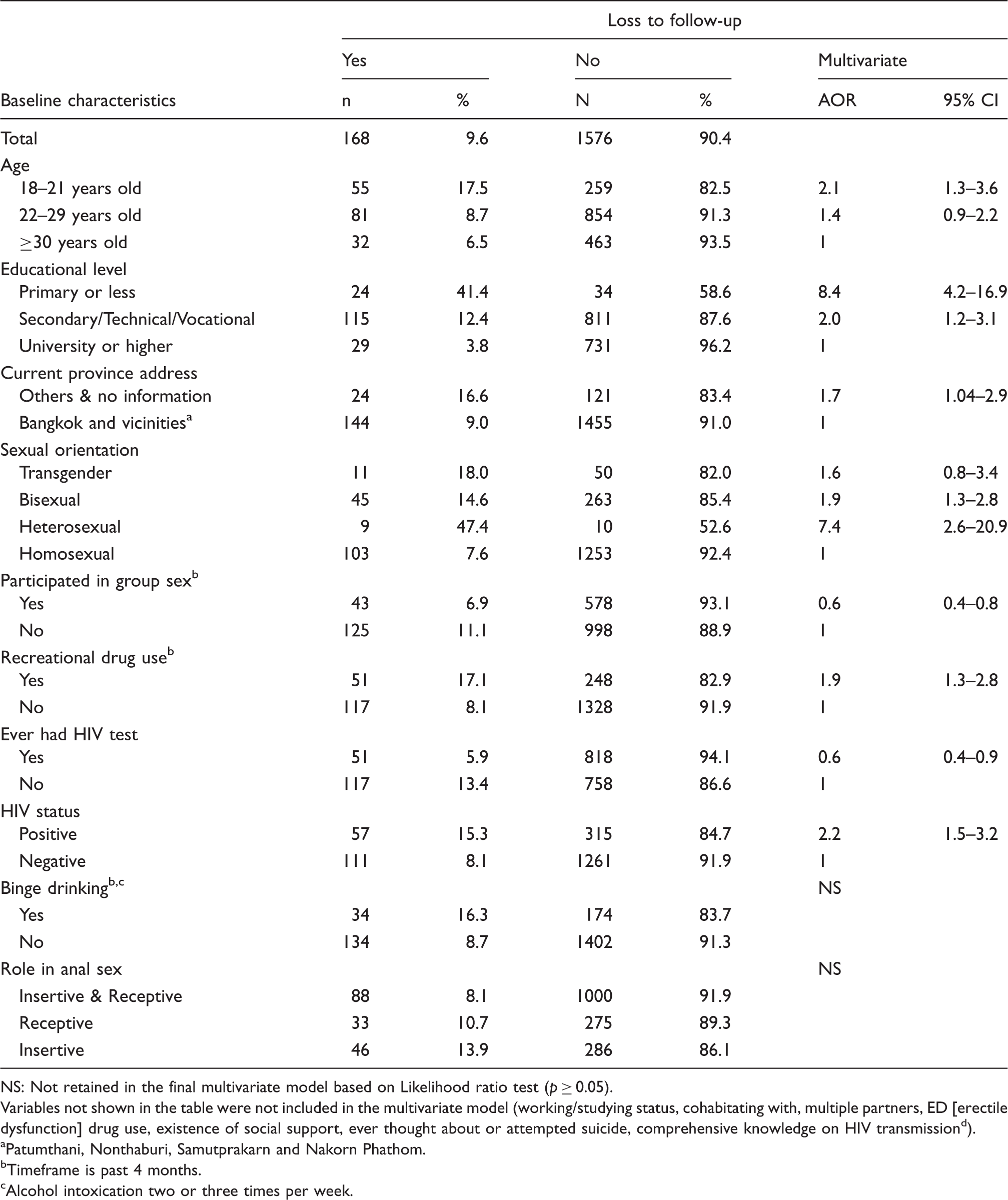
NS: Not retained in the final multivariate model based on Likelihood ratio test (p ≥ 0.05).
Variables not shown in the table were not included in the multivariate model (working/studying status, cohabitating with, multiple partners, ED [erectile dysfunction] drug use, existence of social support, ever thought about or attempted suicide, comprehensive knowledge on HIV transmissiond).
Patumthani, Nonthaburi, Samutprakarn and Nakorn Phathom.
Timeframe is past 4 months.
Alcohol intoxication two or three times per week.
Reporting participation in group sex in the past four months increased by age (30.2% among 18–21 years; 35.4% among 22–29 years; 39.4% among ≥30 years; p for trend <0.01). In contrast, a Chi square test for trend between recreational drug use in past 4 months and age was not statistically significant (data not shown).
Factors associated with prevalent HIV infection between all participants and those retained (i.e. with at least one follow-up visit)
Comparison of factors associated with prevalent HIV infection among all participants and retained participants among Thai men who have sex with men (MSM) enrolled in Bangkok MSM Cohort Study, Thailand 2006–2010.

CI: confidence interval.
NS: Not retained in the final multivariate model based on Likelihood ratio test (p ≥ 0.05). Among all participants; current province address (p = .22), erectile dysfunction drug use (p = .46). Among retained participants; ever had HIV test (p = .06), recreational drug use (p = .08) and binge drinking (p = .53).
Variables not show in the table were not included in the multivariate model (existing of social support, ever thought about or attempted suicide and comprehensive knowledge on HIV transmission [correct answer to all four questions i.e. condoms can protect against HIV transmission during vaginal sex, condoms can protect against HIV transmission during anal sex, HIV can be transmitted through sharing needles and syringes, and a person living with HIV can look healthy]).
1725 observations included in the final model.
1566 observations included in the final model.
Not included: Not included in the multivariate model (p > 0.10).
Patumthani, Nonthaburi, Samutprakarn, and Nakorn Phathom.
Timeframe is past 4 months.
Alcohol intoxication two or three times per week.
Bias assessment
Adjusted relative ORs (ROR) of factors associated with prevalent HIV infection among all participants and retained participants among Thai men who have sex with men (MSM) enrolled in Bangkok MSM Cohort Study, Thailand 2006–2010.

AOR: adjusted odd ratio; ROR: relative adjusted odd ratio; CI: confidence Interval: NA: Interval cannot estimated due to SEretained < SEall.
The interval estimated ROR*exp (±1.96*se).
Timeframe is past 4 months.
Discussion
Our results demonstrate that only 10% of high-risk Thai MSM enrolled in the BMCS were LTFU by month-36. Young age (18–21 years), below secondary education, use of recreational drugs in past four months, no previous HIV testing, being HIV-infected, reporting being heterosexual/bisexual, and living outside Bangkok and the surrounding vicinity were associated with LTFU. These are characteristics similar to the profile of high-risk sexually active young Thai MSM disproportionately affected by HIV infection.13,14 Finally, based on the bias estimate (adjusted ROR) LTFU biased the association between risk characteristics (i.e. sexual orientation: transgender; unprotected anal intercourse: receptive/insertive) and prevalent HIV infection.
We found that characteristics of participants LTFU were similar to those previously reported.3–6 Our results raise an important issue concerning HIV risk behaviour, young MSM were less likely to return for the follow-up visit, which could result in an underestimate of risk behaviour associations in longitudinal studies, given the available data that suggest that they are a high HIV-incidence group.8,15 Recreational drug users and HIV-infected MSM are less likely to return for follow-up visits, especially when newly diagnosed with HIV infection, consistent with previous reports that people who inject drugs or who are newly diagnosed with HIV are at risk for being LTFU. 4 Our participants may have been unaware of their HIV status before being enrolled into the BMCS; only half had ever had an HIV test prior to enrollment in the study. Recently-diagnosed participants may not have fully addressed their health needs, been in denial, or had not yet created a strong link with a care provider or facility. 4 Effective voluntary counselling and testing services emphasising post-HIV counselling are needed to provide a more intensive support for individuals with newly-diagnosed HIV infection.
Recreational drug use in past four months has been associated with high-risk behaviours in other studies among MSM,16–20 suggesting the MSM population is at high risk for HIV infection. LTFU among recreational drug users can introduce bias in estimating associations between HIV infection and other factors. Our analyses failed to detect a relationship between sexual orientation (i.e. transgender), ever having had a HIV test, and recreational drug use in past four months with prevalent HIV infection when data for one-sixth (17%) of the original study sample was excluded due to LTFU.
Participation in group sex in past four months was negatively associated with LTFU, an unexpected finding given sex party participation and use of recreational drugs (‘high party sex’) has been reported in many MSM studies.20,21 Younger participants were less likely to engage in group sex than older participants; however, the distribution of recreational drug use in the past four months was similar between age groups. The association between young age and LTFU may explain the effect of participation in group sex in the past four months and LTFU in our results.
The present study examined the effect of LTFU on the associated factors of prevalent HIV infection. We found that the adjusted RORs between the retained and all participants were nearly identical to most associated factors, except unprotected anal intercourse with any partner (receptive/insertive) and sexual orientation (transgender), especially as the bias estimate (adjusted ROR) of sexual orientation (transgender) exceeded 70%. Our findings demonstrate that LTFU significantly biased the association between prevalent HIV infection and sexual orientation (transgender) as well as prevalent HIV infection and unprotected anal intercourse with any partner (receptive/insertive). Although our LTFU proportion was similar to other HIV prospective studies,4,7 we cannot rule out that non-probability sampling (i.e. convenience sampling), which was used to approach the study participants, may have introduced some bias. However, to apply probability sampling to a subpopulation such as MSM is impossible, given that no sampling frame is available for this population. Our results show an example of how LTFU can distort the validity of findings in a study on prevalent HIV infection among a MSM cohort. We recommend bias estimation should be a part of all cohort studies conducted to investigate HIV infection among subpopulations. We identified 15% of LTFU among HIV-infected MSM, similar to 12% LTFU previously reported among HIV-infected Thai adults starting antiretroviral therapy (ART) 7 and 17% among newly HIV-diagnosed persons in a French database. 4 In addition, a low CD4 count (<50 cells/mm3) was associated with LTFU among HIV-infected after initiation of ART. 3 In our cohort, more than one-third (37%) of those LTFU who were also HIV-infected were eligible for ART according to the Thailand national guidelines for ART at the time of analyses (i.e., start ART at CD4 <350 cells/mm3 22 ). We were not able to determine outcomes (e.g. clinical progression and viral load) for HIV-infected persons who were LTFU in this study.
This study included several limitations. MSM enrolled in the BMCS may not have been representative of the Bangkok MSM community at large because participants were not randomly selected. In addition, desirability bias may have caused under-reporting of sexual and drug use risk behaviours. Lastly, information on specific variables related to LTFU e.g. subject reimbursement for interview, migrant, and retirement were not collected.
Our study demonstrates that future longitudinal cohort studies conducted among MSM in Bangkok should integrate specific measures to minimise LTFU. Special attention should be given to young MSM and those with lower levels of education. Post-HIV test counselling and directed counselling for participants who use recreational drugs are needed to ensure the retention of high-risk participants, not only to ensure validity of study findings but also to provide treatment and care to these vulnerable MSM.
Footnotes
Acknowledgments
We acknowledge the participants of the Bangkok Men Who Have Sex With Men Cohort Study for their time and efforts. In addition, this research could not be possible without the dedication and expertise of the staff at the Silom Community Clinic.
Declaration of Conflicting Interests
The authors declared no potential conflicts of interest with respect to the research, authorship, and/or publication of this article. The findings and conclusions in this report are those of the authors and do not necessarily represent the views of the US Centers for Disease Control and Prevention.
Funding
The authors disclosed receipt of the following financial support for the research, authorship, and/or publication of this article: The US Centers for Disease Control and Prevention sponsored this study.