






Abstract
Barriers to antiretroviral therapy (ART) adherence among pregnant women are varied and complex. This study explored the constructs of a theoretical model, the Health Belief Model (HBM) to understand and predict ART adherence among pregnant women in Guyana. A cross-sectional study surveyed 108 pregnant women attending 11 primary care clinics. ART adherence ranging from the past weekend to three months was assessed through self-reports, and health beliefs with the Adherence Determinants Questionnaire (ADQ). Constructs with sufficient variation in responses were tested for association with the level of adherence using Spearman’s rank correlation coefficient and test. Sixty-seven per cent (72) of the women reported being always adherent. Although there was positive endorsement of ART treatment and adherence, the HBM did not help in understanding or predicting ART adherence in this population. Only one item from the perceived susceptibility construct was significantly associated (p = 0.009) with adherence. Interventions are warranted to address ART adherence in this population, as 19% of the women were recently non-adherent. Although the ADQ did not contribute to a deeper understanding or provide insight into pathways that can be targeted for intervention, theoretical models can play a key role in identifying these pathways.
Introduction
The Caribbean region has an estimated adult HIV prevalence of 1.1% 1 , the second highest after Sub-Saharan Africa. Guyana’s adult HIV prevalence is 1.4% 2 in the general population and 1.9% 2 among pregnant women, with women accounting for an estimated 58.1% 1 of all persons living with HIV.
Antiretroviral therapy (ART) use during pregnancy has contributed to significant reductions in vertical transmission rates as well as improvements in maternal health with overall reductions in morbidity and mortality. However, treatment efficacy requires high levels of adherence. Recent studies indicate that pregnant women are still not achieving the required optimal adherence levels.3,4 Barriers to adherence in this population are varied, and as such, strategies to understand the factors related to poor adherence are important to inform appropriate interventions for optimal maternal and infant health outcomes. The development of successful interventions requires information on the predictors of ART adherence grounded in behavioural science theory to provide the necessary concepts to either change or reinforce behaviour. 5
Theoretical context
In general, behavioural theory is important in identifying processes through which health decisions are made, thus providing insights and explanations about health outcomes. By uncovering these mechanisms and how they work, they offer more effective behaviour change strategies. Behavioural risks such as non-adherence to medication or medical advice, risky sexual activities or the inability to engage in health promotion have serious implications for public health. 6 Similarly, the use of theory for HIV and AIDS prevention can assist in identifying characteristics that play a role in predicting and understanding behaviour. Theory-based interventions can provide the tools for reducing risky behaviour and maintaining healthy habits.7,8
The Health Belief Model (HBM) was selected as the theoretical model for this study, since it is one of the most widely used frameworks in health behaviour research for understanding and predicting adherence behaviour to health advice.9,10 The HBM which dates back to the 1950s 11 has been used to explain and guide interventions to change health behaviour including adherence in chronic health diseases such as HIV,12–15 and emphasizes the role of several factors: (1) perceived severity of a disease; (2) perceived susceptibility of an individual to that disease or susceptibility to disease progression; (3) perceived benefits linked with health behaviour to combat the disease; (4) perceived barriers to practicing the health behaviour; (5) cues to action; and (6) self-efficacy. Perceived severity deals with a person’s belief about the medical, clinical, and social consequences of contracting an illness or leaving it untreated; perceived susceptibility refers to a person’s belief that s/he is at risk of contracting an illness or worsening of the condition; perceived benefits address a person’s beliefs about the efficacy and feasibility of a particular action for treating or preventing illness; perceived barriers refer to a person’s beliefs about the problems s/he may face while trying to perform a health behaviour and weighing the benefits against the negatives; cues are either internal or external triggers resulting in a course of action; and self-efficacy refers to a person’s confidence in his/her ability to successfully execute the action.
The HBM constructs can help to predict the rationale for prevention and control of ill health. It is based on the assumption that persons will change their behaviour if they believe that their health is at risk and their actions could lead to adverse consequences.6,9,11 In terms of adherence to HIV medication, the HBM predicts that adherence is more likely to occur if the individual understands the gravity of their illness, the possibility of advanced HIV disease, the benefits of ARV treatment and the negative consequences of prematurely discontinuing treatment.9,16 Although many studies on ART adherence have been conducted worldwide,17–21 few research studies have incorporated the HBM as a theoretical framework for ART adherence, and none have been conducted in Guyana and the wider Caribbean region.10,12–14 Despite its strength, some deficiencies of the HBM include its emphasis on individual perceptions without consideration of behavioural skills and social or environmental factors.9,22,60 Notwithstanding these criticisms, the HBM has been used to predict patient adherence.9,23,24 In a review of studies utilizing the HBM over a 10-year period (1974–1984), Janz and Becker 9 indicated that research conducted during that period validates the use of the HBM as a tool for interpreting persons’ decisions on health matters. However, they posited that more research needs to be done to streamline the instruments used to measure its constructs.
A literature search for Caribbean studies of ART adherence on PubMed and the HIV Gateway database of Caribbean HIV research 25 yielded 15 peer-reviewed journal articles and abstracts presented at international conferences.18,19,26–38 None focused on ART adherence in pregnancy, none were from Guyana, and none included a theoretical framework (Table 1). Factors found to be associated with ART adherence included: support from family, friends or healthcare providers; being married or co-habiting; satisfaction with the health system; and adherence counselling. Barriers to adherence included: medication side effects; alcohol use; mental health issues such as depression; stigma; lack of food; and being away from home.
This study was conducted to explore the constructs of the HBM to understand and predict adherence to ART among pregnant women in Guyana, and to the author’s knowledge is the first study to examine the HBM among HIV-positive pregnant women in general and Guyana specifically.
Methods
Study setting
The study was conducted at 11 sites (West Demerara Regional Hospital, Campbellville Health Centre, Dorothy Bailey Health Centre, Georgetown Public Hospital Corporation, Beterverwagting Health Centre, East La Penitence Health Centre, Davis Memorial Hospital, Mercy Hospital, New Amsterdam Health Centre, Cumberland Health Centre and Bohemia Health Centre) within three of the ten Administrative Regions of Guyana – regions 3, 4 and 6. Region 4 is the most heavily populated region, with 41.3% of the population, and the three regions contribute to 71.6% of the total population and 88.2% of reported HIV cases. 2 All study sites provide HIV treatment and care services free-of-charge, and also provide primary health care to the general population.
Sampling
The study sites in Regions 3, 4 and 6 were the sites with the highest numbers of the study population during the data collection period, and it is thought that most eligible women attending there in the period were recruited to the study, providing a broadly representative sample of the study population. Eligibility included: being at least 16 years of age; initiating ART prior to or in the current pregnancy; and being capable of giving consent. The author was facilitated by the nurse supervisor to identify patients typical of the target group.
Data collection
A cross-sectional survey was conducted with data being collected between August 2012 and August 2013 using interviewer-administered questionnaires. Ethical approval was obtained from University College London Research Ethics Committee in the United Kingdom, and the Guyana Ministry of Health Institutional Review Board. Written informed consent was obtained from all participants.
Measures
Adherence
The ART adherence measure was based on an adaptation of the Adult AIDS Clinical Trials Group adherence instrument by Chesney and colleagues. 40 Questions queried both recent non-adherence (past four days, weekend) and distal adherence (past three months). Self-reports were used to measure adherence based on three ordered categories: recent non-adherence (persons who missed doses in the past four days or weekend); recent adherence, but distal non-adherence (persons who did not miss doses in the past four days or at the weekend but missed from the past week to three months); and always adherent (persons who had never missed any doses in the past week, weekend or three months).
Health beliefs
The adherence determinants questionnaire (ADQ) was first developed and validated to assess factors related to cancer control by DiMatteo et al. 41 It consists of seven subscales and a total of 38 Likert scale statements varying from 1 (strongly disagree) to 5 (strongly agree). The seven subscales include: interpersonal care and relationship with healthcare providers; perceived utility of treatment; perceived severity of illness; perceived susceptibility to illness progression; subjective norms (beliefs that family and friends support adherence to treatment plan); intentions to comply with treatment; and support/barriers to adherence. The ADQ perceived susceptibility subscale comprised three questions such as ‘No matter what I do, there’s a good chance of my HIV getting worse’. The perceived severity subscale consisted of four questions which included ‘There are many diseases more severe than HIV’. The perceived benefits construct comprised four questions measuring benefits of ARV treatment such as ‘The benefits of my treatment plan outweigh any problems I might have in following it’. Perceived barriers consisted of four questions such as ‘Lots of things get in the way of following my treatment plan’. Items were reverse-scored where appropriate to produce a total score, where higher scores were indicative of greater perceptions. The internal consistency reliability coefficient for the full seven subscales was α = 0.48, with alphas of 0.5, 0.3, 0.1 and 0.4 for perceived susceptibility, perceived severity, perceived benefits and perceived barriers respectively. To facilitate comparison among the subscales, scores were linearly transformed to a 0–100 scale. The HBM constructs of perceived susceptibility, perceived barriers, perceived benefits and perceived severity were assessed with the other three constructs from the ADQ.
Other measures
Additional data were collected on socio-demographic and clinical characteristics including age, race, religion, education, marital status, income, treatment regimen and CD4 T cell count.
Statistical analyses
Data were analysed using Stata IC13. 42 The original five-point Likert scale ranging from ‘strongly disagree’ (1) to ‘strongly agree’ (5) was regrouped into three response categories of ‘Disagree’, ‘Neither’, and ‘Agree’ because of the small numbers within the various response categories. Spearman’s rank correlation coefficient and test was utilised to examine the relationship between the ADQ constructs and levels of adherence.
Results
Characteristics of participants
Published articles and conference abstracts from Caribbean region.
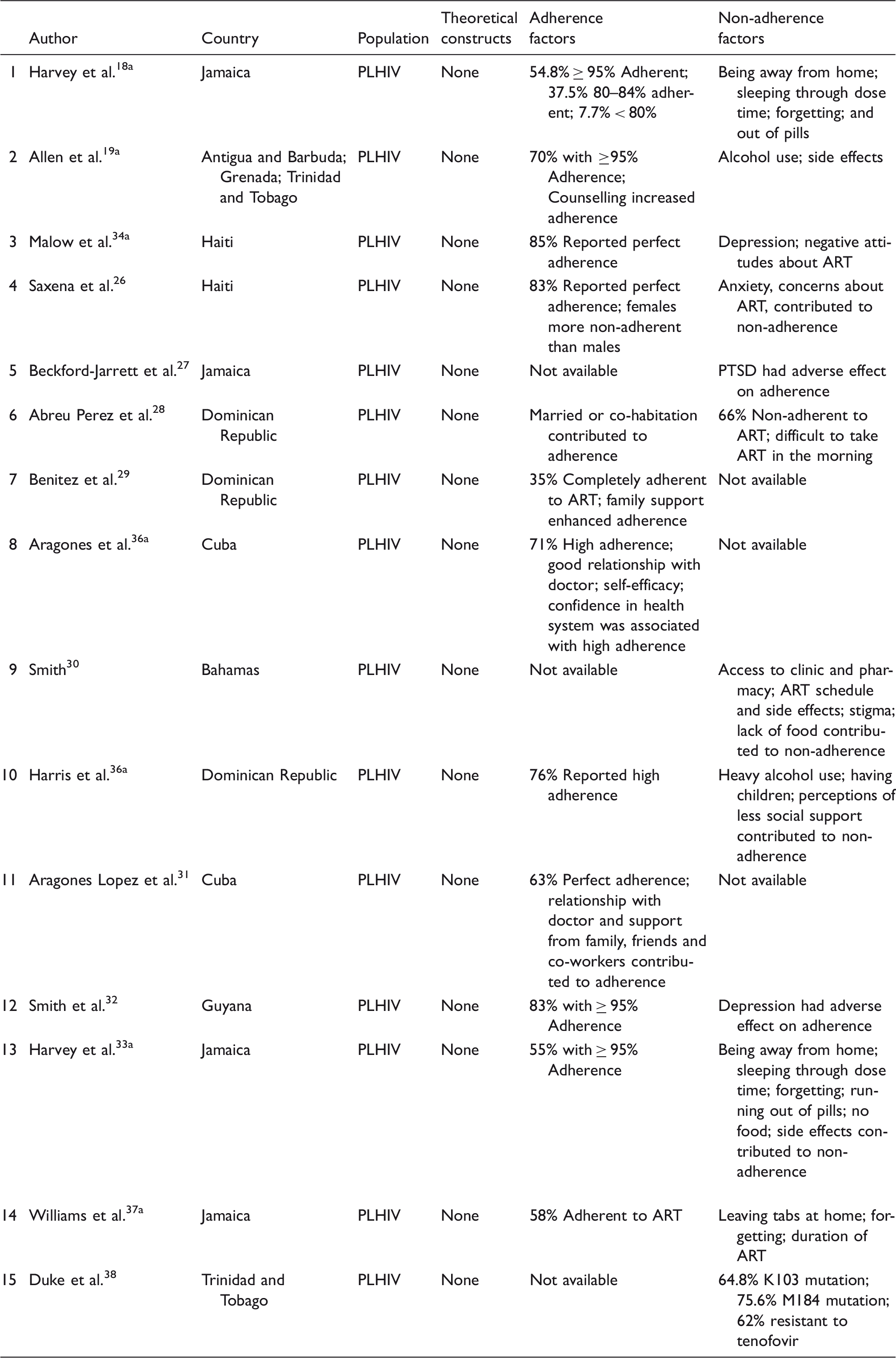
ART: antiretroviral therapy; PLHIV: people living with HIV.
Published journal articles.
ART adherence and health beliefs
Adherence levels for the women were distributed as follows: recent non-adherence (19%); recent adherence, but distal non-adherence (15%); and always adherent (67%), with 34% being non-adherent. Based on the distribution of individual responses to the seven ADQ constructs, only perceived susceptibility and perceived severity had sufficient variation in responses to warrant further examination for associations with adherence.
Perceived severity and susceptibility
Characteristics of HIV-positive pregnant women.
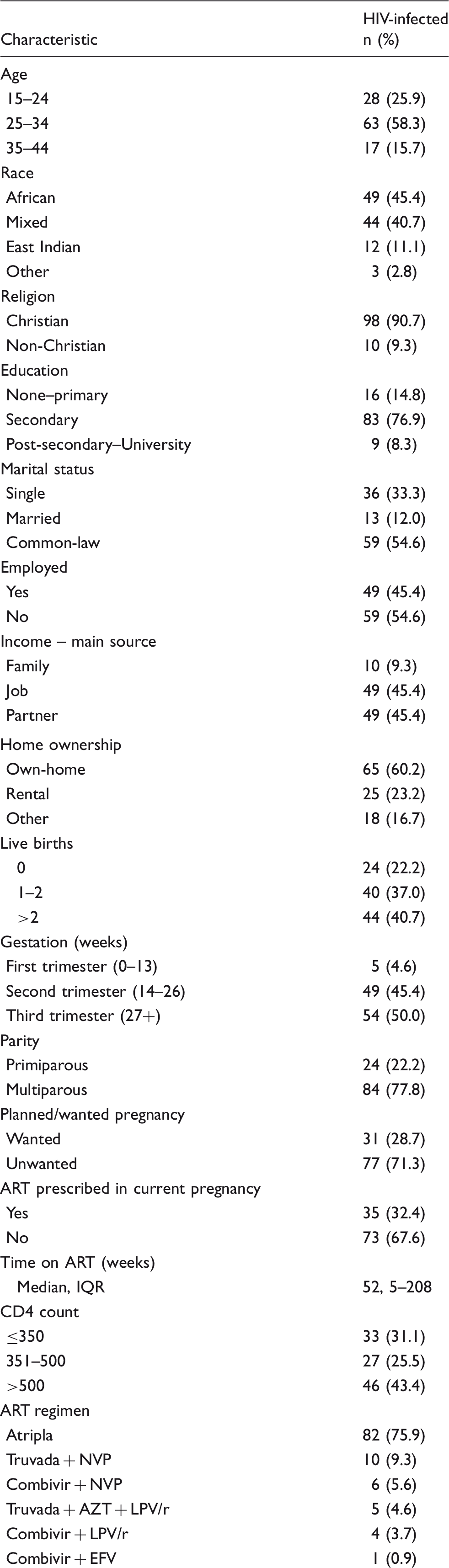
ART: antiretroviral therapy.
Distribution of health beliefs and adherence a .
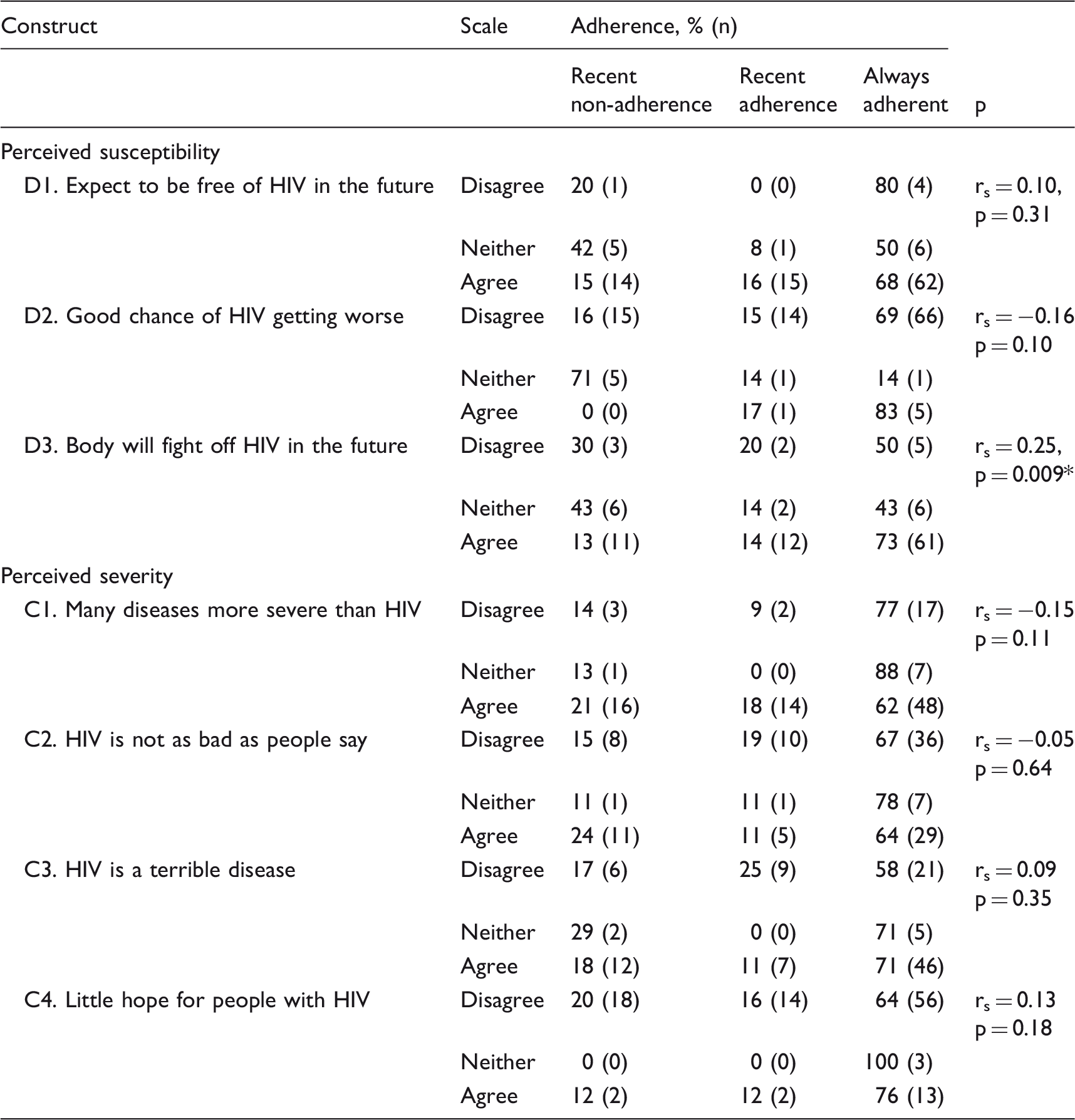
Spearman’s rank correlation coefficient and test; *statistically significant test.
Discussion
These findings indicate that achieving adequate ART adherence levels is a challenge for this group of pregnant women, as only 67% were always adherent and 19% were recently non-adherent. The studies by Mepham et al. 20 and Nachega et al. 3 among pregnant women in other settings have identified adherence levels of 61% and 74%, respectively. Rates ranging from 55% to 90% have been identified among PLHIV in the Caribbean region,18,19,35,37 with data from a Guyana abstract identifying 83% PLHIV with ≥95% adherence 32 albeit different measures and definitions of adherence were applied and none of the studies were among pregnant women.
However, the fact that 19% of the women in the survey were recently non-adherent is a worrying finding as this action not only compromises their own health but also that of the child. Moreover, as this was a cross-sectional survey, this proportion may not truly reflect adherence behaviour, as adherence levels could have fluctuated with the possibility that many more women were non-adherent at other times in the pregnancy, implying that levels of non-adherence may be underestimated and could be much higher in this group. Longitudinal studies are warranted to determine the magnitude of these issues, followed by appropriate interventions.
The HBM was selected as the theoretical framework in this study to gain an understanding of and predict adherence to ART medication among pregnant women. However, these HBM constructs as operationalised by the ADQ did not seem to provide much insight into ART adherence, although overall the women indicated positive endorsement of treatment and adherence. Although the HBM has been used in other populations and settings, this study is the first of its kind among HIV-positive pregnant women. Only one item from the perceived susceptibility construct, D3 ‘Body will fight off HIV in the future’ was significantly associated with adherence. However, due to the number of statistical tests performed on the data, this association might be attributed to chance.
The HBM has had mixed reviews in terms of predicting treatment adherence. Barclay et al. 14 examined the use of the HBM to predict adherence among 185 HIV-positive adults with the HBM components of the ADQ. Their findings indicated that perceived susceptibility and perceived severity were unrelated to adherence in adults over 50 years. However, perceived benefits predicted poor adherence within the younger cohort. Another study by Turner et al. 15 on predictors of adherence among 89 veterans with multiple sclerosis using four HBM constructs found that only perceived benefits predicted adherence. Gao et al.’s 10 study on health beliefs, disease severity, and adherence among 72 HIV-positive participants found two constructs (perceived susceptibility, perceived barriers) significantly related to ART adherence.
One of the criticisms of the HBM is that there is no standard tool to measure the constructs, and all of the studies highlighted in the discussion section used different measures of analysis. Blackwell 16 and Munro et al. 22 contend that the HBM is not a reliable tool for predicting adherence as it produces inconsistent results when used in risk-reduction behaviours ‘linked to more socially determined or unconscious behaviours (Blackwell, 16 p.165).
Another model worth considering in understanding the women’s adherence is Fishbein’s integrative model (IM) for behavioural prediction, an updated model for the theories of reasoned action and planned behaviour.5,43 Fishbein argues that this framework can be used to explain all types of behaviours and includes the constructs of intentions, environmental constraints and skills/abilities. This model includes the construct of environmental constraints which is one of the deficiencies of the HBM. The construct of self-efficacy which originates from Bandura’s Social Cognitive theory is described as a key component for both initiating and maintaining behaviour change, as it measures the ability to successfully achieve an outcome.44,45 Self-efficacy (not measured in this study) was not originally a construct of the four original HBM components, but was later added on to the model.9,22 It is also a component of other health behaviour models, such as the IM discussed above. Several studies have identified a relationship between self-efficacy and adherence, whereby higher self-efficacy predicted better adherence.46–48 As such, the role that this construct plays in the adherence behaviour of this population warrants some attention.
While the Caribbean literature to date has identified environmental and skills factors (mental health, forgetting, medication side effects, lack of self-efficacy and food insecurity) adversely impacting adherence, the use of appropriate interventions guided by randomised control trials (RCTs) have not been undertaken. Evidence from RCTs and observational studies, primarily conducted in resource-limited settings in Africa, provide support for simple or low-cost interventions such as use of mobile phone short messaging system, reminder phone calls, counselling and education, and peer treatment supporters.49–54 The use of theory to inform this type of research can only strengthen the work already documented via the epidemiological approach to yield additional benefits in understanding health behaviour, given the unique cultural, socio-economic, and health system factors confronting the Caribbean region.
Further research work is needed to validate screening tools for adherence and mental health issues, particularly depression, given what has been highlighted in this study and other Caribbean literature.
Strengths and limitations
One of the strengths of this study is that this was the first time the constructs of the HBM were used to examine ART adherence in a pregnant HIV-positive population in Guyana, as well as a low-middle income country.
As this was a cross-sectional study, the associations identified among the variables can only be considered correlations and may not be causal. The small number of responses (<10) for some questions of the ADQ may have limited the ability to detect possible associations with adherence due to limited variance. There was complete endorsement of a single response category for many items of the ADQ. Further, multiple comparison tests of the data may have increased the probability of a type 1 error.
Use of a five-point Likert scale may not be appropriate for use in this population as the subtle differences in scale items agree/strongly agree may have been confusing. Future studies in this population utilizing, for example, a three-point scale using agree, disagree and neither should be undertaken.
The study was based on self-reports of adherence which may be compromised by either lapses in recall or the tendency for a socially acceptable response. However, prior ART studies have found them to be a reliable measurement tool, as results have significantly correlated with other data such as serum levels (viral load, CD4 cell count), MEMS, and pharmacy data.55–58
Conclusion
Although some constructs of the HBM have predicted medication adherence, in this study, however, the use of the ADQ scale as a proxy for the HBM constructs did not seem to help in understanding or predicting adherence in this population. The HBM constructs were generally not found to be associated with adherence, with the lone construct associated producing counter-intuitive results. The HBM as a theoretical model and the ADQ may not be worthwhile tools to help understand or predict adherence in this population, and might be inadequate or inappropriate for this cultural setting. Many ADQ item responses reflected overwhelming positive endorsement for treatment adherence, raising concerns about the ability of the ADQ to properly measure the HBM or its ability to measure these constructs within this population.
Moreover, these results suggest that individual attitudes are of very limited use in explaining adherence and are not primary ART adherence determinants based on the findings from this study, and existing literature from Africa and the Caribbean which tend to indicate that psychological, environmental and socio-cultural factors may be more important. Finally, because adherence is a key factor to achieving UNAIDS’ ambitious target of an AIDS-free generation in low- and middle-income countries by 2030, 59 we need to continue to determine its predictors to better define our interventions. Further testing of this model in this population is warranted with a more simplified Likert scale and a weighting on the construct of susceptibility. Although the tools (ADQ) used to measure the HBM did not contribute to a deeper understanding or provide insight into pathways that can be targeted for intervention, theoretical models play a key role in identifying these pathways.
Footnotes
Acknowledgements
The author would like to express profound gratitude to the women who participated in this study. Special thanks to Lorraine Sherr, Zelee Hill, and Andrew Copas of University College London and the anonymous reviewers for constructive feedback.
Declaration of conflicting interests
The authors declared no potential conflicts of interest with respect to the research, authorship, and/or publication of this article.
Funding
The authors received no financial support for the research, authorship, and/or publication of this article.