






Abstract

Quite why my parents – or should I say Santa – thought a little book about the press should be in my Christmas stocking in 1969, I don't know, but discovering Ladybird's The Story of Newspapers halfway down the net really did change my life. From then on, I knew exactly what I wanted to be: a journalist.
Ladybird books were part of every child's reading in the 1960s. Today, the clever owners of their copyright have used the illustrations again in ironic titles such as Midlife Crisis, The Nerd and The Big Night Out. Then, they were used to teach children to read and to encourage them to become well-informed but wear their knowledge lightly. The Story of Newspapers followed the usual format – a 50-page, 7-inch x 4.5-inch mini-hardback with clear text and full colour illustration, costing 2/6 (and later editions 18p). It was part of series 601 whose titles included The Story of Nuclear Power and Exploring Space. The series was also called “Achievements”, suggesting an era of success and optimism.
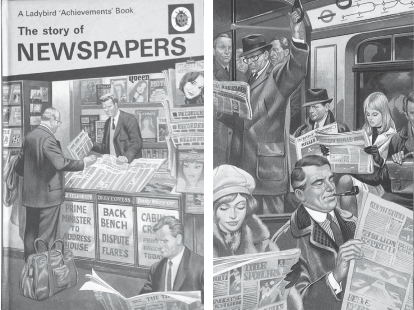
Now the series could be reissued as “Ancient History” or “The Way We Were”. Here was a potted history of news, with an account of the first paper, The Daily Courant, published in 1702, the imposition of the stamp tax, and the start of parliament's press gallery. There was plenty on the Harmsworths, Dickens and Lord Beaverbrook. But its contemporary account of newspapers in the 1960s is now a fascinating historical one. It is not only the explanation of the printing process, with its cylinders and metal plates, which emphasises how different journalism is today, or the picture of the mail train speeding through the night to deliver the papers. It is also the scene in a crowded Tube train, where every single passenger, seated or strap-swinging, is reading a paper. The readers were, according to this Ladybird version of the world, nearly always middle-class. The family depicted leisurely reading the paper in their garden are browsing The Observer.
And then there are the images of journalists at work which seem so archaic: the pipes and the fags that created a fug in every newsroom are there, although there is no hint of the noise of clattering typewriters or constant phones ringing, that provided every paper then with its soundtrack.
What I didn't notice, 50 years ago, was the ominous statement “Some papers have a woman's editor”, indicating the ghetto into which female readers and writers were put. The war correspondent collecting reports is a man, alongside all-male soldiers; the all-male editorial department, or the editorial conference, has one woman, sitting beside the editor. At the age of 10 I assumed the woman at the editorial conference was also a journalist, rather than an editorial PA. After all, journalists were always armed with their shorthand notebooks in this world of newspapers.
Ladybird took its readers through the making of a paper, from newsgathering to the role of news editors, sub-editors, leaders and features, and the role of conferences “to decide the broad outlines of the contents of the next day's paper”. What came across then was the extent to which the paper was a team effort: “the news editor supervises reporters”; “the writing team is completed by the specialists and the critics”. It was also a race against the clock, all determined by the printing press and the trains: “even up to the last minute before printing starts”; “dispatched in time to reach its most distant destination the next morning”.
The Story of Newspapers was produced by two Ladybird regulars, the author William David Siddle and the illustrator Ron Embleton. The pair must have had inside knowledge. The cover illustration shows flyers for different papers. While the one for The Daily Telegraph says “Prime Minister to address house”, the Daily Express's says “Back bench dispute flares”. In the crowded Tube train, one commuter reads a paper whose back page says “Spoilers”.
The section that enthralled me was “The Street of Ink”. After reading it, I too wanted to belong to “the centre of the British newspaper world”. By the time I got to Fleet Street, papers had started to move out. Ladybird was prescient in its account, explaining to readers the problems of competition from other media forms – mostly commercial television then – that would undercut advertising revenue, and that the high-speed rotary presses of the 1960s “may one day be obsolete”. But like so many Ladybird titles of the time, it was unrelentingly upbeat. The printing methods might change, but newspapers would always have a future, it suggested. The day when the Tube train commuters would barely touch a paper and stare at their mobiles was beyond imagining.
