







Abstract
The present experiment tested the impact of sexual objectification on women’s behavior in social interactions. We predicted that when objectified, women would narrow their social presence by spending little time talking, particularly when interacting with men. Participants (males and females) gave an oral introduction of themselves to an alleged interaction partner (male or female). Objectification was manipulated by having participants believe their bodies were either visually inspected or not inspected during this introduction. Specifically, participants introduced themselves through a closed-circuit device in one of three conditions: body (videotaped from the neck down), face (videotaped from the neck up), or audio (no videotaping). Women who were in the body condition and thought they were interacting with men spent less time talking than participants in all other groups. In addition, the majority of women disliked the body condition, indicating that they found having their bodies gazed at aversive. Implications for women’s behavior in mixed-sex contexts are discussed.
Sexual objectification occurs when a person is viewed as a mere body that exists for the pleasure and use of others (Bartky, 1990). This treatment targets women more often than men and occurs both through media portrayals that routinely focus on women’s bodies (Archer, Iritani, Kimes, & Barrios, 1983; Thompson, 2000; Ward, 2003) and through interpersonal interactions that frequently involve comments about or gazes at women’s bodies (Swim, Hyers, Cohen, & Ferguson, 2001). Past research has documented the negative impact of sexual objectification on women’s psychological well-being (Fredrickson, Roberts, Noll, Quinn, & Twenge, 1998; Grabe, Ward, & Hyde, 2008; Quinn, Kallen, Twenge, & Fredrickson, 2006). Very little is known, however, about the impact of objectification during social interaction. In the present research, focusing on an understudied but potentially consequential impact of objectification, we tested how objectified targets present themselves to interaction partners.
Society rewards women for having desirable bodies (e.g., in popularity, marriage opportunity, and economic benefits; Margolin & White, 1987; Unger, 1979). Moreover, focusing on their appearance might assuage women’s existential threats associated with their own creature-like nature (Goldenberg & Roberts, 2004). For these reasons, women are theorized to willingly participate in their own objectification and become preoccupied with appearing as “good objects” (Fredrickson & Roberts, 1997). Drawing on these ideas, we predicted that when objectified, women would try not only to appear as good objects, but also to behave like ones. Because an object does not possess a rich personality, women may narrow their social presence by spending less time talking when objectified in social interactions. In essence, women may silence their full and complex beings and reduce their presence to their bodies. Thus, we set out to examine whether verbal behaviors, such as talking time, are affected by sexual objectification. Because women are more susceptible than men to becoming preoccupied with their physical appearance (Fredrickson et al., 1998; cf. Hebl, King, & Lin, 2004) and do so particularly when anticipating a male’s gaze (Calogero, 2004), we expected that women, but not men, would talk less when objectified, especially when interacting with men.
We also explored the impact of objectification on gender self-stereotyping as a potential alternative process (Chiu, Hong, Lam, Tong, & Lee, 1998; Lorenzi-Cioldi, 1991). Under objectifying conditions, particularly in mixed-sex interactions, women may present themselves as stereotypically female. Thus, women may talk less when objectified not because they are presenting themselves as objects with narrowed presence, but because they are trying to appear feminine, and therefore agreeable and submissive (Rudman & Glick, 2001; see also Zanna & Pack, 1975). However, on the basis of our theorizing and previous findings showing that the effects of objectification on cognitive performance occur independently of gender stereotyping (Quinn et al., 2006), we expected the tendency to present oneself as an object, and not as stereotypically feminine, to account for women’s narrowed presentation under objectifying conditions.
We led female and male participants to believe they were interacting with a male or female partner through a closed-circuit device in one of three communication conditions: body, face, or audio. In the body condition, which was the objectification condition, participants’ bodily appearance was made salient by having them believe that only their bodies were visible in the interaction. In the face condition, participants believed that only their faces were visible in the interaction, which allowed us to control for visual inspection while varying the particular focus on the body. In the audio condition, participants believed that they were only heard and not seen.
We timed participants’ oral introductions of themselves to their partners. Our hypothesis was that women would talk less when objectified, particularly when interacting with men. Thus, we expected a three-way interaction involving participant’s gender, partner’s gender, and condition, demonstrating that women who interacted with men in the body condition spent the least amount of time talking. This effect was expected to be independent of gender self-stereotyping. We also tested whether interacting with a partner who inspects one’s body is an aversive experience for women. Because being objectified is theorized to be a negative experience for women (Fredrickson & Roberts, 1997), we expected that female participants would dislike being in the body condition, relative to the other conditions. Additionally, we expected women to dislike the body condition more than men, who were not expected to experience the negative impact of objectifying treatment (Fitzgerald, 1993).
Method
Participants and design
Participants, who earned research credit, were 207 undergraduate students (93 men, 114 women; mean age = 18.73 years, SD = 1.24). Each was randomly assigned to have either a male or a female alleged interaction partner and to participate in one communication condition (body, face, or audio). Thus, the study involved a 2 (participant’s gender: male, female) × 2 (alleged partner’s gender: male, female) × 3 (communication condition: body, face, audio) between-subjects design.
Procedure and measures
Participants were tested individually. A same-sex experimenter led each participant to a room equipped with a computer, headphones, audio recorder, and video camera. The experimenter explained that the study was examining “what makes an interaction successful” and that the participant would interact with another student in the adjacent cubicle through a close-circuit system. To manipulate the gender of the alleged partner, the experimenter mentioned that the partner was “another female [male] student” and referred to the interaction partner with gendered pronouns (e.g., he or she) throughout the session.
To manipulate objectification, the experimenter explained that the study was examining how people use different channels of communication (“facial expressions, body gestures, and vocal cues”) and that the interaction would therefore be conducted through either an audio or a video channel. The participant then randomly chose one of three folded notes that determined assignment to the communication condition. In the body condition, the experimenter explained that the interaction would be conducted through a video device (which the experimenter angled down to focus on the participant’s body) such that the participant and the partner would view each other only “from the neck down.” In the face condition, the experimenter directed the video camera toward the participant’s face and explained that the interactants would view each other only “from the neck up.” In the audio condition, the experimenter explained that the interaction would be conducted through an audio device and would involve no videotaping. To strengthen the objectifying treatment, the experimenter flipped the camera’s screen to face participants in the video conditions (body and face), so that they saw how they were ostensibly viewed by their partners. In the audio condition, the experimenter covered the camera’s lens, instructing participants to use the audio recorder.
Participants were then instructed to introduce themselves to their (alleged) partner for 2 min, prior to viewing the partner’s introduction. To standardize the introductions, the experimenter handed participants topics to refer to (“four things you like doing the most,” “four things you like doing the least,” “plans for the future,” “your biggest fear”). The experimenter explained that the recording device would stay on for the full 2 min regardless of how long the participant talked. If the participant stopped talking before 2 min passed, the experimenter, who remained in the room during the introduction, said, “There are ___ seconds left. It’s up to you whether you want to keep going or not.” A research assistant, unaware of the hypotheses and conditions, listened to the audio recordings of all participants and timed each participant’s speech.
Upon completing the oral introduction, participants were asked to rate the degree to which different traits (feminine, masculine, and gender neutral) described their personality; ratings were made on a scale from 1, not at all, to 7, very much. Participants believed this questionnaire would be shown to their partner, and thus it was used to examine whether women presented themsleves as steretoypically female in the body condition. The feminine traits were associated with communal orientation (“compassionate,” “self-sacrificing,” “caring,” “faithful,” “giving”; α = .76), and the masculine traits with agency (“competent,” “intelligent,” “ambitious,” “a leader”; α = .67; Rudman & Glick, 2001).
After participants completed this questionnaire, the experimenter stepped out of the room, supposedly to hand the questionnaire to the partner. Meanwhile, participants completed additional questions presented as serving research purposes only and not to be seen by the partner. These questions included the items for the objectification manipulation check, which were rated on a scale from 1, not at all, to 7, very much: “I felt more like a body than as a real person while presenting myself” and “while introducing myself I felt as if my body and my identity were separate things,” r(205) = .56, p < .01; also included were the measure of least preferred condition (“If I could choose the condition I would NOT like to be in, I would choose: 1. body/2. face /3. audio”) and demographic questions.
Results
Manipulation check
A 2 (participant’s gender) × 2 (partner’s gender) × 3 (communication condition) between-subjects analysis of variance (ANOVA) was conducted on the objectification manipulation check. The only significant effect was a main effect for communication condition, F(2, 195) = 4.57, p < .05, η p 2 = .05. A planned contrast using weights of 2 (body), –1 (face), and –1 (audio) demonstrated that participants in the body condition felt more like objects (M = 3.56, SD = 1.63) compared with those in the other two conditions (face condition: M = 3.05, SD = 1.42; audio condition: M = 2.77, SD = 1.45), t(204) = 2.92, p < .01. The orthogonal contrast between the face and audio conditions was not significant, t(204) = 1.12, p = .26. Thus, as intended, the body condition, compared with the other two conditions, led both male and female participants to focus more on their bodies.
Talking time
A 2 (participant’s gender) × 2 (partner’s gender) × 3 (communication condition) ANOVA on talking time, measured in seconds, revealed a main effect for participant’s gender. Women (M = 107.25, SD = 20.70) talked less than men (M = 114.68, SD = 9.65), F(1, 195) = 16.29, p < .01, η p 2 = .08. A main effect for partner’s gender further revealed that participants who believed they were interacting with a man talked less (M = 106.15, SD = 21.73) than those who believed they were interacting with a woman (M = 114.28, SD = 10.57), F(1, 195) = 13.56, p < .01, η p 2 = .07.
The predicted three-way interaction was obtained, F(2, 195) = 3.07, p < .05, η p 2 = .03 (see Fig. 1). Pair-wise comparisons using Tukey’s b revealed that women who were in the body condition and thought they were interacting with a man talked significantly less than all other groups in the study. Additionally, women who were in the face condition and thought they had a male partner, although they talked significantly more than women who were in the body condition and thought they had a male partner, talked significantly less than participants in all other groups. The remaining pair-wise comparisons were not significant. Thus, women talked less than men only when visually inspected by a male partner, and particularly when the inspection was directed at their body.
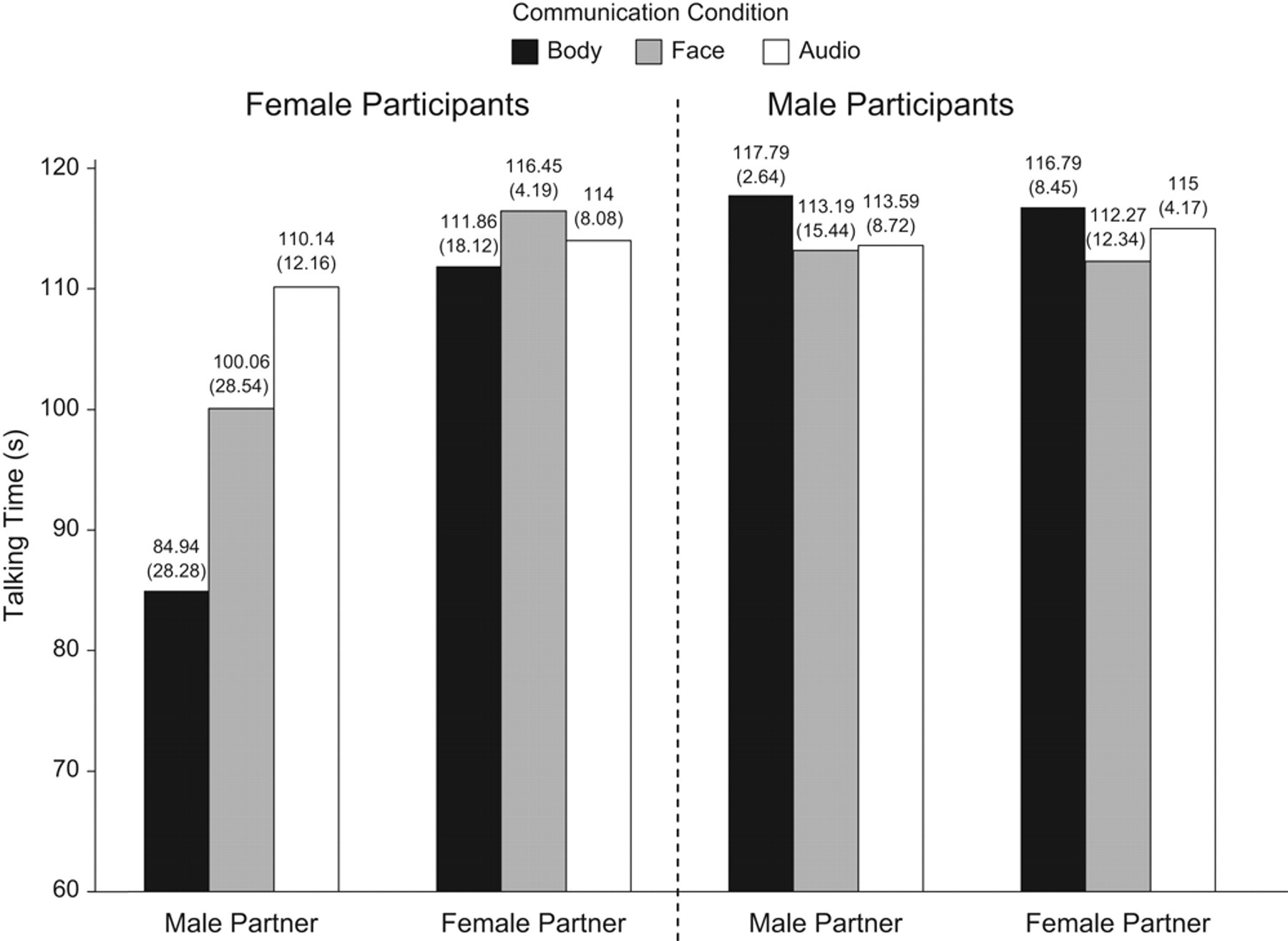
Talking time as a function of participant’s gender, partner’s gender, and communication condition. Standard deviations are presented in parentheses.
Gender self-stereotyping
To examine the possible role of gender self-stereotyping, we conducted a 2 (participant’s gender) × 2 (partner’s gender) × 3 (communication condition) × 2 (gender stereotype: communion vs. agency) mixed-model ANOVA, with the last factor varying within subjects. The analysis revealed a Participant’s Gender × Gender Stereotype interaction, F(1, 194) = 8.11, p < .01, η p 2 = .04. Pair-wise comparisons using Tukey’s b revealed that whereas women presented themselves as more communal (M = 5.82, SD = 0.75) than men (M = 5.33, SD = 0.82), there were no gender differences in agentic self-descriptions (men: M = 5.48, SD = 0.87; women: M = 5.57, SD = 0.80). Women also described themselves as more communal than agentic. The remaining pair-wise comparisons were not significant.
There were no significant effects of communication condition on gender stereotyping, and the Communication Condition × Participant’s Gender × Partner’s Gender × Gender Stereotype interaction was not significant, F(2, 194) = 0.50, n.s. Supporting our prediction that the effects of objectification on talking time would be independent of gender self-stereotyping, the relevant three-way interaction for talking time remained significant after controlling for communal and agentic ratings, F(2, 192) = 3.05, p = .05, η p 2 = .03.
Least preferred condition
To determine whether interacting with a partner who inspects one’s body is an aversive experience for women and not for men, we tested the condition least preferred by male and female participants. Among women, the percentage who disliked the body condition (61.1%) was significantly greater than the percentage who disliked the face condition (31.5%), χ2(1, N = 90) = 10.24, p < .01, or the audio condition (7.4%), χ2(1, N = 74) = 45.46, p < .01 (see Fig. 2). There was also a significant difference between the latter two percentages, χ2(1, N = 42) = 16.10, p < .01. Among men, the percentage who disliked the body condition (35.9%) was not significantly different from the percentage who disliked the face condition (42.4%), χ2(1, N = 71) = 0.50, n.s., and was somewhat greater than the percentage who disliked the audio condition (21.7%), χ2(1, N = 53) = 3.19, p = .07. There was a significant difference between the latter two percentages, χ2(1, N = 59) = 6.12, p < .05. Thus, women, but not men, showed a particular aversion to the body condition. In addition, of the participants (men and women) who disliked the body condition, the percentage who were women (66.67%) was larger than the percentage of women in the sample as a whole (55%), χ2(1, N = 99) = 5.44, p < .05, which indicates that women had a stronger dislike for the body condition than men.
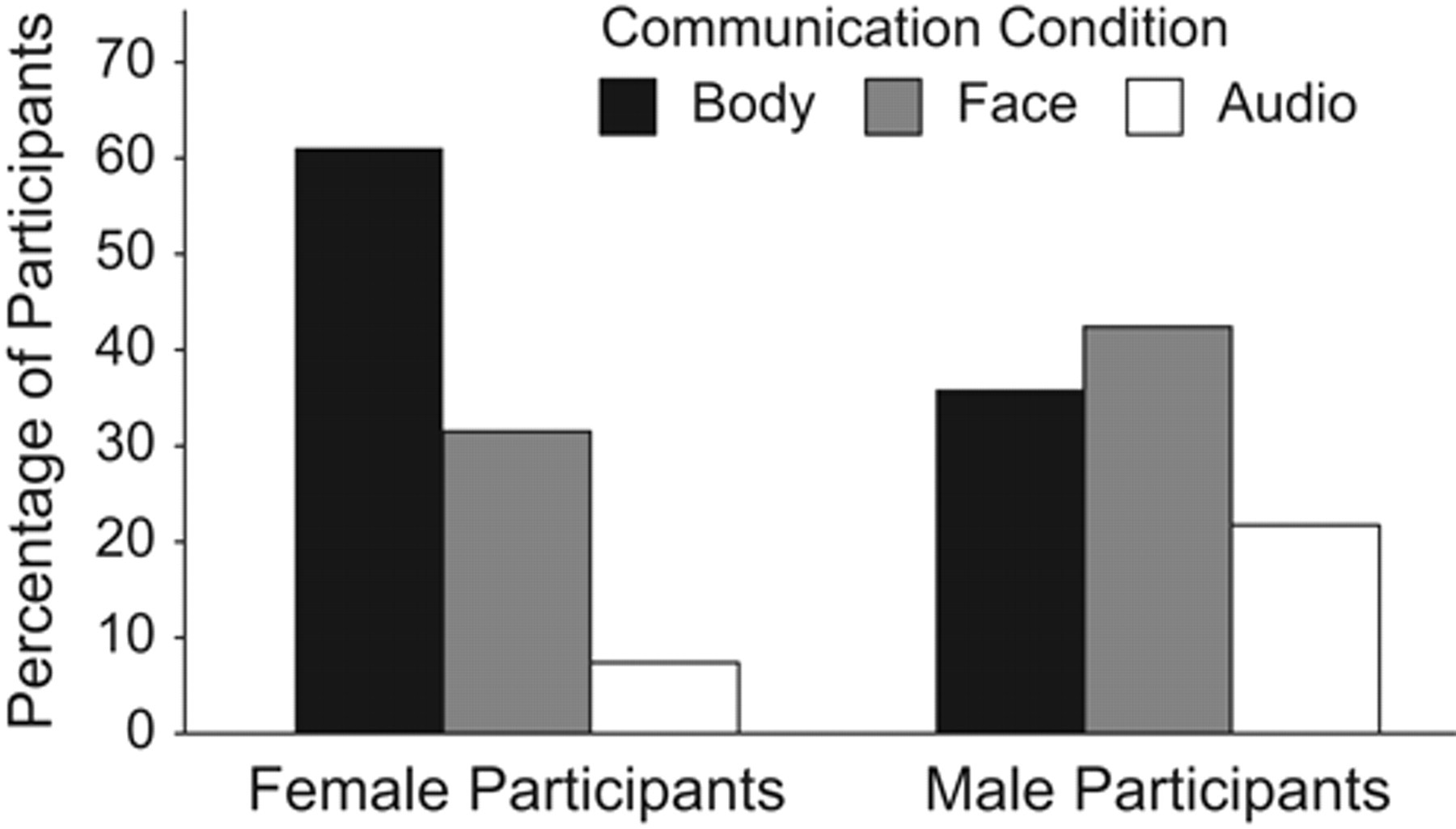
Percentages of women and men who chose each communication condition as their least preferred one.
Discussion
Whereas previous work has emphasized the effects of objectification on women’s mental health and intellectual performance, the present research identified the impact of objectification on women’s behaviors in social interactions. We demonstrated that when a woman believes that a man is focusing on her body, she narrows her presence in the interaction by spending less time talking. The impact of objectification on talking time occurred independently of gender self-stereotyping, which suggests that attempts to behave femininely did not account for this effect. It is important to note that the majority of women disliked the body condition, indicating they found having their bodies gazed at aversive. In addition, when freed from this experience, and from visual inspection more generally (i.e., in the audio condition), women did not talk less than men. Our results support objectification theory (Fredrickson & Roberts, 1997) in that it was only women, and not men, who narrowed their presence as a result of a focus on their bodies, and it was a male’s gaze and not simply any gaze that affected women’s presence.
Although the effect of objectification on talking time was empirically established in our study, the underlying mechanism is less clear. One motivational explanation, derived from our theorizing, is that women talk less when objectified because they attempt to align their behavior with what they assume is expected of them as sexual objects. Another possibility is that women’s cognitive resources are consumed by regulating concerns about appearance (Quinn, Chaudoir, & Kallen, in press), which might leave them with less capacity to organize and express their thoughts. Future research might also consider the generalizability of our work to more naturalistic settings. To manipulate communication condition (body, face, or audio), we used an unusual focus that is unlikely to occur outside of the laboratory, where people participate in more complex interactive contexts and objectification often occurs more subtly.
Nevertheless, because women often recognize that their bodies are the target of visual inspection outside of the laboratory, our findings indicate that they may narrow their presence and thereby hinder their performance in mixed-sex contexts, including job interviews, work meetings, or classroom interactions. Recognizing that their bodies are the target of visual inspection may also affect women’s mental health, particularly given the relationship between self-silencing and women’s risk for depression (Jack, 1991; Whiffen, Foot, & Thompson, 2007). Thus, the present research has theoretical as well as practical implications for understanding the effects of objectification on women’s behavior in social interactions and ultimately on their long-term welfare.
Footnotes
Acknowledgements
We thank Megan Riley, Teresa Reyes, and Jonathan Rosen for assistance in data collection.
The authors declared that they had no conflicts of interests with respect to their authorship and/or the publication of this article.