







Abstract

Ever since Thompson (1980) inverted Margaret Thatcher’s eyes and mouth, to grotesque effect (Fig. 1a), researchers have puzzled over why “Thatcherized” faces look so bizarre and why the effect disappears with inversion. After much study, 1 the Thatcher illusion has been attributed to distorted spatial relations between features, which make the upright face look bizarre, and to difficulty coding these spatial relations in inverted faces (for reviews, see Anstis, 2005; Rhodes & Jeffery, 2009). This conclusion fits snugly into a long-standing theoretical view that orientation-sensitive configural coding of spatial relations is central to face expertise (Diamond & Carey, 1986; Maurer, Le Grand, & Mondloch, 2002; Peterson & Rhodes, 2003; Rossion, 2008; Yin, 1969). As a result, in introductory psychology courses, Thompson’s Thatcher has become a “poster girl” demonstrating the importance of configural coding in face perception.
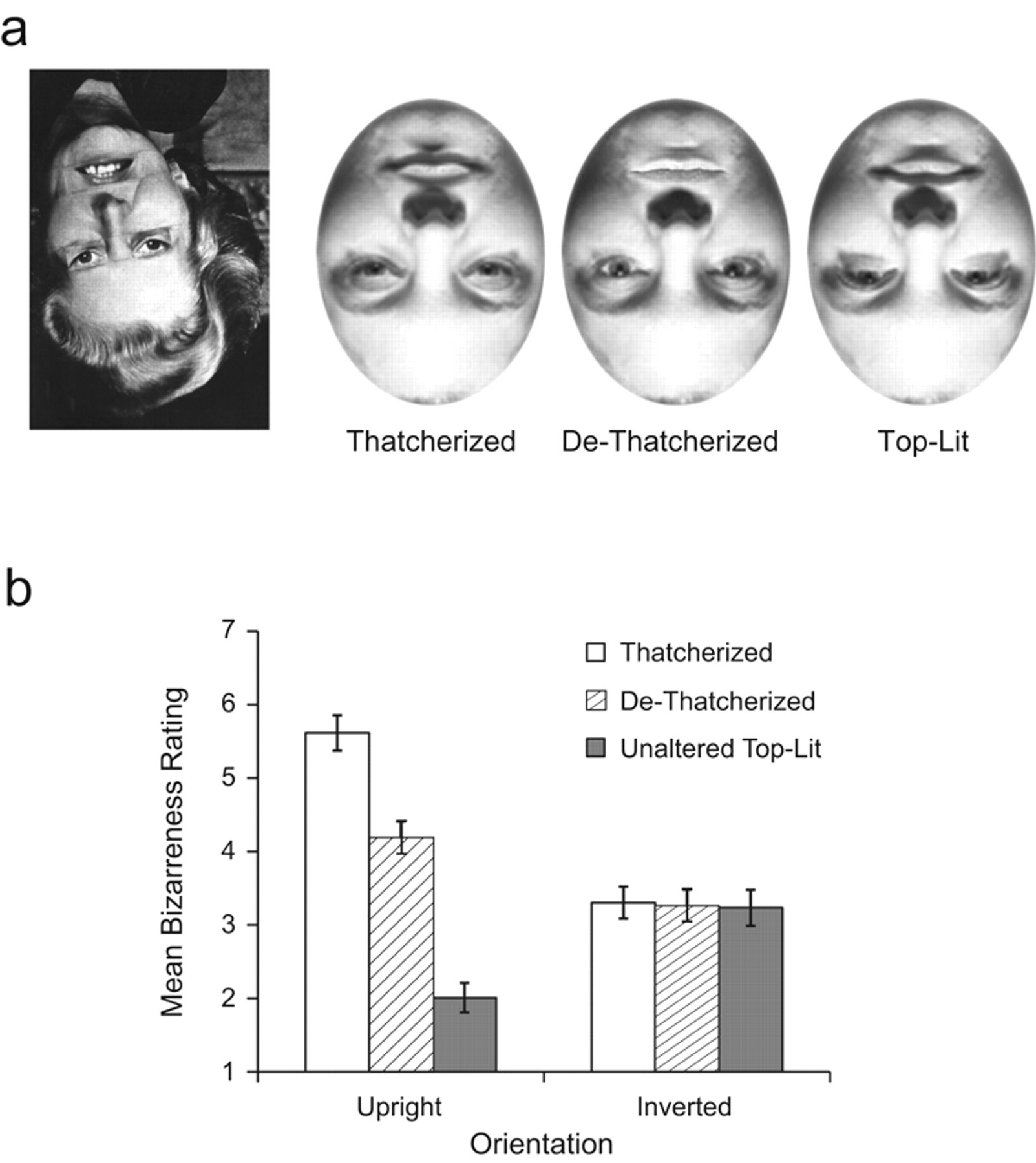
Illustration of the Thatcher illusion and experimental stimuli and results. The illustrations in (a) show Margaret Thatcher with inverted (upside-down) eyes and mouth, along with examples of the stimuli used in the experiment. The inverted features in Thatcherized faces result in inconsistent lighting, with bottom-lit features appearing in top-lit faces. The grotesque effect can be seen by turning the page upside-down. When the inconsistent lighting is eliminated in de-Thatcherized faces, which have inverted eyes and mouth from a bottom-lit face, much of the bizarreness disappears. The graph (b) presents mean bizarreness ratings for upright and inverted Thatcherized, de-Thatcherized, and unaltered top-lit faces. The error bars represent standard errors.
However, the very strength of the Thatcher illusion challenges this interpretation. Other abnormal spatial relations simply do not produce inversion effects as large as those seen for Thatcherized faces (Bartlett & Searcy, 1993; McKone & Yovel, 2009; Murray, Yong, & Rhodes, 2000; Rhodes, Brake, & Atkinson, 1993), which suggests that there is more to the illusion than altered configuration. We show here that the solution to this puzzle lies in disrupted shape-from-shading perception caused by inverted features. Extraction of shape from shading is done globally, assuming (unconsciously) a single, overhead, source of illumination (Kleffner & Ramachandran, 1992; Ramachandran, 1988). We suggest that Thatcherized faces are assumed to be uniformly top lit (cf. Hill & Bruce, 1993), although the inverted eyes and mouths are actually bottom lit. As a result, these features appear concave, giving a sunken, ghoulish appearance.
To test this shape-from-shading hypothesis, we created “de-Thatcherized” faces, in which eyes and mouths from bottom-lit faces were inverted and pasted onto top-lit faces, giving the appearance of convex features lit from above (Fig. 1a). We predicted that these faces would look less bizarre when upright and have smaller inversion effects than Thatcherized faces even though both face types have inverted features.
Method
Participants
Seventeen Caucasians (9 female, 8 male; mean age = 21 years, SD = 7.4, range: 18–49) from the University of Western Australia participated for course credit.
Stimuli
Twelve adult Caucasians (6 female, 6 male) were photographed supine to eliminate gravity-induced differences between upright and inverted images (Enns & Shore, 1997; McMullen, Shore, & Henderson, 2000). A single light source, angled 45° above or below the middle of the face, provided top and bottom lighting, respectively. Pupils were horizontally aligned, and Thatcherized faces were created by flipping the eyes (including lashes, excluding eyebrows) and mouth of each top-lit face in Photoshop (Fig. 1a). De-Thatcherized faces were created by flipping the eyes and mouth of each bottom-lit face and pasting them onto the top-lit face (Fig. 1a). An oval mask eliminated hair and ears. Faces measured 8.9° horizontally. The experimental stimuli consisted of the original top-lit faces, plus their Thatcherized and de-Thatcherized versions, for 10 of the 12 models. Images for the remaining 2 models were used as practice stimuli. The faces were unfamiliar.
Procedure
On each trial of a forced-choice task, the Thatcherized and de-Thatcherized versions of a face were presented side by side for 2 s (random trial order), and participants chose which looked more bizarre. Each pair was shown once in each orientation (upright, inverted) and once in each left/right arrangement, for a total of 40 trials (10 models × 2 orientations × 2 left/right arrangements). The task began with 8 practice trials (2 models × 2 orientations × 2 left/right arrangements). In a rating task, upright and inverted Thatcherized, de-Thatcherized, and unaltered top-lit faces were presented individually for 1.5 s each (random order) and rated for bizarreness using a 7-point scale. Sixty experimental trials (10 models × 2 orientations × 3 versions) were preceded by 12 practice trials using the other 2 models. 2 Task order was randomized. Participants used a chin rest (n = 8) or were told not to tilt their heads (n = 9). There was no effect of presence/absence of the chin rest, and we do not consider this factor further.
Results
Forced-choice task
One face was recognized by 1 participant, so data for that face were dropped. As predicted, the proportion of trials on which the Thatcherized face was chosen as more bizarre than the de-Thatcherized face was very high. The (upright) Thatcherized face was almost always chosen (M = .94, SD = .02), and at a rate significantly above chance (.50), t(16) = 47.20, p < .0001. This bias was significantly reduced for inverted faces (M = .60, SD = .03), F(1, 16) = 63.58, p < .0001 (η p 2 = .799), but remained above chance, t(16) = 17.76, p < .0001.
Rating task
A two-way analysis of variance with face type (Thatcherized, de-Thatcherized, top-lit) and orientation (upright, inverted) as repeated measures factors yielded significant effects of face type, F(2, 32) = 113.38, p < .0001, η p 2 = .876, and orientation, F(1, 26) = 37.87, p < .0001, η p 2 = .703, and a significant interaction, F(2, 26) = 116.38, p < .0001, η p 2 = .879. Planned comparisons showed that for upright faces, de-Thatcherized versions looked much less bizarre than Thatcherized versions, t(16) = 8.00, p < .0001, supporting the shape-from-shading hypothesis (Fig. 1b). Not surprisingly, unaltered faces looked even less bizarre than de-Thatcherized faces (Fig. 1b), t(16) = 11.79, p < .0001. The inversion effect (upright minus inverted) was also substantially reduced for de-Thatcherized faces relative to Thatcherized faces (Fig. 1b), t(16) = 6.25, p < .0001, as predicted, but remained significant, t(16) = 6.03, p < .0001.
Conclusion
These results demonstrate that misperception of three-dimensional feature shape contributes strongly to the bizarre appearance of upright Thatcherized faces and the loss of that bizarreness with inversion. When we removed the inconsistent lighting cues responsible for this misperception, in de-Thatcherized faces, the illusion was greatly reduced (Fig. 1b). It did not, however, disappear completely, which indicates that sensitivity to two-dimensional spatial relations between or within features also contributed. We conclude that the Thatcher illusion results from the orientation sensitivity of mechanisms that code three-dimensional, as well as two-dimensional, feature shape and spatial relations. More generally, our results highlight the neglected roles of both three-dimensional information and feature appearance in face perception (Harris & Aguirre, 2009; Hill & Bruce, 1996; McKone & Yovel, 2009; Rhodes, Hayward, & Winkler, 2006).
Footnotes
Acknowledgements
This work formed part of an honors thesis submitted to the University of Western Australia by the first author.
The authors declared that they had no conflicts of interests with respect to their authorship and/or the publication of this article.
This work was supported by the Australian Research Council.
1.
Thompson (1980) has received more than 50 citations in the past 5 years and is among the 10 most cited articles of the journal Perception, in which it was published (Rhodes & Jeffery, 2009).
2.
Intermediate orientations were also presented, but those results are beyond the scope of this report.