






Abstract
Infants are highly sensitive to statistical patterns in their auditory language input that mark word categories (e.g., noun and verb). However, it is unknown whether experience with these cues facilitates the acquisition of semantic properties of word categories. In a study testing this hypothesis, infants first listened to an artificial language in which word categories were reliably distinguished by statistical cues (experimental group) or in which these properties did not cue category membership (control group). Both groups were then trained on identical pairings between the words and pictures from two categories (animals and vehicles). Only infants in the experimental group learned the trained associations between specific words and pictures. Moreover, these infants generalized the pattern to include novel pairings. These results suggest that experience with statistical cues marking lexical categories sets the stage for learning the meanings of individual words and for generalizing meanings to new category members.
Infants spend a great deal of time listening to their native language. Although they presumably understand very little of what they hear, this experience plays a critical role in later language development. For example, during the 1st year, infants begin to notice predictable sound sequences, such as frequently co-occurring syllables and the alternation of strongly and weakly stressed syllables (e.g., Jusczyk, Cutler, & Redanz, 1993; Jusczyk, Luce, & Charles-Luce, 1994; Saffran, Aslin, & Newport, 1996). Sensitivity to these patterns allows infants to extract candidate words from fluent speech (e.g., Jusczyk, Houston, & Newsome, 1999; Saffran, 2001) and to link the sounds of these nascent lexical items with their meanings (Graf Estes, Evans, Alibali, & Saffran, 2007).
One way that infants learn these properties of language is by tracking statistical information, or the frequencies and co-occurrence probabilities of sounds and words. Statistical learning mechanisms are well suited to learning about the specific items that infants encounter, such as frequent sound sequences (e.g., Saffran et al., 1996). Growing evidence suggests that statistical learning also supports acquisition of abstract language structure, such as syntactic categories (e.g., noun, verb, adjective), which are the building blocks of syntax. For example, two statistical cues that reliably distinguish words from different syntactic categories are distributional cues, or the sentence contexts in which words are likely to occur (Mintz, Newport, & Bever, 2002), and phonological cues, or words’ sound properties (Kelly, 1992; Monaghan, Chater, & Christiansen, 2005). By the age of 12 months, infants can use correlations between distributional and phonological cues to group words from an artificial language into categories (Gerken, Wilson, & Lewis, 2005; Gómez & Lakusta, 2004; Lany & Gómez, 2008).
However, to learn the kinds of categories present in natural languages, infants must integrate what they learn about words’ distributional and phonological properties with information about their meanings. Semantic information is a critical dimension that distinguishes categories; for example, nouns are likely to refer to objects, whereas verbs tend to refer to actions. Despite substantial research suggesting that infants track statistical cues that point to lexical categories, little is known about the interaction between statistical and semantic information during early language learning. One possibility is that infants’ early experience with the sounds and distributions of words facilitates the subsequent discovery of the semantic properties common to words belonging to the same category (Maratsos & Chalkley, 1980). However, mapping between word forms and referents is a demanding task for infants (e.g., Stager & Werker, 1997), and they may be unable to accurately identify and maintain information about a word’s distributional context and phonology while simultaneously tracking potential referents. Moreover, another prominent hypothesis holds that infants initially use the semantic properties of words to form syntactic categories (Grimshaw, 1981; Pinker, 1984), and that such learning bootstraps sensitivity to the distributional and phonological regularities characterizing these categories. If this is the case, infants may fail to integrate statistical cues with semantic information, at least initially.
The experiments reported here were thus designed to investigate whether experience with statistical cues facilitates infants’ acquisition of the semantic properties of word categories. We used an artificial-language methodology to independently manipulate statistical (distributional and phonological) and semantic (word-referent) cues. Figure S1 in the Supplemental Material available on-line contains a schematic illustration of the procedure. The critical manipulation took place in the first phase, in which 22-month-old infants listened to a language containing two word categories that either were or were not reliably marked by statistical cues (experimental and control groups, respectively). All infants were then trained on identical pairings between a subset of these words and pictures from two semantic categories. Words from one category were used as labels for animals, and words from the other category were used as labels for vehicles. We tested whether infants learned the trained associations between words and pictures, and also whether they generalized the semantic properties common to the word categories. The question of interest was whether infants’ initial exposure to categories that were well marked by statistical cues in the absence of referents (experimental group) would facilitate later semantic learning.
Experiment 1
Method
Participants
Sixty-four infants (mean age = 22.2 months, range = 21.3–22.7) were randomly assigned to the experimental (13 female, 19 male) or control (15 female, 17 male) condition. All infants were born full term; were free of problems with hearing, vision, or language, according to parental report; and came from monolingual English-speaking homes. Data from additional infants were excluded because of excessive fussiness (n = 11), inattention (n = 11), or equipment failure (n = 3).
Materials
In the auditory familiarization phase, infants listened to a sequence of two-word phrases from an artificial language (Table 1) while no referents were present. The experimental language contained the word categories X and Y, each consisting of 8 words. These categories were distinguished by correlated phonological and distributional cues: X words were disyllabic and followed each of two a words in phrases (e.g., ong coomo, erd coomo), whereas Y words were monosyllabic and followed each of two b words in phrases (e.g., alt deech, ush deech). The control language contained the same vocabulary, but the a words preceded half of the X words and half of the Y words, whereas the b words preceded the remaining X and Y words. Thus, although the control language contained distributional regularities that could be used to form word categories (i.e., X 1–4 and Y 5–8 belonged to one category, and X 5–8 and Y 1–4 belonged to a different category), words belonging to each of these categories could be either monosyllabic or disyllabic; that is, phonological cues to category membership were removed. Infants typically fail to acquire category-based structure when words’ distributional and phonological properties are uncorrelated (Gerken et al., 2005; Gómez & Lakusta, 2004; Lany & Gómez, 2008).
The Phrases Used in Auditory Familiarization
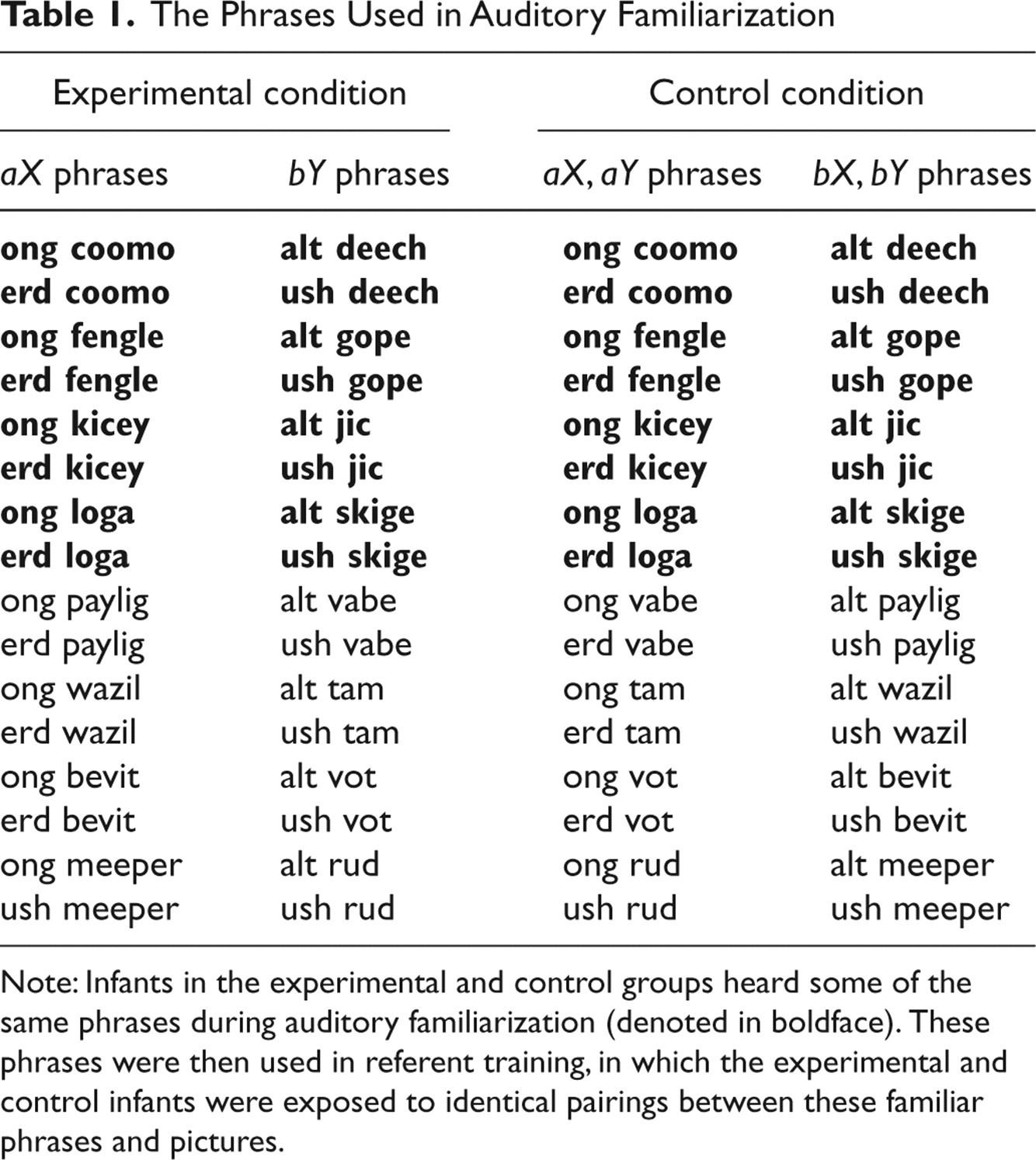
Note: Infants in the experimental and control groups heard some of the same phrases during auditory familiarization (denoted in boldface). These phrases were then used in referent training, in which the experimental and control infants were exposed to identical pairings between these familiar phrases and pictures.
The language materials were spoken by an adult female in an animated voice and digitized for editing. One token of each word was selected, and phrases were created by splicing these tokens together, separated by 0.1 s of silence. Strings were created by combining an a phrase and a b phrase separated by 0.3 s of silence. Strings were separated by 0.7 s of silence. The experimental and control languages each contained 32 unique phrases.
In the second phase, referent training, infants viewed pictures of animals and vehicles as they were labeled by aX and bY phrases that had been heard during auditory familiarization (Table 2). Three X words and three Y words were uniquely paired with pictures of animals and vehicles unlikely to be familiar to infants of this age according to MacArthur Communicative Development Inventory norms (Dale & Fenson, 1996). Each X word and Y word was used as a label in two unique phrases (e.g., ong coomo, erd coomo). Critically, infants in the experimental and control groups observed the same picture-phrase associations, and for both groups, familiar aX phrases referred to pictures from one category, and familiar bY phrases referred to pictures from the other category. However, only the infants in the experimental group had experienced reliable statistical cues indicating that those X and Y words belonged to different categories.
Picture-Phrase Pairings Used in Referent Training

Note: The aX and bY phrases familiar to infants in the experimental and control conditions from auditory familiarization (the boldface phrases in Table 1) were used as labels for pictures of animals and vehicles during referent training. The pairings between the word categories and picture categories were counterbalanced across conditions, such that X words referred to animals and Y words to vehicles for half of the infants, and X words referred to vehicles and Y words to animals for the other half. Infants were exposed to three animal-label pairings and three vehicle-label pairings (either the first or the final three of the pairings listed for each category). The remaining two pairings were presented on generalization trials in the test phase.
The pictures were taken from a set of four animals and four vehicles. The particular pictures that were trained versus withheld to examine generalization in the subsequent test phase were counterbalanced across infants. In addition, half of the infants heard aX phrases referring to animals, and half heard them referring to vehicles.
Test materials consisted of two pictures from referent training (one animal and one vehicle) and two unfamiliar pictures (also one animal and one vehicle). On each familiar trial, infants saw an animal or vehicle picture from referent training and heard the trained aX or bY labeling phrase. On each generalization trial, infants saw an unfamiliar animal or vehicle picture and heard an aX or bY phrase that was familiar from auditory familiarization but had not been used during referent training. Figure S2 in the Supplemental Material available on-line depicts sample test trials.
The test was designed to determine whether infants could use a labeling phrase to find the target picture. On familiar trials, infants could use the trained associations to find the target picture. Success on generalization trials required infants to go beyond trained associations, mapping an untrained aX phrase to a novel animal and an untrained bY phrase to a novel vehicle (or vice versa). The question of interest was whether prior exposure to phrases containing reliable statistical cues to category membership (i.e., experimental group) would facilitate mapping trained words to referents (familiar trials) and generalizing common semantic properties to novel category members (generalization trials).
Procedure
The three-phase experiment took place in a sound-attenuated booth. A parent or caregiver accompanied each infant during the entire experiment. During auditory familiarization, the familiarization sequence was played from a speaker mounted on a wall of the testing booth. Each phrase occurred four times during the randomized sequence (3.5 min), which should have been sufficient exposure for infants in the experimental condition to acquire the category structure (Gómez & Lakusta, 2004). Infants were allowed to move around in the booth and play quietly. Parents were instructed not to talk to their infant.
During referent training, a single picture was presented on each trial via an LCD projector. The picture was displayed for 6.25 s on the lower left or right side of a projection screen mounted on the wall above the speaker. After 1.5 s, two labeling phrases (e.g., “ong coomo, erd coomo,” separated by 0.1 s of silence) were played from the speaker below the screen. The object moved up and down to maintain infants’ attention. Each of the six pictures was presented four times, with each object’s position on the screen (i.e., right or left side) and order of the labeling phrases counterbalanced across trials, for a total of 24 training trials. A 7-s filler trial consisting of an infant-appropriate cartoon paired with music was presented after every 4th trial to keep infants engaged in the task. Infants viewed the pictures while seated on the parent’s lap approximately 1 m from the screen. Parents listened to masking music over headphones, and were instructed to remain unresponsive to the pictures on the screen. The duration of this phase was 3.5 min, and the presentation of stimuli was controlled by Habit X software (Cohen, Atkinson, & Chaput, 2004).
On each test trial, an animal picture and a vehicle picture were presented simultaneously on the lower left and right corners of the screen. The pictures were accompanied by silence for 2 s, and then an aX or bY labeling phrase was played as the pictures remained on the screen for an additional 4.25 s. Each of the two familiar picture-phrase associations was tested four times (twice with each labeling phrase—e.g., a 1 X and a 2 X), with screen side counterbalanced, for a total of eight familiar trials. Likewise, each of the two unfamiliar pictures was tested four times, for a total of eight generalization trials. The order of test trials was randomized, and as in referent training, we presented a filler trial after every fourth trial to maintain infants’ attention. The test phase was controlled by Habit X software and lasted approximately 2.2 min.
Results and discussion
Coding and analysis
Infants’ looking behavior during the test was recorded onto a DVD at 30 frames per second and coded off-line by trained observers naive to the content of each trial. Coders viewed the files frame by frame, indicating whether an infant was looking to the picture on the left or the picture on right, transitioning between pictures, or off task (see Fernald, Zangl, Portillo, & Marchman, 2008, for details). Four trials each from 25% of participants (n = 16) were randomly selected and independently coded. Agreement between coders within a single frame was greater than 99%.
We first calculated the proportion of trials on which each infant was looking at the target picture in each 33-ms interval. Figure 1 depicts this measure, averaged across infants within a group, separately for familiar trials and generalization trials. Trials were divided into two time windows: baseline and target. The baseline window corresponded to the 2 s prior to onset of the labeling phrase, during which infants should have had no systematic preference for either picture. The target window began just after the onset of the labeling phrase (2,367 ms) 1 and ended 1 s after the offset of the phrase (4,500 ms). During this window, infants could have used the label to find the target. Trials during which an infant was not looking to either picture for at least half of the baseline and half of the target window were excluded from all analyses. Infants failing to contribute half (4/8) of either the familiar or the generalization trials were not included in the final data set (see Participants section). Preliminary analyses revealed no differences in looking behavior between males and females, and thus gender was not included as a variable in subsequent analyses.
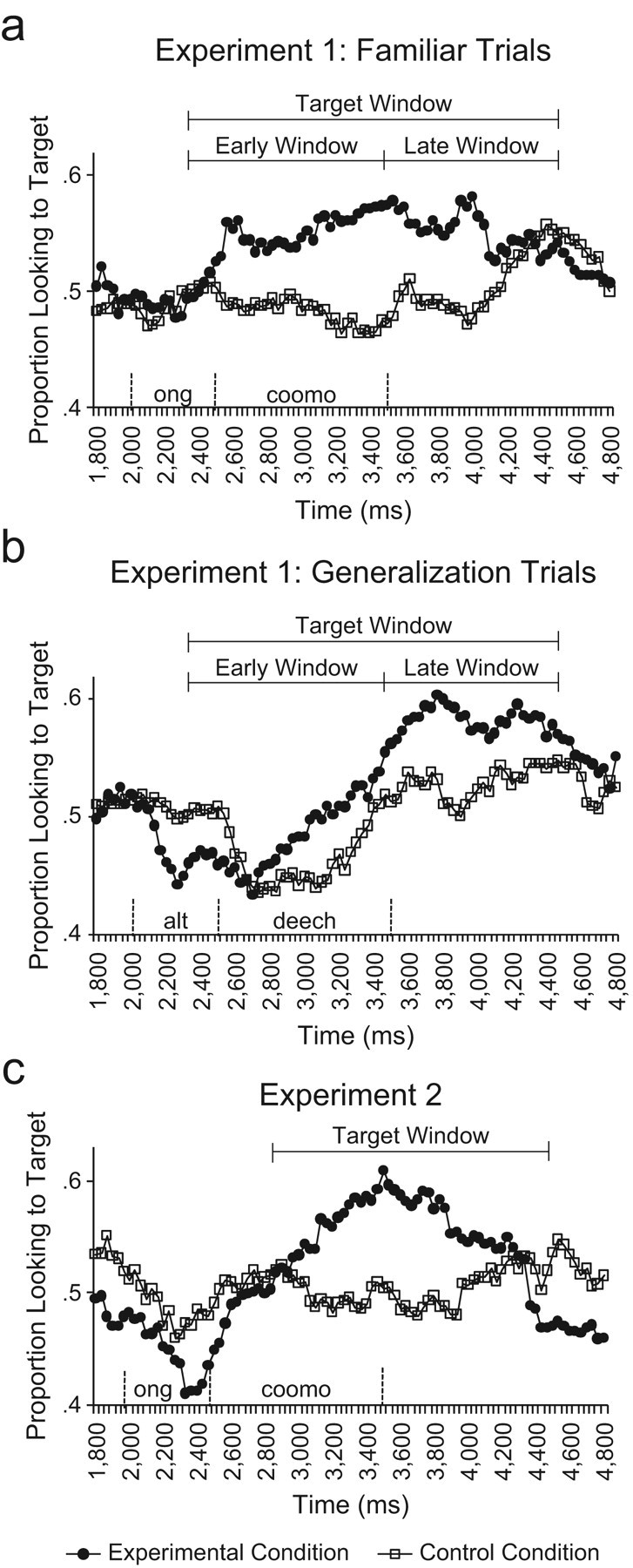
Performance in Experiments 1 (a, b) and 2 (c). Each graph shows the mean proportion of trials on which infants in each condition (experimental, control) were looking to the target picture during each 33-ms interval. Chance is .5. The boundaries of the target window (and its early and late components) are demarcated by solid lines, and the onset and offset of words in the labeling phrase are marked by dashed lines. For Experiment 1, results are shown separately for (a) familiar trials and (b) generalization trials.
Test performance
We examined performance using an analysis of variance with familiarization condition (experimental vs. control) as a between-participants factor and test trial type (familiar vs. generalization) as a within-participants factor. The dependent variable consisted of a difference score calculated by subtracting an infant’s mean proportion of looks to the target during the baseline window from his or her mean proportion of correct looks to the target during the target window (Table 3). There was a significant effect of familiarization condition, F(1, 60) = 5.97, p = .02, η p 2 = .09, with the experimental group showing greater increases in looking to the target picture than the control group. No other effects were significant, Fs(1, 62) < 1. These results suggest that compared with infants in the control condition, infants in the experimental condition were better able to learn the associations between the phrases and pictures and to generalize their prior experience to novel associations.
Experiment 1 Results: Mean Proportion of Trials on Which Infants Looked to the Target Picture During the Baseline and Target Windows

Note: Standard errors are given in parentheses. One-sample t tests were used to test whether the increase in looking to the target during the target window (relative to baseline) was significantly greater than zero.
p < .05. **p < .01. ***p < .001.
The previous analysis suggested that the experimental group showed better learning than the control group, but did not indicate whether infants in each group showed above-chance looking to the target picture on familiar and generalization trials. We therefore asked whether infants in each group successfully found the target picture on familiar and generalization trials. When hearing familiar English words, 21-month-old infants show increases in looking to matching pictures before they have heard the entire label (e.g., Fernald, Swingley, & Pinto, 2001). Infants in our experiment may likewise have shown an increase in looking to the target on familiar trials before hearing the entire labeling phrase. However, generalizing to novel category members, as tested in generalization trials, may take more time. Thus, we divided the target window into an early window, beginning just after the onset of the aX or bY phrase and ending at the average offset of the phrase (2,367–3,467 ms), and a late window, beginning at the offset of the label and ending 1 s later (3,500–4,500 ms). As in the prior analysis, the dependent measure was a difference score reflecting the increase in looking to the target relative to baseline.
Infants in the experimental condition showed significant increases in looking to the target during both the early and the late windows on familiar trials (one-sample t tests, two-tailed), t(31) = 3.41, p = .002, d = 0.6, and t(31) = 2.71, p = .01, d = 0.5 respectively. During generalization trials, they showed significant increases in looking to the target during the late window, t(31) = 7.62, p < .001, d = 1.3, but not the early window, t(31) = 0.03, p = .98 (Table 3). These results suggest that infants in the experimental condition were able to use partial information to correctly identify trained target pictures, as well as to link phrases with pictures that they had never seen before after hearing the entire label. Control infants showed no evidence of finding the target picture during familiar or generalization trials in either the early or the late window, ts < 1.
These findings are consistent with the possibility that experience with reliable statistical cues marking word-category membership facilitates learning the individual meanings of those words (e.g., coomo refers to guinea pigs), as well as the meaning common to words within the category (e.g., aX phrases refer to animals). One explanation for this finding is that forming rudimentary X and Y categories from experience with reliable cues in the initial listening phase provided a foundation for learning the correlated semantic properties during referent training. Another possibility is that experimental infants’ experience with the phonological patterns of the aX and bY phrases facilitated their auditory processing of the labeling phrases, which left them with more resources to learn about the specific picture-phrase associations. This, in turn, may have facilitated learning that words with the same distributional and phonological properties also referred to pictures with similar semantic properties. On either account, infants’ experience with reliable statistical cues facilitated learning categories of semantically related words.
However, an alternative possibility is that the infants in the experimental condition learned a global association, for example, between aX phrases and “animal,” and between bY phrases and “vehicle,” without learning the specific associations between each label-picture pair. Thus, rather than learning the semantic properties common to X and Y words, infants may have associated general meanings with the a and b words. Such a global sensitivity would have allowed infants to find the target on both familiar and generalization trials. However, it would not reflect sensitivity to a semantically related category of distinct words (i.e., to commonalities in the meanings of individual words within a category). Moreover, learning at this highly abstract level would not necessarily facilitate learning the meanings of individual words. Experiment 2 was thus designed to test the specificity of infants’ sensitivity to the trained phrase-picture associations.
Experiment 2
Method
Participants
Participant in Experiment 2 were 64 infants (mean age = 22.03 months, range = 21.3–22.8) who were born full term; were free of problems with hearing, vision, or language, according to parental report; and came from monolingual English-speaking homes. Infants were randomly assigned to the experimental (14 female, 18 male) or control (14 female, 18 male) condition. Data from additional infants were excluded because of excessive fussiness (n = 15), inattention (n = 3), parental interference (n = 4), or equipment failure (n = 5).
Materials
The materials for auditory familiarization and referent training were identical to those in Experiment 1. The materials used in the test phase consisted of four familiar pictures, two animals and two vehicles, from referent training (see Table 2). Each test trial consisted of either the two animal or the two vehicle pictures and an aX or bY phrase that had been associated with one of them during referent training. Because the a and b words had been associated equally often with the two pictures, infants had to use the X and Y words to find the target picture.
Procedure
The procedure was identical to that of Experiment 1, with the exception that the test phase consisted of eight trials.
Results and discussion
On test trials, the only information in the labeling phrase that identified the target picture was the X or Y word, and thus the overall target window began 367 ms after the onset of that word. Because the X and Y words occurred relatively late in a trial, we did not further divide the overall target window. The coding and analysis techniques were identical to those in Experiment 1. Two trials each from 25% of participants (n = 16) were randomly selected and independently coded, to assess reliability. Agreement between coders within a single frame was 99%. Preliminary analyses revealed no differences in looking behavior between males and females; gender was not included as a variable in subsequent analyses.
An independent-samples t test revealed that infants in the experimental condition were significantly more accurate than control infants, t(62) = 2.35, p = .02, d = 0.6 (see Table 4 and Fig. 1c). Moreover, they reliably increased their looking to the target picture during the target window relative to baseline, t(31) = 2.75, p = .01, d = 0.5, whereas control infants failed to do so, t(31) = 0.62, p = .54. These findings support the claim that infants in the experimental group learned the specific associations between novel words and their referents.
Experiment 2 Results: Mean Proportion of Trials on Which Infants Looked to the Target Picture During the Baseline and Target Windows

Note: Standard errors are given in parentheses. One-sample t tests were used to test whether the increase in looking to the target during the target window (relative to baseline) was significantly greater than zero.
p < .05.
Discussion
These findings provide the first evidence that infants can integrate statistical information, in the form of distributional and phonological cues, with semantic knowledge when learning word categories. Previous research demonstrated that infants use statistical cues to form rudimentary categories (Gerken et al., 2005; Gómez & Lakusta, 2004; Lany & Gómez, 2008). Strikingly, our results suggest that experience with such cues not only facilitates learning the semantic properties of individual words, but also allows infants to rapidly generalize these semantic properties to novel category members.
These findings shed new light on how the forms and distributions of words influence learning what those words mean. Previous findings suggest that infants’ experience with statistical cues relevant to segmenting words plays an important role in later word learning (Graf Estes et al., 2007). In the current experiment, we tested how experience with category-level statistical cues affects word learning. The picture-phrase associations presented during referent training, and tested on familiar trials in Experiment 1 and all trials in Experiment 2, were relatively unambiguous and were equally familiar to infants in the two conditions. Nonetheless, only infants in the experimental condition were able to learn these associations. Thus, infants’ prior experience with category-level statistics (i.e., the consistent pattern that a words were followed by disyllabic X words, and b words by monosyllabic Y words), rather than the frequencies of individual words or phrases, helped infants to link individual words to specific meanings.
Experience with reliable statistical cues also enabled infants in the experimental group to identify the referents of new words under more demanding circumstances. On generalization trials in Experiment 1, infants heard an aX or bY phrase that had not previously been associated with a referent. Nevertheless, infants in the experimental condition successfully determined which of two novel pictures that phrase was more likely to refer to. These findings suggest that the infants used statistical information, in the form of distributional and phonological cues, to discover novel associations between phrases and pictures within a familiar category. These findings are consistent with the syntactic bootstrapping hypothesis (e.g., Landau & Gleitman, 1985), which suggests that the process of learning word meanings is inextricably linked with syntactic knowledge: Structural information, such as the sentence contexts in which words occur, provides important information about word meanings. The current findings suggest that experience with the distributional and phonological regularities marking words’ category membership may play an important role in the development of the ability to use structural information in word learning.
Our findings suggest several avenues of investigation for future research concerning the acquisition of lexical categories. For example, the semantic categories in the current experiments were ones that are already familiar to 22-month-olds. Indeed, infants begin to distinguish between animate and inanimate entities by the age of 9 weeks, likely on the basis of perceptual features such as motion and vocalization (e.g., Legerstee, 1991). However, most other categories do not carve the world at its perceptual joints, and different languages employ categories that partition concepts differently. Thus, it would be informative to know whether experience with statistical cues marking categories can help infants to shape the semantic boundaries of novel categories. In addition, future studies should address whether the findings from these experiments, which used a relatively simple and reliable artificial language, scale up to the richer and more probabilistic patterns found in natural languages.
In sum, these findings provide strong support for the hypothesis that infants begin to learn lexical categories from their experience with the sounds and distributions of words, even before they know words’ meanings. This initial exposure to distributional and phonological cues provides a foundation for acquiring a quite different source of information: the semantic properties of category members. It is becoming increasingly evident that infants’ early experience listening to language profoundly affects their subsequent language development. Infants’ experience with statistical regularities in their auditory environment allows them to detect and integrate new and qualitatively different information about such patterns, a process that appears to play a critical role in the acquisition of lexical categories.
Footnotes
Acknowledgements
We thank the members of the Infant Learning Lab at the University of Wisconsin–Madison for their contributions to this work, Anne Fernald and the Center for Infant Studies at Stanford University for providing the customized coding software, and LouAnn Gerken, Rebecca Gómez, Jessica Hay, Jessica Payne, Alexa Romberg, and three anonymous reviewers for comments on an earlier draft. We are also grateful to the families whose participation made this research possible. The content is solely the responsibility of the authors and does not necessarily represent the official views of the Eunice Kennedy Shriver National Institute of Child Health and Human Development or the National Institutes of Health.
The authors declared that they had no conflicts of interests with respect to their authorship and/or the publication of this article.
This research was funded by National Institute of Child Health and Human Development Grants F32 HD057698 to J.L. and R01HD37466 to J.R.S., by a James S. McDonnell Foundation Scholar Award to J.R.S, and by National Institutes of Health Grant P30 HD03352 to the Waisman Center, University of Wisconsin–Madison.

1.
Windows were chosen on the basis of previous studies of lexical access in infants (see Fernald et al., 2008). In particular, the estimated latency to launch a saccade in response to auditory information is 367 ms at the approximate age of 22 months.
References
Supplementary Material
Please find the following supplemental material available below.
For Open Access articles published under a Creative Commons License, all supplemental material carries the same license as the article it is associated with.
For non-Open Access articles published, all supplemental material carries a non-exclusive license, and permission requests for re-use of supplemental material or any part of supplemental material shall be sent directly to the copyright owner as specified in the copyright notice associated with the article.
