







Abstract

The public’s perception of a given health risk increases with coverage of the risk in the news media (e.g., Kalichman, 1994; see Breakwell, 2007, for a review). Laboratory experiments further suggest that heightened perception of the risk posed by one hazard fosters heightened perception of the risk posed by other, unrelated hazards (Johnson & Tversky, 1983). This generalization across domains reflects that intuitive risk assessments are often based on current feelings (Loewenstein, Weber, Hsee, & Welch, 2001), which allows feelings elicited by one threat to influence assessment of other threats (Schwarz & Clore, 2007). Accordingly, minor everyday events that bring a current, affectively charged threat to mind may influence risk perception in unrelated domains. We present a naturalistic test of this possibility in the context of the current swine flu pandemic, which spread from initial cases in Mexico to more than 70 countries and all 50 states of the United States, resulting in some 30,000 documented cases with 145 deaths worldwide within 2 months (World Health Organization, 2009). The extensive media coverage of swine flu highlighted the risk of contagion and offered hygiene recommendations, ranging from frequent hand washing to wearing face masks and avoiding physical contact (Centers for Disease Control and Prevention, 2009).
To instantiate the threat of contagion, we arranged for participants in two field experiments to encounter a sneezing person before answering questions about perceived risk. As predicted, exposure to public sneezing increased the perceived risk of contracting a serious disease (which might include the flu), as well as the perceived risk of unrelated threats, namely, having a heart attack and dying from a crime or accident (Study 1). Moreover, sneezing elicited more negative evaluations of the country’s health care system (Study 1) and shifted policy preferences from allocating resources to the creation of green jobs to allocating resources to vaccine development (Study 2).
Method
Study 1
On May 7, 2009, when swine flu received broad media attention, students in public areas of buildings on the University of Michigan campus passed a confederate who did (sneezing condition) or did not (control condition) sneeze and cough while they walked by. Next, an experimenter asked them to complete a one-page self-administered questionnaire to help with her class project. Of 67 students approached, 50 (25 men, 25 women; mean age = 22.7 years, SD = 7.42) completed the questionnaire, 26 (out of 37) in the sneezing condition and 24 (out of 30) in the control condition; cooperation did not differ significantly between the conditions, χ2(1, N = 67) = 0.83, p > .3.
Participants estimated the risk of an “average American” to contract a serious disease, have a heart attack before age 50, or die from a crime or accident, along a scale from 0 (impossible) to 100 (certain to happen). They also evaluated the U.S. health care system on a question taken from a New York Times/CBS News (2009) poll (scale from 1, our health care system has so much wrong with it that we need to completely rebuild it, to 7, our health care system works pretty well and only minor changes are necessary to make it work better) and provided demographic information.
Study 2
On May 26 through 30, 2009, an experimenter asked pedestrians in shopping malls and downtown business areas in Ann Arbor, Michigan, to participate in a 1-min survey. Of 78 people approached, 47 agreed to take the survey (27 men, 20 women; mean age = 42.4 years, SD = 17.0); sneezing was manipulated after respondents agreed to participate. Holding the questionnaire in her right hand, the experimenter coughed and sneezed once while covering her mouth with her left forearm before handing the questionnaire to participants in the sneezing condition (n = 23); in the control condition (n = 24), the same experimenter did not sneeze. The experimenter turned to other passersby while participants completed the questionnaire.
The first question noted that the New York Times had reported on a $1.3 billion federal investment in vaccine development and asked participants whether they would prefer the federal government to spend this money “(1) to facilitate the production of flu vaccines, or (2) to create green jobs.” A second question, taken from a New York Times/CBS News (2009) poll, asked whether the country is generally on the wrong track or going in the right direction (1 = wrong, 7 = right).
Results
Compared with participants in the control condition of Study 1, those who had just passed a sneezing confederate perceived the average American as more likely to contract a serious disease, to have a heart attack before age 50, and to die from a crime or accident (Table 1). A mixed-model analysis of variance revealed a main effect of the sneezing manipulation, F(1, 48) = 10.06, p = .003, that was not qualified by the type of risk assessed (F < 1 for the interaction of manipulation and risk measure). Participants in the sneezing condition also reported a more negative view of the health care system (Table 1). Similarly, in Study 2, participants in the sneezing condition were more likely than those in the control condition to favor federal spending on the production of flu vaccines rather than on the creation of green jobs (sneezing condition: 47.8%; control condition: 16.7%), χ2(1, N = 47) = 5.25, p < .05, d = 0.71. With Cohen’s d ranging from 0.5 to 0.8, these effects had a moderate to large magnitude. Finally, participants’ general evaluation of whether the country was going in the wrong direction was unaffected by the manipulation (sneezing condition: M = 4.22, SD = 1.57; control condition: M = 4.17, SD = 1.50), t(44) < 1, n.s., which suggests that sneezing did not elicit a general negativity bias.
Effects of Exposure to a Sneezing Person on Risk Perception and Health-Care-System Evaluation in Study 1
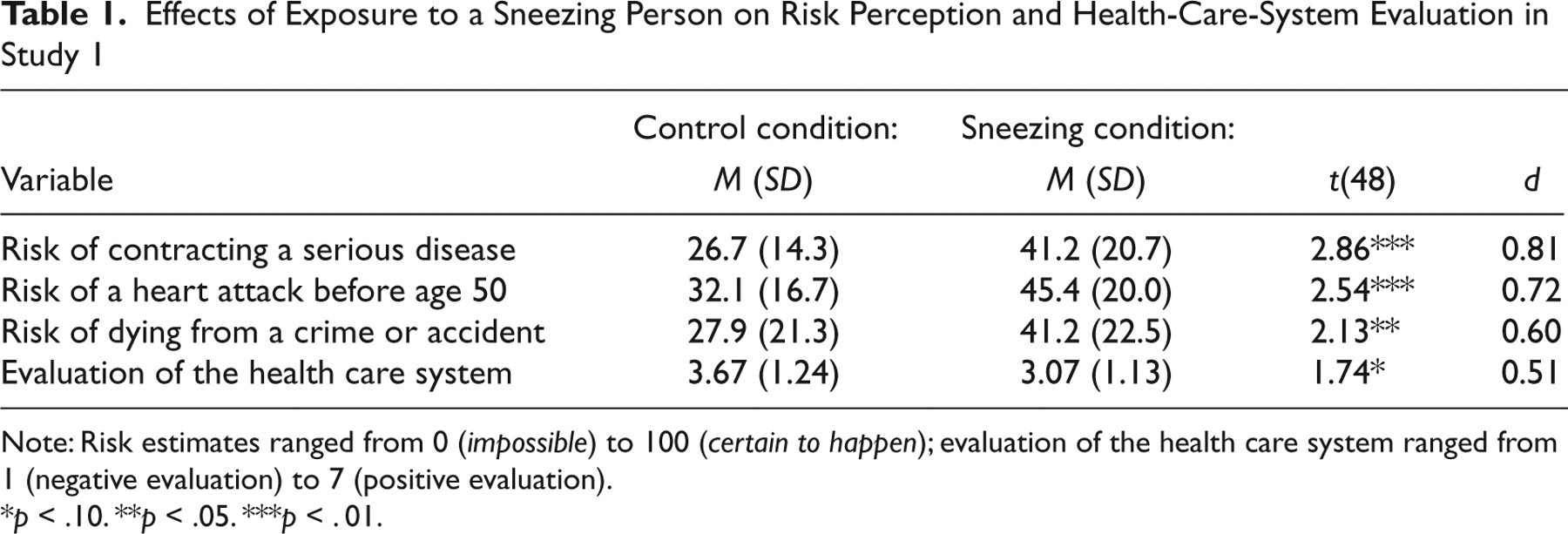
Note: Risk estimates ranged from 0 (impossible) to 100 (certain to happen); evaluation of the health care system ranged from 1 (negative evaluation) to 7 (positive evaluation).
p < .10. **p < .05. ***p < . 01.
Discussion
Exposure to a mundane event (a sneezing person) related to a salient health threat (a flu pandemic) increased the perception of a substantively related risk (contracting a major disease) and shifted policy preferences from other current priorities (green jobs) to the production of flu vaccines. Moreover, the heightened perception of risk generalized to threats that have no substantive relationship with influenza (heart disease and dying from crime or accidents). Such generalization across hazards is assumed to reflect reliance on current feelings in intuitive risk assessment (Johnson & Tversky, 1983; Loewenstein et al., 2001). Debriefing suggested that people have no insight into these processes; they assume that exposure to a sneeze may influence their perception of flu risk, but not their perception of unrelated risks. Future research may fruitfully address the assumed affective mediation of the observed effects, their persistence over time, and the likely role of media attention to the hazard associated with the event, which was not manipulated in the present studies.
Footnotes
The authors declared that they had no conflicts of interests with respect to their authorship and/or the publication of this article.
This research was supported by an R C Lee Centenary Scholarship to the first author.