







Abstract
To contribute to researchers’ understanding of how humans choose mates, we examined how the number of mate options influenced the dating decisions made by 1,868 women and 1,870 men across 84 speed-dating events. Multilevel modeling of these decisions revealed that when faced with abundant choice, choosers paid less attention to characteristics requiring more time to elicit and evaluate (e.g., occupational status and educational attainment) and more attention to characteristics that are quickly and easily assessed (e.g., height and weight). Human mate choice sits squarely within the domain of general cognition, as this study shows it to be constrained by bounds on cognitive resources.
Over a decade ago, psychologists were called on to pay attention to the how—not just the who—of human mate choice, as the dearth of research investigating the cognitive processes underlying mate choice was limiting understanding of this important decision-making domain (Miller, 1997; Miller & Todd, 1998). It is in this vein that we describe the results of a study of the effects of abundant choice on real-world mating behavior.
Iyengar and Lepper’s (2000) findings support the view that although people are attracted to choice, the mere offering of choice may lead to cognitive overload, delayed choice, choice regret, and poor choice. The rationale for this “tyranny of choice” (Schwartz, 2004) centers on the cognitive costs associated with the processing of a larger number of options, such as increasing attentional and memory load (Malhotra, 1982), mounting difficulty of assessing the differences between the options (Reutskaja & Hogarth, 2009), or increasing uncertainty and lesser justifiability regarding what constitutes the best option (Iyengar & Lepper, 2000).
Mate choice is, of course, different from consumer choice in many respects, and thus, it is conceivable that an abundance of mate options may not be overwhelming in the same way as an abundance of jams or chocolates. One such difference is that this is a choice that humans and nonhuman animals alike have been making across millennia, and consequently, each species has evolved choice strategies that suit their particular reproductive environment. As Hutchinson (2005) noted, “a lekking bird might have evolved specifically to cope with extensive choice” (p. 78). 1 Given our social brain (Dunbar, 1998), the same may apply to humans. In addition, humans demonstrate and self-report strong preferences for particular characteristics in a mate (e.g., Kurzban & Weeden, 2005; Todd, Penke, Fasolo, & Lenton, 2007). Chernev’s (2003) research on consumer decision making indicates that individuals with well-defined preferences are resistant to the supposed downsides of too much choice, because they can make use of a ready point of comparison. Thus, is having too many mate options really like having too many jams?
Recent studies hint that abundant mate choice, like abundant consumer choice, taxes cognitive resources (Lenton, Fasolo, & Todd, 2008; Saad, Eba, & Sejean, 2009). Accordingly, mate choosers, like consumers, may implement different choice strategies depending on the number of options they face (Payne, Bettman, & Johnson, 1993). Indirect evidence for this possibility is a study of mating skew among speed daters that found that having more options was associated with choosers’ choices converging—that is, choosers tended to “propose” to the same subset of speed daters as more options were introduced (Lenton, Fasolo, & Todd, 2009; see Huberman & Jiang, 2006, for similar findings in consumer choice). The strongest evidence to date comes from a lab-based experiment in which women were asked to select the one man they would most like to contact from a dating Web site containing 4, 24, or 64 profiles: As the number of options increased, participants self-reported lesser use of a comprehensive choice strategy and greater use of heuristic choice strategies (Lenton & Stewart, 2008).
The aims of the present study were to assess behaviorally whether people do, in fact, adopt different choice strategies as a function of the number of potential mates before them and to make this assessment in a real-world mate choice environment. More specifically, using choice data obtained from one of the United Kingdom’s largest speed-dating agencies, we sought to determine whether and how participants’ use of different types of cues changes with the number of mate options. Prior speed-dating research has demonstrated the importance of morphological cues (e.g., weight) to male and female choosers alike (Kurzban & Weeden, 2005). Because these cues can be apprehended visually and do not require a verbal exchange for verification, they can be quickly and easily assessed (QEA). As such, they may become even more significant when choosers are confronted with abundant choice (Lenton et al., 2009; Sullivan, 1994). We hypothesized that speed daters manage abundant mate choice by using heuristic-like choice strategies, focusing on QEA cues, in larger speed-dating sessions and a relatively more comprehensive choice strategy, elevating the use of non-QEA cues, in smaller speed-dating sessions.
Method
Speed dating
The speed-dating events were similar to those described by others (Finkel & Eastwick, 2008; Kurzban & Weeden, 2005; Todd et al., 2007). In brief, several men met a comparable number of women for a series of 3-min minidates. Afterward, and usually within 48 hr, participants communicated their decisions (“yes” or “no” for each date) to the agency. What is somewhat unusual about this study’s events is that the participants created on-line profiles wherein they reported their age, weight, height, educational attainment, religion, occupation, and smoking status; the profiles could be accessed by other participants only after the event, and they were not integral to the communication of decisions. Our set of QEA cues contained the first three profile attributes, as these could be perceived visually. Our set of non-QEA cues contained the latter four attributes, because these could not be perceived visually and, thus, would necessitate a verbal exchange to discern. The distinction between visual and nonvisual or verbal cues is prevalent in social psychology (Fiske, 1998) and is similar to the distinction made in biology between morphological traits and behavioral displays (Sullivan, 1994). Categorization to cue set (QEA vs. non-QEA) was performed a priori.
Sample
Our sample included anonymized speed-dating records of 1,868 women and 1,870 men who participated in 84 speed-dating events. The events gathered an average of 23.6 male partners (SD = 3.9, range = 15–31) and 23.5 female partners (SD = 3.9, range = 15–31). Overall, we had 41,782 decisions (yes or no) made by female and 40,544 decisions made by male choosers.
We categorized speed-dating events by size: A speed-dating event was small if it presented choosers with 15 to 23 partners and large if it presented choosers with 24 to 31 partners. This delineation was chosen to equate the number of observations within each category (N small = 41,094; N large = 41,232). Note that there are virtually no statistically significant mean differences in partner characteristics by event size, except for age: Both male and female choosers in small (vs. large) sessions faced slightly older partners, t(26,466) = 32.3, p < .001, and t(25,205) = 35.1, p < .001, respectively. (See Table S1 in the Supplemental Material available on-line. Table S1 also shows that the hypothesis that cue variance changes with event size is not supported by the data.)
Results
Statistical models
Choosers’ decisions were analyzed using generalized linear mixed model logistic regressions, in which we controlled for random effects at the chooser and event levels to account for the fact that decisions were nested within choosers and choosers were nested within events (Rabe-Hesketh, Skrondal, & Pickles, 2005). The dependent variable represented choosers’ dating decisions (no = 0, yes = 1). The simultaneously entered predictors were chooser gender, event size, the QEA partner cues (age, height, and weight, as indicated by body mass index), the non-QEA partner cues (religious affiliation, occupation, educational attainment, and smoking status), and the two- and three-way interactions between cue, gender, and event size. The footnote in Table 1 describes how the predictors were coded.
Results of the Generalized Linear Mixed Model of Individual Choosers’ Decisions
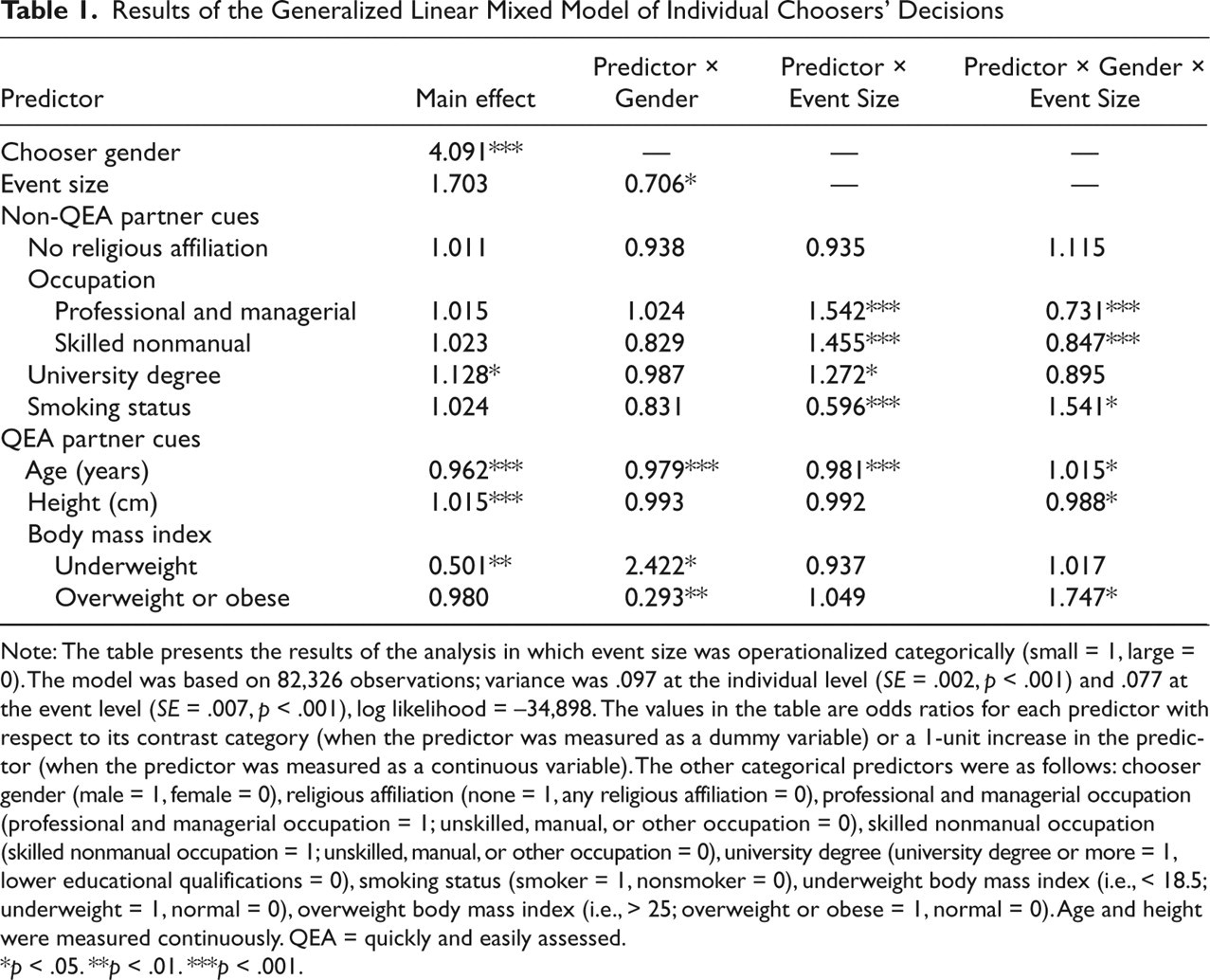
Note: The table presents the results of the analysis in which event size was operationalized categorically (small = 1, large = 0). The model was based on 82,326 observations; variance was .097 at the individual level (SE = .002, p < .001) and .077 at the event level (SE = .007, p < .001), log likelihood = −34,898. The values in the table are odds ratios for each predictor with respect to its contrast category (when the predictor was measured as a dummy variable) or a 1-unit increase in the predictor (when the predictor was measured as a continuous variable). The other categorical predictors were as follows: chooser gender (male = 1, female = 0), religious affiliation (none = 1, any religious affiliation = 0), professional and managerial occupation (professional and managerial occupation = 1; unskilled, manual, or other occupation = 0), skilled nonmanual occupation (skilled nonmanual occupation = 1; unskilled, manual, or other occupation = 0), university degree (university degree or more = 1, lower educational qualifications = 0), smoking status (smoker = 1, nonsmoker = 0), underweight body mass index (i.e., < 18.5; underweight = 1, normal = 0), overweight body mass index (i.e., > 25; overweight or obese = 1, normal = 0). Age and height were measured continuously. QEA = quickly and easily assessed.
p < .05. **p < .01. ***p < .001.
Does cue use change with event size?
The results of the analyses, shown in Table 1, revealed main effects for several predictors: All else being equal, choosers preferred partners who had a university degree and were younger, taller, and not underweight. More important, however, is the finding that the effect of nearly every partner cue—except religious affiliation and underweight body mass index—was qualified by event size (sometimes in combination with chooser gender; see columns 3 and 4 in Table 1). Our general contention that choosers choose differently as a function of the number of options they face is supported.
Table 2 shows the specific effects of each partner cue on men’s and women’s decisions in small and large events separately. Four out of five non-QEA predictors influenced choosers’ decisions in small events, whereas these same predictors had lesser or (more often) no impact in large events. This pattern held for men and women equally. A fifth non-QEA predictor (religious affiliation) did not influence decisions in events of either size.
Odds Ratios for the Effects of Partner Cues on Male and Female Choosers’ Decisions in Small and Large Events
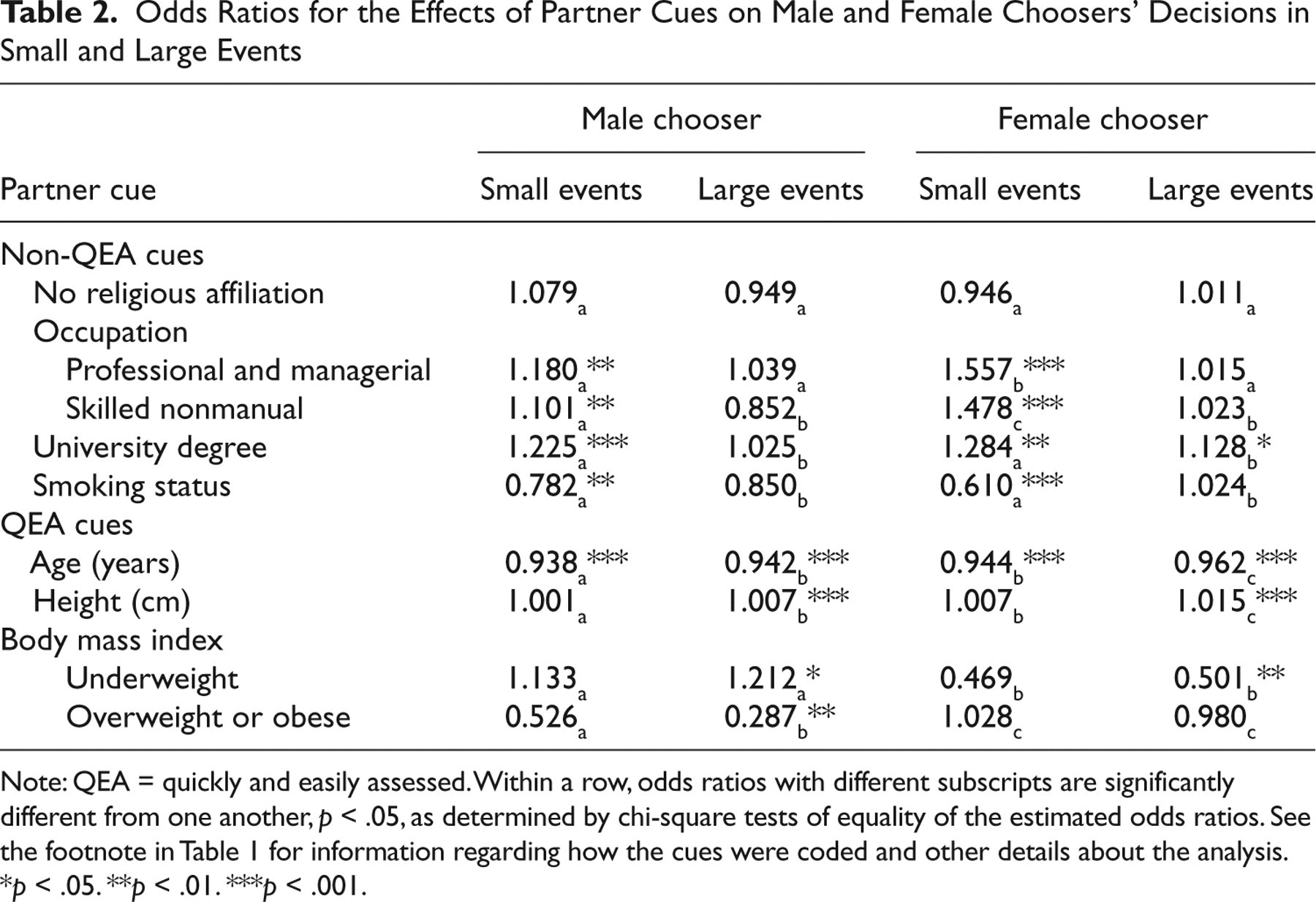
Note: QEA = quickly and easily assessed. Within a row, odds ratios with different subscripts are significantly different from one another, p < .05, as determined by chi-square tests of equality of the estimated odds ratios. See the footnote in Table 1 for information regarding how the cues were coded and other details about the analysis.
p < .05. **p < .01. ***p < .001.
In contrast, QEA cues were more likely to influence decisions in large events than in small events. Height influenced decisions in large events but not in small events, as did being underweight (though in opposite directions for men and women). A female partner’s overweight status influenced men’s decisions in large events only, although a male partner’s overweight status had no influence on women’s decisions in events of either size. Finally, (young) age influenced choosers’ decisions in both large and small events, although—unexpectedly—the effect was stronger in small than in large events (more on this in the Discussion).
We performed the multilevel analysis a second time, but with event size as a continuous variable. The results are available in Table S2, in the Supplemental Material available on-line. Although these results are broadly similar to those shown in Table 1, in this second analysis, event size qualified the effects of the non-QEA cues (again, with no effects of religious affiliation) but not the QEA cues. The latter were found to be (un)important, regardless of the event size. This difference between the continuous and categorical analyses suggests that the continuous event size variable yields only marginal changes in decisions per one additional speed dater (on average) and/or the possible presence of nonlinearities in the impact of event size on QEA cue use.
Discussion
In summary, the results demonstrate that choices in small speed-dating sessions were driven primarily by non-QEA cues, whereas choices in large sessions were more likely to be driven by QEA cues. Thus, in the mate-choice domain, choosers adopt heuristic-like choice strategies when faced with an abundance of options. These findings are in accord with the idea that time spent making a choice is one of the greatest costs incurred in mate choice (Sullivan, 1994). Although speed daters in small and large sessions have an equivalent amount of time per date, recent research investigating the effects of abundant choice on time perception (Fasolo, Carmeci, & Misuraca, 2009) suggests that speed daters in large sessions are likely to have felt more time poor. Time, of course, is not the only cost of mate choice. Attention to and memory for the options also require cognitive resources (e.g., Payne et al., 1993), thus cues that can be assessed quickly and easily are likely to dominate when time and cognitive resources are (or seem to be) pressed.
The pattern of QEA versus non-QEA cue use across speed-dating events of varying sizes was the same for female and male choosers. These results lend support to Miller’s (1997) proposal that although gender differences may be observed at the cue preference level (e.g., men having a stronger preference for partner youth), what men and women do with the cues they acquire is similar, as both have to evaluate the cues (some of which are deceptive), integrate the cues, compare options, and so on. This interpretation fits well with other studies suggesting that the how of mate choice judgment and decision making is not gender based. For example, Lenton, Bryan, Hastie, and Fischer (2007) found that men and women rely on the same cognitive mechanism—social projection—to arrive at their different judgments of others’ sexual intent. In addition, Haselton and Buss’s (2000) research suggests that in the evaluation of potential mates, both men and women possess the same goal: minimizing error. Accordingly, although the who of mate choice may be explainable in terms of sexual selection, the how of mate choice is explainable in terms of natural selection.
As described previously, partner age explained men’s and women’s decisions in both small and large events, with its impact being weaker (rather than greater) in the latter. Clearly, age is an important cue no matter how many options are available. We interpret the direction of the effect as being due to one or both of the following: (a) Choosers in small (vs. large) sessions faced slightly older partners, and thus their choices reflected their greater demand for youth; (b) choosers’ perception of this QEA cue became more error-prone as other QEA cues were attended to. Future research might investigate this latter proposal more directly.
Another provocative implication of our study is that observed (average) gender differences in the value placed on a partner’s attractiveness (Feingold, 1990), a QEA cue, may be a mere side effect of average gender differences in the number of potential partners to which a chooser pays attention (Baumeister, Catanese, & Vohs, 2001). That is, the how of mate choice might, in part, determine gender differences in the who. Further along these lines, people who are unrestricted (vs. restricted) in sociosexual orientation pay more attention to potential partners’ physical characteristics (Simpson & Gangestad, 1992), perhaps because they are open to a wider range of potential mates. It is boundedly rational (Simon, 1990; Gigerenzer & Selten, 2001) for those seeking a multitude of (short-term) mates to focus largely on cues for which assessment is not costly and that signify physical fitness, just as it is for individuals seeking a monogamous partnership to pay attention to cues that take longer to reveal themselves and that indicate fitness as a long-term partner.
Our results have implications for theorizing in a variety of choice domains, including that concerning “too much” consumer choice (e.g., Huberman & Jiang, 2006; Iyengar & Lepper, 2000; Schwartz, 2004). For example, consumers encountering abundant choice may not select by attribute importance but rather by the visual salience of an attribute (e.g., packaging color may be more salient than calorie content). A recent meta-analysis indicates that the average effect of too much choice on choice-related affect and metacognition is zero (Scheibehenne, Greifeneder, & Todd, in press). This outcome may occur, in part, because choosers may not feel overwhelmed by the presence of many options if they can effectively winnow them according to a few crucial QEA attributes.
The findings of our study also contribute to researchers’ understanding of mating skew (Hutchinson, 2005; Lenton et al., 2009) and of mate choice more generally, as they highlight the important role that cognitive resources play in this domain: to choose a mate requires time, attention, memory, information-integration strategies, and comparison skills. The types of cues choosers attend to and, consequently, the options they select will vary according to the nature of the chooser’s choice environment. Despite being normatively irrational, choosers do a pretty good job of consistently using the cues to which they do pay attention, and if the choice environment (e.g., a large speed-dating event) corresponds to the chooser’s goals (e.g., short-term mating), then good choices will be facilitated. In conclusion, we take the title of Miller and Todd’s (1998) article one step further and argue that mate choice is not just turning cognitive, it is cognitive.
Footnotes

References
Supplementary Material
Please find the following supplemental material available below.
For Open Access articles published under a Creative Commons License, all supplemental material carries the same license as the article it is associated with.
For non-Open Access articles published, all supplemental material carries a non-exclusive license, and permission requests for re-use of supplemental material or any part of supplemental material shall be sent directly to the copyright owner as specified in the copyright notice associated with the article.
