







Abstract
Theories from diverse areas of psychology assume that affective stimuli facilitate approach and avoidance behavior because they elicit motivational orientations that prepare the organism for appropriate responses. Recent evidence casts serious doubt on this assumption. Instead of motivational orientations, evaluative-coding mechanisms may be responsible for the effect of stimulus valence on approach-avoidance responses. Three studies tested contrasting predictions derived from these two accounts. Results supported motivational theories, as stimulus valence facilitated compatible approach-avoidance responses even though participants had no intention to approach or to avoid the stimuli, and the valence of the response labels was dissociated from the approach and avoidance movements (Study 1). Stimulus valence also facilitated compatible approach-avoidance responses when participants were not required to process the valence of the stimuli (Studies 2a and 2b). These findings are at odds with the evaluative-coding account and support the notion of a unique, automatic link between the perception of valence and approach-avoidance behavior.
Recognizing good or bad stimuli in the environment and reacting appropriately is one of the most important regulatory needs of organisms. In particular, quickly escaping from dangers and grasping opportunities to gain rewards are part of the behavioral repertoire that ensures survival in environments with scarce resources and threatening foes. Indeed, numerous classic and current theories from diverse areas of psychology suggest that approach and avoidance behaviors are driven by specialized systems that evolved to efficiently process emotional valence and trigger functional responses (e.g., Darwin, 1872; Davidson, Ekman, Saron, Senulis, & Friesen, 1990; Dickinson & Dearing, 1979; Gray, 1994; Lang, Bradley, & Cuthbert, 1990; LeDoux, 1996; Lewin, 1935/1967; Öhman, 1987; Strack & Deutsch, 2004). In this traditional view, valence processing and the resulting motivational tendencies are attributed a special status among psychological processes because they are so fundamental for an organism’s survival (cf. Bargh, 1997; Zajonc, 1980). Recently, this position has been questioned on both theoretical and empirical grounds (Eder, Hommel, & De Houwer, 2007). According to this new perspective, valence has no special status among other stimulus features, such as size, color, and location. Consequently, approach and avoidance behaviors may not be regulated by distinct motivational mechanisms. Instead, they are seen as behaviors that follow general principles of action control (Eder & Rothermund, 2008; Lavender & Hommel, 2007).
One current manifestation of this overarching debate centers on the observation that perceiving positive stimuli facilitates simple approach behaviors (e.g., pulling a lever toward the body or moving a figure on a computer screen toward a stimulus), whereas perceiving negative stimuli facilitates simple avoidance behaviors (e.g., pushing a lever away from the body or moving a figure away from a stimulus; Chen & Bargh, 1999; De Houwer, Crombez, Baeyens, & Hermans, 2001). Traditionally, such compatibility effects were interpreted as being caused by motivational orientations immediately triggered by automatic stimulus evaluations (Chen & Bargh, 1999; Neumann, Förster, & Strack, 2003). Recently, however, some researchers have argued that these compatibility effects may simply follow from general mechanisms of action control, which are not specific to valence.
The theory of event coding (TEC; Hommel, Müsseler, Aschersleben, & Prinz, 2001) describes such a general mechanism of action control. According to the TEC, actions are represented by feature codes that refer to the anticipated distal effects of the actions. Furthermore, actions and perceived stimuli are represented in a common representational domain. As a consequence, when the representations of a stimulus and an action share a large number of features, response execution is facilitated.
The same process is suspected to be responsible for facilitating approach and avoidance behaviors. Specifically, the evaluative-coding account assumes that valenced stimuli facilitate compatible approach or avoidance behavior because of an overlap between the valence of the stimulus and the valence of the response (Eder & Rothermund, 2008; Lavender & Hommel, 2007). According to the evaluative-coding account, response valence stems from the intentional labeling of responses in evaluative terms. Labeling a behavior as approach (e.g., “toward”) attaches positive valence to the behavior representation, whereas labeling a behavior as avoidance (e.g., “away”) attaches a negative valence. The resulting evaluative codes of the behavior representations may then overlap with stimulus valence and thereby cause approach to be faster with positive stimuli and avoidance to be faster with negative stimuli.
It is important to note that the evaluative-coding view predicts that any behavior that is represented with evaluative codes will be facilitated by valence-congruent stimuli. In contrast, motivational theories assume that valenced objects trigger only functional responses (i.e., only those responses that change the distance between the self and the object in the service of fundamental needs like survival and nurturance). Furthermore, the evaluative-coding account predicts that responses will be facilitated only if they are intentionally labeled in an evaluative way (Eder & Rothermund, 2008). In contrast, the motivational view predicts that approach-avoidance responses are facilitated independently of an intentional labeling of the responses in terms of approach and avoidance.
To test the evaluative-coding hypothesis against the motivational view, Eder and Rothermund (2008) studied joystick movements that were labeled either in terms of approach-avoidance behavior (i.e., move “toward” vs. “away”) or in an evaluative way unrelated to approach-avoidance behavior (i.e., move “upward” vs. “downward”). According to independent tests, the labels “toward” and “upward” are evaluated positively, whereas the labels “away” and “downward” are evaluated negatively. Consequently, the evaluative-coding hypothesis predicts that when movements labeled “upward” and “downward” are made in response to valenced stimuli, they should generate the same kind of compatibility effects as approach and avoidance movements because both kinds of behavior representations contain evaluative codes. From a motivational perspective, however, no response facilitation should occur when movements are labeled “upward” and “downward” because these labels do not suggest a functional response.
The results strongly supported the evaluative-coding hypothesis: Positive stimuli facilitated movements that were described with positive labels, and negative stimuli facilitated movements that were described with negative labels, irrespective of whether the labels referred to approach-avoidance movements or to upward-downward movements, and irrespective of the actual direction of the movement. Thus, Eder and Rothermund’s (2008) observations suggest that the often-observed effects of compatibility between stimulus valence and approach-avoidance behavior are a consequence of a general mechanism of action control (i.e., response facilitation due to feature overlap) that is not specific to approach-avoidance functionality. If this interpretation is valid, it seriously calls into question the widespread idea that valenced stimuli automatically induce specific motivational states of approach and avoidance to facilitate corresponding behaviors.
The studies reported in this article were designed to provide a more sensitive test of the motivational view than the methods used by Eder and Rothermund (2008). In their studies, the intentional labeling of joystick movements, rather than the movements themselves, fully determined the compatibility effects. We suspect that the movements themselves had no impact because joystick movements are ambiguous regarding the direction of distance change. Specifically, the same movement can mean approach or avoidance depending on whether the self or the object serves as the reference point (Seibt, Neumann, Nussinson, & Strack, 2008; see also Markman & Brendl, 2005). In particular, pulling a joystick can mean approach (i.e., moving the object toward the self) or avoidance (i.e., withdrawing the hand from the object). Conversely, pushing a joystick can mean approach (i.e., reaching toward the object) or avoidance (i.e., pushing the object away). Therefore, compatibility effects in the joystick task depend solely on the labeling of the responses. If this reasoning is correct, the joystick task does not allow a sensitive test of potential effects of motivational orientations, which should occur independently of labeling.
To overcome this limitation, we used an adapted version of the manikin task designed by De Houwer et al. (2001). In this task, participants move a figure (manikin) on a computer screen toward or away from a stimulus (e.g., a positive or negative word) by pressing the up or down key on a keyboard. The stimulus always appears centered, whereas the manikin appears in either the upper or the lower half of the screen. We instructed our participants to move the manikin “upward” (positively labeled response) or “downward” (negatively labeled response) without making a reference to the concept of approach-avoidance movements or the labels “toward” or “away.” Depending on the starting position of the manikin, upward and downward movements moved the manikin toward or away from the stimulus in the center of the screen and therefore implied approach and avoidance movements, respectively. Thus, motivational-compatibility effects could be tested in addition to and independently from evaluative-coding effects (see Fig. 1).
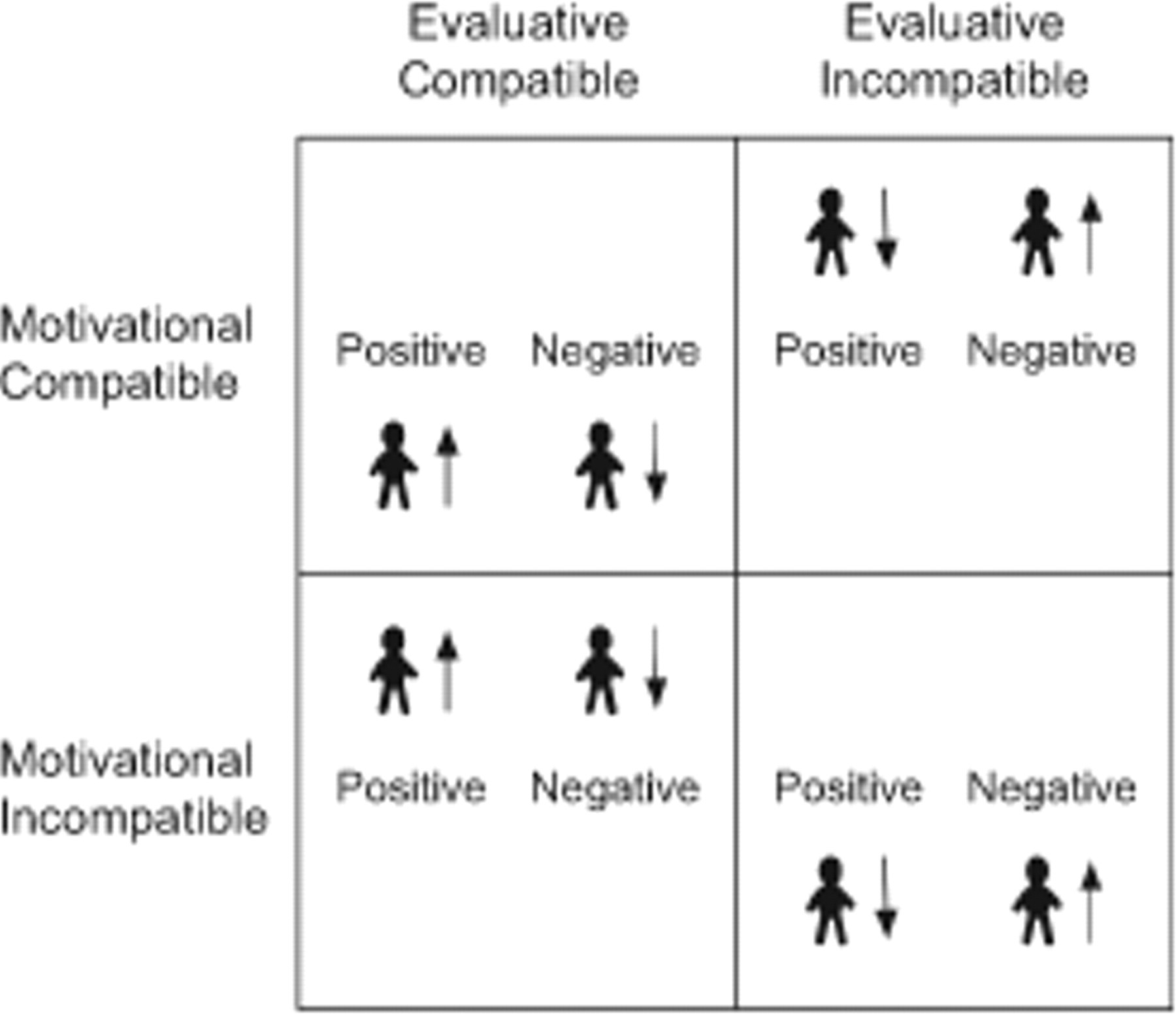
Illustration of the four experimental conditions. Participants were instructed to move the figure (manikin) either upward or downward when a positive or negative stimulus word was shown. Initial placement of the manikin in the upper or lower half of the screen caused upward and downward movements to imply moving toward or away from the stimulus word. Compatibility refers to the match between the stimulus valence and the response, in either evaluative terms (upward or downward) or motivational terms (toward or away from the stimulus). In the evaluative-coding view, when the valence of the response label matches the valence of the stimulus word (i.e., “upward” when a positive stimulus is shown and “downward” when a negative stimulus is shown), the trial is considered compatible. In the motivational view, when the direction of distance change matches the valence of the stimulus word (i.e., movement toward a positive stimulus or away from a negative stimulus), the trial is considered compatible.
The manikin task has an advantage over joystick tasks because the responses are unambiguous regarding distance change (cf. Krieglmeyer & Deutsch, in press), and thus the effects of valence on approach and avoidance movements can be tested independently of labeling the responses in terms of approach and avoidance. From the perspective of motivational theories, participants would be faster to move the manikin toward positive words and away from negative words than toward negative words and away from positive words. We expected to observe this pattern even though participants did not intend to make toward and away movements (but rather intended to make upward and downward movements), and even though the valence of the response labels was dissociated from the directions of approach and avoidance. In addition, we expected to replicate the evaluative-compatibility effect demonstrated by Eder and Rothermund (2008); that is, we expected that participants would respond faster when instructed to move the manikin upward, rather than downward, if the stimulus word was positive and would respond faster when instructed to move the manikin downward, rather than upward, if the stimulus word was negative.
Study 1
Method
Participants
Forty-seven University of Würzburg students who were not psychology majors (20 female and 27 male) took part in the study in exchange for a chocolate bar. The mean age was 23.7 years (SD = 2.9 years).
Materials and procedure
We used 30 positive and 30 negative nouns as test stimuli and 4 positive and 4 negative nouns as practice stimuli (Hager & Hasselhorn, 1994; Klauer & Musch, 1999). The manikin was a simple drawing of a person and had a length of about 2.8 cm. Participants were instructed to imagine being the manikin and to move with that manikin by pressing the up and down keys of the keyboard. Following the procedure used by De Houwer et al. (2001), a trial started with the manikin appearing in either the upper or the lower half of the screen. After 750 ms, a word was presented in the center of the screen. Participants were instructed to move the manikin as quickly and accurately as possible upward when the word was positive and downward when the word was negative, or vice versa. They had to press the appropriate key three times to move the figure up or down the screen. Depending on the initial position of the figure and the movement direction, the figure stopped either at the edge of the screen or close to the word. The screen turned black 50 ms after the third key press. If participants made an incorrect response, an error message appeared immediately after the first key press for 500 ms. The time between the onset of the word and the first key press served as the dependent variable.
Participants completed one block of evaluation-compatible trials (positive-upward, negative-downward) and one block of evaluation-incompatible trials (positive-downward, negative-upward), each consisting of 60 trials that were presented in random order. Each block was preceded by 8 practice trials. The order of the blocks was counterbalanced across participants. The manikin appeared equally often in the top half and the bottom half of the screen, so that half the trials in each block were motivationally compatible (toward positive stimuli or away from negative stimuli) and half were motivationally incompatible (away from positive stimuli or toward negative stimuli).
Results
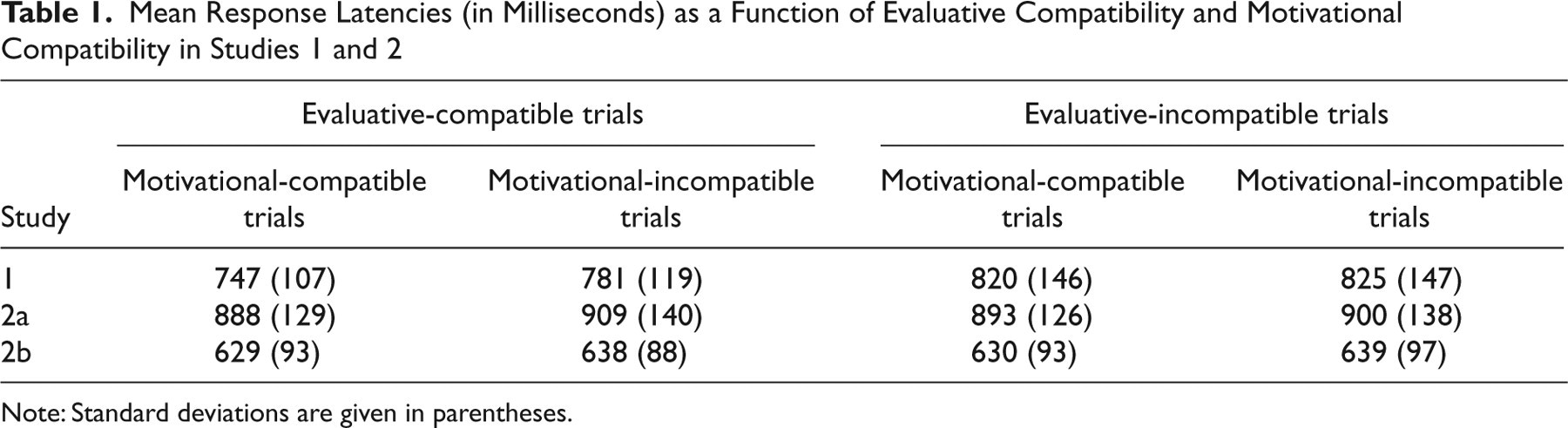
Incorrect responses (6.0%) and responses with latencies below 150 ms and above 1,500 ms (4.8% of the correct responses) were discarded. 1 We submitted the response latencies to a 2 (evaluative compatibility) × 2 (motivational compatibility) repeated measures analysis of variance (ANOVA). 2 Responses in the evaluation-compatible block (i.e., upward movements in response to positive words and downward movements in response to negative words) were faster than responses in the evaluation-incompatible block (i.e., upward movements in response to negative words and downward movements in response to positive words), F(1, 46) = 14.87, p < .001, η p 2 = .24 (see Table 1). In addition, responses on motivation-compatible trials (toward positive words and away from negative words) were faster than responses on motivation-incompatible trials (toward negative words and away from positive words), F(1, 46) = 8.61, p = .005, η p 2 = .16. Furthermore, the ANOVA revealed a significant interaction of evaluative and motivational compatibility, F(1, 46) = 4.74, p = .035, η p 2 = .09. Simple comparisons indicated that the motivational-compatibility effect occurred only in the evaluation-compatible block, t(46) = 4.33, p < .001, and not in the evaluation-incompatible block, t < 1.
Mean Response Latencies (in Milliseconds) as a Function of Evaluative Compatibility and Motivational Compatibility in Studies 1 and 2
Note: Standard deviations are given in parentheses.
Discussion
In line with the evaluative-coding account, and replicating Eder and Rothermund’s (2008) previous work, Study 1 showed that stimulus valence facilitated responses that were labeled in an evaluatively compatible way (“upward” or “downward”). Results also supported the motivational view, as stimulus valence facilitated movements that involved a compatible distance change, even though participants mentally represented their behaviors as up and down movements that were independent of actual distance change. Thus, a motivational-compatibility effect was observed even though participants did not have the intention to approach or avoid the stimulus, and even though they did not label their behaviors in approach-avoidance terms. The latter finding is at odds with the evaluative-coding account, but can be explained by motivational theories.
Stimulus valence facilitated compatible approach-avoidance responses only when the valence of the response labels was congruent with stimulus valence. A possible explanation for this finding is that participants had to deploy more executive control during the evaluation-incompatible block (i.e., positive-downward, negative-upward) than during the evaluation-compatible block. In the incompatible block, participants had to overcome automatically activated but incorrect response tendencies, whereas in the compatible block, they could simply follow their immediate response tendencies. It seems possible that the deployment of executive control might erase all bottom-up modulations of the responses, including modulations by motivational orientations. This explanation implies that the motivational-compatibility effect should be independent of evaluation compatibility when evaluation-compatible and -incompatible trials are intermixed so that the deployment of executive control remains more constant throughout the experiment. The design of the following studies allowed testing of this hypothesis.
Studies 2a and 2b
The main goal of Studies 2a and 2b was to test whether motivational- and evaluative-compatibility effects depend on evaluation intentions. To this end, we instructed participants to respond with upward and downward movements according to the grammatical category of the stimulus words. Stimulus valence was varied independently of grammatical category. Whereas the motivational view assumes facilitation of approach-avoidance responses even if stimulus valence is not intentionally processed (Chen & Bargh, 1999), the evaluative-coding account predicts a reduction in evaluative-compatibility effects when participants do not need to evaluate the stimulus. Lavender and Hommel (2007) even failed to find evaluative-compatibility effects under these conditions. To examine the generality of our findings, we conducted two studies with different methods. In Study 2a, participants moved a manikin in a setup similar to the one used in Study 1. In Study 2b, participants moved a dot on a screen upward or downward by moving a pen on a writing tablet.
Method
Participants
In Study 2a, 94 University of Würzburg students who were not psychology majors (45 female and 49 male) participated in exchange for a chocolate bar. Their mean age was 23.6 years (SD = 4.3 years). In Study 2b, 34 undergraduate students (27 female and 7 male) from Ghent University participated in exchange for €5. Their mean age was 20.2 years (SD = 2.0 years).
Materials and procedure
Study 2a
We used 20 positive nouns, 20 negative nouns, 20 positive adjectives, and 20 negative adjectives as test stimuli in Study 2a. The adjectives were taken from Wentura, Rothermund, and Bak (2000). The nouns were the nouns corresponding to the adjectives (e.g., “friendliness” corresponds to the adjective “friendly”). Two words from each stimulus category (the four combinations of valence and grammatical category) were used as practice stimuli. The procedure was the same as in Study 1 with the following exceptions: Participants were instructed to move with the manikin upward when the word was a noun and downward when the word was an adjective, or vice versa; the mapping between grammatical category and upward versus downward response was counterbalanced across participants; and after completing 8 practice trials, participants completed 80 test trials in random order (i.e., not blocked by evaluative compatibility).
Study 2b
The stimuli in Study 2b were eight positive and eight negative nouns, as well as eight positive and eight negative adjectives (Hermans & De Houwer, 1994). An additional five positive and five negative nouns as well as five positive and five negative adjectives were used as practice stimuli. Participants used a pen to make their responses, and pen movements were recorded using a horizontally placed digitizer (WACOM writing tablet, WACOM Europe GmbH, Krefeld, Germany) designed to measure pen pressure. The position of the pen was recorded with the help of software that was custom-written in the Delphi language.
At the start of each trial, three red rectangular bars 1.5 cm in height and 8 cm in width appeared, positioned at the top, center, and bottom of the screen. Additionally, a blue circle (the starting position for the pen movement) appeared either in the upper or the lower half of the screen, midway between two rectangles, accompanied by a 200-ms warning tone. Participants were instructed to place the cursor (an orange dot) in the blue circle by moving the pen on the digitizer. A word appeared in the central rectangle 750 ms after participants had placed the pen on the starting position; at the same time, the blue circle disappeared, and the orange dot remained on the screen. Participants were asked to move the dot by moving the pen on the digitizer upward or downward as quickly and accurately as possible; in one block of trials, participants were told to move the dot upward when the word was a noun and downward when the word was an adjective; in the other block, they were given the opposite instructions. When the dot met the border of the upper or lower rectangular bar, the word disappeared, and the next trial started. A red cross appeared for 400 ms in case of an incorrect response, and “te laat” (“too late”) appeared when no response was given within 3,000 ms. The time between the appearance of the word and the onset of movement from the starting point (with pen pressure exceeding 0.24 N) served as the dependent variable.
Each participant completed two blocks, one mapping nouns with upward movement and adjectives with downward movement, and one with the reversed mapping. The order of the blocks was counterbalanced across participants. Each block consisted of 128 trials presented in random order and was preceded by 20 practice trials.
Results
Study 2a
Incorrect responses (8.5%) and responses with latencies below 150 ms and above 1,500 ms (9.1% of the correct responses) were discarded. A 2 (evaluative compatibility) × 2 (motivational compatibility) ANOVA yielded the expected motivational-compatibility effect (i.e., faster responses when approaching positive words and avoiding negative words), F(1, 93) = 7.56, p = .007, η p 2 = .08 (Table 1). 3 Neither the main effect of evaluative compatibility, F < 1, nor the interaction between evaluative and motivational compatibility was significant, F < 1.6.
Study 2b
Incorrect responses (0.15%) and responses with latencies below 150 ms and above 1,500 ms (0.89% of the correct responses) were discarded. A 2 (evaluative compatibility) × 2 (motivational compatibility) ANOVA showed the expected effect of motivational compatibility, F(1, 33) = 12.25, p = .001, η p 2 = .27 (Table 1). Neither the main effect of evaluative compatibility nor the interaction between evaluative and motivational compatibility was significant, all Fs < 1.
General Discussion
The results of these three studies support the motivational view of approach-avoidance behaviors. Responses to valenced stimuli were faster when they implied a compatible distance change (i.e., positive-toward, negative-away) than when they implied an incompatible distance-change (i.e., positive-away, negative-toward). Most important, this effect occurred even though participants did not intend to approach or avoid the stimuli, but instead mentally represented their behaviors as up and down movements that were independent of actual distance change. Thus, approach-avoidance behaviors were facilitated although the valence of the response labels was dissociated from the approach-avoidance direction.
This finding is at odds with the evaluative-coding account of approach-avoidance behaviors (Eder & Rothermund, 2008; Lavender & Hommel, 2007), which posits that response facilitation results only from the compatibility of stimulus valence and response-label valence. We observed effects of stimulus valence on unintended approach-avoidance responses when participants had evaluation intentions (Study 1), as well as in the absence of evaluation intentions (Studies 2a and 2b). Although in Study 1 the motivational-compatibility effect was significant only in the evaluative-compatible block, in Studies 2a and 2b it was independent of evaluative compatibility. Thus, the results of Studies 2a and 2b support our reasoning that the interaction between evaluative and motivational compatibility in Study 1 resulted from the block structure of the task. Corroborating the generality of the findings, these results were obtained with two different response modes, namely, moving a figure by pressing a key (Study 2a) and moving a dot by moving a pen (Study 2b). Together, the present findings corroborate the assumption of a unique, automatic link between stimulus valence and motivational orientations that cannot be reduced to a more general mechanism of action control, such as the one described by the TEC (Hommel et al., 2001).
In Study 1, we also observed effects of stimulus valence on intended upward-downward responses, thereby replicating the results of Eder and Rothermund (2008). In particular, responses in evaluation-compatible trials (positive-upward, negative-downward) were faster than responses in evaluation-incompatible trials (positive-downward, negative-upward). However, this evaluative-compatibility effect depended on participants’ intention to process stimulus valence, as it did not occur when they responded according to the grammatical category of the stimulus (Studies 2a and 2b). This observation is consistent with previous findings regarding the evaluative-coding account (Lavender & Hommel, 2007).
We suspect that previous research did not reveal motivational-compatibility effects independent of response labeling because the responses were ambiguous regarding their distance-changing consequences. In particular, pushing and pulling a joystick, as in Eder and Rothermund’s (2008) studies, can mean either pushing the stimulus away from the body and pulling it toward the body or reaching for the stimulus and withdrawing the hand from it (Seibt et al., 2008). In Lavender and Hommel’s (2007) study, participants moved a doll from a plate positioned in front of the computer screen to a plate nearer to the screen (but farther away from the participant) or to a plate farther away from the screen (but nearer to the participant). In that study, motivational-compatibility effects could be tested only when participants perceived the movement as changing the distance between the doll and the stimulus. However, it is possible that participants perceived the movement mainly as changing the distance between their body and the doll. The possibility of focusing on different distance changes introduces error variance, thereby decreasing the power of the test to detect effects of unintentional valence processing (cf. Krieglmeyer & Deutsch, in press). In contrast, the responses in the manikin and the pen-moving task are unambiguous regarding distance change. In both tasks, the change in distance between the stimulus and the manikin or the dot can be seen clearly on the screen. Furthermore, the distance of all stimuli to the participant’s body remains constant, thereby excluding the possibility that the participant focus on distance changes relative to his or her body.
Another advantage of our adapted manikin task is that it allows one to exclude the alternative explanation that participants relabel the responses in terms of approach-avoidance movements. Relabeling is likely to occur if it reduces the complexity of the task (cf. Eder & Rothermund, 2008). In our task, however, relabeling the responses in terms of “toward” and “away” would actually increase task complexity. Using the labels in the instructions implies a very simple rule: Positive means upward; negative means downward. Relabeling the behaviors in terms of distance change would yield a more complex rule, for instance, “If the word is positive and the manikin appears above the word, then move away by pressing the up key.”
In sum, our findings indicate that two mechanisms may proceed in parallel when one encounters emotionally significant stimuli. As suggested by the evaluative-coding view, evaluation intentions may modulate the degree to which stimulus valence activates responses that are labeled in an evaluatively compatible way. For instance, if one is about to decide between being aggressive (a negatively labeled action) or diplomatic (a positively labeled action), encountering something negative may facilitate the former action.
The motivational mechanism may operate independently of and in parallel to the evaluative-coding mechanism. In particular, stimulus valence elicits motivational orientations, which result in the activation of behavioral tendencies that increase or decrease the distance between the self and the stimulus. This mechanism operates independently of evaluative-response labeling, as well as independently of behavioral and evaluation intentions, thereby automatically fulfilling important regulatory needs of organisms (cf. Lang et al., 1990). For instance, when a car speeds toward you, this mechanism would let you jump away quickly, irrespective of what you are intending at that moment and irrespective of how you label your response. It is important to note that this mechanism does not inflexibly activate concrete motor programs, such as flexing or extending the arm (e.g., Cacioppo, Priester, & Berntson, 1993). Instead, it activates behavioral tendencies that have adaptive consequences in the given context. In other words, we consider approach-avoidance behaviors to be represented in terms of their distance-changing consequences, rather than in terms of their motor programs (Strack & Deutsch, 2004; van Dantzig, Pecher, & Zwaan, 2008). In essence, our findings corroborate the idea of a distinct motivational mechanism that efficiently processes emotional stimuli and quickly triggers functional responses.
Footnotes
Acknowledgements
We thank Fritz Strack for valuable comments on an earlier draft, Wouter Hulstijn and Erik Franck for their help in developing and programming Study 2b, and Chris Bouwhuisen for developing the Delphi software. We also thank Katrin Brodbeck, Els De Bruycker, Felix Götz, and Judith Seehaber for collecting the data.
The authors declared that they had no conflicts of interest with respect to their authorship or the publication of this article.
This research was supported by a grant from the German Science Foundation to Fritz Strack (STR 264/23-1) and by Grant BOF/GOA2006/001 from Ghent University to Jan De Houwer.
1.
This cutoff was chosen on the basis of the distribution of the response latencies, as well as previous research that compared different criteria for outlier elimination in the manikin task (Krieglmeyer & Deutsch, in press).
2.
We conducted a preliminary analysis that included the counterbalancing factor of block order. The interaction between block order and evaluative compatibility was significant, F(1, 45) = 6.51, p = .014. The evaluative-compatibility effect was positive in both order groups, yet it reached significance only when participants first completed the evaluation-incompatible block, t(45) = 4.68, p < .001, and not when the reverse block order was used, t(45) = 1.13, p = .26.
3.
We conducted preliminary analyses that included the counterbalancing factor of the mapping of grammatical categories with upward versus downward responses. In Study 2a, the main effect of this factor and its interactions with the other factors were not significant, all Fs < 1.7. In Study 2b, the main effect of mapping of grammatical categories, F(1, 33) = 4.47, p = .042, and the interaction between mapping and evaluative compatibility, F(1, 33) = 4.38, p = .044, reached significance. However, the evaluative-compatibility effect was not significant in either of the mapping conditions, ts < 1.7, p > .10.